|
YOU ARE
REQUIRED TO READ THE
COPYRIGHT NOTICE AT
THIS LINK BEFORE YOU READ THE FOLLOWING WORK, THAT IS
AVAILABLE SOLELY FOR PRIVATE STUDY, SCHOLARSHIP OR RESEARCH PURSUANT
TO 17 U.S.C. SECTION 107 AND 108. IN THE EVENT THAT THE LIBRARY
DETERMINES THAT UNLAWFUL COPYING OF THIS WORK HAS OCCURRED, THE
LIBRARY HAS THE RIGHT TO BLOCK THE I.P. ADDRESS AT WHICH THE
UNLAWFUL COPYING APPEARED TO HAVE OCCURRED. THANK YOU FOR RESPECTING
THE RIGHTS OF COPYRIGHT OWNERS. |
Part II
The General Theory of Relativity
Special and General Principle of Relativity
The basal principle, which was the pivot of all our previous
considerations, was the special principle of relativity, i.e.
the principle of the physical relativity of all uniform motion.
Let as once more analyse its meaning carefully.
It was at all times clear that, from the point of view of the idea it
conveys to us, every motion must be considered only as a relative motion.
Returning to the illustration we have frequently used of the embankment
and the railway carriage, we can express the fact of the motion here
taking place in the following two forms, both of which are equally
justifiable :
(a) The carriage is in motion relative to the
embankment,
(b) The embankment is in motion relative to the carriage.
In (a) the embankment, in (b) the carriage, serves as the body of
reference in our statement of the motion taking place. If it is simply a
question of detecting or of describing the motion involved, it is in
principle immaterial to what reference-body we refer the motion. As
already mentioned, this is self-evident, but it must not be confused with
the much more comprehensive statement called "the principle of
relativity," which we have taken as the basis of our investigations.
The principle we have made use of not only maintains that we may
equally well choose the carriage or the embankment as our reference-body
for the description of any event (for this, too, is self-evident). Our
principle rather asserts what follows : If we formulate the general laws
of nature as they are obtained from experience, by making use of
(a) the embankment as reference-body,
(b) the railway carriage as reference-body,
then these general laws of nature (e.g. the laws
of mechanics or the law of the propagation of light in vacuo)
have exactly the same form in both cases. This can also be expressed as
follows : For the physical description of natural processes, neither of
the reference bodies K,
K1
is unique (lit. " specially marked out ") as compared with the other.
Unlike the first, this latter statement need not of necessity hold a
priori; it is not contained in the conceptions of " motion" and "
reference-body " and derivable from them; only experience can
decide as to its correctness or incorrectness.
Up to the present, however, we have by no means maintained the
equivalence of all bodies of reference
K
in connection with the formulation of natural laws. Our course was more on
the following lines. In the first place, we started out from the
assumption that there exists a reference-body
K,
whose condition of motion is such that the Galileian law holds with
respect to it : A particle left to itself and sufficiently far removed
from all other particles moves uniformly in a straight line. With
reference to K (Galileian reference-body) the
laws of nature were to be as simple as possible. But in addition to
K, all bodies of reference
K1
should be given preference in this sense, and they should be exactly
equivalent to K for the formulation of natural
laws, provided that they are in a state of uniform rectilinear and
non-rotary motion with respect to
K ; all
these bodies of reference are to be regarded as Galileian
reference-bodies. The validity of the principle of relativity was assumed
only for these reference-bodies, but not for others (e.g. those possessing
motion of a different kind). In this sense we speak of the special
principle of relativity, or special theory of relativity.
In contrast to this we wish to understand by the "general principle of
relativity" the following statement : All bodies of reference
K,
K1, etc.,
are equivalent for the description of natural phenomena (formulation of
the general laws of nature), whatever may be their state of motion. But
before proceeding farther, it ought to be pointed out that this
formulation must be replaced later by a more abstract one, for reasons
which will become evident at a later stage.
Since the introduction of the special principle of relativity has been
justified, every intellect which strives after generalisation must feel
the temptation to venture the step towards the general principle of
relativity. But a simple and apparently quite reliable consideration seems
to suggest that, for the present at any rate, there is little hope of
success in such an attempt; Let us imagine ourselves transferred to our
old friend the railway carriage, which is travelling at a uniform rate. As
long as it is moving uniformly, the occupant of the carriage is not
sensible of its motion, and it is for this reason that he can without
reluctance interpret the facts of the case as indicating that the carriage
is at rest, but the embankment in motion. Moreover, according to the
special principle of relativity, this interpretation is quite justified
also from a physical point of view.
If the motion of the carriage is now changed into a non-uniform motion,
as for instance by a powerful application of the brakes, then the occupant
of the carriage experiences a correspondingly powerful jerk forwards. The
retarded motion is manifested in the mechanical behaviour of bodies
relative to the person in the railway carriage. The mechanical behaviour
is different from that of the case previously considered, and for this
reason it would appear to be impossible that the same mechanical laws hold
relatively to the non-uniformly moving carriage, as hold with reference to
the carriage when at rest or in uniform motion. At all events it is clear
that the Galileian law does not hold with respect to the non-uniformly
moving carriage. Because of this, we feel compelled at the present
juncture to grant a kind of absolute physical reality to non-uniform
motion, in opposition to the general principle of relativity. But in what
follows we shall soon see that this conclusion cannot be maintained.
The Gravitational Field
"If we pick up a stone and then let it go, why does it fall to the
ground ?" The usual answer to this question is: "Because it is attracted
by the earth." Modern physics formulates the answer rather differently for
the following reason. As a result of the more careful study of
electromagnetic phenomena, we have come to regard action at a distance as
a process impossible without the intervention of some intermediary medium.
If, for instance, a magnet attracts a piece of iron, we cannot be content
to regard this as meaning that the magnet acts directly on the iron
through the intermediate empty space, but we are constrained to imagine —
after the manner of Faraday — that the magnet always calls into being
something physically real in the space around it, that something being
what we call a "magnetic field." In its turn this magnetic field operates
on the piece of iron, so that the latter strives to move towards the
magnet. We shall not discuss here the justification for this incidental
conception, which is indeed a somewhat arbitrary one. We shall only
mention that with its aid electromagnetic phenomena can be theoretically
represented much more satisfactorily than without it, and this applies
particularly to the transmission of electromagnetic waves. The effects of
gravitation also are regarded in an analogous manner.
The action of the earth on the stone takes place indirectly. The earth
produces in its surrounding a gravitational field, which acts on the stone
and produces its motion of fall. As we know from experience, the intensity
of the action on a body diminishes according to a quite definite law, as we
proceed farther and farther away from the earth. From our point of view
this means : The law governing the properties of the gravitational field
in space must be a perfectly definite one, in order correctly to represent
the diminution of gravitational action with the distance from operative
bodies. It is something like this: The body (e.g. the earth)
produces a field in its immediate neighbourhood directly; the intensity
and direction of the field at points farther removed from the body are
thence determined by the law which governs the properties in space of the
gravitational fields themselves.
In contrast to electric and magnetic fields, the gravitational field
exhibits a most remarkable property, which is of fundamental importance
for what follows. Bodies which are moving under the sole influence of a
gravitational field receive an acceleration, which does not in the
least depend either on the material or on the physical state of the body.
For instance, a piece of lead and a piece of wood fall in exactly the same
manner in a gravitational field (in vacuo), when they start off
from rest or with the same initial velocity. This law, which holds most
accurately, can be expressed in a different form in the light of the
following consideration.
According to Newton's law of motion, we have
(Force) = (inertial mass) x (acceleration),
where the "inertial mass" is a characteristic constant of
the accelerated body. If now gravitation is the cause of the acceleration,
we then have
(Force) = (gravitational mass) x (intensity of the
gravitational field),
where the "gravitational mass" is likewise a characteristic
constant for the body. From these two relations follows:

If now, as we find from experience, the acceleration is to be
independent of the nature and the condition of the body and always the
same for a given gravitational field, then the ratio of the gravitational
to the inertial mass must likewise be the same for all bodies. By a
suitable choice of units we can thus make this ratio equal to unity. We
then have the following law: The gravitational mass of a body is
equal to its inertial law.
It is true that this important law had hitherto been recorded in
mechanics, but it had not been interpreted. A satisfactory
interpretation can be obtained only if we recognise the following fact :
The same quality of a body manifests itself according to
circumstances as " inertia " or as " weight " (lit. " heaviness '). In the
following section we shall show to what extent this is actually the case,
and how this question is connected with the general postulate of
relativity.
The Equality of Inertial and Gravitational Mass
as an argument for the General Postulate of Relativity
We imagine a large portion of empty space, so far removed from stars
and other appreciable masses, that we have before us approximately the
conditions required by the fundamental law of Galilei. It is then possible
to choose a Galileian reference-body for this part of space (world),
relative to which points at rest remain at rest and points in motion
continue permanently in uniform rectilinear motion. As reference-body let
us imagine a spacious chest resembling a room with an observer inside who
is equipped with apparatus. Gravitation naturally does not exist for this
observer. He must fasten himself with strings to the floor, otherwise the
slightest impact against the floor will cause him to rise slowly towards
the ceiling of the room.
To the middle of the lid of the chest is fixed externally a hook with
rope attached, and now a " being " (what kind of a being is immaterial to
us) begins pulling at this with a constant force. The chest together with
the observer then begin to move "upwards" with a uniformly accelerated
motion. In course of time their velocity will reach unheard-of values —
provided that we are viewing all this from another reference-body which is
not being pulled with a rope.
But how does the man in the chest regard the Process ? The acceleration
of the chest will be transmitted to him by the reaction of the floor of
the chest. He must therefore take up this pressure by means of his legs if
he does not wish to be laid out full length on the floor. He is then
standing in the chest in exactly the same way as anyone stands in a room
of a home on our earth. If he releases a body which he previously had in
his land, the acceleration of the chest will no longer be transmitted to
this body, and for this reason the body will approach the floor of the
chest with an accelerated relative motion. The observer will further
convince himself that the acceleration of the body towards the floor
of the chest is always of the same magnitude, whatever kind of body he may
happen to use for the experiment.
Relying on his knowledge of the gravitational field (as it was
discussed in the preceding section), the man in the chest will thus come
to the conclusion that he and the chest are in a gravitational field which
is constant with regard to time. Of course he will be puzzled for a moment
as to why the chest does not fall in this gravitational field. just then,
however, he discovers the hook in the middle of the lid of the chest and
the rope which is attached to it, and he consequently comes to the
conclusion that the chest is suspended at rest in the gravitational field.
Ought we to smile at the man and say that he errs in his conclusion ? I
do not believe we ought to if we wish to remain consistent ; we must
rather admit that his mode of grasping the situation violates neither
reason nor known mechanical laws. Even though it is being accelerated with
respect to the "Galileian space" first considered, we can nevertheless
regard the chest as being at rest. We have thus good grounds for extending
the principle of relativity to include bodies of reference which are
accelerated with respect to each other, and as a result we have gained a
powerful argument for a generalised postulate of relativity.
We must note carefully that the possibility of this mode of
interpretation rests on the fundamental property of the gravitational
field of giving all bodies the same acceleration, or, what comes to the
same thing, on the law of the equality of inertial and gravitational mass.
If this natural law did not exist, the man in the accelerated chest would
not be able to interpret the behaviour of the bodies around him on the
supposition of a gravitational field, and he would not be justified on the
grounds of experience in supposing his reference-body to be " at rest."
Suppose that the man in the chest fixes a rope to the inner side of the
lid, and that he attaches a body to the free end of the rope. The result
of this will be to strtech the rope so that it will hang "vertically"
downwards. If we ask for an opinion of the cause of tension in the rope,
the man in the chest will say: "The suspended body experiences a downward
force in the gravitational field, and this is neutralised by the tension
of the rope ; what determines the magnitude of the tension of the rope is
the gravitational mass of the suspended body." On the other hand,
an observer who is poised freely in space will interpret the condition of
things thus : " The rope must perforce take part in the accelerated motion
of the chest, and it transmits this motion to the body attached to it. The
tension of the rope is just large enough to effect the acceleration of the
body. That which determines the magnitude of the tension of the rope is
the inertial mass of the body." Guided by this example, we see
that our extension of the principle of relativity implies the
necessity of the law of the equality of inertial and gravitational
mass. Thus we have obtained a physical interpretation of this law.
From our consideration of the accelerated chest we see that a general
theory of relativity must yield important results on the laws of
gravitation. In point of fact, the systematic pursuit of the general idea
of relativity has supplied the laws satisfied by the gravitational field.
Before proceeding farther, however, I must warn the reader against a
misconception suggested by these considerations. A gravitational field
exists for the man in the chest, despite the fact that there was no such
field for the co-ordinate system first chosen. Now we might easily suppose
that the existence of a gravitational field is always only an apparent
one. We might also think that, regardless of the kind of gravitational
field which may be present, we could always choose another reference-body
such that no gravitational field exists with reference to it.
This is by no means true for all gravitational fields, but only for those
of quite special form. It is, for instance, impossible to choose a body of
reference such that, as judged from it, the gravitational field of the
earth (in its entirety) vanishes.
We can now appreciate why that argument is not convincing, which we
brought forward against the general principle of relativity at the end of
Section 18. It is certainly true that the observer in the railway
carriage experiences a jerk forwards as a result of the application of the
brake, and that he recognises, in this the non-uniformity of motion
(retardation) of the carriage. But he is compelled by nobody to refer this
jerk to a " real " acceleration (retardation) of the carriage. He might
also interpret his experience thus: " My body of reference (the carriage)
remains permanently at rest. With reference to it, however, there exists
(during the period of application of the brakes) a gravitational field
which is directed forwards and which is variable with respect to time.
Under the influence of this field, the embankment together with the earth
moves non-uniformly in such a manner that their original velocity in the
backwards direction is continuously reduced."
In What Respects are the Foundations of Classical Mechanics and of the
Special Theory of Relativity Unsatisfactory?
We have already stated several times that classical mechanics starts
out from the following law: Material particles sufficiently far removed
from other material particles continue to move uniformly in a straight
line or continue in a state of rest. We have also repeatedly emphasised
that this fundamental law can only be valid for bodies of reference
K which possess certain unique states of motion,
and which are in uniform translational motion relative to each other.
Relative to other reference-bodies
K the law is
not valid. Both in classical mechanics and in the special theory of
relativity we therefore differentiate between reference-bodies
K relative to which the recognised " laws of
nature " can be said to hold, and reference-bodies
K
relative to which these laws do not hold.
But no person whose mode of thought is logical can rest satisfied with
this condition of things. He asks : " How does it come that certain
reference-bodies (or their states of motion) are given priority over other
reference-bodies (or their states of motion) ? What is the reason for
this Preference? In order to show clearly what I mean by this
question, I shall make use of a comparison.
I am standing in front of a gas range. Standing alongside of each other
on the range are two pans so much alike that one may be mistaken for the
other. Both are half full of water. I notice that steam is being emitted
continuously from the one pan, but not from the other. I am surprised at
this, even if I have never seen either a gas range or a pan before. But if
I now notice a luminous something of bluish colour under the first pan but
not under the other, I cease to be astonished, even if I have never before
seen a gas flame. For I can only say that this bluish something will cause
the emission of the steam, or at least possibly it may do so. If,
however, I notice the bluish something in neither case, and if I observe
that the one continuously emits steam whilst the other does not, then I
shall remain astonished and dissatisfied until I have discovered some
circumstance to which I can attribute the different behaviour of the two
pans.
Analogously, I seek in vain for a real something in classical mechanics
(or in the special theory of relativity) to which I can attribute the
different behaviour of bodies considered with respect to the reference
systems K and
K1.1)
Newton saw this objection and attempted to invalidate it, but without
success. But E. Mach recognsed it most clearly of all, and because of this
objection he claimed that mechanics must be placed on a new basis. It can
only be got rid of by means of a physics which is conformable to the
general principle of relativity, since the equations of such a theory hold
for every body of reference, whatever may be its state of motion.
Footnotes
1) The
objection is of importance more especially when the state of motion of the
reference-body is of such a nature that it does not require any external
agency for its maintenance, e.g. in the case when the
reference-body is rotating uniformly.
A Few Inferences from the General Principle of Relativity
The considerations of Section 20 show that the general principle of relativity puts us in a
position to derive properties of the gravitational field in a purely
theoretical manner. Let us suppose, for instance, that we know the
space-time " course " for any natural process whatsoever, as regards the
manner in which it takes place in the Galileian domain relative to a
Galileian body of reference K. By means of purely
theoretical operations (i.e. simply by calculation) we are then able to
find how this known natural process appears, as seen from a reference-body
K1 which is accelerated relatively to
K. But since a gravitational field exists with
respect to this new body of reference
K1,
our consideration also teaches us how the gravitational field influences
the process studied.
For example, we learn that a body which is in a state of uniform
rectilinear motion with respect to
K (in
accordance with the law of Galilei) is executing an accelerated and in
general curvilinear motion with respect to the accelerated reference-body
K1 (chest). This acceleration or
curvature corresponds to the influence on the moving body of the
gravitational field prevailing relatively to
K.
It is known that a gravitational field influences the movement of bodies
in this way, so that our consideration supplies us with nothing
essentially new.
However, we obtain a new result of fundamental importance when we carry
out the analogous consideration for a ray of light. With respect to the
Galileian reference-body K, such a ray of light
is transmitted rectilinearly with the velocity
c.
It can easily be shown that the path of the same ray of light is no longer
a straight line when we consider it with reference to the accelerated
chest (reference-body K1). From this
we conclude, that, in general, rays of light are propagated
curvilinearly in gravitational fields. In two respects this result is
of great importance.
In the first place, it can be compared with the reality. Although a
detailed examination of the question shows that the curvature of light
rays required by the general theory of relativity is only exceedingly
small for the gravitational fields at our disposal in practice, its
estimated magnitude for light rays passing the sun at grazing incidence is
nevertheless 1.7 seconds of arc. This ought to manifest itself in the
following way. As seen from the earth, certain fixed stars appear to be in
the neighbourhood of the sun, and are thus capable of observation during a
total eclipse of the sun. At such times, these stars ought to appear to be
displaced outwards from the sun by an amount indicated above, as compared
with their apparent position in the sky when the sun is situated at
another part of the heavens. The examination of the correctness or
otherwise of this deduction is a problem of the greatest importance, the
early solution of which is to be expected of astronomers.1)
In the second place our result shows that, according to the general
theory of relativity, the law of the constancy of the velocity of light
in vacuo, which constitutes one of the two fundamental
assumptions in the special theory of relativity and to which we have
already frequently referred, cannot claim any unlimited validity. A
curvature of rays of light can only take place when the velocity of
propagation of light varies with position. Now we might think that as a
consequence of this, the special theory of relativity and with it the
whole theory of relativity would be laid in the dust. But in reality this
is not the case. We can only conclude that the special theory of
relativity cannot claim an unlimited domain of validity ; its results
hold only so long as we are able to disregard the influences of
gravitational fields on the phenomena (e.g. of light).
Since it has often been contended by opponents of the theory of
relativity that the special theory of relativity is overthrown by the
general theory of relativity, it is perhaps advisable to make the facts of
the case clearer by means of an appropriate comparison. Before the
development of electrodynamics the laws of electrostatics were looked upon
as the laws of electricity. At the present time we know that electric
fields can be derived correctly from electrostatic considerations only for
the case, which is never strictly realised, in which the electrical masses
are quite at rest relatively to each other, and to the co-ordinate system.
Should we be justified in saying that for this reason electrostatics is
overthrown by the field-equations of Maxwell in electrodynamics ? Not in
the least. Electrostatics is contained in electrodynamics as a limiting
case ; the laws of the latter lead directly to those of the former for the
case in which the fields are invariable with regard to time. No fairer
destiny could be allotted to any physical theory, than that it should of
itself point out the way to the introduction of a more comprehensive
theory, in which it lives on as a limiting case.
In the example of the transmission of light just dealt with, we have
seen that the general theory of relativity enables us to derive
theoretically the influence of a gravitational field on the course of
natural processes, the laws of which are already known when a
gravitational field is absent. But the most attractive problem, to the
solution of which the general theory of relativity supplies the key,
concerns the investigation of the laws satisfied by the gravitational
field itself. Let us consider this for a moment.
We are acquainted with space-time domains which behave (approximately)
in a "Galileian" fashion under suitable choice of reference-body,
i.e. domains in which gravitational fields are absent. If we now
refer such a domain to a reference-body
K1
possessing any kind of motion, then relative to
K1
there exists a gravitational field which is variable with respect to space
and time.2) The
character of this field will of course depend on the motion chosen for
K1. According to the general theory of
relativity, the general law of the gravitational field must be satisfied
for all gravitational fields obtainable in this way. Even though by no
means all gravitational fields can be produced in this way, yet we may
entertain the hope that the general law of gravitation will be derivable
from such gravitational fields of a special kind. This hope has been
realised in the most beautiful manner. But between the clear vision of
this goal and its actual realisation it was necessary to surmount a
serious difficulty, and as this lies deep at the root of things, I dare
not withhold it from the reader. We require to extend our ideas of the
space-time continuum still farther.
Footnotes
1) By
means of the star photographs of two expeditions equipped by a Joint
Committee of the Royal and Royal Astronomical Societies, the existence of
the deflection of light demanded by theory was first confirmed during the
solar eclipse of 29th May, 1919. (Cf.
Appendix III.)
2) This
follows from a generalisation of the discussion in Section 20
Behaviour of Clocks and Measuring-Rods on a Rotating Body of Reference
Hitherto I have purposely refrained from speaking about the physical
interpretation of space- and time-data in the case of the general theory
of relativity. As a consequence, I am guilty of a certain slovenliness of
treatment, which, as we know from the special theory of relativity, is far
from being unimportant and pardonable. It is now high time that we remedy
this defect; but I would mention at the outset, that this matter lays no
small claims on the patience and on the power of abstraction of the
reader.
We start off again from quite special cases, which we have frequently
used before. Let us consider a space time domain in which no gravitational
field exists relative to a reference-body
K whose
state of motion has been suitably chosen.
K is
then a Galileian reference-body as regards the domain considered, and the
results of the special theory of relativity hold relative to
K. Let us suppose the same domain referred to a
second body of reference K1, which is
rotating uniformly with respect to
K. In order to
fix our ideas, we shall imagine K1 to
be in the form of a plane circular disc, which rotates uniformly in its
own plane about its centre. An observer who is sitting eccentrically on
the disc K1 is sensible of a force
which acts outwards in a radial direction, and which would be interpreted
as an effect of inertia (centrifugal force) by an observer who was at rest
with respect to the original reference-body
K.
But the observer on the disc may regard his disc as a reference-body which
is " at rest " ; on the basis of the general principle of relativity he is
justified in doing this. The force acting on himself, and in fact on all
other bodies which are at rest relative to the disc, he regards as the
effect of a gravitational field. Nevertheless, the space-distribution of
this gravitational field is of a kind that would not be possible on
Newton's theory of gravitation.1)
But since the observer believes in the general theory of relativity, this
does not disturb him; he is quite in the right when he believes that a
general law of gravitation can be formulated- a law which not only
explains the motion of the stars correctly, but also the field of force
experienced by himself.
The observer performs experiments on his circular disc with clocks and
measuring-rods. In doing so, it is his intention to arrive at exact
definitions for the signification of time- and space-data with reference
to the circular disc K1, these
definitions being based on his observations. What will be his experience
in this enterprise ?
To start with, he places one of two identically constructed clocks at
the centre of the circular disc, and the other on the edge of the disc, so
that they are at rest relative to it. We now ask ourselves whether both
clocks go at the same rate from the standpoint of the non-rotating
Galileian reference-body K. As judged from this
body, the clock at the centre of the disc has no velocity, whereas the
clock at the edge of the disc is in motion relative to
K
in consequence of the rotation. According to a result obtained in
Section 12, it follows that the latter clock goes at a rate
permanently slower than that of the clock at the centre of the circular
disc, i.e. as observed from
K. It is
obvious that the same effect would be noted by an observer whom we will
imagine sitting alongside his clock at the centre of the circular disc.
Thus on our circular disc, or, to make the case more general, in every
gravitational field, a clock will go more quickly or less quickly,
according to the position in which the clock is situated (at rest). For
this reason it is not possible to obtain a reasonable definition of time
with the aid of clocks which are arranged at rest with respect to the body
of reference. A similar difficulty presents itself when we attempt to
apply our earlier definition of simultaneity in such a case, but I do not
wish to go any farther into this question.
Moreover, at this stage the definition of the space co-ordinates also
presents insurmountable difficulties. If the observer applies his standard
measuring-rod (a rod which is short as compared with the radius of the
disc) tangentially to the edge of the disc, then, as judged from the
Galileian system, the length of this rod will be less than
I, since, according to
Section 12, moving bodies suffer a shortening in the direction of the
motion. On the other hand, the measuring-rod will not experience a
shortening in length, as judged from
K, if it is
applied to the disc in the direction of the radius. If, then, the observer
first measures the circumference of the disc with his measuring-rod and
then the diameter of the disc, on dividing the one by the other, he will
not obtain as quotient the familiar number π = 3.14 . . ., but a larger
number,2) whereas of
course, for a disc which is at rest with respect to
K,
this operation would yield π exactly. This proves that the propositions of
Euclidean geometry cannot hold exactly on the rotating disc, nor in
general in a gravitational field, at least if we attribute the length
I to the rod in all positions and in every
orientation. Hence the idea of a straight line also loses its meaning. We
are therefore not in a position to define exactly the co-ordinates
x, y, z relative to the disc by means of the
method used in discussing the special theory, and as long as the co-
ordinates and times of events have not been defined, we cannot assign an
exact meaning to the natural laws in which these occur.
Thus all our previous conclusions based on general relativity would
appear to be called in question. In reality we must make a subtle detour
in order to be able to apply the postulate of general relativity exactly.
I shall prepare the reader for this in the following paragraphs.
Footnotes
1) The
field disappears at the centre of the disc and increases proportionally to
the distance from the centre as we proceed outwards.
2)
Throughout this consideration we have to use the Galileian (non-rotating)
system K as reference-body, since we may only
assume the validity of the results of the special theory of relativity
relative to K (relative to
K1
a gravitational field prevails).
Euclidean and Non-Euclidean Continuum
The surface of a marble table is spread out in front of me. I can get
from any one point on this table to any other point by passing
continuously from one point to a " neighbouring " one, and repeating this
process a (large) number of times, or, in other words, by going from point
to point without executing "jumps." I am sure the reader will appreciate
with sufficient clearness what I mean here by " neighbouring " and by "
jumps " (if he is not too pedantic). We express this property of the
surface by describing the latter as a continuum.
Let us now imagine that a large number of little rods of equal length
have been made, their lengths being small compared with the dimensions of
the marble slab. When I say they are of equal length, I mean that one can
be laid on any other without the ends overlapping. We next lay four of
these little rods on the marble slab so that they constitute a
quadrilateral figure (a square), the diagonals of which are equally long.
To ensure the equality of the diagonals, we make use of a little
testing-rod. To this square we add similar ones, each of which has one rod
in common with the first. We proceed in like manner with each of these
squares until finally the whole marble slab is laid out with squares. The
arrangement is such, that each side of a square belongs to two squares and
each corner to four squares.
It is a veritable wonder that we can carry out this business without
getting into the greatest difficulties. We only need to think of the
following. If at any moment three squares meet at a corner, then two sides
of the fourth square are already laid, and, as a consequence, the
arrangement of the remaining two sides of the square is already completely
determined. But I am now no longer able to adjust the quadrilateral so
that its diagonals may be equal. If they are equal of their own accord,
then this is an especial favour of the marble slab and of the little rods,
about which I can only be thankfully surprised. We must
experience many such surprises if the construction is
to be successful.
If everything has really gone smoothly, then I say that the points of
the marble slab constitute a Euclidean continuum with respect to the
little rod, which has been used as a " distance " (line-interval). By
choosing one corner of a square as " origin" I can characterise every
other corner of a square with reference to this origin by means of two
numbers. I only need state how many rods I must pass over when, starting
from the origin, I proceed towards the " right " and then " upwards," in
order to arrive at the corner of the square under consideration. These two
numbers are then the " Cartesian co-ordinates " of this corner with
reference to the " Cartesian co-ordinate system" which is determined by
the arrangement of little rods.
By making use of the following modification of this abstract
experiment, we recognise that there must also be cases in which the
experiment would be unsuccessful. We shall suppose that the rods " expand
" by in amount proportional to the increase of temperature. We heat the
central part of the marble slab, but not the periphery, in which case two
of our little rods can still be brought into coincidence at every position
on the table. But our construction of squares must necessarily come into
disorder during the heating, because the little rods on the central region
of the table expand, whereas those on the outer part do not.
With reference to our little rods — defined as unit lengths — the
marble slab is no longer a Euclidean continuum, and we are also no longer
in the position of defining Cartesian co-ordinates directly with their
aid, since the above construction can no longer be carried out. But since
there are other things which are not influenced in a similar manner to the
little rods (or perhaps not at all) by the temperature of the table, it is
possible quite naturally to maintain the point of view that the marble
slab is a " Euclidean continuum." This can be done in a satisfactory
manner by making a more subtle stipulation about the measurement or the
comparison of lengths.
But if rods of every kind (i.e. of every material) were to
behave in the same way as regards the influence of temperature
when they are on the variably heated marble slab, and if we had no other
means of detecting the effect of temperature than the geometrical
behaviour of our rods in experiments analogous to the one described above,
then our best plan would be to assign the distance one to two
points on the slab, provided that the ends of one of our rods could be
made to coincide with these two points ; for how else should we define the
distance without our proceeding being in the highest measure grossly
arbitrary ? The method of Cartesian coordinates must then be discarded,
and replaced by another which does not assume the validity of Euclidean
geometry for rigid bodies. 1)
The reader will notice that the situation depicted here corresponds to the
one brought about by the general postulate of relativity (Section
23).
Footnotes
1)
Mathematicians have been confronted with our problem in the following
form. If we are given a surface (e.g. an ellipsoid) in Euclidean
three-dimensional space, then there exists for this surface a
two-dimensional geometry, just as much as for a plane surface. Gauss
undertook the task of treating this two-dimensional geometry from first
principles, without making use of the fact that the surface belongs to a
Euclidean continuum of three dimensions. If we imagine constructions to be
made with rigid rods in the surface (similar to that above with the marble
slab), we should find that different laws hold for these from those
resulting on the basis of Euclidean plane geometry. The surface is not a
Euclidean continuum with respect to the rods, and we cannot define
Cartesian co-ordinates in the surface. Gauss indicated the
principles according to which we can treat the geometrical relationships
in the surface, and thus pointed out the way to the method of Riemman of
treating multi-dimensional, non-Euclidean continuum. Thus it is that
mathematicians long ago solved the formal problems to which we are led by
the general postulate of relativity.
Gaussian Co-ordinates
According to Gauss, this combined analytical and geometrical mode of
handling the problem can be arrived at in the following way. We imagine a
system of arbitrary curves (see Fig. 4) drawn on the surface of the table.
These we designate as u-curves, and we indicate
each of them by means of a number. The Curves
u=
1, u= 2 and
u= 3 are
drawn in the diagram. Between the curves
u= 1 and
u= 2 we must imagine an infinitely large number
to be drawn, all of which correspond to real numbers lying between 1 and
2. 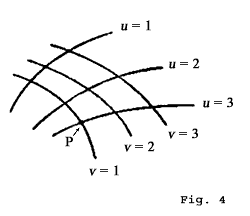 We
have then a system of u-curves, and this
"infinitely dense" system covers the whole surface of the table. These
u-curves must not intersect each other, and
through each point of the surface one and only one curve must pass. Thus a
perfectly definite value of u belongs to every
point on the surface of the marble slab. In like manner we imagine a
system of v-curves drawn on the surface. These
satisfy the same conditions as the
u-curves, they
are provided with numbers in a corresponding manner, and they may likewise
be of arbitrary shape. It follows that a value of
u
and a value of v belong to every point on the
surface of the table. We call these two numbers the co-ordinates of the
surface of the table (Gaussian co-ordinates). For example, the point
P in the diagram has the Gaussian co-ordinates
u= 3,
v= 1. Two
neighbouring points P and
P1
on the surface then correspond to the co-ordinates We
have then a system of u-curves, and this
"infinitely dense" system covers the whole surface of the table. These
u-curves must not intersect each other, and
through each point of the surface one and only one curve must pass. Thus a
perfectly definite value of u belongs to every
point on the surface of the marble slab. In like manner we imagine a
system of v-curves drawn on the surface. These
satisfy the same conditions as the
u-curves, they
are provided with numbers in a corresponding manner, and they may likewise
be of arbitrary shape. It follows that a value of
u
and a value of v belong to every point on the
surface of the table. We call these two numbers the co-ordinates of the
surface of the table (Gaussian co-ordinates). For example, the point
P in the diagram has the Gaussian co-ordinates
u= 3,
v= 1. Two
neighbouring points P and
P1
on the surface then correspond to the co-ordinates
P: u,v
P1: u + du, v + dv,
where
du and
dv
signify very small numbers. In a similar manner we may indicate the
distance (line-interval) between P and
P1, as measured with a little rod, by
means of the very small number ds. Then according
to Gauss we have
ds2 = g11du2 + 2g12dudv
= g22dv2
where
g11, g12, g22,
are magnitudes which depend in a perfectly definite way on
u and
v. The magnitudes
g11, g12 and g22,
determine the behaviour of the rods relative to the
u-curves
and v-curves, and thus also relative to the
surface of the table. For the case in which the points of the surface
considered form a Euclidean continuum with reference to the
measuring-rods, but only in this case, it is possible to draw the
u-curves and
v-curves
and to attach numbers to them, in such a manner, that we simply have :
ds2 = du2 + dv2
Under these conditions, the
u-curves and
v-curves are straight lines in the sense of
Euclidean geometry, and they are perpendicular to each other. Here the
Gaussian coordinates are simply Cartesian ones. It is clear that Gauss
co-ordinates are nothing more than an association of two sets of numbers
with the points of the surface considered, of such a nature that numerical
values differing very slightly from each other are associated with
neighbouring points " in space."
So far, these considerations hold for a continuum of two dimensions.
But the Gaussian method can be applied also to a continuum of three, four
or more dimensions. If, for instance, a continuum of four dimensions be
supposed available, we may represent it in the following way. With every
point of the continuum, we associate arbitrarily four numbers,
x1, x2, x3, x4,
which are known as " co-ordinates." Adjacent points correspond to adjacent
values of the coordinates. If a distance
ds is
associated with the adjacent points
P and
P1, this distance being measurable and
well defined from a physical point of view, then the following formula
holds:
ds2 = g11dx12
+ 2g12dx1dx2 . . . . g44dx42,
where the magnitudes g11, etc., have values
which vary with the position in the continuum. Only when the continuum is
a Euclidean one is it possible to associate the co-ordinates
x1 . . x4. with the points
of the continuum so that we have simply
ds2 = dx12 + dx22
+ dx32 + dx42.
In this case relations hold in the four-dimensional
continuum which are analogous to those holding in our three-dimensional
measurements.
However, the Gauss treatment for
ds2
which we have given above is not always possible. It is only possible when
sufficiently small regions of the continuum under consideration may be
regarded as Euclidean continua. For example, this obviously holds in the
case of the marble slab of the table and local variation of temperature.
The temperature is practically constant for a small part of the slab, and
thus the geometrical behaviour of the rods is almost as it ought
to be according to the rules of Euclidean geometry. Hence the
imperfections of the construction of squares in the previous section do
not show themselves clearly until this construction is extended over a
considerable portion of the surface of the table.
We can sum this up as follows: Gauss invented a method for the
mathematical treatment of continua in general, in which " size-relations "
(" distances " between neighbouring points) are defined. To every point of
a continuum are assigned as many numbers (Gaussian coordinates) as the
continuum has dimensions. This is done in such a way, that only one
meaning can be attached to the assignment, and that numbers (Gaussian
coordinates) which differ by an indefinitely small amount are assigned to
adjacent points. The Gaussian coordinate system is a logical
generalisation of the Cartesian co-ordinate system. It is also applicable
to non-Euclidean continua, but only when, with respect to the defined
"size" or "distance," small parts of the continuum under consideration
behave more nearly like a Euclidean system, the smaller the part of the
continuum under our notice.
The Space-Time Continuum of the Special Theory of Relativity
Considered as a Euclidean Continuum
We are now in a position to formulate more exactly the idea of
Minkowski, which was only vaguely indicated in
Section 17. In accordance with the special theory of relativity,
certain co-ordinate systems are given preference for the description of
the four-dimensional, space-time continuum. We called these " Galileian
co-ordinate systems." For these systems, the four co-ordinates
x, y, z, t, which determine an event or — in
other words, a point of the four-dimensional continuum —
are defined physically in a simple manner, as set forth in detail in the
first part of this book. For the transition from one Galileian system to
another, which is moving uniformly with reference to the first, the
equations of the Lorentz transformation are valid. These last form the
basis for the derivation of deductions from the special theory of
relativity, and in themselves they are nothing more than the expression of
the universal validity of the law of transmission of light for all
Galileian systems of reference.
Minkowski found that the Lorentz transformations satisfy the following
simple conditions. Let us consider two neighbouring events, the relative
position of which in the four-dimensional continuum is given with respect
to a Galileian reference-body K by the space
co-ordinate differences dx, dy, dz and the
time-difference dt. With reference to a second
Galileian system we shall suppose that the corresponding differences for
these two events are dx1, dy1, dz1,
dt1. Then these magnitudes always fulfil the condition
1)
dx2 + dy2 + dz2 - c2dt2
= dx1 2 + dy1 2 + dz1 2 - c2dt1
2.
The validity of the Lorentz transformation follows from this condition.
We can express this as follows: The magnitude
ds2 = dx2 + dy2 + dz2
- c2dt2,
which belongs to two adjacent points of the
four-dimensional space-time continuum, has the same value for all selected
(Galileian) reference-bodies. If we replace
x, y, z,
 ,
by x1, x2, x3, x4,
we also obtain the result that ,
by x1, x2, x3, x4,
we also obtain the result that
ds2 = dx12 + dx22
+ dx32 + dx42.
is independent of the choice of the body of reference. We
call the magnitude ds the " distance " apart of
the two events or four-dimensional points.
Thus, if we choose as time-variable the imaginary variable
instead of the real quantity t, we can regard the
space-time continuum — accordance with the special theory of relativity —
as a ", Euclidean " four-dimensional continuum, a result which follows
from the considerations of the preceding section.
Footnotes
1) Cf.
Appendixes
I and
2. The relations which are derived there for the coordinates
themselves are valid also for co-ordinate differences, and thus
also for co-ordinate differentials (indefinitely small differences).
The Space-Time Continuum of the General Theory of Relativity is Not a
Euclidean Continuum
In the first part of this book we were able to make use of space-time
co-ordinates which allowed of a simple and direct physical interpretation,
and which, according to Section 26, can be regarded as four-dimensional Cartesian
coordinates. This was possible on the basis of the law of the constancy
of the velocity of light. But according to Section 21 the general theory of relativity cannot retain this law. On
the contrary, we arrived at the result that according to this latter
theory the velocity of light must always depend on the coordinates when a
gravitational field is present. In connection with a specific illustration
in Section 23, we found that the presence of a gravitational field
invalidates the definition of the coordinates and the ifine, which led us
to our objective in the special theory of relativity.
In view of the results of these considerations we are led to the
conviction that, according to the general principle of relativity, the
space-time continuum cannot be regarded as a Euclidean one, but that here
we have the general case, corresponding to the marble slab with local
variations of temperature, and with which we made acquaintance as an
example of a two-dimensional continuum. Just as it was there impossible to
construct a Cartesian co-ordinate system from equal rods, so here it is
impossible to build up a system (reference-body) from rigid bodies and
clocks, which shall be of such a nature that measuring-rods and clocks,
arranged rigidly with respect to one another, shall indicate position and
time directly. Such was the essence of the difficulty with which we were
confronted in Section 23.
But the considerations of Sections 25 and
26 show us the way to surmount this difficulty. We refer the
four dimensional space-time continuum in an arbitrary manner to Gauss
co-ordinates. We assign to every point of the continuum (event) four
numbers, x1, x2, x3, x4
(co-ordinates), which have not the least direct physical significance, but
only serve the purpose of numbering the points of the continuum in a
definite but arbitrary manner. This arrangement does not even need to be
of such a kind that we must regard
x1, x2,
x3, as "space" co-ordinates and
x4,
as a " time " co-ordinate.
The reader may think that such a description of the world would be
quite inadequate. What does it mean to assign to an event the particular
co-ordinates x1, x2, x3,
x4, if in themselves these co-ordinates have no
significance ? More careful consideration shows, however, that this
anxiety is unfounded. Let us consider, for instance, a material point with
any kind of motion. If this point had only a momentary existence without
duration, then it would to described in space-time by a single system of
values x1, x2, x3, x4.
Thus its permanent existence must be characterised by an infinitely large
number of such systems of values, the co-ordinate values of which are so
close together as to give continuity; corresponding to the material point,
we thus have a (uni-dimensional) line in the four-dimensional continuum.
In the same way, any such lines in our continuum correspond to many points
in motion. The only statements having regard to these points which can
claim a physical existence are in reality the statements about their
encounters. In our mathematical treatment, such an encounter is expressed
in the fact that the two lines which represent the motions of the points
in question have a particular system of co-ordinate values,
x1, x2, x3, x4,
in common. After mature consideration the reader will doubtless admit that
in reality such encounters constitute the only actual evidence of a
time-space nature with which we meet in physical statements.
When we were describing the motion of a material point relative to a
body of reference, we stated nothing more than the encounters of this
point with particular points of the reference-body. We can also determine
the corresponding values of the time by the observation of encounters of
the body with clocks, in conjunction with the observation of the encounter
of the hands of clocks with particular points on the dials. It is just the
same in the case of space-measurements by means of measuring-rods, as a
little consideration will show.
The following statements hold generally : Every physical description
resolves itself into a number of statements, each of which refers to the
space-time coincidence of two events
A and
B. In terms of Gaussian co-ordinates, every such
statement is expressed by the agreement of their four co-ordinates
x1, x2, x3, x4.
Thus in reality, the description of the time-space continuum by means of
Gauss co-ordinates completely replaces the description with the aid of a
body of reference, without suffering from the defects of the latter mode
of description; it is not tied down to the Euclidean character of the
continuum which has to be represented.
Exact Formulation of the General Principle of Relativity
We are now in a position to replace the pro. visional formulation of
the general principle of relativity given in Section 18 by an exact formulation. The form there used, "All bodies
of reference K, K1, etc., are
equivalent for the description of natural phenomena (formulation of the
general laws of nature), whatever may be their state of motion," cannot be
maintained, because the use of rigid reference-bodies, in the sense of the
method followed in the special theory of relativity, is in general not
possible in space-time description. The Gauss co-ordinate system has to
take the place of the body of reference. The following statement
corresponds to the fundamental idea of the general principle of
relativity: "All Gaussian co-ordinate systems are essentially
equivalent for the formulation of the general laws of nature."
We can state this general principle of relativity in still another
form, which renders it yet more clearly intelligible than it is when in
the form of the natural extension of the special principle of relativity.
According to the special theory of relativity, the equations which express
the general laws of nature pass over into equations of the same form when,
by making use of the Lorentz transformation, we replace the space-time
variables x, y, z, t, of a (Galileian)
reference-body K by the space-time variables
x1, y1, z1, t1,
of a new reference-body K1. According
to the general theory of relativity, on the other hand, by application of
arbitrary substitutions of the Gauss variables
x1, x2, x3, x4, the
equations must pass over into equations of the same form; for every
transformation (not only the Lorentz transformation) corresponds to the
transition of one Gauss co-ordinate system into another.
If we desire to adhere to our "old-time" three-dimensional view of
things, then we can characterise the development which is being undergone
by the fundamental idea of the general theory of relativity as follows :
The special theory of relativity has reference to Galileian domains,
i.e. to those in which no gravitational field exists. In this
connection a Galileian reference-body serves as body of reference,
i.e. a rigid body the state of motion of which is so chosen that the
Galileian law of the uniform rectilinear motion of "isolated" material
points holds relatively to it.
Certain considerations suggest that we should refer the same Galileian
domains to non-Galileian reference-bodies also. A gravitational
field of a special kind is then present with respect to these bodies (cf.
Sections 20 and 23).
In gravitational fields there are no such things as rigid bodies with
Euclidean properties; thus the fictitious rigid body of reference is of no
avail in the general theory of relativity. The motion of clocks is also
influenced by gravitational fields, and in such a way that a physical
definition of time which is made directly with the aid of clocks has by no
means the same degree of plausibility as in the special theory of
relativity.
For this reason non-rigid reference-bodies are used, which are as a
whole not only moving in any way whatsoever, but which also suffer
alterations in form ad lib. during their motion. Clocks, for
which the law of motion is of any kind, however irregular, serve for the
definition of time. We have to imagine each of these clocks fixed at a
point on the non-rigid reference-body. These clocks satisfy only the one
condition, that the "readings" which are observed simultaneously on
adjacent clocks (in space) differ from each other by an indefinitely small
amount. This non-rigid reference-body, which might appropriately be termed
a "reference-mollusc", is in the main equivalent to a Gaussian
four-dimensional co-ordinate system chosen arbitrarily. That which gives
the "mollusc" a certain comprehensibility as compared with the Gauss
co-ordinate system is the (really unjustified) formal retention of the
separate existence of the space co-ordinates as opposed to the time
co-ordinate. Every point on the mollusc is treated as a space-point, and
every material point which is at rest relatively to it as at rest, so long
as the mollusc is considered as reference-body. The general principle of
relativity requires that all these molluscs can be used as
reference-bodies with equal right and equal success in the formulation of
the general laws of nature; the laws themselves must be quite independent
of the choice of mollusc.
The great power possessed by the general principle of relativity lies
in the comprehensive limitation which is imposed on the laws of nature in
consequence of what we have seen above.
The Solution of the Problem of Gravitation on the Basis of the General
Principle of Relativity
If the reader has followed all our previous considerations, he will
have no further difficulty in understanding the methods leading to the
solution of the problem of gravitation.
We start off on a consideration of a Galileian domain, i.e. a
domain in which there is no gravitational field relative to the Galileian
reference-body K. The behaviour of measuring-rods
and clocks with reference to K is known from the
special theory of relativity, likewise the behaviour of "isolated"
material points; the latter move uniformly and in straight lines.
Now let us refer this domain to a random Gauss coordinate system or to
a "mollusc" as reference-body
K1. Then
with respect to K1 there is a
gravitational field G (of a particular kind). We
learn the behaviour of measuring-rods and clocks and also of freely-moving
material points with reference to
K1
simply by mathematical transformation. We interpret this behaviour as the
behaviour of measuring-rods, docks and material points tinder the
influence of the gravitational field
G. Hereupon
we introduce a hypothesis: that the influence of the gravitational field
on measuringrods, clocks and freely-moving material points continues to
take place according to the same laws, even in the case where the
prevailing gravitational field is not derivable from the
Galfleian special care, simply by means of a transformation of
co-ordinates.
The next step is to investigate the space-time behaviour of the
gravitational field G, which was derived from the
Galileian special case simply by transformation of the coordinates. This
behaviour is formulated in a law, which is always valid, no matter how the
reference-body (mollusc) used in the description may be chosen.
This law is not yet the general law of the gravitational
field, since the gravitational field under consideration is of a special
kind. In order to find out the general law-of-field of gravitation we
still require to obtain a generalisation of the law as found above. This
can be obtained without caprice, however, by taking into consideration the
following demands:
(a) The required generalisation must likewise
satisfy the general postulate of relativity.
(b) If there is any matter in the domain under
consideration, only its inertial mass, and thus according to
Section 15 only its energy is of importance for its effect in exciting
a field.
(c) Gravitational field and matter together must
satisfy the law of the conservation of energy (and of impulse).
Finally, the general principle of relativity permits us to determine
the influence of the gravitational field on the course of all those
processes which take place according to known laws when a gravitational
field is absent i.e. which have already been fitted into the
frame of the special theory of relativity. In this connection we proceed
in principle according to the method which has already been explained for
measuring-rods, clocks and freely moving material points.
The theory of gravitation derived in this way from the general
postulate of relativity excels not only in its beauty ; nor in removing
the defect attaching to classical mechanics which was brought to light in
Section 21; nor in interpreting the empirical law of the equality of
inertial and gravitational mass ; but it has also already explained a
result of observation in astronomy, against which classical mechanics is
powerless.
If we confine the application of the theory to the case where the
gravitational fields can be regarded as being weak, and in which all
masses move with respect to the coordinate system with velocities which
are small compared with the velocity of light, we then obtain as a first
approximation the Newtonian theory. Thus the latter theory is obtained
here without any particular assumption, whereas Newton had to introduce
the hypothesis that the force of attraction between mutually attracting
material points is inversely proportional to the square of the distance
between them. If we increase the accuracy of the calculation, deviations
from the theory of Newton make their appearance, practically all of which
must nevertheless escape the test of observation owing to their smallness.
We must draw attention here to one of these deviations. According to
Newton's theory, a planet moves round the sun in an ellipse, which would
permanently maintain its position with respect to the fixed stars, if we
could disregard the motion of the fixed stars themselves and the action of
the other planets under consideration. Thus, if we correct the observed
motion of the planets for these two influences, and if Newton's theory be
strictly correct, we ought to obtain for the orbit of the planet an
ellipse, which is fixed with reference to the fixed stars. This deduction,
which can be tested with great accuracy, has been confirmed for all the
planets save one, with the precision that is capable of being obtained by
the delicacy of observation attainable at the present time. The sole
exception is Mercury, the planet which lies nearest the sun. Since the
time of Leverrier, it has been known that the ellipse corresponding to the
orbit of Mercury, after it has been corrected for the influences mentioned
above, is not stationary with respect to the fixed stars, but that it
rotates exceedingly slowly in the plane of the orbit and in the sense of
the orbital motion. The value obtained for this rotary movement of the
orbital ellipse was 43 seconds of arc per century, an amount ensured to be
correct to within a few seconds of arc. This effect can be explained by
means of classical mechanics only on the assumption of hypotheses which
have little probability, and which were devised solely for this purpose.
On the basis of the general theory of relativity, it is found that the
ellipse of every planet round the sun must necessarily rotate in the
manner indicated above ; that for all the planets, with the exception of
Mercury, this rotation is too small to be detected with the delicacy of
observation possible at the present time ; but that in the case of Mercury
it must amount to 43 seconds of arc per century, a result which is
strictly in agreement with observation.
Apart from this one, it has hitherto been possible to make only two
deductions from the theory which admit of being tested by observation, to
wit, the curvature of light rays by the gravitational field of the sun,1)
and a displacement of the spectral lines of light reaching us from large
stars, as compared with the corresponding lines for light produced in an
analogous manner terrestrially (i.e. by the same kind of atom).
2) These two
deductions from the theory have both been confirmed.
Footnotes
1)
First observed by Eddington and others in 1919. (Cf.
Appendix III, pp. 126-129).
2)
Established by Adams in 1924. (Cf.
p. 132)
Go to Next Page
|