|
YOU ARE
REQUIRED TO READ THE
COPYRIGHT NOTICE AT
THIS LINK BEFORE YOU READ THE FOLLOWING WORK, THAT IS
AVAILABLE SOLELY FOR PRIVATE STUDY, SCHOLARSHIP OR RESEARCH PURSUANT
TO 17 U.S.C. SECTION 107 AND 108. IN THE EVENT THAT THE LIBRARY
DETERMINES THAT UNLAWFUL COPYING OF THIS WORK HAS OCCURRED, THE
LIBRARY HAS THE RIGHT TO BLOCK THE I.P. ADDRESS AT WHICH THE
UNLAWFUL COPYING APPEARED TO HAVE OCCURRED. THANK YOU FOR RESPECTING
THE RIGHTS OF COPYRIGHT OWNERS. |
For the relative orientation of the co-ordinate systems
indicated in 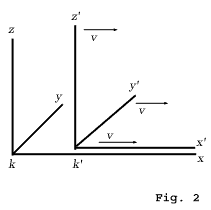 , the x-axes
of both systems permanently coincide. In the present case we can divide
the problem into parts by considering first only events which are
localised on the x-axis.
Any such event is represented with respect to the co-ordinate system
K by
the abscissa x
and the time t,
and with respect to the system K1
by the abscissa x'
and the time t'.
We require to find x'
and t'
when x
and t
are given. , the x-axes
of both systems permanently coincide. In the present case we can divide
the problem into parts by considering first only events which are
localised on the x-axis.
Any such event is represented with respect to the co-ordinate system
K by
the abscissa x
and the time t,
and with respect to the system K1
by the abscissa x'
and the time t'.
We require to find x'
and t'
when x
and t
are given.
A light-signal, which is proceeding along the positive
axis of x,
is transmitted according to the equation
x = ct
or
x - ct = 0 . . . (1).
Since the same light-signal has to be
transmitted relative to K1
with the velocity c,
the propagation relative to the system
K1
will be represented by the analogous formula
x' - ct' = O . . . (2)
Those space-time points (events) which satisfy (x)
must also satisfy (2). Obviously this will be the case when the relation
(x' - ct') = λ (x - ct) . .
. (3).
is fulfilled in general, where λ indicates a
constant ; for, according to (3), the disappearance of (x
- ct) involves the disappearance of (x'
- ct').
If we apply quite similar considerations to light rays
which are being transmitted along the negative
x-axis, we obtain the
condition
(x' + ct') = µ(x + ct) . .
. (4).
By adding (or subtracting) equations (3) and (4), and
introducing for convenience the constants
a and
b in place
of the constants λ and µ, where

and

we obtain the equations
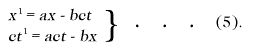
We should thus have the solution of our problem, if the
constants a
and b
were known. These result from the following discussion.
For the origin of
K1
we have permanently x' = 0,
and hence according to the first of the equations (5)

If we call v
the velocity with which the origin of
K1
is moving relative to K,
we then have

The same value v
can be obtained from equations (5), if we calculate the velocity of
another point of K1
relative to K,
or the velocity (directed towards the negative
x-axis) of a point of
K with
respect to K'.
In short, we can designate v
as the relative velocity of the two systems.
Furthermore, the principle of relativity teaches us
that, as judged from K,
the length of a unit measuring-rod which is at rest with reference to
K1
must be exactly the same as the length, as judged from
K', of a
unit measuring-rod which is at rest relative to
K. In order to see how the
points of the x-axis
appear as viewed from K,
we only require to take a " snapshot " of
K1
from K;
this means that we have to insert a particular value of
t (time of
K),
e.g. t = 0.
For this value of t
we then obtain from the first of the equations (5)
x' = ax
Two points of the
x'-axis which are separated by
the distance Δx'
= I when measured in the
K1
system are thus separated in our instantaneous photograph by the distance

But if the snapshot be taken from
K'(t'
= 0), and if we eliminate
t from the
equations (5), taking into account the expression (6), we obtain
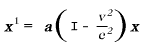
From this we conclude that two points on the
x-axis
separated by the distance I
(relative to K)
will be represented on our snapshot by the distance

But from what has been said, the two snapshots must be
identical; hence Δx
in (7) must be equal to Δx'
in (7a), so that we obtain
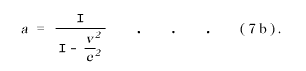
The equations (6) and (7b) determine the constants
a and
b. By
inserting the values of these constants in (5), we obtain the first and
the fourth of the equations given in
Section 11.
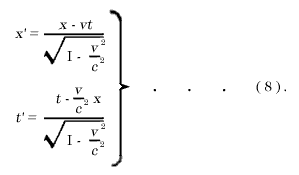
Thus we have obtained the Lorentz transformation for
events on the x-axis.
It satisfies the condition
x'2 - c2t'2
= x2 - c2t2 . . . (8a).
The extension of this result, to include events which
take place outside the x-axis,
is obtained by retaining equations (8) and supplementing them by the
relations

In this way we satisfy the postulate of the constancy of
the velocity of light in vacuo for rays of light of arbitrary
direction, both for the system K
and for the system K'.
This may be shown in the following manner.
We suppose a light-signal sent out from the origin of
K at
the time t = 0.
It will be propagated according to the equation

or, if we square this equation, according to the
equation
x2 + y2 + z2
= c2t2 = 0 . . . (10).
It is required by the law of propagation of light, in
conjunction with the postulate of relativity, that the transmission of the
signal in question should take place — as judged from
K1
— in accordance with the corresponding formula
r' = ct'
or,
x'2 + y'2 + z'2
- c2t'2 = 0 . . . (10a).
In order that equation (10a) may be a consequence of
equation (10), we must have
x'2 + y'2 + z'2
- c2t'2 = σ (x2 + y2 + z2
- c2t2) (11).
Since equation (8a) must hold for points on the
x-axis, we
thus have σ = I.
It is easily seen that the Lorentz transformation really satisfies
equation (11) for σ = I;
for (11) is a consequence of (8a) and (9), and hence also of (8) and (9).
We have thus derived the Lorentz transformation.
The Lorentz transformation represented by (8) and (9)
still requires to be generalised. Obviously it is immaterial whether the
axes of K1
be chosen so that they are spatially parallel to those of
K. It is
also not essential that the velocity of translation of
K1
with respect to K
should be in the direction of the
x-axis. A simple consideration shows that we
are able to construct the Lorentz transformation in this general sense
from two kinds of transformations, viz. from Lorentz transformations in
the special sense and from purely spatial transformations. which
corresponds to the replacement of the rectangular co-ordinate system by a
new system with its axes pointing in other directions.
Mathematically, we can characterise the generalised
Lorentz transformation thus :
It expresses
x', y', x', t', in terms of
linear homogeneous functions of x,
y, x, t, of such a kind that the relation
x'2 + y'2 + z'2
- c2t'2 = x2 + y2 + z2
- c2t2 (11a).
is satisfied identically. That is to say: If
we substitute their expressions in
x, y, x, t, in place of
x', y', x', t',
on the left-hand side, then the left-hand side of (11a) agrees with the
right-hand side.
We can characterise the Lorentz transformation still
more simply if we introduce the imaginary
 in place of
t, as
time-variable. If, in accordance with this, we insert in place of
t, as
time-variable. If, in accordance with this, we insert
x1 = x
x2 = y
x3 = z
x4 =
and similarly for the accented system
K1,
then the condition which is identically satisfied by the transformation
can be expressed thus :
x1'2 + x2'2
+ x3'2 + x4'2 = x12
+ x22 + x32 + x42
(12).
That is, by the afore-mentioned choice of "
coordinates," (11a) [see the end of
Appendix II] is transformed into this equation.
We see from (12) that the imaginary time co-ordinate
x4,
enters into the condition of transformation in exactly the same way as the
space co-ordinates x1,
x2, x3. It is due to
this fact that, according to the theory of relativity, the " time "x4,
enters into natural laws in the same form as the space co ordinates
x1, x2, x3.
A four-dimensional continuum described by the
"co-ordinates" x1, x2,
x3, x4, was called
"world" by Minkowski, who also termed a point-event a " world-point." From
a "happening" in three-dimensional space, physics becomes, as it were, an
" existence " in the four-dimensional " world."
This four-dimensional " world " bears a close similarity
to the three-dimensional " space " of (Euclidean) analytical geometry. If
we introduce into the latter a new Cartesian co-ordinate system (x'1,
x'2, x'3)
with the same origin, then x'1,
x'2, x'3,
are linear homogeneous functions of
x1, x2, x3
which identically satisfy the equation
x'12 + x'22
+ x'32 = x12 + x22
+ x32
The analogy with (12) is a complete one. We
can regard Minkowski's " world " in a formal manner as a four-dimensional
Euclidean space (with an imaginary time coordinate) ; the Lorentz
transformation corresponds to a " rotation " of the co-ordinate system in
the four dimensional " world."
From a systematic theoretical point of view, we may
imagine the process of evolution of an empirical science to be a
continuous process of induction. Theories are evolved and are expressed in
short compass as statements of a large number of individual observations
in the form of empirical laws, from which the general laws can be
ascertained by comparison. Regarded in this way, the development of a
science bears some resemblance to the compilation of a classified
catalogue. It is, as it were, a purely empirical enterprise.
But this point of view by no means embraces the whole of
the actual process ; for it slurs over the important part played by
intuition and deductive thought in the development of an exact science. As
soon as a science has emerged from its initial stages, theoretical
advances are no longer achieved merely by a process of arrangement. Guided
by empirical data, the investigator rather develops a system of thought
which, in general, is built up logically from a small number of
fundamental assumptions, the so-called axioms. We call such a system of
thought a theory. The theory finds the justification for its
existence in the fact that it correlates a large number of single
observations, and it is just here that the " truth " of the theory lies.
Corresponding to the same complex of empirical data,
there may be several theories, which differ from one another to a
considerable extent. But as regards the deductions from the theories which
are capable of being tested, the agreement between the theories may be so
complete that it becomes difficult to find any deductions in which the two
theories differ from each other. As an example, a case of general interest
is available in the province of biology, in the Darwinian theory of the
development of species by selection in the struggle for existence, and in
the theory of development which is based on the hypothesis of the
hereditary transmission of acquired characters.
We have another instance of far-reaching agreement
between the deductions from two theories in Newtonian mechanics on the one
hand, and the general theory of relativity on the other. This agreement
goes so far, that up to the present we have been able to find only a few
deductions from the general theory of relativity which are capable of
investigation, and to which the physics of pre-relativity days does not
also lead, and this despite the profound difference in the fundamental
assumptions of the two theories. In what follows, we shall again consider
these important deductions, and we shall also discuss the empirical
evidence appertaining to them which has hitherto been obtained.
According to Newtonian mechanics and Newton's law of
gravitation, a planet which is revolving round the sun would describe an
ellipse round the latter, or, more correctly, round the common centre of
gravity of the sun and the planet. In such a system, the sun, or the
common centre of gravity, lies in one of the foci of the orbital ellipse
in such a manner that, in the course of a planet-year, the distance
sun-planet grows from a minimum to a maximum, and then decreases again to
a minimum. If instead of Newton's law we insert a somewhat different law
of attraction into the calculation, we find that, according to this new
law, the motion would still take place in such a manner that the distance
sun-planet exhibits periodic variations; but in this case the angle
described by the line joining sun and planet during such a period (from
perihelion—closest proximity to the sun—to perihelion) would differ from
3600. The line of the orbit would not then be a closed one but
in the course of time it would fill up an annular part of the orbital
plane, viz. between the circle of least and the circle of greatest
distance of the planet from the sun.
According also to the general theory of relativity,
which differs of course from the theory of Newton, a small variation from
the Newton-Kepler motion of a planet in its orbit should take place, and
in such away, that the angle described by the radius sun-planet between
one perhelion and the next should exceed that corresponding to one
complete revolution by an amount given by
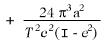
(N.B. — One complete revolution corresponds to
the angle 2π in the absolute angular measure customary in physics, and the
above expression giver the amount by which the radius sun-planet exceeds
this angle during the interval between one perihelion and the next.) In
this expression a
represents the major semi-axis of the ellipse,
e its eccentricity,
c the
velocity of light, and T
the period of revolution of the planet. Our result may also be stated as
follows : According to the general theory of relativity, the major axis of
the ellipse rotates round the sun in the same sense as the orbital motion
of the planet. Theory requires that this rotation should amount to 43
seconds of arc per century for the planet Mercury, but for the other
Planets of our solar system its magnitude should be so small that it would
necessarily escape detection. 1)
In point of fact, astronomers have found that the theory
of Newton does not suffice to calculate the observed motion of Mercury
with an exactness corresponding to that of the delicacy of observation
attainable at the present time. After taking account of all the disturbing
influences exerted on Mercury by the remaining planets, it was found (Leverrier:
1859; and Newcomb: 1895) that an unexplained perihelial movement of the
orbit of Mercury remained over, the amount of which does not differ
sensibly from the above mentioned +43 seconds of arc per century. The
uncertainty of the empirical result amounts to a few seconds only.
In Section 22 it has been already mentioned that according to the general
theory of relativity, a ray of light will experience a curvature of its
path when passing through a gravitational field, this curvature being
similar to that experienced by the path of a body which is projected
through a gravitational field. As a result of this theory, we should
expect that a ray of light which is passing close to a heavenly body would
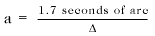
be deviated towards the latter. For a ray of light which passes the sun at
a distance of Δ sun-radii from its centre, the angle of deflection (a)
should amount to
It may be added that, according to the theory, half of
 this deflection is
produced by the Newtonian field of attraction of the sun, and the other
half by the geometrical modification (" curvature ") of space caused by
the sun. this deflection is
produced by the Newtonian field of attraction of the sun, and the other
half by the geometrical modification (" curvature ") of space caused by
the sun.
This result admits of an experimental test by means of
the photographic registration of stars during a total eclipse of the sun.
The only reason why we must wait for a total eclipse is because at every
other time the atmosphere is so strongly illuminated by the light from the
sun that the stars situated near the sun's disc are invisible. The
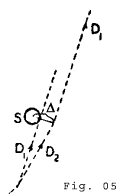
predicted effect can be seen clearly from the accompanying diagram. If the
sun (S)
were not present, a star which is practically infinitely distant would be
seen in the direction D1,
as observed front the earth. But as a consequence of the deflection of
light from the star by the sun, the star will be seen in the direction
D2,
i.e. at a somewhat greater distance from the centre of the sun
than corresponds to its real position.
In practice, the question is tested in the following
way. The stars in the neighbourhood of the sun are photographed during a
solar eclipse. In addition, a second photograph of the same stars is taken
when the sun is situated at another position in the sky, i.e. a
few months earlier or later. As compared with the standard photograph, the
positions of the stars on the eclipse-photograph ought to appear displaced
radially outwards (away from the centre of the sun) by an amount
corresponding to the angle a.
We are indebted to the [British]
Royal Society and to the Royal Astronomical Society for the investigation
of this important deduction. Undaunted by the [first
world] war and by difficulties of both a material and a
psychological nature aroused by the war, these societies equipped two
expeditions — to Sobral (Brazil), and to the island of Principe (West
Africa) — and sent several of Britain's most celebrated astronomers (Eddington,
Cottingham, Crommelin, Davidson), in order to obtain photographs of the
solar eclipse of 29th May, 1919. The relative discrepancies to be expected
between the stellar photographs obtained during the eclipse and the
comparison photographs amounted to a few hundredths of a millimetre only.
Thus great accuracy was necessary in making the adjustments required for
the taking of the photographs, and in their subsequent measurement.
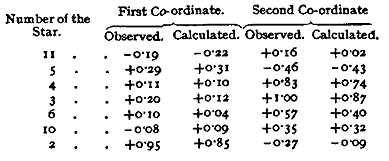
The results of the measurements confirmed the theory in
a thoroughly satisfactory manner. The rectangular components of the
observed and of the calculated deviations of the stars (in seconds of arc)
are set forth in the following table of results :
In Section 23 it has been shown that in a system
K1
which is in rotation with regard to a Galileian system
K, clocks of
identical construction, and which are considered at rest with respect to
the rotating reference-body, go at rates which are dependent on the
positions of the clocks. We shall now examine this dependence
quantitatively. A clock, which is situated at a distance
r from the
centre of the disc, has a velocity relative to
K which is given by
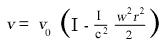
V = wr
where
w represents the angular
velocity of rotation of the disc K1
with respect to K.
If v0,
represents the number of ticks of the clock per unit time (" rate " of the
clock) relative to K
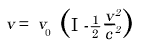
when the clock is at rest, then the " rate " of the clock (v)
when it is moving relative to K
with a velocity V,
but at rest with respect to the disc, will, in accordance with
Section 12, be given by
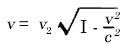
or with sufficient accuracy by
This expression may also be stated in the following
form:
If we represent the difference of potential of the
centrifugal force between the position of the clock and the centre of the
disc by φ, i.e. the work, considered negatively, which must be
performed on the unit of mass against the centrifugal force in order to
transport it from the position of the clock on the rotating disc to the
centre of the disc, then we have

From this it follows that
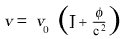
In the first place, we see from this expression that two
clocks of identical construction will go at different rates when situated
at different distances from the centre of the disc. This result is aiso
valid from the standpoint of an observer who is rotating with the disc.
Now, as judged from the disc, the latter is in a
gravitational field of potential φ, hence the result we have obtained will
hold quite generally for gravitational fields. Furthermore, we can regard
an atom which is emitting spectral lines as a clock, so that the following
statement will hold:
An atom absorbs or emits light of a
frequency which is dependent on the potential of the gravitational field
in which it is situated.
The frequency of an atom situated on the surface of a
heavenly body will be somewhat less than the frequency of an atom of the
same element which is situated in free space (or on the surface of a
smaller celestial body).
Now φ = - K
(M/r), where
K is Newton's constant of
gravitation, and M
is the mass of the heavenly body. Thus a displacement towards the red
ought to take place for spectral lines produced at the surface of stars as
compared with the spectral lines of the same element produced at the
surface of the earth, the amount of this displacement being
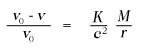
For the sun, the displacement towards the red predicted
by theory amounts to about two millionths of the wave-length. A
trustworthy calculation is not possible in the case of the stars, because
in general neither the mass M
nor the radius r
are known.
It is an open question whether or not this effect
exists, and at the present time (1920) astronomers are working with great
zeal towards the solution. Owing to the smallness of the effect in the
case of the sun, it is difficult to form an opinion as to its existence.
Whereas Grebe and Bachem (Bonn), as a result of their own measurements and
those of Evershed and Schwarzschild on the cyanogen bands, have placed the
existence of the effect almost beyond doubt, while other investigators,
particularly St. John, have been led to the opposite opinion in
consequence of their measurements.
Mean displacements of lines towards the less refrangible
end of the spectrum are certainly revealed by statistical investigations
of the fixed stars ; but up to the present the examination of the
available data does not allow of any definite decision being arrived at,
as to whether or not these displacements are to be referred in reality to
the effect of gravitation. The results of observation have been collected
together, and discussed in detail from the standpoint of the question
which has been engaging our attention here, in a paper by E. Freundlich
entitled "Zur Prüfung der allgemeinen Relativitäts-Theorie" (Die
Naturwissenschaften, 1919, No. 35, p. 520: Julius Springer, Berlin).
At all events, a definite decision will be reached
during the next few years. If the displacement of spectral lines towards
the red by the gravitational potential does not exist, then the general
theory of relativity will be untenable. On the other hand, if the cause of
the displacement of spectral lines be definitely traced to the
gravitational potential, then the study of this displacement will furnish
us with important information as to the mass of the heavenly bodies.
[A]
1)
Especially since the next planet Venus has an orbit that is almost an
exact circle, which makes it more difficult to locate the perihelion with
precision.
[A] The displacement of spectral lines
towards the red end of the spectrum was definitely established by Adams in
1924, by observations on the dense companion of Sirius, for which the
effect is about thirty times greater than for the Sun. R.W.L. —
translator
Since the publication of the first edition of this
little book, our knowledge about the structure of space in the large ("
cosmological problem ") has had an important development, which ought to
be mentioned even in a popular presentation of the subject.
My original considerations on the subject were based on
two hypotheses:
(1) There exists an average density
of matter in the whole of space which is everywhere the same and different
from zero.
(2) The magnitude (" radius ") of
space is independent of time.
Both these hypotheses proved to be consistent, according
to the general theory of relativity, but only after a hypothetical term
was added to the field equations, a term which was not required by the
theory as such nor did it seem natural from a theoretical point of view ("
cosmological term of the field equations ").
Hypothesis (2) appeared unavoidable to me at the time,
since I thought that one would get into bottomless speculations if one
departed from it.
However, already in the 'twenties, the Russian
mathematician Friedman showed that a different hypothesis was natural from
a purely theoretical point of view. He realized that it was possible to
preserve hypothesis (1) without introducing the less natural cosmological
term into the field equations of gravitation, if one was ready to drop
hypothesis (2). Namely, the original field equations admit a solution in
which the " world radius " depends on time (expanding space). In that
sense one can say, according to Friedman, that the theory demands an
expansion of space.
A few years later Hubble showed, by a special
investigation of the extra-galactic nebulae (" milky ways "), that the
spectral lines emitted showed a red shift which increased regularly with
the distance of the nebulae. This can be interpreted in regard to our
present knowledge only in the sense of Doppler's principle, as an
expansive motion of the system of stars in the large — as required,
according to Friedman, by the field equations of gravitation. Hubble's
discovery can, therefore, be considered to some extent as a confirmation
of the theory.
There does arise, however, a strange difficulty. The
interpretation of the galactic line-shift discovered by Hubble as an
expansion (which can hardly be doubted from a theoretical point of view),
leads to an origin of this expansion which lies " only " about 109
years ago, while physical astronomy makes it appear likely that the
development of individual stars and systems of stars takes considerably
longer. It is in no way known how this incongruity is to be overcome.
I further want to remark that the theory of expanding
space, together with the empirical data of astronomy, permit no decision
to be reached about the finite or infinite character of
(three-dimensional) space, while the original " static " hypothesis of
space yielded the closure (finiteness) of space.
Return to Table of Contents
|