|
by Irene Abigail
Piccinini
In an often quoted passage, Strauss once asserted: "I
am in no way a Cohenian!"[1].
Notwithstanding this disclaimer, there are distinct echoes and
correspondences between Strauss's work and Cohen's. Without ever
becoming a "Cohenian" in a scholastic sense, Strauss nevertheless paid
close attention to questions raised by Cohen and engaged with them
repeatedly. In the following, I will focus on Strauss's critique of
Cohen's reading of Baruch Spinoza's Theological-Political Treatise
(henceforth: TPT). I will show that Strauss's own reading of Spinoza is
shaped by questions he derived from engaging with Cohen.
First, I will explain why Spinoza has been described
as Hermann Cohen's "arch-enemy". The paper will then focus on Strauss's
criticism of Cohen's interpretation of Spinoza, as expressed in
Strauss's first philosophical essay, "Cohen's Analysis of Spinoza's
Bible Science". Finally, I will track Cohen's influence on the early
Strauss through "The Testament of Spinoza" (1932). I will argue that
this article contains a quasi-Cohenian interpretation of Baruch Spinoza.
"Cohenian", because (i) Strauss's interpretation answers questions
raised by Cohen in his reading of Spinoza, and (ii) Strauss's answers
are closer to Cohen's interpretive stance than one might think; "quasi",
because Strauss's answers to Cohen's questions are very different from
Cohen's own answers.
I.
That Baruch Spinoza "was the arch-enemy to Hermann
Cohen" is a pregnant statement made by Steven Schwarzschild[2].
In this statement, Schwarzschild brilliantly captures a number of
verdicts by Cohen concerning Spinoza. Cohen considered Spinoza a
renegade to his people, an apostate full of hatred for the Jews, a
"falsifier and slanderer of Judaism"[3],
someone guilty of "a humanly incomprehensible betrayal"[4].
Franz Nauen has remarked that Cohen found Spinoza "essentially
disloyal"[5]; in Cohen's words, Spinoza
lacked the ethical virtue of fidelity (Treue)[6].
I will therefore use Cohen's concept of fidelity as a key to explain his
utter aversion to Spinoza[7].
The virtue of fidelity is not only an important
component of Cohen's theoretical system in general but more importantly
it is also one of Cohen's most effective and forceful intellectual tools
to strengthen Jewish identity and to defend Judaism against anti-Jewish
attacks. As many scholars have pointed out, Cohen was deeply engaged
in the fight against anti-Jewish feelings of all kinds, ranging from
ancient religious prejudices to more recent racist ideologies[8].
Parallel to his fight against anti-Jewish sentiments, Cohen was
increasingly committed to Jewish education and scholarship and, in his
writings, he emphasized the universal values contained in Judaism and
its profound contributions to Western culture. In this context,
fidelity toward one's family, friends, religious community, and
nationality is used by Cohen to explain why it is morally indispensable
to maintain a Jewish identity in spite of the difficulties of living in
a non- Jewish society.
|
According to the United Nations Convention on the
Elimination of All Forms of Racial Discrimination,
the term "racial
discrimination" shall mean any distinction, exclusion,
restriction or preference based on race, colour, descent, or
national or ethnic origin which has the purpose or effect of
nullifying or impairing the recognition, enjoyment or
exercise, on an equal footing, of human rights and
fundamental freedoms in the political, economic, social,
cultural or any other field of public life.'
This
definition does not make any difference between prosecutions
based on ethnicity and race, in part because the distinction
between the ethnicity and race remains debatable among
anthropologists. According to British law, racial group
means "any group of people who are defined by reference to
their race, colour, nationality (including citizenship) or
ethnic or national origin".
--
Racism, by Wikipedia |
Cohen discusses the virtue of fidelity in two
prominent places, namely in Ethik des reinen Willens (Ethics of
Pure Will, 1904, second edition 1907), ch. 14, and in Religion der
Vernunft aus den Quellen des Judentums (Religion of Reason From the
Sources of Judaism, 1919, second edition 1928), ch. 21. As an ethical
virtue, Cohen describes fidelity as a persistency of the will: it is
directed toward the Other, but its main goal is the unity of the Self[9].
Fidelity is what allows human beings to go beyond the fickleness of the
heart and therefore what gives steadiness (Stetigkeit) to a
relationship, be it with a single person (friendship, love), with a
community (national, religious), or with G-d. According to Cohen, not
relationships themselves but their persistency, the steadiness of
maintaining them, has "a crucial ethical value" [10],
because it leads to perfecting what Cohen calls "ethical
self-consciousness."
Cohen uses the virtue of fidelity to explain why a
person should preserve a link to her people and religious community in
the face of any personal choice. In particular, in his essay "Der
Religionswechsel in der neuen Ära des Antisemitismus"[11],
Cohen establishes a connection between fidelity to the Jewish
community and the fight against anti- Semitism. Cohen condemns those
who choose conversion to Christianity on grounds of social expediency,
such as to avoid the growing effects of anti-Jewish attacks or simply to
improve their social condition or gain a better job. Cohen agrees that
being part of the Jewish community is difficult because of social
prejudice and anti-Jewish feelings. Nevertheless, according to him,
leaving the community to avoid persecution leads the persecutor to
strengthen her prejudice and negative attitude towards the community.
Therefore Cohen considers religious conversion not only a private,
personal act, but also a public one, a betrayal of one's own people,
which affects the whole community. The lack of fidelity towards one's
own people is therefore a lack of faithfulness towards family and
friends, which are part of the community. But, as we mentioned,
the main goal of fidelity is the unity of the self, so a lack of
fidelity is ultimately a lack of fidelity toward oneself, a rejection of
the ethical improvement of one's own ethical self-consciousness[12].
Fidelity guarantees that one will maintain a continuity with her own
history and identity, in spite of any change and development which may
occur in one's life[13]. Thus, Cohen
defines remembering as the "psychological function of faithfulness"[14]:
in the end, lack of fidelity leads to forgetting who one is and who one
should become (through one's ethical improvement).
|
All
national institutions of churches, whether Jewish, Christian
or Turkish, appear to me no other than human inventions, set
up to terrify and enslave mankind, and monopolize power and
profit.
I do not mean by this declaration to condemn those who
believe otherwise; they have the same right to their belief
as I have to mine. But it is necessary to the happiness of
man, that he be mentally faithful to himself. Infidelity
does not consist in believing, or in disbelieving; it
consists in professing to believe what he does not believe.
It is impossible to calculate the moral mischief, if I may
so express it, that mental lying has produced in society.
When a man has so far corrupted and prostituted the chastity
of his mind, as to subscribe his professional belief to
things he does not believe, he has prepared himself for the
commission of every other crime. He takes up the trade of a
priest for the sake of gain, and in order to qualify himself
for that trade, he begins with a perjury. Can we conceive
any thing more destructive to morality than this?
--
The Age of Reason, by Thomas Paine
|
In light of Cohen's analysis of the virtue of
fidelity, it seems clear why Cohen couldn't accept Spinoza's behaviour
towards the Jewish community. As a Jew, Cohen was not only deeply
committed to preserving and strengthening the Jewish identity, but he
also considered this duty, on a more theoretical level, as a fundamental
part of the improvement of his ethical self-consciousness. As a part of
his duty, Cohen included the task of purifying the Jewish religion
from its mythological elements, showing that the Jewish religion is a
Religion of Reason, a religion whose inner core is morality and
whose inner task is the moral progress of humanity towards the messianic
ideal of a unified humanity. Cohen considered Spinoza as an enemy
not only to the Jewish people but also to the project of ethical
idealism: instead of developing the universalistic elements contained
in the Jewish tradition, Spinoza discredited it as a political
legislation, thus offering arguments to defamers and detractors of the
Jewish belief. Spinoza especially lacked fidelity because he knew
Judaism from the inside, had a good Jewish education, and nevertheless
-- Cohen maintains -- gave a false and misleading image of the Jewish
tradition. According to Cohen, Spinoza did all of this intentionally:
his lack of fidelity was deliberate[15].
Spinoza's attitude towards Judaism had, in Cohen's opinion, fatal
consequences not only because it lent credence to anti-Jewish arguments,
but most of all because it led many thinkers, including Kant, to a
complete misunderstanding of the Jewish religion. Instead of
fighting anti-Jewish prejudices, Spinoza contributed to them: "The
key statements in which Spinoza discharged his vindictive hatred of the
Jews can still be found today almost literally in the daily newspapers
of certain political tendencies"[16].
For this reason it seems quite clear why Cohen's critique of Spinoza
manifested itself as "a holy war against an enemy to whom no quarter can
be given, a battle not only between truth and falsehood but between good
and evil"[17].
II.
Leo Strauss began his philosophical career with a
critical essay on Hermann Cohen's interpretation of Spinoza's
Theological-Political Treatise ("Cohen's Analysis of Spinoza's Bible
Science")[18]. The article appeared in the
May/June 1924 issue of the Jewish periodical Der Jude, edited by
Martin Buber, and attracted the attention of Julius Guttmann, the
director of the Academy for the Science of Judaism (Akademie für die
Wissenschaft des Judentums). On Guttmann's initiative, the Academy
offered Strauss a research fellowship, which he accepted, and he was
subsequently employed by the Academy to finish his monograph on Spinoza[19]
and to work on the Mendelssohn Jubiläumsausgabe.[20]
|
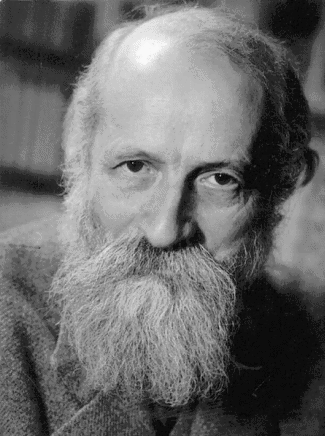
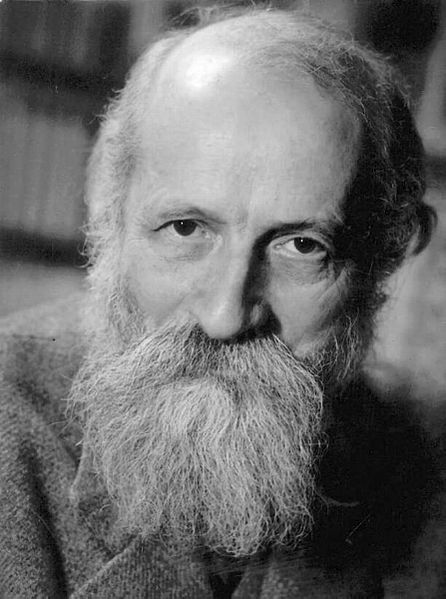
Martin
Buber (Hebrew: מרטין בובר; February 8, 1878 – June 13,
1965) was an Austrian-born Jewish philosopher best known for
his philosophy of dialogue, a form of religious
existentialism centered on the distinction between the
I-Thou relationship and the I-It relationship.
Born in
Vienna, Buber came from a family of observant Jews, but
broke with Jewish custom to pursue secular studies in
philosophy. In 1902, Buber became the editor of the weekly
Die Welt, the central organ of the Zionist movement,
although he later withdrew from organizational work in
Zionism. In 1923 Buber wrote his famous essay on existence,
Ich und Du (later translated into English as I and Thou),
and in 1925 he began translating the Hebrew Bible into the
German language.
In 1930
Buber became an honorary professor at the University of
Frankfurt am Main, and resigned in protest from his
professorship immediately after Adolf Hitler came to power
in 1933. He then founded the Central Office for Jewish Adult
Education, which became an increasingly important body as
the German government forbade Jews to attend public
education. In 1938, Buber left Germany and settled in
Jerusalem, in the British Mandate for Palestine, receiving a
professorship at Hebrew University and lecturing in
anthropology and introductory sociology.
Buber's
wife Paula died in 1958, and he died at his home in the
Talbiyeh neighborhood of Jerusalem on June 13, 1965.
--
"Martin Buber," by Wikipedia |
A study of Strauss's early writings on Spinoza vis
à vis Strauss's relationship with Cohen is interesting in light of
his lifelong engagement with Cohen. Strauss honoured Cohen by writing
an introduction to the English edition of Cohen's Religion of Reason
out of the Sources of Judaism. If we consider that the same
article was also published at the end of Strauss's last work, the
posthumously published Studies in Platonic Philosophy, it
represents in some sense a kind of conclusion to Strauss's own work. As
remarked by many scholars, Cohen remained for Strauss a permanent and
stimulating point of reference from the very beginning to the very end
of his philosophical activity[21].
Strauss greatly honored the memory of Cohen but he also displayed
complete intellectual independence in criticizing Cohen's views. The
analysis of Strauss's early writings on Spinoza, especially of "Cohen's
Analysis of Spinoza's Bible Science" and of "The Testament of Spinoza",
will show that Strauss took seriously the questions raised by Cohen in
his critique of Spinoza and that he gave answers to these questions
that, while not strictly speaking Cohenian, seem inspired by Cohen's way
of thinking and that may therefore constitute a Cohenian legacy.
Strauss explained his reasons for engaging with
Hermann Cohen's interpretation of Spinoza in his Preface to the
English edition (1965) of his monograph on Spinoza's Critique of
Religion. However, a connection between Cohen's legacy and Strauss's
research project on Spinoza's Bible Science was openly drawn by Strauss
many years before this well-known Preface. Already in 1926, Strauss
wrote as follows: "I owe the idea for my work to the critical study of
Hermann Cohen's article, 'Spinoza über Staat und Religion, Judentum und
Christentum' (…) which, in terms of the radicalism of its questioning
and the forcefulness with which he calls Spinoza to account, is simply
paradigmatic and which, in this very respect, is peerless in the recent
literature on Spinoza"[22]. Similarly,
Franz Rosenzweig remarked that Strauss was the only one in his
generation who gave an appropriate response to Cohen's criticism of
Spinoza: "Cohen took Spinoza seriously. For this reason, his Spinoza has
not been taken seriously. Except for Leo Strauss's short and important
essay 'On the Bible Science of Spinoza and His Precursors', (…) I am not
aware of any other work that grappled seriously with Cohen's problem"[23].
Nevertheless, Strauss pointed out from the very beginning of his
investigation that he couldn't but find a discrepancy between Cohen's
own philosophical project, which he saw as inscribed in the tradition of
the Enlightenment, and Cohen's opposition to Spinoza: "To be sure,
while few of Cohen's contemporaries were as inspired as he was by the
spirit of the great age of the Enlightenment, to which he zealously
testified in many important passages of his writings, when it comes to
his criticism of Spinoza, apparently diverted by his insight into the
deeper opposition, he failed to recognize Spinoza's true objective
(which is essentially identical with that of the Enlightenment) as
well as the immediate target of his attack.
|
…peoples’
free judgments are very diverse and everyone thinks they
know everything themselves, and it can never happen that
everyone will think exactly alike and speak with one voice.
It would have been impossible therefore for people to live
in peace, unless each one gave up his right to act according
to his own decision alone. Each one therefore surrendered
his right to act according to his own resolution, but not
his right to think and judge for himself. Thus no one can
act against the sovereign’s decisions without prejudicing
his authority, but they can think and judge and speak
without restriction, provided they merely speak or teach by
way of reason alone.[xiv]
--
Spinoza, Theological-Political Treatise, ch. 20, paragraphs 6 and
7.
The most
plausible plea, which hath ever been offered in favor of
hereditary succession, is, that it preserves a nation from
civil wars; and were this true, it would be weighty;
whereas, it is the most barefaced falsity ever imposed upon
mankind. The whole history of England disowns the fact.
Thirty kings and two minors have reigned in that distracted
kingdom since the conquest, in which time there have been
(including the Revolution) no less than eight civil wars and
nineteen rebellions. Wherefore instead of making for peace,
it makes against it, and destroys the very foundation it
seems to stand on....
Where
there are no distinctions there can be no superiority,
perfect equality affords no temptation. The republics of
Europe are all (and we may say always) in peace. Holland and
Switzerland are without wars, foreign or domestic;
monarchical governments, it is true, are never long at rest:
the crown itself is a temptation to enterprising ruffians at
home; and that degree of pride and insolence ever attendant
on regal authority swells into a rupture with foreign
powers, in instances where a republican government, by being
formed on more natural principles, would negotiate the
mistake.
-- Common Sense, by Thomas
Paine
But unhappily there is
no security in the state of the public mind, that the
suspension of worse forms of legal persecution, which has
lasted for about the space of a generation, will continue.
In this age the quiet surface of routine is as often ruffled
by attempts to resuscitate past evils, as to introduce new
benefits. What is boasted of at the present time as the
revival of religion, is always, in narrow and uncultivated
minds, at least as much the revival of bigotry; and where
there is the strongest permanent leaven of intolerance in
the feelings of a people, which at all times abides in the
middle classes of this country, it needs but little to
provoke them into actively persecuting those whom they have
never ceased to think proper objects of persecution. For it
is this -- it is the opinions men entertain, and the
feelings they cherish, respecting those who disown the
beliefs they deem important, which makes this country not a
place of mental freedom. For a long time past, the chief
mischief of the legal penalties is that they strengthen the
social stigma. It is that stigma which is really effective,
and so effective is it, that the profession of opinions
which are under the ban of society is much less common in
England, than is, in many other countries, the avowal of
those which incur risk of judicial punishment. In respect to
all persons but those whose pecuniary circumstances make
them independent of the good will of other people, opinion,
on this subject, is as efficacious as law; men might as well
be imprisoned, as excluded from the means of earning their
bread. Those whose bread is already secured, and who desire
no favors from men in power, or from bodies of men, or from
the public, have nothing to fear from the open avowal of any
opinions, but to be ill-thought of and ill-spoken of, and
this it ought not to require a very heroic mould to enable
them to bear. There is no room for any appeal ad
misericordiam in behalf of such persons. But though we do
not now inflict so much evil on those who think differently
from us, as it was formerly our custom to do, it may be that
we do ourselves as much evil as ever by our treatment of
them. Socrates was put to death, but the Socratic philosophy
rose like the sun in heaven, and spread its illumination
over the whole intellectual firmament. Christians were cast
to the lions, but the Christian Church grew up a stately and
spreading tree, overtopping the older and less vigorous
growths, and stifling them by its shade. Our merely social
intolerance, kills no one, roots out no opinions, but
induces men to disguise them, or to abstain from any active
effort for their diffusion. With us, heretical opinions do
not perceptibly gain or even lose, ground in each decade or
generation; they never blaze out far and wide, but continue
to smoulder in the narrow circles of thinking and studious
persons among whom they originate, without ever lighting up
the general affairs of mankind with either a true or a
deceptive light. And thus is kept up a state of things very
satisfactory to some minds, because, without the unpleasant
process of fining or imprisoning anybody, it maintains all
prevailing opinions outwardly undisturbed, while it does not
absolutely interdict the exercise of reason by dissentients
afflicted with the malady of thought. A convenient plan for
having peace in the intellectual world, and keeping all
things going on therein very much as they do already. But
the price paid for this sort of intellectual pacification,
is the sacrifice of the entire moral courage of the human
mind. A state of things in which a large portion of the most
active and inquiring intellects find it advisable to keep
the genuine principles and grounds of their convictions
within their own breasts, and attempt, in what they address
to the public, to fit as much as they can of their own
conclusions to premises which they have internally
renounced, cannot send forth the open, fearless characters,
and logical, consistent intellects who once adorned the
thinking world. The sort of men who can be looked for under
it, are either mere conformers to commonplace, or
time-servers for truth whose arguments on all great subjects
are meant for their hearers, and are not those which have
convinced themselves. Those who avoid this alternative, do
so by narrowing their thoughts and interests to things which
can be spoken of without venturing within the region of
principles, that is, to small practical matters, which would
come right of themselves, if but the minds of mankind were
strengthened and enlarged, and which will never be made
effectually right until then; while that which would
strengthen and enlarge men's minds, free and daring
speculation on the highest subjects, is abandoned.
Those in whose eyes
this reticence on the part of heretics is no evil, should
consider in the first place, that in consequence of it there
is never any fair and thorough discussion of heretical
opinions; and that such of them as could not stand such a
discussion, though they may be prevented from spreading, do
not disappear. But it is not the minds of heretics that are
deteriorated most, by the ban placed on all inquiry which
does not end in the orthodox conclusions. The greatest harm
done is to those who are not heretics, and whose whole
mental development is cramped, and their reason cowed, by
the fear of heresy. Who can compute what the world loses in
the multitude of promising intellects combined with timid
characters, who dare not follow out any bold, vigorous,
independent train of thought, lest it should land them in
something which would admit of being considered irreligious
or immoral? Among them we may occasionally see some man of
deep conscientiousness, and subtile and refined
understanding, who spends a life in sophisticating with an
intellect which he cannot silence, and exhausts the
resources of ingenuity in attempting to reconcile the
promptings of his conscience and reason with orthodoxy,
which yet he does not, perhaps, to the end succeed in doing.
No one can be a great thinker who does not recognize, that
as a thinker it is his first duty to follow his intellect to
whatever conclusions it may lead. Truth gains more even by
the errors of one who, with due study and preparation,
thinks for himself, than by the true opinions of those who
only hold them because they do not suffer themselves to
think. Not that it is solely, or chiefly, to form great
thinkers, that freedom of thinking is required. On the
contrary, it is as much, and even more indispensable, to
enable average human beings to attain the mental stature
which they are capable of. There have been, and may again
be, great individual thinkers, in a general atmosphere of
mental slavery. But there never has been, nor ever will be,
in that atmosphere, an intellectually active people. Where
any people has made a temporary approach to such a
character, it has been because the dread of heterodox
speculation was for a time suspended. Where there is a tacit
convention that principles are not to be disputed; where the
discussion of the greatest questions which can occupy
humanity is considered to be closed, we cannot hope to find
that generally high scale of mental activity which has made
some periods of history so remarkable. Never when
controversy avoided the subjects which are large and
important enough to kindle enthusiasm, was the mind of a
people stirred up from its foundations, and the impulse
given which raised even persons of the most ordinary
intellect to something of the dignity of thinking beings. Of
such we have had an example in the condition of Europe
during the times immediately following the Reformation;
another, though limited to the Continent and to a more
cultivated class, in the speculative movement of the latter
half of the eighteenth century; and a third, of still
briefer duration, in the intellectual fermentation of
Germany during the Goethian and Fichtean period. These
periods differed widely in the particular opinions which
they developed; but were alike in this, that during all
three the yoke of authority was broken. In each, an old
mental despotism had been thrown off, and no new one had yet
taken its place. The impulse given at these three periods
has made Europe what it now is. Every single improvement
which has taken place either in the human mind or in
institutions, may be traced distinctly to one or other of
them. Appearances have for some time indicated that all
three impulses are well-nigh spent; and we can expect no
fresh start, until we again assert our mental freedom.
--
On
Liberty, by John Stuart Mill
|
Spinoza did not turn against the 'monotheism of
Judaism' or against the 'social ethics of the prophets' but rather
against revealed religion in all its forms. In view of Cohen's
radicalization of the question, one must again undertake an analysis of
the Theological-Political Treatise (TPT) as a radical
critique of revealed religion"[24]. The
analysis of the TPT as a radical critique of revealed religion
was undertaken by Strauss in his first book Spinoza's Critique of
Religion, but the first steps of this investigation are already
clearly expressed in his earlier essay, "Cohen's Analysis of Spinoza's
Bible Science". Using a historical-critical approach, Strauss wanted
to show that many (if not all) of Cohen's criticisms were due to a
mistaken perspective, and therefore unmotivated.
III.
In "Cohen's Analysis of Spinoza's Bible Science"
Strauss argues that Cohen's objections to Spinoza are unjustified:
considering the historical and intellectual context in which Spinoza
lived and wrote, what Cohen judged to be incomprehensible was perfectly
comprehensible. For example, some elements criticized by Cohen, such as
the connection between political theory and critique of the Bible, the
interpretation of the Bible based on political considerations, and the
identification of religion and Scriptures belonged with 17th century
philosophical culture in general, and not with Spinoza alone. As
Strauss remarks, "Spinoza was compelled to engage in the critique of the
Bible by legitimate motives, whether or not he was full of hatred toward
Judaism"[25], because this attitude was a
part of the struggle - which Spinoza shared with the intellectuals of
his century - for the liberation of politics and science from the
oppressive influence of ecclesiastical institutions.
|
For
example, fish are determined by nature to swim and big fish
to eat little ones, and therefore it is by sovereign natural
right that fish have possession of the water and that big
fish eat small fish. For it is certain that nature,
considered wholly in itself, has a sovereign right to do
everything that it can do, i.e., the right of nature extends
as far as its power extends.
--
Spinoza, Theological-Political Treatise, ch. 16, paragraph
2. |
As for Cohen's philosophically more complex
objection that Spinoza's Ethics and the TPT contained
contradictory philosophical assumptions, Strauss answers that "the moral
principle of the Treatise does not contradict that of the
Ethics. Spinoza's general way of proceeding in the Treatise
can be justified also from a systematic perspective, because the
fundamental necessity and the objective (…) legitimacy of the
argumentatio ad hominem (…) follows from the principle of hierarchy
that is fundamental to the Ethics"[26].
In any case, the most problematic element of Cohen's
interpretation of Spinoza concerned, as we mentioned, Spinoza's attitude
towards Judaism. Cohen maintained that the main purpose of Spinoza's
critique of the Bible was to launch an attack on the Jewish religion and
- even worse in Cohen's perspective - to show a greater reverence
towards Christianity than towards Judaism. In this respect, Strauss
remarks that "the essential conclusions of Spinoza's Bible science are
sufficiently motivated by the actual nature (…) of the object of this
science"[27], without any need to refer to
Spinoza's Jewish connection, as Cohen does. It should not be
surprising, according to Strauss, that Spinoza pointed out the
political, nationalistic, particularistic, cultish and naïve-egotistical
elements of the Old Testament, instead of what Cohen considered the most
important elements for a fair evaluation of Judaism, namely the moral,
rational, humanistic and universalistic aspects of the Jewish tradition.
Strauss observes that Spinoza's critique of the Bible need not
reflect Spinoza's attitude towards Judaism, because both the purpose and
the result of the investigations in the TPT can be explained and
understood without referring to Spinoza's own connection to the Jewish
world. The TPT, writes Strauss, "is a Christian-European, not
a Jewish, event"[28], so its purpose
and method should be analyzed in the context of the antithesis between
the traditional-ecclesiastical and the critical-scholarly
interpretations of the Bible. What Cohen forgot, according to
Strauss, is that in the 17th century the striving against ecclesiastical
claims on science and the state was not yet resolved as it was in
Cohen's time. As Strauss maintains, it would be impossible to
understand and evaluate Spinoza's TPT without considering this
fundamental struggle of European culture in the 17th and 18th century.
Strauss thus concludes his essay without discussing
the question of Spinoza's attitude towards Judaism and the Jews.
Nevertheless, he underlines that a further investigation was needed to
clarify whether some (and, if so, which) Jewish impulses might still be
alive in Spinoza's Bible science and how the interests of Judaism relate
to Spinoza's Biblical scholarship. In this respect, Strauss points out
the importance of Cohen's legacy for a further study of Spinoza's work:
"Cohen is right when he establishes (…) the interest of Judaism as
the highest authority for assessing this science (viz., Spinoza's Bible
Science). (…) He is right when he seeks to measure Spinoza's thought
about Judaism, and his conduct towards Judaism, by Jewish standards"[29].
According to Strauss he is wrong, however, "when he determines the
interest of Judaism by the external consideration of the purposes of
theologico-political apologetics, rather than determining it on the
basis of the inner need of the spirit of our people [Volksgeist]"[30].
In any case, Strauss acknowledges "the exemplary seriousness of Hermann
Cohen"[31], attested by the fact that his
questioning was free from the romantic image of the "God-intoxicated
man" (Novalis) that had become pervasive in German as well as in Jewish
culture. In this respect, although not explicitly, Strauss displays a "Cohenian"
perspective: he adopts Cohen's non- or anti-romantic stance toward
Spinoza and his writings, and he focuses on the philosophical and
political presuppositions of the Treatise.
IV.
Strauss subsequently proceeded to answer Cohen's
question of how the interests of Judaism are affected by Spinoza's Bible
science. Two years after the publication of Spinoza's Critique of
Religion, where he had developed his thesis of the
"Christian-European" character of the TPT in greater detail,
Strauss wrote a short essay entitled "The Testament of Spinoza"[32],
which I consider a quasi-Cohenian afterword to his book on Spinoza. "The
Testament of Spinoza" focuses on Spinoza's attitude towards Judaism and
provides an answer to Cohen's question about the relationship between
the interests of Judaism and Spinoza's Biblical studies: it constitutes
the further investigation whose task Strauss articulated at the
conclusion of "Cohen's Analysis of Spinoza's Bible Science". Published
in Bayerische Israelitische Gemeindezeitung, a Jewish periodical,
"The Testament of Spinoza" is written for a Jewish public in the context
of a Jewish culture, underscoring the importance of a "Jewish point of
view" toward Spinoza. Furthermore, the essay begins and ends with a
reference to Hermann Cohen: Cohen's question of whether Spinoza was
responsible for a "humanly incomprehensible betrayal" frames Strauss's
essay. Finally, although Strauss disagrees with Cohen on how this
question should be answered, he nevertheless points to the relevance of
Cohen's legacy for his own philosophical reasoning.
According to Strauss, Spinoza's philosophical work
should not be considered as the result of his Jewish heritage. Although
Spinoza was born and grew up within Amsterdam's Sephardic community, and
although Spinoza's philosophical education began by reading the writings
of medieval Jewish philosophers, Strauss maintains that he belongs to
the European-Mediterranean tradition as a whole rather than to a
parochially Jewish one:
"Good European" that he is, Spinoza takes from the
Jewish tradition the common property of European ideas that it
conveyed to him -- and nothing else. Thus we believe
we have answered the question of whether the Jew as a Jew is
entitled to venerate Spinoza. Spinoza belongs not to Judaism, but
to the small band of superior minds whom Nietzsche called the "good
Europeans." To this community belong all the philosophers
of the seventeenth century, but Spinoza belongs to it in a special
way. Spinoza did not remain a Jew, while Descartes, Hobbes,
and Leibniz remained Christians. Thus it is not in accordance
with Spinoza's wishes that he be inducted into the pantheon of the
Jewish nation.[33]
Thus, according to Strauss, Jews should relinquish
their claim on Spinoza, noticing that this wouldn't mean surrendering
him to the enemies of the Jewish nation, but rather "leave him to
that distant and strange community of 'neutrals' whom one can call, with
considerable justice, the community of the 'good Europeans'"[34].
Strauss argues that one may or may not venerate Spinoza; nonetheless,
one should respect his last will, "and his last will was neutrality
toward the Jewish nation, based on his break with Judaism"[35].
The statement about Spinoza's neutrality toward
Judaism is the result of Strauss's historical-critical analysis of the
TPT, which he began with "Cohen's Analysis of Spinoza's Bible
Science" and completed in his book on Spinoza's Critique of Religion.
In the latter work, Strauss highlighted the distance between Spinoza and
his original community as a peculiar and essential component of his
philosophical work[36]. In this respect,
Strauss argues that Cohen was wrong to maintain that Spinoza had a
vengeful attitude towards Judaism because of the ban of the Amsterdam
community, but at the same time Cohen was right that Spinoza had no
legitimate place within the Amsterdam community, and therefore the
Amsterdam community was justified in sanctioning Spinoza's distance
through a public ban. As to Spinoza's neutrality, Strauss infers it
from Spinoza's well known statement in the third chapter of the TPT
that "(i)f the foundations of the Jewish religion have not rendered the
minds of the Jews effeminate (…), then I would absolutely believe that
someday, given the opportunity and human affairs being so changeable,
they (the Jews) will once again establish their empire and God will
elect them anew"[37]. This is,
according to Strauss, Spinoza's "political testament" and a "neutral
consideration of the possibility condition [Möglichkeitsbedingung]
for the restoration of the Jewish state"[38].
In other words, with this statement Spinoza did not express any wish or
desire for a possible restoration of the Jewish state, but merely
discussed the condition of its possibility. Spinoza's attitude is thus
judged by Strauss as a sort of condescension "from the height of his
philosophical neutrality"[39], which
leaves to the Jews the decision whether or not to liberate themselves
from their religion to reestablish a Jewish state. Furthermore, "he
voiced this view not as a Jew, but as a neutral; and he did not even
voice it, but rather just tossed it off"[40].
In his conclusion, Strauss asks whether Spinoza's
testament is about the liberation of the Law from the "spirit
that makes the political restoration impossible"[41],
i.e., from the foundations of the Jewish religion, advocating a
transformation of the Law into "a means of national preservation" or
"a form of national life"[42]. His answer
takes Cohen's judgment into account:
Not in this way, not with veiled words and a weary
heart, should we bid farewell to Spinoza -- if, in fact,
we must bid farewell to him as someone on whose
conscience is a "humanly incomprehensible betrayal" (Cohen) of our
nation. For a moment at least, we would like to disregard the
popular principles on the strength of which one saw oneself
compelled either to canonize Spinoza or to condemn him. (…) And
still we ask whether we owe him veneration? Spinoza will be
venerated as long as there are men who know how to appreciate the
inscription on his signet-ring ("caute") or, to put it plainly:
as long as there are men who know what it means to utter [the word]:
independence [Unabhängigkeit].[43]
|
The
positioning of a monument to Spinoza at his place of birth
on the Zwanenburgwal in Amsterdam is a tribute to his
philosophical views, the influence of which on Western
thinking is invaluable.
The sculpture is a triad: a platform, an icosahedron, and a
statue of the philosopher form an inseparable whole. The
platform is playfully modeled after the laws of Newton, who,
coming after Galileo and Keppler, described how the planets
form an elliptical arc around the earth, like Spinoza wanted
to encompass and describe the spiritual universe in his
Ethics.
The bronze figure of the philosopher is wrapped in a cloak
that bears symbols which refer to his ideas on tolerance,
freedom of religion and freedom of speech, and which
simultaneously form a link with today’s multicultural
society (for Spinoza was also a son of immigrants). The
cloak is decorated with sparrows, ring-necked parakeets and
roses, lying on its folds in relief. The ring-necked
parakeet, which a few years ago chose the Vondel Park as its
biotope, has proved to be hardy: it has adapted to the
climate, eats what is available and now circulates
throughout the entire city. The sparrow, our most
archetypical bird, is having a difficult time, however – not
that the species is in danger of dying out, but its former
ubiquitousness is no more. And finally, the rose.
Engraved in Spinoza’s signet ring was a rose wreathed with
the word CAUTE (caution). The rose, universal metaphor for
beauty, also has thorns (‘spinoza’ literally means ‘thorn’).
The philosopher’s thinking is represented by an icosahedron,
a mathematical globular form comprised of twenty identical
triangular planes, twelve angular points, and thirty edges,
made of polished granite: a reference to his profession of
lens grinder.
The statue stands on an ovular platform of terrazzo. Its
spiraling shape once again emphasizes the essence of things:
after all, every plant and flower branches off in a regular
spiral, as does our DNA. Carved into the side of the
platform is the philosopher’s name and the citation The
purpose of the state is freedom, a statement which makes
Spinoza, who was born 376 years ago at this spot, forever
contemporary.
--
Nicolas Dings
On
November 24, 1632, a great philosopher was born in Holland
of Spanish-Portuguese Jewish parents. Benedict Spinoza—an
original thinker destined to become one of the world's
greatest modern philosophers—has exercised such a profound
impact upon modern thought that even today there is much
debate upon his philosophy, and only within the last 100
years has his influence been thoroughly recognized for its
effect on today's thinking. Spinoza was little understood in
his time, consequently was labeled an atheist, and was
excommunicated from his Jewish faith when he was just 24
years old. Only about a century ago were his writings
seriously examined and his pantheism fully realized. It was
then that the label "the God-intoxicated philosopher" was
ascribed to him.
Spinoza
is one of the few people who can be called a true
individual. Yet, in accordance with his philosophical
beliefs, he denied such individuality by recognizing that
true individuality is the realization of universality.
He lived his life accordingly and, as a result, he became
misunderstood and eventually obscure until now. In the
past, a newspaper article cast doubts about the contention
that Spinoza was a Rosicrucian. The news writer proposed
that Spinoza used the rose symbol on his personal seal not
to identify himself as a Rosicrucian but, rather, to
coincide with his name—the argument being that the name
"Spinoza" is similar to the Latin espinosa which means "rose
with sharp thorns" and consequently the rose he used "has no
Rosicrucian significance." We must ask, then, what proof
can support the contention that Benedict Spinoza was indeed
a Rosicrucian? The question may seem simple enough; however,
the answer is far more complex than is often realized.
Therefore, it is necessary to divert our attention
momentarily from the specific question at hand to a brief
and general historical approach.
Historical Approach
Traditionally, the Rosicrucian movement kept membership
strictly confidential. There are many reasons for this,
but the primary ones applicable here are political and
religious. Rosicrucians have always taught, among other
things, freedom of thought and religion. In the 17th Century
persecution by the Church against any allegedly "heretical"
person or group was intense. At that time the church viewed
independent thinking as not only dangerous but also as
undermining its very existence. Needless to say, it was
necessary for such individuals to hide there affiliation or
even deny it when accused of membership. As a group, the
Rosicrucian brotherhood instructed its initiates in past
ages to maintain a vow of secrecy and not to reveal even
their own affiliation unless permitted to do so by a high
official in the Order.
Another
point to consider is that the history of the Rosicrucian
tradition is divided into two categories: the chronological,
where documentation is available; and the traditional, where
Rosicrucian history is related by word of mouth. It should
be noted, however, that much of the movement's traditional
history can be documented through careful and painstaking
research if one knows what to look for.
In the
16th and 17th Centuries, Rosicrucian authors used pseudonyms
in connection with their work, and only members of the
Rosicrucian brotherhood knew their true identities.
Naturally, public references would have no such information
at their disposal. As a result, unless an individual
authored books explaining the Rosicrucian movement or its
teachings, which many did in their own names or through
pseudonyms known only to other members, there was no outward
indication of any Rosicrucian affiliation. Given the times,
just because persons did not publicly reveal their
affiliation with the movement does not mean they were not
privately affiliated with this secret organization. And, on
the other hand, an individual's public claim of Rosicrucian
affiliation does not necessarily prove membership. However,
we can basically utilize five general points to verify
membership:
Five
Points Of Past Membership
1.
Personal revelation by the individual.
2. Work signed by a Rosicrucian symbolic name.
3. Traditional accounts from the brotherhood itself
referring to a personal affiliation.
4. Manuscripts and books containing terminology and symbols
distinctly Rosicrucian.
5. Indirect reference through friends and associates.
The case
of Spinoza's affiliation is quite interesting and the last
three points are most readily applicable in this regard.
Rosicrucian Content in Published Works
Through published material it is known that Spinoza is
maintained as having been a Rosicrucian. First, we can
divide that claim into two parts, thus approaching the
"proof' dualistically. The term "Rosicrucian" can be used
generically as "Rosicrucian in thought" or, secondly,
specifically, as being affiliated with a "Rosicrucian group
or body." In the former writings most notably his Ethics
are very much in agreement with Rosicrucian philosophy.
In our terminology we would not only relegate Spinoza as a
rationalist, which he indeed was, but also as a mystical
pantheist which concurs so closely with the Rosicrucian
teachings that it seems almost identical in many instances.
There are many ideas in Spinoza's works which point in that
direction.
For
instance, we can briefly state that Spinoza's definition of
God is likened to an omnipotent, impersonal essence infusing
all existence and inseparable from that existence. This
definition accounts for Spinoza's pantheism. Then, simply,
Spinoza proceeds to explain how creation manifests by using
a rather complex structure of explanation, as do the
Rosicrucians.
We
recognize that there is much academic philosophical debate
concerning whether Spinoza could be classified as a true
mystic, and we may refer to the many Spinoza Symposiums that
are held annually in the Netherlands, and specifically to
the one held in Leiden in 1973. And even though we are
sympathetic with the "mystic" argument, the point is
irrelevant to the argument of Spinoza's Rosicrucian
connections. Along the same train of thought,
academically and philosophically it could also be argued,
based upon many tenets of Rosicrucian philosophy, whether or
not Rosicrucians were really mystics. It all depends upon
how one defines mysticism.
Publication Notations of Rosicrucian Terminology and Symbols
Point 4,
referring to manuscripts and books containing Rosicrucian
terminology and symbols, throws new light upon the
verification of Spinoza's membership. Disregarding the
"rose" argument mentioned earlier, let us refer to the
title page of Spinoza's Theological and Political Treatise
where we find the Latin phrase apud Henricum Kunraht. First
of all, Heinrich Khunrath died in 1605, almost thirty years
before Spinoza was born. Then, we may wonder, why does the
name appear? If we look a little further we find that
Heinrich Khunrath was a Rosicrucian and that his major work
Amphitheatre of
Eternal Wisdom contained seven Arcanes, or Rosicrucian
Keys. We find on one of his plates the symbol of the
Hieroglyphic Monad
designed by the English Rosicrucian John Dee.
|
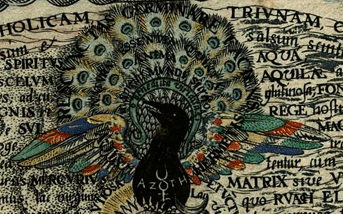
Azoth was
considered to be a universal medicine or universal solvent
sought in alchemy (similar to other alchemical idealized
substance, alkahest, that like azoth was the aim, goal and
vision of many alchemical works it was to achieve). Its
symbol was the Caduceus and so the term, which being
originally a term for an occult formula sought by alchemists
much like the philosopher's stone, became a poetic word
for the element mercury, the name being originally
derived from Arabic al-zā'ūq "the mercury".
Azoth is the essential agent of transformation in alchemy.
It is the name given by ancient alchemists to Mercury,
the animating spirit hidden in all matter that makes
transmutation possible. The spelling consists of the
initial letter of the English, Greek and Hebrew alphabets
followed by the final letters of the English alphabet (Z),
the Greek alphabet (Omega) and the Hebrew alphabet (Tau).
The word comes from the Arabic az z�'uq which means
"Mercury." The word occurs in the writings of many early
alchemists, such as Zosimos, Mary the Jewess, Olympiodorus,
and Jabir ibn Hayyan (Geber). The word Azoth is also
related to the Ain Soph (ultimate substance) of the Kabbalah.
In his masterwork The Secret Teachings of All Ages. Manley
P. Hall explained this connection: "The universe is
surrounded by the sphere of light or stars. Beyond that
sphere is Schamayim, who is the Divine Fiery Water, the
first outflow of the Word of God, the flaming river pouring
from the presence of the eternal mind. Schamayim, who is
this fiery Androgyne, divides. His Fire becomes Solar fire
and his Water becomes Lunar water in our universe. Schamayim
is the Universal Mercury or Azoth -- the measureless spirit
of life. That original spiritual fiery water comes through
Eden ("vapor" in Hebrew) and pours itself into the four main
rivers of the four Elements. This comprises the River of
Living Water -- the Azoth -- or fiery mercurial essence,
that flows out from the throne of God and Lamb. In this Eden
(vaporous essence or mist) is the first or spiritual Earth,
the incomprehensible and intangible dust out of which God
formed Adam Kadmon, the spiritual body of man, which must
become fully revealed through time." In his book
Transcendental Magic, Eliphas Levi wrote: "The Azoth or
Universal Medicine is, for the soul, is supreme reason and
absolute justice; for the mind, it is mathematical and
practical truth; for the body it is the quintessence, which
is a combination of gold and light. In the superior or
spiritual world, it is the First Matter of the Great Work,
the source of the enthusiasm and activity of the alchemist.
In the intermediate or mental world, it is intelligence and
industry. In the inferior or material world, it is physical
labor. Sulfur, Mercury, and Salt, which, volatized and
fixed alternately, compose the Azoth of the sages.
Sulfur corresponds to the elementary form of Fire, Mercury
to Air and Water, Salt to Earth." Known as the Universal
Solvent, Universal Cure, and Elixir of Life (elixir vitae),
the Azoth is said to embody all medicines, as well as the
first principles of all other substances. The 16th
century alchemist
Paracelsus was said to have achieved the Azoth, and in
portraits of him carrying his sword, the inscription "Azoth"
can be seen on the pommel or handle. It is said he kept
the infallible remedy handy in a concealed compartment in
the handle in case he needed it in an emergency or if he was
injured in a fight. He said it was the "counter poison" to
any physical, mental, or spiritual threat. As the Universal
Life Force, the Azoth is not only the animating energy (spiritus
animatus) of the body but is also the inspiration and
enthusiasm that moves the mind. In the cosmos and within
each of us, the Azoth is the mysterious evolutionary force
responsible for the relentless drive towards physical and
spiritual perfection. Thus, the concept of the Azoth is
analogous to the light of nature or mind of God. Because
the Azoth contains the complete information of the whole
universe, it is also used as another word for the
Philosopher's Stone. One of the hints for the
preparation of the Stone is Ignis et Azoth tibi sufficiunt
("Fire and Azoth are sufficient"). There are scores of
esoteric drawings depicting the Azoth and how it is used in
the Great Work of alchemy. Examples include the Azoth of the
Philosophers of Basil Valentine and the Hieroglyphic Monad
of Dr. John Dee.
The
term was considered by occultist Aleister Crowley to
represent a unity of beginning and ending by tying together
the first and last letters of the alphabets of antiquity[1];
A/Alpha/Alef (first character of Latin, Greek & Hebrew), Z
(final character in Latin), O as Omega (final character in
Greek) and Th as Tau (final character in Hebrew). In this
way permeation and totality of beginning and end was
symbolised to consider the supreme wholeness and thus the
universal synthesis of opposites as a 'cancellation' (i.e.
solvent) or cohesion (i.e. medicine), and in such a way is
similar to the philosophical "absolute" of Hegel's
dialectic. Crowley further made reference in his works
referring to Azoth as "the fluid." calling it the universal
solvent or universal medicine of the medieval alchemical
philosophers, and him in the same place purporting these two
seeming opposites as its lauded function to those said
demographics, accentuating Crowley's personal psychology
about the pervasive properties he ascribes it in his work
and terminology/mythos as a unifier or unification of a
certain extreme instance beholden to a contradict nature, so
seen being unreconcilable a nature if otherwise sought apart
of the philosophical ideal of Azoth. Whether it is thought
to be a material quality or spiritual one.
An
interesting fact is that in some languages, especially
Slavic but some others as well (e.g. Italian, French), azoth
is the name for nitrogen, but the etymology is different (in
Italian it's "azoto" which comes from the Greek ἀ+ζωή "no
life").
--
"Azoth," by Wikipedia
Heinrich Khunrath (ca.
1560–September 9, 1605), or Dr. Henricus Khunrath as he was
also called, was a physician, hermetic philosopher, and
alchemist. Frances Yates considered him to be a link between
the philosophy of John Dee and Rosicrucianism.
Life and Education
Khunrath was born in
Dresden, Germany, the son of the merchant Sebastian Kunrat
and his wife Anna in the year 1560. He was the younger
brother of the Leipzig physician Conrad Khunrath.In the
winter of 1570, he may have enrolled at the University of
Leipzig under the name of Henricus Conrad Lips. The
uncertainties surrounding his life stem from his supposed
use of multiple names. It is certain that in May 1588,
he matriculated at the University of Basel, Switzerland,
earning his Medicinæ Doctor degree on September 3, 1588,
after a defense of twenty-eight doctoral theses.
Career
Khunrath, a disciple of
Paracelsus,
practiced medicine in Dresden, Magdeburg, and Hamburg and
may have held a professorial position in Leipzig. He
traveled widely after 1588, including a stay at the Imperial
court in Prague, home to the mystically inclined Habsburg
emperor Rudolf II. During this court stay Khunrath met noted
magician John Dee in 1589 while the latter was confined in
prison. Dee probably became Khunrath's mentor in
hermetic philosophy and he praised Dee in many of his later
works. In September 1591, Khunrath was appointed court
physician to Count Rosemberk in Trebona. He probably met
Johann Thölde while at Trebona, one of the suggested authors
of the "Basilius Valentinus" treatises on alchemy.
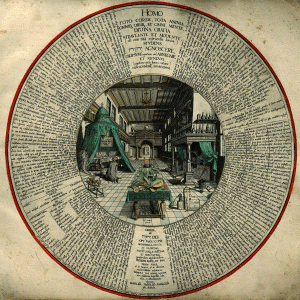
Hermetic alchemist
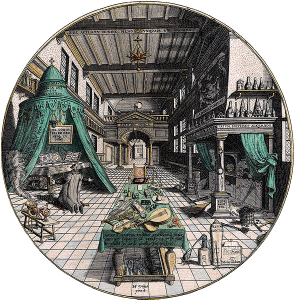
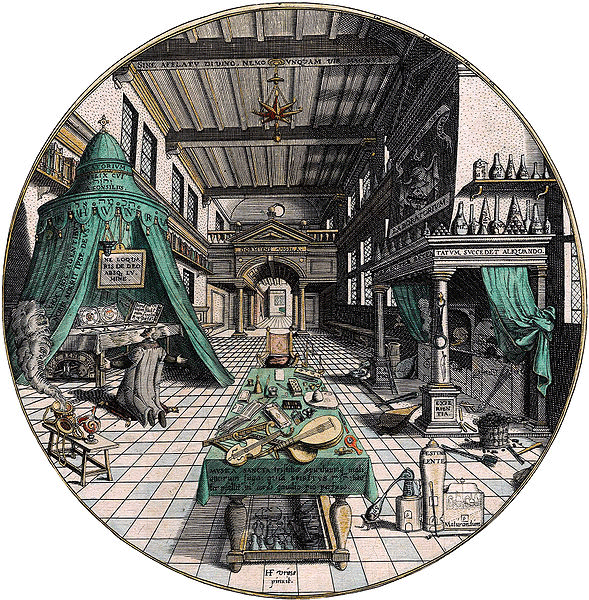
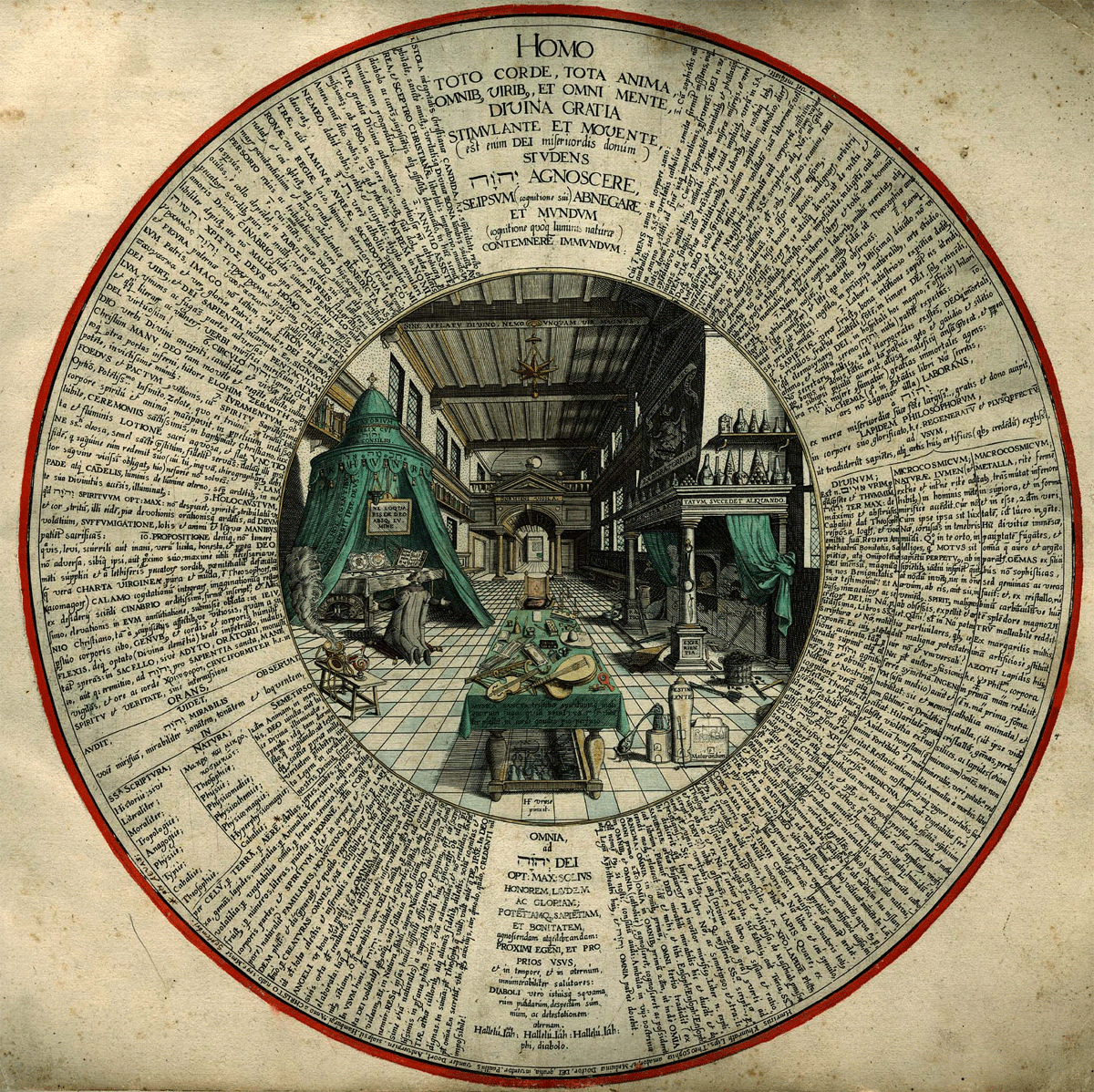
"The First Stage of the
Great Work," better-known as the "Alchemist's Laboratory."
The drawing of the laboratory is credited to architectural
painter Hans Vredeman de Vries (1527-1604) and shows
Khunrath in his laboratory.
Khunrath's brushes with
John Dee and Thölde and Paracelsian beliefs led him to
develop a Christianized natural magic, seeking to find the
secret prima materia that would lead man into eternal
wisdom. The Christianized view that Khunrath took was framed
around his commitment to Lutheran theology. He also held
that experience and observation were essential to practical
alchemical research, as would a natural philosopher.
His most famous work on alchemy is the Amphitheatrum
Sapientiae Aeternae (Amphitheater of Eternal Wisdom), a work
on the mystical aspects of that art, which contains the
oft-seen engraving entitled "The First Stage of the Great
Work," better-known as the "Alchemist's Laboratory." The
book was first published at Hamburg in 1595,with four
circular elaborate, hand-colored, engraved plates heightened
with gold and silver which Khunrath designed and were
engraved by Paullus van der Doort. The book was then made
more widely available in an expanded edition with the
addition of other plates published posthumously in Hanau in
1609. Amphitheatrum Sapientiae Aeternae is an alchemical
classic, combining both Christianity and magic. In it,
Khunrath showed himself to be an adept of spiritual alchemy
and illustrated the many-staged and intricate path to
spiritual perfection. Khunrath's work was important in
Lutheran circles. John Warwick Montgomery has pointed out
that Johann Arndt (1555–1621), who was the influential
writer of Lutheran books of pietiesm and devotion, composed
a commentary on Amphitheatrum. Some of the ideas in his
works are Kabbalistic in nature and foreshadow
Rosicrucianism.
Death
Khunrath may have
encountered some opposition to his alchemical work because
most of his publications on alchemy were published widely
after his death. He died in poverty in either Dresden or
Leipzig on September 9, 1605. The tension between
spirituality and experiment in Amphitheatrum Sapientiae
Aeternae brought about its condemnation by the Sorbonne in
1625.
-- "Heinrich Khunrath," by
Wikipedia
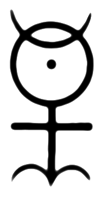
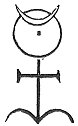
Dee's glyph, whose
meaning he explained in
Monas Hieroglyphica as representing (from top to
bottom): the moon; the sun; the elements; and fire.
The Monas Hieroglyphica (or
Hieroglyphic Monad) is an esoteric symbol invented and
designed by John Dee, the Elizabethan Magus and Court
Astrologer of Elizabeth I of England. It is also the title
of the 1564 book in which Dee expounds the meaning of his
symbol.
The
Hieroglyphic embodies Dee's vision of the unity of the
Cosmos and is a composite of various esoteric and
astrological symbols. Dee wrote a commentary on it which
serves as a primer of its mysteries. However, the obscurity
of the commentary is such that it is believed that Dee used
it as a sort of textbook for a more detailed explanation of
the Hieroglyph which he would give in person. In the absence
of any remaining detail of this explanation we may never
know the full significance of the Glyph.
The existence of the
Hieroglyph links Dee to Rosicrucianism but in what way
remains obscure. On the title page of the Rosicrucian
Manifesto The Chymical Wedding of Christian Rosenkreutz, the
Hieroglyph appears beside the text of the invitation to the
Royal Wedding given to Rosenkreutz who narrates the work.
|
On
an evening before Easter-day, I sate at a table, and having
in my humble prayer conversed with my Creator and considered
many great mysteries (whereof the Father of Lights had shewn
me not a few), and being now ready to prepare in my heart,
together with my dear Paschal Lamb, a small, unleavened,
undefiled cake, all on a sudden ariseth so horrible a
tempest, that I imagined no other but that, through its
mighty force, the bill whereon my little house was founded
would fly all in pieces. But inasmuch as this, and the like,
from the devil (who had done me many a spight) was no new
thing to me, I took courage, and persisted in my meditation
till somebody touched me on the back, whereupon I was so
hugely terrified that I durst hardly look about me, yet I
shewed myself as cheerful as humane frailty would permit.
Now the same thing still twitching me several times by the
coat, I glanced back and behold it was a fair and glorious
lady, whose garments were all skye-colour, and curiously
bespangled with golden stars. In her right hand she bare a
trumpet of beaten gold, whereon a Name was ingraven which I
could well read but am forbidden as yet to reveal. In her
left hand she had a great bundle of letters in all
languages, which she (as I afterwards understood) was to
carry into all countries. She had also large and beautiful
wings, full of eyes throughout, wherewith she could mount
aloft, and flye swifter than any eagle. As soon as I turned
about, she looked through her letters, and at length drew
out a small one, which, with great reverence, she laid upon
the table, and, without one word, departed from me. But in
her mounting upward, she gave so mighty a blast on her
gallant trumpet that the whole hill echoed thereof, and for
a full quarter of an hour afterward I could hardly hear my
own words.
In
so unlooked for an adventure I was at a loss how to advise
myself, and, therefore, fell upon my knees, and besought my
Creator to permit nothing contrary to my eternal happiness
to befall me, whereupon, with fear and trembling, I went to
the letter, which was now so heavy as almost to outweigh
gold. As I was diligently viewing it, I found a little Seal,
whereupon was ingraven a curious Cross, with this
inscription IN HOC SIGNO
 VINCES.
As
soon as I espied this sign I was comforted, not being
ignorant that it was little acceptable, and much less
useful, to the devil. Whereupon I tenderly opened the
letter, and within it, in an azure field, in golden letters,
found the following verses written:--
"This day, this day, this, this
The Royal Wedding is.
Art thou thereto by birth inclined,
And unto joy of God design’d?
Then may’st thou to the mountain tend
Whereon three stately Temples stand,
And there see all from end to end.
Keep watch and ward,
Thyself regard;
Unless with diligence thou bathe,
The Wedding can't thee harmless save:
He'll damage have that here delays;
Let him beware too light that weighs."
Underneath stood Sponsus and Sponsa.
--
The Chymical Marriage of Christian
Rosencreutz |
It is indeed at least
possible that Dee showed the Glyph to Johannes Valentinus
Andreae or even an associate during one of his visits to
Central Europe. However, whether Andrae's claims of
authoring the treatise hold any weight is still a hotly
debated question among scholars.
Frances Yates notes that Dee's influence later "spread to
Puritanism in the New World through John Winthrop, an
alchemist and a follower of Dee; Winthrop used the 'monas'
as his personal mark."[1]
-- "Monas Hieroglyphica,"
by Wikipedia |
That
symbol also appeared next to the invitation to Christian
Rosenkreuz in the third Rosicrucian Manifesto published in
the 17th Century—the Chymical Wedding of Christian
Rosenkreuz.
It is a
distinct possibility that a chain of Rosicrucian influence
was being passed on traditionally from person to person,
showing a Rosicrucian link. If we translate Spinoza's
apud Henricum Kunraht to "in the house of Heinrich Khunrath,"
perhaps Spinoza was revealing his Rosicrucian association in
the roundabout manner used by many other Rosicrucians
throughout history to reveal their association.
Perhaps
the argument by itself is not conclusive. Intentional
obscurity never is. But that coupled with the "rose"
argument which could quite conceivably refer to a double
meaning, along with Point 5, the indirect reference through
friends could effectively argue against the claim that
Spinoza was not a Rosicrucian.
|
2. Anulo assistentiae gratiae Diuinae admonitorio,
uirtuosae uidelicet catholicaeque promissionis, ab ipso, in cuius ore
non inuentus fuit dolus, datae, dicentis, Amen, amen dico uobis, si quid
petieritis Patrem in nomine meo, dabit uobis, petite et accipietis:
digito anulari decoratus.
[Google translate: Ring insurance
admonitorio to divine grace, namely virtuous catholicaeque
of promise, by him, in whose mouth was no guile was found,
given to them, saying, Verily, verily, I say unto you,
Whatsoever ye shall ask the Father in my name, will give
you, ask and you shall receive: the finger with the
RING-MAKER.]
--
Amphitheatrum
Sapientiae Aeternae, by
Heinrich Khunrath
|
Known
Friends and Associates
We can
learn much about a person by looking at his friends and
associates. Even though Spinoza was excommunicated from the
Jewish faith, and also avoided by much of the non-Jewish
population of Holland, he still circulated in some rather
influential circles. Were his associates Rosicrucian? Did
his philosophical meetings have a Rosicrucian undercurrent?
We know for a fact that Spinoza was in contact with, and
impressed by, two Rosicrucians. First, there was Wilhelm
Gottfried Leibnitz, whose affiliation with the Order is
established by a published letter stating that he was at one
time the secretary of a Rosicrucian Lodge. And secondly,
there was Dr. Helvitius, whom Spinoza commented to in a
letter to Jarig Jellis concerning Dr. Helvitius' alchemical
transmutation. Spinoza allegedly observed one such
transmutation. Also, we find that Spinoza's well-known
friend, Jan de Witt, the Grand Pensionary of Holland, was
tutored at an early age by Isaac Beekman, a known
Rosicrucian. Could such influence have a lasting effect
upon Jan de Witt as is often the case? And, if so, could
that influence have been passed on to Spinoza?
Without
actual written verification in Spinoza's own hand claiming
Rosicrucian affiliation, it can be argued that he was not a
Rosicrucian by claiming the above illustrations as mere
suppositions. Perhaps, even any one of the above arguments
by itself could be disregarded as inconsequential. However,
all together, they will, at the very least, shed some doubt
among those who deny Spinoza's Rosicrucian affiliation.
Keeping in mind the necessary obscurity of 17th Century
Rosicrucian members and even outright denials made out of
deception in order to protect the movement, the "hints" left
behind are one way of keeping historical records intact.
Yet, it is often difficult for the uninitiated historian to
be able to pick up on such "hints." This is obvious in many
of the written histories that have been published recently
and in the past concerning the Rosicrucians. And this also
contributes to the difficulty in the identification of a
personage as being a Rosicrucian.
Most of
you have probably at one time or another, read an article or
a book published outside of our Order on the subject of
Rosicrucian history, and perhaps you have found certain
points of disagreement. We can say that many such works are
the result of well-meaning but incomplete research.
Sometimes it is even difficult to gain an historical
perspective regarding recent times, let alone several
centuries in the past. For example, there was an article on
the Rosicrucians which claimed that an Order was started in
this century by "Dr. H. Spencer Clymer"! If it is that
difficult to be accurate today, then imagine the difficulty
in researching the past where we have access to far less
factual material.
In
conclusion, we can state with a reasonable amount of
certainty, that Spinoza was a Rosicrucian, as his life and
writings exemplify those characteristics which we should
consider to be of the classic Rosicrucian movement.
Various signs point to the validity of this argument, and we
feel that the subtle "hints" we have described in this
article can be relied upon to determine this mystic
philosopher's relationship in regards to the Rosicrucian
tradition.
--
"Benedict Spinoza: Philosopher, Mystic, Rosicrucian," by
Gary L. Stewart
THE SPIRITUAL TEACHER OF
HIERONYMUS BOSCH
There is a possibility
that the initials "I.A." which are mentioned in the
Fama Fraternitatis, refer to a certain Jacob van
Almaengien, a Jew. In the
Fama, this individual is expressly described as a
"non-German". If this is so, Jacob can be regarded as one of
the first disciples of Christian Rosencreutz, and the
person mentioned by Cuperinus in his curious history --
Die merkwuerdige Geschichte der Stadt von den Bosch,
written at the time of Philip, Duke of Brabant and King of
Castile/ Fraenger's attention was drawn to the original
documents by Jan Mosmans Archivist of the church of St. Jan,
at s'Hertogenbosch.
Cuperinus writes as
follows:
"In the year of Our
Lord, 1496, on the thirteenth day of the month of
December, the new Prince and Duke, Philip, came into the
city of Bosch, where he was received with much merriment
and rejoicing. There, on the fifteenth day of the same
month, the people swore fealty to him and received him
as Duke of Brabant, in the presence of his father
Maximilian, the Emperor of Rome. The City made him a
gift of two large and valuable oxen with silvered horns
and two hogsheads of wine. When the ceremony had been
concluded, the young Prince Philip rode to the church of
St. Jan. There a certain Jew was baptized by the Dean,
Master Ghysbert de Bie, in the presence of Duke Philip,
of Lord Jan van Bergen, of Cornelius van Sevenbergen,
and of other noble Lords who all stood as godparents and
witnesses, and he was given the new name of Philip van
Saint Jan. His name previously had been Jacob van
Almaengien; but this Jew did not remain constant (to
his new religion); he neglected his Christianity and
again became a Jew."
Fraenger comments that at
the same time, Jacob van Almaengien, alias Philip van St.
Jan, became a member of the illustrious Brotherhood of Our
Lady (Liebfrauen Bruderschaft). We find a record of "Master
Philip van St. Jan, erstwhile a Jew", as a member, in their
Year-book, 1496/7. The title of Master, Magister, indicated
that he had received a University education. Yet, despite
such an illustrious baptism, the proselyte had apparently
the impudence regardless of the implied affront to the ruler
of the country, the city, and the burghers, to return to his
former religion, after only a few brief years: For those
times he was a unique example of monstrous religious
egocentricity.
It is probable, in our
view, that Cuperinus took exception to Jacob's neglect of
his religious (Church) duties. Cuperinus expresses his wrath
at this in his last sentence. As Fraenger failed to
recognise the abundant evidence of Rosicrucian ideas and
concepts in the paintings of Bosch, the real reason for
Cuperinus' condemnation of Jacob also escaped him, i.e.,
Jacob's apparent neglect of his church duties. Had he
recognised the Rosicrucian content, and its connections,
Fraenger would have realised the impossibility, at least at
that time, in s'Hertogenbosch, of a convert from Judaism to
Christianity being re-baptised into Judaism.
Bosch, the painter, was
also a member of the illustrious Brotherhood of Our Lady,
and belonged to the inner circle, where Rosicrucian ideas
were familiar to the members. It is significant, therefore,
that Jacob was admitted to this Order in the very hour of
his baptism.
At this point, it is
necessary once again to refer to the
Fama Fraternitatis. We find in
The Chymical Wedding of Christian Rosencreutz, A.D.
1459, and the
Fama Fraternitatis that, literally "'I.A.' brought
in a skilled painter, 'B'''. This painter, "B", could easily
be Hieronymus Bosch; at all events, in the documents of
Cuperinus, there is mention of a meeting of two men whose
initials are "LA." and "B" respectively.
Recent radiological
examinations of two different versions of The Temptations
of St. Anthony further point to the identities of these
two people. Both carry the signatures "I.A." and "B".
(Photos alleged to be of both are reproduced, (Figs. 121,
144.) Strangely, an extended "M" is written beneath the
signature in the first illustration. This may be intended to
refer to the book, "M" (Liber Mundi) which is
mentioned in the
Fama. There are a large number of other indications
pointing in this same direction, but research into this has
not been fully completed.
The late Johan Brouwer
gives an authoritative account, from his intimate knowledge
of Spanish history about the year 1500, of his research into
documents of that time. In Johanna de Waanzinnige
[16] he describes how a priest of Salamanca denigrated
Philip the Fair and scornfully called him a "friend of Jews"
(after the death of Johanna's husband). This priest was
correct in his statement, as Philip gave his name to the
Jew, Jacob van Almaengien (i.e. Germany) according to
Cuperinus, and he was present at the baptism of Jews in
Veere, Zeeland, in the year 1497. Most probably it is
correct to suspect the support of the Emperor Maximilian,
Philip's father, for all this, as Philip the Fair was still
too young to be able fully to appreciate the value and
meaning of Rosicrucian teaching. Maximilian had also kept
Erasmus Grasser, the sculptor, in his service for a
considerable time (see Figs. 146 and 147). He must have
known exactly what was afoot and what the world philosophy
was that stood behind it all.
-- "The
Pictorial Language of Hieronymus Bosch," by Clement A.
Wertheim Aymes
To the most
excellent Majesty of the famous King Maximilian
--
"Monas Hieroglyphica
(The Hieroglyphic Monad)," by Dr. John Dee |
Concluding his essay, Strauss refers to
independence, whose semantic frame includes liberty and freedom: the
independence of Spinoza from the community of his origins, the political
independence of the Jews, which Strauss considered to be Spinoza's
testament to the Jews (and which Strauss, as a political Zionist, wished
for the Jewish nation), and also independence as intellectual freedom,
exemplified in different manners by both Spinoza and Cohen. In this
respect, Strauss seems to include Cohen implicitly among those who
should (or do, even though unaware) "venerate" Spinoza because of
Spinoza's freedom in thinking and philosophizing, if for no other
reason. By virtue of being a thinker who was deeply inspired by the
spirit of the Enlightenment Cohen might thus be considered an heir of
Spinoza's teaching, namely of his independence and freedom[44].
V.
The result of Strauss's evaluation of Cohen's critique
of Spinoza is a successful apology of Baruch Spinoza and his TPT.
Nevertheless, it might also be considered a vindication of Cohen, namely
from two perspectives.
First, Cohen's question is taken by Strauss with the
seriousness that it deserves: Strauss shows in this case -- as in the
rest of his life -- a reverence not only for Cohen as someone whom he
called "a passionate philosopher and a Jew passionately devoted to
Judaism"[45] and whose figure fascinated
him from early on, but also for Cohen's teaching from a more strictly
philosophical point of view. Strauss articulated the importance of
Cohen's legacy for his own approach to Spinoza in his "Preface" to
Spinoza's Critique of Religion. In spite of his defense of Spinoza
against Cohen's attack, Strauss still seems to look for a legitimate
reason for Cohen's attitude towards Spinoza, showing himself as a
disciple whose reverence for his master remains untouched by the fact
that he can't agree with him. In this sense, Strauss's position is "Cohenian"
since he answers questions raised by Cohen in keeping with the
philosophical spirit of "independence" that he considers the common
property of both, Spinoza and Cohen.
Second, Strauss also seems to follow in Cohen's
footsteps in that he espouses independence and freedom of thought while
struggling to remain a philosopher and a Jew (if not a believing Jew) in
a non-Jewish world. In this sense, Strauss implicitly affirms the
relevance of Cohen's legacy for the Jewish philosophical heritage when
he takes as starting points for his own inquiries the very questions
raised by Cohen. More explicitly, Strauss maintains that what Cohen said
"is by no means irrelevant, and is (…) worthy of the study of everyone"[46]
who is concerned with the struggle of being both a philosopher and a
Jew. Strauss seems to be "Cohenian" because he shared with Cohen this
same struggle, thus inheriting some of Cohen's virtue of fidelity.
Delivering a lecture at the Hillel House of the University of Chicago,
Strauss argued that "it is impossible not to remain a Jew. It is
impossible to run away from one's origins"[47]
; Strauss's argument sounds undoubtedly Cohenian: "It is necessary to
accept one's past. That means that out of this undeniable necessity one
must make a virtue. The virtue in question is fidelity, loyalty, piety
in the old Latin sense of the word pietas"[48].
It is worthy of notice that Strauss cited Cohen's concept of fidelity
also in the second-last paragraph of his "Introductory Essay" to Hermann
Cohen's Religion of Reason: "Almost his (viz. Cohen's)
whole work, his whole life bears testimony to this fidelity and his
gratitude to the Jewish heritage -- a fidelity limited only by his
intellectual probity, by a virtue that he traced to that very heritage"[49].
It seems to me that Strauss, in his lifelong struggle to remain both
a philosopher and loyal Jew,
exercised the same virtue.
_______________
Notes:
1.
Letter to Dr. Gottschalk, December 28, 1931; however, the letter
proceeds with the following statement: "Cohen is much too original and
deep a thinker that the doubtfulness of his teaching can release us
thereby from listening, in any event, to that which he says" (cited in
Alan Udoff, "On Leo Strauss: An Introductory Account", Leo Strauss's
Thought: Toward a Critical Engagement, ed. by Alan Udoff, Boulder:
L. Rinner Publishers, 1991: 1-29, esp. pp. 22-23 n3).
2.
Steven Schwarzschild, "Do Noachites have to believe in Revelation? (A
passage in Dispute between Maimonides, Spinoza, Mendelssohn and H.
Cohen)" in The Jewish Quarterly Review, 52 (1961-1962), pp.
296-308, and 53 (1962-1963), pp. 30-65, esp. p. 38
3.
Hermann Cohen, "Die religiösen Bewegungen der Gegenwart" repr. in
Hermann Cohens Jüdische Schriften, ed. B. Strauß, with an
introduction by Franz Rosenzweig, Berlin: Schwetschke, 1924, (three
volumes; henceforth: JS I-III), vol. I, 36-65, esp. 55.
4.
JS III 361.
5.
Franz Nauen, "Hermann Cohen's Perceptions of Spinoza: A Reappraisal",
AJSReview, 4 (1979), pp. 111-124, esp. p. 123.
6.
See Hermann Cohen, Kants Begründung der Ethik, 2nd edition,
Berlin: Bruno Cassirer, 1910, p. 467.
7.
Cohen had many theoretical reasons to dislike Spinoza and his pantheism
but these reasons fail to explain the violence of Cohen's verdict on
Spinoza. For a better understanding of Cohen's approach to Spinoza, see
Nauen, op. cit., and cf. Ernst Simon, "Zu Hermann Cohens Spinoza-Auffassung",
repr. in Brücken. Gesammelte Aufsätze, Heidelberg: Lambert
Schneider, 1965, pp. 205-214, and Hans Liebeschütz, "Hermann Cohen und
Spinoza", Bulletin of the Leo Baeck Institute, 12 (December
1960), pp. 225-238.
8.
See Helmut Holzhey, Cohen und Natorp, 2 vols., Basel/Stuttgart:
Schwabe & Co., 1986, vol. 1, p. 37; Sylvain Zac, La philosophie
religieuse de Hermann Cohen, Paris: J. Vrin, 1984, p. 19.
9.
See Hermann Cohen, System der Philosophie. Zweiter Teil: Ethik des
reinen Willens, Berlin: Bruno Cassirer, repr. in Werke, vol.
7, with an English Introduction by S. S. Schwarzschild, Hildesheim: Olms,
1981, esp. pp. 569-570 (henceforth ErW). For a description of Cohen's
ethical theory of virtues, see Andrea Poma, The critical philosophy
of Hermann Cohen, transl. by John Denton, Albany: State University
of New York Press, 1997.
10.
ErW 577.
11.
Hermann Cohen, "Der Religionswechsel in der neuen Ära des Antisemitismus",
Allgemeine Zeitung des Judentums, 2. Oktober 1890, pp. 489-490,
repr. in JS II 342-345.
12.
See ErW 583: "Without fidelity, ethical self-consciousness remains a
goal that the ethical work-in-progress will never achieve". See also
Hartwig Wiedebach, Die Bedeutung der Nationalität für Hermann Cohen,
Hildesheim, Olms, 1997, esp. p. 44.
13.
See ErW 572.
14.
Cohen, Hermann, Die Religion der Vernunft aus den Quellen des
Judentums, nach dem Manuskript des Verfassers neu durchgearbeitet
und mit einem Nachwort versehen von Bruno Strauß, Frankfurt am Main:
Kauffmann (henceforth RV), 1929; trans. S. Kaplan with an Introduction
by L. Strauss, Religion of Reason out of the sources of Judaism,
New York: Frederick Ungar (henceforth RoR), 1972; RV 509, RoR 441. Here,
incidentally, Treue is translated as "faithfulness." I prefer to use
"fidelity" as the best equivalent to the German Treue.
15.
This can be seen, in Cohen's opinion, especially by looking at Spinoza's
explanation of the ben noah: see RV 379-388. A discussion of
Cohen's objections to Spinoza on this topic can be found in
Schwarzschild, op. cit.
16.
JS III 363.
17.
Nauen, op. cit., p. 124.
18.
Leo Strauss, "Cohens Analyse der Bibelwissenschaft Spinozas", Der
Jude, vol. VIII (1924), pp. 295-314, repr. in Leo Strauss,
Gesammelte Schriften, ed. by Heinrich Meier, Stuttgart: Verlag J. B.
Metzler (henceforth: GS 1-3), vol. 1, 1997, pp. 363-386; Engl. in Leo
Strauss, The Early Writings (1921-1932), translated and edited by
Michael Zank, Albany (N.Y.): State University of New York Press, 2002,
pp. 140-172.
19.
Die Religionskritik Spinozas als Grundlage seiner Bibelwissenschaft,
Berlin: Akademieverlag, 1930.
20.
Cf. Michael Zank, "Introduction" in Leo Strauss, The Early Writings
(1921-1932), pp. 10-11.
21.
See Alexander Altmann, "Leo Strauss: 1899-1973", Proceedings of the
American Academy for Jewish Research, XLI-XLII (1973-1974),
xxxiii-xxxvi, esp. p. xxxvi; Alan Udoff, "On Leo Strauss: An
Introductory Account", loc. cit.; Kenneth Hart Green, "Leo Strauss as a
Modern Jewish Thinker", in Leo Strauss, Jewish Philosophy and the
Crisis of the Modernity, ed. by Kenneth Hart Green, Albany: State
University of New York Press, 1997, pp. 1-84, esp. pp. 17-25; Michael
Zank, "Introduction" in Leo Strauss, The Early Writings
(1921-1932), esp. p. 40 n33; Leora Batnitzky, "Hermann Cohen and Leo
Strauss", in Hermann Cohen's Ethics, ed. by David Novak and
Robert Gibbs, forthcoming, which analyzes Strauss's philosophical
relation to Cohen from a methodological point of view. (I wish to thank
Leora Batnitzky who was so kind as to provide me with an advance copy of
her hitherto unpublished essay.)
22.
Leo Strauss, "Zur Bibelwissenschaft Spinozas und seiner Vorläufer",
Korrespondenzblatt des Vereins zur Gründung und Erhaltung einer Akademie
für die Wissenschaft des Judentums, 7 (1926), pp. 1-22; repr. in GS
1, pp. 389-414; Engl. in The Early Writings (1921-1932), pp.
173-200, esp. p. 173.
23.
Franz Rosenzweig, "Einleitung" in Hermann Cohen, "Ein Ungedruckter
Vortrag Hermann Cohens über Spinozas Verhältnis zum Judentum", in
Festgabe zum Zehnjährigen Bestehen der Akademie für die Wissenschaft des
Judentums. 1919-1929, Berlin: Akademie Verlag, 1929, pp. 42-44, p.
43.
24.
Leo Strauss, The Early Writings (1921-1932), p. 173. For the
original, see "Zur Bibelwissenschaft Spinozas und seiner Vorläufer",
loc. cit., p. 183.
25.
Leo Strauss, The Early Writings (1921-1932), p. 147 (in the
original the entire sentence is emphasized as the general conclusion to
section I of the essay).
26.
Ibid., p. 152 (in the original, the entire sentence is emphasized as the
general conclusion to section II of the essay).
27.
Ibid., p. 157 (in the original, the entire sentence is emphasized as the
general conclusion to section III of the essay).
28.
Ibid., p. 158.
29.
Ibid., p. 161.
30.
Ibid.
31.
Ibid.
32.
Leo Strauss, "The Testament of Spinoza", Bayerische Israelitische
Gemeindezeitung. München, vol. 8 n. 21 (November 1st, 1932), p. 322,
324-326, repr. in GS 1, pp. 415-422; Engl. in The Early Writings
(1921-1932), pp. 216-223.
33.
The Early Writings (1921-1932), pp. 219-20 (emphases in the
original).
34.
Ibid., p. 220.
35.
Ibid.
36.
See Leo Strauss, Die Religionskritik Spinozas als Grundlage seiner
Bibelwissenschaft. Untersuchungen zu Spinozas Theologisch-politischem
Traktat, Berlin: Akademie Verlag, 1930, repr. in GS 1, pp. 1-361,
esp. p. 214; Engl. transl. by E. M. Sinclair, Spinoza's Critique of
Religion, New York: Schocken, 1965. It seems to me worth of notice
that Cohen also remarked about Spinoza's process of estrangement [Entfremdung]
from Judaism (see JS III 360). Here we may notice an important
difference between Cohen's and Strauss's understanding of Spinoza's
relation to Jewish identity: Cohen considered Spinoza as continuously
related to the Jewish world, whereas Strauss considered it possible and
legitimate to acknowledge Spinoza's claim of neutrality toward Judaism
as a result of his distance from Judaism.
37.
Cited in "The Testament of Spinoza", loc. cit., p. 220.
38.
Ibid.
39.
Ibid., p. 221.
40.
Ibid., p. 222.
41.
Ibid., p. 221.
42.
Ibid.
43.
Ibid., p. 222 (emphases in the original).
44.
See also Leo Strauss, "Preface" to Spinoza's Critique of Religion,
loc. cit., pp. 137-177, esp. p. 168, where Strauss argues that Cohen
seemed unaware of Spinoza's legacy in his own way of thinking and
philosophical assumptions.
45.
Leo Strauss, "A Giving of Accounts", repr. in Jewish Philosophy and
the Crisis of the Modernity, pp. 457-466, esp. p. 460.
46.
Leo Strauss, "Why We Remain Jews", repr. in Jewish Philosophy and the
Crisis of the Modernity, pp. 311-356, esp. p. 344.
47.
Ibid. p. 317.
48.
Ibid., p. 320.
49.
Leo Strauss, "Introductory Essay" in Hermann Cohen, Religion of
Reason Out of the Sources of Judaism, repr. in Jewish Philosophy
and the Crisis of Modernity, pp. 267-282, esp. p. 281.
Return
to Table of Contents
|