|
by Gary L. Stewart
On
November 24, 1632, a great philosopher was born in Holland
of Spanish-Portuguese Jewish parents. Benedict Spinoza—an
original thinker destined to become one of the world's
greatest modern philosophers—has exercised such a profound
impact upon modern thought that even today there is much
debate upon his philosophy, and only within the last 100
years has his influence been thoroughly recognized for its
effect on today's thinking. Spinoza was little understood in
his time, consequently was labeled an atheist, and was
excommunicated from his Jewish faith when he was just 24
years old. Only about a century ago were his writings
seriously examined and his pantheism fully realized. It was
then that the label "the God-intoxicated philosopher" was
ascribed to him.
Spinoza
is one of the few people who can be called a true
individual. Yet, in accordance with his philosophical
beliefs, he denied such individuality by recognizing that
true individuality is the realization of universality.
He lived his life accordingly and, as a result, he became
misunderstood and eventually obscure until now. In the
past, a newspaper article cast doubts about the contention
that Spinoza was a Rosicrucian. The news writer proposed
that Spinoza used the rose symbol on his personal seal not
to identify himself as a Rosicrucian but, rather, to
coincide with his name—the argument being that the name
"Spinoza" is similar to the Latin espinosa which means "rose
with sharp thorns" and consequently the rose he used "has no
Rosicrucian significance." We must ask, then, what proof
can support the contention that Benedict Spinoza was indeed
a Rosicrucian? The question may seem simple enough; however,
the answer is far more complex than is often realized.
Therefore, it is necessary to divert our attention
momentarily from the specific question at hand to a brief
and general historical approach.
Historical Approach
Traditionally, the Rosicrucian movement kept membership
strictly confidential. There are many reasons for this,
but the primary ones applicable here are political and
religious. Rosicrucians have always taught, among other
things, freedom of thought and religion. In the 17th Century
persecution by the Church against any allegedly "heretical"
person or group was intense. At that time the church viewed
independent thinking as not only dangerous but also as
undermining its very existence. Needless to say, it was
necessary for such individuals to hide there affiliation or
even deny it when accused of membership. As a group, the
Rosicrucian brotherhood instructed its initiates in past
ages to maintain a vow of secrecy and not to reveal even
their own affiliation unless permitted to do so by a high
official in the Order.
Another
point to consider is that the history of the Rosicrucian
tradition is divided into two categories: the chronological,
where documentation is available; and the traditional, where
Rosicrucian history is related by word of mouth. It should
be noted, however, that much of the movement's traditional
history can be documented through careful and painstaking
research if one knows what to look for.
In the
16th and 17th Centuries, Rosicrucian authors used pseudonyms
in connection with their work, and only members of the
Rosicrucian brotherhood knew their true identities.
Naturally, public references would have no such information
at their disposal. As a result, unless an individual
authored books explaining the Rosicrucian movement or its
teachings, which many did in their own names or through
pseudonyms known only to other members, there was no outward
indication of any Rosicrucian affiliation. Given the times,
just because persons did not publicly reveal their
affiliation with the movement does not mean they were not
privately affiliated with this secret organization. And, on
the other hand, an individual's public claim of Rosicrucian
affiliation does not necessarily prove membership. However,
we can basically utilize five general points to verify
membership:
Five
Points Of Past Membership
1.
Personal revelation by the individual.
2. Work signed by a Rosicrucian symbolic name.
3. Traditional accounts from the brotherhood itself
referring to a personal affiliation.
4. Manuscripts and books containing terminology and symbols
distinctly Rosicrucian.
5. Indirect reference through friends and associates.
The case
of Spinoza's affiliation is quite interesting and the last
three points are most readily applicable in this regard.
Rosicrucian Content in Published Works
Through published material it is known that Spinoza is
maintained as having been a Rosicrucian. First, we can
divide that claim into two parts, thus approaching the
"proof' dualistically. The term "Rosicrucian" can be used
generically as "Rosicrucian in thought" or, secondly,
specifically, as being affiliated with a "Rosicrucian group
or body." In the former writings most notably his Ethics
are very much in agreement with Rosicrucian philosophy.
In our terminology we would not only relegate Spinoza as a
rationalist, which he indeed was, but also as a mystical
pantheist which concurs so closely with the Rosicrucian
teachings that it seems almost identical in many instances.
There are many ideas in Spinoza's works which point in that
direction.
For
instance, we can briefly state that Spinoza's definition of
God is likened to an omnipotent, impersonal essence infusing
all existence and inseparable from that existence. This
definition accounts for Spinoza's pantheism. Then, simply,
Spinoza proceeds to explain how creation manifests by using
a rather complex structure of explanation, as do the
Rosicrucians.
We
recognize that there is much academic philosophical debate
concerning whether Spinoza could be classified as a true
mystic, and we may refer to the many Spinoza Symposiums that
are held annually in the Netherlands, and specifically to
the one held in Leiden in 1973. And even though we are
sympathetic with the "mystic" argument, the point is
irrelevant to the argument of Spinoza's Rosicrucian
connections. Along the same train of thought,
academically and philosophically it could also be argued,
based upon many tenets of Rosicrucian philosophy, whether or
not Rosicrucians were really mystics. It all depends upon
how one defines mysticism.
Publication Notations of Rosicrucian Terminology and Symbols
Point 4,
referring to manuscripts and books containing Rosicrucian
terminology and symbols, throws new light upon the
verification of Spinoza's membership. Disregarding the
"rose" argument mentioned earlier, let us refer to the
title page of Spinoza's Theological and Political Treatise
where we find the Latin phrase apud Henricum Kunraht. First
of all, Heinrich Khunrath died in 1605, almost thirty years
before Spinoza was born. Then, we may wonder, why does the
name appear? If we look a little further we find that
Heinrich Khunrath was a Rosicrucian and that his major work
Amphitheatre of
Eternal Wisdom contained seven Arcanes, or Rosicrucian
Keys. We find on one of his plates the symbol of the
Hieroglyphic Monad
designed by the English Rosicrucian John Dee.
|
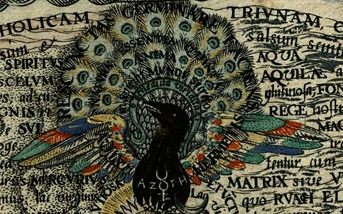
Azoth was
considered to be a universal medicine or universal solvent
sought in alchemy (similar to other alchemical idealized
substance, alkahest, that like azoth was the aim, goal and
vision of many alchemical works it was to achieve). Its
symbol was the Caduceus and so the term, which being
originally a term for an occult formula sought by alchemists
much like the philosopher's stone, became a poetic word
for the element mercury, the name being originally
derived from Arabic al-zā'ūq "the mercury".
Azoth is the essential agent of transformation in alchemy.
It is the name given by ancient alchemists to Mercury,
the animating spirit hidden in all matter that makes
transmutation possible. The spelling consists of the
initial letter of the English, Greek and Hebrew alphabets
followed by the final letters of the English alphabet (Z),
the Greek alphabet (Omega) and the Hebrew alphabet (Tau).
The word comes from the Arabic az z�'uq which means
"Mercury." The word occurs in the writings of many early
alchemists, such as Zosimos, Mary the Jewess, Olympiodorus,
and Jabir ibn Hayyan (Geber). The word Azoth is also
related to the Ain Soph (ultimate substance) of the Kabbalah.
In his masterwork The Secret Teachings of All Ages. Manley
P. Hall explained this connection: "The universe is
surrounded by the sphere of light or stars. Beyond that
sphere is Schamayim, who is the Divine Fiery Water, the
first outflow of the Word of God, the flaming river pouring
from the presence of the eternal mind. Schamayim, who is
this fiery Androgyne, divides. His Fire becomes Solar fire
and his Water becomes Lunar water in our universe. Schamayim
is the Universal Mercury or Azoth -- the measureless spirit
of life. That original spiritual fiery water comes through
Eden ("vapor" in Hebrew) and pours itself into the four main
rivers of the four Elements. This comprises the River of
Living Water -- the Azoth -- or fiery mercurial essence,
that flows out from the throne of God and Lamb. In this Eden
(vaporous essence or mist) is the first or spiritual Earth,
the incomprehensible and intangible dust out of which God
formed Adam Kadmon, the spiritual body of man, which must
become fully revealed through time." In his book
Transcendental Magic, Eliphas Levi wrote: "The Azoth or
Universal Medicine is, for the soul, is supreme reason and
absolute justice; for the mind, it is mathematical and
practical truth; for the body it is the quintessence, which
is a combination of gold and light. In the superior or
spiritual world, it is the First Matter of the Great Work,
the source of the enthusiasm and activity of the alchemist.
In the intermediate or mental world, it is intelligence and
industry. In the inferior or material world, it is physical
labor. Sulfur, Mercury, and Salt, which, volatized and
fixed alternately, compose the Azoth of the sages.
Sulfur corresponds to the elementary form of Fire, Mercury
to Air and Water, Salt to Earth." Known as the Universal
Solvent, Universal Cure, and Elixir of Life (elixir vitae),
the Azoth is said to embody all medicines, as well as the
first principles of all other substances. The 16th
century alchemist
Paracelsus was said to have achieved the Azoth, and in
portraits of him carrying his sword, the inscription "Azoth"
can be seen on the pommel or handle. It is said he kept
the infallible remedy handy in a concealed compartment in
the handle in case he needed it in an emergency or if he was
injured in a fight. He said it was the "counter poison" to
any physical, mental, or spiritual threat. As the Universal
Life Force, the Azoth is not only the animating energy (spiritus
animatus) of the body but is also the inspiration and
enthusiasm that moves the mind. In the cosmos and within
each of us, the Azoth is the mysterious evolutionary force
responsible for the relentless drive towards physical and
spiritual perfection. Thus, the concept of the Azoth is
analogous to the light of nature or mind of God. Because
the Azoth contains the complete information of the whole
universe, it is also used as another word for the
Philosopher's Stone. One of the hints for the
preparation of the Stone is Ignis et Azoth tibi sufficiunt
("Fire and Azoth are sufficient"). There are scores of
esoteric drawings depicting the Azoth and how it is used in
the Great Work of alchemy. Examples include the Azoth of the
Philosophers of Basil Valentine and the Hieroglyphic Monad
of Dr. John Dee.
The
term was considered by occultist Aleister Crowley to
represent a unity of beginning and ending by tying together
the first and last letters of the alphabets of antiquity[1];
A/Alpha/Alef (first character of Latin, Greek & Hebrew), Z
(final character in Latin), O as Omega (final character in
Greek) and Th as Tau (final character in Hebrew). In this
way permeation and totality of beginning and end was
symbolised to consider the supreme wholeness and thus the
universal synthesis of opposites as a 'cancellation' (i.e.
solvent) or cohesion (i.e. medicine), and in such a way is
similar to the philosophical "absolute" of Hegel's
dialectic. Crowley further made reference in his works
referring to Azoth as "the fluid." calling it the universal
solvent or universal medicine of the medieval alchemical
philosophers, and him in the same place purporting these two
seeming opposites as its lauded function to those said
demographics, accentuating Crowley's personal psychology
about the pervasive properties he ascribes it in his work
and terminology/mythos as a unifier or unification of a
certain extreme instance beholden to a contradict nature, so
seen being unreconcilable a nature if otherwise sought apart
of the philosophical ideal of Azoth. Whether it is thought
to be a material quality or spiritual one.
An
interesting fact is that in some languages, especially
Slavic but some others as well (e.g. Italian, French), azoth
is the name for nitrogen, but the etymology is different (in
Italian it's "azoto" which comes from the Greek ἀ+ζωή "no
life").
--
"Azoth," by Wikipedia
Heinrich Khunrath (ca.
1560–September 9, 1605), or Dr. Henricus Khunrath as he was
also called, was a physician, hermetic philosopher, and
alchemist. Frances Yates considered him to be a link between
the philosophy of John Dee and Rosicrucianism.
Life and Education
Khunrath was born in
Dresden, Germany, the son of the merchant Sebastian Kunrat
and his wife Anna in the year 1560. He was the younger
brother of the Leipzig physician Conrad Khunrath.In the
winter of 1570, he may have enrolled at the University of
Leipzig under the name of Henricus Conrad Lips. The
uncertainties surrounding his life stem from his supposed
use of multiple names. It is certain that in May 1588,
he matriculated at the University of Basel, Switzerland,
earning his Medicinæ Doctor degree on September 3, 1588,
after a defense of twenty-eight doctoral theses.
Career
Khunrath, a disciple of
Paracelsus,
practiced medicine in Dresden, Magdeburg, and Hamburg and
may have held a professorial position in Leipzig. He
traveled widely after 1588, including a stay at the Imperial
court in Prague, home to the mystically inclined Habsburg
emperor Rudolf II. During this court stay Khunrath met noted
magician John Dee in 1589 while the latter was confined in
prison. Dee probably became Khunrath's mentor in
hermetic philosophy and he praised Dee in many of his later
works. In September 1591, Khunrath was appointed court
physician to Count Rosemberk in Trebona. He probably met
Johann Thölde while at Trebona, one of the suggested authors
of the "Basilius Valentinus" treatises on alchemy.
Hermetic alchemist
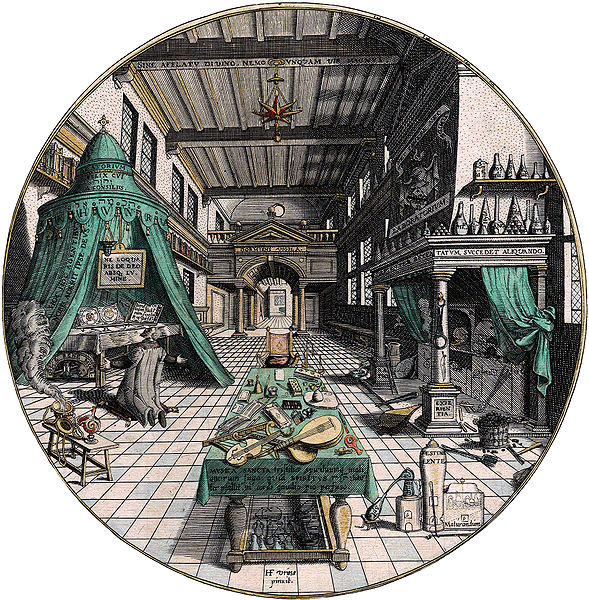
"The First Stage of the
Great Work," better-known as the "Alchemist's Laboratory."
The drawing of the laboratory is credited to architectural
painter Hans Vredeman de Vries (1527-1604) and shows
Khunrath in his laboratory.
Khunrath's brushes with
John Dee and Thölde and Paracelsian beliefs led him to
develop a Christianized natural magic, seeking to find the
secret prima materia that would lead man into eternal
wisdom. The Christianized view that Khunrath took was framed
around his commitment to Lutheran theology. He also held
that experience and observation were essential to practical
alchemical research, as would a natural philosopher.
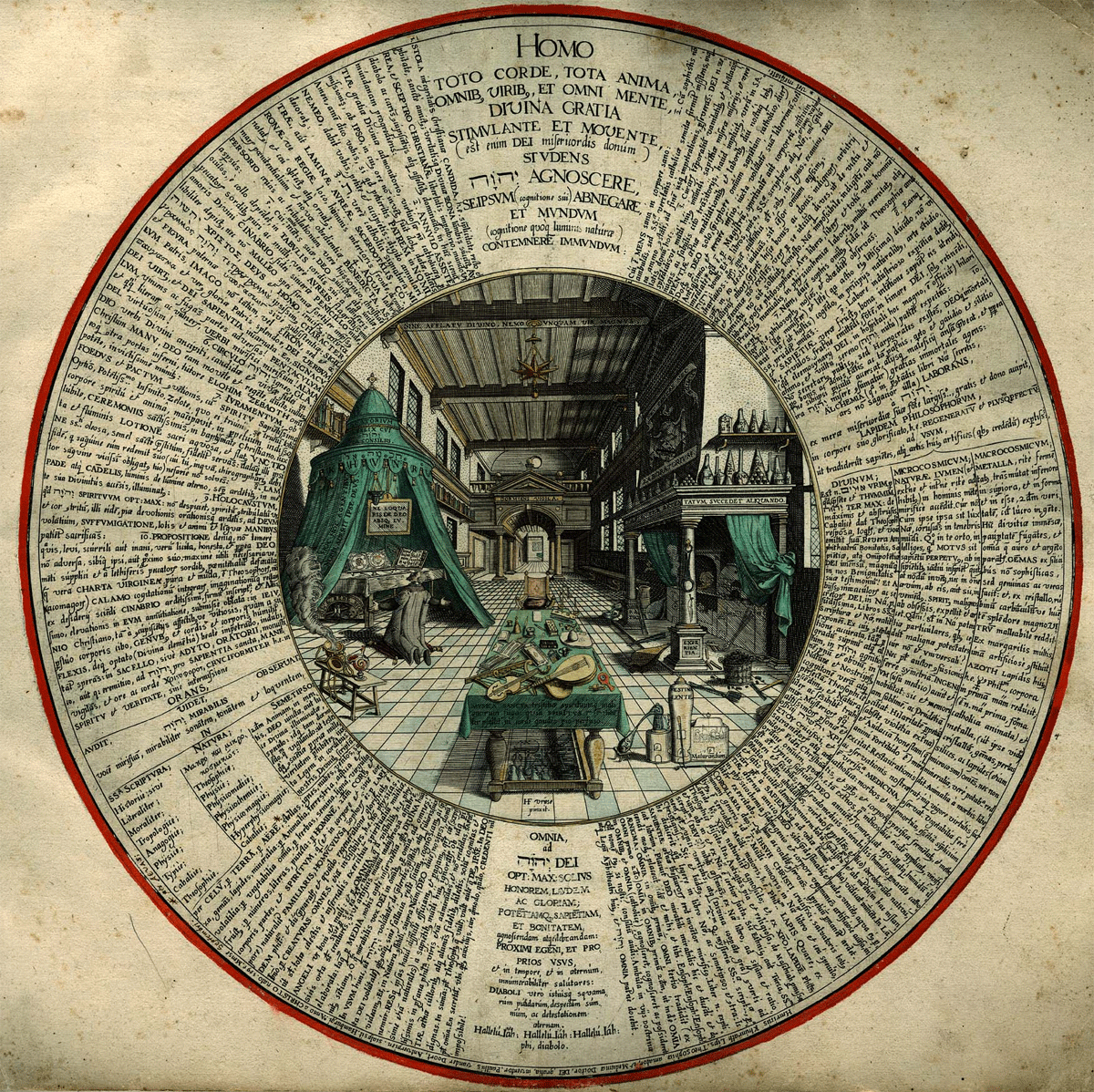
His most famous work on alchemy is the Amphitheatrum
Sapientiae Aeternae (Amphitheater of Eternal Wisdom), a work
on the mystical aspects of that art, which contains the
oft-seen engraving entitled "The First Stage of the Great
Work," better-known as the "Alchemist's Laboratory." The
book was first published at Hamburg in 1595,with four
circular elaborate, hand-colored, engraved plates heightened
with gold and silver which Khunrath designed and were
engraved by Paullus van der Doort. The book was then made
more widely available in an expanded edition with the
addition of other plates published posthumously in Hanau in
1609. Amphitheatrum Sapientiae Aeternae is an alchemical
classic, combining both Christianity and magic. In it,
Khunrath showed himself to be an adept of spiritual alchemy
and illustrated the many-staged and intricate path to
spiritual perfection. Khunrath's work was important in
Lutheran circles. John Warwick Montgomery has pointed out
that Johann Arndt (1555–1621), who was the influential
writer of Lutheran books of pietiesm and devotion, composed
a commentary on Amphitheatrum. Some of the ideas in his
works are Kabbalistic in nature and foreshadow
Rosicrucianism.
Death
Khunrath may have
encountered some opposition to his alchemical work because
most of his publications on alchemy were published widely
after his death. He died in poverty in either Dresden or
Leipzig on September 9, 1605. The tension between
spirituality and experiment in Amphitheatrum Sapientiae
Aeternae brought about its condemnation by the Sorbonne in
1625.
-- "Heinrich Khunrath," by
Wikipedia
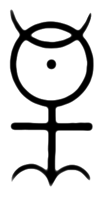
Dee's glyph, whose
meaning he explained in
Monas Hieroglyphica as representing (from top to
bottom): the moon; the sun; the elements; and fire.
The Monas Hieroglyphica (or
Hieroglyphic Monad) is an esoteric symbol invented and
designed by John Dee, the Elizabethan Magus and Court
Astrologer of Elizabeth I of England. It is also the title
of the 1564 book in which Dee expounds the meaning of his
symbol.
The
Hieroglyphic embodies Dee's vision of the unity of the
Cosmos and is a composite of various esoteric and
astrological symbols. Dee wrote a commentary on it which
serves as a primer of its mysteries. However, the obscurity
of the commentary is such that it is believed that Dee used
it as a sort of textbook for a more detailed explanation of
the Hieroglyph which he would give in person. In the absence
of any remaining detail of this explanation we may never
know the full significance of the Glyph.
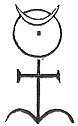
The existence of the
Hieroglyph links Dee to Rosicrucianism but in what way
remains obscure. On the title page of the Rosicrucian
Manifesto The Chymical Wedding of Christian Rosenkreutz, the
Hieroglyph appears beside the text of the invitation to the
Royal Wedding given to Rosenkreutz who narrates the work.
|
On
an evening before Easter-day, I sate at a table, and having
in my humble prayer conversed with my Creator and considered
many great mysteries (whereof the Father of Lights had shewn
me not a few), and being now ready to prepare in my heart,
together with my dear Paschal Lamb, a small, unleavened,
undefiled cake, all on a sudden ariseth so horrible a
tempest, that I imagined no other but that, through its
mighty force, the bill whereon my little house was founded
would fly all in pieces. But inasmuch as this, and the like,
from the devil (who had done me many a spight) was no new
thing to me, I took courage, and persisted in my meditation
till somebody touched me on the back, whereupon I was so
hugely terrified that I durst hardly look about me, yet I
shewed myself as cheerful as humane frailty would permit.
Now the same thing still twitching me several times by the
coat, I glanced back and behold it was a fair and glorious
lady, whose garments were all skye-colour, and curiously
bespangled with golden stars. In her right hand she bare a
trumpet of beaten gold, whereon a Name was ingraven which I
could well read but am forbidden as yet to reveal. In her
left hand she had a great bundle of letters in all
languages, which she (as I afterwards understood) was to
carry into all countries. She had also large and beautiful
wings, full of eyes throughout, wherewith she could mount
aloft, and flye swifter than any eagle. As soon as I turned
about, she looked through her letters, and at length drew
out a small one, which, with great reverence, she laid upon
the table, and, without one word, departed from me. But in
her mounting upward, she gave so mighty a blast on her
gallant trumpet that the whole hill echoed thereof, and for
a full quarter of an hour afterward I could hardly hear my
own words.
In
so unlooked for an adventure I was at a loss how to advise
myself, and, therefore, fell upon my knees, and besought my
Creator to permit nothing contrary to my eternal happiness
to befall me, whereupon, with fear and trembling, I went to
the letter, which was now so heavy as almost to outweigh
gold. As I was diligently viewing it, I found a little Seal,
whereupon was ingraven a curious Cross, with this
inscription IN HOC SIGNO
 VINCES.
As
soon as I espied this sign I was comforted, not being
ignorant that it was little acceptable, and much less
useful, to the devil. Whereupon I tenderly opened the
letter, and within it, in an azure field, in golden letters,
found the following verses written:--
"This day, this day, this, this
The Royal Wedding is.
Art thou thereto by birth inclined,
And unto joy of God design’d?
Then may’st thou to the mountain tend
Whereon three stately Temples stand,
And there see all from end to end.
Keep watch and ward,
Thyself regard;
Unless with diligence thou bathe,
The Wedding can't thee harmless save:
He'll damage have that here delays;
Let him beware too light that weighs."
Underneath stood Sponsus and Sponsa.
--
The Chymical Marriage of Christian
Rosencreutz |
It is indeed at least
possible that Dee showed the Glyph to Johannes Valentinus
Andreae or even an associate during one of his visits to
Central Europe. However, whether Andrae's claims of
authoring the treatise hold any weight is still a hotly
debated question among scholars.
Frances Yates notes that Dee's influence later "spread to
Puritanism in the New World through John Winthrop, an
alchemist and a follower of Dee; Winthrop used the 'monas'
as his personal mark."[1]
-- "Monas Hieroglyphica,"
by Wikipedia
THE SPIRITUAL TEACHER OF
HIERONYMUS BOSCH
There is a possibility
that the initials "I.A." which are mentioned in the
Fama Fraternitatis, refer to a certain Jacob van
Almaengien, a Jew. In the
Fama, this individual is expressly described as a
"non-German". If this is so, Jacob can be regarded as one of
the first disciples of Christian Rosencreutz, and the
person mentioned by Cuperinus in his curious history --
Die merkwuerdige Geschichte der Stadt von den Bosch,
written at the time of Philip, Duke of Brabant and King of
Castile/ Fraenger's attention was drawn to the original
documents by Jan Mosmans Archivist of the church of St. Jan,
at s'Hertogenbosch.
Cuperinus writes as
follows:
"In the year of Our
Lord, 1496, on the thirteenth day of the month of
December, the new Prince and Duke, Philip, came into the
city of Bosch, where he was received with much merriment
and rejoicing. There, on the fifteenth day of the same
month, the people swore fealty to him and received him
as Duke of Brabant, in the presence of his father
Maximilian, the Emperor of Rome. The City made him a
gift of two large and valuable oxen with silvered horns
and two hogsheads of wine. When the ceremony had been
concluded, the young Prince Philip rode to the church of
St. Jan. There a certain Jew was baptized by the Dean,
Master Ghysbert de Bie, in the presence of Duke Philip,
of Lord Jan van Bergen, of Cornelius van Sevenbergen,
and of other noble Lords who all stood as godparents and
witnesses, and he was given the new name of Philip van
Saint Jan. His name previously had been Jacob van
Almaengien; but this Jew did not remain constant (to
his new religion); he neglected his Christianity and
again became a Jew."
Fraenger comments that at
the same time, Jacob van Almaengien, alias Philip van St.
Jan, became a member of the illustrious Brotherhood of Our
Lady (Liebfrauen Bruderschaft). We find a record of "Master
Philip van St. Jan, erstwhile a Jew", as a member, in their
Year-book, 1496/7. The title of Master, Magister, indicated
that he had received a University education. Yet, despite
such an illustrious baptism, the proselyte had apparently
the impudence regardless of the implied affront to the ruler
of the country, the city, and the burghers, to return to his
former religion, after only a few brief years: For those
times he was a unique example of monstrous religious
egocentricity.
It is probable, in our
view, that Cuperinus took exception to Jacob's neglect of
his religious (Church) duties. Cuperinus expresses his wrath
at this in his last sentence. As Fraenger failed to
recognise the abundant evidence of Rosicrucian ideas and
concepts in the paintings of Bosch, the real reason for
Cuperinus' condemnation of Jacob also escaped him, i.e.,
Jacob's apparent neglect of his church duties. Had he
recognised the Rosicrucian content, and its connections,
Fraenger would have realised the impossibility, at least at
that time, in s'Hertogenbosch, of a convert from Judaism to
Christianity being re-baptised into Judaism.
Bosch, the painter, was
also a member of the illustrious Brotherhood of Our Lady,
and belonged to the inner circle, where Rosicrucian ideas
were familiar to the members. It is significant, therefore,
that Jacob was admitted to this Order in the very hour of
his baptism.
At this point, it is
necessary once again to refer to the
Fama Fraternitatis. We find in
The Chymical Wedding of Christian Rosencreutz, A.D.
1459, and the
Fama Fraternitatis that, literally "'I.A.' brought
in a skilled painter, 'B'''. This painter, "B", could easily
be Hieronymus Bosch; at all events, in the documents of
Cuperinus, there is mention of a meeting of two men whose
initials are "LA." and "B" respectively.
Recent radiological
examinations of two different versions of The Temptations
of St. Anthony further point to the identities of these
two people. Both carry the signatures "I.A." and "B".
(Photos alleged to be of both are reproduced. Strangely, an extended "M" is written beneath the signature in the first illustration. This may be intended to
refer to the book, "M" (Liber Mundi) which is
mentioned in the
Fama. There are a large number of other indications
pointing in this same direction, but research into this has
not been fully completed.
The late Johan Brouwer
gives an authoritative account, from his intimate knowledge
of Spanish history about the year 1500, of his research into
documents of that time. In Johanna de Waanzinnige he describes how a priest of Salamanca denigrated
Philip the Fair and scornfully called him a "friend of Jews"
(after the death of Johanna's husband). This priest was
correct in his statement, as Philip gave his name to the
Jew, Jacob van Almaengien (i.e. Germany) according to
Cuperinus, and he was present at the baptism of Jews in
Veere, Zeeland, in the year 1497. Most probably it is
correct to suspect the support of the Emperor Maximilian,
Philip's father, for all this, as Philip the Fair was still
too young to be able fully to appreciate the value and
meaning of Rosicrucian teaching. Maximilian had also kept
Erasmus Grasser, the sculptor, in his service for a
considerable time. He must have
known exactly what was afoot and what the world philosophy
was that stood behind it all.
-- "The
Pictorial Language of Hieronymus Bosch," by Clement A.
Wertheim Aymes
To the most
excellent Majesty of the famous King Maximilian
--
"Monas Hieroglyphica
(The Hieroglyphic Monad)," by Dr. John Dee
The
positioning of a monument to Spinoza at his place of birth
on the Zwanenburgwal in Amsterdam is a tribute to his
philosophical views, the influence of which on Western
thinking is invaluable.
The sculpture is a triad: a platform, an icosahedron, and a
statue of the philosopher form an inseparable whole. The
platform is playfully modeled after the laws of Newton, who,
coming after Galileo and Keppler, described how the planets
form an elliptical arc around the earth, like Spinoza wanted
to encompass and describe the spiritual universe in his
Ethics.
The bronze figure of the philosopher is wrapped in a cloak
that bears symbols which refer to his ideas on tolerance,
freedom of religion and freedom of speech, and which
simultaneously form a link with today’s multicultural
society (for Spinoza was also a son of immigrants). The
cloak is decorated with sparrows, ring-necked parakeets and
roses, lying on its folds in relief. The ring-necked
parakeet, which a few years ago chose the Vondel Park as its
biotope, has proved to be hardy: it has adapted to the
climate, eats what is available and now circulates
throughout the entire city. The sparrow, our most
archetypical bird, is having a difficult time, however – not
that the species is in danger of dying out, but its former
ubiquitousness is no more. And finally, the rose.
Engraved in Spinoza’s signet ring was a rose wreathed with
the word CAUTE (caution). The rose, universal metaphor for
beauty, also has thorns (‘spinoza’ literally means ‘thorn’).
The philosopher’s thinking is represented by an icosahedron,
a mathematical globular form comprised of twenty identical
triangular planes, twelve angular points, and thirty edges,
made of polished granite: a reference to his profession of
lens grinder.
The statue stands on an ovular platform of terrazzo. Its
spiraling shape once again emphasizes the essence of things:
after all, every plant and flower branches off in a regular
spiral, as does our DNA. Carved into the side of the
platform is the philosopher’s name and the citation The
purpose of the state is freedom, a statement which makes
Spinoza, who was born 376 years ago at this spot, forever
contemporary.
--
Nicolas Dings
[T]he
good angels, to us, Friend, assistants, who warns us
faithfully...
Amphitheatrum
Sapientiae Aeternae, by Heinrich Khunrath |
That
symbol also appeared next to the invitation to Christian
Rosenkreuz in the third Rosicrucian Manifesto published in
the 17th Century—the Chymical Wedding of Christian
Rosenkreuz.
It is a
distinct possibility that a chain of Rosicrucian influence
was being passed on traditionally from person to person,
showing a Rosicrucian link. If we translate Spinoza's
apud Henricum Kunraht to "in the house of Heinrich Khunrath,"
perhaps Spinoza was revealing his Rosicrucian association in
the roundabout manner used by many other Rosicrucians
throughout history to reveal their association.
Perhaps
the argument by itself is not conclusive. Intentional
obscurity never is. But that coupled with the "rose"
argument which could quite conceivably refer to a double
meaning, along with Point 5, the indirect reference through
friends could effectively argue against the claim that
Spinoza was not a Rosicrucian.
|
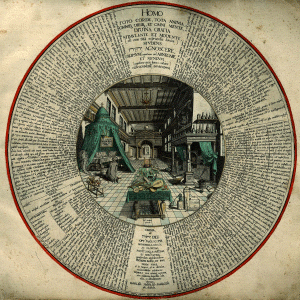
2. Anulo assistentiae gratiae Diuinae admonitorio,
uirtuosae uidelicet catholicaeque promissionis, ab ipso, in cuius ore
non inuentus fuit dolus, datae, dicentis, Amen, amen dico uobis, si quid
petieritis Patrem in nomine meo, dabit uobis, petite et accipietis:
digito anulari decoratus.
[Google translate: Ring insurance
admonitorio to divine grace, namely virtuous catholicaeque
of promise, by him, in whose mouth was no guile was found,
given to them, saying, Verily, verily, I say unto you,
Whatsoever ye shall ask the Father in my name, will give
you, ask and you shall receive: the finger with the
RING-MAKER.]
--
Amphitheatrum
Sapientiae Aeternae, by
Heinrich Khunrath
|
Known
Friends and Associates
We can
learn much about a person by looking at his friends and
associates. Even though Spinoza was excommunicated from the
Jewish faith, and also avoided by much of the non-Jewish
population of Holland, he still circulated in some rather
influential circles. Were his associates Rosicrucian? Did
his philosophical meetings have a Rosicrucian undercurrent?
We know for a fact that Spinoza was in contact with, and
impressed by, two Rosicrucians. First, there was Wilhelm
Gottfried Leibnitz, whose affiliation with the Order is
established by a published letter stating that he was at one
time the secretary of a Rosicrucian Lodge. And secondly,
there was Dr. Helvitius, whom Spinoza commented to in a
letter to Jarig Jellis concerning Dr. Helvitius' alchemical
transmutation. Spinoza allegedly observed one such
transmutation. Also, we find that Spinoza's well-known
friend, Jan de Witt, the Grand Pensionary of Holland, was
tutored at an early age by Isaac Beekman, a known
Rosicrucian. Could such influence have a lasting effect
upon Jan de Witt as is often the case? And, if so, could
that influence have been passed on to Spinoza?
Without
actual written verification in Spinoza's own hand claiming
Rosicrucian affiliation, it can be argued that he was not a
Rosicrucian by claiming the above illustrations as mere
suppositions. Perhaps, even any one of the above arguments
by itself could be disregarded as inconsequential. However,
all together, they will, at the very least, shed some doubt
among those who deny Spinoza's Rosicrucian affiliation.
Keeping in mind the necessary obscurity of 17th Century
Rosicrucian members and even outright denials made out of
deception in order to protect the movement, the "hints" left
behind are one way of keeping historical records intact.
Yet, it is often difficult for the uninitiated historian to
be able to pick up on such "hints." This is obvious in many
of the written histories that have been published recently
and in the past concerning the Rosicrucians. And this also
contributes to the difficulty in the identification of a
personage as being a Rosicrucian.
Most of
you have probably at one time or another, read an article or
a book published outside of our Order on the subject of
Rosicrucian history, and perhaps you have found certain
points of disagreement. We can say that many such works are
the result of well-meaning but incomplete research.
Sometimes it is even difficult to gain an historical
perspective regarding recent times, let alone several
centuries in the past. For example, there was an article on
the Rosicrucians which claimed that an Order was started in
this century by "Dr. H. Spencer Clymer"! If it is that
difficult to be accurate today, then imagine the difficulty
in researching the past where we have access to far less
factual material.
In
conclusion, we can state with a reasonable amount of
certainty, that Spinoza was a Rosicrucian, as his life and
writings exemplify those characteristics which we should
consider to be of the classic Rosicrucian movement.
Various signs point to the validity of this argument, and we
feel that the subtle "hints" we have described in this
article can be relied upon to determine this mystic
philosopher's relationship in regards to the Rosicrucian
tradition.
Return
to Table of Contents
|