|
Chapter 5: The
Covert War and Tonkin Gulf: February-August, 1964
Highlights of
the Period: February-August, 1964
FEBRUARY 1964
Operation Plan 34A, a program of clandestine military operations
against North Vietnam, was started.
MARCH 1964
Robert S. McNamara, Secretary of Defense, urged on his return
from Vietnam that plans be made for "new and significant pressures
on North Vietnam" since the new government of Gen. Nguyen
Khanh was considered unable to improve the outlook in South
Vietnam.
President Johnson approved, and cabled Henry Cabot Lodge, the
U.S. Ambassador in Saigon, that "our planning for action against the
North is on a contingency basis at the present."
APRIL 1964
Scenarios for escalation were reviewed in Saigon by Lodge, William
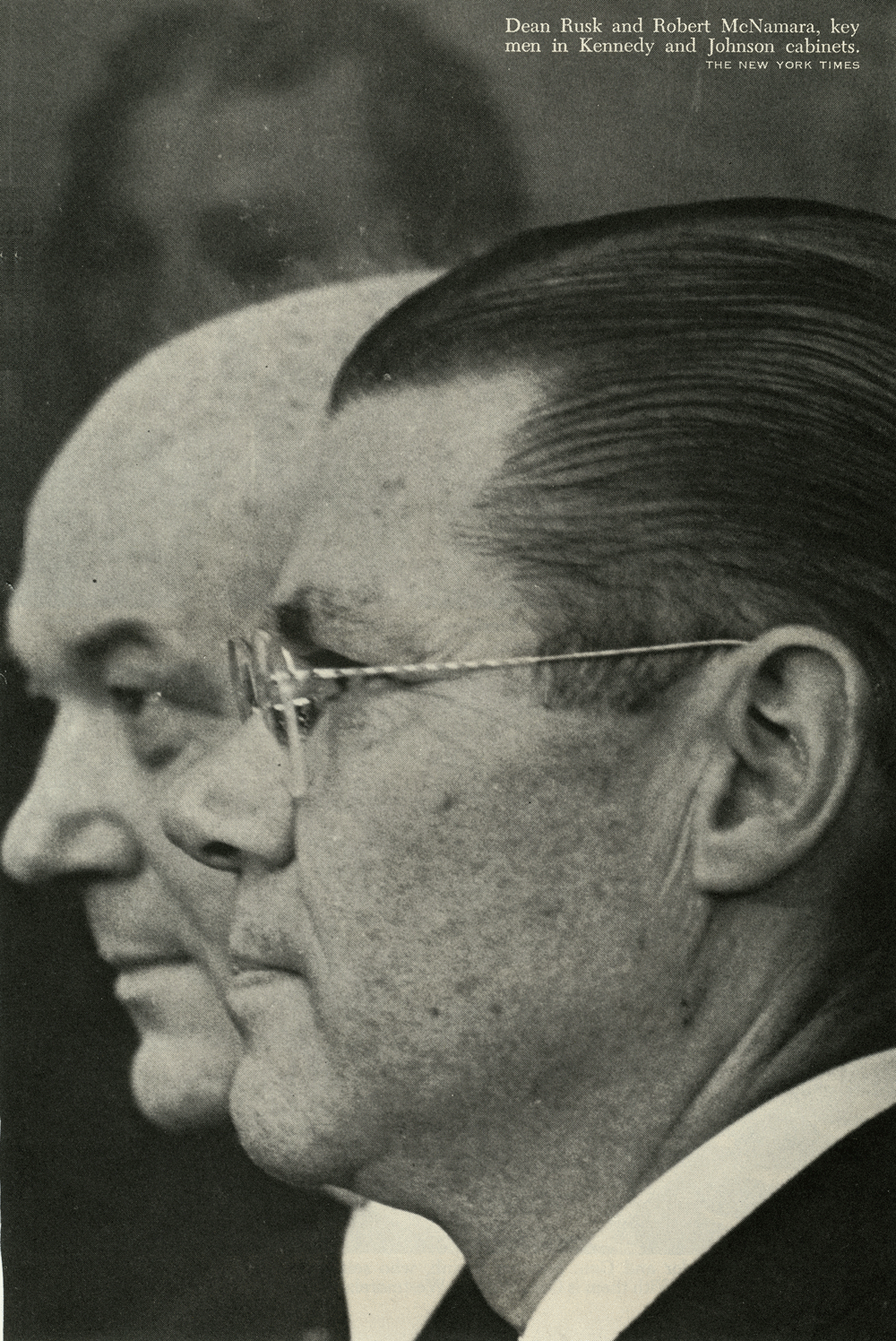
P. Bundy, Secretary of State Dean Rusk, Gen. Earle G.
Wheeler. The plans covered details of stepping up U.S. military
involvement to conform with the Administration's conviction that
Hanoi controlled the Vietcong. The extent of Hanoi's involvement
should be "proven to the satisfaction of our own public, of our allies,
and of the neutralists," according to Mr. Rusk.
MAY 1964
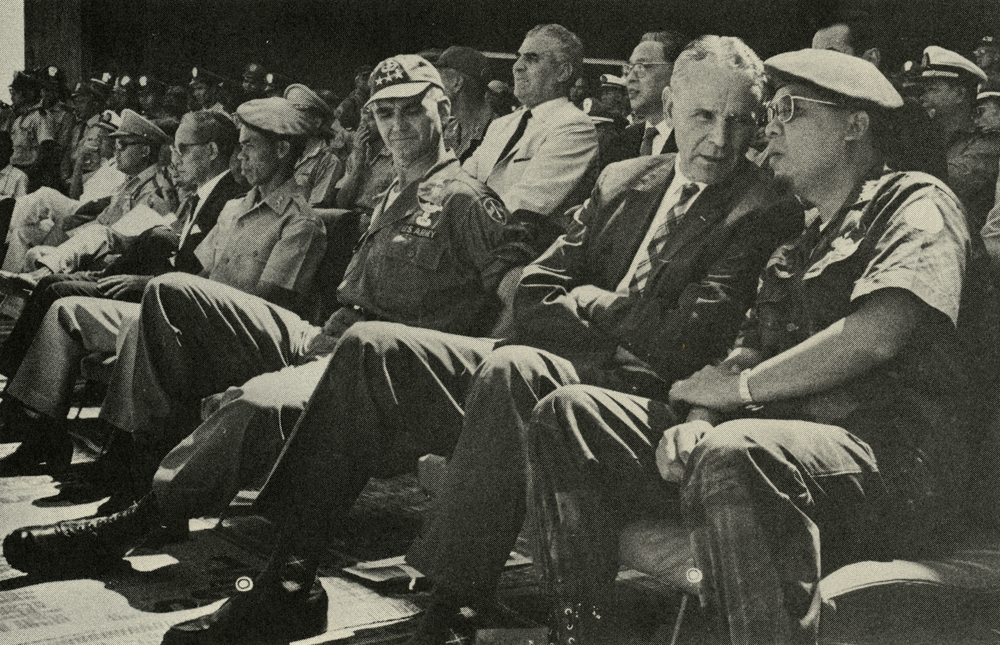
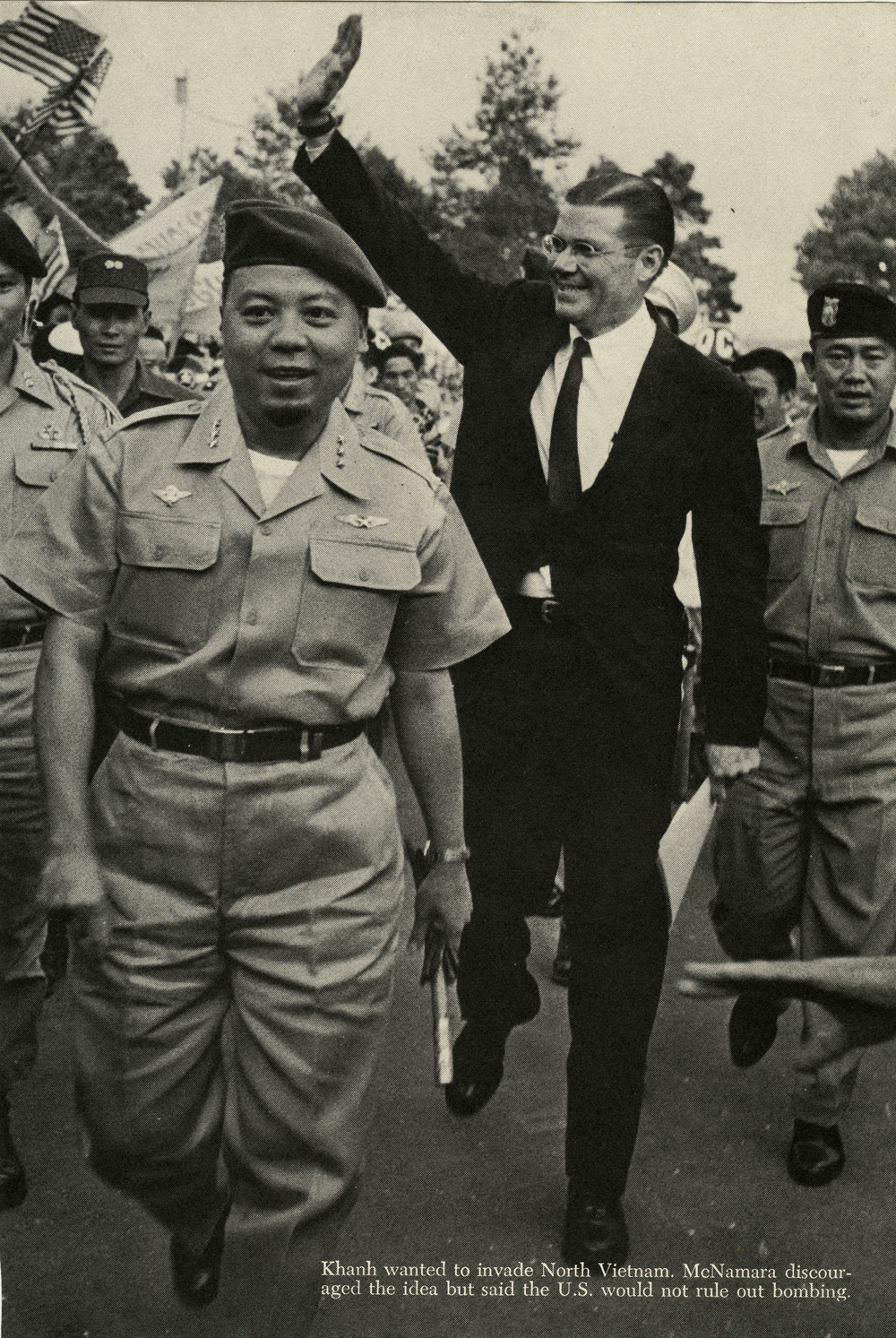
General Khanh asked the U.S. to mount attacks on the North, and
told Mr. Lodge that Saigon wanted to declare war on North Vietnam.
Mr. McNamara did not "rule out" the possibility of bombing
attacks, but stressed that "such actions must be supplementary to
and not a substitute for" success against the Vietcong in the South.
Mr. Lodge cabled Mr. Rusk that the U.S. could not "expect a much
better performance" from the Saigon government "unless something"
in the way of U.S. action was forthcoming.
William Bundy sent the President a 30-day scenario for graduated
military pressure against the North that would culminate in full-scale
bombing attacks. This included a joint Congressional resolution
"authorizing whatever is necessary with respect to Vietnam."
JUNE 1964
At the Honolulu strategy meeting, Ambassador Lodge urged "a
selective bombing campaign against military targets in the North" to
bolster shaky morale in the South. He questioned the need for the
242
Congressional resolution; Mr. .Rusk, Mr. McNamara and John
McCone of the C.I.A. supported it.
Preparatory military deployments in Southeast Asia got underway.
J. Blair Seaborn, a Canadian diplomat, met secretly in Hanoi with
Pham Van Dong, North Vietnam's Premier, and warned him of the
"greatest devastation" to the North that would result from escalation
by Hanoi.
The President resisted pressure to ask for the Congressional resolution
immediately and to step up the war effort.
Mr. Johnson queried the C.I.A. about the "domino theory." The
agency replied that only Cambodia was likely "quickly succumb to
Communism" if Laos and South Vietnam fell, but said that U.S.
prestige would be damaged.
JULY 1964
General Khanh announced a "March North" propaganda
campaign.
South Vietnamese naval commandos raided two North Vietnamese
islands in the Gulf of Tonkin. This was part of the "growing
operational capabilities" of the 34A program, the Pentagon study
says.
AUGUST 1964
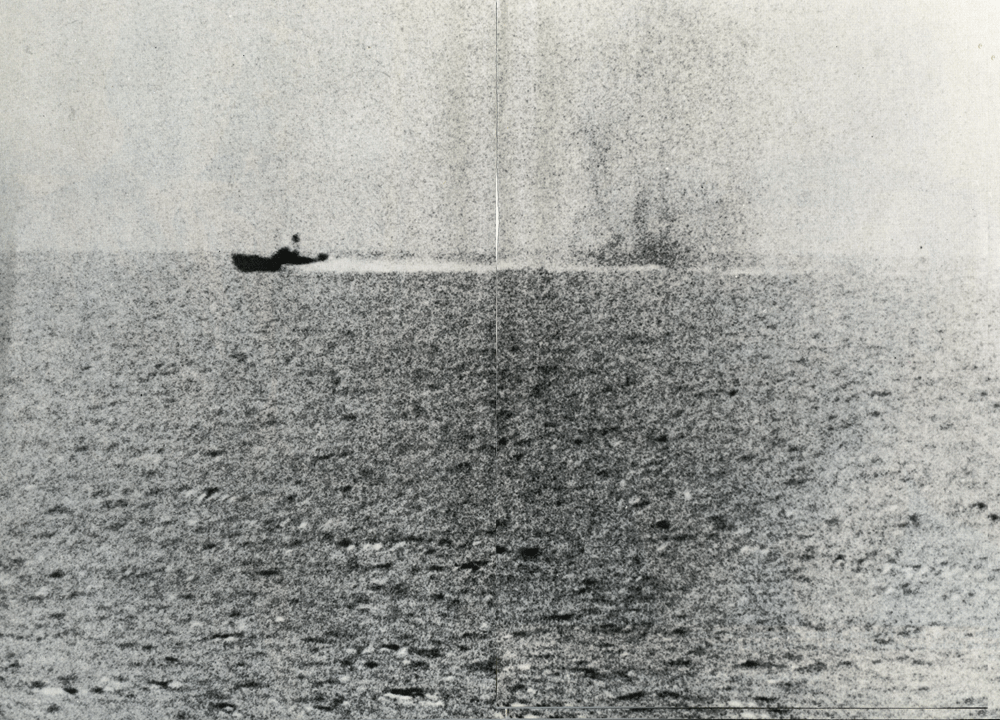
The destroyer Maddox, on intelligence patrol duty in the Gulf of
Tonkin, was attacked by two North Vietnamese PT boats seeking the
South Vietnamese raiders. Joined by the C. Turner Joy, the U.S. vessels
were attacked again by torpedo boats, the history reports.
Less than 12 hours after the news of the second attack reached
Washington, bombers were on the way to North Vietnam on reprisal
raids from carriers.
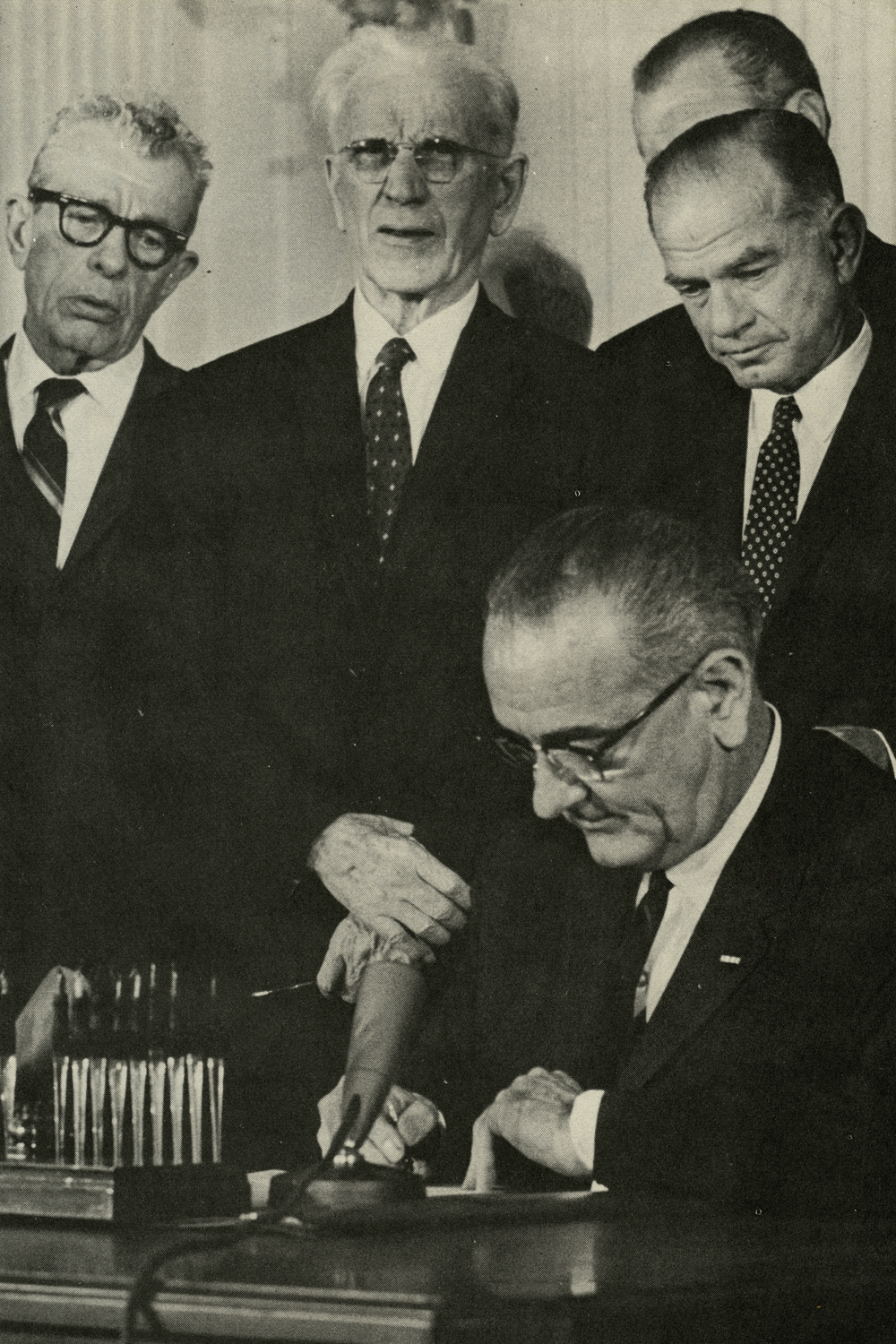
The Tonkin Gulf resolution, drafted by the Administration, was
introduced in Congress. Administration officials testified; Mr. Mc-
Namara disclaimed knowledge of the South Vietnamese attacks on
the islands. The resolution passed.
What the study calls "an important threshhold in the war"-U.S.
reprisal air strikes against the North-had been crossed with "virtually
no domestic criticism."
243
Chapter 5
The Covert War and Tonkin Gulf:
February-August, 1964
-BY NEIL SHEEHAN
This article, the first in the series as published by The
Times, appears here in chronological order, with the initial
paragraphs revised.
The Pentagon papers disclose that for six months before
the Tonkin Gulf incident in August, 1964, the United States
had been mounting clandestine military attacks against North
Vietnam while planning to obtain a Congressional resolution
that the Administration regarded as the equivalent of a
declaration of war.
When the incident occurred, the Johnson Administration
did not reveal these clandestine attacks and pushed the previously
prepared resolution through both houses of Congress
on Aug. 7.
Within 72 hours, the Administration, again drawing on a
prepared plan, secretly sent a Canadian emissary to Hanoi.
He warned Premier Pham Van Dong that the resolution
meant North Vietnam must halt the Communist-led insurgencies
in South Vietnam and Laos or "suffer the consequences."
The magnitude of this threat to Hanoi, the nature and extent
of the covert military operations and the intent of the
Administration to use the resolution to commit the nation to
open warfare, if this later proved desirable, were all kept
secret.
The section of the Pentagon history dealing with the internal debate,
planning and action in the Johnson Administration
from the beginning of 1964 to the August clashes between
North Vietnamese PT boats and American destroyers -- portrayed
as a critical period when the groundwork was laid
for the wider war that followed-also makes the following
disclosures:
• The clandestine military operations had become so extensive
by August, 1964, that Thai pilots flying American
T-28 fighter planes apparently bombed and strafed North
Vietnamese villages near the Laotian border on Aug. 1 and 2.
• Although a firm decision to begin sustained bombing of
North Vietnam was not made until months later, the Administration
was able to order retaliatory air strikes on less
than six hours' notice during the Tonkin incident because
planning had progressed so far that a list of targets was available
for immediate choice.
• The target list had been drawn up in May, along with
a draft of the Congressional resolution, also as part of a
proposed "scenario" culminating in air raids on North Vietnam.
• During a whirlwind series of Pentagon meetings at which
the targets for the Tonkin reprisals were selected, Secretary
of Defense Robert S. McNamara and the Joint Chiefs of Staff
also arranged for the deployment to Southeast Asia of air
strike forces earmarked for the opening phases of the bombing
campaign. Within hours of the retaliatory air strikes on Aug.
4, and three days before the passage of the Tonkin resolution,
the squadrons began their planned moves.
What the Pentagon papers call "an elaborate program of
covert military operations against the state of North Vietnam"
began on Feb. 1, 1964, under the code name Operation Plan
34A. President Johnson ordered the program, on the recommendation
of Secretary McNamara, in the hope, held very
faint by the intelligence community, that "progressively escalating
pressure" from the clandestine attacks might eventually
force Hanoi to order the Vietcong guerrillas in Vietnam and
the Pathet Lao in Laos to halt their insurrections.
In a memorandum to the President on Dec. 21, 1963, after
a two-day trip to Vietnam, Mr. McNamara remarked that
the plans, drawn up by the Central Intelligence Agency station
and the military command in Saigon, were "an excellent
job."
"They present a wide variety of sabotage and psychological
operations against North Vietnam from which I believe we
245
should aim to select those that provide maximum pressure
with minimum risk," Mr. McNamara wrote. [See Document
61.]
President Johnson, in this period, showed a preference for
steps that would remain "noncommitting" to combat, the
study found. But weakness in South Vietnam and Communist
advances kept driving the planning process. This, in turn,
caused the Saigon Government and American officials in
Saigon to demand ever more action.
Through 1964, the 34A operations ranged from flights over
North Vietnam by U-2 spy planes and kidnappings of North
Vietnamese citizens for intelligence information, to parachuting
sabotage and psychological-warfare teams into the North,
commando raids from the sea to blow up rail and highway
bridges and the bombardment of North Vietnamese coastal
installations by PT boats.
These "destructive undertakings," as they were described
in a report to the President on Jan. 2, 1964, from Maj. Gen.
Victor H. Krulak of the Marine Corps, were designed "to
result in substantial destruction, economic loss and harassment."
The tempo and magnitude of the strikes were designed
to rise in three phases through 1964 to "targets identified with
North Vietnam's economic and industrial well-being."
The clandestine operations were directed for the President
by Mr. McNamara through a section of the Joint Chiefs organization
called the Office of the Special Assistant for
Counterinsurgency and Special Activities. The study says that
Mr. McNamara was kept regularly informed of planned and
conducted raids by memorandums from General Krulak, who
first held the position of special assistant, and then from
Maj. Gen. Rollen H. Anthis of the Air Force, who succeeded
him in February, 1964. The Joint Chiefs themselves periodically
evaluated the operations for Mr. McNamara.
Secretary of State Dean Rusk was also informed, if in less
detail.
The attacks were given "interagency clearance" in Washington,
the study says, by coordinating them with the State
Department and the Central Intelligence Agency, including
advance monthly schedules of the raids from General Anthis.
The Pentagon account and the documents show that William
P. Bundy, the Assistant Secretary of State for Far
Eastern Affairs, and John T. McNaughton, head of the
Pentagon's politico-military operations as the Assistant Secretary
of Defense for International Security Affairs, were the
senior civilian officials who supervised the distribution of the
246
schedules and the other aspects of interagency coordination
for Mr. McNamara and Mr. Rusk.
The analyst notes that the 34A program differed in a
significant respect from the relatively low-level and unsuccessful
intelligence and sabotage operations that the C.I.A.
had earlier been carrying out in North Vietnam.
The 34A attacks were a military effort under the control
in Saigon of Gen. Paul D. Harkins, chief of the United
States Military Assistance Command there. He ran them
through a special branch of his command called the Studies
and Observations Group. It drew up the advance monthly
schedules for approval in Washington. Planning was done
jointly with the South Vietnamese and it was they or "hired
personnel," apparently Asian mercenaries, who performed
the raids, but General Harkins was in charge.
The second major segment of the Administration's covert
war against North Vietnam consisted of air operations in
Laos. A force of propeller-driven T-28 fighter-bombers, varying
from about 25 to 40 aircraft, had been organized there.
The planes bore Laotian Air Force markings, but only some
belonged to that air force. The rest were manned by pilots of
Air America (a pseudo-private airline run by the C.I.A.) and
by Thai pilots under the control of Ambassador Leonard
Unger. [See Document #73.]
Reconnaissance flights by regular United States Air Force
and Navy jets, code-named Yankee Team, gathered photographic
intelligence for bombing raids by the T-28's against
North Vietnamese and Pathet Lao troops in Laos.
The Johnson Administration gradually stepped up these
air operations in Laos through the spring and summer of
1964 in what became a kind of preview of the bombing of
the North. The escalation occurred both because of ground
advances by the North Vietnamese and the Pathet Lao and
because of the Administration's desire to bring more military
pressure against North Vietnam.
As the intensity of the T-28 strikes rose, they crept closer
to the North Vietnamese border. The United States Yankee
Team jets moved from high-altitude reconnaissance at the
beginning of the year to low-altitude reconnaissance in May.
In June, armed escort jets were added to the reconnaissance
missions. The escort jets began to bomb and strafe North
Vietnamese and Pathet Lao troops and installations whenever
the reconnaissance planes were fired upon.
The destroyer patrols in the Gulf of Tonkin, code-named
De Soto patrols, were the third element in the covert military
247
pressures against North Vietnam. While the purpose of the
patrols was mainly psychological, as a show of force, the
destroyers collected the kind of intelligence on North Vietnamese
warning radars and coastal defenses that would be
useful to 34A raiding parties or, in the event of a bombing
campaign, to pilots. The first patrol was conducted by the
destroyer Craig without incident in February and March, in
the early days of the 34A operations.
The analyst states that before the August Tonkin incident
there was no attempt to involve the destroyers with the
34A attacks or to use the ships as bait for North Vietnamese
retaliation. The patrols were run through a separate naval
chain of command.
Although the highest levels of the Administration sent
the destroyers into the gulf while the 34A raids were taking
place, the Pentagon study, as part of its argument that a
deliberate provocation was not intended, in effect says that
the Administration did not believe that the North Vietnamese
would dare to attack the ships.
But the study makes it clear that the physical presence of
the destroyers provided the elements for the Tonkin clash.
And immediately after the reprisal air strikes, the Joint Chiefs
of Staff and Assistant Secretary of Defense McNaughton put
forward a "provocation strategy" proposing to repeat the
clash as a pretext for bombing the North.
Of the three elements of the covert war, the analyst cites
the 34A raids as the most important. The "unequivocal"
American responsibility for them "carried with it an implicit
symbolic and psychological intensification of the U.S. commitment,"
he writes. "A firebreak had been crossed."
The fact that the intelligence community and even the
Joint Chiefs gave the program little chance of compelling
Hanoi to stop the Vietcong and the Pathet Lao, he asserts,
meant that "a demand for more was stimulated and an expectation
of more was aroused."
On Jan. 22, 1964, a week before the 34A raids started,
the Joint Chiefs warned Mr. McNamara in a memorandum
signed by the Chairman, Gen. Maxwell D. Taylor, that while
"we are wholly in favor of executing the covert actions
against North Vietnam ... it would be idle to conclude that
these efforts will have a decisive effect" on Hanoi's will to
support the Vietcong. [See Document #62.]
The Joint Chiefs said the Administration "must make ready
to conduct increasingly bolder actions," including "aerial
bombing of key North Vietnam targets, using United States
248
resources under Vietnamese cover," sending American ground
troops to South Vietnam and employing "United States forces
as necessary in direct actions against North Vietnam."
And after a White House strategy meeting on Feb. 20,
President Johnson ordered that "contingency planning for
pressures against North Vietnam should be speeded up."
"Particular attention should be given to shaping such pressures
so as to produce the maximum credible deterrent effect
on Hanoi," the order said.
The impelling force behind the Administration's desire to
step up the action during this period was its recognition of
the steady deterioration in the positions of the pro-American
governments in Laos and South Vietnam, and the corresponding
weakening of the United States hold on both countries.
North Vietnamese and Pathet Lao advances in Laos were
seen as having a direct impact on the morale of the anti-
Communist forces in South Vietnam, the primary American
concern.
This deterioration was also concealed from Congress and
the public as much as possible to provide the Administration
with maximum flexibility to determine its moves as it chose
from behind the scenes.
The United States found itself particularly unable to cope
with the Vietcong insurgency, first through the Saigon military
regime of Gen. Duong Van Minh and later through that of
Gen. Nguyen Khanh, who seized power in a coup d'etat on
Jan. 30, 1964. Accordingly, attention focused more and more
on North Vietnam as "the root of the problem," in the words
of the Joint Chiefs.
Walt W. Rostow, the dominant intellectual of the Administration,
had given currency to this idea and provided
the theoretical framework for escalation. His concept, first
enunciated in a speech at Fort Bragg, N.C., in 1961, was
that a revolution could be dried up by cutting off external
sources of support and supply.
Where North Vietnam was concerned, Mr. Rostow had
evolved another theory that a credible threat to bomb the
industry Hanoi had so painstakingly constructed out of the
ruins of the French Indochina War would be enough to
frighten the country's leaders into ordering the Vietcong to
halt their activities in the South.
In a memorandum on Feb. 13, 1964, Mr. Rostow told
Secretary of State Rusk that President Ho Chi Minh "has an
industrial complex to protect: he is no longer a guerrilla
fighter with nothing to lose."
249
The Administration was firmly convinced from interceptions
of radio traffic between North Vietnam and the guerrillas
in the South that Hanoi controlled and directed the Vietcong.
Intelligence analyses of the time stated, however, that "the
primary sources of Communist strength in South Vietnam are
indigenous," arising out of the revolutionary social aims of
the Communists and their identification with the nationalist
cause during the independence struggle against France in the
nineteen-fifties.
The study shows that President Johnson and most of his
key advisers would not accept this intelligence analysis that
bombing the North would have no lasting effect on the situation
in the South, although there was division-even among
those who favored a bombing campaign if necessary-over
the extent to which Vietcong fortunes were dependent on the
infiltration of men and arms from North Vietnam.
William Bundy and Mr. Rusk mentioned on several occasions
the need to obtain more evidence of this infiltration to
build a case publicly for stronger actions against North Vietnam.
Focus Turns to Bombing
As the Vietcong rebellion gathered strength, so did interest
in bombing the North as a substitute for successful prosecution
of the counterinsurgency campaign in the South, or at
least as an effort to force Hanoi to reduce guerrilla activity
to a level where the feeble Saigon Government could handle
it.
This progression in Administration thinking was reflected in
Mr. McNamara's reports to President Johnson after the
Secretary's trips to Vietnam in December and March.
In his December memorandum recommending initiation
of the covert 34A raids, Mr. McNamara painted a "gloomy
picture" of South Vietnam, with the Vietcong controlling
most of the rice and population heartland of the Mekong
Delta south and west of Saigon. "We should watch the situation
very carefully," he concluded, "running scared, hoping
for the best, but preparing for more forceful moves if the
situation does not show early signs of improvement."
Then, in his memorandum of March 16 on his latest trip,
Mr. McNamara reported that "the situation has unquestionably been
growing worse" and recommended military planning
for two programs of "new and significant pressures upon
North Vietnam."
The first, to be launched on 72 hours' notice, was described
as "Border Control and Retaliatory Actions." These would
include assaults by Saigon's army against infiltration routes
along the Ho Chi Minh Trail network of supply lines through
southeastern Laos, "hot pursuit" of the guerrillas into Cambodia,
"retaliatory bombing strikes" into North Vietnam by
the South Vietnamese Air Force "on a tit-for-tat basis" in
response to guerrilla attacks, and "aerial mining . . . (possibly
with United States assistance) of the major . . . ports in
North Vietnam." The words in parentheses are Mr. McNamara's.
The second program, called "Graduated Overt Military
Pressure," was to be readied to begin on 30 days' notice.
"This program would go beyond reacting on a tit-for-tat
basis," Mr. McNamara told the President. "It would include
air attacks against military and possibly industrial targets."
The raids would be carried out by Saigon's air force and by
an American air commando squadron code-named Farmgate,
then operating in South Vietnam with planes carrying South
Vietnamese markings. To conduct the air strikes, they would
be reinforced by three squadrons of United States Air Force
B-57 jet bombers flown in from Japan.
President Johnson approved Mr. McNamara's recommendations
at a National Security Council meeting on March 17,
1964, directing that planning "proceed energetically."
Mr. McNamara had advocated trying a number of measures
to improve the Saigon Government's performance first,
before resorting to overt escalation. "There would be the
problem of marshaling the case to justify such action, the
problem of Communist escalation and the problem of dealing
with pressures for premature or 'stacked' negotiations," he
remarked in his March memorandum.
His description of negotiations echoed a belief in the Administration
that the Government of General Khanh was
incapable of competing politically with the Communists.
Therefore, any attempt to negotiate a compromise political
settlement of the war between the Vietnamese themselves
was to be avoided because it would result in a Communist
take-over and the destruction of the American position in
South Vietnam.
Similarly, any internal accommodation between the opposing
Vietnamese forces under the vague "neutralization"
251
formula for Vietnam that had been proposed by President
de Gaulle of France that June was seen as tantamount to the
same thing, a Communist victory. In his March memorandum,
Mr. McNamara mentioned the dangerous growth of "neutralist
sentiment" in Saigon and the possibility of a coup by neutralist
forces who might form a coalition government with the
Communists and invite the United States to leave.
William Bundy would later refer to this possibility as a
"Vietnam solution" that must be prevented.
In a glimpse into the President's thoughts at this time, the
study shows he was concerned with the problem. Mr. Johnson
told Ambassador Henry Cabot Lodge in a cablegram to
Saigon on March 20, 1964, that he was intent on "knocking
down the idea of neutralization wherever it rears its ugly
head, and on this point I think nothing is more important
than to stop neutralist talk wherever we can by whatever
means we can." [See Document #65.]
Mr. Lodge was opposed to planning for "massive destruction
actions" before trying what he described as "an essentially
diplomatic carrot and stick approach, backed by covert
military means."
This plan, which Mr. Lodge had been proposing since the
previous October, involved sending a secret non-American
envoy to Hanoi with an offer of economic aid, such as food
imports to relieve the rice shortages in North Vietnam, in
return for calling off the Vietcong. If the North Vietnamese
did not respond favorably, the stick-unpublicized and unacknowledged
air strikes, apparently with unmarked planes -- would
be applied until they did.
The President's message of March 20 shared Mr. Lodge's
opinion that it was still too early for open assaults on the
North.
"As we agreed in our previous messages to each other,"
Mr. Johnson cabled, "judgment is reserved for the present
on overt military action in view of the consensus from Saigon
conversations of McNamara mission with General Khanh and
you on judgment that movement against the North at the
present would be premature. We ... share General Khanh's
judgment that the immediate and essential task is to strengthen
the southern base. For this reason, our planning for action
against the North is on a contingency basis at present, and
immediate problem in this area is to develop the strongest
possible military and political base for possible later action."
Mr. Johnson added that the Administration also expected
252
a "showdown" soon in the Chinese-Soviet dispute "and action
against the North will be more practicable" then.
This and the other sporadic insights the study gives into
Mr. Johnson's thoughts and motivations during these months
leading up to the Tonkin Gulf incident in August indicate
a President who was, on the one hand, pushing his Administration
to plan energetically for escalation while, on the other,
continually hesitating to translate these plans into military
action.
The glimpses are of a Chief Executive who was determined
to achieve the goal of an "independent, non-Communist South
Vietnam" he had enunciated in a national security action
memorandum in March, yet who was holding back on actions
to achieve that goal until he believed they were absolutely
necessary.
Above all, the narrative indicates a President who was
carefully calculating international and domestic political conditions
before making any of his moves in public.
By the latter half of April, 1964, accordingly, planning for
further attacks against the North had matured sufficiently'
through several scenarios for Secretary Rusk, William Bundy
and Gen. Earle G. Wheeler, the Army Chief of Staff, to review
the plans with Ambassador Lodge at a Saigon strategy
meeting on April 19 and 20.
The scenario envisioned escalation in three stages from
intensification of the current clandestine 34A raids, to "covert
U.S. support of overt . . . aerial mining and air strike operations"
by Saigon to "overt joint . . . aerial reconnaissance,
naval displays, naval bombardments and air attacks" by the
United States and South Vietnam.
The analyst does not mention any provision in the April
planning scenario for a Congressional resolution that would
constitute authority to wage war; he refers instead to "Presidential
consultations with key Congressional leaders." But
the idea of a resolution was already current by then. The
author reports its first emergence in discussions in the State
Department in mid-February, 1964, "on the desirability of
the President's requesting a Congressional resolution, drawing
a line at the borders of South Vietnam." He cites a Feb. 13
letter to Secretary Rusk to this effect from Mr. Rostow, then
chairman of the State Department's Policy Planning Council.
At the April Saigon meeting and in the weeks immediately
afterward, the author says, "a deliberate, cautious pacing
of our actions" prevailed over a near-term escalation approach
being pressed by the Joint Chiefs and Mr. Rostow.
253
One reason for this, the study explains, was that the Administration
recognized that it "lacked adequate information
concerning the nature and magnitude" of infiltration of trained
guerrilla leaders and arms from the North and was beginning
a major effort to try to gather enough concrete evidence to
justify escalation if this became necessary.
"For example," the study reports, "citing the 'lack of
clarity' on the 'role of external intrusion' in South Vietnam,
Walt Rostow urged William Sullivan [chairman of the interagency
Vietnam coordinating committee] on the eve of
[a] March visit to attempt to 'come back from Saigon with
as lucid and agreed a picture' as possible on the extent of
the infiltration and its influence on the Vietcong."
The direct outcome of Mr. Rusk's April visit to Saigon
was his agreement to try Ambassador Lodge's carrot-and-stick
approach. On April 30, 1964, the Secretary flew to
Ottawa and arranged with the Canadian Government for
J. Blair Seaborn, Canada's new representative on the International
Control Commission, to convey the offer of United
States economic aid to Premier Dong when Mr. Seaborn
visited Hanoi in June.
On May 4 General Khanh, sensing a decline in his fortunes
and beginning to abandon the idea of strengthening his government
to the point where it could defeat the Vietcong in
the South, told Ambassador Lodge that he wanted to declare
war quickly on North Vietnam, have the United States start
bombing and send 10,000 Special Forces troops of the United
States Army into the South "to cover the whole Cambodian-
Laotian border." Mr. Lodge deflected the suggestions.
Secretary McNamara, on a visit to Saigon May 13, was
instructed to tell General Khanh that while the United States
did not "rule out" bombing the North, "such actions must
be supplementary to and not a substitute for successful
counter-insurgency in the South" and that "we do not intend
to provide military support nor undertake the military objective
of 'rolling back' Communist control in North Vietnam."
But on May 17, when the Pathet Lao launched an offensive
on the Plaine des Jarres that threatened to collapse the pro-
American Government of Premier Souvanna Phouma and
with it "the political underpinning of United States-Laotian
policy," the study declares, this "deliberate, cautious approach"
to escalation planning was suddenly thrown into
"crisis management."
The Administration immediately turned the Laotian air
operations up a notch by intensifying the T-28 strikes and,
254
on May 21, by starting low-altitude target reconnaissance by
United States Navy and Air Force jets over areas held by the
Pathet Lao and the North Vietnamese.
In Washington, the chief planner, William Bundy, assisted
by Mr. McNaughton and Mr. Sullivan, worked up a 30-day
program culminating in full-scale bombing of the North. He
submitted it as a formal draft Presidential memorandum for
consideration by an executive committee of the National
Security Council.
For a number of reasons, this May 23 scenario was never
carried out as written. The President, in fact, delayed another
nine months the scenario's denouement in an air war.
But the document is important because it reveals how far
the Administration had progressed in its planning by this
point and because a number of the steps in the scenario were
carried out piecemeal through June and July and then very
rapidly under the political climate of the Tonkin Gulf clash.
For the military side of the scenario, the President's order
of March 17 to plan for retaliatory air strikes on 72 hours'
notice and for full-scale air raids on 30 days' notice had
borne fruit in Operation Plan 37-64.
This plan had been prepared in the Honolulu headquarters
of Adm. Harry D. Felt, commander in chief of Pacific forces,
or CINCPAC, and had been approved by the Joint Chiefs on
April 17. It tabulated how many planes and what bomb
tonnages would be required for each. phase of the strikes,
listed the targets in North Vietnam with damage to be
achieved, and programmed the necessary positioning of air
forces for the raids. A follow-up operation plan, designated
32-64, calculated the possible reactions of China and North
Vietnam and the American ground forces that might be
necessary to meet them.
The Joint Staff had refined the bombing plan with more
target studies. These estimated that an initial category of
targets associated with infiltration, such as bridges and depots
of ammunition and petroleum, could be destroyed in only
12 days if all the air power in the western Pacific were used.
For the political side of the scenario, recommendations
from William Bundy and Mr. Rusk had produced more evidence
of infiltration by the North for public release to justify
escalation. William J. Jorden, a former correspondent of The
New York Times who had become a State Department official,
had gone to South Vietnam and had pulled together the data
available there for a possible new State Department white
paper.
255
Here is the scenario as the Pentagon analyst quotes it. The
words in parentheses-and the numbers designating the length
of time to "D-Day"-were in the original scenario and the
words in brackets were inserted by the analyst for clarification:
"1. Stall off any 'conference [Laos or] Vietnam until D-Day.'
"2. Intermediary (Canadian?) tell North Vietnam in general
terms that U.S. does not want to destroy the North Vietnam
regime (and indeed is willing 'to provide a carrot') but
is determined to protect South Vietnam from North Vietnam.
"3. (D-30) Presidential speech in general terms launching
Joint Resolution.
"4. (D-20) Obtain joint resolution approving past actions
and authorizing whatever is necessary with respect to Vietnam.
"Concurrently: An effort should be made to strengthen
the posture in South Vietnam. Integrating (interlarding in a
single chain of command) the South Vietnamese and U.S.
military and civilian elements critical to pacification, down
at least to the district level, might be undertaken.
"5. (D-16) Direct CINCPAC to take all prepositioning
and logistic actions that can be taken 'quietly' for the D-Day
forces ....
"6. (D-15) Get Khanh's agreement to start overt South
Vietnamese air attacks against targets in the North (see D-Day
item 15 below), and inform him of U.S. guarantee to protect
South Vietnam in the event of North Vietnamese and/or
Chinese retaliation.
"7. (D-14) Consult with Thailand and the Philippines to
get permission for U.S. deployments; and consult with them
plus U .K., Australia, New Zealand and Pakistan, asking for
their open political support for the undertaking and for their
participation in the re-enforcing action to be undertaken in
anticipation of North Vietnamese and/or Chinese retaliation.
"8. (D-13) Release an expanded 'Jorden Report,' including
recent photography and evidence of the communication nets,
giving full documentation of North Vietnamese supply and
direction of the Vietcong.
"9. (D-12) Direct CINCPAC to begin moving forces and
making specific plans on the assumption that strikes will be
made on D-Day (see Attachment B in backup materials for
deployments) .
"10. (D-10) Khanh makes speech demanding that North
Vietnam stop aggression, threatening unspecified military action
if he does not. (He could refer to a 'carrot.')
"11. (D-3) Discussions with allies not covered in Item
above.
256
"12. (D-3) President informs U.S. public (and thereby
North Vietnam) that action may come, referring to Khanh
speech (Item 10 above) and declaring support for South
Vietnam.
"13. (D-l) Khanh announces that all efforts have failed
and that attacks are imminent. (Again he refers to limited
goal and possibly to 'carrot.')
"14. (D-Day) Remove U.S. dependents.
"15. (D-Day) Launch first strikes .... Initially, mine their
ports and strike North Vietnam's transport and related ability
(bridge, trains) to move south; and then against targets which
have maximum psychological effect on the North's willingness
to stop insurgency-POL (petroleum, oil and lubricants)
storage, selected airfields, barracks/ training areas, bridges,
railroad yards, port facilities, communications, and industries.
Initially, these strikes would be by South Vietnamese aircraft;
they could then be expanded by adding Farmgate, or U.S.
aircraft, or any combination of them.
"16. (D-Day) Call for conference on Vietnam (and go
to U.N.). State the limited objective: Not to overthrow the
North Vietnam regime nor to destroy the country, but to stop
D.R.V.-directed efforts in the South. Essential that it be made
clear that attacks on the North will continue (i.e., no ceasefire)
until (a) terrorism, armed attacks, and armed resistance
to pacification efforts in the South stop, and (b) communications
on the networks out of the North are conducted entirely
in uncoded form."
The last paragraph was to provide a capsule definition of
what the Administration meant when it later spoke publicly
about "negotiations," a definition the analyst describes as
"tantamount to unconditional surrender" for the other side.
The covering memorandum on the scenario pointed out
that military action would not begin until after "favorable
action" on the joint Congressional resolution. William Bundy
drafted the resolution on May 25.
Attached to the scenario were assessments of possible
Soviet, Chinese and North Vietnamese reactions. These included
a provision for reinforcing the South Vietnamese
Army "by U.S. ground forces pre positioned in South Vietnam
or on board ship nearby" if Hanoi reacted by intensifying
Vietcong activity in the South.
After meetings on May 24 and 25, the Executive Committee
of the National Security Council-including Secretaries Rusk
and McNamara, John A. McCone, Director of Central Intelligence,
and McGeorge Bundy, Presidential assistant for national security-decided
to recommend to the President only
piecemeal elements of the scenario. Among these were the
sending of the Canadian emissary to Hanoi and the move for
a joint Congressional resolution.
The documents do not provide a clear explanation for their
decision, the analyst says, although an important factor seems
to have been concern that "our limited objectives might have
been obscured" if the Administration had begun a chain of
actions to step up the war at this point.
Whether political considerations in an election year also
prompted the President to limit the proposed escalation is
a question that is not addressed by the study here. The narrative
does attribute such motives to Mr. Johnson's similar
hesitation to take major overt actions in the following month,
June.
In any case, the account explains, the urgency was taken
out of the Laos crisis by a Polish diplomatic initiative on
May 27 for a new Laos conference that would not include
discussions of Vietnam, a major fear of the Administration.
The President instructed his senior advisers to convene another
strategy conference in Honolulu at the beginning of
June "to review for . . . final approval a series of plans for
effective action."
On his way to the conference, after attending the funeral
of Prime Minister Jawaharlal Nehru in New Delhi, Secretary
Rusk stopped off in Saigon for conversations with General
Khanh and Ambassador Lodge.
The Ambassador and Gen. William C. Westmoreland, who
was replacing General Harkins as chief of the Military Assistance
Command in Saigon, flew to Honolulu with Secretary
Rusk for the strategy session at Admiral Felt's headquarters
there on June 1 and 2, 1964. They were joined by William
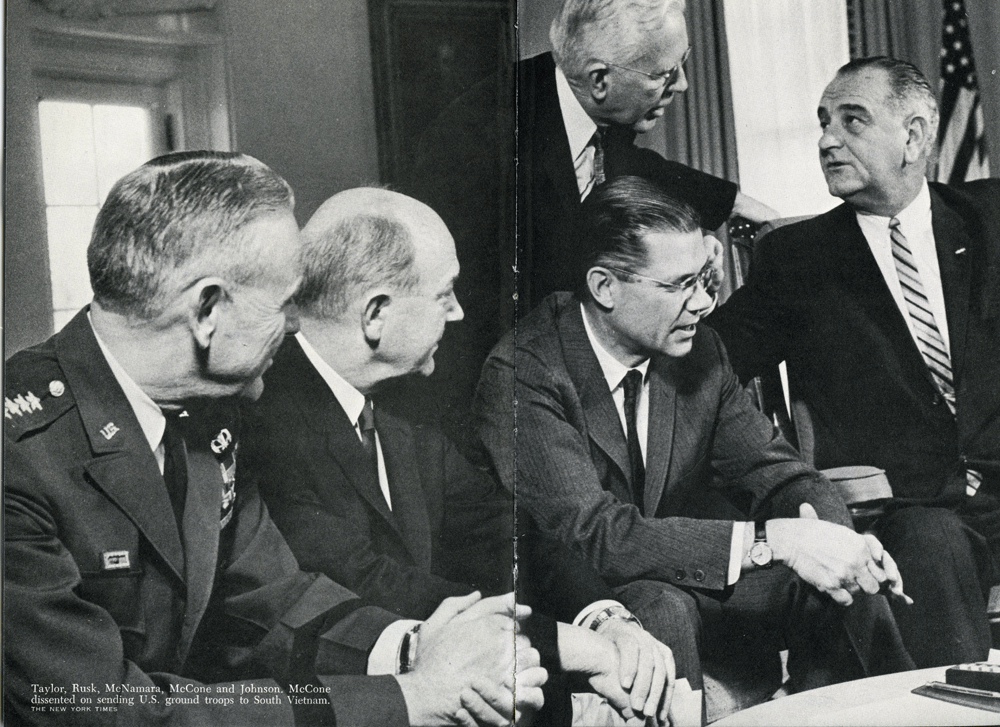
Bundy, Mr. McNamara, General Taylor, Mr. McCone and
Mr. Sullivan.
While he had previously counseled patience, Mr. Lodge's
chief recommendation at Honolulu reflected his growing
nervousness over the shakiness of the Saigon regime. He
argued for bombing the North soon.
The analyst writes: "In answer to Secretary Rusk's query
about South Vietnamese popular attitudes, which supported
Hanoi's revolutionary aims, the Ambassador stated his conviction
that most support for the VC would fade as soon
as some 'counterterrorism measures' were begun against the
D.R'y."-the Democratic Republic of (North) Vietnam.
Admiral Felt's record of the first day's session quotes Mr.
258
Lodge as predicting that "a selective bombing campaign
against military targets in the North" would "bolster morale
and give the population in the South a feeling of unity."
The Honolulu discussions concentrated on an air war,
ranging over its entire implications, down to such details
as the kind of antiaircraft guns North Vietnam had and how
difficult these defenses might make attacks on particular
targets. By now the Joint Chiefs had improved on Admiral
Felt's Operation Plan 37-64 to the point of producing the
first version of a comprehensive list of 94 targets, from bridges
to industries, that Mr. McNamara and President Johnson
would use to select the actual sites to be struck when sustained
air raids began in the coming year.
Obtaining a Congressional resolution "prior to wider U.S.
action in Southeast Asia" was a major topic. The analyst
paraphrases and quotes from William Bundy's memorandum
of record on the second day's talks to summarize the discussion
concerning the resolution:
"Ambassador Lodge questioned the need for it if we were
to confine our actions to 'tit-for-tat' air attacks against North
Vietnam. However, Secretaries McNamara and Rusk and
C.I.A. Director McCone all argued in favor of the resolution.
In support, McNamara pointed to the need to guarantee
South Vietnam's defense against retaliatory air attacks and
against more drastic reactions by North Vietnam and Communist
China. He added that it might be necessary, as the
action unfolded . . . to deploy as many as seven divisions.
Rusk noted that some of the military requirements might involve
the calling up of reserves, always a touchy Congressional
issue. He also stated that public opinion on our Southeast Asia
policy was badly divided in the United States at the moment
and that, therefore, the President needed an affirmation of
support.
"General Taylor noted that there was a danger of reasoning
ourselves into inaction," the memorandum goes on. "From
a military point of view, he said the U.S. could function in
Southeast Asia about as well as anywhere in the world except
Cuba."
The upshot of the conference, however, was that major
actions "should be delayed for some time yet," the historian
says. A separate briefing paper that William Bundy prepared
for Secretary Rusk to use in communicating the conference's
findings to the President at a White House meeting late on
the afternoon of June 3 counseled more time "to refine our
plans and estimates." Mr. Bundy emphasized the need for
259
an "urgent" public relations campaign at home to "get at the
basic doubts of the value of Southeast Asia and the importance
of our stake there."
Secretary McNamara, General Taylor and Mr. McCone
joined Secretary Rusk in making the June 3 report to the
President on the Honolulu conference. A documentary record
of this White House meeting is not available, but the study
deduces the President's reaction and decisions from the subsequent
actions taken by his senior advisers.
Where decisive military actions were concerned, "the President
apparently recognized the need for more and better
information, but did not convey a sense of urgency regarding
its acquisition," the analyst says. He notes that on the same
day as the White House meeting, "possibly just following,"
Secretary McNamara told the Joint Chiefs that he wanted
to meet with them on June 8, five days later, "to discuss
North Vietnamese targets and troop movement capabilities."
But one element of the May 23 scenario, the positioning
of forces for later action, began to fall into place right after
the White House meeting. The Pentagon study says that
"noncommitting military actions . . . were given immediate
approval."
On June 4 Mr. McNamara directed the Army to take
"immediate action ... to improve the effectiveness and readiness
status of its materiel prestocked for possible use in Southeast
Asia."
The Secretary's directive specifically ordered the Army to
augment stocks previously placed with Thailand's agreement
at Korat, a town south of the Laotian border, to support potential
combat operations by a United States Army infantry
brigade and to give "first priority at the Okinawa Army Forward
Depot to stocking non-air-transportable equipment" that
would be required by another Army infantry brigade flown to
the island staging base on sudden notice.
The President also "apparently encouraged" the intensified
public-relations campaign recommended by William Bundy
and the other Honolulu conference participants, the study
asserts.
"In June, State and Defense Department sources made
repeated leaks to the press affirming U.S. intentions to support
its allies and uphold its treaty commitments in Southeast
Asia," the analyst explains, citing several articles that month
in The New York Times. The Administration also focused
publicity through June and into July on its military prepositioning
moves. The augmentation of the Army war stocks
260
at Korat in Thailand was given "extensive press coverage,"
the account says, citing a dispatch in The Times on June 21,
1964.
And what the analyst calls "the broad purpose" of these
positioning moves-to serve as steps in the operation planswas
not explained to the public.
The Administration did openly step up its air operations
in Laos in mid-June, after the enemy provided it with a
rationale of self-defense. On June 6 and 7 two Navy jets on
low-altitude target reconnaissance flights were shot down by
enemy ground fire. Washington immediately added armed
escort jets to the reconnaissance flights and on June 9 the
escort jets struck Pathet Lao gun positions and attacked a
Pathet Lao headquarters.
A similar escalation of the T-28 operations and the involvement
of Thai pilots was unofficially acknowledged in
Washington, although the responsibility for these operations
was laid to the Laotian Government. And subsequent strikes
by the American escort jets against enemy positions were not
made public.
At the end of June the Royal Laotian Air Force was secretly
strengthened with more T-28's, and American planes began
conducting troop transport operations and night reconnaissance
flights for a successful counteroffensive by the Laotian
Army to protect the key position of Muong Soui.
Firmness, but Restraint
President Johnson was projecting an image of firmness but
moderation, the study notes. In early June, he first requested
and then rejected a draft from Mr. Rostow for a major
policy speech on Southeast Asia that took an "aggressive
approach," and instead relied "on news conferences and
speeches by other officials to state the official view," the
account continues. "In contrast to the Rostow approach, [the
President's] news conference on 23 June and Secretary Rusk's
speech at Williams College, 14 June, emphasized the U.S.
determination to support its Southeast Asian allies, but avoided
any direct challenge to Hanoi and Peking or any hint of
intent to increase our military commitment."
A formal question the President submitted to the C.I.A.
in June also indicated what was on his mind. "Would the
261
rest of Southeast Asia necessarily fall if Laos and South
Vietnam came under North Vietnamese control?" he asked.
The agency's reply on June 9 challenged the domino theory,
widely believed in one form or another within the Administration.
"With the possible exception of Cambodia," the C.I.A.
memorandum said, "it is likely that no nation in the area
would quickly succumb to Communism as a result of the fall
of Laos and South Vietnam. Furthermore, a continuation of
the spread of Communism in the area would not be inexorable,
and any spread which did occur would take time-time in
which the total situation might change in any number of ways
unfavorable to the Communist cause."
The C.I.A. analysis conceded that the loss of South Vietnam
and Laos "would be profoundly damaging to the U.S. position
in the Far East" and would raise the prestige of China "as a
leader of world Communism" at the expense of a more
moderate Soviet Union. But the analysis argued that so long
as the United States could retain its island bases, such as those
on Okinawa, Guam, the Philippines and Japan, it could wield
enough military power in Asia to deter China and North
Vietnam from overt military aggression against Southeast
Asia in general.
Even in the "worst case," if South Vietnam and Laos were
to fall through "a clear-cut Communist victory," the United
States would still retain some leverage to affect the final outcome
in Southeast Asia, according to the analysis.
It said that "the extent to which individual countries would
move away from the U.S. towards the Communists would
be significantly affected by the substance and manner of U.S.
policy in the period following the loss of Laos and South
Vietnam."
As in the case of the earlier C.I.A. analysis stating that
the real roots of Vietcong strength lay in South Vietnam,
the study shows that the President and his senior officials
were not inclined to adjust policy along the lines of this
analysis challenging the domino theory.
Only the Joint Chiefs, Mr. Rostow and General Taylor
appear to have accepted the domino theory in its literal
sense-that all of the countries of Southeast Asia, from
Cambodia to Malaysia, would tumble automatically into the
Communist camp if the linchpin, South Vietnam, were
knocked out, and that the United States position in the rest
of the Far East, from Indonesia through the Philippines to
Japan and Korea, would also be irrevocably harmed.
262
Yet the President and most of his closest civilian advisers-
Mr. Rusk, Mr. McNamara and McGeorge Bundy-seem to
have regarded the struggle over South Vietnam in more or
less these terms. [See Document #63.]
In 1964, the Administration also feared an outbreak of
other "wars of national liberation" in the Asian, African and
Latin American countries, and, Mr. McNamara wrote in
his March 16 memorandum to the President, "the South
Vietnam conflict is regarded as a test case."
The struggle in South Vietnam was likewise bound up with
the idea of "containing China," whose potential shadow over
Southeast Asia was viewed as a palpable threat by Mr. Rusk
because of his World War II experience in Asia and the
victory of Mao Tse-tung's revolution in China.
But behind these foreign-policy axioms about domino effects,
wars of liberation and the containment of China, the
study reveals a deeper perception among the President and
his aides that the United States was now the most powerful
nation in the world and that the outcome in South Vietnam
would demonstrate the will and the ability of the United
States to have its way in world affairs.
The study conveys an impression that the war was thus
considered less important for what it meant to the South
Vietnamese people than for what it meant to the position of
the United States in the world.
Mr. McNaughton would later capsulize this perception in
a memorandum to Mr. McNamara seeking to apportion
American aims in South Vietnam:
"70 pct.-To avoid a humiliating U.S. defeat (to our
reputation as a guarantor).
"20 pct.-To keep SVN (and then adjacent) territory from
Chinese hands.
"10 pct.- To permit the people of SVN to enjoy a better,
freer way of life.
"Also-To emerge from crisis without unacceptable taint
from methods used.
"NOT-To 'help a friend,' although it would be hard to
stay in if asked out."
The words in parentheses are Mr. McNaughton's.
Thus, he had reasoned in another memorandum, even if
bombing North Vietnam did not force Hanoi to call off the
Vietcong, "it would demonstrate that U.S. was a 'good doctor'
willing to keep promises, be tough, take risks, get bloodied
and hurt the enemy badly."
And while the study shows doubt and worry in the Ad-
263
ministration, it also reveals an underlying confidence among
the decision makers at the top, whose attitude would count,
that if this mightiest nation resolved to use its vast power,
the other side would buckle.
Mr. Rostow would articulate this confidence in a memorandum
to Secretary Rusk that fall: "I know well the anxieties
and complications on our side of the line. But there may be
a tendency to underestimate both the anxieties and complications
on the other side and also to underestimate that
limited but real margin of influence on the outcome that
flows from the simple fact that we are the greatest power
in the world-if we behave like it."
Accordingly, in mid-June, the Administration carried out
another element of the May 23 scenario, the element that
had first been formulated by Ambassador Lodge as his "carrot
and stick." On June 18, at the Administration's request, Mr.
Seaborn, the new Canadian representative on the International
Control Commission, paid the first of his two secret calls on
Premier Dong in Hanoi.
Washington sought to convey to North Vietnam through
Mr. Seaborn the more precise and threatening meaning of
the preparatory military deployments to Southeast Asia that
it was publicizing on a vaguer level in public. Back in May,
Mr. Lodge had urged an unacknowledged air strike on some
target in the North "as a prelude to his [Mr. Seaborn's] arrival"
if the Vietcong had recently committed some terrorist
act "of the proper magnitude" in the South, but the President
apparently did not see fit to act on the suggestion by June.
The analyst says Mr. Seaborn stressed to Premier Dong
that while the United States' ambition in Southeast Asia
was limited and its intentions "essentially peaceful," its
patience was not limitless. The United States was fully aware
of the degree to which Hanoi controlled the Vietcong, Mr.
Seaborn said, and "in the event of escalation the greatest
devastation would of course result for the D.R.V. itself."
The North Vietnamese Premier, the study relates, "fully
understood the seriousness and import of the warning conveyed
by Seaborn." Whether Mr. Seaborn also proffered the
"carrot" of food and other economic aid is not reported.
At the June 3 meeting at the White House, the President
had also apparently approved continued work for the Congressional
resolution, the historian says, because planning for
it continued apace. "Its intended purpose," the historian comments,
"was to dramatize and make clear to other nations
the firm resolve of the United States Government in an election year to
support the President in taking whatever action
was necessary to resist Communist aggression in Southeast
Asia."
By June 10, there was "firm support" from most of the
foreign-policy-making machinery of the Government for obtaining
the resolution, although the account notes that at an
interagency meeting that day "five basic 'disagreeable questions'
were identified for which the Administration would
have to provide convincing answers to assure public support.
"These included: ( 1) Does this imply a blank check for
the President to go to war in Southeast Asia? (2) What kinds
of force could he employ under this authorization? (3) What
change in the situation (if any) requires the resolution now?
(4) Can't our objectives be attained by means other than
U.S. military force? (5) Does Southeast Asia mean enough
to U.S. national interests?"
Despite the prospect of having to answer these questions
publicly, William Bundy wrote in a memorandum for a second
interagency meeting on June 12, the Administration
required a Congressional resolution immediately as "a continuing
demonstration of U.S. firmness and for complete
flexibility in the hands of the executive in the coming political
months." While the United States did not expect "to move
in the near future to military action against North Vietnam,"
he said, events in South Vietnam or Laos might force it to
reconsider this position.
But in the opinion of the analyst, the President in June,
1964, already felt "the political conventions just around the
corner and the election issues regarding Vietnam clearly
drawn," and so he recoiled at this time from the repercussions
of major escalation and of seeking a Congressional resolution.
At a high-level meeting on both subjects June 15, McGeorge
Bundy, the historian says, brought Presidential guidance to
Secretaries Rusk and McNamara in the form of a White
House memorandum that postponed a decision for the present.
Washington's efforts to achieve some political stability in
Saigon and to hold the line militarily against the guerrillas
were coming to naught, however, under the blows of the
Vietcong. In his fear and nervousness, General Khanh broke
a promise he had made to Ambassador Lodge and Secretary
Rusk in their May meeting to consult with Washington before
publicly announcing any intention to declare war on the North
and to start a bombing campaign.
On July 19, he started a "March North" campaign of militant
slogans and oratory at a "unification rally" in Saigon.
265
The same day, as the analyst puts it, Air Marshal Nguyen Cao
Ky, then chief of the South Vietnamese Air Force, "spilled
the beans to reporters" on joint planning that the United
States and the Saigon Government had secretly been conducting
since June, with President Johnson's approval, for ground
and air assaults in Laos.
In an emotional meeting on July 23 with General Taylor,
who had just replaced Mr. Lodge as Ambassador, General
Khanh asserted that North Vietnamese draftees had been
taken prisoner with Vietcong guerrillas in fighting in the
northern provinces. The United States should realize, he said,
that the war had entered a new phase that called for new
measures.
During another heated meeting on July 24, General Khanh
asked Ambassador Taylor whether to resign. The Ambassador
asked him not to do so and cabled Washington urging that
the United States undertake covert joint planning with the
South Vietnamese for bombing the North.
The State Department, the study says, immediately authorized
Ambassador Taylor "to tell Khanh the U.S.G. had
considered attacks on North Vietnam that might begin, for
example, if the pressure from dissident South Vietnamese
factions became too great. He must keep this confidential."
The Pentagon narrative skims over the last few days in
July, 1964, but a summary of a command and control study
of the Tonkin Gulf incident done by the Defense Department's
Weapons System Evaluation Group in 1965, which The Times
obtained along with the Pentagon narratives, fills in the events
of these few days.
The study discloses that after a National Security Council
meeting called on July 25, apparently to discuss these critical
developments in Saigon, the Joint Chiefs proposed air strikes
by unmarked planes flown by non-American crews against
several targets in North Vietnam, including the coastal bases
for Hanoi's flotilla of torpedo boats.
Assistant Secretary McNaughton sent the Joint Chiefs'
memorandum to Secretary Rusk on July 30, the study reports,
the same day that a chain of events was to unfold that would
make it unnecessary to carry out the Joint Chiefs' plan, even
if the President had wanted to accept it.
The Pentagon narrative now remarks that the clandestine
34A raids against North Vietnam-after getting off to what
the Joint Chiefs had called "a slow beginning" in a report to
Mr. McNamara on May 19-picked up in tempo and size
during the summer, although the analyst provides few details.
266
The Joint Chiefs had informed Mr. McNamara that trained
sabotage teams, electronic intelligence-gathering equipment,
C-123 transports for the airdrops and fast PT boats for the
coastal raids were giving the program "growing operational
capabilities.
At midnight on July 30, South Vietnamese naval commandos
under General Westmoreland's command staged an amphibious
raid on the North Vietnamese islands of Hon Me and
Hon Nieu in the Gulf of Tonkin.
While the assault was occurring, the United States destroyer
Maddox was 120 to 130 miles away, heading north into the
gulf on the year's second De Soto intelligence-gathering
patrol. Her sailing orders said she was not to approach closer
than eight nautical miles to the North Vietnamese coast and
four nautical miles to North Vietnamese islands in the gulf.
The account does not say whether the captain of the Maddox
had been informed about the 34A raid. He does state
that the Maddox altered course twice on Aug. 2 to avoid
a concentration of three North Vietnamese torpedo boats and
a fleet of junks that were still searching the seas around the
islands for the raiders.
The destroyer reached the northernmost point of her assigned
patrol track the same day and headed south again.
"When the [North Vietnamese] PT boats began their highspeed
run at her, at a distance of approximately 10 miles,
the destroyer was 23 miles from the coast and heading further
into international waters," the study says. "Apparently," it
explains, "these boats . . . had mistaken Maddox for a South
Vietnamese escort vessel."
In the ensuing engagement, two of the torpedo boats were
damaged by planes launched from the aircraft carrier Ticonderoga,
stationed to the south for reasons the study does
not explain. A third PT boat was knocked dead in the water,
sunk by a direct hit from one of the Maddox's five-inch guns.
The next day, Aug. 3, President Johnson ordered the
Maddox reinforced by the destroyer C. Turner Joy and
directed that both destroyers be sent back into the gulf, this
time with instructions not to approach closer than 11 nautical
miles to the North Vietnamese coast. A second aircraft carrier,
the Constellation, on a visit to Hong Kong, was instructed
to make steam and join the Ticonderoga as quickly
as possible.
The study terms these reinforcing actions "a normal precaution"
in the light of the first attack on the Maddox and
not an attempt to use the destroyers as bait for another attack
267
that would provide a pretext for reprisal airstrikes against
the North. "Moreover," it comments, "since the augmentation
was coupled with a clear [public] statement of intent to continue
the patrols and a firm warning to the D.R.V. that a
repetition would bring dire consequences, their addition to the
patrol could be expected to serve more as a deterrent than
a provocation."
The study gives a clear impression that the Administration
at this moment did not believe the North Vietnamese would
dare to attack the reinforced destroyer patrol.
For on the night of Aug. 3, while the De Soto patrol was
resuming, two more clandestine 34A attacks were staged. PT
boats manned by South Vietnamese crews bombarded the
Rhon River estuary and a radar installation at Vinhson. This
time the Maddox and the Turner Joy were definitely warned
that the clandestine assaults were going to take place, the
documents show.
Apparently expecting the President to order a resumption
of the patrol, the admiral commanding the Seventh Fleet
asked General Westmoreland on Aug. 2 to furnish him the
general location of the planned raids so that the destroyers
could steer clear of the 34A force. There was a good deal
of cable traffic back and forth between the two commanders
through the Pentagon communications center in Washington
to modify the patrol's course on Aug. 3 to avoid any interference
with the raiders.
On the night of Aug. 4, Tonkin Gulf time, approximately
24 hours after this second 34A assault, North Vietnamese
torpedo boats then attacked both the Maddox and the Turner
Joy in what was to be the fateful clash in the gulf.
The Pentagon account says that Hanoi's motives for this
second attack on the destroyers are still unclear. The narrative
ties the attack to the chain of events set off by the 34A
raids of July 30, but says that Hanoi's precise motive may
have been to recover from the embarrassment of having two
torpedo boats damaged and another sunk in the first engagement
with the Maddox, without any harm to the American
destroyer.
"Perhaps closer to the mark is the narrow purpose of
prompt retaliation for an embarrassing and well-publicized
rebuff by a much-maligned enemy," the narrative says. "Inexperienced
in modern naval operations, D.R.V. leaders may
have believed that under the cover of darkness it would be
possible to even the score or to provide at least a psychological
victory by severely damaging a U.S. ship."
268
The study does not raise the question whether the second
34A raid on the night of Aug. 3, or the apparent air strikes
on North Vietnamese villages just across the Laotian border
on Aug. 1. and 2 by T-28 planes, motivated the Hanoi leadership
in any way to order the second engagement with the
destroyers.
Marshall Green, then the Deputy Assistant Secretary of
State for Far Eastern Affairs, mentioned the apparent bombing
of the villages in a lengthy memorandum to William Bundy
dated Nov. 7, 1964, on United States covert activities in
Indochina. [See Document #73.]
Listing complaints that North Vietnam had been making to
the International Control Commission over the T-28 operations
with Thai pilots, Mr. Green noted charges by Hanoi that
"T-28's have violated North Vietnamese airspace and bombed/
strafed NVN villages on Aug. 1 and 2, and on Oct. 16 and
17 and again on Oct. 28. The charges are probably accurate
with respect to the first two dates (along Route 7) and the
last one (Mugia Pass area)." The words in parentheses are
Mr. Green's.
The context of the memorandum indicates that the raids
on the North Vietnamese villages may have been inadvertent.
But neither the narrative nor Mr. Green's memorandum says
whether Hanoi thought this at the time the air strikes occurred.
Whatever the North Vietnamese motives for the second
clash, President Johnson moved quickly now to carry out
what the analyst calls "recommendations made . . . by his
principal advisers earlier that summer and subsequently placed
on the shelf."
Because of the Pacific time difference, the Pentagon received
the first word that an attack on the Maddox and the
Turner Joy might be imminent at 9:20 A.M. on the morning
of Aug. 4, after the destroyers had intercepted North Vietnamese
radio traffic indicating preparations for an assault.
The flash message that the destroyers were actually engaged
came into the communications center at 11 A.M.
The Joint Chiefs' staff began selecting target options for
reprisal air strikes from the 94-target list, the first version of
which was drawn up at the end of May. Adm. U. S. Grant
Sharp, who had replaced Admiral Felt as commander in chief
of Pacific forces, telephoned from Honolulu to suggest bombing
the coastal bases for the torpedo boats.
Within 10 minutes, Mr. McNamara convened a meeting
with the Joint Chiefs in his conference room on the third
269
floor of the Pentagon to discuss possibilities for retaliation.
Secretary Rusk and McGeorge Bundy came over to join them.
Twenty-five minutes later the two secretaries and Mr.
Bundy left for a previously scheduled National Security
Council meeting at the White House. They would recommend
reprisal strikes to the President, while the Joint Chiefs stayed
at the Pentagon to decide on specific targets.
At 1:25 P.M., two and a half hours after the flash message
of the engagement and possibly while Mr. McNamara, Mr.
Rusk, Mr. McCone and McGeorge Bundy were still at lunch
with the President, the director of the Joint Staff telephoned
Mr. McNamara to say that the Chiefs had unanimously
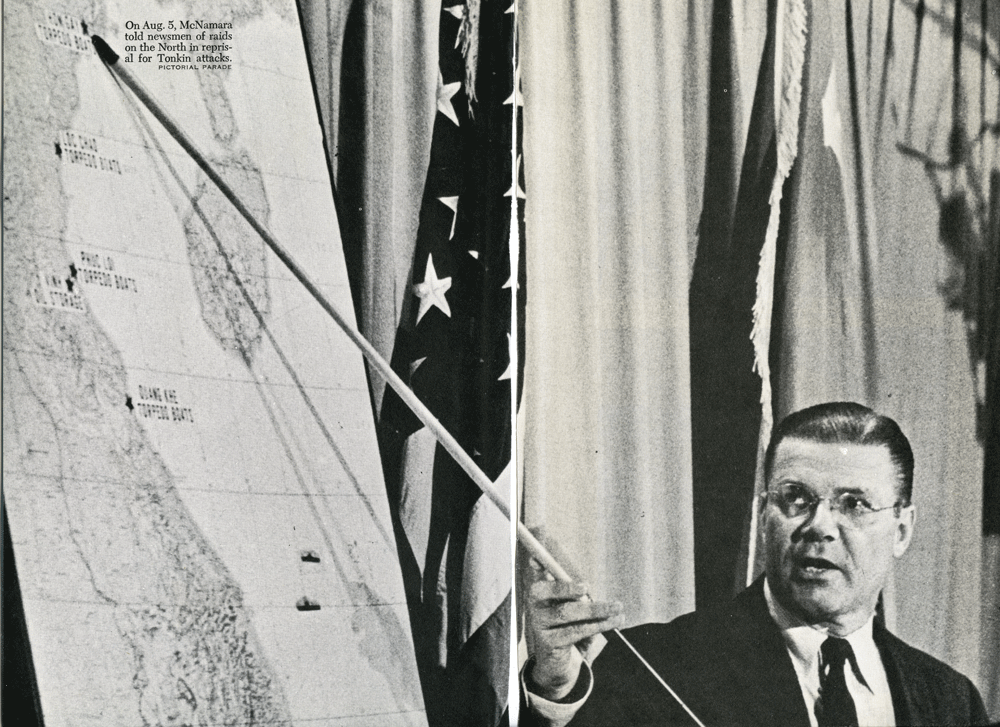
agreed on the targets. Fighter-bombers from the carriers
Constellation and Ticonderoga should strike four torpedo boat
bases at Hongay, Lochau, Phucloi and Quangkhe, and an oil
storage depot near Vinh that held some 10 per cent of North
Vietnam's petroleum supply.
At a second National Security Council meeting that afternoon,
President Johnson ordered the reprisals, decided to
seek the Congressional resolution immediately and discussed
with his advisers the swift Southeast Asia deployment of the
air strike forces designated in Operation Plan 37-64 for the
opening blows in a possible bombing campaign against the
North. His approval for these preparatory air deployments,
and for the readiness of Marine Corps and Army units planned
to meet any Chinese or North Vietnamese retaliation to a
bombing campaign, was apparently given later that day, the
study shows.
Mr. McNamara returned to the Pentagon at 3 P.M. to
approve the details of the reprisal strikes, code-named Pierce
Arrow. An execution order was prepared by the Joint Staff,
but at 4 P.M. Mr. McNamara learned from Admiral Sharp
in a telephone conversation that there was now confusion
over whether an attack on the destroyers had actually taken
place.
The Secretary told Admiral Sharp that the reprisal order
would remain in effect, but that the admiral was to check
and make certain that an attack had really occurred before
actually launching the planes. At 4:49 P.M., less than six
hours after the first message of the attack had flashed into
the Pentagon communications center, the formal execution
order for the reprisals was transmitted to Honolulu. Admiral
Sharp had not yet called back with confirming details of
the attack. The order specified that the carriers were to
launch their planes within about two and a half hours.
270
The admiral called back at 5 :23 P.M. and again a few
minutes after 6 o'clock to say that he was satisfied, on the
basis of information from the task group commander of the
two destroyers, that the attack had been genuine. The study
says that in the meantime Mr. McNamara and the Joint Chiefs
had also examined the confirming evidence, including intercepted
radio messages from the North Vietnamese saying
that their vessels were engaging the destroyers and that two
torpedo boats had been sunk.
By now Mr. McNamara and the Chiefs had moved on to
discussing the prepositioning of the air strike forces under
Operation Plan 37-64.
At 6:45 P.M., President Johnson met with 16 Congressional
leaders from both parties whom he had summoned to the
White House. He told them that because of the second unprovoked
attack on the American destroyers, he had decided
to launch reprisal air strikes against the North and to ask
for a Congressional resolution, the study says.
The Pentagon study gives no indication that Mr. Johnson
informed the Congressional leaders of United States responsibility
for and command of the covert 34A raids on July 30
and Aug. 3.
Nor does the history give any indication that Mr. Johnson
told the Congressional leaders of what the historian describes
as "the broader purpose of the deployments" under Operation
Plan 37-64, which Mr. McNamara was to announce at a
Pentagon news conference the next day and describe as a
precautionary move.
"It is significant," the analyst writes, "that few of these
additional units were removed from the western Pacific when
the immediate crisis subsided. In late September the fourth
attack aircraft carrier was authorized to resume its normal
station in the eastern Pacific as soon as the regularly assigned
carrier completed repairs. The other forces remained in the
vicinity of their August deployment."
At 8:30 P.M. on Aug. 4, Mr. McNamara returned to the
Pentagon and at 11: 30 P.M., after several telephone calls
to Admiral Sharp, he learned that the Ticonderoga had
launched her bomb-laden aircraft at 10:43 P.M. They were
expected to arrive over their targets in about an hour and
50 minutes.
The carriers had needed more time to get into launching
position than the execution order had envisioned. The Constellation,
steaming from Hong Kong, was not to launch her
planes for another couple of hours.
271
The President did not wait. Sixteen minutes after Mr.
McNamara's last phone call to Admiral Sharp, at 11: 36 P.M.,
he went on television to tell the nation of the reprisal
strikes. He characterized his actions as a "limited and fitting"
response. "We still seek no wider war," he said.
Almost simultaneously, the air deployments under Operation
Plan 37-64 had begun.
The first F-I02 Delta Dagger jet fighters were landing at
Saigon's airport around the time Mr. McNamara described
the deployments at a Pentagon news conference on Aug. 5.
He had given a brief post-midnight conference the same day
to describe the reprisal strikes. He reported now that 25
North Vietnamese patrol craft had been destroyed or damaged
along with 90 per cent of the oil storage tanks near
Vinh.
"Last night I announced that moves were under way to
reinforce our forces in the Pacific area," he continued. "These
moves include the following actions:
"First, an attack carrier group has been transferred from
the First Fleet on the Pacific coast to the western Pacific.
Secondly, interceptor and fighter-bomber aircraft have been
moved into South Vietnam. Thirdly, fighter-bomber aircraft
have been moved into Thailand. Fourthly, interceptor and
fighter-bomber squadrons have been transferred from the
United States into advance bases in the Pacific. Fifthly, an
antisubmarine task force group has been moved into the
South China Sea. And finally, selected Army and Marine
forces have been alerted and readied for movement."
The study notes that the Administration drafted the Congressional
resolution for the two men who would sponsor
its passage through both houses for the President: Senator
J. W. Fulbright of Arkansas, chairman of the Senate Foreign
Relations Committee, and Representative Thomas E. Morgan
of Pennsylvania, chairman of the House Foreign Affairs
Committee.
Precisely who drafted this final version of the resolution
is not mentioned. The wording was less precise than that of
the resolution drafted by William Bundy for the May 23
scenario, but the key language making the resolution in effect
a declaration of war remained:
"Resolved by the Senate and House of Representatives of
the United States of America in Congress assembled, That
the Congress approve and support the determination of the
President, as Commander in Chief, to take all necessary measures to
repel any armed attack against the forces of the
United States and to prevent further aggression.
"Sec. 2. The United States regards as vital to its national
interest and to world peace the maintenance of international
peace and security in Southeast Asia. Consonant with the
Constitution of the United States and the Charter of the
United Nations and in accordance with its obligations under
the Southeast Asia Collective Defense Treaty, the United
States is, therefore, prepared, as the President determines, to
take all necessary steps, including the use of armed force,
to assist any member or protocol state of the Southeast Asia
Collective Defense Treaty requesting assistance in defense of
its freedom."
Mr. McNamara and Secretary Rusk both testified on behalf
of the resolution in secret sessions of the Senate and
House foreign relations committees on Aug. 6. In his narrative,
the Pentagon analyst occasionally quotes from and
refers to portions of their testimony that have never been
made public by the Pentagon. Along with the study, The
Times also obtained more extensive quotations from this
portion of the hearing transcript. The following account of
the testimony on Aug. 6 thus contains both quotations used
by the Pentagon analyst and the fuller quotations obtained
by The Times.
Senator Wayne Morse of Oregon had learned that boats
manned by South Vietnamese crews had attacked the two
North Vietnamese islands on July 30. Mr. Morse, one of
two Senators who were to vote against the Tonkin Gulf
resolution-the other was Ernest L. Gruening of Alaska -- alleged
during the secret hearing on Aug. 6 that Mr. McNamara had known about
the raids and that the destroyers
had been associated with it.
"First," Mr. McNamara replied, "our Navy played absolutely
no part in, was not associated with, was not aware of,
any South Vietnamese actions, if there were any. . . . The
Maddox was operating in international waters, was carrying
out a routine patrol of the type we carry out all over the
world at all times.
"I did not have knowledge at the time of the attack on
the island," he said. "There is no connection between this
patrol and any action by South Vietnam."
Mr. McNamara contended that whatever action had taken
place against these North Vietnamese islands had been part
of an anti-infiltration operation being conducted by a fleet
273
of coastal patrol junks the United States had helped South
Vietnam to organize in December, 1961.
"In the first seven months of this year they have searched
149,000 junks, some 570,000 people," he is quoted as telling
the committee in this secret session. "This is a tremendous
operation endeavoring to close the seacoasts of over 900
miles. In the process of that action, as the junk patrol has
increased in strength, they have moved farther and farther
north endeavoring to find the source of the infiltration.
"As part of that, as I reported to you earlier this week,
[Mr. McNamara had testified before the committee in a secret
session on Aug. 3 after the first attack on the Maddox], we
understand that the South Vietnamese sea force carried out
patrol action around these islands and actually shelled the
parts they felt were associated with this infiltration.
"Our ships had absolutely no knowledge of it, were not
connected with it; in no sense of the word can be considered
to have backstopped the effort," he said.
Senator Frank Church of Idaho then asked Secretary Rusk
at the same secret session: "I take it that our government
which supplied these boats . . . . did know that the boats
would be used for attacks on North Vietnamese targets, and
that we acquiesced in that policy, is that correct?"
"... In the larger sense, that is so, but as far as any particular
detail is concerned we don't from Washington follow
that in great detail," Mr. Rusk replied.
"They are doing it with our acquiescence and consent, is
that correct?" Senator Church continued.
"But within very limited levels as far as North Vietnam
is concerned," Mr. Rusk said.
At a Pentagon news conference after his testimony before
the committee, Mr. McNamara spoke about the coastal patrol
junks again and avoided any specific mention of the July 30
raid:
Q. Mr. Secretary?
A. Yes?
Q. Have there been any incidents that you know
involving the South Vietnamese vessels and the North
Vietnamese?
A. No, none that I know of, although I think that
I should mention to you the South Vietnamese naval
patrol activities that are carried on to prevent in the
infiltration of men and materiel from the North into
the South.
274
In the last seven months of 1961, for example, about
1,400 men were infiltrated across the 17th Parallel
from North Vietnam into South Vietnam. To prevent
further infiltration of that kind, the South Vietnamese
with our assistance have set up a naval patrol
which is very active in that area which continues to
inspect and examine junks and their personnel.
In one eight-month period that I can recall they
discovered 140 Vietcong infiltrators.
Q. They operate on their own?
A. They operate on their own. They are part of the
South Vietnamese Navy, commanded by the South
Vietnamese Navy, operating in the coastal waters
inspecting suspicious incoming junks, seeking to deter
and prevent the infiltration of both men and materiel
from North Vietnam into South Vietnam.
Q. Mr. Secretary. Do these junks go north into
North Vietnam areas?
A. They have advanced closer and closer to the
17th Parallel and in some cases I think have moved
beyond that in an effort to stop the infiltration closer
to the point of origin.
Q. Do our naval vessels afford any cover for these
operations?
A. Our naval vessels afford no cover whatsoever.
Our naval personnel do not participate in the junk operations.
When Senator George S. McGovern of South Dakota
subsequently brought up the July 30 attack on the islands
during the Senate floor debate on the resolution, Senator
Fulbright replied that he had been assured by the Administration
that "our boats did not convoy or support or back
up any South Vietnamese naval vessels" and that the destroyer
patrol "was entirely unconnected or un associated
with any coastal forays the South Vietnamese themselves may
have conducted."
The Congressional resolution passed on Aug. 7 by a vote
of 88 to 2 in the Senate and 416 to 0 in the House.
The history shows that besides the May 19 progress report
from the Joint Chiefs on the 34A Operations, Mr. McNamara
had received other memorandums on the clandestine attacks
from General Anthis, the special assistant to the Joint Chiefs,
on June 13, July 1 and July 28, 1964. General Anthis drew
275
up the advance monthly schedules of the covert operations
for approval by William Bundy and Mr. McNaughton.
Where Mr. Rusk is concerned, the study reveals that he
was kept reasonably well informed.
The study also makes it clear that there was no connection
between the 34A raids and the coastal patrol junk fleet described
by Mr. McNamara and referred to by Mr. Rusk.
Thus, in the space of three days, the Administration had
put firmly into place two key elements of the May 23
scenario-prepositioning of major air strike forces and Congressional
authorization for wider action.
Internal Administration planning for Congressional authorization
to escalate also now disappears from the documentary
record. The account notes that during the next round of
planning "the question of Congressional authority for open
acts of war against a sovereign nation was never seriously
raised."
There was confusion in Congress, however, over precisely
what the resolution meant, the account says, commenting:
"Despite the nearly unanimous votes of support for the
resolution, Congressional opinions varied as to the policy
implications and the meaning of such support. The central
belief seemed to be that the occasion necessitated demonstrating
the nation's unity and collective will in support of
the President's action and affirming U.S. determination to
oppose further aggression. However, beyond that theme, there
was a considerable variety of opinion .... Several spokesmen
stressed that the resolution did not constitute a declaration
of war, did not abdicate Congressional responsibility for determining
national policy commitments and did not give the
President carte blanche to involve the nation in a major Asian
war."
The Administration would now communicate the meaning
of the resolution to Hanoi by carrying out in a more significant
manner an element of the May 23 scenario that Washington
had already used once in June when the Canadian emissary
had paid his first visit to Hanoi.
On Aug. 10, Mr. Seaborn was sent back with a second
message for Premier Dong, which concluded:
"a. That the events of the past few days should add credibility
to the statement made last time, that 'U.S. public and
official patience with North Vietnamese aggression is growing
extremely thin.'
"b. That the U.S. Congressional resolution was passed
with near unanimity, strongly reaffirming the unity and de-
276
termination of the U.S. Government and people not only
with respect to any further attacks on U.S. military forces
but more broadly to continue to oppose firmly, by all necessary
means, D.R.V. efforts to subvert and conquer South
Viet-Nam and Laos.
"c. That the U.S. has come to the view that the D.R.Y.
role in South Vietnam and Laos is critical. If the D.R.Y.
persists in its present course, it can expect to continue to
suffer the consequences. [The word "continue" referred to
the reprisal air strikes that followed the Tonkin incident.]
"d. That the D.R.Y. knows what it must do if the peace
is to be restored.
"e. That the U.S. has ways and means of measuring the
D.R.Y.'s participation in, and direction and control of, the
war on South Vietnam and in Laos and will be carefully
watching the D.R.V.'s response to what Mr. Seaborn is telling
them." [See Document #68.]
Mr. McNaughton had drafted the message on the day the
resolution was passed.
During this, as in his first meeting with Mr. Seaborn in
June, the history says, "Pham Van Dong showed himself
utterly unintimidated and calmly resolved to pursue the course
upon which the D.R.V. was embarked to what he confidently
expected would be its successful conclusion."
In the heat of the Tonkin clash, the Administration had
also accomplished one of the major recommendations of the
June strategy conference at Honolulu-preparing the American
public for escalation.
"The Tonkin Gulf reprisal constituted an important firebreak
and the Tonkin Gulf resolution set U.S. public support
for virtually any action," the study remarks.
Almost none of the "disagreeable questions" the Administration
might have to answer about the resolution, which had
given the President pause in mid-June, had been asked in
the emotional atmosphere of the crisis.
And inside the Administration the planners were moving
more quickly now.
On Aug. 10, three days after passage of the resolution,
Ambassador Taylor cabled the President a situation report on
South Vietnam. It said that the Khanh regime had only "a
50-50 chance of lasting out the year." Therefore, a major
objective of the United States Mission in Saigon was to "be
prepared to implement contingency plans against North Vietnam
with optimum readiness by Jan. 1, 1965."
On Aug. 11, four days after passage of the resolution,
277
William Bundy drew up a memorandum for a high-level
State-Defense Departments policy meeting. The memorandum
outlined graduated steps towards a possible full-scale
air war against North Vietnam with "a contingency date, as
suggested by Ambassador Taylor, of 1 January 1965." But
until the end of August, Mr. Bundy said, there should be "a
short holding phase, in which we would avoid actions that
would in any way take the onus off the Communist side for
escalation." [See Document #70.]
On Aug. 14, a lengthy summary of Mr. Bundy's memorandum
was cabled to Ambassador Taylor, Ambassador Unger
in Vientiane, and to Admiral Sharp in Honolulu for comments
that would permit "further review and refinement."
The Tonkin Gulf reprisal air strikes, the analyst writes,
"marked the crossing of an important threshold in the war,
and it was accomplished with virtually no domestic criticism,
indeed, with an evident increase in public support for the
Administration. The precedent for strikes against the North
was thus established and at very little apparent cost.
"There was a real cost, however," he concludes, in that
the Administration was psychologically preparing itself for
further escalation. "The number of unused measures short
of direct military action against the North had been depleted.
Greater visible commitment was purchased at the price of
reduced flexibility." And "for all these reasons, when a decision
to strike the North was faced again, it was much easier
to take."
Admiral Sharp, in his cable to Washington on Aug. 17
commenting on Mr. Bundy's memorandum, "candidly"
summed up this psychological commitment, the analyst says.
"Pressures against the other side once instituted should
not be relaxed by any actions or lack of them which would
destroy the benefits of the rewarding steps previously taken,"
the admiral wrote.
278
KEY DOCUMENTS
Following are the texts of key documents accompanying the
Pentagon's study of the Vietnam war, for the period December,
1963, through the Tonkin Gulf incident in August, 1964, and its
aftermath. Except where excerpting is specified, the documents are
printed verbatim, with only unmistakable typographical errors
corrected.
# 61
McNamara Report to Johnson on the
Situation in Saigon in '63
Memorandum, "Vietnam Situation," from Secretary of
Defense Robert S. McNamara to President Lyndon B.
Johnson, Dec. 21, 1963.
In accordance with your request this morning, this is a summary
of my conclusions after my visit to Vietnam on December
19-20.
1. Summary. The situation is very disturbing. Current trends,
unless reversed in the next 2-3 months, will lead to neutralization
at best and more likely to a Communist-controlled state.
2. The new government is the greatest source of concern. It is
indecisive and drifting. Although Minh states that he, rather than
the Committee of Generals, is making decisions, it is not clear
that this is actually so. In any event, neither he nor the Committee
are experienced in political administration and so far they show
little talent for it. There is no clear concept on how to re-shape
or conduct the strategic hamlet program; the Province Chiefs,
most of whom are new and inexperienced, are receiving little or no
direction because the generals are so preoccupied with essentially
political affairs. A specific example of the present situation is
that General [name illegible] is spending little or no time commanding
III Corps, which is in the vital zone around Saigon and
needs full-time direction. I made these points as strongly as possible
to Minh, Don, Kim, and Tho.
3. The Country Team is the second major weakness. It lacks
leadership, has been poorly informed, and is not working to a
279
common plan. A recent example of confusion has been conflicting
USOM and military recommendations both to the Government
of Vietnam and to Washington on the size of the military budget.
Above all, Lodge has virtually no official contact with Harkins.
Lodge sends in reports with major military implications without
showing them to Harkins, and does not show Harkins important
incoming traffic. My impression is that Lodge simply does not
know how to conduct a coordinated administration. This has of
course been stressed to him both by Dean Rusk and myself (and
also by John McCone), and I do not think he is consciously rejecting
our advice; he has just operated as a loner all his life and
cannot readily change now.
Lodge's newly-designated deputy, David Nes, was with us and
seems a highly competent team player. I have stated the situation
frankly to him and he has said he would do all he could to constitute
what would in effect be an executive committee operating
below the level of the Ambassador.
As to the grave reporting weakness, both Defense and CIA must
take major steps to improve this, John McCone and I have discussed
it and are acting vigorously in our respective spheres.
4. Viet Cong progress has been great during the period since
the coup, with my best guess being that the situation has in fact
been deteriorating in the countryside since July to a far greater
extent than we realized because of our undue dependence on distorted
Vietnamese reporting. The Viet Cong now control very
high proportions of the people in certain key provinces, particularly
those directly south and west of Saigon. The Strategic Hamlet
Program was seriously over-extended in those provinces, and the
Viet Cong has been able to destroy many hamlets, while others
have been abandoned or in some cases betrayed or pillaged by the
government's own Self Defense Corps. In these key provinces,
the Viet Cong have destroyed almost all major roads, and are
collecting taxes at will.
As remedial measures, we must get the government to reallocate
its military forces so that its effective strength in these
provinces is essentially doubled. We also need to have major
increases in both military and USOM staffs, to sizes that will give
us a reliable, independent U.S. appraisal of the status of operations.
Thirdly, realistic pacification plans must be prepared, allocating
adequate time to secure the remaining government-controlled
areas and work out from there.
This gloomy picture prevails predominantly in the provinces
around the capital and in the Delta. Action to accomplish each
of these objectives was started while we were in Saigon. The
situation in the northern and central areas is considerably better,
and does not seem to have deteriorated substantially in recent
months. General Harkins still hopes these areas may be made
reasonably secure by the latter half of next year.
In the gloomy southern picture, an exception to the trend of
Viet Cong success may be provided by the possible adherence to
280
the government of the Cao Dai and Hoa Hao sects, which total
three million people and control key areas along the Cambodian
border. The Hoa Hao have already made some sort of agreement,
and the Cao Dai are expected to do so at the end of this month.
However, it is not clear that their influence will be more than
neutralized by these agreements, or that they will in fact really
pitch in on the government's side.
5. Infiltration of men and equipment from North Vietnam
continues using (a) land corridors through Laos and Cambodia;
(b) the Mekong River waterways from Cambodia; (c) some
possible entry from the sea and the tip of the Delta. The best
guess is that 1000-1500 Viet Cong cadres entered South Vietnam
from Laos in the first nine months of 1963. The Mekong route
(and also the possible sea entry) is apparently used for heavier
weapons and ammunition and raw materials which have been turning
up in increasing numbers in the south and of which we have
captured a few shipments.
To counter this infiltration, we reviewed in Saigon various
plans providing for cross-border operations into Laos. On the
scale proposed, I am quite clear that these would not be politically
acceptable or even militarily effective. Our first need would be
immediate
U-2 mapping of the whole Laos and Cambodian border,
and this we are preparing on an urgent basis.
One other step we can take is to expand the existing limited
but remarkably effective operations on the Laos side, the so-called
Operation HARDNOSE, so that it at least provides reasonable
intelligence on movements all the way along the Laos corridor;
plans to expand this will be prepared and presented for approval
in about two weeks.
As to the waterways, the military plans presented in Saigon
were unsatisfactory, and a special naval team is being sent at once
from Honolulu to determine what more can be done. The whole
waterway system is so vast, however. that effective policing may
be impossible.
In general, the infiltration problem, while serious and annoying,
is a lower priority than the key problems discussed earlier. However,
we should do what we can to reduce it.
6. Plans for Covert Action into North Vietnam were prepared
as we had requested and were an excellent job. They present a
wide variety of sabotage and psychological operations against
North Vietnam from which I believe we should aim to select those
that provide maximum pressure with minimum risk. In accordance
with your direction at the meeting. General Krulak of the JCS
is chairing a group that will layout a program in the next ten
days for your consideration.
7. Possible neutralization of Vietnam is strongly opposed by
Minh, and our attitude is somewhat suspect because of editorials
by the New York Times and mention by Walter Lippmann and
others. We reassured them as strongly as possible on this-and
in somewhat more general terms on the neutralization of Cambodia. I
recommend that you convey to Minh a Presidential
message for the New Year that would also be a vehicle to stress
the necessity of strong central direction by the government and
specifically by Minh himself.
8. U.S. resources and personnel cannot usefully be substantially
increased. I have directed a modest artillery supplement, and also
the provision of uniforms for the Self Defense Corps, which is
the most exposed force and suffers from low morale. Of greater
potential significance, I have directed the Military Departments
to review urgently the quality of the people we are sending to
Vietnam. It seems to have fallen off considerably from the high
standards applied in the original selections in 1962, and the JCS
fully agree with me that we must have our best men there.
Conclusion. My appraisal may be overly pessimistic. Lodge,
Harkins, and Minh would probably agree with me on specific
points, but feel that January should see significant improvement.
We should watch the situation very carefully, running scared,
hoping for the best, but preparing for more forceful moves if the
situation does not show early signs of improvement.
# 62
'64 Memo by Joint Chiefs of Staff
Discussing Widening of the War
Memorandum from Gen. Maxwell D. Taylor, Chairman
of the Joint Chiefs of Staff, to Secretary of Defense McNamara, Jan. 22,
1964, "Vietnam and Southeast Asia."
1. National Security Action Memorandum No. 273 makes
clear the resolve of the President to ensure victory over the externally
directed and supported communist insurgency in South
Vietnam. In order to achieve that victory, the Joint Chiefs of
Staff are of the opinion that the United States must be prepared
to put aside many of the self-imposed restrictions which now
limit our efforts, and to undertake bolder actions which may embody
greater risks.
2. The Joint Chiefs of Staff are increasingly mindful that our
fortunes in South Vietnam are an accurate barometer of our
fortunes in all of Southeast Asia. It is our view that if the U.S.
program succeeds in South Vietnam it will go far toward stabilizing
the total Southeast Asia situation. Conversely, a loss of South
Vietnam to the communists will presage an early erosion of
the remainder of our position in that subcontinent.
3. Laos, existing on a most fragile foundation now, would not
be able to endure the establishment of a communist-or pseudo
neutralist-state on its eastern flank. Thailand, less strong today
than a month ago by virtue of the loss of Prime Minister Sarit,
282
would probably be unable to withstand the pressures of infiltration
from the north should Laos collapse to the communists in its
turn. Cambodia apparently has estimated that our prospects in
South Vietnam are not promising and, encouraged by the actions
of the French, appears already to be seeking an accommodation
with the communists. Should we actually suffer defeat in South
Vietnam, there is little reason to believe that Cambodia would
maintain even a pretense of neutrality.
4. In a broader sense, the failure of our programs in South
Vietnam would have heavy influence on the judgments of Burma,
India, Indonesia, Malaysia, Japan, Taiwan, the Republic of Korea,
and the Republic of the Philippines with respect to U.S. durability,
resolution, and trustworthiness. Finally, this being the first real test
of our determination to defeat the communist wars of national
liberation formula, it is not unreasonable to conclude that there
would be a corresponding unfavorable effect upon our image in
Africa and in Latin America.
5. All of this underscores the pivotal position now occupied by
South Vietnam in our world-wide confrontation with the communists
and the essentiality that the conflict there would be
brought to a favorable end as soon as possible. However, it
would be unrealistic to believe that a complete suppression of the
insurgency can take place in one or even two years. The British
effort in Malaya is a recent example of a counterinsurgency effort
which required approximately ten years before the bulk of the
rural population was brought completely under control of the
government, the police were able to maintain order, and the
armed forces were able to eliminate the guerrilla strongholds.
6. The Joint Chiefs of Staff are convinced that, in keeping
with the guidance in NSAM 273, the United States must make
plain to the enemy our determination to see the Vietnam campaign
through to a favorable conclusion. To do this, we must
prepare for whatever level of activity may be required and, being
prepared, must then proceed to take actions as necessary to
achieve our purposes surely and promptly.
7. Our considerations, furthermore, cannot be confined entirely
to South Vietnam. Our experience in the war thus far leads
us to conclude that, in this respect, we are not now giving sufficient
attention to the broader area problems of Southeast Asia.
The Joint Chiefs of Staff believe that our position in Cambodia,
our attitude toward Laos, our actions in Thailand, and our great
effort in South Vietnam do not comprise a compatible and integrated
U.S. policy for Southeast Asia. U.S. objectives in Southeast
Asia cannot be achieved by either economic, political, or military
measures alone. All three fields must be integrated into a single,
broad U.S. program for Southeast Asia. The measures recommended
in this memorandum are a partial contribution to such
a program.
8. Currently we and the South Vietnamese are fighting the war
on the enemy's terms. He has determined the locale, the timing,
283
and the tactics of the battle while our actions are essentially
reactive.
One reason for this is the fact that we have obliged ourselves
to labor under self-imposed restrictions with respect to
impeding external aid to the Viet Congo These restrictions include
keeping the war within the boundaries of South Vietnam,
avoiding the direct use of U.S. combat forces, and limiting U.S.
direction of the campaign to rendering advice to the Government
of Vietnam. These restrictions, while they may make our international
position more readily defensible, all tend to make the
task in Vietnam more complex, time-consuming, and in the end,
more costly. In addition to complicating our own problem, these
self-imposed restrictions may well now be conveying signals of
irresolution to our enemies -- encouraging them to higher levels of
vigor and greater risks. A reversal of attitude and the adoption
of a more aggressive program would enhance greatly our ability to
control the degree to which escalation will occur. It appears
probable that the economic and agricultural disappointments
suffered by Communist China, plus the current rift with the
Soviets, could cause the communists to think twice about undertaking
a large-scale military adventure in Southeast Asia.
9. In adverting to actions outside of South Vietnam, the
Joint Chiefs of Staff are aware that the focus of the counterinsurgency
battle lies in South Vietnam itself, and that the war
must certainly be fought and won primarily in the minds of the
Vietnamese people. At the same time, the aid now coming to the
Viet Cong from outside the country in men, resources, advice, and
direction is sufficiently great in the aggregate to be significant --
both
as help and as encouragement to the Viet Congo It is our
conviction that if support of the insurgency from outside South
Vietnam in terms of operational direction, personnel, and material
were stopped completely, the character of the war in South
Vietnam would be substantially and favorably altered. Because
of this conviction, we are wholly in favor of executing the covert
actions against North Vietnam which you have recently proposed
to the President. We believe, however, that it would be idle to
conclude that these efforts will have a decisive effect on the communist
determination to support the insurgency; and it is our
view that we must therefore be prepared fully to undertake a
much higher level of activity, not only for its beneficial tactical
effect, but to make plain our resolution, both to our friends and
to our enemies.
10. Accordingly, the Joint Chiefs of Staff consider that the
United States must make ready to conduct increasingly bolder
actions in Southeast Asia; specifically as to Vietnam to:
a. Assign to the U.S. military commander responsibilities for
the total U.S. program in Vietnam.
b. Induce the Government of Vietnam to turn over to the
United States military commander, temporarily, the actual tactical
direction of the war.
c. Charge the United States military commander with complete
284
Pending questions include: (a) whether YT strikes should be
made in support of RLAF T-28 corridor operations; (b) whether
YT recce should be made of areas north of 20° parallel; (c) YT
suppressive attacks against Route 7, especially Ban Ken Bridge;
and (d) YT activity in event of large-scale ground offensive by
PL (this issue has not arisen but undoubtedly would, should the
PL undertake an offensive beyond the capabilities of Lao and
sheep-dipped Thai to handle).
c. T·28 OPERATIONS
There are now 27 T-28 (including three RT-28) aircraft in
Laos, of which 22 are in operation. CINCPAC has taken action,
in response to Ambassador Unger's request to build this inventory
back up to 40 aircraft for which a pilot capability, including Thai,
is present in Laos.
The T-28's are conducting the following operations:
1. General harassing activities against Pathet Lao military
installations
and movement, primarily in Xieng Khouang and Sam
Neua Provinces. This also includes efforts to interdict Route 7.
2. Tactical support missions for Operation Anniversary Victory
No.2 (Saleumsay), the FAR-Meo clearing operation up Route 4
and north of Tha Thorn.
3. Tactical support for Operation Victorious Arrow (Sone Sai),
aFAR clearing operations in southern Laos.
4. Strikes on targets of opportunity, including in support of
FAR defensive ac.tions such as at Ban Khen northwest Thakhek.
5. Corridor interdiction program. The original targets under
this program have been hit and plans are now underway to hit
four additional targets (including in the Tchepone area), plus
restriking some of the original 13 targets. Ambassador Unger has
submitted for approval under this program 6 additional targets.
6. The Ambassador has been authorized to discuss with the
RLAF RT-28 reconnaissance in northwest Laos along the area
just north of and to the east and west of the line from Veng Phou
Kha-Muong Sai.
In recent weeks, the T-28's have been dropping a large number
of surrender leaflets on many of their missions. These have
already led, in some cases, to PL defections.
U.S. participation in SAR operations for downed T-28's, is
authorized.
We are faced by the following problems in connection with the
T-28's:
1. Authority for Yankee Team aircraft to engage in suppressive
strikes in the corridor area, in support of the T-28 strike program
there, has not been given as yet.
2. Also withheld is authorization for YT suppressive fire attack
on Ban Ken Bridge on Route 7.
3. We are investigating reports of greatly increased truck movement
along Route 7 as well as enemy build-up of tanks and other
313
equipment just across the border in NVN. Counteraction may be
required involving attack on Ban Ken.
4. Thai involvement. Hanoi claims to have shot down a T-28
over DRV territory on August 18 and to have captured the Thai
pilot flying the plane. Although the information the North Vietnamese
have used in connection with this case seems to be
accurate, it is not clear the pilot is alive and can be presented to
the ICC. The possibility cannot be excluded, however, nor that
other Thai pilots might be captured by the PL.
5. The DRV claims T-28's have violated North Vietnamese
airspace and bombed/strafed NVN villages on August 1 and 2,
and on October 16 and 17 and again on October 28. The charges
are probably accurate with respect to the first two dates (along
Route 7) and the last one (Mu Gia Pass area). The October 16
and 17 strikes were actually in disputed territory which was
recognized by the 1954 Geneva Agreements as being in Laos.
6. The Pathet Lao has called to the attention of the ICC T-28
strikes in the corridor area and called for the ICe to stop them
and inform the Co-Chairmen. The ICC has already agreed to
investigate another PL charge concerning alleged U.S./SVN activities
in the corridor area in violation of the Geneva Agreements.
D. DeSOTO PATROLS
Further DeSoto Patrols have been held in abeyance pending toplevel
decision. Ambassador Taylor (Saigon's 1378) sees no advantage
in resuming DeSoto Patrols except for essential intelligence
purposes. He believes we should tie our actions to Hanoi's support
of Viet Cong, not to the defense of purely U.S. interests.
E. CROSS BORDER GROUND OPERATIONS
Earlier in the year several eight-man reconnaissance teams were
parachuted into Laos as part of Operation Leaping Lena. All of
these teams were located by the enemy and only four survivors
returned to RVN. As a result of Leaping Lena, Cross Border
Ground Operations have been carefully reviewed and COMUSMACV
has stated that he believes no effective Cross Border
Ground Operations can be implemented prior to January 1, 1965
at the earliest.
F. COVERT OPERATIONS IN LAOS
Consideration is being given to improving Hardnose (including
greater Thai involvement) and getting Hardnose to operate more
effectively in the corridor infiltration areas.
No change in status of Kha.
G. OTHER SENSITIVE INTELLIGENCE OPERATIONS
These include "Queen Bee," "Box Top," "Lucky Dragon" and
"Blue Springs."
314
responsibility for conduct of the program against North Vietnam.
d. Overfly Laos and Cambodia to whatever extent is necessary
for acquisition of operational intelligence.
e. Induce the Government of Vietnam to conduct overt ground
operations in Laos of sufficient scope to impede the flow of
personnel and material southward.
f. Arm, equip, advise, and support the Government of Vietnam
in its conduct of aerial bombing of critical targets in North Vietnam
and in mining the sea approaches to that country.
g. Advise and support the Government of Vietnam in its conduct
of large-scale commando raids against critical targets in
North Vietnam.
h. Conduct aerial bombing of key North Vietnam targets, using
U.S. resources under Vietnamese cover, and with the Vietnamese
openly assuming responsibility for the actions.
i. Commit additional U.S. forces, as necessary, in support of
the combat action within South Vietnam.
j. Commit U.S. forces as necessary in direct actions against
North Vietnam.
11. It is our conviction that any or all of the foregoing actions
may be required to enhance our position in Southeast Asia. The
past few months have disclosed that considerably higher levels of
effort are demanded of us if U.S. objectives are to be attained.
12. The governmental reorganization which followed the coup
d'etat in Saigon should be completed very soon, giving basis for
concluding just how strong the Vietnamese Government is going
to be and how much of the load they will be able to bear themselves.
Additionally, the five-month dry season, which is just now
beginning, will afford the Vietnamese an opportunity to exhibit
their ability to reverse the unfavorable situation in the critical
Mekong Delta. The Joint Chiefs of Staff will follow these important
developments closely and will recommend to you progressively
the execution of such of the above actions as are
considered militarily required, providing, in each case, their detailed
assessment of the risks involved.
13. The Joint Chiefs of Staff consider that the strategic importance
of Vietnam and of Southeast Asia warrants preparations
for the actions above and recommend that the substance of this
memorandum be discussed with the Secretary of State.
# 63
'64 McNamara Report on Steps to Change
the Trend of the War
Excerpts from memorandum, "South Vietnam," from
Secretary of Defense McNamara to President Johnson,
March 16, 1964.
285
I. U.S. OBJECTIVES IN SOUTH VIETNAM
We seek an independent non-Communist South Vietnam. We
do not require that it serve as a Western base or as a member
of a Western Alliance. Vietnam must be free, however, to accept
outside assistance as required to maintain its security. This assistance
should be able to take the form not only of economic and
social pressures but also police and military help to root out and
control insurgent elements.
Unless we can achieve this objective in South Vietnam, almost
al! of Southeast Asia will probably fall under Communist
dominance (all of Vietnam, Laos, and Cambodia), accommodate
to Communism so as to remove effective U.S. and anti-Communist
influence (Burma), or fall under the domination of forces not
now explicitly Communist but likely then to become so (Indonesia
taking over Malaysia). Thailand might hold for a period with
our help, but would be under grave pressure. Even the Philippines
would become shaky, and the threat to India to the west, Australia
and New Zealand to the south, and Taiwan, Korea, and
Japan to the north and east would be greatly increased.
All these consequences would probably have been true even
if the U.S. had not since 1954, and especially since 1961, become
so heavily engaged in South Vietnam. However, that fact accentuates
the impact of a Communist South Vietnam not only in
Asia, but in the rest of the world, where the South Vietnam conflict
is regarded as a test case of U.S. capacity to help a nation
meet a Communist "war of liberation."
Thus, purely in terms of foreign policy, the stakes are high. They
are increased by domestic factors.
II. PRESENT U.S. POLICY IN SOUTH VIETNAM
We are now trying to help South Vietnam defeat the Viet Cong,
supported from the North, by means short of the unqualified use
of U.S. combat forces. We are not acting against North Vietnam
except by a very modest "covert" program operated by South
Vietnamese (and a few Chinese Nationalists)-a program so
limited that it is unlikely to have any significant effect. In Laos,
we are still working largely within the framework of the 1962
Geneva Accords. In Cambodia we are still seeking to keep Sihanouk
from abandoning whatever neutrality he may still have and
fulfilling his threat of reaching an accommodation with Hanoi and
Peking. As a consequence of these policies, we and the GVN have
had to condone the extensive use of Cambodian and Laotian
territory by the Viet Cong, both as a sanctuary and as infiltration
routes.
m. THE PRESENT SITUATION IN SOUTH VmTNAM
The key elements in the present situation are as follows:
A. The military tools and concepts of the GVN-US efforts
286
are generally sound and adequate. * Substantially more can be
done in the effective employment of military forces and in the
economic and civic action areas. These improvements may require
some selective increases in the U.S. presence, but it does not appear
likely that major equipment replacement and additions in
U.S. personnel are indicated under current policy.
B. The U.S. policy of reducing existing personnel where South
Vietnamese are in a position to assume the functions is still
sound. Its application will not lead to any major reductions in the
near future, but adherence to this policy as such has a sound
effect in portraying to the U.S. and the world that we continue to
regard the war as a conflict the South Vietnamese must win and
take ultimate responsibility for. Substantial reductions in the
numbers of U.S. military training personnel should be possible
before the end of 1965. However, the U.S. should continue to
reiterate that it will provide all the assistance and advice required
to do the job regardless of how long it takes.
C. The situation has unquestionably been growing worse, at
least since September:
1. In terms of government control of the countryside, about
40% of the territory is under Viet Cong control or predominant
influence. In 22 of the 43 provinces, the Viet Cong control 50%
or more of the land area, including 80% of Phuoc Tuy; 90%
of Binh Duong; 75% of Hau Nghia; 90% of Long An; 90% of
Kien Tuong; 90% of Dinh Tuong; 90% of Kien Hoa and 85%
of An Xuyen.
2. Large groups of the population are now showing signs of
apathy and indifference, and there are some signs of frustration
within the U.S. contingent. ...
a. The ARVN and paramilitary desertion rates, and particularly
the latter, are high and increasing.
b. Draft-dodging is high while the Viet Cong are recruiting
energetically and effectively.
c. The morale of the hamlet militia and of the Self Defense
Corps, on which the security of the hamlets depends, is poor and
failing.
3. In the last 90 days the weakening of the government's position
has been particularly noticeable ....
4. The political control structure extending from Saigon down
into the hamlets disappeared following the November coup ....
5. North Vietnamese support, always significant, has been increasing
....
D. The greatest weakness in the present situation is the uncertain
viability of the Khanh government. Khanh himself is a
very able man within his experience, but he does not yet have
*Mr. McCone emphasizes that the GVN/US program can never be
considered completely satisfactory so long as it permits the Viet Cong a
sanctuary in Cambodia and a continuing uninterrupted and unmolested
source of supply and reinforcement from NVN through Laos.
287
wide political appeal and his control of the army itself is uncertain
....
E. On the positive side, we have found many reasons for encouragement
in the performance of the Khanh Government to
date. Although its top layer is thin, it is highly responsive to U.S.
advice, and with a good grasp of the basic elements of rooting
out the Viet Congo ...
2. Retaliatory Actions. For example:
a. Overt high and/or low-level reconnaissance flights by U.S.
or Farmgate aircraft over North Vietnam to assist in locating and
identifying the sources of external aid to the Viet Congo
b. Retaliatory bombing strikes and commando raids on a tit-for-tat basis
by the GVN against NVN targets (communication
centers, training camps, infiltration routes, etc.)
C. Aerial mining by the GVN aircraft (possibly with U.S. assistance)
of the major NVN ports.
3. Graduated Overt Military Pressure by GVN and U.S. Forces.
This program would go beyond reacting on a tit-for-tat basis.
It would include air attacks against military and possibly industrial
targets. The program would utilize the combined resources
of the GVN Air Force and the U.S. Farmgate Squadron, with the
latter reinforced by three squadrons of B-57s presently in Japan.
Before this program could be implemented it would be necessary
to provide some additional air defense for South Vietnam and to
ready U.S. forces in the Pacific for possible escalation.
The analysis of the more serious of these military actions (from
2 (b) upward) revealed the extremely delicate nature of such
operations, both from the military and political standpoints.
There would be the problem of marshalling the case to justify
such action, the problem of communist escalation, and the problem
of dealing with the pressures for premature or "stacked"
negotiations. We would have to calculate the effect of such military
actions against a specified political objective. That objective,
while being cast in terms of eliminating North Vietnamese control
and direction of the insurgency, would in practical terms be
directed toward collapsing the morale and the self-assurance of the
Viet Cong cadres now operating in South Vietnam and bolstering
the morale of the Khanh regime. We could not, of course, be sure
that our objective could be achieved by any means within the
practical range of our options. Moreover, and perhaps most importantly,
unless and until the Khanh government has established
its position and preferably is making significant progress in the
South, an overt extension of operations into the North carries
the risk of being mounted from an extremely weak base which
might at any moment collapse and leave the posture of political
confrontation worsened rather than improved.
The other side of the argument is that the young Khanh Government
[two words illegible] reinforcement of some significant
sources against the North and without [words illegible] the in-
288
country program, even with the expansion discussed in Section
[words illegible] may not be sufficient to stem the tide.
[Words illegible] balance, except to the extent suggested in
Section V below, I [words illegible] against initiation at this time
of overt GVN and/or U.S. military [word illegible] against North
Vietnam.
C. Initiate Measures to Improve the Situation in South Vietnam.
There were and are sound reasons for the limits imposed by
present policy-the South Vietnamese must win their own fight;
U.S. intervention on a larger scale, and/or GVN actions against
the North, would disturb key allies and other nations; etc. In any
case, it is vital that we continue to take every reasonable measure
to assure success in South Vietnam. The policy choice is not an
"either / or" between this course of action and possible pressures
against the North; the former is essential without regard to our
decision with respect to the latter. The latter can, at best, only
reinforce the former.
The following are the actions we believe can be taken in order
to improve the situation both in the immediate future and over
a longer-term period. To emphasize that a new phase has begun,
the measures to be taken by the Khanh government should be
described by some term such as "South Vietnam's Program for
National Mobilization."
Basic U.S. Posture
1. The U.S. at all levels must continue to make it emphatically
clear that we are prepared to furnish assistance and support for as
long as it takes to bring the insurgency under control.
2. The U.S. at all levels should continue to make it clear that
we fully support the Khanh government and are totally opposed
to any further coups. The Ambassador should instruct all elements,
including the military advisors, to report intelligence information
of possible coups promptly, with the decision to be made
by the ambassador whether to report such information to Khanh.
However, we must recognize that our chances would not be
great of detecting and preventing a coup that had major military
backing.
3. We should support fully the Pacification Plan now announced
by Khanh (described in Annex B), and particularly the basic
theory-now fully accepted both on the Vietnamese and U.S.
sides-of concentrating on the more secure areas and working out
from these through military operations to provide security, followed
by necessary civil and economic actions to make the
presence of the government felt and to provide economic improvements
....
v. POSSmI.E LATER ACTIONS
If the Khanh government takes hold vigorously-inspiring confidence,
whether or not noteworthy progress has been made--or
289
if we get hard information of significantly stepped-up VC arms
supply from the North, we may wish to mount new and significant
pressures against North Vietnam. We should start preparations
for such a capability now. (See Annex C for an analysis of the
situation in North Vietnam and Communist China.) Specifically,
we should develop a capability to initiate within 72 hours the
"Border Control" * * and "Retaliatory Actions" referred to on
pages 5 and 6, and we should achieve a capability to initiate with
30 days' notice the program of "Graduated Overt Military
Pressure." The reasoning behind this program of preparations for
initiating action against North Vietnam is rooted in the fact that,
even with progress in the pacification plan, the Vietnamese Government
and the population in the South will still have to face the
prospect of a very lengthy campaign based on a war-weary nation
and operating against Viet Cong cadres who retain a great
measure of motivation and assurance.
In this connection, General Khanh stated that his primary concern
is to establish a firm base in the South. He favors continuation
of covert activities against North Vietnam, but until such
time as "rear-area security" has been established, he does not wish
to engage in overt operations against the North.
In order to accelerate the realization of pacification and particularly
in order to denigrate the morale of the Viet Cong forces,
it may be necessary at some time in the future to put demonstrable
retaliatory pressure on the North. Such a course of action
might proceed according to the scenario outlined in Annex D ....
VIT. RECOMMENDATIONS
I recommend that you instruct the appropriate agencies of the
U.S. Government:
1. To make it clear that we are prepared to furnish assistance
and support to South Vietnam for as long as it takes to bring the
insurgency under control.
2. To make it clear that we fully support the Khanh government
and are opposed to further coups.
3. To support a Program for National Mobilization (including
a national service law) to put South Vietnam on a war footing.
4. To assist the Vietnamese to increase the armed forces (regular
plus paramilitary) by at least 50,000 men.
5. To assist the Vietnamese to create a greatly enlarged Civil
Administrative Corps for work at province, district and hamlet
levels.
6. To assist the Vietnamese to improve and reorganize the
paramilitary forces and increase their compensation .
•• Authority should be granted immediately for covert Vietnamese
operations
into Laos, for the purposes of border control and of "hot pursuit"
into Laos. Decision on "hot pursuit" into Cambodia should await further
study of our relations with that country.
290
7. To assist the Vietnamese to create an offensive guerrilla
force.
8. To provide the Vietnamese Air Force 25 A-IH aircraft in
exchange for the present T-28s.
9. To provide the Vietnamese Army additional M-I13 armored
personnel carriers (withdrawing the M-114s there), additional
river boats, and approximately $5-10 million of other additional
material.
10. To announce publicly the Fertilizer Program and to expand
it with a view within two years to trebling the amount of fertilizer
made available.
11. To authorize continued high-level U.S. overflights of South
Vietnam's borders and to authorize "hot pursuit" and South Vietnamese
ground operations over the Laotian line for the purpose
of border control. More ambitious operations into Laos involving
units beyond battalion size should be authorized only with the
approval of Souvanna Phouma. Operations across the Cambodian
border should depend on the state of relations with Cambodia.
12. To prepare immediately to be in a position on 72 hours'
notice to initiate the full range of Laotian and Cambodian
"Border Control" actions (beyond those authorized in Paragraph
11 above) and the "Retaliatory Actions" against North Vietnam,
and to be in a position on 30 days' notice to initiate the program
of "Graduated Overt Military Pressure" against North Vietnam.
# 64
U.S. Order for Preparations for Some
Retaliatory Action
Excerpts from National Security Action Memorandum
288, "U.S. Objectives in South Vietnam," March 17, 1964,
as provided in the body of the Pentagon study. The words
in brackets are the study's. The paragraph in italics is the
paraphrase by a writer of the study.
[The United States' policy is] to prepare immediately to be in
a position on 72 hours' notice to initiate the full range of Laotian
and Cambodian "Border Control actions" . . . and the "Retaliatory
Actions" against North Vietnam, and to be in a position
on 30 days' notice to initiate the program of "Graduated Overt
Military Pressure" against North Vietnam ....
We seek an independent non-Communist South Vietnam. We
do not require that it serve as a Western base or as a member of
a Western Alliance. South Vietnam must be free, however, to accept
outside assistance as required to maintain its security. This
assistance should be able to take the form not only of economic
291
and social measures but also police and military help to root out
and control insurgent elements.
Unless we can achieve this objective in South Vietnam, almost
all of Southeast Asia will probably fall under Communist dominance
(all of Vietnam, Laos, and Cambodia), accommodate to
Communism so as to remove effective U.S. and anti-Communist
influence (Burma), or fall under the domination of forces not
now explicitly Communist but likely then to become so (Indonesia
taking over Malaysia). Thailand might hold for a period without
help, but would be under grave pressure. Even the Philippines
would become shaky, and the threat to India on the West, Australia
and New Zealand to the South, and Taiwan, Korea, and
Japan to the North and East would be greatly increased.
All of these consequences would probably have been true even
if the U.S. had not since 1954, and especially since 1961, become
so heavily engaged in South Vietnam. However, that fact accentuates
the impact of a Communist South Vietnam not only in Asia
but in the rest of the world, where the South Vietnam conflict is
regarded as a test case of U.S. capacity to help a nation to meet
the Communist "war of liberation."
Thus, purely in terms of foreign policy, the stakes are high ....
We are now trying to help South Vietnam defeat the Viet
Cong, supported from the North, by means short of the unqualified
use of U.S. combat forces. We are not acting against North
Vietnam except by a modest "covert" program operated by South
Vietnamese (and a few Chinese Nationalists) -a program so
limited that it is unlikely to have any significant effect. ...
There were and are some sound reasons for the limits imposed
by the present policy-the South Vietnamese must win their own
fight; U.S. intervention on a larger scale, and/or GVN actions
against the North, would disturb key allies and other nations;
etc. In any case, it is vital that we continue to take every reasonable
measure to assure success in South Vietnam. The policy
choice is not an "either/or" between this course of action and possible
pressure against the North; the former is essential and
without regard to our decision with respect to the latter. The latter
can, at best, only reinforce the former ....
Many of the actions described in the succeeding paragraphs fit
right into the framework of the [pacification] plan as announced
by Khanh. Wherever possible, we should tie our urgings of such
actions to Khanh's own formulation of them, so that he will be
carrying out a Vietnamese plan and not one imposed by the
United States ....
Among the alternatives considered, but rejected for the time
being ... were overt military pressure on North Vietnam, neutralization,
return of U.S. dependents, furnishing of a U.S. combat
unit to secure the Saigon area, and a full takeover of the command
in South Vietnam by the U.S. With respect to this last
proposal, it was said that
292
· .. the judgment of all senior people in Saigon, with which we
concur, was that the possible military advantages of such action
would be far outweighed by adverse psychological impact. It
would cut across the whole basic picture of the Vietnamese winning
their own war and lay us wide open to hostile propaganda
both within South Vietnam and outside.
# 65
Cable from President to Lodge on
Escalation Contingencies
Cablegram from President Johnson to Henry Cabot
Lodge, United States Ambassador in Saigon, March 20,
1964.
1. We have studied your 1776 and I am asking State to have
Bill Bundy make sure that you get out latest planning documents
on ways of applying pressure and power against the North. I
understand that some of this was discussed with you by Mc-
Namara mission in Saigon, but as plans are refined it would be
helpful to have your detailed comments. As we agreed in our
previous messages to each other, judgment is reserved for the
present on overt military action in view of the consensus from
Saigon conversations of McNamara mission with General Khanh
and you on judgment that movement against the North at the
present would be premature. We have [sic] share General Khanh's
judgment that the immediate and essential task is to strengthen the
southern base. For this reason our planning for action against
the North is on a contingency basis at present, and immediate
problem in this area is to develop the strongest possible military
and political base for possible later action. There is additional
international reason for avoiding immediate overt action in that
we expect a showdown between the Chinese and Soviet Communist
parties soon and action against the North will be more
practicable after than before a showdown. But if at any time you
feel that more immediate action is urgent, I count on you to let
me know specifically the reasons for such action, together with
your recommendations for its size and shape.
2. On dealing with de Gaulle, I continue to think it may be
valuable for you to go to Paris after Bohlen has made his first
try. (State is sending you draft instruction to Bohlen, which I
have not yet reviewed, for your comment.) It ought to be possible
to explain in Saigon that your mission is precisely for the
purpose of knocking down the idea of neutralization wherever it
rears its ugly head and on this point I think that nothing is more
important than to stop neutralist talk wherever we can by whatever
means we can. I have made this point myself to Mansfield
293
and Lippmann and I expect to use every public opportunity to restate
our position firmly. You may want to convey our concern on
this point to General Khanh and get his ideas on the best possible
joint program to stop such talk in Saigon, in Washington,
and in Paris. I imagine that you have kept General Khanh abreast
of our efforts in Paris. After we see the results of the Bohlen
approach you might wish to sound him out on Paris visit by you.
# 66
Draft Resolution for Congress on Actions
in Southeast Asia
Draft Resolution on Southeast Asia, May 25, 1964, as
provided in the body of the Pentagon study.
Whereas the signatories of the Geneva Accords of 1954, including
the Soviet Union, the Communist regime in China, and Viet
Nam agreed to respect the independence and territorial integrity
of South Viet Nam, Laos and Cambodia; and the United States,
although not a signatory of the Accords, declared that it would
view any renewal of aggression in violation of the Accords with
grave concern and as seriously threatening international peace
and security;
Whereas the Communist regime in North Viet Nam, with the
aid and support of the Communist regime in China, has systematically
flouted its obligations under these Accords and has engaged
in aggression against the independence and territorial integrity
of South Viet Nam by carrying out a systematic plan for the
subversion of the Government of South Viet Nam, by furnishing
direction, training, personnel and arms for the conduct of guerrilla
warfare within South Viet Nam, and by the ruthless use of terror
against the peaceful population of that country;
Whereas in the face of this Communist aggression and subversion
the Government and people of South Viet Nam have
bravely undertaken the defense of their independence and territorial
integrity, and at the request of that Government the United
States has, in accordance with its Declaration of 1954, provided
military advice, economic aid and military equipment;
Whereas in the Geneva Agreements of 1962 the United States,
the Soviet Union, the Communist regime in China, North Viet
Nam and others solemnly undertook to respect the sovereignty,
independence,
neutrality, unity and territorial integrity of the Kingdom
of Laos;
Whereas in violation of these undertakings the Communist
regime in North Viet Nam, with the aid and support of the
294
Communist regime in China, has engaged in aggression against
the independence, unity and territorial integrity of Laos by maintaining
forces on Laotian territory, by the use of that territory
for the infiltration of arms and equipment into South Viet Nam,
and by providing direction, men and equipment for persistent
armed attacks against the Government of (words illegible) ;
Whereas in the face of this Communist aggression the Government
of National Unification and the non-Communist elements
in Laos have striven to maintain the conditions of unity, independence
and neutrality envisioned for their country in the
Geneva Agreements of 1962;
Whereas the United States has no territorial, military or political
ambitions in Southeast Asia, but desires only that the peoples of
South Viet Nam, Laos and Cambodia should be left in peace by
their neighbors to work out their own destinies in their own way,
and, therefore, its objective is that the status established for these
countries in the Geneva Accords of 1954 and the Geneva Agreements
of 1962 should be restored with effective means of enforcement;
Whereas it is essential that the world fully understand that the
American people are united in their determination to take all
steps that may be necessary to assist the peoples of South Viet
Nam and Laos to maintain their independence and political integrity.
Now, therefore, be it resolved by the Senate and House of
Representatives of the United States of America in Congress
assembled:
That the United States regards the preservation of the independence
and integrity of the nations of South Viet Nam and
Laos as vital to its national interest and to world peace;
Sec. 2. To this end, if the President determines the necessity
thereof, the United States is prepared, upon the request of the
Government of South Viet Nam or the Government of Laos, to
use all measures, including the commitment of armed forces to
assist that government in the defense of its independence and
territorial integrity against aggression or subversion supported,
controlled or directed from any Communist country.
Sec. 3. (a) The President is hereby authorized to use for assistance
under this joint resolution not to exceed $ _
during the fiscal year 1964, and not to exceed $ during
the fiscal year 1965, from any appropriations made available
for carrying out the provisions of the Foreign Assistance Act of
1961, as amended, in accordance with the provisions of that Act,
except as otherwise provided in this joint resolution. This
authorization
is in addition to other existing authorizations with respect
to the use of such appropriations.
(b) Obligations incurred in carrying out the provisions of this
joint resolution may be paid either out of appropriations for
military assistance or appropriations for other than military assistance
except that appropriations made available for Titles I, III,
295
and VI of Chapter 2, Part I, of the Foreign Assistance Act of
1961, as amended, shall not be available for payment of such
obligations.
(c) Notwithstanding any other provision of the Foreign Assistance
Act of 1961, as amended, when the President determines
it to be important to the security of the United States and in
furtherance of the purposes of this joint resolution, he may
authorize the use of up to $ of funds available under
subsection (a) in each of the fiscal years 1964 and 1965 under
the authority of section 614 (a) of the Foreign Assistance Act of
1961, as amended, and is authorized to use up to $ _
of such funds in each such year pursuant to his certification that it
is inadvisable to specify the nature of the use of such funds, which
certification shall be deemed to be a sufficient [words illegible].
(d) Upon determination by the head of any agency making
personnel available under authority of section 627 of the Foreign
Assistance Act of 1961, as amended, or otherwise under that Act,
for purposes of assistance under this joint resolution, any officer or
employee so made available may be provided compensation and
allowances at rates other than those provided by the Foreign
Service Act of 1946, as amended, the Career Compensation Act
of 1949, as amended, and the Overseas Differentials and Allowances
Act to the extent necessary to carry out the purposes of
this joint resolution. The President shall prescribe regulations
under which such rates of compensation and allowances may be
provided. In addition, the President may utilize such provisions
of the Foreign Service Act of 1946, as amended, as he deems appropriate
to apply to personnel of any agency carrying out functions
under this joint resolution.
# 67
Cable from Taylor Warning on the
"March North" Campaign
Excerpts from cablegram from Ambassador Taylor in
Saigon to the State Department, July 25, 1964.
The GVN public campaign for "Marching North" (reported
EMBTEL 201) may take several courses. In the face of U.S. coolness
and absence of evidence of real grassroots support outside
certain military quarters, it may die down for a while although
it is hardly likely to disappear completely. On the other hand,
the proponents of a "Quick Solution" may be able to keep it alive
indefinitely as an active issue, in which case it is likely to foment
an increasing amount of dissatisfaction with the U.S. (assuming
that we continue to give it no support) to the serious detriment
of our working relations with the GVN and hence of the ultimate
296
chances of success of the in-country pacification program. In such
a case, Vietnamese leaders in and out of government, unable to
find a vent to their frustration in "Marching North" may seek
other panaceas in various forms of negotiation formulas. General
Khanh may find in the situation an excuse or a requirement to
resign.
Finally, this "March North" fever can get out of hand in an
act of rashness-one maverick pilot taking off for Hanoi with a
load of bombs-which could touch off an extension of hostilities
at a time and in a form most disadvantageous to U.S. interests.
Faced with these unattractive possibilities, we propose a course
of action designed to do several things.
We would try to avoid head-on collision with the GVN which
unqualified U.S. opposition to the "March North" campaign would
entail. We could do this by expressing a willingness to engage in
joint contingency planning for various forms of extended action
against GVN [sic]. Such planning would not only provide an
outlet for the martial head of steam now dangerously compressed
but would force the generals to look at the hard facts of life
which lie behind the neon lights of the "March North" slogans.
This planning would also gain time badly needed to stabilize
this government and could provide a useful basis for military action
if adjudged in our interest at some future time. Finally, it
would also afford U.S. an opportunity, for the first time, to have
a frank discussion with GVN leaders concerning the political objectives
which they would envisage as the purposes inherent in
military action against the DRV ....
It would be important, however, in initiating such a line of action
that we make a clear record that we are not repeat not assuming
any commitment to supplement such plans ....
# 68
U.S. Note to Canada on Points for Envoy
to Relay to Hanoi
United States note delivered at the Canadian Embassy in
Washington, Aug. 8, 1964, for transmission to J. Blair
Seaborn, Canadian member of the 1nternational Control
Commission.
Canadians are urgently asked to have Seaborn during August
10 visit make following points (as having been conveyed to him
by U.S. Government since August 6) :
A. Re Tonkin Gulf actions, which almost certainly will come
up:
1. The DRV has stated that Hon Ngu and Hon Me islands
297
were attacked on July 30. It should be noted that the USS MADDOX
was all of that day and into the afternoon of the next day,
over 100 miles south of those islands, in international waters
near the 17th parallel, and that the DRV attack on the MADDOX
took place on August 2nd, more than two days later. Neither the
MADDOX or any other destroyer was in any way associated with
any attack on the DRV islands.
2. Regarding the August 4 attack by the DRV on the two U.S.
destroyers, the Americans were and are at a complete loss to understand
the DRV motive. They had decided to absorb the August
2 attack on the grounds that it very well might have been the
result of some DRV mistake or miscalculation. The August 4
attack, however-from the determined nature of the attack as
indicated by the radar, sonar, and eye witness evidence both from
the ships and from their protecting aircraft-was, in the American
eyes, obviously deliberate and planned and ordered in advance.
In addition, premeditation was shown by the evidence that the
DRV craft were waiting in ambush for the destroyers. The attack
did not seem to be in response to any action by the South
Vietnamese nor did it make sense as a tactic to further any diplomatic
objective. Since the attack took place at least 60 miles from
nearest land, there could have been no question about territorial
waters. About the only reasonable hypothesis was that North
Vietnam was intent either upon making it appear that the United
States was a "paper tiger" or upon provoking the United States.
3. The American response was directed solely to patrol craft
and installations acting in direct support of them. As President
Johnson stated: "Our response for the present will be limited
and fitting."
4. In view of uncertainty aroused by the deliberate and unprovoked
DRV attacks this character, U.S. has necessarily carried
out precautionary deployments of additional air power to SVN
and Thailand.
B. Re basic American position:
5. Mr. Seaborn should again stress that U.S. policy is simply
that North Vietnam should contain itself and its ambitions within
the territory allocated to its administration by the 1954 Geneva
Agreements. He should stress that U.S. policy in South Vietnam
is to preserve the integrity of that state's territory against guerrilla
subversion.
6. He should reiterate that the U.S. does not seek military bases
in the area and that the U.S. is not seeking to overthrow the
Communist regime in Hanoi.
7. He should repeat that the U.S. is fully aware of the degree
to which Hanoi controls and directs the guerrilla action in South
Vietnam and that the U.S. holds Hanoi directly responsible for
that action. He should similarly indicate U.S. awareness of North
Vietnamese control over the Pathet Lao movement in Laos and
the degree of North Vietnamese involvement in that country. He
298
should specifically indicate U.S. awareness of North Vietnamese
violations of Laotian territory along the infiltration route into
South Vietnam.
8. Mr. Seaborn can again refer to the many examples of U.S.
policy in tolerance of peaceful coexistence with Communist regimes,
such as Yugoslavia, Poland, etc. He can hint at the
economic and other benefits which have accrued to those countries
because their policy of Communism has confirmed itself to the
development of their own national territories and has not sought
to expand into other areas.
9. Mr. Seaborn should conclude with the following new points:
a. That the events of the past few days should add credibility to
the statement made last time, that "U.S. public and official
patience with North Vietnamese aggression is growing extremely
thin."
b. That the U.S. Congressional Resolution was passed with
near unanimity, strongly re-affirming the unity and determination
of the U.S. Government and people not only with respect to any
further attacks on U.S. military forces but more broadly to continue
to oppose firmly, by all necessary means, DRV efforts to
subvert and conquer South Vietnam and Laos.
c. That the U.S. has come to the view that the DRV role in
South Vietnam and Laos is critical. If the DRV persists in its
present course, it can expect to continue to suffer the consequences.
d. That the DRV knows what it must do if the peace is to be
restored.
e. That the U.S. has ways and means of measuring the DRV's
participation in, and direction and control of, the war on South
Vietnam and in Laos and will be carefully watching the DRV's
response to what Mr. Seaborn is telling them.
# 69
Summary of Taylor's Report Sent to
McNamara by Joint Chiefs
Excerpts from Summary of Ambassador Taylor's first
mission report from Saigon, on Aug. 10, 1964, as transmitted
on Aug. 14 by Col. A. R. Brownfield, acting special assistant
to the Joint Chiefs of Staff for counterinsurgency and
special activities, to Secretary McNamara, through Col.
Alfred J. F. Moody, the Secretary's military assistant.
Colonel Brownfield's covering memorandum said this summary
had also been supplied to Gen. Earle G. Wheeler,
Chairman of the Joint Chiefs, and to Deputy Secretary of
Defense Cyrus R. Vance, for their appearance before the
House Armed Services Committee on Aug. 18.
299
· .. The basis of this report and monthly reports hereafter are
the results of a country-wide canvass of responsible U.S. advisors
and observers. The canvass dealt with: Army and public morale,
combat effectiveness of military units, U.S./GVN counterpart
relationships, and effectiveness of GVN officials.
-In broad terms, the canvass results are surprisingly optimistic
at the operational levels of both the civil and military organizations.
This feeling of optimism exceeds that of most senior U.S.
officials in Saigon. Future reports should determine who is right.
VIET CONG SITUATION:
Strategy:
-The communist strategy as defined by North Vietnam and
the puppet National Liberation Front is to seek a political settlement
favorable to the communists. This political objective to be
achieved by stages, passing first through "neutralism" using the
National Liberation Front machinery, and then the technique of
a coalition government.
Tactics:
-The VC tactics are to harass, erode and terrorize the VN
population and its leadership into a state of demoralization without
an attempt to defeat the RVNAF or seize and conquer terrain
by military means. U.S./GVN progress should be measured
against this strategy and these tactics.
Status:
In terms of equipment and training, the VC are better armed
and led today than ever in the past.
- VC infiltration continues from Laos and Cambodia.
-No indication that the VC are experiencing any difficulty in
replacing their losses in men and equipment.
-No reason to believe the VC will risk their gains in an overt
military confrontation with GVN forces, although they have a
sizable force with considerable offensive capability in the central
highlands.
GVN SITUATION:
Political:
-The slow pace of the CI campaign and the weakness of his
government has caused Khanh to use the March North theme
to rally the homefront, and offset the war weariness.
-U.S. observers feel the symptoms of defeatism are more in
the minds of the inexperienced and untried leadership in Saigon
than in the people and the Army.
-We may face mounting pressure from the GVN to win the
war by direct attack on Hanoi which if resisted will cause local
politicians to seriously consider negotiation or local soldiers to
consider a military adventure without U.S. consent.
300
-For the present, the Khanh government has the necessary
military support to stay in power.
-It is estimated that Khanh has a 50/50 chance of lasting out
the year.
-The government is ineffective, beset by inexperienced ministers
who are jealous and suspicious of each other.
-Khanh does not have confidence or trust in most of his
ministers and is not able to form them into a group with a common
loyalty and purpose.
-There is no one in sight to replace Khanh.
-Khanh has, for the moment, allayed the friction between
the Buddhists and Catholics.
-Khanh has won the cooperation of the Hoa Hao and Cao
Dai.
-Khanh has responded to our suggestions for improved relations
between GVN and U.S. Mission.
-The population is confused and apathetic.
-Khanh has not succeeded in building active popular support
in Saigon.
-Population support in the countryside is directly proportionate
to the degree of GVN protection.
-There are grounds to conclude that no sophisticated psychological
approach is necessary to attract the country people to the
GVN at this time. The assurance of a reasonably secure life is
all that is necessary.
-The success of U.S. attacks on North Vietnam, although
furnishing a psychological lift to the GVN, may have whetted
their appetite for further moves against the DRV ....
Military:
-The regular and paramilitary personnel strengths are slowly
rising and by January 1965 should reach 98% of the target
strength of 446,000.
-The RVNAF desertion rate has decreased to .572% or lh
the rate of last March.
-Three VNAF squadrons of A-1H aircraft will be combat
ready by 30 September 1964 and the fourth by 1 December 1964
with a two to one pilot to cockpit ratio.
-The evaluation of RVNAF units reports the following number
combat effective:
28 of 30 regiments
100 of 101 infantry, marine and airborne battalions
17 of 20 ranger battalions
19 of 20 engineer battalions
-The principal defects are low present for duty strengths and
weak leadership at the lower levels. Both are receiving corrective
treatment.
-Extensive intelligence programs are underway to improve our
intelligence capability by the end of the year.
301
GVN OVERALL OBJECfIVE:
-Increase in percentage of population control represents progress
toward stabilizing the in-country situation. Using July figures
as a base, the following percentages should be attainable.
GVN control
VC control
Contested
Rural
31 July 64 31
33%
20%
47%
Dec 64
40%
16%
44%
Urban
31 July 64 31 Dec 64
44% 47%
18% 14%
42% 39%
U.S. MISSION OBJECTIVES:
Do everything possible to bolster the Khanh Government.
Improve the in-country pacification campaign against the Vc.
Concentrating efforts on strategically important areas such as
the provinces around Saigon (The Hop Tac Plan).
Undertake "show-window" social and economic projects in
secure urban and rural areas.
Be prepared to implement contingency plans against North
Vietnam with optimum readiness by January 1, 1965.
Keep the U.S. public informed of what we are doing and
why ....
# 70
William Bundy Memo on Actions Available
to U.S. after Tonkin
Excerpts from second draft of a memorandum, "Next
Courses of Action in Southeast Asia," by William P. Bundy,
Assistant Secretary of State for Far Eastern Affairs, Aug.
11, 1964. A summary was cabled to the Pacific command
and the embassies in Saigon and Vientiane on Aug. 14 with
requests for comments. According to the Pentagon study,
the full draft was edited in the office of Assistant Secretary
of Defense John T. McNaughton. Words that were deleted
at that time are shown below in double parentheses; words
that were inserted at that time are shown in italics. Boldface
type denotes underlining in the original document. Also,
according to the McNaughton office's editing, the second
paragraph, beginning "We have agreed ... ," was to be
moved below, to follow the heading "Phase One-'Military
Silence' (through August)."
I. INTRODUCTION
This memorandum examines the courses of action the U.S.
might pursue, commencing in about two weeks, assuming that the
302
Communist side does not react further the [sic] the events of
last week.
We have agreed that the intervening period will be in effect
a short holding phase, in which we would avoid actions that
would in any way take the onus off the Communist side for
escalation ...
III. ESSENTIAL ELEMENTS OF U.S. POLICY
A. South Viet-Nam is still the main theater. Morale and
momentum there must be maintained. This means:
1. We must devise means of action that, for minimum risks, get
maximum results «for minimum risks)) in terms of morale in
SVN and pressure on NVN.
2. We must continue to oppose any Viet-Nam conference, and
must play the prospect of a Laos conference very carefully. We
must particularly avoid any impression of rushing to a Laos conference,
and must show a posture of general firmness into which
an eventual Laos conference would fit without serious loss.
3. We particularly need to keep our hands free for at least
limited measures against the Laos infiltration areas. . . .
C. Solution. Basically, a solution in both South Viet-Nam and
Laos will require a combination of military pressures and some
form of communication under which Hanoi (and Peiping) eventually
accept the idea of getting out. * Negotiation without continued
pressure, indeed without continued military action will
not achieve our objectives in the foreseeable future. But military
pressure could be accompanied by attempts to communicate with
Hanoi and perhaps Peiping-through third-country channels,
through side conversations around a Laos conference of any
sort-provided always that we make it clear both to the Communists
and to South Viet-Nam that the pressure will continue
until we have achieved our objectives. After, but only after, we
have «established a)) know that North Vietnamese are hurting
and that the clear pattern of pressure has dispelled suspicions of
our motives, we could «then)) accept a conference broadened
to include the Viet-Nam issue. (The UN now looks to be out as
a communication forum, though this could conceivably change.)
*We have never defined precisely what we mean by "getting out"-what
actions, what proofs, and what future guarantees we would accept. A
small
group should work on this over the next month. The actions we want the
DRV to take are probably these:
(a) Stop training and sending personnel to wage war in SVN and Lao",.
(b) Stop sending arms and supplies to SVN and Lao",.
(c) Stop directing and controlling military actions in SVN and Laos.
(d) Order the VC and PL to stop their insurgencies and military action.
(e) Remove VM forces and cadres from SVN and Laos.
(f) See that VC and PL stop attacks and incidents in SVN and LaoJ.
(g) See that VC and PL cease resistance to government forces.
(h) See that VC and PL turn in weapons and relinquish bases.
(i) See that VC and PL surrender for amnesty or expatriation.
303
IV. TIMING AND SEQUENCE OF ACTIONS
A. PHASE ONE-"Military Silence" (through August) (see p.
1)
(A.) B. PHASE TWO-Limited pressures (September through
December)
There are a number of limited actions we could take that would
tend to maintain the initiative and the morale of the GVN and
Khanh, but that would not involve major risks of escalation.
Such actions could be such as to foreshadow stronger measures to
come, though they would not in themselves go far to change
Hanoi's basic actions.
1. 34A operations could be overtly acknowledged and justified
by the GVN. Marine operations could be strongly defended on
the basis of continued DRV sea infiltration, and successes could
be publicized. Leaflet operations could also be admitted and defended,
again on the grounds of meeting DRV efforts in the
South, and their impunity (we hope) would tend to have its own
morale value in both Vietnams. Air-drop operations are more
doubtful; their justification is good and less clear than the other
operations, and their successes have been few. With the others
admitted, they could be left to speak for themselves-a:ld of
course security would forbid any mention of specific operations
before they succeeded.
2. Joint planning ** between the US and the GVN already
covers possible actions against the DRV and also against the
Panhandle. It can be used in itself to maintain the morale of the
GVN leadership, as well as to control and inhibit any unilateral
GVN moves. With 34A outlined, it could be put right into the
same framework. We would not ourselves publicize this planning
but it could be leaked (as it probably would anyway) with desirable
effects in Hanoi and elsewhere.
3. Stepped-up training of Vietnamese on jet aircraft should
now be undertaken in any event in light of the presence of MIG's
in North Vietnam. The JCS are preparing a plan, and the existence
of training could be publicized both for its morale effect
in the GVN and as a signal to Hanoi of possible future action.
4. Cross-border operations into the Panhandle could be conducted
on a limited scale. To be successful, ground operations
would have to be so large in scale as to be beyond what the GVN
can spare, and we should not at this time consider major US
or Thai ground action from the Thai side. But on the air side,
there are at least a few worthwhile targets in the infiltration areas,
and these could be hit by U.S. and/or « [deleted phrase illegible]
and by)) GVN air. Probably we should use both (query if U.S.
strike should be under a [word illegible] cover) U.S. & GVN;
probably we should avoid publicity so as not to embarrass Souvanna;
the Communist side might squawk, but in the past they
• ·This is in Phase One also
304
have been silent on this area. The strikes should probably be
timed and plotted on the map to bring them to the borders of
North Vietnam at the end of December.
5. DESOTO patrols could be reintroduced at some point. Both
for present purposes and to maintain the credibility of our account
of the events of last week, they must be clearly dissociated
from 34A operations both in fact and in physical appearance.
[Sentence deleted here is illegible.] In terms of course patterns,
we should probably avoid penetrations of 11 miles or so and stay
at least 20 miles off; whatever the importance of asserting our view
of territorial waters, it is less than the international drawbacks of
appearing to provoke attack unduly. [Previous sentence is marked
in handwriting "disagree."]
6. Specific tit-for-tat actions could be undertaken for any
VC or DRV activity suited to the treatment. [Deleted sentence
illegible.] These would be "actions of opportunity." As Saigon 377
points out, the VC have "unused dirty tricks" such as mining (or
attacks) in the Saigon River, sabotage of major POL stocks, and
terrorist attacks on U.S. dependents. The first two, at least, would
lend themselves to prompt and precise reprisal, e.g., by mining
the Haiphong channel and attacking the Haiphong POL storage.
Terrorism against U.S. dependents would be harder to find the
right reprisal target, and reprisal has some disadvantages in that
it could be asked why this was different from the regular pattern
of terrorism against South Vietnamese. However, we should look
at possible [deleted word is illegible] classes of tit-for-tat
situations.
7. The sequence and mix of US and GVN actions needs
careful thought. At this point, both the GVN role ((and)) in the
actions and the rationales directly ((related)) relating the actions
to what is being done to the GVN should be emphasized. Overt
34A actions should ((certainly)) be the first moves, and the
GVN might go first in air attacks on the Panhandle. But there
are advantages in other respects to actions related to U.S. forces.
If we lost an aircraft in the Panhandle (( or a U-2 over the
DRV)) we could act hard and fast, and of course similarly for
any attack on the DESOTO patrols. The loss of a U-2 over NVN
does not offer as good a case. Probably the sequence should be
played somewhat by ear.
Summary. The above actions are in general limited and controllable.
However, if we accept-as of course we must-the
necessity of prompt retaliation especially for attacks on our own
forces, they could amount to at least a pretty high noise level
that might stimulate some pressures for a conference. The problem
is that these actions are not in themselves a truly coherent
program of strong enough pressures either to bring Hanoi around
or to sustain a pressure posture into some kind of discussions.
Hence, while we might communicate privately to Hanoi while
all this was going on, we should continue absolutely opposed to
any conference.
305
«B.)) C. PHASE THREE-More Serious Pressures. (January
1965 and following).
All the above actions would be foreshadowing systematic military
action against the DRV, and we might at some point conclude
that such action was required either because of incidents
arising from the above actions or because of deterioration in the
situation in South Viet-Nam, particularly if there were to be clear
evidence of greatly increased infiltration from the north. However,
in the absence of such major new developments, we should probably
be thinking of a contingency date, as suggested by Ambassador
Taylor, of 1 January 1965. Possible categories of action
«are)) beginning at about that time, are:
1. Action against infiltration routes and facilities is probably
the best opening gambit. It would follow logically the actions in
the Sept.-Dec. Phase Two. It could be justified by evidence that
infiltration was continuing and, in all probability, increasing. The
family of infiltration-related targets starts with clear military
installations
near the borders. It can be extended almost at will
northward, to inflict progressive damage that would have a meaningful
cumulative effect and would always be keyed to one rationale.
2. Action in the DRV against selected military-related targets
would appear to be the next upward move. POL installations and
the mining of Haiphong Harbor (to prevent POL import as its
rationale) would be spectacular actions, as would action against
key bridges and railroads. All of these could probably be designed
so as to avoid major civilian casualties.
3. Beyond these points it is probably not useful to think at the
present time ....
# 71
Pacific Commander's Evaluation of
Washington's Action Scenario
Excerpts from cablegram from Adm. U. S. Grant Sharp,
commander of Pacific forces, to Joint Chiefs of Staff, "Next
Courses of Action in Southeast Asia," Aug. 17, 1964.
2. Recent U.S. military actions in Laos and North Vietnam
demonstrated our intent to move toward our objectives. Our
operations and progress in Laos constitute one step along the
route. Our directness and rapidity of reaction in bombing North
Vietnamese installations and deploying U.S. combat forces to
Southeast Asia were others. Each step played a part. Their effect
was to interrupt the continually improving Communist posture,
catch the imagination of the Southeast Asian peoples, provide some
lift to morale, however temporary, and force CHICOM/DRV
306
assessment or reassessment of U.S. intentions. But these were only
steps along the way. What we have not done and must do is
make plain to Hanoi and Peiping the cost of pursuing their current
objectives and impeding ours. An essential element of our military
action in this course is to proceed in the development of our
physical readiness posture: deploying troops, ships, aircraft, and
logistic resources in a manner which accords a maximum freedom
of action. This is the thrust we should continue to pursue, one
which is intended to provide more than one feasible course for
consideration as the changed and changing Southeast Asian situation
develops. Remarks in the paragraphs which follow are
submitted in light of this assessment and with the view that pressures
against the other side once instituted should not be relaxed
by any actions or lack of them which would destroy the benefits of
the rewarding steps previously taken in Laos and North Vietnam
....
3. Para I.
The proposed two weeks suspension of operations is not in
consonance with desire to get the message to Hanoi and Peiping.
Pierce Arrow showed both force and restraint. Further demonstration
of restraint alone could easily be interpreted as period of
second thoughts about Pierce Arrow and events leading thereto
as well as sign of weakness and lack of resolve. Continuous and
effective pressure should be implied to the Communists in both
the POI and panhandle. Consequently, concur in continued
RECCE of DRV, panhandle and POI. Concur in attempt to
secure Phou Kout and continued T-28 and Triangle operations.
Resumption of 34A actions and Desoto Patrols is considered
appropriate. Each can be carefully conducted to avoid interference
with the other ....
7. Para mAl
Concur that South Vietnam is current hot spot and main concern
in S.E. Asia. RVN cannot be reviewed apart from S.E. Asia.
It is merely an area in a large theater occupied by the same
enemy. Action to produce significant results in terms of pressure
on DRV and improvements of morale in RVN must entail risk.
Temptation toward zero action and zero risk must be avoided ....
11. Para m c
Concur with the thesis set forth that we make clear to all that
military pressure will continue until we achieve our objectives.
Our actions must keep the Communists apprehensive of what
further steps we will take if they continue their aggression. In this
regard, we have already taken the large initial step of putting U.S.
combat forces into Southeast Asia. We must maintain this posture;
to reduce it would have a dangerous impact on the morale
and will of all people in Southeast Asia. And we must face up to
the fact that these forces will be deployed for some time and to
their need for protection from ground or air attack. RVN cannot
307
provide necessary ground security without degraduation of the
counterinsurgency effort and has little air defense capability. A
conference to include Vietnam, before we have overcome the insurgency,
would lose U.S. our allies in Southeast Asia and represent
a defeat for the United States.
12. Para IV A 1
Knowledge of success of 34A operations would have a highly
beneficial effect morale in the RVN. Suggest that these operations
might be leaked to the press rather than overtly acknowledging
them. 34A operations should be resumed to keep up external
pressure on the DRV ....
20. In considering more serious pressure, we must recognize
that immediate action is required to protect our present heavy
military investment in RVN. We have introduced large amounts
of expensive equipment into RVN and a successful attack against
Bien Hoa, Tan Son Nhut, Danang, or an installation such as a
radar or communication site would be a serious psychological
defeat for U.S. MACV reports that inability of GVN to provide
requisite degree of security and therefore we must rely on U.S.
troops. MACV has requested troops for defense of the three locations
mentioned above. My comments on this request are being
transmitted by separate message. In addition to the above, consideration
should be given to creating a U.S. base in RVN. A U.S.
base in RVN would provide one more indication of our intent
to remain in S.E. Asia until our objectives are achieved. It could
also serve as a U.S. command point or control center in event of
the chaos which might follow another coup. By an acknowledged
concrete U.S. (as received) commitment, beyond the advisory
effort, it informs the Communists that an overt attack on the
RVN would be regarded as a threat to U.S. forces. Such a base
should be accessible by air and sea, possessed of well developed
facilities and installations, and located in an area from which U.S.
operations could be launched effectively. Danang meets these
criteria ....
22. In conclusion, our actions of August 5 have created a
momentum which can lead to the attainment of our objectives in
S.E. Asia. We have declared ourselves forcefully both by overt
acts and by the clear readiness to do more. It is most important
that we not lose this momentum.
# 72
Memo from the Joint Chiefs on
September's Covert Raids
Memorandum from Maj. Gen. Rollen H. Anthis, an Air
Force aide to the Joint Chiefs of Staff, to Assistant Secretary
of State Bundy and Assistant Secretary of Defense
308
McNaughton, Aug. 27, 1964. The subject of the memorandum
was given as "OPLAN 34A-September Schedule."
1. Attached hereto is COMUSMACV'S proposed schedule of
34A actions for September.
2. All of the actions listed have either been specifically approved
previously or are similar to such approved actions. For example,
Action (3) (d) was specifically approved by consideration of
JCSM-426-64 dated 19 May 1964, while Action (3) (b) is similar
to a previously approved action against a security post.
3. The method of attack has been changed in some instances
from destruction by infiltration of demolition teams to the concept
of standoff bombardment from PTFs. These actions are so
indicated in the attachment.
The proposed September 34A actions are as follows:
(1) Intelligence Collection Action
(a) 1-30 September-Aerial photography to update selected
targets along with pre- and post-strike coverage of approved
actions.
(b) 1-30 September-Two junk capture missions; remove captives
for 36-48 hours interrogation; booby trap junk with antidisturbance
devices and release; captives returned after interrogation;
timing depends upon sea conditions and current intelligence.
(2) Psychological Operations
(a) 1-30 September-In conjunction with approved overflights
and maritime operations, delivery of propaganda leaflets, gift kits,
and deception devices simulating resupply of phantom teams.
(b) 1-30 September-Approximately 200 letters of various
propaganda themes sent through third country mail channels to
North Vietnam.
(c) 1-30 September-Black Radio daily 30-minute programs
repeated once, purports to be voice of dissident elements in North
Vietnam.
(d) 1-30 September-White Radio broadcast of eight-and-onehalf
hours daily, propaganda "Voice of Freedom."
(3) Maritime Operations
(a) 1-30 September-Demolition of Route 1 bridge by infiltrated
team accompanied by fire support teams, place short-delay
charges against spans and caissons, place antipersonnel mines on
road approaches. (This bridge previously hit but now repaired).
(b) 1-30 September-Bombard Cape Mui Dao observation
post with 81 MM mortars and 40 MM guns from two PTFs.
(c) 1-30 September-Demolition of another Route 1 bridge
(see map), concept same as (3) (a) above.
(d) 1-30 September-Bombard Sam Son radar, same as (3) (b).
(e) 1-30 September-Bombard Tiger Island barracks, same as
(3) (b).
(f) 1-30 September-Bombard Hon Ngu Island, same as (3)
(b).
309
(g) 1-30 September-Bombard Hon Matt Island, same as (3)
(b) and run concurrently with (3) (£).
(h) 1-30 September-Destruction of section of Hanoi-Vinh
railroad by infiltrated demolition team supported by two VN
marine squads, by rubber boats from PTFs, place short-delay
charges and antipersonnel mines around area.
(i) 1-30 September-Bombard Hon Me Island in conjunction
with (3) (a) above, concept same as (3) (b).
(j) 1-30 September-Bombard Cape Falaise gun positions in
conjunction with (3) (h) above, concept same as (3) (b).
(k) 1-30 September-Bombard Cape Mui Ron in conjunction
with junk capture mission, concept same as (3) (b).
(4) Airborne Operations-Light-of-moon period 16-28 September
(a) Four missions for resupply of in-place teams.
(b) Four missions for reinforcement of in-place teams.
(c) Four missions to airdrop new psyops/sabotage teams depending
upon development of drop zone and target information.
These are low-key propaganda and intelligence gathering teams
with a capability for small-scale sabotage on order after locating
suitable targets.
(5) Dates for actual launch of maritime and airborne operations
are contingent upon the intelligence situation and weather
conditions.
# 73
State Department Aide's Report on Actions
Taken after Tonkin
Part VIII, "Immediate Actions in the Period Prior to
Decision," of an outline for Assistant Secretary Bundy, Nov.
7, 1964. Markings indicate that it was drafted by Deputy
Assistant Secretary of State Marshall Green.
The U.S., together with the RLG and GVN, are involved in a
number of operations--34-A, Yankee Team, Reece, and RLAF
T-28 ops-designed to warn and harass North Vietnam and to
reduce enemy capabilities to utilize the Lao Panhandle for reinforcing
the Vietcong in South Vietnam and to cope with PL/VM
pressures in Laos. The U.S. also has under consideration De Soto
Patrols and Cross Border Ground Operations. The present status
and outlook of these operations are described below, together
with a checklist of outstanding problems relating to each of the
field of operations.
In general the working group is agreed that our aim should be
to maintain present signal strength and level of harassment, showing
no signs of lessening of determination but also avoiding
actions that would tend to prejudge the basic decision.
310
A. OPLAN 34·A
Although not all of Oplan 34-A was suspended after the first
Tonkin Gulf incident, in effect little was accomplished durin~ the
remainder of August and the months of September. Several successful
maritime and airborne operations have been conducted
under the October schedule. A schedule for November is under
discussion and will probably be approved November 7.
1. Maritime Operations
Since the resumption of Marops under the October schedule,
the following have been completed:
Recon L Day (Oct. 4) Probe to 12 miles of Vinh Sor.
Recon L + 2 (Oct. 10) Probe to 12 miles of Vinh Sor.
Loki IV L + 5 Junk capture failed
32 & 45 E L 8 (Oct. 28/29) Bombard Vin Son radar and Mui
Dai observation post.
The following operation was refused approval:
44c L + 10 Demolition by frog men supported by fire team of
bridge on Route 1.
Currently approved is:
34B L + 12 (Nov. 4, on) Bombardment of barracks on Hon
Matt and Tiger Island.
The following maritime operations remain on the October
schedule and presumably will appear on the November schedule
along with some additional similar operations:
L + 13 Capture of prisoner by team from PTF
L + 15 Junk capture
L + 19 Bombard Cap Mui Ron and Tiger Island
L + 25 Bombard Yen Phu and Sam Son radar
L + 28 Blow up Bridge Route 1 and bombard Cap Mui Dao
L + 30 Return any captives from L + 1 15
L + 31 Bombard Hon Ne and Hon Me
L + 36 Blow up pier at Phuc Loi and bombard Hon Ngu
L + 38 Cut Hanoi-Vinh rail line
L + 41 Bombard Dong Hoi and Tiger Island
L + 24 Bombard Nightingale Island.
2. Airbonle Operations
Five teams and one singleton agent were in place at the beginning
of October. Since then one of the teams has been resupplied
and reinforced. The remaining four were scheduled to be resupplied
and reinforced but weather prevented flights. These
operations, plus the dropping of an additional team, will appear
on the November schedule.
Two of the teams carried out successful actions during October.
One demolished a bridge, the other ambushed a North Vietnamese
patrol. Both teams suffered casualties, the latter sufficient to cast
doubt on the wisdom of the action.
3. Psychological Operations
Both black and white radio broadcasts have been made daily.
311
Black broadcasts have averaged eight to ten hours weekly, white
broadcasts sixty hours weekly.
Letters posted through Hong Kong have averaged about from
50 to 100 weekly.
During September and October only one leaflet delivery was
made by air. This was done in conjunction with a resupply
mission.
The November schedule will call for a large number of leaflet
and deception operations.
4. Reconnaissance Flights
An average of four flights per week have covered the bulk of
Oplan 34-A targets.
PROBLEMS
1. Surfacing of Marops- The question of whether to surface
Marops remains unresolved. While Washington has suggested this
be done, General Khanh has been reluctant to do so. It is argued
that surfacing the operations would enable the U.S. to offer some
protection to them; the counterargument postulates U.S. involvement
in North Vietnam and consequent escalation.
2. Security of Operations-The postponement of an operation,
whether because of unfavorable wealth or failure of Washington
to approve at the last moment, jeopardizes the operation. Isolation
of teams presents hazards.
3. Base Security-After the Bien Hoa shelling some attention
has been given to the security of the Danang base. Perimeter
guard has been strengthened, but action remains to be taken for
marine security, although a survey is underway.
4. Team welfare-In-place teams Bell and Easy have been in
dire need of supplies for several weeks. Weather has prevented
resupply, which will be attempted again during the November
moon phase.
5. NVN Counteraction-The capability of the North Vietnamese
against Marops has improved somewhat, although not yet
sufficiently to frustrate these operations.
B. YANKEE TEAM OPERATIONS
For several months now the pattern of Yankee Team Operations
has [words illegible] a two-week period and about ten flights
during the same time interval [words illegible] for Panhandle
coverage. Additionally, we have recently been authorized a maximum
of two shallow penetration flights daily to give comprehensive
detailed coverage of cross border penetration. We have also
recently told MACV that we have a high priority requirement for
night photo recce of key motor able routes in Laos. At present
about 2 nights recce flights are flown along Route 7 areas within
a two-week span.
YT supplies cap for certain T-28 corridor strikes. Cap aircraft
are not authorized to participate in strike or to provide suppressive
fire.
312
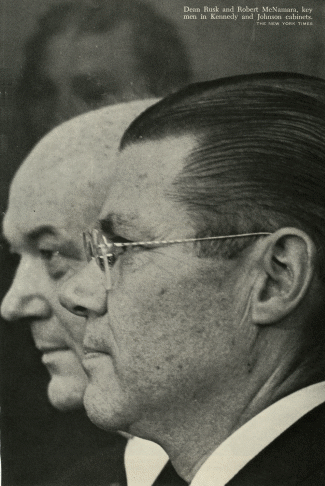
Dean Rusk and Robert McNamara, key men in Kennedy and
Johnson cabinets (The New York Times).
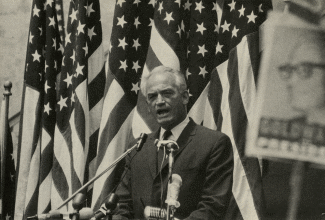
Barry Goldwater campaigning for the Presidency in 1964.
He was an advocate of full-scale air attacks on North Vietnam (Sam
Vestal - Pix).
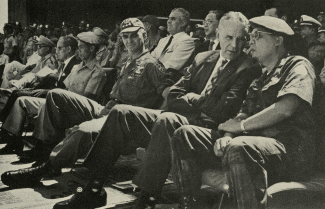
Gen. Maxwell Taylor and Gen. Nguyen Khanh, who seized
power early in 1964. With them is Gen. William Westmoreland. (Nguen van
Duc -- Pix).
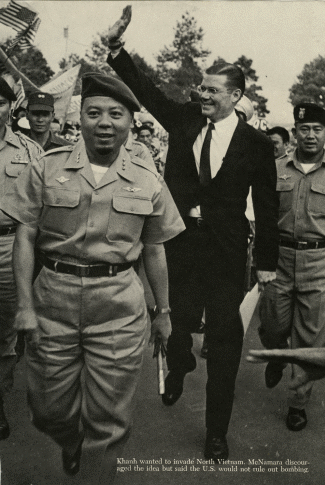
Khanh wanted to invade North Vietnam. McNamara
discouraged the idea but said the U.S. would not rule out bombing.
(Terence Khoo -- PIX)
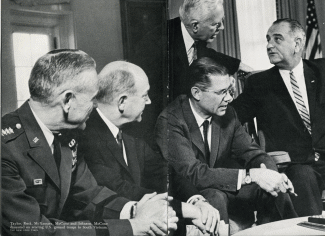
Taylor, Rusk, McNamara, McCone and Johnson. McCone
dissented on sending U.S. ground troops to South Vietnam (The New York
Times).
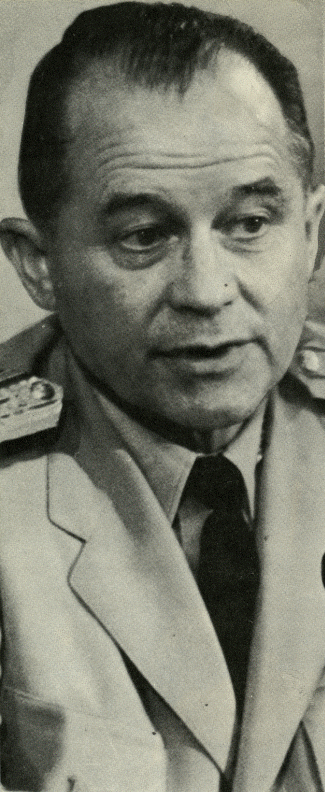
Adm. Harry Felt, whose headquarters made plans for
retaliatory bombing of the North long before Tonkin clash.
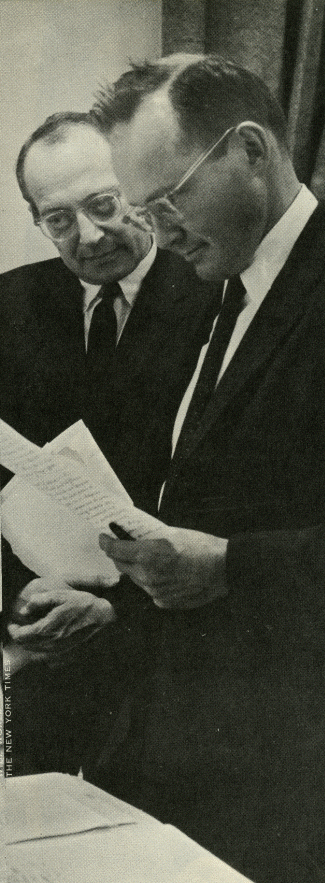
Walt Rostow and McGeorge Bundy considered the
options.
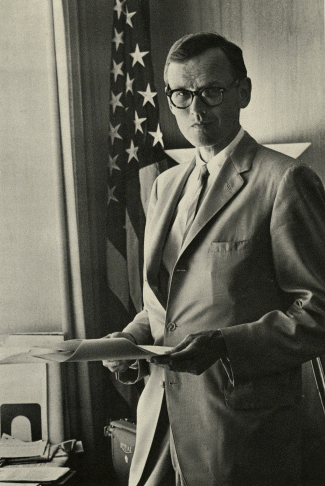
William Bundy wrote 30-day scenario to culminate in
bombing (The New York Times).
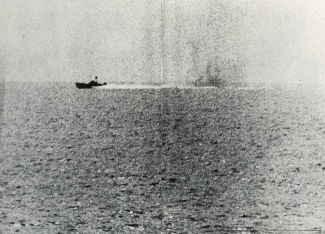
Photograph taken from the destroyer Maddox shows
attack by North Vietnamese PT boat in Gulf of Tonkin, Aug. 2, 1964 (Wide
World).
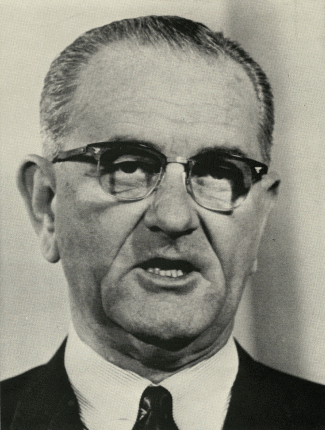
On Aug. 4, 1964, President Johnson announced the Tonkin
Gulf clashes and called for special powers to fight aggression. (UPI)
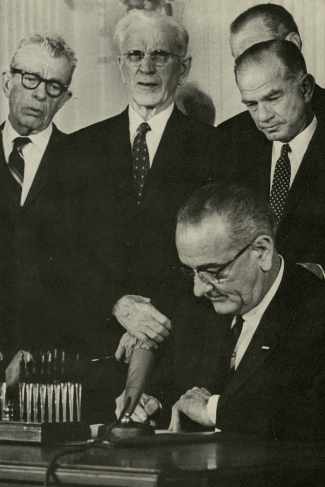
Days later he signed the Tonkin Gulf Resolution. Behind
him are Everett Dirksen, John McCormack and J.W. Fulbright (Pictorial
Parade).
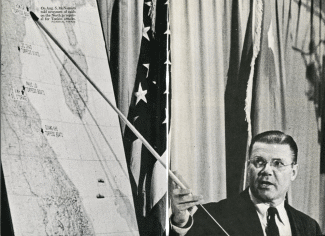
On Aug. 5, McNamara told newsmen of raids on the North
in reprisal for Tonkin attacks (Pictorial Parade).
Souvanna Phouma of
Laos was urged to hit enemy trails from North Vietnam (UPI).
John McNaughton
outlined aims and analyzed plans of action against the North (Wide
World).
Go to Next Page |