|
Chapter 4: The
Overthrow of Ngo Dinh Diem: May-November, 1963
Highlights of
the Period: May-November, 1963
The Kennedy
Administration's "complicity" in the 1963 overthrow
of President Ngo Dinh Diem is documented in the Pentagon
study, which says that this episode "inadvertently deepened" U.S.
involvement in the Vietnam conflict.
Here, in chronological order, are highlights of this period:
MAY-JUNE 1963
Buddhist protests against the Diem government flared into violence
after government troops attacked demonstrators in Hue.
AUGUST 1963
The Saigon regime, violating its pledge to the U.S. that it would
seek to conciliate the Buddhists, staged midnight raids on Buddhist
pagodas.
The first request for U.S. support of a coup was made to a C.I.A.
agent.
George W. Ball, Acting Secretary of State, told Henry Cabot
Lodge, the new U.S. Ambassador, that Diem must "remove" Nhu
and his wife or "we can no longer support Diem." He said that
"appropriate military commanders" could be given a pledge of
"direct support in any interim period of breakdown central government
mechanism." The Ambassador was authorized to threaten a
cut-off of U.S. aid unless the jailed Buddhists were released.
Lodge replied that the chances of "Diem's meeting our demands
are virtually nil." He added that "by making them, we give Nhu
chance to forestall" a coup, and suggested that "we go straight to
generals with our demands."
C.I.A. agents made contact with two plotters.
CoL Lucien Conein, a top C.I.A. agent, met with Lieut. Gen.
Duong Van Minh, a leader of the plot.
Lodge, replying to a query from President Kennedy, said that
"U.S. prestige" was publicly committed; he added, "there is no turning
back ... "
A National Security meeting "reaffirmed basic course." The U.S.
"will support a coup which has a good chance of succeeding."
President Kennedy, in a private message to Lodge, pledged "everything
possible to help you conclude this operation successfully,"
but he asked to be given continuing reports on the situation to allow
a possible "reverse" signal.
The Ambassador reported a breakdown in the conspiracy.
At a National Security Council meeting, Paul M. Kattenburg, the
head of the Vietnam Interdepartmental Working Group, urged U.S.
disengagement. Secretary of State Dean Rusk said that the U.S.
would not pull out "until the war is won," and "will not run a coup."
164
OCTOBER 1963
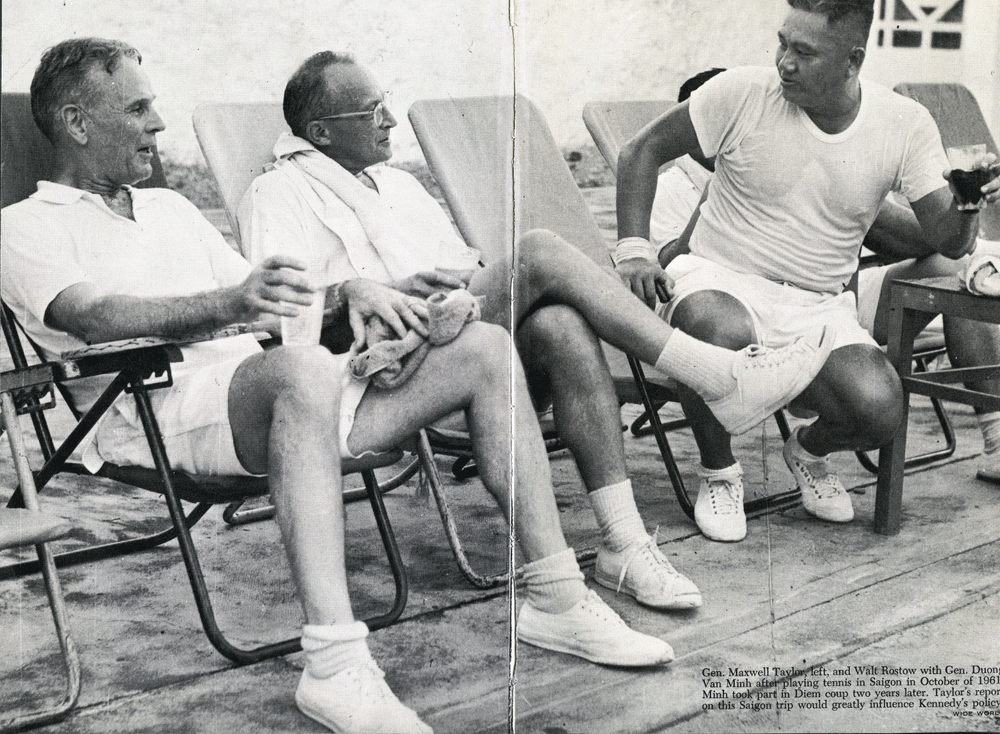
Robert S. McNamara, Secretary of Defense, and Gen. Maxwell D.
Taylor, Chairman of the Joint Chiefs of Staff, proposed after meeting
with Diem that the U.S. "work with the Diem regime but not
support it." They urged economic pressures.
Conein and other C.I.A. agents renewed their contacts with Minh
and other plotters. Lodge recommended assurances that the U.S.
would not "thwart" coup.
The President accepted the McNamara-Taylor proposals, including
a series of economic cut-offs. The study says this "leaves ambiguous"
the question of whether the aid suspension is meant as "green
light for coup."
The aid cut-offs began.
The White House messages to the Ambassador stressed "surveillance
and readiness," not "active promotion" of a coup. The study
says they stressed also the desire for the "plausibility of denial" of
U.S. involvement.
The coup was canceled. Its leader cited as the reason the attitude
of Gen. Paul D. Harkins, the U.S. military commander in Saigon.
Harkins denied "trying to thwart" a coup but said that he "would not
discuss coups that were not my business."
Doubts about the coup were revived in Washington, the study
says. The White House wanted the "option of judging and warning
on any plan with poor prospects of success."
Lodge opposed any move to "pour cold water" on the plot.
The White House told Lodge to "discourage" the plot if quick success
seemed unlikely. Lodge replied that the U.S. was unable to
"delay or discourage a coup."
NOVEMBER 1963
The coup proceeded on schedule. Diem, on the phone with Lodge,
asked about the "attitude of the U.S." Lodge replied that he was not
"well enough informed" to say, and told him: "If I can do anything
for your personal safety, please call me."
The Pentagon study says that Diem finally accepted the offer of
safe-conduct out of the country made by the coup's leaders. He and
his brother were shot to death by armored units.
165
Chapter 4
The Overthrow of Ngo Dinh Diem:
May-November, 1963
-BY HEDRICK SMITH
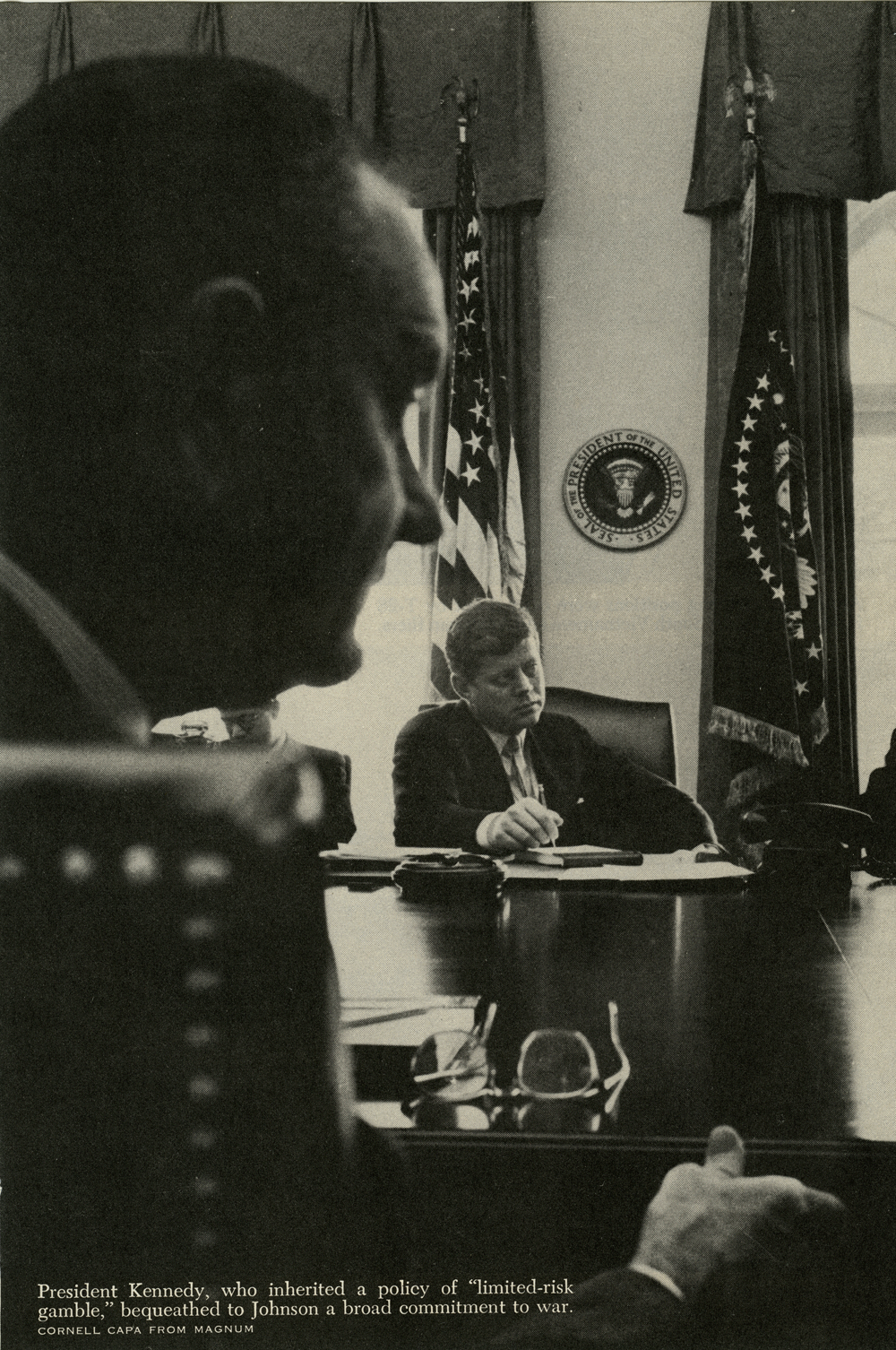
The Pentagon's secret study of the Vietnam war discloses
that President Kennedy knew and approved of plans for the
military coup d'etat that overthrew President Ngo Dinh Diem
in 1963.
"Our complicity in his overthrow heightened our responsibilities
and our commitment" in Vietnam, the study finds.
In August and October of 1963, the narrative recounts, the
United States gave its support to a cabal of army generals bent
on removing the controversial leader, whose rise to power Mr.
Kennedy had backed in speeches in the middle nineteen-fifties
and who had been the anchor of American policy in Vietnam
for nine years.
The coup, one of the most dramatic episodes in the history
of the American involvement in Vietnam, was a watershed.
As the Pentagon study observes, it was a time when Washington-
with the Diem regime gone-could have reconsidered
its entire commitment to South Vietnam and decided to disengage.
At least two Administration officials advocated disengagement
but, according to the Pentagon study, it "was never
seriously considered a policy alternative because of the assumption
that an independent, non-Communist SVN was too
important a strategic interest to abandon."
The effect, according to this account, was that the United
States, discovering after the coup that the war against the
Vietcong had been going much worse than officials previously
thought, felt compelled to do more-rather than less-for
Saigon. By supporting the anti-Diem coup, the analyst asserts,
166
"the U.S. inadvertently deepened its involvement. The inadvertence
is the key factor."
According to the Pentagon account of the 1963 events in
Saigon, Washington did not originate the anti-Diem coup, nor
did American forces intervene in any way, even to try to
prevent the assassinations of Mr. Diem and his brother Ngo
Dinh Nhu, who, as the chief Diem political adviser, had
accumulated immense power. Popular discontent with the
Diem regime focused on Mr. Nhu and his wife.
But for weeks-and with the White House informed every
step of the way-the American mission in Saigon maintained
secret contacts with the plotting generals through one of the
Central Intelligence Agency's most experienced and versatile
operatives, an Indochina veteran, Lieut. Co!. Lucien Conein.
He first landed in Vietnam in 1944 by parachute for the
Office of Strategic Services, the wartime forerunner of the
C.I.A.
So trusted by the Vietnamese generals was Colonel Conein
that he was in their midst at Vietnamese General Staff headquarters
as they launched the coup. Indeed, on Oct. 25, a week
earlier, in a cable to McGeorge Bundy, the President's special
assistant for national security, Ambassador Lodge had occasion
to describe Colonel Conein of the C.I.A.-referring to
the agency, in code terminology, as C.A.S.-as the indispensable
man:
"C.A.S. has been punctilious in carrying out my instructions.
I have personally approved each meeting between General
Don [one of three main plotters] and Conein who has
carried out my orders in each instance explicitly ....
"Conein, as you know, is a friend of some 18 years' standing
with General Don, and General Don has expressed extreme
reluctance to deal with anyone else. I do not believe
the involvement of another American in close contact with the
generals would be productive." [See Document # 52.]
So closely did the C.I.A. work with the generals, official
documents reveal, that it provided them with vital intelligence
about the arms and encampments of pro-Diem military forces
after Mr. Lodge had authorized C.I.A. participation in tactical
planning of the coup.
So intimately tied to the conspiracy did the Ambassador
himself become that he offered refuge to the families of the
generals if their plot failed-and he obtained Washington's
approval. Near the end, he also sent a message to Washington
seeking authority to put up the money for bribes to win over
officers still loyal to President Diem. [See Document # 57.]
167
The fear of failure-fed by bitterly conflicting advice from
Ambassador Lodge and Gen. Paul D. Harkins, chief of the
American Military Assistance Command in Saigon-dogged
President Kennedy to the end.
In late August, with a coup by the generals expected any
hour, President Kennedy sent a private message to Ambassador
Lodge. Possibly thinking back to the collapse of the Bay
of Pigs invasion of Cuba he said: "I know from experience
that failure is more destructive than an appearance of indecision
.... When we go, we must go to win, but it will be
better to change our minds than fail."
In his Aug. 30 cablegram, obtained by The New York
Times along with the Pentagon study, the President also
pledged "We will do all that we can to help you conclude
this operation successfully."
On Oct. 30, after the plot had been postponed and later
revived, the White House cabled Mr. Lodge with instructions
to delay further any coup that did not have "a high prospect
of success." But it left the ultimate judgment up to the
Ambassador and asserted that once a coup "under responsible
leadership" had begun, "it is in the interest of the U.S. Government
that it should succeed." [See Document #56.]
The conclusions of the Pentagon study run contrary to the
denial of American involvement by Ambassador Lodge in a
press interview on June 29, 1964, and the impression given by
the more carefully worded disavowals of American responsibility
published in the memoirs of some Kennedy Administration
officials.
"For the military coup d'etat against Ngo Dinh Diem, the
U.S. must accept its full share of responsibility," the Pentagon
account asserts.
"Beginning in August of 1963 we variously authorized,
sanctioned and encouraged the coup efforts of the Vietnamese
generals and offered full support for a successor government.
In October we cut off aid to Diem in a direct rebuff, giving a
green light to the generals. We maintained clandestine contact
with them throughout the planning and execution of the coup
and sought to review their operational plans and proposed
new government."
The intrigues of the Vietnamese generals and of Mr. Nhu
have largely been recounted before. Two added elements
emerge from the Pentagon study: the step-by-step American
collusion with the conspiracy, revealed previously only in
shadowy outline; and the feud inside the American Government
that brought it close to paralysis at decisive moments.
168
For if the Diem regime was a house divided against itself,
so was the Kennedy Administration.
In Saigon, the two chief antagonists were Ambassador
Lodge, considered even by admirers an aloof, shrewd Massachusetts
Brahmin politician; and General Harkins, an affable,
athletic cavalry officer who had been a protege of the World
War II tank commander, Maj. Gen. George S. Patton, 3d.
As the Pentagon study recounts it, the Ambassador quickly
became a partisan of the anti-Diem plot, while General Harkins
resented what he felt would be shabby treatment of
President Diem. "I would suggest we try not to change horses
too quickly," the general declared in a cable to Gen. Maxwell
D. Taylor, Chairman of the Joint Chiefs of Staff, on Oct. 30,
less than 48 hours before the coup. [See Document # 54.]
"After all, rightly or wrongly, we have backed Diem for
eight long hard years. To me it seems incongruous now to
get him down, kick him around and get rid of him. The U.S.
has been his mother superior and father confessor since he's
been in office and he leaned on us heavily."
The Ambassador and the general clashed at almost every
juncture on almost every major issue and their controversy
reverberated at the highest levels of government in Washington.
At one point, the study relates, the two men even relayed
contradictory messages to the plotters. Subsequently, Ambassador
Lodge held such tight control over the conspiratorial
maneuvering that General Harkins protested to Washington
that he was being kept in the dark.
Ultimately, the Pentagon narrative shows, it was Mr.
Lodge-a supremely self-confident ambassador, a former Republican
vice-presidential nominee with independent political
power, firm in his views, jealous of his ambassadorial prerogatives,
intent on asserting his full authority-who exerted
critical influence on the Government.
"Political Decay"
Until the eruption of Buddhist demonstrations against the
Diem regime in May, 1963, much of the American public
was oblivious to the "political decay" in Vietnam described in
the Pentagon account: the atmosphere of suspicion, the pervasive
but latent disaffection with the autocratic Diem regime, the taint of
corruption, the suppressed discontent in the
Army.
In America, the early months of 1963 were a season of
bullish public pronouncements about the war. In his State
of the Union address on Jan. 14, President Kennedy declared
that the "spearpoint of aggression has been blunted in Vietnam"
while Adm. Harry D. Felt, commander in chief of
Pacific forces, predicted victory within three years.
Although this reflected the view prevailing among policymakers,
a national intelligence estimate on April 17 offered
a less glowing picture. Provided that outside help to the
Vietcong was not increased, the intelligence paper estimated
that the guerrillas could be "contained militarily" but added
that there was still no persuasive evidence that the enemy had
been "grievously hurt" by the allied war efforts. Conclusion:
"The situation remains fragile."
Moreover, as the Pentagon account recalls, military officers
had twice tried to kill President Diem-in November,
1960, and again in February, 1962. Deeply distrustful of the
army, the South Vietnamese President had placed loyal
favorites in sensitive posts commanding troops around Saigon,
established a trusted network of military chiefs in all provinces
and stripped potential challengers and malcontents of troop
commands.
Over the years, secret intelligence reports had told of the
corrosive effect of such methods on military morale. Periodically,
they also described the gulf between the mandarin ruler
and the apathetic peasantry, or the alienation of an urban
middle class resentful of overbearing political controls and of
its lack of real political voice.
At times even Washington felt exasperated with its chosen
ally for failing to strive for greater popular allegiance through
political, military and economic reforms. But the United
States had become accustomed to having President Diem reject
its advice and, early in 1963, found itself somewhat on the
defensive before his complaint that there were too many prying
Americans roaming his land.
"As the U.S. commitment and involvement deepened," the
Pentagon chronicle relates, "frictions between American advisers
and Vietnamese counterparts at all levels increased.
Diem, under the influence of Nhu, complained about the
quantity and zeal of U.S. advisers. They were creating a
colonial impression among the people, he said."
Despite such frictions, the Kennedy Administration was
content to continue the general policy that, the Pentagon
170
analyst observes, was aptly captured in a journalistic aphorism:
"Sink or swim with Ngo Dinh Diem."
As the Pentagon study recounts the 1963 political crisis, the
spark of revolt was struck in the central Vietnamese city of
Hue on May 8, when Government troops fired into a crowd
of Buddhists displaying religious banners in defiance of a
Government decree. Nine persons were killed and 14 injured,
when they were crushed by armored vehicles.
The regime blamed a Vietcong provocateur. The Buddhists
demanded that the Government admit it was the guilty party
and pay indemnities to families of the victims. President
Diem refused and, despite superficial compromises, the deadlock
was never broken. The two sides slid into a series of increasingly
violent confrontations.
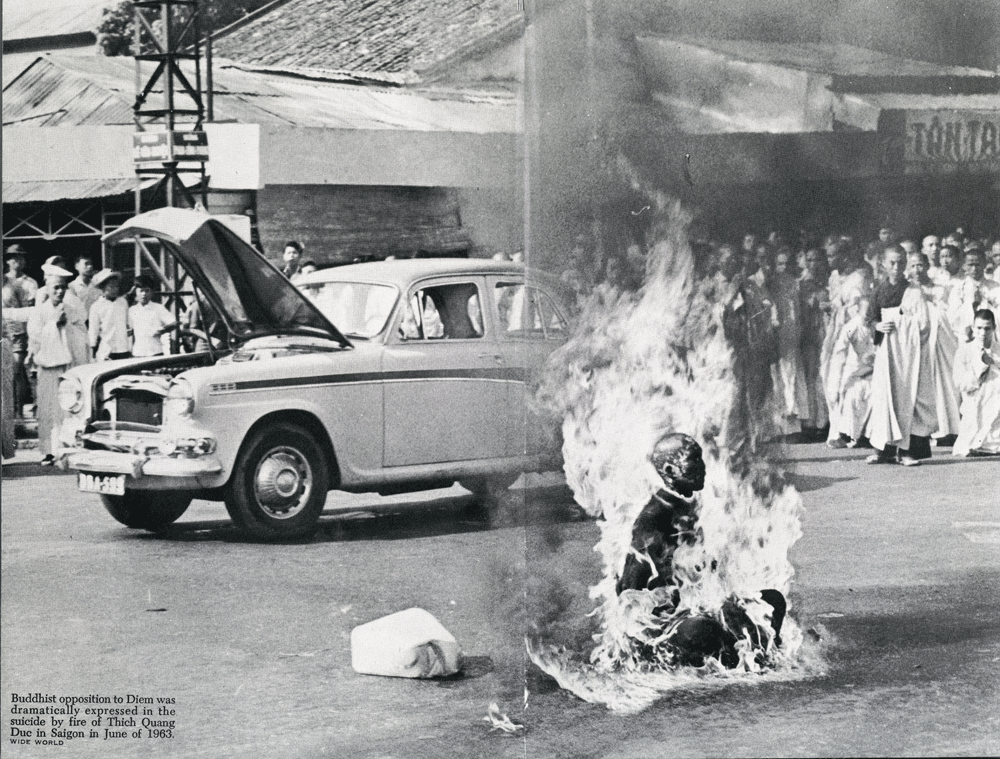
The Buddhist protests-mass demonstrations and the immolations
of yellow-robed monks-were met by police truncheons
and growing arrests. Mrs. Nhu, the bachelor President's
outspoken sister-in-law, angered the opposition by
ridiculing the fiery Buddhist suicides as "barbecues." There
was an outcry of shock abroad, especially in America, which
brought the Kennedy Administration under strong public
criticism for the United States' policy of backing President
Diem.
The original May incident was hardly enough to shake the
foundations of power. The Pentagon account blames the regime's
mandarin rigidity for fueling the crisis. The Buddhist
protests became a lightning rod for accumulated political frustrations.
For the first time, the protests exposed the American
public to the depth of Vietnamese disaffection with the
Government.
By early July C.I.A. agents were tipped off to two rapidly
developing coup plots. And a special national intelligence
estimate on July 10 forecast that unless President Diem
satisfied the Buddhists, "disorders will probably flare again
and the chances of a coup or assassination attempts against
him will become better than ever." [See Document #34.]
The very next day, Mr. Nhu daringly faced down some
senior generals and the plotting subsided temporarily.
Throughout May and June the United States Embassy tried
to prod President Diem into meeting Buddhist demands by
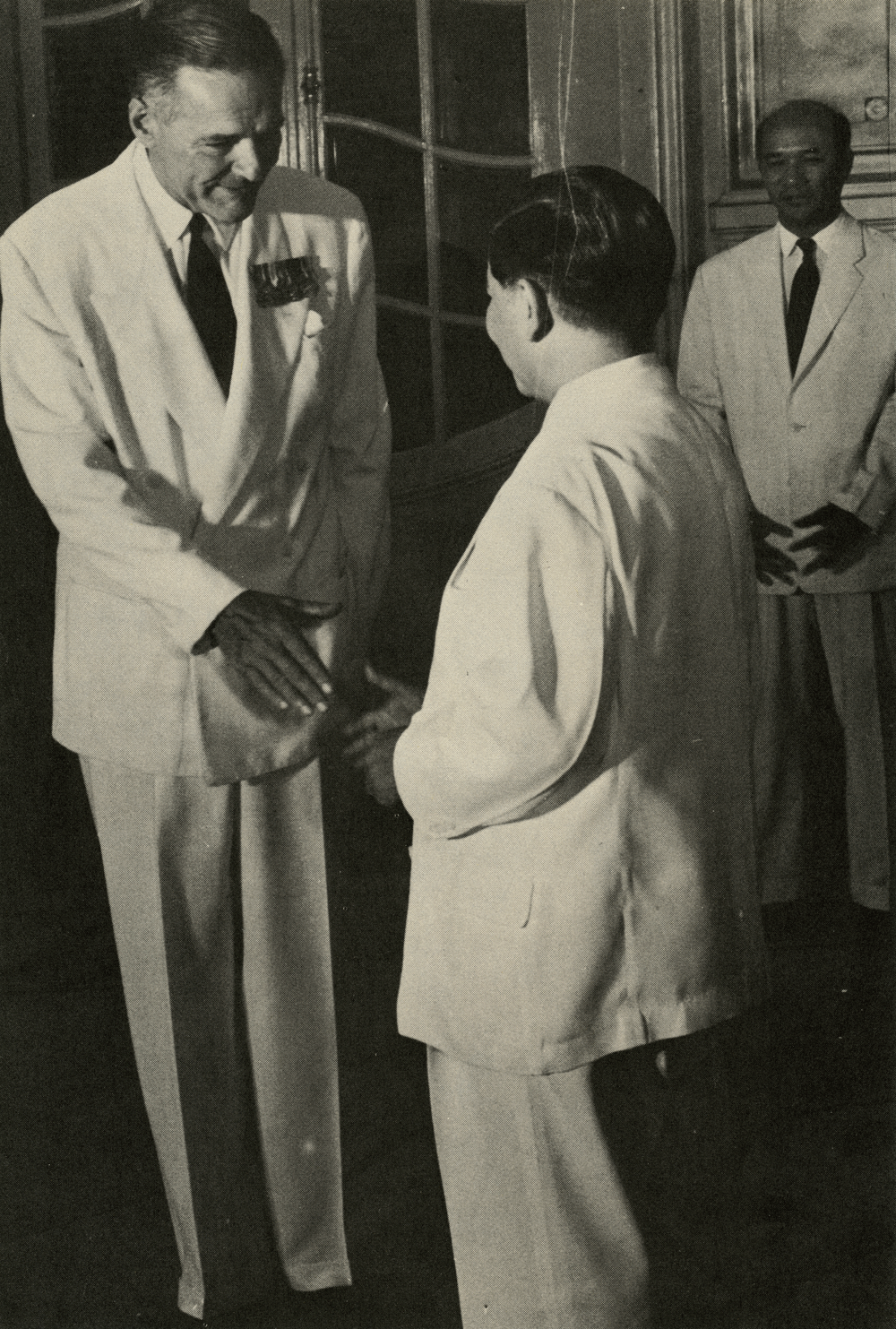
alternately soft and hard tactics. Ambassador Frederick E.
Nolting, a soft-spoken Virginian who, the Pentagon narrative
notes, considered it his duty to get along with President Diem,
tried gentle persuasion. When he left on vacation, his deputy,
William C. Truehart, took a tougher line, warning Mr. Diem
171
on June 12 that unless the Buddhist CflSlS was solved, the
United States would be forced to dissociate itself from him.
Cutting short his vacation, Ambassador Nolting rushed to
Washington early in July to urge the Administration not to
abandon President Diem yet, arguing that his overthrow
would plunge Vietnam into religious civil war. Although President
Kennedy had already decided to send Mr. Lodge to
Saigon as Ambassador late in August, he granted Mr. Nolting
a last chance to try to talk President Diem into conciliating
the Buddhists.
The Pentagon study relates that on Aug. 14, the eve of
his departure, Ambassador Nolting extracted such a promise.
As a final gesture to the departing American envoy, President
Diem gave a press interview on Aug. 15 saying that conciliation
had always been his policy toward the Buddhists and,
contradicting Mrs. Nhu's earlier criticism, asserted that his
family was pleased with the Lodge appointment.
Shock for Washington
Six days later the dam broke. South Vietnamese Special
Forces troops in white helmets carried out midnight raids
against Buddhist pagodas throughout the country. More than
1,400 people, mostly monks, were arrested and many of them
beaten. Two days later, the army generals conspiring against
President Diem first sought official American support.
The pagoda raids stunned Washington.
"In their brutality and their blunt repudiation of Diem's
solemn word to Nolting, they were a direct, impudent slap in
the face for the U.S.," the narrative asserts. "For better or
worse, the Aug. 21 pagoda raids decided the issue for us."
American officials found them particularly galling because
the raiding parties were led by Vietnamese Special Forces,
which were largely financed by the C.I.A. for covert war
operations, but which had in effect become the private army
of Mr. Nhu.
The Pentagon account describes how Mr. Nhu had telephone
lines to the United States Embassy cut to keep American
officials ignorant and how he fooled them into believing
the army had carried out the crackdown.
Because the army had declared martial law the day before
and because some of those raiding parties wore borrowed
172
paratroop uniforms, the embassy initially put the blame on
Saigon's army in reporting to Washington.
Actually, the study explains, Mr. Nhu had bypassed the
regular army chain of command and had ordered the raids
personally. This version does not make it clear whether
President Diem had approved in advance or merely accepted
after the fact.
Both in Washington and Saigon, the United States denounced
the raids and dissociated itself from such repressive
policies. Mr. Lodge, in Honolulu for final briefings, was told
to fly at once to Saigon where he landed on the morning of
Aug. 22. Significantly, the next section of ,the Pentagon narrative
is entitled "Lodge vs. Diem."
What the study terms the "first requests for support" came
from the acting chief of staff of the armed forces, Maj. Gen.
Tran Van Don, a French-trained Vietnamese aristocrat, and
one of his deputies, Maj. Gen. Le Van Kim, reputed to be
the real brains behind the coup. Despite their high positions,
neither general had direct command over troops because
Mr. Nhu had become suspicious of them.
Drawing on a C.I.A. information report, the study recounts
that on Aug. 23, General Don told an American agent that
the Voice of America should retract its broadcasts blaming the
army for the pagoda raids and put out an accurate version in
order to help the army. It was time, he said, for the United
States to make its position known on internal Vietnamese
affairs.
General Kim was more explicit. The pagoda raids, he told
another agent, showed the lengths to which Mr. Nhu would
go, and a firm American stand now in favor of his removal
would unify the army and permit it to take action against
both Mr. Nhu and his wife.
Significantly, the embassy reported that high civilian
officials were also telling American diplomats that the Nhus'
removal was vital. Nguyen Dinh Thuan, President Diem's
Defense Minister, gave the blunt advice that "under no circumstances
should the United States acquiesce in what the
Nhus had done." Foreign Minister Vu Van Mau resigned
and shaved his head like a Buddhist monk in protest.
Less than 48 hours after his arrival in Saigon, Ambassador
Lodge cabled the State Department to report the coup feelers
but cautioned that the most pivotal commanders around Saigon
were still loyal to the Ngo brothers. Other officers'
loyalties were unknown. Those circumstances, Mr. Lodge
173
reckoned, would make American support of a coup d'etat
a "shot in the dark."
His message reached Washington Saturday morning, Aug.
24, setting off what became one of the most controversial
actions in the Kennedy Administration. The State Department,
over the signature of Acting Secretary George W. Ball,
sent Ambassador Lodge a reply that served as the initial
American sanction for the coup.
H began by saying that the Uni,ted States could not tolerate
the powerful role of Mr. Nhu and his wife any longer. The
key passage went on to declare in the stuttering language of
cables:
"We wish give Diem reasonable opportunity to remove
Nhus, but if he remains obdurate, then we are prepared
to accept the obvious implication that we can no longer support
Diem. You may also tell appropriate military commanders
we will give them direct support in any interim
period of breakdown central government mechanism." [See
Document #35.]
Moreover, the message gave Ambassador Lodge broad
leeway on how to proceed, and pledged to "back you to the
hilt on actions you take to achieve our objectives."
This crucial message also cleared the way for public retractions
of the earlier Voice of America broadcasts and instructed
Mr. Lodge to pass the word that Washington could
not provide further military and economic support to South
Vietnam unless "prompt dramatic actions" were taken to
release the jailed Buddhists and fulfill their demands.
The Pentagon study, drawing upon Roger Hilsman's book
"To Move a Nation," published in 1964, explains that the
controversial message was drafted by Mr. Hilsman, Assistant
Secretary of State; W. Averell Harriman, Under Secretary of
State for Political Affairs; Michael V. Forrestal, White House
specialist on Vietnam and Southeast Asia, and Mr. Ball. The
prime movers were said to be Mr. Hilsman and Mr. Harriman.
The necessary top-level approval of the cablegram was
complicated by the fact that President Kennedy was in
Hyannisport, Mass., for the weekend, Secretary of State Dean
Rusk was in New York and Secretary of Defense Robert S.
McNamara and John A. McCone, Director of Central Intelligence,
were on vacation.
According to the Hilsman account, both the President and
Mr. Rusk were furnished early drafts of the cable and,
through several telephone conversations, participated in revising
the message before it was sent. Roswell L. Gilpatric,
174
Acting Secretary of Defense, approved it for the civilian side
of the Pentagon. Gen. Maxwell D. Taylor, Chairman of the
Joint Chiefs of Staff, was given a belated check by telephone
while out to dinner and, upon being told the President had
approved the message, accepted on behalf of the military.
The Pentagon study reports that on Monday, when all the
principal officers of government returned to Washington,
several, especially General Taylor, had second thoughts. But
by then it was too late.
In Saigon, the State Department's message had set a new
chain of events in motion. The cablegram arrived in Saigon
at midday Sunday, Aug. 25, and according to the Pentagon
account, Ambassador Lodge immediately summoned General
Harkins and John H. Richardson, the C.I.A. station chief.
After their strategy session, Mr. Lodge urgently cabled the
State Department, proposing a change in tactics:
"Believe that chances of Diem's meeting our demands are
virtually nil. At same time, by making them we give Nhu
chance to forestall or block action by military. Risk, we believe,
is not worth taking, with Nhu in control combat forces
Saigon.
"Therefore, propose we go straight to generals with our
demands, without informing Diem. Would tell them we prepared
have Diem without Nhus but it is in effect up to them
whether we keep him. Would insist generals take steps ,to release
Buddhist leaders and carry out June 16 agreement. Request
immediate modification instructions." [See Document
#36.]
The Ambassador said that General Harkins concurred, and
a separate report from Mr. Richardson to C.I.A. headquarters
fully endorsed Mr. Lodge's approach.
The immediate reply, obtained by The New York Times
though not cited in the Pentagon narrative, was from Mr.
Hilsman and Mr. Ball: "Agree to modification proposed."
It is not known whether this was cleared with President
Kennedy and other senior officials, but under normal bureaucratic
practice Mr. Hilsman would have initiated it.
When that cable reached Saigon, the Pentagon account
reports, Mr. Lodge called another strategy session Monday
morning. His inner circle decided that the "American official
hand should not show," meaning that General Harkins would
not talk to the generals. The contact men would be Colonel
Conein, an old acquaintance of several of the generals, and
another C.I.A. officer; the second agent's contacts petered out
eventually.
175
The C.I.A. men were not only to tell the generals the gist
of Washington's Aug. 24 message but also, as Mr. Richardson
advised headquarters on Aug. 26, to convey the following
message: "We cannot be of any help during initial action of
assuming power of the state. Entirely their own action, win or
lose. Don't expect to be bailed out." The plotters, moreover,
were to be informed that the United States "hoped bloodshed
can be avoided or reduced to absolute minimum." [See Document
#37.]
In Washington on that same Monday, President Kennedy,
informed of the misgivings of General Taylor and others,
called together the National Security Council.
The Pentagon study, with very limited direct access to
written records of Council meetings and none for these crucial
days, accepts the Hilsman book's recollection that the principal
doubters were Secretary McNamara, Mr. McCone and
General Taylor, opposed by the senior State Department
officials.
The Council met again on Tuesday. The Hilsman book reports
that at that session Mr. Nolting, the former Ambassador,
was doubtful that President Diem could be separated from
his brother, as the Pentagon leaders proposed, but he also
spoke with prophetic doubt about the capacity of the generals
to lead the country.
The upshot, the Pentagon study continues, was that Saigon
was asked on Aug. 27 to give more details about the plot and
to assess the effect of delaying the coup.
This opened the breach between Ambassador Lodge and
General Harkins, in turn worsening the rift in Washington.
The documentary record indicates that Washington's message
reached Saigon after the two C.I.A. agents had made
separate contacts with two additional members of the army
cabal to convey the American position. Significantly, they
learned that the plot leader was Lieut. Gen. Duong Van
Minh, military adviser to the Presidency, a good combat
commander and the general with the strongest following
among the officer corps.
His supporters included not only Generals Don and Kim
but also Maj. Gen. Tran Thien Khiem, executive officer of
,the Joint General Staff; Maj. Gen. Nguyen Khanh, commander
of the II Corps region stretching northward from
Saigon, and Col. Nguyen Van Thieu, commander of the Fifth
Division just north of the capital. But Saigon itself and the
Mekong Delta to the south were in the hands of supporters of
President Diem.
176
From this balance of force, the Pentagon study recounts,
Ambassador Lodge sized up the coup's prospects favorably,
arguing that "chances of success would be diminished by delay."
General Harkins sent a separate message that he saw no
clear-cut advantage for the coup plotters and no reason for
"crash approval" of the plot. He doubted that the coup
would be launched until the United States gave the word. His
cablegram pledged full support to the Ambassador in carrying
out the earlier instructions but, the analyst notes, it cryptically
implied that his earlier concurrence had "been volunteered,"
evidently meaning that Mr. Lodge had overstated his views.
But the incident is left unexplained.
A third message from Mr. Richardson, the C.I.A. chief,
backed Ambassador Lodge. "Situation here has reached point
of no return," he told the agency's headquarters. "Saigon is
armed camp. Current indications are the Ngo family have
dug in for last ditch battle. . .. There may be widespread
fighting in Saigon and serious loss of life." [See Document
#38.]
But Mr. Richardson warned that even if the Ngo brothers
prevailed, "They and Vietnam will stagger on to final defeat
at the hands of their own people and the VC."
Meanwhile, the Vietnamese generals, accustomed over the
years to being warned by Americans not ,to engage in conspiracies
against their own government, were having their own
worries about the Americans.
On Aug. 29, the Pentagon study says, General Minh himself
met Colonel Conein and asked for clear evidence that the
United States would not betray the conspiracy to Mr. Nhu.
As a clear sign of American support, he asked that Washington
suspend economic aid to the Diem regime.
A second general made another check with the result that,
according to the Pentagon study, the Ambassador authorized
the C.I.A. to "assist in tactical planning" of the coup d'etat.
A subsequent C.I.A. message, on Oct. 5, discloses that in
August the American agents provided the coup organizers
with sensitive information including a detailed plan and an
armaments inventory for Camp Longthanh, a secret installation
of the loyalist Special Forces commanded by Co!. Le
Quang Tung.
The Americans in Saigon were well ahead of the policy
makers in Washington. The top-level debate there, the Pentagon
study relates, had become so heated and testy that
President Kennedy personally cabled Ambassador Lodge and
177
General Harkins asking each man again for his "independent
judgment."
The Ambassador's reply to the President was an ardent
case for the coup:
"We are launched on a course from which there is no respectable
turning back: the overthrow of the Diem Government.
There is no turning back in part because U.S. prestige
is already publicly committed to this end in large measure and
will become more so as facts leak out. In a more fundamental
sense, there is no turning back because there is no possibility,
in my view, that the war can be won under a Diem administration
.... " [See Document #39.]
Rejecting the idea of seeing President Diem, Mr. Lodge
suggested instead that General Harkins be authorized personally
to repeat earlier C.I.A. messages to the generals to
ease their doubts. If that proved inadequate, the Ambassador
wanted to suspend American aid as General Minh had requested.
The study recounts that General Harkins, for his part,
stuck to his position that there was still time, without endangering
the plotters, for a final approach to President
Diem with an ultimatum to drop Mr. Nhu.
With tension high in both Saigon and Washington, the
National Security Council held a climactic meeting on Aug.
29. A State Department message to Saigon that night indicated
that President Kennedy leaned more on Ambassador Lodge's
advice than on General Harkins's. [See Document #40.]
The N.S.C., the cablegram said, had "reaffirmed basic
course" and, specifically authorized General Harkins to repeat
earlier C.I.A. messages to the plotters. It told him to
stress American support for the move "to eliminate the Nhus
from the government" but it did not mention President Diem
one way or the other.
Nonetheless, it reflected the prevailing acceptance of Ambassador
Lodge's view that there was no turning back. "The
U.S.G. will support a coup which has good chance of succeeding
but plans no direct involvement of U.S. armed forces," it
said. "Harkins should state that he is prepared to establish
liaison with the coup planners and to review their plans, but
will not engage directly in joint coup planning."
Moreover, the message authorized Mr. Lodge "to announce
suspension of aid" to the Diem regime whenever and however
he chose. But with an eye to the Administration's public
image, it cautioned him to "manage" such an announcement
178
so as to "minimize appearance of collusion" with the generals.
The State Department cablegram explained that the question
of a "last approach" to President Diem-advocated by
General Harkins-"remains undecided." Secretary Rusk, possibly
reflecting some personal doubts, raised this issue in a
separate message to Mr. Lodge. But the Ambassador rejected
the idea out of hand.
At this point Mr. Kennedy sent his totally private message
to Ambassador Lodge. The President said he had given his
"full support" to the earlier message and promised that Washington
would do everything possible "to help you conclude
this operation successfully."
He asked the Ambassador to provide him with a running
assessment of the coup's prospects right up to the "go signal"
to permit him to "reverse previous instructions," if necessary.
The Ambassador's brief reply, on Aug. 30, acknowledged
the President's right to change directions but warned him
that, since "the operation" had to be Vietnamese-run, the
American President might not be able to control it.
As matters turned out, Washington's agonizing had been to
no avail. For, according to the study, General Harkins's first
direct contact with the conspirators brought news that General
Minh had called off the coup for the time being, fearing
a bloody standoff in Saigon.
According to the Pentagon account, General Harkins was
also told that Mr. Richardson's careful cultivation of Mr.
Nhu had aroused suspicions among the generals that the C.I.A.
chief might be undercutting them and that the President's
brother was on the C.I.A. payroll. Later this would become an
important issue and would lead to Mr. Richardson's replacement.
But on Aug. 31, Ambassador Lodge reported to Washington
the collapse of the conspiracy and the end of the coup
phase. He told Secretary Rusk-who had worried in a cable
only the day before about the lack of "bone and muscle"
among the conspirators-that there was "neither the will nor
the organization among the generals ,to accomplish anything."
Mr. Lodge also reported hearing that Mr. Nhu was secretly
dealing with Hanoi and the Vietcong through the French and
Polish ambassadors, both of whose governments favored a
neutralist solution between North and South Vietnam.
Washington was in a quandary. It had finally taken the
risk of seeking an alternative to the Diem regime only to see
the attempt dissolve. As the Pentagon narrative says: "The
179
u.s. found itself at the end of August, 1963, without a policy
and with most of its bridges burned."
The members of the National Security Council-minus the
President-held a "where do we go from here?" meeting on
Aug. 31. That session was revealing, the author comments,
because of the "rambling inability to focus on the problem"-
the sense of an administration adrift.
The most controversial position was advanced by Paul M.
Kattenburg, a 39-year-old diplomat who headed the Vietnam
Interdepartmental Working Group. He proposed disengagement-
thereby, according to the Pentagon version, becoming
the first official on record in a high-level Vietnam policy meeting
to pursue to its logical conclusion the analysis that the
war effort was irretrievable, either with or without President
Diem.
Until he spoke, the trend of the discussion seemed to favor
reluctantly sliding back toward some workable relationship
with the Diem regime since there seemed no alternative.
Secretary Rusk commented that it was "unrealistic" to insist
that Me. Nhu "must go" and Secretary McNamara pushed
for reopening high-level contact with the Presidential Palace.
[See Document #44.]
In rebuttal, Assistant Secretary of State Hilsman reminded
the group of the crippling malaise within the Vietnamese
Government and the impact on the American image and
policy elsewhere if Washington acquiesced "to a strong Nhu-dominated
government."
According to the minutes of the meeting, Mr. Kattenburg
pushed this argument a step further by asserting that if the
United States tried to "live with" the Diem regime, it would
be "thrown out of the country in six months." In the next
six months to a year, he argued the war effort would go
steadily downhill to the point where the Vietnamese people
"will gradually go to the other side and we will be obliged
to leave."
His analysis was immediately dismissed by Vice President
Johnson, Secretary Rusk and Secretary McNamara. Me. Rusk
was reported in the minutes as insisting that American policy
be based on two points-"than we will not pull out of Vietnam
until the war is won, and that we will not run a coup. " Mr.
McNamara endorsed this view.
Vice President Johnson said he agreed completely, reportedly
declaring that "we should stop playing cops and robbers
and get back to talking straight to the [Saigon Government]
... and once again go about winning the war."
180
It was more easily said than done. As the Pentagon study
recounts, the Kennedy Administration passed through the next
five weeks without any real policy but with three general
notions in mind: first, the compulsion to send special missions
to reassess the situation in Vietnam; second, the attempt to
coerce the Diem regime into moderation through economic
and propaganda pressures; and third, Ambassador Lodge's
efforts to persuade the Nhus to leave the country while giving
the cold shoulder to President Diem.
President Kennedy, in a television interview Sept. 2, applied
his personal pressure on the Diem regime for the first
time. The South Vietnamese Government, he said, would have
to "take steps to bring back popular support" after the
Buddhist repressions, otherwise the war could not be won.
Success was possible, he said "with changes in policy and perhaps
with personnel." But he did not specify whom he meant.
At another inconclusive National Security Council meeting
four days later, Attorney General Robert F. Kennedy returned
to the question of disengagement. The Pentagon account reports
him as reasoning that if the war was unwinnable by any
foreseeable South Vietnamese regime, it was time to get out
of Vietnam. But, if the Diem regime was the obstacle, he
contended, then Ambassador Lodge should be given the power
to bring about the necessary changes.
But the Administration's immediate response ,to its dilemma
was-at Secretary McNamara's suggestion-to send a
fact-finding mission to Vietnam for a fresh look: Maj. Gen.
Victor H. Krulak, the Pentagon's top-ranking expert in
counter-guerrilla warfare, and Joseph A. Mendenhall, the
former political counselor in the Saigon Embassy.
The two men came back after an exhausting four-day tour
with such diametrically opposed assessments that President
Kennedy was moved to ask, "You two did visit the same
country, didn't you?"
Dissatisfied, President Kennedy dispatched Secretary McNamara and
General Taylor on a new fact-finding mission
on Sept. 23. They met with President Diem on Sept. 29 and
although Mr. McNamara had the authority to press the South
Vietnamese ruler to remove his brother from power, he did
not raise the issue. No explanation is given for this significant
omission.
The Pentagon analyst comments that the report of their mission,
submitted on Oct. 2, tried to bridge the Lodge-Harkins
gap, and in the process reflected for the first time serious
doubts in Mr. McNamara's mind.
181
The military assessment-which the Secretary of Defense
radically revised in retrospect after the successful Nov. 1
coup-was generally optimistic. It reported "great progress"
in the last year with no ill effects on the conduct of the war
from the prolonged political crisis, and asserted that the
"bulk" of American troops could be withdrawn by the end
of 1965. The two men proposed and-with the President's
approval-announced that 1,000 Americans would be pulled
out by the end of 1963. [See Document #47.]
Their political analysis found discontent with the Diem-
Nhu regime a "seething problem" that could boil over at
any time. Unaware of the revived plotting, they discounted
prospects for an early coup on grounds that the generals appeared
to have "little stomach" for it and proposed that in the
meantime, "we should work with the Diem regime but not
support it." The study notes that they recommended a series
of economic pressures, including an aid cutoff, without indicating
whether they remembered that this was the "go" signal
that the generals had previously requested.
The Kennedy Administration was already engaged in a
pressure campaign that, whatever its intent, was bound to
encourage the army generals to try again, as the narrative
notes.
The President's televised remark on the need for possible
changes in personnel was the first shot. Next, on Sept. 14,
Washington informed the embassy that it was deferring decisions
on an $18.5-million program to finance commercial
imports to South Vietnam. Three days later the White House
instructed Ambassador Lodge to make new efforts to achieve
a "visible reduction" in the influence of the Nhus --'preferably
by arranging their departure from Vietnam "at least for an
extended vacation." [See Document #45.]
It gave him broad authority to use aid as leverage in this
venture, "bearing in mind that it is not our current policy to
cut off aid entirely." In particular, it was suggested, Mr.
Lodge might want to limit or reroute aid now going "to or
through Nhu" or his collaborators. It also urged him-without
ordering him-to resume contact with President Diem. But
Mr. Lodge demurred.
Washington's high-level messages to ·the Ambassador
throughout the fall of ] 963 are notable for the unusual
deference they show him. President Kennedy himself proceeded
with delicacy on those rare occasions when he overruled
the Ambassador. Once, in a personal cablegram to Mr.
Lodge in mid-September, he commented that, as the son of a
182
former Ambassador, "I am well trained in the importance of
protecting the effectiveness of the man-on-the-spot." The record
shows that the President understood, too, how firm and
explicit he had to be to overrule the Ambassador-and, significantly,
he did not do so in the final days before the coup.
Death Knell for Diem
In October, the tempo of events quickened. In Saigon on
Oct. 2, the analyst writes, Colonel Conein "accidentally" ran
into General Don, who proposed a date that evening in
Nhatrang. That night, the C.I.A. man learned that the conspiracy
was on the track again and that General Minh, its
leader, wanted to discuss the details. Ambassador Lodge approved
the meeting.
Oct. 5 was a fateful day both in Saigon and in Washington.
For the first time in weeks, another Buddhist monk burned
himself to death in the central marketplace in Saigon. Mr.
Richardson, the C.I.A. chief whose links to Mr. Nhu had
aroused suspicions among the Army generals, left South Vietnam
after what are described as behind-the-scenes efforts by
Ambassador Lodge to have him transferred. And President
Kennedy took far-reaching decisions to apply major economic
sanctions against the Diem regime.
At 8: 30 A.M. that same day Colonel Conein went to
General Minh's headquarters for a 70-minute meeting. According
to the C.I.A. account of the meeting, the two men
talked in French. The South Vietnamese general, nicknamed
Big Minh by his colleagues because of his burly build, disclaimed
any personal political ambition.
But he said that the army commanders felt the war would be
lo&t unless the government was changed soon and that he
"must know" the American Government's position on a
change of regime "within the very near future." The general
said he did not expect "any specific American support" for
the coup d'etat but did need assurances that the Americans
would not block it. He did not press for an on-the-spot commitment,
but asked for another date with Colonel Conein.
General Minh outlined several possible tactics. The two
main ones called for retaining President Diem but assassinating
his two powerful and feared brothers Mr. Nhu and Ngo
Dinh Can, the regime's proconsul in Central Vietnam; or, a
183
head-on military battle for control of Saigon and the government
against roughly 5,500 loyalist troops in the capital.
Because of the abortive plot in August, Ambassador Lodge
reacted warily. In a special message to Secretary Rusk, he
commented that neither he nor General Harkins had "great
faith in Big Minh." [See Document #49.] Nonetheless, he
recommended giving the generals assurance that the United
States would not "thwart" their coup, that it would review
their plans-"other than assassination plans"-and that it
would continue aid to any future government that gave promise
of gaining popular support and winning the war. He said
General Harkins concurred in these recommendations.
In Washington, too, events were gaining momentum. On
Oct. 2, President Kennedy had received the recommendations
of the McNamara-Taylor mission (drafted before the new
Saigon contacts) urging tight new pressures on the regime in
the hopes of gaining some reforms and simultaneously advocating
covert contacts with "possible alternative leadership"
without actively promoting a coup.
The President accepted all the report's proposals. According
to the Pentagon account, he specifically authorized
suspension of economic subsidies for South Vietnam's commercial
imports, a freeze on loans to enable Saigon to
build a waterworks and an electric-power plant for the capital
region, and, significantly, a cut-off of financial support for
the Vietnamese Special Forces-controlled by Mr. Nhuun -- less
they were put under the Joint General Staff, headed
by the plotting generals.
There were to be no public announcements, and the various
steps were to be unrolled consecutively at Mr. Lodge's discretion.
But in a city as keyed-up and alert to every nuance
in American policy as Saigon, the Pentagon study notes,
these steps were bound to be read in many quarters as the
death knell for the Diem regime. Only a month before, he
recalls, the cut-offs had been discussed-and approved-as a
signal of American support to the generals, if necessary.
The analyst comments that the documentary record in early
October "leaves ambiguous" whether the White House intended
the aid suspensions to be a "green light" for the coup.
But he says that they were interpreted that way by the generals.
The Diem regime reacted furiously. Its press outlets publicized
the freeze on import subsidies on Oct. 7 and accused Washington
of sabotaging the war effort.
In a White House message-sent on Oct. 5 through C.I.A.
channels for tight security within the American Government-
184
Washington gave Ambassador Lodge careful coaching. It
instructed him that "no' initiative shouldn't be taken to give
any active covert encouragement to' a coup." But he was to'
organize an "urgent covert effort . . . to' identify and build
up contacts with possible alternative leadership as and when
it appears." [See Document #50.]
The Washington message emphasized that the objectives
should be "surveillance and readiness" rather than "active
promotion of a coup." It told Mr. Lodge that "you alone"
should manage the operation, through the C.I.A. chief in
Saigon.
These instructions were transmitted before Washington had
received the report of the Minh-Conein contact, the Pentagon
study observes. For, on the very next day, with time to' digest
that report, Washington took a considerably more flexible
approach.
The C.I.A. relayed new White House instructions on Oct. 6.
In a passage that Ambassador Loge interpreted as signaling
a desire for a change of regime-though General Harkins
later disputed him vigorously on this point-Washington said
that while it did not wish to' "stimulate" a coup, it also did
not want "to' leave the impression that the U.S. would thwart
a change of government." Nor would it withhold aid from a
new regime. [See Document #51.]
In view of General Minh's modest request for American
acquiescence, the generals could interpret this as a go ahead.
The Oct. 6 message also ordered the C.I.A. man to obtain
"detailed information" to help Washington assess the coup's
chances. Yet it cautioned against "being drawn into reviewing
Dr advising on operational plans or other actions" that might
eventually "tend to' identify U.S. too closely" with a coup.
In the language of the Oct. 5 cable, Washington wanted to'
preserve "plausibility if denia1."
The new American position was conveyed to General Minh
by his C.I.A. contact about Oct. 10.
On Oct. 18, with the cut-off of commercial import subsidies
already causing financial scares in Saigon, the Pentagon study
reports that General Harkins informed President Diem that
American funds were being cut off from the Special Forces.
The narrative notes that by then the coup plans were well
advanced and the American move against what amounted to
a Presidential Palace guard was an obvious spur to the conspirators.
By mid-October the Administration was hearing very disturbing
intelligence estimates on the war. On Oct. 19 the
185
C.I.A. reported that the tempo of Vietcong attacks was rising,
Government troops "missing in action" were increasing and
other military indicators were "turning sour," as the Pentagon
account puts it. In a controversial report on Oct. 22, the
State Department's Bureau of Intelligence and Research contested
the military optimism of recent months. It concluded
that there had been "an unfavorable shift in the military balance"
since July and that the Government would have been
in trouble even without the Buddhist crisis.
Against this background, the conspiracy in Saigon hit a
snag.
The narrative recounts that General Don, in a state of
agitation, told Colonel Conein on Oct. 23 that the coup had
been scheduled for Oct. 26--and then called off because
General Harkins had discouraged it on Oct. 22. General Don's
account was that General Harkins complained to him that a
Vietnamese colonel had discussed the coup plans with an
American officer, asking for support-all without sanction
from the senior generals.
General Harkins, he said, had insisted that American
officers should not be approached about a coup because it
distracted them from the war. He implied that General
Harkins might have leaked word of the plot to the palace.
He demanded reassurance of American support-and got it
from Colonel Conein.
The Pentagon study quotes a message from Ambassador
Lodge on Oct. 23 saying that he had talked with General
Harkins who said he had misunderstood Washington's policy
guidance. The Ambassador quoted the general as saying he
hoped he had not upset the delicate arrangements and would
tell General Don that his previous remarks did not reflect
American policy. That very night, the Pentagon version says,
General Harkins saw General Don to retract his earlier
statements.
On Oot. 24, however, in a message to General Taylor, the
Chairman of the Joint Chiefs, General Harkins disputed Mr.
Lodge's version of the events. He denied having violated
Washington's policy guidance, saying he had merely rebuffed
General Don's suggestion that they meet again to discuss
coup plans.
"I told Don that I would not discuss coups that were not
my business though I had heard rumors of many," General
Harkins told Washington. Insisting that he was "not trying
to thwart a change in government," he did, however, voice
the prophetic fear that if the Diem regime was toppled, its
186
fall might touch off faotional warfare within the army that
would eventually "interfere with the war effort."
General Taylor's immediate reply was: "View here is that
your actions in disengaging from the coup discussions were
correct and that you should continue to avoid any involvement."
This evidently reflected Washington's earlier instructions
that Mr. Lodge alone should manage the coup contacts
through the C.I.A.
The incident once again opened the breach between the
Ambassador and the general. It underscored not only their
differences in views but also, the Pentagon analyst says, their
total lack of coordination.
Moreover, it deepened the Vietnamese generals' suspicion
of General Harkins, whom they had always mistrusted because
of his closeness to President Diem. Not only did they subsequently
refuse to talk to him about the coup out of fear of
leaks to the palace, the account says, but they consistently
refused to show any Americans their detailed plans despite
repeated promises ,to do so-a point that bedeviled Washington.
Nonetheless, Colonel Conein's reassurances had sufficiently
emboldened them that, according to a C.I.A. information
report, they passed the word to Ambassador Lodge on Oct.
24 that the coup would occur before Nov. 2. President Diem
also chose Oot. 24 finally to break the ice with Mr. Lodge
by inviting him to spend Sunday, Oct. 27, with him at the
presidential villa in the mountain resort of Dalat.
But in Washington General Harkins's reports had revived
doubts about the coup, and it was now Mr. Lodge's turn to
be on the defensive.
The Pentagon study recounts that Mr. McCone, the C.I.A.
director, and McGeorge Bundy, the President's special assistant
for national security, sent out cablegrams expressing
worry that General Don might be a double-agent from the
Diem-Nhu regime ,trying to entrap the United States. Mr.
Bundy also suggested replacing Colonel Conein as the C.I.A.
contact man.
On Oct. 25 Ambassador Lodge tried to put Washington's
mind at ease. In a message to Mr. Bundy, he discounted the
likelihood that General Don was engaged in a "provocation"
and stoutly defended Colonel Conein.
The Ambassador also argued against any temptation to
"pour cold water" on the plot. While he acknowledged that
struggles among successors of the Diem regime could damage
the war effort, he contended that it was "at least an even bet
187
that ,the next government would not bungle and stumble as
much as the present one has." [See Document # 52.]
The White House reply, on Oct. 25, endorsed his view that
the United States "should not be in position of thwarting
coup" but urged him to give the White House "the option
of judging and warning on any plan with poor prospects of
success." [See Document #53.]
It indicated that President Kennedy's main worries, as in
August, were failure and the appearance of complicity. "We
are particularly concerned," the White House cablegram said,
"about hazard that an unsuccessful coup, however carefully
we avoid direct engagement, will be laid at our door by
public opinion almost everywhere."
What neither the Ambassador nor the White House knew,
the Pentagon narratives notes, was that the coup plotters were
even then manipulating the balance of military forces around
Saigon in their favor, double-dealing with Mr. Nhu and outwitting
him.
The pivotal figure was Maj. Gen. Ton That Dinh, the
military governor of Saigon and commander of the III
Corps-all the regular army troops in the capital region. The
Pentagon account describes how General Don played upon
General Dinh's vanity to maneuver him into a clash with
Mr. Nhu, thereby enlisting his cooperation for the coup plot.
Through another channel, however, Mr. Nhu learned of
the conspiracy and, confronting General Dinh with that news,
told him to help lay a trap for the other generals. This
maneuver called for starting a false coup to lure the anti-
Diemists into the open and then using General Dinh's forces
to crush the real plot.
The young general informed the other conspirators of
Mr. Nhu's counterplot. To be on the safe side, in case he
was really loyal to Mr. Nhu, they recruited troop commanders
under him.
In Saigon, the atmosphere had become one of impending
violence. So intense was the maneuvering, according to the
Pentagon study, that it was "virtually impossible to keep track
of all the plots against the regime." The United States Embassy
in one cable to Washington identified 10 dissident groups
in addition to the generals' plot.
Nonetheless President Diem, at his Oct. 27 meeting with
Mr. Lodge, seemed unprepared to yield an inch-a "fruitless,
frustrating" exchange, according to the Pentagon version.
Paraphrasing the Ambassador's report, the study recounts
that President Diem inquired about the suspension of American aid and in
reply Mr. Lodge asked about the release of
hundreds of arrested Buddhists and student demonstrators,
and about reopening schools shut by the regime in fear of
further turbulence. President Diem, the analyst says, "offered
excuses and complaints."
Finally, Ambassador Lodge said: "Mr. President, every
single specific suggestion which I have made, you have rejected.
Isn't there some one thing you may think of that is
within your capabilities to do and that would favorably impress
U.S. opinion?"
The Ambassador reported that President Diem "gave me
a blank look and changed the subject."
At Saigon airport the next morning, as President Diem and
Mr. Lodge were about to go to a ceremony dedicating a
Vietnamese power plant, General Don daringly took the
Ambassador aside.
The Pentagon account says General Don "asked [Mr.
Lodge] if Conein was authorized to speak for him."
"Lodge assured Don that he was," the account continues.
"Don said that the coup must be thoroughly Vietnamese and
that the U.S. must not interfere. Lodge agreed, adding that
the U.S. wanted no satellites but would not thwart a coup.
When Lodge asked about the timing of the coup, Don replied
the generals were not yet ready.
Later that day, General Don met with Colonel Conein and
urged that Mr. Lodge make no change in his previously
announced plans to leave on a trip to Washington on Oct. 31
for fear that postponement might tip off the Presidential
Palace. General Don also disclosed that General Dinh, the
III Corps commander, had been neutralized, shifting the
military balance in the coup's favor.
By Oct. 29, the analyst comments, Ambassador Lodge
clearly felt that the United States was "committed" to the
coup and that it was too late for second thoughts, and he
communicated those views forcefully to Washington.
After reporting the support of prominent leaders, including
Vice President Nguyen Ngoc Tho, for the coup, the Ambassador
said he felt an attempt was "imminent."
"Whether this coup fails or succeeds," Mr. Lodge said,
"the U.S.G. must be prepared to accept the fact that we will
be blamed, however unjustifiably; and finally that no positive
action by the U.S.G. can prevent a coup attempt-short of
informing Diem and Nhu with all the opprobrium that such
an action would entail."
With the first Vietnamese troop movements preparatory to
189
the coup already under way, the Pentagon gave orders to
have a naval task force stand off the Vietnamese coast "if
events required," as the account puts it. When Mr. Lodge
was informed of this, he urged discretion lest the Diem
regime be alerted.
Events now had an ineluctable momentum. But, in Washington,
the study reports, Secretary McNamara and the Joint
Chiefs of Staff were vacillating over the continuing differences
between Ambassador Lodge and General Harkins.
They put their anxieties before a National Security Council
meeting on Oct. 29, and the White House then instructed Ambassador
Lodge to show General Harkins, who had been away
in Bangkok briefly, the relevant messages to be sure that he
would be fully aware of the coup arrangements. If Mr. Lodge
was to go through with his trip home as scheduled, Washington
felt that General Harkins-rather than the Ambassador's
deputy, as would have been customary-should be in charge
of the American mission.
Belatedly apprised of the continuing Don-Conein contacts
and the Ambassador's latest recommendations to Washington,
General Harkins sent off three angry cables to General Taylor
on Oct. 30.
He was "irate," the analyst remarks, not only at having
been excluded by Mr. Lodge from information about the
coup but also at reading the Ambassador's gloomy assessments
of how the war was going, which diametrically opposed
his own views. He protested to Washington that the Ambassador
was keeping him in the dark.
More important, he declared, in a message cited by the
study, there was a "basic" difference between them in interpreting
Washington's instructions.
Since receiving the Oct. 5 guidance from the White House,
General Harkins said, he had been operating in the belief
that the basic American policy line was that "no initiative"
should be taken to encourage a coup. But he said Mr. Lodge
took the position that the Oct. 6 message-"not to thwart" a
coup-modified the policy line and indicated that "a change
of government is desired and ... the only way to bring about
such a change is by a coup."
Moreover, General Harkins sought to undermine confidence
in the conspiracy by accusing General Don of lying or serving
as a double agent. Overlooking his own earlier refusal to
talk about the coup, General Harkins told Washington:
"What he [Don] told me is diametrically opposed to what
he told Colonel Conein. He told Conein the coup would
190
be before Nov. 2. He told me he was not planning a coup
when I sat with Don and Big Minh for two hours during the
parade last Saturday. No one mentioned coups." [See Document
#54.]
The Harkins messages shook Washington's confidence
severely and the White House conveyed its anxieties to Ambassador
Lodge on Oct. 30. It reckoned the military balance
of forces as "approximately equal," raising the danger of
prolonged fighting or even defeat. If the coup group could
not show prospects for quick success, the White House said,
"we should discourage them from proceeding since a miscalculation
could result in jeopardizing the U.S. position in Southeast
Asia." [See Document #56.]
Contrary to Mr. Lodge's position, the White House also
felt that a word from the Americans could delay the coup but
it refrained from ordering him to halt the conspiracy.
That same night, the documentary record discloses, Mr.
Lodge replied, suggesting an even deeper involvement. In
answer to Washington's worries, he held to the view that the
Americans did not "have the power to delay or discourage
a coup." [See Document #57.]
At this late hour, he urged that the United States keep
"hands off," not only because he believed "Vietnam's best
generals are involved" but also because he shared their expectation
that some wavering units would join the coup.
"If we were convinced that the coup was going to fail,
we would, of course do everything we could to stop it," he
pledged. But that was not his expectation.
Mr. Lodge dismissed the suggestion of opening up a second
channel to the generals. Instead, he suggested that the cabal
might need "funds at the last moment with which to buy off
potential opposition. To the extent that these funds can be
passed discreetly, I believe we should furnish them."
The Ambassador took a considerably less apocalyptic view
of failure than did Washington. "We will have to pick up the
pieces as best we can at that time," he said. "We have a
commitment to the generals from the August episode to attempt
to help in the evacuation of their dependents. We should
try to live up to this if conditions will permit."
He predicted that once the coup was under way, the Diem
regime "will request me or General Harkins to use our influence
to call it off." His response, he said, would be that
"our influence could not be superior to [President Diem's]
and if he is unable to call it off, we would certainly be unable
to do so."
191
In the event of a deadlock or some negotiations that required
the "removal of key personalities," he suggested Saipan
as a good destination because "the absence of press, communications,
etc., would allow us some leeway to make further
decision as to their ultimate disposition."
And he said that if asked to provide political asylum for
senior officials, presumably meaning not only President Diem
but such opponents as Vice President Tho, "We would probably
have to grant it."
In addition, the Ambassador responded to General Harkins's
attacks on his operating methods by objecting vigorously
to the Administration's plans to put the general in charge of
the American mission if the Ambassador left Saigon. He
thought it wrong, he said, to put a military man in control
during such a politically charged time.
"This is said impersonally," the Ambassador commented,
"since General Harkins is a splendid general and an old
friend of mine to whom I would gladly entrust anything I
have."
His message ended by saying: "General Harkins has read
this and does not concur."
The final White House message to Ambassador Lodge,
which went out later that night, was stern in tone and refused
to accept his contention that the United States was powerless
to stop a coup without betraying it to the Diem regime.
"If you should conclude that there is not clearly a high
prospect of success," the White House told Mr. Lodge, "you
should communicate this doubt to generals in a way calculated
to persuade them to desist at least until chances are better."
[See Document #58.]
But once again Washington left the matter in Mr. Lodge's
hands by allowing him to make the final judgment on the
prospects for the coup's success. It asserted, moreover, that
once a coup was under way, "it is in the interest of the U.S.
Government that it should succeed."
The message also set out guidelines for the American
mission in the event of a coup-to reject appeals for direct
intervention from either side; if necessary, to be ready to play
some intermediary role but to maintain strict neutrality without
the appearance of pressure on either side; and if the coup
failed, to "afford asylum ... to those to whom there is any
expressed or implied obligation" with the hope that they
would use other countries' embassies as well.
The White House urged the Ambassador not to feel committed
to this scheduled visit home on Oct. 31. But it insisted
192
that if he left and the coup did occur, General Harkins would
be put in charge. Mr. Lodge, of course, was forced to cancel
his trip to Washington, and the coup was launched on Nov. 1.
That morning the Ambassador called on President Diem
with Adm. Harry D. Felt, commander in chief of American
forces in the Pacific. At noon, Admiral Felt went to the airport,
unaware that the military forces were already gathering
for the final assault on the Diem regime.
The coup unrolled like clockwork. At 1:30 P.M., coup
forces seized the police headquarters, radio stations, the airport
and other installations and began their attacks on the
Presidential Palace and the Special Forces barracks.
When loyal officers alerted Mr. Nhu to the first crucial
moves, he thought it all part of his devious counterplot with
General Dinh and he told the loyal commanders not to
intervene. But later, when the attack on the palace began, he
tried to call General Dinh to order the counterattack only to
be told that the general was unavailable.
Within three hours all resistance had been crushed except
at the Presidential Palace, and the generals broadcast demands
for the Ngo brothers to resign. President Diem replied by
asking them to come to the palace for consultations-a tactic
used in 1960 to delay the coup long enough for loyal troops
to reach the city. But the generals refused.
Not long afterward, President Diem telephoned Ambassador
Lodge to ask where the United States stood. Their conversation
was recorded by the Embassy:
DIEM: Some units have made a rebellion, and I
want to know what is the attitude of the U.S.
LODGE: I do not feel well enough informed to be
able to tell you. I have heard the shooting, but am not
acquainted with all the facts. Also it is 4:30 A.M. in
Washington and the U.S. Government cannot possibly
have a view.
DIEM: But you must have general ideas. After
all, I am a chief of state. I have tried to do my duty.
I want to do now what duty and good sense require.
I believe in duty above all.
LODGE: You have certainly done your duty. As I
told you only this morning, I admire your courage and
your great contributions to your country. No one can
take away from you the credit for all you have done.
Now I am worried about your physical safety. I have a
report that those in charge of the current activity offer
193
you and your brother safe conduct out of the country
if you resign. Have you heard this?
DIEM: No. [And then, after a pause] You have my
telephone number.
LODGE: Yes. If I can do anything for your physical
safety, please call me.
DIEM: I am trying to re-establish order.
While fighting continued at the palace, President Diem and
his brother escaped through a secret tunnel and hid in Cholon,
the Chinese section of the capital. Shortly after dawn, the
last palace stronghold surrendered.
Throughout the night the Pentagon study recounts, President
Diem kept contact by phone with the generals who,
urging him to surrender, offered a guarantee of safe conduct
to the airport to permit him to leave South Vietnam. At 6:20
A.M. the President finally agreed, but did not tell General
Minh his whereabouts.
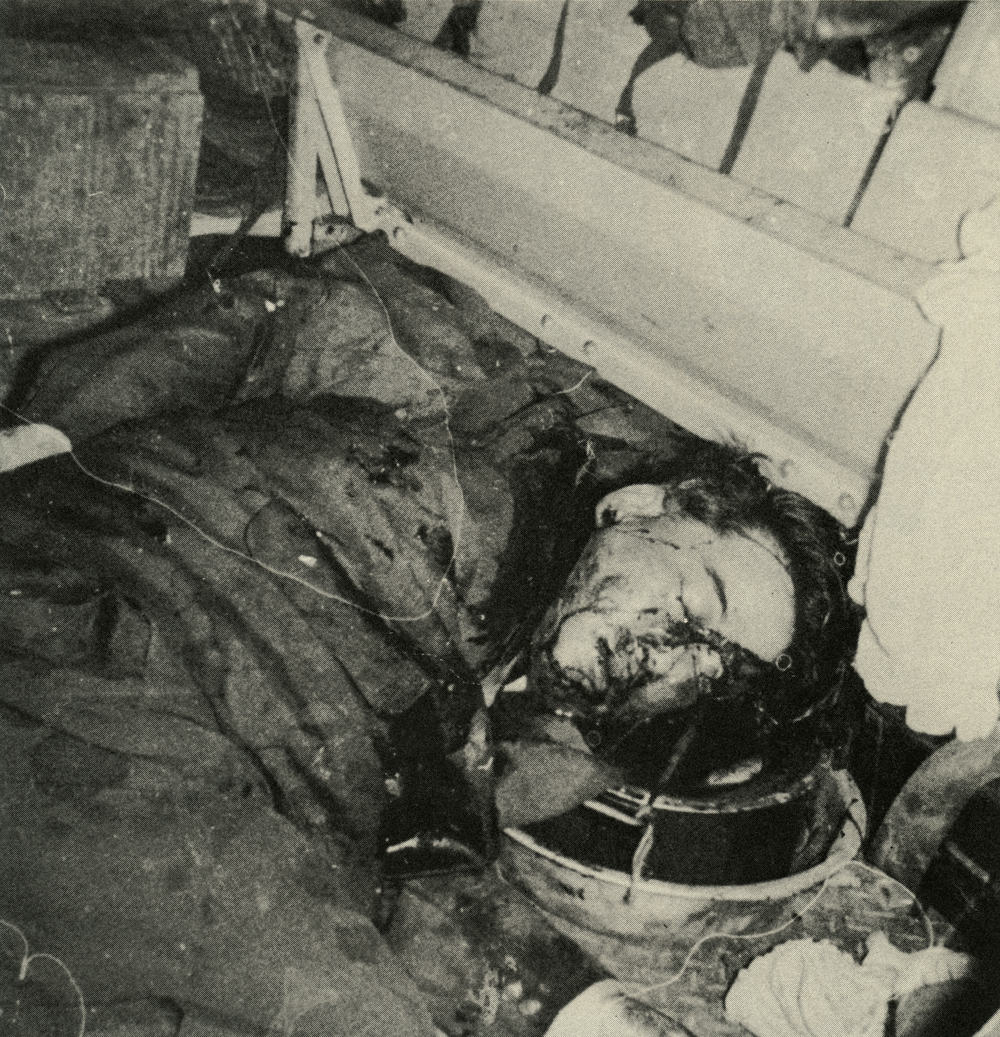
According to the account, the Ngo brothers were tracked
down by some armored units commanded by a long-time
enemy of the President, and, after their capture, they were
shot to death inside an armored car carrying them to the
Joint General Staff headquarters.
Washington delayed immediate recognition of the new
regime because, the study says, Secretary Rusk felt that a delay
would reduce the appearance of American complicity in the
coup and would make the generals look less like American
stooges. Mr. Rusk also discouraged any large delegations of
generals from calling on Ambassador Lodge as if they were
"reporting in."
The Kennedy Administration is described as shocked and
dismayed by the murders of the two leaders but says it had
been "reluctant to intervene on behalf of Diem and Nhu for
fear of appearing to offer support to them or reneging on our
pledges of noninterference to the generals."
The Americans had also reportedly counted on the coup
committee's offer of safe conduct to the Ngo brothers which,
until the very last moment-when the armored units were
just about to seize them-President Diem had repeatedly
rejected.
194
New Omens of Peril
In what the analyst calls the first of self-satisfaction,
Ambassador Lodge cabled Washington on Nov. 4 predicting
that the change of regime would shorten the war against the
Vietcong because of the improved morale in the South Vietnamese
Army.
But the Pentagon study recounts a number of immediate
and disturbing omens. Vietcong activity jumped dramatically
immediately after the coup. The fall of the Diem regime, as
Mr. Lodge reported, also exposed the inflated South Vietnamese
reports of success for the strategic-hamlet program.
Equally significant, when Mr. Lodge first met General
Minh, the new chief of state, he reported to Washington that
the general seemed "tired and somewhat frazzled" though
"obviously a good, well-intentioned man."
"Will he be strong enough to get on top of things?" Mr.
Lodge wondered.
It was a prophetic comment, for within three months one
of the coup group, Maj. Gen. Nguyen Khanh, seized power
for himself, starting a round of intramural power struggles
that plagued Washington for the next two years drawing it
ever deeper into the Vietnam war in an effort to prop up
successive South Vietnamese regimes.
Just before President Kennedy's assassination, his top aides
held a Vietnam strategy conference at Honolulu. Within four
days of that meeting, President Johnson issued a new Vietnam
policy paper to demonstrate that there would be no break
from the Kennedy policies.
Particularly in the sphere of covert operations against North
Vietnam, which became a prelude to the Tonkin Gulf clashes
in 1964, the Pentagon narrative describes a smooth transition
in the decision-making process. The Honolulu conference, set
up under President Kennedy, ordered planning for a stepped-up
program of what the account calls "non-attributable hit-and-
run" raids against North Vietnam. In his first Vietnam
policy document, on Nov. 26, President Johnson gave his
personal sanction to the planning for these operations.
In confident language, President Johnson set an objective
in South Vietnam that was to stand unchallenged within the
Administration for three and a half years: to assist "the pea-
195
pIe and Government of that country to win their contest
against the externally directed and supported Communist conspiracy."
He reaffirmed the goal of concluding the war by
the end of 1965. [See Document #60.]
But a harbinger of events was a report to President Johnson
from Secretary McNamara-"laden with gloom" as the
analyst puts it-a month later.
After a trip to Vietnam, the Secretary of Defense reported
on Dec. 21, 1963, that the new regime was "indecisive and
drifting."
"Vietcong progress," Me. McNamara said, in a major shift
of his own thinking, "has been great during the period since
the coup, with my best guess being that the situation has in
fact been deteriorating in the countryside since July to a far
greater extent than we realize because of our undue dependence
on distorted Vietnamese reporting."
In conclusion, he felt compelled to say: "The situation is
very disturbing. Current trends, unless reversed in the next
two-three months, would lead to a neutralization at best and
more likely to a Communist-controlled state."
His assessment laid the groundwork for decisions in early
1964 to step up the covert war against North Vietnam, and
increase American aid to the South.
196
KEY DOCUMENTS
Following are texts of key documents accompanying the Pentagon's
study of the Vietnam war, for the period of the 1963 coup
d'etat against President Ngo Dinh Diem, the events leading up to
it and its aftermath. Except where excerpting is specified, the
documents are printed verbatim, with only unmistakable typographical
errors corrected.
# 33
Notes on Kennedy Meeting on Diem
Regime in July, 1963
Memorandum by Roger Hilsman, Assistant Secretary of
State for Far Eastern Affairs, on a meeting held at the
White House July 4, 1963. Besides President Kennedy and
Mr. Hilsman, participants were Under Secretary of State
George Ball; Under Secretary of State Averell Harriman;
McGeorge Bundy, Presidential assistant for national security;
and Michael V. Forrestal, Southeast Asia specialist
on the White House staff.
The President was briefed on developments in Indonesia, Laos
and Viet-Nam. The portion on Viet-Nam follows:
A joint agreement was signed on June 16 in which the Government
met the Buddhists' five demands. The Buddhists and the
Government then worked together on the funeral arrangements
for the bonze who burned himself to death so that incidents could
be avoided. The funeral came off without trouble.
Since then there have been rumors circulating in Saigon that
the Government does not intend to live up to the agreement. These
rumors were given credence by an article appearing in the
English-language
"Times" of Viet-Nam, which is dominated by the Nhus.
The article contained a veiled attack on the U.S. and on the
Buddhists. There was a suggestion that the monk who burned
himself to death was drugged and a provocative challenge to the
Buddhists that, if no further demonstrations occurred on July 2,
this would amount to an admission by the Buddhists that they
were satisfied with the Government's action. (The President injected
questions on the possibility of drugging, to which Mr. Hilsman replied
that religious fervor was an adequate explanation.)
At this point there was a discussion of the possibility of getting
rid of the Nhus in which the combined judgment was that it would
not be possible.
Continuing the briefing, Mr. Hilsman said that the Buddhists
contained an activist element which undoubtedly favored increasing
demands as well as charging the Government with dragging
its feet. There was thus an element of truth in Diem's view that
the Buddhists might push their demands so far as to make his fall
inevitable.
During these events the U.S. had put extremely heavy pressure
on Diem to take political actions. Most recently we had urged
Diem to make a speech which would include announcements that
he intended to meet with Buddhist leaders, permit Buddhist chaplains
in the army and so on. If Diem did not make such a speech
and there were further demonstrations, the U.S. would be compelled
publicly to dissassociate itself from the GVN's Buddhist
policy. Mr. Hilsman reported that Diem had received this approach
with what seemed to be excessive politeness but had said
he would consider making such a speech.
Our estimate was that no matter what Diem did there will be
coup attempts over the next four months. Whether or not any of
these attempts will be successful is impossible to say.
Mr. Hilsman said that everyone agreed that the chances of
chaos in the wake of a coup are considerably less than they were
a year ago. An encouraging sign relative to this point is that the
war between the Vietnamese forces and the Viet Cong has been
pursued throughout the Buddhist crisis without noticeable let-up.
At this point Mr. Forrestal reported on General Krulak's views
that, even if there were chaos in Saigon, the military units in the
field would continue to confront the Communists.
Mr. Hilsman went on to say that Ambassador Nolting believes
that the most likely result of a coup attempt that succeeded in
killing Diem was civil war. Mr. Hilsman disagreed with this view
slightly in that he thought civil war was not the most likely result
but that it was certainly a possible result.
The timing of Ambassador Nolting's return and Ambassador
Lodge's assumption of duty was then discussed. The President's
initial view was that Ambassador Nolting should return immediately
and that Ambassador Lodge should assume his duties as
soon thereafter as possible. The President volunteered that Ambassador
Nolting had done an outstanding job, that it was almost
miraculous the way he had succeeded in turning the war around
from the disastrously low point in relations between Diem and
ourselves that existed when Ambassador Nolting took over. Mr.
Hilsman pointed out the personal sacrifices that Ambassador
Nolting had been forced to make during this period, and the
President said that he hoped a way could be found to commend
Ambassador Nolting publicly so as to make clear the fine job he
had done and that he hoped an appropriate position could be found
198
for him in Washington so that he could give his children a suitable
home in the years immediately ahead.
The President's decision was to delegate the authority to decide
on the timing of Ambassador Nolting's return to the Assistant
Secretary for Far Eastern Affairs; that Ambassador Lodge should
report to Washington no later than July 15 so that he could take
the Counterinsurgency Course simultaneously with the normal
briefings for an ambassador; and that Ambassador Lodge should
arrive in Saigon as soon as possible following completion of the
CI Course on August 14. Arrangements were made for Ambassador
Nolting to see the President at 4:00 p.m. on Monday,
July 8.
# 34
Intelligence Estimate on '63 Unrest
Excerpts from Special National Intelligence Estimate
53-2-63, "The Situation in South Vietnam," July 10, 1963.
CONCLUSIONS
A. The Buddhist crisis in South Vietnam has highlighted and
intensified a widespread and long-standing dissatisfaction with the
Diem regime and its style of government. If-as is likely-Diem
fails to carry out truly and promptly the commitments he has
made to the Buddhists, disorders will probably flare again and
the chances of a coup or assassination attempts against him will
become better than ever ...
B. The Diem regime's underlying uneasiness about the extent
of the U.S. involvement in South Vietnam has been sharpened by
the Buddhist affair and the firm line taken by the U.S. This attitude
will almost certainly persist and further pressure to reduce
the U.S. presence in the country is likely ....
C. Thus far, the Buddhist issue has not been effectively exploited
by the Communists, nor does it appear to have had any
appreciable effect on the counterinsurgency effort. We do not think
Diem is likely to be overthrown by a Communist coup. Nor do we
think the Communists would necessarily profit if he were overthrown
by some combination of his non-Communist opponents.
A non-Communist successor regime might be initially less effective
against the Viet Cong, but, given continued support from the U.S.
could provide reasonably effective leadership for the government
and the war effort ....
199
# 35
Washington Message to Lodge on
Need to Remove Nhus
Cablegram tram the State Department to Ambassador
Henry Cabot Lodge in Saigon, Aug. 24, 1963.
It is now clear that whether military proposed martial law or
whether Nhu tricked them into it, Nhu took advantage of its
imposition to smash pagodas with police and Tung's Special
Forces loyal to him, thus placing onus on military in eyes of world
and Vietnamese people. Also clear that Nhu has maneuvered himself
into commanding position.
U.S. Government cannot tolerate situation in which power lies
in Nhu's hands. Diem must be given chance to rid himself of
Nhu and his coterie and replace them with best military and
political personalities available.
If, in spite of all of your efforts, Diem remains obdurate and
refuses, then we must face the possibility that Diem himself
cannot be preserved.
We now believe immediate action must be taken to prevent
Nhu from consolidating his position further. Therefore, unless you
in consultation with Harkins perceive overriding objections you
are authorized to proceed along following lines:
(1) First we must press on appropriate levels of GVN following
line:
(a) USG cannot accept actions against Buddhists taken by Nhu
and his collaborators under cover martial law.
(b) Prompt dramatic actions redress situation must be taken,
including repeal of decree 10, release of arrested monks, nuns, etc.
(2) We must at same time also tell key military leaders that
U.S. would find it impossible to continue support GVN militarily
and economically unless above steps are taken immediately which
we recognize requires removal of Nhus from the scene. We wish
give Diem reasonable opportunity to remove Nhus, but if he
remains obdurate, then we are prepared to accept the obvious
implication that we can no longer support Diem. You may also
tell appropriate military commanders we will give them direct
support in any interim period of breakdown central government
mechanism.
(3) We recognize the necessity of removing taint on military
for pagoda raids and placing blame squarely on Nhu. You are
authorized to have such statements made in Saigon as you consider
desirable to achieve this objective. We are prepared to take
same line here and to have Voice of America make statement
along lines contained in next numbered telegram whenever you
give the word, preferably as soon as possible.
Concurrently, with above, Ambassador and country team should
200
urgently examine all possible alternative leadership and make
detailed plans as to how we might bring about Diem's replacement
if this should become necessary.
Assume you will consult with General Harkins re any precautions
necessary protect American personnel during crisis period.
You will understand that we cannot from Washington give you
detailed instructions as to how this operation should proceed, but
you will also know we will back you to the hilt on actions you
take to achieve our objectives.
Needless to say we have held knowledge of this telegram to
minimum essential people and assume you will take similar precautions
to prevent premature leaks.
# 36
Lodge's Reply to Washington
Cablegram from Ambassador Lodge to Secretary of State
Dean Rusk and Assistant Secretary of State Roger Hilsman,
Aug. 25, 1963.
Believe that chances of Diem's meeting our demands are virtually
nil. At same time, by making them we give Nhu chance to
forestall or block action by military. Risk, we believe, is not
worth taking, with Nhu in control combat forces Saigon.
Therefore, propose we go straight to Generals with our demands,
without informing Diem. Would tell them we prepared
have Diem without Nhus but it is in effect up to them whether
to keep him. Would also insist generals take steps to release
Buddhist leaders and carry out June 16 agreement.
Request immediate modification instructions. However, do not
propose move until we are satisfied with E and E plans. Harkins
concurs. I present credentials President Diem tomorrow 11 A.M.
# 37
C.I.A. Aide's Cable to Chief on Contact
with Saigon Generals
Cablegram from John Richardson, the Central Intelligence
Agency's Saigon station chief, to John A. McCone,
Director of Central Intelligence, Aug. 26, 1963.
During meeting with Harkins, Trueheart, Mecklin and cas on
morning 26 Aug Lodge made decision that American official
hand should not show. Consequently, Harkins will take no initiative with
VNese generals. (Conein to convey points below to
Gen. Khiem; Spera to Khanh; if Khiem agrees on Conein talking
to Don, he will).
(A) Solicitation of further elaboration of action aspects of
present thinking and planning. What should be done?
(B) We in agreement Nhus must go.
(C) Question of retaining Diem or not up to them.
(D) Bonzes and other arrestees must be released immediately
and five-point agreement of 16 June fully carried out.
(E) We will provide direct support during any interim period
of breakdown central gov mechanism.
(F) We cannot be of any help during initial action of assuming
power of state. Entirely their own action, win or lose. Don't
expect be bailed out.
(G) If Nhus do not go and if Buddhists situation is not redressed
as indicated, we would find it impossible continue military
and economic support.
(H) It hoped bloodshed can be avoided or reduced to absolute
minimum.
(I) It hoped that during process and after, developments conducted
in such manner as to retain and increase the necessary
relations between VNese and Americans which will allow for
progress of country and successful prosecution of the war.
# 38
C.I.A. Station Chief's Cable on Coup
Prospects in Saigon
Cablegram from Mr. Richardson to Mr. McCone, Aug.
28,1963.
Situation here has reached point of no return. Saigon is armed
camp. Current indications are that Ngo family have dug in for
last ditch battle. It is our considered estimate that General officers
cannot retreat now. Cone in's meeting with Gen. Khiem (Saigon
0346) reveals that overwhelming majority of general officers,
excepting Dinh and Cao, are united, have conducted prior planning,
realize that they must proceed quickly, and understand that
they have no alternative but to go forward. Unless the generals
are neutralized before being able to launch their operation, we
believe they will act and that they have good chance to win. If
General Dinh primarily and Tung secondly cannot be neutralized
at outset, there may be widespread fighting in Saigon and serious
loss of life.
We recognize the crucial stakes and involved and have no doubt
that the generals do also. Situation has changed drastically since
21 August. If the Ngo family wins now, they and Vietnam will
202
stagger on to final defeat at the hands of their own people and the
VC. Should a generals' revolt occur and be put down, GVN will
sharply reduce American presence in SVN. Even if they did not
do so, it seems clear that American public opinion and Congress,
as well as world opinion, would force withdrawal or reduction of
American support for VN under the Ngo administration.
Bloodshed can be avoided if the Ngo family would step down
before the coming armed action. . . . It is obviously preferable
that the generals conduct this effort without apparent American
assistance. Otherwise, for a long time in the future, they will be
vulnerable to charges of being American puppets, which they are
not in any sense. Nevertheless, we all understand that the effort
must succeed and that whatever needs to be done on our part
must be done. If this attempt by the generals does not take place
or if it fails, we believe it no exaggeration to say that VN runs
serious risk of being lost over the course of time.
# 39
Lodge Cable to Secretary Rusk on
U.S. Policy Toward a Coup
Cablegram from Ambassador Lodge to Secretary Rusk,
Aug. 29, 1963.
We are launched on a course from which there is no respectable
turning back: the overthrow of the Diem government. There is
no turning back in part because U.S. prestige is already publicly
committed to this end in large measure and will become more so
as the facts leak out. In a more fundamental sense, there is no
turning back because there is no possibility, in my view, that the
war can be won under a Diem administration, still less that Diem
or any member of the family can govern the country in a way to
gain the support of the people who count, i.e., the educated class
in and out of government service, civil and military-not to mention
the American people. In the last few months (and especially
days) they have in fact positively alienated these people to an
incalculable degree. So that I am personally in full agreement with
the policy which I was instructed to carry out by last Sunday's
telegram.
2. The chance of bringing off a Generals' coup depends on
them to some extent; but it depends at least as much on us.
3. We should proceed to make all-out effort to get Generals to
move promptly. To do so we should have authority to do
following:
(a) That Gen. Harkins repeat to Generals personally message
previously transmitted by CAS officers. This should establish their
authenticity. Gen. Harkins should have order on this.
203
(b) If nevertheless Generals insist on public statement that all
U.S. aid to VN through Diem regime has been stopped, we would
agree, on express understanding that Generals will have started at
same time. (We would seek persuade Generals that it would be
better to hold this card for use in event of stalemate. We hope it
will not be necessary to do this at all.)
(c) VNese Generals doubt that we have the will power, courage,
and determination to see this thing through. They are haunted
by the idea that we will run out on them even though we have
told them pursuant to instructions, that the game had started.
5. We must press on for many reasons. Some of these are:
(a) Explosiveness of the present situation which may well
lead to riots and violence if issue of discontent with regime is not
met. Out of this could come a pro-Communist or at best a neutralist
set of politicians.
(b) The fact that war cannot be won with the present regime.
(c) Our own reputation for steadfastness and our unwillingness
to stultify ourselves.
(d) If proposed action is suspended, I believe a body blow
will be dealt to respect for us by VNese Generals. Also, all those
who expect U.S. to straighten out this situation will feel let down.
Our help to the regime in past years inescapably gives a responsibility
which we cannot avoid.
6. I realize that this course involves a very substantial risk of
losing VN. It also involves some additional risk to American
lives. I would never propose it if I felt there was a reasonable
chance of holding VN with Diem.
[Point 7 unavailable.]
8. . .. Gen. Harkins thinks that I should ask Diem to get rid
of the Nhus before starting the Generals' action. But I believe
that such a step has no chance of getting the desired result and
would have the very serious effect of being regarded by the Generals
as a sign of American indecision and delay. I believe this is
a risk which we should not run. The Generals distrust us too much
already. Another point is that Diem would certainly ask for time
to consider such a far-reaching request. This would give the ball
to Nhu.
9. With the exception of par. 8 above Gen. Harkins concurs in
this telegram.
#40
Rusk Cable to Lodge on Views of
National Security Council
Cablegram from Secretary Rusk to Ambassador Lodge,
Aug. 29, 1963. The Pentagon study says the message fol-
Lowed a meeting of the NationaL Security Council.
204
1. Highest level meeting noon today reviewed your 375 and
reaffirmed basic course. Specific decisions follow:
2. In response to your recommendation, General Harkins is
hereby authorized to repeat to such Generals as you indicate the
messages previously transmitted by CAS officers. He should
stress that the USG supports the movement to eliminate the
Nhus from the government, but that before arriving at specific
understandings with the generals, General Harkins must know
who are involved, resources available to them and overall plan
for coup. The USG will support a coup which has good chance
of succeeding but plans no direct involvement of U.S. armed
forces. Harkins should state that he is prepared to establish liaison
with the coup planners and to review plans, but will not engage
directly in joint coup planning.
3. Question of last approach to Diem remains undecided and
separate personal message from Secretary to you develops our
concern and asks your comment.
4. On movement of U.S. forces, we do not expect to make any
announcement or leak at present and believe that any later decision
to publicize such movements should be closely connected to
developing events on your side. We cannot of course prevent unauthorized
disclosures or speculation, but we will in any event
knock down any reports of evacuation.
5. You are hereby authorized to announce suspension of aid
through Diem government at a time and under conditions of your
choice. In deciding upon the use of this authority, you should
consider importance of timing and managing announcement so as
to minimize appearance of collusion with Generals and also to
minimize danger of unpredictable and disruptive reaction by existing
government. We also assume that you will not in fact use this
authority unless you think it essential, and we see it as possible
that Harkins' approach and increasing process of cooperation may
provide assurance Generals desire. Our own view is that it will
be best to hold this authority for use in close conjunction with
coup, and not for present encouragement of Generals, but decision
is yours.
# 41
Further Rusk Cable to Lodge on
Diem-Nhu Relationship
Cablegram from Secretary Rusk to Ambassador Lodge,
Aug. 29, 1963.
Deeply appreciate your 375 which was a most helpful clarification.
We fully understand enormous stakes at issue and the heavy
responsibilities which you and Harkins will be carrying in the days
205
ahead and we want to do everything possible from our end to help.
Purpose of this message is to explore further question of possible
attempt to separate Diem and the Nhus. In your telegram
you appear to treat Diem and the Nhus as a single package
whereas we had indicated earlier to the Generals that if the Nhus
were removed the question of retaining Diem would be up to
them. My own personal assessment is (and this is not an instruction)
that the Nhus are by all odds the greater part of the problem
in Vietnam, internally, internationally and for American public
opinion. Perhaps it is inconceivable that the Nhus could be removed
without taking Diem with them or without Diem's abandoning
his post. In any event, I would appreciate your comment
on whether any distinction can or should be drawn as between
Diem and Counselor and Madame Nhu.
The only point on which you and General Harkins have different
views is whether an attempt should be made with Diem to
eliminate the Nhus and presumably take other steps to consolidate
the country behind a winning effort against the Viet Congo My
own hunch, based in part on the report of Kattenburg's conversations
with Diem is that such an approach could not succeed if
it were cast purely in terms of persuasion. Unless such a talk
included a real sanction such as a threatened withdrawal of our
support, it is unlikely that it would be taken completely seriously
by a man who may feel that we are inescapably committed to an
anti-Communist Vietnam. But if a sanction were used in such a
conversation, there would be a high risk that this would be taken
by Diem as a sign that action against him and the Nhus was
imminent and he might as a minimum move against the Generals
or even take some quite fantastic action such as calling on North
Vietnam for assistance in expelling the Americans.
It occurs to me, therefore, that if such an approach were to be
made it might properly await the time when others were ready
to move immediately to constitute a new government. If this be
so, the question then arises as to whether an approach to insist
upon the expulsion of the Nhus should come from Americans
rather than from the Generals themselves. This might be the
means by which the Generals could indicate that they were prepared
to distinguish between Diem and the Nhus. In any event,
were the Generals to take this action it would tend to protect
succeeding Vietnam administrations from the charge of being
wholly American puppets subjected to whatever anti-American
sentiment is inherent in so complex a situation.
I would be glad to have your further thoughts on these points
as well as your views on whether further talks with Diem are
contemplated to continue your opening discussions with him. You
will have received formal instructions on other matters through
other messages. Good luck.
206
# 42
Lodge's Response to Rusk on Diem's
Closeness to Brother
Cablegram from Ambassador Lodge to Secretary Rusk,
Aug. 30, 1963.
I agree that getting the Nhus out is the prime objective and
that they are "the greater part ... "
This surely cannot be done by working through Diem. In fact
Diem will oppose it. He wishes he had more Nhus, not less.
The best chance of doing it is by the Generals taking over the
government lock, stock and barrel.
After this has been done, it can then be decided whether to put
Diem back in again or go on without him. I am rather inclined
to put him back, but I would not favor putting heavy pressure on
the Generals if they don't want him. My greatest single difficulty
in carrying out the instructions of last Sunday is inertia. The days
come and go and nothing happens. It is, of course, natural for the
Generals to want assurances and the U.S. Government has certainly
been prompt in its reactions. But here it is Friday and,
while in one way much has been done, there is not yet enough to
show for the hours which we have all put in.
If I call on Diem to demand the removal of the Nhus, he will
surely not agree. But before turning me down, he will pretend to
consider it and involve us in prolonged delays. This will make
the Generals suspicious of us and add to the inertia.
Such a call by me would look to the Nhus like an ultimatum
and would result in their taking steps to thwart any operation
dealing with them.
I agree with you that if a sanction were used, it could provoke
an even more fantastic reaction. In fact I greatly dislike the idea
of cutting off aid in connection with the Generals' operation and
while I thank you for giving me the authority to make an
announcement, I hope I will never have to use it.
It is possible, as you suggested . . . for the Generals when, as
and if their operation gets rolling to demand the removal of the
Nhus before bringing their operation to fruition. But I am afraid
they will get talked out of their operation which will then
disintegrate,
still leaving the Nhus in office.
If the Generals' operation does get rolling, I would not want to
stop it until they were in full control. They could then get rid of
the Nhus and decide whether they wanted to keep Diem.
It is better for them and for us for them to throw out the Nhus
than for us to get involved in it.
I am sure that the best way to handle this matter is by a truly
VN ese movement even if it puts me rather in the position of
pushing a piece of spaghetti.
I am contemplating no further talks with Diem at this time.
207
# 43
Cable by U.S. General in Saigon to Taylor
on End of August Plot
Cablegram from Gen. Paul D. Harkins, United States
commander in Saigon, to Gen. Maxwell D. Taylor, Chairman
of the Joint Chiefs of Staff, Aug. 31, 1963.
(saw Khiem: he stated Big Minh had stopped planning at this
time, and was working on other methods; others had called off
planning also, himself and Khanh, following Minh. He knew Thao
was making plans--but that few of military trusted him because
of his VC background-and that he might still be working for
the VC. The Generals were not ready as they did not have enough
forces under their control compared to those under President and
now in Saigon. He indicated they, the Generals, did not want to
start anything they could not successfully finish.
· .. At a meeting yesterday, Mr. Nhu said he now went along
with everything the U.S. wants to do, and even had the backing
of Pres. Kennedy. I said this was news to me. Khiem said he
wondered if Nhu was again trying to flush out the generals. He
intimated the generals do not have too much trust in Nhu and
that he's such a friend of Mr. Richardson the generals wonder if
Mr. Nhu and Mme. Nhu were on the CIA payroll ....
· .. I asked if someone couldn't confront the Nhus with the
fact that their absence from the scene was the key to the overall
solution. He replied that for anyone to do that would be
self-immolation-
he also went on to say he doubted if the Nhus and
Diem could be split.
· .. So we see we have an "organisation de confusion" with
everyone suspicious of everyone else and none desiring to take
any positive action as of right now. You can't hurry the East. ...
#44
Memo on Washington Meeting in
Aftermath of August Plot
Memorandum by Maj. Gen. Victor H. Krulak, special
assistant to the Joint Chiefs of Staff for counterinsurgency
and special activities, on a meeting at the State Department
Aug. 31, 1963. Besides General Krulak, participants were
Vice President Johnson; Secretary Rusk; Secretary Mc-
Namara; Deputy Secretary of Defense Roswell L. Gilpatric;
McGeorge Bundy; General Taylor; Edward R. Murrow,
director of the United States Information Agency; Lieut.
208
Gen. Marshall S. Carter, Deputy Director of the Central
Intelligence Agency. Richard Helms and William E. Colby
of the C.I.A.; Frederick E. Nolting Jr., former Ambassador
in Saigon; Assistant Secretary Hilsman, and Paul M. Kattenburg
of the State Department, head of the Interdepartmental
Working Group on Vietnam.
1. Secretary Rusk stated that, in his judgment, we were back
to where we were about Wednesday of last week, and this causes
him to go back to the original problem and ask what in the
situation led us to think well of a coup. Ruling out hatred of the
Nhus, he said, there would appear to be three things:
a. The things that the Nhus had done or supported, which
tended to upset the GVN internally.
b. The things that they had done which had an adverse external
effect.
c. The great pressures of U.S. public opinion.
2. Mr. Rusk then asked if we should not pick up Ambassador
Lodge's suggestion in his message of today (Saigon 391) and
determine what steps are required to re-gird solidarity in South
Vietnam-such as improvement in conditions concerning students
and Buddhists and the possible departure of Madame Nhu.
He said that we should determine what additional measures are
needed to improve the international situation-such as problems
affecting Cambodia-and to improve the Vietnamese position
wherein U.S. public opinion is concerned. He then said that he
is reluctant to start off by saying now that Nhu has to go; that
it is unrealistic.
3. Mr. McNamara stated that he favored the above proposals
of the Secretary of State, with one additional step-that is to
establish quickly and firmly our line of communication between
Lodge, Harkins and the GVN. He pointed out that at the moment
our channels of communication are essentially broken and that
they should be reinstituted at all costs.
4. Mr. Rusk added that we must do our best not to permit
Diem to decapitate his military command in light of its obviously
adverse effect on the prosecution of the war. At this point he
asked if anyone present had any doubt in his mind but that the
coup was off.
5. Mr. Kattenburg said that he had some remaining doubt;
that we have not yet sent the generals a strong enough message;
that the BOA statement regarding the withdrawal of aid was
most important, but that we repudiated it too soon. He stated
further that the group should take note of the fact that General
Harkins did not carry out his instructions with respect to communication
with the generals. Mr. Rusk interrupted Kattenburg
to state that, to the contrary, he believed Harkins' conduct was
exactly correct in light of the initial response which he received
from General Khiem (they were referring to Harkins' report in
MACV 1583).
209
6. Mr. Hilsman commented that, in his view, the generals are
not now going to move unless they are pressed by a revolt from
below. In this connection Ambassador Nolting warned that in
the uncoordinated Vietnamese structure anything can happen, and
that while an organized successful coup is out, there might be
small flurries by irresponsible dissidents at any time.
7. Mr. Hilsman undertook to present four basic factors which
bear directly on the problem confronting the U.S. now. They
are, in his view:
a. The mood of the people, particularly the middle level officers,
non-commissioned officers and middle level bureaucrats,
who are most restive. Mr. McNamara interrupted to state that
he had seen no evidence of this and General Taylor commented
that he had seen none either, but would like to see such evidence
as Hilsman could produce. Mr. Kattenburg commented that the
middle level officers and bureaucrats are uniformly critical of the
government, to which Mr. McNamara commented that if this
indeed be the fact we should know about it.
b. The second basic factor, as outlined by Hilsman, was what
effect will be felt on our programs elsewhere in Asia if we
acquiesce to a strong Nhu-dominated government. In this connection,
he reported that there is a Korean study now underway
on just how much repression the United States will tolerate before
pulling out her aid. Mr. McNamara stated that he had not seen
this study and would be anxious to have it.
c. The third basic factor is Mr. Nhu, his personality and his
policy. Hilsman recalled that Nhu has once already launched
an effort aimed at withdrawal of our province advisors and stated
that he is sure he is in conversation with the French. He gave,
as supporting evidence, the content of an intercepted message,
which Mr. Bundy asked to see. Ambassador Nolting expressed
the opinion that Nhu will not make a deal with Ho Chi Minh
on Ho's terms.
d. The fourth point is the matter of U.S. and world opinion,
Hilsman stated that this problem was moving to a political and
diplomatic plane. Part of the problem, he said, is the press, which
concludes incorrectly that we have the ability to change the things
in Vietnam of which they are critical. To this Mr. Murrow added
that this problem of press condemnation is now worldwide.
8. Mr. Kattenburg stated that as recently as last Thursday
it was the belief of Ambassador Lodge that, if we undertake to
live with this repressive regime, with its bayonets at every street
corner and its transparent negotiations with puppet bonzes, we
are going to be thrown out of the country in six months. He
stated that at this juncture it would be better for us to make
the decision to get out honorably. He went on to say that, having
been acquainted with Diem for ten years, he was deeply disappointed
in him, saying that he will not separate from his
brother. It was Kattenburg's view that Diem will get very little
210
support from the military and, as time goes on, he will get less
and less support and the country will go steadily down hill.
9. General Taylor asked what Kattenburg meant when he said
that we would be forced out of Vietnam within six months.
Kattenburg replied that in from six months to a year, as the
people see we are losing the war, they will gradually go to the
other side and we will be obliged to leave. Ambassador Nolting
expressed general disagreement with Mr. Kattenburg. He said
that the unfavorable activity which motivated Kattenburg's remarks
was confined to the city and, while city support of Diem
is doubtless less now, it is not greatly so. He said that it is improper
to overlook the fact that we have done a tremendous job
toward winning the Vietnam war, working with this same imperfect,
annoying government.
10. Mr. Kattenburg added that there is one new factor-the
population, which was in high hopes of expelling the Nhus after
the VOA announcement regarding cessation of aid; now, under
the heel of Nhu's military repression, they would quickly lose
heart.
11. Secretary Rusk commented that Kattenburg's recital was
largely speculative; that it would be far better for us to start on
the firm basis of two things-that we will not pull out of Vietnam
until the war is won, and that we will not run a coup. Mr. McNamara
expressed agreement with this view.
12. Mr. Rusk then said that we should present questions to
Lodge which fall within these parameters. He added that he believes
we have good proof that we have been winning the war,
particularly the contrast between the first six months of 1962 and
the first six months of 1963. He then asked the Vice President
if he had any contribution to make.
13. The Vice President stated that he agreed with Secretary
Rusk's conclusions completely; that he had great reservations
himself with respect to a coup, particularly so because he had
never really seen a genuine alternative to Diem. He stated that
from both a practical and a political viewpoint, it would be a
disaster to pull out; that we should stop playing cops and robbers
and get back to talking straight to the GVN, and that we should
once again go about winning the war. He stated that after our
communications with them are genuinely reestablished, it may be
necessary for someone to talk rough to them-perhaps General
Taylor. He said further that he had been greatly impressed with
Ambassador Nolting's views and agreed with Mr. McNamara's
conclusions.
14. General Taylor raised the question of whether we should
change the disposition of the forces which had been set in motion
as a result of the crisis. It was agreed that there should be no
change in the existing disposition for the time being.
211
# 45
While House Cable to Lodge on Pressure
for Saigon Reforms
Cablegram from White House to Ambassador Lodge,
Sept. 17, 1963. The Pentagon study says this message followed
a meeting of the National Security Council but
adds, "There is no evidence on the degree of consensus of
the principals in this decision."
1. Highest level meeting today has approved broad outline of
an action proposals program designed to obtain from GVN, if
possible, reforms and changes in personnel necessary to maintain
support of Vietnamese and US opinion in war against Viet Congo
This cable reports this program and our thinking for your comment
before a final decision. Your comment requested soonest.
2. We see no good opportunity for action to remove present
government in immediate future; therefore, as your most recent
messages suggest, we must for the present apply such pressures
as are available to secure whatever modest improvements on the
scene may be possible. We think it likely that such improvements
can make a difference, at least in the short run. Such a course,
moreover, is consistent with more drastic effort as and when
means become available, and we will be in touch on other channels
on this problem.
3. We share view in your 523 that best available reinforcement
to your bargaining position in this interim period is clear evidence
that all U.S. assistance is granted only on your say-so. Separate
telegram discusses details of this problem, but in this message we
specifically authorize you to apply any controls you think helpful
for this purpose. You are authorized to delay any delivery of
supplies or transfer of funds by any agency until you are satisfied
that delivery is in U.S. interest, bearing in mind that it is not
our current policy to cut off aid, entirely. In other words, we
share your view that it will be helpful for GVN to understand
that your personal approval is a necessary part of all U.S. assistance.
We think it may be particularly desirable for you to use
this authority in limiting or rerouting any and all forms of assistance
and support which now go to or through Nhu or individuals
like Tung who are associated with him. This authorization specifically
includes aid actions currently held in abeyance and you
are authorized to set those in train or hold them up further
in your discretion. We leave entirely in your hands decisions on
the degree of privacy or publicity you wish to give to this process.
4. Subject to your comment and amendment our own list of
possible helpful action by government runs as follows in approximate
order of importance:
A. Clear the air-Diem should get everyone back to work and
212
get them to focus on winning the war. He should be broadminded
and compassionate in his attitude toward those who have, for
understandable reasons, found it difficult under recent circumstances
fully to support him. A real spirit of reconciliation could
work wonders on the people he leads; a punitive, harsh or autocratic
attitude could only lead to further resistance.
B. Buddhists and students-Let them out and leave them unmolested.
This more than anything else would demonstrate the
return of a better day and the refocusing on the main job at
hand, the war.
C. Press-The press should be allowed full latitude of expression.
Diem will be criticized, but leniency and cooperation with
the domestic and foreign press at this time would bring praise for
his leadership in due course. While tendentious reporting is irritating,
suppression of news leads to much more serious trouble.
D. Secret and combat police-Confine its role to operations
against the VC and abandon operations against non-Communist
opposition groups thereby indicating clearly that a period of
reconciliation and political stability has returned.
E. Cabinet changes to inject new untainted blood, remove
targets of popular discontent.
F. Elections-These should be held, should be free, and should
be widely observed.
G. Assembly-Assembly should be convoked soon after the
elections. The Government should submit its policies to it and
should receive its confidence. An assembly resolution would be
most useful for external image purposes.
H. Party-Can Lao party should not be covert or semi-covert
but a broad association of supporters engaged in a common,
winning cause. This could perhaps be best accomplished by
I. Repeal or suitable amendment Decree 10.
J. Rehabilitation by ARVN of pagodas.
K. Establishment of Ministry of Religious Affairs.
L. Liberation of passport issuances and currency restrictions
enabling all to leave who wish to.
M. Acceptance of Buddhist Inquiry Mission from World Federation
to report true facts of situation to world.
5. You may wish to add or subtract from the above list, but
need to set psychological tone and image is paramount. Diem
has taken positive actions in past of greater or less scope than
those listed, but they have had little practical political effect
since they were carried out in such a way as to make them hollow
or, even if real, unbelievable (e.g., martial law already nominally
lifted, Assembly elections scheduled, and puppet bonzes established)
.
6. Specific "reforms" are apt to have little impact without
dramatic, symbolic move which convinces Vietnamese that reforms
are real. As practical matter we share your views that this
can best be achieved by some visible reduction in influence of
Nhus, who are symbol to disaffected of all that they dislike in
213
GVN. This we think would require Nhus' departure from Saigon
and preferably Vietnam at least for extended vacation. We recognize
the strong possibility that these and other pressures may not
produce this result, but we are convinced that it is necessary to
try.
7. In Washington, in this phase, we would plan to maintain a
posture of disapproval of recent GVN actions, but we would
not expect to make public our specific requests of Diem. Your
comment on public aspects of this phase is particularly needed.
8. We note your reluctance to continue dialogue with Diem
until you have more to say, but we continue to believe that
discussions with him are at a minimum an important source of
intelligence and may conceivably be a means of exerting some
persuasive effect even in his present state of mind. If you believe
that full control of U.S. assistance provides you with means of
resuming dialogue, we hope you will do so. We ourselves can
see much virtue in effort to reason even with an unreasonable
man when he is on a collision course. We repeat, however, that
this is a matter for your judgment.
9. Meanwhile, there is increasing concern here with strictly
military aspects of the problem, both in terms of actual progress
of operations and of need to make effective case with Congress
for continued prosecution of the effort. To meet these needs,
President has decided to send Secretary of Defense and General
Taylor to Vietnam, arriving early next week. It will be emphasized
here that it is a military mission and that all political decisions
are being handled through you as President's Senior Representative.
10. We repeat that political program outlined above awaits
your comment before final decision. President particularly emphasizes
that it is fully open to your criticism and amendment. It is
obviously an interim plan and further decisions may become
necessary very soon.
# 46
Lodge Cable to Kennedy on Means of
Bringing Reforms
Cablegram from Ambassador Lodge to State Department
"for President only," Sept. 19, 1963.
1. Agree that no good opportunity for action to remove present
government in immediate future is apparent and that we should,
therefore, do whatever we can as an interim measure pending
such an eventuality.
2. Virtually all the topics under paragraph 4, letters A to M,
have been taken up with Diem and Nhu at one time or another,
214
most of them by me personally. They think that most of them
would either involve destroying the political structure on which
they rest or loss of face or both. We, therefore, could not
realistically
hope for more than lip service. Frankly, I see no opportunity
at all for substantive changes. Detailed comments on items A to M
are contained in separate telegram.
3. There are signs that Diem-Nhu are somewhat bothered by
my silence. According to one well placed source, they are guessing
and off-balance and "desperately anxious" to know what U.S.
posture is to be. They may be preparing some kind of a public
relations package, possibly to be opened after the elections. I
believe that for me to press Diem on things which are not in the
cards and to repeat what we have said several times already
would be a little shrill and would make us look weak, particularly
in view of my talk with Nhu last night at a dinner where
I had a golden opportunity to make the main points of your CAP
63516 as reported in 54!.
4. Also, I doubt that a public relations package will meet needs
of situation which seems particularly grave to me, notably in the
light of General Big Minh's opinion expressed very privately
yesterday that the Viet Cong are steadily gaining in strength; have
more of the population on their side than has the GVN; that
arrests are continuing and that the prisons are full; that more and
more students are going over to the Viet Cong; that there is
great graft and corruption in the Vietnamese administration of
our aid; and that the "Heart of the Army is not in the war." All
this by Vietnamese No. 1 General is now echoed by Secretary
of Defense Thuan (See my 542), who wants to leave the country.
5. As regards your paragraph 3 on withholding of aid, I still
hope that I may be informed of methods, as requested in my
478, September 11, which will enable us to apply sanctions in a
way which will really affect Diem and Nhu without precipitating
an economic collapse and without impeding the war effort. We
are studying this here and have not yet found a solution. If a way
to do this were to be found, it would be one of the greatest discoveries
since the enactment of the Marshall Plan in 1947 because,
so far as I know, the U.S. had never yet been able to
control any of the very unsatisfactory governments through which
we have had to work in our many very successful attempts to
make these countries strong enough to stand alone.
6. I also believe that whatever sanctions we may discover
should be directly tied to a promising coup d'etat and should not
be applied without such a coup being in prospect. In this connection,
I believe that we should pursue contact with Big Minh and
urge him along if he looks like acting. I particularly think that
the idea of supporting a Vietnamese Army independent of the
government should be energetically studied.
7. I will, of course, give instructions that programs which one
[sic] can be effectively held up should be held up and not released
without my approval provided that this can be done without
215
serious harmful effect to the people and to the war effort. Technical
assistance and (omission) support to communications support
programs may be one way. This would be a fly-speck in the
present situation and would have no immediate effect, but I hope
that U.S. (omission) may get Vietnamese officials into the habit
of asking me to release items which are held up and that, over
a long period of time, it might create opportunities for us to
get little things done.
8. But it is not even within the realm of possibility that such
a technique could lead them to do anything which causes loss
of face or weakening of their political organization. In fact, to
threaten them with suppression of aid might well defeat our
purposes and might make a bad situation very much worse.
9. There should in any event be no publicity whatever about
this procedure. If it is possible (omission) a program, I intend
to (omission).
10. As regards your paragraph 6 and "dramatic symbolic
moves," I really do not think they could understand this even
if Thao wanted to, although I have talked about it to Diem, and
to Nhu last night (See my 541). They have scant comprehension
of what it is to appeal to public opinion as they have really no
interest in any other opinion than their own. I have repeatedly
brought up the question of Nhu's departure and have stressed that
if he would just stay away until after Christmas, it might help
get the Appropriation Bill through. This seems like a small thing
to us but to them it seems tremendous as they are quite sure
that the Army would take over if he even stepped out of the
country.
11. Your paragraph 8. I have, of course, no objection to seeing
Diem at any time that it would be helpful. But I would rather
let him sweat for awhile and not go to see him unless I have
something really new to bring up. I would much prefer to wait
until I find some part of the AID program to hold up in which
he is interested and then have him ask me to come and see him.
For example, last night's dinner which I suspect Nhu of stimulating
is infinitely better than for me to take the initiative for an
appointment and to call at the office. Perhaps my silence had
something to do with it.
# 47
McNamara-Taylor Report on Mission to
South Vietnam
Excerpts from memorandum for President Kennedy from
Secretary McNamara and General Taylor, dated Oct. 2,
1963, and headed "Report of McNamara-Taylor Mission
to South Vietnam."
216
A. CONCLUSIONS.
1. The military campaign has made great progress and continues
to progress.
2. There are serious political tensions in Saigon (and perhaps
elsewhere in South Vietnam) where the Diem-Nhu government
is becoming increasingly unpopular.
3. There is no solid evidence of the possibility of a successful
coup, although assassination of Diem or Nhu is always a possibility.
4. Although some, and perhaps an increasing number, of GVN
military officers are becoming hostile to the government, they
are more hostile to the Viet Cong than to the government and
at least for the near future they will continue to perform their
military duties.
5. Further repressive actions by Diem and Nhu could change
the present favorable military trends. On the other hand, a return
to more moderate methods of control and administration, unlikely
though it may be, would substantially mitigate the political crisis.
6. It is not clear that pressures exerted by the U.S. will move
Diem and Nhu toward moderation. Indeed, pressures may increase
their obduracy. But unless such pressures are exerted, they
are almost certain to continue past patterns of behavior.
B. RECOMMENDATIONS.
We recommend that:
1. General Harkins review with Diem the military changes
necessary to complete the military campaign in the Northern and
Central areas (I, II, and III Corps) by the end of 1954, and in
the Delta (IV Corps) by the end of 1965. This review would
consider the need for such changes as:
a. A further shift of military emphasis and strength to the
Delta (IV Corps).
b. An increase in the military tempo in all corps areas, so
that all combat troops are in the Field an average of 20 days out
of 30 and static missions are ended.
c. Emphasis on "clear and hold operations" instead of terrain
sweeps which have little permanent value.
d. The expansion of personnel in combat units to full authorized
strength.
e. The training and arming of hamlet militia at an accelerated
rate, especially in the Delta.
f. A consolidation of the strategic hamlet program, especially
in the Delta, and action to insure that future strategic hamlets
are not built until they can be protected, and until civic action
programs can be introduced.
2. A program be established to train Vietnamese so that essential
functions now performed by U.S. military personnel can
be carried out by Vietnamese by the end of 1965. It should be
possible to withdraw the bulk of U.S. personnel by that time.
217
3. In accordance with the program to train progressively Vietnamese
to take over military functions, the Defense Department
should announce in the very near future presently prepared plans
to withdraw 1000 U.S. military personnel by the end of 1963.
This action should be explained in low key as an initial step in
a long-term program to replace U.S. personnel with trained
Vietnamese without impairment of the war effort.
4. The following actions be taken to impress upon Diem our disapproval
of his political program.
a. Continue to withhold commitment of funds in the commodity
import program, but avoid a formal announcement. The potential
significance of the withholding of commitments for the 1964 military
budget should be brought home to the top military officers in
working level contacts between USOM and MAVC and the Joint
General Staff; up to now we have stated $95 million may be used
by the Vietnamese as a planning level for the commodity import
program for 1964. Henceforth we could make clear that this
is uncertain both because of lack of final appropriation action by
the Congress and because of executive policy.
b. Suspend approval of the pending AID loans for the Saigon-
Cholon Waterworks and Saigon Electric Power Project. We should
state clearly that we are doing so as a matter of policy.
c. Advise Diem that MAP and CIA support for designated units,
now under Colonel Tung's control (mostly held in or near the
Saigon area for political reasons) and will be cut off unless these
units are promptly assigned to the full authority of the Joint General
Staff and transferred to the field.
d. Maintain the present purely "correct" relations with the top
GVN, and specifically between the Ambassador and Diem. Contact
between General Harkins and Diem and Defense Secretary
Thuan on military matters should not, however, be suspended, as
this remains an important channel of advice. USOM and USIA
should also seek to maintain contacts where these are needed to
push forward programs in support of the effort in the field, while
taking care not to cut across the basic picture of U.S. disapproval
and uncertainty of U.S. aid intentions. We should work with the
Diem government but not support it. . . .
As we pursue these courses of action, the situation must be
closely watched to see what steps Diem is taking to reduce repressive
practices and to improve the effectiveness of the military
effort. We should set no fixed criteria, but recognize that we
would have to decide in 2 - 4 months whether to move to more
drastic action or try to carryon with Diem even if he had not
taken significant steps.
5. At this time, no initiative should be taken to encourage actively
a change in government. Our policy should be to seek
urgently to identify and build contacts with an alternative leadership
if and when it appears.
6. The following statement be approved as current U.S. policy
toward South Vietnam and constitute the substance of the government
position to be presented both in Congressional testimony and
in public statements.
a. The security of South Vietnam remains vital to United States
security. For this reason, we adhere to the overriding objective of
denying this country to Communism and of suppressing the Viet
Cong insurgency as promptly as possible. (By suppressing the
insurgency we mean reducing it to proportions manageable by the
national security forces of the GVN, unassisted by the presence of
U.S. military forces.) We believe the U.S. part of the task can
be completed by the end of 1965, the terminal date which we are
taking as the time objective of our counterinsurgency programs.
b. The military program in Vietnam has made progress and is
sound in principle.
c. The political situation in Vietnam remains deeply serious.
It has not yet significantly affected the military effort, but could
do so at some time in the future. If the result is a GVN ineffective
in the conduct of the war, the U.S. will review its attitude
toward support for the government. Although we are deeply concerned
by repressive practices, effective performance in the conduct
of the war should be the determining factor in our relations
with the GVN.
d. The U.S. has expressed its disapproval of certain actions of
the Diem-Nhu regime will do so again if required. Our policy
is to seek to bring about the abandonment of repression because of
its effect on the popular will to resist. Our means consist of
expressions
of disapproval and the withholding of support from the GVN
activities that are not clearly contributing to the war effort. We will
use these means as required to assure an effective military program
....
# 48
Lodge Message on Meeting of C.I.A. Agent
with Gen. Minh
Cablegram from Ambassador Lodge to the State Department,
Oct. 5, 1963.
I. Lt. CoJ. Conein met with Gen Duong Van Minh at Gen.
Minh's Headquarters on Le Van Duyet for one hour and ten
minutes morning of 5 Oct 63. This meeting was at the initiative of
Gen Minh and has been specifically cleared in advance by Ambassador
Lodge. No other persons were present. The conversation
was conducted in French.
2. Gen. Minh stated that he must know American Government's
position with respect to a change in the Government of Vietnam
within the very near future. Gen. Minh added the Generals were
aware of the situation is deteriorating rapidly and that action to
change the Government must be taken or the war will be lost to
219
the Viet Cong because the Government no longer has the support
of the people. Gen. Minh identified among the other Generals
participating with him in this plan:
Maj. Gen. Tran Van Don
Brig. Gen. Tran Thien Khiem
Maj. Gen. Tran Van Kim
3. Gen. Minh made it clear that he did not expect any specific
American support for an effort on the part of himself and his
colleagues to change the Government but he states he does need
American assurances that the USG will not rpt not attempt to
thwart this plan.
4. Gen. Minh also stated that he himself has no political ambitions
nor do any of the other General Officers except perhaps, he
said laughingly, Gen. Ton That Dinh. Gen. Minh insisted that his
only purpose is to win the war. He added emphatically that to do
this continuation of American Military and Economic Aid at the
present level (he said one and one half million dollars per day) is
necessary.
5. Gen. Minh outlined three possible plans for the accomplishment
of the change of Government:
a. Assassination of Ngo Dinh Nhu and Ngo Dinh Can keeping
President Diem in Office. Gen Minh said this was the easiest plan
to accomplish.
b. The encirclement of Saigon by various military units particularly
the unit at Ben Cat.
c. Direct confrontation between military units involved in the
coup and loyalist military units in Saigon. In effect, dividing the
city of Saigon into sectors and cleaning it out pocket by pocket.
Gen. Minh claims under the circumstances Diem and Nhu could
count on the loyalty of 5,500 troops within the city of Saigon.
6. Conein replied to Gen. Minh that he could not answer
specific questions as to USG non-interference nor could he give
any advice with respect to tactical planning. He added that he
could not advise concerning the best of the three plans.
7. Gen. Minh went on to explain that the most dangerous men
in South Viet-Nam are Ngo Dinh Nhu, Ngo Dinh Can and Ngo
Trong Hieu. Minh stated that Hieu was formerly a Communist and
still has Communist sympathies. When Col. Conein remarked that
he had considered Co!. Tung as one of the more dangerous individuals,
Gen. Minh stated 'if I get rid of Nhu, Can and Hieu,
Co!. Tung will be on his knees before me."
8. Gen. Minh also stated that he was worried as to the role of
Gen. Tran Thien Khiem since Khiem may have played a double
role in August. Gen. Minh asked that copies of the documents
previously passed to Gen. Khiem (plan of Camp Long Thanh and
munitions inventory at that camp) be passed to Gen. Minh personally
for comparison with papers passed by Khiem to Minh purportedly
from CAS.
9. Minh further stated that one of the reasons they are having
to act quickly was the fact that many regimental, battalion and
220
company commanders are working on coup plans of their own
which could be abortive and a "catastrophe."
10. Minh appeared to understand Conein's position of being
unable to comment at the present moment but asked that Conein
again meet with Gen. Minh to discuss the specific plan of operations
which Gen. Minh hopes to put into action. No specific date
was given for this next meeting. Conein was again noncommittal in
his reply. Gen. Minh once again indicated his understanding and
stated that he would arrange to contact Conein in the near future
and hoped that Conein would be able to meet with him and give
the assurance outlined above.
# 49
Further Lodge Comments to Rusk
Cablegram from Ambassador Lodge to Secretary Rusk,
Oct. 5, 1963.
Reference Big Minh-Conein meeting (CAS Saigon 1455). While
neither General Harkins nor I have great faith in Big Minh, we
need instructions on his approach. My recommendation, in which
General Harkins concurs, is that Cone in when next approached by
Minh should:
1. Assure him that U.S. will not attempt to thwart his plans.
2. Offer to review his plans, other than assassination plans.
3. Assure Minh that U.S. aid will be continued to Vietnam under
Government which gives promise of gaining support of people and
winning the war against the Communists. Point out that it is our
view that this is most likely to be the case if Government includes
good proportion of well qualified civilian leaders in key positions.
(Conein should press Minh for details his thinking Re composition
future Government). I suggest the above be discussed with Secretary
McNamara and General Taylor who contacted Minh in recent
visit.
# 50
Kennedy Position on Coup Plots
Cablegram from White House to Ambassador Lodge,
transmitted on Central Intelligence Agency channel, Oct.
5, 1963. The Pentagon study says this message emanated
from a meeting of the National Security Council.
In conjunction with decisions and recommendations in separate
EPTEL, President today approved recommendation that no intia-
221
tive should now be taken to give any active covert encouragement
to a coup. There should, however, be urgent covert effort with
closest security, under broad guidance of Ambassador to identify
and build contacts with possible alternative leadership as and when
it appears. Essential that this effort be totally secure and fully
deniable and separated entirely from normal political analysis and
reporting and other activities of country team. We repeat that this
effort is not repeat not to be aimed at active promotion of coup
but only at surveillance and readiness. In order to provide
plausibility to denial suggest you and no one else in Embassy issue
these instructions orally to Acting Station Chief and hold him
responsible
to you alone for making appropriate contacts and reporting
to you alone.
All reports to Washington on this subject should be on this
channel.
# 51
White House Cable for Lodge on
Response to Gen. Minh
Cablegram from White House to Ambassador Lodge, Oct.
6,1963.
1. Believe CAP 63560 gives general guidance requested
REFTEL. We have following additional general thoughts which
have been discussed with President. While we do not wish to stimulate
coup, we also do not wish to leave impression that U.S. would
thwart a change of government or deny economic and military
assistance to a new regime if it appeared capable of increasing
effectiveness of military effort, ensuring popular support to win
war and improving working relations with U.S. We would like
to be informed on what is being contemplated but we should
avoid being drawn into reviewing or advising on operational plans
or any other act which might tend to identify U.S. too closely with
change in government. We would, however, welcome information
which would help us assess character of any alternate leadership.
2. With reference to specific problem of General Minh you
should seriously consider having contact take position that in present
state his knowledge he is unable present Minh's case to responsible
policy officials with any degree of seriousness. In order to
get responsible officials even to consider Minh's problem, contact
would have to have detailed information clearly indicating that
Minh's plans offer a high prospect of success. At present contact
sees no such prospect in the information so far provided.
3. You should also consider with Acting Station Chief whether
it would be desirable in order to preserve security and deniability
in this as well as similar approaches to others whether appropriate
arrangements could be made for follow-up contacts by individuals
222
brought in especially from outside Vietnam. As we indicated in
CAP 63560 we are most concerned about security problem and we
are confining knowledge these sensitive matters in Washington to
extremely limited group, high officials in White House, State, Defense
and CIA with whom this message cleared.
# 52
Lodge Message to Bundy on Dealings
with Generals
Cablegram from Ambassador Lodge to McGeorge Bundy,
Oct. 25, 1963.
1. I appreciate the concern expressed by you in ref. a relative
to the Gen. Don/Conein relationship, and also the present lack of
firm intelligence on the details of the general's plot. I hope that
ref. b will assist in clearing up some of the doubts relative to
general's plans, and I am hopeful that the detailed plans promised
for two days before the coup attempt will clear up any remaining
doubts.
2. CAS has been punctilious in carrying out my instructions. I
have personally approved each meeting between Gen. Don and
Conein who has carried out my orders in each instance explicitly.
While I share your concern about the continued involvement of
Conein in this matter, a suitable substitute for Conein as the principal
contact is not presently available. Conein, as you know, is a
friend of some eighteen years' standing with Gen. Don, and General
Don has expressed extreme reluctance to deal with anyone
else. I do not believe the involvement of another American in
close contact with the generals would be productive. We are, however,
considering the feasibility of a plan for the introduction of
an additional officer as a cut-out between Conein and a designee
of Gen. Don for communication purposes only. This officer is
completely unwitting of any details of past or present coup activities
and will remain so.
3. With reference to Gen. Harkins' comment to Gen. Don
which Don reports to have referred to a presidential directive and
the proposal for a meeting with me, this may have served the
useful purpose of allaying the General's fears as to our interest.
If this were a provocation, the GVN could have assumed and
manufactured any variations of the same theme. As a precautionary
measure, however, I of course refused to see Gen. Don.
As to the lack of information as to General Don's real backing,
and the lack of evidence that any real capabilities for action have
been developed, ref. b provides only part of the answer. I feel sure
that the reluctance of the generals to provide the U.S. with full
details of their plans at this time, is a reflection of their own
223
sense of security and a lack of confidence that in the large American
community present in Saigon their plans will not be prematurely
revealed.
4. The best evidence available to the Embassy, which I grant
you is not as complete as we would like it, is that Gen. Don and
the other generals involved with him are seriously attempting to
effect a change in the government. I do not believe that this is a
provocation by Ngo Dinh Nhu, although we shall continue to
assess the planning as well as possible. In the event that the coup
aborts, or in the event that Nhu has masterminded a provocation,
I believe that our involvement to date through Conein is still
within the realm of plausible denial. CAS is perfectly prepared to
have me disavow Conein at any time it may serve the national
interest.
5. I welcome your reaffirming instructions contained in CAS
Washington 74228. It is vital that we neither thwart a coup nor
that we are even in a position where we do not know what is
going on.
6. We should not thwart a coup for two reasons. First, it seems
at least an even bet that the next government would not bungle
and stumble as much as the present one has. Secondly, it is extremely
unwise in the long range for us to pour cold water on
attempts at a coup, particularly when they are just in their beginning
stages. We should remember that this is the only way in which
the people in Vietnam can possibly get a change of government.
Whenever we thwart attempts at a coup, as we have done in the
past, we are incurring very long lasting resentments, we are assuming
an undue responsibility for keeping the incumbents in office,
and in general are setting ourselves in judgment over the affairs of
Vietnam. Merely to keep in touch with this situation and a policy
merely limited to "not thwarting" are courses both of which entail
some risks but these are lesser risks than either thwarting all coups
while they are stillborn or our not being informed of what is happening.
All the above is totally distinct from not wanting U.S.
military advisors to be distracted by matters which are not in
their domain, with which I heartily agree. But obviously this does
not conflict with a policy of not thwarting. In judging proposed
coups, we must consider the effect on the war effort. Certainly a
succession of fights for control of the Government of Vietnam
would interfere with the war effort. It must also be said that the
war effort has been interfered with already by the incompetence of
the present government and the uproar which this has caused.
7. Gen. Don's intention to have no religious discrimination in a
future government is commendable and I applaud his desire not to
be "a vassal" of the U.S. But I do not think his promise of a
democratic election is realistic. This country simply is not ready
for that procedure. I would add two other requirements. First,
that there be no wholesale purges of personnel in the government.
Individuals who were particularly reprehensible could be dealt
with later by the regular legal process. Then I would be impractical,
but I am thinking of a government which might include
Tri Quang and which certainly should include men of the stature
of Mr. Buu, the labor leader.
8. Copy to Gen. Harkins.
# 53
Bundy's Reply on Coup Hazards
Cablegram from McGeorge Bundy to Ambassador
Lodge, Oct. 25, 1963.
Your 1964 most helpful.
We will continue to be grateful for all additional information
giving increased clarity to prospects of action by Don or others,
and we look forward to discussing with you the whole question of
control and cut-out on your return, always assuming that one of
these D-Days does not turn out to be real. We are particularly
concerned about hazard that an unsuccessful coup, however carefully
we avoid direct engagement, will be laid at our door by
public opinion almost everywhere. Therefore, while sharing your
view that we should not be in position of thwarting coup, we
would like to have option of judging and warning on any plan
with poor prospects of success. We recognize that this is a large
order, but President wants you to know of our concern.
# 54
Harkins Message to Taylor Voicing
Doubts on Plot
Cablegram from General Harkins in Saigon to General
Taylor, Oct. 30, 1963.
Your JCS 4188-63 arrived as I was in the process of drafting
one for you along the same lines. I share your concern. I have not
as yet seen Saigon 768. I sent to the Embassy for a copy at 0830
this morning-as of now 1100-the Embassy has not released it.
Also CINCPAC 0-300040Z infor JCS came as a surprise to me
as I am unaware of any change in local situation which indicates
necessity for actions directed. Perhaps I'll find the answer in
Saigon 768. Or perhaps actions directed in CINCPAC 300040Z
are precautionary in light of Gen. Don's statement reported in
CAS 1925 that a coup would take place in any case not later than
2 November. It might be noted Don also is supposed to have said
CAS Saigon 1956--that though the coup committee would not
225
reI ase the details, the Ambassador would receive the complete
plan for study two days prior to the scheduled times for the coup.
I have not been informed by the Ambassador that he has
received any such plan. I talked to him yesterday on my return
from Bangkok and he offered no additional information. He has
agreed to keep me completely informed if anything new turns up.
Incidentally he leaves for Washington tomorrow (31st) afternoon.
If the coup [one word illegible] to happen before the second
he's hardly going to get two days notice.
One thing I have found out, Don is either lying or playing both
ends against the middle. What he told me is diametrically opposed
to what he told Col. Conein. He [word illegible] Conein the coup
will be before November 2nd. He told me he was not planning a
coup. I sat with Don and Big Minh for 2 hours during the parade
last Saturday. No one mentioned coups. To go on:
Both CAS Saigon 1896 and 1925 were sent first and delivered
to me after dispatch. My 1991 was discussed with the Ambassador
prior to dispatch. My 1993 was not, basically because I had not
seen CAS Saigon 1925 before dispatch and I just wanted to get
the record straight from my side and where my name was
involved.
The Ambassador and I are certainly in touch with each other
but whether the communications between us are effective is som~.-
thing else. I will say Cabot's methods of operations are entirely
different from Amb Nolting's as far as reporting in the [word
illegible] is concerned.
Fritz would always clear messages concerning the military with
me or my staff prior to dispatch. So would John Richardson if
MACV was concerned. This is not [word illegible] today. Cite
CAS 1896 and 1925 for examples. Also you will recall I was not
the recipient of several messages you held when you were here.
CINCPAC brought this matter up again when I saw him in
Bangkok, this past [word illegible] end. He is going to make a
check when he returns to see if he holds messages I [word
illegible] not received. Have just received Saigon 768. I will have
to report you are correct in believing that the Ambassador is forwarding
military reports and evaluation [word illegible] consulting
me. For his weekly report to the President, at his request, I
furnish [word illegible] a short military statement. For preparation
of 768 I made no mention of the [word illegible] I will answer 768
separately today.
There is a basic difference apparently between the Ambassador's
thinking and mine on the interpretation of the guidance contained
in CAP 63560 dated 6 October and the additional thoughts, I
repeat, thoughts expressed in CAS Washington 74228 dated 9
October. I interpret CAP 63560 as our basic guidance and that
CAS 74228 being additional thoughts did not change the basic
guidance in that no initiative should now be taken to give any
active covert encouragement to a coup. The Ambassador feels that
74228 does change 63560 and that a change of government is
226
desired and feels as stated in CAS Saigon 1964 that the only way
to bring about such a change is by a coup.
I'm not opposed to a change in government, no indeed, but I'm
inclined to feel that at this time the change should be in methods
of governing rather than complete change of personnel. I have
seen no batting order proposed by any of the coup groups. I think
we should take a hard look at any proposed list before we make
any decisions. In my contacts here I have seen no one with the
strength of character of Diem, at least in fighting Communists.
Certainly there are no Generals qualified to take over in my
opinion.
I am not a Diem man per se. I certainly see the faults in his
character. I am here to back 14 million SVN people in their fight
against communism and it just happens that Diem is their leader
at this time. Most of the Generals I have talked to agree they can
go along with Diem, all say it's the Nhu family they are opposed
to.
Perhaps the pressures we have begun to apply will cause Diem
and Nhu to change their ways. This apparently not evident as yet.
I'm sure the pressures we have begun to apply if continued will
affect the war effort. To date they have not. I am watching this
closely and will report when I think they have.
I do not agree with the Ambassador's assessment in 768 that we
are just holding our own. The GVN is a way ahead in the I, II
and parts of the III Corps and making progress in the Delta.
Nothing has happened in October to change the assessment you
and Secretary McNamara made after your visit here.
I would suggest we not try to change horses too quickly. That
we continue to take persuasive actions that will make the horses
change their course and methods of action. That we win the military
effort as quickly as possible, then let them make any and all
the changes they want.
After all, rightly or wrongly, we have backed Diem for eight
long hard years. To me it seems incongruous now to get him
down, kick him around and get rid of him. The U.S. has been his
mother superior and father confessor since he's been in office and
he has leaned on us heavily.
Leaders of other under-developed countries will take a dim view
of our assistance if they too were led to believe the same fate lies
in store for them.
# 55
Further Harkins Comments to
General Taylor
Cablegram from General Harkins to General Taylor,
Oct. 30, 1963.
227
1. Admiral Felt not addee [sic] this message but will be provided
copy upon his arrival Saigon tomorrow.
2. I now hold copy of SAIGON 768 and this amplifies my
MAC 2028 which initially responded to your JCS 4188-63.
3. SAIGON 768 was Ambassador Lodge personal report to
President in response to DEPTEL 576 which is possible explanation
why I had not seen 768 until one week after dispatch and
only when I requested a copy so that I might intelligently respond
to your JCS 4188-63 which referred to 768.
4. Upon receipt of DEPTEL 576 Ambassador Lodge requested
that I provide him brief suggested inputs for responses to questions
1 and 2 (a) 1 of DEPTEL 576 in that they were principally
military in nature. I have done this on weekly basis but have had
no knowledge as to whether my suggested brief inputs were utilized
in his personal report since as indicated abot [sic] these were not
opened to me.
5. My suggested brief inputs for para 1 which were provided the
Ambassador for use as he saw fit in drafting his personal evaluations
for the past three weeks follow:
16 OCT: On balance we are gaining in contest with the VC.
There will continue to be minor ups and downs but the general
trend has been and continues upward.
23 OCT: While significant changes are, and will be, difficult to
identify on a day to day or even weekly comparative basis as
regards the contest with the Viet Cong, the general trend continues
to be favorable. The tempo of RVN-initiated operations is increasing
and recently the tempo of VC-initiated activity has
fallen off.
30 OCT: No change from that previously reported. National
day affair this past week tended to bring about a slight reduction
in the tempo of RVN initiated actions, however VC actions also
waned and on balance the trend continues to be favorable.
6. My suggested brief inputs for paragraph 2 (a) which were
provided the Ambassador for use as he saw fit in drafting his
personal evaluations for the past three weeks follow:
16 OCT: The government has responded at many points when
we have cited need for improvement in the campaign against the
VC (shift of boundaries; placement of VNSF activities in corps
areas under OPCON of corps comdr; reallocation of forces).
Additionally Gen Don and Gen Stilwell, my G-3 have spent the
last week in the conduct of a Corps by Corps assessment of the
present situation with a view to further desirable reallocation of
forces. Based on their recommendations I will make further
recommendations to Pres. Diem. (for inclusion in ANS to para
2 (a) Ambassador was advised that US/GVN military relations
remain good).
23 OCT: Response received from the government in reaction to
military areas where we have cited needed improvement has been
favorable in some areas, while in other areas nO indication of
response has been received to date. In no case have they flatly
228
resisted recommended improvements. Favorable indications are
the commitment of nearly half of the general reserve to operations,
plans for possible further redistribution of forces, and a
recognition of the requirement to effect consolidation in the strategic
hamlet program.
30 OCT: No specific responses have been received from the
government this past week in reaction to military areas where we
have cited need for improvement. This is believed due in great
part to their preoccupation with National day affairs.
7. Comparison of my 23 October suggested brief inputs quoted
above with SAIGON 678 indicates Ambassador Lodge did not see
fit to utilize my suggestions to any significant degree. It also
apparent that upon further reflection Ambassador determined that
more retailed response was required than he initially felt necessary
when he requested brief inputs on principally military items.
8. I believe certain portions SAIGON 768 require specific comment.
These follow:
Para F of answer to question I-View of Vice Pres Tho that
there are only 15 to 20 all-around hamlets in the area south of
Saigon which are really good is ridiculous and indicates need for
him to get out of Saigon and visit countryside so as to really
know of progress which is being made. In past two weeks I have
visited nine Delta provinces (Tay Ninh, Binh Duong, Hau Nghia,
Long An, Kien Phong, Kien Hoa, An Giang, Phong Dinh, Chuong
Thien) eight of which are south of Saigon, and I do not find the
province chiefs or sector advisors to hold the same views as Vice
Pres Tho.
Para H of answer to question 1-1 am unable to concur in
statement that quote one cannot drive as much around the country
as one could two years ago end of quote. I believe it will be some
time before, if we ever do, experience mass surrenders of the VC.
I am unable to concur in statement that VC is quote in fact,
reckoned at a higher figure than it was two years ago end quote.
I have not observed the signs that hatred of the government has
tended to diminish the Army's vigor, enthusiasm and enterprise.
I find it difficult to believe the few rumors one hears regarding
Generals being paid off with money and flashy cars. Most cars I
see in use by Generals are same they have been using for past
two years and few if any qualify as flashy to my mind. I do not
concur with the evaluation of the 14 October report of the Delta
Subcommittee of the Committee on Province Rehabilitation which
states that the VC are gaining. Moreover take exception to the
implication that the report represents official country team agency
views and is consequently authoritative in the views it presents.
Agency representatives on this sub-committee served as individuals
in reporting to the COPROR Committee, incidentally there were
wide divergencies even among sub-committee members. COPROR
Committee received but did not place its stamp of approval or
concurrence on report of its Sub-Committee. COPROR Committee
returned the report to its Sub-Committee for rework. Consequently this
report has not as yet been submitted to country team
nor has it been referred to individual country team agencies for
review and/or comment. Any views quoted from this Sub-Committee
report therefore have no rpt no validity as expressions of
country team or individual agency views.
Para J of answer to question I-With regard to the quote existing
political control over troop movement, which prevents optimum
use of the Army end quote. 1 do not deny that political
influences enter into this picture however 1 feel we have made
and are making significant strides in this area and do not concur
that time is not working for us-so long as political controls
remain as at present.
Para J of answer to question I-As indicated in paras 5 and 6
above and in other reports 1 have filed my evaluation is that from
the military point of view the trend is definitely in RVN favor
consequently 1 cannot concur that quote we at present are not
doing much more than holding our own end quote.
Answer under (a) to question 2-1 am correctly quoted here
but para 6 gives full context of my suggested input.
Answer under (c) to question 2-As indicated para 6 above
Ambassador was advised that US/GVN military relations remain
good.
# 56
Bundy Cable to Lodge Voicing
White House Concern
CabLegram from McGeorge Bundy to Ambassador
Lodge, Oct. 30, 1963.
1. Your 2023, 2040, 2041 and 2043 examined with care at
highest levels here. You should promptly discuss this reply and
associated messages with Harkins whose responsibilities toward
any coup are very heavy especially after you leave (see para. 7
below). They give much clearer picture group's alleged plans and
also indicate chances of action with or without our approval now
so significant that we should urgently consider our attitude and
contingency plans. We note particularly Don's curiosity your departure
and his insistence Conein be available from Wednesday
night on, which suggests date might be as early as Thursday.
2. Believe our attitude to coup group can still have decisive
effect on its decisions. We believe that what we say to coup group
can produce delay of coup and that betrayal of coup plans to
Diem is not repeat not our only way of stopping coup. We therefore
need urgently our combined assessment with Harkins and
CAS (including their separate comments if they desire). We concerned
that our line-up of forces in Saigon (being cabled in next
230
•
message) indicates approximately equal balance of forces, with
substantial possibility serious and prolonged fighting or even defeat.
Either of these could be serious or even disastrous for U.S.
interests, so that we must have assurance balance of forces clearly
favorable.
3. With your assessment in hand, we might feel that we should
convey message to Don, whether or not he gives 4 or 48 hours
notice that would (A) continue explicit hands-off policy, (B) positively
encourage coup, or (C) discourage.
4. In any case, believe Cone in should find earliest opportunity
express to Don that we do not find presently revealed plans give
clear prospect of quick results. This conversation should call attention
important Saigon units still apparently loyal to Diem and
raise serious issue as to what means coup group has to deal with
them.
5. From operational standpoint, we also deeply concerned Don
only spokesman for group and possibility cannot be discounted he
may not be in good faith. We badly need some corroborative
evidence whether Minh, and others directly and completely involved.
In view Don's claim he doesn't handle "military planning"
could not Conein tell Don that we need better military picture and
that Big Minh could communicate this most naturally and easily
to Stillwell? We recognize desirability involving MACV to minimum,
but believe Stillwell far more desirable this purpose than
using Conein both ways.
6. Complexity above actions raises question whether you should
adhere to present Thursday schedule. Concur you and other U.S.
elements should take no action that could indicate U.S. awareness
coup possibility. However, DOD is sending berth-equipped military
aircraft that will arrive Saigon Thursday and could take you out
thereafter as late as Saturday afternoon in time to meet your
presently proposed arrival Washington Sunday. You could explain
this being done as convenience and that your Washington arrival
is same. A further advantage such aircraft is that it would permit
your prompt return from any point en route if necessary. To
reduce time in transit, you should use this plane, but we recognize
delaying your departure may involve greater risk that you personally
would appear involved if any action took place. However,
advantages your having extra two days in Saigon may outweigh
this and we leave timing of flight to your judgment.
7. Whether you leave Thursday or later, believe it essential that
prior your departure there be fullest consultation Harkins and
CAS and that there be clear arrangements for handling (A)
normal activity, (B) continued coup contacts, (C) action in event
a coup starts. We assume you will wish. Truehart as charge to be
head of country team in normal situation, but highest authority
desires it clearly understood that after your departure Harkins
should participate in supervision of all coup contacts and that in
event a coup begins, he become head of country team and direct
representative of President, with Truehart in effect acting as
231
POLAD. On coup contacts we will maintain continuous guidance
and will expect equally continuous reporting with prompt account
of any important divergences in assessments of Harkins and Smith.
8. If coup should start, question of protecting U.S. nationals
at once arises. We can move Marine Battalion into Saigon by air
from Okinawa within 24 hours if-[sic] available. We are sending
instructions to CINCPAC to arrange orderly movement of seaborne
Marine Battalion to waters adjacent to South Vietnam in
position to close Saigon within approximately 24 hours.
9. We are now examining post-coup contingencies here and
request your immediate recommendations on position to be adopted
after coup begins, especially with respect to requests for assistance
of different sorts from one side or the other also request you
forward contingency recommendations for action if coup (A)
succeeds, (B) fails, (C) is indecisive.
10. We reiterate burden of proof must be on coup group to
show a substantial possibility of quick success; otherwise, we
should discourage them from proceeding since a miscalculation
could result in jeopardizing U.S. position in Southeast Asia.
# 57
Lodge Response to Bundy on Letting
Coup Plan Proceed
Cablegram from Ambassador Lodge to McGeorge Bundy,
Oct. 30, 1963. The Pentagon study identifies this message
as a reply to Mr. Bundy's cablegram.
1. We must, of course, get best possible estimate of chance of
coup's success and this estimate must color our thinking, but do
not think we have the power to delay or discourage a coup. Don
has made it clear many times that this is a Vietnamese affair. It
is theoretically possible for us to turn over the information which
has been given to us in confidence to Diem and this would undoubtedly
stop the coup and would make traitors out of us. For
practical purposes therefore I would say that we have very little
influence on what is essentially a Vietnamese affair. In addition,
this would place the heads of the Generals, their civilian supporters,
and lower military officers on the spot, thereby sacrificing
a significant portion of the civilian and military leadership needed
to carry the war against the VC to its successful conclusion. After
our efforts not to discourage a coup and this change of heart, we
would foreclose any possibility of change of the GVN for the
better. Diem/Nhu have displayed no intentions to date of a desire
to change the traditional methods of control through police action
or take any repeat any actions which would undermine the power
position or solidarity of the Ngo family. This, despite our heavy
232
pressures directed DEPTEL 534. If our attempt to thwart this
coup were successful, which we doubt, it is our firm estimate that
younger officers, small groups of military, would then engage in
an abortive action creating chaos ideally suited to VC objectives.
2. While we will attempt a combined assessment in a following
message, time has not yet permitted substantive examination of
this matter with General Harkins. My general view is that the
U.S. is trying to bring this medieval country into the 20th Century
and that we have made considerable progress in military and
economic ways but to gain victory we must also bring them into
the 20th Century politically and that can only be done by either
a thoroughgoing change in the behavior of the present government
or by another government. The Viet Cong problem is partly military
but it is also partly psychological and political.
3. With respect to paragraph 3 Ref., I believe that we should
continue our present position of keeping hands off but continue
to monitor and press for more detailed information. CAS has
been analyzing potential coup forces for some time and it is their
estimate that the Generals have probably figured their chances
pretty closely and probably also expect that once they begin to
move, not only planned units, but other units will join them. We
believe that Vietnam's best Generals are involved in directing this
effort. If they can't pull it off, it is doubtful other military
leadership
could do so successfully. It is understandable that the Generals
would be reticent to reveal full details of their plan for fear
of leaks to the GVN.
4. Re para. 4, Ref., we expect that Conein will meet Don on
the night of 30 Oct or early morning 31 Oct. We agree with Para.
4, Ref., that we should continue to press for details and question
Don as to his estimate of the relative strengths of opposing forces.
We do not believe, however, that we should show any signs of
attempting to direct this affair ourselves or of giving the impression
of second thoughts on this Vietnemese initiation. In the meantime,
we will respond specifically to CAS Washington 79126.
Please note that CAS Saigon 2059 corrects CAS Saigon 2023 and
two regiments of the 7th Division are included in the coup forces.
5. Apparently Para. 5, Ref., overlooks CAS 1445, 5 Oct 1963
which gave an account of the face to face meeting of General
"Big Minh" and Conein at Minh's instigation and through the
specific arrangement of Gen Don. Minh specifically identified Gen
Don as participating in a plan to change the government. Please
note that Minh's remarks parallel in every way the later statements
of Gen. Don. We believe that the limitation of contact to
Don and Cein [sic] is an appropriate security measure consonant
with our urging that the smallest number of persons be aware of
these details.
6. We do not believe it wise to ask that "Big Minh" pass his
plans to Gen. Stilwell. The Vietnamese believe that there are
members of the U.S. military who leak to the Government of
Vietnam. I do not doubt that this is an unjust suspicion but it is a
233
fact that this suspicion exists and there is no use in pretending
that it does not.
7. I much appreciate your furnishing the berth-equipped military
aircraft which I trust is a jet. I intend to tell Pan American
that a jet has been diverted for my use and therefore I will no
longer need their services. This will undoubtedly leak to the newspapers
and the GVN may study this move with some suspicion. I
will answer any inquiries on this score to the effect that I am most
pleased by this attention and that this is obviously dO:le as a
measure to insure my comfort and save my time. To allay suspicions
further, I will offer space on the aircraft to MACV for
emergency leave cases, etc., and handle this in as routine fashion
as possible. I wish to reserve comment as to my actual time of
departure until I have some additional information, hopefully
tomorrow.
8. Your para. 7 somewhat perplexes me. It does not seem
sensible to have the military in charge of a matter which is so
profoundly political as a change of government. In fact, I would
say to do this would probably be the end of any hope for a
change of government here. This is said impersonally as a general
proposition, since Gen. Harkins is a splendid General and an old
friend of mine to whom I would gladly entrust anything I have.
I assume that the Embassy and MACV are able to handle normal
activities under A, that CAS can continue coup contacts under B,
and as regards C, we must simply do the very best we can in the
light of events after the coup has started.
9. We appreciate the steps taken as outlined in para. 8. However,
we should remember that the GVN is not totally inept in its
foreign soundings and that these moves should be as discreet and
security conscious as possible. I would, of course, call for these
forces only in case of extreme necessity since my hope coincides
with the Generals that this will be an all-Vietnamese affair.
10. We anticipate that at the outset of the coup, unless it moves
with lightning swiftness, the GVN will request me or Gen. Harkins
to use our influence to call it off. I believe our responsibilities
should be that our influence certainly could not be superior to that
of the President who is Commander-in-Chief and that if he is
unable to call it off, we would certainly be unable to do so and
would merely be risking American lives attempting to interfere in
this Vietnamese problem. The Government might request aircraft.
Helicopters, for the evacuation of key personalities that would
have to be studied closely, but we would certainly not commit our
planes and pilots between the battle lines of the opposing forces.
We should, rather, state that we would be willing to act in this
fashion during a truce in which both sides agree to the removal
of key personalities. I believe that there would be immediate
political problems in attempting to take these personalities to
another neighboring country and probably we would be best
served in depositing them in Saipan where the absence of press,
communications, etc., would allow us some leeway to make a
234
further decision as to their ultimate disposition. If senior Vietnamese
personalities and their families requested asylum in the
Embassy or other American installations, we would probably have
to grant it in light of our previous action with respect to Tri
Quang. This will undoubtedly present later problems but hopefully
the new government might feel disposed to help us solve this
problem. Naturally, asylum would be granted on the same basis
as the Buddhists, i.e., physical presence at the Embassy or other
location.
11. As to requests from the Generals, they may well have need
of funds at the last moment with which to buy off potential opposition.
To the extent that these funds can be passed discreetly, I
believe we should furnish them, provided we are convinced that
the proposed coup is sufficiently well organized to have a good
chance of success. If they are successful, they will undoubtedly
ask for prompt recognition and some assurance that military and
economic aid will continue at normal level. We should be prepared
to make these statements if the issue is clear-cut predicating
our position on the President's stated desire to continue the war
against the VC to final victory. VOA might be an important
means of disseminating this message. Should the coup fail, we will
have to pick up the pieces as best we can at that time. We have
a commitment to the Generals from the August episode to attempt
to help in the evacuation of their dependents. We should try to
live up to this if conditions will permit. American complicity will
undoubtedly be charged and there might be some acts taken
against specific personalities which we should anticipate and make
provision against as best we can. Should the coup prove indecisive
and a protracted struggle is in progress, we should probably offer
our good offices to help resolve the issue in the interest of the war
against the VC. This might hold some benefit in terms of concessions
by GVN. We will naturally incur some opprobrium from
both sides in our role as mediator. However, this opprobrium
would probably be less distasteful than a deadlock which would
open the door to the VC. We consider such a deadlock as the least
likely possibility of the three.
12. As regards your para. 10, I do not know what more proof
can be offered than the fact these men are obviously prepared to
risk their lives and that they want nothing for themselves. If I am
any judge of human nature, Don's face expressed of sincerity and
determination on the morning that I spoke to him. Heartily agree
that a miscalculation could jeopardize position in Southeast Asia.
We also run tremendous risks by doing nothing.
If we were convinced that the coup was going to fail, we would,
of course, do everything we could to stop it.
13. Gen. Harkins has read this and does not concur.
235
# 58
Further Bundy Instructions to Lodge on
Contingency Plans
Cablegram from McGeorge Bundy to Ambassador Lodge,
Oct. 30, 1963.
1. Our reading your thoughtful 2063 leads us to believe a significant
difference of shading may exist on one crucial point (see
next para.) and on one or two lesser matters easily clarified.
2. We do not accept as a basis for U.S. policy that we have no
power to delay or discourage a coup. In your paragraph 12 you
say that if you were convinced that the coup was going to fail you
would of course do everything you could to stop it. We believe
that on this same basis you should take action to persuade coup
leaders to stop or delay any operation which, in your best judgment,
does not clearly give high prospect of success. We have not
considered any betrayal of generals to Diem, and our 79109
explicitly reject that course. We recognize the danger of appearing
hostile to generals, but we believe that our own position should be
on as firm ground as possible, hence we cannot limit ourselves to
proposition implied in your message that only conviction of certain
failure justifies intervention. We believe that your standard
for intervention should be that stated above.
3. Therefore, if you should conclude that there is not clearly a
high prospect of success, you should communicate this doubt to
generals in a way calculated to persuade them to desist at least
until chances are better. In such a communication you should use
the weight of U.S. best advice and explicitly reject any implication
that we oppose the effort of the generals because of preference
for present regime. We recognize need to bear in mind generals'
interpretation of U.S. role in 1960 coup attempt, and your agent
should maintain clear distinction between strong and honest advice
given as a friend and any opposition to their objectives.
We continue to be deeply interested in up-to-the-minute assessment
of prospects and are sending this before reply to our CAS
79126. We want continuous exchange latest assessments on this
topic.
5. To clarify our intent, paragraph 7 of our 79109 is rescinded
and we restate our desires as follows:
a. While you are in Saigon you will be Chief of Country Team
in all circumstances and our only instruction is that we are sure
it will help to have Harkins fully informed at all stages and to
use advice from both him and Smith in framing guidance for coup
contacts and assessment. We continue to be concerned that neither
Conein nor any other reporting source is getting the clarity we
would like with respect to alignment of forces and level of
determination
among generals.
b. When you leave Saigon and before there is a coup, Truehart
236
will be Chief of the Country Team. Our only modification of
existing procedures is that in this circumstance we wish all instruction
to Conein to be conducted in immediate consultation with
Harkins and Smith so that all three know what is sold in Conein.
Any disagreement among the three on such instruction should be
reported to Washington and held for our resolution, when time
permits.
c. If you have left and a coup occurs, we believe that emergency
situation requires, pending your return, that direction of
c('untry team be vested in most senior officer with experience of
military decisions, and the officer in our view is Harkins. We do
not intend that this switch in final responsibility should be publicized
in any way, and Harkins will of course be guided in basic
posture by our instructions, which follow in paragraph 6. We do
not believe that this switch will have the effect suggested in your
paragraph 8.
6. This paragraph contains our present standing instructions for
U.S. posture in the event of a coup.
a. U.S. authorities will reject appeals for direct intervention
from either side, and U.S.-controlled aircraft and other resources
will not be committed between the battle lines or in support of
either side, without authorization from Washington.
b. In event of indecisive contest, U.S. authorities may in their
discretion agree to perform any acts agreeable to both sides, such
as removal of key personalities or relay of information. In such
actions, however, U.S. authorities will strenuously avoid appearance
of pressure on either side. It is not in the interest of USG
to be or appear to be either instrument of existing government or
instrument of coup.
c. In the event of imminent or actual failure of coup, U.S.
authorities may afford asylum in their discretion to those to whom
there is any express or implied obligation of this sort. We believe
however that in such a case it would be in our interest and probably
in interest of those seeking asylum that they seek protection
of other Embassies in addition to our own. This point should be
made strongly if need arises.
d. But once a coup under responsible leadership has begun, and
within these restrictions, it is in the interest of the U.S. Government
that it should succeed.
7. We have your message about return to Washington and we
suggest that all public comment be kept as low-key and quiet as
possible, and we also urge that if possible you keep open the
exact time of your departure. We are strongly sensitive to great
disadvantage of having you out of Saigon if this should turn out
to be a week of decision, and if it can be avoided we would prefer
not to see you pinned to a fixed hour of departure now.
237
# 59
Lodge's Last Talk with Diem
Excerpt from cablegram from Ambassador Lodge to
State Department, Nov. 1, 1963, as provided in the body
of the Pentagon study. According to the narrative, the
message says that at 4:30 P.M. on Nov. 1 President Diem
telephoned Ambassador Lodge and the following conversation
ensued:
DIEM: Some units have made a rebellion and I want to know
what is the attitude of the U.S.?
LODGE: I do not feel well enough informed to be able to tell
you. I have heard the shooting, but am not acquainted with all
the facts. Also it is 4:30 a.m. in Washington and the U.S. Government
cannot possibly have a view.
DIEM: But you must have some general ideas. After all, I am
a Chief of State. I have tried to do my duty. I want to do now
what duty and good sense require. I believe in duty above all.
LODGE: You have certainly done your duty. As I told you
only this morning, I admire your courage and your great contributions
to your country. No one can take away from you the credit
for all you have done. Now I am worried about your physical
safety. I have a report that those in charge of the current activity
offer you and your brother safe conduct out of the country if
you resign. Had you heard this?
DIEM: No. (And then after a pause) You have my telephone
number.
LODGE: Yes. If I can do anything for your physical safety,
please call me.
DIEM: I am trying to re-establish order.
# 60
Order by Johnson Reaffirming Kennedy's
Policy on Vietnam
Excerpts from National Security Action Memorandum
273, Nov. 26, 1963, four days after the assassination of
President Kennedy, as provided in the body of the Pentagon
study. Paragraphs in italics are the study's paraphrase.
"A National Security Action Memorandum was drafted to give
guidance and direction to our efforts to improve the conduct of
the war under the new South Vietnamese leadership. It described
the purpose of the American involvement in Vietnam as, "to assist
238
the people and Government of that country to win their contest
against the externally directed and supported Communist conspiracy."
It defined contribution to that purpose as the test of all u.s. actions
in Vietnam. It reiterated the objectives of withdrawing
1,000 U.S. troops by the end of 1963 and ending the insurgency
in I, II, and III Corps by the end of 1964, and in the Delta by
the end of 1965. U.S. support for the new regime was confirmed
and all U.S. efforts were directed to assist it to consolidate itself
and expand its popular support ....
The objectives of the United States with respect to the withdrawal
of U.S. military personnel remain as stated in the White
House statement of October 2, 1963....
The President expects that all senior officers of the government
will move energetically to insure the full unity of support for
established U.S. policy in South Vietnam. Both in Washington and
in the field, it is essential that the government be unified. It is of
particular importance that express or implied criticism of officers
of other branches be assiduously avoided in all contacts with the
Vietnamese government and with the press ....
We should concentrate our efforts, and insofar as possible we
should persuade the government of South Vietnam to concentrate
its effort, on the critical situation in the Mekong Delta. This
concentration
should include not only military but political, economic,
turn the tide not only of battle but of belief, and we should seek to
turn not only of battle but of belief, and we should seek to increase
not only the controlled hamlets but the productivity of this
area, especially where the proceeds can be held for the advantage
of anti-Communist forces ...
It is a major interest of the United States government that the
present provisional government of South Vietnam should be
assisted in consolidating itself in holding and developing increased
public support .
. . . And in conclusion, plans were requested for clandestine
operations by the GVN against the North and also for operations
up to 50 kilometers into Laos; and, as a justification for such
measures, State was directed to develop a strong, documented case
"to demonstrate to the world the degree to which the Viet Cong
is controlled, sustained and supplied from Hanoi, through Laos
and other channels." ...
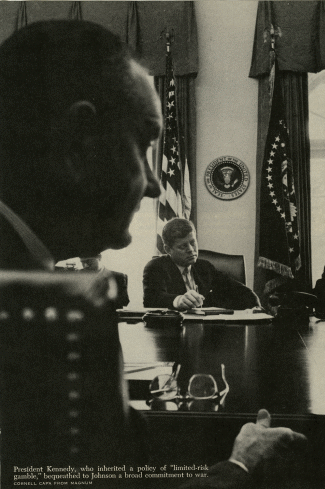
President Kennedy, who inherited a policy
of "limited-risk gamble," bequeathed to Johnson a broad commitment to
war. (Cornell Capa from Magnum)
Attacks on Vietcong positions were
carried out by T-28 fighters piloted by South Vietnamese and American
fliers. (Pictorial Parade)
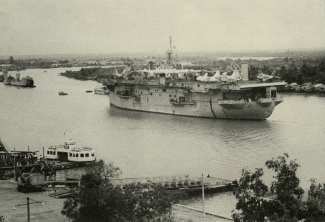
In a major policy decision, Kennedy sent
the carrier Core, to Saigon late in 1961, with helicopters and
U.S. advisers. (Francois Sully from Black Star).
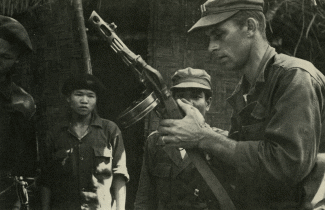
United States advisers in Laos in 1961
and 1962. Their task was to help in the fight against Pathet Lao
guerrillas. (PIX)
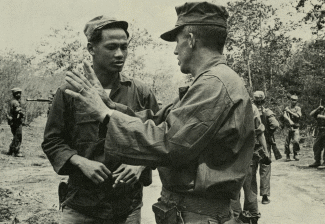
Nicholas Tikhimiroff from Magnum
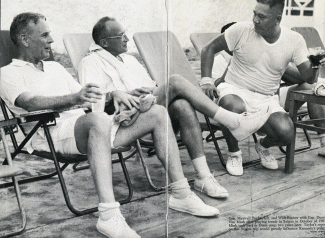
Gen. Maxwell Taylor, left, and Walt
Rostow with Gen. Duong Van Minh after playing tennis in Saigon in
October of 1961. Minh took part in Diem coup two years later. Taylor's
report on this Saigon trip would greatly influence Kennedy's policy.
(Wide World).
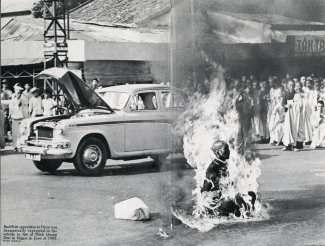
Buddhist opposition to Diem was
dramatically expressed in the suicide by fire of Thich Quang Duc in
Saigon in June of 1963. (Wide World).
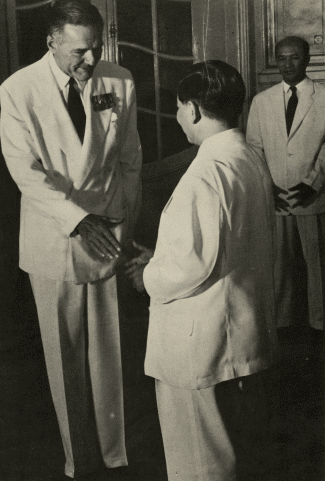
Henry Cabot Lodge, U.S. Ambassador, and
Diem, Aug., 1963 (Wide World).
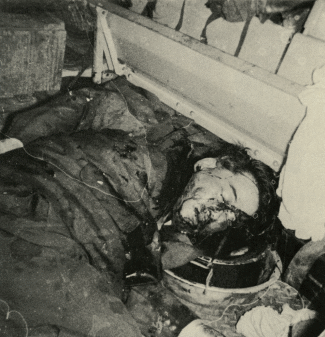
President Diem, shot in coup, November,
1963 ("Paris Match")
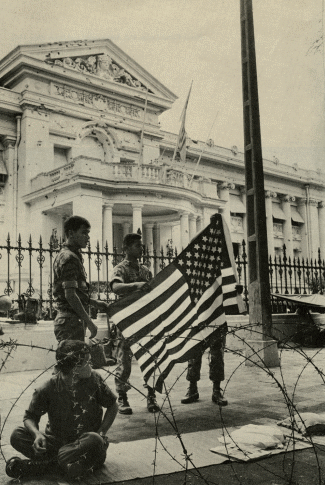
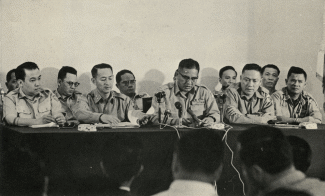
In the aftermath of the Diem coup, Gen.
Duong Van Minh announces the formation of ruling junta. At rear, second
from right, is Nguyen Van Thieu, later to become President. Gen. Tran
Van Don, below, a leader in plot, is cheered by crowd (Keystone Press).
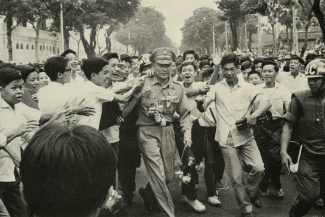
Outside the bullet-scarred Presidential
Palace in Saigon, soldiers who overthrew Diem display flag in the rubble
(Wide World).
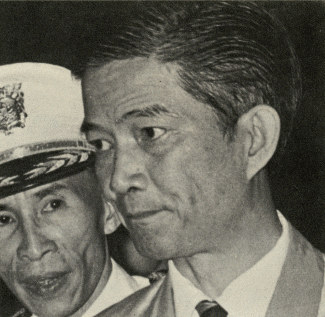
Ngo Dinh Nu, Diem's brother also died in
1963 coup. (Black Star)
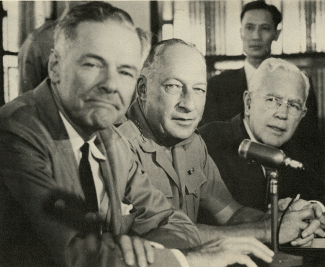
Ambassador Lodge, Gen. Paul Harkins and
John McCone, who was the Director of Central Intelligence. Lodge and
Harkins had often disagreed on the ways to deal with President Diem
(Black Star).
Go to Next Page |