|
Chapter 2:
Origins of the Insurgency in South Vietnam
Other Events of
the Period: 1945-1960
April 12, 1945:
Roosevelt dies.
May 8, 1945: War in Europe ends.
Aug. 6, 1945: Atom bomb dropped on Hiroshima.
Aug. 14, 1945: Japan surrenders.
Jan. 10, 1946: First U.N. General Assembly opens.
Nov. 2,1948: Truman elected.
Dec. 7, 1949: Communists complete take-over of China.
June 25,1950: North Korean troops invade South Korea.
Nov. 1, 1952: First U.S. hydrogen bomb explosion.
Nov. 4, 1952: Eisenhower elected.
March 5, 1953: Stalin dies.
July 27,1953: Korean war armistice.
Aug. 12, 1953: Soviet Union explodes first H-bomb.
Sept. 8, 1954: SEA TO Pact signed.
July 18-23, 1955: Summit meeting, Geneva.
Oct. 23, 1956: Hungarian uprising begins.
Oct. 29, 1956: Suez invasion.
Nov. 6, 1956: Eisenhower re-elected.
Oct. 4, 1957: Soviet Union launches Sputnik I.
July 15, 1958: U.S. Marines in Lebanon.
Jan. 1, 1959: Castro takes power in Cuba.
Sept. 15-27, 1959: Khrushchev visits U.S.
Nov. 8, 1960: Kennedy elected.
Chapter 2:
Origins of the Insurgency in South Vietnam
by Fox
BUTTERFIELD
The secret
Pentagon study of the Vietnam war says the
United States Government's official view that the war was
imposed on South Vietnam by aggression from Hanoi is "not
wholly compelling."
Successive administrations in Washington, from President
John F. Kennedy to President Richard M. Nixon, have used
this interpretation of the origins of the war to justify American
intervention in Vietnam. But American intelligence estimates
during the nineteen-fifties show, the Pentagon account
says, that the war began largely as a rebellion in the South
against the increasingly oppressive and corrupt regime of
Ngo Dinh Diem.
"Most of those who took up arms were South Vietnamese
and the causes for which they fought were by no means contrived
in North Vietnam," the Pentagon account says of the
years from 1956 to 1959, when the insurgency began.
The study also disputes many critics of American policy
in Vietnam who have contended that North Vietnam became
involved in the South only after 1965 in response to large-scale
American intervention.
"It is equally clear that North Vietnamese Communists
operated some form of subordinate apparatus in the South
in the years 1954-1960," the Pentagon study says.
And in 1959, the account continues, Hanoi made a clear
decision to assert its control over the growing insurgency and
to increase its infiltration of trained cadres from the North.
71
Thereafter, the study says, "Hanoi's involvement in the developing
strife became evident."
Developments related to the origins of the war that are disclosed
by the Pentagon history include the following:
• American officials in Saigon, including those in the embassy,
the Central Intelligence Agency and the military command
were fully aware of President Diem's shortcomings.
They regularly reported to Washington that he was "authoritarian,
inflexible and remote," that he entrusted power
only to his own family and that he had alienated all elements
of the population by his oppressive policies .
• From 1954 to 1958 North Vietnam concentrated on its
internal development, apparently hoping to achieve reunification
either through the elections provided for in the Geneva
settlement or through the natural collapse of the weak Diem
regime. The Communists left behind a skeletal apparatus in
the South when they regrouped to North Vietnam in 1954
after the war with the French ended, but the cadre members
were ordered to engage only in "political struggle."
• In the years before 1959 the Diem regime was nearly
successful in wiping out the agents, who felt constrained by
their orders not to fight back. Their fear and anger at being
caught in this predicament, however, apparently led them to
begin the insurgency against Mr. Diem, despite their orders,
sometime during 1956-57.
North Vietnam's leaders formally decided in May, 1959,
at the 15th meeting of the Lao Dong (Communist) party's
Central Committee, to take control of the growing insurgency.
Captured Vietcong personnel and documents report that as
a result of the decision the Ho Chi Minh Trail of supply lines
was prepared, southern cadre members who had been taken
North were infiltrated back to the South and the tempo of the
war suddenly speeded up.
The Pentagon account says that both American intelligence
and Vietcong prisoners attributed the Vietcong's rapid success
after 1959 to the Diem regime's mistakes.
In a report prepared by the Rand Corporation of Santa
Monica, Calif., on the interrogation of 23 Vietcong cadre
members, one southern member said of the Communists' success:
"The explanation is not that the cadre were exceptionally
gifted but the people they talked to were ready for rebellion.
The people were like a mound of straw, ready to be ignited.
"If at that time the Government in the South had been a
72
good one, if it had not been dictatorial, then launching the
movement would have been difficult."
A United States intelligence estimate of August, 1960, on
the rapidly deteriorating situation in South Vietnam concluded:
"The indications of increasing dissatisfaction with the Diem
government have probably encouraged the Hanoi regime to
take stronger action at this time."
To emphasize how the Diem regime's oppressive and corrupt
policies helped prepare the way for the insurgency in
South Vietnam, the Pentagon study devotes a lengthy section
to Mr. Diem's rule-as Premier from 1954 until late 1955
and then as President until he was overthrown in 1963.
When Mr. Diem took office in 1954, the account notes, it
seemed for a while that he "did accomplish miracles," as his
supporters contended.
To the surprise of most observers, he put down the Binh
Xuyen gangster sect in Saigon and the Cao Dai and the Hoa
Hao, armed sects in the countryside. He created a stable government
and a loyal army where there had been only chaos.
And he won diplomatic recognition for South Vietnam from
many foreign governments.
But from the beginning, the account says, President Diem's
personality and political concepts tended to decrease his Government's
effectiveness.
The product of a family that was both zealously Roman
Catholic and a member of the traditional Mandarin ruling
class, Mr. Diem was authoritarian, moralistic, inflexible,
bureaucratic and suspicious. His mentality is described in the
account as like that of a "Spanish Inquisitor."
His political machine was a "rigidly organized, overcentralized
family oligarchy." He trusted only his family members,
particularly his brother Ngo Dinh Nhu, who had organized
the semi-secret Can Lao party.
An American intelligence estimate of May, 1959, described
the situation as follows:
"President Diem continues to be the undisputed ruler of
South Vietnam; all important and many minor decisions are
referred to him.
"Although he professes to believe in representative government
and democracy, Diem is convinced that the Vietnamese
are not ready for such a political system and that he must
rule with a firm hand, at least so long as national security is
threatened.
"He also believes that the country cannot afford a political
73
opposition which could obstruct or dilute the Government's
efforts to establish a strong rule. He remains a somewhat
austere and remote figure to most Vietnamese and has not
generated widespread popular enthusiasm.
"Diem's regime reflects his ideas. A facade of representative
government is maintained, but the Government is in fact
essentially authoritarian.
"The legislative powers of the National Assembly are strictly
circumscribed; the judiciary is undeveloped and subordinate
to the executive; and the members of the executive branch
are little more than the personal agents of Diem.
"No organized opposition, loyal or otherwise, is tolerated,
and critics of the regime are often repressed."
To make matters worse, according to the account, Mr.
Diem's programs designed to increase security in the countryside
were carried out so badly that they "drove a wedge
not between the insurgents and the farmers, but between the
farmers and the Government, and eventuated in less rather
than more security."
The Civic Action program, designed to help the Government
in Saigon establish communication with the peasants,
went astray when President Diem used northern refugees and
Catholics almost exclusively to go into the villages. To the
peasants these Civic Action team members were outsiders.
The Diem land-reform program, instead of redistributing
land to the poor, ended up taking back what the peasants
had been given by the Vietminh and returning it to the landlords.
In 1960, 75 percent of the land was still owned by
15 percent of the people.
Mr. Diem abolished the traditional elected village councils
out of fear that Communists might gain power in them. Then
he replaced these popular bodies with appointed outsiders,
northern refugees and Catholics loyal to him.
In the so-called anti-Communist denunciation campaign,
which was begun in the summer of 1955, from 50,000 to
100,000 people were put in detention camps. But, the account
says, many of the detainees were not Communists at all.
President Diem also ordered a number of population-relocation
programs to increase security, but these too backfired,
it says.
Montagnard tribesmen who were forced to leave their traditional
homelands in the Central Highlands for more settled
and secure areas made easy recruits for the Vietcong, the
chronicle relates, and peasants who were forced to move out
74
of their ancestral villages and build new ones in the so-called
agroville program resented the Saigon Government.
Despite "Diem's preoccupation with security," the account
says, "he poorly provided for police and intelligence in the
countryside"; the Self-Defense Corps and Civil Guard-both
militia groups-were "poorly trained and equipped, miserably
led. "
"Their brutality, petty thievery and disorderliness induced
innumerable villagers to join in open revolt against Diem,"
the account continues.
By curbing freedom of speech and jailing dissidents, the
history says, Mr. Diem alienated the intellectuals; by promoting
officers on the basis of loyalty to his family rather
than on the basis of ability, he alienated large segments of the
armed forces.
Looking at the Diem Government's growing problems in
January, 1960, the United States Embassy concluded in a
"Special Report on the Internal Security Situation in Vietnam":
"The situation may be summed up in the fact that the
Government has tended to treat the population with suspicion
or to coerce it and has been rewarded with an attitude of
apathy and resentment.
"The basic factor which has been lacking is a feeling of
rapport between the Government and the population. The
people have not identified themselves with the Government."
The report pointed to this "growth of apathy and considerable
dissatisfaction among the rural populace" as a major
cause of the insurgency.
"Political Struggle"
The Pentagon study divides the development of the insurgency
in South Vietnam into roughly three periods:
From 1954 to 1956 the country enjoyed relative quiet as
Communist cadres left behind in the South devoted themselves
to "political struggle." From 1956 to 1958, after President
Diem's rejection of the scheduled elections, dissident
cadres in the South began the insurgency. With Hanoi's decision
to take over the insurgency in 1959, the third period,
that of full-scale war, began.
When Ho Chi Minh established his capital in Hanoi after
75
the Geneva conference in 1954, American intelligence reported
that North Vietnam's new leaders could be expected
to concentrate on building their war-ravaged and primitive
economy.
According to the American information, the Communists
had taken with them 90,000 armed men from the South,
leaving 5,000 to 10,000 armed men behind as a "skeletal
apparatus."
From captured documents, American intelligence officials
believed that the "stay-behind cadres" had the main task of
preparing for the elections scheduled for 1956 to reunify the
country. The cadre members were ordered to carry out only
"political struggle," which meant largely propaganda activity
and infiltration of the Saigon Government.
A document captured early in 1955 from a Communist
field organizer and sent to Washington by the Central Intelligence
Agency warned that "it is not the time to meet the
enemy." The Communists apparently believed, the study says,
that they would get control of the country either through the
elections or by the collapse of the Diem regime through its
own weakness.
In 1966 the confidential Rand Corporation study of captured
southern cadre members who originally went to the
North in 1954 showed that most of them had expected that
the Communists would win in the 1956 elections.
"Our political officer explained that we were granted Vietnam
north of the 17th Parallel now, but in 1956 there would
be a general election and we would regain the South and be
reunited with our families," one captive reported.
"I was a political officer," another explained. "I went to
the North just like all the other combatants in my unit. I
believed, at the time, that regroupment was only temporary,
because from the study sessions on the Geneva agreement we
drew the conclusion that we could return to the South after
the general election."
While there were some incidents of murder or kidnapping
in the southern countryside from 1954 to 1956, they were not
directly attributable to the Communist "stay-behinds," the
account says.
A United States intelligence estimate of July, 1956, noted:
"During the past year the Communists in South Vietnam
have remained generally quiescent. They have passed by a
number of opportunities to embarrass the Diem regime.
"Although some cadres and supplies are being infiltrated
across the 17th Parallel, the D.R.V. [Democratic Republic of
76
North Vietnam] probably has not sent any large-scale reinforcement
or supply to the South."
The American intelligence network in South Vietnam,
though limited in size, was well informed of the Communists'
attitudes and actions during this period, the study explains.
An intelligence estimate in May, 1957, noted:
"Because the countrywide elections envisaged by the Geneva
agreements have not been held and because military
action has been prevented, the D.R.Y. has been frustrated
in its hopes of gaining control of SVN. This has caused some
discontent among cadres evacuated from the South in the
expectation that they would soon return."
Intelligence gathered from Communist agents and documents
captured in the nineteen-sixties, when the American
intelligence network had expanded, filled out this picture of
frustration and disillusionment among the cadre members.
A captured Communist who had been in charge of propaganda
in Saigon testified: "The period from the armistice of
1954 until 1958 was the darkest time for the Vietcong in
South Vietnam. The political agitation policy proposed by
the Communist party could not be carried out due to the
arrest of a number of party members."
Another cadre member reported: "The cadres who had remained
behind in the South had almost all been arrested.
Only one or two cadres were left in every three to five villages.
"
A document that appears to be a party history, captured
in 1966 by the United States First Infantry Division during
a sweep through the area called the Iron Triangle near Saigon,
described the cadres' predicament. Noting that the Diem
Government's harsh security policies had "truly and efficiently
destroyed our party," the document referring to the scheduled
date for the elections said:
"Particularly after 20 July 1956, the key cadres and party
members in South Vietnam asked questions which demanded
answers:
"Can we still continue the struggle to demand the implementation
of the Geneva agreement given the existing regime
in South Vietnam? If not, what must be done? A mood
of skepticism and nonconfidence in the orientation of the
struggle began to seep into the party apparatus and among
some of the masses."
For some cadres, the documents said the answer was "armed
struggle" despite their orders. It continued:
"The situation truly ripened for an armed movement
77
against the enemy. But the leadership of the Nam Bo Regional
Committee [then the Vietcong's headquarters for the
southern part of South Vietnam] at that time still hesitated
for many reasons, but the principal reason was the fear of
violating the party line.
"The majority of party members and cadres felt that it
was necessary to immediately launch an armed struggle in
order to preserve the movement and protect the forces. In
several areas the party members on their own initiative had
organized armed struggle against the enemy."
According to the Pentagon account, the result of the
cadres' decision to begin armed struggle was soon apparent
in Saigon.
American intelligence officers in Saigon estimated that 30
armed terrorist incidents were initiated in the last quarter of
1957, with at least 75 local officials assassinated or kidnapped.
On Oct. 22, 13 Americans were wounded in three bombings
in Saigon.
But, the account says, "there is only sparse evidence that
North Vietnam was directing, or was capable of directing,
that violence."
During this period, from 1956 to 1958, the party leaders in
Hanoi were engaged in "a serious reconsideration" of their
policy, the account says.
Sometime early in 1957 Le Duan, a southerner who had
led the fight in the South during the French Indochina war,
returned to Hanoi from a two-year stay in the South, carrying
news that the struggle there was going badly. According
to American intelligence reports, he told the Politburo
that it was wasting time with its orders for "political struggle."
He was said to have urged military pressure.
Mr. Duan, the study notes, was named a member of the
Politburo later that same year, and in September, 1960, he
became the First Secretary of the party.
The futility of their policy must have been brought home
to the leaders in Hanoi according to the study, when on
Jan. 24, 1957, the Soviet Union proposed the admission of
both North and South Vietnam to the United Nations.
But until 1958 North Vietnam was still primarily concerned
with its internal development, the account says, especially
during 1956, when there was a peasant revolt against the
Communists' harsh land-reform program.
In December, 1958, or January, 1959, the study continues,
"Hanoi apparently decided that the time had come to intensify
its efforts."
78
American intelligence quickly picked up clues about this
decision.
The C.I.A. came into possession of a directive from
Hanoi to its headquarters for the Central Highlands during
December, 1958, stating that the Lao Dong party's Central
Committee had decided to "open a new stage of the struggle."
And in January, 1959, the C.I.A. received a copy of an
order directing the establishment of two guerrilla operations
bases, one in Tayninh Province near the Cambodian border
and another in the western Central Highlands.
The C.I.A. also learned at this time that Mr. Duan was
making a secret visit to the South.
The decision that had been made privately by the Politburo
was formally ratified by the Central Committee at its 15th
meeting in May, 1959. All available evidence suggests that
this was "the point of departure for D.R.V. intervention,"
the narrative says.
Scholars and journalists who have studied the origins of
the insurgency, but who have not had access to American
intelligence reports, have not attached such significance to
that 15th session.
The United States Embassy in Saigon, reporting to Washington
on the Central Committee decision, noted that a resolution
had been passed saying that the struggle for reunification
would have to be carried out by "all appropriate measures
other than peaceful," the embassy reported.
The document captured by the First Infantry Division recalled
the 1959 decision:
"After the resolution of the 15th plenum of the Central
Committee was issued, all of South Vietnam possessed a clear
and correct strategic policy and orientation.
"The directive of the Politburo in May, 1959, stated that
the time had come to push the armed struggle. Thanks to
this we closely followed the actual situation in order to formulate
a program, and in October, 1959, the armed struggle
was launched."
A rapid build-up of Hanoi's potential for infiltration followed
the party's decision to take a more active role in the
insurgency, the analyst says.
Infiltration from North Vietnam had actually begun as
early as 1955, United States intelligence reports show, but
only in 1959 did the C.I.A. pick up evidence of large-scale
infiltration.
To operate the infiltration trails, a group of montagnard
79
tribesmen from Quangtri and Thuathien Provinces were given
special training in North Vietnam in 1958 and 1959.
Early in 1959 also, the C.I.A. reported, Hanoi formed "special
border crossing teams" composed of southerners who
went to the North in 1954. Their mission was to carry food,
drugs and other supplies down the trail network.
And in April, 1959, the C.I.A. learned, the 559th Transportation
Group was established directly under the party's
Central Committee as a headquarters in charge of infiltration.
Large training centers for infiltrators were reportedly established
early in 1960 at Xuanmai and Sontay, near Hanoi.
During 1959 and 1960, United States intelligence officials
estimated, 26 groups of infiltrators, totaling 4,500 people,
made the trip south.
From later interrogation of captured infiltrators, United
States intelligence officers learned that until 1964 almost all
the infiltrators were native southerners who went to the
North in 1954.
A Rand Corporation study of 71 of the infiltrators showed
that two out of three were members of the Lao Dong party;
that they had all undergone extensive periods of training in
North Vietnam before being sent south; and that most of
them were officers, senior noncommissioned officers or party
cadre members.
Hanoi's decision to switch from "political struggle" to
"armed struggle" was rapidly reflected in a rise in terrorist
attacks in South Vietnam during the second half of 1959,
the Pentagon study says.
The United States Embassy, in a Special Report on the
Internal Security Situation in Vietnam in January, 1960,
noted that while there were 193 assassinations in all of 1958,
there were 119 assassinations in the last four months of 1959
alone.
Even more alarming, the embassy said, were Vietcong attacks
for the first time on large South Vietnamese Army units.
A Vietcong ambush of two companies of Saigon's 23d Division
on Sept. 26, 1959, with the killing of 12 Government
soldiers and the loss of most of their weapons, brought home
"the full impact of the seriousness of the present situation."
The stepped-up insurgency led to the first American casualties
of the war in South Vietnam. On July 8, 1959, a
terrorist bomb inside the Bienhoa base compound killed two
United States servicemen.
In its January, 1960, report on the deteriorating situation,
the embassy also passed on to Washington two comments
80
made by the North Vietnamese Premier, Ph am Van Dong,
which it considered significant:
First: "'You must remember we will be in Saigon tomorrow,
we will be in Saigon tomorrow.' These words were
spoken by Premier Ph am Van Dong in a conversation with
French Consul Georges-Picot on Sept. 12, 1959."
And second: "In November, Pham Van Dong twice told
Canadian Commissioner Erichsen-Brown that 'We will drive
the Americans into the sea.'" The Canadian, a representative
on the International Control Commission, was stationed
in Hanoi.
The National Liberation Front for South Vietnam was
officially founded on Dec. 20, 1960, the study relates, and
within a year its membership had quadrupled to 300,000. By
then the insurgency had taken root.
81
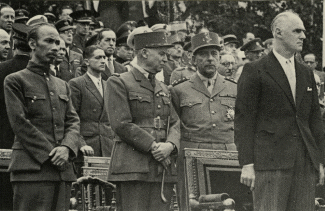
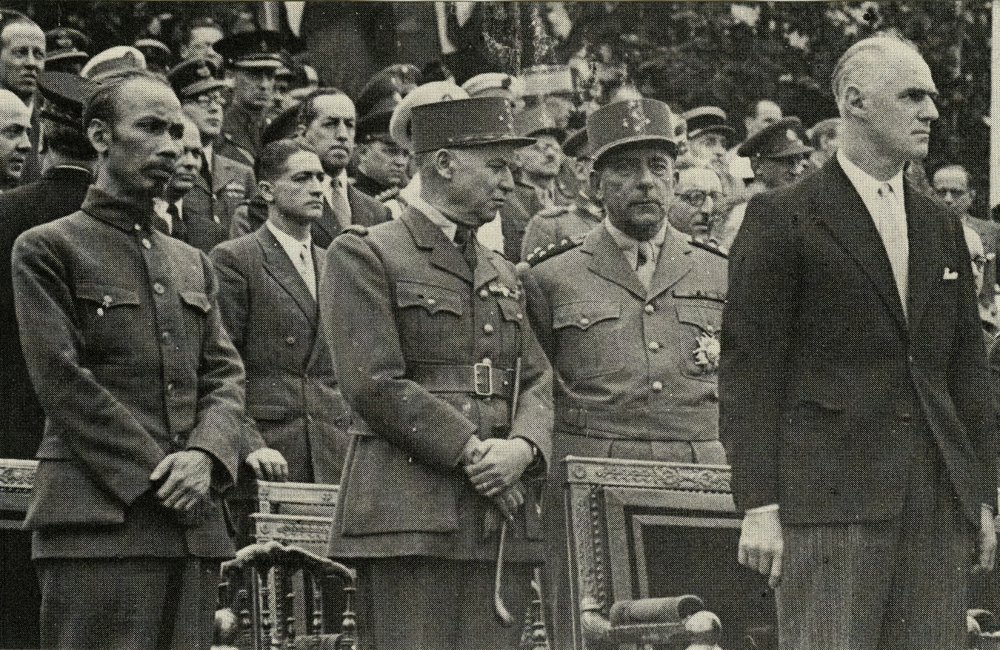
Ho Chi Minh, left,
in Paris, 1946. Third from left, Gen. Jean de Lattre de Tassigny, later
commander of Indochina forces. (A.F.P. from Pictorial)
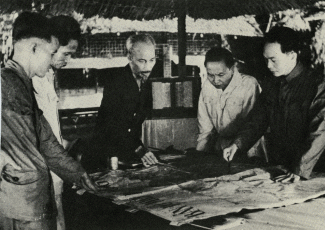
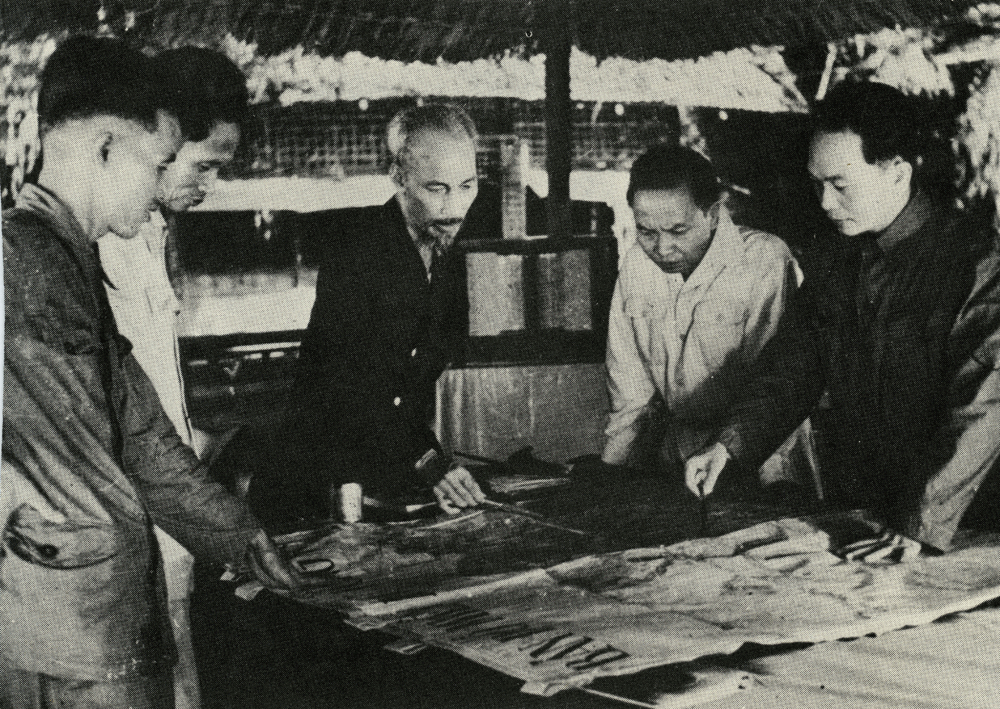
Ho planning
Dienbienphu attack in 1954. Second from left is
Pham Van Dong; at right is Vo Nguyen Giap, chief strategist.
(Black Star)
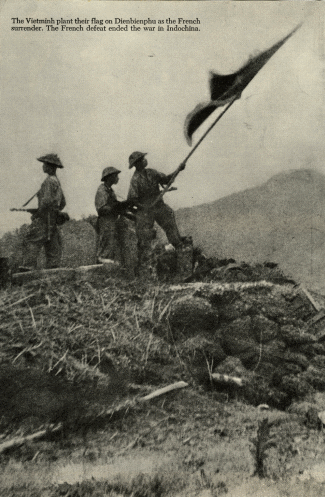
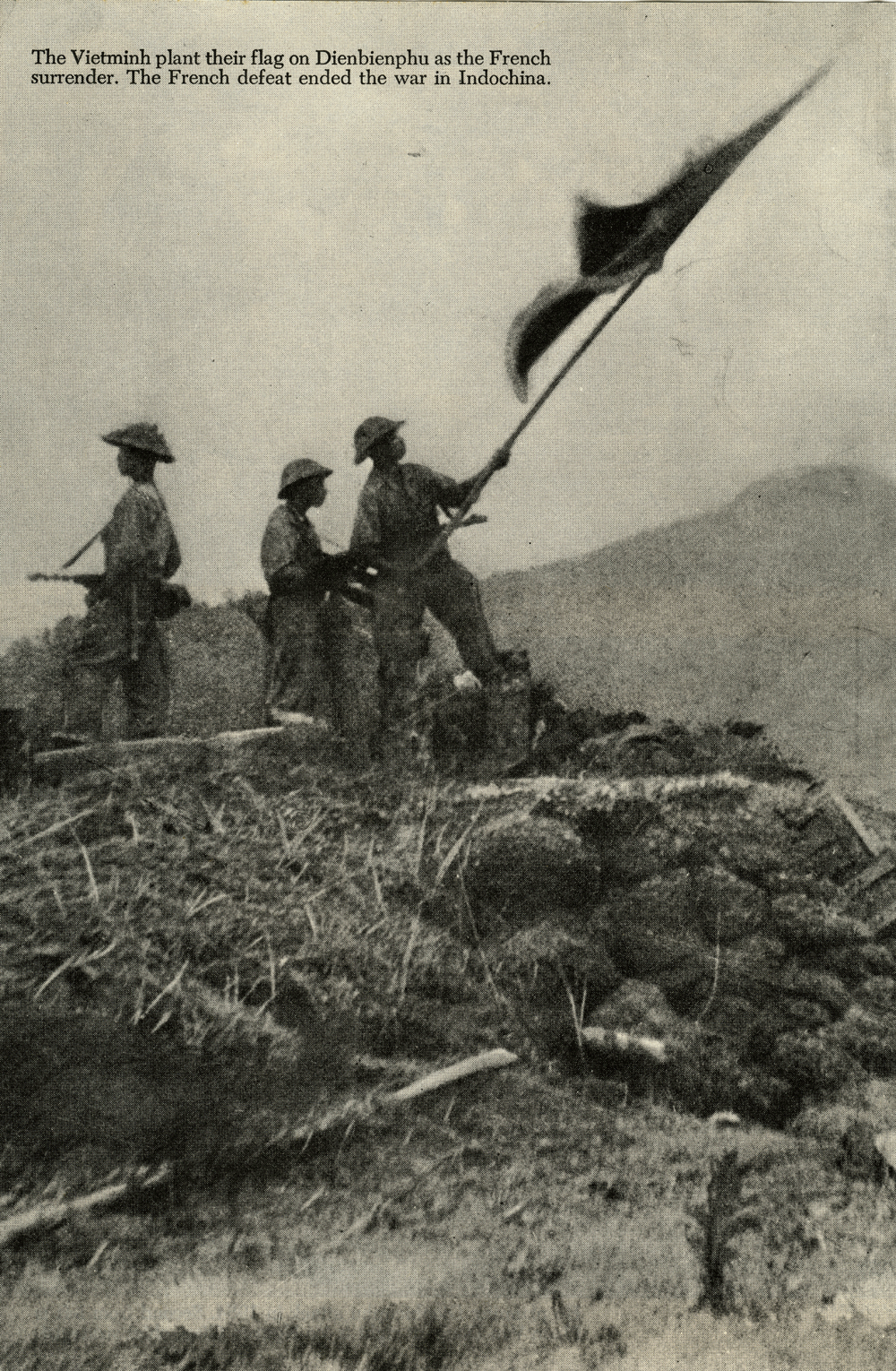
The Vietminh plant
their flag on Dienbienphu as the French
surrender. The French defeat ended the war in Indochina.
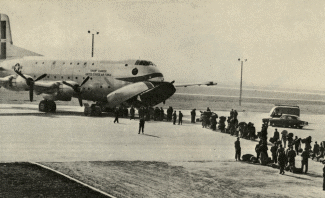
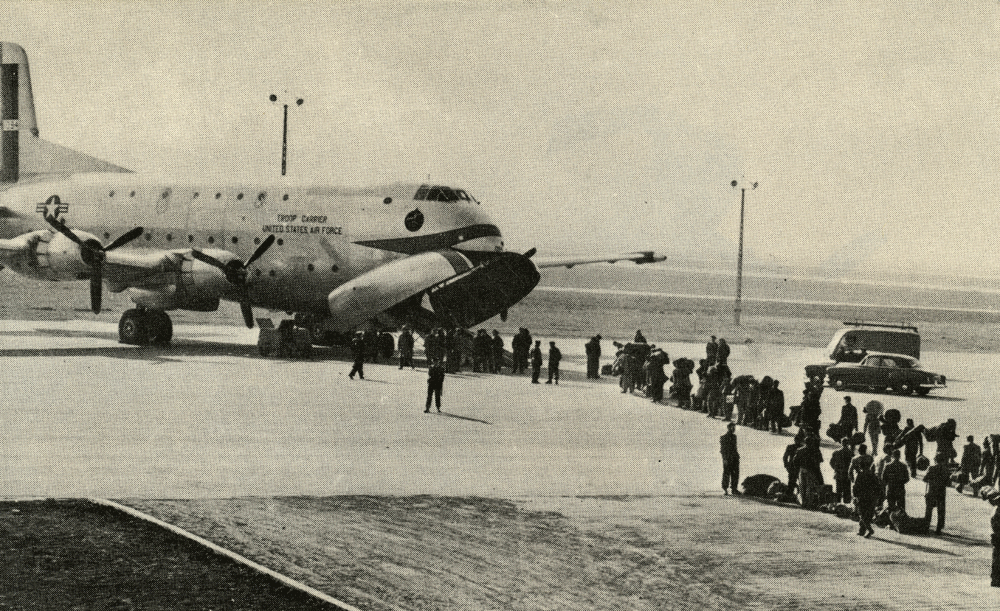
U.S. airlifted
French troops from Paris to Saigon in 1954. (Wide World)
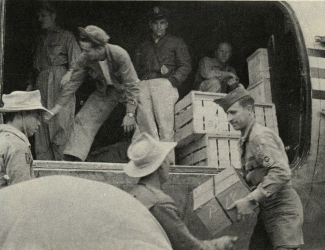
In Haiphong,
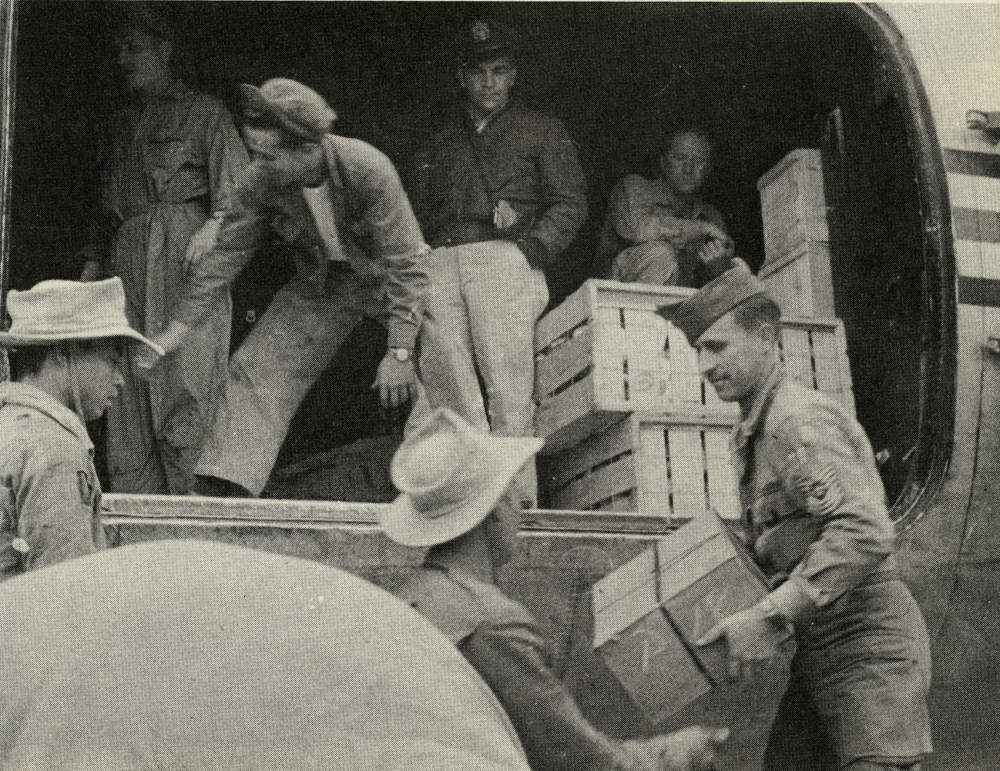
American airmen unload supplies for the French. (Pictorial Parade;
"Paris Match")
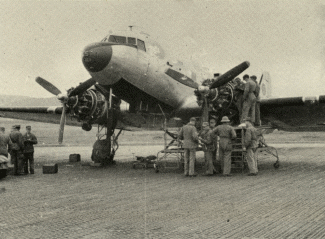
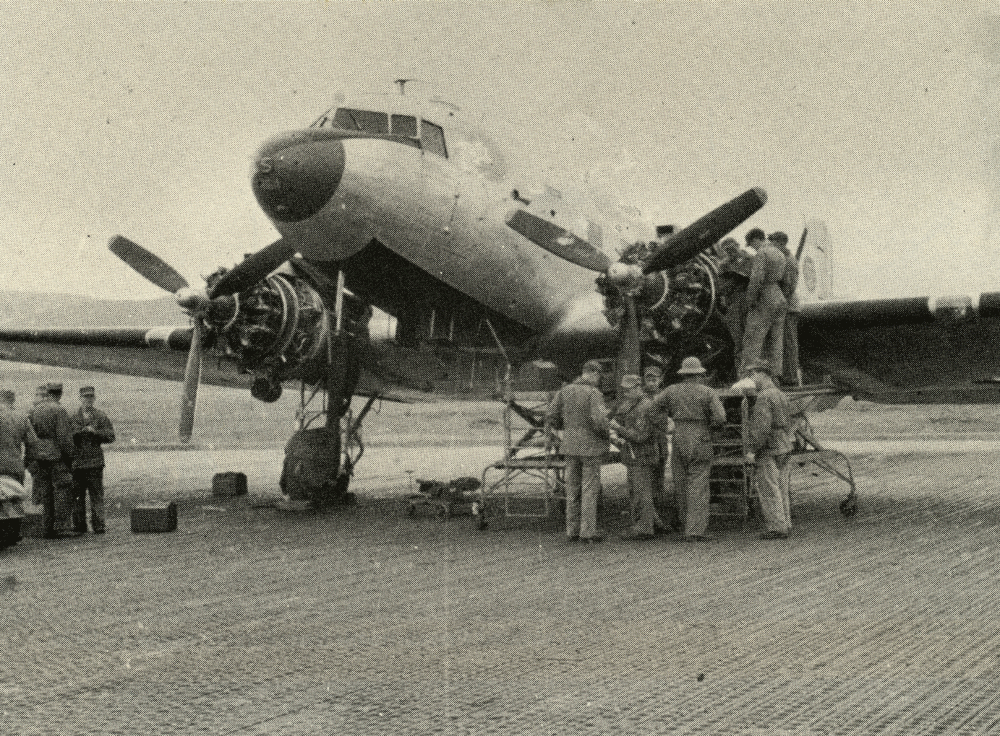
C-47's given to
the French were serviced by U.S. mechanics. (Pictorial Parade)
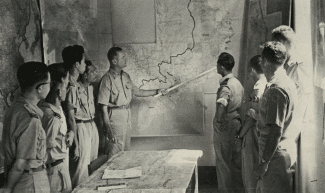
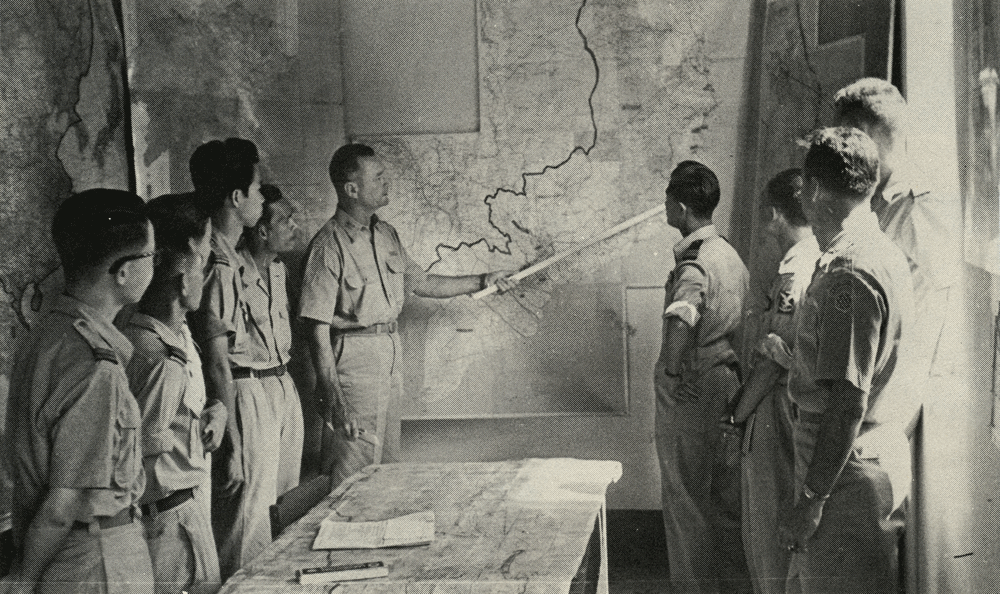
U.S. colonel
advises Vietnamese officers at Mytho in 1955. (The New York Times)
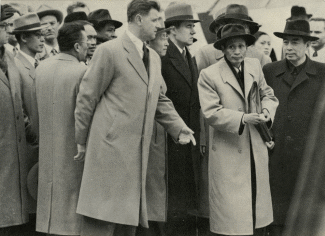
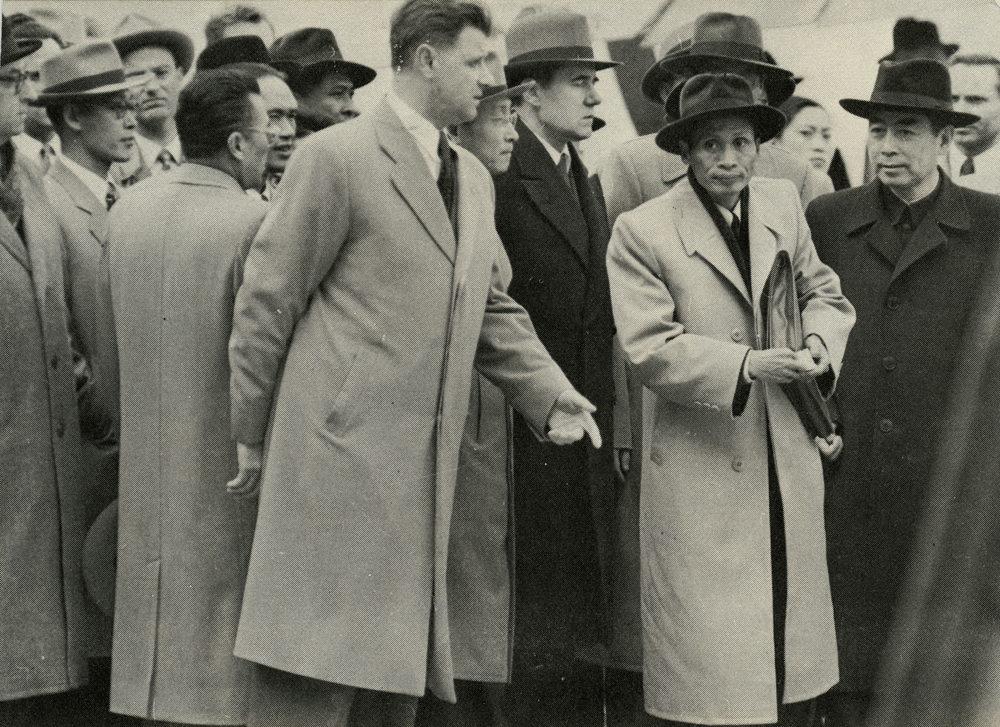
Pham Van Dong
headed Vietminh delegation at 1954 Geneva
talks. Next to him are Chou En-lai of People's Republic
of China, right, and Andrei Gromyko of Soviet Union. (UPI)
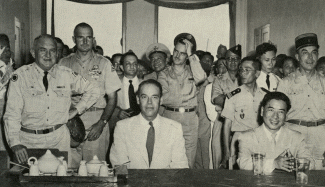
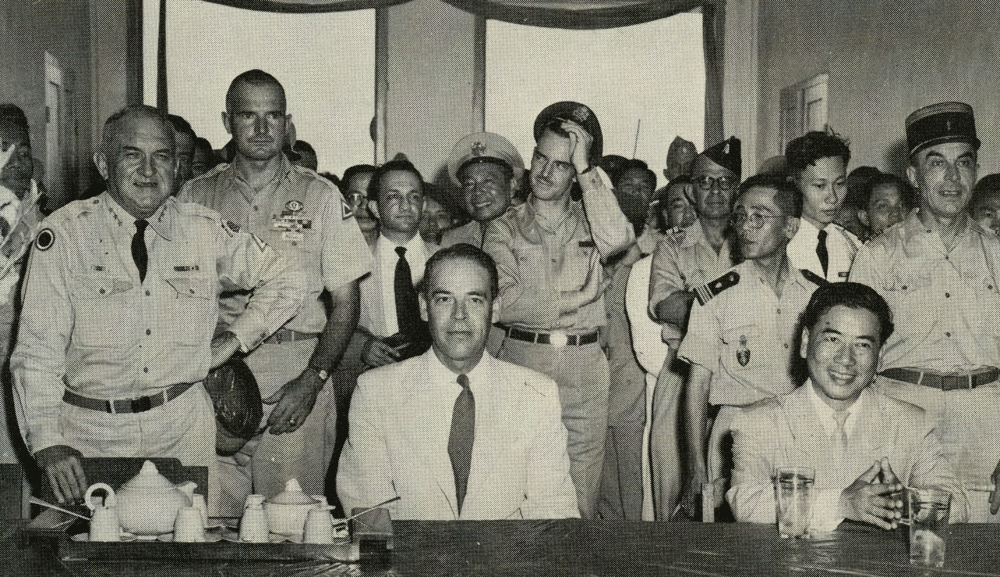
Chief of U.S.
mission in 1955 was Gen. John O'Daniel, left.
Ambassador Frederick Reinhardt is seated next to President
Ngo Dinh Diem. Col. Edward Lansdale, center, doffs his cap. (Francois
Sully from Black Star)
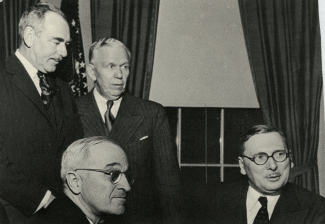
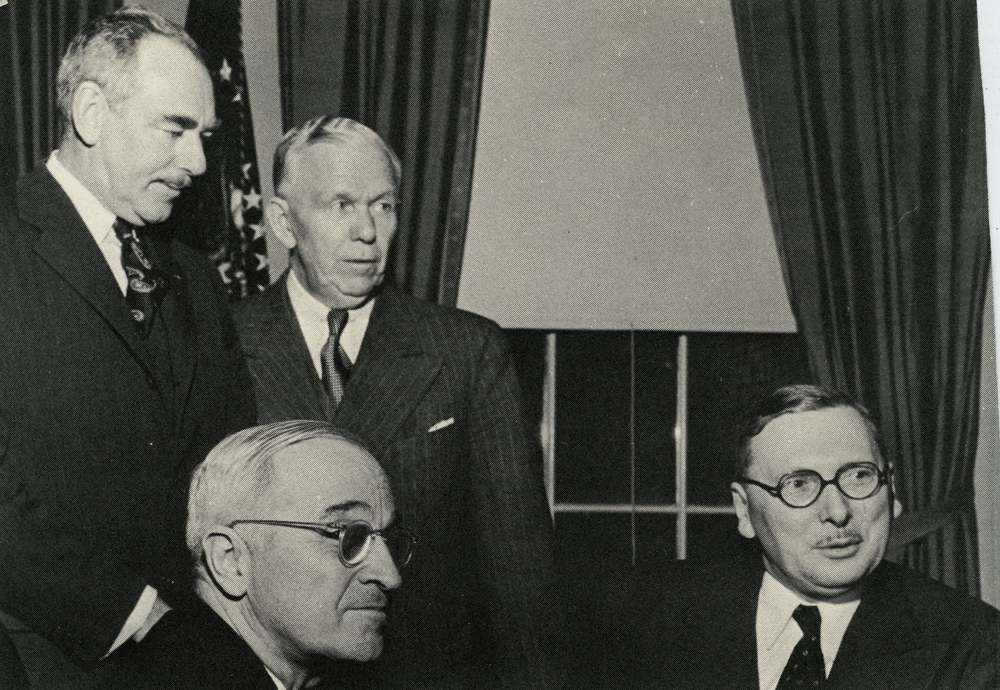
President Truman,
Dean Acheson and George Marshall with
Rene Pleven of France. Acheson had counseled Truman to give
aid to the French: earlier, Marshall had been ambivalent. (Nick De
Margoli -- Pix)
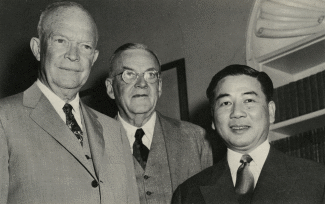
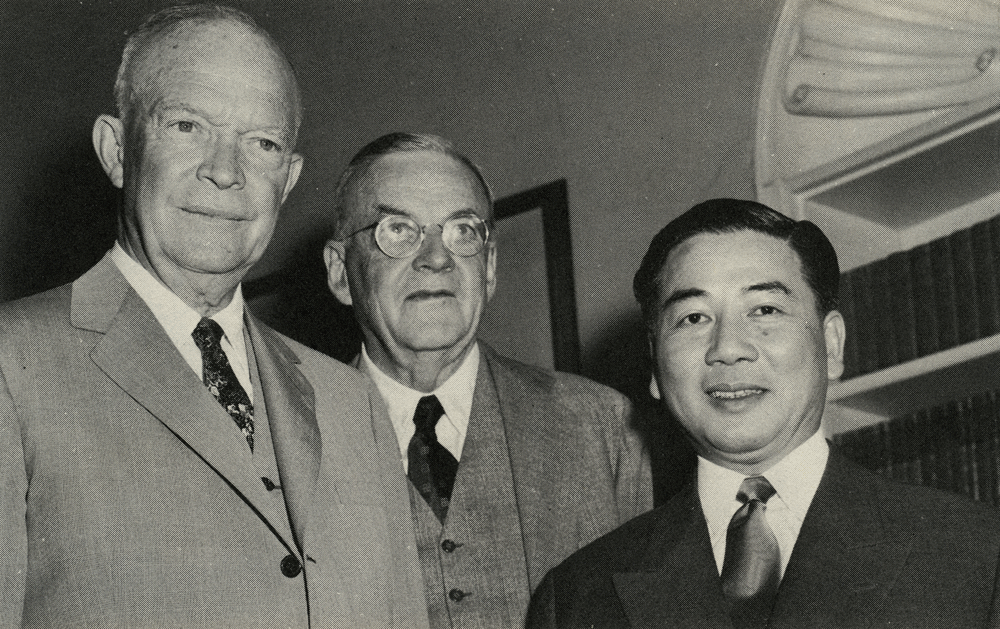
President
Eisenhower, John Foster Dulles and Diem in 1957.
U.S. vowed to prevent a Communist takeover of South Vietnam,
fearing a "domino effect" throughout Southeast Asia. (Wide World)
Go to Next Page |