Part 1 of 2
3. The Evolution of Natural Movement Education
The complexity of modern society in the twentieth century is apparent in every phase of modern living. Phenomenal progress in science and technology, accelerated by the demands of two major world wars, affected all areas of human culture. Mechanization, automation, electronics, and nuclear science revolutionized the activities of life and work. Inventions in speedy transportation decreased travel time, increased internationalism, and led to incredible ventures in outer space. Scientists delved freely into the secrets of the unknown and revealed new truths about the nature of the human organism and its environment. The heritage of the past was brought to light, and inventions in printing, radio, and television made these new discoveries available to the masses. A need for higher levels of learning, for longer periods of schooling, and for changes in educational methods became evident.
Concurrent with modern progress, the growth of cities and urban living deprived man of opportunities and motivations for natural movement. Since movement is vital to the human organism, the need for a more effective movement training became urgent, a need which could not be met by the mechanical exercises of the nationalistic gymnastic systems. At the turn of the century, new methods which stressed movement as an expression of the whole personality evolved. The concept of the whole personality as a unity of mind, body, and spirit, a unity which had been recognized by philosophers, educators, and physical educators of the past, reappeared and was substantiated by modern discoveries in biology and psychology. The new findings revealed that man is mentally and emotionally involved in every activity of life and that there is an interrelationship and balance of mind, body, and emotion in all human behavior.
Movement was studied in relation to the physical causes of motion, biological and psychological motivations, and in its affinity to rhythm and the arts. Early in the twentieth century, revolutionary ideas about free and expressive movement caused a revolt against artificial movement not only in gymnastics, but also in drama, music, and the dance.
PIONEER CONCEPTS OF MOVEMENT AND RHYTHM
FRANCOIS DELSARTE
Romanticism, which began in the era of naturalism, strongly influenced the performing arts in the first part of the nineteenth century. Romanticism emphasized the expression of thought and emotion, and it was during this era that Francois Delsarte (1811-1871) began in France to develop his art of expression, an art which he called "Applied Aesthetics."
Initially, Delsarte had studied to become a singer at the Paris Conservatory, a government institution which offered "instruction in acting, music, and the ballet," but, disappointed in this ambition, he later began to study the arts of elocution and drama. [1] Stage movement in the early nineteenth century was stylized, artificial, and arbitrary. Opposed to this kind of acting, Delsarte created a system of movement and gestures which enabled both the orator and actor to express thought and emotion naturally and gracefully. He studied the emotional reactions of people under different circumstances, and observed that emotions have an effect on the movements of the body, and on appearance, attitude and behavior. Tabulating and classifying his data, he developed an "art and system of expression."
A man of varied talents, Delsarte was a musician, composer, actor, orator, master of pantomime, and inventor; in addition, he was a student of anatomy in medical school. He was a religious man, deeply influenced by the beauty of Greek works of art and by his lofty faith in the potential perfection of the human being. His ultimate ideal was his somewhat metaphysical "Law of Trinity," which seems to have been drawn from the doctrine of the unity of the Father, Son, and Holy Ghost. Delsarte explained this law as "the unity of three things, each of which is essential to the other two, each coexisting in time, co-penetrating in space, and cooperative in motion."
The Law of Trinity is evident in Delsarte's concept of man as a unity of mind, body, and spirit; and in his thought of movement he saw this law as a union of time, space, and motion. He further analyzed movement as a trinity of tension-relaxation, balance, and form; force, form, design; excentric, concentric, and normal motions. [2[ As explained by the Delsarte teacher and writer Genevieve Stebbins, in her book Delsarte System of Expression, an expansive motion "from yourself as a center" is excentric, a contractive motion to a center is concentric, and "motion between these two extremes, being well balanced," is normal. [3] By interchanging and combining two of these motion qualities, Delsarte arranged nine combinations of excentric, concentric and normal actions in what he termed a "ninefold accord," in which the first motion quality was strong and the second was weak.
Delsarte's "Law of Correspondence" is related to the Law of Trinity, and implies that expressive movement should correspond with the thought or emotion which inspired it, or, as Delsarte expressed it, "To each spiritual function responds a function of the body; to each grand function of the body corresponds a spiritual act." Analyzing movement in space and by dividing and subdividing it into components of three's, he derived a large number of gestures which he classified for the three zones of the body. The head, he named the concentric, mental and intellectual zone; the upper torso and arms, the normal, emotional, moral, and spiritual zone; and the lower torso and legs, the excentric, vital, and physical zone. He identified the realms of space surrounding the body, and he related gestures and attitudes in the three zones to the characteristic, expressive functions of each zone. Again, he analyzed each of the three zones into three's, and classified and described gestures for the expression of sensation, sentiment, and thought for each subdivision. [4]
In addition, Delsarte formulated "Three Great Orders of Movement" and "Nine Laws of Motion." His Three Great Orders of Movement dealt with oppositions, parallelisms, and successions in body motion. Oppositions referred to "any two parts of the body moving in opposite directions simultaneously" as well as to the force used to overcome gravity. Parallelism meant the simultaneous motion of two parts of the body in the same direction, and succession indicated the fluid wavelike motion that passes either through the whole body or through parts of it. [5]
Delsarte's Nine Laws of Motion referred to altitude, force, motion, sequence, direction, form, velocity, reaction, and extension; each law had particular significance in expressive movement. For example, writing about the significance of the law of altitude in pantomime, Stebbins explains that the body rises in positive assertion and falls with negative assertion while different degrees of altitude signify various modifications of assertion. The law of force signifies that, both spiritually and physically, conscious strength assumes weak attitudes and conscious weakness assumes strong attitudes. The law of motion implies that excitement or passion tends to expand gesture, thought or reflection tends to contract gesture, while love or affection moderates gesture. Delsarte's law of velocity states that "velocity is in proportion to the mass moved and the force moving." Thus, the speed of motion in the expression of deep emotion is slow and deliberate, and it vanes from slow to quick, depending upon the superficiality or explosiveness of the emotion. The significance of the law of reaction is that "every extreme of emotion tends to react to the opposite." [6]
Today, Delsarte's complex system of expressive gestures might be challenged, yet the influence of his basic movement theories is evident in current movement education. He established the concept of movement as a medium for the communication of thought and emotion, and in so doing he made acting, mime, and oratory more natural, and therefore more eloquent. His concept of man as a triune of mind, body, and spirit, and of movement as a union of space, time, and motion, his identification of realms of space and of the three great orders of movement, his laws of velocity and reaction, as well as his meticulous movement analysis led to new approaches in the study of dance and gymnastics. To quote R. Tait McKenzie, "Delsarte may be said to have been the greatest influence in directing attention to the value of muscular action to express thought, and his principles continually crop out in other schemes of gymnastics." [7]
Delsarte, himself, did not publish his work. 'What is known about his method comes from notebooks of his students and records of his lectures, from the publications of his disciples, and from the teachings of his son and daughter. In the United States, the Delsarte system has become known chiefly through Delsarte's American pupil Steele MacKaye, through MacK aye's pupil Genevieve Stebbins, through the teacher of expression Emily Bishop, and, currently, through the dancer Ted Shawn.
Steele MacKaye was an American actor, director, playwright, and producer. About 1871 he introduced Delsarte's system of expression into the United States in order to improve the quality of acting on the American stage. MacKaye's methods were adopted and modified by many leading American schools of oratory and expression. To train the body as an effective instrument of expression, Mac- Kaye arranged a system of "harmonic exercises." These exercises became the basis for different systems of Americanized Delsarte gymnastics which Delsarte himself had not even conceived of. [8] Delsarte did not create his method for the teaching of gymnastics, but for the development of natural, expressive gestures in oratory and acting. MacKaye's pupils and followers, some with only a superficial knowledge of the Delsarte method, developed personal systems of expressions, claiming that their methods fostered culture, health, grace, and beauty of motion. MacKaye, like Delsarte, did not publish any books about his work. His method became known mainly through the work of his pupils, records of his lectures, reports, and studies, and by the books written by his son, Percy MacKaye, and by Genevieve Stebbins of New York.
Genevieve Stebbins, a dedicated exponent of Delsarte's system, was an intelligent and cultured woman who had travelled widely in both East and West, and had studied intensively the arts, oratory, and expressive movement. While learning French drama in Paris, she interviewed Abbe Delaumosne, who had compiled the Delsarte system of dramatic art. She also studied in New York for two years with Steele MacKaye, and she wrote that in six months she acquired all MacKaye had learned from Delsarte and that the remainder of her studies consisted of repetitions and variations. [9] Deeply influenced by the beauty and grace of famous Greek sculpture in the great European museums and art galleries, she searched for evidence of Delsarte's laws of movement in the arrested actions of these models. [10]
Mrs. Stebbins organized a system of physical and aesthetic culture which, she maintained, represented an elaboration of Delsarte's art of expression, modified for American needs. Similar to Delsarte, who had used a few exercises, and MacKaye, who had created his "harmonic exercises," Mrs. Stebbins developed her own "aesthetic gymnastics" to train the body as an effective instrument for graceful, artistic expression. She distinguished "between a few gymnastic exercises given for freedom and grace of motion in gesture" and a gymnastic system for physical development. [11]
Stebbins' system of physical culture was eclectic. She combined the aesthetic movements and gestures of Delsarte's system with Swedish or Ling exercises and added the ceremonial forms of Oriental prayer, affirming that these "properly combined and graded into systematic progressive exercises constitute a perfect system of gymnastics." She wrote, "Wherever possible I have converted every exercise in the Swedish System into a Delsarte drill and have met with the most flattering results .... Delsarte has given the esthetics and Ling the athletics of a perfect method. We have only to include the breathing and the mental imagery which have been the common property of every mystic and occult fraternity under the sun, and our system of development is complete." [12]
The basic elements of Mrs. Stebbins' gymnastics were relaxation, energizing, and breathing, and she called her relaxation exercises "decomposing exercises." "True relaxation," she wrote, "means resigning the body to the law of gravity, the mind to nature and the entire energy to deep rhythmic breathing." Her energizing exercises were movements of dynamic contrasts. The breathing exercises were given for muscular and vital development which, she said, would aid ninety percent of women who were "either round-shouldered, flatchested or almost ruined around the waist." [13]
Mrs. Stebbins taught that Delsarte's laws of sequence, opposition, and correspondence were essential factors in the evolution of beauty of form, "harmonic balance," graceful motion and artistic presentation. Her students explored and felt the shifting of weight, performed oppositional movements, and simulated poses and movements of old Greek statues and friezes. Her concepts of movement, such as the change of center of gravity, successive and simultaneous motion, countermotion, willed movement, and body awareness have lived on in contemporary movement education.
Another prominent leader in Americanized Delsarte culture of the early twentieth century was Emily Bishop of Chautauqua and New York City. A well-known teacher of expression, an author and lecturer on subjects of health and beauty, Mrs. Bishop taught for many years in the School of Expression as well as in the School of Physical Education of the Chautauqua Institute, New York. [14]
Excerpts from an address to the American Association for the Advancement of Physical Education in 1892 give, in part, her theory of movement in body training. "The final aim of Americanized Delsarte Culture," she said, "was to lead man back to nature's ways, to make him healthy, free, strong, simple, natural." She likened the harmonious training of the "bodily instrument" to the tuning of a piano, which is a harmonizing of all its parts.
Mrs. Bishop distinguished between Gymnastics of Exercise for "physical growth" and Gymnastics of Expression for "the growth of mental and emotive natures as well as the physical." Gymnastics of Expression, she stated, include "movements and altitudes that always mean something" and "are expressive of certain inner conditions .... " "Where the one uses motion for motion's sake, the other uses motion as related to emotion or to a mental state." Maintaining that grace is "ease in force," she declared that "precision, harmony and ease-the three elements of grace-must characterize our movements" and that "only free, unconscious movements are ever graceful."
She emphasized relaxation for relief of undue tensions and for recharging the nerve centers "with vital energy" and maintained that "to relax, to energize, and to harmoniously guide the nerve-force in action constitute gymnastics of Americanized Delsarte Culture." [15]
Ted Shawn, dancer, choreographer, teacher, writer, and founder and director of the Jacob's Pillow dance center and school, Massachusetts, is considered the current authority on Delsarte in the United States. He studied the Delsarte system of expression for several years with Mrs. Richard Hovey, who had learned it in France from Gustave Delsarte, the son of Francois Delsarte. Shawn has collected a great number of books and memorabilia on Delsarte's work, many of which were published before 1890. Shawn's book, Every Little Movement, recapitulates Delsarte's art of expression. His Delsarte studies with Mrs. Hovey, he said, gave him the "basis for all his performing, teaching and lecturing career." [16]
The values claimed for American Delsarte gymnastics were challenged by professional leaders in physical education [17] and the Delsarte furor died out in the early years of the twentieth century. Yet, in Europe, some of Delsarte's basic principles of movement had a strong influence on the development of modern movement education for girls and women. It was chiefly through the German teacher of gymnastics Mrs. Hedwig Kallmeyer-Simon, who had studied with Genevieve Stebbins in New York, that Delsarte's methods made their way into Germany. [18]
While these developments took place in America, other concepts which were of historical importance for movement education were taking form in Europe. They came from the musician, Jaques- Dalcroze, who developed a method of music and rhythmic education; Dr. Bess M. Mensendieck, who founded a new approach to movement on the basis of conscious movement control and kinesiology; Isadora Duncan, who created a new style of free and natural movement in dance; and the dancer Rudolf Laban, who analyzed movement into the basic elements of motion.
EMILE JAQUES-DALCROZE
Emile Jaques-Dalcroze (1865-1950) was an outstanding musician and an inspired teacher of music and movement. His new rhythmic training had a far-reaching influence on many progressive developments in music and movement education, the performing arts, and in general education. After he became professor of harmony at the Geneva Conservatory of Music in 1892, he devised a new and stimulating approach to ear training and keyboard improvisation for the purpose of sensitizing the students' hearing and listening faculties and for developing musical creativity, In the course of his teaching, he experimented with musical rhythm by having the students walk or sway their bodies to his improvisations on the piano. [19] He came to the conclusion that "musical sensations of a rhythmic nature call for the muscular and nervous response of the whole organism." [20] These experiments led Dalcroze to develop exercises [or the improvement of musical rhythm through body movement. His method eventually became known as "eurhythmics," a term which means good rhythm.
Dalcroze created many varied exercises for the improvement of metrical precision, musical memorization, quick reaction, and other requirements of good rhythm. [21] While he improvised on the piano, the students would interpret the musical time patterns by steps. and at the same time perform with the arms conducting movements which marked the measure of the music. Dalcroze's rhythmic exercises also stressed an awareness and interpretation of melodic progression, dynamic shading, accelerando and retardando and other rhythmic factors which are inherent in the rhythm of music as well as in body movement. In addition, he created many exercises for relaxation and breathing, for simultaneous unrelated actions of different parts of the body, and for leading with music and following with movement and vice versa.
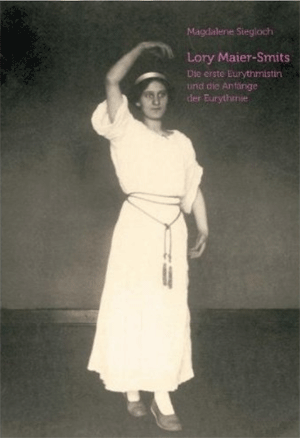
Dalcroze gave demonstrations in many European cities, and his performances were acclaimed by world-renowned musicians, actors, writers, and educators. In 1911, the Dalcroze Institute was built in Hellerau near Dresden, Germany, by the German industrialists, the Dohrn brothers. [22] This Institute was an immediate success. Students from all over the world came there to study music and the dance, and artists such as Nijinski, Diaghileff, Max Reinhardt, Stanislavski, and G. Bernard Shaw visited classes and performances to get acquainted with Dalcroze's unique method of rhythmic and artistic training. Great festivals and large theatrical productions were staged, and the Dalcroze Institute became a world center for music, the dance, and opera. At that time, the movements of the "eurythmicians," on the stage as well as in the classes, were Greek in style, and the Dalcroze dancers, like the Duncan dancers, wore Greek tunics. [23]
This great work was interrupted by the outbreak of the First World War. In 1914, the Dalcroze Institute in Hellerau was closed and the master returned to Geneva, Switzerland, where he opened a new training school for eurhythmic teachers. Still in operation in Geneva, this institute is a training center for Dalcroze eurthymics, keyboard improvisation, ear training, and other corresponding musical subjects as well as "eutonie" and body technique. The Dalcroze Institute of Hellerau was reopened for a short time in 1915 by several of Dalcroze's outstanding graduates, who renamed it the Hellerau School.
Through his method, Dalcroze proved that an education in music will be greatly fostered when body movements are used to understand and feel musical rhythm, and that movement training can be greatly improved when musical rhythm is taught in conjunction with movement. Dalcroze made a great contribution to more sensitivity in music and artistic education, and also to a better understanding of the relationship of music, movement, and the dance.
Dalcroze was also known for his work with children and for his unique ability to awaken their appreciation and enjoyment of music and movement through eurythmics. [24] Terms of contemporary movement activities such as "rhythmic movement," "child rhythms," and "rhythmic education," all originate basically in Dalcroze's teaching, although many represent in practice a digression from his methods.
Most remarkable, perhaps, was Dalcroze's conclusion that rhythm is an important elemental, ethical order in life, a significant factor in human behavior, and a powerful force in the moral education of youth. [25] Today, eurythmics is taught not only as an activity in music and movement education, but also as a therapeutic method for the physically handicapped, the emotionally disturbed, and for the socially and economically deprived. The magnitude of Dalcroze's work was recognized not only during his lifetime, but it is also evident today in the endeavors of his followers who base their teaching on his philosophy, and develop his ideas creatively in their own spheres of work.
BESS MENSENDIECK
Early in the twentieth century, Bess M. Mensendieck, M.D. (1864-1958), who specialized in medical gymnastics in Germany, created the Mensendieck system of functional exercises, which was a new, original method of body training. Born in New York and educated in Europe, Dr. Mensendieck began her medical studies in New York and continued in Paris, where she was one among the first women students at the medical college. She received her medical degree from the University of Zurich, Switzerland.
In Paris, Dr. Mensendieck studied under a disciple of Dr. Guillaume B. Duchenne de Boulogne (1806-1875), who taught and demonstrated his method of testing muscle function by the inducement of electric current. Dr. Duchenne's "Physiology of Motion" became the basis of Dr. Mensendieck's own work. Instead of using electric current, however, Dr. Mensendieck taught her students to use their own will power as the stimulus for consciously innervating specific muscles to perform their tasks.
Over a period of three years, Dr. Mensendieck. tested and applied her theory on a number of patients, both men and women, and she gradually established her own original teaching technique. She demonstrated the results at six-month intervals to her medical colleagues, who enthusiastically approved of her contribution to the science of muscle function through conscious innervation. There \vas continued evidence that her patients improved, not only physically, but also mentally, while simultaneously attaining a more harmonious and attractive body. [26]
In addition to muscle function, Dr. Mensendieck studied body mechanics intensively, in particular the work of the physicists Christian W. Braune (1831-1892) and Otto Fischer (1861-1917) of Jena, Germany. Their studies and calculations became the basis for her principles of posture, the superposition of the various body masses. She was particularly interested in helping the women of her time to overcome individual shortcomings and to improve their health and well-being. To study muscle function in action, her pupils stood disrobed between two mirrors, one in front and the other behind, to enable them to observe the action of the back muscles.
The Mensendieck method acquaints the student with her muscular system, develops an awareness of muscular function, and teaches her to actively participate in her own improvement. Movements, thus understood and performed consciously, Mensendieck claimed, eventually became correct motion patterns and, in time, automatic and unconsciously performed motion sequences. The result is a certain flow and beauty of movement and slimmer body form. Mensendieck emphasized the correct use of body mechanics and muscle function [or efficiency and beauty of motion in the activities of everyday life. [27]
Mensendieck founded a scientific approach to body training in functional movement, and introduced the concept of consciously willed natural movement instead of mechanical exercising. She invented exercises for strengthening specific muscle groups which, lacking muscle tone, cause faulty structure and posture. Franz Hilker says that Mensendieck's exercises will always keep their validity since they are based on anatomical and physiological principles and on the physical laws of body motion. She was opposed to musical accompaniment and other external stimuli for movement, as well as to emotional involvement and the use of objects. Her primary purpose was to use scientific methods for the improvement of body structure and posture, as well as the health, shape, and beauty of the human body. [28]
Dr. Mensendieck established centers for training teachers in the Mensendieck method in a number of Northern European countries and she continued her researches and published books in both Europe and the United States. Although she left Germany during the First World War, her graduates carried on her work. While some graduates adhered to her method, others developed freer movements of the whole body in space, because Mensendieck's static exercises did not satisfy the natural drive for movement. Yet her scientific approach continued, and Bruno Saurbier maintains that all gymnastics for women originate somehow in the logical, objective, educational work of Dr. Bess M. Mensendieck. [29]
ISADORA DUNCAN
A new style of dance appeared at the turn of the century in the United States when Isadora Duncan (1878-1927) presented her unique natural dance. In contrast to the traditional ballet, her dance expressed both thought and emotion through free and natural movements. Her original style reflected impelling artistry, imaginative ideas, and serious study of the nature of human movement.
Even as a child, Isadora was gifted in dance, and she improvised movements to interpret the phenomena of nature. In her biography, My Life, she tells how she danced the waves of the ocean, the rustling trees, the flight of birds, and "the spontaneous joy of growing things." Her mother, a pianist and piano teacher, played masterworks for her dances and, throughout her career, Isadora's dancing was inspired by great music. With little formal schooling, she was an avid reader of what pleased her and of what contributed to her art. A child of nature, she was inspired by the ideas of Rousseau, Whitman, and Nietzsche. [30] Born in a poor yet artistic atmosphere in San Francisco, she became a person of international stature in the world of poets, painters, sculptors, musicians, and actors. The freedom from discipline which she enjoyed in her youth continued in adult life and is evident in the free expression of her dance ideas.
Although Isadora Duncan had some formal ballet training, she opposed the rigorous ballet discipline which completely separated body from the mind and spirit. She called the ballet "a false and preposterous art." "My art," she wrote, "is just an effort to express the truth of my Being in gesture and movement." [31] Basing her dances upon natural movements "familiar to all races, such as walking, running, skipping, jumping, kneeling, reclining and rising," [32] she improvised sensitive and artistic movements in her own style. She composed dances to romantic music, to symphonies, poetry, and revolutionary hymns.
Greek culture had a strong influence on the arts of expression in Isadora's youth. She studied Greek art and lived for some time in Greece, she steeped herself in Greek mythology and culture, wore Greek tunics, and thought of herself as "a pure Greek." Her movements 'were influenced by the forms and positions of dancers portrayed on ancient Greek vases and bas-reliefs, through which she discovered the "sequences of natural movement." [33] She maintained that her dance sprang from "the great nature of America" and that she was "the spiritual daughter of Walt Whitman," [34] and she composed many dances to Greek themes. Describing Isadora's dancing, Curt Sachs wrote that "she breathes life into the statues of the Greeks. She frees the old Hellenic dance from the rigidity of sculpture, from its sleep in museums. With insight and feeling she thaws out the movement and rhythm which the ancient sculptors had charmed into frozen calm." [35]
Isadora studied her own body to discover its movement potentialities and its reaction to the force of gravity. With introspection, she sought the source of the inner feelings which motivated her desire for expression. She tried to find the center from which movement first springs and then progresses by involuntary action. This center, she believed, was the solar plexus, "the temporal home of the soul." [36]
Agnes DeMille, the dancer, choreographer, and dance historian, writes that Isadora had some precedent for her dance style, since "Francois Delsarte (1811-1871) had analyzed the gestures and postures of the body for expression" and since "Jaques- Dalcroze had related movement to rhythm scientifically .... " [37] In Isadora's famous German dance school, the influence of both Delsarte and Dalcroze was evident. Cultivating freedom of expression, and a feeling for beauty, she taught her pupils to observe and interpret the movements of nature, and to walk, run, and move naturally to music. [38]
Duncan, like MacKaye and Stebbins, stressed the importance of gymnastics for the harmonious development of the body, and she used exercises for suppleness and strength [39] so that the body might become "an instrument as perfect as possible" for the expression of "the sentiments and thoughts of the soul." [40] Like her contemporaries, she adhered to the Greek ideal of gesture and body attitude, and both teacher and students wore tunics, a custom which continued for some time in the Duncan schools.
Isadora Duncan's dance was received with reservations in the United States, where Victorian mores and Puritanism still dominated. A dance performed in a scanty Greek tunic and bare feet, at a time of long skirts and full-dress bathing suits, was, to say the least, shocking. Her simplicity, naturalness, and artistry were acclaimed, however, in Europe; and, even today, older people who saw her dance in her prime speak with awe of the beauty of her movements and the spirituality of her dancing.
In Central Europe, Isadora Duncan's new dance style resulted in a revolt against the traditional ballet forms and the birth of the dance as an independent, expressive art form. Also, in the United States, new styles of free dance emerged, styles variously known as the interpretive dance, "rhythmic dancing, Greek dancing, natural dancing." [41] Duncan's natural expressive movements eventually influenced classical ballet, which in time became more fluent and sensitive. Her ideas of free movement improvisation to communicate thought and emotion are continued in the contemporary dance, and her free, natural movements also furthered the revolt against artificial gymnastics.