Part 1 of 2
Chapter 7: An Interview with Dr. Robert Strecker
Excerpt from Emerging Viruses: AIDS & Ebola: Nature, Accident or Intentional?, by Leonard G. Horowitz, DMD, MA, MPH
THE next morning, I tried contacting Strecker again. First I dialed what I thought was his published telephone number. Again, it rang continuously unanswered. Then I called the number directory assistance had given me for Dr. William Campbell Douglass, a physician from Clayton, Georgia, who had published an article entitled "WHO Murdered Africa," which supported Strecker's theory. As in past attempts, a machine instructed me to leave a message.
"Is there anyone there!? This is about the sixth time I've called. I've been trying to reach you for months. I'm trying to reach Dr. William Douglass. I need to get in touch with Dr. Robert Strecker. My name is Dr. Len Horowitz, and this is an emergency. If anyone can answer, would you please return my call?" I then left my 800 number and hung up.
Two days later I received a call from a Mr. William Douglass. I was delighted. He immediately informed me, however, that he was not the person I sought.
"I've been getting a couple of calls a month for Dr. Strecker, so I finally decided to get his number. If you like, I can give it to you."
"Please. I would really appreciate it."
Finally! I thought as I quickly dialed the magic numbers, feeling the end of my frustration might be near.
"Hello, this is Dr. Strecker's office," a woman's kindly voice answered.
Following a lengthy introduction, the woman informed me that Dr. Strecker was indeed alive, well, and practicing internal medicine in Needles, California. He was busy seeing patients, I was told, but I was assured he would return my call that evening.
"All right!" I affirmed as I hung up the phone. Then I quickly relayed the good news to Jackie.
The information on Strecker's whereabouts immediately helped to ease her concerns.
On the Line
That night, Robert Strecker returned my call with news about his ongoing crusade to bring the "truth to light." We spoke at length about our independent investigations, immediately developing the warm rapport that two black sheep isolated from the establishment's scientific flock might.
Pondering safety, I asked, "Has anyone from the government ever bothered you over all these years?"
"Not really," he replied. "Since the suspicious deaths of my brother and Representative Huff, [1] I've just gone about my business. There was one incident though that occurred shortly after I sent reports of my findings to all the health and intelligence agencies."
"What happened?"
"Well, first, the CIA warned all agencies that I was a communist and told them not to take anything I said seriously. My brother Ted obtained a copy of the release they sent out through the Freedom of Information Act. Their counterintelligence efforts apparently worked."
"Do you still have a copy of the release?"
"I wish I did," Strecker replied. "It disappeared along with a lot of other records Ted and I had collected. Shortly after Ted's death, my office was burglarized."
"Interesting," I said. "Who do you think did it?"
"I believe it was the CIA, but I obviously can't prove it."
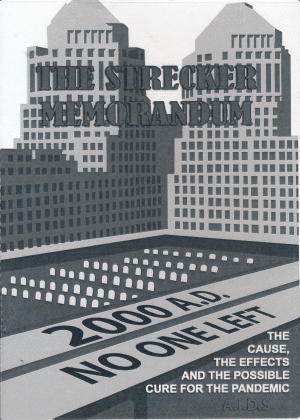
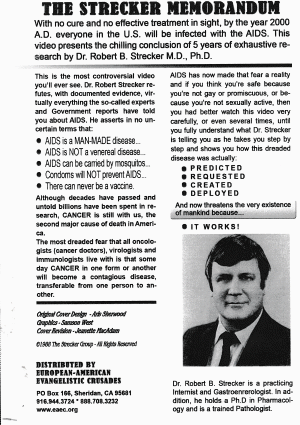
Following an illuminating conversation, Robert - as he preferred to be called - and I agreed to mail each other copies of our previous publications. He would send me a copy of 'The Strecker Memorandum,' which I still had not viewed, and I would send him 'Deadly Innocence,' which he had not heard about.
Then we also agreed to exchange interviews. I set up a time to be a guest on "He Said/She Said," a radio program Strecker cohosted with Betsy Prior on KGER-AM, Los Angeles, and he agreed to be interviewed for this book.
The Strecker Interview
Several weeks went by before we could coordinate our schedules for my telephone interview with Strecker. By this time, I had watched 'The Strecker Memorandum,' and considered, as Acer had, Strecker's position that AIDS had been "predicted, requested, created, and deployed."
Strecker, I now knew, was a stocky, earnest-looking man in his late 40s or early 50s. His dark blond hair glistened as he spoke. His wire-rimmed glasses and slightly graying temples portrayed a more mature, intelligent, demeanor than what his boyish face disguised. He spoke quickly and easily, accompanied by an unmistakable Midwestern drawl. He appeared to me to be a once all American, football hero type, whose athleticism and idealism was quickly dashed by the nature of medical education and academic politics.
I began the interview by reading from a list of questions I had prepared for Robert to answer:
LEN: Robert, first off, what convinced you that the AIDS virus was synthetically manufactured?
ROBERT: What convinced us [The Strecker Group] was the fact that this new agent had suddenly appeared out of nowhere. That the virus had characteristics of animal viruses more so than human viruses, and that the genetic structure of the AIDS virus actually looked like the viruses that appeared in animals that would not normally adapt themselves in humans. . . .
That could have occurred spontaneously, but not by the process that scientists have normally talked about. For instance, not by the virus running in primates [the highest order of mammals, including man, monkeys, and lemurs] because if you look at the genetic structure of the AIDS virus, what you find is that the codon choices [the specific sequence of three (purine and pyrimidine) bases in the viral RNA that codes for the production of a specific amino acid by the infected cell] included in the AIDS virus are not existent in primate genes.
Therefore, to assume that they simply mutated in order to adapt themselves into primates in the case of AIDS is vanishingly small although still possible.
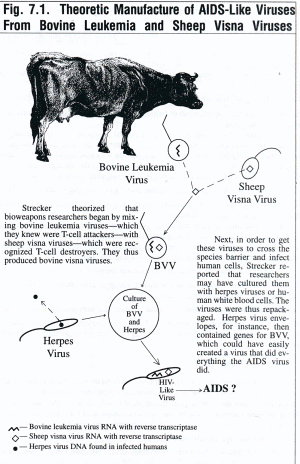
What happened is that the virus either mutated in cattle and sheep, and then was artificially adapted to humans by growing in human tissue cultures, which they [virologists] do and in which they are easily manipulated in that manner - or the virus was actually constructed in a laboratory by gene manipulation, which was available to scientists in the early '70s although many of the techniques were not talked about until the mid '70s, because the biowarfare laboratories throughout the world have always been about five to ten years ahead of other laboratories working on all kinds of projects.
In addition, a clearer reason is, if you look at the appearance of the 'human retroviruses,' the fact is that there were a host of these things that appeared all at the same time. So, you have to explain not only the appearance of HIV-I, but also HIV-II, HTLV-I, NTLV-II, HTLV-IV, HTLV-V, HTLV-VI, ad nauseam.
And so, to say that these things all spontaneously mutated at the same time in nature, and in the same direction, to infect human beings spontaneously and spread disease in worldwide epidemic proportions, in my opinion, is absurd compared to the known fact that scientists were working with exact progenitors of these viruses in their laboratories, which we can document.
The Green Monkey Theory
LEN: But what about the green monkey theory - the theory that a green monkey bit an African or someone had sex with an ape?
ROBERT: That's just nonsense. . . . Green monkeys are about the size of chickens. So the idea of a human having sex with a female monkey the size of a chicken is, of course, absurd.
In addition, the theory that a transmission occurred through biting, of course, is always said to be close to impossible. If you look at the CDC and everybody else, they say that biting is not an easy way to spread these diseases except in the case of the purported green monkey which is suddenly the way it was spread. [2]
We don't believe that the viruses came from primates or from green monkeys. In addition, if you look at the whole theory that was published in Rolling Stone. . . which accused Wistar Institute of spreading AIDS to Africa in the polio vaccines of the early 1960s; Wistar, of course, says that they have now reviewed all their stocks [without finding any incriminating evidence for the allegation]. . . . Wistar Institute is one of the world's biological leaders in 'retrovirus, virus, and cancer causation, cancer research,' [and is] located in Philadelphia. [3]
And these viruses were originally known by their Philadelphia names. They were called 'NBC' for New Bolton Center, which is also in Philadelphia. And if you look up the original AIDS virus, in our opinion, that goes back to cattle viruses that were called NBC, New Bolton Center I through about XIV or XVI. [4]
And we identified HLTV-I and HLTV-II and HLTV-III in those first cultures that were adapted to human beings by growing them in human tissue culture. . . .
For many years actually, you could simply call up New Bolton and say, "Give me some NBC-XIII." And they would send it to you. And then when AIDS appeared around 1978 or so, all of a sudden the NBC line all disappeared. You could no longer order them.
LEN: How interesting.
The Cow Theory
ROBERT: Yeah. It is interesting. And so we tracked NBC, I think it's [NBC-] XIII . . . back to Louisiana State Agriculture Farm (LSAF) cow BFC-44. And what happens was you see, they were looking a lot at HLTV-I, which is like bovine leukemia virus (BLV), [5] and this cow at the LSAF got they thought a BLV infection. She got huge lymph nodes in the neck just like HLTVV-I/BLV in cattle. And then she apparently conquered it because the lymph nodes went down; she got better after a mononucleosis-like disease, and she made lots and lots and lots of antibodies against this virus.
Then about five or six years later, she started losing weight rapidly, developed diarrhea, and died with pneumonia. And they autopsied her and of course she had no immune system left.
And as far as we can tell, that was the original bovine visna virus isolate.
LEN: What year was that?
ROBERT: 1969. And that virus was capable of wiping out T-cells selectively, it produced syncytium [a mass of cell fluids containing many cell nuclei formed by the joining of originally separate cells as a result of infection or disease] [6] in tissue culture, and it does everything that AIDS does.
LEN: Now, who was studying that?
ROBERT: That was isolated from the LSAF outside of New Orleans.
LEN: So Gallo wasn't the only one studying that virus?
ROBERT: No, everybody was. These [cultures] were [widely distributed]. If you go back and look at the veterinary literature, they were looking at all the BLV, bovine leukemia virus lines, bovine syncytium viruses, and bovine visna viruses. And all these things were being studied. . . .
Well, at this point, they were still essentially noninvasive because they were restricted to animals. But, then what happened was in the late '60s and early '70s they started growing these in human tissue.
Early Researchers
LEN: Now when you say 'they,' can you be more specific in terms of the labs that you're familiar with that were doing this work?
ROBERT: Yeah, well virtually every lab in the world that was doing sophisticated lymphocyte studies. But particularly Gallo and company at the NIH, ahh . . . ahh . . . actually there were only a few guys you know - Gallo, Montagnier, a couple of guys that are dead, Baltimore, [7] Teman, [8] and a few others and a few veterinarians. . . .
Dmochowski was interesting because he was the first one to show that you could basically adapt retroviruses to different mammalian species by growing them in the tissue cultures that you wanted them to go to. Now he's down in Texas. [9]
Miller, in 1969, took bovine leukemia virus and injected it into chimpanzees, and the chimpanzees formed antibodies against the virus. [10] So they concluded that these chimpanzees were immune. And so that was the decision for telling everybody that bovine viruses in human beings posed no threat; which is relatively true, there is a species barrier.
Since the 1950s and even the 1940s Bumy, [11] Bobrow, [12] and all these guys from Europe said these [bovine] viruses posed a threat to humans, so they began a whole program of mass extermination of cattle in Europe that carried BLV and other viruses. [13]
In this country, half of our herds are infected with BLV, BFC, or BVV, and the only thing that has prevented, in my opinion, everyone from dying of T-cell leukemia is the fact that pasteurization of the milk kills viruses.
Now if you look at the distribution of T-cell leukemia across the upper United States, from like Minnesota to Wisconsin, there's a huge incidence of T-cell leukemia in dairy farmers.
And if you actually look at some of the studies done in France, they found that guys working in meat-packing plants had a greater incidence of T-cell leukemia too. [13]
So there's all this evidence that T-cell leukemia is related to BLV, which it certainly is, [and] for sure, if you culture the virus in human tissue and adapt it, what you get [is an HTLV-I-like virus that thrives in humans]. . . .
If you look at BVV, bovine visna virus, [13] . . . it's very closely related [to HIV], but it's still not there; it's not the same as AIDS because what you have is bovine visna virus - a virus growing in cattle - and that's not adapted to humans yet. To adapt it to humans, you've got to grow it in human tissue, as they were doing in those early '70s. And what they discovered was that it was a selective T-cell destroyer [just as the AIDS virus is].
French/American ʺBullʺ
ROBERT: Do you know what the true conflict [was] that occurred between Gallo and Montagnier?
LEN: The one that I'm aware of was that Montagnier allegedly gave him what he thought was the virus, and Gallo supposedly cloned it.
ROBERT: That was all bull. . . . Because they both had the viruses growing in their labs in the early 1970s.
The real problem was, and what happens is - suppose you take a culture of lymphocytes, you take T-cell lymphocytes and you dump in HTLV-I or II. What happens to the T-lymphocyte culture?
LEN: It gets infected, and it proliferates.
ROBERT: That's exactly what happens. The tissue grows and grows and grows in human beings. That's what results in leukemia. You have to take the cells out; they get so packed that the tissue culture dies.
Now what happens when you dump bovine visna or AIDS virus into the same tissue cultures?
LEN: The cells don't grow.
ROBERT: Exactly! They're lysed. They die. So when you come back in a day or two and look, there's nothing left except debris. And so Gallo couldn't figure out how to make enough virus for the antibody tests. They needed virus in quantities to get everything going. And they couldn't get them to reproduce long enough to get large quantities of virus.
[I felt the urge to interrupt Strecker at this point since I had questioned this same allegation before when Randy Shilts advanced it in 'The Band.' Instead, I remained silent, heeding my father's recommendation that I could, "learn more from listening than speaking."]
ROBERT: So that's the real argument. And what Montagnier figured out was if you dump in Epstein-Barr virus on to the Tlymphocytes, you immortalize them. . . . They will just sit there and make virus for you, which is why if you have an Epstein- Barr virus infection on top of an AIDS virus infection you're in sorry, sorry shape. . . . The immortalized Epstein-Barr-virus-infected T-cells will just churn out AIDS viruses day after day after day. . . . And so that was the real thing that Montagnier discovered. . . . [14]
LEN: And that's not published anywhere?
ROBERT: Oh sure it's published. But it's the true argument versus the suspicious argument that, "You stole my virus." That's all a lot of bull because they both had the virus, and they both knew what they were doing from day one in my opinion.
[If that was true, I considered, then Gallo would have also known about the Epstein-Barr virus effects, which I recalled he also published. [14] So I questioned Strecker:]
LEN: Now when I look back at the research literature, at least in the Index Medicus, Montagnier did not have too many publications in this field [in the early 1970s], whereas Gallo had been churning out the publications.
ROBERT: Except that Montagnier had worked with Gallo! [15]
LEN: They did?
ROBERT: Yeah, they were in the same [building] or on the same hallway.
LEN: At the NCI?
ROBERT: Yes! . . . Montagnier was over here. . . around 1965 or so; he and Gallo were working together. . . . They're all connected.
LEN: Interesting.
[I had not considered the possibility that Gallo and Montagnier had known about each other's work prior to 1978 as Shilts documented.]
ROBERT: And then when. . . Donald Francis and what's his name? When they published that cat house experiment, and questioned, "Is it possible that there's a human retrovirus similar to this one." Of course [there was]! Gallo had already isolated HTLV-III. . . . And his office was only twenty-five feet away.
[I sat up on the edge of my seat taken by the allegation. 'The Band' presented Francis as somewhat of a hero during his alleged conflict with Gallo and other NCI administrators over withholding support for AIDS research. I suspected he knew about Gallo's early research, and Strecker was now alleging the same.]
LEN: You mean Don Francis from the CDC? Francis was originally at the NCI before he went to the CDC?
ROBERT: Yes. . . . He was working there right next to Gallo. And that's when they did their famous cat house experiments showing that the cats were transferring the viruses back and forth amongst themselves. And then they wrote this article that said, "It is possible. . ." [16]
I mean, they knew or else they didn't talk for the whole time. They knew that there was a similar virus out there growing in human beings. . . . Gallo had already isolated it, and their labs were twenty-five feet apart.
LEN: Now what I seem to have dug up in the 'WHO Chronicle,' is that the first American laboratory to be sent any of the viral strains from which they began was the NCI [17]
ROBERT: Yeah. Well, I think that's a lie. I mean, I think the viruses were growing in the basement of the NCI all along. . . . Do you know about the meeting between Gallo, Montagnier, and Salk?
LEN: No.
ROBERT: Oh my God! Anyway, a year or two ago, and this is documented in 'Science' or somewhere, Gallo, Montagnier, and Salk met in San Diego to write up the history - the official history - of their discoveries. [18]
LEN: Salk? The polio virus Salk?
ROBERT: Yeah, they met down there and made up a story. . . . And I personally believe that virtually everything they wrote was bull. . . . We [referring again to his brother and other colleagues in The Strecker Group] understood that they used to meet like two or three times a week and decide what to tell next - how to package it, how to discuss it. In other words, they already knew everything because they'd been working on it since the early 1970s. They basically knew they had the same stuff [retroviruses and reagents] because if you look at what happened, their discoveries were too quick. . . .
LEN: OK. Explain this now. Why did Gallo in 1980 become so frustrated that he couldn't keep the [T-lymph] cells alive, so allegedly he quit.
ROBERT: What?
LEN: According to Shilts, Gallo dropped out of the AIDS race for about two years.
ROBERT: I don't believe that either. I don't know what he was doing in that time frame, but he was still working on AIDS; there's no doubt about that.
LEN: According to Shilts, Gallo had only about 10 percent of his lab going on the AIDS problem. He said that Gallo stonewalled researchers throughout the world [by] not providing the antibodies, not providing the cell lines that were required to identify and cultivate the virus.
ROBERT: Yeah. . . . Why would they want to give things away when they knew what was going on already, and it was a matter of Gallo and Montagnier deciding who was going to tell what when. . . . Do you know the story about the patent? [19]
LEN: Gallo ripped Montagnier off.
ROBERT: Yeah. That's what brought the split. You see we [the United States] tried to take all the money.
LEN: Well, that's what they've done.
ROBERT: Yes. Yes. Yes. So that's what got the French so angry. And what was Montagnier going to do? Come out and say, "Well, we lied. We've been doing this work all along. We're all crooks."
So that's, in my opinion, what happened. Anybody with any scientific credibility knew that Gallo stole the virus if that's what they were talking about because they [HLTV-III and LAV] were identical. . . . But I think that the big war was really a war over money.
LEN: Oh, for sure.
ROBERT: Yeah. Anybody with any sense knew; I mean retrovirologists laugh about it because they knew that Gallo stole it. It was only the press that was blind.
LEN: But how do YOU reconcile the first comment that they all had these things and then later that he [Gallo] cloned it [Montagnier's LAV]?
ROBERT: They had them, and you can grow the virus in perpetuity if you keep constantly changing their cell line as it kills it. That doesn't mean you can grow it in any quantity. In other words, every lab in the world - and these were all over the world, they weren't just here and in France; they were in Germany and Russia and everywhere - [and] a lot of people had the [human] cell lines, and they had the cattle cell lines [in the early 1970s]. . . . And we know they had, in 1976, BVV, bovine visna virus, growing in brain tissue in Brussels because we have papers on that. One paper said that the AIDS[-like] virus would infect [human] brain tissue. And the guy even wrote, "Is it possible that this is a cause of slow virus disease of man?" [20] So, I mean, they were everywhere.
The ʺConspiracy of Cellsʺ
ROBERT: Plus, they were growing in cattle naturally, and we were using fetal calf serum as growth medium for every cell culture in the world. . . . The theory was that since these were extracted from fetuses, they were sterile, but in fact, they weren't.
Because the AIDS virus and BLV-I and II were being transferred in the gene lines. And so they were potentially transferring these viruses into every tissue culture throughout the world. . . .
So it gets very mixed up. You've got to read a book called 'Conspiracy of Cells,' by Michael Gold. [21] This is a story about Walter Nelson Reese who worked in the highest containment laboratory in the NIH - the BSL 4 lab. That's where they keep their tissue cultures, and they had like 300 to 400 of them. And in 1981, Walter Nelson Reese published a paper [in 'Science'] saying that over a third of them were Henrietta-Lack-cell-contaminated cell lines.
Henrietta Lack was a black lady who worked at Hopkins in the late 1950s. She died around 1965 or so while she was still working there. . . [from] a tumor of the uterus that literally ate her alive. And that tissue was the first human tissue that was grown in perpetuity in tissue cultures. Because up till then, they would only grow one or two divisions and then die, and her tissue called HELA - that's where HELA comes from, Henrietta Lack - was the first [cancer cells] that would grow in tissue cultures.
Now those cell lines were sent all over the world, and what happened was that scientists were contaminating their tissue culture cells with HELA accidentally. And in the early 1970s, I think '72 under Nixon, the Russians sent us six cell lines that they thought contained human cancer-causing viruses. And those were sent to Walter Nelson Reese who was the keeper of the cell lines in the United States. He was in San Francisco, and it was his job to keep the cell lines straight and not contaminate them.
That was [during] the great "war on cancer," that's where all this stuff came from. The NIH was funded in '72 with billions of dollars to find the cancer virus. . . .
Nixon was trying to steal the show from [Teddy] Kennedy by coming up with a virus and vaccine against cancer. They said, "Let's find a virus." So that's where the big cancer virus hypothesis came from.
Now when we got these six cell lines from the Russians. . . Reese started looking at them and discovered that they were all female; then he discovered that they were all black. And so he questioned, 'How many black females are there in Moscow who have cancer?' And, of course, what he discovered was that these were all Henrietta Lack cell contaminants that contained monkey viruses. And so all that stuff the Russians sent us was in fact a fraud. But. . . it was a very embarrassing thing because they thought they had got there first, and what we proved was that they were awful scientists.
So then what Walter Nelson Reese did is that he started looking at all the cell lines of the United States, and closely. And [then he] discovered that at the NIH, over a third of them were HELA contaminated.
What happened was that when they would open their tissue culture lids, they would aerosolize small particles into the air. They would float around and drop into another cell line, and HELA's so aggressive that it will literally take over. And so it just takes one cell to drop into another cell line and it takes over, and it amalgamates, and those were called HELA contaminated.
And so what the NIH did to him [Dr. Reese] was, of course, defunded him and put him out of business. Because he proved they were all a bunch of idiots.
LEN: Oh - I see.
ROBERT: So then the problem was you had a whole bunch of HELA-contaminated cell lines floating around and being sent out as clean cell lines and they weren't; they were actually human cancer malignant cell lines, and some of them contained viruses that were from other species.
And so it represented a big problem. Plus, they were throwing in fetal calf serum which was contaminated with these bovine viruses.
So you had a mixture for a natural [disaster]. I mean, the thing is, like they said in the '72 conferences, it's a wonder that we don't have worse disasters. You just wonder why we haven't been annihilated by these idiots.
If, for instance, you look at the tissue cell culture that was used to determine x-ray tolerance of human tissue, it turns out it's a HELA-contaminated cell line. Which means the most radiation-resistant cell line in the world is used as the standard to determine how much radiation a human should be exposed to!
LEN: Unreal.
ROBERT: Well, that's all documented in 'Conspiracy of Cells' by Michael Gold. . . . Walter Nelson Reese now runs an art gallery. They put him out of business. . . .
The ʺPatient Zeroʺ Theory
LEN: All right, let's get back. . . to the situation with AIDS. What about the "patient zero theory?"
ROBERT: That's nonsense. First off, this guy lived in Canada and flew primarily in Canadian cities, yet you must propose that he only had sex in American cities because the disease broke out in specific American cities where he allegedly had sex.
In addition, it doesn't make any sense if you look at the time frame. AIDS broke out in '78 in Manhattan and then in '80 in San Francisco. It didn't break out in Montreal in '79, or in Toronto, in Quebec, or Ontario in '80, whatever. It broke out in select cities in the United States in a select time frame which corresponds exactly to the hepatitis B study. [22]
LEN: OK. Let's talk about that study for a minute. If you could conceive of a way that vaccine could have been contaminated, how could it have happened?
ROBERT: Two ways. One way accidentally and one way intentionally.
LEN: All right then, elaborate. . . .
ROBERT: Well the vaccine was prepared from gays first off, and then it had plasma expanders that came from cattle added to it.
LEN: So the hepatitis B vaccine is produced through the bovine serum.
ROBERT: Yes. . . . It had expanders put into it as a mechanism of production.
LEN: Like serum?
ROBERT: Yeah, serum. . . . Because they needed to expand the volume.
LEN: Now is the vaccine produced in cow carcases?
ROBERT: No, it's made from humans.
LEN: The hepatitis B vaccine [is made] from the gay men's serum?
ROBERT: And also from straight men's serum.
LEN: OK.
ROBERT: And. . . that's the most interesting thing. Why did they make two separate vaccines?
LEN: Yeah. Why?
ROBERT: Because the epitopes [23] [surface molecules] of hepatitis B [antigens] in gays was different than in straights. . . . So what does that tell you?
LEN: I'm not quite sure.
ROBERT: Well it tells you there's not a lot of exchange going on between the two pools. Because if there were, the hepatitis B would not have separated into two epitopes. So if there was a lot of exchange, the information would have been heterogeneous in the pools, not homogeneous and not different [between homosexual and heterosexual men].
Now suppose you introduce a virus which is transferred like hepatitis B into the gay pool or population. When will it show up in the heterosexual pool?
LEN: I don't know. When?
ROBERT: Well it will take it a long time to show up there, because what you know is that the exchange of information going on between homosexuals and heterosexuals is limited.
So Szmuness was the guy who conducted that study. [22] Szmuness came from Poland, and was educated in Moscow. He somehow managed to escape [from Poland] to the United States with his family in tow, and ended up in New York City. . . as the head of the New York City Blood Bank.
[That is interesting, I thought as I reflected on my recent tour of the National Holocaust Museum in Washington. The Nazis, I learned, had done extensive blood and genetics research in an effort to discriminate and exterminate mixed breeds from their racist and white supremacist world. A Russian-educated Polish researcher with Szmuness's credentials could have best survived Nazi-occupied Poland by joining the Nazi's research effort, or post-Nazi Poland by serving Russia. How did he end up in the United States? I wondered if there was a link between the Nazi effort to exterminate homosexuals and Szmuness's study that targeted gays with allegedly tainted hepatitis B vaccines? The German-owned Merck Company, after all, funded the study and produced the experimental and control vaccines] [22]
LEN: So [still somewhat perplexed, I asked,] that's the theory of unintentional infection?
ROBERT: Well, the fact is that the vaccine could have been prepared in a way that unintentionally infected them. Yes. [But] it might have been intentionally contaminated by somebody [also]. . . . They may have been testing gays trying to develop an immunity against something they knew was already ripping through Africa. . . . It could be that they were testing it just to test it, or it could be that somebody intentionally was trying to exterminate gays, or in our opinion, it could be that their actual goal was to exterminate the United States.
[Strecker's latter remark took me by surprise. It was the first thing he said which to me made no sense.]
LEN: The actual goal was to try to exterminate the United States? And that's one of your most plausible explanations?
ROBERT: Yes.
LEN: And who would have been behind that?
ROBERT: Some foreign party. The Russians or someone who didn't like us. Because the Russians have talked about that for fifty years. There have been KGB biological warfare experts that have been trying to do that to us for fifty years.
[I felt intuitively uncomfortable with Strecker's explanation. I recalled his comments about Walter Nelson Reese which proved the Soviets knew far less about viral biotechnology than American researchers. Moreover, it seemed farfetched to believe the Russians had somehow managed to infiltrate the New York City Blood Center which appeared to be the starting point for the AIDS epidemic in America. This part of Strecker's theory would have required Szmuness, or one of his associates, to have been a secret agent working for Russia.]
LEN: OK, but why would they have started with gays?
ROBERT: For a very obvious reason. And that is because nothing would be done. Just think about this. Suppose you put this virus in the heterosexuals or kids. What kind of response would have occurred compared to the response that did occur?
LEN: Right. That's for sure. Quite different. I appreciate that, but still, even to this day, the heterosexual spread is limited compared to the spread in the gay population.
ROBERT: Only in this country.
LEN: Right.
ROBERT: If you look in the world, what percentage of the world's AIDS cases are heterosexuals?
LEN: Ninety percent.
ROBERT: Over 90 percent. Right. Exactly. . . It's only in this country that you have this strange, unexplained predominance of homosexuals. Now, that's why you have to remember what I just told you. What happens when you put a virus that is transferred like hepatitis B into the homosexuals? When does it appear in heterosexuals?
LEN: Not for a long time.
ROBERT: Exactly. . . [That's why] I think it was pure genius.
Now people say, "Well nobody would think of that." And my answer to that is: "Well, I thought of it. So why couldn't they think of it?"
LEN: I still like my theory better.
[Problems with the 'communist theory' flooded my head. Strecker noted the Russians were way behind us in viral research. How would the Russians have gained access to the viruses in Gallo's or Merck's labs in the first place. Even if Szmuness had been a Russian agent, he would have needed to gain access to the viruses first in order to contaminate the vaccines. Also, had the Russians created AIDS-like viruses shortly after Gallo surely did, then why had Gallo become the world's preeminent retrovirologist and not some Russian? Also the patents are worth millions. Why would the United States and not Russia hold the patents on the AIDS virus antibodies and cell lines?]
ROBERT: Yeah. I mean I don't have the answer. I'm just telling you my theory.
African Vaccine Trials
LEN: OK. So that's the intentional theory.
ROBERT: Yeah. It could've been an experiment. It could've been intentional to get rid of gays. It could've been intentional to infect all of us.
LEN: OK.
ROBERT: And you see what happened. In our opinion, IARC, the International Agency for Research on Cancer, took these viruses to Africa in the early 1970s and tested them. Because we think they were trying to get the virus/cancer hypothesis proved; they wanted to develop a vaccine, and they wanted to find out which of those [viruses] were actually causing cancer because they weren't sure. [24]
So how do you prove it. How do you prove Koch's postulates [25] in the case of virus and cancer?
LEN: Difficult.
ROBERT: Yeah. You've got to test them.
LEN: Right.