4. Fishy Friends
In the 1980s the WWF decided it wanted to be more than just a conservation organization, advocating for the world's big, beloved superstar animals. Taking a new, ecological tack the organization set out to protect nature from the fundamental evils of modern times.
In a speech to celebrate the 20th anniversary of the WWF, founder Max Nicholson defined the enemy precisely: "These are the giants: ruthless and harmful technological development; profligate waste of the world's readily available energy reserves; and senseless multiplication like crazy rabbits. The sad truth is that someone will have to tackle those three big nasties, and if it isn't to be us, who will?" [4]
In its mission statement from late 1989 the WWF first began to speak of the "sustainable use of renewable resources" -- this was the only way the planet's biodiversity and natural environment could be saved in the face of
human overpopulation.
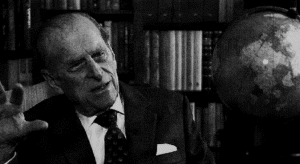
Under the presidency of Prince Philip (1981-1996) the WWF developed into a global environmental organization that also regularly collaborated with global corporations. The panda had bedded down with profit, and soon a common strategic project was born: the "green economy". A strategy for our times, bringing tidings of comfort and joy in the midst of climate collapse and rainforest decimation: there would be more growth and more consumerism while simultaneously conserving natural resources -- on land and in the water.
In the past, whenever I saw the likable little WWF panda on a poster, a soup packet or a beer can, my emotional response was largely positive -- a result of the successful marketing that has made the WWF panda one of the world's most trusted brand logos. It was only by chance that I first ran across a story that would eventually shake my personal panda faith to the core. In the Steintor district of Bremen I ran into Luisa Ludwig, an old friend from Chile who I hadn't seen in years. After Pinochet's military putsch Luisa had lived in exile in Germany, and later returned home to teach at the German school in Santiago.
She told me she now ran a little guesthouse in a tiny southern Chilean town with the melodious name of Puyuhuapi. There was nothing there, she said, but mountains, glaciers, fjords and several salmon farms in which a total environmental collapse had occurred. She said an estimated 100 million salmon had met an excruciating end in their huge underwater cages. At first it appeared they had been victims of the deadly salmon virus ISA, for which there is no cure. As it turned out, the real cause of the disaster was the greed of the salmon industry, in particular the Norwegian company Marine Harvest. My curiosity piqued, I searched the Internet and was astonished to find that John Fredriksen, one of the world's most infamous financial investors, is the principal owner of the company.
On the Marine Harvest website I not only found images of healthy-looking pink salmon and the company promise that it took its "social and ecological responsibility" very seriously, but also the friendly panda from the WWF. The pairing struck me as obscene -- and the story certainly seemed interesting enough to be worth pursuing. In February 2009 I set off with my colleague Arno Schumann on a journey to the end of the world. We wanted to get to the bottom of the fish farming disaster, and to find out how the panda had hooked up with the salmon.
From Santiago we took off on the new privately owned freeway for a 1,000-kilometer road trip down to the cold south. I had been there for the first time in 1981 and remembered the region as a green paradise, with dark forests, snow-dusted volcanic mountains and deep, blue lakes.
But the forests south of Valdivia had now been completely replaced by pulp plantations: slender, brown-green pines and eucalyptus trees lined up in rigid rows like soldiers. Between the rows of trees were wide muddy aisles plowed up by the mechanical harvesters.
Every few years the industrial tree crops are felled, stripped bare in seconds, and transported to one of the gigantic pulp mills nearby -- their belching smokestacks can be seen from kilometers away. What remains is a landscape that is naked, industrially standardized and biologically dead. The forest sell-out had been the brainchild of the Chicago Boys, a group of economists that obliged the Pinochet dictatorship with tips on the quickest way to turn Chile's rich natural resources into cold hard cash.
Oddly enough, many of these pulp lumber operations now bear the "ecolabel" FSC, which stands for Forest Stewardship Council, co-founded by the WWF. This certification has a good reputation for enforcing especially strict standards -- companies who bare the label practice "sustainable" lumber production only. That, at any rate, is the claim of the FSC, an NGO with its headquarters in Bonn, Germany.
The Shell oil company, a major financial sponsor of the WWF, also runs enormous tree plantations in southern Chile, as well as in Argentina and Paraguay. Shell, too, has received the squeaky green FSC ecolabel for "sustainable forestry". The certification eases business dealings, but also the conscience of customers.
The idea of the FSC founders had originally been to enable natural forests to be exploited in a genuinely sustainable manner, preserving and protecting them for the future. But the fact is that a majority of the wood now bearing the FSC label comes from industrial plantations that are little more than green deserts, devoid of diverse plant and animal life.
The few extreme survivalist organisms that do manage to hang on in these wastelands are snuffed out with herbicides and pesticides.
The Salmon King
Nearing the city of Puerto Montt we were met with the stench of rotten fish.
It wasn't the salmon farms that stank but the fishmeal factories. They produce the feed for the voracious aquaculture fish, which are quickly fattened for the slaughter, gaining 5 kilograms within 18 months, a feat that can only be achieved with feed concentrates made of fishmeal and fish oil.
The smell followed us all the way to the ferry terminal at the port of Pargua, where we caught the ferry to
Chiloe Island. Back in 1981 I had visited this fabulously beautiful island, with its seaside pile dwellings and enduring water spirit folklore. It was a poor but beautiful place. It was now barren and ugly, and the people still poverty-stricken, in spite of the "salmon miracle".
The huge steel rings of the salmon cages could be seen in the fjords, in stark contrast to the blue of the water; container trucks jammed the highways.
The red containers carried a toxic freight: millions of salmon carcasses contaminated with the virus. They had been slaughtered and were now being taken to the fishmeal factories for disposal. There they would be made into feed pellets for their surviving salmon brethren -- recycling, Chilean style. The virulent salmon disease ISA has been an ecological disaster. At the time of our visit most of the salmon farms had already been shut down by the authorities and put under quarantine for a number of years.
Achao was a grim place. The rain had been falling for hours onto the rooftops, shingled with gray alerce wood. The seafood restaurants were empty; a few drunken men in Marine Harvest rain jackets staggered down the street towards us.
On the shore two old women sat under a wooden shelter selling hand-knitted socks and sweaters to feed their families -- the men had been fired without notice when ISA broke out. The company had given them two months severance pay -- the equivalent of 550 dollars.
Maria, one of the women, complained:
"The industry promised us prosperity but the salmon have brought only misfortune. My husband and our three sons are now out of work. They can't go back to working as fishermen; there's nothing more to fish: no mussels, no sea urchins, everything's dead." When I asked whom she thought was responsible for the disaster she said: "The Norwegians. They made a lot of money with the salmon. Now that they've contaminated our ocean they're just clearing off."
A third of all commercial salmon production worldwide is in the hands of the Norwegian John Fredriksen. With an estimated private fortune of 13.5 billion dollars the corpulent, ruddy-faced "salmon king" is one of the richest men on the planet. Fredriksen started out as a small herring merchant, and the Norwegian bourgeoisie still see him as a parvenu with crude manners. His motto is simple: "Anything that's good for the shareholders is good for the company." He jets around the world on his razzias accompanied by a small entourage of 18 staff members.
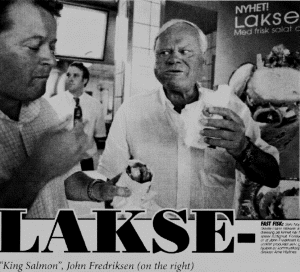 "King Salmon", John Fredriksen (on the right)
Whenever a business that Fredriksen deems strategically important falters he moves in, buying up stocks until he has a controlling share of the company. Fredriksen has used this modus operandi to amass a substantial global empire:
he owns Frontline, the world's largest tanker fleet, and Seadrill, the market leader in oil platforms. John Fredriksen got into the salmon trade more or less by chance. In 2007 a major Norwegian salmon company was about to go bankrupt. Fredriksen bought it and then merged with two other players in that fishy business. Since then he's been the big daddy of the salmon industry as well. His aquaculture company Marine Harvest dumps 100 million salmon a year onto the global market. Aquaculture professes to be a "clean" method of producing fish in large quantities. The WWF has elected to do a partnership deal with Fredriksen's company -- presumably because the organization believes that intensive farming in the sea is the solution to the food supply problems of the future.
Swimming Pharmacies
On a boat ride through the Reloncavi Fjord a few kilometers south of Puerto Montt, marine biologist
Hector Kol described the farm-bred salmon as "swimming pharmacies". With 38 salmon and trout farms located in the fjord, its capacities are maxed out.
An average of 200,000 salmon are crammed into each cage -- twice as many as permitted in Europe. A single Chilean farm with six cages thus stocks over a million fish at any given time. The individual farms are much too close together; infectious disease can spread in a flash: the virus epidemic was a disaster waiting to happen.
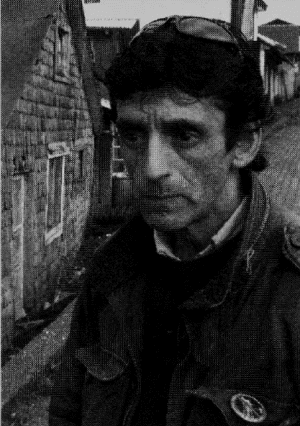 Hector Kol, salmon rebel
A year earlier there had been a mass salmon "jailbreak" in the Reloncavi Fjord that saw 130,000 salmon on the loose. Salmon are predators, and the escapees had soon gobbled up everything in the fjord; there was nothing left for the local fishermen to catch.
Hector Kol, salmon rebel
A year earlier there had been a mass salmon "jailbreak" in the Reloncavi Fjord that saw 130,000 salmon on the loose. Salmon are predators, and the escapees had soon gobbled up everything in the fjord; there was nothing left for the local fishermen to catch. Hector Kol knows every salmon farm in the area; he used to be a project developer for the Hector Kol, salmon rebel industry, until he realized that his work was contributing to ecosystem collapse in the fjords. He quit his job, and has worked for a pittance consulting the small-scale fishermen's cooperatives ever since. Throughout southern Chile, wherever there is a salmon workers' strike or a blockade staged by outraged fishermen, the wiry high-strung chain smoker can't be far away: Hector Kol is a man on a mission.
The salmon industry views Kol as a ringleader and a traitor -- he has to watch his back. Environmental activists from Santiago had warned him of a possible attempt on his life, but
Hector Kol was a hardened veteran of the resistance against the Pinochet dictatorship: "I won't stop until the salmon dictatorship in Chile is over as well." As we drove along the bumpy fjordside sand roads he pointed to the white silos on the shore:
"There are too many salmon in the cages, so there's not enough oxygen, and they suffocate." The silos were oxygen compressors used to give artificial respiration to the sea.
Hector Kol had taken samples at many different farms -- always with the salmon company security boats hot on his heels. He had also studied the companies' environmental reports in detail:
"In Norway it is permissible to use one gram of antibiotics per ton of salmon produced; in Chile there are no restrictions. Here they sometimes use up to eight hundred times the amount of antibiotics as in Europe -- the same antibiotics that are used to treat humans. That's dangerous, because the bacteria become resistant to them. In one year Marine Harvest added as much antibiotics to the feed at a single farm in this fjord than used by the entire Norwegian salmon industry that same year."
In addition to the antibiotics, other dangerous chemical substances are also used to push salmon production volumes higher still. Hector Kol knows them all: "Even the salmon eggs are treated with fungicides, which contain carcinogenic substances such as crystal violet and malachite green. The feeding cages are routinely painted with antifouling agents that contain heavy metals."
The marine biologist opened his laptop and showed us video footage shot by a mussel diver of the seabed beneath the salmon farm cages. An undersea garbage landscape unfolded on the screen: pipes, old fishing nets and parts of cages, rotten feed and a thick layer of salmon feces, with dead mussels, sea urchins and starfish floating in the murky soup.
"Everything's been killed off down there. The industry uses the sea as a garbage dump; the salmon in our farms produce the same amount of feces as the 14 million inhabitants of Chile. The entire marine ecosystem is being ruthlessly destroyed for a quick profit -- and the WWF is doing nothing to stop it."
When Panda Met Salmon
What the WWF did do was to enter into a partnership agreement with Marine Harvest, in April 2008. The press release announcing the collaboration said the two parties were joining forces to advance the production of ''sustainable" salmon. To Hector Kol that sounded like a cynical sneer:
"25,000 workers have already lost their jobs because half of the aquaculture farms have had to close down due to the virus pandemic. Where is the social sustainability the WWF talks about? It claims that the salmon industry is good for Chile, which is just stabbing us in the back." I offered that the dialogue between the WWF and the company had its positive aspects. There had been small improvements. For example,
the Chilean WWF and Adolfo Alvial, the Technical Director of Marine Harvest in Chile, had planned a pilot project: in future the young salmon, called smolt, would be kept in closed tanks while they grew, so they would no longer soil the fjords and lakes. Hector dismissed my argument: "That's just a token initiative. Where are those tanks? They exist only on paper; Marine Harvest isn't going to spend a single Peso on them."
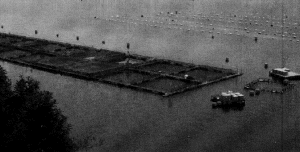 Salmon farm in Chile
The following day we went to meet with Marine Harvest Chile director Adolfo Alvial. He admitted outright that the water tank project had, in fact, been ''suspended".
Salmon farm in Chile
The following day we went to meet with Marine Harvest Chile director Adolfo Alvial. He admitted outright that the water tank project had, in fact, been ''suspended". The company currently had other, more pressing, concerns: "We've also been hit very hard by the virus crisis. We'll take up the idea again when the time is ripe.
The WWF appreciates our position." Alvial proved to be one of the company's self-critical thinkers. As a biologist he was well aware that the industry had inflicted serious damage to the ecosystem of the Chilean fjords: "We've made many mistakes, but we, and John Fredriksen personally, are determined to learn from them. It is possible to reconcile sustainability with profit. We can't give up now, because we have a responsibility for feeding humankind. The small-scale independent fishermen can't catch enough; we need aquaculture."
The crisis in Chile has led to a salmon shortage on the world market, triggering a rise in prices. Marine Harvest has responded by ramping up production in Norway. In Chile the company has behaved like a vulture circling above the dying industry: as smaller companies succumb to the epidemic Marine Harvest has moved in to buy up their infrastructure. When the crisis is over Fredriksen will have even more control over the global salmon trade than before the outbreak. And the extermination of millions of diseased salmon won't put the company in the red -- the fish were well insured.
Outside a McDonald's in Oslo advertising banners fluttered in the wind. The omnipresent American eatery was promoting its latest creation: the new Marine Harvest salmon wrap, with which Fredriksen hoped to penetrate new markets, winning over young urbane consumers with a hip "sustainable" product.
We were in Oslo to meet with Maren Esmark, Marine Conservation Officer at WWF Norway. She had negotiated the partnership deal with Marine Harvest.
I questioned her about the ethics of cooperating with a company that is clearly a two-faced beast: in Norway it seems to behave properly, and at the same time it's destroying marine ecosystems and people's lives in Chile. Ms. Esmark responded with unruffled diplomacy: "The partnership with Marine Harvest is still young and only applies to Norway. The situation in Chile is unfortunate, but Chile is not part of our partnership agreement." How convenient! Never mind that it's one and the same company. That's what I call double-dealing. I was starting to get on Maren Esmark's nerves: "What exactly do you want? We could stop the dialogue with Marine Harvest, but do you think that would make the world a better place?"
She firmly believed that the partnership with the WWF had already made Marine Harvest "better", at least in Norway. Together they would continue to "reduce the company's ecological footprint".
New measures would be introduced, for example to prevent so many salmon from escaping their cages. Because when the aquafarmed salmon breeds with wild varieties, genetic diversity is lost. The WWF also aimed to use the partnership to solve the problem of salmon feed. The company fed its stocks, in Norway as well, on a mixture containing North Sea herring. The plan was to replace this popular seafood, wherever possible, with protein from fish considered inedible by humans.
I pressed the point: did the partnership agreement include binding commitments? Who monitors the company to make sure it keeps its promises? The WWF representative remained vague: "At the moment it's about testing the waters and formulating joint, verifiable goals in the partnership." Fed up with the corporate-speak, I asked to see a copy of the agreement. Maren Esmark was unable to oblige: "The agreement is being revised at Marine Harvest. I'll send you a copy as soon as it's finished." She did not. Several subsequent requests also failed to produce the document; I never did get to see it. Perhaps it was really more of a non-bonding declaration of intent than an actual credible contract. That would certainly be a cost-effective way for the company to "green" its tarnished image.
But what was in it for the WWF? Was money changing hands? A rather uncomfortable question for Maren Esmark, who hesitated before answering:
"Yes, the agreement also involves money. We get financial support for our work on marine conservation." When I asked how much money Fredriksen's empire funnels into the WWF, she looked searchingly around for help but there was no one to come to her aid. "Well, it's ... in euro or in Norwegian crowns?" -- "The currency makes no difference." -- "Okay. Well, the WWF gets about 100,000 euros a year." That's almost 135,000 dollars. Per annum.
Did she think it was a case of: "He who pays the piper calls the tune"? Oddly, Maren Esmark was quick to agree, albeit by putting a new spin on an old saying: "Yes,
every partnership with industrial companies is a challenge. But as a global organization we have to come to terms with that. We work with large companies while at the same time criticizing them, regardless of whether we are taking their money."
Then why wasn't the WWF criticizing the ecological misdeeds of its partner in Chile? "That is outside of WWF Norway's purview." But this excuse had apparently been forgotten only minutes later when Maren Esmark launched into a fervent plea of support for the Chilean operations: "We believe that the salmon industry will bring great benefit to Chile's coastal inhabitants. It creates jobs and pay and we don't want that to stop."
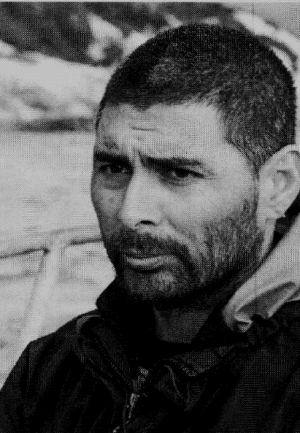 Christian Soto, diver
Death in a Cage
Christian Soto, diver
Death in a Cage
Cristian Soto is one of 50,000 people employed in the Chilean salmon industry. His job as a diver takes him down to the icy depths of the salmon cages. The WWF is not in his good books. He wonders why the organization does nothing for the people who work and die for Marine Harvest. He, too, risks his life daily for the salmon business. A
s a day laborer on the aquaculture farms of Marine Harvest and other operators he cleans and repairs nets and removes the contaminated carcasses of diseased salmon. At the time of our meeting that was about 3,000 dead salmon a day -- per cage: "There are not enough transport containers available so we have to pack the dead salmon in sacks, which are left hanging in the cages until a ship comes by to collect them. By that time the salmon are already decomposing and the stench is horrific. We do all of this work without any protective clothing whatsoever."
We rented a little fishing boat and chugged along with Cristian Soto to visit a sea lion colony on the other side of the fjord. Almost a hundred of the imposing animals were sunning themselves there on the rocks. The bulls, which weigh over a ton, roared fearsomely as we approached.
The sea lion is a protected species in Chile but the salmon companies continue to hunt them mercilessly nonetheless: sea lions love salmon. One of Cristian Soto's jobs is to chase the sea lions out of the cages. "When they manage to get into a cage we have to get them out. First they shoot them; usually the operations manager does that. Then we have to go down to see if they're really dead -- it's a life-threatening job. You can refuse to do it, but then they say: don't bother showing up here tomorrow. Last year a sea lion injured by a gunshot got ahold of my leg and pulled me down into deep water. My fins and mask were torn off in the process. I survived."
The lives of the around 6,000 salmon divers in Chile hang on a sort of garden hose that supplies them with air from above. The tubes are often damaged and prone to tearing. Sometimes the divers also get tangled up in the nets down below and can't get back up to the surface. The water pressure is immense, because the divers have to go down much further than the legal limit. "Our license only permits us to dive a maximum of 20 meters deep, but the cages are 40 meters down. The law states that every salmon farm must have a decompression chamber within a radius of 500 meters; that's a matter of life and death when it comes to a diving accident. In reality they don't exist, or they're defective. A dead diver is cheaper for the company. 18 of my colleagues lost their lives last year alone."
One of them was one of Cristian Soto's best friends: "It took seven hours to get him to the next operable decompression chamber. He was dead on arrival." The diver told us the story with tears in his eyes; death was his constant companion. Why did he subject himself to it?
He's actually a music teacher, but you can't live on a teacher's salary in Chile. "I do it so that my two children can go to a good school." The divers make good money by Chilean standards: about 1,200 euros a month.
Cristian invited us back to his home, opened a computer database and showed us the picture of a young colleague who had lost his life on August 26th, 2007 on the Marine Harvest farm Puchilco.
Cristian read us a passage from the accident investigator's report: "The diver had no valid license. Damage to the equipment prevented him from being supplied with oxygen. The compulsory rescue diver was not present."
The dead diver was Pedro Pablo Alvarado.
He was 29 when he lost his life at a depth of 40 meters, where he was repairing the nets that guard against sea lions. Cristian had studied the files of the public prosecution and spoken with colleagues and bereaved relatives:
"The company claims that the accident happened at a depth of 20 meters -- that's the maximum depth he was legally allowed to dive to with his license. Everyone knows that can't be the case, because the sea lion nets hang at a depth of 40 meters. Furthermore: Pedro Pablo had to dive during a storm, although the Marines, as the responsible authority, had prohibited all diving in the area."
I inquired at the relevant public prosecution department about the outcome of the investigation:
two years after the diver's death Marine Harvest had had to pay a fine of ca. 2,700 dollars -- for violation of safety regulations. The public prosecutor had declined to pursue a charge of involuntary manslaughter. The justice system protects the perpetrators, not the victims, according to Cristian Soto: "Every time there's an accident the public prosecutor comes to the same conclusion: the only one responsible for the death is the diver himself. The criminal justice system doesn't protect us. That is very unjust. I've been lucky up to now. But my family has to get used to the idea that one day I won't come back either."
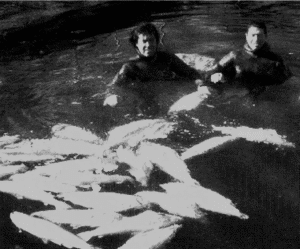 Divers with salmon carcasses
This story illustrates that the salmon industry is prepared to rationalize the loss of divers' lives in the name of efficiency. In the language of economics it's the ''comparative cost advantage" that northern countries have when they relocate their operations to the south.
In the past ten years, an estimated 100 Chilean divers have died in the cages. In the Norwegian salmon industry there was one diver death in the same period. We decided to confront the company with these numbers. Adolfo Alvial, the Marine Harvest Technical Director in Chile, was willing to talk to us, but he first wanted to show us his pride and joy: the new eco breeding farm Rio Blanco, located in the gentle rolling foothills of the Andes. It is the most modern installation of its kind: clean, environmentally friendly, with closed-circuit water systems and biofilters. Here, in huge tubs, was the new generation of farm-bred salmon -- all 10 million of them.
What a contrast to the company's brutal salmon cage habitats! I remarked on this difference to Alvial and told him I felt like Alice in Wonderland. He gave a satisfied smile: "You're in reality. Chile is the land of wonders. This facility shows the change of course that Marine Harvest is making. This is where we want to go, although there's still a lot to be done."
Next question: why did 100 divers have to die to keep the salmon business booming? The suave smile suddenly vanished from Adolfo's face: "There is no explanation for that. I could argue with the number 100. Sometimes the victims are mussel divers who dive along the coast at their own risk, and when they get killed it's blamed on us. That's unfair. But never mind that, even if it's only 10, 12 or 20: every death is one too many." As soon as our camera was shut off he leaned over and said with a wink: "Just between us, most of the divers die because they come to work drunk. Their archenemy is alcohol, not the company."
Petter's Happy Salmon
Back again to Norway, where we met with Marine Harvest's Technical Director, Petter Arnesen. A sincere, reserved man, who led us to his speedboat, in which we would view with him the model living conditions of the corporation's Norwegian salmon. The head of PR had just resigned and management had foisted the task on Arnesen -- he had negotiated the partnership agreement with the WWF, after all. The global "Aquaculture Dialogue" program was another brainchild of Arnesen and the WWF. It would issue new sustainability certification to enable the global aquaculture industry to shed its grubby image once and for all.
Petter Arnesen admitted that, to date, agreements with the WWF had been imprecise and generalized. The actual documentation was still "in flux". The most important thing, however, was the ongoing dialogue: "We learn something from the WWF about marine ecological processes, and the WWF can learn how aquaculture really works."
And Marine Harvest's payments to the WWF? What were they for, exactly? According to Arnesen the money goes to finance the post of WWF salmon expert. He saw nothing objectionable about a company paying the salary of its external critics. Not least because of the disaster in Chile, Marine Harvest would have to become "more sustainable" to survive. That's where the WWF could help. In Norway, said Petter Arnesen, everything was already much better than in the Chilean operations anyway.
We seemed to fly in the boat across the dark green waters of the Bokna Fjord. Along the steep banks waterfalls crashed from great heights into the sea below. Every few kilometers huge rings could be seen rising from the water: salmon farms. Automatic feeding machines hurled feed pellets into the air and immediately thousands of salmon breached the surface to snap them up. Their scaly bodies glistened in the sunlight.
With utter sincerity, Technical Director Arnesen ensured us that his salmon were "absolutely happy".
The contrast to Chile was clearly evident: the water in the Norwegian aquafarming areas is barely sullied; hygiene regulations are adhered to, and state supervision is strict. Violators of environmental laws lose the licensing that operators In Norway must reapply for annually, for every farm. Marine Harvest gets its Chilean licenses at a rock bottom price: 150 dollars a year for one hectare of sea area. And then there are the low wages in Chile: about ten percent of labor costs in Norway.
One company, two completely different sets of standards. Petter Arnesen admitted that with the Chilean operations there had been a big temptation to start turning a quick profit right away, and that: "We should have seen that the disaster was inevitable." Because several years prior, there had already been an ISA outbreak in Norway. But because the salmon farms there are farther apart and the hygiene standards higher, they had managed to stop the spread of the virus within a few months, whereas in Chile the epidemic raged as far south as the Strait of Magellan, extending its reach across 1000 kilometers. Petter Arnesen shares personal responsibility for the catastrophe; he spent years in Chile helping to establish the salmon aquafarming industry there. "Yes," he admitted reluctantly, "unfortunately we hadn't learned enough from the lesson we'd been taught in Norway." He slumped down a bit and stared silently ahead for a few seconds before adding: "I think it would have been better if you had submitted your questions before the interview."
As soon as he had composed himself again, Arnesen proclaimed in a firm voice that all of the challenges in aquaculture would be mastered, including the biggest one of all: how to convert salmon to vegetarianism?
The carnivorous predator fish need large amounts of animal protein. The feed concentrate dumped into the cages by the ton is made mainly of fishmeal and fish oil. It's a negative cycle: 4-6 kilograms of wild fish are killed and made into meal to produce one kilo of salmon flesh. More than half of the world's fish catch now goes to making feed concentrate for salmon and other animals. Farm-bred salmon consume more animal protein than they produce. How can that be sustainable?
"We see the problem the same way the WWF does," conceded Petter Arnesen. "We're experimenting with increasing the share of vegetable protein in the feed, using soy, for example." The company was determined to achieve this, he said, as the fish reserves of the world's oceans were already "exhausted". The trouble is, when there is too little fish product in the feed the salmon raised on it no longer contain as much healthy omega 3 fatty acids. That's not the kind of salmon the retailers want.
The poor Technical Director has the daunting task of circling the square -- luckily the WWF can lend him a hand: by simply designating the whole thing "sustainable".
Although the CIA knew that the estimated 120,000 VC Self-Defense Forces (which Westmoreland described as "old men, old women and children") were the integral element of the insurgency, Carver, after being shown "evidence that I hadn't heard before," cut a deal on September 13. He sent a cable to Helms saying: "Circle now squared .... We have agreed set of figures Westmoreland endorsed." [14] In November National Security Adviser Walt Rostow showed President Johnson a chart indicating that enemy strength had dropped from 285,000 in late 1966 to 242,000 in late 1967. President Johnson got the success he wanted to show, and Vietnam got Tet. --
The Phoenix Program, by Douglas Valentine
***
The Square within the Circle [is one of] the most potent of all the magical figures. --
The Secret Doctrine: The Synthesis of Science, Religion, and Philosophy, by Helena Petrovna Blavatsky
***
"As the sky with its stars and constellations is nothing separate from the All but includes the All, so is the 'firmament' of Man not separate from Man; and as the Universal Mind is not ruled by any external being, likewise the firmament in Man (his individual sphere of mind) is not subject to the rule of any creature, but is an independent and powerful whole." -- This fundamental truth of occultism is allegorically represented in the interlaced double triangles. He who has succeeded in bringing his individual mind in exact harmony with the Universal Mind has succeeded in reuniting the inner sphere with the outer one, from which he has only become separated by mistaking illusions for truths. He who has succeeded in carrying out practically the meaning of this symbol has become one with the father; he is virtually an adept, because he has succeeded in squaring the circle and circling the square. All of this proves that Paracelsus has brought the root of his occult ideas from the East. --
The Life of Philippus Theophrastus Bombast of Hohenheim Known by the Name of Paracelsus and the Substance of his Teachings, by Franz Hartmann, M.D.
***
Our scientific procedure is obviously the negation of the Absolute. That was an acute and happy remark of Goethe's: "He who devotes himself to nature attempts to find the squaring of the circle."-- The Foundations of the Nineteenth Century, by Houston Stewart Chamberlain
***
The geometrician does not know the square of the circle. --
De Monarchia of Dante Alighieri
***
It is impossible to square the circle perfectly because of its arc. --
The Convivio, by Dante Alighieri
Could genetic engineering be the answer? Arnesen wisely kept quiet on the subject. The company wouldn't consider "that sort of thing"; it couldn't be "communicated" to European consumers. But in 2013, the time had come after all: in a laboratory on Prince Edward Island in Canada the US biotech company Aquabounty produced the first genetically modified salmon. The Canadian Ministry of the Environment had granted permission for the commercial mass production and marketing of the GM salmon eggs. The mood at Aquabounty was upbeat; they were confident that the US Food and Drug Administration (FDA) would soon approve the marketing of its whopping "Frankenfish", which grows twice as fast as conventional farm-bred salmon. I feared that it, too, would soon bear the "sustainable aquaculture" seal of approval.
We could already smell the Chilean port city of Talcahuano miles before we reached it. The harbor of the fishmeal hub was lined with modern trawlers;
the Humboldt current region off the coast of Chile is thought to have the most abundant fish stocks in the world. On the quay we met up with Nelson Estrada. After 19 hours out to sea in stormy weather, he and his 13 compadres were busy unloading 90 tons of fresh anchovies with a huge hose that reaches down into the hold like an elephant's trunk to suck up the catch. The fish are then taken by truck to one of the local fishmeal factories. It's always a bleak moment for Nelson Estrada:
"The industry has bought up most of the fishing licenses. Our entire catch goes to the feed industry -- although anchovies are very healthy and high in protein. It's criminal. This industry disgusts me, but I have to support my family, that's why I work for them."
Nelson is a fisherman's union activist and was in a hurry; the next morning the trawler crewmen would be going on strike to protest the low prices paid by the fishmeal factories for the fish. The captains weren't earning enough money to payoff the trawlers, which had been financed by the fishmeal factories, making captain and crew totally dependent on the feed industry:
"We're nothing but slaves of the transnational industry; there are no independent fishermen left in Chile." Nelson Estrada is a born fisherman. At 12 he lost his father to the sea. He invited us on board and took us into the hold, where he showed us the multi-ton mountain of glistening little anchovy bodies:
''I'm ashamed of this here: these fish are tiny; they haven't even reached sexual maturity. We're plundering the stocks before they can even reproduce. There'll be nothing left for future generations."
95 percent of all fish caught in Chilean waters end up as feed concentrate for salmon, pigs, cattle and chickens. They are the fuel for a greedy global intensive farming industry that is bringing the world to its knees. Nelson Estrada is a fighter, but he, too, felt that the economic cards were stacked hopelessly against him: "Our government is too weak to stand up to the corporations. It's more convenient for the politicians to take sides with the powerful financial players, in the name of free-market economy'. They play along, but the rules are made by others."
In with the Sharks
At the far corner of the salmon empire Douglas Tompkins is lord of the land. His personal national park Pumalin lies nestled up against the Andes in Patagonia. Many Chilean conservationists don't trust him; in their view, Tompkins is a globalization "profiteer". He had grown his own companies Esprit and The North Face into huge empires by moving production to low-wage Asian countries.
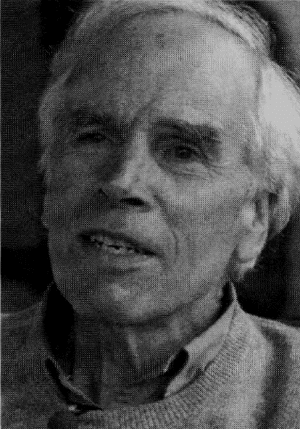 Douglas Tompkins
When I put the criticisms to him, Tompkins gave a weary smile: "I don't deny it. But when it became clear to me where this type of globalization would lead, I took the consequences and got out." He sold his shares in the enterprises and used the money to buy up one of the last temperate rainforests in Patagonia. He thus rescued a green paradise of 290,000 hectares from the chainsaws of the pulp industry. Tompkins is now regarded by the worldwide nature conservation movement as something of a "deep ecology" guru. Not satisfied with cosmetic corrections, this movement advocates putting a complete stop to the obsession with unchecked Douglas Tompkins growth.
Tompkins has no sympathy for the way the WWF cozies up to industry: "The idea that there can be sustainable intensive farming in the ocean is crazy; it's a dangerous illusion that brings us closer to ecological collapse."
When Tompkins started his project here 20 years ago he never suspected that he would one day be hemmed in by industrial aquaculture. The gaunt, delicate man with the lucent eyes sat facing me in an armchair in his old, restored villa -- a wooden palace right on the shore of Lake Llanquihue. The Gringo, as he's called here, is constantly at loggerheads with his neighbors the salmon farms. They put his paradise at risk; he maddens them by filing charges whenever they break the already lenient Chilean environmental laws. For example when one of the local farms installed 24 cages -- twice as many as permitted.
Was he glad that nature was now striking back at the hubris of the aquaculture industry in the form of the salmon virus? A friendly smile spread across Tompkins's face and it looked as though he would nod in agreement, but then suppressed the impulse:
"I can't be pleased about it, because the crisis left many people destitute. I do care about them. Still, they should use the opportunity to just shut down the salmon industry. Traditional fishing practices are much better; they can be done in an organic, sustainable manner. Chile is a paradise for fish and shellfish. Many more people could be employed in the traditional fishing industry than in salmon farming, and they would live with much more dignity."
The rampant corporate growth, he said, was like a "ferocious acceleration machine" that would destroy everything beautiful on the planet. The situation in Chile illustrated that "Karl Marx was right: capitalism devours itself in the end". Tompkins said he believed the WWF dialogue policy to be a strategic misconception: "The destruction of the planet can be stopped only by the civil resistance that exists in Chile, and in many other countries on Earth. These grass roots movements have joined together to become an increasingly powerful force."
The rich American feared that Chile's political class didn't have the strength to seize the opportunity and reverse the trend. On the contrary, they were now planning to open up the untouched glacial region in the south of the Magellan Strait to the relentless "Forward, march!" of global capitalism. There were plans for a highway that would extend all the way down to Punta Arenas, and five huge hydroelectric plants were also in the works. The energy from these facilities would enable corporations from the US, Canada, and Europe to finally crack open the glaciers and mountains to get at the mother lode within.
The salmon industry, too, stood in the starting blocks for the southward sprint: the government had already issued the first licenses for new aquafarms in the southern Magellan Strait. According to Tompkins, the companies were advancing like a swarm of locusts, leaving a trail of destruction in their wake: "With industrial fish farming we are producing a dead planet. There's no economic diversity anymore, just like there's no longer any diversity out there in the ocean. They reduce everything down to a single species: salmon. This development will catch up with us one day, and we'll pay for it, because we've forgotten that we're a part of nature. Let nature manage the oceans. She knows how; she's proved it for billions of years. Businessmen like John Fredriksen believe that as long as the profit's good everything else will take care of itself. The opposite is true."
Pandas Don't Bite
At the end of our voyage through the realm of the salmon we finally located the monarch himself:
a solitary John Fredriksen stood wearing angler's hat and raingear in the little river of Naustdal in central Norway, angling for wild salmon. He loves the peace and quiet there more than anything and leases an entire section of the river, where now he alone is allowed to fish. He comes to his private piece of river once or twice during the season -- no one knows the exact dates. I had taken my daughter along and rented rooms in a nearby farmhouse for two weeks, speculating on the arrival of Big John. Just as we were about' to give up and head home, and were making a last riverside surveillance round, we saw smoke rising from the chimney of Fredriksen's little smokehouse. Someone had fired up the fish-smoking oven. From a deeply mistrustful villager I was able to coax the information that Fredriksen had arrived early that morning -- airlifted in by his personal helicopter.
Concealed in the bushes along the riverbank we observed him through binoculars. He was waiting for a salmon to bite. No luck; there were no salmon there to take the bait.
Even in that exclusive Norwegian salmon Shangrila their stocks have been decimated by the parasites, bacteria, and viruses unleashed on the wild populations by the aquafarms. When the wild salmon come from the open sea and swim upstream to their river spawning grounds they pass by the farms and become infected by their captive relatives. They die of the disease before getting a chance to spawn the next generation.
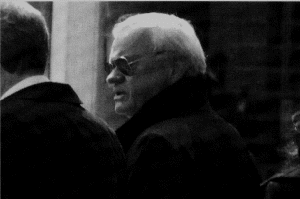 John Fredriksen in London
In a silent burst of anger, John Fredriksen threw his fishing rod into the bushes as I waded towards him in the shallows. He called for his bodyguards but the sound of the rushing waterfalls drowned out his voice. He had no choice but to stomp back towards his fishing villa. Soon afterwards his people came after me in a van to confiscate the film I had shot. We jumped into the car and made a quick getaway. What a shame! Fredriksen had missed the opportunity for an engaging conversation over smoked salmon and beer. I would have loved to have asked what motivates him and why he always has to be the biggest at everything he does. Later on I made a final twilight attempt: I got his housekeeper on the phone, but she relayed the message that her employer wished no further contact.
Every other year John Fredriksen attends the Nor-Shipping maritime trade fair in Oslo. The biennial mega event week is considered the leading international industry show of its kind. For me it was the last chance to make personal contact; we searched all day in vain for Fredriksen. A Norwegian shipbroker consoled me: "John is a shy guy, but I'm sure he'll be here tonight." That evening was the night of the shipping magnates, with a VIP party on the celebrated tall ship Christian Radich -- a champagne and caviar affair.
We set up our camera dockside of the three-masted venue and waited. Late that night we finally caught sight of Fredriksen's twin daughters as they clattered up the swaying gangway in black mini-dresses and high heels. Once on board, the future heiresses to a multi-billion fortune immediately attracted a whole flock of eager suitors. The young women are both already on the management boards of daddy's companies: Kathrine has a hand in shipping, Cecilie in salmon. The following night we were in luck: we finally caught the big fish by chance, in the middle of the Oslo harbor promenade.
My journalist colleague Arno Schumann made a beeline for Fredriksen, camera rolling. Fredriksen's companions closed ranks to protect him. I shouted through the human shield, asking if he felt personally responsible for the calamity that was still ravaging Chile. The salmon king continued on his way, po-faced, but then reacted after all with a little joke: "I'm just a salmon fisher". When I reminded him that he owned Marine Harvest he immediately changed his tune and grew serious: eel have nothing to do with the operational business, but I'm very sorry about what's happened. I sympathize with everyone there who has been affected." Fredriksen then quickly disappeared into an upscale restaurant to enjoy a gourmet meal of fresh oysters, fish and fine wine. Anchors aweigh and off to new business opportunities. There was no Chilean salmon on the menu there that night.
Why would the WWF seek out someone like John Fredriksen, of all people, as a partner for saving the planet? He is the prototypical financial investor, obedient to the law of profit; the Earth's natural resources are apparently little more to him than the means to erecting his cold, monetary castle. Fredriksen could have gone down in the annals as one of the most notorious bad guys in the history of corporate capitalism. But then, as if by divine intervention, the panda had plopped down in his lap. And suddenly his empire took on a miraculous green glow.
Over half of the global fish catch now ends up in the mills of the fishmeal factories instead of on people's plates. As fish stocks worldwide become increasingly depleted, the salmon industry is turning to a new feed source. Companies have now begun to send huge trawlers into the Antarctic to fish for krill, the tiny crabs that are the oceans' staff of life; the largest nutritional reserves of the world's maritime systems. Krill, too, are now being used to make salmon feed.
Chilean aquafarmed salmon travel across the globe by airfreight, destined to land in bite-sized portions on restaurant tables in Paris, Tokyo, and New York, et al. The hungry diner sees only a perfectly innocent-looking delicate rosy-pink piece of fish. But the appearance of the salmon belies the martyrdom it has endured to end up there; the numerous chemicals and antibiotics it had to swallow to survive life in the crowded cages. And you can't tell by looking at the meal on the plate how much energy was used to produce it, and how much was wasted on long-distance shipment. For those at the top of the financial food chain, the bottom line makes it all worthwhile, but is the whole thing really socially and ecologically acceptable?
Intensive farming is accelerating the depletion of natural resources and destroying the traditional fishing industry. Thus "sustainable salmon farming" is a fairytale concocted by the aquafarming industry and the WWF in a collaboration aimed at lulling our critical thinking capacities to sleep. There is no right way to do the wrong thing. The big sharks eat everything that gets in their way. And the political authorities elected to represent the interests of civil society feebly allow the multinational corporations to make all the rules in the global game.
The WWF apparently swims with sharks in the audacious hope that its moral influence will turn them into docile vegetarians. In the summer of 2011, the WWF finally reached an agreement with the industrial salmon sector, and together they launched the certification program for marine farming facilities: the Aquaculture Stewardship Council, or ASC. With that, the intensive farming of fish in the open sea rose to the ranks of nobility in the realm of the green economy.
During my research for this book I also spoke with many WWF activists. They were committed to their area of interest and were certainly doing the best job they could; they knew very little about the WWF's international partnerships -- and didn't want to hear anything about them either. However, when confronted with the fact that the world's oceans are being fished bare to feed a predator species in intensive aquafarming units, they did at least seem to suspect that all could not be completely rosy.
The typical reaction was, in effect: "I really don't want to know all the gory details. My own project is above board, and that's what I'm concentrating on."
A management-level staffer at WWF International told me in confidence that he was "ashamed" of the partnership with the salmon industry, but a public airing of his critical views was out of the question; it would certainly cost him his well-paid job. This individual said the loss of "credibility" in WWF policies was down to sociological developments: the WWF had grown too big, and collected money without making sure they knew where it came from.
The classic environmentalists had been ''ousted" from executive positions in the WWF and replaced by marketing specialists who failed to take a "principled" stance on nature conservation issues and saw themselves primarily as fundraisers.
The critical thinkers within the WWF are deeply frustrated, but to date the internal conflicts that are presumably smoldering have been successfully kept under wraps. In Germany, for example, many WWF activists have for many years taken part in protests against nuclear energy -- but strictly as private individuals, displaying no visible WWF affiliation. Not until 2002 did WWF International officially distance itself from nuclear energy production, finally joining the growing ranks of atomic energy phase-out proponents.
Can the proximity of the WWF to big business be explained by the lure of money and recognition alone? A former WWF manager who left over ethical issues but would like to remain anonymous suspects there is more to it than the increasing dependency on major donations. In her view: "The WWF is like a pizzeria. Everything looks clean and nice on the outside. And they actually do have pizza -- delicious, made from certified organic ingredients. But this pizzeria has a back room where all the really important deals are done -- that frightens me."