|
THE ILLUMINATUS! TRILOGY |
|
"It's probably all jumbled in your head," I went on, furious that our plan was falling apart, that I needed his trust now but had no way to earn it. "We've been disintoxicating and dehypnotizing you, but you almost certainly can't tell where the Illuminati left off and we rescued you and started reversing the treatment. You're due to explode into psychosis within twenty-four hours and we're using the only techniques that can defuse that process." "Why am I hearing everything twice?" Saul asked, balancing between wary skepticism and a sense that Malik was not playing games any more but urgently trying to help him. "The stuff they gave you was an MDA derivative— very high on mescaline and methedrine both. It has an echo effect for seventy-two hours minimum. You're hearing what I'm going to say before I say it and then again when I do say it. That'll pass in a few minutes, but it'll be back, every half hour or so, for the next day yet. The end of the chain is psychosis, unless we can stop it." "Unless we can stop it." "It's easing up now," Saul said carefully, "Less of an echo that time. I still don't know whether to trust you. Why were you trying to turn me into Barney Muldoon?" "Because the psychic explosion is on Saul Goodman's time-track, not on Barney Muldoon's." Ten big rhinoceroses, eleven big rhinoceroses . . . "You Wascal Wabbit," Simon whispers through the Judas Window. Immediately the door opens and a grinning young man with the Frisco-style Jesus Christ hair-and-beard says, "Welcome to the Joshua Norton Cabal." Joe sees to his relief that it was a normal but untypically clean hippie hangout, and there are none of the sinister accoutrements of the Lake Shore Drive coven. At the same time, he hears the strange man in the bed asking, "Why were you trying to turn me into Barney Muldoon?" My God, now it's happening when I'm awake as well as when I'm asleep. Simu-multi-taneously, he hears the alarm and cries, "The Illuminati must be attacking!" "Attacking this building?" Saul asks confusedly. "Building? You're on a submarine, man. The Lief Erickson, on its way to Atlantis!" Twenty big rhinoceroses, twenty-one big rhinoceroses ... "Number Seventeen," read Professor Curve, "Law and anarchists will give the American people a speedy Cadillac."
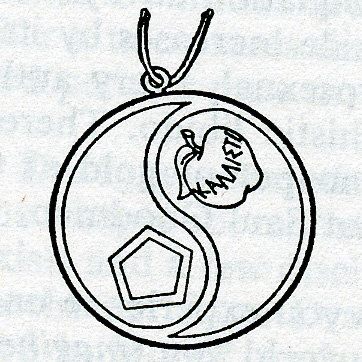
You can call me Doc Iggy. My full name, at present, is Dr. Ignotum P. Ignotius. The P. stands for Per. If you're a Latinist, you'll realize that translates as "the unknown explained by the still more unknown." I think it's a quite appropriate name for my function tonight, since Simon brought you here to be illuminized. My slave name, before I was turned on myself, is totally immaterial. As far as I'm concerned, your slave name is equally pointless, and I'll call you by the password of the Norton Cabal, which Simon used at the door. Until tomorrow morning, when the drug starts wearing off, you are U. Wascal Wabbit. That's U., the initial, not why-oh-you, by the way. We accept Bugs Bunny as an exemplar of Mummu here, too, but otherwise we have little in common with the SSS. That's the Satanist, Surrealists and Sadists— the crew who began your illuminization in Chicago. All we share with them actually is use of the Tristero anarchist postal system, to evade the government's postal inspectors, and a financial agreement whereby we accept their DMM script—Divine Marquis Memorial script— and they accept our hempscript and the flaxscript of the Legion of Dynamic Discord. Anything to avoid Federal Reserve notes, you know. It'll be a while yet before the acid starts working, so I'll just chat like this, about things that are more or less trivial— or quadrivial, or maybe pentivial—until I can see that you're ready for more serious matters. Simon's in the chapel, with a woman named Stella who you'll really dig, getting things ready for the ceremony. You might wonder why we're called the Norton Cabal. The name was chosen by my predecessor, Malaclypse the Younger, before he left us to join the more esoteric group known as ELF—the Erisian Liberation Front. They're the Occidental branch of the Hung Mung Tong Cong and all their efforts go into a long-range anti-Illuminati project known only as Operation Mindfuck. But that's another, very complicated, story. One of Malaclypse's last writings, before he went into the Silence, was a short paragraph saying, "Everybody understands Mickey Mouse. Few understand Hermann Hesse. Hardly anyone understands Albert Einstein. And nobody understands Emperor Norton." I guess Malaclypse was already into the Mindfuck mystique when he wrote that. (Who was Emperor Norton? Joe asks, wondering if the drug is beginning to work already or Dr. Ignotius just has a tendency to speak more slowly than most people.) Joshua Norton, Emperor of the United States and Protector of Mexico. San Francisco is proud of him. He lived in the last century and got to be emperor by proclaiming himself as such. For some mysterious reason, the newspapers decided to humor him and printed his proclamations. When he started issuing his own money, the local banks went along with the joke and accepted it on par with U.S. currency. When the Vigilantes got into a lynching mood one night and decided to go down to Chinatown and kill some Chinese, Emperor Norton stopped them just by standing in the street with his eyes closed reciting the Lord's Prayer. Are you beginning to understand Emperor Norton a little, Mr. Wabbit? (A little, Joe said, a little. . .) Well, chew on this for a while, friend: there were two very sane and rational anarchists who lived about the same time as Emperor Norton across the country in Massachusetts: William Green and Lysander Spooner. They also realized the value of having competing currencies instead of one uniform State currency, and they tried logical arguments, empirical demonstrations and legal suits 'to get this idea accepted. They accomplished nothing. The government broke its own laws to find ways to suppress Green's Mutual Bank and Spooner's People's Bank. That's because they were obviously sane, and their currency did pose a real threat to the monopoly of the Illuminati. But Emperor Norton was so crazy that people humored him and his currency was allowed to circulate. Think about it. You might begin to understand why Bugs Bunny is our symbol and why our currency has the ridiculous name hempscript. Hagbard Celine and his Discordians, even more absurdly, call their money flaxscript. That commemorates the Zen Master who was asked, "What is the Buddha?" and replied, "Five pounds of flax." Do you begin to see the full dimensions of our struggle with the Illuminati? At least, for now, you can probably grasp this much: their fundamental fallacy is the Aneristic Delusion. They really believe in law n' order. As a matter of fact, since everybody in this crazy, millennia-old battle has his own theory about what the Illuminati are really aiming at, I might as well tell you mine. I think they're all scientists and they want to set up a scientific world government. The Jacobins were probably following precise Illuminati instructions when they sacked the churches in Paris and proclaimed the dawn of the Age of Reason. You know the story about the old man who was in the crowd when Louis XVI went to the guillotine and who shouted as the king's head fell, "Jacques De Molay, thou art avenged"? All the symbols that De Molay introduced into Masonry are scientific implements— the T-square, the architect's triangle, even that pyramid that has caused so much bizarre speculation. If you count the eye as part of the design, the pyramid has 73 divisions, you know, not 72. What's 73 mean? Simple: multiply it by five, in accordance with Weishaupt's funfwissenschaft, the science of fives, and you get 365, the days of the year. The damn thing is some kind of astronomical computer, like Stonehenge. The Egyptian pyramids are facing to the East, where the sun rises. The great pyramid of the Mayans has exactly 365 divisions, and is also facing to the East. What they're doing is worshipping the "order" they have found in Nature, never realizing that they projected the order there with their own instruments. That's why they hate ordinary mankind— because we're so disorderly. They've been trying for six or seven thousand years to reestablish Atlantis-style high civilization— law 'n' order— the Body Politic, as they like to call it. A giant robot is what their Body Politic really amounts to, you know. A place for everything and everything in its place. A place for everybody and everybody in his place. Look at the Pentagon— look at the whole army, for Goddess's sake! That's what they want the planet to be like Efficient, mechanical, orderly— very orderly— and inhuman. That's the essence of the Aneristic Delusion: to imagine you have found Order and then to start manipulating the quirky, eccentric chaotic things that really exist into some kind of platoons or phalanxes that correspond to your concept of the Order they're supposed to manifest. Of course, the quirkiest, most chaotic things that exist are other people— and that's why they're so obsessed with trying to control us. Why are you staring like that? Am I changing colors or growing bigger or something? Good: the acid is starting to work. Now we can really get to the nitty-gritty. First of all, most of what I've been telling you is bullshit. The IIluminati have no millennia-old history; neither do the JAMs. They invented their great heritage and tradition— Jacques De Molay and Charlemagne and all of it— out of whole cloth in 1776, picking up all sorts of out-of-context history to make it seem plausible. We've done the same. You might wonder why we copy them, and even deceive our own recruits about this. Well, part of illumination— and we've got to be illuminized ourselves to fight them— is in learning to doubt everything. That's why Hagbard has that painting in his stateroom saying "Think for yourself, schmuck," and why Hassan i Sabbah said "Nothing is true." You've got to learn to doubt us, too, and everything we tell you. There are no honest men on this voyage. In fact, maybe this part is the only lie I've told you all evening, and the Illuminati history before 1776 really is true and not an invention. Or maybe we're just a front for the Illuminati... to recruit you indirectly. . . . Feeling paranoid? Good: illumination is on the other side of absolute terror. And the only terror that is truly absolute is the horror of realizing that you can't believe anything you've ever been told. You have to realize fully that you are "a stranger and afraid in a world you never made," like Houseman says. Twenty-two big rhinoceroses, twenty-three big. rhinoceroses .. . The Illuminati basically were structure-freaks. Hence, their hangup on symbols of geometric law and architectural permanence, especially the pyramid and the pentagon. (God's Lightning, like all authoritarian Judeo-Christian heresies, had its own share of this typically Occidental straight-line mystique, which was why even the Jews among them, like Zev Hirsch, accepted the symbol first suggested by Atlanta Hope: that most Euclidean of all religious emblems: the Cross.) The Discordians made their own sardonic commentary on the legal and scientific basis of law V order by using a 17-step pyramid—17 being a number with virtually no interesting geometric, arithmetic or mystic properties, outside of Java, where it was the basis of a particularly weird musical scale— and topping it with the Apple of Discord, symbol of the un-rational, un-geometrical, and thoroughly disorderly spontaneity of the vegetable world of creative evolution. The Erisian Liberation Front (ELF) had no symbol, and when asked for one by new recruits, replied loftily that their symbol could not be pictured, since it was a circle whose circumference was everywhere and its center nowhere. They were the most far-out group of all, and only the most advanced Discordians could begin to understand their gibberish. The JAMs, however, had a symbol that anyone could understand, and, just as Harry Pierpont showed it to John Dillinger midway through a nutmeg high in Michigan City prison, Dr. Ignotius showed it to Joe midway through his first acid trip. "This," he said dramatically, "is the Sacred Chao."
"That's a symbol of technocracy," Joe said, giggling. "Well," Dr. Ignotius smiled, "at least you're original. Nine out of ten new members mistake it for the Chinese yin-yang or the astrological symbol of Cancer. It's similar to both of them— and also to the symbols of the Northern Pacific Railroad and the Sex Information and Education Council of the United States, all of which is eventually going to lead to some interesting documents being produced at John Birch headquarters, I'm sure, proving that sex educators run the railroads or that astrologers control the sex educators or something of that sort. No, this is different. It is the Sacred Chao, symbol of Mummu, God of Chaos. "On the right, O nobly born, you will see the image of your 'female' and intuitive nature, called yin by the Chinese. The yin contains an apple which is the golden apple of Eris, the forbidden apple of Eve, and the apple which used to disappear from the stage of the Flatbush Burlesque House in Brooklyn when Linda Larue did the split on top of it at the climax of her striptease. It represents the erotic, libidinal, anarchistic, and subjective values worshiped by Hagbard Celine and our friends in the Legion of Dynamic Discord. "Now, O nobly born, as you prepare for Total Awakening, turn your eyes to the left, yang side of the Sacred Chao. This is the image of your 'male,' rationalistic ego. It contains the pentagon of the Illuminati, the Satanists, and the U.S. Army. It represents the anal, authoritarian, structural, law 'n' order values which the Illuminati have imposed, through their puppet governments, on most of the peoples of the world. "This is what you must understand, O newborn Buddha: neither side is complete, or true, or real. Each is an abstraction, a fallacy. Nature is a seamless web in which both sides are in perpetual war (which is another name for perpetual peace). The equation always balances. Increase one side, and the other side increases by itself. Every homosexual is a latent heterosexual, every authoritarian cop is the shell over an anarchistic libido. There is no Vernichtung, no Final Solution, no pot of gold at the end of the rainbow, and you are not Saul Goodman, when you're lost out here." Listen: the chaos you experience under LSD is not an illusion. The orderly world you imagine you experience, under the artificial and poisonous diet which the Illuminati have forced on all civilized nations, is the real illusion. I am not saying what you are hearing. The only good fnord is a dead fnord. Never whistle while you're pissing. An obscure but highly significant contribution to sociology and epistemology occurs in Malignowski's study "Retroactive Reality," printed in Wieczny Kwiat Wtadza, the journal of the Polish Orthopsychiatric Psociety, for Autumn 1959. "All affirmations are true in some sense, false in some sense, meaningless in some sense, true and false in some sense, true and meaningless in some sense, false and meaningless in some sense, and true and false and meaningless in some sense. Do you follow me?" (In some sense, Joe mutters. . . .) The author, Dr. Malignowski, was assisted by three graduate students named Korzybski-1, Korzybski-2, and Korzybski-3 (Siamese triplets born to a mathematician and, hence, indexed rather than named). Malignowski and his students interviewed 1,700 married couples, questioning husband and wife separately in each case, and asked 100 key questions about their first meeting, first sexual experience, marriage ceremony, honeymoon, economic standing during the first year of marriage, and similar subjects which should have left permanent impressions on the memory. Not one couple in the 1,700 gave exactly the same answers to 100 questions, and the highest single score was made by a couple who gave the same answers to 43 of the questions. "This study demonstrated graphically what many psychologists have long suspected: the life-history which most of us carry around in our skulls is more our own creation (at least seven percent more) than it is an accurate recording of realities. As Malignowski concludes, 'Reality is retroactive, retrospective and illusory.' "Under these circumstances, things not personally experienced but recounted by others are even more likely to be distorted, and after a tale passes through five tellers it is virtually one hundred percent pure myth: another example of the Law of Fives. "Only Marxists," Dr. Iggy concluded, opening the door to usher Joe into the chapel room, "still believe in an objective history. Marxists and a few disciples of Ayn Rand." Jung took the parchment from Drake and stared at it "It's not to be signed in blood? And what the hell is this yin-yang symbol with the pentagon and the apple? You're a fucking fake." His lips curled tightly in against his teeth. "What do you mean?" said George through a throat that was rapidly closing up. "I mean you're not from the goddam Illuminati," said Jung. "Who the hell are you?" "Didn't you know that before I came here— that I'm not from the Illuminati?" said George. "I'm not trying to fake anybody out. Honest, really, I thought you knew the people who sent me. I never said I was from the Illuminati." Maldonado nodded, a slight smile bringing his face to life. "I know who he is. The people of the Old Strega. The Sybil of Sybils. All hail Discordia, kid. Right?" "Hail Eris," said George with a slight feeling of relief. Drake frowned. "Well, we seem to be at cross purposes. We were contacted by mail, then by telephone, then by messenger, by parties who made it quite clear that they knew all about our business with the Illuminati. Now, to the best of my knowledge— perhaps Don Federico knows better— there is only one organization in the world that knows anything about the AISB, and that is the AISB itself." George could tell he was lying. Maldonado raised a warning hand. "Wait. Up, everybody. To the bathroom." Drake sighed. "Oh, Don Federico! You and your tired notions of security. If my house isn't safe, we're all dead men as of this moment. And if the AISB is as good as it's said to be, an old trick like running water will be no obstacle to them. Let's conduct this discussion like civilized men, for God's sake, and not huddled around my shower stall." "There are times when dignity is suicide," said Maldonado. He shrugged. "But, I yield. I'll settle the question with you in hell if you're wrong." "I'm still in the dark," said Richard Jung. "I don't know who this guy is or where he's from." "Look, Chinaman," said Maldonado. "You know who the Ancient Illuminated Seers of Bavaria are, right? Well, every organization has opposition, right? So do the Illuminati. Opposition that's like them, religious, magical, spooky stuff. Not simply interested in becoming rich, as is our gentlemanly aim in life. Playing supernatural games. Capeesh?" Jung looked skeptical. "You could be describing the Communist party, the CIA, or the Vatican." "Superficial," said Maldonado scornfully. "And upstarts, compared with the AISB. Because the Bavarian Illuminati aren't Bavarians, you understand. That's just a recent name and manifestation for their order. Both the Illuminati and their opposition, which this guy represents, go back a long ways before Moscow, Washington or Rome. A little imagination is called for to understand this, Chinaman." "If the Illuminati are yang," George said helpfully, "we're yin. The only solution is a Yin Revolution. Dig?" "I am a graduate of Harvard Law School," said Jung loftily, "and I do not dig it. What are you, a bunch of hippies?" "We never made a deal with your bunch before," said Maldonado. "They never had enough to offer us." Robert Putney Drake said, "Yes, but wouldn't you like to, though, Don Federico? Haven't you had a bellyfull of the others? I know I have. I know where you're from now, George. And you people have been making giant strides in recent decades. I'm not surprised that you're able to tempt us. It's worth our lives— and we are supposedly the most secure men in the United States— to betray the Illuminati. But I understand you offer us statues from Atlantis. By now they should be uncrated. And that there are more where these came from? Is that right, George?" Hagbard had said nothing about that, but George was too worried about his own survival to quibble. "Yes," he said. "There are more." Drake said, "Whether we want to risk our lives by working with your people will depend on what we find when we examine the objets d'art you are offering. Don Federico, being a highly qualified expert in antiquities, particularly in those antiquities which have been carefully kept outside of the ken of conventional archaeological knowledge, will pronounce on the value of what you've brought. As a Sicilian thoroughly versed in his heritage, Don Federico is familiar with things Atlantean. The Sicilians are about the only extant people who do know about Atlantis. It is not generally realized that the Sicilians have the oldest continuous civilization on the face of the planet. With all due respects to the Chinese." Drake nodded formally to Jung. "I consider myself an American," said Jung. "Though my family knows a thing or two about Tibet that might surprise you." "I'm sure," said Drake. "Well, you shall advise, as you are able. But the Sicilian heritage goes back thousands of years before Rome, as does their knowledge of Atlantis. There were a few things washed up on the shores of North Africa, a few things found by divers. It was enough to establish a tradition. If there were a museum of Atlantean arts, Don Federico is one of the few people in the world qualified to be a curator." "In other words," said Maldonado with a ghastly smile, "those statues better be authentic, kid. Because I will know if they are not." "They are," said George. "I saw them picked up off the ocean bottom myself." "That's impossible," said Jung. "Let's look," said Drake. He stood up and placed the palm of his hand flat against an oak panel which immediately slid to one side, revealing a winding metal staircase. Drake leading the way, the four of them descended what seemed to George five stories to a door with a combination lock. Drake opened the door and they passed through a series of other chambers, ending up in a large underground garage. The Gold & Appel truck was there and beside it the four statues, freed of their crates. There was no one in the room. "Where did everybody go?" said Jung. "They're Sicilians," said Drake. "They saw these and were afraid. They did the job of uncrating them and left." His face and Maldonado's wore a look of awe. Jung's craggy features bore an irritated, puzzled frown. "I'm beginning to feel that I've been left out of a lot," he said. "Later," said Maldonado. He took a small jeweler's glass out of his pocket and approached the nearest statue. "This is where they got the idea for the great god Pan," he said. "But you can see the idea was more complicated twenty thousand years ago than two thousand." Fixing the jeweler's glass in his eye, he began a careful inspection of a glittering hoof. At the end of an hour, Maldonado, with the help of a ladder, had gone over each of the four statues from bottom to top with fanatical care and had questioned George about the manner of their seizure as well as what little he knew of their history. He put his jeweler's glass away, turned to Drake and nodded. "You got the four most valuable pieces of art in the world." Drake nodded. "I surmised as much. Worth more than all the gold in all the Spanish treasure ships there ever were." "If I have not been dosed with a hallucinogenic drug," said Richard Jung, "I gather you are all saying these statues come from Atlantis. I'll take your word for it that they're solid gold, and that means there's a lot of gold there." "The value of the matter is not worth one one ten-thousandth the value of the form," said Drake. "That I don't see," said Jung. "What is the value of Atlantean art if no reputable authority anywhere in the world believes in Atlantis?" Maldonado smiled. "There are a few people in the world who know that Atlantis existed, and who know there is such a thing as Atlantean art. And believe me, Richard, those few got enough money to make it worth anyone's while who has a piece from the bottom of the sea. Any one of these statues could buy a middle-sized country." Drake clapped his hands with an air of authority. "I'm satisfied if Don Federico is satisfied. For these and for four more like them— or the equivalent if four such statues simply don't exist— my hand is joined with the hand of the Discordian movement. Let us go back upstairs and sign the papers— in pen and ink. And then, George, we would like you to be our guest at dinner." George didn't know if he had the authority to promise four more statues, and he was certain that total openness was the only safe approach with these men. As they were climbing the stairs, he said to Drake, who was above him, "I wasn't authorized by the man who sent me to promise anything more. And I don't believe he has any more at the moment, unless he has a collection of his own. I know these four statues are the only ones he captured on this trip." Drake let out a small fart, an incredible thing, it seemed to George, for the leader of all organized crime in the United States to do. "Excuse me," he said. "The exertion of these stairs is too much for me. Would love to put in an elevator, but that wouldn't be as secure. One of these days my heart will give out, going up and down those stairs." The fart smelled moderately bad, and George was glad when he had climbed out of its neighborhood. He was surprised that a man of Drake's importance would acknowledge that he farted. Perhaps that kind of straightforwardness was a factor in Drake's success. George doubted that Maldonado would admit to a fart. The Don was too devious. He was not your earthy sort of Latin— he was paper-thin and paper-pale, like a Tuscan aristocrat of attenuated bloodline. They reentered Drake's office, and Drake and Maldonado each signed the parchment scroll. After the phrase, "for valuable considerations received," Drake inserted the words, "and considerations of equal value yet to come." He smiled at George. "Since you can't guarantee the additional objects, I'll expect to hear from your boss within twenty-four hours after you leave here. This whole deal is contingent upon the additional payment from you." ORGASM. HER BUBBIES FRITCHID BY THE GYNING DEEP SEADOODLER. All in a lewdercrass chaste for a moulteeng fawkin. In fact, hearing Drake say that he was to be leaving the Syndicate fortress made George feel a bit better. He signed in behalf of the Discordians and Jung signed as a witness. Drake said, "You understand, there is no way the organizations which Don Federico and I represent can be bound by anything we sign. What we agree to here is to use our influence with our many esteemed colleagues and to hope that they will grant us the favor of cooperation in the mutual enterprise." Maldonado said, "I couldn't have said it better myself. We, of course, personally pledge our lives and our honor to further your purposes." Robert Putney Drake took a cigar out of a silver humidor. Slapping George on the back, he shoved the cigar into his mouth. "You know, you're the first hippie I've ever done business with. I suppose you'd like to have some marijuana. I don't keep any around the house, and as you probably know we don't deal much in the stuff. Too bulky to transport, considering the amount you can make on it. Aside from that, I think you'll like the food and drink here. We'll have a big dinner and some entertainment." The dinner was steak Diane, and it was served to the four men at a long table in a dining room hung with large, old paintings. They were waited on by a series of beautiful young women, and George wondered where the gang leaders kept their wives and mistresses. In some sort of pur-dah, perhaps. There was something Arabic about this whole setup. During the main course a blonde in a long white gown which left one breast bare played the harp in a corner of the room and sang. There was conversation with the coffee; four young women sat down briefly with the men and regaled them with witticisms and funny stories. With the brandy came Tarantella Serpentine. She was an amazingly tall woman, at least six feet two, with long blond hair that was piled high on her head and fell below her shoulders. She was wearing tinkling gold bracelets around her wrists and ankles, and there were diaphonous veils wrapped around her slender body, and nothing else. George could see pink nipples and dark crotch hair. When she strode through the door Banana-Nose Maldonado wiped his mouth with his napkin and began applauding gleefully. Robert Putney Drake smiled proudly and Richard Jung swallowed hard. George just stared. "The star of our little rural retreat," said Drake by way of introduction. "May I present— Miss Tarantella Serpentine." Maldonado's applause continued, and George wondered if he should join in. Music, Oriental but with a touch of rock, flooded the room. The sound reproduction equipment was excellent, nigh perfect. Tarantella Serpentine began to dance. It was a strange, hybrid sort of dance, a synthesis of belly-dancing, go-go, and modern ballet. George licked his lips and he felt his face get warm and his penis begin to throb and swell as he watched. Tarantella Serpentine's dance was even more sensuous than the dance Stella Maris had done when he was being initiated into the Discordian movement. After she had done three dances, Tarantella bowed and left. "You must be tired, George," said Drake, resting his hand on George's shoulder. Suddenly, George realized he had been going on almost no sleep except for the times he'd dozed off in the car on the way from Mad Dog to the Gulf. He had been under incredible physical, and even more important, emotional pressure. He agreed that he was tired, and, praying that he would not be murdered in his sleep, he let Drake lead him to a bedroom. The bed was an enormous four poster with a cloth-of-gold canopy. Naked, George slid between cool, crisp sheets, and clutching the top sheet around his neck, lay flat on his back, shut his eyes tight and sighed. That morning he had been on a beach in the Gulf of Mexico watching naked Mavis masturbate. He had fucked an apple. He had been to Atlantis. And now he was lying on a downy-soft mattress in the home of the chief of all organized crime in America. If he closed his eyes he might find himself back in the Mad Dog jail. He shook his head. There was nothing to fear. He heard the bedroom door open. There was nothing to fear. To prove it, he kept his eyes closed. He heard a board squeak. Squeaky boards in this place? Sure— to warn the sleeper that there was someone sneaking up on him. He opened his eyes. Tarantella Serpentine was standing over the bed. "Bobby-baby sent me," she said. George closed his eyes again. "Sweetheart," he said, "you are beautiful. You really are. You're beautiful. Make yourself comfortable." She reached down and turned on a bedside lamp. She was wearing a gold metallic bikini top with a short matching skirt. Her breasts were delightfully small, George thought. Although, on a five-foot-two girl they'd be ample. But Tarentella was built like a Vogue model. George liked her looks. He had always been partial to tall, slender boyish women. "I'm not intruding on you, am I?" she asked. "You sure you wouldn't rather sleep?" "Well it's not so much what Td rather do," said George. "I doubt that I can do anything other than sleep. I have had a very trying day." Masturbated once, he thought, had one blow job, and fucked one apple. Forgive us our debts as we forgive our debtors. Plus been scared out of my wits 90 percent of the time. Tarantella said, "My name is known in ratified circles for what I can achieve with men whose days are all trying. Presidents, kings, Syndicate heads— naturally— rock stars, oil billionaires, people like that. My thing is, I can make men come. Over and over and over and over again. Ten times, sometimes even twenty times, no matter how old or how tired. I get paid a lot. Tonight, Bobby-baby is paying for my services, and I'm to service you. Which I like very much, because most of my clientele is on the middle-aged side, and you're nice and young and have a firm body." She gently pulled the sheet loose from George's grip— he had forgotten he was still holding it up around his neck— and caressed his bare shoulder. "How old are you, George— twenty-two?" "Twenty-three," said George. "But I don't want to disappoint you. I'm willing and I'm interested. In fact, I'm curious about what you do. But I'm pretty tired." "Honey, you can't disappoint me. The more limp you are, the more I like it. The more of a challenge you are to me. Let me show you my specialty." Tarantella doffed her bra, skirt, and panties quickly but deliberately enough to let George enjoy watching her. Smiling at him, she stood before him, her legs spread wide apart. Her fingernails tickled her nipples, and George watched them swell up. Then, her left hand playing with her left breast, her right hand snaked down to her groin and began massaging the golden-brown hairs of her mons. Her middle finger disappeared between her legs. After a few moments a scarlet flush spread over her face, neck, and chest, her body arched backward, and she gave a single, agonized cry. Her skin, from head to toe, was glowing with a fine coating of sweat. After a momentary pause she smiled and looked at him. Her right hand caressed his cheek and he felt the wetness on his face and smelled the Lobster Newburg aroma of a young cunt. Her fingers drifted to the sheets, and with a sudden movement she stripped them away from George's body. She grinned down at his stiff cock and in a moment was on top of him, holding his prick, inserting it into herself. Two minutes of smooth pistonlike movements on her part brought him to an unexpectedly pleasant orgasm. "Baby," he said. "You could wake the dead." He enjoyed his second orgasm about a half hour later, and his third a half hour after that. The second time Tarantella lay on her back and George lay on top of her, and the third time she was on her stomach and he was straddling her from the rear. There was something about the mood Tarantella created that was crucial to what she called her "specialty." Though she had boasted about her ability to make a man come repeatedly, when it came right down to doing things she made him feel that it didn't really matter what happened with him. She was fun-loving, playful, carefree. He did not feel obligated in any sense to stiffen, to come. Tarantella might view men as a challenge, but she made it clear that George was not to see her as a challenge. After a short nap, he woke to find her sucking his rapidly hardening penis. It took much longer this time for him to come, but he enjoyed every second of mounting pleasure. After that they lay side by side and talked for a while. Then Tarantella went to the bedside table and took a tube of petroleum jelly out of a drawer. She began applying it to his penis, which grew erect during the process. Then she rolled over and presented him with her rosy asshole. It was the first time George had had a woman that way, and he came rather quickly after insertion from the novelty and excitement of it all. They slept for a while and he awoke to find her masturbating him. Her fingers were very clever and seemed quickly to find their way to all the most sensitive parts of his penis— with special attention to that area just behind the crown of the head. He opened his eyes wide when he came and saw, after a few seconds, a small, pale, pearl-like drop of semen appear on the end of his dick. A wonder there was any at all. It was getting to be a trip. His ego went away somewhere, and he was all body, letting it all happen. It was fucking Tarantella, and it was coming— and, judging by the sounds she was making and the wetness in which his penis was sloshing, she was coming, too. There followed two more blow jobs. Then Tarantella pulled something that looked like an electric razor out of the bed-table drawer. She plugged it into the wall and began to stroke his penis with its vibrating head, pausing every so often to lick and lubricate the areas she was working on. George closed his eyes and rolled his hips from side to side as he felt yet another orgasm coming on. From a great distance he heard Tarantella Serpentine say, "My greatness lies in the life I can generate in limp pricks." George's pelvis began to pump up and down. It was really going to be that superorgasm Hemingway described. It began to happen. It was pure electricity. No juice— all energy pouring out like lightning through the magic wand at the center of his being. He wouldn't be surprised to discover that his balls and cock were disintegrating into whirling electrons. He screamed, and behind his tight-clenched eyes, he saw, very clearly, the smiling, face of Mavis. He awoke in the dark, and his instinctive groping motion told him that Tarantella was gone. Instead, Mavis, in a white doctor's smock, stood at the foot of the bed, watching him with large bright eyes. The darkened Drake bedroom had turned into a hospital ward, and was suddenly brightly lit. "How did you get here?" he blurted. "I mean— how did I get here?" "Saul," she said kindly, "it's almost all over. You've come through it." And suddenly he realized that he felt, not twenty-three, but sixty-three years old. "You've won," he admitted, "I'm no longer sure who I am." "You've won," Mavis contradicted. "You've gone through ego loss and now you're beginning to discover who you really are, poor old Saul." He examined his hands: old man's. Wrinkled. Goodman's hands. "There are two forms of ego loss," Mavis went on, "and the Illuminati are masters of both. One is schizophrenia, the other is illumination. They set you on the first track, and we switched you to the other. You had a time bomb in your head, but we defused it." Malik's apartment. The Playboy Club. The submarine. And all the other past lives and lost years. "By God," Saul Goodman cried, "I've got it. I am Saul Goodman, but I am all the other people, too." "And all time is this time," Mavis added softly. Saul sat upright, tears gleaming in his eyes. "I've killed men. I've sent them to the electric chair. Seventeen times. Seventeen suicides. The savages who cut off fingers or toes or ears for their gods are more sensible. We cut off whole egos, thinking they are not ourselves but separate. God God God," and he burst in sobs. Mavis rushed forward and held him, cradling his head to her breast. "Let it out," she said. "Let it all out. It's not true unless it makes you laugh, but you don't understand until it makes you weep." QUEENS. Psychoanalysts in living cells, moving in military ordure, and a shitty outlook on life and sex, dancing coins in harry's krishna. It all coheres, even if you approach it bass ackwards. It coheres. "Gruad the grayface!" Saul screamed, weeping, beating his fist against the pillow as Mavis held his head, stroked his hair. "Gruad the damned! And I have been his servant, his puppet, sacrificing myselves on his electric altars as burnt offerings." "Yes, yes," Mavis cooed in his ear. "We must learn to give up our sacrifices, not our joys. They have taught us to give up everything except our sacrifices, and those are what we must give up. We must sacrifice our sacrifices." "The Grayface, the life-hater!" Saul shrieked. "The bastard motherfucker! Osiris, Quetzalcoatl, I know him under all his aliases. Grayface, Grayface, Grayface! I know his wars and his prisons, the young boys he shafts up the ass, the George Dorns he tries to turn into killers like himself. And I have served him all my life. I have sacrificed men on his bloody pyramid!" "Let it out," Mavis repeated, holding the old man's trembling body "Let it all out, baby. . . ." NOTHUNG. Woden you gnaw it, when you herd those flying sheeps with Wagner's loopy howls? Hassan walked this loony valley, he had to wake up by himself. August 23, 1966: before he ever heard of the SSS, the Discordians, the JAMs or the Illuminati: stoned and beatific, Simon Moon is browsing in a Consumer Discount store on North Clark street, digging the colors, not really intending to buy anything. He stops in a frieze, mesmerized by a sign above the timeclock:
"God's pajamas," Simon mutters, incredulous. "Pajamas? Aisle seven," a clerk says helpfully. "Yes. Thanks," Simon speaks very distinctly, edging away, hiding his high. God's pajamas and spats, he thinks in a half-illuminated trance, either I'm more stoned than I think or that sign is absolutely the whole clue to how the show runs. RAGS. Hail Ghoulumbia, her monadmen are fled and all she's left now is a bloody period. "The funny part," Saul said, smiling while a few tears still flowed, "is that I'm not ashamed of this. Two days ago I would have rather died than be seen weeping— especially by a woman." "Yes," Mavis said, "especially by a woman." "That's it— isn't it?" Saul gasped. 'That's their whole gimmick. I couldn't see you without seeing a woman. I couldn't see that editor, Jackson, without seeing a Negro. I couldn't see anybody without seeing the attached label and classification." "That's how they keep us apart," Mavis said gently. "And that's how they train us to keep our masks on. Love was the hardest bond for them to smash, so they had to create patriarchy, male supremacy, and all that crap— and the 'masculine protest' and 'penis envy" in women came in as a result— so even lovers couldn't look at one another without seeing a separate category." "O my God, my God," Saul moaned, beginning to weep heavily again. " 'A rag, a bone, a hank of hair.' O my God. And you were with them!" he cried suddenly, raising his head. "You're a former Illuminatus— that's why you're so important to Hagbard's plan. And that's why you have that tattoo!" "I was one of the Five who run the U.S.," Mavis nodded. "One of the Insiders, as Robert Welch calls them. I've been replaced now by Atlanta Hope, the leader of God's Lightning." "I've got it, I've got it!" Saul said, laughing, "I looked every way but the right way before. He's inside the Pentagon. That's why they build it in that shape, so he couldn't escape. The Aztecs, the Nazis . . . and now us ..." "Yes," Mavis said grimly. "That's why thirty thousand Americans disappear every year, without trace, and their cases end up in the unsolved files. He has to be fed." " 'A man, though naked, may be in rags." Saul quoted. "Ambrose Bierce knew about it." "And Arthur Machen," Mavis added. "And Lovecraft. But they had to write in code. Even so, Lovecraft went too far, mentioning the Necronomicon by name. That's why he died so suddenly when he was only forty-seven. And his literary executor, August Derleth, was persuaded to insert a note in every edition of Lovecraft's works, claiming that the Necronomicon doesn't exist and was just part of Lovecraft's fantasy." "And the Lloigor?" Saul asked. "And the dols?" "Real," Mavis said. "All real. That's what causes bad acid trips and schizophrenia. Psychic contact with them when the ego wall breaks. That's where the Illuminati were sending you when we raided their fake Playboy Club and short-circuited the process." "Du hexen Hase," Saul quoted. And he began to tremble. UNHEIMLICH. Urvater whose art's uneven, horrid be thine aim. Harpoons in him, corpus whalem: take ye and hate. Fernando Poo was given prominent attention in the world press only once before the notorious Fernando Poo Incident. It occurred in the early 1970s (while Captain Tequilla y Mota was first studying the art of the Coup d'Etat and laying his first plans,) and was occasioned by the outrageous claims of the anthropologist J. N. Marsh, of Miskatonic University, that artifacts he had found on Fernando Poo proved the existence of the lost continent of Atlantis. Although Professor Marsh had an impeccable reputation for scholarly caution and scientific rigor before this, his last published book, Atlantis and Its Gods, was greeted with mockery and derision by his professional colleagues, especially after his theories were picked up and sensationalized by the press. Many of the old man's friends, in fact, blame this campaign of ridicule for his disappearance a few months later, which they suspect was the suicide of a broken-hearted and sincere searcher after truth. Not only were Marsh's theories now beyond all scientific credibility, but his methods— such as quoting Allegro's The Sacred Mushroom and the Cross or Graves' The White Goddess as if they were as reputable as Boas, Mead, or Frazer— seemed to indicate senility. This impression was increased by the eccentric dedication "To Ezra Pound, Jacques De Molay and Emperor Norton I." The real scientific scandal was not the theory of Atlantis (that was a bee that had haunted many a scholarly bonnet) but Marsh's claim that the gods of Atlantis actually existed; not as supernatural beings, of course, but as a superior class of life, now extinct, which had preexisted mankind and duped the earliest civilization into worshiping them as divine and offering terrible sacrifices at their altars. That there was absolutely no archaeological or paleontological evidence that such beings ever existed, was the mildest of the scholarly criticisms aimed at this hypothesis. Professor Marsh's rapid decline, in the few months between the book's unanimous rejection by the learned world and his sudden disappearance, caused great pain to colleagues at Miskatonic. Many recognized that he had acquired some of his notions from Dr. Henry Armitage, generally regarded as having gone somewhat bananas after too many years devoted to puzzling out the obscene metaphysics of the Necronomicon. When the librarian Miss Horus mentioned at a faculty tea shortly after the disappearance that Marsh had spent much of the past month with that volume, one Catholic professor urged, only half-jokingly, that Miskatonic should rid itself of scandals once and for all by presenting "that damned book" (he emphasized the word very deliberately) to Harvard. Missing Persons Department of the Arkham police assigned the Marsh case to a young detective who had previously distinguished himself by tracing several missing infants to one of the particularly vile Satanist cults that have festered in that town since the witch-hunting days of 1692. His first act was to examine the manuscript on which the old man had been working since the completion of "Atlantis and Its Gods." It seemed to be a shortish essay, intended for an anthropological magazine, and was quite conservative in tone and concept, as if the professor regretted the boldness of his previous speculations. Only one footnote, expressing guarded and qualified endorsement of Urqhuart's theory about Wales being settled by survivors from Mu, showed the bizarre preoccupations of the Atlantis book. However, the final sheet was not related to this article at all and seemed to be notes for a piece which the Professor evidently intended to submit, brazenly and in total contempt of academic opinion, to a pulp publication devoted to flying saucers and occultism. The detective puzzled over these notes for a long time:
The detective then spent an afternoon at Miskatonic library, browsing through the writings of Ambrose Bierce, J-K Huysmans, Arthur Machen, Robert W. Chambers, and H. P. Lovecraft. He found that all repeated certain key words; dealt with lost continents or lost cities; described superhuman beings trying to misuse or victimize mankind in some unspecified manner; suggested that there was a cult, or group of cults, among mankind who served these beings; and described certain books (usually not giving their titles: Lovecraft was an exception) that reveal the secrets of these beings. With a little further research, he found that the occult and Satanist circles in Paris in the 1880s had influenced the fiction of both Huysmans and Machen, as well as the career of the egregious Aleistair Crowley, and that Seabrook (who knew Crowley) hinted at more than he stated outright in his book on Witchcraft, published two years before his suicide. He then wrote a little table:
The detective then went back and reread, not skimming this time, the stories by these writers in which drugs were specifically mentioned, according to Marsh's notes. He now had a hypothesis: the old man had been lured into a drug cult, as had these writers, and had been terrified by his own hallucinations, finally ending his own life to escape the phantoms his own narcotic-fogged brain had created. It was a good enough theory to start with, and the detective conscientiously set about interviewing every friend on campus of old Marsh, leading into the subject of grass and LSD very slowly and indirectly. He made no headway and was beginning to lose his conviction when good fortune struck, in the form of a remark by another anthropology professor about Marsh's preoccupation in recent years with amanita muscaria, the hallucinogenic mushroom used in ancient Near Eastern religions. "A very interesting fungus, amanita," this professor told the detective. "Some sensationalists without scholarly caution have claimed it was every magic potion in ancient lore: the soma of the Hindus, the sacrament used in the Dionysian and Eleusinian mysteries in Greece, even the Holy Communion of the earliest Christians and Gnostics. One chap in England even claims amanita, and not hashish, was the drug used by the Assassins in the Middle Ages, and there's a psychiatrist in New York, Puharich, who claims it actually does induce telepathy. Most of that is rubbish, of course, but amanita certainly is the strongest mind-altering drug in the world. If the kids ever latch onto it, LSD will seem like a tempest in a teapot by comparison." The detective now concentrated on finding somebody— anybody— who had actually seen old Marsh when he was stoned out of his gourd. The testimony finally came from a young black student named Pearson, who was majoring in anthropology and minoring in music. "Excited and euphoric? Yeah," he said thoughtfully. "I saw old Joshua that way once. It was in the library of all places— that's where my girl works— and the old man jumped up from a table grinning about a yard wide and said out loud, but talking to himself, you know, 'I saw them— I saw the fnords!' Then he ran out like Jesse Owens going to get his ashes hauled. I was curious and went over to peek at what he'd been reading. It was the New York Times editorial page, and not a picture on it, so he certainly didn't see the fnords, whatever the hell they are, there. You think he was maybe bombed a little?" "Maybe, maybe not," the detective said noncommittally, obeying the police rule of never accusing anyone of anything in hearing of a witness unless ready to make an arrest. But he was already quite sure that Professor Marsh would never reappear to be subject to arrest or any other harassment by those who had not entered his special world of lost civilizations, vanished cities, lloigors, dols, and fnords. To this day, the file on the Joshua N. Marsh case in the Arkham police department bears the closing line: "Probable cause of death: suicide during drug psychosis." Nobody ever traced the change in Professor Marsh back to a KCUF meeting in Chicago and a strangely spiked punch; but the young detective, Daniel Pricefixer, always retained a nagging doubt and a shapeless disquiet about this particular investigation, and even after he moved to New York and went to work for Barney Muldoon, he was still addicted to reading books on pre-history and thinking strange thoughts. SIMON MAGUS. You will come to know gods. After the disappearance of Saul Goodman and Barney Muldoon, the FBI went over the Malik apartment with a fine-tooth comb. Everything was photographed, fingerprinted, analyzed, catalogued, and where possible shipped back to the crime laboratory in Washington. Among the items was a short note on the back of a Playboy Club lunch receipt, not in Malik's handwriting, which meant nothing to anybody and was included only for the sake of the completeness so loved by the Bureau. The note said:
On April 25, most of New York was talking about the incredible event that had occurred shortly before dawn at the Long Island mansion of the nation's best-known philanthropist, Robert Putney Drake. Danny Pricefixer of the Bomb Squad, however, was almost oblivious of this bizarre occurrence, as he drove through heavy traffic from one part of Manhattan to another interviewing every witness who might have spoken to Joseph Malik in the week before the Confrontation explosion. The results were uniformly disappointing: aside from the fact that Malik had grown increasingly secretive in recent years, none of the interviews seemed to provide any useful information. A killer smog had again settled on the city, for the seventh straight day, and Danny, a nonsmoker, was very aware of the wheeze in his chest, which did nothing to improve his mood. Finally, at three in the afternoon, he left the office of ORGASM at 110 West Fortieth Street (an associate editor there was an old friend of Malik's and frequently lunched with him, but had nothing substantial to offer in leads) and remembered that the main branch of the New York Public Library was only half a block away. The hunch had been in the back of his mind, he realized, ever since he glanced at Malik's weird Illuminati memos. What the hell, he thought, it'll only be a few more wasted minutes in a wasted day. For once, the congestion at the window in the main reference room was not quite as bad as a Canal Street traffic jam. Atlantis and Its Gods by Professor J. N. Marsh was delivered to him in seventeen minutes, and he began leafing through it looking for the passage he vaguely remembered. At last, on page 123, he found it:
Thoughtfully and quietly, Danny Pricefixer returned the book to the clerk at the checkout window. Thoughtfully and quietly, he walked out on Fifth Avenue and stood between the two guardian lions. Who was it, he wondered, who had asked, "Since nobody wants war, why do wars keep happening?" He looked at the killer smog around him and asked himself another riddle, "Since nobody wants air pollution, why does air pollution keep increasing?" Professor Marsh's words came back to him: "if these beings had survived to our time, as some occultists claim...." Walking toward his car, he passed a newsstand and saw that the disaster at the Drake Mansion was still the biggest headline even in the afternoon editions. It was irrelevant to his problem, however, so he ignored it. Sherri Brandi continued the chant in her mind, maintaining the rhythm of her mouth movements . . . fifty-three-big rhinoceroses, fifty-four big rhinoceroses, fifty-five—Camel's nails dug into her shoulders suddenly and the salty gush splashed hot on her tongue. Thank the Lord, she thought, the bastard finally made it. Her jaw was tired and she had a crick in her neck and her knees hurt, but at least the son-of-a-bitch would be in a good mood now and wouldn't beat her up for having so little to report about Charley and his bugs. She stood up, stretching her leg and neck muscles to remove the cramps, and looked down to see if any of Car-mel's come had dribbled on her dress. Most men wanted her naked during a blow job, but not creepy Carmel; he insisted she wear her best gown, always. He liked soiling her, she realized; but, hell, he wasn't as bad as some pimps and we've all got to get our kicks some way. Carmel sprawled back in the easy chair, his eyes still closed. Sherri fetched the towel she had been warming over the radiator and completed the transaction, drying him and gently kissing his ugly wand before tucking it back inside his fly and zippering him up. He does look like a gaddam frog, she thought bitterly, or a nasty-tempered chipmunk. "Terrif," he said finally. The johns really get their money's worth from you, kid. Now tell me about Charley and his bugs." Sherri, still feeling cramped, pulled over a footstool and perched on its edge. "Well," she said, "you know I gotta be careful. If he knows I'm pumping him, he might drop me and take up with some other girl..." "So you were too damn cautious and you didn't get anything out of him?" Carmel interrupted accusingly. "Oh, he's over the loop," she answered, still vague. "I mean, really crazy now. That must be... uh, important... if you have to deal with him..." She came back into focus. "How I know is, he thinks he's going to other planets in his dreams. Some planet called Atlantis. Do you know which one that is?" Carmel frowned. This was getting stickier: first, find a commie: then, find out how to get the info out of Charley despite the FBI and CIA and all the other government people; and now, how to deal with a maniac... He looked up and saw that she was out of focus again, staring into space. Dopey broad, he thought, and then watched as she slid slowly off the stool onto a neat sleeping position on the floor. "What the hell?" he said out loud. When he knelt next to her and listened for her heart, his own face paled. Jesus, Jesus, Jesus, he thought standing up, now I got to get rid of a fucking corpus delectus. The damned bitch went and died. "I can see the fnords!" Barney Muldoon cried, looking up from the Miami Herald with a happy grin. Joe Malik smiled contentedly. It had been a hectic day- especially since Hagbard had been tied up with the battle of Atlantis and the initiation of George Dorn- but now, at last, he had the feeling their side was winning. Two minds set on a death trip by the Illuminati had been successfully saved. Now if everything worked out right between George and Robert Putney Drake... The intercom buzzed and Joe answered, calling across the room without rising, "Malik." "How's Muldoon?" Hagbard's voice asked. "Coming all the way. He sees the fnords in a Miami paper." "Excellent," Hagbard said dustractedly. "Mavis reports that Saul is all the way through, too, and just saw the fnords in the New York Times. Bring Muldoon up to my room. We've located that other problem- the sickness vibrations that FUCKUP has been scanning since March. It's somewhere around Las Vegas and it's at a critical stage. We think there's been one death already." "But we've got to get to Ingolstadt before Walpurgia night..." Joe said thoughtfully. "Revise and rewrite," Hagbard said. "Some of us will go to Ingolstadt. Some of us will have to go to Las Vegas. It's the old Illuminati one-two punch- two attacks from different directions. Get your asses in gear, boys. They're immanentizing the Eschaton." WEISHAUPT. Fnords? Prffft!
|