|
MORALS AND DOGMA |
|
XIX. GRAND PONTIFF. THE true Mason labors for the benefit of those who are to come after him, and for the advancement and improvement of his race. That is a poor ambition which contents itself within the limits of a single life. All men who deserve to live, desire to survive their funerals, and to live afterward in the good that they have done mankind, rather than in the fading characters written in men's memories. Most men desire to leave some work behind them that may outlast their own day and brief generation. That is an instinctive impulse, given by God, and often found in the rudest human heart; the surest proof of the soul's immortality, and of the fundamental difference between man and the wisest brutes. To plant the trees that, after we are dead, shall shelter our children, is as natural as to love the shade of those our fathers planted. The rudest unlettered husbandman, painfully conscious of his own inferiority, the poorest widowed mother, giving her life-blood to those who pay only for the work of her needle, will toil and stint themselves to educate their child, that he may take a higher station in the world than they;--and of such are the world's greatest benefactors. In his influences that survive him, man becomes immortal, before the general resurrection. The Spartan mother, who, giving her son his shield, said, "WITH IT, OR UPON IT!" afterward shared the government of Lacedæmon with the legislation of Lycurgus; for she too made a law, that lived after her; and she inspired the Spartan soldiery that afterward demolished the walls of Athens, and aided Alexander to conquer the Orient. The widow who gave Marion the fiery arrows to burn her own house, that it might no longer shelter the enemies of her infant country, the house where she had lain upon her husband's bosom, and where her children had been born, legislated more effectually for her State than Locke or Shaftesbury, or than many a Legislature has done, since that State won its freedom. It was of slight importance to the Kings of Egypt and the Monarchs of Assyria and Phœnicia, that the son of a Jewish woman, a foundling, adopted by the daughter of Sesostris Ramses, slew an Egyptian that oppressed a Hebrew slave, and fled into the desert, to remain there forty years. But Moses, who might other-wise have become Regent of Lower Egypt, known to us only by a tablet on a tomb or monument, became the deliverer of the Jews, and led them forth from Egypt to the frontiers of Palestine, and made for them a law, out of which grew the Christian faith; and so has shaped the destinies of the world. He and the old Roman lawyers, with Alfred of England, the Saxon Thanes and Norman Barons, the old judges and chancellors, and the makers of the canons, lost in the mists and shadows of the Past, these are our legislators; and we obey the laws that they enacted. Napoleon died upon the barren rock of his exile. His bones, borne to France by the son of a King, rest in the Hôpital des Invalides, in the great city on the Seine. His Thoughts still govern France. He, and not the People, dethroned the Bourbon, and drove the last King of the House of Orleans into exile. He, in his coffin, and not the People, voted the crown to the Third Napoleon; and he, and not the Generals of France and England, led their united forces against the grim Northern Despotism. Mahomet announced to the Arabian idolaters the new creed, "There is but one God, and Mahomet, like Moses and Christ, is His Apostle." For many years unaided, then with the help of his family and a few friends, then with many disciples, and last of all with an army, he taught and preached the Koran. The religion of the wild Arabian enthusiast converting the fiery Tribes of the Great Desert, spread over Asia, built up the Saracenic dynasties, conquered Persia and India, the Greek Empire, Northern Africa, and Spain, and dashed the surges of its fierce soldiery against the battlements of Northern Christendom. The law of Mahomet still governs a fourth of the human race; and Turk and Arab, Moor and Persian and Hindu, still obey the Prophet, and pray with their faces turned toward Mecca; and he, and not the living, rules and reigns in the fairest portions of the Orient. Confucius still enacts the law for China; and the thoughts and ideas of Peter the Great govern Russia. Plato and the other great Sages of Antiquity still reign as the Kings of Philosophy, and have dominion over the human intellect. The great Statesmen of the Past still preside in the Councils of Nations. Burke still lingers in the House of Commons; and Berryer's sonorous tones will long ring in the Legislative Chambers of France. The influences of Webster and Calhoun, conflicting, rent asunder the American States, and the doctrine of each is the law and the oracle speaking from the Holy of Holies for his own State and all consociated with it: a faith preached and proclaimed by each at the cannon's mouth and consecrated by rivers of blood. It has been well said, that when Tamerlane had builded his pyramid of fifty thousand human skulls, and wheeled away with his vast armies from the gates of Damascus, to find new conquests, and build other pyramids, a little boy was playing in the streets of Mentz, son of a poor artisan, whose apparent importance in the scale of beings was, compared with that of Tamerlane, as that of a grain of sand to the giant bulk of the earth; but Tamerlane and all his shaggy legions, that swept over the East like a hurricane, have passed away, and become shadows; while printing, the wonderful invention of John Faust, the boy of Mentz, has exerted a greater influence on man's destinies and overturned more thrones and dynasties than all the victories of all the blood-stained conquerors from Nimrod to Napoleon. Long ages ago, the Temple built by Solomon and our Ancient Brethren sank into ruin, when the Assyrian Armies sacked Jerusalem. The Holy City is a mass of hovels cowering under the dominion of the Crescent; and the Holy Land is a desert. The Kings of Egypt and Assyria, who were contemporaries of Solomon, are forgotten, and their histories mere fables. The Ancient Orient is a shattered wreck, bleaching on the shores of Time. The Wolf and the Jackal howl among the ruins of Thebes and of Tyre, and the sculptured images of the Temples and Palaces of Babylon and Nineveh are dug from their ruins and carried into strange lands. But the quiet and peaceful Order, of which the Son of a poor Phœnician Widow was one of the Grand Masters, with the Kings of Israel and Tyre, has continued to increase in stature and influence, defying the angry waves of time and the storms of persecution. Age has not weakened its wide foundations, nor shattered its columns, nor marred the beauty of its harmonious proportions. Where rude barbarians, in the time of Solomon, peopled inhospitable howling wildernesses, in France and Britain, and in that New World, not known to Jew or Gentile, until the glories of the Orient had faded, that Order has builded new Temples, and teaches to its millions of Initiates those lessons of peace, good-will, and toleration, of reliance on God and confidence in man, which it learned when Hebrew and Giblemite worked side by side on the slopes of Lebanon, and the Servant of Jehovah and the Phœnician Worshipper of Bel sat with the humble artisan in Council at Jerusalem. It is the Dead that govern. The Living only obey. And if the Soul sees, after death, what passes on this earth, and watches over the welfare of those it loves, then must its greatest happiness consist in seeing the current of its beneficent influences widening out from age to age, as rivulets widen into rivers, and aiding to shape the destinies of individuals, families, States, the World; and its bitterest punishment, in seeing its evil influences causing mischief and misery, and cursing and afflicting men, long after the frame it dwelt in has become dust, and when both name and memory are forgotten. We know not who among the Dead control our destinies. The universal human race is linked and bound together by those influences and sympathies, which in the truest sense do make men's fates. Humanity is the unit, of which the man is but a fraction. What other men in the Past have done, said, thought, makes the great iron network of circumstance that environs and controls us all. We take our faith on trust. We think and believe as the Old Lords of Thought command us; and Reason is powerless before Authority. We would make or annul a particular contract; but the Thoughts of the dead Judges of England, living when their ashes have been cold for centuries, stand between us and that which we would do, and utterly forbid it. We would settle our estate in a particular way; but the prohibition of the English Parliament, its uttered Thought when the first or second Edward reigned, comes echoing down the long avenues of time, and tells us we shall not exercise the power .of disposition as we wish. We would gain a particular advantage of another; and the thought of the old Roman lawyer who died before Justinian, or that of Rome's great orator Cicero, annihilates the act, or makes the intention ineffectual. This act, Moses forbids; that, Alfred. We would sell our land; but certain marks on a perishable paper tell us that our father or remote ancestor ordered otherwise; and the arm of the dead, emerging from the grave, with peremptory gesture prohibits the alienation. About to sin or err, the thought or wish of our dead mother, told us when we were children, by words that died upon the air in the utterance, and many a long year were forgotten, flashes on our memory, and holds us back with a power that is resistless. Thus we obey the dead; and thus shall the living, when we are dead, for weal or woe, obey us. The Thoughts of the Past are the Laws of the Present and the Future. That which we say and do, if its effects last not beyond our lives, is unimportant. That which shall live when we are dead, as part of the great body of law enacted by the dead, is the only act worth doing, the only Thought worth speaking. The desire to do something that shall benefit the world, when neither praise nor obloquy will reach us where we sleep soundly in the grave, is the noblest ambition entertained by man. It is the ambition of a true and genuine Mason. Knowing the slow processes by which the Deity brings about great results, he does not expect to reap as well as sow, in a single lifetime. It is the inflexible fate and noblest destiny, with rare exceptions, of the great and good, to work, and let others reap the harvest of their labors. He who does good, only to be repaid in kind, or in thanks and gratitude, or in reputation and the world's praise, is like him who loans his money, that he may, after certain months, receive it back with interest. To be repaid for eminent services with slander, obloquy, or ridicule, or at best with stupid indifference or cold ingratitude, as it is common, so it is no misfortune, except to those who lack the wit to see or sense to appreciate the service, or the nobility of soul to thank and reward with eulogy, the benefactor of his kind. His influences live, and the great Future will obey; whether it recognize or disown the lawgiver. . Miltiades was fortunate that he was exiled; and Aristides that he was ostracized, because men wearied of hearing him called "The Just." Not the Redeemer was unfortunate; but those only who repaid Him for the inestimable gift He offered them, and for a life passed in toiling for their good, by nailing Him upon the cross, as though He had been a slave or malefactor. The persecutor dies and rots, and Posterity utters his name with execration: but his victim's memory he has unintentionally made glorious and immortal. If not for slander and persecution, the Mason who would benefit his race must look for apathy and cold indifference in those whose good he seeks, in those who ought to seek the good of others. Except when the sluggish depths of the Human Mind are broken up and tossed as with a storm, when at the appointed time a great Reformer comes, and a new Faith springs up and grows with supernatural energy, the progress of Truth is slower than the growth of oaks; and he who plants need not expect to gather. The Redeemer, at His death, had twelve disciples, and one betrayed and one deserted and denied Him. It is enough for us to know that the fruit will come in its due season. When, or who shall gather it, it does not in the least concern us to know. It is our business to plant the seed. It is God's right to give the fruit to whom He pleases; and if not to us, then is our action by so much the more noble. To sow, that others may reap; to work and plant for those who are to occupy the earth when we are dead; to project our influences far into the future, and live beyond our time; to rule as the Kings of Thought, over men who are yet unborn; to bless with the glorious gifts of Truth and Light and Liberty those who will neither know the name of the giver, nor care in what grave his unregarded ashes repose, is the true office of a Mason and the proudest destiny of a man. All the great and beneficent operations of Nature are produced by slow and often imperceptible degrees. The work of destruction and devastation only is violent and rapid. The Volcano and the Earthquake, the Tornado and the Avalanche, leap suddenly into full life and fearful energy, and smite with an unexpected blow. Vesuvius buried Pompeii and Herculaneum in a night; and Lisbon fell prostrate before God in a breath, when the earth rocked and shuddered; the Alpine village vanishes and is erased at one bound of the avalanche; and the ancient forests fall like grass before the mower, when the tornado leaps upon them. Pestilence slays its thousands in a day; and the storm in a night strews the sand with shattered navies. The Gourd of the Prophet Jonah grew up, and was withered, in a night. But many years ago, before the Norman Conqueror stamped his mailed foot on the neck of prostrate Saxon England, some wandering barbarian, of the continent then unknown to the world, in mere idleness, with hand or foot, covered an acorn with a little earth, and passed on regardless, on his journey to the dim Past. He died and was forgotten; but the acorn lay there still, the mighty force within it acting in the darkness. A tender shoot stole gently up; and fed by the light and air and frequent dews, put forth its little leaves, and lived, because the elk or buffalo chanced not to place his foot upon and crush it. The years marched onward, and the shoot became a sapling, and its green leaves went and came with Spring and Autumn. And still the years came and passed away again, and William, the Norman Bastard, parcelled England out among his Barons, and still the sapling grew, and the dews fed its leaves, and the birds builded their nests among its small limbs for many generations. And still the years came and went, and the Indian hunter slept in the shade of the sapling, and Richard Lion-Heart fought at Acre and Ascalon, and John's bold Barons wrested from him the Great Charter; and to! the sapling had become a tree; and still it grew, and thrust its great arms wider abroad, and lifted its head still higher toward the Heavens; strong-rooted, and defiant of the storms that roared and eddied through its branches; and when Columbus ploughed with his keels the unknown Western Atlantic, and Cortez and Pizarro bathed the cross in blood; and the Puritan, the Huguenot, the Cavalier, and the follower of Penn sought a refuge and a resting-place beyond the ocean, the Great Oak still stood, firm-rooted, vigorous, stately, haughtily domineering over all the forest, heedless of all the centuries that had hurried past since the wild Indian planted the little acorn in the forest;--a stout and hale old tree, with wide circumference shading many a rood of ground; and fit to furnish timbers for a ship, to carry the thunders of the Great Republic's guns around the world. And yet, if one had sat and watched it every instant, from the moment when the feeble shoot first pushed its way to the light until the eagles built among its branches, he would never have seen the tree or sapling grow. Many long centuries ago, before the Chaldæan Shepherds watched the Stars, or Shufu built the Pyramids, one could have sailed in a seventy-four where now a thousand islands gem the surface of the Indian Ocean; and the deep-sea lead would nowhere have found any bottom. But below these waves were myriads upon myriads, beyond the power of Arithmetic to number, of minute existences, each a perfect living creature, made by the Almighty Creator, and fashioned by Him for the work it had to do. There they toiled beneath the waters, each doing its allotted work, and wholly ignorant of the result which God intended. They lived and died, incalculable in numbers and almost infinite in the succession of their generations, each adding his mite to the gigantic work that went on there under God's direction. Thus hath He chosen to create great Continents and Islands; and still the coral-insects live and work, as when they made the rocks that underlie the valley of the Ohio. Thus God hath chosen to create. Where now is firm land, once chafed and thundered the great primeval ocean. For ages upon ages the minute shields of infinite myriads of infusoria, and the stony stems of encrinites sunk into its depths, and there, under the vast pressure of its waters, hardened into limestone. Raised slowly from the Profound by His hand, its quarries underlie the soil of all the continents, hundreds of feet in thickness; and we, of these remains of the countless dead, build tombs and palaces, as the Egyptians, whom we call ancient, built their pyramids. On all the broad lakes and oceans the Great Sun looks earnestly and lovingly, and the invisible vapors rise ever up to meet him. No eye but God's beholds them as they rise. There, in the upper atmosphere, they are condensed to mist, and gather into clouds, and float and swim around in the ambient air. They sail with its currents, and hover over the ocean, and roll in huge masses round the stony shoulders of great mountains. Condensed still more by change of temperature, they drop upon the thirsty earth in gentle showers, or pour upon it in heavy rains, or storm against its bosom at the angry Equinoctial. The shower, the rain, and the storm pass away, the clouds vanish, and the bright stars again shine clearly upon the glad earth. The rain-drops sink into the ground, and gather in subterranean reservoirs, and run in subterranean channels, and bubble up in springs and fountains; and from the mountain-sides and heads of valleys the silver threads of water begin their long journey to the ocean. Uniting, they widen into brooks and rivulets, then into streams and rivers; and, at last, a Nile, a Ganges, a Danube, an Amazon, or a Mississippi rolls between its banks, mighty, majestic, and resistless, creating vast alluvial valleys to be the granaries of the world, ploughed by the thousand keels of commerce and serving as great highways, and as the impassable boundaries of rival nations; ever returning to the ocean the drops that rose from it in vapor, and descended in rain and snow and hail upon the level plains and lofty mountains; and causing him to recoil for many a mile before the head-long rush of their great tide. So it is with the aggregate of Human endeavor. As the invisible particles of vapor combine and coalesce to form the mists and clouds that fall in rain on thirsty continents, and bless the great green forests and wide grassy prairies, the waving meadows and the fields by which men live; as the infinite myriads of drops that the glad earth drinks are gathered into springs and rivulets and rivers, to aid in levelling the mountains and elevating the plains, and to feed the large lakes and restless oceans; so all Human Thought, and Speech and Action, all that is done and said and thought and suffered upon the Earth combine together, and flow onward in one broad resistless current toward those great results to which they are determined by the will of God. We build slowly and destroy swiftly. Our Ancient Brethren who built the Temples at Jerusalem, with many myriad blows felled, hewed, and squared the cedars, and quarried the stones, and carved the intricate ornaments, which were to be the Temples. Stone after stone, by the combined effort and long toil of Apprentice, Fellow-Craft, and Master, the walls arose; slowly the roof was framed and fashioned; and many years elapsed before, at length, the Houses stood finished, all fit and ready for the Worship of God, gorgeous in the sunny splendors of the atmosphere of Palestine. So they were built. A single motion of the arm of a rude, barbarous Assyrian Spearman, or drunken Roman or Gothic Legionary of Titus, moved by a senseless impulse of the brutal will, flung in the blazing brand; and, with no further human agency, a few short hours sufficed to consume and melt each Temple to a smoking mass of black unsightly ruin. Be patient, therefore, my Brother, and wait!
Therefore faint not, nor be weary in well-doing! Be not discouraged at men's apathy, nor disgusted with their follies, nor tired of their indifference! Care not for returns and results; but see only what there is to do, and do it, leaving the results to God! Soldier of the Cross! Sworn Knight of Justice, Truth, and Toleration! Good Knight and True! be patient and work! The Apocalypse, that sublime Kabalistic and prophetic Summary of all the occult figures, divides its images into three Septenaries, after each of which there is silence in Heaven. There are Seven Seals to be opened, that is to say, Seven mysteries to know, and Seven difficulties to overcome, Seven trumpets to sound, and Seven cups to empty. The Apocalypse is, to those who receive the nineteenth Degree, the Apotheosis of that Sublime Faith which aspires to God alone, and despises all the pomps and works of Lucifer. LUCIFER, the Light-bearer! Strange and mysterious name to give to the Spirit of Darkness! Lucifer, the Son of the Morning! Is it he who bears the Light, and with its splendors intolerable blinds feeble, sensual, or selfish Souls? Doubt it not! for traditions are full of Divine Revelations and Inspirations: and Inspiration is not of one Age nor of one Creed. Plato and Philo, also, were inspired. The Apocalypse, indeed, is a book as obscure as the Sohar. It is written hieroglyphically with numbers and images; and the Apostle often appeals to the intelligence of the Initiated. "Let him who hath knowledge, understand! let him who understands, calculate!" he often says, after an allegory or the mention of a number. Saint John, the favorite Apostle, and the Depositary of all the Secrets of the Saviour, therefore did not write to be understood by the multitude. The Sephar Yezirah, the Sohar, and the Apocalypse are the completest embodiments of Occultism. They contain more meanings than words; their expressions are figurative as poetry and exact as numbers. The Apocalypse sums up, completes, and surpasses all the Science of Abraham and of Solomon. The visions of Ezekiel, by the river Chebar, and of the new Symbolic Temple, are equally mysterious expressions, veiled by figures of the enigmatic dogmas of the Kabalah, and their symbols are as little understood by the Commentators, as those of Free Masonry. The Septenary is the Crown of the Numbers, because it unites the Triangle of the Idea to the Square of the Form. The more the great Hierophants were at pains to conceal their absolute Science, the more they sought to add grandeur to and multiply its symbols. The huge pyramids, with their triangular sides of elevation and square bases, represented their Metaphysics, founded upon the knowledge of Nature. That knowledge of Nature had for its symbolic key the gigantic form of that huge Sphinx, which has hollowed its deep bed in the sand, while keeping watch at the feet of the Pyramids. The Seven grand monuments called the Wonders of the World, were the magnificent Commentaries on the Seven lines that composed the Pyramids, and on the Seven mystic gates of Thebes. The Septenary philosophy of Initiation among the Ancients may be summed up thus: Three Absolute Principles which are but One Principle: four elementary forms which are but one; all forming a Single Whole, compounded of the Idea and the Form. The three Principles were these: 1°. BEING IS BEING. In Philosophy, identity of the Idea and of Being or Verity; in Religion, the first Principle, THE FATHER. 2°. BEING IS REAL. In Philosophy, identity of Knowing and of Being or Reality; in Religion, the Logos of Plato, the Demiourgos, the WORD. 3°. BEING IS LOGIC. In Philosophy, identity of the Reason and Reality; in Religion, Providence, the Divine Action that makes real the Good, that which in Christianity we call THE HOLY SPIRIT. The union of all the Seven colors is the White, the analogous symbol of the GOOD: the absence of all is the Black, the analogous symbol of the EVIL. There are three primary colors, Red, Yellow, and Blue; and four secondary, Orange, Green, Indigo, and Violet; and all these God displays to man in the rainbow; and they have their analogies also in the moral and intellectual world. The same number, Seven, continually reappears in the Apocalypse, compounded of three and four; and these numbers relate to the last Seven of the Sephiroth, three answering to BENIGNITY or MERCY, SEVERITY or JUSTICE, and BEAUTY or HARMONY; and four to Netzach, Hōd, Yesōd, and Malakoth, VICTORY, GLORY, STABILITY, and DOMINATION. The same numbers also represent the first three Sephiroth, KETHER, KHOKMAH, and BAINAH, or Will, Wisdom, and Understanding, which, with DAATH or Intellection or Thought, are also four, DAATH not being regarded as a Sephirah, not as the Deity acting, or as a potency, energy, or attribute, but as the Divine Action. The Sephiroth are commonly figured in the Kabalah as constituting a human form, the ADAM KADMON or MACROCOSM. Thus arranged, the universal law of Equipoise is three times exemplified. From that of the Divine Intellectual, Active, Masculine ENERGY, and the Passive CAPACITY to produce Thought, the action of THINKING results. From that of BENIGNITY and SEVERITY, HARMONY flows; and from that of VICTORY or an Infinite overcoming, and GLORY, which, being Infinite, would seem to forbid the existence of obstacles or opposition, results STABILITY or PERMANENCE, which is the perfect DOMINION of the Infinite WILL.
The last
nine Sephiroth are included in, at the same time that they have flowed
forth from, the first of all, KETHER, or the CROWN. Each also, in
succession flowed from, and yet still remains included in, the one
preceding it. The Will of God includes His Wisdom, and His Wisdom is His
Will specially developed and acting. This Wisdom is the Logos that
creates, mistaken and personified by Simon Magus and the succeeding
Gnostics. By means of its utterance, the letter YŌD, it creates the
worlds, first in the Divine Intellect as an Idea, which invested with
form became the fabricated World, the Universe of material reality. YŌD
and HE, two letters of the Ineffable Name of the Manifested Deity,
represent the Male and the Female, the Active and the Passive in
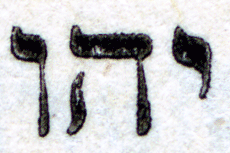
Equilibrium, and the VAV completes the Trinity and the Triliteral Name
יהו,
Thus the ten Sephiroth contain all the Sacred Numbers, three, five, seven, and nine, and the perfect Number Ten, and correspond with the Tetractys of Pythagoras. BEING
Is BEING, אהיה אשר אהיה,
In the Beginning was, that is to say, IS, WAS, and WILL BE, the WORD, that is to say, the REASON that Speaks.
Εν αρχῃ ην
Ὁ Λογος!
The Word is the reason of belief, and in it also is the expression of the Faith which makes. Science a living thing. The Word,. Λογος, is the Source of Logic. Jesus is the Word Incarnate. The accord of the Reason with Faith, of Knowledge with Belief, of Authority, with Liberty, has become in modern times the veritable enigma of the Sphinx. It is
WISDOM that, in the Kabalistic Books of the Proverbs and Ecclesiasticus,
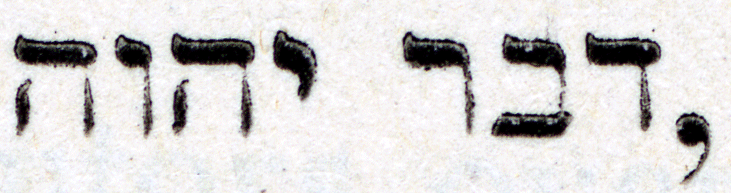
is the Creative Agent of God. Elsewhere in the Hebrew writings it is דבר
יהוה,
Nothing surpasses and nothing equals, as a Summary of all the doctrines of the Old World, those brief words engraven by HERMES on a Stone, and known under the name of "The Tablet of Emerald:" the Unity of Being and the Unity of the Harmonies, ascending and descending, the progressive and proportional scale of the Word; the immutable law of the Equilibrium, and the proportioned progress of the universal analogies; the relation of the Idea to the Word, giving the measure of the relation between the Creator and the Created, the necessary mathematics of the Infinite, proved by the measures of a single corner of the Finite;--all this is expressed by this single proposition of the Great Egyptian Hierophant: "What is Superior is as that which is Inferior, and what is Below is as that which is Above, to form the Marvels of the Unity."
|