|
MORALS AND DOGMA |
|
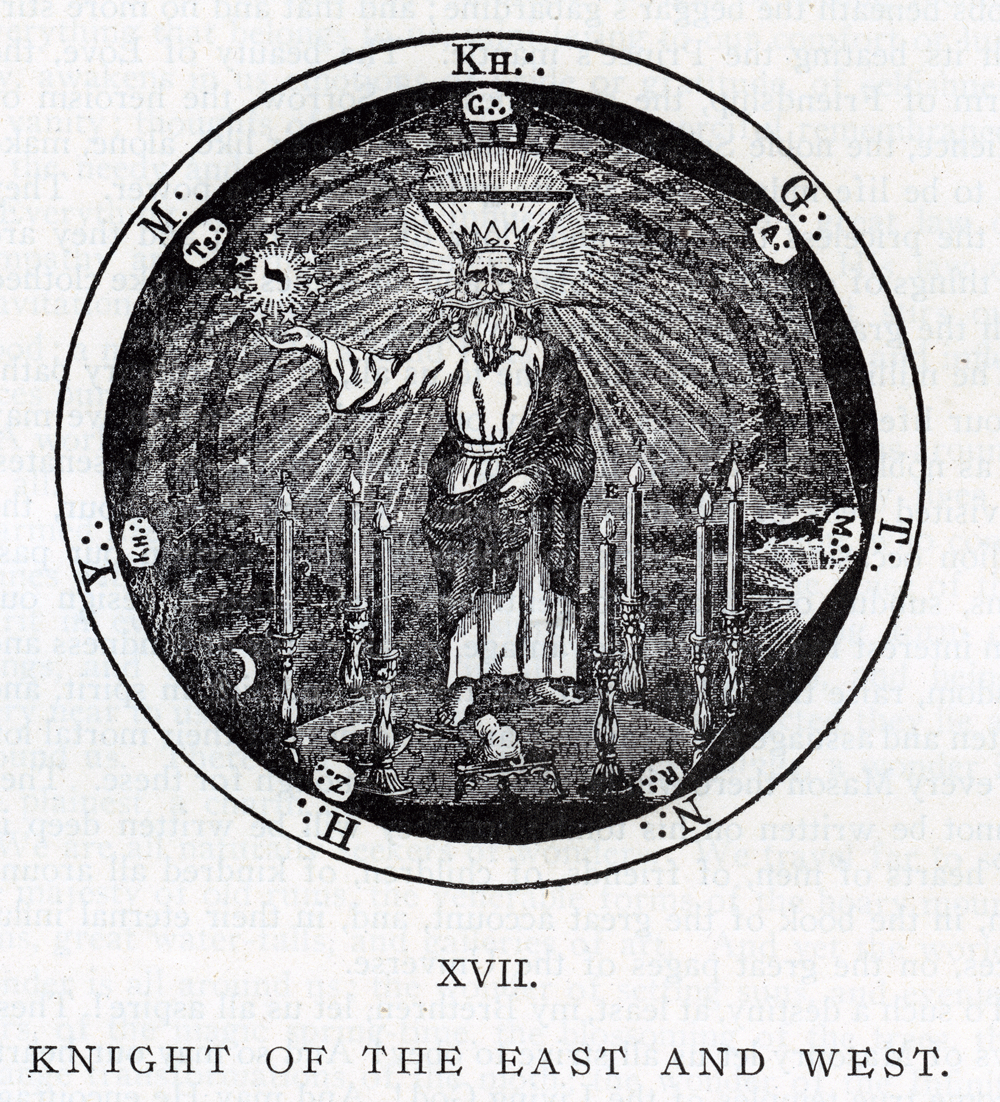
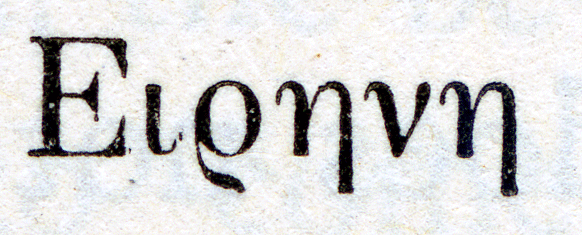
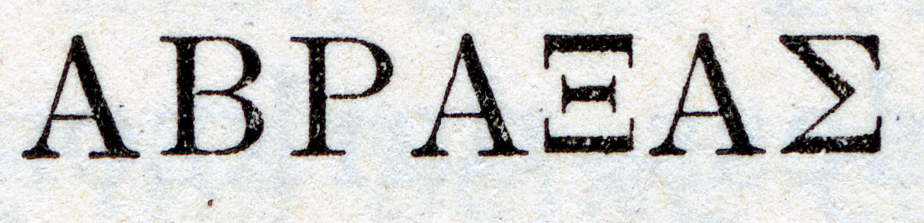
XVII. KNIGHT OF THE EAST AND WEST. THIS is the first of the Philosophical Degrees of the Ancient and Accepted Scottish Rite; and the beginning of a course of instruction which will fully unveil to you the heart and inner mysteries of Masonry. Do not despair because you have often seemed on the point of attaining the inmost light, and have as often been disappointed. In all time, truth has been hidden under symbols, and often under a succession of allegories: where veil after veil had to be penetrated before the true Light was reached, and the essential truth stood revealed. The Human Light is but an imperfect reflection of a ray of the Infinite and Divine. We are about to approach those ancient Religions which once ruled the minds of men, and whose ruins encumber the plains of the great Past, as the broken columns of Palmyra and Tadmor lie bleaching on the sands of the desert. They rise before us, those old, strange, mysterious creeds and faiths, shrouded in the mists of antiquity, and stalk dimly and undefined along the line which divides Time from Eternity; and forms of strange, wild, startling beauty mingled in the vast throngs of figures with shapes monstrous, grotesque, and hideous. The religion taught by Moses, which, like the laws of Egypt, enunciated the principle of exclusion, borrowed, at every period of its existence, from all the creeds with which it came in contact. While, by the studies of the learned and wise, it enriched itself with the most admirable principles of the religions of Egypt and Asia, it was changed, in the wanderings of the People, by everything that was most impure or seductive in the pagan manners and superstitions. It was one thing in the times of Moses and Aaron, another in those of David and Solomon, and still another in those of Daniel and Philo. At the time when John the Baptist made his appearance in the desert, near the shores of the Dead Sea, all the old philosophical and religious systems were approximating toward each other. A general lassitude inclined the minds of all toward the quietude of that amalgamation of doctrines for which the expeditions of Alexander and the more peaceful occurrences that followed, with the establishment in Asia and Africa of many Grecian dynasties and a great number of Grecian colonies, had prepared the way. After the intermingling of different nations, which resulted from the wars of Alexander in three-quarters of the globe, the doctrines of Greece, of Egypt, of Persia, and of India, met and intermingled everywhere. All the barriers that had formerly kept the nations apart, were thrown down; and while the People of the West readily connected their faith with those of the East, those of the Orient hastened to learn the traditions of Rome and the legends of Athens. While the Philosophers of Greece, all (except the disciples of Epicurus) more or less Platonists, seized eagerly upon the beliefs and doctrines of the East,--the Jews and Egyptians, before then the most exclusive of all peoples, yielded to that eclecticism which prevailed among their masters, the Greeks and Romans. Under the same influences of toleration, even those who embraced Christianity, mingled together the old and the new, Christianity and Philosophy, the Apostolic teachings and the traditions of Mythology. The man of intellect, devotee of one system, rarely displaces it with another in all its purity. The people take such a creed as is offered them. Accordingly, the distinction between the esoteric and the exoteric doctrine, immemorial in other creeds, easily gained a foothold among many of the Christians; and it was held by a vast number, even during the preaching of Paul, that the writings of the Apostles were incomplete; that they contained only the germs of another doctrine, which must receive from the hands of philosophy, not only the systematic arrangement which was wanting, but all the development which lay concealed therein. The writings of the Apostles, they said, in addressing themselves to mankind in general, enunciated only the articles of the vulgar faith; but transmitted the mysteries of knowledge to superior minds, to the Elect,--mysteries handed down from generation to generation in esoteric traditions; and to this science of the mysteries they gave the name of Γνῶσις; [Gnosis]. The Gnostics derived their leading doctrines and ideas from Plato and Philo, the Zend-avesta and the Kabalah, and the Sacred books of India and Egypt; and thus introduced into the bosom of Christianity the cosmological and theosophical speculations, which had formed the larger portion of the ancient religions of the Orient, joined to those of the Egyptian, Greek, and Jewish doctrines, which the Neo-Platonists had equally adopted in the Occident. Emanation from the Deity of all spiritual beings, progressive degeneration of these beings from emanation to emanation, redemption and return of all to the purity of the Creator; and, after the re-establishment of the primitive harmony of all, a fortunate and truly divine condition of all, in the bosom of God; such were the fundamental teachings of Gnosticism. The genius of the Orient, with its contemplations, irradiations, and intuitions, dictated its doctrines. Its language corresponded to its origin. Full of imagery, it had all the magnificence, the inconsistencies, and the mobility of the figurative style. Behold, it said, the light, which emanates from an immense centre of Light, that spreads everywhere its benevolent rays; so do the spirits of Light emanate from the Divine Light. Behold, all the springs which nourish, embellish, fertilize, and purify the Earth: they emanate from one and the same ocean; so from the bosom of the Divinity emanate so many streams, which form and fill the universe of intelligences. Behold numbers, which all emanate from one primitive number, all resemble it, all are composed of its essence, and still vary infinitely; and utterances, decomposable into so many syllables and elements, all contained in the primitive Word, and still infinitely various; so the world of Intelligences emanated from a Primary Intelligence, and they all resemble it, and yet display an infinite variety of existences. It revived and combined the old doctrines of the Orient and the Occident; and it found in many passages of the Gospels and the Pastoral letters, a warrant for doing so. Christ himself spoke in parables and allegories, John borrowed the enigmatical language of the Platonists, and Paul often indulged in incomprehensible rhapsodies, the meaning of which could have been clear to the Initiates alone. It is admitted that the cradle of Gnosticism is probably to be looked for in Syria, and even in Palestine. Most of its expounders wrote in that corrupted form of the Greek used by the Hellenistic Jews, and in the Septuagint and the New Testament; and there was a striking analogy between their doctrines and those of the Judeo-Egyptian Philo, of Alexandria; itself the seat of three schools, at once philosophic and religious--the Greek, the Egyptian, and the Jewish. Pythagoras and Plato, the most mystical of the Grecian Philosophers (the latter heir to the doctrines of the former), and who had travelled, the latter in Egypt, and the former in Phœnicia, India, and Persia, also taught the esoteric doctrine and the distinction between the initiated and the profane. The dominant doctrines of Platonism were found in Gnosticism. Emanation of Intelligences from the bosom of the Deity; the going astray in error and the sufferings of spirits, so long as they are remote from God, and imprisoned in matter; vain and long-continued efforts to arrive at the knowledge of the Truth, and re-enter into their primitive union with the Supreme Being; alliance of a pure and divine soul with an irrational soul, the seat of evil desires; angels or demons who dwell in and govern the planets, having but an imperfect knowledge of the ideas that presided at the creation; regeneration of all beings by their return to the κόσμος νοητός, [kosmos noētos], the world of Intelligences, and its Chief, the Supreme Being; sole possible mode of re-establishing that primitive harmony of the creation, of which the music of the spheres of Pythagoras was the image; these were the analogies of the two systems; and we discover in them some of the ideas that form a part of Masonry; in which, in the present mutilated condition of the symbolic Degrees, they are disguised and overlaid with fiction and absurdity, or present themselves as casual hints that are passed by wholly unnoticed. The distinction between the esoteric and exoteric doctrines (a distinction purely Masonic), was always and from the very earliest times preserved among the Greeks. It remounted to the fabulous times of Orpheus; and the mysteries of Theosophy were found in all their traditions and myths. And after the time of Alexander, they resorted for instruction, dogmas, and mysteries, to all the schools, to those of Egypt and Asia, as well as those of Ancient Thrace, Sicily, Etruria, and Attica. The Jewish-Greek School of Alexandria is known only by two of its Chiefs, Aristobulus and Philo, both Jews of Alexandria in Egypt. Belonging to Asia by its origin, to Egypt by its residence, to Greece by its language and studies, it strove to show that all truths embedded in the philosophies of other countries were trans-planted thither from Palestine. Aristobulus declared that all the facts and details of the Jewish Scriptures were so many allegories, concealing the most profound meanings, and that Plato had borrowed from them all his finest ideas. Philo, who lived a century after him, following the same theory, endeavored to show that the Hebrew writings, by their system of allegories, were the true source of all religious and philosophical doctrines. According to him, the literal meaning is for the vulgar alone. Whoever has meditated on philosophy, purified himself by virtue, and raised himself by contemplation, to God and the intellectual world, and received their inspiration, pierces the gross envelope of the letter, discovers a wholly different order of things, and is initiated into mysteries, of which the elementary or literal instruction offers but an imperfect image. A historical fact, a figure, a word, a letter, a number, a rite, a custom, the parable or vision of a prophet, veils the most profound truths; and he who has the key of science will interpret all according to the light he possesses. Again we see the symbolism of Masonry, and the search of the Candidate for light. "Let men of narrow minds withdraw," he says, "with closed ears. We transmit the divine mysteries to those who have received the sacred initiation, to those who practise true piety, and who are not enslaved by the empty trappings of words or the preconceived opinions of the pagans." To Philo, the Supreme
Being was the Primitive Light, or the Archetype of Light, Source
whence the rays emanate that illuminate Souls. He was also the Soul
of the Universe, and as such acted in all its parts. He Himself
fills and limits His whole Being. His Powers and Virtues fill and
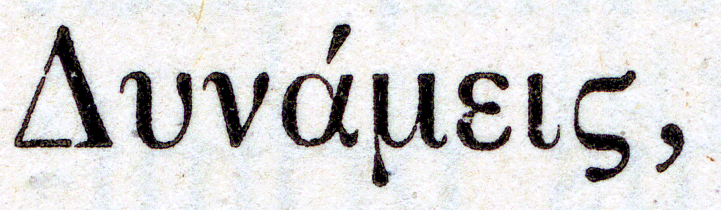
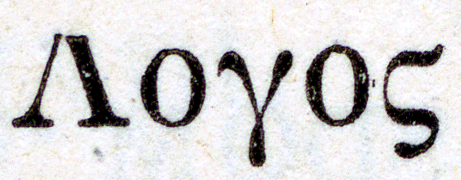
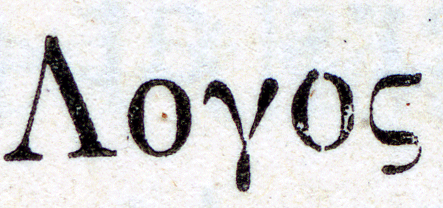
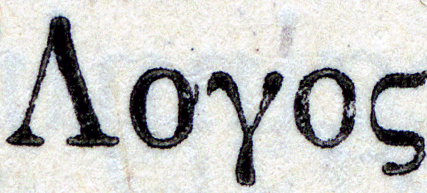
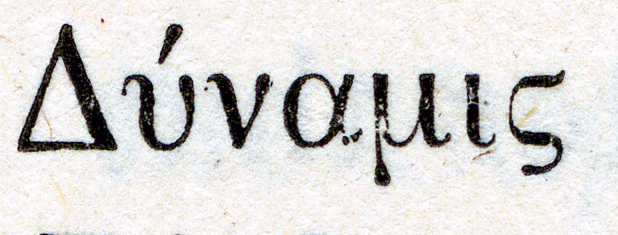
penetrate all. These Powers [Δυνάμεις, His image is THE WORD
[Λογος
The LOGOS being the
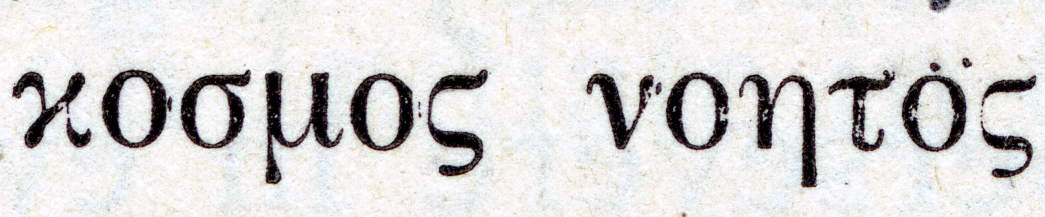
World of Ideas [κοσμος νοητος
God only is Wise. The
wisdom of man is but the reflection and image of that of God. He is
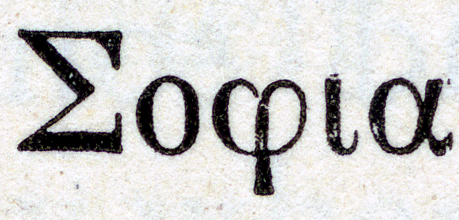
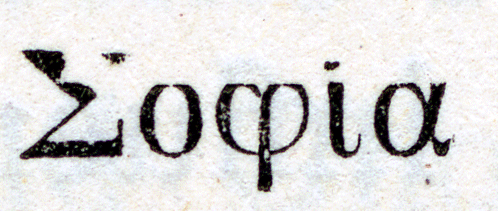
the Father, and His WISDOM the mother of creation: for He united
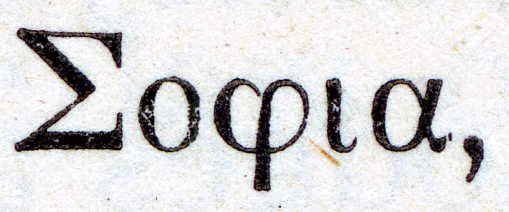
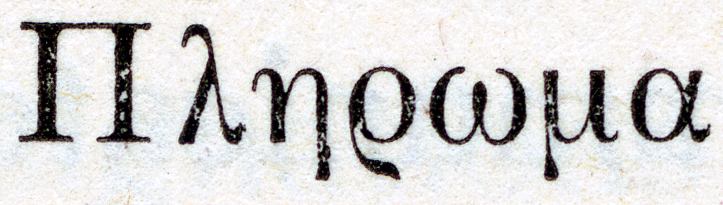
Himself with WISDOM [Σοφια, The Word is not only the Creator, but occupies the place of the Supreme Being. Through Him all the Powers and Attributes of God act. On the other side, as first representative of the Human Family, He is the Protector of men and their Shepherd. God gives to man the Soul or Intelligence, which exists before the body, and which he unites with the body. The reasoning Principle comes from God through the Word, and communes with God and with the Word; but there is also in man an irrational Principle, that of the inclinations and passions which produce disorder, emanating from inferior spirits who fill the air as ministers of God. The body, taken from the Earth, and the irrational Principle that animates it concurrently with the rational Principle, are hated by God, while the rational soul which He has given it, is, as it were, captive in this prison, this coffin, that encompasses it. The present condition of man is not his primitive condition, when he was the image of the Logos. He has fallen from his first estate. But he may raise himself again, by following the directions of WISDOM [Σοφια] and of the Angels which God has commissioned to aid him in freeing himself from the bonds of the body, and combating Evil, the existence whereof God has permitted, to furnish him the means of exercising his liberty. The souls that are purified, not by the Law but by light, rise to the Heavenly regions, to enjoy there a perfect felicity. Those that persevere in evil go from body to body, the seats of passions and evil desires. The familiar lineaments of these doctrines will be recognized by all who read the Epistles of St. Paul, who wrote after Philo, the latter living till the reign of Caligula, and being the contemporary of Christ. And the Mason is familiar with these doctrines of Philo: that the Supreme Being is a centre of Light whose rays or emanations pervade the Universe; for that is the Light for which all Masonic journeys are a search, and of which the sun and moon in our Lodges are only emblems: that Light and Darkness, chief enemies from the beginning of Time, dispute with each other the empire of the world; which we symbolize by the candidate wandering in darkness and being brought to light: that the world was created, not by the Supreme Being, but by a secondary agent, who is but His WORD [the Λογος], and by types which are but his ideas, aided by an INTELLIGENCE, or WISDOM [Σοφια], which gives one of His Attributes; in which we see the occult meaning of the necessity of recovering "the Word"; and of our two columns of STRENGTH and WISDOM, which are also the two parallel lines that bound the circle representing the Universe: that the visible world is the image of the invisible world; that the essence of the Human Soul is the image of God, and it existed before the body; that the object of its terrestrial life is to disengage itself of its body or its sepulchre; and that it will ascend to the Heavenly regions whenever it shall be purified; in which we see the meaning, now almost forgotten in our Lodges, of the mode of preparation of the candidate for apprenticeship, and his tests and purifications in the first Degree, according to the Ancient and Accepted Scottish Rite. Philo incorporated in his eclecticism neither Egyptian nor Oriental elements. But there were other Jewish Teachers in Alexandria who did both. The Jews of Egypt were slightly jealous of, and a little hostile to, those of Palestine, particularly after the erection of the sanctuary at Leontopolis by the High-Priest Onias; and therefore they admired and magnified those sages, who, like Jeremiah, had resided in Egypt. "The wisdom of Solomon" was written at Alexandria, and, in the time of St. Jerome, was attributed to Philo; but it contains principles at variance with his. It personifies Wisdom, and draws between its children and the Profane, the same line of demarcation that Egypt had long before taught to the Jews. That distinction existed at the beginning of the Mosaic creed. Moshah himself was an Initiate in the mysteries of Egypt, as he was compelled to be, as the adopted son of the daughter of Pharaoh, Thouoris, daughter of Sesostris-Ramses; who, as her tomb and monuments show, was, in the right of her infant husband, Regent of Lower Egypt or the Delta at the time of the Hebrew Prophet's birth, reigning at Heliopolis. She was also, as the reliefs on her tomb show, a Priestess of HATHOR and NEITH, the two great primeval goddesses. As her adopted son, living in her Palace and presence forty years, and during that time scarcely acquainted with his brethren the Jews, the law of Egypt compelled his initiation: and we find in many of his enactments the intention of preserving, between the common people and the Initiates, the line of separation which he found in Egypt. Moshah and Aharun his brother, the whole series of High-Priests, the Council of the 70 Elders, Salomoh and the entire succession of Prophets, were in possession of a higher science; and of that science Masonry is, at least, the lineal descendant. It was familiarly known as THE KNOWLEDGE OF THE WORD. AMUN, at first the God of Lower Egypt only, where Moshah was reared [a word that in Hebrew means Truth], was the Supreme God. He was styled "the Celestial Lord, who sheds Light on hidden things." He was the source of that divine life, of which the crux ansata is the symbol; and the source of all power, He united all the attributes that the Ancient Oriental Theosophy assigned to the Supreme Being. He was the πλήρωμα (Pleroma), or "Fullness of things," for He comprehended in Himself everything; and the LIGHT; for he was the Sun-God. He was unchangeable in the midst of everything phenomenal in his worlds. He created nothing; but everything emanated from Him; and of Him all the other Gods were but manifestations. The Ram was His
living symbol; which you see reproduced in this Degree, lying on the
book with seven seals on the tracing-board. He caused the creation of
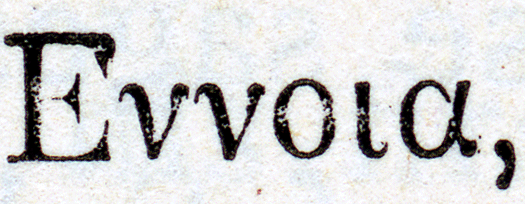
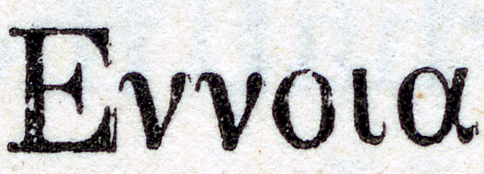
the world by the Primitive Thought [Εννοια, In this Degree, unknown for a hundred years to those who have practised it, these emblems reproduced refer to these old doctrines. The lamb, the yellow hangings strewed with stars, the seven columns, candlesticks, and seals all recall them to us. The Lion was the symbol of ATHOM-RE, the Great God of Upper Egypt; the Hawk, of RA or PHRE; the Eagle, of MENDES; the Bull, of APIS; and three of these are seen under the platform on which our altar stands. The first HERMES was the INTELLIGENCE or WORD of God. Moved with compassion for a race living without law, and wishing to teach them that they sprang from His bosom, and to point out to them the way that they should go [the books which the first Hermes, the same with Enoch, had written on the mysteries of divine science, in the sacred characters, being unknown to those who lived after the flood], God sent to man OSIRIS and Isis, accompanied by THOTH, the incarnation or terrestrial repetition of the first HERMES; who taught men the arts, science, and the ceremonies of religion; and then ascended to Heaven or the Moon. OSIRIS was the Principle of Good. TYPHON, like AHRIMAN, was the principle and source of all that is evil in the moral and physical order. Like the Satan of Gnosticism, he was confounded with Matter. From Egypt or Persia the new Platonists borrowed the idea, and the Gnostics received it from them, that man, in his terrestrial career, is successively under the influence of the Moon, of Mercury, of Venus, of the Sun, of Mars, of Jupiter, and of Saturn, until he finally reaches the Elysian Fields; an idea again symbolized in the Seven Seals. The Jews of Syria and Judea were the direct precursors of Gnosticism; and in their doctrines were ample oriental elements. These Jews had had with the Orient, at two different periods, intimate relations, familiarizing them with the doctrines of Asia, and especially of Chaldea and Persia;--their forced residence in Central Asia under the Assyrians and Persians; and their voluntary dispersion over the whole East, when subjects of the Seleucidæ and the Romans. Living near two-thirds of a century, and many of them long afterward, in Mesopotamia, the cradle of their race; speaking the same language, and their children reared with those of the Chaldeans, Assyrians, Medes, and Persians, and receiving from them their names (as the case of Danayal, who was called Bæltasatsar, proves), they necessarily adopted many of the doctrines of their conquerors. Their descendants, as Azra and Nahamaiah show us, hardly desired to leave Persia, when they were allowed to do so. They had a special jurisdiction, and governors and judges taken from their own people; many of them held high office, and their children were educated with those of the highest nobles. Danayal was the friend and minister of the King, and the Chief of the College of the Magi at Babylon; if we may believe the book which bears his name, and trust to the incidents related in its highly figurative and imaginative style. Mordecai, too, occupied a high station, no less than that of Prime Minister, and Esther or Astar, his cousin, was the Monarch's wife. The Magi of Babylon were expounders of figurative writings, interpreters of nature, and of dreams,--astronomers and divines; and from their influences arose among the Jews, after their rescue from captivity, a number of sects, and a new exposition, the mystical interpretation, with all its wild fancies and infinite caprices. The Aions of the Gnostics, the Ideas of Plato, the Angels of the Jews, and the Demons of the Greeks, all correspond to the Ferouers of Zoroaster. A great number of Jewish families remained permanently in their new country; and one of the most celebrated of their schools was at Babylon. They were soon familiarized with the doctrine of Zoroaster, which itself was more ancient than Kuros. From the system of the Zend-Avesta they borrowed, and subsequently gave large development to, everything that could be reconciled with their own faith; and these additions to the old doctrine were soon spread, by the constant intercourse of commerce, into Syria and Palestine. In the Zend-Avesta, God is Illimitable Time. No origin can be assigned to Him: He is so entirely enveloped in His glory, His nature and attributes are so inaccessible to human Intelligence, that He can be only the object of a silent Veneration. Creation took place by emanation from Him. The first emanation was the primitive Light, and from that the King of Light, ORMUZD. By the "WORD," Ormuzd created the world pure. He is its preserver and judge; a Being Holy and Heavenly; Intelligence and Knowledge; the First-born of Time without limits; and invested with all the Powers of the Supreme Being. Still he is, strictly speaking, the Fourth Being. He had a Ferouer, a pre-existing Soul [in the language of Plato, a type or ideal]; and it is said of Him, that He existed from the beginning, in the primitive Light. But, that Light being but an element, and His Ferouer a type, he is, in ordinary language, the First-born of ZEROUANE-AKHERENE. Behold, again, "THE WORD" of Masonry; the Man, on the Tracing-Board of this Degree; the LIGHT toward which all Masons travel. He created after his own image, six Genii called Amshaspands, who surround his Throne, are his organs of communication with inferior spirits and men, transmit to Him their prayers, solicit for them His favors, and serve them as models of purity and perfection. Thus we have the Demiourgos of Gnosticism, and the six Genii that assist him. These are the Hebrew Archangels of the Planets. The names of these Amshaspands are Bahman, Ardibehest, Schariver, Sapandomad, Khordad, and Amerdad. The fourth, the Holy SAPANDOMAD, created the first man and woman. Then ORMUZD created 28 Izeds, of whom MITHRAS is the chief. They watch, with Ormuzd and the Amshaspands, over the happiness, purity, and preservation of the world, which is under their government; and they are also models for mankind and interpreters of men's prayers. With Mithras and Ormuzd, they make a pleroma [or complete number] of 30, corresponding to the thirty Aions of the Gnostics, and to the ogdoade, dodecade, and decade of the Egyptians. Mithras was the Sun-God, invoked with, and soon confounded with him, becoming the object of a special worship, and eclipsing Ormuzd himself. The third order of pure spirits is more numerous. They are the Ferouers, the THOUGHTS of Ormuzd, or the IDEAS which he conceived before proceeding to the creation of things. They too are superior to men. They protect them during their life on earth; they will purify them from evil at their resurrection. They are their tutelary genii, from the fall to the complete regeneration. AHRIMAN, second-born of the Primitive Light, emanated from it, pure like ORMUZD; but, proud and ambitious, yielded to jealousy of the First-born. For his hatred and pride, the Eternal condemned him to dwell, for 12,000 years, in that part of space where no ray of light reaches; the black empire of darkness. In that period the struggle between Light and Darkness, Good and Evil, will be terminated. AHRIMAN scorned to submit, and took the field against ORMUZD. To the good spirits created by his Brother, he opposed an innumerable army of Evil Ones. To the seven Amshaspands he opposed seven Archdevs, attached to the seven Planets; to the Izeds and Ferouers an equal number of Devs, which brought upon the world all moral and physical evils. Hence Poverty, Maladies, Impurity, Envy, Chagrin, Drunkenness, Falsehood, Calumny, and their horrible array. The image of Ahriman was the Dragon, confounded by the Jews with Satan and the Serpent-Tempter. After a reign of 3000 years, Ormuzd had created the Material World, in six periods, calling successively into existence the Light, Water, Earth, plants, animals, and Man. But Ahriman concurred in creating the earth and water; for darkness was already an element, and Ormuzd could not exclude its Master. So also the two concurred in producing Man. Ormuzd produced, by his Will and Word, a Being that was the type and source of universal life for everything that exists under Heaven. He placed in man a pure principle, or Life, proceeding from the Supreme Being. But Ahriman destroyed that pure principle, in the form wherewith it was clothed; and when Ormuzd had made, of its recovered and purified essence, the first man and woman, Ahriman seduced and tempted them with wine and fruits; the woman yielding first. Often, during the three latter periods of 3000 years each, Ahriman and Darkness are, and are to be, triumphant. But the pure souls are assisted by the Good Spirits; the Triumph of Good is decreed by the Supreme Being, and the period of that triumph will infallibly arrive. When the world shall be most afflicted with the evils poured out upon it by the spirits of perdition, three Prophets will come to bring relief to mortals. SOSIOSCH, the principal of the Three, will regenerate the earth, and restore to it its primitive beauty, strength, and purity. He will judge the good and the wicked. After the universal resurrection of the good, he will conduct them to a home of everlasting happiness. Ahriman, his evil demons, and all wicked men, will also be purified in a torrent of melted metal. The law of Ormuzd will reign everywhere; all men will be happy; all, enjoying unalterable bliss, will sing with Sosiosch the praises of the Supreme Being. These doctrines, the details of which were sparingly borrowed by the Pharisaic Jews, were much more fully adopted by the Gnostics; who taught the restoration of all things, their return to their original pure condition, the happiness of those to be saved, and their admission to the feast of Heavenly Wisdom. The doctrines of
Zoroaster came originally from Bactria, an Indian Province of
Persia. Naturally, therefore, it would include Hindu or Buddhist
elements, as it did. The fundamental idea of Buddhism was, matter
subjugating the intelligence, and intelligence freeing itself from
that slavery. Perhaps something came to Gnosticism from China.
"Before the chaos which preceded the birth of Heaven
and Earth," says Lao-Tseu, "a single Being existed, immense and
silent, immovable and ever active--the mother of the Universe. I
know not its name: but I designate it by the word Reason. Man has
his type and model in the Earth; Earth in Heaven; Heaven in Reason;
and Reason in Itself." Here again are the Ferouers, the Ideas, the
Aions the REASON or INTELLIGENCE [Εννοια
The dominant system among the Jews after their captivity was that of the Pharoschim or Pharisees. Whether their name was derived from that of the Parsees, or followers of Zoroaster, or from some other source, it is certain that they had borrowed much of their doctrine from the Persians. Like them they claimed to have the exclusive and mysterious knowledge, unknown to the mass. Like them they taught that a constant war was waged between the Empire of Good and that of Evil. Like them they attributed the sin and fall of man to the demons and their chief; and like them they admitted a special protection of the righteous by inferior beings, agents of Jehovah. All their doctrines on these subjects were at bottom those of the Holy Books; but singularly developed; and the Orient was evidently the source from which those developments came. They styled themselves Interpreters; a name indicating their claim to the exclusive possession of the true meaning of the Holy Writings, by virtue of the oral tradition which Moses had received on Mount Sinai, and which successive generations of Initiates had transmitted, as they claimed, unaltered, unto them. Their very costume, their belief in the influences of the stars, and in the immortality and transmigration of souls, their system of angels and their astronomy, were all foreign. Sadduceeism arose merely from an opposition essentially Jewish, to these foreign teachings, and that mixture of doctrines, adopted by the Pharisees, and which constituted the popular creed. We come at last to the Essenes and Therapeuts, with whom this Degree is particularly concerned. That intermingling of oriental and occidental rites, of Persian and Pythagorean opinions, which we have pointed out in the doctrines of Philo, is unmistakable in the creeds of these two sects. They were less distinguished by metaphysical speculations than by simple meditations and moral practices. But the latter always partook of the Zoroastrian principle, that it was necessary to free the soul from the trammels and influences of matter; which led to a system of abstinence and maceration entirely opposed to the ancient Hebriac ideas, favorable as they were to physical pleasures. In general, the life and manners of these mystical associations, as Philo and Josephus describe them, and particularly their prayers at sunrise, seem the image of what the Zend-Avesta prescribes to the faithful adorer or Ormuzd; and some of their observances cannot otherwise be explained. The Therapeuts resided in Egypt, in the neighborhood of Alexandria; and the Essenes in Palestine, in the vicinity of the Dead Sea. But there was nevertheless a striking coincidence in their ideas, readily explained by attributing it to a foreign influence. The Jews of Egypt, under the influence of the School of Alexandria, endeavored in general to make their doctrines harmonize with the traditions of Greece; and thence came, in the doctrines of the Therapeuts, as stated by Philo, the many analogies between the Pythagorean and Orphic ideas, on one side, and those of Judaism on the other: while the Jews of Palestine, having less communication with Greece, or contemning its teachings, rather imbibed the Oriental doctrines, which they drank in at the source and with which their relations with Persia made them familiar. This attachment was particularly shown in the Kabalah, which belonged rather to Palestine than to Egypt, though extensively known in the latter; and furnished the Gnostics with some of their most striking theories. It is a significant fact, that while Christ spoke often of the Pharisees and Sadducees, He never once mentioned the Essenes, between whose doctrines and His there was so great a resemblance, and, in many points, so perfect an identity. Indeed, they are not named, nor even distinctly alluded to, anywhere in the New Testament. John, the son of a Priest who ministered in the Temple at Jerusalem, and whose mother was of the family of Aharun, was in the deserts until the day of his showing unto Israel. He drank neither wine nor strong drink. Clad in hair-cloth, and with a girdle of leather, and feeding upon such food as the desert afforded, he preached, in the country about Jordan, the baptism of repentance, for the remission of sins; that is, the necessity of repentance proven by reformation. He taught the people charity and liberality; the publicans, justice, equity, and fair dealing; the soldiery, peace, truth, and contentment; to do violence to none, accuse none falsely, and be content with their pay. He inculcated the necessity of a virtuous life, and the folly of trusting to their descent from Abraham. He denounced both Pharisees and Sadducees as a generation of vipers, threatened with the anger of God. He baptized those who confessed their sins. He preached in the desert; and therefore in the country where the Essenes lived, professing the same doctrines. He was imprisoned before Christ began to preach. Matthew mentions him without preface or explanation; as if, apparently, his history was too well known to need any. "In those days," he says, "came John the Baptist, preaching in the wilderness of Judea." His disciples frequently fasted; for we find them with the Pharisees coming to Jesus to inquire why His Disciples did not fast as often as they; and He did not denounce them, as His habit was to denounce the Pharisees; but answered them kindly and gently. From his prison, John sent two of his disciples to inquire of Christ: "Art thou he that is to come, or do we look for another?" Christ referred them to his miracles as an answer; and declared to the people that John was a prophet, and more than a prophet, and that no greater man had ever been born; but that the humblest Christian was his superior. He declared him to be Elias, who was to come. John had denounced to Herod his marriage with his brother's wife as unlawful; and for this he was imprisoned, and finally executed to gratify her. His disciples buried him; and Herod and others thought he had risen from the dead and appeared again in the person of Christ. The people all regarded John as a prophet; and Christ silenced the Priests and Elders by asking them whether he was inspired. They feared to excite the anger of the people by saying that he was not. Christ declared that he came "in the way of righteousness"; and that the lower classes believed him, though the Priests and Pharisees did not. Thus John, who was often consulted by Herod, and to whom that monarch showed great deference, and was often governed by his advice; whose doctrine prevailed very extensively among the people and the publicans, taught some creed older than Christianity. That is plain: and it is equally plain, that the very large body of the Jews that adopted his doctrines, were neither Pharisees nor Sadducees, but the humble, common people. They must, therefore, have been Essenes. It is plain, too, that Christ applied for baptism as a sacred rite, well known and long practiced. It was becoming to him, he said, to fulfill all righteousness. In the 18th chapter of the Acts of the Apostles we read thus: "And a certain Jew, named Apollos, born at Alexandria, an eloquent man, and mighty in the Scriptures, came to Ephesus. This man was instructed in the way of the Lord, and, being fervent in spirit, he spake and taught diligently the things of the Lord, knowing only the baptism of John; and he began to speak boldly in the synagogue; whom, when Aquilla and Priscilla had heard, they took him unto them, and expounded unto him the way of God more perfectly." Translating this from the symbolic and figurative language into the true ordinary sense of the Greek text, it reads thus: "And a certain Jew, named Apollos, an Alexandrian by birth, an eloquent man, and of extensive learning, came to Ephesus. He had learned in the mysteries the true doctrine in regard to God; and, being a zealous enthusiast, he spoke and taught diligently the truths in regard to the Deity, having received no other baptism than that of John." He knew nothing in regard to Christianity; for he had resided in Alexandria, and had just then come to Ephesus; being, probably, a disciple of Philo, and a Therapeut. "That, in all times," says St. Augustine, "is the Christian religion, which to know and follow is the most sure and certain health, called according to that name, but not according to the thing itself, of which it is the name; for the thing itself, which is now called the Christian religion, really was known to the Ancients, nor was wanting at any time from the beginning of the human race, until the time when Christ came in the flesh; from whence the true religion, which had previously existed, began to be called Christian; and this in our days is the Christian religion, not as having been wanting in former times, but as having, in later times, received this name." The disciples were first called "Christians," at Antioch, when Barnabas and Paul began to preach there. The Wandering or Itinerant Jews or Exorcists, who assumed to employ the Sacred Name in exorcising evil spirits, were no doubt Therapeutæ or Essenes, "And it came to pass," we read in the 19th chapter of the Acts, verses 1 to 4, "that while Apollos was at Corinth, Paul, having passed through the upper parts of Asia Minor, came to Ephesus; and finding certain disciples, he said to them, 'Have ye received the Holy Ghost since ye became Believers?' And they said unto him, 'We have not so much as heard that there is any Holy Ghost.' And he said to them, 'In what, then, were you baptized?' And they said 'In John's baptism.' Then said Paul, 'John indeed baptized with the baptism of repentance, saying to the people that they should believe in Him who was to come after him, that is, in Jesus Christ. When they heard this, they were baptized in the name of the Lord Jesus." This faith, taught by John, and so nearly Christianity, could have been nothing but the doctrine of the Essenes; and there can be no doubt that John belonged to that sect. The place where he preached, his macerations and frugal diet, the doctrines he taught, all prove it conclusively. There was no other sect to which he could have belonged; certainly none so numerous as his, except the Essenes. We find, from the two letters written by Paul to the brethren at Corinth, that City of Luxury and Corruption, that there were contentions among them. Rival sects had already, about the 57th year of our era, reared their banners there, as followers, some of Paul, some of Apollos, and some of Cephas. Some of them denied the resurrection. Paul urged them to adhere to the doctrines taught by himself, and had sent Timothy to them to bring them afresh to their recollection. According to Paul, Christ was to come again. He was to put an end to all other Principalities and Powers, and finally to Death, and then be Himself once more merged in God; who should then be all in all. The forms and ceremonies of the Essenes were symbolical. They had, according to Philo the Jew, four Degrees; the members being divided into two Orders, the Practici and Therapeutici; the latter being the contemplative and medical Brethren; and the former the active, practical, business men. They were Jews by birth; and had a greater affection for each other than the members of any other sect. Their brotherly love was intense. They fulfilled the Christian law, "Love one another." They despised riches. No one was to be found among them, having more than another. The possessions of one were intermingled with those of the others; so that they all had but one patrimony, and were brethren. Their piety toward God was extraordinary. Before sunrise they never spake a word about profane matters; but put up certain prayers which they had received from their forefathers. At dawn of day, and before it was light, their prayers and hymns ascended to Heaven. They were eminently faithful and true, and the Ministers of Peace. They had mysterious ceremonies, and initiations into their mysteries; and the Candidate promised that he would ever practise fidelity to all men, and especially to those in authority, "because no one obtains the government without God's assistance." Whatever they said, was firmer than an oath; but they avoided swearing, and esteemed it worse than perjury. They were simple in their diet and mode of living, bore torture with fortitude, and despised death. They cultivated the science of medicine and were very skillful. They deemed it a good omen to dress in white robes. They had their own courts, and passed righteous judgments. They kept the Sabbath more rigorously than the Jews. Their chief towns were Engaddi, near the Dead Sea, and Hebron. Engaddi was about 30 miles southeast from Jerusalem, and Hebron about 20 miles south of that city. Josephus and Eusebius speak of them as an ancient sect; and they were no doubt the first among the Jews to embrace Christianity: with whose faith and doctrine their own tenets had so many points of resemblance, and were indeed in a great measure the same. Pliny regarded them as a very ancient people. In their devotions they turned toward the rising sun; as the Jews generally did toward the Temple. But they were no idolaters; for they observed the law of Moses with scrupulous fidelity. They held all things in common, and despised riches, their wants being supplied by the administration of Curators or Stewards. The Tetractys, composed of round dots instead of jods, was revered among them. This being a Pythagorean symbol, evidently shows their connection with the school of Pythagoras; but their peculiar tenets more resemble those of Confucius and Zoroaster; and probably were adopted while they were prisoners in Persia; which explains their turning toward the Sun in prayer. Their demeanor was sober and chaste. They submitted to the superintendence of governors whom they appointed over themselves. The whole of their time was spent in labor, meditation, and prayer; and they were most sedulously attentive to every call of justice and humanity, and every moral duty. They believed in the unity of God. They supposed the souls of men to have fallen, by a disastrous fate, from the regions of purity and light, into the bodies which they occupy; during their continuance in which they considered them confined as in a prison. Therefore they did not believe in the resurrection of the body; but in that of the soul only. They believed in a future state of rewards and punishments; and they disregarded the ceremonies or external forms enjoined in the law of Moses to be observed in the worship of God; holding that the words of that lawgiver were to be understood in a mysterious and recondite sense, and not according to their literal meaning. They offered no sacrifices, except at home; and by meditation they endeavored, as far as possible, to isolate the soul from the body, and carry it back to God. Eusebius broadly admits "that the ancient Therapeutæ were Christians; and that their ancient writings were our Gospels and Epistles." The ESSENES were of the Eclectic Sect of Philosophers, and held PLATO in the highest esteem; they believed that true philosophy, the greatest and most salutary gift of God to mortals, was scattered, in various portions, through all the different Sects; and that it was, consequently, the duty of every wise man to gather it from the several quarters where it lay dispersed, and to employ it, thus reunited, in destroying the dominion of impiety and vice. The great festivals of the Solstices were observed in a distinguished manner by the Essenes; as would naturally be supposed, from the fact that they reverenced the Sun, not as a god, but as a symbol of light and fire; the fountain of which, the Orientals supposed God to be. They lived in continence and abstinence, and had establishments similar to the monasteries of the early Christians. The writings of the Essenes were full of mysticism, parables, enigmas, and allegories. They believed in the esoteric and exoteric meanings of the Scriptures; and, as we have already said, they had a warrant for That in the Scriptures themselves. They found it in the Old Testament, as the Gnostics found it in the New. The Christian writers, and even Christ himself, recognized it as a truth, that all Scripture had an inner and an outer meaning. Thus we find it said as follows, in one of the Gospels: "Unto you it is given to know the mystery of the Kingdom of God; but unto men that are without, all these things are done in parables; that seeing, they may see and not perceive, and hearing they may hear and not understand. . . . And the disciples came and said unto him, 'Why speakest Thou the truth in parables?'--He answered and said unto them, 'Because it is given unto you to know the mysteries of the Kingdom of Heaven, but to them it is not given.'" Paul, in the 4th chapter of his Epistle to the Galatians, speaking of the simplest facts of the Old Testament, asserts that they are an allegory. In the 3d chapter of the second letter to the Corinthians, he declares himself a minister of the New Testament, appointed by God; "Not of the letter, but of the spirit; for the letter killeth." Origen and St. Gregory held that the Gospels were not to be taken in their literal sense; and Athanasius admonishes us that "Should we understand sacred writ according to the letter, we should fall into the most enormous blasphemies." Eusebius said, "Those who preside over the Holy Scriptures, philosophize over them, and expound their literal sense by allegory." The sources of our knowledge of the Kabalistic doctrines, are the books of Jezirah and Sohar, the former drawn up in the second century, and the latter a little later; but containing materials much older than themselves. In their most characteristic elements, they go back to the time of the exile. In them, as in the teachings of Zoroaster, everything that exists emanated from a source of infinite LIGHT. Before everything, existed THE ANCIENT OF DAYS, the KING OF LIGHT; a title often given to the Creator in the Zend-Avesta and the code of the Sabæans. With the idea so expressed is connected the pantheism of India. THE KING OR LIGHT, THE ANCIENT, is ALL THAT IS. He is not only the real cause of all Existences; he is Infinite [AINSOPH]. He is HIMSELF: there is nothing in Him that We can call Thou. In the Indian doctrine, not only is the Supreme Being the real cause of all, but he is the only real Existence: all the rest is illusion. In the Kabalah, as in the Persian and Gnostic doctrines, He is the Supreme Being unknown to all, the "Unknown Father." The world is his revelation, and subsists only in Him. His attributes are reproduced there, with different modifications, and in different degrees, so that the Universe is His Holy Splendor: it is but His Mantle; but it must be revered in silence. All beings have emanated from the Supreme Being: The nearer a being is to Him, the more perfect it is; the more remote in the scale, the less its purity. A ray of Light, shot from the Deity, is the cause and principle of all that exists. It is at once Father and Mother of All, in the sublimest sense. It penetrates everything; and without it nothing can exist an instant. From this double FORCE, designated by the two parts of the word I∴H∴U∴H∴ emanated the FIRST-BORN of God, the Universal FORM, in which are contained all beings; the Persian and Platonic Archetype of things, united with the Infinite by the primitive ray of Light. This
First-Born is the Creative Agent, Conservator, and animating Principle
of the Universe. It is THE LIGHT of LIGHT. It possesses the three
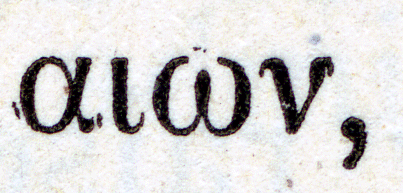
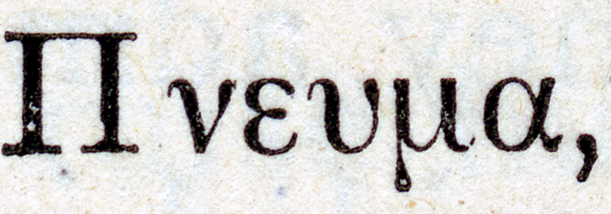
Primitive Forces of the Divinity, LIGHT, SPIRIT, and LIFE [Φώς, Πνευμά,
and Ζων
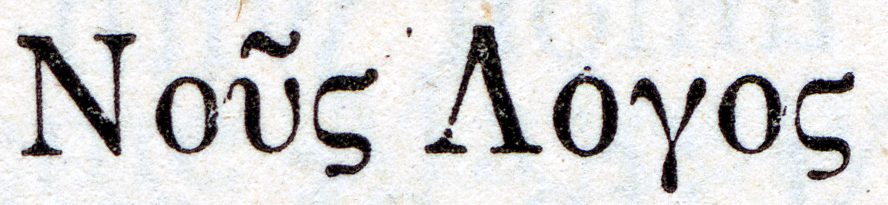
Wisdom
was called NOUS and LOGOS [and Νοῦς Λογος
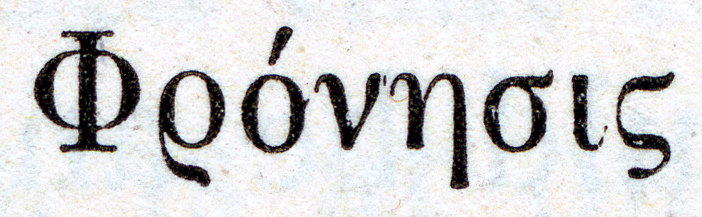
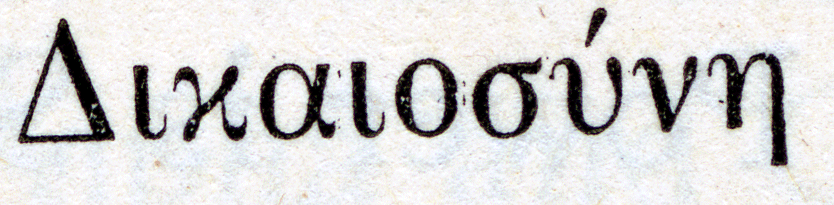
Beauty is represented by green and yellow. Victory is YAHOVAH-TSABAOTH, the column on the right hand, the column Jachin: Glory is the column Boaz, on the left hand. And thus our symbols appear again in the Kabalah. And again the LIGHT, the object of our labors, appears as the creative power of Deity. The circle, also, was the special symbol of the first Sephirah, Kether, or the Crown. We do not further follow the Kabalah in its four Worlds of Spirits, Aziluth, Briah, Yezirah, and Asiah, or of emanation, creation, formation, and fabrication, one inferior to and one emerging from the other, the superior always enveloping the inferior; its doctrine that, in all that exists, there is nothing purely material; that all comes from God, and in all He proceeds by irradiation; that everything subsists by the Divine ray that penetrates creation; and all is united by the Spirit of God, which is the life of life; so that all is God; the Existences that inhabit the four worlds, inferior to each other in proportion to their distance from the Great King of Light: the contest between the good and evil Angels and Principles, to endure until the Eternal Himself cones to end it and re-establish the primitive harmony; the four distinct parts of the Soul of Man; and the migrations of impure souls, until they are sufficiently purified to share with the Spirits of Light the contemplation of the Supreme Being whose Splendor fills the Universe. The WORD was also found in the Phœnician Creed. As in all those of Asia, a WORD of God, written in starry characters, by the planetary Divinities, and communicated by the Demi-Gods, as a profound mystery, to the higher classes of the human race, to be communicated by them to mankind, created the world. The faith of the Phœnicians was an emanation from that ancient worship of the Stars, which in the creed of Zoroaster alone, is connected with a faith in one God. Light and Fire are the most important agents in the Phœnician faith. There is a race of children of the Light. They adored the Heaven with its Lights, deeming it the Supreme God. Everything emanates from a Single Principle, and a Primitive Love, which is the Moving Power of All and governs all. Light, by its union with Spirit, whereof it is but the vehicle or symbol, is the Life of everything, and penetrates everything. It should therefore be respected and honored everywhere; for everywhere it governs and controls. The
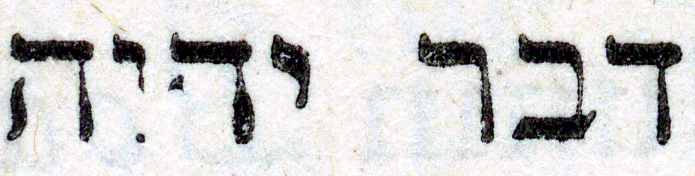
Chaldaic and Jerusalem Paraphrasts endeavored to render the phrase,
DEBAR-YAHOVAH [דבר יהוה
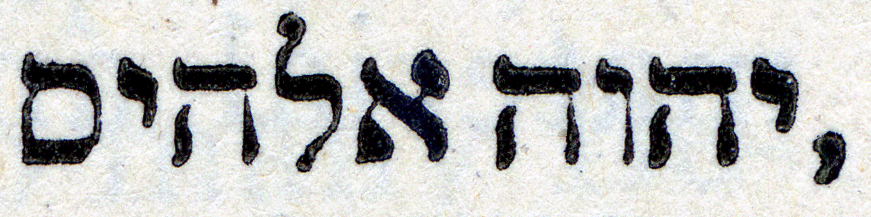
So, in
xxviii. Gen. 20, 21, where Jacob says: "If God [יהיה אלהים So, in
iii. Gen. 8, for "The Voice of the Lord God" [יהוה אלהים In ix.
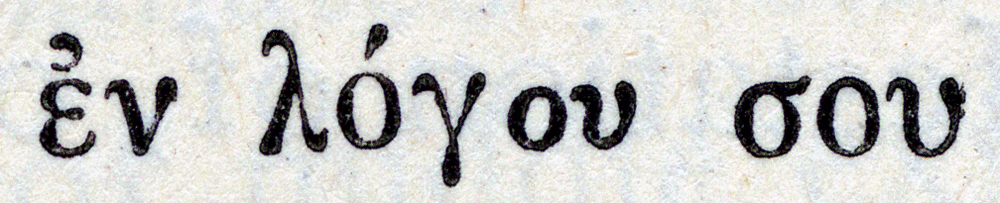
Wisdom, 1, "O God of my Fathers and Lord of Mercy! who has made all
things with thy word. ἐν λόγου σου
And in
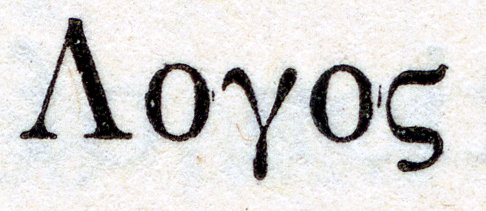
xviii. Wisdom, 15, "Thine Almighty Word [Λογος
Philo
speaks of the Word as being the same with God. So in several places he
calls it "δεύτερος Θεἰος Λόγος
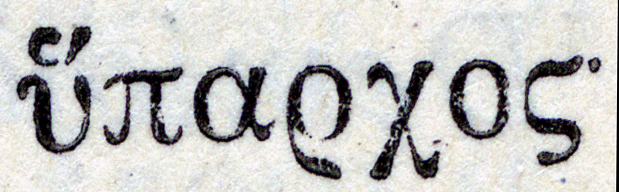
Thus, when John commenced to preach, had been for ages agitated, by the Priests and Philosophers of the East and West, the great questions concerning the eternity or creation of matter: immediate or intermediate creation of the Universe by the Supreme God; the origin, object, and final extinction of evil; the relations between the intellectual and material worlds, and between God and man; and the creation, fall, redemption, and restoration to his first estate, of man. The Jewish doctrine, differing in this from all the other Oriental creeds, and even from the Alohaȳistic legend with which the book of Genesis commences, attributed the creation to the immediate action of the Supreme Being. The Theosophists of the other Eastern Peoples interposed more than one intermediary between God and the world. To place between them but a single Being, to suppose for the production of the world but a single intermediary, was, in their eyes, to lower the Supreme Majesty. The interval between God, who is perfect Purity, and matter, which is base and foul, was too great for them to clear it at a single step. Even in the Occident, neither Plato nor Philo could thus impoverish the Intellectual World. Thus, Cerinthus of Ephesus, with most of the Gnostics, Philo, the Kabalah, the Zend-Avesta, the Puranas, and all the Orient, deemed the distance and antipathy between the Supreme Being and the material world too great, to attribute to the former the creation of the latter. Below, and emanating from, or created by, the Ancient of Days, the Central Light, the Beginning, or First Principle [Αρχὴ], one, two, or more Principles, Existences, or Intellectual Beings were imagined, to some one or more of whom [without any immediate creative act on the part of the Great Immovable, Silent Deity], the immediate creation of the material and mental universe was due. We have already spoken of many of the speculations on this point. To some, the world was created by the LOGOS or WORD, first manifestation of, or emanation from, the Deity. To others, the beginning of creation was by the emanation of a ray of LIGHT, creating the principle of Light and Life. The Primitive THOUGHT, creating the inferior Deities, a succession of INTELLIGENCES, the Iynges of Zoroaster, his Amshaspands, Izeds, and Ferouers, the Ideas of Plato, the Aions of the Gnostics, the Angels of the Jews, the Nous, the Demiourgos, the DIVINE REASON, the Powers or Forces of Philo, and the Alohayim, Forces or Superior Gods of the ancient legend with which Genesis begins; to these and other intermediaries the creation was owing. No restraints were laid on the Fancy and the Imagination. The veriest Abstractions became Existences and Realities. The attributes of God, personified, became Powers, Spirits, Intelligences. God was the Light of Light, Divine Fire, the Abstract Intellectuality, the Root or Germ of the Universe. Simon Magus, founder of the Gnostic faith, and many of the early Judaizing Christians, admitted that the manifestations of the Supreme Being, as FATHER, or JEHOVAH, SON or CHRIST, and HOLY SPIRIT, were only so many different modes of Existence, or Forces [δυναμεις] of the same God. To others they were, as were the multitude of Subordinate Intelligences, real and distinct beings. The Oriental imagination revelled in the creation of these Inferior Intelligences, Powers of Good and Evil, and Angels. We have spoken of those imagined by the Persians and the Kabalists. In the Talmud, every star, every country, every town, and almost every tongue has a Prince of Heaven as its Protector. JEHUEL is the guardian of fire, and MICHAEL, of water. Seven spirits assist each; those of fire being Seraphiel, Gabriel, Nitriel, Tammael, Tchimschiel, Hadarniel, and Sarniel. These seven are represented by the square columns of this Degree, while the columns JACHIN and BOAZ represent the angels of fire and water. But the columns are not representatives of these alone. To Basilides, God was without name, uncreated, at first containing and concealing in Himself the Plenitude of His Perfections; and when these are by Him displayed and manifested, there result as many particular Existences, all analogous to Him, and still and always Him. To the Essenes and the Gnostics, the East and the West both devised this faith; that the Ideas, Conceptions, or Manifestations of the Deity were so many Creations, so many Beings, all God, nothing without Him, but more than what we now understand by the word ideas. They emanated from and were again merged in God. They had a kind of middle existence between our modern ideas, and the intelligences or ideas, elevated to the rank of genii, of the Oriental mythology. These
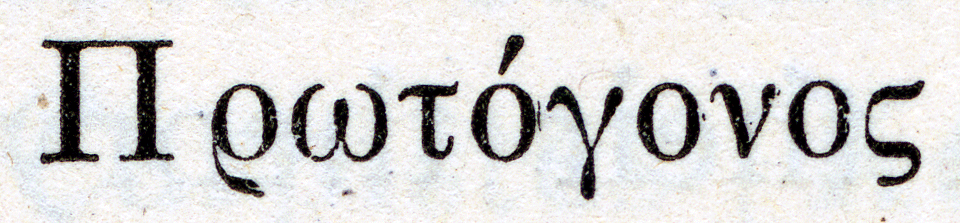
personified attributes of Deity, in the theory of Basilides, were the
Πρωτόγονος
With the Ophites, a sect of the Gnostics, there were seven inferior spirits [inferior to Ialdabaoth, the Demiourgos or Actual Creator]: Michaël, Surièl, Raphaël, Gabriel, Thauthabaoth, Erataoth, and Athaniel, the genii of the stars called the Bull, the Dog, the Lion, the Bear, the Serpent, the Eagle, and the Ass that formerly figured in the constellation Cancer, and symbolized respectively by those animals; as Ialdabaoth, Iao, Adonaï, Eloï, Oraï, and Astaphaï were the genii of Saturn, the Moon, the Sun, Jupiter, Venus, and Mercury. The WORD appears in all these creeds. It is the Ormuzd of Zoroaster, the Ainsoph of the Kabalah, the Nous of Platonism and Philonism, and the Sophia or Demiourgos of the Gnostics. And all
these creeds, while admitting these different manifestations of the
Supreme Being, held that His identity was immutable and permanent. That
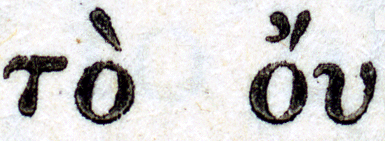
was Plato's distinction between the Being always the same [τὸ ὄν
The belief in dualism in some shape, was universal. Those who held that everything emanated from God, aspired to God, and re-entered into God, believed that, among those emanations were two adverse Principles, of Light and Darkness, Good and Evil. This prevailed in Central Asia and in Syria; while in Egypt it assumed the form of Greek speculation. In the former, a second Intellectual Principle was admitted, active in its Empire of Darkness, audacious against the Empire of Light. So the Persians and Sabeans understood it. In Egypt, this second Principle was Matter, as the word was used by the Platonic School, with its sad attributes, Vacuity, Darkness, and Death. In their theory, matter could be animated only by the low communication of a principle of divine life. It resists the influences that would spiritualize it. That resisting Power is Satan, the rebellious Matter, Matter that does not partake of God. To many there were two Principles; the Unknown Father, or Supreme and Eternal God, living in the centre of the Light, happy in the perfect purity of His being; the other, eternal Matter, that inert, shapeless, darksome mass, which they considered as the source of all evils, the mother and dwelling-place of Satan. To Philo and the Platonists, there was a Soul of the world, creating visible things, and active in them, as agent of the Supreme Intelligence; realizing therein the ideas communicated to Him by that Intelligence, and which sometimes excel His conceptions, but which He executes without comprehending them. The Apocalypse or Revelations, by whomever written, belongs to the Orient and to extreme antiquity. It reproduces what is far older than itself. It paints, with the strongest colors that the Oriental genius ever employed, the closing scenes of the great struggle of Light, and Truth, and Good, against Darkness, Error, and Evil; personified in that between the New Religion on one side, and Paganism and Judaism on the other. It is a particular application of the ancient myth of Ormuzd and his Genii against Ahriman and his Devs; and it celebrates the final triumph of Truth against the combined powers of men and demons. The ideas and imagery are borrowed from every quarter; and allusions are found in it to the doctrines of all ages. We are continually reminded of the Zend-Avesta, the Jewish Codes, Philo, and the Gnosis. The Seven Spirits surrounding the Throne of the Eternal, at the opening of the Grand Drama, and acting so important a part throughout, everywhere the first instruments of the Divine Will and Vengeance, are the Seven Amshaspands of Parsism; as the Twenty-four Ancients, offering to the Supreme Being the first supplications and the first homage, remind us of the Mysterious Chiefs of Judaism, foreshadow the Eons of Gnosticism, and re-produce the twenty-four Good Spirits created by Ormuzd and inclosed in an egg. The Christ of the Apocalypse, First-born of Creation and of the Resurrection, is invested with the characteristics of the Ormuzd and Sosiosch of the Zend-Avesta, the Ainsoph of the Kabalah and the Carpistes [Καρπιότης] of the Gnostics. The idea that the true Initiates and Faithful become Kings and Priests, is at once Persian, Jewish, Christian, and Gnostic. And the definition of the Supreme Being, that He is at once Alpha and Omega, the beginning and the end--He that was, and is, and is to come, i.e., Time illimitable, is Zoroaster's definition of Zerouane-Akherene. The depths of Satan which no man can measure; his triumph for a time by fraud and violence; his being chained by an angel; his reprobation and his precipitation into a sea of metal; his names of the Serpent and the Dragon; the whole conflict of the Good Spirits or celestial armies against the bad; are so many ideas and designations found alike in the Zend-Avesta, the Kabalah, and the Gnosis. We even find in the Apocalypse that singular Persian idea, which regards some of the lower animals as so many Devs or vehicles of Devs. The guardianship of the earth by a good angel, the renewing of the earth and heavens, and the final triumph of pure and holy men, are the same victory of Good over Evil, for which the whole Orient looked. The gold, and white raiments of the twenty-four Elders are, as in the Persian faith, the signs of a lofty perfection and divine purity. Thus the Human mind labored and struggled and tortured itself for ages, to explain to itself what it felt, without confessing it, to be inexplicable. A vast crowd of indistinct abstractions, hovering in the imagination, a train of words embodying no tangible meaning, an inextricable labyrinth of subtleties, was the result. But one grand idea ever emerged and stood prominent and unchangeable over the weltering chaos of confusion. God is great, and good, and wise. Evil and pain and sorrow are temporary, and for wise and beneficent purposes. They must be consistent with God's goodness, purity, and infinite perfection; and there must be a mode of explaining them, if we could but find it out; as, in all ways we will endeavor to do. Ultimately, Good will prevail, and Evil be overthrown. God alone can do this, and He will do it, by an Emanation from Himself, assuming the Human form and redeeming the world. Behold the object, the end, the result, of the great speculations and logomachies of antiquity; the ultimate annihilation of evil, and restoration of Man to his first estate, by a Redeemer, a Masayah, a Christos, the incarnate Word, Reason, or Power of Deity. This Redeemer is the Word or Logos, the Ormuzd of Zoroaster, the Ainsoph of the Kabalah, the Nous of Platonism and Philonism; He that was in the Beginning with God, and was God, and by Whom everything was made. That He was looked for by all the People of the East is abundantly shown by the Gospel of John and the Letters of Paul; wherein scarcely anything seemed necessary to be said in proof that such a Redeemer was to come; but all the energies of the writers are devoted to showing that Jesus was that Christos whom all the nations were expecting; the "Word," the Masayah, the Anointed or Consecrated One. In this Degree the great contest between good and evil, in anticipation of the appearance and advent of the Word or Redeemer is symbolized; and the mysterious esoteric teachings of the Essenes and the Cabalists. Of the practices of the former we gain but glimpses in the ancient writers; but we know that, as their doctrines were taught by John the Baptist, they greatly resembled those of greater purity and more nearly perfect, taught by Jesus; and that not only Palestine was full of John's disciples, so that the Priests and Pharisees did not dare to deny John's inspiration; but his doctrine had extended to Asia Minor, and had made converts in luxurious Ephesus, as it also had in Alexandria in Egypt; and that they readily embraced the Christian faith, of which they had before not even heard. These old controversies have died away, and the old faiths have faded into oblivion. But Masonry still survives, vigorous and strong, as when philosophy was taught in the schools of Alexandria and under the Portico; teaching the same old truths as the Essenes taught by the shores of the Dead Sea, and as John the Baptist preached in the Desert;. truths imperishable as the Deity, and undeniable as Light. Those truths were gathered by the Essenes from the doctrines of the Orient and the Occident, from the Zend-Avesta and the Vedas, from Plato and Pythagoras, from India, Persia, Phœnicia, and Syria, from Greece and Egypt, and from the Holy Books of the Jews. Hence we are called Knights of the East and West, because their doctrines came from both. And these doctrines, the wheat sifted from the chaff, the Truth separated from Error, Masonry has garnered up in her heart of hearts, and through the fires of persecution, and the storms of calamity, has brought them and delivered them unto us. That God is One, immutable, unchangeable, infinitely just and good; that Light will finally overcome Darkness,--Good conquer Evil, and Truth be victor over Error;--these, rejecting all the wild and useless speculations of the Zend-Avesta, the Kabalah, the Gnostics, and the Schools, are the religion and Philosophy of Masonry. Those speculations and fancies it is useful to study; that knowing in what worthless and unfruitful investigations the mind may engage, you may the more value and appreciate the plain, simple, sublime, universally-acknowledged truths, which have in all ages been the Light by which Masons have been guided on their way; the Wisdom and Strength that like imperishable columns have sustained and will continue to sustain its glorious and magnificent Temple.
|