|
ORDERS TO KILL -- THE TRUTH BEHIND THE MURDER OF MARTIN LUTHER KING |
|
Chapter 29: Raul: Otober 31, 1994-July 5, 1995 ON OCTOBER 31, 1994, as a part of our discovery in the civil suit against Loyd Jowers, Raul ____ and others, I prepared to take the deposition (examination under oath) of a woman who allegedly had known a person named Raul in Houston, Texas, in the 1960s and who had come to learn that he was involved in the killing of Dr. King. In the autumn of 1993 she had contacted Lewis Garrison, whose name she had seen in the newspaper in conjunction with Loyd Jowers's request for immunity. For some reason, Garrison had brought Ken Herman into his first meeting with her in 1993 and she believed (as apparently did Lewis Garrison) that he was still working as my investigator. I only gradually learned about her existence and had been denied access to her. Lewis Garrison finally had agreed to facilitate the taking of her deposition. The next morning, November 1, the woman had apparently become ill and had returned home with her husband. Garrison, embarrassed and upset, gave Chastain and me their names and telephone number. He said that Herman had told him categorically that the witnesses would not talk to us. In case they were trying to avoid us, Chastain and I immediately prepared a summons for the woman and her husband, whom I will call Cheryl and Bob, and set out for the town where they lived, which was a few hours from Memphis. We arrived at their home as a school bus pulled up to drop off a youngster who we would learn was their grandson, and whom they looked after until his mother finished work. As Bob greeted the boy on the sidewalk I approached and called his name. He didn't seem to be surprised in the slightest, indicating that he recognized me from television. I introduced Wayne and said that I believed that someone might have been feeding them misinformation. He said casually, "Come on in." We sat down in the living room and he introduced his wife to us. They both insisted that she had not been well and on Monday had not felt up to the formal deposition. They appeared pleased to meet us and said that after that first meeting in Garrison's office they only met with Herman and former Thames Television producer lack Saltman, with meetings being held at Herman's home with no lawyers present. They said that they had wondered where the lawyers were, since they had come forward for the express purpose of trying to help free an innocent man. In this and subsequent sessions I learned about Cheryl's experiences as a young woman. She almost always appeared to be nervous and frequently glanced at her husband for support as she recalled events. She said that in 1962 when she was fourteen years old she met a man who went by the nickname of Dago. Years later she learned his real name which she told me. His first name was Raul but I will use the pseudonym Pereira for his family name. Each day she would walk from her home on Hanson Road to South Houston Junior High School, passing a small gas station on the corner of East Haven and College Boulevard. Dago didn't seem to work at that station but just sat around in front. Since he was friendly to her and she was having a difficult time living with her aunt and uncle, where a pattern of abuse had been established over a number of years, she was happy to know him. She recalled that he was about 5'9" tall, a bit wiry, and weighed 155-160 pounds. His hair was dark with a reddish tint and she thought that he would have been around thirty years old. (I recalled that this matched James's description of Raul, particularly with respect to hair color). In a year's time when she was fifteen she met and married Bob, who by his own admission drank continually and stayed out a good deal. Soon after they were married Cheryl and Bob moved to a small house on East Haven, near the gas station. During this period she only saw Dago occasionally, and between 1966 and 1970 he disappeared from the area. She did not see him at all, but in 1969 or 1970 she did come to know a man whom she and Bob called Armando. Armando began to hang around a good deal; and with Bob gone much of the time Cheryl was very lonely and began to spend more and more time with Armando and his friends and appears to have been exploited by them and some of their associates. Since Armando did not drive at all she frequently drove him places. One of the places they visited was the rented house of Felix Torrino [sic] on the corner of 74th Street and Avenue L. It was at Torrino's house sometime in 1970 that she recalled seeing Dago again for the first time following his absence. At that time Armando told her that Dago, who was much younger, was his cousin with the same family name and that Dago's real name was Raul Pereira. He said that they emigrated to the United States from Brazil or Portugal, though Raul came over many years after Armando. Cheryl said that Armando was quite proud of the fact that he once lived in Chicago and worked for Al Capone's organization. After she had spent some time with them, Armando and Torrino independently told her that Raul had actually killed Martin Luther King. They even told her some details, mentioning some bushes and trees at the rear of the rooming house and saying that Raul had leaned on and broken a tree branch while carrying out the shooting. When she heard this she was shocked. Raul did not know that they had told her and they did not want him to know. Cheryl became increasingly close to this group between 1970 and 1978 and knew that they were involved in different illegal activities which included gunrunning, forging passports, and even the making of pornographic films. She assisted in some of this activity, including the passport forging and gunrunning. When a shipment of guns was arriving from New Orleans she would drive down to the Houston ship's channel, go on to the docks, and allow the boxes to be loaded into the trunk of her car. Often making several trips as instructed, she would deliver the guns, which were either in cardboard boxes or crates, to Torrino's house where, she said, Raul Pereira, Torrino, and their associates would assemble them. She would only go to pick up the guns when particular customs agents were on duty so that she would just be waved through. Though she never asked questions, she heard the men comment that it was safer to ship the weapons around the coast by boat than to truck them in by road. (I recalled the information provided by Warren about the gun-running operation which was run for Marcello by Zip Chimento, as a result of which stolen military weapons were delivered by Warren and other 20th SFG officers to barges in a cove which bordered property owned by Marcello. Too, there was British merchant seaman Sid Carthew's account of being approached in the Neptune Bar in Montreal by a man who introduced himself as Raul, who offered to sell him new military-issue handguns. Carthew said Raul told him that the guns were stolen from a military base and that a master sergeant had to be paid off. The degree of independent corroboration of this activity appeared to be staggering.) Cheryl said that during this period Raul Pereira lived or at least spent a good deal of time in a second-floor apartment in a house on Navigation near 75th Street, close to the docks. Though Raul did drive, she frequently drove him and Armando wherever they wanted to go. She recalled dropping Raul off at the Alabama movie theater where he would often go in the morning to meet with Houston associates of Carlos Marcello. Included in this group were the theater manager, Ross Vallone, who seemed to be Marcello's main man in Houston, and another man, Joe Bacile, who at one point asked Cheryl to marry him. She refused, electing to stay with Bob. Bob said that Marcello owned a number of these movie theaters in Houston, and Cheryl thought there was some pornographic movie production activity going on at the Alabama. Cheryl actually saw Marcello in Houston on a couple of occasions with Armando, Raul, and their friends, at a fruit stand on Navigation and in a bar next door. She said that on another occasion it was arranged for her to spend time with Marcello at a house in the area. One day in the early 1970s, around 1:00 p.m., she drove Armando over to Torrino's house where the usual group had gathered. Her car keys were on a ring which had a plastic viewfinder containing miniature photos of John and Robert Kennedy and Martin Luther King. One of those seated around the table (she believed his name was Manuel) picked up the keys which she had put down on the table, looked into the viewfinder and then tossed it to Raul. Cheryl said when Raul saw it he became angrier than she had ever seen him. She didn't recall everything he said but did remember him shouting, "I killed that black son of a bitch once and it looks like I'll have to do it again." He dropped the keys on the floor and stamped on the plastic viewfinder. Then he grabbed her, put a gun to her head, and forced her into a bedroom where he proceeded to rape her. She said she left Torrino's house that afternoon shattered by the experience. Bob pressed her to tell him what was wrong but she didn't because she feared he might do something which they would regret. From that point on, although she still associated with the group, she tried to keep her distance from Raul who behaved as though nothing had happened. She recalled that in 1978 and 1979 two of Bob's brothers got into trouble and were prosecuted. Bob and Cheryl asked Houston attorney Percy Foreman to defend them. Foreman became attracted to Cheryl and even offered her a job. She wanted to decorate houses which Foreman owned and rented out but he wanted her to work in his office. He was trying to impress her and even gave her an original sketch of himself which he personally signed on June 22, 1979 (see photograph #27). After a while she learned that Foreman had been James Earl Ray's lawyer. He told her that one day white Americans would learn that Ray was a "sacrifice" or had to be "sacrificed" for their welfare. He even told her that he knew Ray was innocent, but that it didn't matter. Cheryl, who had been harboring the terrible secret about who she really believed killed Dr. King, decided finally to unburden herself. She told Foreman. Shortly afterward Foreman informed her that he had spoken with Raul Pereira. To her horror, he appeared to have known him for some time, Thereafter Foreman called her at home several times a week to talk to her about Raul and tell her to be careful. She had the impression that he spoke regularly with Raul, and was trying to take advantage of her plight to get her into bed. She was afraid of alienating him but wasn't interested and tried to keep her distance. Finally, at one point in 1979, Foreman told her in no uncertain terms that if she and Bob did not leave Houston, they would be dead within the year. They prepared to leave and put their house up for sale. In a matter of weeks Cheryl was driving on the expressway and a wheel simply fell off her car, nearly causing her to be annihilated by an eighteen wheel tractor-trailer, She believed this was no accident because every one of the nuts came off, Since Bob regularly serviced the car and checked the wheels, the lug nuts must have been deliberately loosened. They left, only returning to sell their house, and in 1981 resettled in their present home. They had no further contact with either Armando or Raul Pereira. Cheryl and Bob also told me that they had seen the Edginton/BBC documentary and in it recognized a photograph of Jules "Ricco" Kimbel taken over twenty years ago, as being someone they had seen in Houston associating with Raul, Armando, and their crowd. They said that they had told their story to Herman and Saltman when they first met them a year earlier, Recently they had been shown an old photograph by them which Cheryl recognized as being of Raul Pereira, It was obvious that Herman and Saltman wanted to develop a commercial production based upon Cheryl's story. *** CHERYL APPEARED to have no reason to lie and she did not ask for money. Percy Foreman did dedicate the sketch of himself to her so there was obviously some relationship there, but the other details of her extraordinary story required checking to the extent possible. I contacted Houston investigator Jim Carter and asked him to check out some leads. I authorized him to call Ross Vallone who still lived in Houston. Pretending to be an old friend of Raul Pereira's, Carter first established Vallone's connection with the Alabama theater and then told him that he was trying to locate their mutual friend. Vallone went silent for a moment and then said that he really didn't know where he was. Carter said there was no doubt that he knew him. I located a telephone listing in Houston in the name of Amaro Pereira and when I raised it with Bob, he said, "Oh yeah, Armando's name was Amaro but we always called him 'Armando.'" When Carter checked it out he learned that an Amaro Pereira had lived at the address but had been gone for a number of years. The present residents had kept the phone in his name rather than changing it and having to put up a deposit. Next I gave Carter the task of checking out a number of people in Houston with the name Pereira. *** DURING THIS TIME WAYNE AND I drove to Corinth, Mississippi, for an unannounced visit to the home of James Latch, the former vice president of LL&L (Liberto, Liberto and Latch) Produce Company. Wayne was uneasy about doing so but I pressed for the visit, since Frank Liberto's old partner had avoiding me for some time. We found the house and knocked on the door. Eventually Mr. Latch appeared and, somewhat guardedly, invited us in. Wayne's uneasiness could only have increased when the phone rang as we entered and before we even sat down. We had given Mr. Latch our business cards and in response to the caller's questions he read out our details over the phone, After this conversation, while we were in the beginning stages of our interview, the phone rang again and he repeated the process. Finally we began an uninterrupted session. Latch was clearly trying to distance himself from Frank Liberto by claiming ignorance of Liberto's activities and saying that Liberto had not dealt fairly with him on financial matters. He insisted that two heart attacks and a stroke had severely affected his memory. Consequently, he said he did not recall who was on the phone to his partner on the afternoon of April 4 when his partner received two telephone calls, or even if he had answered the phone as John McFerren insisted he had done. He did recall occasional visits by Liberto's brother, Tony, from New Orleans as well as from his mother. He also recalled that Liberto occasionally visited his father who, divorced from his mother, lived in Beaumont, Texas. Gladys, Liberto's wife, also worked in the business, he said, and was an inveterate gambler. Liberto once told him that she gambled heavily in Las Vegas at the local dog track, sometimes losing substantial sums of money. One time she even pawned the valuable jade ring given to him by Elvis Presley. (This confirmed Nathan Whitlock's recollections.) *** IN THEIR DEPOSITIONS IN THE CIVIL CASE (Ray v. Jowers et al.) Nathan Whitlock and his mother told their stories. Nathan confirmed his earlier account of Frank Liberto's admissions. Lavada Whitlock Addison said she ran a restaurant which Frank Liberto frequented in 1977-78. He would regularly stop in early in the morning on his way to work and have oatmeal prepared specially. He would also come in for a late afternoon beer or two on his way home from the market. Gradually, he developed a friendship of sorts with Mrs. Whitlock and he would occasionally be candid with her and her son Nathan. He complained, for example, about his wife -- who he said was a compulsive gambler -- and his mistress (whom he kept in a condo at the Lynton Square development on the corner of Macon and Graham) who he said was only interested in his money. When serving him and other customers, Mrs. Whitlock would often sit down at the table with them to chat. On one occasion she recalled that something about the King assassination came on the television and Liberto calmly commented, partly to Mrs. Whitlock and partly to no one in particular, "I had Martin Luther King killed." Startled, she responded instantly, rising at the same time, saying, "Don't tell me such things," and "I don't believe it anyway." *** CHASTAIN HAD PREVIOUSLY TOLD ME that at the October 1994 meeting in Garrison's office when he was given a copy of the request for immunity, Herman had made a point of telling Garrison that he had informed him about his client's -- Jowers's -- involvement in the killing as soon as he had learned about it. Herman told the attorney that he felt that he had an obligation to do so because he had done investigatory work for Garrison's law office. I wondered what had happened to his obligation to James Earl Ray. It was this foreknowledge that put Jowers on his guard and caused him to require Garrison to be present during his testimony at the television trial and also explained Herman's earlier statement in the aftermath of the television trial that somehow Garrison had found out about Jowers's involvement. just prior to Jowers's deposition, attorney Garrison confirmed to me that Herman had told him about the existence of the waitresses who could implicate his client, as a result of which Jowers insisted that he be present as a condition of testifying. Loyd Jowers was deposed over a nine and one-half-hour period. He had with him a typed clause asserting his Fifth Amendment rights ready for use. Nine hours would pass before he would use it. We began at a gentle pace as I took him from his childhood and early life in a large rural family to his days on the police force, which roughly lasted from 1946-1948. After that he formed his own "Veterans Cab Company" whose initial members Were all World War II veterans. It was during his brief career as a police officer that he met Memphis produce dealer Frank C. Liberto in 1946 or 1947. He denied knowing any other Frank Liberto. "When I asked him about the liquor man up the street he said he knew him and made purchases from him, sometimes daily, but that until my question he had not known that "Frank" (as he knew him) was a Liberto. He simply didn't know his last name. He said that back in 1946 he knew both patrolman N. E. Zachary and Sam Evans. He also knew inspector Don Smith when he was a patrolman. He became particularly close to G. P. Tines, who years later became an inspector in charge of the intelligence bureau. The friendship developed because Tines's wife and Jowers's first wife went to school together. Jowers supplied details of his six marriages (three to the same woman). He recalled Frank C. Liberto in the late 1940s as a prominent produce man whose business was located downtown in the market near central police headquarters. Later the market moved to Scott Street and Liberto moved his business there. Jowers believed that the Scott Street produce business LL&L was owned by Frank Liberto and his brother, but he didn't remember the brother's name. He denied knowing Frank Liberto well, although he believed that "Frank," as he called him, did help him get some taxi business from the market. He said that he didn't see Frank Liberto again until 1965. He refused to acknowledge any business dealings with him. In 1966 he left Veterans Cab and went to work for the Yellow Cab Company, owned by Hamilton Smythe, as a dispatcher. The next year (1967) he opened a restaurant called the Check Off Inn on 1.53 East Calhoun Street, the site of the old Tremont Cafe, He maintained that when he eventually opened Jim's Grill in the summer of 1967 his wife ran the Check Off Inn, but it was not clear how she could have done this while working full-time for the Memphis Stone and Gravel Company. He also denied that there had been any gambling going on at the Check Off. When he opened Jim's Grill he moved Lena, a cook from the Check Off, over to the grill. He also hired Betty Spates and her sisters Alda Mae Washington and Bobbi Smith. At the time a white woman also worked for him as a waitress, but he couldn't remember her name. He described an Esso gas station on the corner of Vance and Second, and he remembered another station on Vance and Third which he thought was a Shell station. (I thought that either of these could have been where James went to try to have his spare tire repaired around the time of the shooting.) He acknowledged driving both a white Cadillac and a brown Rambler station wagon and said that it was possible that the Cadillac was in his wife's name. He confirmed that his wife, Dorothy had her hair done every Thursday. (April 4, 1968, was a Thursday.) Though he bought most of his supplies from Montesi's supermarket, he said that fresh vegetables came from M. E. Carter and that deliveries were made every day. He said that the back door from the rooming house was boarded up, but he couldn't explain why it appeared to be open in police evidence photographs I showed to him taken shortly after the killing. Jowers said that on April 4 he drove the white Cadillac to work and that Bobbi Smith worked on the morning of April 4 but left around 4:00 p.m. He said Betty Spates did not work at all that day because one of her children was sick. Also, he said that Big Lena and Rosie Lee had gone from his employ months earlier and that he himself had fixed breakfast for the "eggs and sausage" man. (Sometime prior to Jowers's deposition I had located Rosie Lee Dabney and she confirmed that she was waiting on tables in Jim's Grill on the afternoon of April 4. She said she served eggs and sausage to a stranger on the afternoon of the shooting and again the next morning. An MPD report dated April 6 stated that Dabney was on duty all day on April 4 and that she had served eggs and sausage to a stranger.) Jowers could not identify a photograph of Jack Youngblood as the "eggs and sausage man." At the time of the gunshot he said that he was drawing a pitcher of beer. Jowers confirmed with certainty that the bushes in the backyard had been cut down. He actually drew a line surprisingly close to the building up to where he said the thick bushes came. He acknowledged that the waitresses probably did take food up to Grace Walden but denied telling Bobbi not to take food up to her on the morning of April 4. He denied driving Bobbi to work on the morning of April 5 or going out to the back or even looking out there on the morning after the shooting. He said he drove the white Cadillac that day. Incredibly, he categorically denied having any relationship with Betty Spates. He also denied knowing anything about the Oakview house and ever staying overnight there. He did, however, admit to speaking with Spates on December 13, 1993, the night the Prime Time Live program was filmed, to warn her, he said, that reporters were on the way to her house. I showed Jowers a copy of the transcript of the ABC Prime Time Live program and he agreed it was an accurate statement. I then entered it into the record. When I began to question him on the statements he made on the program, he invoked the Fifth Amendment. I noted for the record that the transcript had already been agreed to and entered into evidence and that in my opinion the protection of the Fifth Amendment was not available to him. Garrison then agreed to stipulate "... that the questions were asked and Mr. Jowers gave these answers" (the answers being those responses given during the television program). Jowers's testimony was extraordinary for the number of un truths he told, many of which were clearly contradicted by other evidence and testimony and some of which contradicted his earlier statements. Jowers, for reasons best known to himself and his counsel, insisted on deposing Betty Spates. Lewis Garrison served a subpoena on her, and she came along in a hostile frame of mind. Before beginning, I took her aside and explained that Jowers, who had denied having any relationship with her, had insisted that she be called. Initially, she was inclined not to remember anything, but gradually she decided to cooperate. She confirmed the factual truthfulness of the affidavit she had given to me which I have discussed in detail earlier. Willie Akins was also deposed and stated that years after the event Jowers admitted to him that he was involved in the killing. Jowers described his meeting with Raul, Raul having brought the gun to him at the grill, and Frank Liberto arranging for a delivery of a large sum of money in a produce box which was included in a regular delivery. The scene was striking. Jowers greeted Akins cordially and then Akins, under oath, proceeded to directly incriminate his old friend. Akins continued to maintain that years later he had been asked by Jowers to kill Frank Holt. At the end of the deposition Jowers and Akins went off together talking about old times. Betty's sister Bobbi Smith was also subpoenaed and appeared as scheduled on December 22. Under oath she confirmed what she had told me in an informal interview on December 18, 1992, two years earlier. Jowers had told her not to take breakfast upstairs to Grace Walden on the morning of April 4. She usually did this about twice a week around 10-10:30 a.m., after the morning rush was over. I had always thought that this was significant because it meant that something was going on up there well before noon that day, some four or more hours before James arrived to rent the room. Bobbi also said that Jowers picked her up on the mornings of April 4 and 5, as usual, in his brown station wagon which on April 4 he parked just north of the grill in front of the U.S. fixtures store. (I remembered that during and after hypnosis Charles Hurley, who was picking up his wife Peggy on South Main Street that afternoon, recalled seeing a brown station wagon on that side of the street. ) On the way in on the morning of April 5, Jowers told Bobbi about the rifle being found in the backyard after the killing. She also confirmed that Jowers often spent the night at the Oakview house where she lived with her mother and Betty in 1969, and that he had a longstanding affair with Betty during all of this time. She also said that at the time of the killing Betty did have a job at the Seabrook Wallpaper company across the street from Jim's Grill. Finally, she said that she had told the same story to the TBI investigators sent by Pierotti and she did not understand why they would say that she knew nothing or had retracted her story. They told her not to discuss the matter with anyone. *** SOMETIME AFTER TELLING ME his story about Frank Liberto, Nathan Whitlock told me about a rumor of an earlier King murder contract put out to a member of a family named Nix who lived in Tipton County, Tennessee. Nathan said he understood that Red Nix had been given a new car and a rifle and was paid $500 a week to track and kill King. If he succeeded he was to get $50,000. Whitlock thought the offer came from Frank C. Liberto. Red had been killed not too long after Dr. King was shot. At Whitlock's suggestion I met with Red's brother, Norris, and Bobby Kizer, who jointly owned and ran the Neon Moon nightclub on Sycamore View in East Memphis. They confirmed that Red was given a new car and was put on a payroll for a job. "He was after someone all right," said Norris Nix, "but I don't know who." They believed that Tim Kirk, who was a friend of Red Nix, would know who hired him, and offered to ask him to tell me what he knew. He could, they said, free my client. Bobby Kizer even offered to go up to the prison with me to talk to Kirk. I was surprised. I thought I knew everything Kirk had to say. Eventually I visited him again to ask him about the Red Nix murder contract. He said with certainty that the contract was put out by Carlos Marcello, not Frank C. Liberto. It was sometime in mid-1967. He said Nix knew Marcello and undertook various jobs for him. A car had indeed been provided. This was the first indication directly linking Marcello to a contract on Dr. King. Nathan Whitlock had been under the impression that Frank C. Liberto had also been behind the Nix contract. Kirk said there was no way. It came directly from New Orleans and Carlos Marcello. Kirk said that Red Nix was set up and killed sometime after the assassination and that it could well have been related to his knowledge about the contract. He promised to try to check out what was behind Red's murder. Try as he did, he was un- able to learn anything. Information about the Marcello/Red Nix contract reminded my assistant lean about something that Memphis investigator Jim Kellum had included in one of his reports in 1992 before he asked to be released. It concerned an informant who had allegedly mentioned a similar contract which was put out at a meeting in Jackson, Tennessee. Kellum agreed to arrange a meeting. On the morning of December 20, 1994, Kellum brought to breakfast "Jerry," a longtime trusted informant of his. Jerry told of attending a meeting in Jackson, Mississippi, in mid-1967 at the Blue Note Lounge. There, a wheelchair paraplegic named Joe "Buck" Buchanan, who was into a variety of illegal activities and well connected in New Orleans, put out a $50,000 contract on Dr. King, which Jerry believed had come from that city. Jerry also said that Tim Kirk was at that meeting, as was one of the Tiller brothers from Memphis (who we knew had some association with Kirk) .When I raised the meeting with Kirk he said he had a vague recollection of the event. It seemed that this contract was later picked up by Red Nix, possibly directly from Marcello. Jerry said that Joe Buchanan was killed some years later, shot sitting in his wheelchair in his front yard, after being set up by a woman he knew well. Jerry said that she was probably still alive and would likely know why Buchanan was killed and who ordered him to be shot. Jerry agreed to try to locate her and find out. He ultimately became unable or unwilling to do so. More than ever the trail of the Memphis contract that actually resulted in Dr. King's death led to New Orleans and pointed toward the involvement of the Mafia organization of Carlos Mar- cello. Marcelo had not just given his approval but had taken on the job and had attempted to subcontract it on more than one occasion -- the last time being through his Memphis associates which included Frank C. Liberto and the Memphis Godfather. *** FOR A NUMBER OF YEARS THERE had been rumors about a Yellow Cab taxi driver having seen someone going down over the wall just after the shooting, As part of the investigation for the television trial, I had asked two of my investigators, Herman and Billings, to get the names of Yellow Cab drivers working on April 4. They were not forthcoming. Finally, in autumn of 1994 a driver came forward of his own volition. At first, he tried to tell his story to the attorney general but he encountered total disinterest. Then, after spotting Lewis Garrison's name in the local paper in an article about the case, he telephoned him and left his name. Garrison duly passed it on to me and I spoke to him on November 5, 1994. Louie Ward told me a story he had held back, out of fear, for twenty-six years. He had been driving on the night of April 4 and around 6:00 p.m. he was parked near the corner of Perkins and Quince. Suddenly he heard the dispatcher come on the radio, obviously responding to a driver's call about an emergency (the drivers could only hear the dispatcher's side of conversations with the other drivers). He heard the dispatcher say that he would send an ambulance and then, in response to something else the driver said, the dispatcher said he would send one anyway and call the police. From what he had heard Ward learned that the emergency was the shooting of Martin Luther King, He also realized that the driver was taking a fare to the airport. Ward went straight to the airport and met up with the driver who told him his story. Ward said that the driver, whose name he could not recall and who probably was in his early sixties, was driving car 58. The driver said that he had gone to the Lorraine shortly before 6:00 p.m. to pick up a passenger with an enormous amount of luggage. As they finished loading up his taxi in the Lorraine parking lot, the driver turned to look at the area of dense brush and trees opposite the motel. His passenger quickly punched him on the arm in order to get his attention and (so the driver later thought) distract him from looking at the brush, saying, "Look up there -- Dr. King's standing alone on the balcony. Everybody's always saying how difficult it would be to shoot him since he is always in a crowd. Now look at him." At that precise moment the shot rang out and the driver saw Dr. King get struck in the jaw and fall. The driver said he grabbed his microphone and told his dispatcher that Dr. King had been shot. The dispatcher said he would call an ambulance, and the driver said that considering the wound he didn't think it would do much good. Then Ward said the driver told him that he saw a man come down over the wall empty-handed, run north on Mulberry Street, and get into a black and white MPD traffic police car which was parked across the middle of the intersection of Mulberry and Huling. At that point the driver told the dispatcher to tell the police that one of their units had the man. Meanwhile, the passenger was becoming irritable, saying that they had to leave immediately because otherwise the ambulance and other cars would box them in and he had to make his plane. They left. Ward heard the driver repeat the story to three MPD officers at the airport, and observed a second interview being conducted later that evening in the Yellow Cab office by other policemen. After that evening Ward said he never even saw the driver of car 58 again. Ward was working full-time at the Memphis army depot and was on the job round the clock the next two or three days. It was only after this period that he was able to return to his part-time taxi driving. When he went back to the South Second Street Yellow Cab office for the first time after the killing he asked after the car 58 driver. Three or four of the drivers in the office told him that he had fallen or had been pushed from a speeding car onto the Memphis-Arkansas bridge late on the evening of April 4. Ward also said that at that time there was speculation by some of the drivers that since the man seen fleeing the area wasn't carrying a gun that perhaps it was hidden in the back of Loyd Jowers's cafe because all of this activity took place behind that building. Ward agreed to undergo hypnosis in order to see if he could recollect the names of the driver of car 58 and the dispatcher. Subsequently, under hypnosis, he recalled that the driver's name was Paul, and that after the fleeing man got into the passenger side of the MPD traffic car, the car headed north at top speed. Louie Ward agreed to try to help us locate the dispatcher on duty. I did manage to locate and depose a former Yellow Cab dispatcher named Prentice Purdy. Under oath in May 1995 Purdy stated that he nearly always worked the 7 a.m. to 3 p.m. shift and that was his schedule on the day of the assassination. He did recall a full-time driver named Paul and said that he believed that he almost exclusively did airport runs. He said that he could not specifically recall ever seeing Paul after April 4, but he did not know if or when he had died. He said he was unable to remember Paul's last name, though he did agree to continue to think about it. I telephoned him a few days later and he still was unable to recall the name but within the week he had left a message on Chastain's answerphone and I called him back. He said Paul's last name was Butler. Telephone records indicated that a Paul Butler who was a driver for the Yellow Cab company was listed in the 1967 Memphis residential telephone directory. His wife, Betty, continued to be listed in 1968 as his widow. According to social security death listings Paul Butler died in August 1967. He obviously could not have been the driver of car 58 on April 4, 1968. We were back to square one. The story was consistent with Solomon Jones's observations, but I wondered why Ernestine Campbell or William Ross would not have seen this person. When asked, Ernestine said that at that time she had focused her entire attention on the balcony and then on Jesse Jackson's actions at the foot of the stairs. I also recalled that immediately after the shot William Ross had turned and run back to the driveway, so within seconds of the shooting as he stared at the balcony his back would have been to the wall on the opposite side of the street. The fleeing man could well have been missed by Ross though seen by Jones, who had stared at the area of the origin of the shot for a brief while after it was fired. I recalled the curious photograph shown to Ed Redditt during the course of the investigation by the Justice Department, which showed the evidence bundle on the corner of Mulberry and Huling. The chain of events recounted by Ward might explain why at some time there could have been a plan to drop the incriminating evidence bundle on this street corner which now appeared to be on the actual escape route of the assassin. * * * ON THE MORNING OF NOVEMBER 9, I met with Steve Tompkins in his G-10 office in the Tennessee State Capitol Building. He had prepared a chronology of events for me, which I was eager to analyze and discuss. He had printed it out before he left the office the previous night. He looked everywhere but couldn't find it. When he thought about it he remembered placing it on a desk in the office with his secretary's resume on top of a manila legal size folder. Both were gone. He was convinced that his office had been entered and the file taken. I had recently had a similar experience. On one visit to Birmingham my address/appointment book had disappeared. I had come to make it a habit to carry with me at all times the most sensitive working files. After completing a number of telephone calls I left the room, taking the file bag with me, but leaving the address book behind, lying on the unmade bed. When I returned I needed a phone number and looked for the book. It was nowhere to be found. I located the housekeeper who had, in my absence, cleaned the room and made the bed. She remembered seeing the book and moving it before changing the sheets. She returned to the room with me and showed me the end table against the wall where she had placed the book on top of a sweater which I had also left lying on the bed. The sweater was there exactly where she had placed it, but the book was missing. She and I looked behind and under the table and the bed and all over the room. It remained missing and has never turned up. Reluctantly, I had to conclude that it had been surreptitiously removed. For some time I had followed the practice of registering in an assumed name. On this occasion, since I was only in Birmingham for one night and only a couple of people knew I was in the city and no one knew where I was staying, I had not taken this precaution. Even though the book contained little relevant or indispensable information, and my writing was often illegible anyway, it was an ominous indication that a closer look was being taken at my activity. In addition, one day later a Memphis friend who was holding material from a source for me, told me that the "eyes only" file was missing. These incidents were worrying. Steve Tompkins was concerned but could do nothing except print out another copy. Security would now have to be a more important concern than ever before. *** JUST BEFORE THE COURTS CLOSED for Christmas, attorney Garrison filed a motion in the civil suit on behalf of defendant Jowers asking for the right to test the rifle in evidence. His rationale was that if in fact this was the murder weapon, then he could have no liability since it was the rifle purchased by James. Since we had been trying to have the weapon tested for some time, we did not object. The court said it would consider the motion but at the time of this book going to press no ruling had been made. *** SOME MONTHS BEFORE, Richard Bakst, a Maryland taxi cab driver, had told me about one of his passengers who claimed he knew a Memphis policeman who was on duty in the area of the Lorraine Motel on the day of the killing. The passenger had said that the officer, who was a family friend, had seen, just after the shooting, a man running in the brush area toward South Main Street. He was carrying a rifle. When, shortly afterward, the officer told his superior on the scene about the incident, he was told to forget about it, because they already knew who did it. Bakst had consistently refused to name his passenger, who he said did not want to discuss the matter further. On December 17, Bakst finally disclosed the identity of his passenger, Michael. Eventually I spoke with Michael and he agreed to talk to the former MPD officer. In 1968, the policeman was a motorcycle officer and was, Michael believed, assigned to Dr. King's escort unit. Michael basically confirmed Bakst's account, including the order from a superior officer to say nothing about seeing a man with a rifle in the bushes. According to Michael, the policeman was willing to talk to me. I left Chastain's phone number and my own but again as this book goes to press we have not heard from him. * * * JIM KELLUM, WHO HAD WORKED with the MPD intelligence bureau, confirmed to me for the first time on December 20, 1994, that he had learned that Reverend Billy Kyles had been an informant during 1967-1968. His source, who had been an administrative aide and secretary in the intelligence bureau, confirmed to me that Kyles had indeed supplied them with information on a regular basis but was unclear as to the precise dates of this service and appeared too nervous about going into detail. *** I NEXT RETURNED TO THE STORY about a rifle having been stored, for a time, in the premises of another Liberto family member's business where Ezell Smith had worked. We finally learned that Ezell had died. One of his friends (who was also a friend of John McFerren) was O. D. Hester, whose street name was "Slim." Slim now lived in Illinois, outside of Chicago. John McFerren called him. Slim said he knew all about the rifle kept in this building. "Tango," who ran a store in the produce-market area, disclosed to John McFerren that he also knew all about the gun being kept in the Liberto business premises. When I met with Tango late one evening in February 1995, he told me that a man named Columbus Jones had told him about a rifle being carried to those premises around the time of the killing, although he did not know any details about the weapon. Jones said his source was Ezell. He said that it was rumored that this was the gun that had killed Martin Luther King. Columbus Jones died in early 1995 before I could speak to him. I did speak with Slim. Ezell had told him that the murder weapon was kept and assembled at the Liberto premises where he worked. He promised to speak with another man who had worked for that business to try to obtain details about the rifle, but he was unable to locate him. *** ON SATURDAY, MARCH 11, 1995, attorney Lewis Garrison, with Loyd Jowers present, began to depose James in a small conference room at the Riverbend Penitentiary. The deposition continued until noon the following day. Throughout the session Jowers listened intently as James gave the usual answers to the questions he had heard a thousand times before. As he left the prison that Sunday afternoon for what was described as a 500 mile drive to his current home, Loyd Jowers seemed to be more amenable than ever before to revealing details which I believed would ultimately establish James's innocence. Jowers agreed to answer some questions about the killing through his lawyer. There would be no recordings of his statement and the attorney Lewis Garrison would take the follow-up questions to him for his response. On March 14, 1995, the process began in Garrison's 400 North Main Street office. While he provided some new details of the conspiracy, much of what he said confirmed information obtained previously from Betty Spates, Betty's sister Bobbi Smith, and taxi driver James McCraw. At the outset Garrison stressed that the Holt story did not originate with Jowers. He was uncertain whose brainstorm it was, but believed it originated with Willie Akins and Ken Herman. Though he emphasized that it was not concocted by Jowers he had to acknowledge that his client did go along with it for awhile. Jowers contended that in March 1968 he was first approached by a local businessman who dealt in securities and bonds and whom he had come to know from his gambling activity with Frank Liberto. This man told him that because of the location of Jim's Grill he was going to be asked to provide certain assistance in the carrying out of a contract to assassinate Martin Luther King. In exchange for this assistance he would be paid handsomely. On March 15, soon after this conversation, Jowers was approached by produce man Frank C. Liberto to whom he owed a very large gambling debt. This debt would be forgiven, Liberto told him, and he would receive a large amount of money if he would provide the assistance initially mentioned by the messenger. Specifically Liberto said:
1. $100,000 would be delivered to
him in cash in the bottom
of an M. E. Carter vegetable produce box. The money came
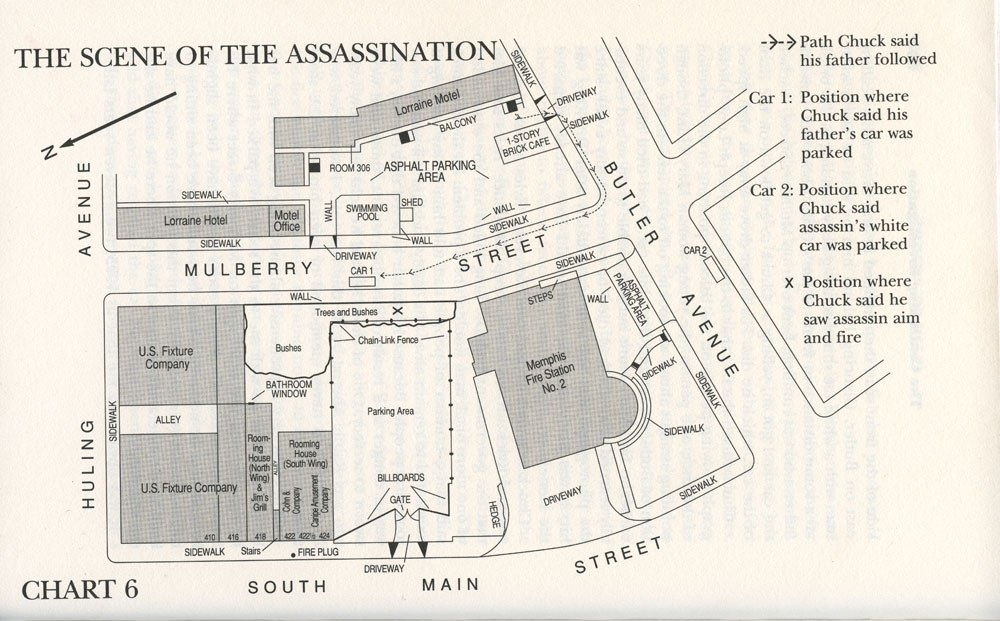
from New Orleans, as did the contract on King's life. Jowers agreed. As Liberto said, a man did come to see him. In fact he met with this man on two occasions before April 4. Jowers thought that he introduced himself as "Raul" or "Royal." Jowers said he appeared to have a Latin/Indian appearance. He was about 5'9" in height and weighed approximately 145-155 pounds. He had dark hair and appeared to be between thirty-five and forty years old. (This description matched that provided by Cheryl and James.) They discussed the plans for the killing. Raul told Jowers that his role would be to receive and hold the murder weapon on the day of the killing until Raul picked it up. After the shooting Jowers would have to take charge of it again and keep it concealed until Raul came to take it away. Jowers was also expected to keep his staff out of the way at all times. He confirmed Bobbi's story that he instructed her not to follow her usual practice of taking food to Grace Walden. On the morning of April 4, sometime around 11:00 a.m. after the rush was over, Raul, according to plan, came into Jim's Grill, bringing with him a rifle concealed in a box which he turned over to Jowers to hold. Jowers said that Raul told him that he would be back later that afternoon to pick it up. Jowers put the gun under the counter and carried on with his work. He next admitted that he took his nap in the back room sometime around or after 1:00 p.m. when the lunch crowd had gone. He woke and began to work again around 4:00 p.m. Sometime later, Raul returned briefly and took the gun from him and went back into the kitchen area with it. Jowers claimed to be uncertain as to whether he remained in the rear of the grill, or went upstairs by the back stairway. (According to James's recollections, Raul was upstairs off and on during the afternoon. It therefore seems more likely that Raul took the gun upstairs to room 5-B and concealed it there). Jowers said that sometime before 6:00 p.m. he went out into the brush where he joined another person. He did not provide any more details except to admit that immediately after the shot he picked up the rifle which had been placed on the ground and carried it on the run in through the back door of Jim's Grill. As he ran into the back of the grill he was confronted by Betty who, as she had said, stood near him as he broke the gun down, wrapped it in a cloth and quickly put it under the counter in the grill itself. Jowers finally confirmed that her recollection of the events was basically correct. He also admitted that the next morning between 10 and 11 a.m. he showed the rifle, which was in a box under the counter, to taxi driver James McCraw, thus confirming McCraw's recollection. Sometime later that morning but before noon, Raul reappeared in the grill, picked up the gun and took it away. He said he never saw the rifle again and had no idea where it was taken or where it is today. (When McCraw was deposed in mid June 1995 Jowers in front of Chastain and Garrison explicitly threatened McCraw just prior to the deposition beginning. He said to McCraw, who was rising to greet him, something like, "You'd better stand up while you can, 'cause if you continue to run your mouth, you won't be able to stand up again.") The version of events just laid out was completely at odds with the answers Jowers gave in his deposition. Though his most recent statements were consistent with information and accounts of other less self-interested persons it had to be borne in mind that Jowers was aware of many of the other statements. *** ON APRIL 15, 1995, THE United States Attorney General's office finally replied to my earlier letter requesting a federal grand jury. Basically, the letter said that the federal government could do nothing and that it was well known that a state investigation was in process and a post conviction relief petition pending. I was urged to provide my evidence to the state authorities. I really expected nothing else from the administration which had just taken former Tennessee Governor Ned McWerter to Washington as a special consultant to the president. On May 8, 1995, the Tennessee Supreme Court denied our application for Extraordinary Appeal. The Court of Criminal Appeals's injunction remained in effect, prohibiting trial court judge Joe Brown from issuing any order concerning evidence before his court. The judge was also ordered to issue a final order on our petition. The action of the appellate courts appeared to me to be an unprecedented draconian stripping away of a trial court's authority. Because the judge's decision to allow the petitioner an opportunity to put on (proffer) evidence had been reversed by the appellate courts, it was generally assumed that the judge would now have no alternative but to dismiss the petition. I believed that the judge could still order an evidentiary hearing or even a trial. I planned to request a hearing so that full oral argument could take place. *** ON THURSDAY JUNE 1, 1995, a former client of Lewis Garrison whom I will call "Chuck" walked into Garrison's law offices in Memphis. Some years ago Chuck had injured his leg while working and Garrison had obtained disability benefits for him. He was looking for some additional legal assistance on this matter. In the course of their meeting the subject of the King assassination came up, apparently prompted by a telephone call to Garrison from Loyd Jowers. Chuck told Garrison about something he observed related to the killing. Garrison urged Chuck to talk to me. He was very afraid. Garrison and Chuck's common-law wife told me that a number of people had told him that he would be killed if he told what he saw. Eventually, under threat of subpoena, he called me and we spoke for nearly an hour. He said that in 1968 he was six years old. On April 4 of that year he rode from Tunica, Mississippi, to Memphis with his father who made the journey in order to meet with Dr. King. He did not know why his father was meeting with Dr. King on that day but remembers being excited about the trip. Chuck, now about thirty-five years old, said at that time his hair was in plaits, which were cut off soon after that day. His father drove up to Memphis, eventually reaching Mulberry Street and going south toward the Lorraine. He parked opposite but just south of room 306 in the shade of the trees and bushes just above and behind the wall. (I realized that at that time in the afternoon the sun would have been in the west behind the brush and trees on the wall which would have provided shade in the spot he described). Chuck said his father told him to wait in the car. He said his father went onto the motel property through a southern entrance near the corner of Butler and Mulberry and ascended the southernmost staircase leading to the balcony. He walked north along the balcony to Dr. King's room 306. Chuck said that after he saw his father enter the room he lay down on the front seat and took a nap. He believed that it was around 4 p.m. He didn't know how long he slept. When he woke up he sat up on the open window frame of the front passenger door and with a child's curiosity began to look all around. In a short while his attention was drawn to a man in the brush and trees area above the wall about five or six feet in front (south) of him. He said the man stood looking directly across at the motel. He was a few feet back from the edge of the wall and partially obscured by the trees and bushes. He was of medium build, had dark hair and a black moustache and appeared to be Arab or Mexican. He was dressed in khaki trousers and a short-sleeved shirt and wore an army officer's style (Garrison) peaked hat. Holding a rifle close in up against his stomach, he stood there for a while looking across at the Lorraine and then disappeared, going back into the bushes and trees. Chuck thought that he was hunting birds. He came from a rural area and was used to seeing people with rifles hunting birds or rabbits, so this did not seem unusual to him. Chuck thought that a long time passed before the man reappeared. He thought it must have been about an hour, but it is obviously difficult for him twenty-seven years later to assess his sense of time when he was six years old. He recalled seeing a photographer/reporter walk down Mulberry Street from Butler. The reporter looked at him as he walked right past him. He urged me to find this reporter who he thought would at least be able to establish his presence. I was unable to do so. At one point he saw his daddy leave Dr. King's room and begin to walk toward the same southernmost stairway at the far end of the balcony he had climbed earlier. He also saw Dr. King come out onto the balcony and stand at the railing just at this time the man reappeared, clearly visible just a few feet back from the wall, though partially obscured by the bushes. Chuck's attention was drawn at this time because at that moment birds flew up from the trees, apparently disturbed by the man. The man raised the rifle and took aim and as he did so Chuck said even today he can vividly recall his fear that the man (who he thought was going to shoot at a bird) might hit his daddy because he was pointing his gun in the direction of the Lorraine balcony. The man seemed to take his time. He was facing Chuck who was staring at him from a sloping distance of about twelve to fifteen feet. The man's right hand held the stock of the gun and his left-hand trigger finger was on the rifle trigger. He fired and Chuck saw two puffs of smoke come from the barrel of the gun and linger even after the man was gone. Strangely, Chuck did not recall hearing the shot. The man moved instantly back into the bushes and disappeared. Chuck said that he lost sight of the man but then no more than two to three minutes later, he saw the man run up to a white car parked on the far (south) side of Butler Street, opposite the fire station. (To get there, if the alleged shooter was in front of the fence he would have had to either run along the wall under cover of the bushes, jump down at the back of the fire station and continue running north to Butler, or scale the fence at its lowest point in the corner at the rear of Canipe's, cut through the parking lot and round the front of the fire station to Butler. If he was behind the fence he would already be in the parking lot and follow the latter route. Either route would have put him and the rifle he carried in clear view of any passers-by for a period of time. Chuck specifically stated he did not see him running along Mulberry Street.) Chuck said that having reached the car the man opened the driver's side front door and threw the rifle across into the passenger's side of the front seat, then jumped in and drove away heading east on Butler. Glancing behind him he said he saw a white man with a white tee shirt and a big belly standing in the brush area some distance in front of Jim's Grill. About this time his father, who was running, bent over up Mulberry Street, reached the car and got in, yelling at Chuck to get down on the floor of the car, which he did. His father drove away at high speed. Chuck raised the fact that in the famous Joseph Louw photograph showing people on the balcony pointing in the direction of the shot, one person, the young woman Mary Hunt, though pointing straight ahead was looking off to the left -- in the direction of Butler Street and the white car. I had tried many years earlier to find Mary Hunt but was unable to do so and eventually learned that she had died of cancer. In any event, since the photograph was not shot immediately after Dr. King was hit, it was likely that the man would have already departed the scene. Chuck said that he had told Reverend Kyles about what he saw and Kyles advised him to keep his silence. Kyles told him that the government had Dr. King killed and the elimination of one more black man wouldn't be a problem for them. Chuck said that a number of people had told him to say nothing if he wanted to remain alive. His daddy had him tell what he saw to several people. Because his father believed that the boy's life was in danger as a result of his observations, those told were sworn to secrecy. One of those he said he told very many years ago was Ralph Abernathy. If this was true, I wondered why Abernathy had never mentioned or even hinted at the story to me. Chuck was very apprehensive about being seen with me but he consented to go with me to the scene. We parked in what he thought was the exact spot on Mulberry Street where his father had parked. Dr. King's room would have been slightly behind him or north of where he would have been sitting in the front seat (see chart 6). From this position he would have been able to see a car parked in the spot where he said he saw the white car.
CHART 6: THE SCENE OF THE ASSASSINATION It was obvious to me that in 1995, twenty-seven years later, Chuck was somewhat disoriented with respect to the physical scene. He thought that there was a second driveway into the Lorraine off Mulberry Street. There wasn't, although there was an entrance from Butler near the southern stairway. More importantly, he didn't initially appreciate the fact that the fire station backed right down onto Mulberry Street, neither did he realize how large it was. On the Mulberry Street side the parking lot was closed in by a tall chain-link fence which was set back a short distance (around four feet) from the wall. Though the fence was mostly covered by brush and weeds it was bare and clearly visible near the north corner bordering the rooming house rear yard. Chuck said that he never noticed the fence and that the man he saw simply went back into the brush away from the wall. I recalled that the area where Reverend James Orange had always insisted that he saw the smoke appeared to be very close to the spot where Chuck said he had seen the shooter. I had always assumed that Orange had been mistaken and that he must have meant the bushes behind Jim's Grill and the north wing of the rooming house, because the trajectory of the bullet and observations of other witnesses pointed to the shot having been fired from further north. I couldn't conceive how a shot fired from a point that far south, which would have been to his left, could have struck Dr. King in the right cheek, exited below the right jawbone and reentered the right side of his neck. For this to happen he would have had to turn considerably to his left just before being hit and there is no eyewitness indication of this. I was also unable to find anyone who remembered seeing Chuck's father's car parked on the west side of Mulberry. When I interviewed Carthel Weeden, who was in charge of fire station 2 in 1968, he said that immediately after the shooting he ran across to the Lorraine and helped Benny Thornton put Dr. King on the stretcher for transportation to the hospital. At one point he was confronted by a hysterical, somewhat heavy-set black woman dressed in black. He learned that her name was Catherine. She was screaming that, "he was shot in a white car." Weeden thought she meant that the shot came from below from a passing white car. I thought this must have been the young woman referred to in a note in 1968 defense co-counsel Hugh Stanton's file, who was identified as a LeMoyne college student and described as screaming at the police to go after a man she saw getting away. As discussed earlier, I had tried unsuccessfully to locate her. It was possible that she meant that the shooter was leaving in a white car. I had never heard any report about Chuck's father participating in any meeting with Dr. King on that day. For at least some of the time that Chuck said his father was meeting with Dr. King there was an SCLC executive staff meeting in progress. Reverend Hosea Williams did not recall any outsiders being present during the meeting but believed that some people from Mississippi had been called to Memphis. Reverend Lawson was not at the meeting but said that people often drove long distances to see Dr. King about any number of things. Such a visit would not have been unusual at that time since the southern leg of the Poor People's march was starting in Mississippi. I spoke with some black leaders in Tunica who knew Chuck's family. No one said that they had heard about his father ever meeting with Dr. King. One community leader even said that the family left the area in the early 1960s, moving to Memphis. One of Chuck's brothers, who was three years older than Chuck, said that they were tenant farmers in Tunica in 1968 but that it was very unlikely that his father would leave the farm to go to Memphis in April. He said that he certainly did not remember it happening. Chuck's elderly mother, on the other hand, did recall her husband saying that he had met with Dr. King. She said he mentioned it more than once but she was not certain when the meeting or meetings took place. She also vaguely remembered hearing about something that Chuck saw that was kept secret, but she could not, or would not, recall any details. She did say that during this time she was ill and away from the family and she believed that her husband and the younger children did live in Memphis for a while. She also remembered that six-year-old Chuck did have plaited hair for a while. I discussed these conversations with Chuck on Sunday, July 2. He told me that he had gone to a funeral the day before at which his brother and one or more of the community leaders with whom I had spoken told him that if he continued to talk he would get himself killed. Chuck had the impression that their concern was centered round secrets other than the King assassination that he might have heard when he was around his father. They also invited him to join the local Masonic lodge where previously he had been excluded from membership. His brother pressed him to join. As a "brother" in the lodge he would be bound to secrecy. When I spoke with Chuck's common-law wife she confirmed that Chuck had told her this story many years ago. She had known him since about 1979 and she believed that he first unburdened himself about what he saw in 1987 or 1988. She also said that at the time of the television trial she went with Chuck to visit his family and during that visit he brought up the experience. The family members did not want it raised and advised Chuck for his own good to keep quiet. She had always found Chuck to be truthful. Whatever his faults, lying was not one of them. His attorney, Lewis Garrison, basically confirmed his reliability but noted that he had had a minor drug problem and had recently served a short jail term. Chuck seemed sincere but corroboration was virtually nonexistent and his story implausible. On the face of it, the degree of specificity seemed impressive but even if he was telling the truth he could easily have been mistaken as to the details, particularly since he was only six years old at the time. He had no apparent reason to lie but it was possible that the entire story was a fabrication. In light of all the available conflicting information, and absent additional corroboration, I had to discount Chuck's story. *** By MAY 1995 THE INVESTIGATION in Houston had not borne fruit. In the interim Garrison said he had been told by Herman that the man they believed to be Raul who they were looking at lived in Detroit, was using the name Diablo, and was in the import/ export business specializing in a particular product. A search of those businesses led nowhere and I assumed that Herman was putting out disinformation. Too, James had told me that Herman and Saltman had shown him an old photograph which he said was the same picture he had seen in 1979 and which he had recognized as being of Raul. He could not however recognize a 1994 photograph they showed him of a man they claimed was the same person. At the time of Loyd Jowers's deposition on November 2, 1994, Garrison showed Jowers the 1994 photograph which was provided to him by Herman and returned to him. Jowers said that he could not make a positive identification. Garrison also showed me the photograph which was of a relatively slim man dressed in a blue jacket, white shirt and tie, with graying brown hair. Sometime later attorney Garrison informed me that Jowers was later shown the earlier photograph of the man alleged to be the younger Raul Pereira and he tentatively said that he was the man named "Raul" or "Royal" who he knew was involved with the crime. Cheryl told me that she too had been shown the more recent photograph. At first she said she couldn't be certain because the greying hair confused her. She likened it to someone wearing a wig. Subsequently, she told me that the similarity of the facial structure convinced her that it was the Raul Pereira she knew. I decided to go to Houston myself with Cheryl and Bob. We retraced Cheryl's movements from the time she first moved to Houston at age fourteen. A Waffle House restaurant now stood on the spot where the gas station had been located. We spent time in the area of the docks and Navigation Avenue observing an old house which was one of the places where she said Raul stayed during the time she saw him in Houston. We also drove past the house rented by Torrino where Cheryl said Raul allegedly admitted the killing and she was raped. It was now painted a grayish blue color (see photograph #26). The places Raul Pereira used in Houston appeared to be temporary accommodations. I had the impression that he might have had a permanent base elsewhere. Cheryl and Bob were nervous being in the obviously rough and hostile area, where strangers, particularly those with cameras, were regarded as the enemy and often subjected to drive-by shootings. The scene, they said, was very much as it was back then, incredibly poor and dilapidated. The Alabama Theatre was now a bookstore but Cheryl was able to point out Ross Vallone's old office where he held court, always seated in a recliner chair. Bob tried to talk to some of the people who had been around during the 1960s and 1970s. The few he located were reluctant to talk, with the exception of one person who did talk and even gave him a photograph of Amaro which he gave to me. Before parting company Cheryl executed an affidavit which set out her story in detail and said that she knew James Earl Ray was innocent and that she was prepared to testify in court on his behalf and tell what she knew. Upon my return to England, a Houston area lawyer confirmed in a lengthy telephone conversation that Percy Foreman had become in the 1960s and 1970s the foremost lawyer for organized crime figures. Former mob lawyer Frank Ragano, who had represented Carlos Marcello and Santo Trafficante, had previously told me about Foreman's role as a lawyer for prominent mob figures. (He also revealed their extensive dissatisfaction with his services.) I heard a rumor that the man I was looking for lived in the Northeast. I began a computerized state-by-state, name and residence check and cross-referenced search, using the name of Raul Pereira provided by Cheryl. It was a long shot that the man might be using his real name but there was always a chance. A small number of people named Raul Pereira surfaced. I instituted credit and other checks on these persons. By a process of elimination based primarily on age, ethnic origin (I had decided to focus only on white male immigrants between fifty-five and sixty-eight years of age with Portuguese or Brazilian origins), the list gradually reduced. The search was completed in early June and one person remained who satisfied the basic criteria. He appeared to be a relatively successful businessman, nearly sixty-one years old. He jointly owned his home, which was in a middle to upper middle class neighborhood in a city in the Northeast, with his wife. He had two grown children, one a twenty-five-year-old daughter and a son who appeared to be thirty-three. I then did a yellow pages search of import/export companies specializing in a particular product in that man's county. One possibility came up. When I called the business number an answer machine referred me to the home telephone number of the man I was focusing on. I turned my attention to gathering more information about his personal life as well as his business. He owned another property on the same street where his import/ export business was located in one of the city's poorest areas. He was reportedly a member of the local Portuguese American society and had no criminal record. From immigration records I learned that he had entered the United States from Portugal through New York City. His social security number had been issued in New York between 1961 and 1963 and he first appeared in his city telephone directory in 1965. (I recalled that Cheryl had said she first met this man she knew as Raul Pereira in Houston in 1962.) If this was James's Raul then for at least twenty years he had clearly led a double life. A letter arrived from James in which he said that he had received a letter from Saltman stating that he and Herman had confronted Raul. He had apparently been hostile, taken photographs of them, and had his Spanish-speaking wife ask them to leave. I wanted to obtain a current photograph of the Raul Pereira I was looking at in order to show it to Cheryl and also to determine whether this was the same man whom Herman and Saltman were considering, whose photograph I had seen at Jowers's deposition. So, in June 1995 I instructed a surveillance team to take photographs of him. When the photographs arrived at my office in London, I anxiously opened the courier pack. I was virtually certain it was the same man whose photograph I saw at the time of Jowers's deposition. The man I had begun to focus on earlier that spring clearly appeared to be the same person Herman and Saltman were looking at. I decided to call Herman. He put Saltman on and they confirmed the visit and the hostile reception. Raul would not come to the door. His daughter spoke to them, lying in response to even the most simple and apparently nonthreatening questions. Giving no indication of where the man was or the man's identity, they both assured me that the man that they had found was Cheryl's Raul. When I expressed skepticism designed to draw out information, they jointly confirmed to me that the birth date and social security number of the man in the older photograph were identical to the birth date and the social security number of the man they had recently visited and who was the man in the more recent photographs. Herman later said that a C.I.A. contact of his told him that there was an active C.I.A. file on this person. The file reportedly indicated that Raul had worked for the Portuguese Government's national munitions company with some coordinating responsibility for weapons sales and distribution between October 1957 and December 1961. Immediately thereafter I spoke with Cheryl. She told me that prior to Herman and Saltman's visit to Raul, they arranged for her to participate in a telephone conversation which was put through to Raul Pereira's home. She believed various members of his family, including himself, his wife, his daughter and son-in-law, were on various extensions and participated at different times. Cheryl said when Raul came on the phone she knew it was the Raul Pereira she had known in Houston, because of the way he pronounced her name. He never could pronounce it correctly. Despite what became hysterical denials of knowing her and ever being in Houston, she said she had no doubt this was the man. It was obvious that Raul Pereira had been well and truly alerted and I was concerned that he might flee. This, of course, would allow the state to continue to contend that he was not the right man and that James's Raul never existed. In addition, since Herman and Saltman said they did not have enough to satisfy their television producers I was apprehensive about what further action they might take which could induce him to flee. There therefore appeared to be little choice but to promptly join Raul Pereira as a party in the civil action against Jowers. We prepared a summons to go along with the original complaint in which he had been named, and a notice of deposition. The complaint against Raul alleged that:
1. He entered into a conspiracy
with others to kill Dr. Martin
Luther King, Jr. There was, however, always the possibility that he was not the right man and we had to acknowledge it. A mistake could greatly destroy our credibility, yet inaction could lose for us one of the most, if not the most, significant on- the-scene player whose very existence had been denied by the MPD, the FBI, and the HSCA. I decided upon a middle ground. At the time he was being served he would be handed a letter informing him that if he was not the man we sought and was willing to talk to us and confirm the fact that we were in error, then we would withdraw the action against him. In the meantime we would request an order from the court sealing the file so that the fact that a summons and complaint and a notice of deposition had been issued and served upon him would not be made public. Accordingly, Chastain and Garrison went into the judge's chambers on Friday, June 23, and secured an order sealing the file until further order of the court. Around this time private investigator Bob Cruz told me that a source of his inside the Immigration and Naturalization Service (INS) had informed him that Raul Pereira had come into the United States on December 11, 1961. His source also said that Raul's INS file had been transferred in October 1994 to Memphis, Tennessee. He commented that there was no apparent reason for sending the file to Memphis and that the file would only be transferred at the request of another federal agency. With time of the essence, I arranged a meeting with Cheryl and Bob in Memphis on the weekend of June 24. I showed Cheryl the photographs I had obtained of Raul Pereira. I was virtually certain that they were of the same man Herman and Saltman had photographed but she would not confirm that this was the Raul she knew. She did say once again that the man she talked to on the telephone call was the Raul she knew, and stated that the phone call was actually made from her home. This meant that the number would have been on a recent month's bill. She and Bob promised to give us the number so that we could compare it with the number we had for the Raul Pereira we had located. Cheryl executed an affidavit in which she stated she recognized Raul from a 1960s photograph and also recognized the facial features of the man in a 1994 photograph she had been shown by Ken Herman. She further stated that she participated in a telephone conversation with Raul Pereira and that she was positive that this was the Raul she knew in Houston because of his inability to correctly pronounce her name, and that based upon her identification she understood we were preparing to bring him into the lawsuit against Loyd Jowers and others. The following Sunday evening I called for the phone number but Bob said he could not find the bill. On Monday at 7:45 a.m. we met Bob Cruz, who had organized the surveillance detail. He reported that the mother and daughter had already gone out, apparently leaving Raul at home alone. Before approving the final arrangements for service I needed to be absolutely certain that this was the same man being looked at by Saltman and Herman. I decided to call Raul myself and talk to him on the telephone. I did so and adopted a sympathetic tone, saying that I believed that he may have been harassed unjustly and I wanted him to know that though these people had once been associated with me as a lawyer in the case they were no longer working with me and were off on their own. He ponderously took down Chastain's and my details. He spoke with a fairly heavy accent and did not appear to be flustered. It was difficult to tell how much, if any, of Raul Pereira's language problem was feigned. (The surveillance team had told me that he demonstrated a high degree of street smarts when they tried to tail him. They said he knew exactly which moves to make to shake them off.) He seemed puzzled that I knew about his "problem" and confirmed that he had been bothered by some people and that this was upsetting him and his family. He expressed surprise that things thirty years old were being raised now and denied ever being in Houston. I asked him to meet with Chastain and me privately in order to try to clear up any question of his involvement and he asked me to call him back that evening after 7 p.m. when he would have had a chance to talk to his "kids" and his wife. I agreed and we held off any attempt at service that day. At 7:15 p.m. his daughter answered and said, in effect, that her father did not have to prove anything and his word denying any knowledge of the events would be good enough. She confirmed that a man named Saltman had appeared at their front door wanting to question her father and she said that she told him that if he published or released any information about her father they would sue him. My impression was that she was well trained and intelligent Mr. Pereira knew what he was doing by putting her forward. Toward the end of the conversation she said that they might ask their lawyer about talking to me, though she would not give me his name. At that point I concluded that we would have to serve Raul Pereira. I left the papers with P. I. Cruz to formally serve. The man I have called Raul Pereira was served on July 5 and made a party defendant in the Ray v. Jowers et at. lawsuit.
|