|
WOMEN AND SPANISH FASCISM -- THE WOMEN'S SECTION OF THE FALANGE 1934-1959 |
|
5. Continuing the Revolution: SF 1945-1959 As Sección Femenina (SF) prepared to face the 1950s, it had much cause for satisfaction. The nation had taken its first steps to recovery since the Civil War and the interventionary programmes of SF were giving way to more institutionalized welfare and education work. Its national training schools were fully operational and one had been relocated and expanded. SF’s rural regeneration schemes were given new outlets by the Department of Syndicates and the Ministry of Housing. And the propaganda triumph of 1948, the performance of its choir and dance teams (coros y danzas) to foreign audiences, was scheduled to continue with further trips approved by central government. But amid the optimism, the decade started with anxieties about how SF should develop as an organization. Alongside the sense of achievement that programmes were expanding was a consciousness that the political doctrine was based on a memory and vision of the past. This chapter examines the difficulties this caused in the lower ranks of SF and how the organization tried to re-present its identity while keeping faith with the values of the Civil War and the doctrine of José Antonio. It considers SF’s continuing usefulness to the regime and the value placed on its work in financial terms, its contribution to social legislation affecting women in the 1950s and lastly, its impact on the female unaffiliated population. At one level, it was the case that the Francoist vision of a regenerated Spain coincided broadly with the original ideas of José Antonio, although, as noted elsewhere, Franco ignored the more extreme of José Antonio’s ideas such as nationalizing the banks. The basic tenets of the Falange, drafted in 1934, had been adopted with little alteration by Franco when he unified the parties of the Right in 1937. These included the vision of Spain as a ‘unit of destiny in the universal order’, staking a claim to Empire with her citizens united in the common aim of restoring wealth and influence to the nation. [1] There was, too, a call for a ‘National Revolution’ to bring this about, in which the style would be ‘direct, ardent and combative’, emphasizing José Antonio’s belief in life as a form of military service ‘to be lived in a pure spirit of service and sacrifice’. [2 ] But the final point of Falangist doctrine, which had spelled out how the Revolution was to be made, was deleted by Franco when he adopted the Programmatic Points of the Falange as a basis for Unification. José Antonio had declared that the Falange intended to enter into few political pacts, and he also described how the Revolution would be made by the ‘Conquest of the State’. [3] The removal of the final clause distanced Franco from anything beyond a rhetorical commitment to the revolutionary potential of the Falange. In 1937, there was no thought of compulsorily involving the entire population in a process of political mobilization. The newly unified parties of the Right were not about to carry through the joseantoniano idea of a mass penetration of society by elite members. Only in SF and, to a lesser extent, in the Youth Front of the National Movement, was it seriously proposed that society could be transformed by the rigorous imposition of political and social teachings. [4] In this vision of the Revolution, elite members (mandos) would work ‘in tune with the historic destiny of the people, even where this is not in accordance with the wish of the masses’. [5] SF’s dynamism was initially helpful after the Civil War. The urgency of the problems it faced required its specialists to function as emergency aid providers, working to achieve measurable targets in child health, a reduction in infant mortality and improved domestic economies in the villages. But the work of SF staff was always in the context of the joseantoniano principles of the Falange Revolution and the overarching principles of Francoism. Their job, or ‘mission’ as it was described in SF literature, had many dimensions. Training manuals stressed the ‘complete work’ (labor total) expected of local specialists. The rural instructor, for example, had a specific teaching and advisory role in village and farming communities but also had to contribute to the ‘moral, cultural and recreational’ development of rural families. [6] In the belief that joseantoniano doctrine provided a complete model for how people should run their lives, the rural instructor was required to organize exemplar leisure activities, such as ‘best housewife’ competitions and musical and drama contributions for local festivals. [7] There were other SF specialists to help, such as the local youth or physical education instructor, but in the context of the widespread rural poverty of the 1950s, the expectation must have seemed impossible to many. Even by 1945, there were indications that the style and rhetoric of SF operations were out of step with the direction of the regime. Youth membership was falling, and in 1946 complaints from SF health workers (divulgadoras) were increasing. Like the rural instructors, their ‘mission’ had many facets and in the early years had no guaranteed payment. In the period between 1946 and 1951, a large number resigned, their situation illustrative of the difficulties faced by many SF staff. [8] The social problems which SF had tackled so energetically after the Civil War were no less urgent. But among the specialist mandos, particularly those working at local level, there was a sense that the wartime spirit in which the programmes had been spearheaded could not last forever. SF’s operational style had no parallel outside the Falangist sector of the National Movement and was in contrast to the depoliticized subordination promoted by the authoritarian conservatives in the regime. Carlists, monarchists and Christian Democrats alike had no tradition of interventionary programmes or efforts to mobilize the general population, which was still in the grips of the post-war repression and economic hardship. As Dionisio Ridruejo commented on his return to Spain in 1951: The conformism of the nation has made everyone used to the lack of information and the dogmatic asphyxiation of intellectual life…. The nation is quiet as a mill-pond…. The atmosphere, which you could describe as relaxed or morally deadened and apparently self-satisfied, is scarcely recognizable as belonging to the Spain I left. [9] It was in these difficult political and social circumstances that SF staff were attempting to interest communities in the Falange Revolution and José Antonio. Parents in general wanted their daughters to study, not join a political youth group or go off to summer camp. And whereas SF’s programmes had the political and cultural legitimization of the regime, mandos still had to face the barriers of a male-dominated and controlled society. The male population, particularly the authorities locally, did not uniformly welcome women arriving in villages ‘with their luggage on their back, to save from death, ignorance and misery those souls forgotten by everyone except the Falange’. [10] SF staff’s qualities of inventiveness and persuasion were often more useful than political rhetoric in combating prejudice. A former teacher in the travelling schools recalls the strategy used to ensure that male residents would come to the literacy classes and agricultural courses organized in the villages. The SF team was routinely ignored by all the men on arrival, and the staff’s priority was to start cookery classes for the women. After a few days the men would begin to appreciate the improved catering at home. The mandos would then visit the local bar, where they were invariably the only females present. The men would get up as they came in and insist on paying. After this, staff knew that they could start their full programme of classes and that men would attend. [11] But the price of carrying out successful programmes was the increasing sense of tiredness of the mandos responsible. By the early 1950s, there was a feeling in the service hierarchy at provincial and local level that realism should prevail and that social and educational outcomes should be made the priority. Orders coming from the national office were not always obeyed, and a double standard developed between the ideologues of Almagro [36], who clung rigidly to the original joseantoniano doctrine, and the staff on the ground. For Pilar, however, the separation of doctrine from SF’s programmes was never a possibility. There was no thought of consciously going against the direction of the regime, which after 1945 was keen to present the National Movement as a broad-based party of State. SF had accepted this, understanding that the 1947 Law of Succession was necessary and also that the regime was becoming increasingly Catholic (‘National Catholic’) in its leanings. It was simply the case that Pilar believed utterly in the continuing basis for SF’s moral authority. Nonetheless, at the 1952 SF conference, she acknowledged the crisis: For some … we are the kind of ferocious tyranny which they classify as a totalitarian State…. For others … we are admirable women, who for charitable reasons dedicate ourselves to alleviating need, to the point where for some Falangists, this should be the sole duty of the SF…. Well, we are neither one thing nor the other; we are … the female part of a Political Movement, with its doctrinal core, which makes us live in a passionate will to serve and which has as its immediate objective the moral revolution. Because we know that by making the person, we make the Nation. [12] In style, too, SF was incontrovertibly tied to the recent past. The early Falange had come into being as a protest against the Second Republic. The manner of its development, its conflict with Republican governments and its role in the Civil War were integral to its ideology. This was manifest in its oratory, which included calls to its supporters (camaradas), constant denunciations of its enemies and was both warlike and heavily sentimental. The rhetoric and symbolism that were so essential to SF’s belief system also largely formed the style of the Axis powers. But while this and the political nature of SF’s programmes made the job of mandos difficult, Pilar saw a way to impose the ‘moral revolution’ other than through propaganda and textbooks. Since its inception in 1938, the SF journal, Revista ‘Y’ had carried articles of general interest on careers and study, marriage and Francoist social and welfare legislation. [13] The opportunity came at the beginning of the decade to bring these issues to a more public forum and establish a role for SF as a national voice representing women’s interests. From the contacts made during SF’s visits to Latin America with its choirs and dance teams came the idea of hosting a conference for SF members and women from Spanish-speaking countries. The remit of the twelve-day SF Hispano-American conference which began in Madrid on 3 June 1951 was to discuss issues of interest to women, including employment, higher education and women’s role in politics. [14] But perhaps inevitably, the conference opened up divisions in the thinking among the higher mandos. As noted in Chapter 1, SF had a contradictory stance on paid female employment. There were clearly inequalities, lack of opportunities and discrimination but it was not clear how SF could champion employment rights without appearing to contradict the fundamental notion that women’s principal role was as homemakers. By the time of the conference, certain of the original mandos felt in any case that the moment was right to put pressure on ministers to improve employment legislation. The editor of an SF journal, Mercedes Fórmica, a founder member of SF, had been asked to prepare proposals on women’s employment in Spain for one of the conference sessions. She prevailed on Pilar to add a section to those for discussion -- the situation of women in the liberal professions. Mercedes Fórmica headed a team of eleven professional women at the Institute of Political Studies and over the following twenty-two months produced her report. To her astonishment, the document was withdrawn moments before it was due for presentation at the conference and Mercedes Fórmica was told it had ‘been lost’. [15] The experience did not deflect Mercedes Fórmica from further contributions to legislative reform but it convinced her and others that SF was missing opportunities. To her mind, SF should be building on its success and showing government it was time to put right the discrimination against women which the Second Republic had failed to address. It was a point of view which caused some mandos, including Mercedes Fórmica, to conclude that the criterion of family above all else would forever inform Pilar’s way of thinking. Nonetheless, SF did campaign for changes to legislation on women’s issues. The Hispano-American conference had set up a discussion panel to look at discriminatory female legislation and in 1952 a further forum, the First Congress of Justice and Law, took the discussions forward. Over the following six years, SF worked towards reform of the Civil Code and in 1958, the government announced sixty-six changes that would favour women. Considering that Franco had re-established the Civil Code of 1889, under which married women were legally subordinate to their husbands and male adultery was condoned, the number of injustices to women were many. The sixty-six changes were an extremely modest first step to righting discrimination and did nothing to alter the premise that women were fundamentally dependent on men and that married women, in particular, were subject to their authority in family and property matters. They removed three major injustices: that a widow who remarried should not lose maternal authority over her existing children and secondly that a wife seeking legal separation should not automatically forfeit her family home, considered to be the husband’s, and rights over her children. Even if the case went against her, she would be entitled to half the shared possessions and all her own. Finally, the distinction between male adultery and that of the woman was removed, both being considered a cause for legal separation. 16 The second piece of legislation of the 1950s was unequivocally the product of SF intervention. Since the 1940s, the Town and Country department had been conscious of the precarious employment situation of domestic staff. They had access to certain SF facilities such as summer camps but had no entitlements to benefits, so that when they became too old to work, the family frequently dismissed them to face an old age with neither home nor pension. It took four years from 1955 before the government was persuaded to set up a social security scheme. The proposal had been drafted by the head of Town and Country and was finally due to go the Council of Ministers for discussion. It had been blocked at the first session because of lack of time and was due to be presented that day. At the last minute, the minister responsible, Fermín Sanz Orrio, called the head of Town and Country to his office and told her that it would not be presented for discussion because ministers’ wives had heard the proposals and were objecting (on the grounds that the scheme would add to their wage bill for domestic servants). SF’s response was to invite the ministers’ wives, together with Doña Carmen, the wife of Franco, to a tea-party at the Medina Circle. In the presence of the bill’s opponents, SF staff described the need for the legislation to Doña Carmen. She promised to tell her husband and the bill was passed unopposed at the next Council of Ministers. [17] Although both pieces of legislation were undoubtedly important, it was not until the 1960s that SF intervention and pressure in government began to bring about major change. [18] Less controversial, and therefore more acceptable to SF was its contribution to the nation’s culture. This was a role for SF which freed it from the direct transmission of political ideas yet which was in tune with the doctrine of José Antonio. And whereas its other programmes were targeted at the female population, involvement in culture was not gender-specific. Moreover, it aligned SF with elements of the male Falange, for whom a trademark of Falangism was intellectual curiosity and open-mindedness. And although, as Amando de Miguel has indicated, any ‘liberalism’ on the part of male Falangist intellectuals amounted to little more than a protest against the traditional cultural monopoly of culture by the Church, it was none the less an area where SF could be seen to represent the most ‘modern’ elements of Falangism. [19] Its Foreign Service re-opened the Madrid Lyceum and the Ladies’ Residence, both closed at the beginning of the Civil War. Renamed the Medina Cultural Circle, the Lyceum was one of the very few places left after the war offering cultural events of quality. Its recitals and lectures attracted such writers and musicians that were still in circulation, helping to establish SF as a cultural bridge-head for the regime. SF’s role was also in harmony with attempts of the regime to foster cultural links abroad to counter Spain’s international isolation. [20] Its contacts with Latin America were particularly welcome as they fitted the concept of Spain as the ‘spiritual axis of the hispanic world’ [21] without this appearing a ridiculous aspiration following the Axis defeat. This had been a prime aim of the Hispano-American conference and there were a number of outcomes. Six of the visiting countries decided to start their own cultural forums and from here came the idea of further collaboration and links between these and SF’s Medina Circle. Of these, the most significant were SF scholarships, enabling Latin American women to study for a year in Spain and, in some cases, for Spanish women to go there. [22] The success of the Hispano-American conference encouraged the belief in SF that the regime valued its cultural initiatives and the joseantoniano doctrine which underpinned them. This was a conclusion which seemed justified by national events at the beginning of the 1950s. Amid the rhetoric and propaganda of the Civil War, the most serious attempt at an intellectual justification of the conflict had come from Falangists such as Dionisio Ridruejo and Antonio Tovar. At the beginning of the decade, politicians sympathetic to the early Falange re-presented this view. The idea that ‘revolution’ could be combined with ‘restoration’ as Sheelagh Ellwood has said, allowed for discussion of how the regime and its future as a monarchy could develop politically and culturally. [23] State propaganda idealized the nation as a unified, Catholic community, guided away from foreign danger by the wisdom of the Caudillo. The Fundamental Laws were in place, which defined Spain as a kingdom and set out a façade of democratic representation and a charter of rights for its citizens. Within this framework, encouragement could be given to academic endeavour and limited political discussion could be tolerated. Optimism reigned in SF following appointments made in the Ministry of Education in 1951. The new minister, Joaquín Ruiz Giménez, was acutely aware of the need to improve the intellectual standards of higher education, which had been severely compromised by the Civil War. His appointment of the Falangists Pedro Laín Entralgo, Antonio Tovar and Torcuato Fernández Miranda to rectorships of universities was a mark of his faith in the National Movement as a vehicle for promoting the values of the regime. [24] In 1953, Falangists were told by the Secretary-General of the Movement: ‘The Falange considers that … respect for intelligence is at the heart of Spanish intellectual tradition, the pinnacle of western culture and the quintessence of thinking and Catholic political tradition.’ [25] A further force for change came from Jorge Jordana, the new leader of the Movement’s Students’ Syndicate, the SEU (sindicato español universitario), which saw the need to encourage intellectual and cultural activity. [26] SF was completely in agreement. Through its operation of the Ladies’ Residence and its own Students’ Syndicate (SF- SEU), it felt a stakeholder in the debate on how universities should be run. But by the early 1950s, there were many political currents within the National Movement, particularly in the universities. The modernizing ideas of Jorge Jordana were acceptable to the majority of students, but some wanted greater reforms, especially with regard to the election of student representatives. There were other students who believed that Franco’s policies (in particular the Law of Succession) had broken faith with the Nationalist cause. Finally, a minority of left-wingers opposed both Franco and the basis on which he had come to power. SF centrally was informed of all developments in the universities through its staff members (mandos) who worked in the female section of SEU. [27] SF-SEU mandos regularly engaged in the types of cultural activity which Ruiz Giménez was trying to encourage. But apart from being an outlet for artistic and intellectual endeavour, SF-SEU was also the seed-bed for female political activity. Between 1951 and 1954, the direction of the National Movement was much discussed among them. In 1953, there was still a feeling of optimism that Franco had recognized its potential for constructive help and that he was not allowing monarchists and conservatives to have the upper hand. But there was also an awareness that updating and greater efficiency were needed. SF-SEU mandos fully agreed with SEU’s assessment that without a dynamic, up-to-date image, the National Movement would have no influence on the course of politics. [28] There were two main views among SEU and SF-SEU members on how the original doctrine of José Antonio should best be preserved. The first wished to reinforce the values of the Civil War through an integrating approach, as Ruiz Carnicer has said ‘to implant the regime on Spanish society with something more than repression and the power of the Army’. [29] The other view was more conservative, believing that values could only be maintained by excluding any opposition. SF overall was more inclined towards the first of these views. The policies of Ruiz Giménez to encourage cultural diversity within the universities had sat well with SF-SEU activities. In a broader sense, too, his views were in line with SF’s belief in reconciliation of the victors and vanquished of the war and the power of joseantoniano doctrine as a unifying force. SF’s opinion changed, however, in 1954, when it became seriously worried by a number of incidents in the universities, interpreting them, as did Franco, as having wider significance. Problems had started when a SEU-led demonstration at the beginning of the year against the visit of Queen Elizabeth II to Gibraltar led to the arrest of its organizers by the authorities and subsequent retaliation by students. The incident seriously dented SEU’s claim to be the legitimate representative of patriotic feeling. It was now increasingly isolated, on the one hand visibly supporting the regime’s anti-Gibraltar sentiment and on the other angering the authorities for having done so. The effect of the Gibraltar incident was compounded by plans of Ruiz Giménez over the next two years to broaden the cultural base of the universities. Among them, his decision to organize a conference for young university writers alarmed the leadership of SEU, who was sure that such an event would be infiltrated by Communists. Having authorized the conference, Ruiz Giménez then sanctioned a planning forum, which soon became a venue for dissidents. Jorge Jordana resigned in protest and although his successor had the conference banned, the damage was done. The dissident students proposed an alternative student body, to be elected democratically and replacing SEU. This angered SEU supporters and they protested violently, causing material damage in the Law Faculty. This was followed two days later by a counter-demonstration in which a Falangist student was severely wounded. The fights and shootings so alarmed the authorities that they temporarily closed Madrid University, suspended two articles of the citizens’ charter and arrested all those connected with the organization of the congress. The dean and rector of Madrid University were dismissed, Ruiz Giménez resigned and even the Secretary-General of the Movement, Raimundo Fernández Cuesta -- who had been abroad at the time of the incident -- was replaced. The events of 1956 took place after the SF conference, but from February, focused the minds of Pilar and the mandos on the future of SF. Those nearest to the crisis, SF-SEU mandos, had the widest divergence of opinions. Many thought that SEU had already gone too far in its attempts to modernize. Others thought the opposite, citing the need for new political textbooks and different teaching methods in SF. And there was an underlying worry that events in the universities would compromise the position of the National Movement in the regime, inclining Franco to shift support to other sectors. Events seemed to be confirming this. The restoration of the monarchy had been brought a step nearer with the news that the young Juan Carlos was coming to live in Spain. SF now had to balance its commitment to the Falangist Revolution with its loyalty to Franco. Its support for the political ideals of SEU (particularly its anti-Gibraltar sentiments) and the cultural goals of Ruiz Giménez had to be set against the greater need to uphold stability of the regime. A solution appeared to be offered to SF by Franco’s own plans for the National Movement. The replacement for Fernández Cuesta, José Luis de Arrese, was given the task of rewriting its constitution and re-drafting the Fundamental Laws. Under Arrese’s proposals, the original twenty-six Programmatic Points of the Movement lost all mention of its fascist past and emphasized the Catholic nature of the State, its natural unity and the primacy of family. Additionally, the proposed Organic Law of the Movement and the Law of Government Organization greatly increased the powers of the National Movement, both in the short term and after Franco’s death. [30] For Pilar, Arrese’s proposals were a potential solution. She had already accepted the need to re-present the teachings of José Antonio, telling members at the January conference of 1956: ‘We must renew ourselves or die.’ [31] Her hope was that a reformed, more powerful Movement would be able to contain the cross-currents within the regime and in a letter to members on 12 March she shared her feelings about the situation in the University: These are the events which should make us think of our role in provoking the unrest but also in the terrible responsibility of opening the way to a pure and simple return to 1936. Can we take back control of the University? Following these events, two ministers have been replaced and it seems that at last Falange is to be given the political powers it has hitherto lacked. If it really can direct politics and conquer the State from above with the full responsibility of success and failure, it will be a good thing. But let us trust in the words of the Secretary-General in Valladolid and the confidence that the Caudillo has in the Falange. [32] While it awaited the outcome of the Arrese proposals, SF made plans for its own reform, accepting Ruiz Giménez’s principle that the regime needed further legitimization than the memory of the Civil War. But there was no question of changing the elements of SF which were causing the real problems -- namely the salary arrangements for its specialist staff, the overall rigidity of its hierarchy nor its determination to impose beliefs on the female population. The only proposals were a dilution of some of the political teaching to the unaffiliated and the removal of the more public signs of militarization. In the reformed textbooks, the Civil War would be mentioned less and current issues would be emphasized. José Antonio’s ideas would be a seamless whole with the policies of the regime, and references to Empire would be no more than affirmations of spiritual solidarity with Latin America. The regime at La Mota would remain unchanged but the Falange salute and the regular wearing of uniform would go. Arrese’s proposals did not find approval with government and at first SF did not react, at least not publicly. In the memory of a mando close to Pilar, the subject was talked about but not discussed officially. SF had already made up its mind to go ahead with reforms, regardless of what was going on around it. [33] This independent line may also have been prompted by the knowledge that larger political moves were on the horizon. Major changes to the economy were about to be set in motion following the appointment of economic reformers to the Cabinet in 1957. The prospect of a free market economy was unwelcome to SF mandos because it would, they argued, promote materialistic values, making the sacrifices and spiritual values of joseantoniano doctrine ever more remote. These apprehensions were increased when Franco, reacting to the unpopularity of the Arrese proposals, removed key Falangists from the Cabinet. Arrese had been replaced as Secretary-General by José Solís Ruiz and one of SF’s greatest allies, José Antonio Girón de Velasco, was dropped from his post of Minister of Labour. The Cabinet changes provoked an immediate response within SF and a second set of proposals for reform. In December, all the national specialists (regidoras centrales) met to discuss how to respond to the new circumstances. One suggestion was to detach SF from the National Movement, making it a non-political association. A second was to remove all political content from its programmes, turning it into a purely professional and educational body. But the third proposal won most favour -- change from within, involving a rationalization and modernization of all its departments. [34] The changes begun two years previously at the 1956 national conference were now continued at the national conference of 1958, held at La Mota. The statement of Pilar that ‘a new political age is beginning to dawn’ [35] and her affirmations of support for SF’s internal reforms were optimistic in the extreme: We need to restate our position, giving it a broad enough base so that we do not end up as an exclusive group, but at the same time not dropping the important contributions we are making. We must make the adjustments necessary to our position, so that it is in line with a world that is moving on -- that is our most urgent task. [36] The hope in 1958 was that the strength and doctrinal truth of the Falangist message could still have a resonance within the broad base that was the National Movement. In essence, that was the case, since the principles of good citizenship, Catholic values and service to the nation were uncontentious. But it was not clear how SF’s definition of service fitted in. Its driving force went beyond a sense of duty and a desire to help. It was based on the joseantoniano vision of a Falangist Revolution to be put in place by a select minority who would dedicate their lives to the cause. On two counts -- the need for suitable elites to carry out the Revolution and the assumption that the female civil population was itself under an obligation to receive its teachings -- SF was incontrovertibly tied to the past. In this sense, talk of modernization was futile. A better marker of progress would probably have been scrutiny of how well its programmes had been accepted to date. It was the case that SF teachings were often met with indifference and even resistance by the unaffiliated majority of the population. Despite problems, however, SF never questioned its duty to transmit the programmes. But by 1956, even with SF’s proposed modernized structure, Pilar admitted to her members that its powers of persuasion were unequal to the task: ‘The majority of Spaniards have not wanted to understand us or have been incapable of doing so.’ [37] In the face of the nation’s indifference, SF staff were ‘like Don Quixotes, tilting at windmills’. [38] Pilar was no doubt correct in her assessment, but it was also true that SF’s work was always constrained by inadequate funding. The National Movement’s budget in 1958 represented just 0.21 per cent of government spending, hardly a basis for making the Revolution. [39] The perennial lack of money was in that sense a political reality and a statement -- however unwelcome -- of the worth attached to the programmes. What the government gave with one hand, it appeared to take back with the other. After a one-off payment, it had not funded the youth programme after its separation from the Youth Front in 1945 and its support was largely in the form of concessions granted. These included a decree of 1952 requiring Civil Governors to make their welfare fund available for the use of SF and the agreement in 1948 that SF should be given premises either free or at a peppercorn rent. [40] Within its limitations, SF tried to make good the deficit. From 1947, for example, Pilar allowed schools, camps and sanatoria to accept donations. [41] Nine years later, it introduced a monthly lodging fee for students in its national schools. But despite these savings, the money was never enough. [42] The funding question could be seen as relative to the national economy, but the opposite view -- that Franco traded on SF’s goodwill and could have done more to support its programmes -- seems more realistic. And at the end of the decade, perhaps the clearest proof to Pilar that Falangism was not valued was the news that a government decision had been taken to move José Antonio’s remains from El Escorial, where he had been buried in 1939, to a new burial site in the recently completed monument to the Nationalist dead of the Civil War, the Valley of the Fallen. In her memoirs, she records her displeasure and the fact that she and her brother, Miguel, had decided to remove the body for a private family re-burial. The government’s decision was interpreted by Falangists as the regime’s rejection of joseantoniano doctrine. Contemporaries remember that Pilar’s opposition was based on the fact that she felt that the Valley should be the burial place for men who had actually fought in the war. But the heart of the controversy was that El Escorial contained the mausoleum of Spanish kings and queens. José Antonio’s burial there in 1939 had been in recognition of his own political importance and was a symbolic connection between Falangism and past imperial glories. His removal in 1959 doubtless confirmed the remoteness of his doctrine, appearing to close the door finally on hopes of restoring Spanish influence abroad through the medium of hispanidad. The re-burial was discussed at the 1958 SF national conference at La Mota, where the Secretary-General of the National Movement, José Solís Ruiz, needed all his powers of persuasion to convince the assembled delegates that the decision was in their best interests. The Valley would provide a final resting place for the Founder that was removed from sectors of the regime who were critical of the Falange. [43] Franco’s request to Miguel and Pilar represented it as the place among ‘the heroes and martyrs of our Crusade … the place of honour that is his amidst our glorious Fallen’. [44] Their official reply was in apparent agreement, but Pilar’s memoirs are more telling. She asserts that ‘the removal and the way it was planned caused deep unrest among Falangists’, confirming her previous worries about the state of the National Movement. [45] It was almost a resigning matter for Pilar. A mando close to the discussion recalls that she would certainly have presented her resignation from SF without the concession made by Franco that Falangists would be allowed to carry the coffin in the manner of the first funeral. [46] The re-burial of José Antonio was perhaps SF’s clearest indicator that its own Falangist Revolution was of no interest to the regime. There were also signs that SF’s political message was simply not relevant to the female population. While it could claim that its Revolution had penetrated society, there was little evidence that the process had attracted many to its ranks. The organization’s propaganda gives abundant information on the detail of its programmes (numbers of layettes made, injections given, homes visited, library books borrowed and so on) but data on membership is scant and contradictory. Much SF membership information relates to numbers of women and girls at the receiving end of the programmes, such as the numbers taught cookery, physical education and national-syndicalism. On this definition, as the facilities for each of these subjects were increased both materially and in terms of SF staff trained to teach them, the organization could claim to be reaching an ever-larger audience. For example, in 1944, there were 6,776 schools where SF subjects were being taught. By 1951, this had risen to 12,888. [47] The number of girls being taught the subjects was increased correspondingly from 352,229 in 1944 to 624,968 in 1951. [48] But that was no indication of how many were led willingly towards greater involvement and on the question of full adult membership (including the number of career mandos), information is scarce. Official figures were frequently misleading. Arriba, for example, gave the female membership of the Youth Wing in 1941 as 278,952 girls. [49] But this is widely at variance with SF’s own figure for 1940 of 37,900 girls and may well have blurred the distinction between those required to receive the teachings and those who volunteered for more. [50] Although SF’s figures for 1948 and 1951 were substantially higher, the numbers of girls going on to become adult members were still very small. [51] With regard to social service, the official figures can be read several ways but even with the most positive interpretation, numbers are low. [52] Between 1938 and 1959, according to figures published by Pilar Primo de Rivera, the average number of women annually was only 31,962. 53 The actual figure for 1950 of 29,127 women represented just 2.4 per cent of the single female working population. [54] And as with youth membership, the experience of social service led few to continue their connections with SF. [55] Part of the problem was that membership of SF was coming to be irrelevant for all but women intending to be career mandos. During and just after the war, women wishing to contribute part-time voluntary work could do so under the membership category of ‘adherent’ (adherida). Before long, however, women were compulsorily enrolled with SF while they were completing their social service, making it impossible to ascertain whether they would have joined if they had had a choice in the matter. Another factor was the requirement of membership as entry to many jobs: this effectively stripped the party card of any doctrinal significance. Finally, as SF became absorbed into the fabric of the State, its schools and courses were increasingly open to all comers, not just its own members. The other side of the coin was the ‘value-added’ dimension that SF contributed to Spanish society up to 1959. From its earliest days, it developed a twin role of organizing its own social, welfare and educational activities as well as supporting women already in State employment. The perceived needs of post-war Spain were translated into new specialisms, many of which had no equivalent in any other part of the National Movement. This was the case with rural instructors, working alongside country women in villages and practical nurses and health visitors, who worked at a less specialized level than existing health professionals to fill a gap in preventive health and social care. In education, SF’s instructors introduced physical education, music and domestic science to schools as well as teaching adult literacy. In each case, up to the early 1950s, these posts were filled on either a voluntary basis or with a token salary. Figures for 1948 show that there were 11,271 women working in the SF specialisms. [56] There was also an overlap between the functions of the specialist volunteers and women working in State education and health posts. During the 1950s, the distinction between SF specialisms and mainstream careers lessened as SF began to set higher entry levels for its own specialisms. In 1951, the only year for which statistics are available, there were 6,293 SF specialist staff (instructoras) in schools teaching politics, physical education, domestic science and music. There were a further 939 serving teachers in salaried State posts, who were members of SF and teaching its prescribed subjects as part of their overall timetable. [57] Their affiliation to SF would entitle them to further training and commit them to extra-curricular activities with their pupils. In the course of the 1950s, this became more common as SF’s training establishments offered a greater number of courses leading to State qualifications, as well as its own lower-level specialisms, such as instructoras and divulgadoras. This in turn led to even fewer boundaries between SF specialists and professional women whose training had been completed in one of its establishments. ‘Membership’ as such came to be rarely required for this latter category. A further apparent indicator of SF’s impact on society was its increased number of specialist establishments and the total number and diversity of courses run within them. What had started in 1942 with the opening of the first national school, La Mota, had expanded to provincial and local-level training facilities in each of the educational and welfare areas. Other premises included the domestic schools (escuelas de hogar), university residences (colegios mayores), junior residences (colegios menores), craft workshops (talleres de artesanía), specialist teacher training colleges (Escuelas de Especialidades), agricultural schools (granjas-escuelas) and the local and provincial headquarters which were the base for many of SF’s other activities, such as its youth and literacy programmes. [58] But as courses proliferated, so did bureaucracy. The national model for the running of provincial and local courses was in itself immobilist. Modifying norms of La Mota, Las Navas and Aranjuez for use elsewhere was never considered, as they had all been based on the ‘invariable doctrine’ of José Antonio. The reality of SF’s situation was that programmes started with the spirit and impetus of the Civil War were now being delivered by many staff who had not themselves lived through that war. There was no argument that the welfare and educational needs of the population were growing, as urbanization began and Spain took its first steps towards the economic boom of the 1960s. SF’s increased and diverse involvement in rural communities, in the workplace and in all fields of education needed no justification. But its moral authority, based on a political doctrine of the 1930s, was increasingly seen as an ideal, attainable (and indeed desirable) only by those mandos who were at the apex of the hierarchical pyramid. That was certainly the case up to the end of the 1950s. In a society where male authority and dominance were publicly acknowledged in the Labour Charter, welfare legislation and the doctrine of ‘family, syndicate, town hall’, SF promoted the woman from within that framework. In the 1940s, that meant predominantly basic education and training programmes which did not challenge either family or political sensibilities, accepting that the pace of change had to be gradual. In the context of the Falange Revolution, that did not remove the urgency of the task, but it was recognized that the approach had to be non-confrontational. The balance between doctrinal purity and pragmatism that SF attempted to strike was not an easy one. SF’s internal reforms did not change the moral base on which its programmes were based and were largely cosmetic. Pilar’s stance, which she maintained to the end of the 1950s, was that promotion of the woman was primarily in relation to her duties at home. There was room for debate and manoeuvre, particularly round the question of work, but faced with the possibility of moving more radically, she chose to contain change within the framework of the authority structure imposed by the State. By the end of the decade, this position was less tenable. The National Movement had been increasingly sidelined and the basis for joseantoniano doctrine -- the memory of the Civil War -- was growing remote. Factors that had nothing to do with the Falangist Revolution were driving the pace of change. Improvements to the economy in conjunction with changing employment patterns for women were forcing the need for further legislative reform on their behalf. For SF, the gap between rhetoric and reality was growing. Its promotion of women according to joseantoniano principles did not match their emerging needs. As it struggled at the end of the 1950s to reconcile the two, there was a recognition that it would need to be bolder in approach and demands. In the following decade, SF campaigned strongly for equality of opportunity in all fields, and underplayed the domestic message of earlier years. Its contributions to political debate henceforth were more public and outspoken but it made little difference to the membership base, its funding or the relationship with the regime.
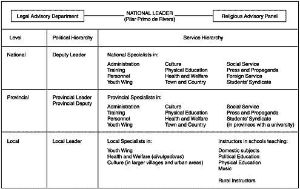
Figure 5.1 The twin hierarchies of Sección Femenina (SF) in 1952. Source: FET y de las JONS, La Sección Femenina: historia y organización, Madrid: SF de FET y de las JONS, 1952, pp. 23-4, index.
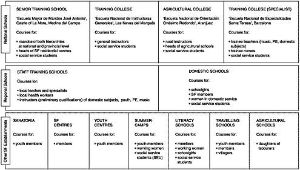
Figure 5.2 Training centres of Sección Femenina (SF) in 1952. Source: FET y de las JONS, La Sección Femenina: historia y organizacion, Madrid: SF de FET y de las JONS, 1952, pp. 44-5.
|