|
WOMEN AND SPANISH FASCISM -- THE WOMEN'S SECTION OF THE FALANGE 1934-1959 |
|
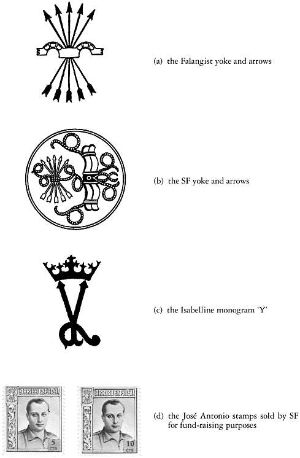
2. The construction of ideology: icons, rituals and private spaces It has been said of fascist ideologies that their core is the fundamental political myth which mobilizes their activists and supporters. [1] In the case of the Falange, the vision of a society transformed by José Antonio’s projected ‘Revolution’ continued to inspire a minority of members, but for most, membership of the single party in the Francoist state soon lost most of its original political resonance. It might have been assumed that this would also happen within the Falange’s Sección Femenina (SF). In its early days, SF had a tiny membership, little autonomy and a low public profile and even when the organization grew, it was always hierarchically and financially dependent on the National Movement. As the latter’s political force diminished in government, SF might have been expected to suffer equal decline and ideological dilution. But this was far from the case. From the beginning of the Civil War, Pilar Primo de Rivera began to develop an identity for SF which led to public perceptions of the organization as being the ‘ideological reserve’ of the Falange. The focus of this chapter is how this was achieved and the extent to which the ideological base of SF may be said to display characteristics of ‘generic fascism’. It examines how the legacy of José Antonio became the core myth of SF and the part played by Pilar in this. It also considers her part in constructing other elements of the SF belief system between 1937 and 1950. The first formal gathering of SF in January 1937 and the opening of the SF national academy at the end of the Civil War are discussed in relation to this. Finally, the chapter considers the context of Pilar’s leadership and how it became in itself a part of SF’s ideological identity. José Antonio denied that the Falange was fascist, although he acknowledged its ‘coincidences with Fascism in essential points which are of universal validity’. [2] Of these, the most significant was his creation of a mythic core of beliefs, inspirational for his followers but also sufficiently homogeneous to be rationalized in different ways and at different levels by succeeding generations. His vision of the projected Falangist Revolution is close to the definition of the ‘fascist minimum’ described by Roger Griffin, whereby the national community rises phoenix-like after a period of encroaching decadence which has all but destroyed it. [3] Also recognizable within Griffin’s definition is José Antonio’s utopic and organicist concept of the nation, a definition which fitted well to the Francoist project of reconstructing the state after the Civil War. For José Antonio, Spain was a ‘unit of destiny in the universal order … a plane to which a nation rises when it fulfils a universal mission in History’. [4] The ills of Spain were described in terms of contamination and physical sickness, needing the force of a revolution to heal the patient: ‘Spain needs to get itself going, not stay in bed like an invalid who doesn’t want to get better.’ [5] ‘Curing the patient’ was the responsibility of the Falange’s elites, seen as fulfilling an important ‘mission’. It was of course the case that much of José Antonio’s political imagery and style had already been incorporated into Nationalist rhetoric. As Michael Richards has stated, the regime conceptualized the nation in terms of a division between good and evil, Spain and Anti-Spain. [6] The ‘Crusade’ of Franco sought to purge Spaniards not only politically but also morally of all traces of the recent past and in this, the Falange’s militarism, austerity and cult of violence played an important part. But where the doctrine of José Antonio comes closest to the definition of fascism as a political ideology is in the style and semiotic language of the Falange. As Roger Griffin has said: ‘[Ideology] … is rooted in sub-rational and pre-verbal layers of consciousness within the individual and may express itself in a wide variety of both verbal and non-verbal cultural phenomena.’ [7] For Pilar, anxious to propagate the teachings of her brother in ways which would have resonance among women, it was important to establish SF as both fully within the Nationalist cause and yet with its own, female distinctness. Part of this involved putting into place operational structures which used SF’s financial and human resources to the full. In this, Pilar was helped by Falangists and her members during the Civil War, creating the bureaucracy which remained in place throughout the regime. But more significant was her creation of an identity for SF which engaged Members’ emotions and loyalties. The values and world-view of SF were to be expressed not just through political rhetoric but by giving the organization an internal structure, style and set of core values which would build loyalty and commitment. Given SF’s early status as an offshoot of the male Falange, this was a considerable task. When Pilar came to write a serialized history of SF in 1938, great store was placed on its role before the Civil War. In fact, in the first three years of SF’s existence, the women allowed to join did so in the capacity of general supporters round José Antonio and their first manifesto said little: ‘Our mission is not in hard combat but in preaching, spreading the word and setting an example. We must also support the menfolk, confident in the knowledge that we understand them and can share their concerns.’ [8] Little interest in SF was expressed outside Madrid. By the end of 1935, only in Vigo, Valladolid and Pamplona was there a constituted SF base and there were just 800 members nationwide. [9] But there were indications that the first members were looking for a role beyond that of attending the men’s meetings. Early SF fund-raising devices signaled a desire to have ownership of a part of the Falange political campaign. The sale of bars of soap inscribed with the Falange emblem and the commemorative José Antonio stamp were examples of SF initiatives that owed nothing to male Falangists. [10] Nonetheless, the organization played a wholly subsidiary role in Falange and Pilar’s leadership was primarily as ‘campaign manager’. Only with its ceremonial presence did the early SF have any distinct public image. At funerals and memorial services to Falangist ‘martyrs’, members laid the wreath of roses, providing, as a contemporary observer remembers, an air of ‘optimistic theatricality’. [11] It was the forerunner of a role that became characteristic of SF during and after the Civil War. Members’ uniformed presence at the many public gatherings was a symbolic recognition of the human cost of the conflict, a poetic sharing of Nationalist grief. However in all other aspects, SF continued in the shadow of the male Falange, even after February 1936 when the Falange was declared illegal. SF itself was now illegal and in the months which elapsed before the Civil War, members were fully involved in Falangist conspiracies. In Pilar’s account, this period was represented as SF’s ‘foundational’ stage, shown as a time of ‘persecution, hatred, and incomprehension on the part of our enemies’. [12] Following the arrest of forty-two Falangists, members were asked to visit them in prison and care for their families. In monthly installments in SF’s journal, Revista ‘Y’, this pre-war period was reconstructed as dangerous and heroic, when activities included storing guns and the tiny band of original members risked arrest at any time. [13] This chronicle was the first part of Pilar’s construction of SF as an organization with its own legitimacy. At the outbreak of war, because of her absence from the Nationalist zone, SF welfare activity was sporadic and uncoordinated. But within a few weeks of arriving in Salamanca, she had established a central base for SF activities, communication with members in the ‘liberated’ zones and planned SF’s first national conference. This was a decisive step in the creation of SF’s ideological base and set of conventions, rituals and symbols. Central to the issue was Pilar’s leadership of SF as the sister of the founder of the Falange. By the time of the conference in January 1937, José Antonio had already been killed. His death in Alicante jail in November 1936 meant that the ideological base of Falange, at least at a symbolic level, could now be interpreted as residing within the leadership of SF. Pilar, as the closest link to José Antonio, could invest SF with the importance of being the organization which most closely embodied his teachings. This was consistent with Pilar’s own importance in Salamanca, where she was established as a leading Falangist, and SF as the reference point for doctrinal purity. [14] Her apartment was the unofficial centre of Falangist activity in Salamanca and she received frequent visitors from other provinces including the Falangist poet and head of propaganda, Dionisio Ridruejo. [15] He already knew Pilar and, as related in Chapter 6, his sister Angela was the SF provincial leader for Segovia. With his help, Pilar organized the January conference and it is likely that his was the guiding hand behind its ceremonial and aesthetics. [16] It is also probable that it was Ridruejo who was instrumental in persuading her to join the conspiracy of silence surrounding José Antonio’s death in November 1936. It was known to Pilar and the Falange immediately that José Antonio had been shot, but his death was not declared officially for two years. Until November 1938, on all public occasions, he was referred to as the ‘Absent One’ (El Ausente). Concealment of the facts was (at least in part) the idea of Ridruejo, who wished to cast José Antonio as a symbolic, inspirational presence during the war. But in agreeing to silence, Pilar must have been aware that José Antonio’s death was public knowledge. [17] Certainly everyone in SF knew the facts, but at the January conference, the fifty delegates shared in the fiction as she enjoined them to pray for him: Please remember, comrades, to pray to the Lord for [José Antonio] … who is still in prison and whom we need so badly, so that it may be as it says in the Scriptures: ‘A thousand arrows may fall at your left and ten thousand at your right, but none will touch you. Because He sent His angels to watch over you wherever you pass.’ [18] It was the first stage in the construction of José Antonio as a figure of mythic importance in SF. The idea of El Ausente had come from the male Falange, but it was arguably in SF where its impact was greatest. Pilar’s use of the present tense to refer to him at conferences and her constant allusions to his teachings confirmed him as a metaphysical presence over the course of the two years before his death was announced. Emotional references to José Antonio in public forums also encouraged a projection of collective grief on to her. Intentionally or not, she had been established as the principal conduit for the emotions of José Antonio’s followers and was herself the bearer of national grief. As members were told at the the second SF national conference: Few of you will be without sorrow or sad memories -- a father, brother or child who has fallen in battle or who is fighting in the trenches. Because … you have Pilar Primo de Rivera as leader, the magnificent comrade, model of … sacrifice and virtue, the sister of José Antonio who for us, uniquely, is … a constant presence, watchful and inspiring. [19] After the Civil War, Pilar’s leadership of SF continued to be based on the legitimacy of José Antonio’s memory, her position as his sister and her early membership of the Falange. [20] His main ideological legacy was his writings, quoted extensively by Pilar both in formal settings and in conversations with her staff. José Antonio’s speeches were understood variously as chronicles of the past, inspiration for the Falangist Revolution and as solutions for the present. In the memory of one mando, the end note for many political discussions was Pilar’s phrase ‘as José Antonio said’. [21] On the basis that his words conveyed absolute, eternal truths, they were felt to be relevant for every problem and there was no need to speculate on how he would have faced current circumstances. José Antonio’s works were SF’s doctrinal core, but the memory of his life and death was also central to its belief system. From the end of the Civil War, SF members contributed actively to the elaborate ceremonial of his burial in El Escorial and the many commemorations which followed. His cell in Alicante jail was preserved by local members as a shrine, and artefacts were sent from SF provincial centres to adorn the chapel built on the site of his shooting. [22] Their collective sense of loss was shown by a mass presence at his funeral procession in November 1939: José Antonio’s body was transported on the shoulders of Falangists from Alicante to the royal palace and monastery of El Escorial where he was buried at the foot of the high altar, near the crypts of Spanish monarchs. [23] It was a journey of nearly 500 kilometres, taking ten days and nights and the spectacle had the resonance of a State occasion and a traditional religious procession. [24] Although not the coffin bearers, SF considered itself a main player in the ceremony: five thousand youth members were outside the church, Pilar took part in the all-night vigil before the funeral and the cortege was welcomed in many villages by SF choruses of Gregorian chant. [25] Emotional identification with José Antonio continued through SF members’ intense interest in his past. His high profile in society (‘sporting, elegant, just turned thirty, with a prestigious surname and a distinguished professional reputation’ [26] ), gave rise to speculations about his love life, it being generally agreed he had sacrificed private happiness in the service of Spain. The secrecy built up around this added to the mystery: ‘Like all men he had a love life: his existence would not have been complete without this side to his character. But, respecting the privacy he himself would have maintained, we must remain silent.’ [27] Nonetheless, it was true that a leading member of the SF had been romantically involved with him and this was doubtless the basis on which the stories of the girlfriends of José Antonio (las novias de José Antonio) continued to circulate. But José Antonio’s most serious attachment had no connection with SF. It was with Pilar Luna Azlor de Aragón, a member of one of Spain’s most aristocratic families. The relationship was opposed by her family on the grounds of his inferior lineage and came to an end. [28] Sympathy for José Antonio’s rejection by the aristocracy could therefore also be read as an affirmation of Falangist populism in the minds of SF members. Whereas SF’s role at his funeral was faithfully chronicled, the romantic stories became oral tradition, adding an intriguing dimension to the known facts about the dead leader. Whether members were displaying hero worship or sublimating religious or sexual stirrings, their commitment remained. Terms such as ‘you loved José Antonio’, ‘you followed him’ and ‘his spirit kept us going’ are used by past members to describe their sense of closeness. As one mando recalled: ‘By the age of fourteen I had read everything he had written and I was convinced.’ [29] After 1945, when all but a minority in the National Movement were losing interest in ideological origins, Pilar Primo de Rivera continued to base her thinking and development of the organization on the joseantoniano past. In the words of one former Falangist, ‘one whole part of the SF was José Antonio’, and as late as 1958 Pilar assured members: ‘Outside José Antonio, there are no solutions that are either attractive or effective.’ [30] The memory of El Ausente and the sense that SF was the ‘ideological reserve of the Falange’ [31] were also encouraged by the aesthetics of the Salamanca conference, no doubt engineered by Dionisio Ridruejo to echo the gatherings of the Falange in José Antonio’s lifetime. In the austere setting of the Bank of Salamanca, the uniformed delegates sat at tables draped with Falangist flags, with the only ornamentation a statue of the Virgin. At Salamanca, norms were established which were absorbed and remained within SF identity throughout its existence. [32] But the conference went beyond imitation of the male Falange style. ‘Invented traditions’ played their part, too, all the more remarkable given the speed with which arrangements had been made. [33] Principal among these was the political capital made from the location of each conference, which began in one city and ended in a second. In this, SF was the forerunner of the post-war Francoist project of recreating the justification for the Civil War through the ‘sanctification’ of battle sites. [34] Apart from being the conference venue, each city was regarded as a political shrine, with the journey in between a further opportunity for sightseeing. No precedent for this existed in the male Falange and it set a pattern for subsequent annual gatherings, which in the war years were all in Castile. [35] José Antonio had seen Castile as the spiritual heart of the nation, with its ‘austerity of conduct, a religious sense of life … a solidarity with forebears and descendants’. [36] Through its exploitation of the conference sites, SF created its own ‘mythic time’, identifying Falangism with the heroes, events and buildings of medieval and Golden Age Spain. Mandos would be ‘penetrated by the spirit and … comforted by the aroma of History and Legend emanating from the old stones’. [37] Pilar claimed her conferences to be like constellations: ‘Each must have its sign.’ [38] Salamanca was a seat of wisdom, its present-day classes still teaching ‘universal laws above the will of Caesar’ while Segovia’s aqueduct reminded members that ‘Order and Service (should be) in the supreme service of charity’. [39] The principal reference point in this ‘mythic time’ was the reign of the Catholic Monarchs, Ferdinand and Isabella. For SF (and for the regime in general), this period epitomized José Antonio’s vision of past greatness and the inspiration for Spain’s future. Four historical events had particular importance: the expulsion of the Jews, the establishment of the Inquisition, the completion of the Christian Reconquest of Spain from the Moors and the authorization of Columbus’ voyage to the Indies. The Catholic Monarchs had found the solution to Spain’s problems of the past (lack of religious and national unity) and were the heralds of future glories, as territorial expansion brought wealth and power to Spain. The parallel with Franco’s ‘Reconquest’ of a godless Spain was an obvious one. The first two post-war national conferences were held in Madrid-Toledo (1940) and Barcelona-Gerona (1941). In each, the theme of the Falange ‘Reconquest’ was evident in Pilar’s speech and the visits organized for delegates. Addressing conference members in Madrid, Pilar welcomed the ‘liberated’ provinces, comparing them to the return of the Prodigal Son: If you could have seen us go out on our terraces, like the father of the Prodigal Son, to see if you were coming! Until one by one, broken and in ruins, you came in. Now we have your lands but what we must do now is win back your souls…. You know the Caudillo, because it is he who freed you; you also know who José Antonio is because he visited your lands; now we shall show you what the Falange is. [40] At this conference, visits were made to historic sites and Falange memorials such as the house of the Marquis of Riscal. This was the venue of the first Falange National Council, and where both José Antonio and later Pilar had been appointed. And although this had only been six years before, it now became a moment to be noted in the SF chronicle of its past. [41] Conferences allowed connections to be drawn with both the Golden Age and more recent times. The first venues were proclaimed as having links with Queen Isabella (her image on the façade of Salamanca university, Valladolid where she married and Segovia where she was proclaimed Queen of Castile). In subsequent years, conferences exploited Civil War connections (the siege of Toledo, SF ‘martyrs’ in Valencia, the Liberation of Tarragona), earlier glories (the Reconquest of Granada, El Cid of Burgos) or were held at religious shrines (Santiago, Guadalupe, Zaragoza). The combination of austerity and militarism affirmed the role of SF as part of the Falangist Revolution, which had begun in 1933 but for which the historic justification was placed in the fifteenth century. Reinforcing SF’s own symbolic continuity with the past, the Golden Age word regidor was appropriated to denote a specialist SF staff member. In the fifteenth and sixteenth centuries, the term had meant an alderman, but in 1939 SF constructed the description regiduría for each of its specialist departments. [42] With every specialist designated a regidora, there was a current of modernity alongside the nostalgia. In the Golden Age, the regidora had been merely the wife of the regidor but in SF terminology, her post had considerable autonomy and no male equivalent. The emerging structure of SF had been formalized at the Salamanca conference in 1937 and this was followed by the opening of its first training school in the same year. As already noted, the staff corps was organized into twin hierarchies. The first of these, the political hierarchy, linked Pilar and her staff working in the provinces and villages. The second was the service hierarchy, the specialists who managed the SF departments. [43] The need for coherence and consistency in the training of elites of both hierarchies had been recognized at the beginning of the war and the Málaga school ran two courses for the training of provincial mandos in wartime. Its training programme gave form to the rituals and customs which had characterized SF activities since 1934. These could now be written up formally and presented to potential recruits as the value system of SF. Among these were the SF awards, established in 1937 with the creation of its Legal Advisory Department, which worked as part of the political hierarchy at national level. This dealt with all legal and disciplinary matters and recommended individuals for the annual awards of the emblem ‘Y’. [44] The awards system was an acknowledgement of service and an important strand in SF’s construction of its own past. It was a recasting of the male Falange’s ways of honouring war heroes, or ‘the Fallen’ (los Caídos) as they were always known. The first step in doing this had been at the Salamanca conference, where the list of SF women killed in service had been added to the names of Falange heroes printed on the black curtain. Some SF members had received government military decorations but SF introduced its own system for recognizing service. Thirty-eight of the fifty-nine women members who died in service were awarded posthumous honours and many survivors were decorated for bravery. The SF award of ‘Y’ could be collective, as in the case of all SF nurses who served in the Blue Division and the entire SF centre of Toledo, honoured in October 1939 for ‘the continued excellence of their services’. [45] The founding mandos of the organization were also rewarded. The system had not only recorded SF’s proudest moments but was restating its stages of development. The significance of the awards ceremony was increased by its celebration on the day of St Teresa. The adoption of Teresa of Avila as patron saint and Queen Isabella of Castile as historical role model for members provided SF with a female version of José Antonio’s concept of the ideal Falangist. He had described service to Falange as ‘both religious and military’ [46] and the lives of Teresa and Isabella were idealized in SF propaganda and textbooks to represent the female equivalent. Teresa and Isabella were praised for their high intellectual capacity and readiness to tackle domestic tasks. [47] Both were presented as revolutionaries, Isabella having confronted many enemies (Moors, Jews, nobles) and Teresa, who had travelled Spain founding convents. Isabella had supposedly sacrificed personal happiness with her marriage to Ferdinand ‘who lacked the firm morality of his royal consort’ [48] and Teresa had established a norm of austerity in the face of opposition. The amalgam of Isabella’s and Teresa’s virtues embodied the ‘way of being’ which SF required of its mandos. ‘The shortest path between two points is the one going through the stars’, José Antonio had said. [49] This neatly expressed the near impossibility of SF’s task and the super-human strength needed to accomplish it. Once members understood the lives of Teresa and Isabella, they would understand that service with SF transcended earthly dimensions and brought divine intercession: Who is the Patron Saint of the Sección Femenina? St. Teresa of Jesus. Why was this saint chosen? Because she is a Spanish saint, because her virtues and character fit very well into our way of being, but above all so that she can protect the Sección Femenina. [50] As Pilar could say to the youth members (flechas) about to be received into the adult organization on St Teresa’s Day: ‘Until now, as the little girls you were, we have been putting you to the test, as aspirants.’ [51] Teresa was not just the patron saint: the women of SF were members of her Order. Part of the construction of Isabella as SF’s role model was her representation as emblem and icon. Her monogram, ‘Y’, was chosen as the principal SF award and became the title of SF’s main journal (Revista ‘Y’ para la mujer nacional-sindicalista). This appeared monthly from 1938 and combined propaganda with items of more general interest to women. Revista ‘Y’ had originated from Pilar’s wish to create a parallel to the male Falange’s Vértice, and generally maintained the latter’s critical quality, with well-known contributors writing for both. [52] The symbolism of the letter ‘Y’ was many-layered. It was the Isabelline monogram and also the conjunction ‘and’. Moreover, it was the first letter of another symbol with which she was associated -- the yoke. All three were representations of unity, and in the Falangist context, symbols of what José Antonio had called ‘the poetry of the State’. [53] Above all, SF literature represented it as the symbol of service: The ‘Y’ unites and the woman’s mission also was to unite: city with country, the powerful with the needy, pain with joy, harshness with gentleness. The woman must give cohesion -- union -- to the members of a family; she must secure that vertical union which is the continuance and survival of the home in the course of all the trials of life. [54] The Isabelline yoke was an SF modification of the Falangist emblem of the yoke and arrows. In the SF version, the yoke was depicted separately and the arrows were lashed to it. This never entirely replaced the official Falange emblem but was used in much of the official literature. The size and design of the yoke (longer and wider than the arrows) reinforced SF’s claim for a role and identity of its own. Its work would have a shared historic constant with the male Falange but a separate expression. But the major way in which separate identity was achieved for SF was by its acquisition of a permanent private space, which would embody all its ideology and allow full expression of its practices and rituals. It already had premises throughout Spain and a national office in Madrid, but these were functional buildings with no capacity for ceremonial functions. [55] But in 1939, at a mass rally in Medina del Campo, Franco promised Pilar Primo de Rivera an academy for SF elite members. The spirit of Isabella would reside in a ‘mother-house’ which would be SF’s highest ranking training school and its spiritual core. La Mota, rebuilt in the fifteenth century on the foundations of an earlier castle, was in an elevated position above the town of Medina in the province of Valladolid and opened in 1942 as the ‘Senior National Training School: José Antonio’ (Escuela Mayor de Mandos: José Antonio). Its pedigree as SF’s spiritual and historical home could hardly have been bettered. Its location was the heartland of Castile, in a town which had been reconquered from the Moors by a companion of El Cid. It had been presented in 1475 to Isabella, who had then ordered its restoration and enlargement. The castle’s heyday had been the Golden Age of Spain when it had become (at least in the folk memory of the SF) one of Isabella’s favourite residences. [56] The reconstruction of the castle was placed under the supervision of Franco’s Director-General of Architecture, Pedro Muguruza. It took three years to complete and was formally opened in May 1942. Only the outer shell of the castle was standing and it was not until Muguruza’s team had excavated the foundations that the original interior was glimpsed. They established that there had been a central courtyard surrounded by pillars on three sides and a freestanding façade. A plan for reconstruction was drawn up by Muguruza’s architect, with a few touches which suggested a thought for its future use. A pulpit was set into the wall of the dining room, giving it the appearance of a convent refectory. The façade in the central courtyard was a cast of one originating from Isabella’s tutor, Beatriz Galindo, and the banister of the great staircase was a copy of the original in the Hospital founded by Beatriz Galindo in Madrid. [57] Perhaps the most remarkable feature of La Mota was the speed with which its constructed identity and training routine came into operation. It received its first students shortly after its inauguration in May 1942 and, judging by the staff handbooks, even its detailed running scarcely changed over the following twenty years. It played a significant public role, becoming the cultural focus for the town of Medina and a reception centre for guests of SF and of central government. La Mota’s rapidly constructed pedigree found no rival in the many other training schools which followed and it remained the undisputed spiritual and emotional heart of the organization: ‘La Mota was La Mota -- it was never a matter for debate.’ [58] As its first staff handbook stated: ‘Life in the School is a permanent act of service. No frivolousness in the behaviour and spirit of its camaradas can be tolerated.’ [59] Tales of cold showers, readings from the pulpit and the personalities of its staff soon became part of SF folk history. In the memory of one student, the prospect of going there for the first time was ‘a bit daunting’. [60] The furbishing of the castle established much of what came to be known as the SF style (estilo). This was central to long-held ideas of Pilar, who had said in 1940: ‘We have wanted to make La Mota the synthesis of tradition and revolution following the style of José Antonio.’ [61] Past glories and modern realities were to be combined in decor that harmonized with the castle’s restoration and was functional for its intended use. Some of its acquisitions became instant icons, such as the statue of the Virgin commissioned for the chapel. Paintings by Benjamín Palencia and a bust of José Antonio by Emilio Aladrén were other early acquisitions and the chapel received the memorial stone from José Antonio’s tomb in El Escorial when his remains were reburied in the Valley of the Fallen in 1959. Interior design at La Mota was also a political statement. Decor reflected both the imperial past and rural traditions, with a combination of formal, classical furniture and simpler pieces in local and provincial style. La Mota illustrated the good taste that was part of José Antonio’s ‘invariable doctrine’ and would be the guiding principle for members in the creation of their own home. Pilar had stated in 1938: The true duty of women towards their country is to form families, with a proper base of austerity and joy, where everything traditional is fostered, where carols are sung on Christmas Day round the crib and where there is also a joyous generosity in actions. [62] In the SF understanding, all matters of taste, as well as personal and domestic virtues, found expression in home-making. It required not only application of estilo but the broader qualities and outlook of the ‘way of being’. Thrift, ingenuity and cheerfulness were part of this and could be read as the external manifestations of political conviction. That understanding was exemplified in La Mota, the mother-house. It was not an exact representation of domestic reality, being a larger-than-life ideal home which contained no men. However, its bricks and mortar stood for the enduring values of domesticity and its interior elegance for the elevation of the role of housewife. At one level, life in La Mota exemplified the Falangist family, where women from all over Spain and from a variety of backgrounds came together in camaraderie to experience and restate their political beliefs. At another, it was a construct of home and family life, an acting out of some of the routines and roles implicit in women’s ‘transcendental mission’ as home-builders. The etiquette at table, daily tidying of rooms, flower arranging and handiwork classes were part of a routine which would add to understanding and development of ‘way of being’. As Pilar told her members: You can see for example in our Schools that we go to the very greatest lengths to place a vase in the best position…. In other matters of our personal grooming, housekeeping, of our concealment of our animal instincts, we must keep on telling our camaradas (comrades) how they must organize their lives so that their outer appearance is in accordance with the truth and finesse of their Falangist temperament. [63] La Mota was bound to the figure of Pilar and it remained her pet project, the place where she felt most at home. In the early days she often lectured there but even when administration kept her in the Madrid office, she visited socially on a regular basis and a bedroom was kept there for her permanently. Many of the emotions bound up in the collective memory of La Mota and its courses are also of her as leader. The numerous anecdotes relating to Pilar at La Mota (her impromptu visits, the personal interest she took in ‘her girls’, her lack of ceremony and extreme frugality, for example) suggest that the identities of the national leader and her main training school were bound together in the collective memory of the mandos. The lectures on national-syndicalism were the formal statement of doctrine but it was the example of Pilar -- her actual and remembered presence -- which gave practical expression to those theories. The apparent contradiction between her unassuming persona and her achievements as leader was the management model for everyone else. La Mota also provided the model for the further training establishments built by SF in the early 1940s. The names of the war heroines read out at national conferences as well as those of the organization’s favourite role models were used as titles for schools and summer camps. The overall most important name -- José Antonio -- had already been taken for La Mota. The second -- that of Isabella -- was soon adopted for the second national academy. The ‘National School for Youth Instructors: Isabella The Catholic’ was opened in Madrid in 1942, shortly after La Mota, its first site being part of the El Pardo Palace and moving in 1951 to its permanent home in Las Navas del Marqués outside Madrid. [64] Las Navas had parallels with La Mota. It was another restored castle, modelled on the lines of its sister establishment and offering residential courses only. La Mota might have been the spiritual centre of SF, but in Las Navas members were tested physically. It combined a bleak mountain setting with inadequate heating and an emphasis on competitive sport. But as in La Mota, committed students apparently accepted its discipline and held affectionate memories. Even after 1956, when it began mainstream teacher training, its routines continued unchanged although it is debatable how far students identified with its name and role model. Just as the Senior National Training School José Antonio was never called anything but La Mota, so the School of Isabella the Catholic remained Las Navas in the collective memory. The other national schools of SF followed the model of the two ‘greats’ but were less well known. The first agricultural school was named after two of the SF war victims, the fourth national training school after St. Teresa and the remaining institutions after recent military political heroes. [65] SF had no need to seek out the male historical equivalents of St. Teresa or indeed introduce the figure of Isabella’s husband. In the absence of a suitable female figure, the recent past was good enough. But in whichever national school elites did their training, the values and ideology of SF were constant and transmitted in the same way. Members brought to their work a sense of political identity which encouraged them to regard their service as a patriotic duty and themselves as belonging to the ‘select minority’ of José Antonio. The construction of that identity had begun before the Civil War with the remembered exploits of the original members in the months when the Falange had been declared illegal and was developed through the aesthetics and conventions of the national conferences and the adoption of female role models. But more important than any of these was SF’s identification with José Antonio and the legacy of his teachings. The strength of members’ belief in José Antonio established SF as an organization with its own mythic core. His doctrine was seen to contain absolute, eternal truths and as Georges Sorel has said of core myths within fascism, these gave the members of SF ‘inclinations which recur to the mind with the insistence of instincts in all the circumstances of life’. [66] Apart from direct reference to his teachings, SF made symbolic connections with José Antonio through the adoption of the Falange ‘style’, with its austerity and militarism and particularly through the opening of La Mota. And alongside the memory of its charismatic leader was the establishment of ideological roots for SF in Castile. José Antonio’s identification with Castile as the spiritual heart of Spain was already part of the broader Nationalist rhetoric. SF’s appropriation of La Mota, therefore, enabled its symbolic core to be both unique and particular while fitting seamlessly into the overarching ideology of the regime. La Mota was the epicentre of that reality and Isabella its human representation. But of equal significance to SF mandos was the identification of La Mota with the leadership of Pilar. The core belief of SF in the absolute truth in the doctrine of José Antonio did not change. With the acquisition of La Mota, however, a parallel core belief developed -- that SF itself was inseparable from Pilar. Her adherence to joseantoniano ideology, which earned SF a reputation as being the most doctrinally pure part of the National Movement, went beyond imitation of the male organization. The rituals and icons she developed, which had their fullest and most abiding expression in La Mota, established the existence of a parallel and exclusively female Falangist identity. The importance of the creation of SF’s ideological identity cannot be over-estimated. It was certainly true that its political goals encompassed both José Antonio’s vision of a transformed society and the broader agenda of the Franco dictatorship. But its use of symbols, icons and private spaces encouraged a level of personal engagement which went beyond the regime’s political rhetoric, so that its ideology was a lived reality for activists. In this sense, SF matched José Antonio’s early vision of the Falange as ‘not a way of thinking but a way of being’ and stood out from other parts of the National Movement because its ideological identity remained intact. [67] The call to the Nationalist cause and the subsequent appeal to women to help rebuild Spain after the Civil War mobilized many women. The strength of SF’s emotional appeal, however, endured the political and social changes of post-war Spain, surviving for thirty-eight years.
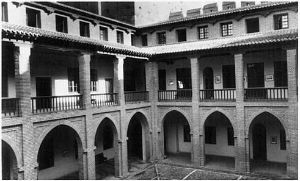
Plate 2.1 Central courtyard, La Mota. Source: A. Ortolá.
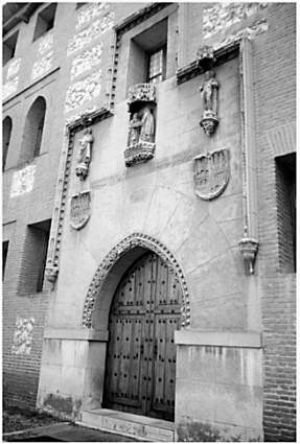
Plate 2.2 Façade in central courtyard (Puerta de La Latina), La Mota. Source: K. Richmond.
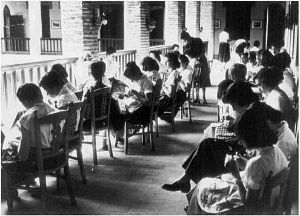
Plate 2.3 Sewing, La Mota. Source: A. Ortolá.
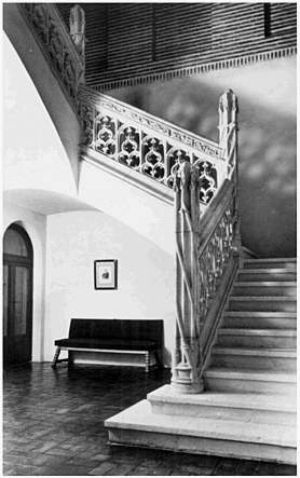
Plate 2.4 Great staircase (Escalera de honor), La Mota. Source: A. Ortolá.
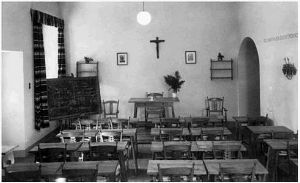
Plate 2.5 Classroom, La Mota. Source: A. Ortolá.
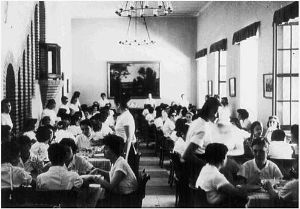
Plate 2.6 Dining room, La Mota. Source: A. Ortolá.
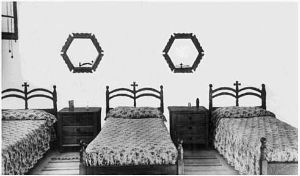
Plate 2.7
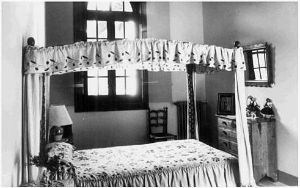
Bedroom, La Mota. Source: A. Ortolá. Plate 2.8 Bedroom of Pilar Primo de Rivera, La Mota. Source: A. Ortolá.
Figure 2.1 Emblems and insignia of Sección Femenina (SF).
|