|
VALLE DE LOS CAIDOS (VALLEY OF THE FALLEN) |
|
by Wikipedia
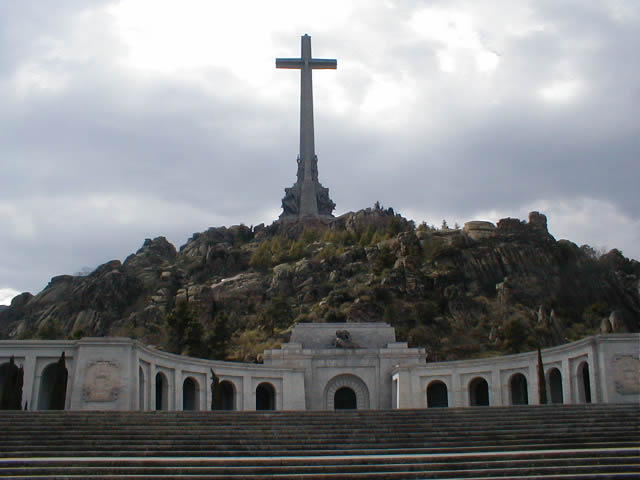
Santa Cruz del Valle de los Caídos, view from the esplanade. The Valle de los Caídos (in English: Valley of the Fallen) is a monumental memorial in the municipality of San Lorenzo de El Escorial, erected at Cuelgamuros Valley in the Sierra de Guadarrama, near Madrid, conceived by Spanish dictator Francisco Franco to honour those who fell during the Spanish Civil War. However, only two names are commemorated— those of José Antonio Primo de Rivera and Franco himself.[1] It was also claimed by Franco that the monument was meant to be a "national act of atonement". As a surviving artifact of Franco's rule, the monument and its Catholic basilica remain controversial, especially due to the manner and circumstances of its construction (built by political prisoners). Basilica, cross and abbey Rising above the valley is one of the world's largest basilicas, Basílica de la Santa Cruz del Valle de los Caídos (Basilica of the Holy Cross of the Valley of the Fallen), hewn out of a granite ridge, and the tallest memorial cross in the world, a 152.4-metre-high construction of stone. In 1960, Pope John XXIII declared the underground crypt a basilica. The dimensions of the underground basilica, as excavated, are larger than those of St. Peter's Basilica in Rome. To avoid competition, a partitioning wall was built near the inside of the entrance and a sizable entryway was left unconsecrated.
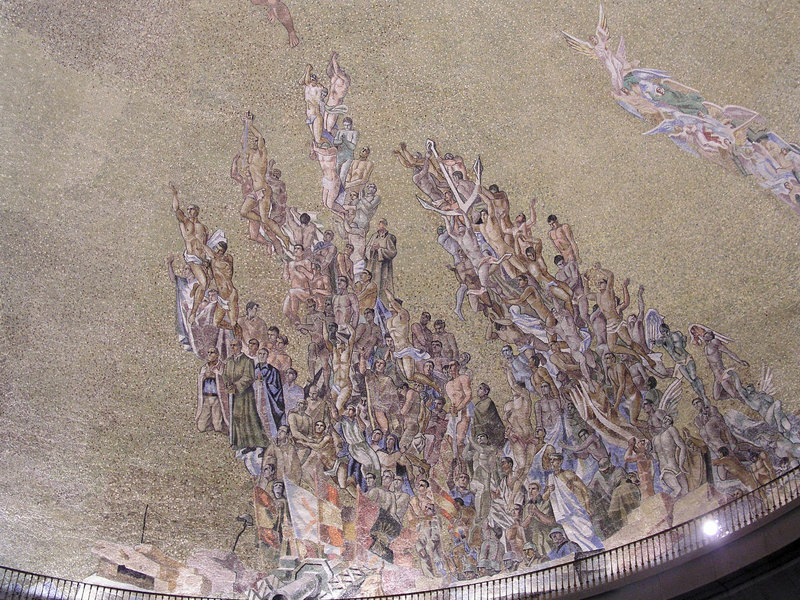
Dome inside the Basilica The shrine, a landmark in 20th-century Spanish architecture, was designed by Pedro Muguruza and Diego Méndez on a scale to equal, according to Franco, "the grandeur of the monuments of old, which defy time and forgetfulness". It is laid out in uniquely Spanish Neo-Herrerian style, which was intended as a revival of Juan de Herrera’s classicist architecture, exemplified in El Escorial. This architecture was widely used in public buildings of post-war Spain and is rooted on the International classicism exemplified by Albert Speer or Mussolini's Esposizione Universale Roma. The monumental hieratic sculptures over the main gate and the base of the cross culminated the career of Juan de Ávalos. The monument consists of a wide explanada (esplanade) with a spectacular view of the valley and the outskirts of Madrid in the distance. A long vaulted crypt was tunnelled out of solid granite by thousands of Republican military prisoners. It pierces the mountain to the massive transept, which lies exactly below the cross. On the wrought-iron gates, Franco's neo-Habsburg double-headed eagle is prominently displayed. On entering the basilica, visitors are flanked by two large metal statues of art deco angels holding swords. There is a
funicular that connects the basilica with the base of the cross. There
is a spiral staircase and a lift inside the cross, connecting the top of
the basilica dome to a trapdoor on top of the cross [2], but their use
is restricted to maintenance staff.
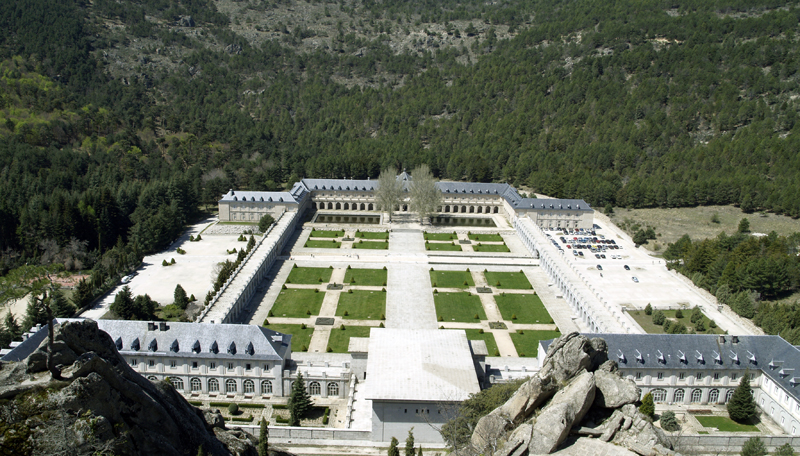
Benedictine Abbey The Benedictine Abbey of the Holy Cross of the Valley of the Fallen (Spanish: Abadía Benedictina de la Santa Cruz de el Valle de los Caídos), on the other side of the mountain, houses priests who say perpetual Masses for the repose of the fallen. The abbey ranks as a Royal Monastery. Valley of the Fallen The valley that contains the monument, preserved as a national park, is located 10 km northeast of the royal site of El Escorial, northwest of Madrid. Beneath the valley floor lie the remains of 40,000, whose names are accounted for in the monument's register. Although the valley contains both Nationalist and Republican graves – several former Republicans' bodies were moved there from temporary graves at the end of the war – the tone of the monument is distinctly Nationalist and anti-Communist, containing the inscription "¡Caídos por Dios y por España!" ("Fallen for God and Spain!"), reflecting the close ties of Franco's Nationalist regime to the Roman Catholic Church. Additionally, Franco's timing of his announcement of the decision to create the monument left no doubts: on 1 April 1940, the day of the victory parade to celebrate the first anniversary of his triumph over the Republic, Franco announced his personal decision to raise a splendid monument to those who had fallen in his cause.[3] Today, Spain's Socialist Government has been debating plans to re-designate the Valley of the Fallen a "monument to Democracy" or as a memorial to all Spaniards killed in conflict "for Democracy" (believed to mean only the Republican side). [4] Other political organizations, among them centrist Catholic groups, believe that the monument is already dedicated to all of the dead, civilian and military of both Nationalist and Republican sides. Franco's tomb In 1975, after Franco's death, the site was designated by the interim government as the burial place for the Caudillo, who actually did not desire to be buried in the valley, but in Madrid. Unlike the fallen of the Civil War who were laid to rest in the valley exterior to the basilica, Franco was buried inside the church. His grave is marked by a simple tombstone engraved with his name, on the choir side of the main altar (between the altar and the apse of the Church; behind the altar, from the perspective of a person standing at the main door). Franco was the second person buried in the Santa Cruz basilica. Franco had earlier interred José Antonio Primo de Rivera, founder of the Falange, the Spanish fascist party that aided his ascension to power, under a modest gravestone on the nave side of the altar. Primo de Rivera died November 20, 1936, exactly 39 years before Franco, whose grave is on the exact opposite side of the altar. Today, the Valle de los Caídos is a popular tourist site and every November 20 is marked by memorial celebrations by Franco's nostalgic supporters and Falange activists. Controversy in construction "The work of
construction itself was undertaken by the forced labour" of allegedly
20,000 Republican prisoners, "fourteen of whom were killed" [died during
construction works] and many more injured; it was intended that
through such work prisoners would have the opportunity to "redeem
themselves". [5] (This is also claimed in Section '1939' of the
Spanish Civil War.) The motto used by the Spanish Nationalist government
was "el trabajo enoblece" "work is ennobling". Nevertheless, the
use of convict labor to build the basilica and cross has been
controversial. According to the project records, no more than 2,000
workers participated directly in the construction, some of them highly
skilled, as required by the complexity of the work. These convicts at
the workplace included those convicted of political crimes. A 1940
Spanish law recognized the possibility of "redeeming" two days of
conviction for each working day. This benefit was increased to six
days when labour was carried out at the basilica. Political rallies in celebration of the former dictator are now banned by a recent law, voted on by the Congress of Deputies on 16 October 2007. [6] The organization that runs the Valley of the Fallen is also required to share information on all of those who died during the civil war and who suffered repression, not just those who were killed or murdered by the Republicans.[7] References 1.
Mary Ann Sullivan, The Valley of the Fallen (El Valle de los Caídos), at
www.bluffton.edu
|