|
SILENT SPRING |
|
7. Needless Havoc
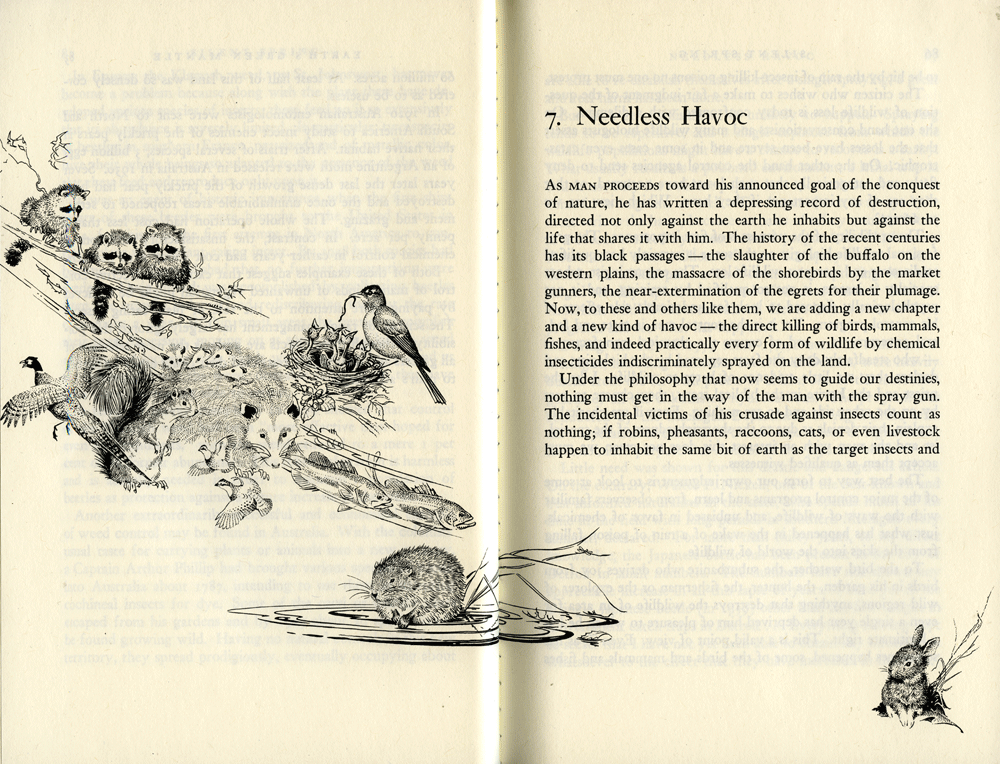
As MAN PROCEEDS toward his announced goal of the conquest of nature, he has written a depressing record of destruction, directed not only against the earth he inhabits but against the life that shares it with him. The history of the recent centuries has its black passages -- the slaughter of the buffalo on the western plains, the massacre of the shorebirds by the market gunners, the near-extermination of the egrets for their plumage. Now, to these and others like them, we are adding a new chapter and a new kind of havoc -- the direct killing of birds, mammals, fishes, and indeed practically every form of wildlife by chemical insecticides indiscriminately sprayed on the land. Under the philosophy that now seems to guide our destinies, nothing must get in the way of the man with the spray gun. The incidental victims of his crusade against insects count as nothing; if robins, pheasants, raccoons, cats, or even livestock happen to inhabit the same bit of earth as the target insects and to be hit by the rain of insect-killing poisons no one must protest. The citizen who wishes to make a fair judgment of the question of wildlife loss is today confronted with a dilemma. On the one hand conservationists and many wildlife biologists assert that the losses have been severe and in some cases even catastrophic. On the other hand the control agencies tend to deny flatly and categorically that such losses have occurred, or that they are of any importance if they have. Which view are we to accept? The credibility of the witness is of first importance. The professional wildlife biologist on the scene is certainly best qualified to discover and interpret wildlife loss. The entomologist, whose specialty is insects, is not so qualified by training, and is not psychologically disposed to look for undesirable side effects of his control program. Yet it is the control men in state and federal governments -- and of course the chemical manufacturers -- who steadfastly deny the facts reported by the biologists and declare they see little evidence of harm to wildlife. Like the priest and the Levite in the biblical story, they choose to pass by on the other side and to see nothing. Even if we charitably explain their denials as due to the shortsightedness of the specialist and the man with an interest this does not mean we must accept them as qualified witnesses. The best way to form our own judgment is to look at some of the major control programs and learn, from observers familiar with the ways of wildlife, and unbiased in favor of chemicals, just what has happened in the wake of a rain of poison falling from the skies into the world of wildlife. To the bird watcher, the suburbanite who derives joy from birds in his garden, the hunter, the fisherman or the explorer of wild regions, anything that destroys the wildlife of an area for even a single year has deprived him of pleasure to which he has a legitimate right. This is a valid point of view. Even if, as has sometimes happened, some of the birds and mammals and fishes are able to re-establish themselves after a single spraying, a great and real harm has been done. But such re-establishment is unlikely to happen. Spraying tends to be repetitive, and a single exposure from which the wildlife populations might have a chance to recover is a rarity. What usually results is a poisoned environment, a lethal trap in which not only the resident populations succumb but those who come in as migrants as well. The larger the area sprayed the more serious the harm, because no oases of safety remain. Now, in a decade marked by insect-control programs in which many thousands or even millions of acres are sprayed as a unit, a decade in which private and community spraying has also surged steadily upward, a record of destruction and death of American wildlife has accumulated. Let us look at some of these programs and see what has happened. During the fall of 1959 some 27,000 acres in southeastern Michigan, including numerous suburbs of Detroit, were heavily dusted from the air with pellets of aldrin, one of the most dangerous of all the chlorinated hydrocarbons. The program was conducted by the Michigan Department of Agriculture with the cooperation of the United States Department of Agriculture; its announced purpose was control of the Japanese beetle. Little need was shown for this drastic and dangerous action. On the contrary, Walter P. Nickell, one of the best-known and best-informed naturalists in the state, who spends much of his time in the field with long periods in southern Michigan every summer, declared: "For more than thirty years, to my direct knowledge, the Japanese beetle has been present in the city of Detroit in small numbers. The numbers have not shown any appreciable increase in all this lapse of years. I have yet to see a single Japanese beetle [in 1959] other than the few caught in Government catch traps in Detroit ... Everything is being kept so secret that I have not yet been able to obtain any information whatsoever to the effect that they have increased in numbers." An official release by the state agency merely declared that the beetle had "put in its appearance" in the areas designated for the aerial attack upon it. Despite the lack of justification the program was launched, with the state providing the manpower and supervising the operation, the federal government providing equipment and additional men, and the communities paying for the insecticide. The Japanese beetle, an insect accidentally imported into the United States, was discovered in New Jersey in 1916, when a few shiny beetles of a metallic green color were seen in a nursery near Riverton. The beetles, at first unrecognized, were finally identified as a common inhabitant of the main islands of Japan. Apparently they had entered the United States on nursery stock imported before restrictions were established in 1912. From its original point of entrance the Japanese beetle has spread rather widely throughout many of the states east of the Mississippi, where conditions of temperature and rainfall are suitable for it. Each year some outward movement beyond the existing boundaries of its distribution usually rakes place. In the eastern areas where the beetles have been longest established, attempts have been made to set up natural controls. Where this has been done, the beetle populations have been kept at relatively low levels, as many records attest. Despite the record of reasonable control in eastern areas, the midwestern states now on the fringe of the beetle's range have launched an attack worthy of the most deadly enemy instead of only a moderately destructive insect, employing the most dangerous chemicals distributed in a manner that exposes large numbers of people, their domestic animals, and all wildlife to the poison intended for the beetle. As a result these Japanese beetle programs have caused shocking destruction of animal life and have exposed human beings to undeniable hazard. Sections of Michigan, Kentucky, Iowa, Indiana, Illinois, and Missouri are all experiencing a rain of chemicals in the name of beetle control. The Michigan spraying was one of the first large-scale attacks on the Japanese beetle from the air. The choice of aldrin, one of the deadliest of all chemicals, was not determined by any peculiar suitability for Japanese beetle control, but simply by the wish to save money -- aldrin was the cheapest of the compounds available. While the state in its official release to the press acknowledged that aldrin is a "poison," it implied that no harm could come to human beings in the heavily populated areas to which the chemical was applied. (The official answer to the query "What precautions should I take?" was "For you, none.") An official of the Federal Aviation Agency was later quoted in the local press to the effect that "this is a safe operation" and a representative of the Detroit Department of Parks and Recreation added his assurance that "the dust is harmless to humans and will not hurt plants or pets." One must assume that none of these officials had consulted the published and readily available reports of the United States Public Health Service, the Fish and Wildlife Service, and other evidence of the extremely poisonous nature of aldrin. Acting under the Michigan pest control law which allows the state to spray indiscriminately without notifying or gaining permission of individual landowners, the low-lying planes began to fly over the Detroit area. The city authorities and the Federal Aviation Agency were immediately besieged by calls from worried citizens. After receiving nearly 800 calls in a single hour, the police begged radio and television stations and newspapers to "tell the watchers what they were seeing and advise them it was safe," according to the Detroit News. The Federal Aviation Agency's safety officer assured the public that "the planes are carefully supervised" and "are authorized to fly low." In a somewhat mistaken attempt to allay fears, he added that the planes had emergency valves that would allow them to dump their entire load instantaneously. This, fortunately, was not done, but as the planes went about their work the pellets of insecticide fell on beetles and humans alike, showers of "harmless" poison descending on people shopping or going to work and on children out from school for the lunch hour. Housewives swept the granules from porches and sidewalks, where they are said to have "looked like snow." As pointed out later by the Michigan Audubon Society, "In the spaces between shingles on roofs, in eaves-troughs, in the cracks in bark and twigs, the little white pellets of aldrin-and-clay, no bigger than a pin head, were lodged by the millions ... When the snow and rain came, every puddle became a possible death potion." Within a few days after the dusting operation, the Detroit Audubon Society began receiving calls about the birds. According to the Society's secretary, Mrs. Ann Boyes, "The first indication that the people were concerned about the spray was a call I received on Sunday morning from a woman who reported that coming home from church she saw an alarming number of dead and dying birds. The spraying there had been done on Thursday. She said there were no birds at all flying in the area, that she had found at least a dozen [dead] in her backyard and that the neighbors had found dead squirrels." All other calls received by Mrs. Boyes that day reported "a great many dead birds and no live ones ... People who had maintained bird feeders said there were no birds at all at their feeders." Birds picked up in a dying condition showed the typical symptoms of insecticide poisoning -- tremoring, loss of ability to fly, paralysis, convulsions. Nor were birds the only forms of life immediately affected. A local veterinarian reported that his office was full of clients with dogs and cats that had suddenly sickened. Cats, who so meticulously groom their coats and lick their paws, seemed to be most affected. Their illness took the form of severe diarrhea, vomiting, and convulsions. The only advice the veterinarian could give his clients was not to let the animals out unnecessarily, or to wash the paws promptly if they did so. (But the chlorinated hydrocarbons cannot be washed even from fruits or vegetables, so little protection could be expected from this measure.) Despite the insistence of the City-County Health Commissioner that the birds must have been killed by "some other kind of spraying" and that the outbreak of throat and chest irritations that followed the exposure to aldrin must have been due to "something else," the local Health Department received a constant stream of complaints. A prominent Detroit internist was called upon to treat four of his patients within an hour after they had been exposed while watching the planes at work. All had similar symptoms: nausea, vomiting, chills, fever, extreme fatigue, and coughing. The Detroit experience has been repeated in many other communities as pressure has mounted to combat the Japanese beetle with chemicals. At Blue Island, Illinois, hundreds of dead and dying birds were picked up. Data collected by birdbanders here suggest that 80 per cent of the songbirds were sacrificed. In Joliet, Illinois, some 3000 acres were treated with heptachlor in 1959. According to reports from a local sportsmen's club, the bird population within the treated area was "virtually wiped out." Dead rabbits, muskrats, opossums, and fish were also found in numbers, and one of the local schools made the collection of insecticide-poisoned birds a science project. *** Perhaps no community has suffered more for the sake of a beetleless world than Sheldon, in eastern Illinois, and adjacent areas in Iroquois County. In 1954 the United States Department of Agriculture and the Illinois Agriculture Department began a program to eradicate the Japanese beetle along the line of its advance into Illinois, holding out the hope, and indeed the assurance, that intensive spraying would destroy the populations of the invading insect. The first "eradication" took place that year, when dieldrin was applied to 1400 acres by air. Another 2600 acres were treated similarly in 1955, and the task was presumably considered complete. But more and more chemical treatments were called for, and by the end of 1961, some 131,000 acres had been covered. Even in the first years of the program it was apparent that heavy losses were occurring among wildlife and domestic animals. The chemical treatments were continued, nevertheless, without consultation with either the United States Fish and Wildlife Service or the Illinois Game Management Division. (In the spring of 1960, however, officials of the federal Department of Agriculture appeared before a congressional committee in opposition to a bill that would require just such prior consultation. They declared blandly that the bill was unnecessary because cooperation and consultation were "usual." These officials were quite unable to recall situations where cooperation had not taken place "at the Washington level." In the same hearings they stated clearly their unwillingness to consult with state fish and game departments.) Although funds for chemical control came in never-ending streams, the biologists of the Illinois Natural History Survey who attempted to measure the damage to wildlife had to operate on a financial shoestring. A mere $1100 was available for the employment of a field assistant in 1954 and no special funds were provided in 1955. Despite these crippling difficulties, the biologists assembled facts that collectively paint a picture of almost unparalleled wildlife destruction -- destruction that became obvious as soon as the program got under way. Conditions were made to order for poisoning insect-eating birds, both in the poisons used and in the events set in motion by their application. In the early programs at Sheldon, dieldrin was applied at the rate of 3 pounds to the acre. To understand its effect on birds one need only remember that in laboratory experiments on quail dieldrin has proved to be about 50 times as poisonous as DDT. The poison spread over the landscape at Sheldon was therefore roughly equivalent to 150 pounds of DDT per acre! And this was a minimum, because there seems to have been some overlapping of treatments along field borders and in corners. As the chemical penetrated the soil the poisoned beetle grubs crawled out on the surface of the ground, where they remained for some time before they died, attractive to insect-eating birds. Dead and dying insects of various species were conspicuous for about two weeks after the treatment. The effect on the bird populations could easily have been foretold. Brown thrashers, starlings, meadowlarks, grackles, and pheasants were virtually wiped out. Robins were "almost annihilated," according to the biologists' report. Dead earthworms had been seen in numbers after a gentle rain; probably the robins had fed on the poisoned worms. For other birds, too, the once beneficial rain had been changed, through the evil power of the poison introduced into their world, into an agent of destruction. Birds seen drinking and bathing in puddles left by rain a few days after the spraying were inevitably doomed. The birds that survived may have been rendered sterile. Although a few nests were found in the treated area, a few with eggs, none contained young birds. Among the mammals ground squirrels were virtually annihilated; their bodies were found in attitudes characteristic of violent death by poisoning. Dead muskrats were found in the treated areas, dead rabbits in the fields. The fox squirrel had been a relatively common animal in the town; after the spraying it was gone. It was a rare farm in the Sheldon area that was blessed by the presence of a cat after the war on beetles was begun. Ninety per cent of all the farm cats fell victims to the dieldrin during the first season of spraying. This might have been predicted because of the black record of these poisons in other places. Cats are extremely sensitive to all insecticides and especially so, it seems, to dieldrin. In western Java in the course of the antimalarial program carried out by the World Health Organization, many cats are reported to have died. In central Java so many were killed that the price of a cat more than doubled. Similarly, the World Health Organization, spraying in Venezuela, is reported to have reduced cats to the status of a rare animal. In Sheldon it was not only the wild creatures and the domestic companions that were sacrificed in the campaign against an insect. Observations on several flocks of sheep and a herd of beef cattle are indicative of the poisoning and death that threatened livestock as well. The Natural History Survey report describes one of these episodes as follows: The sheep ... were driven into a small, untreated bluegrass pasture across a gravel road from a field which had been treated with dieldrin spray on May 6. Evidently some spray had drifted across the road into the pasture, for the sheep began to show symptoms of intoxication almost at once ... They lost interest in food and displayed extreme restlessness, following the pasture fence around and around apparently searching for a way out ... [They] refused to be driven, bleated almost continuously, and stood with their heads lowered; they were finally carried from the pasture ... They displayed great desire for water. Two of the sheep were found dead in the stream passing through the pasture, and the remaining sheep were repeatedly driven out of the stream, several having to be dragged forcibly from the water. Three of the sheep eventually died; those remaining recovered to all outward appearances. This, then, was the picture at the end of 1955. Although the chemical war went on in succeeding years, the trickle of research funds dried up completely. Requests for money for wildlife-insecticide research were included in annual budgets submitted to the Illinois legislature by the Natural History Survey, but were invariably among the first items to be eliminated. It was not until 1960 that money was somehow found to pay the expenses of one field assistant -- to do work that could easily have occupied the time of four men. The desolate picture of wildlife loss had changed little when the biologists resumed the studies broken off in 1955. In the meantime, the chemical had been changed to the even more toxic aldrin, 100 to 300 times as toxic as DDT in tests on quail. By 1960, every species of wild mammal known to inhabit the area had suffered losses. It was even worse with the birds. In the small town of Donovan the robins had been wiped out, as had the grackles, starlings, and brown thrashers. These and many other birds were sharply reduced elsewhere. Pheasant hunters felt the effects of the beetle campaign sharply. The number of broods produced on treated lands fell off by some 50 percent, and the number of young in a brood declined. Pheasant hunting, which had been good in these areas in former years, was virtually abandoned as unrewarding. In spite of the enormous havoc that had been wrought in the name of eradicating the Japanese beetle, the treatment of more than 100,000 acres in Iroquois County over an eight-year period seems to have resulted in only temporary suppression of the insect, which continues its westward movement. The full extent of the toll that has been taken by this largely ineffective program may never be known, for the results measured by the Illinois biologists are a minimum figure. If the research program had been adequately financed to permit full coverage, the destruction revealed would have been even more appalling. But in the eight years of the program, only about $6000 was provided for biological field studies. Meanwhile the federal government had spent about $375,000 for control work and additional thousands had been provided by the state. The amount spent for research was therefore a small fraction of I per cent of the outlay for the chemical program. These midwestern programs have been conducted in a spirit of crisis, as though the advance of the beetle presented an extreme peril justifying any means to combat it. This of course is a distortion of the facts, and if the communities that have endured these chemical drenchings had been familiar with the earlier history of the Japanese beetle in the United States they would surely have been less acquiescent. The eastern states, which had the good fortune to sustain their beetle invasion in the days before the synthetic insecticides had been invented, have not only survived the invasion but have brought the insect under control by means that represented no threat whatever to other forms of life. There has been nothing comparable to the Detroit or Sheldon sprayings in the East. The effective methods there involved the bringing into play of natural forces of control which have the multiple advantages of permanence and environmental safety. During the first dozen years after its entry into the United States, the beetle increased rapidly, free of the restraints that in its native land hold it in check. But by 1945 it had become a pest of only minor importance throughout much of the territory over which it had spread. Its decline was largely a consequence of the importation of parasitic insects from the Far East and of the establishment of disease organisms fatal to it. Between 1920 and 1933, as a result of diligent searching throughout the native range of the beetle, some 34 species of predatory or parasitic insects had been imported from the Orient in an effort to establish natural control. Of these, five became well established in the eastern United States. The most effective and widely distributed is a parasitic wasp from Korea and China, Tiphia vernalis. The female Tiphia, finding a beetle grub in the soil, injects a paralyzing fluid and attaches a single egg to the undersurface of the grub. The young wasp, hatching as a larva, feeds on the paralyzed grub and destroys it. In some 25 years, colonies of Tiphia were introduced into 14 eastern states in a cooperative program of state and federal agencies. The wasp became widely established in this area and is generally credited by entomologists with an important role in bringing the beetle under control. An even more important role has been played by a bacterial disease that affects beetles of the family to which the Japanese beetle belongs -- the scarabaeids. It is a highly specific organism, attacking no other type of insects, harmless to earthworms, warm-blooded animals, and plants. The spores of the disease occur in soil. When ingested by a foraging beetle grub they multiply prodigiously in its blood, causing it to turn an abnormally white color, hence the popular name, "milky disease." Milky disease was discovered in New Jersey in 1933. By 1938 it was rather widely prevalent in the older areas of Japanese beetle infestation. In 1939 a control program was launched, directed at speeding up the spread of the disease. No method had been developed for growing the disease organism in an artificial medium, but a satisfactory substitute was evolved; infected grubs are ground up, dried, and combined with chalk. In the standard mixture a gram of dust contains 100 million spores. Between 1939 and 1953 some 94,000 acres in 14 eastern states were treated in a cooperative federal-state program; other areas on federal lands were treated; and an unknown but extensive area was treated by private organizations or individuals. By 1945, milky spore disease was raging among the beetle populations of Connecticut, New York, New Jersey, Delaware, and Maryland. In some test areas infection of grubs had reached as high as 94 percent. The distribution program was discontinued as a governmental enterprise in 1953 and production was taken over by a private laboratory, which continues to supply individuals, garden clubs, citizens' associations, and all others interested in beetle control. The eastern areas where this program was carried out now enjoy a high degree of natural protection from the beetle. The organism remains viable in the soil for years and therefore becomes to all intents and purposes permanently established, increasing in effectiveness, and being continuously spread by natural agencies. Why, then, with this impressive record in the East, were the same procedures not tried in Illinois and the other midwestern states where the chemical battle of the beetles is now being waged with such fury? We are told that inoculation with milky spore disease is "too expensive" -- although no one found it so in the 14 eastern states in the 1940's. And by what sort of accounting was the "too expensive" judgment reached? Certainly not by any that assessed the true costs of the total destruction wrought by such programs as the Sheldon spraying. This judgment also ignores the fact that inoculation with the spores need be done only once; the first cost is the only cost. We are told also that milky spore disease cannot be used on the periphery of the beetle's range because it can be established only where a large grub population is already present in the soil. Like many other statements in support of spraying, this one needs to be questioned. The bacterium that causes milky spore disease has been found to infect at least 40 other species of beetles which collectively have quite a wide distribution and would in all probability serve to establish the disease even where the Japanese beetle population is very small or nonexistent. Furthermore, because of the long viability of the spores in soil they can be introduced even in the complete absence of grubs, as on the fringe of the present beetle infestation, there to await the advancing population. Those who want immediate results, at whatever cost, will doubtless continue to use chemicals against the beetle. So will those who favor the modern trend to built-in obsolescence, for chemical control is self-perpetuating, needing frequent and costly repetition. On the other hand, those who are willing to wait an extra season or two for full results will turn to milky disease; they will be rewarded with lasting control that becomes more, rather than less effective with the passage of time. An extensive program of research is under way in the United States Department of Agriculture laboratory at Peoria, Illinois, to find a way to culture the organism of milky disease on an artificial medium. This will greatly reduce its cost and should encourage its more extensive use. After years of work, some success has now been reported. When this "breakthrough" is thoroughly established perhaps some sanity and perspective will be restored to our dealings with the Japanese beetle, which at the peak of its depredations never justified the nightmare excesses of some of these midwestern programs. *** Incidents like the eastern Illinois spraying raise a question that is not only scientific but moral. The question is whether any civilization can wage relentless war on life without destroying itself, and without losing the right to be called civilized. These insecticides are not selective poisons; they do not single out the one species of which we desire to be rid. Each of them is used for the simple reason that it is a deadly poison. It therefore poisons all life with which it comes in contact: the cat beloved of some family, the farmer's cattle, the rabbit in the field, and the horned lark out of the sky. These creatures are innocent of any harm to man. Indeed, by their very existence they and their fellows make his life more pleasant. Yet he rewards them with a death that is not only sudden but horrible. Scientific observers at Sheldon described the symptoms of a meadowlark found near death: "Although it lacked muscular coordination and could not fly or stand, it continued to beat its wings and clutch with its toes while lying on its side. Its beak was held open and breathing was labored." Even more pitiful was the mute testimony of the dead ground squirrels, which "exhibited a characteristic attitude in death. The back was bowed, and the forelegs with the toes of the feet tightly clenched were drawn close to the thorax ... The head and neck were outstretched and the mouth often contained dirt, suggesting that the dying animal had been biting at the ground." By acquiescing in an act that can cause such suffering to a living creature, who among us is not diminished as a human being?
|