|
Chapter 2:
Political operations in US foreign policy
A US stance in
favor of democracy helps get the Congress, the
bureaucracy, the media, the public, and elite opinion to back US
policy. It helps ameliorate the domestic debate, disarms critics (who
could be against democracy?), provides a basis for reconciliation
between "realists" and "idealists" ... The democracy agenda enables
us, additionally, to merge and fudge over some issues that would
otherwise be troublesome. It helps bridge the gap between our
fundamental geopolitical and strategic interests ... and our need to
clothe those security concerns in moralistic language ... The democracy
agenda, in short, is a kind of legitimacy cover for our more basic
strategic objectives.
--
Howard Wiarda [1]
Support for democracy ... is becoming the new organizing principle
for American foreign-policy.
--
State Department policy document, 1987 [2]
The policy shift from promoting authoritarianism to promoting polyarchy
was a lengthy process drawn out over several decades, and
reflected in the mainstream social sciences in debates over
modernization/
economic development, political development, democracy, and so
on. It involved the gradual emergence of a working consensus in the
foreign-policy establishment in support of the new political
intervention.
As well, it involved the development of new modalities, instruments/
and agencies for actually accomplishing the transition, in
intervened countries in the Third World, from authoritarianism to
polyarchy. This reorientation entailed, in particular, the expansion of
what is known as political operations in US foreign policy. This
included
a new foreign-policy instrument, political aid, which has come to
supplement the two main tools of US foreign policy since World War
II, military and economic aid programs. These are the issues explored
in this chapter.
Reconstructing foreign-policy in a new world
order
The United States rode on the crest of global power in the decades
following World War II. With its overwhelming military superiority,
economic power, and political influence, Washington had little
difficulty
imposing its will on the Third World through "straight power
relations." Given its critical mass of both direct (military-political)
and
structural (economic) power, such a strategy was highly effective. But
the global US empire was shaken in the 1960s and 1970s by nationalist
revolutions in the Third World, culminating in the US defeat in
Indochina. That defeat eroded the US capacity to shape events abroad,
threw into disarray traditional strategies towards the Third World, and
shattered the post-World War II foreign policy consensus at home. As
US influence continued to wane, two subsequent events demonstrated
the vulnerability of authoritarian regimes and underscored to
policymakers
the imperative of reconstructing foreign policy: the collapse of
the Shah's client regime in Iran in early 1979 and the inability of the
United States to control subsequent developments there, followed just
months later by the Nicaraguan revolution.
For a brief period in the late 1970s, policy was thrown into confusion
and paralysis, as the foreign-policy community groped for an effective
and coherent new formula for coming to terms with a waning Pax
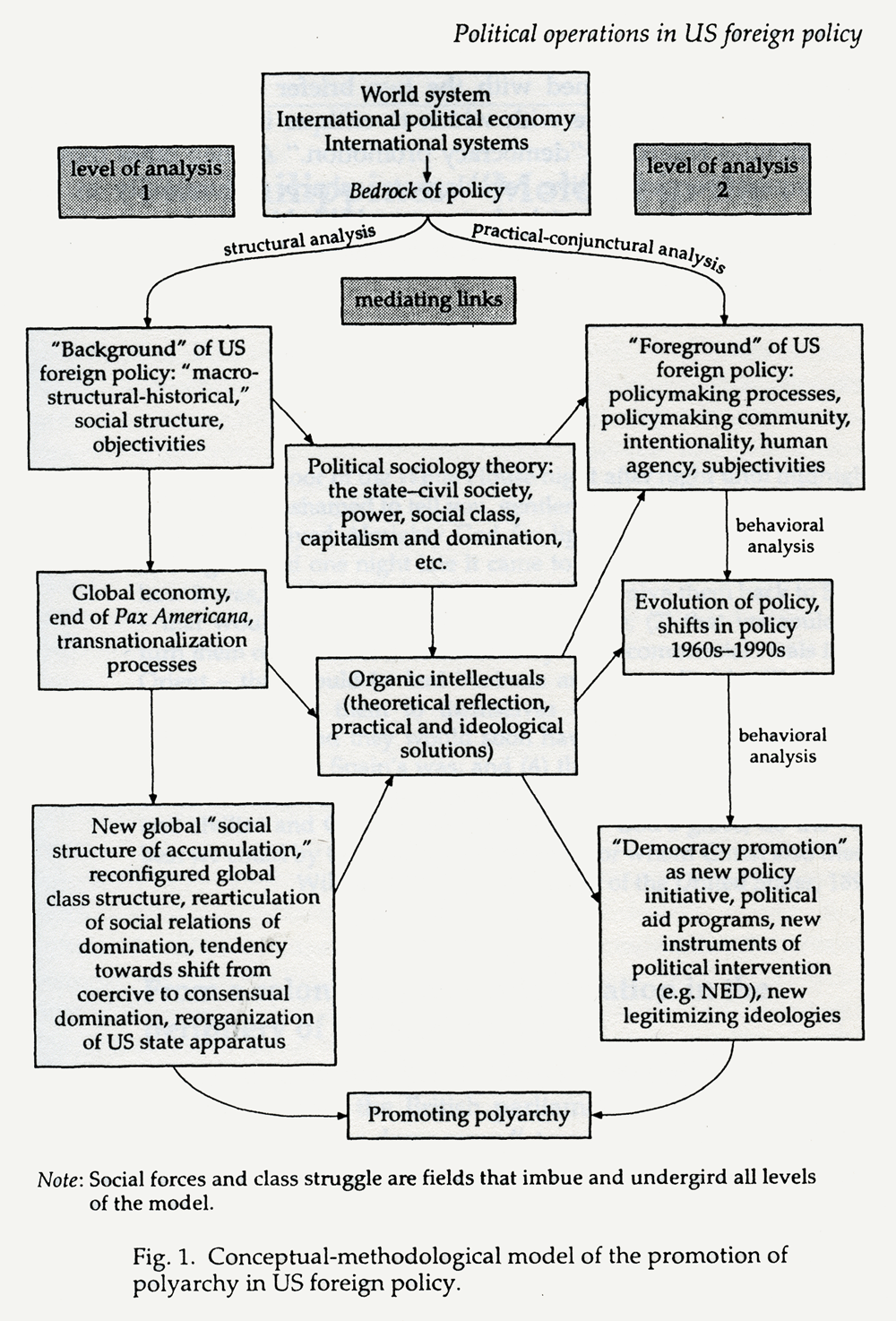
Americana. What was taking place at a structural level was the
transition
to the global economy, the emergence of transnational capital as
the hegemonic fraction of capital on a world scale, and the dissolution
of an international system whose stability had rested on competing
nation-states with a dominant center (a "hegemon"). But a disjuncture
appeared between this level and that of the practical-conjunctural, in
which the policymaking community perceives world events, conducts
often acrimonious internal debates, and develops and implements
policies.
By the end of the
1970s, a consensus was emerging around the broad
contours - but not the concrete policies - of the transnational agenda
among the dominant classes in the United States. These classes are
correlated to the policymaking community, but are not synonymous
with it per se nor with the specific governing bureaucracy, that is,
with
those groups who exercise the formal powers of state.3 That consensus
revolved around the notion that the United States, playing a leadership
role for the transnational elite, had to develop policies to reconstruct
the international order, and to move from the defensive to the offensive
as a first step. This would include broad new political, military, and
economic programs to place revolutionary and nationalist forces in the
Third World, as well as the Soviet Union, on the defensive, and to help
adjust the United States to the reality of the emergent global economy
and society. There was a perceived need for a new reassertionism," a
term which entered the lexicon of the foreign-policymaking community
at this time (although "reassertionism has been identified with
Reagan, it was first launched by the Carter administration, whose
cabinet was drawn almost entirely from the Trilateral Commission and
represented the transnational fraction). The consensus also included
the fiscal and monetary policies of "Reaganomics," which sought to
attune US economic policies to changes in global capital accumulation
and in the role of the state.
These policies were articulated by the transnationalized fraction of
the US elite as the agent that gradually forged consensus. The
semiprivate
institutions which are at the very core of the transnationalized
fraction, the Council on Foreign Relations and the Trilateral Commission
- through which it debates and elaborates strategies, develops
cohesion and outward projection - sponsored studies in the late 1970s
to design a new world order. These included the Council's "1980s
Project" and the Commission's study, "Towards a Renovated International
System."4 The Council is broadly "bipartisan" and its general
policy directives normally represent consensus positions reached
among dominant groups in the United States. It is the single most
powerful and influential elite policy planning group, and has been
largely responsible for the overall direction of US foreign policy since
World War II. In turn, the Council on Foreign Relations is closely tied
to the Trilateral Commission, which is the quintessential political
forum of the transnational elite, the "transnational managerial class"
which stands at the apex of the global class structure. The conclusions
of the two projects were broadly congruent. They called for a "moderate
international order," which meant a world economic environment
in which barriers to the free movement of capital, goods, and
technology would be dismantled, and a new international division of
labor in which labor-intensive phases of production would be trans-
ferred to the South, and they reiterated the Trilateral Commission's
earlier call for reconstituted "democracy." In addition, the "1980s
Project" called for a military build-up and the redeployment of US
forces around the globe.
The notion of consensus here corresponds to the Gramscian concept
of positions advanced by hegemonic fractions within classes and
groups, and not to perfect agreement, to a congruence of interests, or
to
the absence of conflict. One expression of the disjuncture mentioned
above between structural and conjunctural levels of policy was the
neo-conservative movement that came to exercise formal state power
with the election of Ronald Reagan to the presidency in 1980. In a
phenomenon that confused analysts of foreign-policy, the direct agents
of US "reassertionism" and "Reaganomics" became this highly vocal
neo-conservative movement, concentrated in a new right-wing within
the Republican Party. The neo-eonservatives renewed the Cold War
with a vengeance and launched a worldwide counteroffensive against
liberation movements and nationalist Third World governments, involving
dozens of interventionist campaigns.s Its discourse was extremist:
"War, not peace, is the norm in international affairs," proclaimed the
Santa Fe document, drafted in 1980 by Reagan officials as a blueprint
for a new US foreign policy. "Detente is dead. Survival demands a
new US foreign policy. America must seize the initiative or perish."6
The "Reagan Doctrine" of aggressive support for counterrevolutionary
insurgencies and heightened confrontation with the Soviet Union was
backed by the biggest peacetime military build-up in US history and a
redeployment of US military, paramilitary, intelligence, and political
forces around the globe.
While some neo-conservative policies coincided with the transnational
agenda, such as a deepening of "reassertionism" and the
military build-up, certain policies diverged, including a tendency
towards protectionism (reflecting the interests of regional and national
capitalist fractions that formed part of the neo-conservative political
base). But what is of particular importance to this study is that
original
officials in the first Reagan administration, such as Jeanne Kirkpatrick
and Alexander Haig, favored uncritical support for traditional client
regimes and pro-United States dictatorships. The effect of failing to
support allies such as Somoza is that "everywhere our friends will
have noted that the United States cannot be counted on in times of
difficulty and our enemies will have observed that American support
provides no security against the forward march of history," reasoned
Kirkpatrick, in her oft-cited article "Dictators and Double Standards."7
In fact, Kirkpatrick argued that the United States should strengthen its
reliance on authoritarianism to defend US interests.
This disjuncture is a complexity grounded in issues of political
sociology, among them conflict between competing class fractions, the
relative autonomy of the state, the divergence between the public
discourse of "proximate policymakers" and strategic discourse private
to members of dominant groups, and strategies of developing and
appropriating legitimizing symbols and ideology. Besides, the
disjuncture
should not be exaggerated. In analyzing the reconstruction of US
world supremacy under the Reagan administration, Augelli and
Murphy point out that Reagan appealed to what Gramsci referred to
as the "common sense" (contradictory consciousness) of significant
portions of the US mass public.8 But Augelli and Murphy overstate the
discrepancy between the Reaganites and the "world management
oriented" (transnational) fractions. When closely scrutinized, the
Reagan program served the interests of transnational capital on the eve
of globalization - a shift in wealth from labor to capital, dismantling
the Keynesian state, and deregulating capital at home and pursuing
liberalization and reassertionism abroad. Ideological mass appeal to
the emotive and psychological chords of "common sense" played an
important role in relegitimating US and world order and thus helped
surmount the post-Vietnam War, post-Watergate "crisis of govemability"
which had led to an incipient breakdown of hegemony. In this
sense, Reaganism laid the ideological terrain for the agenda of the
transnational elite in the 1980s,in a way not dissimilar to the Gingrich
phenomenon in the 1990s.
The point to stress here is that the right-wing insurgency in US
policy associated with the rise of the the neo-conservatives in the
early
1980s actually masked a broad consensus then emergent in the
strategic centers of US power and in the foreign-policy establishment
around the transnational agenda. In Gill's analysis, the transnational
fraction of capital had unequivocally established its hegemony by the
mid-1980s and was able to fully impose its policies on the US state.
Gill
identifies the second Reagan presidency, beginning in 1984, as the
turning point. From that point on, core economic and foreign policy
responded to the agenda of the transnational elite, even though the
neo-conservatives of the Republican right-wing retained prerogative
over domestic social and other secondary policies. Debates in Washington
after the early 1980s were less over content than over form-
over the wisdom of the fanaticism, the military dimensions, and
reckless aspects of the Reagan Doctrine, a debate most clearly reflected
in the controversial Contra policy towards Nicaragua and the
conflictingpostures
adopted towards Soviet-US negotiations.
The radical rhetoric of such highly visible figures as Haig and
Kirkpatrick, as well as President Reagan himself and other high-profile
Reaganites, concealed the adoption and implementation of the
transnational
agenda within the apparatus of state. Above all, behind the
debates that continued in the mid-1980s was a very broad liberal and
conservative confluence around the new methods of political intervention
and the shift to promoting polyarchy. "Much of the Washington
foreign-policy establishment, and by no means only the Reaganites,
had come to the conclusion that the United States now needed to take
the political and ideological offensive," noted one counselor to Project
Democracy, a government program to develop "democracy promotion"
strategies (see below). "Of course, many within the foreignpolicy
establishment had reservations about one or another of these
activities ... But by the late 1970s-early 1980s,something of a
bipartisan
consensus had begun to emerge [around promoting polyarchy]."9
Political operations
Reassertionism and the shift from backing authoritarianism to promoting
polyarchy involved a thoroughgoing refurbishing and finetuning
of the instruments and ideology of foreign policy. This took
place over an extended period, from the Vietnam War to the late 1980s.
The crucial link between what might appear as contrary processes -
the resurgence of US aggressive intervention abroad in the 1980s, and
the emergence of a "softer" "democracy promotion" in foreign-policy
- is the concept and function of political operations (the more benign
term used by the foreign-policy establishment is "political
development"),
and what has been described as its "handmaid," psychological
operations (similarly referred to in more benign language as
"communications
programs").
As conceived by policymakers, political operations fall into three
broad categories: political action, described by US strategists as "A
full
range of activities including certain kinds of multilateral diplomacy,
support for foreign political parties or forces, and support for or work
with international associations of various kinds"; coercive diplomacy -
"Diplomacy presupposing the use or threatened use of military force
to achieve political objectives"; covert political warfare - "The covert
aspects of active measures, [including] support for insurgencies,
operations
against enemy alliances, influence operations, and black propaganda."
lo For its part, psychological warfare, as described by one
Reagan NSC official, is the "handmaid" of political warfare, "the
planned use of communications to influence human attitudes and
behavior. It consists of political, military, and ideological actions
conducted to create in target groups behavior, emotions, and attitudes
that support the attainment of national objectives... [PSYOPS] will
usually be carried out under the broader umbrella of US national
policy."11
Political operations are broad and inclusive. Rather than being
viewed as any specific program, policy, or practice, it should be more
accurately conceived of as a general framework for interaction in the
international arena. One specialist explained that "politics is the
marshaling of human beings to support or oppose causes ... Such
marshaling must be the objective of all international action, from the
delivery of public speeches to the dropping of bombs." As such,
political operations is in a sense coextensive with all international
action and "is not confined to the tools [specifically] associated with
political warfare" operations, and may be overt or covertY When
divested of the rhetoric, the "democracy promotion" programs in the
Philippines, Chile, Nicaragua, Haiti, and elsewhere were, in fact,
largescale
political operations in foreign policy, involving heavy doses of
political action, coercive diplomacy, covert political warfare, and
psychological operations.
Throughout the 1970s and early 1980s, as US strategists revamped
foreign policy, they developed a critique of the reasons for the decline
in US influence. This rethinking was neither a uniform nor a
conspiratorial
process, and these policymakers were scattered throughout the
extended policymaking community. Different vantage points offered
different views. However, within the foreign-policy establishment as a
whole a consensus was developing on the need to inject foreign policy
with broader political and psychological operations. The conclusion
was that foreign policy had faltered at the political-psychological
level
of engagement, and that political operations should be broadly
introduced.
The "failure to identify and assimilate the lessons of the chief
defeats the United States has suffered internationally in the post War
[World War II) period [and) above all, the Vietnam War," pointed out
a member of the NSC in the early 1980s, reflects great US weaknesses
"at the psychological-political level of conflict."l3 Starting in the
early
1980s,the United States began reorganizing the apparatus of state and
the instruments of foreign policy, in order to enhance the capacity for
sustained political operations.
The two main tools of US foreign policy since World War II have
been military (or security) and economic aid programs, integrated into
overall foreign-policy endeavors. Between World War II and 1990, the
United States spent some $400 billion in such foreign "aid" (over a
trillion dollars at 1990 values).14 The purpose of military aid was to
bolster local repressive forces (at times, proxies) which could suppress
dissent and maintain social control. As well, military aid created
bridges between local forces and the US military and established the
prerequisite conditions for military, intelligence, and covert
intervention
where required. For their part, economic aid programs helped
facilitate US political influence, and more importantly, were intended
to integrate the economies of recipient countries into the international
corporate political economy - by opening up markets, securing access
to resources, building the infrastructure necessary for the operations
of
international capital, and shaping the process of local capital
accumulation
so that it was synchronized and subordinated to the centers of the
world economy. IS These two instruments - military and economic aid
programs - were used efficaciously in the post-World War II years to
reshape the global order and to thrust the United States into the
affairs
of the majority of nations around the globe. As part of the process of
revitalizing foreign policy in the post-Vietnam period, policymakers
gave considerable thought to how these two tools of intervention
might be fine-tuned and given a more explicitly "political focus."
Those policymakers who saw things through the lens of the military
establishment found that traditional military interventions were often
counterproductive. They began developing the concept of low-intensity
warfare, which entered into the US foreign-policy vocabulary as a
term for new modalities of engagement against nationalist and
revolutionary
movements and governments in the 1980s.16 This new doctrine
placed primary emphasis on the political dimensions of conflict and on
the coordination of military activities with economic programs,
diplomatic
initiatives, and psychological warfare. Strategists of low-intensity
warfare argued that while the US had concentrated on preparing for
conventional or nuclear war with the Soviet Union in Europe, the vast
majority of the conflicts in which the US had engaged since World War
II were unconventional encounters with "Soviet proxies" in the Third
World. In conventional warfare, superior military resources predominate.
But in unconventional conflicts of the types generated by the
"position of disparity" in the world order that Kennan mentioned,
such resources in themselves are not the deciding factor. They concluded
that the US had failed because it had not recognized that
unconventional war is often more a political than a military
undertaking.
In Vietnam the United States enjoyed vast conventional military
superiority and won most of the battles but lost the war precisely
because its outcome was determined by imperfectly understood
political variables. Conventional military supremacy can alter those
variables, but the military apparatus is only a means to achieve
political ends. US military strategists rediscovered, as they do
periodically,
the famed nineteenth-century Prussian military theorist Carl von
Clausewitz, and his axiom that "war is the extension of politics by
other means." The strategists drew several essential conclusions
regarding future US participation in unconventional conflicts (with or
without a military component), and then applied these conclusions in
Third World conflict situations. These conclusions were: first, the
target
of such campaigns must be the population itself, the minds of the
people rather than the enemy's military forces; second, in this
undertaking,
policymakers had to take into account the specific culture,
sensibilities, and history of the target population, as well as the
capabilities of the adversaries. Campaigns against other countries
would be tailor-made to suit the particular circumstances of each
foreign-policy operation. Third, it is not enough to try to destroy the
organized forces of adversaries (be they revolutionary or nationalist
forces or otherwise); a movement or group responsive to US interests
had to be created, legitimated and presented to the target population
as a viable alternative to the government to be overthrown or replaced
or the movement to be defeated. Fourth, new forms of political and
military organization had to be developed. (This conclusion helped
lead to the formation of the NED and other "democracy promotion"
agencies.) Fifth, interventionist projects can only be sustained if
there
are strong USconstituencies who support the effort. These, too, have to
be garnered, mobilized, and legitimized. These "lessons" of Vietnam
led to a simple yet fundamental premise: the ultimate objective of
unconventional engagements is to achieve the political, not the
military,
defeat of adversaries. Crucial here is the shift from military to
political competition as the core of US undertakings abroad, even
when the military dimensions of these undertakings appear as the
most salient.
In the 1980s,these lessons were applied to numerous low-intensity
conflict situations, such as in Central America and Southern Africa,
and in many countries and regions which were to undergo transitions
to polyarchy. Starting in the early 1980s, the United States began to
reorganize the military establishment to conduct low-intensity warfare
campaigns. The Joint Chiefs of Staff formed special low-intensity
conflict divisions within the Department of Defense and within each
military service, and also reintroduced political and psychological
warfare branches. The Pentagon even drafted a PSYOPS"master plan"
at the behest of a Presidential Directive, and the National Security
Council set up a top-level "board for low intensity conflict."17The
shift
in the military establishment towards a capacity for flexible,
unconventional
engagements in the Third World accelerated in the early 1990s
with the end of the Cold War.I8
For their part, economic policymakers began developing new ideas,
such as humanitarian resource use and an expansion of traditional
development aid to incorporate "institution-building." One member
of Reagan's National Security Council noted that "international aid
and humanitarian affairs," including "foreign economic and development
aid, food aid, humanitarian assistance (rescue operations, disaster
relief, famine relief, and the like), and technical assistance of
various kinds," are crucial components of political operations in
foreign policy. "Although these functions are bureaucratically scattered
and very largely autonomous, they have a very important
psychological-political component. Whether intentionally or otherwise,
they serve as significant instruments of US foreign policy and
national strategy."19 In 1966 Congress had passed the Title IX
addition to the US Foreign Assistance Act, which called for a
specifically "political focus" to traditional US-funded development
programs.20 As a development growing out of Title IX, the AID
created an Office of Democratic Initiatives in 1984 and launched
numerous "political development" and "institution-building" programs
during the 1980s. In addition, economic assistance programs in
the 1980s and 1990s, both bilateral and multilateral, became effective
precision instruments in promoting the neo-liberal economic model in
the Third World. One analyst has appropriately termed this function
of "economic aid" in the late twentieth century as "financial low
intensity warfare."21
Political aid as political operations
Programs to strengthen friendly politicalmovementsin other countries
are one of the foreign-policyarms of a modem great power.
Until this century, there were three instruments for such efforts:
diplomacy, economic,and military. This triad retains its primacy
today, but it has been supplemented by two additional instruments.
One is propaganda... The other new policy instrument - aid to
friendly political organizationsabroad - ... helps build up political
actors in other polities, rather than merely seeking to influence
existingones. In internationalaffairs,organization is now as important
as issues,just as has alwaysbeen the casein domesticpolitics.
--
Michael A. Samuel sand William A. Douglas (Project Democracy
consultants) [22]
The new political intervention did not eclipse the two traditional
foreign-policy instruments; to the contrary, they were refurbished and
widely deployed. However, the key ingredient was still missing. The
third instrument, "political aid," had remained sporadic and
underdeveloped.
It was the introduction of this third category which would
play a centripetal role in facilitating the shift in policy and bringing
about consensus around promoting polyarchy. As Allen Weinstein, the
first president of NED, put it: "A number of separate strands ...
converged in the 1981-82 period to produce a critical mass of public
attention" on the issue of "democracy promotion" as a component of
overall foreign policy.23
The intellectual underpinning of "political aid" was the argument
contained in the political development literature that the United States
must build up the institutions of political and civil society of
intervened
countries in order to develop structures capable of absorbing tensions,
maintaining social control, and steering societies in directions
responsive
to US and transnational interests. Those arguing for the introduction
of political aid, including a commission supervised by the
National Security Council to create the NED, made broad reference to
the conclusions of a 1972 book by William A. Douglas, Developing
Democracy.24
In his study, Douglas reviewed the modernization and political
development literature and the debates over whether authoritarianism
or "democracy" is best suited to meet US interests. Douglas coined the
term regimented democracy to describe the type of political system the
US should promote in place of authoritarianism. Comparing the
populations of developing nations with "children," and asserting that
underdevelopment was the result of their "traditional attitudes,"
Douglas argued that the peoples of the Third World required "tutelage,"
"regimentation," and "social control," but that "democracy"
could achieve these goals more effectively than authoritarianism:
That a firm hand is needed is undeniable. However, it is harder to
accept the claim that only dictatorship can provide the sufficient
degree of firmness. First, in regard to keeping order, what is involved
is basically effective police work, and there is no reason why
democratic regimes cannot have well-trained riot squads ... democratic
governments may be able to do the same things as dictatorship
to overcome centripetal social forces: use police to stop riots, strike
bargains with the various groups to keep them reasonably satisfied,
and call out the army when peaceful means fail... There is no denying
the need for organization structures by which the modernized elite
can exercise tutelage. However ... it is common experience that in
obtaining the desired behaviour from a balky mule, a balky child, or a
balky peasant, the real key is to find just the right balance between
carrot and stick... Democracy can provide a sufficient degree of
regimentation, if it can build up the mass organizations needed to
reach the bulk of the people on a daily basis. Dictatorship has no
monopoly on the tutelage principle.25
After making the case for "democracy" over authoritarianism,
Douglas went on to develop detailed recommendations on how
"political aid" programs should be introduced. Just as economic aid
addressed economic underdevelopment, reasoned Douglas, political
aid "should address political underdevelopment." Third World
nations "need assistance in politics just as much as in building
infrastructure,
industry, or institutions such as universities, cooperatives,
and trade unions," he argued. "Without political aid, their political
systems may lag behind development in the economic and institutional
sectors, with the resulting political instability... we should undertake
an active policy of political aid, for both developmental and security
reasons." The trick, said Douglas, was to devise the correct
"transplanting
mechanisms" for establishing polyarchy in the Third World,
as well as "insulating devices" which would allow polyarchic systems
to incubate, take hold, and stabilize in the intervened societies.26
Included among the recommendations were: the establishment of a
specialized agency (later to become the NED); the participation of the
private sector (i.e., the dominant organs of US civil society) in
government-
supervised "democracy promotion" abroad; and the modifica-
tion of existing government institutions and programs so as to
synchronize
overall foreign policy with "political development." Two
decades after his study, the "transplanting mechanisms" and "insulating
devices" which Douglas called for became embodied in the new
"democracy promotion" programs. Douglas himself went on to
become a senior consultant to the N5C/s Project Democracy (see
below), which led to the creation of the NED and other "democracy
promotion" organs of the USstate.
Although fierce foreign-policy debates continued in the 1980s over
the basis on which US influence and world order should be reconstructed/
the introduction of "political development" programs garnered
a broad consensus. "The Endowment represented an integration
of conservative and liberal reactions to the American failure in
Vietnam/" stated Gershman. "Conservatives, anxious to overcome the
Vietnam malaise, welcomed a new effort to reassert American democratic
values and to meet the Soviet ideological challenge head on.
Liberals, on the other hand, welcomed an approach that offered a
political alternative to military competition and a creative means of
addressing complex political problems that did not lend themselves to
military solutions."2? Another consultant on political aid noted in the
mid 1980s:a "US policy of political aid... is in its incipient state
and, in
time, may well replace in importance military and economic aid as the
principal foreign assistance program."28
Political aid has become an efficacious instrument of the United
States, in the context of the transnationalization of political
processes,
in its effort to establish control over transnational politics and to
reconfigure a new "historic bloc" over which the transnational elite
exercises hegemony. Similarly, the notion of "institution building" in
political and civil society in intervened countries as part of political
operations abroad, which was first put forward in the political
development literature of the 1960s and has now become part of the
standard lexicon of "democracy promotion/" should be seen theoretically
in its relation to hegemony. There is a close relation between
institutionalization and hegemony, although the two are by no
means identical. As discussed earlier, institutions provide ways of
processing conflicts so as to minimize the use of force in domination.
In this way, institutions may become what Gramsci called "anchors"
for constructing hegemony. The passage from "political development"
of the 1960s to "democracy promotion" of the 1980s and
1990s involves an expansion from "institution building" at the level
of formal state structures to the level of both state structures and
civil society.
The shift from the CIA to the NED
What little political aid the United States has attempted in the past 35
years has been more or less covert, largely financial and most often
administered through the CIA. It did not take long for most policymakers
to realize that such covert operations were inappropriate,
awkward, and embarrassing.
-- Project Democracy consultant
[29]
Political aid programs were sporadic and underdeveloped in the
post-World War II period. Those programs that did exist were
managed by the CIA. The Truman administration created the CIA out
of its World War II precursor, the Office of Strategic Security, as a
covert branch of the US state in the Cold War. Since its inception, the
CIA has carried out thousands of covert operations; overthrown
countless governments; and contributed to the death, directly or
indirectly, of millions of people as a result of its actions.3o
Alongside
intelligence gathering and paramilitary campaigns, a major component
of CIA intervention has been political operations involving the
creation,
covert funding and guidance of allied political groups and
individuals in target countries - media, political parties, trade
unions,
businesses, and associations.
At the height of the Cold War in the 1950s and 196Os, despite
occasional scandals and failures like the Bay of Pigs, the CIA enjoyed
the respect of much of the US public, and the full extent of its
activities
remained hidden from the international community. But during the
1970s,as many of its seamy covert operations became public, it fell into
disrepute. In 1974-5, congressional investigations revealed the sordid
underworld of CIA covert activity at home and abroad. Top-level CIA
officers defected and exposed the history of overseas intrigues, and
investigative journalists uncovered unsavory details of US secret
activities.31 After the US defeat in Indochina and the delegitimization
of foreign intervention, the CIA by the late 1970s was badly
discredited.
In the United States, bipartisan and constituent support
crumbled. In target countries abroad, association with CIA programs
meant instant repudiation. In addition to the stigma, there were other
problems. The CIA had proved adept at staging coups, assassinations,
and installing dictators. It achieved its stated goal in 1973 in Chile,
for
instance, when it orchestrated the military overthrow of the
democratically
elected government of Salvador Allende. In Guatemala, it was
impeccably efficient in organizing the removal in 1954 of the elected
government of Jacobo Arbenz. The CIA showed similar proficiency in
operations in Brazil, Iran, the Congo, the Philippines, Iraq, and dozens
of other countries.
Yet there was something clumsy about these operations. The political
aftermath of covert operations seemed to create new, more
complex problems over the long term. The CIA could destabilize quite
well, but, its detractors argued, it was not good at creating stability.
Nearly four decades after the CIA overthrew the Arbenz government,
Guatemala remained a cauldron of guerrilla insurgency, gross human
rights violations and social instability. The Pinochet regime lasted
sixteen years but was an international pariah. Iran's nationalist prime
minister, Mossadegh, was ousted in the CIA-led coup of 1954, which
installed the Shah and recovered Iranian oil fields for Western
petroleum
companies. But, despite twenty years on the throne, the Shah was
unable to sustain himself in the face of a rising Islamic fundamentalist
movement and popular struggles against his policies. CIA operations
seemingly lacked sophistication and long-term vision. The CIA was
not able to create stable governments or to mold structures in civil
society itself that could provide long-term protection for a
coredominated
market economy and a pro-US political program. Here, the
capable hands of a political surgeon were needed, not the heavy hand
of a paramilitary assassin.
The new, post-Vietnam breed of political professionals lobbied for
the transfer of crucial aspects of the CIA's political operations -
namely, "political aid" - to a new agency. They lobbied for the
establishment of an institution that would use sophisticated techniques,
including elections, political aid, and other political operations, to
achieve lasting results. Two of the original NED founders noted:
"Since the advent of the Cold War, the United States has worked
abroad politically, mainly covertly, with direct government action and
secret financing of private groups." This US political intervention
capacity "is necessary for protecting US security interests," but
efforts
to date have proven inadequate: "[The] various covert means for filling
the political gap in US policy solved some short-term needs, but did
not provide effective long-term solutions. Covert political aid provided
directly by the US government is limited in its effectiveness."32
Thus, while CIA intervention has continued, a more specialized,
leading figures who had been developing the ideas of the new political
intervention, many of them associated with the transnationalized
fraction of the US elite.40 Among those on the APF board were Lane
Kirkland of the American Federation of Labor-Congress of Industrial
Organizations (AFL-CIO), former Republican National Committee
chair William Brock, former Democratic National Committee chair
Charles Manatt, international vice-president for the US Chamber of
Commerce Michael Samuels, as well as Frank Fahrenkopf, Congressman
Dante Fascell, Zbignew Brezezinski, John Richardson, and
Henry Kissinger.The APF was chaired by Allen Weinstein, who would
later become the first president of the NED. The names of APF activists
and the composition of the APF board are revealing. They fall into
three categories. One is members of the inner circle of
second-generation
post-World War II national security and foreign policymakers,
such as Kissinger, Brezezinski, and Richard Allen, all former National
Security Advisors. Another is top representatives of the four major
constituencies that made up the post-World War II foreign-policy
coalition- the Democratic and Republican parties, labor and business.
The third is operatives from the US intelligence and national security
community. These intelligence and security operatives include people
associated with the CIA and dozens of front organizations or foundations
with which it works, as well as operatives from the USIA.
The prominence of the USIA is significant, since this is an agency
with a long track record in political and psychological operations. It
was created by the Eisenhower administration in 1953 as an agency
within the NSC at the recommendation of a top-secret report issued by
the President's Committee on International Information Activities. Its
explicit purpose was to conduct propaganda, political and psychological
operations abroad in conjunction with CIA activities.41 A National
Security Action Memo in 1962 stipulated coordination among
the USIA, the AID, the CIA, the Pentagon, and the State Department in
waging political warfare operations, including civic action, economic
and military aid programs.42 Based on research programs it conducts
directly or commissions governmental and non-governmental agencies
to conduct, the USIA selects propaganda themes, determines target
audiences, and develops comprehensive country plans for media
manipulation and communications programs. As part of Project
Democracy, USIA activities were greatly expanded in the 1980s.43
The APF recommended in 1981 that a presidential commission
examine "how the US could promote democracy overseas." The White
House approved the recommendation for Project Democracy. At its
onset, Project Democracy was attached to the NSC, and supervised by
Walter Raymond Jr., a high-ranking CIA propaganda specialist who
worked closely with Oliver North, a key player in the Iran-Contra
scandal, on covert projects.44 "Overt political action/" explained
Raymond, could help achieve foreign-policy objectives by providing
"support to various institutions [and]... the development of networks
and personal relationships with key people."45 Raymond explained
that the creation of the NED as a "vehicle for quasi-public/private
funds" would fill a "key gap" in US foreign-policy - it would be a
"new art form."46 Raymond and his staff at the NSC worked closely
with Democratic Congressman Dante Fascell of Florida. Fascell chaired
the House Foreign Affairs Committee which would draft the legislation
creating the NED and organized support for the project within
Congress.47
In June 1982, in a speech before the British parliament considered the
symbolic inauguration of the new policy, Ronald Reagan announced
that the United States would pursue a major new program to help
"foster the infrastructure of democracy around the world."48 A secret
White House memo on the minutes of a Cabinet-level planning
meeting to discuss Project Democracy held two months later, in
August, set the agenda: "We need to examine how law and Executive
Order can be made more liberal to permit covert action on a broader
scale, as well as what we can do through substantially increased overt
political action."49 Then, in January 1983/ Reagan signed National
Security Decision Directive 77 (NSDD 77)/ which laid out a comprehensive
framework for employing political operations and psychological
warfare in US foreign policy. At least $65 million was allocated by the
administration to underwrite the activities and programs contemplated
in the NSC directive.5o NSDD 77 focused on three aspects of Project
Democracy.s1One aspect was dubbed "public diplomacy" - psychological
operations aimed at winning support for US foreign policy
among the US public and the international community - and involved
an expansion of propaganda and informational and psychological
operations. The directive defined "public diplomacy" as "those actions
of the US Government designed to generate support for our national
security objectives." An Office of Public Diplomacy (OPD) operating
out of the White House was established.52 The General Accounting
Office ruled OPD an illegal domestic propaganda operation in 1988.
Another aspect set out in the NSC directive was an expansion of covert
sophisticated entity with a focus on political operations a long-term
vision, and a strategic agenda came into existence with the creation of
the NED in 1983. This new entity would not only play the role of
skillful political surgeon, but it would overcome the taint associated
with the covert political operations that the CIA had been carrying out
abroad. Specifically, NED would take over much of the funding and
political guidance for political parties, trade unions, business groups,
news media, and civic organizations that the CIA had traditionally
supplied. The NED is a "combination of Government money, bureaucratic
flexibility and anti-Communist commitment. .. which mixes
public funds and private interests," noted the New York Times shortly
after the Endowment's founding. The NED's work "resembles the aid
given by the Central Intelligence Agency in the 1950s, 60s and 70s to
bolster pro-American political groups."33 Former CIA director William
Colby commented in regard to the NED program: "It is not necessary
to turn to the covert approach. Many of the programs which ... were
conducted as covert operations [can now be] conducted quite openly,
and consequentially, without controversy."34 The idea was to create a
further division of labor within the organs of US foreign policy. The
NED would not replace the CIA, whose programs have continued and
even expanded in the 1990s.35Rather, it would specialize in the overt
development through political aid programs of political and civic
formations, supplementing CIA covert activities in synchronization
with overall US policy towards the country or region in which it
operated.
The NED, with its ideological underpinning of "promoting democracy,"
was well equipped for rebuilding US domestic consensus for
political operations abroad. The name National Endowment for Democracy
conjures up an apolitical and benevolent image not unlike
that of the National Endowment for the Arts or other humanitarian
societies. The efforts to project such an image are, in fact, part and
parcel of the ideological dimensions of the new intervention, and have
been remarkably successful. Standard university texts perpetuate such
an uncritical image. "The National Endowment for Democracy,
launched by the Reagan administration in 1983, is a recent manifestation
of a tradition with a long heritage," states American Foreign Policy:
Pattern and Process, one of the staple US college texts on foreign
policy.
"Its purpose is to encourage worldwide the development of autonomous
political, economic, social and cultural institutions to serve as the
foundations of democracy and the guarantors of individual rights and
freedoms." 36 Yet the NED was created in the highest echelons of the
US national security state, as part of the same project that led to the
illegal operations of the Iran-Contra scandal. It is organically
integrated
into the overall execution of US national security and foreign
policy. In structure, organization, and operation, it is closer to
clandestine
and national security organs such as the CIA than apolitical or
humanitarian endowments as its name would suggest. The NED has
operated in tandem with all major interventionist undertakings in the
1980sand 1990s.
The NSC's
Project Democracy
Efforts to create "political development" programs date back to the
1950s, at the height of the Cold War, when Congress discussed, but
declined to approve, several bills to establish a "Freedom Academy"
that would conduct party-building in the Third World. The passage of
the Title IX addition to the Foreign Aid Act in 1966 spurred renewed
interest in such an agency. The Brookings Institute, one of the most
important policy planning institutes, undertook an extensive research
program on political development programs in coordination with the
AID and other government agencies.37 In 1967, President Johnson
appointed the three-member Katzenback Commission which recommended
that the government "promptly develop and establish a
public-private mechanism to provide public funds openly for overseas
activities of organizations which are adjudged deserving, in the
national interest, of public support."38 A bill was introduced in
Congress in 1967by Rep. Dante Fascell (D.-Fla.) to create an "Institute
of International Affairs," but it was not approved.39 Meanwhile, the
public outcry against intervention abroad in the early 1970s as a result
of the Indochina war and the revelations of CIA activities, as well as
the Watergate scandal, put these initiatives on hold for much of that
decade.
Then, in 1979, with reassertionism taking hold, a group of government
officials, academicians, and trade union, business, and political
leaders connected to the foreign-policy establishment, created the
American Political Foundation (APF), with funding from the State
Department's United States Information Agency (USIA) and from
several private foundations. The APF brought together representatives
of all the dominant sectors of US society, including both parties and
leaders from labor and business. It also brought together many of the
leading figures who had been developing the ideas of the new political
intervention, many of them associated with the transnationalized
fraction of the US elite.40 Among those on the APF board were Lane
Kirkland of the American Federation of Labor-Congress of Industrial
Organizations (AFL-CIO), former Republican National Committee
chair William Brock, former Democratic National Committee chair
Charles Manatt, international vice-president for the US Chamber of
Commerce Michael Samuels, as well as Frank Fahrenkopf, Congressman
Dante Fascell, Zbignew Brezezinski, John Richardson, and
Henry Kissinger. The APF was chaired by Allen Weinstein, who would
later become the first president of the NED. The names of APF activists
and the composition of the APF board are revealing. They fall into
three categories. One is members of the inner circle of
second-generation
post-World War II national security and foreign policymakers,
such as Kissinger, Brezezinski, and Richard Allen, all former National
Security Advisors. Another is top representatives of the four major
constituencies that made up the post-World War II foreign-policy
coalition - the Democratic and Republican parties, labor and business.
The third is operatives from the US intelligence and national security
community. These intelligence and security operatives include people
associated with the CIA and dozens of front organizations or foundations
with which it works, as well as operatives from the USIA.
The prominence of the USIA is significant, since this is an agency
with a long track record in political and psychological operations. It
was created by the Eisenhower administration in 1953 as an agency
within the NSC at the recommendation of a top-secret report issued by
the President's Committee on International Information Activities. Its
explicit purpose was to conduct propaganda, political and psychological
operations abroad in conjunction with CIA activities.41 A National
Security Action Memo in 1962 stipulated coordination among
the USIA, the AID, the CIA, the Pentagon, and the State Department in
waging political warfare operations, including civic action, economic
and military aid programs.42 Based on research programs it conducts
directly or commissions governmental and non-governmental agencies
to conduct, the USIA selects propaganda themes, determines target
audiences, and develops comprehensive country plans for media
manipulation and communications programs. As part of Project
Democracy, USIA activities were greatly expanded in the 1980s.43
The APF recommended in 1981 that a presidential commission
examine "how the US could promote democracy overseas." The White
House approved the recommendation for Project Democracy. At its
onset, Project Democracy was attached to the NSC, and supervised by
Walter Raymond Jr., a high-ranking CIA propaganda specialist who
worked closely with Oliver North, a key player in the Iran-Contra
scandal, on covert projects.44 "Overt political action," explained
Raymond, could help achieve foreign-policy objectives by providing
"support to various institutions [and]... the development of networks
and personal relationships with key people."45 Raymond explained
that the creation of the NED as a "vehicle for quasi-public/private
funds" would fill a "key gap" in US foreign-policy - it would be a
"new art form."46 Raymond and his staff at the NSC worked closely
with Democratic Congressman Dante Fascell of Florida. Fascell chaired
the House Foreign Affairs Committee which would draft the legislation
creating the NED and organized support for the project within
Congress.47
In June 1982, in a speech before the British parliament considered the
symbolic inauguration of the new policy, Ronald Reagan announced
that the United States would pursue a major new program to help
"foster the infrastructure of democracy around the world."48 A secret
White House memo on the minutes of a Cabinet-level planning
meeting to discuss Project Democracy held two months later, in
August, set the agenda: "We need to examine how law and Executive
Order can be made more liberal to permit covert action on a broader
scale, as well as what we can do through substantially increased overt
political action."49 Then, in January 1983, Reagan signed National
Security Decision Directive 77 (NSDD 77), which laid out a comprehensive
framework for employing political operations and psychological
warfare in US foreign policy. At least $65 million was allocated by the
administration to underwrite the activities and programs contemplated
in the NSC directive.50 NSDD 77 focused on three aspects of Project
Democracy.51One aspect was dubbed "public diplomacy" - psychological
operations aimed at winning support for US foreign policy
among the US public and the international community - and involved
an expansion of propaganda and informational and psychological
operations. The directive defined "public diplomacy" as "those actions
of the US Government designed to generate support for our national
security objectives." An Office of Public Diplomacy (OPD) operating
out of the White House was established.52 The General Accounting
Office ruled OPO an illegal domestic propaganda operation in 1988.
Another aspect set out in the NSC directive was an expansion of covert
operations. This aspect would develop into the clandestine, illegal
government operations later exposed in the hearings on the Iran-
Contra scandal of the late 1980s. Parallel to "the public arm of Project
Democracy, now known as the National Endowment for Democracy,"
noted the New York Times, "the project's secret arm took an entirely
different direction after Lieut.-Col. Oliver I. North, then an obscure
National Security Council aide, was appointed to head it."53
The final aspect was the creation of a "quasi-governmental institute."
This would engage in "political action strategies" abroad, stated
NSDD 77.54 This led to the formal incorporation of the NED by
Congress in November 1983. While the CIA and the NSC undertook
"covert" operations under Project Democracy, some of which were
exposed in the Iran-Contra investigations, the NED and related
agencies went on to execute the "overt" side of what the New York
Times described as "open and secret parts" of Project Democracy,
"born as twins" in 1982 with NSDD 77.55 But while the Iran-Contra
covert operations that grew out of Project Democracy were exposed
and (assumed to be) terminated, the NED was consolidated and
expanded as the decade progressed. With the mechanisms in place by
the mid-1980s, the "reassertionists" turned to launching their global
"democracy offensive." "The proposed campaign for democracy must
be conceived in the broadest terms and must weave together a wide
range of superficially disparate aspects of US foreign policy, including
the efforts of private groups," noted one Project Democracy consultant.
"A democracy campaign should become an increasingly important
and highly cost-effective component of ... the defense effort of the
United States and its allies."56The countries in which the NED became
most involved in the 1980s and early 1990s were those set as priorities
for US foreign-policy. "Such a worldwide effort (a 'crusade for
democracy'] directly or indirectly must strive to achieve three goals,"
one Project Democracy participant explained. "The preservation of
democracies from internal subversion by either the Right or the Left;
the establishment of new democracies where feasible; and keeping
open the democratic alternative for all nondemocracies. To achieve
each of these goals we must struggle militarily, economically,
politically
and ideologically."57
In countries designated as hostile and under Soviet influence, such
as Nicaragua and Afghanistan, the United States organized "freedom
fighters" (anti-government insurgents) in the framework of low-intensity
conflict doctrine, while the NED and related organs introduced
complementary political programs. Those countries designated for
transition from right-wing military or civilian dictatorships to stable
"democratic" governments inside the US orbit, including Chile, Haiti,
Paraguay, and the Philippines, received special attention. By the late
1980sand early 1990s,the NED had also launched campaigns in Cuba,
Vietnam, and other countries on the US enemy list, and had also
become deeply involved in the self-proclaimed socialist countries,
including the Soviet Union itself. While these first programs were tied
to the 1980s anti-communist crusade, the NED and other "democracy
promotion" agencies made an easy transition to the post-Cold War era.
As the rubric of anti-communism and national security became outdated,
the rhetoric of "promoting democracy" took on even greater
significance. Perestroika and glasnost highlighted authentic
democratization
as an aspiration of many peoples. But US strategists saw in the
collapse of the Soviet system an opportunity to accelerate political
intervention under the cover of promoting democracy. In the age of
global society, the NED and other "democracy promotion" organs
have become sophisticated instruments for penetrating the political
systems and civil society in other countries down to the grassroots
level.
Structure of the
"democracy promotion" apparatus
Constitutive documents describe the NED as an "independent" and
"private" organization. "Non-governmental" is its juridical status. In
any political or practical sense, such a classification is meaningless;
structurally and functionally it operates as a specialized branch of the
US government. The NED is wholly funded by Congress with funds
channeled through the USIA and the AID, both entities of the Department
of State. From its inception in 1983 to its financial year 1992
allocation by Congress, it has received approximately $210 million in
monies allocated by Congress.58 According to the NED's public
documentation, these allocations account for some 99 percent of its
funding. However, it is clear from the study of its operations abroad
that NED spending is so interlocked with other direct and indirect,
secret and public US government spending, that talk of fixed budgets
is not all that meaningful. All NED grants are submitted to the State
Department for approval, and US embassies abroad frequently handle
logistics for and coordination of NED programs. The State Department
and other executive agencies regularly appoint personnel to participate
in NED programs.59 The decision to make the NED a quasi-private
entity was based on several considerations. First, this would make it
easier to insulate its operations from public scrutiny and
accountability.
For instance, the NED would not be subject to congressional
oversight, as is the CIA. Second, a "private" organization would not be
subject to the same bureaucratic encumbrances as a formal government
agency, and therefore would be afforded greater flexibility in its
operations. Third, formally separating the NED from the State Department
would eliminate apparent or potential conflicts between government-
to-government diplomacy and partisan interference in the
political systems of other countries.
The NED operates overtly, at least on paper, as opposed to the CIA's
covert activities. Its assistance to groups and individuals in other
countries is conducted publicly - above board - according to the NED
charter. This shift from covert to overt is a product of several
practical
and ideological concerns held by policymakers. Overt political
intervention
described as "democratic, nonpartisan assistance" is more
difficult to discredit than "CIA bribes," "covert payoffs," or "secret
intervention." Similarly, it is easier and more ideologically convincing
to sell intervention as "democracy promotion" than as national
security, and thus this assists in legitimizing foreign policy.
Transferring
political intervention from the covert to the overt realm does not
change its character, but it does make it easier for policymakers to
build domestic and international support for this intervention. It also
provides policymakers with greater flexibility and options in pursuing
their country-specific objectives. Despite its officially overt
character
the NED also engages in extensive covert operations. In fact, "overt"
appears to be more an aspect of the "democracy" rhetoric than actual
NED policy. NED activities are often shrouded in secrecy, and NED
officials operate more often in the shadows than in the open, much like
an agency dedicated to covert operations. Revealingly, NSC and other
governmental documents of the early 1980s spoke almost interchangeably
of "political action" and "covert action," and one secret White
House planning document on Project Democracy referred to "covert
action on a broad scale" to promote public and private "democratic
institutions" abroad.60 Clearly those involved in Project Democracy
were not yet clear how covert and overt aspects of the new political
intervention would be portioned out.
The NED functions through a complex system of intermediaries in
which operative aspects, control relationships, and funding trails are
nearly impossible to follow and final recipients are difficult to
identify.
Most monies originating from the NED are first channeled through US
organizations which, in turn, pass them on to foreign counterparts,
who are themselves often pass-throughs for final recipients. Dozens of
US organizations have acted as conduits for NED funds. Financial
accounting becomes nearly impossible, facilitating all sorts of secret
funding, laundering operations, and book-keeping cover-ups which
allow for unscrutinized transactions. Through the multi-tiered structure
of go-betweens, it is difficult to establish the links between US
government operations on the one hand, and seemingly independent
political activities in other countries on the other. In this Alice's
Wonderland of political intervention, things are not what they seem, at
first blush, to be.
The first tier in this system of intermediaries consists of what are
known as the NED core groups. These groups handle the bulk of
appropriated NED funds and programs. They are: the National Democratic
Institute for International Affairs (NDI) and its counterpart, the
National Republican Institute for International Affairs (NRI, whose
name was later changed to International Republican Institute, or IRI),
which are the "international wings" of the Democratic and Republican
parties; the Center for International Private Enterprise (CIPE), a
branch
of the US Chamber of Commerce; and the Free Trade Union Institute
(FTUI), an international branch of the AFL-CIO (the AFL-CIO also
operates abroad through three regional organizations, the AALC, for
Africa, the AAFLI, for Asia, and the AIFLD, for Latin America). These
core groups carry out programs in target countries with those sectors
considered strategic pillars of society: labor (FTUI), business (CIPE)
and the political parties and organizations (NDI and NRI). A host of
other US "private" organizations enmeshed with foreign policy, such
as Freedom House, the Council on the Americas, the Center for
Democracy, and US universities, foundations, think-tanks, and even
the YMCA, handle programs for "civic" sectors. In this structure, the
US state foments direct linkages between the organs of US civil society
and their counterparts in other countries.
Another characteristic of the NED is its fusion of the public and the
private domains in its operations. In "democracy promotion" operations,
"congressional testimony, agency budgets, speeches for department
heads, planning and programming have been routinely farmed
out to private firms rather than done internally by the responsible
bureau," candidly explained one Project Democracy counselor. "In
some cases, these 'private' agencies are really just fronts for the
departments they serve; the agency may prepare a report or a research
project that it then gives to the private firm to attach its letterhead
to,
as if it were really a private activity or initiative."61 The lines of
funding in leadership which originate at the highest levels of the
formal state apparatus and filter down through public and "private"
networks ostensibly unconnected to the government obscures the
linkage between many on-the-ground activities in intervened countries
and the US state. Although they are projected as non-governmental
organizations (NGOs - or in official AID terminology, private voluntary
organizations, or PVOs), the "private" groups which actually
manage many "democracy promotion" programs in intervened countries
form part of an extended US state apparatus. Obscuring this
linkage means that the governmental identity of these groups and the
function of their activities in the service of US foreign policy are
almost
universally unrecognized by US and foreign publics, and may even be
unrecognized by other branches of the state apparatus (e.g., members
of the US Congress), by many of their own employees, and by
governments and publics in intervened countries. (However, the
leadership of these quasi-private groups, top-level policymakers and
field operatives, quite fully recognize their status as instruments of
US
foreign policy.) This blurring of "public" and "private" in US foreign
policy was exposed in the 1980s during investigations into the Iran-
Contra dealings. However, this was mistakenly seen as an aberration
limited to that scandal. It is actually a structural feature of foreign
policy in the current era. In this process, the US state oversees and
guides the application of the overall resources of society to
foreignpolicy
objectives. This means tapping the technological, intellectual
and organizational expertise of those not formally in the government
in which diverse interests are merged and the distinction between state
activity and private activity disappears. For instance, US intervention
in the Nicaraguan elections involved the coordinated actions of the
White House, the National Security Council, the CIA, the Department
of State, the Pentagon, the USIA, the AID, Congress, the Democratic
and Republican parties, the AFL-CIO, the US Chamber of Commerce,
and dozens of "private groups," ranging from Freedom House and the
Cuban American National Foundation, to the National Association of
Broadcasters and sectors of the US Catholic Bishops Conference (see
chapter 5). In theoretical terms, this should be seen as a feature of
transnationalization. The US state acts to combine and fuse the actions
and resources of elites operating in synchronization in civil and
political society, and then project them into a transnational setting,
through which cross-national politics are conducted and efforts are
undertaken to construct hegemony.
A striking feature of the NED structure is the system of interlocking
directorates. The boards of the "core groups" and the host of other
"private" groups in US civil society that participate in "democracy
promotion" programs, such as Freedom House, the Council on the
Americas, and so on, heavily overlap with government and "private"
organization officials who promoted Project Democracy and who sit
on the NED board itself.62 In turn, this is an exact mirror of the
institutional structure of power in the United States, in which the top
leadership of the corporate world, government, and civic groups is
thoroughly interlocking - what Dye has analyzed as the "oligarchic
model" of power and national policymaking. This oligarchic model
has its flip side in the intervened country, where the United States
promotes a string of civic, political, labor, and media organizations
whose leadership is remarkably interlocking. Through US intervention
programs, this leadership is brought together, trained and groomed by
the United States in the art of polyarchic political processes, the
ideological and other dimensions of consensual domination, and is
expected to cohere into a society-wide elite exercising effective
institutional
power. This elite becomes responsive to the concerns of their US
mentors and to the transnational agenda. The goal is to construct a
functioning oligarchic model of power and a polyarchic system which
links local elites to the transnational elite.
This interlocked core group of political warfare specialists strategizes
on and actually conducts these "democracy promotion" projects as
agents of the US elite, but does not constitute a unified group in terms
of domestic US politics or affiliation. They do not represent any
specific
sector or ideological strain in mainstream US politics, and include
right-wing Republicans and moderate Republicans, liberal Democrats
and conservative Democrats and even social democrats, representatives
of labor and representatives of business, and so forth. The new
political intervention is less a creature of the right-wing Republican
presidencies of the 1980s which actually oversaw the shift in policy
than of dominant groups in the United States as a whole, and underscores
the importance of Project Democracy for the restoration, beyond
the specific program of anyone administration, of bipartisanship in
foreign policy which had collapsed in the aftermath of the Vietnam
and Iran debacles. Behind its mere restoration, those who developed
the new political intervention sought the reconstitution of consensus
among the major sectors of US society (political parties, government,
labor, and business). "One byproduct" of the creation of the NED
"may well be the restoration of bipartisanship to its central place in
the American foreign-policy-making process," noted the principal
Project Democracy report. "Not since the post-World War II consensus
broke down during the debates over American involvement in
Vietnam has this missing ingredient - bipartisanship - been
present."63 This bipartisanship represented a consensus among the US
elite on the political aspect of the transnational agenda (promotion of
polyarchy), reflecting the hegemony that the transnationalized fraction
had won.
The NED is only one of several new agencies and programs
established to undertake "democracy promotion." The Reagan
administration
reorganized US foreign aid programs in the 1980s to make
them more responsive to the needs of the transnational agenda. This
reorganization involved establishing four new "pillars," including
"private sector initiatives" and "institution building."64 It led to the
establishment by the State Department in 1984 of the Office of
Democratic
Initiatives (001) attached to the AID "to support and strengthen
democratic institutions... [in a) capacity complementary to the
strengths of other US government and private agencies, and in
coordination with them."65 The 001 originally specialized in financing
electoral processes abroad and spent over $25 million between 1984
and 1987.66After 1987, the NED assumed some of these operations. In
the division of labor, the NED conducts such overtly political
activities
as "party-building," whereas the 001 manages govemment-to-government
"democracy enhancement" programs, such as sponsoring judicial
system reforms, training legislators of national parliaments, and
financing electoral tribunals in intervened countries. In financial year
1990 alone, the AID spent over $93 million through the ODI. 67
Communications are another component in promoting polyarchy. In
1981, the Reagan administration expanded US government capabilities
in the area of "international communications." This was described by
one NSC member as a "general category ... encompassing international
information and international educational and cultural affairs."68 In
March 1983, President Reagan signed National Security Decision
Directive 130, which stipulated international communications as "an
integral part of US national security policy and strategy." The
directive
called for an expansion of US radio and television broadcasting
abroad, the development of a long-term strategy for "communications
assistance" to Third World countries, and increased research on
foreign public opinion. It also sanctioned an expansion of US military
peacetime psychological operations.69 This communications component
pursues the informational dimensions and the ideological discourse
of the transnational elite agenda via the web of global
communications established through the communications revolution.
The NED is thus only one component of "democracy promotion,"
and often merely an auxiliary instrument of foreign-policy operations.
Its magnitude should not be exaggerated since it is quite small
(sometimes
dwarfed) relative to other organs and does not engage directly in
policy formation. However, it undertook the crucial function in the
1980s as the midwife of the new political intervention, bringing
together centrifugal forces in a cohesive new policy orientation, and
its
importance should be seen in how it symbolizes the new intervention
and its strategic insertion into broader intervention undertakings.
Moreover, it has come to coordinate a good portion of the intellectual
thinking and promote the ideological permeation of the new intervention.
This involves funding and coordinating academic research and
scholarly exchanges around the world, including the sponsorship and
dissemination of studies, conferences, and seminars which bring
together people involved in NED programs and representatives of elite
sectors in Third World countries. It also involves publication of a
pseudo-academic journal, the Journal of Democracy (articles are
commissioned
by the NED staff rather than being submitted, manuscripts are
not sent out for peer review and the journal is not attached to any
scholarly institution but is run out of the NED's Washington D.C.
headquarters by the Endowment stafflO).The NED acts as a clearinghouse
for the exchange of ideas and debate among intellectuals and
public and private sector officials around the world. Seminars and
conferences, ongoing informal gatherings, the production and circulation
of books, journals, and bulletins, and so forth, bring these officials
together, integrate them into transnational elite circuits, and help
them
develop ideological affinities and political cohesion. These circuits
put
elites in the South in touch with one another and also attune them to
the ideology, discourse, and program of the transnational elite. While
there are other, more important forums for developed core elite
cohesion (such as the Trilateral Commission at the informal level and
the Group of Seven at the state level), the NED, in tandem with other
US programs designed for these purposes (e.g., AID-funded programs
of study at elite US universities), plays an important integrative
function in transnational class formation, and especially in South-
North elite linkage.
The shift in US policy from backing authoritarianism to promoting
polyarchy, and the development of new policy instruments and
agencies it entails, accelerated dramatically in the 1990s. Total
federal
government spending through the AID, the Departments of State and
Defense, the NED, and the USIA under the rank "assistance for
democratic development" increased from $682 million in 1991 to $736
million in 1992 and to $900 million in 1993.71On assuming office, the
Clinton administration defined three overarching priorities in foreign
policy: (1) promotion of free trade and international economic
integration;
(2) preservation and modernization of the US military capacity,
and (3) "promotion of defense of democracy and human rights."n
The new administration increased the 1993 NED budget by nearly 40
percent, from $35 to $48 million and proposed an eventual increase to
$100 million annually, announced plans to expand USIA media
programs and to introduce "democracy promotion" programs in
other branches of the federal government, and replaced the ODI with
a new division, the Center for Democracy and Governance, to
"centralize and globalize all democratization policies and programs,"
with a budget of $296 million,73 It created several new cabinet and
sub-cabinet offices in the Departments of State and Defense dedicated
specifically to issues of "democracy promotion" and globalization
themes. The administration also created an Inter-Agency Working
Group on Democracy in the NSC, the nerve center of the US state
apparatus.74 The United States will "take the lead around the world"
in the 1990s, declared Assistant Secretary of Defense for Democracy
and Peacekeeping, Morton Halperin, not only in assisting, but in
"guaranteeing" the results of "free elections" and in defending
"constitutional democracies," including through "military action
when necessary."75 Along with the development of low-intensity
warfare doctrines and unconventional capabilities, the US military
theater shifted from Cold War Europe to the Third World, where new
military technologies and highly trained special units would be
deployed in place of conventional units. Promoting polyarchy had
become a long-term and institutionalized aspect of foreign policy, but
one which would be synchronized with, rather than replace, US
military intervention.
Modus operandi of the new political intervention
The modality of "democracy promotion" is a complex transnational
political practice. In the typical operation, the State Department, the
NED, or some quasi-private agency funded by the US government will
commission reports on local conditions in the target country. Often,
teams from the NDI, the NRI, professional consulting agencies, or
another branch of the "democracy network" will be sent to the country
for on-site research, interviews, and meetings with local leaders,
"democratic" political parties, civic groups, and government officials.
Assessments are made of each sector and its needs - political parties,
trade unions, peasants, youth, women, civic groups, etc. In distinction
to the clumsy interventionism of the past, these operations seek
flexibility and workable strategies based on a careful analysis of
country-specific circumstances and the requirements of developing a
polyarchic elite with political action capabilities. The extent to which
outside political professionals actually understand the system and the
local political figures with whom they deal is often questionable.
Outsider accounts are often self-serving and deluded. However, as
part of the new techniques, the US teams employ local operatives who
can provide a more accurate reading of indigenous conditions. A
concrete strategy is drawn up, in synchronization with overall US
policy towards the country or region. Later, funding is approved by
the NED, the State Department, or other organs, and channels for
coordination with the US embassy in the target country are set up.
Often a new high-level ambassador is sent in. The core groups and
other intermediaries, as well as the recipient groups in the target
country, are instructed to draft program proposals and request
funding. Then the flow of money and operatives begins. Once the
"democracy program" is fully underway, the movement of funds and
personnel between Washington and the target country becomes ubiquitous.
The case studies confirm this pattern.
Organizing and advising mass political parties ("party-building") is
a central component of these programs. The task is usually assigned to
political professionals commissioned by the NDI or the NRI. The
emphasis is on training leaders, setting up party structures, and
devising political and electoral strategies honed to the particular
conditions of each intervened country.76 "Building social and economic
institutions without building political parties is like building an
automatic
factory but omitting the computer," according to Douglas.
"Building mass movements requires trained leaders, skilled organizers,
and comprehensive thinkers. Such persons are in short supply [in
developing nations] ... Even if fitting programs can be devised, the
political skills needed to build mass organizations are lacking. Modern
political skills obviously cannot be learned in traditional societies,
and
therefore will be absent unless taught from outside.'m More to the
point theoretically, political parties provide mediating links between
the state and civil society and reconcile and aggregate the different
interests of dominant class fractions, articulate cross-class
aspirations,
and incorporate subordinate class demands into larger hegemonic
projects. "Precisely because [dominant elites] are not solid, congealed
economic and social blocs, they require political formations which
reconcile, coordinate and fuse their interests, and which express their
common purposes as well as their separate interests," notes Ralph
Miliband. "These purposes and interests also require ideological
clothing suitable for political competition," clothing which modern
political parties are ideally suited to provide.78 Parties thus create
what
Talcott Parsons called a "national supra party consensus" based on
"higher order solidarity [read: hegemony]."79 A polyarchic political
system, by its nature, requires a functioning political party system.
The
construction of such a system, or its penetration and transformation
where parties already exist, is generally a top priority of political
intervention programs.
Labor is another strategic sector because of its economic importance
and because of its real and potential political influence.so Programs
focus on promoting moderate and compliant trade unionism and on
assisting allied unions to develop political action capacities in
competition
with more militant tendencies among workers. Major goals are to
control potential worker unrest in response to economic restructuring
and to cultivate a trade union movement receptive to US penetration
and the activity of transnational capital. Moreover, trade unions are
springboards for penetrating wider political sectors. Often, unions are
key access points to political parties and social groups and function as
"agents of influence" within national labor organizations. "Governments
and political parties have used the international labor movement
as one of the principal vehicles for their covert interactions with
political parties and governments in foreign nations," noted one
former AFL-CIO official. "The international trade union movement has
been, and continues to be, a vital tool of governments in shaping the
political destinies of foreign political parties and states and is an
important part of most nations' foreign-policy systems."81 In their
trade union operations, US officials employ a double standard. In those
countries where "democracy promotion" programs are designed to
stabilize pro-United States regimes, the United States encourages allied
unions to practice an apolitical "business" unionism focusing on
bread-and-butter issues at the level of individual employers, and to
recognize the overall legitimacy of the social order. But in countries
targeted for destabilization, such as Nicaragua, Poland, and Panama in
the 1980s, allied unions were encouraged to mount explicitly political
actions, and to mount them against governments, not business management.
In addition, most "democracy promotion" programs involve penetration
of the target country's media, the nurturing of women's and
youth movements, and, in agrarian countries, peasant organizations.82
Each of these sectors, for one or another reason, has been identified by
US specialists as exhibiting specific sectoral characteristics and
social
linkages that require addressing individually within overall
interventionist
projects. A 1986CIA report, for instance, noted that the "youth
factor" in the Third World is crucial because young people tend to be
"receptive to recruitment by extremist politicians." Another specialist
argued: "The youth of a growing population may very well play a
major role in pressing for change. They are among those who are
actually disproportionately disadvantaged; they have less at stake in
the existing structure of authority, more idealism, more impatience."83
And programs targeting the business sector are usually designed to
disseminate free-market values and the ideology of neo-liberalism, in
synchronization with restructuring. Moreover, these programs seek to
assist the technocratic "New Right" business community in intervened
countries to become politicized and develop the skills necessary to
participate in internal political processes (to develop what is referred
to
as a "political action capability"), to develop private sector policies,
and to have these policies incorporated into government policy.
There is a strong reciprocity between economic globalization pressures
and the activities of transnational capital, and the particular
character of "democracy promotion" programs that political operations
specialists will mount in each of these target sectors. For instance,
just as transnational capital has proved deft at appropriating local,
often pre-capitalist patriarchial social relations and cultural patterns
into its economic activity, "democracy promotion" programs which
target women in intervened countries also appropriate and utilize for
the purposes of social control existing gender relations. There has been
a proliferation of research into the new sexual division of labor being
brought about in many countries by the disruption of traditional
"female" activities through capitalist penetration and globalization,
and the subordinate incorporation of women into new activities linked
to the global economy, such as assembly work in maquilladora export
zones and farm labor in agri-business enterprises.84 "Democracy
promotion" programs targeting women, in turn, attempt to channel
and control the diverse forms of political and cultural mobilization
that
women in the Third World have undertaken, at the level of feminist
organizations, trade unions, political parties, and other multi-sectoral
organizations. The US effort is not to thwart women's mobilization
per se, but to counter the popular content of national feminist projects
and to bring them under the hegemony of women from the elite and
of female representatives of transnational pools in intervened
countries.
In a similar manner, programs targetting labor will give special
emphasis to workers in internationalized manufacturing zones, and
programs targeting peasants will concentrate on the agro-export
sector.
Media programs are also of special importance. Two Project Democracy
consultants noted: "The inventory of US work abroad with the
various sectors of democratic pluralist societies reveals that the
biggest
gap is in party-building and the next obvious lack of effort is in
working with news media."8s The communications revolution reached
nearly all parts of the Third World in the 1980s, and has turned radio,
television, and print media into crucial instruments for penetrating the
"political animal" of a nation. The communications revolution has
provided new means of informing and manipulating public opinion,
educating a mass public, influencing the culture of a general population
and providing various demonstration effects. It thus makes a
major contribution to the shifts in power and social relations in an
intervened country, to the relationships between leaders and masses,
and between parties and social groups, and to the political behaviour
in general of the population. In almost every political intervention
project, the media has become a key target of US operations. The
objective is to place a polyarchic elite cultivated by the United States
into a position where it is able to utilize the communications networks
so as to exercise its influence and achieve its hegemony over the
internal political system.
Such sectorial specialization in political intervention is designed to
lead to the creation of a society-wide network of political, social,
cultural, business, and civic organizations in the target country - as
the
counterpart in civil society to elite power in political society -
dependent
on and responsive to US direction, or at least sympathetic to the
concerns of the transnational agenda. The goal is to establish and
consolidate the polyarchic model of power in the intervened society,
predicated on the view that direct power is deposited in institutions
and exercised by those who wield influence in, or control, governmental,
political, labor, social, and civic institutions. The aim is to
construct in intervened countries an exact replica of the structure of
power in the United States. This is done by strengthening existing
political parties and other organizations identified as congenial to US
interests, or by creating from scratch new organizations where ones do
not already exist. With few exceptions, the leaders of these
organizations
are drawn from the local elite and their efforts are aimed at
competing with, or eclipsing, existing broad-based popular organizations
and neutralizing efforts by popular sectors to build their own
organizations in civil society, as we shall see in detail in the case
studies.
At the same time, the shift from promoting authoritarianism to
promoting polyarchy often involves a change in Washington's previous
political alignments. Promoting authoritarianism usually meant
supporting the right; promoting polyarchy often means supporting the
center to center-right, or sometimes even the center-left. The
strategists
of the new political intervention emphasize developing a flexible
political center. The recipients of US support are more progressive and
enlightened in the target country's political landscape than the earlier
autocrats, and may include Christian Democrats, Social Democrats,
and even self-proclaimed Socialists. For instance, in Nicaragua's 1990
elections, Washington betrayed the most right-wing elements of the
anti-Sandinista opposition, to which it had earlier given steadfast
support, and backed the more moderate candidates. In Cuba, as NEDstyle
"democracy promotion" programs got underway in the early
1990s, US backing for the most rabidly right-wing and extremist
opponents of the revolutionary government began to wain and
support began to shift to more moderate and centrist elements of the
Cuban internal and exile forces. For many years these elements had
opposed the extremism of the far-right and had advocated - despite
US opposition - a more sophisticated strategy for undermining the
revolution, not through crude destabilization but by more subtle
political, diplomatic, and ideological means. In Chile, given the
circumstances
in the late 1980s of a right-wing dictatorship and an opposition
polarized between centrist and leftist camps, the United States opted to
promote a center-left alliance under the hegemony of moderate centrists.
In South Africa, Washington chose to support both the militant
African National Congress and the conservative Inkatha movement.86
"Party-building" and other activities for grooming an elite and for
organizing the population of a target country into the society-wide
networks employ multi-tiered structures and a "multiplier" system of
training and control.87Top leaders are recruited, trained, advised, and
funded by US political professionals (or, as is sometimes the case, by
third country activists indigenous to the region who are sent in by US
mentors). A pyramid structure is established, in which these top
leaders set up offices and a staff with US funds. In turn, the national
staff supervise regional offices and staff, which supervise provincial
and local leaders the next level down. And so on. In this way, US
political operatives, working with the top leadership in the intervened
country, are able to foment and control a vertically organized
nationwide
structure for political intervention. US influence and lines of
patronage gradually ripple out through foreign parties, trade unions,
and civic groups.
The actual content of programs ranged from education and training
to institution-building, social projects, information dissemination and
visitor exchanges, and political action. These activities are monitored
by ubiquitous US advisors and supervised by US embassy personnel,
in close coordination with other aspects of US policy towards the
target country, including the judicious use of aid programs, formal
diplomacy, military exchanges, "civic action," and so on. These
activities groom leaders and supply them with financial and material
resources. They are also designed to build up patronage networks
around local leaders and institutions. Such programs transmit a
generally positive view of US foreign policy, of the world order the
United States is promoting, and through such images they shape the
general attitude of members of parties, civic organizations, and trade
unions towards politics and economics. The FIUI's former director
Eugenia Kemble was quite candid in this respect: "The basic point [of
US support for foreign unions] is to build interest groups capable of
shaping public policy in other countries."88 Apart from imparting
actual skills and material resources for political action, the provision
of
money itself, in the form of salaries and stipends, provides opportu-
nities for personal income and status unlikely to exist in the target
countries. Eventually, the leaders and organizations cultivated by the
United States become effective transmission belts for US and
transnational
interests.
According to former Secretary of State George Shultz, a participant
in Project Democracy, the actual content of "democracy promotion"
activities involves five closely related and often overlapping areas: 89
(1) "Leadership training." This involves a wide range of activities
to select, groom, and train a broad-based polyarchic leadership
in the target country, ranging from in-eountry party-building
seminars to scholarships for special training programs at US
universities.
(2) "Education." This means inculcating "the principles and practice
of democracy [read: polyarchy] and ... the character and
values of the United States in the educational systems of other
nations." It also involves penetrating the educational and mass
media systems in the intervened country.
(3) "Strengthening the institutions of democracy." This is the core
category, and involves organizing, funding, and advising
parties, unions, the media, business, and civic groups in
intervened countries. "Here again, we will rely on American
nongovernmental organizations to carry most of the load."
(4) "Conveying ideas and information." This involves the creation
of ideological spaces and assistance programs intended to
develop the work of organic intellectuals within intervened
countries. It has two aspects. One is organizing activities such
as publications and forums whose target audience is the elite.
The purpose is to facilitate elite cohesion around the broad
contours of the transnational agenda but attuned to the specific
conditions and requirements of legitimacy in the intervened
country. The other is programs aimed at establishing the
ideological hegemony of that agenda among the popular
classes of the intervened country, including the dissemination
of ideas through the media, the educational system, and public
cultural activities.
(5) "Development of personal and institutional ties." "Perhaps the
most important results of all our programs will be the develop-
ment of lasting ties and working relationships between
American individuals and organizations and their foreign
counterparts." In the broadest sense, this refers to the
transnationalization
of political structures and civil society, in
which local and transnational elites merge their activities in a
cross-national setting.
All of these programs areas target two dimensions simultaneously:
intra-elite relations, and relations between dominant and subordinate
groups. Diverse intellectual and cultural exchanges and the types of
linkage that develop among different dominant class fractions and elite
clusters are critical components of Gramscian consensus-building
processes
among elites in intervened countries, and are at the same time
important mechanisms for constructing elite hegemony, as we shall
see.
The role of electoral processes and electoral
assistance
Gershman has categorized US political intervention programs into
those aimed at securing a "democratic transition," that is a change of
regime, and those aimed at "long-term democratic political development."
90 The latter category signifies programs to consolidate polyarchic
political systems (and US influence) in societies already
considered "democratic" by bolstering elite forces in political and
civil
society, and by inculcating what the theoreticians of the new political
intervention consider to be the "political culture" of polyarchy.
The first of Gershman's categories, "transitions," usually hinges on
interference in foreign electoral processes, or electoral intervention.
Since
a transfer of formal state power is at stake in elections, electoral
intervention is a pivotal component of the new political intervention.
US policymakers identify two types of transitions: from "authoritarian,"
or right-wing dictatorships, to elitist civilian regimes; and from
left-wing, popular, or nationalist regimes considered adversaries, to
elitist regimes allied with the United States. Chile and the Philippines
were of the first type, Nicaragua of the second. Haiti fell under the
first
in the effort to remove the Duvalier dictatorship, and then shifted to
the second type after Father Jean-Bertrand Aristide won the presidency
in 1990. Interference in the electoral processes of other countries is
not
a new feature of the foreign policy of the United States or other core
powers. The United States since World War II has intervened in
elections in dozens of countries around the world, from Italy and
Greece, to the Congo, Vietnam, Guatemala, Chile, and Jamaica, in
support of US foreign-policy goals in the target countries or regions.91
The United States, in conjunction with local allies, has grown adroit
in staging "demonstration elections," as a mechanism for installing
groups Washington deems favorable to its interests, or legitimizing
internal social orders and US policies through a "free" vote.92 This was
the case in Vietnam in the 1960s and El Salvador in the 1980s, among
other instances. The flip side has been intervention in elections to
prevent "adverse" groups from coming to power through the vote.
Thus the CIA gave clandestine funding to centrist parties in the Italian
elections of 1948, and in the same period it began working to destroy
the political left in Greece. When "adversaries" did come to power
through elections despite US efforts, then the United States turned to
withdrawal of support and clandestine destabilization campaigns to
remove constitutionally elected governments, as in Guatemala and
Chile in 1954 and 1973, respectively, or through outright invasions, as
in the Dominican Republic in 1965.
However, the new electoral intervention is more sophisticated. In the
post-Cold War reconstruction of world order, the role of the electoral
processes in US foreign policy has changed. The process tends to be
less a crude product exported from Washington than a careful blend of
indigenous political factors with US policies. Washington became
encouraged by the prospects for such a convergence after repressive
military regimes in several Latin American countries (Argentina,
Uruguay, and Brazil) turned over power to elected civilian governments.
The key distinction between the so-called "transitions to
democracy" in these Southern Cone countries, and the US-promoted
regime changes later in the decade (Philippines, Chile, Panama,
Paraguay,
etc.) is that in the former US intervention was marginal or even
extraneous to endogenous processes, whereas in the latter endogenous
developments deeply intersected, or were actually transformed, by
external intervention. In such electoral processes, as in the
Philippines
and Chile, sectors of the local elite joined forces with the United
States
as a mechanism for transition from military dictatorships to more
stable polyarchies.
These became controlled transitions, managed jointly by local elites
and US operatives. The key analytical variable in these cases is how
endogenous processes and external intervention become interwoven in
highly complex situations which do not lend themselves to simplification
or predetermined outcomes. There is not a crude US imposition of
elections. Rather, in interacting with indigenous political processes,
the
United States penetrates foreign electoral processes in operations that
are many times more elaborate and extensive than before. Electoralism
in the new political intervention is thus more than mere public
relations. Formal electoral processes become what William Douglas
referred to as a "transplanting mechanism": they allow for transplanting
viable polyarchic political systems into intervened societies,
that is, stable, electorally legitimized institutions that at least
resemble
US or Western analogies, which are apparently national but are pliable
to US and transnational direction and control. In the US construct,
these should be the characteristics that define (and circumscribe) all,
or
almost all, the competing groups in a pluralist political system.
Moreover,
controlled electoral processes provide the United States with the
opportunity to permeate the institutions of civil society and the
political structures of the target country, and to try, from that
vantage
point, to bring about long-term stability around free-market economies
and social orders tied to transnational interests.
To undertake this new form of electoral intervention, the United
States has created an elaborate machinery for "electoral assistance":
"get out the vote" drives, ballot box watching, poll taking, parallel
vote counts, civic training, and so on. In this new elections industry,
the United States despatches specialized teams to carry out everything
from "party-building seminars" to "civic training" and "international
monitoring," and employs the tools of mass psychological manipulation
and the new means of communications developed over the past
fifty years. In these undertakings, the US teams attempt to shape and
manage (and, under certain circumstances, to hijack) indigenous
political
processes and to latch them on to transnational political processes.
The substitution of the NED for the CIA and the introduction of overt
"political aid" has helped Washington to legitimize electoral
assistance.
Said one Project Democracy counselor:
In most countries, foreign financing of campaign activities is viewed
as an extreme form of interference in internal affairs. Neither the
donors nor the recipient groups want the existence of the funding
known. Typically, the funds flow through the intelligence agencies of
foreign governments ... Ironically, it is often more politically
effective
to provide the money openly. The most obvious advantage to overt
transactions is that if one is not hiding anything, one is not subject
to
exposure ... [p]rocedural secrecy [should be) maintained only to
protect recipients working
clandestinely.93
Despite all the rhetoric on "electoral democracy" and emphasis on
"free and fair elections," the United States is only concerned with
assuring procedurally clean elections when the circumstances or
results favor US interests. In official rhetoric, the United States
holds
that a country is a democracy when it has a government that comes to
power through reasonably free and fair elections, and that a process of
democratization in a country is synonymous with organizing a national
electoral process. But this rhetoric is easily cast aside. For
instance, in Nicaragua, the Sandinista government won, hands down,
the 1984 elections, which were judged by the international community
to be free and fair yet the United States continued to claim that the
Sandinista government was undemocratic and pressed ahead with its
war against Nicaragua. Similarly, when United States-backed candidates
lost hands down in free and fair elections in Angola in 1992,
Washington refused to recognize the winning Popular Movement for
the Liberation of Angola, which had been the target of US
destabilization
campaigns since the mid-1970s, and instead pressed the electoral
victors to negotiate "power sharing" with the losers and to convene a
new vote.94 On the other hand, governments came to power in Latin
America and elsewhere in the 1980s and 1990s through elections that
were marred by fraud, such as the 1984 elections in Panama, the 1988
and other elections in Mexico, numerous elections in EI Salvador, and
the 1994 elections in the Dominican Republic. Yet the United States
recognized these governments as "democratic." The United States thus
held a country to be democratic either when US allies came to power
through reasonably free and fair elections, or when US allies came to
power in elections which were not free and fair, but which nonetheless
required recognition because of broader policy concerns.
In sum, US policymakers claim that they are interested in process
(free and fair elections) and not outcome (the results of these
elections);
in reality, the principal concern is outcome. The objective of political
intervention is not to organize or impose free and fair elections on a
nation (in which the left, or traditional autocrats, might win) but
rather, to organize an elite and to impose it on the intervened country
through controlled electoral processes. The mistake in merely promoting
free and fair elections regardless of the outcome, pointed out
former CIA Director William E. Colby, a strong advocate of the new
intervention, is:
It assumes that, if the revolutionary forces were to join the elections
and win them, the outcome would be quite satisfactory. It also
ignores the prospect that the most oligarchic and brutal forces may
win elections, even free ones. The first outcome gives power to those
hostile to the United States. The second ensures repudiation by
American public opinion. The United States must have a better choice
than a brutal dictator or a hostile terrorist. The missing dimension
must be vigorous support of decent, responsible, centrist leadership
and political forces in these countries ... rather than pretending
neutrality among the potential winners of free elections.95
Electoral intervention as one component of
"democracy promotion," and "democracy
promotion" as one component of overall foreign
policy
To recapitulate: exercising influence, and even gaining control, over
foreign electoral processes is an increasingly important component of
the new political intervention, although the objectives might vary from
changing a regime considered undesirable ("electoral coups" or electoral
destabilization), to installing a regime considered more favorable
or stable, to simply heightening the presence and strength of
transnational
pools and other allied constituencies in political and civil society.
However, the new intervention is not limited to electoral involvement,
and takes place before, after, and often irrespective of, elections.
This
intervention functions in coordination with overall US policy, and that
NED activity is coordinated with the full panoply of US policy
instruments. Specific foreign-policy operations can only be understood
in the context of US policy as it has evolved towards specific countries
and regions over a period of years and decades. In other words,
electoral intervention is only one component of the new political
intervention, and "democracy promotion" is only one component of
overall, multidimensional US foreign-policy undertakings.
A caveat must be stressed. US preference for polyarchy is a general
guideline of post-Cold War foreign policy and not a universal
prescription.
Policymakers often assess that authoritarian arrangements are
best left in place in instances where the establishment of polyarchic
systems is an unrealistic, high-risk, or unnecessary undertaking.
"Authoritarian regimes are not all the same," noted Howard Wiarda.
"Some are of such overwhelming strategic importance (for example,
Saudi Arabia) that we are probably best advised not to tamper with
their internal political structure."% Washington continues tacitly to
support authoritarian regimes even when they remain in power by
obstructing electoral processes or breaking with polyarchic procedure,
if a withdrawal of support is seen as running too much of a risk by
opening space for popular or other forces opposed to the transnational
agenda or generating unmanageable instability. This was the case, for
instance, with continued tacit US support for authoritarian regimes in
Kenya and Algeria following fraudulent elections in 1992, Nigeria in
1993, and several Middle Eastern and Asian countries in the early
1990s. As a general rule, authoritarian regimes are supported until or
unless a polyarchic alterantive is viable and in place. This makes
perfect
sense, once it is understood that the US objective is to promote
polyarchy and oppose authoritarianism only when doing so does not
unacceptably jeopardize elite rule itself.
The case studies to follow all show how the typology of the new
political intervention laid out in this chapter is actually
operationalized.
In both the Philippines and Chile, the goal was to remove US
allies, brought to or maintained in power by earlier US interventions,
whose continuation in office no longer served US or transnational
interests. The US effort in these two countries intersected with
indigenous
and broadly based movements against dictatorial governments.
In Nicaragua, the goal was to remove a designated enemy, the
Sandinista government, and restore elite rule. In Haiti, as in the
Philippines and Chile, a dictator supported for decades by the United
States had generated a mass popular fennent and therefore came to
represent a threat to US interests. In distinction, however, the United
States was unable to control a transition in Haiti despite massive
political intervention. Haiti was thus a unique case where the United
States succeeded in imposing the process, but lost control over the
outcome. In the fonner Soviet bloc, the objective was not specifically
to
bring about the demise of communist regimes (that was a goal actively
pursued on all fronts since 1917). Rather, it was to accelerate that
demise and, more significantly, to assure, in elections and in
subsequent
programs, that those forces most closely identified with the
interests of the transnational elite came to power in place of
discredited
communist parties, or that those forces, at the minimum, spread their
influence and positioned themselves strategically in the emerging
societies of the former Soviet bloc. In South Africa, the goal was to
bring under control and maintain within limits the struggle against
apartheid so as to prevent a popular outcome, substituting, in effect,
white minority rule by inter-racial polyarchic minority rule.
Fig. 1. Conceptual-methodological
model of the promotion of polyarchy in U.S. foreign policy. (Note:
Social forces and class struggle are fields that imbue and undergird all
levels of the model.)
Case study selection was based on several considerations. First, the
four countries underwent high-profile "transitions" in which the
United States was heavily involved. They thus provide a wealth of
empirical data in which to examine the new policy of the promotion of
polyarchy. Second, the "transitions" in all four were touted by
policymakers,
and praised by journalists, supportive scholars, and public
commentators, as "success stories" in which the United States broke
sharply with earlier support for authoritarianism and dictatorship and
contributed in a positive way to "democracy," and therefore as
"models" for future US interventions of this type. Third, as becomes
clear in the narrative, the temporal dimensions of these four cases
paint
a cogent portrait of how the new political intervention and its
instruments
emerged in the early 1980sand had become consolidated by the
early 1990s.The Philippines was the first high-profile "success story."
Chile was the second, and so on. It becomes clear that in each
subsequent case, policymakers incorporated the lessons from, and
modified techniques developed in, the preceding cases. Fourth, these
four cases provide sufficient diversity with which to draw some
comparative conclusions whose generalizability is strengthened by the
examinations of the former Soviet bloc and South Africa. In the
Philippines and Chile, the "transitions" were from right-wing
dictatorships
to elite civilian regimes. In Nicaragua, it was from a revolutionary
left-wing regime to a conservative elite regime. In Haiti, it was
a combination of both within a brief six-year period. "Democracy
promotion" programs unfolded in these four countries in the context
of overall US policy which differed sharply in each country. For
example, intervention in Nicaragua combined counterrevolutionary
military actions with political actions. In the Philippines it combined
counterinsurgency military actions with political actions. In Chile the
"transition" involved heavy doses of coercive diplomacy but not US
military operations, and in Haiti it involved all aspects, culminating
in
a full-scale US invasion and occupation. Since the circumstances in
each country and of US intervention in each were quite distinct, a
comparative summation of these cases allows us to identify general
patterns and tendencies not particular to the specific national
circumstances
of intervened countries. The combination of this particular set
of case studies, combined with the two briefer studies, provides a
comparative perspective with which to critique implicit and explicit
assumptions regarding "democracy promotion." Among other things,
a comparative perspective reveals not a sharp discontinuity in US
policy towards these countries but a remarkable historical continuity in
underlying policy along with modifications in accordance with changing
circumstances.
Go to Next Page |