|
PENTAGATE |
|
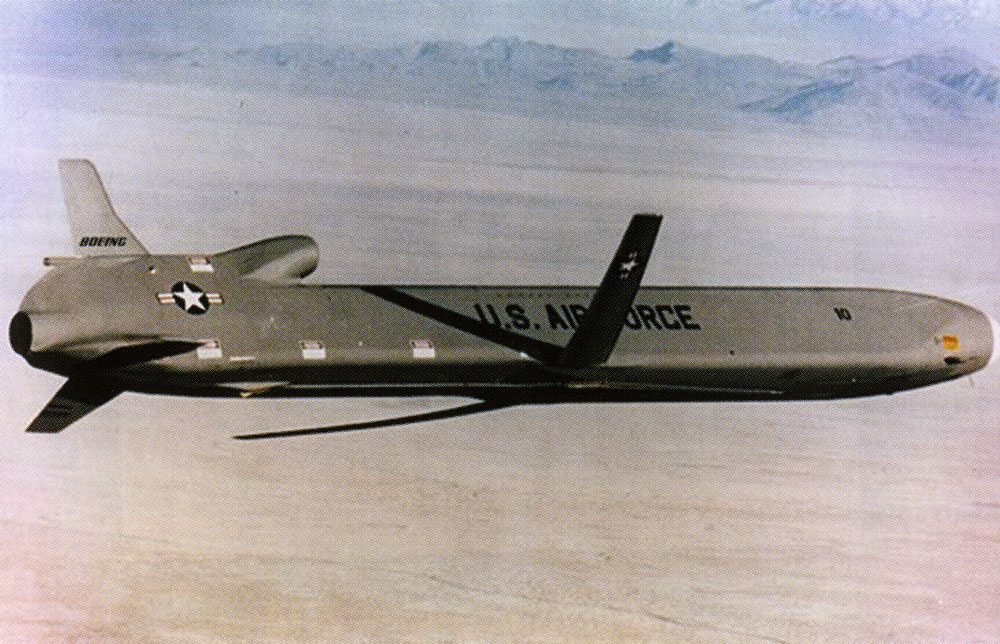
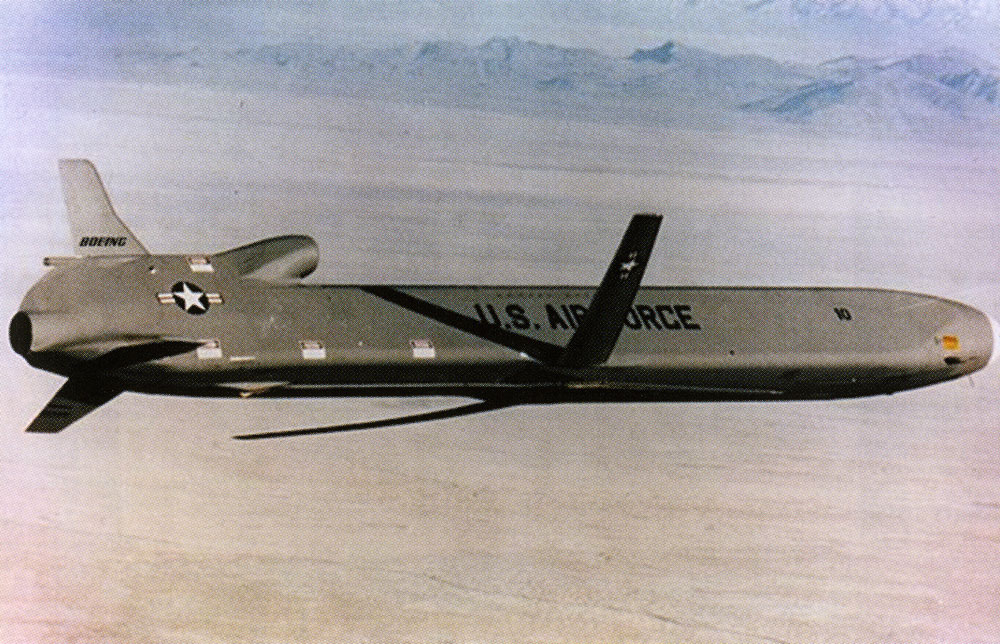
PHOTO SECTION Boeing 757-200 or missile?
"I saw a American Airlines jet coming very quickly and at low altitude." "The airplane
seemed to be able to hold between eight or twelve persons." "We heard something that made the sound of a missile, then we heard a
powerful boom." "A plane, a plane from American Airlines. I thought: 'That's not right,
it's really low.'
And I saw it. I mean, it was like a cruise missile with wings." "A silver airplane with the distinctive marks along the windows that
made me say that was an American Airlines plane." "The speed, the maneuverability, the way that he turned, we all
thought in the radar room,
all of us experienced air traffic controllers, that that was a military
plane." Detonation or deflagration?
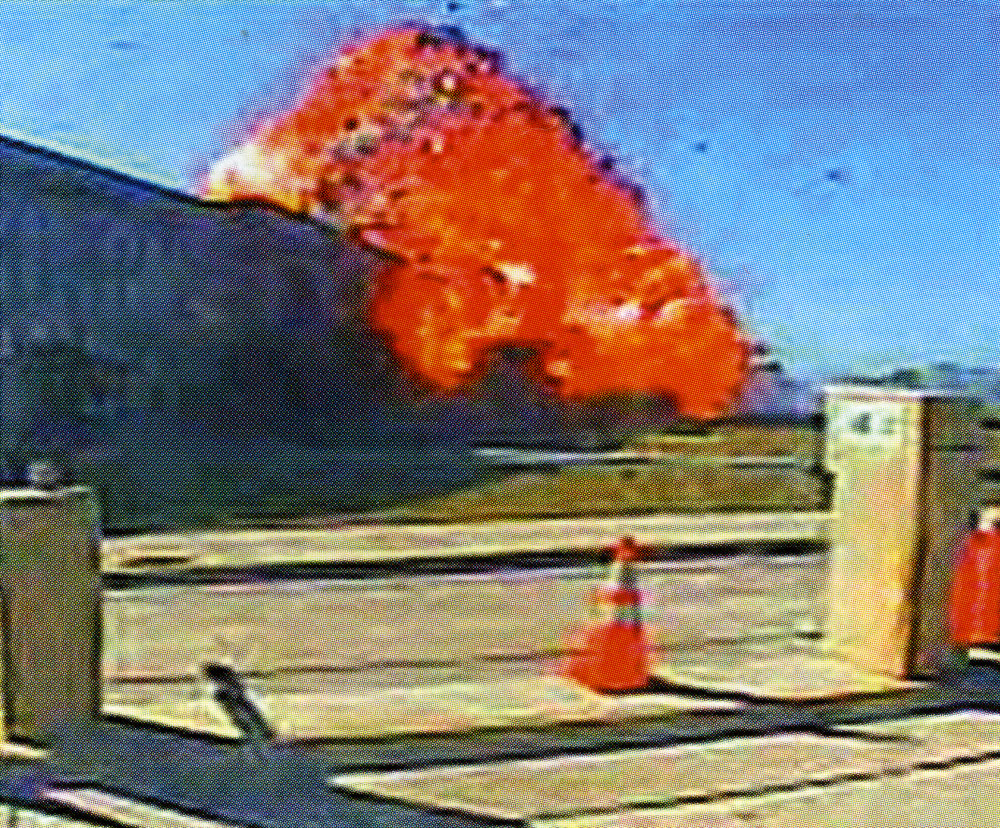
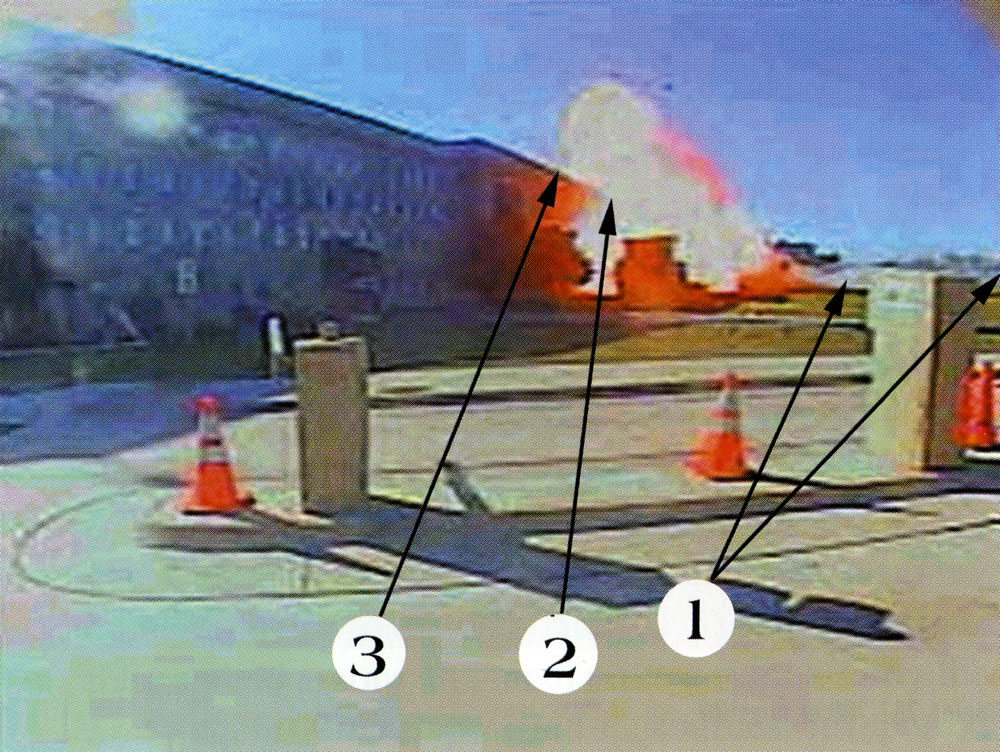
Explosive materials are divided into two groups, according to their progressiveness. Explosives produce a shockwave whose speed of propagation is superior to a value of about six thousand feet per second. One says that they "detonate." Explosive materials whose shockwave speed is lower than that do not detonate. They deflagrate. This is the case, for example, of gunpowder or hydrocarbons. This image of the impact on the Pentagon is very instructive as to the nature of the explosion. Under the pressure of the shockwave, the water contained in the ambient air is compressed and forms a cloud of vapor. The speed of propagation on the shockwave is very high. It corresponds to a detonation of an explosive with high energetic power. The explosion does not correspond to a deflagration of kerosene. 1. Trail of smoke from a propulsion unit. Pentagon
Development of the flame. The color is not that of a hydrocarbon flame in open air. World Trade Center
The yellow color is the sign of a lower temperature of combustion. The flame is mixed with black, heavy smoke. It is that of the combustion of the hydrocarbons in the air. The flame descends, fairly slowly, in front of the facade. That of the Pentagon, in contrast, rises suddenly from inside the building. The fire smolders
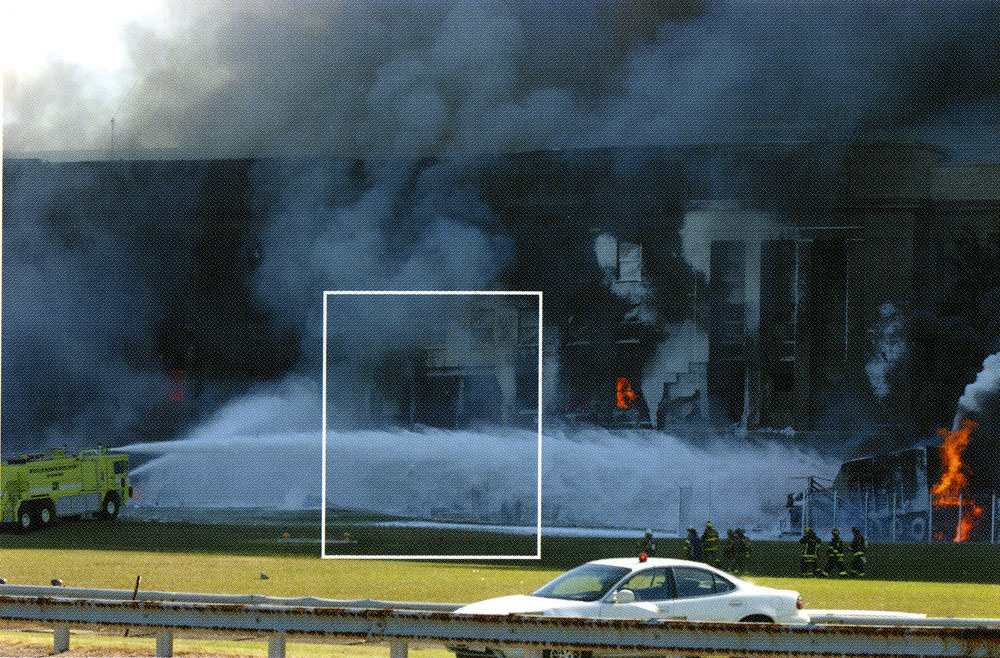
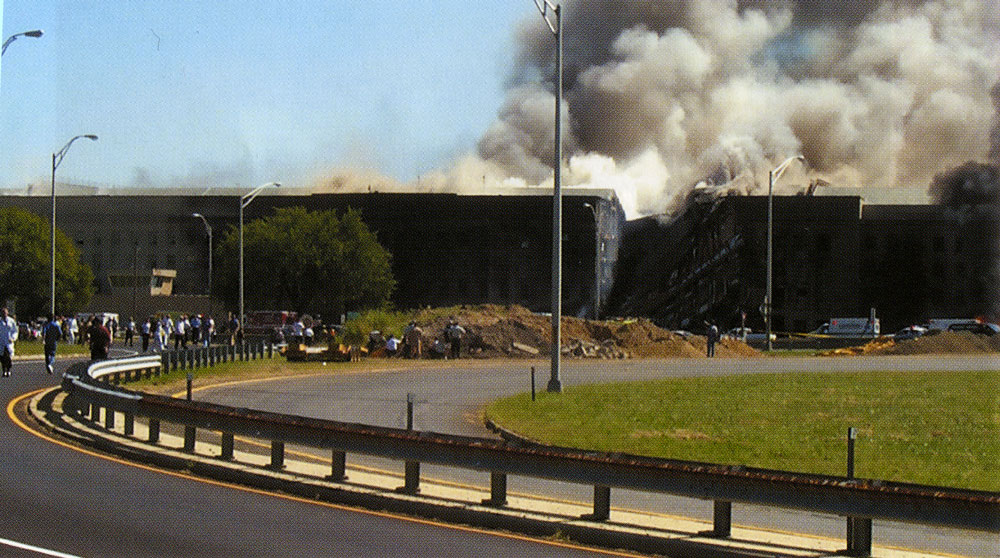
This picture was taken very shortly after the explosion. The firemen are not yet in action. The flame of the explosion is extinguished. The fire lit by the explosive smolders and the flames are not yet visible except at the level of the point of impact (at the place of the red glow, in the axis of the vertical support of the highway sign). We are not in the configuration of an airliner fire because the kerosene would have gone up in flames instantaneously. The start of a classic urban fire
About a minute later, the fires alight inside the building by the heat wave begin to grow in scale. The arrow indicates a hole in the facade through which one sees the heart of a fire beginning to mount. The initial smoke has dissipated. Shortly after, the fires have begun to merge and form a single blaze. The soot and the windows
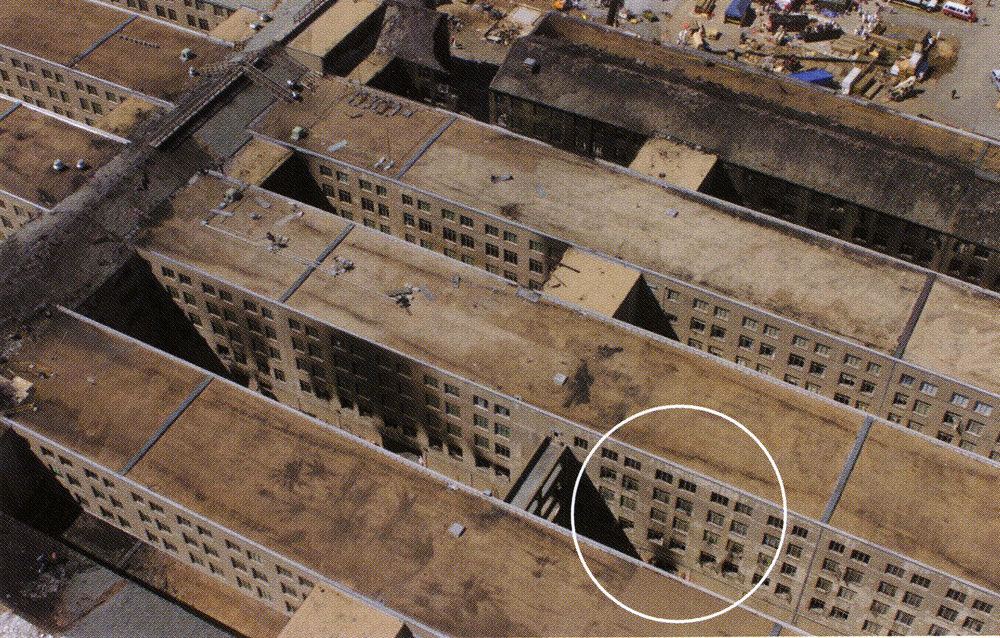
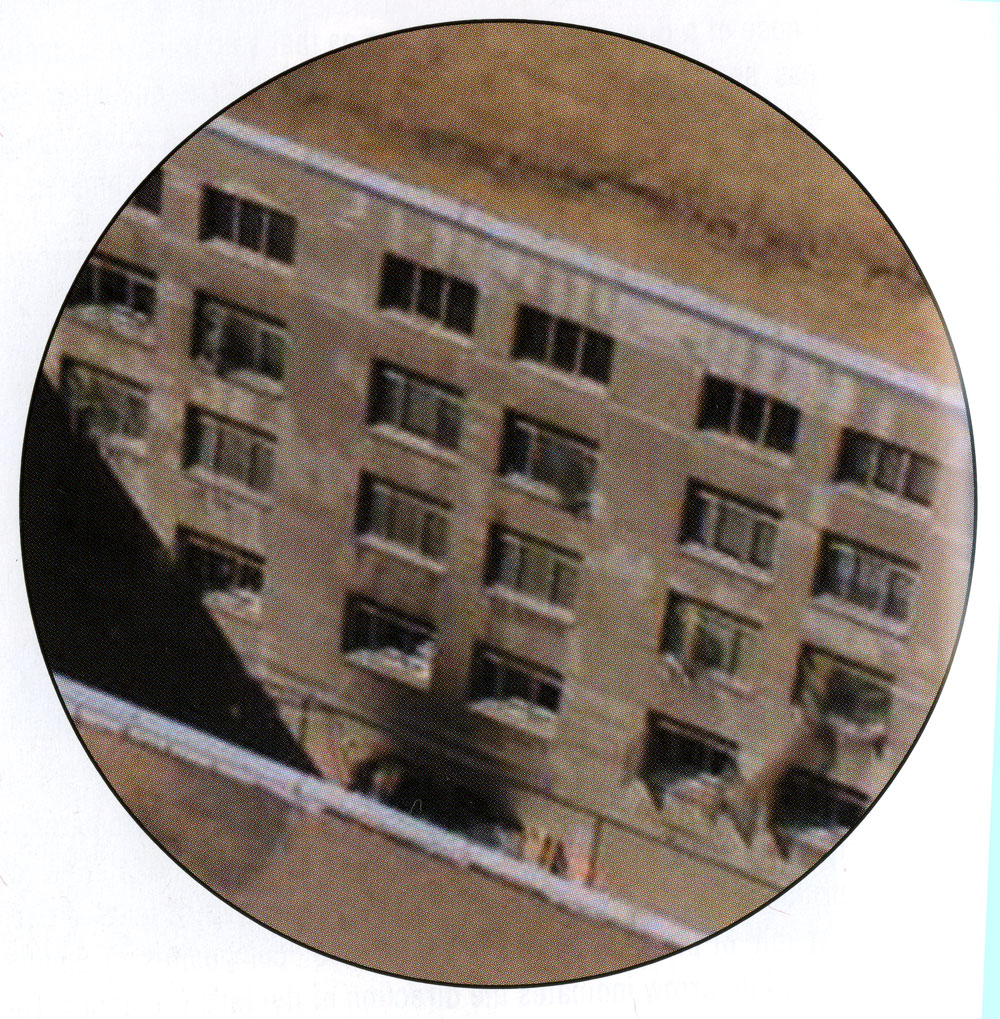
The soot covering the facade is a mixture that corresponds to a classic fire and to a shockwave of a high-yield explosive. It is in no way the thick, oily coat deposited by a kerosene fire The windows have been broken by a detonation and not melted by a hydrocarbon fire that would have lasted several days. Few of them are broken. The windows affected are essentially situated close to the point of the explosion at the level of the lower floors. The building frame
The vertical pillars, certain of which are surrounded by wooden casings, have been weakened. But they haven't been crushed or broken by the leading edge of the wings of an airplane weighing one hundred tons. They would indeed have been hit by the part of the leading edge situated at about the point where the engines are fixed, that is, the most solid area. If an airliner had hit the Pentagon, the wings would have touched the vertical pillars at about the level where the men are standing. The weakened area of the pillars is situated below. Intervention of the first emergency crews at the impact site
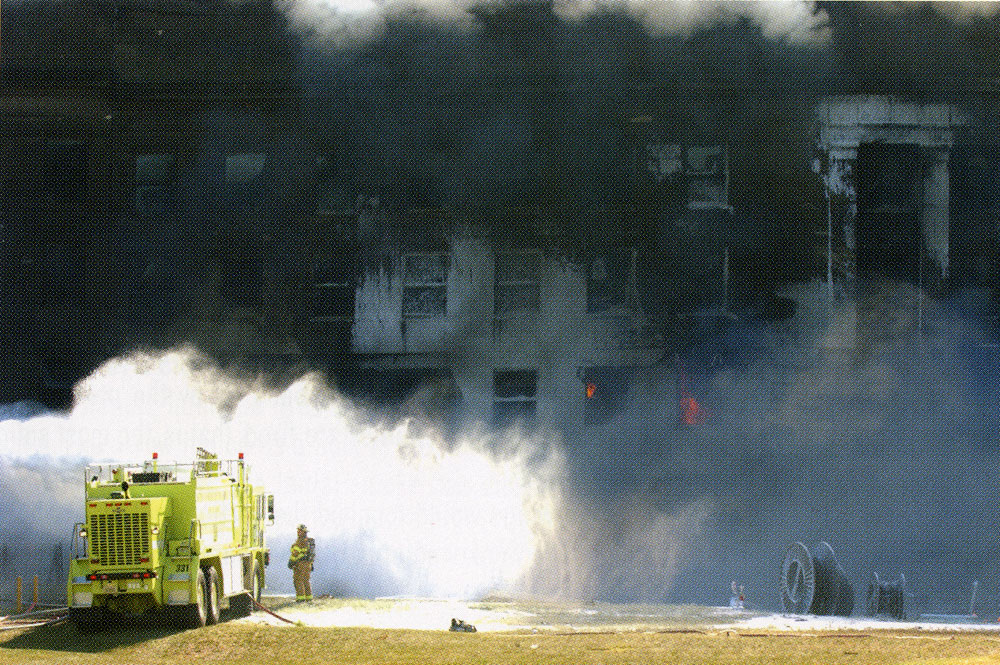
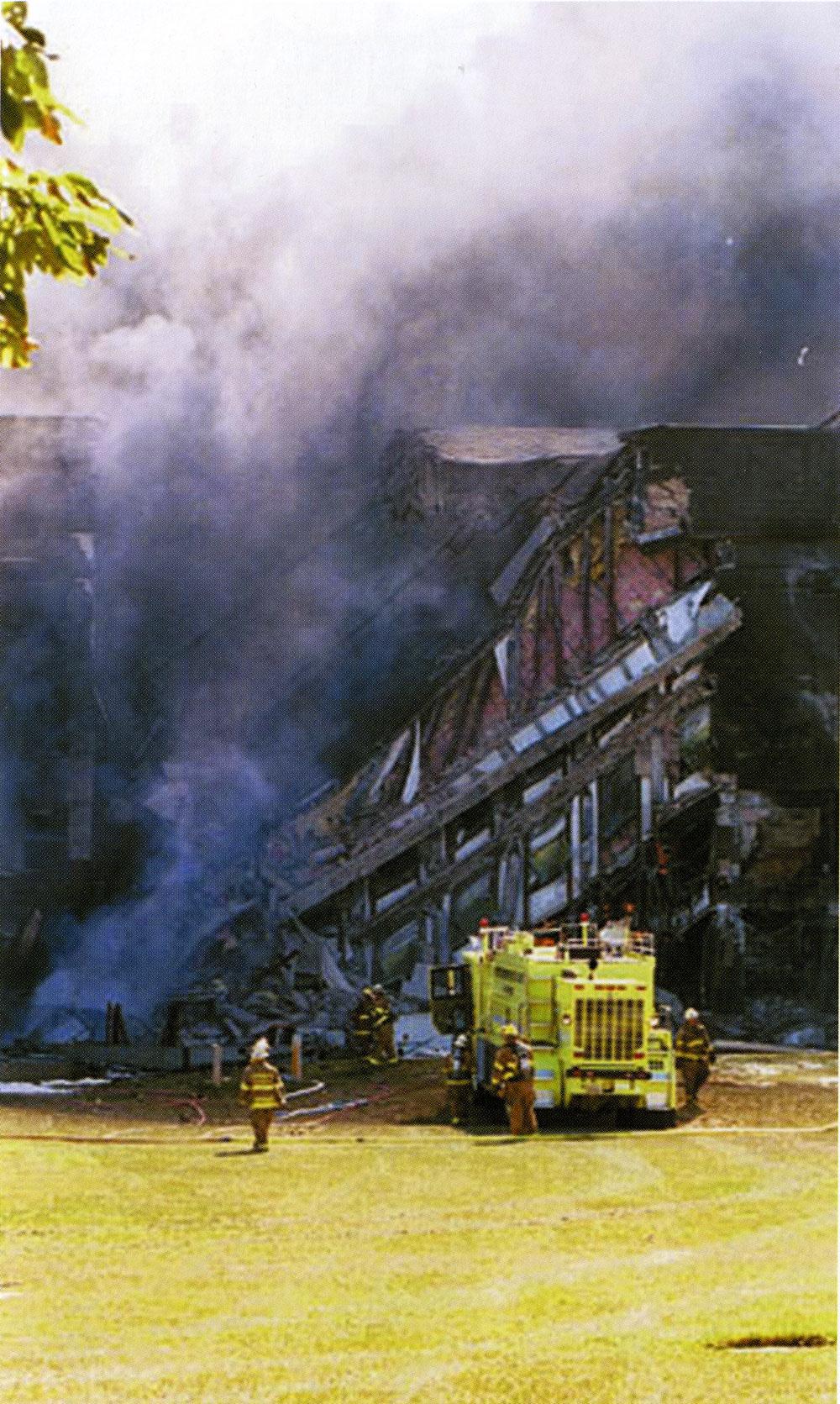
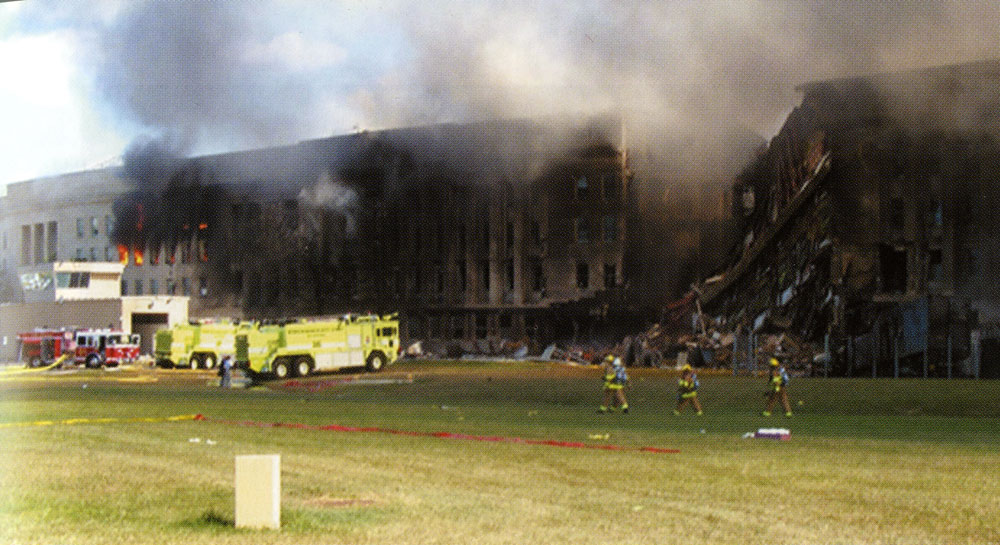
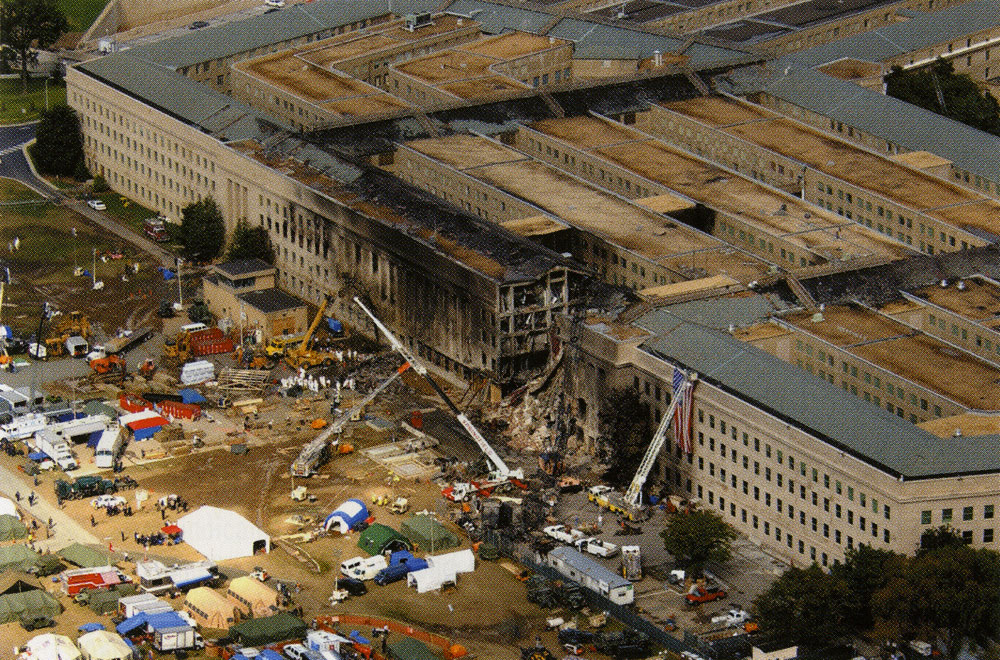
These photos were taken between 9.40 and 10.10 am. The facade has not yet collapsed. One distinguishes the hole by which the aircraft entered, between the ground and first floors (see enlargement on the right-hand page).
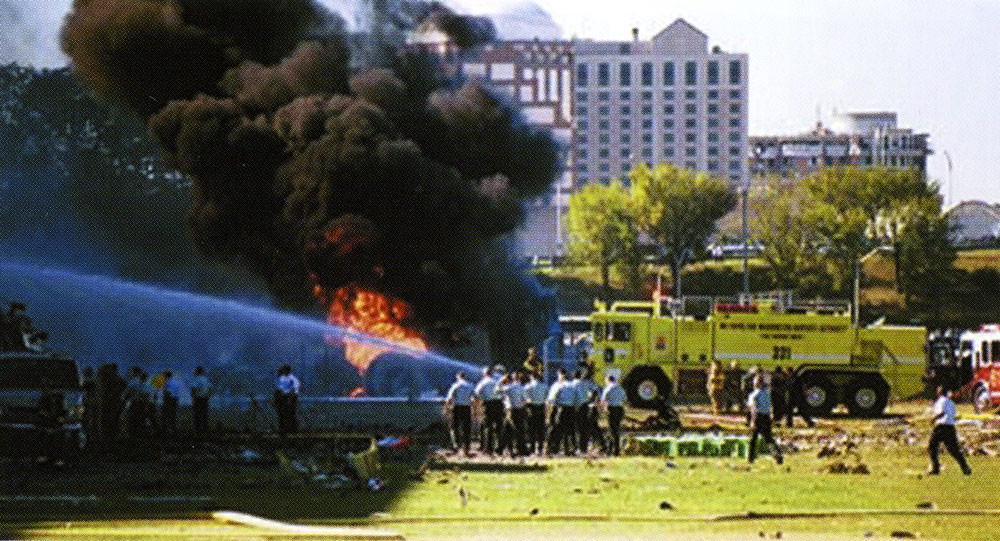
A secondary fire has started on the right: a truck parked in front of the Pentagon has caught fire. The smoke that escapes is that of a hydrocarbon fire. Enlargement of the impact
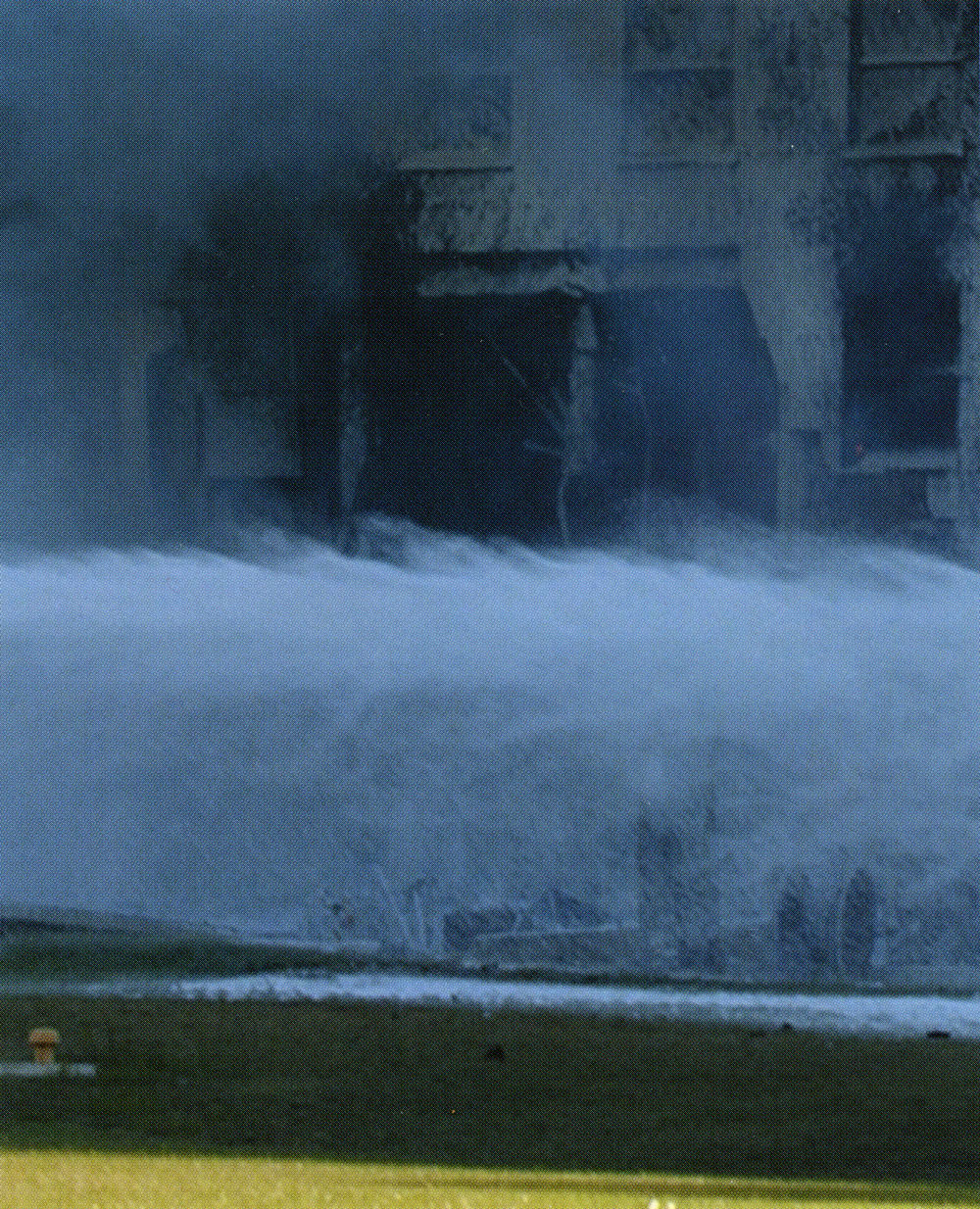
The orifice by which the "Boeing" entered measures about 15 to 18 feet wide. The wall above is intact. It was not hit by the tail of a Boeing 757-200. The lawn is intact, the aircraft not having touched the ground. According to the Department of Defense, the "plane" arrived at an angle of about 45°. A Boeing 757-200 has a cabin 10.5 feet wide in diameter and a wingspan of 114 feet. The jet engines are fixed to the wings and constitute two of the most solid elements of the aircraft. When the landing gear is not extended, the Boeing measures a little over 36 feet in height with the tail. The aircraft was swallowed by the building
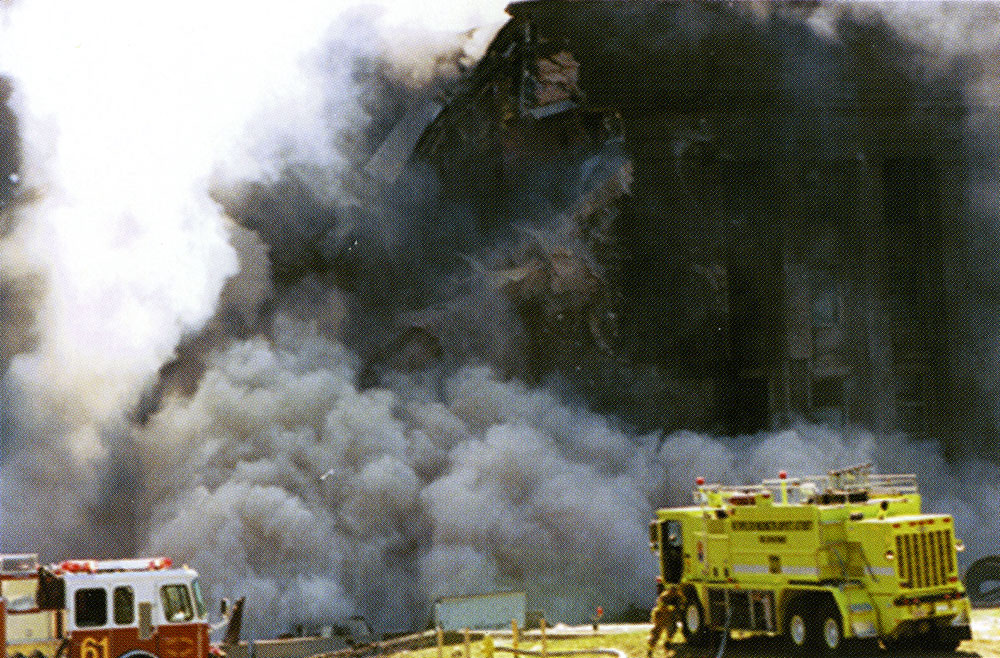
The photograph above shows the facade as it collapses toward 10:10 am. According to many witnesses, the aircraft disappeared into the interior of the building. One observes in fact that the device did not touch the lawn.
A hydrocarbon fire?
One observes two types of smoke. In front of the building, a thick black smoke is coming from a truck that caught fire. From the building itself rises gray smoke. The first does correspond to a hydrocarbon fire. But the other, the main fire, corresponds to a classic urban fire. In the picture to the right, the truck fire has been put out.
The explosion took place in the interior
The fire propagated rapidly in the interior of the building, along the corridors, as one observes in the overview photo below. Outside, a secondary fire started with the explosion of a truck that was parked slightly to the right of the impact. The explosion however did not touch the heliport turret, barely further away on the left. It was thus inside and not outside that the explosion had its greatest effect.
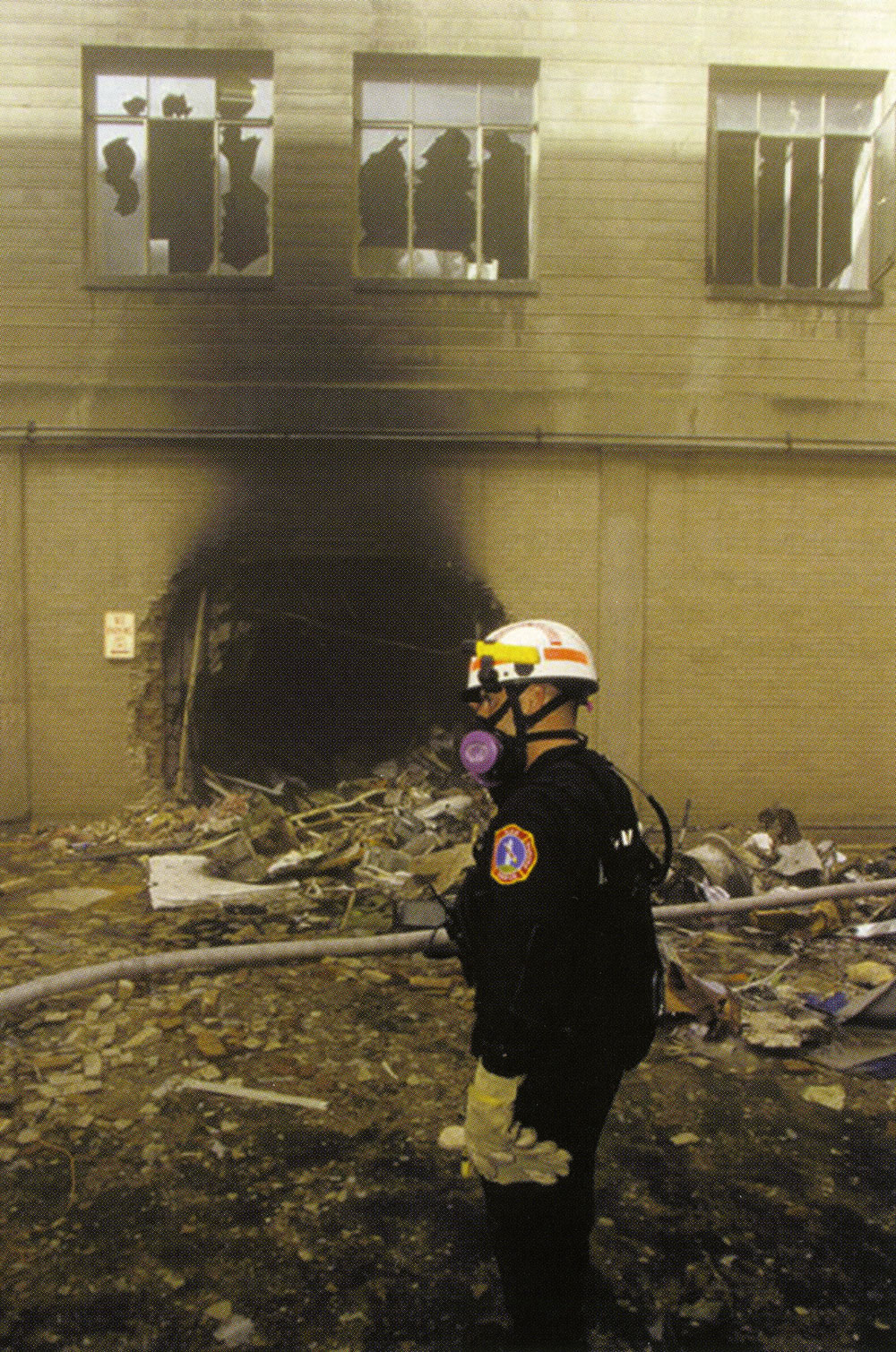
A hole seven feet wide
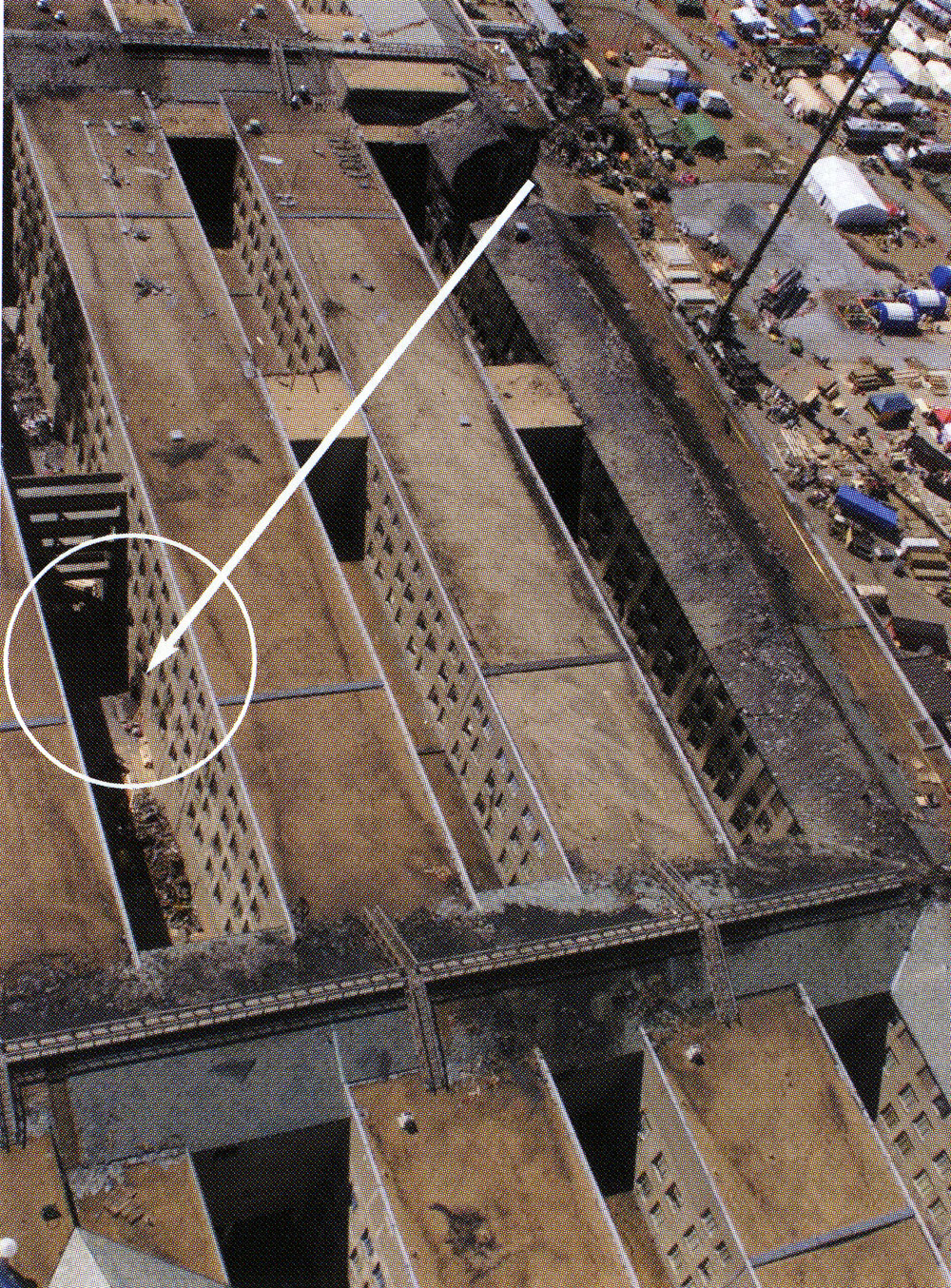
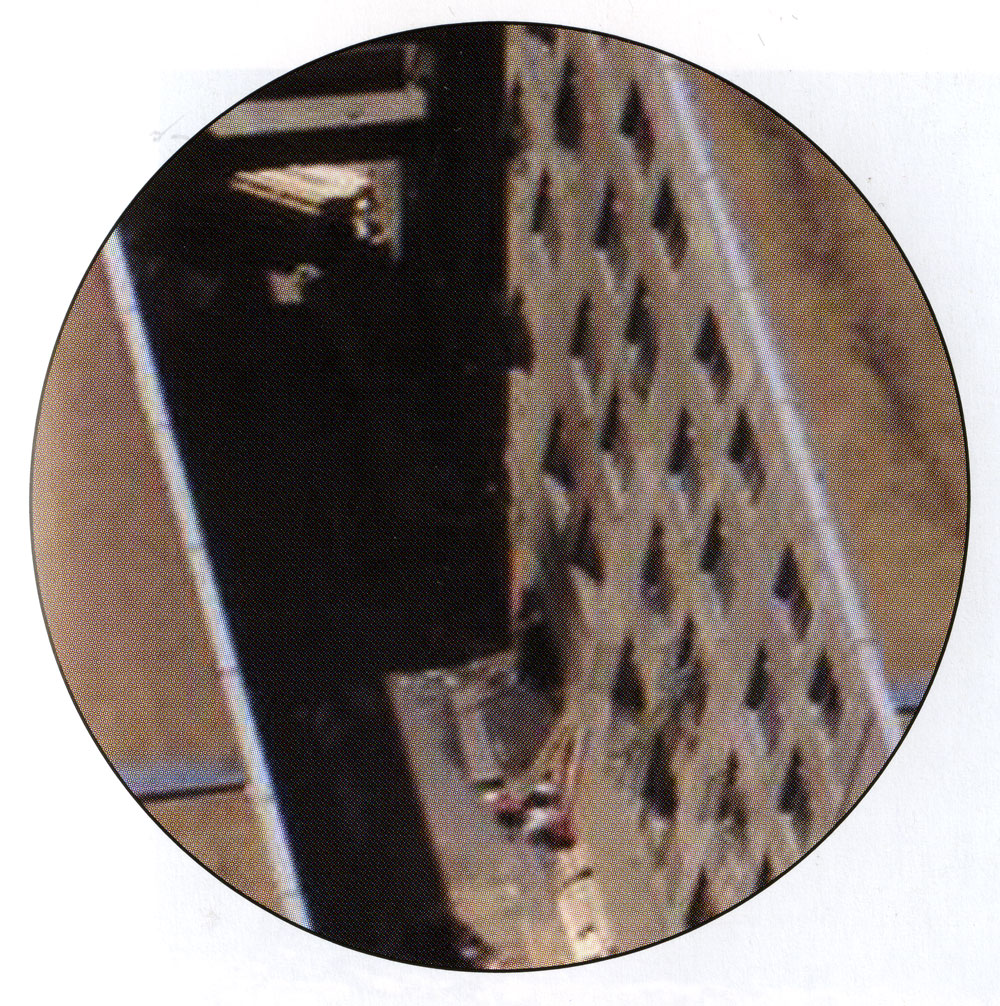
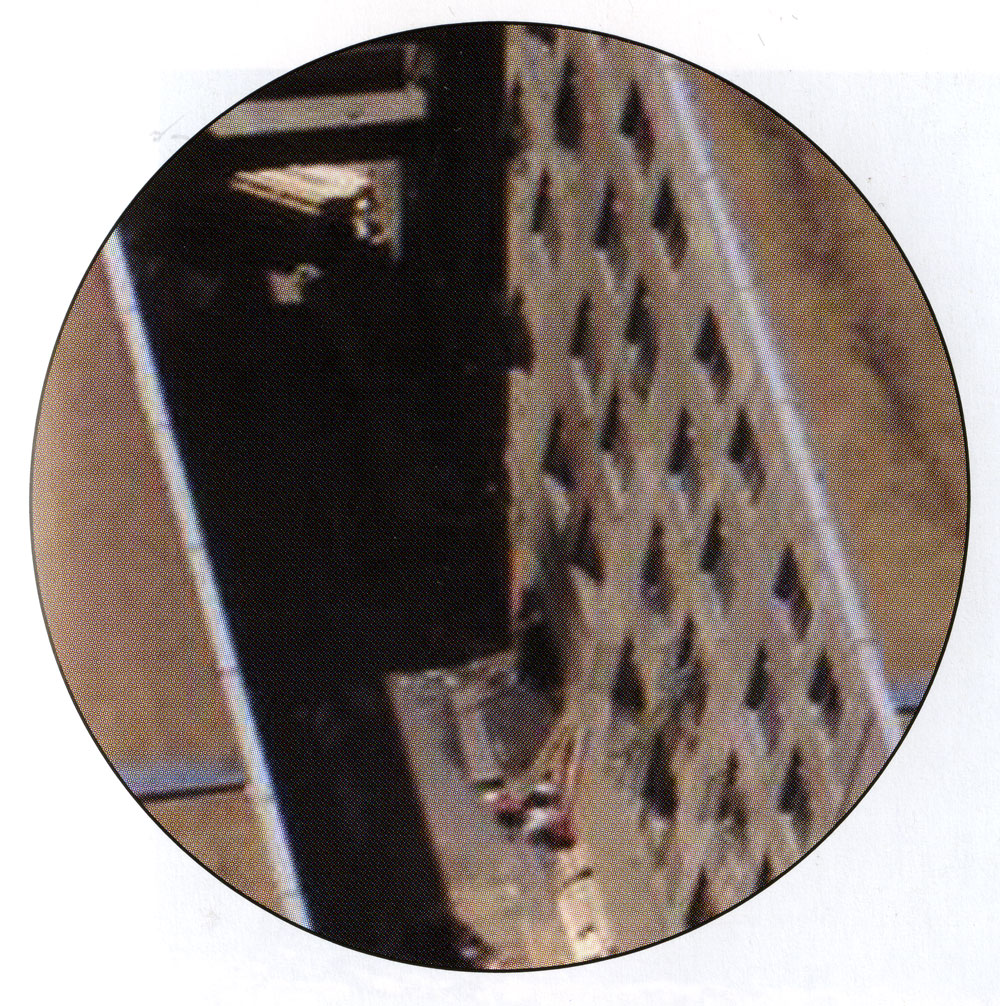
According to the Department of Defense, this photograph represents "the exit orifice marking the place where American Airlines flight 77 ended its penetration of the Pentagon." This hole of about seven feet is said to have been made by "the nose of the plane." The nose of a Boeing
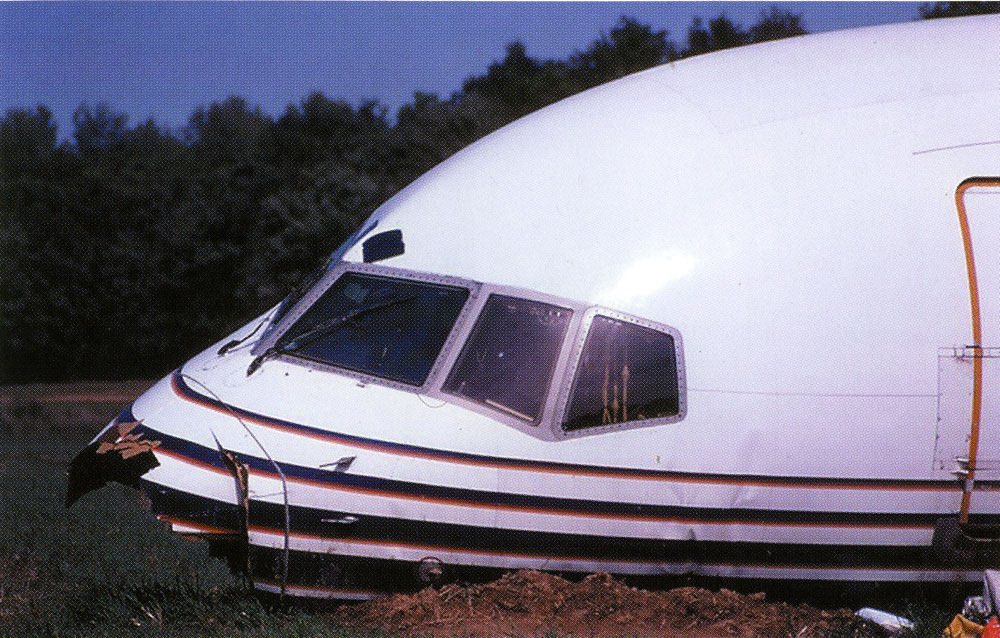
A nose of a Boeing of the same type as that said to have caused the hole, but after a much less serious crash than that supposed to have occurred at the Pentagon. The nose -- or radome -- is a very fragile shell containing electronic navigation devices. The cabin of the plane measures about 10.5 feet in diameter. Diagram of the action of a hollow charge
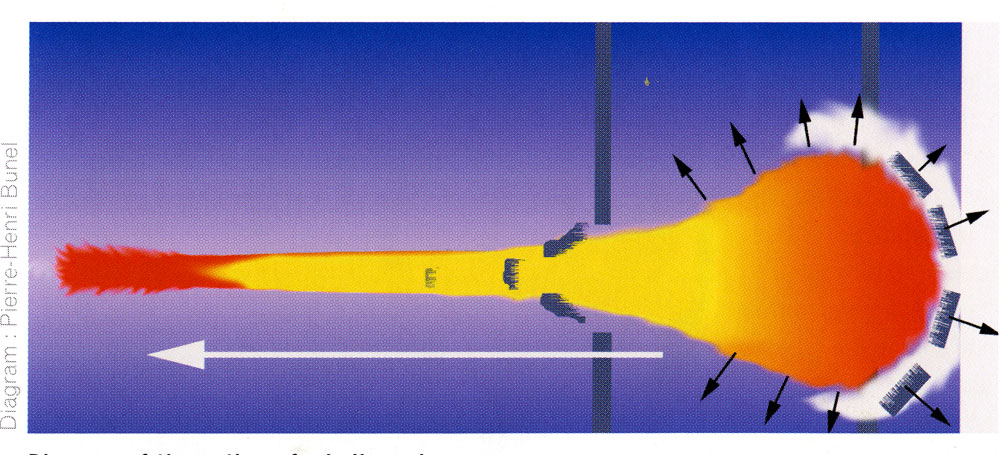
By working the shapes of explosive charges, one can orientate the shockwave in a fashion to send the maximum energy in a given direction. Hollow charges concentrate the principal shockwave in the form a high temperature jet that carries a quantity of energy capable of piercing armour made of steel, composites, or concrete. The white arrow indicates the direction of the jet's projection. The black arrows represent the secondary shockwave. All of the shockwaves rip away debris that becomes burning projectiles. Three pierced buildings
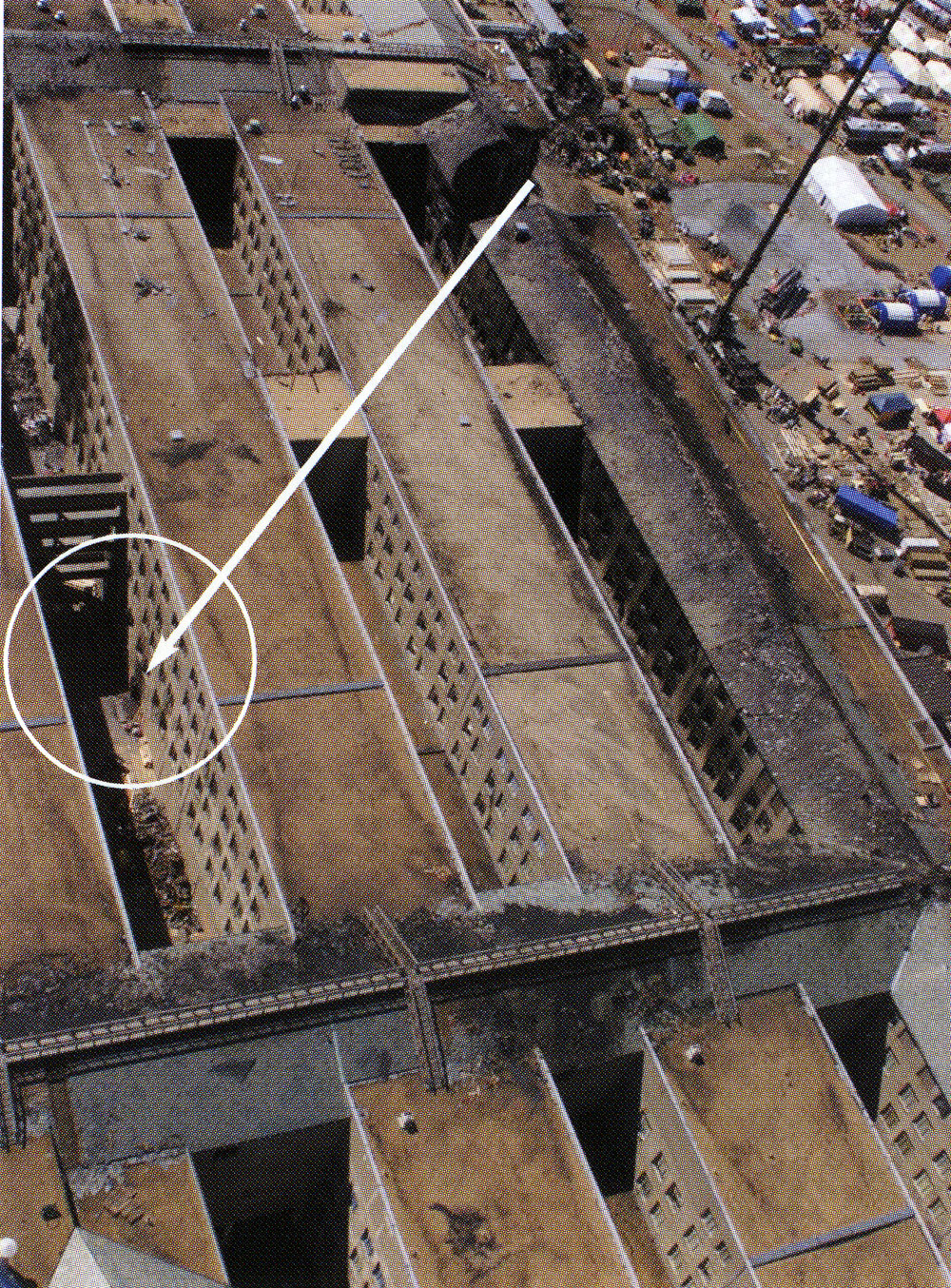
These photographs show the emplacement of the hole (see cover photo) caused by the aircraft The device penetrated into the Pentagon at an angle of about 45° until the facade of the third building. The three buildings have been pierced from one side to the other. They haven't been smashed into as would be the case if had been a plane crash.
According to the official version, a Boeing weighing over 100 tons with a wingspread of 114 feet traversed the three buildings.
The orifice by which it entered, rectangular in shape, measures 15 to 18 feet wide. The exit hole, circular in form, measures 7 feet in diameter. The Boeing is said to have been "gasified" at 5,400° F, at the ground level of the building, without having damaged the upper floors.
The white arrow represents the trajectory of the aircraft, and its point, the place where "it's nose came out." "Evidence" of the plane
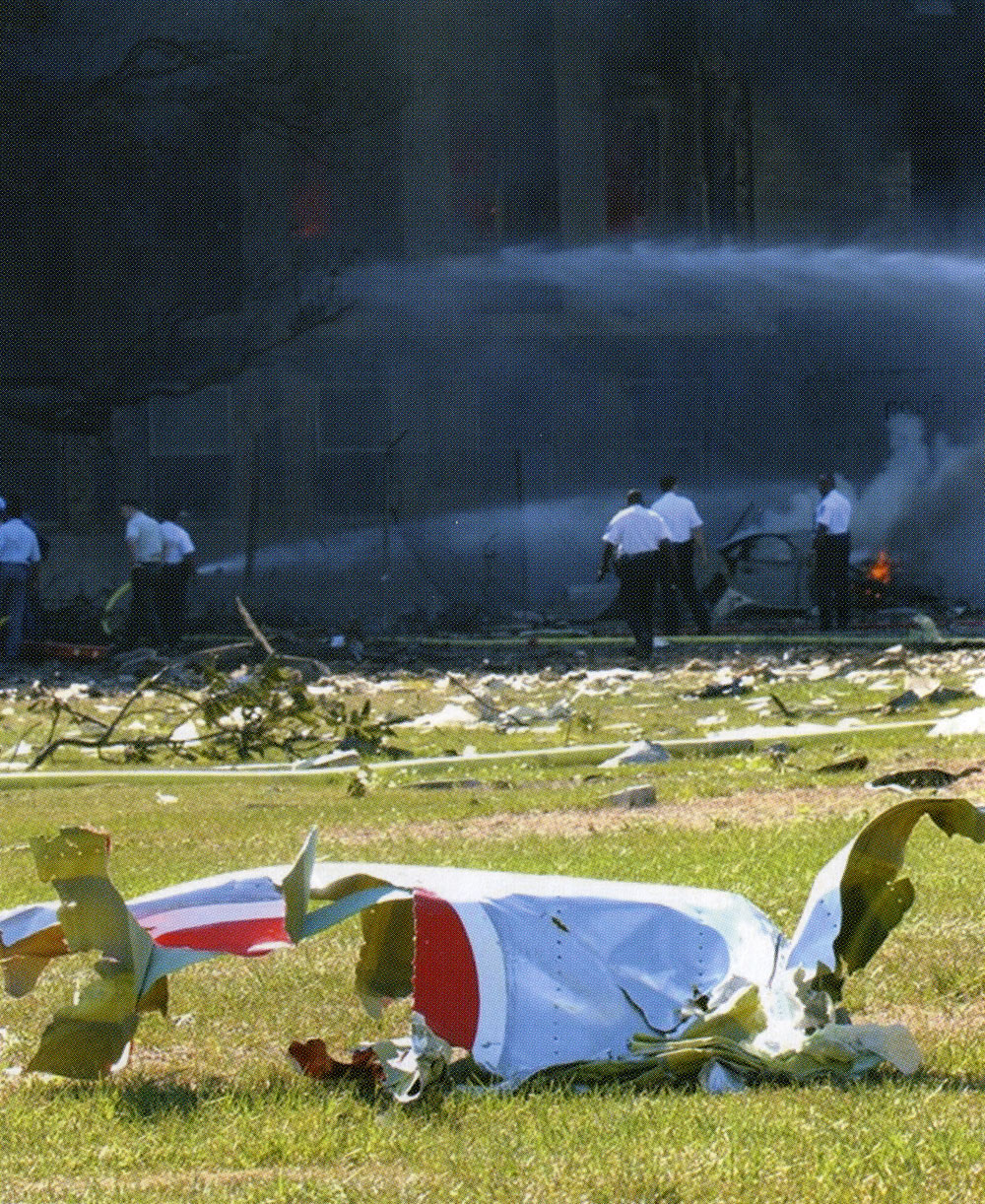
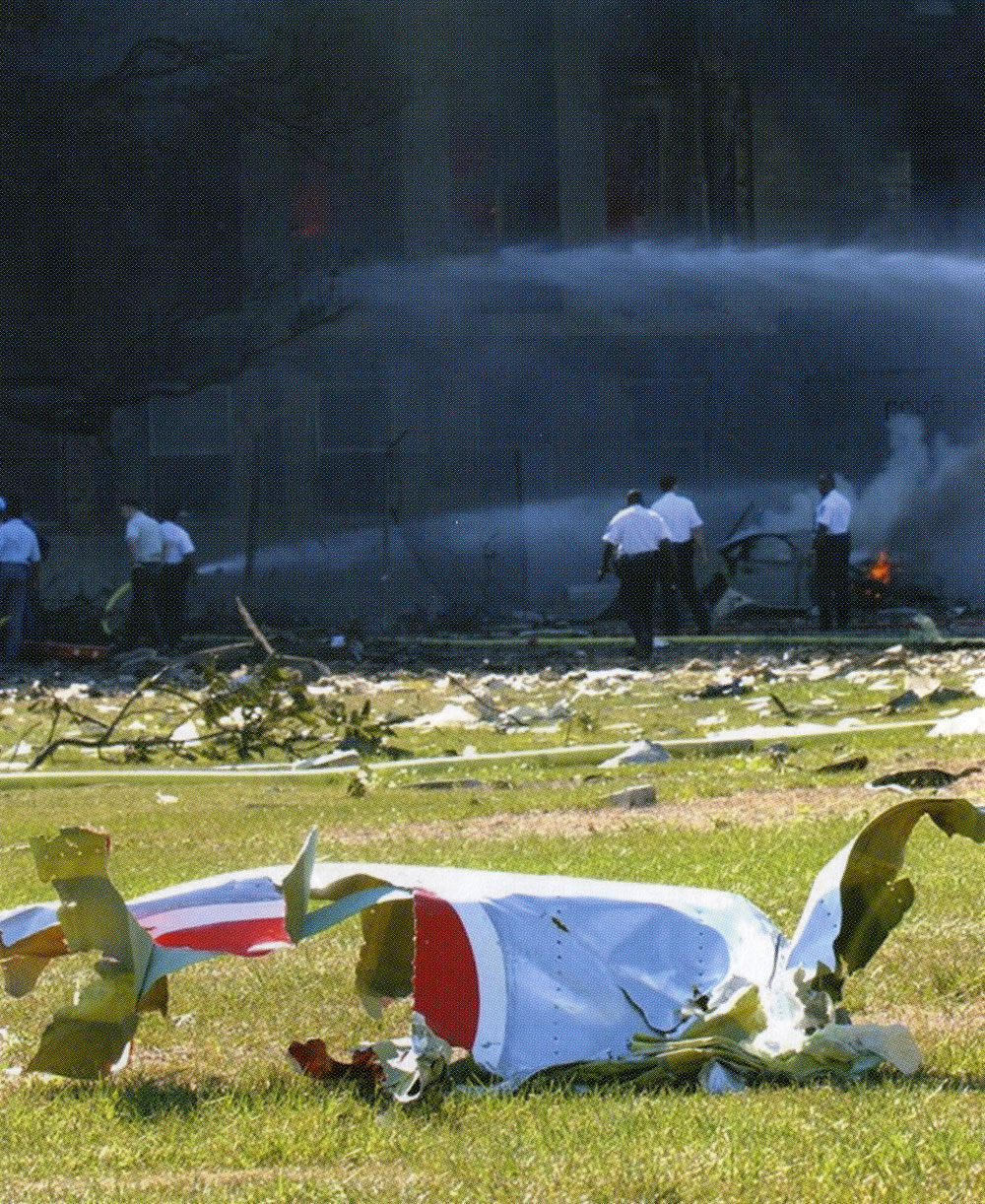
Numerous newspapers have reproduced this shot assuring that it represents a piece of debris from American Airlines flight 77. Yet, this piece of sheet metal does not correspond with any piece of a Boeing 757-200 painted in the colors of American Airlines. It has not moreover been inventoried by the Department of Defense as coming from flight 77.
|