|
PENTAGATE |
|
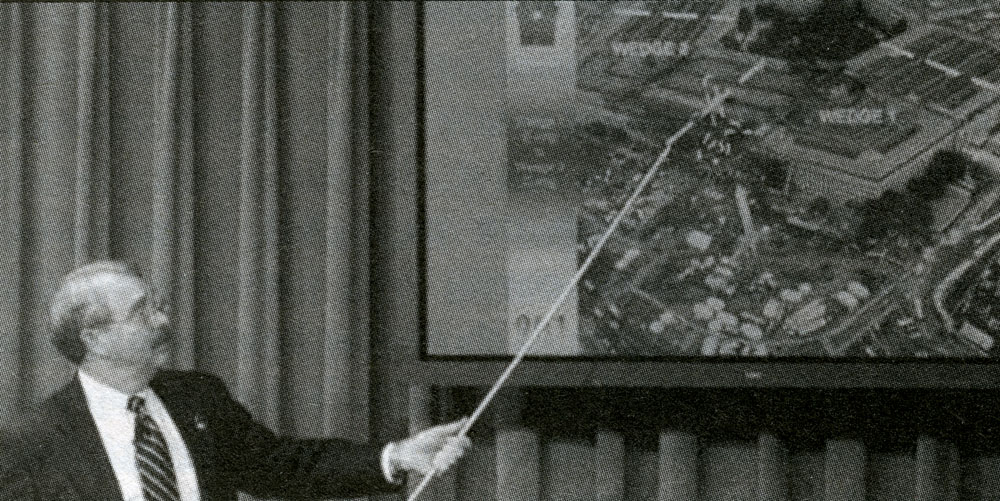
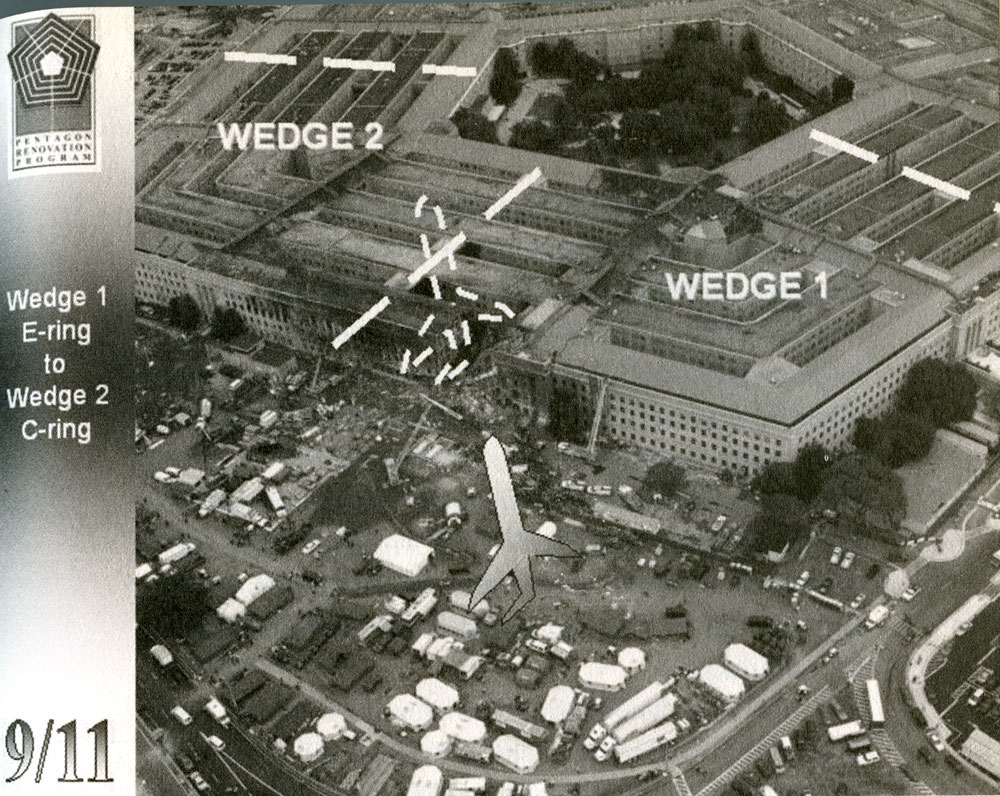
THE MISSILE HYPOTHESIS Immediately after the attack on the Pentagon, the New York Times reported on the extent of the damage: the aircraft "crashed into the outer edge of the building between the first and second floors, 'at full power' Mr. Rumsfeld said. It penetrated three of the five concentric rings of the building." [1] One in fact observes in the photographs distributed mainly by the army that the vehicle pierced a hole measuring several yards wide in the facade. It penetrated the building without touching the ground, which is totally intact. It came out again, three buildings further, creating a perfectly round hole about seven feet in diameter. What kind of vehicle could have caused this damage: a Boeing 757-200 or a missile? The impact The machine crashed into the west facade of the Pentagon, in front of which lies the heliport. Half an hour after the attack, about sixty feet of this facade had collapsed. A fire propagated itself throughout the entire wing of the building, causing enormous destruction. The biggest damages, however, were caused by the water utilized to extinguish the fire, as was made clear by fire chief Ed Plaugher [2], and also by the head of the building's renovation project, Lee Evey. [3] Later, the decision would be taken to raze the whole wing, nearly 300 feet, in order to reconstruct anew. The impact itself is nevertheless quite narrow. The photograph on page VI of the color Photo Section of this book was taken in the very first minutes, upon the arrival of rescue teams, by Corporal James Ingersoll of the United States Marines. In it, one can observe the facade which has not yet collapsed and the point of the aircraft's impact. The orifice was magnified in the next picture. It extends from the ground level to the first floor of the building (about 25 feet high). Its width corresponds to that of two windows above (about 17 to 20 feet wide). It seems, however, that the external wall was carried off between the two supporting pillars, and that the hole was thus larger than the vehicle which crashed into it. The aircraft that passed through this orifice thus measured less than 17 to 20 feet in diameter. That could correspond to the passenger cabin of a Boeing 757-200 which in fact measures 11.5 feet. But this plane also possesses wings that give a total breadth of 125 feet. Fixed upon these wings are the jet engines that constitute two of the aircraft's most solid elements. Finally, the plane also has a big tail. When the landing gear is not deployed, the Boeing measures a little more than 40 feet high. In this picture one can see that the wall just above the hole is still intact. It was thus not hit by the tail of a Boeing 757-200. The exit hole The photograph on page XII ( which also appears on the front cover) was provided by the Department of Defense. It shows the hole from which the aircraft emerged. The picture's initial caption, published on a Navy Web site, indicates: "the exit hole where American Airlines Flight 77 finally stopped after penetrating the Pentagon." [4] This hole is perfectly round and measures about seven feet wide. The two pictures and their blow-ups on pages XIV and XV show the emplacement of the hole. It is located in the inner facade of the third ring. The aircraft penetrated three buildings at an angle of about 45° to the perpendicular. The official version of the Boeing According to the Pentagon, the circular hole that one observes in the third building was caused by the nose of the Boeing 757- 200. Lee Evey, head of the renovation project at the Pentagon, explained it methodically during a press conference on 15 September. [5] "The rings are E, D, C, B and A. Between B and C is a driveway that goes around the Pentagon. It's called A-E Drive. The airplane traveled in a path about like this, and the nose of the aircraft broke through this innermost wall of C ring into A-E Drive. [...] The nose of the plane just barely broke through the inside of the C ring, so it was extending into A-E Drive a little bit. So that's the extent of penetration of the aircraft."
Photo: Department of Defense
Photo: Department of Defense Several experts have tried to explain the official version. This version in its entirety is quite complex and deserves to be studied attentively. -- The absence of debris from the Boeing is explained by the fact that the plane was pulverized when it crashed into this particularly resistant building. "The impact released extreme energy, causing the pulverization of the aircraft," explained an anonymous expert consulted by Le Monde. [6] "The shock was such that the plane was literally pulverized," commented yet another anonymous specialist quoted by Liberation. [7] -- The disappearance of the parts of the plane that are particularly resistant, such as the jet engines or the brakes, is explained by the fact that the aircraft had totally melted (with the exception, however, of a beacon and the black boxes found three days later [8]). "As opposed to cars, planes are above all composed of aluminum, which starts to liquefy towards 1,050° F and the structures of the aircraft melted," analyzed Le Monde. [9] This was confirmed by Liberation: "Much of the plane's debris also melted in the intense heat." [10] -- As for the absence of one hundred tons of melted metal, this is explained by the fact that the fire attained temperatures above 4,500° F, thus causing the evaporation of the plane's materials (but not those of the building, nor those of the beacon and the black boxes). "Depending on what caused it, the materials that feed it, its exposure to oxygen and its duration, a fire of this magnitude could release heat of between 3,000 and 4,500° F," another specialist stated. "The heat released by the fire during 24 hours thus leads us to understand that the greater part of the plane's remains were destroyed." [11] -- The presence of the last hole with a seven foot diameter is explained by the fact that, despite all these ordeals, the nose of the plane continued its mad course through three buildings. That is the conclusion reached by the head of the Pentagon's renovation operation. According to the official version, the damages could thus have been produced by a Boeing 757-200. For that to have occurred, the plane was capable of disintegrating when it made impact with the Pentagon's facade, of melting once it was inside the building, of evaporating at 4,500° F and nevertheless perforating two other buildings to create that hole of seven feet in diameter... [12] The nose of a plane? Imagine for an instant that we had not been told previously that the plane had disintegrated, melted and evaporated. Is it nevertheless possible that the nose of an airliner could have perforated three buildings and produced at its exit a perfectly circular hole seven feet wide? The nose of a plane, the radome, contains the electronic navigation system. In order to allow passage of the waves emitted by the apparatuses, it is not made of metal, but of carbon fibers. Its form was conceived to be aerodynamic, but not particularly shock-resistant. The external envelope, as well as its contents, are thus extremely fragile. Against an obstacle, they would be crushed rather than piercing through. One can see the fragility of plane noses in numerous pictures of crashes that were much less violent than the one that was supposed to have occurred at the Pentagon. The crash, for example, of the Boeing 757-204 of Britannia Airways in September 1999 (see page XIII of the Photo Section). The nose is an extremely fragile shell. It is thus impossible to find the nose of the plane following such an impact. Still less could it have produced a hole as circular as that observed in the third ring of the building. The head of a missile? Yet, the firemen say they saw what they believed was the nose of the plane. The Boeing penetrated as far as ring C, they explain. "The only way you could tell that an aircraft was inside was that we saw pieces of the nose gear," Captain Defina told the NFPA Journal. [13] Questioned, during a press conference at the Pentagon, about the plane's fuel, Captain Ed Plaugher answered, "We have what we believe is a puddle right there that the -- what we believe to be the nose of the aircraft..." [14] What is this piece of apparatus that was capable of inflicting such damage and that the firemen said they had observed? In contrast to the fragile nose of a plane, the heads of certain missiles are extremely resistant. This debris that firemen said they saw and that they had trouble identifying as the nose of the plane could well have been the warhead of a missile. Now, what exactly is the damage involved here? Between the hole through which the vehicle entered and the other it created at the end of its journey, three buildings were pierced through and through. It's important to note that these three building were not smashed into but pierced. One does not in fact observe any other damage than this sort of tunnel through the Pentagon. If a Boeing 757-200 had crashed into these buildings, it would have smashed them. The damages that it caused were in no way comparable to those of an airplane crash. The vehicle that struck the Department of Defense thus produced a very particular effect. Certain missiles are specially conceived to have a piercing effect. These missiles are weighted with depleted uranium, an extremely dense metal that heats with slightest friction and renders piercing easier. These missiles are notably used to pierce bunkers. An airplane crashes and smashes. A missile of this type pierces. * * * The observation of the damage that occurred thus allows us to decide between the two hypotheses of the missile or the airplane. The building was not smashed into as if it had suffered from a classic plane crash, but was perforated as if struck by a missile. To confirm the missile hypothesis, we now have to study the characteristics of the explosion and fire that followed. _______________ 1. 'A Hijacked Boeing 757 Slams into the Pentagon', New York Times, 12 September 2001: http://www.americanmemorials.com/memorial/tribute.asp?idMemorial=1316&idContributor=7466 2. 'DoD News Briefing', Defense Link, Department of Defense, 12 September 2001: http://www.defenselink.mil/news/Sep2001/t09122001_t0912asd.html 3. 'DoD News Briefing on Pentagon Renovation', Defense Link, Department of Defense, 15 September 2001: http://www.defenselink.mil/news/Sep2001/t09152001_t915evey.html 4. 'War and Readiness', All Hands, magazine of the US Navy: http://www.mediacen.navy.mil/pubs/allhands/nov01/pg16.htm 5. 'DoD News Briefing on Pentagon Renovation,' op cit. 6. 'Un avion a bel et bien frappe le Pentagone' [A Plane Really Did Hit the Pentagon], Le Monde, 21 March 2002, op cit. 7. 'Pourquoi la demonstration de Meyssan est cousue de tres gros fils blancs' blancs' [Why Meyssan's Demonstration Is a Tissue of Lies], Liberation, 30 March 2002. 8. 'Flight Data and Cockpit Voice Recorders Found', Defense Link, Department of Defense, 14 September 2001: 9. 'Un avion a bel et bien frappe le Pentagone' [A Plane Really Did Hit the Pentagon], op cit. 10. 'Pourquoi la demonstration de Meyssan est cousue de tres gros fils blancs' blancs' [Why Meyssan's Demonstration Is a Tissue of Lies], op cit. 11. Interview with Claude Moniquet, Hoax buster, 5 April 2002: 12. We have only cited the expert testimonies most often repeated in the press. We have left aside others, like the testimony released by RTBF (the French-language public television network in Belgium) that explained the small size of the impact in this fashion: "The wings of the plane could perfectly well have been folded back on the plane's body, which limited the point of impact." 13. 'ARFF Crews Respond to the Front Line at Pentagon', NFPA
Journal, National Fire Protection Agency, 1 November 2001: 14. 'DoD News Briefing', Defense Link, Department of Defense, 12 September 2001, op cit.
|