|
by Wikipedia
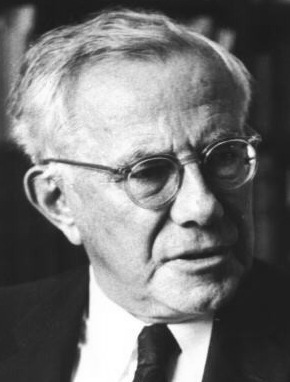
Paul Johannes
Tillich (August 20, 1886 – October 22, 1965) was a German-American
theologian and Christian existentialist philosopher. Tillich was one of
the most influential Protestant theologians of the 20th century.[1]
Among the general populace, he is best known for his works The
Courage to Be (1952) and Dynamics of Faith (1957), which
introduced issues of theology and modern culture to a general
readership. Theologically, he is best known for his major three-volume
work Systematic Theology (1951–63), in which he developed his "method of
correlation": an approach of exploring the symbols of Christian
revelation as answers to the problems of human existence raised by
contemporary existential philosophical analysis.[2][3]
Biography
Tillich was born
on August 20, 1886, in the small village of Starzeddel which was then
part of Germany. He was the oldest of three children, with two sisters:
Johanna (b. 1888, d. 1920) and Elisabeth (b. 1893). Tillich’s
Prussian father Johannes Tillich was a conservative Lutheran pastor of
the Evangelical State Church of Prussia's older Provinces; his
mother Mathilde Dürselen was from the Rhineland and was more liberal.
When Tillich was four, his father became superintendent of a diocese in
Schönfliess, a town of three thousand, where Tillich began elementary
school. In 1898, Tillich was sent to Königsberg [[2]] to begin
gymnasium. At Königsberg, he lived in a boarding house and
experienced loneliness that he sought to overcome by reading the Bible.
Simultaneously, however, he was exposed to humanistic ideas at
school.[3]
In 1900, Tillich’s
father was transferred to Berlin, Tillich switching in 1901 to a Berlin
school, from which he graduated in 1904. Before his graduation, however,
his mother died of cancer in September 1903, when Tillich was 17.
Tillich attended several universities – the University of Berlin
beginning in 1904, the University of Tübingen in 1905, and the
University of Halle in 1905-07. He received his Doctor of Philosophy
degree at the University of Breslau in 1911 and his Licentiate of
Theology degree at the University of Halle in 1912.[3] During his
time at university, he became a member of the Wingolf.
That same year,
1912, Tillich was ordained as a Lutheran minister in the province of
Brandenburg. On 28 September 1914 he married Margarethe ("Grethi") Wever
(1888–1968), and in October he joined the German army as a chaplain.
Grethi deserted Tillich in 1919 after an affair that produced a child
not fathered by Tillich; the two then divorced.[4] Tillich’s academic
career began after the war; he became a Privatdozent of Theology at the
University of Berlin, a post he held from 1919 to 1924. On his return
from the war he had met Hannah Werner Gottswchow, then married and
pregnant.[5] In March 1924 they married; it was the second marriage for
both.
During 1924-25, he
was a Professor of Theology at the University of Marburg, where he began
to develop his systematic theology, teaching a course on it during the
last of his three terms. From 1925 until 1929, Tillich was a
Professor of Theology at the University of Dresden and the University of
Leipzig. He held the same post at the University of Frankfurt during
1929-33.
While at
Frankfurt, Tillich gave public lectures and speeches throughout Germany
that brought him into conflict with the Nazi movement. When Hitler
became German Chancellor in 1933, Tillich was dismissed from his
position. Reinhold Niebuhr visited Germany in the summer of 1933
and, already impressed with Tillich’s writings, contacted Tillich upon
learning of Tillich’s dismissal. Niebuhr urged Tillich to join the
faculty at New York City’s Union Theological Seminary; Tillich
accepted.[4][6]
At the age of 47,
Tillich moved with his family to America. This meant learning English,
the language in which Tillich would eventually publish works such as the
Systematic Theology. From 1933 until 1955 he taught at Union, where he
began as a Visiting Professor of Philosophy of Religion. During 1933-34
he was also a Visiting Lecturer in Philosophy at Columbia University.
Tillich acquired tenure at Union in 1937, and in 1940 he was promoted to
Professor of Philosophical Theology and became an American citizen.[3]
At the Union
Theological Seminary, Tillich earned his reputation, publishing a series
of books that outlined his particular synthesis of Protestant
Christian theology and existential philosophy. He published On
the Boundary in 1936; The Protestant Era, a collection of his
essays, in 1948; and The Shaking of the Foundations, the first of
three volumes of his sermons, also in 1948. His collections of sermons
would give Tillich a broader audience than he had yet experienced. His
most heralded achievements though, were the 1951 publication of volume
one of Systematic Theology which brought Tillich academic
acclaim, and the 1952 publication of The Courage to Be. The first
volume of the systematic theology series prompted an invitation to give
the prestigious Gifford lectures during 1953–54 at the University of
Aberdeen. The latter book, called "his masterpiece" in the Paucks’s
biography of Tillich (p. 225), was based on his 1950 Dwight H. Terry
Lectureship and reached a wide general readership.[3]
These works led
to an appointment at the Harvard Divinity School in 1955, where he
became one of the University’s five University Professors – the five
highest ranking professors at Harvard. Tillich’s Harvard career
lasted until 1962. During this period he published volume 2 of
Systematic Theology[7] and also published the popular book
Dynamics of Faith (1957).
In 1962,
Tillich moved to the University of Chicago, where he was a Professor of
Theology until his death in Chicago in 1965. Volume 3 of
Systematic Theology was published in 1963. In 1964 Tillich became
the first theologian to be honored in Kegley and Bretall's Library of
Living Theology. They wrote: "The adjective ‘great,’ in our opinion, can
be applied to very few thinkers of our time, but Tillich, we are far
from alone in believing, stands unquestionably amongst these few." (Kegley
and Bretall, 1964, pp. ix-x) A widely quoted critical assessment of his
importance was Georgia Harkness' comment, "What Whitehead was to
American philosophy, Tillich has been to American theology."[8][9]
Tillich died on
October 22, 1965, ten days after experiencing a heart attack. In 1966
his ashes were interred in the Paul Tillich Park in New Harmony,
Indiana.
Theology
Method of
correlation
The key to
understanding Tillich’s theology is what he calls the "method of
correlation." It is an approach that correlates insights from Christian
revelation with the issues raised by existential, psychological, and
philosophical analysis.[2]
Tillich states in
the introduction to the Systematic Theology:
Philosophy
formulates the questions implied in human existence, and theology
formulates the answers implied in divine self-manifestation under
the guidance of the questions implied in human existence. This is a
circle which drives man to a point where question and answer are not
separated. This point, however, is not a moment in time.[10]
The
Christian message provides the answers to the questions implied in
human existence. These answers are contained in the revelatory
events on which Christianity is based and are taken by systematic
theology from the sources, through the medium, under the norm. Their
content cannot be derived from questions that would come from an
analysis of human existence. They are ‘spoken’ to human existence
from beyond it, in a sense. Otherwise, they would not be answers,
for the question is human existence itself.[11]
|
The method
employed by the Gnostics, which we may call the “revelatory”
method, was founded upon the idea that they (the Gnostics) had received
a supra-cosmic revelation, either in the form of a “call,” or a vision,
or even, perhaps, through the exercise of philosophical dialectic. This
“revelation” was the knowledge (gnôsis) that humankind is alien
to this realm, and possesses a “home on high” within the plêrôma,
the “Fullness,” where all the rational desires of the human mind come to
full and perfect fruition.
--
Gnosticism, by
Edward Moore, Internet Encyclopedia of Philosophy |
For Tillich, the
existential questions of human existence are associated with the field
of philosophy and, more specifically, ontology (the study of being).
This is because, according to Tillich, a lifelong pursuit of philosophy
reveals that the central question of every philosophical inquiry always
comes back to the question of being, or what it means to be, to exist,
to be a finite human being.[12] To be correlated with these questions
are the theological answers, themselves derived from Christian
revelation. The task of the philosopher primarily involves developing
the questions, whereas the task of the theologian primarily involves
developing the answers to these questions. However, it should be
remembered that the two tasks overlap and include one another: the
theologian must be somewhat of a philosopher and vice versa, for
Tillich’s notion of faith as “ultimate concern” necessitates that the
theological answer be correlated with, compatible with, and in response
to the general ontological question which must be developed
independently from the answers.[13][14] Thus, on one side of the
correlation lies an ontological analysis of the human situation, whereas
on the other is a presentation of the Christian message as a response to
this existential dilemma. For Tillich, no formulation of the question
can contradict the theological answer. This is because the Christian
message claims, a priori, that the logos “who became flesh” is also the
universal logos of the Greeks.[15]
In addition to the
intimate relationship between philosophy and theology, another important
aspect of the method of correlation is Tillich’s distinction between
form and content in the theological answers. While the nature of
revelation determines the actual content of the theological answers, the
character of the questions determines the form of these answers. This is
because, for Tillich, theology must be an answering theology, or
apologetic theology. God is called the “ground of being” because God
is the answer to the ontological threat of non-being, and this
characterization of the theological answer in philosophical terms means
that the answer has been conditioned (insofar as its form is considered)
by the question.[16] Throughout the Systematic Theology,
Tillich is careful to maintain this distinction between form and content
without allowing one to be inadvertently conditioned by the other.
Many criticisms of Tillich’s methodology revolve around this issue of
whether the integrity of the Christian message is really maintained when
its form is conditioned by philosophy.[17]
The theological
answer is also determined by the sources of theology, our
experience, and the norm of theology. Though the form of the theological
answers are determined by the character of the question, these answers
(which “are contained in the revelatory events on which Christianity is
based”) are also “taken by systematic theology from the sources, through
the medium, under the norm.”[16] There are three main sources of
systematic theology: the Bible, Church history, and the history of
religion and culture. Experience is not a source but a medium through
which the sources speak. And the norm of theology is that by which
both sources and experience are judged with regard to the content of the
Christian faith.[18] Thus, we have the following as elements of the
method and structure of systematic theology:
As McKelway
explains, the sources of theology contribute to the formation of the
norm, which then becomes the criterion through which the sources and
experience are judged.[21] The relationship is circular, as it is the
present situation which conditions the norm in the interaction between
church and biblical message. The norm is then subject to change, but
Tillich insists that its basic content remains the same: that of the
biblical message.[22] It is tempting to conflate revelation with the
norm, but we must keep in mind that revelation (whether original or
dependent) is not an element of the structure of systematic theology per
se, but an event.[23] For Tillich, the present day norm is the “New
Being in Jesus as the Christ as our Ultimate Concern”.[24] This is
because the present question is one of estrangement, and the overcoming
of this estrangement is what Tillich calls the “New Being”. But since
Christianity answers the question of estrangement with “Jesus as the
Christ”, the norm tells us that we find the New Being in Jesus as the
Christ.
There is also the
question of the validity of the method of correlation. Certainly one
could reject the method on the grounds that there is no a priori reason
for its adoption. But Tillich claims that the method of any theology and
its system are interdependent. That is, an absolute methodological
approach cannot be adopted because the method is continually being
determined by the system and the objects of theology.[25]
The use of
"Being" in systematic theology
Tillich used the
concept of "being" in systematic theology. There are 3 roles :
...[The
concept of Being] appears in the present system in three places: in
the doctrine of God, where God is called the being as being or the
ground and the power of being;
in the
doctrine of man, where the distinction is carried through between
man's essential and his existential being;
and
finally, in the doctrine of the Christ, where he is called the
manifestation of the New Being, the actualization of which is
the work of the divine Spirit.
— Tillich,
Systematic Theology Vol. 2, p.10
...It is the
expression of the experience of being over against non-being.
Therefore, it can be described as the power of being which resists
non-being. For this reason, the medieval philosophers called being
the basic transcendentale, beyond the universal and the
particular...
The same
word, the emptiest of all concepts when taken as an abstraction,
becomes the most meaningful of all concepts when it is understood as
the power of being in everything that has being.
— Tillich,
Systematic Theology Vol. 2, p.11
Life and the
Spirit
This is part four
of Tillich's Systematic Theology. In this part, Tillich talks
about life and the divine Spirit.
Life
remains ambiguous as long as there is life. The question implied in
the ambiguities of life derives to a new question, namely, that of
the direction in which life moves. This is the question of history.
Systematically speaking, history, characterized as it as by its
direction toward the future, is the dynamic quality of life.
Therefore, the "riddle of history" is a part of the problem of life.
— Tillich ,
Systematic Theology, Vol.2 , p.4
|
b. Existentialism
The basic
experience of existence, described by the philosophy that has become
known as “Existentialism,” involves a general feeling of loneliness or
abandonment (Geworfenheit, “having been thrown”) in/to a world
that is not amenable to the primordial desires of the human being (cf.
Jonas, p. 336). The recognition that the first or primal desire of the
human being is for the actualization or positing of a concrete self or
“I” (an autonomous and discrete individual existing and persisting
amidst the flux and flow of temporal and external “reality”) leads to
the disturbing realization that this world is not akin to the human
being; for this world (so it seems) follows it own course, a course
already mapped out and set in motion long before the advent of human
consciousness. Furthermore, that the essential activity of the human
being—that is, to actualize an autonomous self within the world—is
carried out in opposition to a power or “will” (the force of nature)
that always seems to thwart or subvert this supremely human endeavor,
leads to the acknowledgment of an anti-human and therefore
anti-intellectual power; and this power, since it seems to act, must
also exist. However, the fact that its act does not manifest itself as a
communication between humanity and nature (or pure
objectivity), but rather as a mechanical process of blind necessity
occurring apart from the human endeavor, places the human being in a
superior position. For even though the force of nature may arbitrarily
wipe out an individual human existent, just as easily as it brings one
into existence, this natural force is not conscious of its activity. The
human mind, on the other hand, is. And so a gap or fissure—a
product of reflection—is set up, by which the human being may come to
orient him/herself with and toward the world in which s/he exists and
persists, for a brief moment. Martin Heidegger has described this brief
moment of orientation with/in (toward) the world as “care” (Sorge),
which is always a care or concern for the “moment” (Augenblick)
within which all existence occurs; this “care” is understood as the
product of humankind’s recognition of their unavoidable
being-toward-death. But this orientation is never completed, since
the human soul finds that it cannot achieve its purpose or complete
actualization within the confines set by nature.
While the
thwarting necessity of nature is, for the Existentialist, a simple,
unquestioned fact; for the Gnostics it is the result of the malignant
designs of an inferior god, the Demiurge, carried out through and by
this ignorant deity’s own law. In other words, nature is, for modern
Existentialism, merely indifferent, while for the Gnostics it was
actively hostile toward the human endeavor. “[C]osmic law, once
worshipped as the expression of a reason with which man’s reason can
communicate in the act of cognition, is now seen only in its aspect of
compulsion which thwarts man’s freedom” (Jonas, p. 328). Time and
history come to be understood as the provenance of the human mind,
over-against futile idealistic constructions like law and order,
nomos and cosmos. Knowledge, at this point, becomes a
concrete endeavor—a self-salvific task for the human race.
Becoming aware
of itself, the self also discovers that it is not really its own,
but is rather the involuntary executor of cosmic designs. Knowledge,
gnosis, may liberate man from this servitude; but since the
cosmos is contrary to life and to spirit, the saving
knowledge cannot aim at integration into the cosmic whole and at
compliance with its laws. For the Gnostics … man’s alienation from
the world is to be deepened and brought to a head, for the
extrication of the inner self which only thus can gain itself
(Jonas, p. 329).
The obvious
question, then—Where did we come from? – only becomes
intelligible alongside and within the more dynamic question of Where
are we heading?
c. Hermeneutics
In the context of
ancient Greek thinking, hermêneia was usually associated with
tekhnê, giving us the tekhnê hermêneutikê or “art of
interpretation” discussed by Aristotle in his treatise De
Interpretatione [Peri Hermêneias]. Interpretation or hermeneutics,
according to Aristotle, does not bring us to a direct knowledge of the
meaning of things, but only to an understanding of how things come to
appear before us, and thereby to provide us with an avenue toward
empirical knowledge, as it were.
Moreover, discourse is
hermêneia because a discursive statement is a grasp of the real by
meaningful expression, not a selection of so-called impressions coming
from the things themselves (Paul Ricoeur, The Conflict of
Interpretations 1974, p. 4).
In this sense, we
may say that the “art of interpretation” is a distinctly historical
method of understanding or coming to terms with reality. In other
words, since our “expression” is always an ex-position, a
going-out from the given forms or patterns of reality toward a living
use of these forms with/in Life, then we, as human beings persisting in
a realm of becoming, are responsible, in the last analysis, not for any
eternal truths or “things in themselves,” but only for the forms these
things take on within the context of a living and thinking existence.
Knowledge or understanding, then, is not of immutable and eternal things
in themselves, but rather of the process by which things—that
is, ideas, objects, events, persons, etc.—become revealed within the
existential or ontological process of coming-to-know. The attention to
process and the emergence of meaning occurs on the most immediate
experiential level of human existence, and therefore contains about it
nothing of the metaphysical. However, the birth of metaphysics may be
located within this primordial or phenomenal structure of basic “brute”
experience; for it is the natural tendency of the human mind to order
and arrange its data according to rational principles.
The question will
inevitably arise, though, as to whence these rational principles derive:
are they a derivative product of the phenomenal realm of experience? or
are they somehow endemic to the human mind as such, and hence eternal?
If we take the first question as an answer, we are led to phenomenology,
which “discovers, in place of an idealist subject locked within [a]
system of meanings, a living being which from all time has, as the
horizon of all its intentions, a world, the world” (Ricoeur, p. 9).
According to the general contemporary or “post-modern” formulation, such
a “living being” is directed, intentionally, always and only toward a
multiplicitous world or realm in which human activity itself becomes the
sole object of knowledge, apart from any “transcendent” metaphysical
ideals or schemas. For the Gnostics, on the other hand, who worked
within and upon the latter question, giving it a positive, if somewhat
mytho-poetical answer, rational principles, which seem to be culled from
a mere contact with sensible reality, are held to be reminders of a
unified existence that is an eternal possibility, open to anyone capable
of transcending and, indeed, transgressing this realm of
experience and process —that is, of history. This “transgression”
consists in the act of balancing oneself with/in, and orienting oneself
toward, history as an interplay of past and present, in which the
individual is poised for a decision—either to succumb to the flux and
flow of an essentially decentered cosmic existence, or to strive for a
re-integration into a godhead that is only barely recollected, and more
obscure than the immediate perceptions of reality.
i. Reception and
Revelation
Where are
we heading? This question is at the very heart of Gnostic exegesis,
and indeed colors and directs all attempts at coming to terms, not only
with the Hebrew Scriptures, which served as the main text of Gnostic
interpretation, but with existence in general.
The standard
hermeneutical approach, both in our own era, and in Late Hellenistic
times, is the receptive approach—that is, an engagement with
texts of the past governed by the belief, on the part of the
interpreter, that these texts have something to teach us. Whether we
struggle to overcome our own “prejudices” or presuppositions, which are
the inevitable result of our belonging to a particular tradition by way
of the hermeneutical act (Gadamer), or allow our prejudices to shape our
reading of a text, in an act of “creative misprision” (Bloom) we are
still acknowledging, in some way, our debt to or dependence upon the
text with which we are engaged. The Gnostics, in their reading of
Scripture, acknowledged no such debt; for they believed that the Hebrew
Bible was the written revelation of an inferior creator god (dêmiourgos),
filled with lies intended to cloud the minds and judgment of the
spiritual human beings (pneumatikoi) whom this Demiurge was
intent on enslaving in his material cosmos.
Indeed, while the
receptive hermeneutical method implies that we have something to learn
from a text, the method employed by the Gnostics, which we may call the
“revelatory” method, was founded upon the idea that they (the
Gnostics) had received a supra-cosmic revelation, either in the form of
a “call,” or a vision, or even, perhaps, through the exercise of
philosophical dialectic. This “revelation” was the knowledge (gnôsis)
that humankind is alien to this realm, and possesses a “home on high”
within the plêrôma, the “Fullness,” where all the rational
desires of the human mind come to full and perfect fruition. On this
belief, all knowledge belonged to these Gnostics, and any interpretation
of the biblical text would be for the purpose of explaining the true
nature of things by elucidating the errors and distortions of the
Demiurge. This approach treated the past as something already overcome
yet still “present,” insofar as certain members of the human race were
still laboring under the old law—that is, were still reading the
Scriptures in the receptive manner. The Gnostic, insofar as he still
remained within the world, as an existing being, was, on the other hand,
both present and future. That is to say, the Gnostic embodied within
himself the salvific dynamism of a history that had broken from the
constraint of a tyrannical past, and found the freedom to invent itself
anew. The Gnostic understood himself to be at once at the center and at
the end or culmination of this history, and this idea or ideal was
reflected most powerfully in ancient Gnostic exegesis.
--
Gnosticism, by
Edward Moore, Internet Encyclopedia of Philosophy |
Absolute faith
Tillich stated the
courage to take meaninglessness into oneself presupposes a relation to
the ground of being: absolute faith.[26] Absolute faith can transcend
the theistic idea of God, and has three elements.
… The first
element is the experience of the power of being which is present
even in the face of the most radical manifestation of non being. If
one says that in this experience vitality resists despair, one must
add that vitality in man is proportional to intentionality. The
vitality that can stand the abyss of meaninglessness is aware of a
hidden meaning within the destruction of meaning.
— Tillich,
The Courage to Be, p.177
The second
element in absolute faith is the dependence of the experience of
nonbeing on the experience of being and the dependence of the
experience of meaninglessness on the experience of meaning. Even
in the state of despair one has enough being to make despair
possible.
— Tillich ,
The Courage to Be, p.17
There is a
third element in absolute faith, the acceptance of being accepted.
Of course, in the state of despair there is nobody and nothing that
accepts. But there is the power of acceptance itself which is
experienced. Meaninglessness, as long as it is experienced,
includes an experience of the "power of acceptance". To accept this
power of acceptance consciously is the religious answer of absolute
faith, of a faith which has been deprived by doubt of any concrete
content, which nevertheless is faith and the source of the most
paradoxical manifestation of the courage to be.
— Tillich ,
The Courage to Be, p.177
Faith as
ultimate concern
According to the
Stanford Encyclopedia of Philosophy, Tillich believes the essence of
religious attitudes is what he calls "ultimate concern". Separate from
all profane and ordinary realities, the object of the concern is
understood as sacred, numinous or holy. The perception of its reality is
felt as so overwhelming and valuable that all else seems insignificant,
and for this reason requires total surrender.[27] In 1957, Tillich
defined his conception of faith more explicitly in his work, Dynamics
of Faith.
… "Man, like
every living being, is concerned about many things, above all about
those which condition his very existence...If [a situation or
concern] claims ultimacy it demands the total surrender of him who
accepts this claim...it demands that all other concerns...be
sacrificed."
— Tillich,
Dynamics of Faith, p.1-2
|
For even though
the force of nature may arbitrarily wipe out an individual human
existent, just as easily as it brings one into existence, this natural
force is not conscious of its activity. The human mind, on the other
hand, is. And so a gap or fissure—a product of reflection—is
set up, by which the human being may come to orient him/herself with and
toward the world in which s/he exists and persists, for a brief moment.
Martin Heidegger has described this brief moment of orientation
with/in (toward) the world as “care” (Sorge), which is always a
care or concern for the “moment” (Augenblick) within which all
existence occurs; this “care” is understood as the product of
humankind’s recognition of their unavoidable being-toward-death.
But this orientation is never completed, since the human soul finds
that it cannot achieve its purpose or complete actualization within the
confines set by nature.
--
Gnosticism, by
Edward Moore, Internet Encyclopedia of Philosophy |
Tillich further
refined his conception of faith by stating that
… "Faith as
ultimate concern is an act of the total personality. It is the most
centered act of the human mind...it participates in the dynamics of
personal life."
— Tillich,
Dynamics of Faith, p.5
An arguably
central component of Tillich's concept of faith is his notion that faith
is "ecstatic". That is to say that
… "It
transcends both the drives of the nonrational unconsciousness and
the structures of the rational conscious...the ecstatic character of
faith does not exclude its rational character although it is not
identical with it, and it includes nonrational strivings without
being identical with them. 'Ecstasy' means 'standing outside of
oneself' - without ceasing to be oneself -- with all the elements
which are united in the personal center."
— Tillich,
Dynamics of Faith, p.8-9
In short, for
Tillich, faith does not stand opposed to rational or nonrational
elements (reason and emotion respectively), as some philosophers would
maintain. Rather, it transcends them in an ecstatic passion for the
ultimate.[28]
It should also
be noted that Tillich does not exclude atheists in his exposition of
faith. Everyone has an ultimate concern, and this concern can be in an
act of faith, "even if the act of faith includes the denial of God.
Where there is ultimate concern, God can be denied only in the name of
God"[29]
God Above God
Throughout most
of his works Paul Tillich provides an apologetic and alternative
ontological view of God. Traditional medieval philosophical theology
in the work of figures such as St. Anselm, Thomas Aquinas, Duns Scotus,
and William of Ockham tended to understand God as the highest existing
Being, to which predicates such as omnipotence, omniscience,
omnipresence, goodness, righteousness, holiness, etc. may be ascribed.
Arguments for and against the existence of God presuppose such an
understanding of God. Tillich is critical of this mode of discourse
which he refers to as "theological theism," and argues that if God is a
Being [das Seiende], even if the highest Being, God cannot be properly
called the source of all being, and the question can of course then be
posed as to why God exists, who created God, when God's beginning is,
and so on. To put the issue in traditional language: if God is a being
[das Seiende], then God is a creature, even if the highest one, and thus
cannot be the Creator. Rather, God must be understood as the "ground
of Being-Itself." The problem persists in the same way when attempting
to determine whether God is an eternal essence, or an existing being,
neither of which are adequate, as traditional theology was well
aware.[30] When God is understood in this way, it becomes clear that not
only is it impossible to argue for the "existence" of God, since God is
beyond the distinction between essence and existence, but it is also
foolish: one cannot deny that there is being, and thus there is a Power
of Being. The question then becomes whether and in what way personal
language about God and humanity's relationship to God is appropriate. In
distinction to "theological theism," Tillich refers to another kind of
theism as that of the "divine-human encounter." Such is the theism of
the encounter with the "Holy Other," as in the work of Karl Barth and
Rudolf Otto, and implies a personalism with regard to God's self
revelation. Tillich is quite clear that this is both appropriate and
necessary, as it is the basis of the personalism of Biblical Religion
altogether and the concept of the "Word of God",[31] but can become
falsified if the theologian tries to turn such encounters with God as
the Holy Other into an understanding of God as a being.[32] In other
words, God is both personal and transpersonal.[33]
|
According to the Gnostics, this
world, the material cosmos, is the result of a primordial error on the
part of a supra-cosmic, supremely divine being, usually called
Sophia (Wisdom) or simply the Logos. This being is
described as the final emanation of a divine hierarchy, called the
Plêrôma or “Fullness,” at the head of which resides the supreme
God, the One beyond Being....
The “alien” God, who is the
Supremely Good, is a “god of injection,” for he enters this realm from
outside.
--
Gnosticism, by
Edward Moore, Internet Encyclopedia of Philosophy |
Tillich's
ontological view of God is not without precedent in the history of
Christian theology. Many theologians, especially in the period denoted
by scholars as the Hellenistic or Patristic period of Christian
theology, that of the Church Fathers, understood God as the "unoriginate
source" (agennetos) of all being.[34] This was the view, in particular,
of the theologian Origen, one among the crowd of thinkers by whom
Tillich was deeply influenced, and who themselves had shown notable
influences from middle Platonism.
|
3. Platonism and
Gnosticism
Long before the
advent of Gnosticism, Plato had posited two contrary World Souls: one
“which does good” and one “which has the opposite capacity” (Plato,
Laws X. 896e, tr. Saunders). For Plato, this did not imply that the
cosmos is under the control of a corrupt or ignorant god, as it did for
the Gnostics, but simply that this cosmos, like the human soul,
possesses a rational and an irrational part, and that it is the task of
the rational part to govern the irrational. The question arose, however,
among Platonists, regarding Plato’s true position on this matter. Was
he declaring that a part of the cosmos is evil? or that the divine
Demiurge (who, in the highly influential
Timaeus account, is said to
have crafted the cosmos) actually produced an evil soul? Both of these
conjectures flew in the face of everything that the ancient thinkers
believed about the cosmos—that is, that it was divine, orderly, and
perfect. A common solution, among both Platonists and Pythagoreans, was
to interpret the second or “evil” Soul as Matter, that is, the material
or generative principle, which is the opposite of the truly divine and
unchanging Forms. The purpose of the Intellectual principle, or the
“good” Soul, is to bring this disorderly principle under the control of
reason, and thereby maintain an everlasting but not eternal
cosmos (cf. Timaeus
37d). Since the cosmos, according to Plato in the
Timaeus, cannot be as
perfect as the eternal image upon which it is founded, a generative
principle is necessary to maintain the “living creature” (which is
precisely how the cosmos is described), and therefore not really
“evil,” even though it possesses the “opposite capacity”
(generation, and hence, corruption) from that of the Good or Rational
Soul.
a. Numenius of
Apamea and Neo-Platonism
Several centuries
after Plato, around the time when the great Gnostic thinkers like
Valentinus and Ptolemy were developing their systems, we encounter the
Platonic philosopher Numenius of Apamea (fl. 150 CE). The
main ideas of Numenius’ philosophy, preserved in the fragments of his
writings that survive, bear clear traces of Gnostic influence. His
cosmology describes, in language strikingly similar to that of the
Gnostics, the degradation of the divine dêmiourgos upon his
contact with pre-existent Matter (hulê, or the “indefinite”
principle):
[I]n the
process of coming into contact with Matter, which is the Dyad, [the
Demiurge] gives unity to it, but is Himself divided by it, since
Matter has a character prone to desire [epithumêtikon êthos]
and is in flux. So in virtue of not being in contact with the
Intelligible (which would mean being turned in upon Himself), by
reason of looking towards Matter and taking thought for it, He
becomes unregarding (aperioptos) of Himself. And he seizes
upon the sense realm and ministers to it and yet draws it up to His
own character, as a result of this yearning towards Matter [eporexamenos
tês hulês] (Numenius, Fragment 11, in Dillon 1977, The
Middle Platonists, pp. 367-368).
In this fragment,
Numenius is transferring a basic Gnostic anthropological idea into the
realm of cosmology. It is a common feature of Gnostic systems to
describe the individual human soul’s contact with the material realm as
resulting in a forgetting of the soul’s true origin. Platonism, also,
warned against the soul’s becoming too attached to the realm of the
senses, since this realm is changing and illusory, and does not
accurately reflect the divinity. However, neither Platonism nor
Gnosticism described such a danger as affecting, in any way, the
Demiurge; for the Gnostics declared the Demiurge to be just as much a
part of the cosmos as he was its ruler, and the
orthodox Platonists located the Demiurge outside the cosmos, declaring
the cosmos to be self-sufficient (following
Timaeus
34b). Numenius, however, went further and bridged the gap between the
sensible cosmos and the Intelligible Realm by linking the Demiurge to
the latter by way of contemplation, and to the former by way of his
“desire” (orexis) for matter. In Fragment 18, Numenius
tells us that the Demiurge derives his “critical faculty” (kritikon)
from his contemplation of the Good, and his “impulsive faculty” (hormêtikon)
from his attachment to Matter (Dillon, p. 370). This idea seems to
foreshadow Plotinus’ doctrine that the individual soul will always take
on certain characteristics of Matter, and that these characteristics
manifest themselves in the form of sense perceptions that must be
brought under the controlling influence of rational judgment (cf.
Enneads I.8.9 and I.1.7). Unlike Plotinus, however, who leaves
the World-Soul or active part of the Demiurge safely beyond the
affective cosmic realm, Numenius posits a Demiurge that is both
transcendent and immanent, and arrives at a doctrine of a cosmos that,
even on the highest level—the level of the celestial bodies—is not
devoid of evil influence, since even the Demiurge, the highest cosmic
deity, is infected by the tainting influence of Matter. “This
importation of evil into the celestial realm is surely more Gnostic than
Platonist, and did not comment itself to such successors as Plotinus
or Porphyry, though it does seem to be accepted by Iamblichus” (Dillon,
p. 374).
Plotinus, during
the height of his teaching career at Rome (ca. 255 CE), composed a
treatise “Against Those Who Declare the Creator of This World, and the
World Itself, to be Evil,” also known, simply, as “Against the Gnostics”
(Ennead II.9) in which he argues for the divinity and goodness
of the cosmos, and upholds the ancient Greek belief in the divinity of
the stars and planets, declaring them to be our “noble brethren,” and
responsible only for the good things that befall humankind. Porphyry, in
his Life of Plotinus, tells us that Plotinus commissioned him,
along with his fellow student Amelius, to write more treatises attacking
the Gnostics on points that Plotinus skipped over (Porphyry, Life of
Plotinus 16). Porphyry also mentions by name two Gnostic treatises
that were discovered in Egypt in 1945, and are now readily available to
scholars: Zostrianos, and Allogenes, in the Nag
Hammadi Collection of Codices. These texts, as well as the
Tripartite Tractate (also in the Nag Hammadi Collection) show how
tightly Platonism and Gnosticism were intertwined in the early centuries
of our era.
--
Gnosticism, by
Edward Moore, Internet Encyclopedia of Philosophy |
Tillich further
argues that theological theism is not only logically problematic, but is
unable to speak into the situation of radical doubt and despair about
meaning in life, which is the primary problem typical of the modern age,
as opposed to a fundamental anxiety about fate and death or guilt and
condemnation.[35] This is because the state of finitude entails by
necessity anxiety, and that it is our finitude as human beings, our
being a mixture of being and nonbeing, that is at the ultimate basis of
anxiety. If God is not the ground of being itself, then God cannot
provide an answer to the question of finitude; God would also be finite
in some sense. The term "God Above God," then, means to indicate the
God who appears, who is the ground of being itself, when the "God" of
theological theism has disappeared in the anxiety of doubt.[36] While on
the one hand this God goes beyond the God of theological theism, it is
nevertheless rooted in the religious symbols of Christian faith,
particularly that of the crucified Christ, and is, according to Tillich,
the possibility of the recovery of religious symbols which may otherwise
have become ineffective in contemporary society.
|
b. Christian Gnosticism
The Christian idea that God has
sent his only “Son” (the Logos) to suffer and die for the sins
of all humankind, and so make possible the salvation of all, had a deep
impact on Gnostic thought. In the extensive and important collection of
Gnostic writings discovered at Nag Hammadi, Egypt in 1945, only a
handful present the possibility of having originated in a pre-Christian,
mostly Hellenistic Jewish milieu. The majority of these texts are
Christian Gnostic writings from the early second to late third centuries
CE, and perhaps a bit later. When we consider the notion of salvation
and its meaning for the early Gnostics, who stressed the creative aspect
of our post-salvific existence, we are struck by the bold assertion that
our need for salvation arose, in the first place, from an error
committed by a divine being, Sophia (Wisdom), during the course of her
own creative act (cf.
Apocryphon of John [Codex II] 9:25-10:6). Since this is the
case, how, we are led to ask, will our post-salvation existence be any
less prone to error or ignorance, even evil? The radical message of
early Christianity provided the answer to this problematical question;
and so the Gnostics took up the Christian idea and transformed it, by
the power of their singular mytho-logical technique, into a
philosophically and theologically complex speculative schema.
--
Gnosticism, by
Edward Moore, Internet Encyclopedia of Philosophy |
Tillich argues
that the God of theological theism is at the root of much revolt against
theism and religious faith in the modern period. Tillich states,
sympathetically, that the God of theological theism
deprives me of
my subjectivity because he is all-powerful and all-knowing. I revolt
and make him into an object, but the revolt fails and becomes
desperate. God appears as the invincible tyrant, the being in
contrast with whom all other beings are without freedom and
subjectivity. He is equated with the recent tyrants who with the
help of terror try to transform everything into a mere object, a
thing among things, a cog in a machine they control. He becomes the
model of everything against which Existentialism revolted. This is
the God Nietzsche said had to be killed because nobody can tolerate
being made into a mere object of absolute knowledge and absolute
control. This is the deepest root of atheism. It is an atheism
which is justified as the reaction against theological theism and
its disturbing implications.[37]
|
The teaching of Marcion is
elegantly simple: “the God proclaimed by the law and the prophets is not
the Father of Our Lord Jesus Christ. The God (of the Old Testament) is
known, but the latter (the Father of Jesus Christ) is unknown. The one
is just, but the other is good” (Irenaeus 1.27.1). Marcion believed that
this cosmos in which we live bears witness to the existence of an
inflexible, legalistic, and sometimes spiteful and vengeful God. This
view arose from a quite literal reading of the Old Testament, which does
contain several passages describing God in terms not quite conducive to
divinity—or at least to the idea of the divine that was current in the
Hellenistic era. Marcion then, following Paul (in Romans 1:20) declared
that God is knowable through His creation; however, unlike Paul, Marcion
did not take this “natural revelation” as evidence of God’s singularity
and goodness. Quite the contrary, Marcion believed that he knew the God
of this realm all too well, and that He was not worthy of the devotion
and obedience that He demanded.
--
Gnosticism, by
Edward Moore, Internet Encyclopedia of Philosophy |
Another reason
Tillich criticized theological theism was because it placed God into the
subject-object dichotomy. This is the basic distinction made in
Epistemology, that branch of Philosophy which deals with human
knowledge, how it is possible, what it is, and its limits.
Epistemologically, God cannot be made into an object, that is, an object
of the knowing subject. Tillich deals with this question under the
rubric of the relationality of God. The question is "whether there
are external relations between God and the creature."[38]
Traditionally Christian theology has always understood the doctrine of
creation to mean precisely this external relationality between God, the
Creator, and the creature as separate and not identical realities.
Tillich reminds us of the point, which can be found in Luther, that
"there is no place to which man can withdraw from the divine thou,
because it includes the ego and is nearer to the ego than the ego to
itself."[39] Tillich goes further to say that the desire to draw God
into the subject-object dichotomy is an "insult" to the divine
holiness.[40] Similarly, if God were made into the subject rather than
the object of knowledge (The Ultimate Subject), then the rest of
existing entities then become subjected to the absolute knowledge and
scrutiny of God, and the human being is "reified," or made into a mere
object. It would deprive the person of his or her own subjectivity and
creativity. According to Tillich, theological theism has provoked
the rebellions found in atheism and Existentialism, although other
social factors such as the industrial revolution have also contributed
to the "reification" of the human being. The modern man could no longer
tolerate the idea of being an "object" completely subjected to the
absolute knowledge of God. Tillich argued, as mentioned, that
theological theism is "bad theology".
The God of
the theological theism is a being besides others and as such a
part of the whole reality. He is certainly considered its most
important part, but as a part and therefore as subjected to the
structure of the whole. He is supposed to be beyond the ontological
elements and categories which constitute reality. But every
statement subjects him to them. He is seen as a self which has a
world, as an ego which relates to a thought, as a cause which is
separated from its effect, as having a definite space and endless
time. He is a being, not being-itself."[41]
Alternatively,
Tillich presents the above mentioned ontological view of God as
Being-Itself, Ground of Being, Power of Being, and occasionally as Abyss
or God's "Abysmal Being." What makes Tillich's ontological view of God
different from theological theism is that it transcends it by being the
foundation or ultimate reality that "precedes" all beings. Just as Being
for Heidegger is ontologically prior to conception, Tillich views God to
be beyond Being-Itself, manifested in the structure of beings.[42] God
is not a supernatural entity among other entities. Instead, God is the
ground upon which all beings exist. We cannot perceive God as an
object which is related to a subject because God precedes the
subject-object dichotomy.[42]
Thus Tillich
dismisses a literalistic Biblicism. Instead of rejecting the notion
of personal God, however, Tillich sees it as a symbol that points
directly to the Ground of Being.[43] Since the Ground of Being
ontologically precedes reason, it cannot be comprehended since
comprehension presupposes the subject-object dichotomy. Tillich
disagreed with any literal philosophical and religious statements that
can be made about God. Such literal statements attempt to define God and
lead not only to anthropomorphism but also to a philosophical mistake
that Immanuel Kant warned against, that setting limits against the
transcendent inevitably leads to contradictions. Any statements
about God are simply symbolic, but these symbols are sacred in the sense
that they function to participate or point to the Ground of Being.
Tillich insists that anyone who participates in these symbols is
empowered by the Power of Being, which overcomes and conquers nonbeing
and meaninglessness.
|
In the system of Ptolemy we are
explicitly told that the cause of Sophia’s fall was her desire to know
the ineffable Father. Since the purpose of the Father’s generating of
the Aeons (of which Sophia was the last) was to “elevate all of them
into thought” (Irenaeus 1.2.1) it was not permitted for any Aeon to
attain a full knowledge of the Father. The purpose of the Pleroma was to
exist as a living, collective expression of the intellectual magnitude
of the Father, and if any single being within the Pleroma were to attain
to the Father, all life would cease. This idea is based on an
essentially positive attitude toward existence—that is, existence
understood in the sense of striving, not for a reposeful end, but for an
ever-increasing degree of creative or “constitutive” insight. The goal,
on this view, is to produce through wisdom, and not simply to attain
wisdom as an object or end in itself. Such an existence is not
characterized by desire for an object, but rather by desire for the
ability to persist in creative, constitutive engagement with/in one’s
own “circumstance” (circumscribed stance or individual arena).
When Sophia desired to know the Father, then, what she was desiring was
her own dissolution in favor of an envelopment in that which made her
existence possible in the first place. This amounted to a rejection of
the gift of the Father—that is, of the gift of individual existence and
life. It is for this reason that Sophia was not permitted to know the
Father, but was turned back by the “boundary” (horos) that
separates the Pleroma from the “ineffable magnitude” of the Father (Irenaeus
1.2.2). --
Gnosticism, by Edward Moore, Internet Encyclopedia of Philosophy |
Tillich also
further elaborated the thesis of the God above the God of theism in his
Systematic Theology.
… (the God
above the God of theism) This has been misunderstood as a dogmatic
statement of a pantheistic or mystical character. First of all, it
is not a dogmatic, but an apologetic, statement. It takes seriously
the radical doubt experienced by many people. It gives one the
courage of self-affirmation even in the extreme state of radical
doubt.
— Tillich,
Systematic Theology Vol. 2 , p.12
… In such a
state the God of both religious and theological language disappears.
But something remains, namely, the seriousness of that doubt in
which meaning within meaninglessness is affirmed. The source of this
affirmation of meaning within meaninglessness, of certitude within
doubt, is not the God of traditional theism but the "God above God,"
the power of being, which works through those who have no name for
it, not even the name God.
— Tillich,
Systematic Theology Vol. 2 , p.12
…This is
the answer to those who ask for a message in the nothingness of
their situation and at the end of their courage to be. But
such an extreme point is not a space with which one can live.
The dialectics of an extreme situation are a criterion of truth but
not the basis on which a whole structure of truth can be built.
— Tillich,
Systematic Theology Vol. 2 , p.12
Popular works
by Tillich
Two of Tillich's
works, The Courage to Be (1952) and Dynamics of Faith
(1957), were read widely, even by people who do not normally read
religious books. In The Courage to Be, he lists three basic
anxieties: anxiety about our biological finitude, i.e. that arising from
the knowledge that we will eventually die; anxiety about our moral
finitude, linked to guilt; and anxiety about our existential finitude, a
sense of aimlessness in life. Tillich related these to three different
historical eras: the early centuries of the Christian era; the
Reformation; and the 20th century. Tillich's popular works have
influenced psychology as well as theology, having had an influence on
Rollo May, whose "The Courage to Create" was inspired by "The Courage to
Be".
Reception
Today Tillich’s
most observable legacy may well be that of a spiritually-oriented public
intellectual and teacher with a broad and continuing range of influence.
Tillich‘s chapel sermons (especially at Union) were enthusiastically
received (Tillich was known as the only faculty member of his day at
Union willing to attend the revivals of Billy Graham). When Tillich
was University Professor at Harvard he was chosen as keynote speaker
from among an auspicious gathering of many who had appeared on the cover
of Time Magazine during its first four decades. Tillich along
with his student, psychologist Rollo May, was an early leader at the
Esalen Institute. Contemporary New Age catchphrases describing God
(spatially) as the "Ground of Being" and (temporally) as the "Eternal
Now,"[44] in tandem with the view that God is not an entity among
entities but rather is "Being-Itself" - notions which Eckhart Tolle, for
example, has invoked repeatedly throughout his career[45] - were
pioneered by Tillich. The introductory philosophy course taught by
the person Tillich considered to be his best student, John E. Smith,
"probably turned more undergraduates to the study of philosophy at Yale
than all the other philosophy courses put together. His courses in
philosophy of religion and American philosophy defined those fields for
many years. Perhaps most important of all, he has educated a younger
generation in the importance of the public life in philosophy and in how
to practice philosophy publicly.”[46] In the 1980s and '90s the Boston
University Institute for Philosophy and Religion, a leading forum
dedicated to the revival of the American public tradition of philosophy
and religion, flourished under the leadership of Tillich’s student and
expositor Leroy S. Rouner.
Bibliography
-
The Religious
Situation (1925, Die religiose Lage der Gegenwart), Holt 1932,
Meridian Press 1956, online edition
-
The Socialist
Decision (1933, New York : Harper & Row, c1977)
-
The
Interpretation of History (1936), online edition
-
The Protestant
Era (1948), The University of Chicago Press, online edition
-
The Shaking of
the Foundations (1948), Charles Scribner's Sons, a sermon
collection, online edition
-
Systematic
Theology, 1951–63 (3 volumes), University of Chicago Press
-
Volume 1
(1951). ISBN 0-226-80337-6
-
Volume 2:
Existence and the Christ (1957). ISBN 0-226-80338-4
-
Volume 3:
Life and the Spirit: History and the Kingdom of God (1963). ISBN
0-226-80339-2
-
The Courage to
Be (1952), Yale University Press, ISBN 0-300-08471-4 (2nd ed)
-
Love, Power,
and Justice: Ontological Analysis and Ethical Applications (1954),
Oxford University Press, ISBN 0-19-500222-9
-
Biblical
Religion and the Search for Ultimate Reality (1955), University Of
Chicago Press, ISBN 0-226-80341-4
-
The New Being
(1955), Charles Scribner's Sons, ISBN 0-684-71908-8, a sermon
collection, online edition, 2006 Bison Press edition with
introduction by Mary Ann Stenger: ISBN 0-8032-9458-1
-
Dynamics of
Faith (1957), Harper and Row, ISBN 0-06-093713-0
-
Theology of
Culture (1959), Oxford University Press, ISBN 0-19-500711-5
-
Christianity
and the Encounter of the World Religions (1963), Columbia University
Press, online edition
-
Morality and
Beyond (1963), Harper and Row, 1995 edition: Westminster John Knox
Press, ISBN 0-664-25564-7
The Eternal Now (1963), Charles Scribner’s Sons, 2003 SCM Press:
ISBN 0-334-02875-2, university sermons 1955–63, online edition
-
Ultimate
Concern: Tillich in Dialogue (1965), editor D. Mackenzie Brown,
Harper & Row, online edition
-
On the
Boundary, 1966 New York: Charles Scribner’s
-
My Search for
Absolutes (1967, posthumous), ed. Ruth Nanda Anshen, Simon &
Schuster, 1984 reprint: ISBN 0-671-50585-8 (includes
autobiographical chapter) online edition
-
"The
Philosophy of Religion", in What Is Religion? (1969), ed. James
Luther Adams. New York: Harper & Row
-
"The Conquest
of the Concept of Religion in the Philosophy of Religion" in What is
Religion?
-
"On the Idea
of a Theology of Culture" in What is Religion?
-
My Travel
Diary 1936: Between Two Worlds (1970), Harper & Row, (edited and
published posthumously by J.C. Brauer) online edition
-
A History of
Christian Thought: From its Judaic and Hellenistic Origins to
Existentialism (1972), Simon and Schuster, (edited from his lectures
and published posthumously by C. E. Braaten), ISBN 0-671-21426-8;
-
A History of
Christian Thought (1968), Harper & Row, online edition contains the
first part of the two part 1972 edition (comprising the 38 New York
lectures)
-
The System of
the Sciences (1981), Translated by Paul Wiebe. London: Bucknell
University Press. (originally published in German in 1923)
-
The Essential
Tillich (1987), (anthology) F. Forrester Church, editor;
(Macmillan): ISBN 0-02-018920-6; 1999 (U. of Chicago Press): ISBN
0-226-80343-0
References
1. Ted Peters
(1995), Carl E. Braaten, ed., A map of twentieth-century theology:
readings from Karl Barth to radical pluralism, Fortress Press,
http://books.google.com/books?id=Xax15MpLyjYC&lpg=PA392, retrieved
2011-01-01, "Backjacket review by Ted Peters: "The current
generation of students has heard only the names of Barth, Brunner,
Bultmann, Bonhoeffer, Tillich, and the Niebuhrs.""
2. "Tillich, Paul Johannes Oskar", The Concise Oxford Dictionary of
World Religions. Ed. John Bowker. Oxford University Press, 2000.
Oxford Reference Online. Oxford University Press.
3. "Tillich, Paul." Encyclopædia Britannica. 2008. Encyclopædia
Britannica Online. retrieved 17 February 2008 [1].
4. Paul Tillich: His Life & Thought–Volume 1: Life, Pauck, Wilhelm &
Marion. New York: Harper & Row, 1976
5. Paul Tillich, Lover, Time, October 8, 1973
6. (Tillich, 1964, p. 16).
7. (1957)
8. "Dr. Paul Tillich, Outstanding Protestant Theologian", The Times,
Oct 25, 1965
9. Tillich, John Heywood Thomas, Continuum International Publishing
Group, 2002, ISBN 0-8264-5082-2
10. |Paul Tillich|Systematic Theology, vol. 1, p 61
11. Tillich|Systematic Theology, vol. 1, p. 64
12. Paul Tillich, "Biblical Religion and the Search for Ultimate
Reality," University of Chicago Press: Chicago, 1955, 11-20
13. Tillich, Systematic Theology, vol. 1, pp 23ff.
14. Tillich, Biblical Religion and the Search for Ultimate Reality,
pp 58ff.
15. Tillich, Systematic Theology, vol. 1, p 28.
16. Tillich, Systematic Theology, vol. 1, p 64.
17. McKelway, The Systematic Theology of Paul Tillich, p 47.
18. Tillich, Systematic Theology, vol. 1, p 47.
19. Systematic Theology, vol 1, University of Chicago Press:
Chicago, 1951, 40.
20. Systematic Theology, vol 1, University of Chicago Press:
Chicago, 1951, 35.
21. McKelway, The Systematic Theology of Paul Tillich, pp 55-56.
22. Tillich, Systematic Theology, vol. 1, p 52.
23. McKelway, The Systematic Theology of Paul Tillich, p 80.
24. Tillich, Systematic Theology, vol. 1, p 50.
25. Tillich, Systematic Theology, vol. 1, p 60.
26. The Courage to Be, page 182
27. Wainwright, William (2010-09-29), "Concepts of God", Stanford
Encyclopedia of Philosophy, Stanford University, http://plato.stanford.edu/entries/concepts-god/,
retrieved 2011-01-01
28. Tillich Interview part 12
29. Tillich, Dynamics of Faith, p. 52
30. Systematic Theology, vol 1, University of Chicago Press:
Chicago, 1951, 236.
31. Biblical Religion and the Search for Ultimate Reality,
University of Chicago Press: Chicago, 1955, 21-62.
32. The Courage to Be, Yale: New Haven, 2000, 184.
33. The Courage to Be, Yale: New Haven, 2000, 187.
34. J.N.D. Kelly, Early Christian Doctrines, HarperCollins: New
York, 1978, 128.
35. Tillich, Courage To Be, p 184.
36. The Courage to Be, Yale: New Haven, 2000, 190.
37. Tillich, Courage To Be, p 185.
38. Systematic Theology, vol 1, University of Chicago Press:
Chicago, 1951, 271
39. Systematic Theology, vol 1, University of Chicago Press:
Chicago, 1951, 271.
40. Systematic Theology, vol 1, University of Chicago Press:
Chicago, 1951, 272.
41. Tillich, Courage To Be, p 184.
42. Tillich, Theology of Culture, p 15.
43. Tillich, Theology of Culture, p 127-132.
44. "There is no present in the mere stream of time; but the present
is real, as our experience witnesses. And it is real because
eternity breaks into time and gives it a real present. We could not
even say now, if eternity did not elevate that moment above the
ever-passing time. Eternity is always present; and its presence is
the cause of our having the present at all. When the psalmist looks
at God, for Whom a thousand years are like one day, he is looking at
that eternity which alone gives him a place on which he can stand, a
now which has infinite reality and infinite significance. In every
moment that we say now, something temporal and something eternal are
united. Whenever a human being says, 'Now I am living; now I am
really present,' resisting the stream which drives the future into
the past, eternity is. In each such Now eternity is made manifest;
in every real now, eternity is present." (Tillich, "The Mystery of
Time," in The Shaking of Foundations).
45. In his September 2010 Live Meditation (https://www.eckharttolletv.com/),
e.g., Tolle expounds at length on "the dimension of depth."
46. The Chronicle of Higher Education (Jan. 24, 2010)
Return to Table of Contents |