|
PARERGA AND PARALIPOMENA: SHORT PHILOSOPHICAL ESSAYS |
|
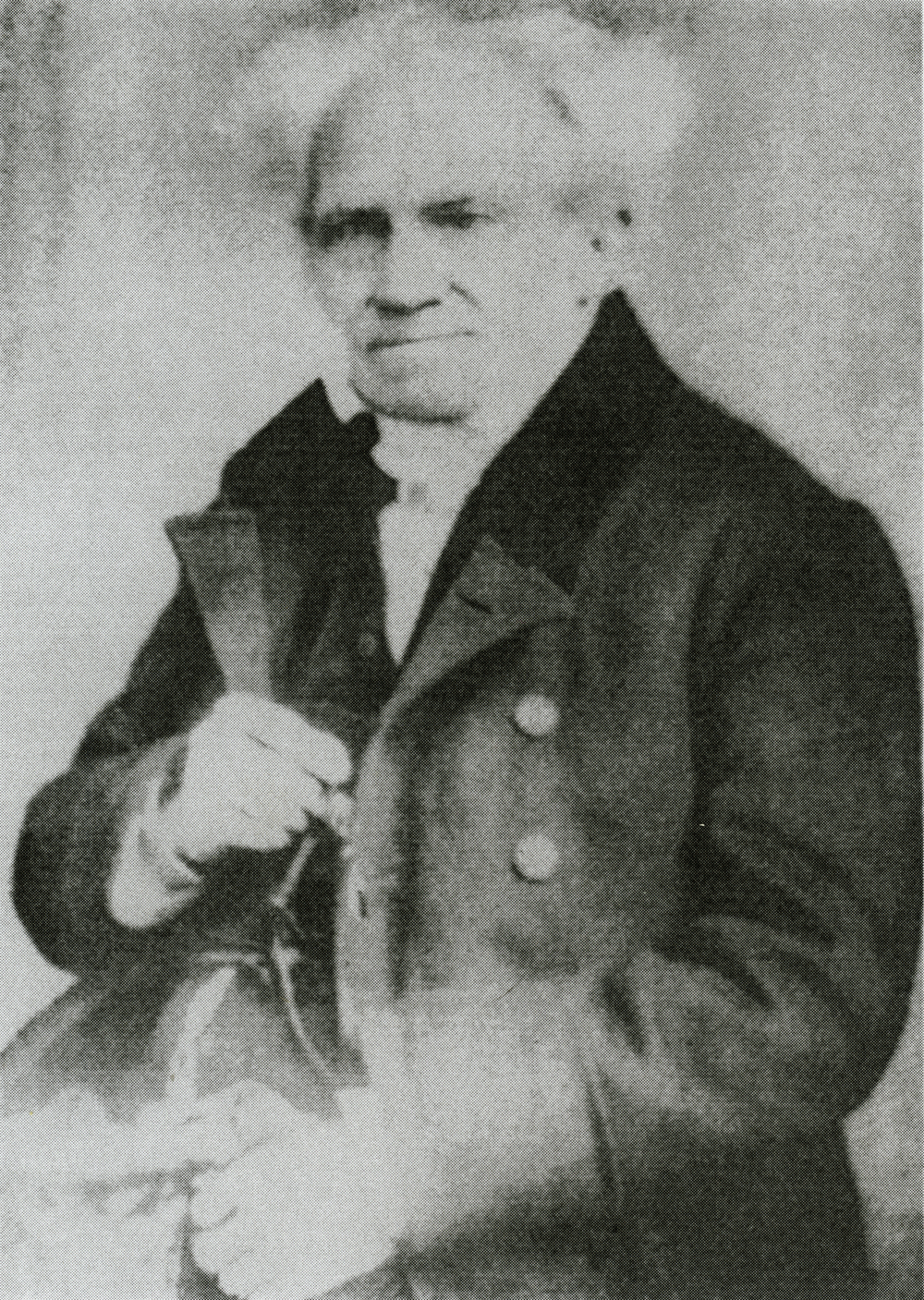
Arthur Schopenhauer in April 1859 (Schopenhauer-Gesellschaft) Translator's Introduction COVERING more than the first half of the nineteenth century Schopenhauer's original and unorthodox opinions inevitably provoked a vigorous reaction of the scholars, thinkers, and theologians who at that time were the representatives of culture, art, science, and religion. More than any other philosopher of modern times he had to contend with fractious contemporaries who were ever ready to denigrate and denounce him, to secrete and suppress his works by the simple expedient of silence, and who did not scruple to misquote him blatantly and unblushingly from his own writings. Such denunciation over several decades was bound to result in a distorted image of the philosopher and a perverted presentation of his views even in the academic circles of the early years of the present century-a presentation that has often been founded on a perfunctory acquaintance with the main tenets of his system.
But the pace and pressure of events in the first half of the twentieth century during which, in spite of an impressive advance in many branches of technology, there has been a steady decline in culture, have imposed on Western man the necessity to re-examine the thoughts of serious philosophers in general and those of Schopenhauer in particular. The easy and agreeable optimism of the years before 1914 with its confident belief in the perfectibility of man and in his steady advance to the millennium was rudely shaken by the outbreak of the First World War and finally shattered by the terrible episodes prior to and during the second war.
By 1945 all melioristic dreams had been dispelled and men in the Western hemisphere were constrained to reappraise the unpalatable truths of philosophical pessimism. In a mood of despair the present generation is evincing a growing interest in those systems of thought which do not shrink from presenting the stark realities of existence, but nevertheless offer a long-term prospect of final emancipation and salvation from the eternal thraldom of birth, life, suffering, death, and rebirth. It is therefore hardly surprising that in the quarter of a century since 1945 many have become increasingly concerned with realistic thinking, and all who have witnessed and experienced barbarism and brutality on a global scale are athirst for a philosophy of life which will facilitate a reconciliation between their rational and logical outlook and the sombre and ineluctable truths and precepts of New Testament Christianity and indeed of all genuine religion. A similar revulsion of feeling a century before may well have ushered in a revival of interest in serious philosophy after the momentous events of 1848, that year of revolutionary rumblings. In 1851 the Parerga and Paralipomena were published at a time when Europe was passing through a period of despondency and disillusionment.
Arthur Schopenhauer was born in Danzig in 1788 and at the early age of twenty-five published his first work On the Fourfold Root of the Principle of Sufficient Reason, for which the University of Jena awarded him a doctor's degree. This essay soon attained the rank of a philosophical classic and even today is probably one of the best treatises on epistemology. In 1816 he wrote a short essay On Vision and Colours, and in 18I9 his chief work, The World as Will and Representation, was published in one volume in which he expounded his whole philosophical system and included in an appendix a masterly criticism of Kant's three Critiques. In 1830 he published in Latin a second essay on the theory of colours and in 1836 there appeared the essay On the Will in Nature, in which he discussed the corroborations which his philosophy had obtained from the empirical sciences since its first appearance. In 1839 and 1840 Schopenhauer wrote two prize-essays: (I) on the freedom of the human will and (2) on the basis of ethics. The first was awarded a prize by a Norwegian academy, but the second was rejected by a Danish academy, although Schopenhauer's was the only essay submitted. In 1841 the two essays, preceded by a long and caustic preface, were published in one volume with the title The Two Fundamental Problems of Ethics.
From his earliest years Schopenhauer was in the habit of noting down the many different observations and reflections which occurred to him during his frequent meditations on the mystery and riddle of existence. By 1844 he had amassed enough material and hoped that Brockhaus, the publisher of 1819, would accede to the proposal to publish a second and enlarged edition of The World as Will and Representation. But in view of the failure of the first edition of 1819 to impress the learned world of that year, the publisher showed little enthusiasm, but finally agreed reluctantly to publish in two volumes an augmented edition of the chief work, for which Schopenhauer received no honorarium. These two volumes likewise failed to stimulate any interest. Undaunted by such discouragement, Schopenhauer steadily pursued the dreary path of truth and turned his attention to other important subjects which had hitherto not come within the framework of his systematic writings. The elaboration and compilation of the many notes and drafts which had accumulated over more than a generation occupied some six years of unremitting daily toil. From Schopenhauer's posthumous notes we learn that these supplementary essays and observations do not enable the reader to become fully acquainted with the main tenets of his philosophical system. On the contrary, they were written for those readers who already subscribed to his earlier and more important works, and so he assumed an acquaintance with his teaching and addressed himself to those already conversant with it.
It may be stated generally that the first volume of Parerga and Paralipomena contains the parerga (supplementary works) whereas the second comprises the paralipomena (matters omitted from the main structure of Schopenhauer's ideas). These paralipomena were regarded by him as complementary to the supplements to his chief work, and this is especially true of chapters I-XIV of the second Parerga volume which therefore assume a knowledge of the author's philosophy. On the other hand, the remainder of the second Parerga volume together with the whole of the first can be understood without any such previous knowledge; yet those already familiar with the main tenets of his philosophy will discern many references to these and observe that they throw additional light on many of his arguments.
At the end of 1850 Schopenhauer was ready to approach a publisher with the manuscript of his last major work in two volumes. But only after long delay and much disappointment was Julius Frauenstadt, his close friend and disciple, able to persuade Hayn of Berlin to publish the two volumes in 1851 in an edition of 750 copies of which Schopenhauer received ten but no honorarium.
Shortly after their publication, the Parerga and Paralipomena came to the notice of John Oxenford, the translator of Goethe's conversations with Eckermann, who in 1852 wrote a review for the Westminster and Foreign Quarterly Review and in 1853 for the same journal an article entitled 'Iconoclasm in German Philosophy'. This article was read by Ernst Otto Lindner, a friend of Schopenhauer's, who arranged for the publication of a German translation in the Vossische Zeitung. The effect was dramatic and almost overnight Schopenhauer in his own country passed from obscurity to fame and from then till his death in 1860 he basked in the sunshine of belated recognition and eminence. This sudden interest in his philosophy called for new editions of his other published works and the old sage's obvious pleasure at final acknowledgement was naive and childlike and in some measure compensated him for the many years of frustration and bitterness.
Of the early English translators of the Parerga and Paralipomena Thomas Bailey Saunders (1860-1928) and Ernest Belfort Bax (1854-1926) are the best-known who before the turn of the century had begun to make selections from the more popular essays. There was no collaboration between the two and a certain amount of duplication was therefore inevitable. Moreover, their styles and terminology were idiosyncratic, a factor which precluded the compilation of their combined efforts into a uniform and homogeneous translation. Bailey Saunders's renderings had indeed caught the piquancy and pungency of Schopenhauer's style, but in some instances they border on paraphrase, a practice of which the philosopher himself disapproved. Nevertheless these two distinguished scholars succeeded in introducing to English readers the many gems of Schopenhauer's genius at a time when it was fashionable to dismiss the philosopher as a crotchety, woman-hating old pessimist. Using the German text of the old and long since discarded Frauenstadt edition of Schopenhauer's works, they inevitably suffered from handicaps which do not burden the modern translator able to avail himself of a more accurate and scholarly text. The present translation is the first complete English rendering of the Parerga and Paralipomena and has been made from the German text of the Hubscher-Brockhaus edition, itself the outcome of more than a century of textual research and emendation. The immense range of Schopenhauer's erudition is reflected in the many quotations from Greek, Latin, English, French, German, Italian, and Spanish authors; translations of all foreign-language quotations are given in footnotes in the text.
No introduction can end without an expression of gratitude to the many friends who through their help and encouragement have greatly contributed to the completion of a long and arduous undertaking. In particular Arthur Hubscher, President of the Schopenhauer-Gesellschaft and the most eminent living authority on Schopenhauer and his philosophy, has for many years generously given valuable advice. Professor Richard Taylor of Rochester University, New York State has sedulously used his influence to bring Schopenhauer's philosophy to the notice of American readers, whilst Bryan Magee has rendered a similar service to students in this country. Finally to his wife Eileen the translator is grateful for her inexhaustible fund of patience and inspiration. Without the very real help and interest of these and many other friends, this translation could not have come to fruition. |