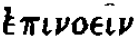
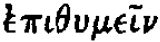
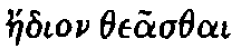
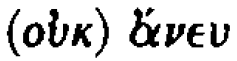
|
ON TYRANNY |
|
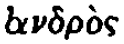
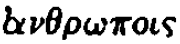
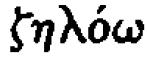
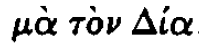
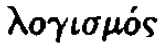
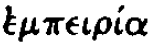
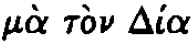
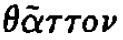
Notes to On Tyranny Introduction 1. Compare Social Research, v. 13, 1946, pp. 123-124. -- Hobbes, Leviathan, "A Review and Conclusion" (ed. by A. R. Waller, p. 523): " ... the name of Tyranny, signifieth nothing more, not lesse, than the name of Sovereignty, be it in one, or many men, saving that they that use the former word, are understood to be angry with them they call Tyrants...." -- Montesquieu, De l'Esprit des Lois, XI 9: "L'embarras d'Aristote parait visiblement quand il traite de la monarchie. Il en etablit cinq especes: il ne les distingue pas par la forme de la constitution, mais par des choses d'accident, comme les vertus ou les vices des princes...." 2. Principe, ch. 15, beginning; Discorsi I, beginning. 3. The most important reference to the Cyropaedia occurs in the Principe. It occurs a few lines before the passage in which Machiavelli expresses his intention to break with the whole tradition (ch. 14, toward the end). The Cyropaedia is clearly referred to in the Discorsi at least four times. If I am not mistaken, Machiavelli mentions Xenophon in the Principe and in the Discorsi more frequently than he does Plato, Aristotle, and Cicero taken together. 4. Discorsi II 2. 5. Classical political science took its bearings by man's perfection or by how men ought to live, and it culminated in the description of the best political order. Such an order was meant to be one whose realization was possible without a miraculous or nonmiraculous change in human nature, but its realization was not considered probable, because it was thought to depend on chance. Machiavelli attacks this view both by demanding that one should take one's bearings, not by how men ought to live but by how they actually live, and by suggesting that chance could or should be controlled. It is this attack which laid the foundation for all specifically modern political thought. The concern with a guarantee for the realization of the "ideal" led to both a lowering of the standards of political life and to the emergence of "philosophy of history": even the modern opponents of Machiavelli could not restore the sober view of the classics regarding the relation of "ideal" and "reality." I. The Problem 1. Hiero 1.8-10; 2.3-6; 3.3-6; 8.1-7; 11.7-15. 2. Memorabilia II 1.21; Cyropaedia VIII 2.12. Compare Aristotle, Politics 1325a 34 ff. and Euripides, Phoenissae 524-5. 106 3. Memorabilia I 2.56. 4. Hiero 1.1; 2.5. 5. Hiero 8.1. Compare Memorabilia IV 2.23-24 with ibid. 16-17. 6. Hiero 1.14-15; 7.2. Compare Plato, Seventh Letter 332d6-7 and Isocrates, To Nicocles 3-4. II. The Title and the Form 1. How necessary it is to consider carefully the titles of Xenophon's writings is shown most clearly by the difficulties presented by the titles of the Anabasis, of the Cyropaedia and, though less obviously, of the Memorabilia. Regarding the title of the Hiero, see also IV note 50, below. 2.
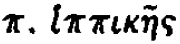
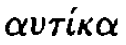
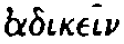
There is only one more writing of Xenophon which would seem to serve the
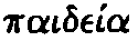
purpose of teaching a skill, the
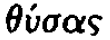
3. Compare Cyropaedia I 3.18 with Plato, Theages 124e11-125e7 and Amatores 138b15 ff. 4. De vectigalibus 1.1. Compare Memorabilia IV 4.11-12 and Symposium 4. 1-2. 5. Hiero 4.9-11; 7.10, 12; 8.10; 10.8; 11.1. 6. Memorabilia I 2.9-11; III 9.10; IV 6.12 (compare IV 4). Oeconomicus 21.12. Resp. Lac. 10.7; 15.7-8. Agesilaus 7.2. Hellenica VI 4.33-35; VII 1.46 (compare V 4.1; VII 3.7-8). The opening sentence of the Cyropaedia implies that tyranny is the least stable regime. (See Aristotle, Politics 1315b10 ff.). 7. Hiero 4.5. Hellenica V 4.9, 13; VI 4.32. Compare Hiero 7.10 with Hellenica VII 3.7. See also Isocrates, Nicocles 24. 8. Plato, Republic 393C11. 9. Memorabilia III 4.7-12; 6.14; IV 2.11. 10. Oeconomicus 1.23; 4.2-19; 5.13-16; 6.5-10; 8.4-8; 9.13-15; 13.4-5; 14.310, 20.6-9; 21.2-12. The derogatory remark on tyrants at the end of the work is a fitting conclusion for a writing devoted to the royal art as such. Since Plato shares the "Socratic" view according to which the political art is not essentially different from the economic art, one may also say that it can only be due to secondary considerations that his Politicus is not entitled Oeconomicus. 11. Memorabilia IV 6.12. 12. Apologia Socratis 34. 13. Memorabilia I 2.31 ff.; III 7.5-6. 14. Plato, Hipparchus 228b-c (cf. 229b). Aristotle, Resp. Athen. 18.1. 15. Plato, Second Letter 310e5 ff. 16. Memorabilia I 5.6. 17. Aristophanes, Pax 698-9. Aristotle, Rhetoric 1391a8-11; 1405b24-28. See also Plato, Hipparchus 228c. Lessing called Simonides the Greek Voltaire. 18. Oeconomicus 6.4; 2.2, 12 ff. Compare Memorabilia IV 7.1 with ibid. III 1.1 ff. Compare Anabasis VI 1.23 with ibid. 110.12. 19. Hiero 9.7-11; 11.4, 13-14, Compare Oeconomicus 1.15. 20. Hiero 1.2, 10; 2.6. 21. Note the almost complete absence of proper names from the Hiero. The only proper name that occurs in the work (apart, of course, from the names of Hiero, Simonides, Zeus, and the Greeks) is that of Dailochus, Hiero's favorite. George Grote, Plato and the other companions of Socrates (London, 1888, v. I, 222), makes the following just remark: "When we read the recommendations addressed by Simonides, teaching Hiero how he might render himself popular, we perceive at once that they are alike well intentioned and ineffectual. Xenophon could neither find any real Grecian despot correspondingly to this portion ... nor could he invent one with any show of plausibility." Grote continues, however, as follows: "He was forced to resort to other countries and other habits different from those of Greece. To this necessity probably we owe the Cyropaedia." For the moment, it suffices to remark that, according to Xenophon, Cyrus is not a tyrant but a king. Grote's error is due to the identification of "tyrant" with "despot." 22. Simonides barely alludes to the mortality of Hiero or of tyrants in general (Hiero 10.4): Hiero, being a tyrant, must be supposed to live in perpetual fear of assassination. Compare especially Hiero 11.7, end, with Agesilaus 9.7 end. Compare also Hiero 7.2 and 7.7 ff. as well as 8.3 ff. (the ways of honoring people) with Hellenica VI 1.6 (honoring by solemnity of burial). Cf. Hiero 11.7, 15 with Plato, Republic 465d2-e2. III. The Setting A. THE CHARACTERS AND THEIR INTENTIONS 1. Hiero 1.12; 2.8. Compare Plato, Republic 579b3-c3. 2. Aristotle, Rhetoric 1391a8-11. 3. Hiero 1.13; 6.13; 11.10. 4. Memorabilia I 2.33. Oeconomicus 7.2. Cyropaedia I 4.13; III 1.14; VIII 4.9. 5. Hiero 1.1-2. 6. Aristotle, Politics 1311a4-5. Compare the thesis of Callides in Plato's Gorgias. 7.
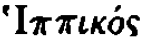
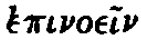
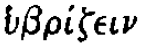
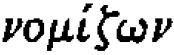
Observe the repeated
8. Hiero 1.8, 14, 16. Simonides says that tyrants are universally admired or envied (1.9), and he implies that the same is of course not true of private men as such. His somewhat more reserved statements in 2.1-2 and 7.1-4 about specific kinds of pleasure must be understood, to begin with, in the light of his general statement about all kinds of pleasure in 1.8. The statement that Simonides makes in 2.1-2 is understood by Hiero in the light of Simonides' general statement, as appears from 2.3-5; 4.6; and 6.12. (Compare also 8.7 with 3.3.) For the interpretation of Simonides' initial question, consider Isocrates, To Nicocles 4- 5. 9. Hiero 2.3-5. One should also not forget the fact that the author of the Hiero never was a tyrant. Compare Plato, Republic 577a-b and Gorgias 470d5-ell. 10. Memorabilia I 3.2; IV 8.6; 5.9-10. Compare Anabasis VI 1.17-21. 11. Memorabilia IV 6.1, 7; III 3.11; I 2.14. 12. Hiero 1.21, 31. 13. Compare Hiero 11.5-6 and Agesilaus 9.6-7 with Pindar, Ol. I and Pyth. I-III. 14. Hiero 1.14. The same rule of conduct was observed by Socrates. Compare
the manner in which he behaved when talking to the "legislators" Critias
and Charicles, with his open blame of the Thirty which he pronounced
"somewhere, " i.e., not in the presence of the tyrants, and which had to
be "reported" to Critias and Charicles (Memorabilia I 2.32-38; observe
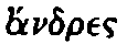
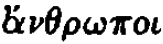
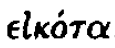
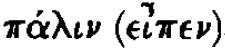
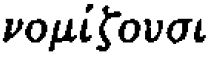
the repetition of
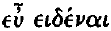
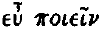
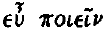
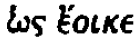
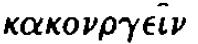
15. Hiero 1.9-10, 16-17; 2.3-5. 16. Hiero 1.10; 8.1. 17. Hiero 2.3-5. 18. While all men consider tyrants enviable, while the multitude is deceived by the outward splendor of tyrants, the multitude does not wish to be ruled by tyrants but rather by the just. Compare Hiero 2.3-5 with ibid. 5.1 and 4.5. Compare Plato, Republic 344b5- l. 19. Compare the end of the Oeconomicus with ibid. 6.12 ff. See also Memorabilia II 6.22 ff. 20. Hiero 5.1; 1.1. 21. Hiero 6.5. Aristotle, Politics 1314a10-13. 22. Hiero 4.2. See note 14 above. 23. Hiero 5.1-2. 24. Hiero mentions "contriving something bad and base" in 4.10, i.e., almost immediately before the crucial passage. Compare also 1.22-23. 25. Memorabilia I 2.31; IV 2.33; Symposium 6.6. Apologia Socratis 20-21. Cyropaedia III 1.39. Compare Plato, Apol. Socr. 23d4-7 and 28a6-bl, as well as Seventh Letter 344c1-3. 26. Memorabilia I 6.12-13. 27. Compare Oeconomicus 6.12 ff. and 11.1 ff with Memorabilia I 1.16 and IV 6.7. Compare Plato, Republic 489e3-490a3. The distinction between the two meanings of "gentleman" corresponds to the Platonic distinction between common or political virtue and genuine virtue. 28. Cyropaedia 11.1. Memorabilia I 2.56; 6.11-12. Compare Memorabilia IV 2.33 with Symposium 3.4. See Plato, Seventh Letter 333b3 ff. and 334al-3 as well as Gorgias 468e6- -9 and 469c3 (cf. 492d2-3); also Republic 493a6 ff. 29. Memorabilia I 2.31 ff.; IV 4.3. Symposium 4.13. Compare Plato, Apol. Socr. 20e8-21a3 and 32c4-d8 as well as Gorgias 480e6 ff.; also Protagoras 329e2-330a2. Cf. note 14 above. 30. Hellenica IV 4.6. Compare Symposium 3.4. 31. Whereas Hiero asserts that the tyrant is unjust, he does not say that he is foolish. Whereas he asserts that the entourage of the tyrant consists of the unjust, the intemperate, and the servile, he does not say that it consists of fools. Consider the lack of correspondence between the virtues mentioned in Hiero 5.1. and the vices mentioned in 5.2. Moreover, by proving that he is wiser than the wise Simonides, Hiero proves that the tyrant may be wise indeed. 32. According to Xenophon's Socrates, he who possesses the specific knowledge required for ruling well is eo ipso a ruler (Memorabilia III 9.10; 1.4). Hence he who possesses the tyrannical art is eo ipso a tyrant. From Xenophon's point of view, Hiero's distrust of Simonides is an ironic reflection of the Socratic truth. It is ironic for the following reason: From Xenophon's point of view, the wise teacher of the royal art, or of the tyrannical art, is not a potential ruler in the ordinary sense of the term, because he who knows how to rule does not necessarily wish to rule. Even Hiero grants by implication that the just do not wish to rule, or that they wish merely to mind their own business (cf. Hiero 5.1 with Memorabilia I 2.48 and II 9.1). If the wise man is necessarily just, the wise teacher of the tyrannical art will not wish to be a tyrant. But it is precisely the necessary connection between wisdom and justice which is questioned by Hiero's distinction between the wise and the just. 33. Hiero 2.3-5 (compare the wording with that used ibid. 1.9 and in Cyropaedia IV 2.28). It should be emphasized that in this important passage Hiero does not speak explicitly of wisdom. (His only explicit remark on wisdom occurs in the central passage, in 5.1). Furthermore, Hiero silently qualifies what he says about happiness in 2.3-5 in a later passage (7.9-10) where he admits that bliss requires outward or visible signs. 34. Hiero 2.6; 1.10. 35. Hiero states at the beginning that Simonides is a wise man ( 36. Hiero 1.9; 6.12.
37. By using the tyrant's fear as a means for his betterment, Simonides acts in accordance with a pedagogic principle of Xenophon; see Hipparchicus 1.8; Memorabilia III 5.5-6; Cyropaedia III 1.23-24. 38. Compare Hiero 1.14 with 1.16. Note the emphatic character of Simonides' assent to Hiero's reply. (1.16, beginning). Compare also 2.2 with 11.2-5. 39. Compare Hiero 4.5 with Hellenica VI 4.32 and VII 3.4-6. 40. Compare Hiero 6.14 with Hellenica VII 3.12. 41. Compare Hiero 6.1-3 with Cyropaedia 13.10, 18. 42.
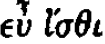
Compare Hiero 8.6 with ibid. 2.1. The statement is not contradicted by
Hiero; it is prepared, and thus to a certain extent confirmed, by what
Hiero says in 1.27 ( 43. Hiero 2.12-18. 44. By showing this, Hiero elaborates what we may call the gentleman's image of the tyrant. Xenophon pays a great compliment to Hiero's education by entrusting to him the only elaborate presentation of the gentleman's view of tyranny which he ever wrote. Compare p. 31 above on the relation between the Hiero and the Agesilaus. The relation of Hiero's indictment of tyranny to the true account of tyranny can be compared to the relation of the Athenian story about the family of Pisistratus to Thucydides' "exact" account. One may also compare it to the relation of the Agesilaus to the corresponding sections of the Hellenica. 45. Memorabilia IV 4.10. Agesilaus 1.6. As for the purpose of the Hellenica, compare IV 8.1 and V 1.4 with II 3.56 as well as with Symposium 1.1 and Cyropaedia VIII 7.24. 46. Memorabilia I 2.58-61. While Xenophon denies the charge that Socrates had interpreted the verses in question in a particularly obnoxious manner, he does not deny the fact that Socrates frequently quoted the verses. Why Socrates liked them, or how he interpreted them, is indicated ibid. IV 6.13-15: Socrates used two types of dialectics, one which leads to the truth and another which, by never leaving the dimension of generally accepted opinions, leads to (political) agreement. For the interpretation of the passage, compare Symposium 4.59-60 with ibid. 4.56-58. 47. Symposium 3.6. Compare Plato, Republic 378d6-8 and al-6. 48. To summarize our argument, " we shall say that if Hiero is supposed to state the truth or even merely to be completely frank, the whole Hiero becomes unintelligible. If one accepts either supposition, one will be compelled to agree with the following criticism by Ernst Richter ("Xenophon-Studien," Fleckeisen's Jahrbucher fur classische Philologie, 19. Supplementband, 1893, 149): "Einem solchen Manne, der sich so freimuthig uber sich selbst aussert, und diese lobenswerten Gesinnungen hegt, mochte man kaum die Schreckensthaten zutrauen, die er als von der Tyrannenherrschaft unzertrennlich hinstellt. Hat er aber wirklich soviel Menschen getotet und ubt er taglich noch soviel Ubelthaten aus, ist fur ihn wirklich das Beste der Strick -- und er musste es ja wissen --, so kommen die Ermahnungen des Simonides in zweiten Teil ganz gewiss zu spat.... Simonides gibt Ratschlage, wie sie nur bei einem Fursten vom Schlage des Kyros oder Agesilaos angebracht sind, nie aber bei einem Tyrannen, wie ihn Hieron beschreibt, der schon gar nicht mehr weiss, wie er sich vor seinen Todfeinden schutzen kann." Not to repeat what we have said in the text, the quick transition from Hiero's indictment of the tyrant's injustice (7.7-13)tohisremark that the tyrants punish the unjust (8.9) is unintelligible but for the fact that his account is exaggerated. If one supposes then that Hiero exaggerates, one has to wonder why he exaggerates. Now, Hiero himself makes the following assertions: that the tyrants trust no one; that they fear the wise; that Simonides is a real man; and that Simonides admires, or is jealous of, the tyrants' power. These assertions of Hiero supply us with the only authentic clue to the riddle of the dialogue. Some of the assertions referred to are without doubt as much suspect of being exaggerated as almost all other assertions of Hiero. But this very fact implies that they contain an element of truth, or that they are true if taken with a grain of salt. B. THE ACTION OF THE DIALOGUE 1. Hiero 1.3. As for the duration of Hiero's reign, see Aristotle, Politics 1315b35 ff. and Diodorus Siculus XI 38. Hiero shows later on (Hiero 6.1-2) that he recalls very well certain pleasures of private men of which he had not been reminded by Simonides. 2. Hiero 1.4-5. The "we" in "we all know" in 1.4 refers of course to private men and tyrants alike. Compare 1.29 and 10.4. 3. Hiero 1.4-6. To begin with, i.e., before Simonides has aroused his opposition, Hiero does not find any difference between tyrants and private men in regard to sleep (1. 7). Later on, in an entirely different conversational situation, Hiero takes up "the pleasures of private men of which the tyrant is deprived"; in that context, while elaborating the gentleman's image of the tyrant (with which Simonides must be presumed to have been familiar from the outset), Hiero speaks in the strongest terms of the difference between tyrants and private men in regard to the enjoyment of sleep (6.3, 7-10). 4. Twelve out of fifteen classes of pleasant or painful things are unambiguously of a bodily nature. The three remaining classes are (1) the good things, (2) the bad things, and (3) sleep. As for the good and the bad things, Simonides says that they please or pain us sometimes through the working of the soul alone and sometimes through that of the soul and the body together. As regards sleep, he leaves open the question by means of what kind of organ or faculty we enjoy it. 5. Compare Hiero 2.1 and 7.3 with Memorabilia II 1. 6. Hiero 1.19. Compare Isocrates, To Nicocles 4. 7. Compare Hiero 4.8-9 with Memorabilia IV 2.37-38. 8. Hiero 1.7-10. Hiero's oath in 1.10 is the first oath occurring in the
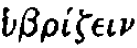
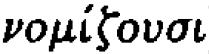
dialogue. Hiero uses the emphatic form
9. See in Hiero 1.10 the explicit reference to the order of Simonides' enumeration. 10. The proof is based on
11. The passage consists of five parts: (1) "sights" (Hiero contributes 163 words, Simonides is silent); (2) "sounds" (Hiero 36 words, Simonides 68 words); (3) "food" (Hiero 230 words, Simonides 76 words); (4) "odors" (Hiero is silent, Simonides 32 words); (5) "sex" (Hiero 411 words, Simonides 42 words). Hiero is most vocal concerning "sex"; Simonides is most vocal concerning "food. " 12. Compare III A, note 42, and III B, notes 11 and 19. As for the connection between sexual love and tyranny, cf. Plato, Republic 573e6.-7, 574e2 and 575a1-2. 13. Hiero 1.31-33. 14. Compare Hiero 1.16 with the parallels in 1.14, 24, 26. 15.
Simonides' first oath
16. Rudolf Hirzel, Der Dialog, I. Leipzig, 1895, 171, notes "die geringe Lebendigkeit des Gesprachs, die vorherrschende Neigung zu langeren Vortragen": all the more striking is the character of the discussion of "food." 17. Simonides grants this by implication in Hiero 1.26. 18. Mr. Marchant (Xenophon, Scripta Minora, Loeb's Classical Library, XV-XVI) says: "There is no attempt at characterization in the persons of the dialogue.... The remark of the poet at c.l.22 is singularly inappropriate to a man who had a liking for good living." In the passage referred to, Simonides declares that "acid, pungent, astringent and kindred things" are "very unnatural for human beings": he says nothing at all against "sweet and kindred things." The view that bitter, acid, etc., things are "against nature, " was shared by Plato (Timaeus 65c-66c), by Aristotle (Eth. Nic. 1153a5-6; cf. De anima 422b 10-14) and, it seems, by Alcmaeon (cf. Aristotle, Metaphysics 986a22-34). Moreover, Simonides says that acid, pungent, etc., things are unnatural for "human beings"; but "human beings" may have to be understood in contradistinction to "real men" (cf. III A, note 35 above). At any rate, the fare censured by Simonides is recommended as a fare for soldiers by Cyrus in a speech addressed to "real men" (Cyropaedia VI 2.31). (Compare also Symposium 4.9). Above all, Marchant who describes the Hiero as "a naive little work, not unattractive, " somewhat naively overlooks the fact that Simonides' utterances serve primarily the purpose, not of characterizing Simonides, but of influencing Hiero; they characterize the poet in a more subtle way than the one which alone is considered by Marchant: the fact that Simonides indicates, or fails to indicate, his likes or dislikes according to the requirements of his pedagogic intentions, characterizes him as wise. 19. Hiero 1.26. "Sex" is the only motive of which Simonides ever explicitly says that it could be the only motive for desiring tyrannical power. Compare note 12 above. 20. Hiero 7.5-6. 21. Hiero 8.6. 22. Note the increased emphasis on "(real) men" in Hiero 2.1. In the parallel passage of the first section (1.9), Simonides had spoken of "most able (real) men." Compare the corresponding change of emphasis in Hiero's replies (see the following note). 23. Compare Hiero 1.16-17 with 2.1, where Simonides declares that the bodily pleasures appear to him to be very minor things and that, as he observes, many of those who are reputed to be real men do not attach any great value to those pleasures. Hiero's general statement in 2.3-5, which is so much stronger than his corresponding statement in the first section (1.10), amounts to a tacit rejection of Simonides' claim: Hiero states that the view expressed by Simonides in 2.1-2, far from being nonvulgar, is the vulgar view. 24. Hiero 2.1-2. Simonides does not explicitly speak of "wealth and power." "Wealth and power" had been mentioned by Hiero in 1.27. (Compare Aristotle, Politics 1311a8-12.) On the basis of Simonides' initial enumeration (1.4-6), one would expect that the second section (ch. 2-6) would deal with the three kinds of pleasure that had not been discussed in the first section, viz. the objects perceived by the whole body, the good and bad things, and sleep. Only good and bad things and, to a lesser degree, sleep are clearly discernible as subjects of the second section. As for good and bad things, see the following passages: 2.6- 7, 3.1, 3, 5; 4.1; 5.2, 4. (Compare also 2.2 with Anabasis III 1.19-20.) As for sleep, see 6.3-9. As for objects perceived by the whole body, compare 1.5 and 2.2 with Memorabilia III 8.8-9 and 10.13. Sleep (the last item of the initial enumeration) is not yet mentioned in the retrospective summary at the beginning of the second section, whereas it is mentioned in the parallel at the beginning of the third section (cf. 2.1 with 7.3); in this manner Xenophon indicates that the discussion of the subjects mentioned in the initial enumeration is completed at the end of the second section: the third section deals with an entirely new subject. 25. Simonides merely intimates it, for he does not say in so many words that "they aspire to greater things, to power and wealth." Taken by itself, the statement with which Simonides opens the second section is much less far-reaching than the statements with which he had opened the discussion of the first section (1.8-9, 16). But one has to understand the later statement in the light of the earlier ones, if one wants to understand the conversational situation. Compare III A, note 8 above. 26. Simonides fails to mention above all the field or farm which occupies the central position among the objects desired by private men (Hiero 4.7) and whose cultivation is praised by Socrates as a particularly pleasant possession (Oeconomicus 5.11). Compare also Hiero 11.1-4 with ibid. 4.7 and Memorabilia III 11.4. Simonides pushes into the background the pleasures of private men who limit themselves to minding their own business instead of being swayed by political ambition (see Memorabilia 1. 2.48 and II 9.1) Farming is a skill of peace (Oeconomicus 4.12 and 1.17). Simonides also fails to mention dogs (compare Hiero 2.2 with Agesilaus 9.6). Compare De vectigalibus 4.8. 27.
Whereas we find in the first section an explicit reference to the order
of Simonides' enumeration (1.10), no such reference occurs in the second
section. In the second section Hiero refers only once explicitly to the
statement with which Simonides had opened the section, i.e., to 2.1-2;
he does this, however, only after (and in fact almost immediately after) Simonides has made his only contribution to the discussion of the second
section (6.12-13). An obvious, although implicit, reference to 2.2
occurs in 4.6-7. (Cf. especially the
28. See note 25 above. 29. As for Simonides, see p. 33 above. Hiero's concern with wealth is indicated by the fact that, deviating from Simonides, he explicitly mentions the receiving of gifts among the signs of honor (compare 7.7-9 with 7.2). To comply with Hiero's desire, Simonides promises him later on (11.12) gifts among other things. Compare Aristotle, Politics 1311a8 ff. and note 74 below. Consider also the emphatic use of "possession" in Simonides' final promise. Simonides' silence about love of gain as distinguished from love of honor (compare Hiero 7.1-4 with Oeconomicus 14.9-10) is remarkable. It appears from Hiero 9.11 and 11.12-13 that the same measures which would render the tyrant honored, would render him rich as well. 30. Friendship as discussed by Hiero in ch. 3 is something different from "helping friends" which is mentioned by Simonides in 2.2. The latter topic is discussed by Hiero in 6.12-13. 31. Compare 2.8 with 1.11-12; 3.7-9 with 1.38; 3.8 and 4.1-2 with 1.27-29; 4.2 with 1.17- 5. In the cited passages of ch. 1, as distinguished from the parallels in ch. 2 ff., no mention of "killing of tyrants" occurs. Compare also the insistence on the moral depravity of the tyrant, or on his injustice, in the second section (5.1-2 and 4.11) with the only mention of "injustice" in the first section (1.12): in the first section only the "injustice" suffered by tyrants is mentioned. As regards, 1.36, see note 41 below. 32. Marchant (loc. cit, XVI) remarks that Xenophon "makes no attempt anywhere to represent the courtier poet; had he done so he must have made Simonides bring in the subject of verse panegyrics on princes at c. 1.14." It is hard to judge this suggested improvement on the Hiero since Marchant does not tell us how far the remark on verse panegyrics on princes would have been more conducive than what Xenophon's Simonides actually says toward the achievement of Simonides' aim. Besides, compare Hiero 9.4 with 9.2. We read in Macauley's essay on Frederick the Great: "Nothing can be conceived more whimsical than the conferences which took place between the first literary man and the first practical man of the age, whom a strange weakness had induced to exchange their parts. The great poet would talk of nothing but treaties and guarantees, and the great king of nothing but metaphors and rhymes." 33. Hiero 3.6; 4.6; 5.1. 34.
Note the frequent use of the second person singular in ch. 13, and the
ascent from the
35. Hiero 6.1-6. 36. Compare Hiero 6.7 with ibid. 6.3 37. Hiero 6.7-9. The importance of Simonides' remark is underlined by the following three features of Hiero's reply: First, that reply opens with the only oath that occurs in the second section. Second, that reply, being one of the three passages of the Hiero in which laws are mentioned (3.9; 4.4; 6.10), is the only passage in the dialogue in which it is clearly intimated that tyrannical government is government without laws, i.e., it is the only passage in Xenophon's only work on tyranny in which the essential character of tyranny comes, more or less, to light. Third, Hiero's reply is the only passage of the Hiero in which Hiero speaks of "you (private men)" (see III A, note 35 above). Compare also III B, note 27 above. 38. The character of Simonides' only contribution to the discussion of the second section can also be described as follows: While he was silent when friendship was being discussed, he talks in a context in which war is mentioned; he is more vocal regarding war than regarding friendship. See note 26 above. 39. The situation is illustrated by the following figures: In the first section (1.1038) Simonides contributes about 218 words out of about 1058; in the second section (2.3-6.16) he contributes 28 words out of about 2,000; in the third section (ch. 7) he contributes 220 words out of 522; in the fourth section (ch. 8-11) he contributes about 1, 475 words out of about 1, 600.-K. Lincke, "Xenophons Hiero und Demetrios von Phaleron," Philologus, v. 58, 1899, 226, correctly describes the "Sinnesanderung" of Hiero as "die Peripetie des Dialogs." 40.
Compare note 24 above. The initial enumeration had dealt explicitly with
the pleasures of "human beings" (see III a, note 35 above), but honor,
the subject of the third section, is the aim, not of "human beings," but
of "real men." One has no right
to assume that the subject of the third section is the pleasures or pains
of the soul, and the subject of the second section is the pleasures or
pains common to body and soul. In the first place, the pleasures or
pains of the soul precede in the initial enumeration the pleasures or
pains common to body and soul; besides
41. Compare Hiero 7.1-4 with ibid. 2.1-2. See III A, note 8, and III B,
note 22 above. The "many" (in the expression "tor many of those who are
reputed to be real men") is emphasized by the insertion of "he said"
after "for many" (2.1), and the purpose of this emphasis is to draw our
attention to the still limited character of the thesis that opens the
second section. This is not the only case in which Xenophon employs this
simple device for directing the reader's attention. The "he said" after
"we seem" in 1.5 draws our attention to the fact that Simonides uses
here for the first time the first person when speaking of private men.
The two redundant "he said" 's in 1.7-8 emphasize the "he answered"
which precedes the first of these two "he said" 's, thus making it clear
that Simonides' preceding enumeration of pleasures has the character
of a question addressed to Hiero, or that Simonides is testing Hiero. The second
"he said" in 1.31 draws our attention to the preceding (lV, i.e., to the
fact that Hiero's assertion concerning tyrants in general is now applied
by Simonides to Hiero in particular. The "he said" in 1.36 draws our
attention to the fact that the tyrant Hiero hates to behave like a
brigand. The redundant" he said" in 7.1 draws our attention to the fact
that the following praise of honor is based on
42. Hiero 7.5-10. 43. Compare Hiero 7.3 with ibid. 1.14-15. 44. In the third section, Simonides completely abandons the vulgar opinion in favor not of the gentleman's opinion but of the opinion of the real man. The aim of the real man is distinguished from that of the gentleman by the fact that honor as striven for by the former does not essentially presuppose a just life. Compare Hiero 7.3 with Oeconomicus 14.9. 45. Hiero 7.11-13. I have put in parentheses the thoughts which Hiero does not express. As for Simonides' question, compare Anabasis VII 7.28. 46. Hiero 1.12. As for the tyrant's fear of punishment, see ibid. 5.2. 47. Regarding strangers, see Hiero 1.28; 5.3; 6.5. 48. Compare Hiero 8.9 with ibid. 7.7 and 5.2. 49. Simonides continues asserting that tyrannical life is superior to private life; compare Hiero 8.1-7 with ibid. 1.8 ff.; 2.1-2; 7.1 ff. 50. Hiero 7.12-13. 51. When comparing Hiero 7.13 with Apologia Socratis 7 and 32, one is led to wonder why Hiero is contemplating such an unpleasant form of death as hanging: does he belong to those who never gave thought to the question of the easiest way of dying? Or does he thus reveal that he never seriously considered committing suicide? Compare also Anabasis II 6.29. 52. Memorabilia I 2.10-11, 14. 53. "You are out of heart with tyranny because you believe...." (Hiero 8.1). 54. Compare also the transition from "tyranny" to the more general "rule" in Hiero 8.1 ff. Regarding the relation of "tyranny" and "rule, " see Memorabilia IV 6.12; Plato, Republic 338d7-11; Aristotle, Politics 1276a2-4. 55. Hiero 7.5-6, 9; compare ibid. 1.37-38 and 3.8-9. 56. Hiero 8.1. 57. Hiero 8.1-7. Compare note 54 above. 58. Compare Hiero 1.36-38. 59.
In this context (8.3), there occur allusions to the topics discussed in
1.10 ff:
60. Memorabilia II 1.27-28; 3.10-14; 6.10-16. Compare Anabasis 19.20 ff. 61. If Simonides had acted differently, he would have appeared as a just man, and Hiero would fear him. Whereas Hiero's fear of the just is definite, his fear of the wise is indeterminate (see pp. 41-45 above); it may prove to be unfounded in a given case. This is what actually happens in the Hiero: Simonides convinces Hiero that the wise can be friends of tyrants. One cannot help being struck by the contrast between Simonides' "censure" of the tyrant Hiero and the prophet Nathan's accusation of the Lord's anointed King David (II Samuel 12). 62. Hiero 8.8. The equally unique
63. Hiero 8.8-10. Compare ibid. 6.12-13. 64. Hiero 9.1. Observe the negative formulation of Simonides' assent to a statement dealing with unpleasant aspects of tyrannical rule. 65. Simonides' speech consists of two parts. In the fairly short first part (9.1-4), he states the general principle. In the more extensive second part (9.5-11), he makes specific proposals regarding its application by the tyrant. In the second part punishment and the like are no longer mentioned. The unpleasant aspects of tyranny, or of government in general, are also barely alluded to in the subsequent chapters. Probably the most charming expression of the poet's dignified silence about these disturbing things occurs in 10.8. There, Simonides refrains from mentioning the possibility that the tyrant's mercenaries, these angels of mercy, might actually punish the evildoers: he merely mentions how they should behave toward the innocent, toward those who intend to do evil and toward the injured. Compare the preceding note. Compare also the statement of the Athenian stranger in Plato's Laws 711 b4-c2 with the subsequent statement of Clinias. 66. As for bewitching tricks to be used by absolute rulers, see Cyropaedia VIII 1.40-42; 2.26; 3.1. These less reserved remarks are those of a historian or a spectator rather than of an adviser. Compare Aristotle, Politics 1314a40: the tyrant ought to play the king. 67. Ch. 9 and ch. 10 are the only parts of the Hiero in which "tyrant" and derivatives are avoided. 68. Compare especially Hiero 9.10 with ibid. 11.10. 69. Hiero 9.7, 11. 70. Hiero 9.6. Compare Aristotle, Politics 1315a31-40. 71. Hiero 8.10. 72. Hiero 10.1. 73. Hiero 10.2. Compare Aristotle, Politics 1314a33 ff. 74. Compare Hiero 4.9, 11 with 4.3 ("without pay") and 10.8. 75. Compare Hiero 11.1 with 9.7-11 and 10.8. 76. Hiero 11.1-6. Compare p. 38 above. One is tempted to suggest that the Hiero represents Xenophon's interpretation of the contest between Simonides and Pindar. 77. Hiero 11.7-15. Compare Plato, Republic 465d2-e2. 78. K. Lincke (loc. cit, 244), however, feels "dass Hiero eines Besseren belehrt worden ware, muss der Leser sich hinzudenken, obgleich es ... besser ware, wenn man die Zustimmung ausgesprochen sahe." The Platonic parallel to Hiero's silence at the end of the Hiero is Callicles' silence at the end of the Gorgias and Thrasymachus' silence in books II- of the Republic. C. THE USE OF CHARACTERISTIC TERMS 1.Marchant, loc. cit, XVI. 2. For instance, Nabis is called "principe" in Principe IX and "tiranno" in Discorsi I 40, and Pandolfo Petruzzi is called "principe" in Principe XX and XXII, and "tiranno" in Discorsi III 6. Compare also the transition from "tyrant" to "ruler" in the second part of the Hiero. 3. Compare Hellenica VI 3.8, end. 4. Hiero 9.6. 5. Hiero 11.6; 1.31. Compare Apologia Socratis 28, a remark which Socrates made "laughingly." 6.Compare the absence of courage (or manliness) from the lists of Socrates' virtues: Memorabilia IV 8.11 (cf. IV 4.1 ff.) and Apologia Socratis 14, 16. Compare Symposium 9.1 with Hiero 7.3. But consider also II, note 22 above. 7. Compare Hiero 9.8 on the one hand with 1.8, 19 and 5.1-2 on the other. 8. Hiero 10.1. IV. The Teaching Concerning Tyranny 1. Aristotle, Politics 1313a33-38. 2. This explanation does not contradict the one suggested on pp. 32-33 above, for the difference between a wise man who does not care to discover, or to teach, the tyrannical art and a wise man who does remains important and requires an explanation. 3. Hiero 1.9-10; 2.3, 5. 4. Compare Hiero 5.2 with the situations in Cyropaedia VII 2.10 on the one hand, and ibid. VII 5.47 on the other. 5. Memorabilia IV 6.12. Compare Cyropaedia I 3.18 and 1.1; Hellenica VII 1.46; Agesilaus 1.4; De vectigalibus 3.11; Aristotle, Politics 1295aI5-18. 6. Hiero 11.12. Compare Hellenica V 1.3-4. 7. Compare pp. 64-65 and III B, note 37 above. In Hiero 7.2 Simonides says that all subjects of tyrants execute every command of the tyrant. Compare his additional remark that all rise from their seats in honor of the tyrant with Resp. Lac. 15.6: no ephors limit the tyrant's power. According to Rousseau (Contrat social III 10), the Hiero confirms his thesis that the Greeks understood by a tyrant not, as Aristotle in particular did, a bad monarch but a usurper of royal authority regardless of the quality of his rule. According to the Hiero, the tyrant is necessarily "lawless" not merely because of the manner in which he acquired his position, but above all because of the manner in which he rules; he follows his own will, which may be good or bad, and not any law. Xenophon's "tyrant" is identical with Rousseau's "despot" (Contrat social III 10 end). Compare Montesquieu, De l'esprit des lois XI 9 and XIV 13 note. 8. Hiero 11.8, 15. Compare ibid. 8.9 with 7.10-12, 7 and 11.1. Compare also 1.11-14 with the parallel in the Memorabilia (II 1. 31). Regarding the fact that the tyrant may be just, compare Plato, Phaedrus 248e3-5. 9. Hiero 11.5, 7, 14-15. 10. Hiero 8.3 and 9.2-10. 11. Hiero 9.6 and 11.3, 12. Compare Hellenica II 3.41; also Aristotle, Politics 1315a32-40 and Machiavelli, Principe XX. 12. Hiero 10.6. Compare Hellenica IV 4.14. 13. As regards prizes, compare especially Hiero 9.11 with Hipparchicus 1.26. Ernst Richter (loc. cit, 107) goes so far as to say that "die Forderungen des zweiten (Teils des Hiero) genau die des Sokrates (sind)." 14. Hiero 11.14; compare ibid. 6.3 and 3.8. 15. Compare Cyropaedia VIII 1.1 and 8.1. 16. Compare Hiero 10.4 with ibid. 4.3. 17. Hiero 9.1 ff. Compare Machiavelli, Principe XIX and XXI, toward the end as well as Aristotle, Politics 1315a4-8. See also Montesquieu, De l'esprit des lois XII 23-24. As for the reference to the division of the city into sections in Hiero 9.5-6 (cf. Machiavelli, Principe XXI, toward the end), one might compare Aristotle, Politics 1305a30-34 and Hume's "Idea of a perfect commonwealth" (toward the end). 18. Memorabilia III 4.8, Oeconomicus 4.7-8; 9.14-15; 12.19. Resp. Lac. 4.6 and 8.4. Cyropaedia V 1.13, AnaJJasis V 8.18 and II 6.19-20. Compare, however, Cyropaedia VIII 1.18. 19. Compare Hiero 9.7-8 with Resp. Lac. 7.1-2. Compare Aristotle, Politics 1305a18-22 and 1313b18-28 as well as Montesquieu, De l'esprit des lois XIV 9. 20. Hiero 11.12-14. Compare Cyropaedia VIII 2.15, 19; 1.17 ff. 21. Compare Hiero 8.10 and 11.13 with Oeconomicus 14.9. 22. Hiero 1.16. 23. Plato, Republic 562b9-c3; Euthydemus 292b4-c1. Aristotle, Eth. Nic. 1131a2629 and 1161a6-9; Politics 1294a10-13; Rhetoric 1365b29 ff. 24. Compare p. 43 above. 25. Hiero 7.9 and 11.8. Compare ibid. 2.2 (horses), 6.15 (horses) and 11.5 (chariots). The horse is the example used for the indirect characterization of political virtue in the Oeconomicus (11.3-6); a horse can possess virtue without possessing wealth; whether a human being can possess virtue without possessing wealth, remains there an open question. The political answer to the question is given in the Cyropaedia (I 2.15) where it is shown that aristocracy is the rule of well-bred men of independent means. Compare page 70 above about the insecurity of property rights under a tyrant. 26. Resp. Lac. 10.4 (cf. Aristotle, Eth. Nic. 1180a24 ff.). Cyropaedia I 2.2 ff. 27. Hiero 9.6. 28. Hiero 5.1-2. 29. Compare Hiero 9.6 with ibid. 5.3-4, Anabasis IV 3.4 and Hellenica VI 1.12. Compare Hiero 9.6 with the parallel in the Cyropaedia (I 2.12). A reduced form of prowess might seem to be characteristic of eunuchs; see Cyropaedia VII 5.61 ff. 30. This is the kind of justice that might exist in a nonpolitical society like Plato's first city or city of pigs (Republic 371e12-372a4). Compare Oeconomicus 14.3-4 with Aristotle, Eth. Nic. 1130b6, 30 ff. 31. Memorabilia IV 8.11. Apol Socr. 14, 16. 32. Compare Hiero 9.8 with Memorabilia IV 3.1 and Hellenica VII 3.6. Compare Plato, Gorgias 507a7-c3. 33. Anabasis VII 7.41. 34. Hiero 10.3. Compare Montesquieu, De l'esprit des lois III 9: "Comme il faut de la vertu dans une republique, et dans une monarchie de l'honneur, il faut de la crainte dans un gouvernement despotique: pour la vertu, elle n 'y est pas necessaire, et l'honneur y serait dangereux." Virtue is then not dangerous to "despotism." (The italics are mine.) 35. Compare Hiero 10.3 with Cyropaedia III 1.16 ff. and VIII 4.14 as well as with Anabasis VII 7.30. 36. Anabasis 19.29. 37. Compare Hiero 11.5, 8 with Memorabilia III 2 and Resp. Lac. 1.2. 38. Memorabilia IV 4.12 ff. Compare ibid. IV 6.5-6 and Cyropaedia 13.17. 39. Aristotle, Eth. Nic. 1129b12. 40. Memorabilia IV 4.13. 41. Oeconomicus 14.6-7. 42. Memorabilia 12.39-47 and I 1.16. 43. Memorabilia I 2.31 ff.; IV 4.3. 44. Agesilaus 4.2. Compare Cyropaedia I 2.7. 45. Compare Memorabilia IV 8.11 with ibid. I 2.7 and Apol Socr. 26. See also Agesilaus 11.8. Compare Plato, Crito 49bl0 ff. (cf. Burnet ad loc.); Republic 335d11-13 and 486b10-12; Clitopho 410a7-b3; Aristotle, Politics 1255a17-18 and Rhetoric 1367b5-6. 46. Cyropaedia VIII 1.22. In Hiero 9.9-10 Simonides recommends honors for those who discover something useful for the city. There is a connection between this suggestion, which entails the acceptance of many and frequent changes, and the nature of tyrannical government as government not limited by laws. When Aristotle discusses the same suggestion which had been made by Hippodamus, he rejects it as dangerous to political stability and he is quite naturally led to state the principle that the "rule of law" requires as infrequent changes of laws as possible (Politics 1268a6-8, b 22 ff.). The rule of laws as the classics understood it can exist only in a "conservative" society. On the other hand, the speedy introduction of improvements of all kinds is obviously compatible with beneficent tyranny. 47. Hiero 11.10-11. Memorabilia III 9.10-13. Compare Aristotle, Politics 1313a9-10. It may be useful to compare the thesis of Xenophon with the thesis of such a convinced constitutionalist as Burke. Burke says (in his "Speech on a motion for leave to bring in a bill to repeal and alter certain acts respecting religious opinions"): " . . . it is not perhaps so much by the assumption of unlawful powers, as by the unwise or unwarrantable use of those which are most legal, that governments oppose their true end and object, for there is such a thing as tyranny as well as usurpation." 48. Cyropaedia 1. 3.18. 49. Compare Anabasis III 2.13. Incidentally, the fact mentioned in the text accounts for the way in which tyranny is treated in Xenophon's emphatically Greek work, the Hellenica. 50. Memorabilia III 9.12-13. Compare Plato, Laws 710c5-d1. We are now in a position to state more clearly than we could at the beginning (pp. 31-32 above) the conclusion to be drawn from the title of the Hiero. The title expresses the view that Hiero is a man of eminence (cf. III A, note 44 above), but of questionable eminence; that the questionable character of his eminence is revealed by the fact that he is in need of a teacher of the tyrannical art; and that this is due, not only to his particular shortcomings, but to the nature of tyranny as such. The tyrant needs essentially a teacher, whereas the king (Agesilaus and Cyrus, e.g.) does not. We need not insist on the reverse side of this fact, viz., that the tyrant rather than the king has any use for the wise man or the philosopher (consider the relation between Cyrus and the Armenian counterpart of Socrates in the Cyropaedia). If the social fabric is in order, if the regime is legitimate according to the generally accepted standards of legitimacy, the need for, and perhaps even the legitimacy of, philosophy is less evident than in the opposite case. Compare note 46 above and V, note 60 below. 51. For an example of such transformations, compare Cyropaedia 13.18 with ibid. 12.1. 52. Hiero 10.1-8. Compare Aristotle, Politics 1311a7-8 and 1314a34 ff. 53. Aristotle, Politics 1276b29-36; 1278b1-5; 1293b3-7. 54. Memorabilia I 2.9-11. 55. Compare pp. 56-57 above. 56. Memorabilia II 1.13-15. 57. Compare also the qualified praise of the good tyrant by the Athenian stranger in Plato's Laws (709d10 ff. and 735d). In 709d10 ff. the Athenian stranger declines responsibility for the recommendation of the use of a tyrant by emphatically ascribing that recommendation to "the legislator." V. The Two Ways of Life 1. Memorabilia 11.8; IV 6.14. 2. Compare Hiero 1.2, 7 with Cyropaedia II 3.11 and VIII 3.35-48; Memorabilia II 1 and I 2.15-16; also Plato, Gorgias 500c-d. 3.
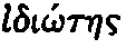
Consider the twofold meaning of
4. Rudolf Hirzel, loc cit., 170 n. 3: "Am Ende klingt aus allen diesen (im Umlauf befindlichen) Erzahlungen (uber Gesprache zwischen Weisen und Herrschern) ... dasselbe Thema wieder von dem Gegensatz, der zwischen den Machtigen der Erde und den Weisen besteht und in deren gesamter Lebansauffassung und Anschauungsweise zu Tage tritt." (Italics mine.) 5. Hiero 5.1. See p. 34 and III A, note 44 above. 6. Plato, Gorgias 500e-d. Aristotle, Politics 1324a24 ff. 7. Compare Hiero 9.2 with Memorabilia III 9.5, 10-11. Compare III A, note 32 above. 8. Memorabilia I 2.16, 39, 47-48; 6.15; II 9.1; III 11.16. 9. Hiero 7.13. 10. Compare Hiero 8.1-10.1 with ibid. 3.3-5 and 11.8-12. 11. Hiero 7.4. Compare ibid. 1.8-9 with 1.14, 16, 21-22, 24, 26 and 2.1-2. 12. The difference between Simonides' explicit statements and Hiero's interpretation of them appears most clearly from a comparison of Hiero 2.1-2 with the following passages: 2.3-5; 4.6; 6.12. 13. See pp. 39f and 51f and III B, notes 39 and 44 above. In the second part (i.e., the fourth section) to which he contributes about three times as much as to the first part, Simonides uses expressions like "it seems to me" or "I believe" much less frequently than in the first part, while he uses in the second part three times t')'w tPTJJ.Li which he never uses in the first part. 14. Hiero 7.2, 4. The ambiguity of
15. Hiero 8.1-7. Compare III B, note 38 above. 16. Hiero 7.3-4. 17. See pp. 62 and 65 above. Regarding the connection between "honor" and "noble, " see Cyropaedia VII 1.13; Memorabilia III 1.1; 3.13; 5.28; Oeconomicus 21.6; Resp. Lac. 4.3-4; Hipparchicus 2.2. 18. Memorabilia II 7.7-14 and III 9.14-15. Cyropaedia VIII 3.40 ff. 19. Hiero 11.10; 1.13; 6.13. Compare Cyropaedia VII 2.26-29. 20. In Hiero 11.15, the only passage in which Simonides applies "happy" and "blessed" to individuals, he does not explain the meaning of these terms. In the two passages in which he speaks of the happiness of the city, he understands by happiness power, wealth, and renown (1I.5, 7. Cf Resp. Lac. 1.1-2). Accordingly, one could expect that he understands by the most noble and most blessed possession that possession of power, wealth, and renown which is not marred by envy. This expectation is, to say the least, not disproved by 11.13- 5. Compare also Cyropaedia VIII 7.6-7; Memorabilia IV 2.34-35; Oeconomicus 4.23-5.1; Hellenica IV 1.36. 21. It is Hiero who on a certain occasion alludes to this meaning of "happiness" (2.3-5). Compare III A, note 33 above. 22. Memorabilia IV 8.11; 16.14. Compare p. 42 and III A, note 25 above. 23.
As for the danger of envy, see Hiero 11.6 and 7.10. As for the work and
toil of the ruler, see 1I .15 ( 24. De vectigalibus 4.5; Resp. Lac. 15.8; Symposium 3.9 and 4.2-3; Anabasis V 7.10. Compare also Cyropaedia I 6.24 and p. 62 above. 25. Memorabilia III 9.8; Cynegeticus 1.17. Compare Socrates' statements in the Memorabilia (IV 2.33) and the Apol. Socr. (26) with Xenophon's own statement in the Cynegeticus (1.1 1). 26. Compare note 23 above. Compare Memorabilia III 11.16; Oeconomicus 7.1 and 11.9; Symposium 4.44. 27. Memorabilia 1. 2.6; 5.6; 6.5; II 6.28-29; IV 1.2.
Symposium 8.41.
Compare Memorabilia IV 2.2 and Cyropaedia I 6.46. Consider the fact that
the second part of the Hiero is characterized by the fairly frequent
occurrence, not only of
28. Memorabilia IV 5.2; Cyropaedia 15.12; Anabasis VII 7.41-42; Symposium 4.44. 29. Memorabilia II 4.5, 7; Oeconomicus 5.11. Compare III B, note 26 above. 30. As for the agreement between Simonides' final statement and the views expressed by Socrates and Xenophon, compare Hiero 11.5 with Memorabilia III 9.14, and Hiero 11.7 with Agesilaus 9.7. 31. Compare Oeconomicus 1.7 ff. with Cyropaedia I 3.17. Compare Isocrates, To Demonicus 28. 32. Memorabilia IV 5.6 and Apol. Socr. 21. Compare Memorabilia 112.3; 4.2; I 2.7. As regards the depreciating remark on wisdom in Memorabilia IV 2.33, one has to consider the specific purpose of the whole chapter as indicated at its beginning. Ruling over willing subjects is called an almost divine good, not by Socrates but by Ischomachus (Oeconomicus 21.11-12). 33. Memorabilia I 4 and 6.10; IV 2.1 and 6.7. Regarding the distinction
between education and wisdom, see also Plato, Laws 653a5-c4 and 659c9
ff., and Aristotle, Politics 1282a3-8. Compare also
Memorabilia II 1.27, where the
34. Compare Hiero 3.2 (and 6.1-3) with the parallel in the Symposium (8.18). 35. Hiero 9.1-11. Simonides does not explain what the best things are. From
9.4 it appears that according to Xenophon's Simonides the things which
are taught by the teachers of choruses do not belong to the best things:
the instruction given by the teachers of choruses is not gratifying to
the pupils, and instruction in the best things is gratifying to the
pupils. Following Simonides, we shall leave it open whether the subjects
mentioned in 9.6 (military discipline, horsemanship, justice in business
dealings, etc.) meet the minimum requirements demanded of the best
things, viz., that instruction in them is gratifying to the pupils. The
fact that he who executes these things well is honored by prizes, does
not prove that they belong to the best things (cf. 9.4 and Cyropaedia
III 3.53). Whether the things Simonides teaches are
the best things will depend on whether the instruction that he gives to
the tyrant is gratifying to the latter. The answer to this question
remains as ambiguous as Hiero's silence at the end of the dialogue.
Xenophon uses in the Hiero the terms
36. Hiero 9.9-10. The opposite view is stated by Isocrates in his To Nicocles 17. 37. The distinction suggested by Simonides between the wise and the rulers reminds one of Socrates' distinction between his own pursuit which consists in making people capable of political action on the one hand, and political activity proper on the other (Memorabilia I 6.15). According to Socrates, the specific understanding required of the ruler is not identical with wisdom, strictly speaking. (Compare the explicit definition of wisdom in Memorabilia IV 6.7-see also ibid. 6.1 and I 1.16 -- with the explicit definition of rule in III 9.10-13 where the term "wisdom" is studiously avoided.) In accordance with this, Xenophon hesitates to speak of the wisdom of either of the two Cyruses, and when calling Agesilaus "wise," he evidently uses the termina loose sense, not to say in the vulgar sense (Agesalaus 6.4-8 and 11.9). In the Cyropaedia, he adumbrates the relation between the ruler and the wise man by the conversations between Cyrus on the one hand, his father (whose manner of speaking is reminiscent of that of Socrates) and Tigranes (the pupil of a sophist whose fate is reminiscent of the fate of Socrates) on the other. Compare pp. 34 and 65 above. Compare IV, note 50 above. 38. See pp. 40-41 above. Compare Plato, Republic 620c3-d2. 39. See pp. 22-23 above. Compare Plato, Republic 581e6-582e9. 40.
"Honor seems to be something great" and "no human pleasure
seems to come
nearer to divinity than the enjoyment connected with honors." (Hiero
7.1, 4). See also the
41. Since the preferences of a wise man are wise, we may say that Simonides reveals his wisdom in his statement on honor to a much higher degree than in his preceding utterances. The effect of that statement on Hiero would therefore ultimately be due to the fact that through it he faces Simonides' wisdom for the first time in the conversation. Without doubt, he interprets Simonides' wisdom, at least to begin with, in accordance with his own view -- the vulgar view -- of wisdom. Compare note 12 above. 42.
43. In Hiero 8.5-6 (as distinguished from ibid. 7.1-4) Simonides does not suggest that rulers are honored more than private men. He does not say that only rulers, and not private men, are honored by the gods (cf. Apol. Socr. 14-18). He says that a given individual is honored more highly when being a ruler than when living as a private man; he does not exclude the possibility that that individual is in all circumstances less honored than another man who never rules. In the last part of 8.5 he replaces "ruler" by the more general "those honored above others" (cf. Apol. Socr. 21). The bearing of 8.6 is still more limited as appears from a comparison of the passage with 2.1 and 7.3. Love of honor may seem to be characteristic of those wise men who converse with tyrants. Plato's Socrates says of Simonides that he was desirous of honor in regard to wisdom (Protagoras 343b7-c3). 44. Hiero 3.1, 6, 8. Compare ibid. 1.19, 21-23, 29 and 4.8. See III B, note 34 above. 45. Compare Hiero 3.1-9 with ibid. 8.1 and 11.8 (the emphatic "you"). See also Hieros' last utterance in 10.1. Hiero's praise of honor in 7.9-10 is clearly not spontaneous but solicited by Simonides' praise of honor in 7.1-4. Hiero's praise of honor differs from Simonides' in this, that only according to the former is love a necessary element of honor. Furthermore, it should be noted that Hiero makes a distinction between pleasure and the satisfaction of ambition (1.27). Xenophon's characterization of Hiero does not contradict the. obvious fact that the tyrant is desirous of honors (cf. 4.6 as well as the emphasis on Hiero's concern with being loved with Aristotle's analysis in Eth. Nic. 1159a12 ff.). But Xenophon asserts by implication that the tyrant's, or the ruler's, desire for honor is inseparable from the desire fur being loved by human beings. The most obvious explanation of the fact that Hiero stresses "love" and Simonides stresses "honor" would of course be this: Hiero stresses the things which the tyrant lacks, whereas Simonides stresses the things which the tyrant enjoys. Now, tyrants are commonly hated (cf. Aristotle, Politics 1312b19-20) but they are honored. This explanation is correct but insufficient because it does not account fur Simonides' genuine concern with honor or praise and for his genuine indifference to being loved by human beings. 46. Compare Hiero 7.1-4 with ibid. 1.16 and the passages cited in the preceding note. The forms of honor other than praise and admiration partake of the characteristic features of love rather than of those of praise and admiration. The fact that Simonides speaks in the crucial passage (Hiero 7.1-4) of honor in general, is due to his adaptation to Hiero's concern with love. Consider also the emphasis on honor rather than on praise in ch. 9. 47. Plato, Gorgias 481d4-5 and 513c7-8. Compare also the characterization of the tyrant in the Republic (see III B, note 12 above). As regards the disagreement between Hiero and Simonides concerning the status of "human beings, " compare the disagreement between the politician and the philosopher on the same subject in Plato's Laws (804b5-cl). 48. This explains also the different attitude of the two types to envy. See p. 84 above. 49. Compare Plato, Gorgias 481d4-5. 50. Hiero 11.8-15. Compare Agesilaus 6.5 and 11.15. 51. Hiero 7.9. Compare Plato, Republic 330c3-6 and Laws 873c2-4; Aristotle, Politics 1262b22-24. Compare also p. 34 and II, note 22 above. Cf. 1 Peter 1.8 and Cardinal Newman's comment: "St. Peter makes it almost a description of the Christian, that he loves whom he has not seen." 52. Simonides fr. 99 Bergk. 53.
Cf. the use of
54. Hiero 8.1-7. That this is not the last word of Xenophon on love, appears most clearly from Oeconomicus 20.29. 55. Compare Hiero 7.9 and 11.14-15 with Hellenica VII 3.12 (Cyropaedia III 3.4) and Memorabilia IV 8.7. The popular view is apparently adopted in Aristotle's Politics 1286b11-12 (cf. 1310b33 ff.). Compare Plato, Gorgias 513e5 ff. and 520e7-11. 56. Compare Hiero 7.9 with ibid. 7.1-4. 57. Men of excellence in an emphatic sense are Hesiod, Epicharmus, and Prodicus (Memorabilia II 1.20-21). Compare also Memorabilia I 4.2-3 and 6.14. 58. Memorabilia I 2.3 and 6.10. Simonides' statement that no human pleasure
seems to come nearer to the divine than the enjoyment connected with
honors (Hiero 7.4) is ambiguous. In particular, it may refer to the
belief that the very gods derive pleasure from being honored (whereas
they presumably do not enjoy the other pleasures 59. As for the connection between this kind of selfishness and wisdom, compare Plato, Gorgias 458a2-7 and the definition of justice in the Republic. Considerations which were in one respect similar to those indicated in our text seem to have induced Hegel to abandon his youthful "dialectics of love" in favor of the "dialectics of the desire for recognition." See A. Kojeve, Introduction a l'etude de Hegel, Paris (Gallimard), 1947, 187 and 510-12, and the same author's "Hegel, Marx et le Christianisme," Critique, 1946, 350-52. 60. Compare Simonides' disparaging remark on a kind of pleasure which is enjoyed by others rather than by oneself in Hiero 1.24 (cf. III B, note 11 above). Consider also the ambiguity of "food" (Memorabilia III 5.10; Plato, Protagoras 313c5-7). As regards the connection between friendship ("love") and sex, cf. Hiero 1.33, 36--38 and 7.6. The explanation suggested in the text can easily be reconciled with the fact that Hiero's concern with the pleasures of sex, if taken literally, would seem to characterize him, not as a ruler in general, but as an imperfect ruler. Xenophon's most perfect ruler, the older Cyrus, is characterized by the almost complete absence of concern with such pleasures. What is true of the perfect ruler, is still more true of the wise: whereas Cyrus does not dare to look at the beautiful Panthea, Socrates visits the beautiful Theodore without any hesitation (cf Cyropaedia V 1.7 ff. with Memorabilia III 11.1; Memorabilia 12.1 and 3.8- 5; Oeconomicus 12.13-14; Agesilaus 5.4-5). To use the Aristotelian terms, whereas Cyrus is continent, Socrates is temperate or moderate. In other words, Cyrus' temperance is combined with inability or unwillingness to look at the beautiful or to admire it (cf. Cyropaedia V 1.8 and VIII 1.42), whereas Socrates' temperance is the foundation for his ability and willingness to look at the beautiful and to admire it. To return to Hiero, he reveals a strong interest in the pleasures of sight (Hiero 1.11-13; cf. 11.10). He is concerned not so much with the pleasures of sex in general as with those of homosexuality. This connects him somehow with Socrates: love of men seems to bespeak a higher aspiration than love of women. (Symposium 8.2, 29; Cyropaedia II 2.28; Plato, Symposium 208d ff. Cf. Montesquieu, De l'esprit des lois VII 9 note: "Quant au vrai amour, dit Plutarque, les femmes n'y ont aucune part. II parlait comme son siecle. Voyez Xenophon, au dialogue intitule Hieron.") Hiero is presented as a ruler who is capable of conversing with the wise and of appreciating them (cf. III A, note 44 above). Does Hiero's education explain why he is not a perfect ruler? Only the full understanding of the education of Cyrus would enable one to answer this question. Compare IV, note 50 above. 61. Hiero 11.7, 11-15. Memorabilia I 2.11. 62. Hiero 6.9. How little Simonides impresses Hiero, a good judge in this matter, as being warlike, is indicated by the latter's "if you too have experience of war" (6.7) as compared with his "I know well that you too have experience" regarding the pleasures of the table (1.19). Cf. also ibid. 1.29, 23. Consider Simonides' silence about "manliness" (p. 64 above), and compare III B, notes 18 and 38, and III C, note 6 above. 63. Hiero 11.7. In the parallel in the Agesilaus (9.7) the qualifying words "among human beings" are omitted. 64. Hiero 2.7-18. (Consider the conditional clauses in 2.7.) The emphasis in this passage is certainly on war. The passage consists of two parts: In the first part (2.7-11) in which Hiero shows that if peace is good and war bad, tyrants are worse off than private citizens, "peace" occurs three times and "war" (and derivations) seven times, in the second part (2.12-18) in which he shows that as regards the pleasures of war-or more specifically as regards the pleasures of wars waged against forcibly subjected people, i.e., against rebellious subjects-tyrants are worse off than private citizens, "peace" does not occur at all but "war" (and derivatives) occurs seven times. 65. Plato, Republic 566e6-567a9. Aristotle, Politics 1313b28-30 and 1305a18-22. 66. Cyropaedia I 4.24; VII 1.13. Memorabilia III 1.6. Compare Plato, Republic 375c1-2 and 537a6-7 with Aristotle, Politics 1327b38-1328a11. 67. Hiero 1.34-35. As regards the relation between Eros and Ares, compare Simonides fr. 43 Bergk and Aristotle, Politics 1269b24-32. 68. Hiero 6.5; compare ibid. 6.14. 69. Hiero 2.2; 6.12-14. Compare the use of the second person singular in 6.13 on the one hand, and in 6.14 on the other. 70. Hiero 5.1. Apol. Socr. 16. Memorabilia I 6.10. Socrates does not teach strategy whereas he does teach economics (compare Memorabilia III I and IV 7.1 with the Oeconomicus). Compare Plato, Republic 366c7-di and the passages indicated in IV, note 45 above. VI. Pleasure and Virtue 1. Compare Memorabilia IV 8.11. 2. See pp. 45-48 and III a, note 44 above. 3.
Compare Hiero 8.6 with ibid. 2.1 and 7.3. Compare Hiero 5.1-2 with
ibid.
3.1-9 and 6.1- on the one hand, and with Memorabilia II 4 and I 6.14 on
the other. Compare Hiero 1.11- 4 with Memorabilia II 1.31:
Hiero does
not mention one's own virtuous actions as the most pleasant sight.
Compare Hiero 3.2 with Symposium 8.18: he does not mention the common
enjoyment of friends about their noble actions among the pleasures of friendship. He replaces Simonides'
4. Hiero 7.9-10. 5. Aristotle's suggestions for the improvement of tyrannical government (in the fifth book of the Politics) are more akin in spirit to Xenophon's suggestions than to Isocrates'; they are, however, somewhat more moralistic than those made in the Hiero. 6. Fr. 71 Bergk. When Xenophon's Simonides says that no human pleasure seems to come nearer to the divine than the enjoyment connected with honors, he may imply that "the divine" is pure pleasure. Compare V, note 58 above. 7. Compare Hiero 4.10 with frs. 5, 38, 39 and 42 Bergk. Compare Plato, Protagoras 346b5-8. Compare also Simonides' definition of nobility as old wealth with Aristotle's view according to which it is not so much wealth as virtue that is of the essence of nobility (Politics 1255a32 ff., 1283a33-38, 1301b3-4). 8. Lyra Graeca, ed. by J. M. Edmonds, vol. 2, revised and augmented edition, 258. Compare p. 64 above. See Hellenica II 3.19 and Apol. Socr. 30. 9. Lyra Graeca, ed. cit., 250, 256 and 260. Compare Plato, Protagoras 316d3-7, 338e6 ff. and 340e9 ff.; also Republic 331el-4 and context (Simonides did not say that to say the truth is of the essence of justice). 10. Compare pp. 34, 40, 5lf., 53, 55f., 76f. 11. Compare pp. 87 ff. above. 12. This would also explain why Simonides emphasizes somewhat later the pleasures connected with food: food is the fundamental need of all animals (Memorabilia II 1.1). In Hiero 7.3, where he hides his wisdom to a lesser degree than in the preceding sections, he does not call, as he did in 2.1, the pleasures of the body "small things." 13. Compare Memorabilia I 4.5 and IV 3.11. 14. Compare Plato, Theatetus 184c5-7 and 185e6-7. 15. Hiero 1.1. Compare the
16. Hiero 1.5. A remark which Simonides makes later on (9.10) might induce one to believe that he identified the good with the useful, and this might be thought to imply that the end for which the good things are useful, is pleasure. This interpretation would not take account of the facts which we discuss in the text. Simonides must therefore be presumed to have distinguished between the good which is good because it is useful for something else, and the good which is intrinsically good and not identical with the pleasant. 17. Hiero 1.22. 18. Hiero 1.9; 2.1; 7.3. 19. See the reference to the divine in Hiero 7.4. 20. Hiero 1.27; 3.3; 6.16. 21. The importance of the problem "fatherland-friendship" for the understanding of the Hiero is shown by the fact that that problem determines the plan of the bulk of the second section (ch. 3-6). This is the plan of ch. 3-6: I (a) friendship (3.1-9); (b) trust (4.1-2); (c) fatherland (4.3-5). II (a) possessions (4.6-11); (b) good men or the virtues (5.1-2); (c) fatherland (5.3-4). III (a) pleasures of private men (6.1-3); (b) fear, protection, laws (6.4- I); (c) helping friends and hurting enemies (6.12-15). The difference between "fatherland" and "trust" is not as clear-cut as that between either of them and "friendship": both fatherland and trust are good with regard to protection, or freedom from fear, whereas friendship is intrinsically pleasant. "Friendship" can be replaced by "possessions" for the reason given in Hiero 3.6, Memorabilia II 4.3-7 and Oeconomicus 1.14; "friendship" can be replaced by "pleasures of private men" for the reason given in Hiero 6.1-3. "Trust" can be replaced by "virtue" (cf. Plato, Laws 630b2-c6) as well as by "protection" (trustworthiness is the specific virtue of guards: Hiero 6.II). "Fatherland" can be replaced by "helping the friends and hurting the enemies" with a view to the fact that helping the friends, i.e., the fellow citizens, and hurting the enemies, i.e., the enemies of the city, is the essence of patriotism (cf. Symposium 8.38). The same distinction which governs the plan of ch. 36, governs the plan of ch. 8-II as well: (a) friendship (ch. 8-9; see 10.1); (b) protection (guards) (ch. 10); (c) fatherland or city (ch. 11; see 11.1). 22. Compare Hiero 3.3 with 4.1 on the one hand, and with 4.3-5 on the other. Compare 4.2 and 6.11. 23. Hiero 4.3-4. Compare 6.6, 10. In what may best be called the repetition
of the statement on the fatherland (5.3-4), Hiero says it is necessary to
be patriotic because one cannot be preserved or be happy without the
city. Compare the
24. Hiero 4.3-4 and 5.3. 25. Compare Hiero 4.3 and 10.4 with 6.10. 26. Hiero 9.2-4 (cf. 1.37; 5.2-3; 8.9). Compare also Hiero's emphasis (in his statement on friendship: 3.7-9) on the relations within the family, with the opposite emphasis in Xenophon's account of Socrates' character (Memorabilia II 2-10): the blood relations are "necessary" (Memorabilia II 1.14). Cyropaedia IV 2.11. Anabasis VII 7.29. Memorabilia II 1.18. Compare Aristotle, Rhetoric 1370a8-17 and Empedocles fr. 116 (Diels, Vorsakratiker, first ed.). See V, note 27 above. 27. Compare Hiero 5.3 and 4.9 with 3.1-9. 28. Observe that friendship and virtue occur in different columns of the plan of ch. 3-6 (see note 21 above). Compare Hiero's praise of the friend with Socrates' praise of the good friend (Memorabilia II 4 and 6). 29. Hiero II.14. 30. Hiero 11.1, 5-6. Compare pp. 87 ff. above. 31. Compare Hellenica I 7.21. 32. Compare Hiero 4.3 with Memorabilia II 3.2 and 1.13-15. 33. Only the fairly short first part of the Memorabilia (I 1-2) deals with "Socrates and the city, " whereas the bulk of the work deals with "Socrates' character"; see the two perorations: I 2.62-64 and IV 8.11. As regards the plan of the Memorabilia, see Emma Edelstein, Xenophontisches und Platonisches Bild des Sokrates, Berlin, 1935, 78-137. 34. Isocrates, Antidosis 155-56. 35. Anabasis III 1.4-9; V 6.15-37. Compare ibid. V 3.7 and VII 7.57. The sentiment of Proxenus is akin to that expressed by Hermes in Aristophanes' Plutus 1151 (Ubi bene ibi patria). (Compare Hiero 5.1 and 6.4 with Plutus 1 and 89.). Compare Cicero, Tusc. disput. V 37.106 ff. 36. Anabasis V 3.6 and Hellenica IV 3.15 (cf. IV 2.17). 37. B. G. Niebuhr, "Ueber Xenophons Hellenika," Kleine historische und philosophische Schriften, I, Bonn, 1828, 467: "Wahrlich einen ausgearteteren Sohn hat kein Staat jemals ausgestossen als diesen Xenophon. Plato war auch kein guter Burger, Athens wert war er nicht, unbegreifliche Schritte hat er getan, er steht wie ein Sunder gegen die Heiligen, Thukydides und Demosthenes, aber doch wie ganz anders als dieser alte Tor!" 38. Hiero 4.3-5 and 5.3. 39. See pp. 75f. above. 40. Cyropaedia II 2.24-26. Dakyns comments on the passage as follows: "Xenophon's breadth of view: virtue is not confined to citizens, but we have the pick of the whole world. Cosmopolitan Hellenism." Consider the conditional clauses in Agesilaus 7.4, 7. Compare Hipparchicus 9.6 and De vectigalibus 2.1-5. 41. Compare Burke, Reflections on the Revolution in France, Everyman's Library ed., p. 59, on the one hand, and Pascal, Provinciales XIII as well as Kant, "Uber den Gemeinspruch: Das mag in the Theorie richtig sein, taugt aber nicht fur die Praxis," on the other. 42. Socrates' statement that cities and nations are "the wisest of human things" (Memorabilia I 4.16) does not mean then that the collective wisdom of political societies is superior to the wisdom of wise individuals. The positive meaning of the statement cannot be established but by detailed interpretation of the conversation during which the statement is made. 43.
The only special virtues of which Simonides speaks with some emphasis,
are moderation and justice. Moderation may be produced by fear, the
spoiler of all pleasures (Hiero 10.2-3 and 6.6; cf. IV, note 35 above),
and it goes along with lack of leisure (9, 8). As for justice, Simonides
speaks once of a special kind of justice, the justice in business
relations, and twice of "doing injustice" (9.6 and 10.8). Now, the term
"justice" designates in Xenophon's works a variety of kindred phenomena
which range from the most narrow legalism to the confines of pure and
universal beneficence. Justice may be identical with moderation, it may
be a subdivision of moderation, and it may be a virtue apart from
moderation. It is certain that Simonides does not understand
by justice legality, and there is no reason to suppose that he
identified justice with beneficence. He apparently holds a considerably
more narrow view of justice than does Hiero. (For Hiero's view of
justice, see especially 5.1-2 and 4.11.) He replaces Hiero's "unjust
men" by "those who commit unjust actions" (for the interpretation
consider Aristotle, Eth. Nic. 1134a17 ff.). Whereas Hiero
identifies justice and moderation by using
44. Memorabilia 111.23, 26, 29. 45. Diogenes Laertius 1165-66. 46. Compare Memorabilia 111.34 with ibid 16.13, Symposium 1.5 and 4.62 and Cynegeticus 13. 47. Memorabilia 13.8-13. 48. Compare Hiero 11.15 with Anabasis VII 7.41. See Anabasis II 1.12 (cf. Simonides fr. 5 Bergk) and Cyropaedia I 5.8-10; also Agesilaus 10.3. 49. V. Brochard, Etudes de philosophie ancienne et de philosophie moderne, Paris (Vrin), 1926, 43. 50. Compare III A, note 27 and IV, note 25 above. 51. Memorabilia IV 6.15. 52. Memorabilia IV 8.6-8 (cf. 16.9 and IV 5.9-10). Apol. Socr. 5-6 and 32. 53. Compare Plato, Republic 357b4-358a3. 54. Apol. Socr. 5. Compare Memorabilia II 1.19. Regarding sibi ipsi placere see especially Spinoza, Ethics Ill, aff. deff. 25. As for the difference between Socrates and Simonides, compare also p. 94 above. VII. Piety and Law 1. De vectigalibus 6.2-3. Compare pp. 3lf. above. 2. When Simonides suggests to Hiero that he should spend money for the adornment of his city with temples inter alia (Hiero 11.1-2), he does not admonish him to practice piety; he merely advises him to spend his money in a way proper to a ruler. Aristotle's ethics which is silent about piety, mentions expenses for the worship of the gods under the heading "munificence." (Eth. Nic. 1122b19-23. Compare Politics 1321a35 ff. Cf. also J. F. Gronovius' note to Grotius' De jure belli ac pacis, Prolegg. §45: "Aristoteli ignoscendum, si inter virtutes morales non posuit religionem.... Nam illi ut veteribus omnibus extra Ecclesiam cultus deorum sub magnificentia ponitur.") 3. Agesilaus 1.34 and Anabasis III 2.13. Compare Plato, Republic 573c3-6. 4. Politics 1314b39 ff. No remark of this kind occurs in Aristotle's discussion of the preservation of the other regimes in the fifth book of the Politics. Cyropaedia VIII 1.23. Compare Isocrates, To Nicocles 20 and Machiavelli, Principle XVIII. 5. Memorabilia IV 6.2-4. 6. Memorabilia IV8.11; I 4; IV 3. 7. Hiero 3.9. Compare Oeconomicus 7.16, 29-30 (cf. 7.22-28). 8. Cicero, De natura deorum I 22.60. 9.
10.
Compare Anabasis V 2.24-25 and Plato, Laws 709b7-8. Considering the
relation between "nature" and "truth" (Oeconomicus 10.2 and
Memorabilia
II 1.22), the distinction between nature and law may imply the view that
the law necessarily contains fictitious elements. In Riera 3.3 Hiero
says: "It has not even escaped the cities that friendship is a very
great good and most pleasant to human beings. At any rate, many cities
have a law ( 11. Anabasis II 6.19-20 (cf Aristotle, Eth. Nic. 1179b4 ff). Symposium 4.19.
|