|
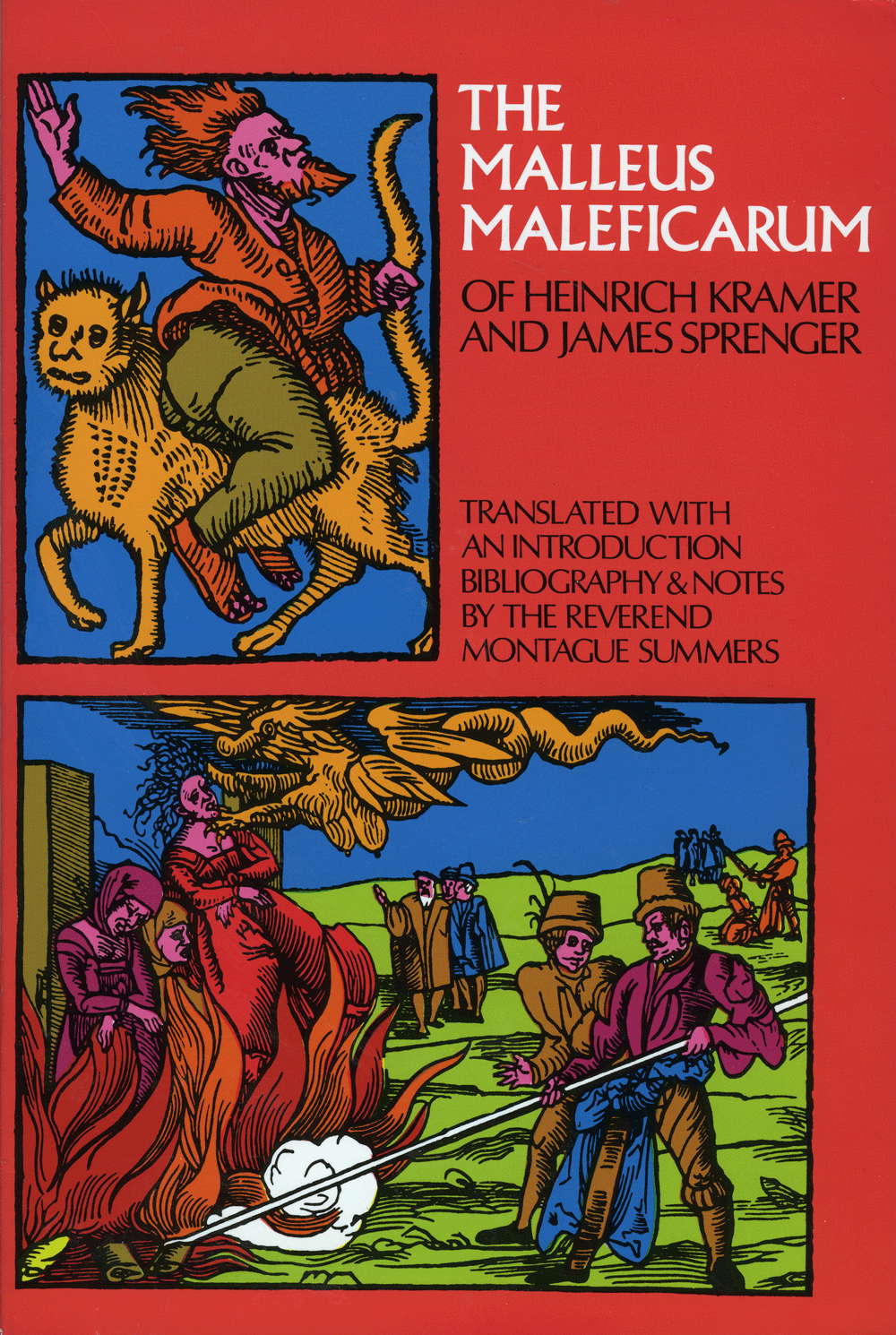
of Heinrich Kramer and James Sprenger
Translated with an Introduction Bibliography & Notes by The Reverend
Montague Summers
|
"It is not too much to say that the
Malleus
Maleficarum is among the most important, wisest, and
weightiest books of the world.
The
Dominican chroniclers, such as Quétif and Echard, number
Kramer and Sprenger among the glories and heroes of their
Order.
Here are cases which occur in the
law-courts to-day, set out with the greatest clarity, argued
with unflinching logic, and judged with scrupulous
impartiality.
It is a work which must irresistibly
capture the attention of all men who think, all who see, or
are endeavouring to see, the ultimate reality beyond the
accidents of matter, time and space."
-- Introduction to
Malleus Maleficarum, by "The Reverend" Montague Summers |
Physics, by Aristotle
On the Soul, by Aristotle
Ethics, by Aristotle
Dionysius the Areopagite, Letter
7, to Polycarp the Hierarch , by Dionysius the Areopagite
|
"With reference to the second point,
that a creature may be changed for better or worse, it
is always to be understood that this can only be done by
the permission and indeed by the power of God, and that
this is only done in order to correct or to punish, but
that God very often allows devils to act as His
ministers and His servants, but throughout all it is God
alone who can afflict and it is He alone who can heal,
for “I kill and I make alive” (Deuteronomy
xxxii, 39). And so evil angels may and do perform the
will of God.
No doubt the devil,
owing to his malice which he harbours against the human
race, would destroy mankind if he were allowed by God to do
so. The fact that God allows him sometimes to do harm and
that sometimes God hinders and prevents him, manifestly
brings the devil into more open contempt and loathing, since
in all things, to the manifestation of His glory, God is
using the devil, unwilling though he be, as a servant and
slave.
-- Malleus Maleficarum, by "The Reverend" Montague Summers |
Table of
Contents:
- Introduction to 1948 Edition
- Introduction to 1928 Edition
- A Note Upon the Bibliography
- The Bull of Innocent VIII:
Innocent, Bishop, Servant of the servants of God, for an eternal
remembrance
- The First Part
- Part One
- Question 1:
Whether the belief that there are such beings as witches is so essential
a part of the Catholic faith that obstinately to maintain the opposite
opinion manifestly savours of heresy.
- Question 2:
If it be in Accordance with the Catholic Faith to maintain that in Order
to bring about some Effect of Magic, the Devil must intimately
co-operate with the Witch, or whether one without the other, that is to
say, the Devil without the Witch, or conversely, could produce such an
Effect.
- Question 3:
Whether children can be generated by Incubi and Succubi.
- Question 4:
By which Devils are the Operations of Incubus and Succubus Practised?
- Question 5:
What is the Source of the Increase of Works of Witchcraft? Whence comes
it that the Practice of Witchcraft hath so notably increased?
- Question 6:
Concerning Witches who copulate with Devils. Why is it that Women are
chiefly addicted to Evil superstitions?
- Question 7:
Whether Witches can Sway the Minds of Men to Love or Hatred.
- Question 8:
Whether Witches can hebetate the Powers of Generation or obstruct the
Venereal Act.
- Question 9:
Whether Witches may work some Prestidigatory Illusion so that the Male
Organ appears to be entirely removed and separate from the Body.
- Question 10:
Whether Witches can by some Glamour Change Men into Beasts.
- Question 11:
That Witches who are Midwives in Various Ways Kill the Child Conceived
in the Womb, and Procure an Abortion; or if they do not this Offer
New-born Children to Devils.
- Question 12:
Whether the Permission of Almighty God is an Accompaniment of
Witchcraft.
- Question 13:
Herein is set forth the Question, concerning the Two Divine Permissions
which God justly allows, namely, that the Devil, the Author or all Evil,
should Sin, and that our First Parents should Fall, from which Origins
the Works of Witches are justly suffered to take place.
- Question 14:
The Enormity of Witches is Considered, and it is shown that the Whole
Matter should be rightly Set Forth and Declared.
- Question 15:
It is Shown that, on Account of the Sins of Witches, the Innocent are
often Bewitched, yea, Sometimes even for their Own Sins.
- Question 16:
The Foregoing Truths are Set out in Particular, this by a Comparison of
the Works of Witches with Other Baleful Superstitions.
- Question 17:
A Comparison of their Crimes under Fourteen Heads, with the Sins of the
Devils of all and every Kind.
- Question 18:
Here follows the Method of Preaching against and Controverting Five
Arguments of Laymen and Lewd Folk, which seem to be Variously Approved,
that God does not Allow so Great Power to the Devil and Witches as is
involved in the Performance of such Mighty Works of Witchcraft.
- The Second Part
- Question 1:
Of those against whom the Power of Witches availeth not at all.
-
Chapter 1: Of the several
Methods by which Devils through Witches Entice and Allure the Innocent
to the Increase of that Horrid Craft and Company.
- Chapter 2:
Of the Way whereby a Formal Pact with Evil is made.
- Chapter 3:
How they are Transported from Place to Place.
- Chapter 4:
Here follows the Way whereby Witches copulate with those Devils known as
Incubi.
- Chapter 5:
Witches commonly perform their Spells through the Sacraments of the
Church. And how they Impair the Powers of Generation, and how they may
Cause other Ills to happen to God’s Creatures of all kinds. But herein
we except the Question of the Influence of the Stars.
- Chapter 6:
How Witches Impede and Prevent the Power of Procreation.
- Chapter 7:
How, as it were, they Deprive Man of his Virile Member.
- Chapter 8:
Of the Manner whereby they Change Men into the Shapes of Beasts.
- Chapter 9:
How Devils may enter the Human Body and the Head without doing any Hurt,
when they cause such Metamorphosis by Means of Prestidigitation.
- Chapter 10:
Of the Method by which Devils through the Operations of Witches
sometimes actually possess men.
- Chapter 11:
Of the Method by which they can Inflict Every Sort of Infirmity,
generally Ills of the Graver Kind.
- Chapter 12:
Of the Way how in Particular they Afflict Men with Other Like
Infirmities.
- Chapter 13:
How Witch Midwives commit most Horrid Crimes when they either Kill
Children or Offer them to Devils in most Accursed Wise.
- Chapter 14:
Here followeth how Witches Injure Cattle in Various Ways.
- Chapter 15:
How they Raise and Stir up Hailstorms and Tempests, and Cause Lightning
to Blast both Men and Beasts.
- Chapter 16:
Of Three Ways in which Mean and Women may be Discovered to be Addicted
to Witchcraft: Divided into Three Heads: and First of the Witchcraft of
Archers.
- Question 2:
Introduction, wherein is Set Forth the Difficulty of this Question.
-
Chapter 1: The Remedies
prescribed by the Holy Church against Incubus and Succubus Devils.
- Chapter 2:
Remedies prescribed for Those who are Bewitched by the Limitation of the
Generative Power.
- Chapter 3:
Remedies prescribed for those who are Bewitched by being Inflamed with
Inordinate Love or Extraordinary Hatred.
- Chapter 4:
Remedies prescribed for those who by Prestidigitative Art have lost
their Virile Members or have seemingly been Transformed into the Shapes
of Beasts.
- Chapter 5:
Prescribed Remedies for those who are Obsessed owing to some Spell.
- Chapter 6:
Prescribed Remedies; to wit, the Lawful Exorcisms of the Church, for all
Sorts of Infirmities and Ills due to Witchcraft; and the Method of
Exorcising those who are Bewitched.
- Chapter 7:
Remedies prescribed against Hailstorms, and for Animals that are
Bewitched.
- Chapter 8:
Certain Remedies prescribed against those Dark and Horrid Harms with
which Devils may Afflict Men.
- The Third Part
- Question 1:
General & Introductory: Who are the Fit and Proper Judges in the
Trial of Witches?
- The First Head
-
Question 1: The Method of
Initiating a Process.
- Question 2:
Of the Number of Witnesses.
- Question 3:
Of the Solemn Adjuration and Re-examination of Witnesses.
- Question 4:
Of the Quality and Condition of Witnesses.
- Question 5:
Whether Mortal Enemies may be Admitted as Witnesses.
- The Second Head
- Question 6:
How the Trial is to be Proceeded with and Continued. And how the
Witnesses are to be Examined in the Presence of Four Other Persons, and
how the Accused is to be Questioned in Two Ways.
- Question 7:
In Which Various Doubts are Set Forth with Regard to the Foregoing
Questions and Negative Answers. Whether the Accused is to be Imprisoned,
and when she is to be considered Manifestly Taken in the Foul Heresy of
Witchcraft. This is the Second Action.
- Question 8:
Which Follows from the Preceding Question, Whether the Witch is to be
Imprisoned, and of the Method of Taking her. This is the Third Action of
the Judge.
- Question 9:
What is to be done after the Arrest, and whether the Names of the
Witnesses should be made Known to the Accused. This is the Fourth
Action.
- Question 10:
What Kind of Defence may be Allowed, and of the Appointment of an
Advocate. This is the Fifth Action.
- Question 11:
What Course the Advocate should Adopt when the Names of the Witnesses
are not Revealed to him. The Sixth Action.
- Question 12:
Of the Same Matter, Declaring more Particularly how the Question of
Personal Enmity is to be Investigated. The Seventh Action.
- Question 13:
Of the Points to be Observed by the Judge before the Formal Examination
in the Place of Detention and Torture. This is the Eighth Action.
- Question 14:
Of the Method of Sentencing the Accused to be Questioned: and How she
must be Questioned on the First Day; and Whether she may be Promised her
Life. The Ninth Action.
- Question 15:
Of the Continuing of the Torture, and of the Devices and Signs by which
the Judge can Recognize a Witch; and how he ought to Protect himself
from their Spells. Also how they are to be Shaved in Parts where they
use to Conceal the Devil’s Masks and Tokens; together with the due
Setting Forth of Various Means of Overcoming the Obstinacy in Keeping
Silence and Refusal to Confess. And it is the Tenth Action.
- Question 16:
Of the fit Time and of the Method of the Second Examination. And it is
the Eleventh Action, concerning the Final Precautions to be Observed by
the Judge.
- The Third Head:
Which is the Last Part of the Work: How the Process is to be Concluded
by the Pronouncement of a Definite and Just Sentence.
-
Question 17: Of Common
Purgation, and especially of the Trial of Red-hot Iron, to which Witches
Appeal.
- Question 18:
Of the Manner of Pronouncing a Sentence which is Final and Definitive.
- Question 19:
Of the Various Degrees of Overt Suspicion which render the Accused
liable to be Sentenced.
- Question 20:
Of the First Method of Pronouncing Sentence.
- Question 21:
Of the Second Method of Pronouncing Sentence, when the Accused is no
more than Defamed.
- Question 22:
Of the Third Kind of Sentence, to be Pronounced on one who is Defamed,
and who is to be put to the Question.
- Question 23:
The Fourth Method of Sentencing, in the Case of one Accused upon a Light
Suspicion.
- Question 24:
The Fifth Manner of Sentence, in the Case of one under Strong Suspicion.
- Question 25:
The Sixth Kind of Sentence, in the Case of one who is Gravely Suspect.
- Question 26:
The Method of passing Sentence upon one who is both Suspect and Defamed.
- Question 27:
The Method of passing Sentence upon one who hath Confessed to Heresy,
but is still not Penitent.
- Question 28:
The Method of passing Sentence upon one who hath Confessed to Heresy but
is Relapsed, Albeit now Penitent.
- Question 29:
The Method of passing Sentence upon one who hath Confessed to Heresy but
is Impenitent, although not Relapsed.
- Question 30:
Of One who has Confessed to Heresy, is Relapsed, and is also Impenitent.
- Question 31:
Of One Taken and Convicted, but Denying Everything
- Question 32:
Of One who is Convicted but who hath Fled or who Contumaciously Absents
himself.
- Question 33:
Of the Method of passing Sentence upon one who has been Accused by
another Witch, who has been or is to be Burned at the Stake.
- Question 34:
Of the Method of passing Sentence upon a Witch who Annuls Spells wrought
by Witchcraft; and of Witch Midwives and Archer-Wizards.
- Question 35:
Finally, of the Method of Passing Sentence upon Witches who Enter or
Cause to be Entered an Appeal, whether such be Frivolous or Legitimate
and Just.
- Letter of Approbation: Official Letter of Approbation of the
Malleus Maleficarum from The Faculty of Theology of the Honourable
University of Cologne
From back cover: For
nearly three centuries Malleus Maleficarum (The Witches' Hammer)
[actually, "The Hammer Against the Witches"] was the
professional manual for witch hunters. This work by two of the most
famous Inquisitors of the age is still a document of the force of that
era's beliefs. Under a Bull of Pope Innocent VIII, Kramer and Sprenger exposed the heresy of those who did not believe in witches and
set forth the proper order of the world with devils, witches, and the
will of God. Even if you do not believe in witchcraft, the world
of 1484 did.
Contemporary cases illustrate methods
by which witches attempt to control and subvert the world: How and
why women roast their first-born male child; the confession of how to
raise a tempest by a washwoman suspended "hardly clear of the ground" by
her thumbs; methods of making a formal pact with the Devil; how witches
deprive men of their vital member; and many others. Methods of
destroying and curing witchcraft, such as remedies against incubus and
succubus devils, are exemplified and weighed by the authors.
Formal rules for initiating a process
of justice are set down: how it should be conducted and the method
of pronouncing sentence; when to use the trial by the red-hot iron; how
the prosecutor should protect himself; how the body is to be shaved and
searched for tokens and amulets, including those sewn under the skin.
As Summers says, it was the casebook on every magistrate's desk.
Montague Summers has given
a very
sympathetic translation. His two introductions are filled with
examples of witchcraft and the historical importance of Malleus
Maleficarum. This famous document should interest the historian, the
student of witchcraft and the occult, and the psychologist who is
interested in the medieval mind as it was confronted with various forces
which could be explained only by witchcraft.
Unabridged republication of the 1928
edition. Introduction to the 1948 edition is also included.
Translation, notes, and two introductions by Montague Summers. A
Bull of Innocent VIII.
|