|
LIFE AND TIMES OF SIR OSWALD MOSLEY & THE BRITISH UNION OF FASCISTS |
|
by
Victor Smart, John Underwood Phillips
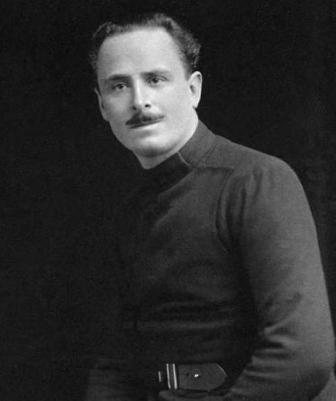
Sir Oswald Mosley was born on the 16 November 1896 into an aristocratic family, from which he inherited his title. Oswald Mosley was educated at Winchester and at the Royal Military Academy Sandhurst following a well worn path for his social class. At the age of eighteen the First World War broke out and he served in the Sixteenth Lancers in France and then in the Royal Flying Corps, the forerunner of the RAF. His experiences during the First World War had a profound effect on him, shaping many of the views that he took into politics. Between 1918 and 1931 Mosley was a Tory, then an Independent Tory, and then a member of the Labour Party. Oswald Mosley became the youngest MP in the House of Commons after winning the seat of Harrow for the Conservative Party in the 1918 General Election. In 1920 he married Cynthia Curzon the daughter of Lord Curzon of Kedleston, the daughter of the former Viceroy of India. Mosley however was not the dutiful husband he had numerous affairs, including relationships with his wife’s younger sister Alexandra Metcalfe and with their stepmother Grace Curzon.
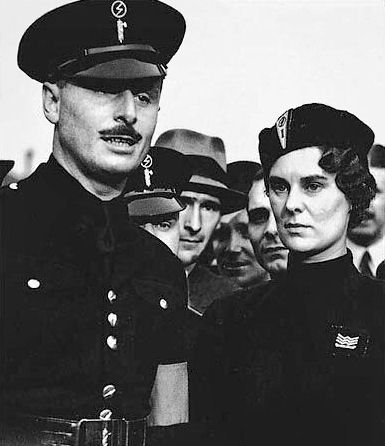
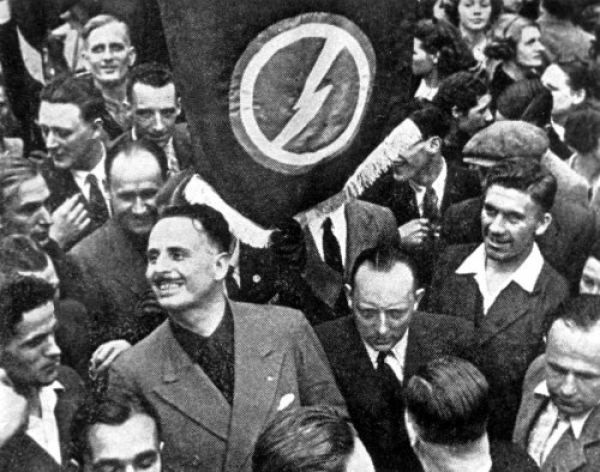
Mosley and BUF members at a rally Mosley became disillusioned with the Conservative Party and he again became re-elected as the MP for Harrow, as an independent candidate in the 1922 General Election. Two years later Mosley joined the Independent Labour Party and in 1926 he was elected to represent Smethwick in the General Election, and in the following year he was elected to the National Executive Committee of the Labour Party. After the cabinet of the second Labour Government refused to endorse his plans for national reconstruction, a task that had been allotted to him as chancellor of the Duchy of Lancaster, he resigned from office in May 1930 and founded the New Party. Supporters of the New Party included John Strachey, William Joyce, John Becket and Harold Nicholson, but in the 1931 General Election not one of the New Party candidates were elected. Within this timeframe the British Facisti was formed in 1923 and the Imperial Fascist League was established in 1928. The former, associated particularly with R. Lintorn Orman, did not last long, but the latter associated predominantly with Arnold S. Leese continued its existence until Leese’s death in 1948. With the crushing defeat of the New Party in the 1931 general election, Mosley began to move toward the most infamous phase of his career. In October 1932 after a visit to Benito Mussolini in Italy during January 1932, he disbanded the New Party and formed the British Union of Fascists: commonly know by its initials the BUF. The BUF quickly developed the appearance of a major political party, with a membership of 40,000, but by 1934 its progress was hindered by the withdrawal of respectable support such as the Rothermere press, which is covered below.
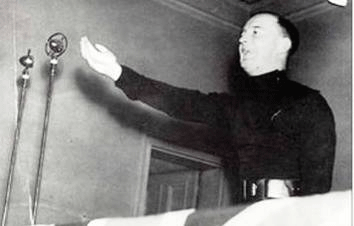
William Joyce aka "Lord Haw-Haw" Mosley appointed William Joyce, the infamous traitor who broadcast pro-Nazi radio broadcasts from Germany, and was known as Lord Haw-Haw, as the BUF’s full time Propaganda Director. Joyce along with Mosley and Mick Clarke were the organisations three main public speakers. On the 7 June 1934 the BUF held a large rally at Olympia in London, about 500 anti-fascists managed to infiltrate the hall, when they began heckling they were attacked by 1,000 black-shirted stewards. Several of the protestors were badly beaten up by the black-shirts, a public outcry ensued and Lord Rothermere and his Daily Mail newspaper withdrew its support and over the next few months membership of the BUF went into decline. By 1936, after Mosley had failed to make further political headway, considerable energy was pumped into the local politics of the East End of London, Mosley and the BUF saw the opportunity to exploit anti-Semitism for political gain. This resulted in violent clashes on the streets of the East End, this conflict was symbolised by the “Battle of Cable Street” in October 1936, in which the BUF and anti-fascist groups fought each other.
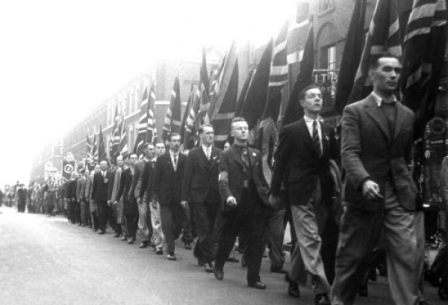
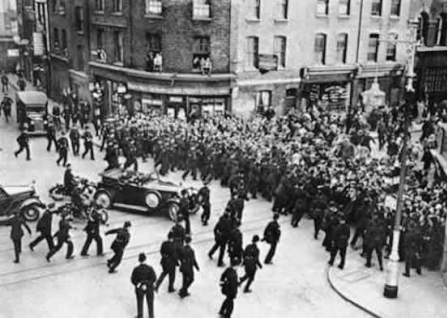
BUF march through East London, 1939 After a series of well-supported marches through the East End of London which had attracted little opposition, Mosley decided to hold a mass rally on 4 October 1936 to mark the fourth anniversary of the founding of the party. The intention was that the BUF should assemble at Royal Mint Street at 2.30 p.m. for an inspection by Mosley. This would be followed by a march through the East End and he was due to speak at Salmon Lane, Limehouse, at 5 p.m.; Stafford Road, Bow, half an hour later; Victoria Park Square at 6 p.m. and Aske Street, Shoreditch, at 6.30 p.m. The BUF began to assemble at 1:25 p.m. but they had been pre-empted by a group of some 500 or so communists who were already there, with the Communist 'Daily Worker' being sold in Leman and Cable Streets. By 2:15 it was estimated that there were around 2,000 communists and anti-BUF demonstrators in the Aldgate area, about half of whom had blocked the Commercial Road at Gardiner's Corner. At 3 p.m. the BUF, still in Royal Mint Street, now totaled around 2,000 including women and cadets and four bands. At 3:30 p.m, Sir Philip Simon after receiving reports from the police of the potential for trouble decided that he did not have the resources to keep the communists and BUF apart and consequently forbade the march. He instead allowed the BUF to march West through the City and the BUF moved off at 4 p.m, ending their march at Somerset House in the Strand at 4:30 p.m.
The "Cable Street Battle" Meanwhile the communists in Cable Street had overturned a lorry; timber was expropriated from a builder's yard, along with bricks with which to pelt the police. Broken glass was strewn across the road to hamper and injure the police horses and the battle between the police and communists lasted for some hours, overall there were dozens of injured police and 70 arrests. Special Branch police report of November 1936 concluded:
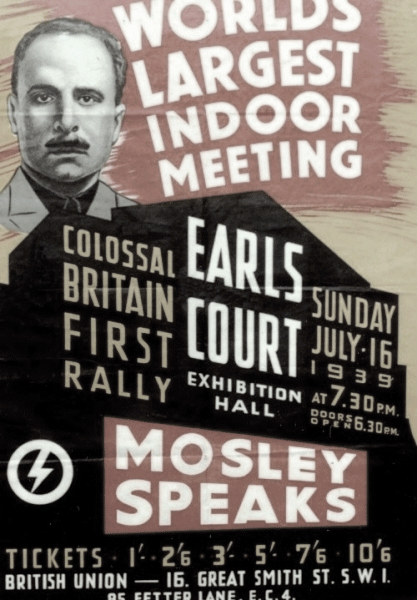
Bus posters advertising BUF rally at Earls court In Stepney, Shoreditch, Bethnal Green, Stoke Newington and Limehouse, crowds estimated at several thousands of people (the highest being 12,000) assembled and accorded the speakers an enthusiastic reception; opposition was either non-existent or negligible and no disorder took place". That year the Government became anxious about the threat to public order, passed the Public Order Act, which banned the wearing of uniforms in public, meant that the BUF could not wear its hallmark black shirts and the appeal of the BUF was curtailed. In addition the economy recovered during the 1930’s and the rise of the National Socialist Party in Germany did not assist the BUF’s cause, but the BUF was active until the outbreak of the Second World War and Mosley continued to attract large crowds at public meetings. Oswald Mosley began an affair with Diana Mitford the daughter of the 2nd Baron Redesdale, one of his wealthy supporters. Diana left her husband but Mosley refused to desert his wife. It was not until Cynthia Curzon died of peritonitis that Mosley agreed to marry Diana. In October 1936 Diana and Mosley secretly married in the house of the Nazi propaganda Minister Joseph Goebbels. Adolf Hitler was one of only six guests at the ceremony. While in Nazi Germany Diana talked to Hitler about the possibility of establishing a pro-Nazi radio station in Britain, but it never materialised. Diana and Mosley had two sons, Alexander born in 1938 and Max born in 1940 who became famous as the president of the Federation Internationale de L’Automobile (FIA).
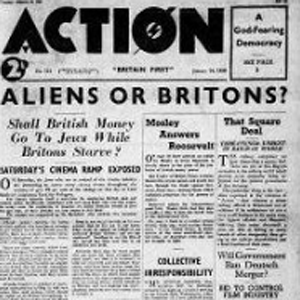
"Action" A BUF periodical First Published Feb 21, 1936 In his book entitled "Fascism" Mosley outlines and answers 100 questions related to his policies, beliefs and goals, some of which are illustrated here: Why is the Movement called Fascist?
Do you believe in the racial theories of the German Nazi Movement?
A rally of the BUF What alterations, if any, will you make in the laws governing the immigration of alien races into Great Britain?
What is the Fascist attitude towards the Jews?
Is not this hard on the minority of Jews who put "Britain First"?
Will the Jews then be persecuted or ill-treated?
Will they be allowed the right of citizenship or permitted to be officials or M.P.'s in the Fascist State?
Will Jews, who are deported, be able to take their money with them?
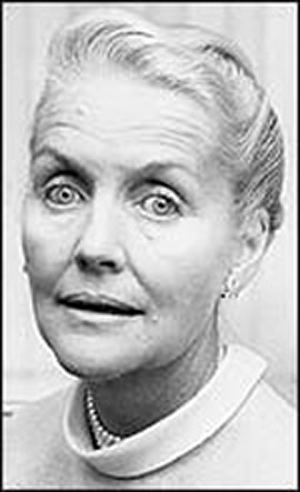
Diana Mosley The outbreak of the Second World War with Nazi Germany soon resulted in the restriction of the BUF activity, although it never disappeared completely. On the 21 May 1940 leading members of the BUF, including Mosley and key members of his organisation such as Neil Francis Hawkins and Alexander Raven Thomson, were interned under Regulation 18B(1A), which permitted the government to detain persons who had associations with enemy powers, Arnold S. Leese was among the other fascist internees. Mosley and his wife lived in a small house in Holloway prison, with a small garden.
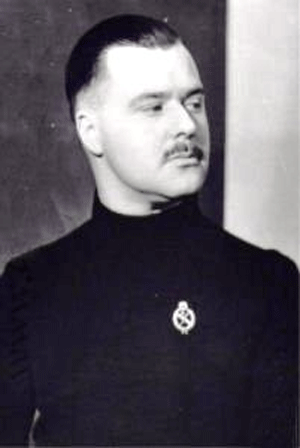
Neil Francis-Hawkins
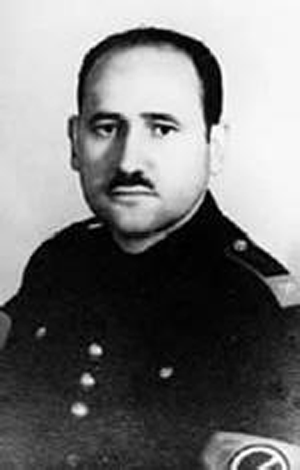
Alexander Raven Thomson Oswald Mosley was released from internment in November 1943, but the BUF was no more, after the war Mosley reconstructed his political organisation as the Union Movement and attempted to launch a National Party of Europe, but both failed and this resulted in Mosley’s decision to leave Britain and live in Ireland. Mosley briefly returned to England in order to fight the 1959 General Election at Kensington North, a year following the Notting Hill race riots and concerns over immigration was a central theme to Mosley’s campaign. He contested the 1966 General Election at Shoreditch and Finsbury but he fared even worse than in 1959. Mosley set about reconstructing the past on his terms. In his autobiography, “My Life” which was published in 1968, he denied that he had ever been an anti-Semite. Sir Oswald Mosley died in his Orsay, near Paris home on the 3 December 1980 from natural causes. _______________ Sources: Wiener Library
|