|
Home LETTING GO OF GOD |
|
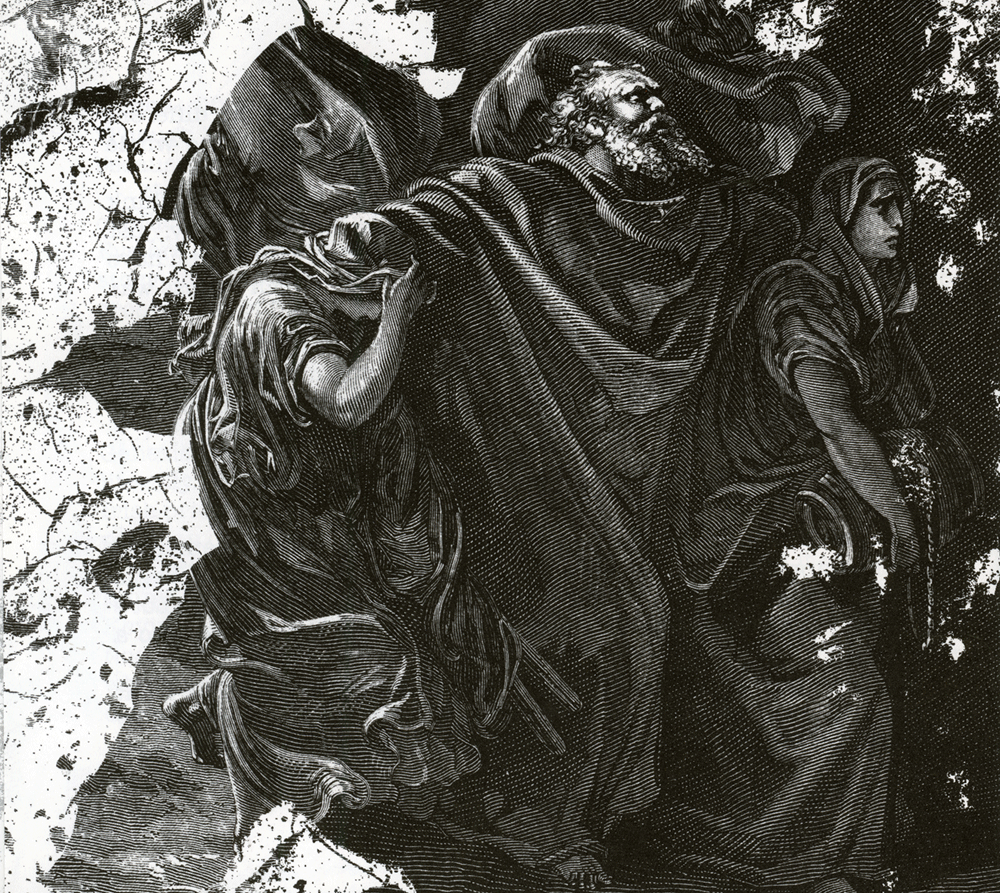
6. Sodom Be Gomorrah; Abraham Be Isaac Then we got to stories like Sodom and Gomorrah. All I remembered about that story is that they were these two sinful cities, like Las Vegas and Reno or something, and God got mad and wiped them out. And Lot's wife looked back when she was told not to and she got turned into a pillar of salt. But the nuns of my grade school didn't explain to us about what happens right before they flee. Right before they flee, Lot is visited by these two angels, who are masquerading as two men, and they come and stay overnight at his house. And this mob forms outside and they yell, "Send out those two angel-like men to us so we can have sex with them!" And Lot yells "No!" (Which I think is a basic rule of hospitality: don't give up your guests to be raped by the angry mob outside.)
But then, what does he say next? He says, "Why don't you take my daughters and rape and do what you will with them? They're virgins!" Okay, so Lot is evil, right? How is it that the story we know about him is about his wife getting turned into a pillar of salt? Maybe that was her only way out. Maybe being a big pillar of salt is preferable to being married to Lot! Anyway, after Lot and his two traumatized daughters flee Sodom and Gomorra, they all go up to a cave in the mountains. And during the night, Lot's two daughters get Lot drunk and then rape him. Do they do this in revenge of what their father did to them? No. The Bible says it's because there aren't any other men around. Even though, the Bible also says that they're not that far from a city named Zoar. So, I guess no men around for maybe a few miles? And wait a minute, so Lot's two daughters just had to drug and rape somebody? And then I guess if you're their dad and you're the only one there.... Okay, I knew the Bible had nutty stories, but I thought they'd be wedged in amongst an ocean of inspiration and history. But instead, the stories just got darker and even more convoluted. This Old Testament God makes the grizzliest tests of people's loyalty. Like when he asks Abraham to murder his son, Isaac. As a kid, we were taught to admire it. I caught my breath reading it. We were taught to admire it? What kind of sadistic test of loyalty is that, to ask someone to kill his or her own child? And isn't the proper answer, "No! I will not kill my child, or any child, even if it means eternal punishment in hell!"? At the next Bible study class Father Tom reminded us, "That Isaac represents what matters to Abraham most. And that's what God asks us to give up for him." I said, "But loving and protecting and caring for the welfare of your child is such a deep ethical, loving instinct and act. So, what if what matters to you most is your own loving behavior? Should we be willing to give up our ethics for God?" And he said, "No! No, it's because your ethics, because your ethics IS your love and faith in God." That confused me a little bit, but I decided to just let that one go. But then, I found out that Abraham is not the only person willing to murder his own child for God. They're all over the place in the Bible. For example, in the book of Judges, this guy named Jephtheh tells God that if he can win this battle, he will kill the first person who greets him when he comes home as a burnt offering. And who is the first person he sees? His only child, his beloved daughter, who runs up to him playing with tambourines and singing. "Hi daddy... what?"
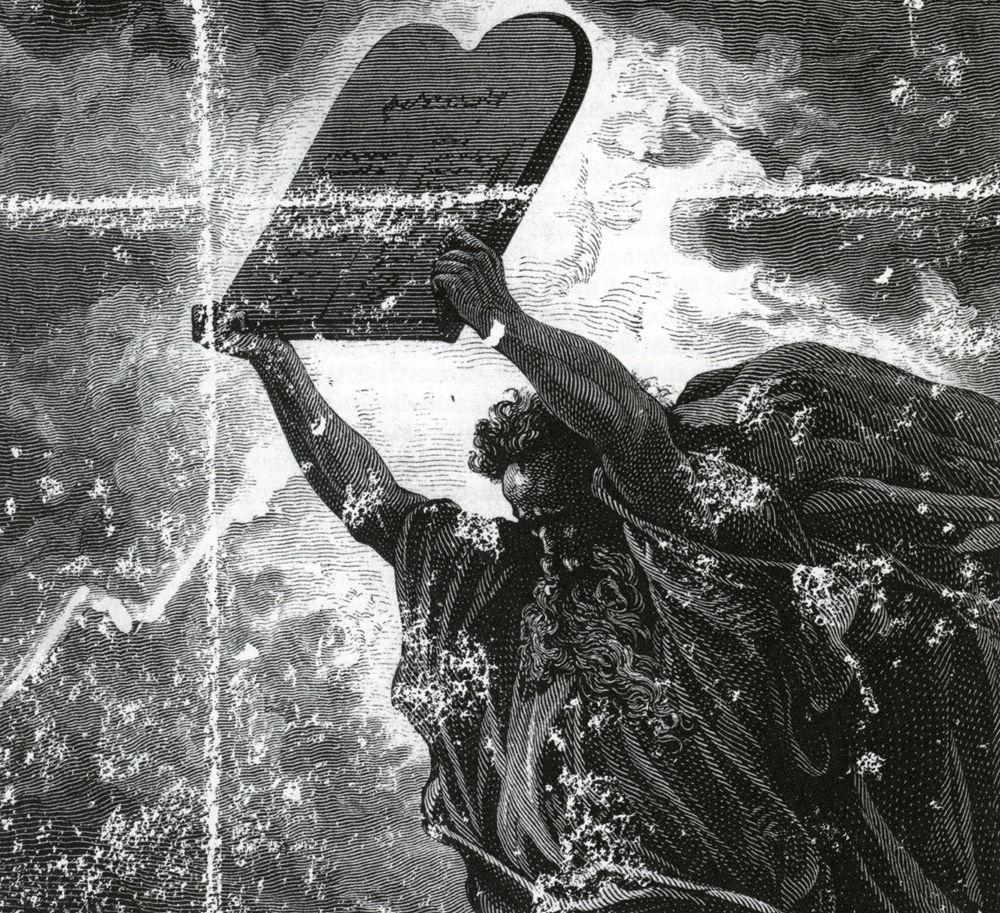
And does God say, "No, don't kill your only child as a burnt offering to me!" Or even, "Jephtheh, who did you expect to be the first person to greet you when you came home?" No, it appears the most important point of this story is that Jephtheh allows his beautiful daughter to go off into the woods for two months to mourn her virginity (I kept thinking, "Run! Run!") before she comes back and he kills her... by lighting her on fire. Even if you leave aside the creepy sacrifice-your-own-offspring stories, the laws of the Old Testament were really hard to take. Leviticus and Deuteronomy are filled with archaic, just hard to imagine laws. Like if a man has sex with an animal, both the man and the animal should be killed. Which I could almost understand for the man, but the animal? Because the animal was a willing participant? Because now the animal's had the taste of human sex and won't be satisfied without it? Or my personal favorite law in the Bible: in Deuteronomy, it says if you're a woman, married to a man, who gets into a fight with another man, and you try to help him out by grabbing onto the genitals of his opponent, the Bible says you immediately have to have your hand chopped off. Even things that I thought were set in stone, like literally set in stone, like the Ten Commandments, were not. I mean, the Ten Commandments that we are all most familiar with, are these rules that God told Moses on Mt. Sinai, without referring to them as commandments and without even setting them in stone. It's only later in Exodus, when Moses goes back up to Mount Sinai, that God then hands him a set of two tablets of stone with these rules chiseled on them. When Moses gets back down off the mountain, he sees the people worshipping a golden calf, and he has a tantrum and he smashes the stones before he reads them. So then Moses goes back up to Mt. Sinai and God gives him another set of stone tablets, and this is the first time now that they are referred to as "The Commandments." And they're chiseled into stone, so you'd sort of think that God must be pretty firm on the subject of commandments by now. But the rules are significantly different than those other rules. Like how all male children have to appear before God three times a year (however that's supposed to be accomplished) and how you shouldn't cook a baby goat in it's mother's milk and how every domestic animals' first born male should be sacrificed. But then the commandment goes on to say that if you don't want to sacrifice your donkey's firstborn male, you could go ahead and substitute a lamb's. If you really needed to.
Some people think that without the Ten Commandments, morality in society would be relative and wishy-washy. But in the Bible morality is relative and wishy-washy. In fact, it sure seems like our modern morality is much more loving and humane than the Bible's morality. Well, Father Tom saw me outside of church after Mass one Sunday. He said, "Julia, you know, you always look so very sad in Bible Study class." And I said, "I'm sorry Father, it's just that, God is so offensive in the Bible. I mean, really, it's like he's bi-polar." And he said, "Well, y'know, the Old Testament. Just remember Julia, that the people who wrote it were an ancient Bronze Age civilization. I mean the stories are legends. They're tales of trickery and deception that were told around the campfire by sheiks who made God impressive by their very ancient standards." I said, "Oh. Wow. Looking at the Old Testament that way, it actually makes a lot of sense now. Looking at the Old Testament that way is quite interesting. But you know, Homer was also an ancient Bronze Age writer, writing about Gods... I mean, how much are we supposed to believe is actually true?" And he said, "Well, there's no evidence that Abraham is anything other than legend. Or Isaac. Or Moses. Or even the whole Exodus story." I said, "The Exodus story is a myth?" And he said, "Well, myth-ish." And I said, "How could something be myth-ish?" And he said, "Well, the Exodus story is a myth in the sense that it never actually happened. But it's not a myth in the fact that a people believed the story was true, and shaped their identity as a culture based on believing it. But, Julia, you can't read the Bible with modern, historical eyes. You've got to read it with the eyes of faith. This is the story that God wants us to know." I left the church thinking, "Okay, calm down. This is the Old Testament. Old. Old is right in the title. A new, a Newer Testament is coming up. And that's why God must have sent his son, Jesus. Because we clearly hadn't gotten the message right. Right? Jesus was all about tearing down those old, archaic ways of worship and reminding people that what mattered most was what we were like on the inside. I could hardly wait to meet Jesus again as if it were the first time.
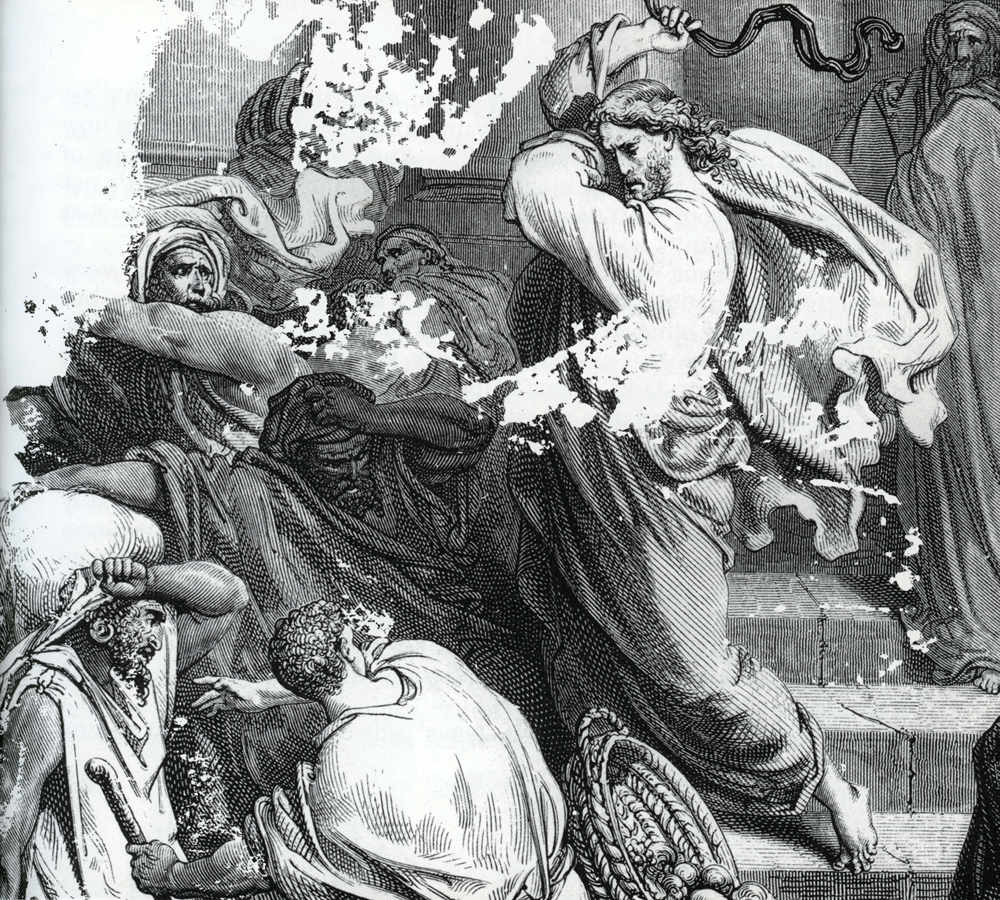
But, oh dear. Well, first of all, Jesus was much angrier than I had expected him to be. I mean, I knew Jesus got angry with all those moneychangers in the temple, but I really had no idea that he was so angry so much of the time. And very impatient. Jesus says that he speaks in parables because the people, they just don't understand anything else. But the parables are often foggy and meaningless. And Jesus is snippy when even the disciples don't get them. He says to them, "If you don't understand this parable, then how can you understand any parable?" And "Are you incapable of understanding?" I kept thinking, "Don't teach in parables then. It's not working! Even your staff doesn't understand them! Why don't you just say what you mean?" Okay, so, Jesus isn't so patient and I think he picked a very ineffective lesson giving technique, and he's angry most of the time, but that doesn't make him bad. It's just, wow, I really expected someone else. Some of the parables are not just foggy, but to me, they're really sort of offensive. Like, in Luke, Jesus helps us understand God's relationship with humans by telling us a story about how God treats people the way people treat their slaves. They beat some more than they beat other ones. Okay, I know this was a different time and everything, and I really tried to keep that in mind as the Bible refers to slavery all over the place. And not only does it not say it's wrong, I mean, the Bible gives advice about how you're supposed to keep your slaves and how slaves should behave obediently at all times to their masters. But I don't know, I sort of thought the Son of God would say slavery was wrong. But no, Jesus does not say that. In fact, he uses slavery as an example of how God treats people. It was really hard to stay on Jesus' side when he started saying really aggressive, just hateful things. Like in Luke, Chapter 19, Jesus says that he is like a King who says, "Anyone who does not recognize me, bring them here and slaughter them before me." Or in John, Chapter 15, where Jesus says, "Anyone who does not believe in me is like a withered branch that will be cast into the fire and burned!" In Matthew he says, "I come not to bring peace, but a sword." In Luke he says, "And if you don't have a sword, sell your clothes and buy one." Then Jesus just starts acting downright crazy. Like in Matthew, Chapter 21, when this fig tree doesn't have a fig for Jesus to eat, he condemns the fig tree to death. That's right, Jesus condemns a fig tree to death. Not a parable, by the way. Just Jesus pissed off that the fig tree didn't have a fig for him to eat when he wanted one! Not exactly the Prince of Peace who taught us to turn the other cheek.... And then, there's family. I have to say, that for me, the most deeply upsetting thing about Jesus, is his family values. Which is amazing when you think how there's so many groups out there who say they base their family values on the Bible. I mean he seems to have no real close ties to his parents. He puts his mother off cruelly, over and over again. At the wedding feast he says to her, "Woman, what have I to do with you?" And once, while he was speaking to a crowd, Mary waited patiently off to the side to talk to him, and Jesus said to the disciples, "Send her away, you are my family now." Matthew, Mark and Luke all tell this exact same story, but Mark actually tells us why Mary was there to see Jesus. He says, Mary came to see Jesus to restrain him, because the people were saying, "He's gone out of his mind." I kept thinking, "Yes! Let's go get Jesus and get him some help!" Anyway, Jesus discourages any contact his converts have with their own families. As we know, he himself does not marry or have children and he explicitly tells his followers not to have families as well, and if they do, they should just abandon them. Now, mostly Jesus says this because he believed the End Of All Time was imminent. Jesus said over and over again that the people who were alive when he was alive would not die naturally, but see the End Of Times. He tells us this in Mathew, Mark and Luke. So, okay, Jesus tells us not to have families because he (mistakenly) believed that the End Of All Time was imminent, but then he tells us not to take care of the families that we do have already. In Luke, Chapter 14, Jesus says, "Anyone who comes to me and does not hate father and mother, brothers and sisters, wife and children cannot be my disciple." I mean, isn't that what cults do? Get you to reject your family in order to inculcate you? So, that's the New Testament family values for you. The supposed big improvement over the Old Testament family values, which seemed to me to be mostly about incest and mass slaughter and protecting your own specific genetic line at all costs. 9. St. Paul & The Book Of Revelation
After the Gospels, there's a bunch of letters written by the early Christians, the most important of which were written by St. Paul. Now, the Bible's view of women is dreadful in general, and I know this was a different time and everything. But St. Paul? Man, he really gets right to the point. St. Paul writes, "Man is the image and glory of God, but woman is the glory of man. A woman should learn in quietness and full submission. I do not permit a woman to teach or have any authority over a man; she must be silent. If there is anything a woman desires to know, let her ask her husband at home. For Adam was formed first, and then Eve. And it was not the man who was deceived, it was the woman who was deceived and became the sinner." The Bible. The Bible. The Good Book! The Good News! I was so disillusioned by the time I finished the epistles, I just didn't think it could get any worse. But, it did. We were just about to read the last, and most oddball book of the Bible: Revelation. Now, apparently, Revelation was written by St. John, the same person who wrote a Gospel and some of the epistles. The biblical historian Ken Smith says that "If his epistles can be seen as John on pot, then Revelations is John on acid." It describes the End of Days with a little too much gruesome enthusiasm. Revelation tells us that in heaven there "is a throne, and the One who sat there had the appearance of a jasper." "Around the throne were four living creatures, and they're covered with eyes, front and back. Day and night they never stop saying, 'Holy, holy, holy is the Lord God Almighty who was and is and is to come.'" In heaven, Jesus resembles a dead lamb with seven horns and seven eyes. When the gates of Hell are opened, locusts pour out with human faces, wearing tiny crowns, and they sting people with their tails. Revelation tells us that only 144,000 people will be saved and go to heaven and that none of them will have, quote, "defiled themselves with women." Which I guess excludes most heterosexual men from heaven and, depending on how you interpret that word "defiled," I would say excludes all women, too. After we finished the Book of Revelation, the entire Bible Study group sat there, dumbfounded, our Bibles on our laps. Father Tom said, "Revelation's a poem about the end of the world?" I said, "Father Tom, I'm having a really hard time with this book." And he told me to, "pray for faith."' I left the church thinking, "Is this one big practical joke? Where is my God? The Jesus I know? The one that 1 love and the one who loves me?" I was driving home, and I was stopped at this red light on Crenshaw and Wilshire, and it was a Sunday, and all these people were walking to church, holding their Bibles. And I wanted to roll down the window and say, "Have you read that book? I mean, really!" I felt like I was in a horror film and the clue to the insanity was not a secret document, it was a book that everyone was holding, that was on every coffee table, the biggest best seller of all time, in every hotel room in the land, the key to the understandings of the faith! And yet, if you cared enough to glance inside, you found you'd opened the door to an insane asylum, with a bunch of crazy people dancing around saying, "Yippity, yippity yah!" And now I'd shut that door and how could I pretend that I hadn't opened that door? My mother said, "Julie, I just ignore what I don't like. Why would you do something like read the Bible cover to cover if you weren't just looking for reasons to get upset? You make your life so much harder than it has to be, honey!" I went to Book Soup and I wandered around and I saw a book called, "The History of God" by this woman Karen Armstrong. Karen Armstrong is this amazing British religious writer who was a nun for seven years and then left the convent and now, I believe, she teaches religious history at a Rabbinical Institute in England. In my mind, the Haley Mills character in "The Trouble With Angels," grows up to become Karen Armstrong. Karen has all sorts of scathingly brilliant ideas. I loved "The History of God." In it, Karen makes a good point. She says that the stories of the Bible are not literally true; everybody knows that they're not literally true, and it isn't even important that they're true. What's important is that they're "psychologically true." And that was a big revelation for me. I felt I finally understood, as if, at long last, I was in on the secret. I thought, "Oh, yeah! This is what everyone already knows; only no one says it. Or maybe this is what Father Tom was trying to tell me when he said 'myth-ish.' He meant it was psychologically true." I walked around thinking, "Of course, of course!" And I remembered the nuns teaching me dogma in grade school, and how exasperated they would get when I asked so many questions. And now I knew what they were thinking, they were thinking, "Don't you know, it's just psychologically true? Everybody else gets that!" So, when I went to Mass on Easter Sunday that year, I felt I had a new positive attitude. I knew the correct way to look at the stories, historical accuracy was not important; that peoples built cultures around them wasn't even important. What was important was that the stories triggered us deep in our psyche, they were: psychologically true. But as I sat there in Mass, I thought, "What does that really mean: psychologically true? I mean, Jesus' death and resurrection, rebirth, okay I get it, psychologically true enough. But what about other stories? I mean what about Persephone going down into the underworld? That's psychologically true, too, I suppose. Or, what about stories from the Iliad? Or Darth Vader? Or the Little Engine That Could? They are also psychologically true stories, aren't they?
"And what's psychologically true about atonement? We were taught that Jesus died for our sins, based on this idea of atonement, or that someone else can pay for the sins of other people. For the first time, after going to church basically my entire life, I considered the idea that God sent his son to earth to suffer and die for our sins. Why?
|