|
THEIR KINGDOM COME -- INSIDE THE SECRET WORLD OF OPUS DEI |
|
15. Octopus Dei
WHILE ESCRIVA DE BALAGUER WAS COLLECTIG 'PUFFS OF PRIDE', OPUS Dei was building corporate pyramids and developing the praxis of profit-transfer accounting. Using anstalts, stiftungs and offshore shell companies, it created veils of corporate secrecy to hide its many tentacles. A stiftung (foundation) is a form of corporate trust developed by the Swiss and often used for intricate financial dealings. Anstalt (establishment) is a Liechtenstein speciality, modelled on an Austrian forerunner, the Privatanstalt. It has a fixed capital but issues no shares. Both are so shrouded in confidentiality that their 'founder-in-fact' or 'founder-in-due-course' -- i.e., the real owners are absolutely unidentifiable to the outside world. Opus Dei's reliance on these devices came about in stages as it grew in size and sophistication. A first stage was its use of ordinary onshore trusts to disguise the ownership of property, but new layers were added in the mid-1950s. One of the most important of these was created by lawyer Alberto Ullastres, before he became minister of commerce. Known as Esfina, its initial capital was not quite $1 million. Esfina promoted a new 'Opusian invention, the so-called 'common works'. These were quite different from 'corporate works', which were concentrated in the educational field and openly linked to Opus Dei, the University of Navarra being a prime example. Common works, on the other hand, although part of the apostolate, were considered as commercial vehicles, financed whenever possible with other people's money but run by Opus Dei personnel. Many of the Esfina holdings were in the 'AOP' (Apostolate of Public Opinion) sector, established to influence public opinion, under the guidance of an oversight committee. In Spain, the first AOP overseers were Laureano Lopez Rodo, Alberto Ullastres and Professor Jesus Arellano. AOP was a cover for pilleria of a different nature. Opus Dei was, and remains, a privileged institution of the Church that claims -- indeed insists with all the piety it can muster -- that its only interest is the spiritual well-being of members and that it never interferes in their daily lives. It doesn't own anything, certainly not a bank, and it never plays politics. But now, with its AOP ministry, Opus Dei wanted to covertly influence public opinion, having first conditioned its members to adopt a set of moral values that set them apart from the rest of society. In a first phase, the Apostolate of Public Opinion concentrated on founding or taking over public companies involved in broadcast and print media, publishing and communications. A majority of the share capital in each company was held in trust by Opus Dei numeraries, supernumeraries or tested co-operators. In all cases, the trustees were required to execute undated contracts of sale for the shares they held which were kept in a safe at the regional headquarters. In Spain, the common works were funded through Esfina, which raised its capital from the families of members and friends. In each case the capital so raised was treated like a savings account at a private bank, receiving interest at rates moderately above commercial bank rates and every account being individually managed with full diligence and discretion. In addition to tax advantages, Esfina's depositors had the satisfaction of believing their money was financing 'God's work'. Esfina's first chairman was Pablo Bofill de Quadras, an Opus Dei numerary who also served on the board of the Spanish subsidiary of a Vatican-controlled company, Condone Espanola. His deputy chairman was Jose Ferrer Bonsoms, a young banker and supernumerary whose family owned extensive holdings in Argentina. Esfina acquired or founded with the monies of others Ediciones Rialp, Opus Dei's flagship publisher, Editorial Magistero Espanol, publisher of secondary- level school books, and SARPE, which in turn owned Alcazar, a conservative newspaper, Actualidad Espanol, a news magazine, Actualidad Economica, a business weekly, Telva, a popular women's magazine, and Mundo Cristiano, a religious magazine. These publications, managed and predominantly staffed by members, in turn needed a press agency, and so Europa Press was born. Their advertising and sales promotion was handled by an Esfina-owned agency, and they used printing presses belonging to Rotopress S.A., also a child of Esfina. All were dependent upon the financial backing of Opus Dei as frequently, serving AOP needs rather than purely commercial pursuits, they ran at a deficit. In 1958, Esfina branched into banking, acquiring a small private bank in Barcelona, which it renamed Banco Latino. Months later it added Credit Andorra, the largest bank in Andorra. In 1959, Esfina formed Universal de Inversiones S.A. to manage its more speculative investments. Universal's president was Francisco Planell Fontrodona, until ordained in 1964. He was assisted by Alfonso Lopez Rodo, brother of Laureano Lopez Rodo, until Alfonso also was ordained. The Falange regarded SARPE's activity with hostility. Strict censorship still reigned in 1962, as rivalry between Opus Dei and the Falange was moving towards a final showdown, and the Falangist minister of information wanted to close SARPE on grounds that it was the propaganda arm of an unauthorized political movement. Opus Dei denied its involvement with SARPE, which was manifestly untrue. When threatened with an expropriation order, Opus Dei's regional administrator telephoned Navarro-Rubio and Calvo Serer to inform them that overnight they had become SARPE's controlling shareholders. The Falange backed down and SARPE was saved by a sleight of hand that would not have been necessary had Opus Dei been what it claimed to be: a spiritual organization that did not engage in politics. A major Opus Dei benefactor immediately following the Civil War was the Catalan industrialist Ferran (Fernando) Valls Taberner, who had financed the opening of a NSRC commission in Barcelona and insured that it was staffed by Opus Dei numeraries and who had founded Banco Popular de los Previsores del Porvenir (the Popular Bank for Future Needs) which after some major face-lifting in the 1950s became the cornerstone of Opus Dei's financial edifice in Spain. With Valls's sudden death in 1942, Felix Millet Maristany, an ultra-religious Catalan financier, became the bank's chairman. In 1947 he changed the name to Banco Popular Espanol and listed it on the Madrid Stock Exchange. His right-hand man was Juan Mariuel Fanjul Sedeno, an Opus Dei supernumerary who, like Millet, had been close to Ferran Valls. Fanjul was proxy-holder for an important block of the bank's shares belonging to the Valls family. [1] Through Fanjul, Opus Dei began its penetration of the bank's directorate. Ferran's eldest son, Luis, became an Opus Dei numerary. At 24 he was an assistant professor of law, first at Barcelona and then at Madrid. In 1950, his Opus Dei superiors decided he should become the Vocal of St Gabriel, looking after the spiritual requirements of supernumeraries and their families. But after two years of struggling with the Archangel's duties, he told his spiritual director that he was not cut out to be a counsellor of souls and wanted to become a banker. In the world of banking Luis Valls became for Opus Dei what Lopez Rodo represented in the world of government. In 1953, he entered the family bank and was taken in hand by Mariano Navarro-Rubio. Banco Popular Espanol had by then moved its main offices to Madrid. A restructuring of the Valls holdings concentrated the banking interests with Luis and his brothers Javier and Felix. Manufacturas Valls, the family textile combine, was left in the hands of their uncles. In any event, Luis and Felix, also a numerary, continued to hold shares in Manufaeturas Valls, which soon branched into nuclear engineering. As Opus Dei was more interested in banking than textiles, Banco Popular was brought solidly under its domination. Opus Dei has never owned the bank, not legally at least, because control was ultimately run through a series of offshore trusts. The joke around Opus Dei was that Esfina really was a coded abbreviation for 'we take money from unholy souls to finance holy works'. The cynical would say that this notion fitted the Opus Dei ethic perfectly, in that as the end-product (money) was destined for holy works, the source from which it came was of no account. Escriva de Balaguer often said this and believed it was morally upright. But Esfina also brought headaches. Using the common works to promote Opus Dei's political agenda, namely the liberalization of the economy and a modernizing of Spain's political structures, involved a degree of risk. The common works also constituted a financial burden. These factors provoked an unexpected reaction from Opus Central. One day in 1963, the regional administrator was informed that the Father in Rome had decreed: 'No more common works!' Buyers were found for a few of the more viable concerns, and in one or two cases -- Telva, for example -- friendly banks financed a staff buy-out. But overall the experience of arbitrarily being required to liquidate the common works was traumatic for most concerned. Many members had put their hearts and sometimes their family's savings into these enterprises, believing they were doing God's work, only to be told that God wasn't interested any more. The liquidation of the common works did not mean that Opus Dei abandoned the AOP concept. It was continued under another form. A few of the common works, moreover, were sacred. These included the Rialp publishing house and Talleres d'Arte Grande, which supplied religious art for Opus Dei centres around the world. After winding down the common works, Esfina's newly freed capital was invested in the banking sector. The first target was Banco Atlantico, a small regional bank whose major shareholder had been killed in a train crash. Negotiations were entrusted to Barcelona industrialist Casimiro Molins Robit, an Opus Dei supernumerary, who led the sellers and public to believe that he was acting on behalf of Banco Popular Espanol. The deal successfully concluded, Molins became Atlantico's new chairman, while management was taken over by the Bofill-Ferrer tandem. They built the bank into one of Spain's top dozen, modifying its statutes along the way to permit 15 per cent of the profits to be donated to social causes. As Bofill and Ferrer were informed that their brother in the faith, finance minister Mariano Navarro-Rubio, was drafting new legislation that would permit commercial banks to branch into merchant banking, they planned to launch Atlantico's own merchant bank, baptized Bankunion. But they wanted to bring international partners into the new unit. The managing director of the Vatican-controlled Condotte d'Acqua S.p.A., Loris Corbi, introduced Bofill to John McCaffery, the Rome representative of Hambros Bank. [2] Bofill offered McCaffery a participation. But Hambros was already committed to form a merchant bank with Banco Popular Espanol. McCaffery therefore suggested that Bofill and Ferrer contact the up-and-coming Milan financier Michele Sindona. Bankunion was registered in October 1963 with a share capital of $24 million. Banco Atlantico directly held only 10 per cent of the capital. It is uncertain whether Sindona ever joined the consortium. If he did, he participated through one of the anonymous foreign investment companies that became Bankunion's majority shareholders. Other investors included Esfina and Condotte Espanola. [3] Like Banco Atlantico, Bankunion's statutes required that 15 per cent of its profits be donated to social causes. [4] Sindona, in the meantime, succeeded in selling a 24 per cent interest in his Banca Privata Finanziaria of Milan to Continental Illinois Bank & Trust of Chicago. Continental Illinois was at the time the seventh largest bank in the United States. The move proved astute as Continental's chairman, a Mormon bishop by the name of David M. Kennedy, became Richard Nixon's Secretary of the Treasury. Sindona was introduced to him by Paul Marcinkus, a priest from Chicago turned Vatican diplomat who became Pope Paul Vi's travel director. Sindona in turn introduced Bofill and Ferrer to David Kennedy. They interested the Mormon bishop in acquiring for Continental Illinois an 18 per cent interest in Banco Atlantico. The transaction was run through a Swiss company, Greyhound Finance AG. Greyhound was domiciled in the Zurich offices of one of Europe's leading confidential money experts, Dr. Arthur Wiederkehr. During the negotiations, Bofill and Ferrer met Wiederkehr, whose talents were much in demand by international capital movers. Sindona used Wiederkehr, and he also told fellow Milan banker Roberto Calvi about the Zurich lawyer's services. Almost as an aside, Sindona introduced Calvi to the Madrid crowd. Opus Dei at the time was re-organizing its corporate holdings worldwide along the guidelines established in Spain. Ownership and management of assets were generally split between two separate corporate entities which in turn were owned by one or more private trusts or holding companies. This gave Opus Dei an almost invisible corporate profile but also theoretically gave it access to a percentage of the funds received as grants by certain of its auxiliary societies. In Ireland, for example, the Work had been present since July 1947. Its property investments there were placed under the umbrella of University Hostels Limited. But the properties themselves were managed by another company, Hostels Management Limited. Sixty-two per cent of University Hostels' shares held in the name of Father Patrick Cormac Burke were transferred to Lismullin Scientific Trust. University Hostels' remaining shares went to Tara Trust. While it is unclear who were the owners of these trusts, both listed their address as Knapton House, which was an Opus Dei residence in Dun Laoghaire, County Dublin. In 1977 the Reverend Doctor Frank Planell was named Opus Dei's regional vicar for Ireland. As Francisco Planell Fontrodona, 'Frank' had already served Opus Dei as chairman of Esfina's Universal de Inversiones S.A. One of the most gifted Irish numeraries under Planell was Seamus Timoney, a professor of mechanical engineering at University College, Dublin. When not lecturing, Timoney tinkered with advanced weapons systems, designing and patenting a sturdy armoured personnel carrier known as the Timoney APC. Timoney, however, was no marketing expert. Was it too much to assume that Father Frank referred the matter to Opus Central, which happened to be aware that the Argentine Army needed this type of equipment? It is known that the Timoney APC went into production in 1978 and that an undisclosed number were sold to the Argentine Armed Forces. [5] If normal prescriptions were followed, 10 per cent of the proceeds of the Argentine sale would have been paid to Opus Central. Professor Timoney was an interesting case. Associated with Opus Dei since the 1950s, he was internationally known for his weaponry inventions. In 1957, he incorporated Industrial Engineering Designers Limited, which became an Opus Dei auxiliary society. Five of the six founding directors of Engineering Designers were Opus Dei numeraries. Netherhall Educational Trust, the principal Opus Dei charitable trust in the UK, received a 'gift share'. Several prominent Opus Dei members in Ireland and the UK also put up capital, and yet Opus Dei claimed, 'No funds of Opus Dei were ever sought by Professor Timoney, nor given to him.' [6] Technically, that may have been correct, but it did not prevent Timoney in his various ventures from calling upon the resources of the Opus Dei network, bringing to Ireland associated engineers from Britain, Spain and the US. Industrial Engineering Designers Limited's manufacturing facility, Advanced Technology Limited -- one supposes another auxiliary society -- was set up in 1975. Ad Tee, as it became known, built and tested prototypes of the Timoney APC. One of the largest orders for the vehicle came from the Belgian Army. It was also produced under licence in General Pinochet's Chile. If not disturbed by the fact that an Opus Dei numerary, supposedly dedicated to achieving Christian perfection, spent his spare time designing armoured personnel carriers and other military machines, then one will not be bothered by the fact that numerary Michael Adams supported the throwing of bombs by IRA terrorists. Adams was managing director of Four Courts Press, publishers of The Way in Ireland, and he lived at Opus Dei's national headquarters, Harvieston, in Dublin. What he really went on the record to state was that throwing bombs in Northern Ireland was defensible if it brought the British to the negotiating table. This is what he wrote: 'None -- let's hope -- of the guerrillas in the North [i.e., Ulster] enjoys killing English soldiers, yet they will celebrate in a kind of poignant exhilaration the death of each soldier because each death builds up the only language which the British seem to understand ... It is pathetic that the sorrow of bereaved English families should need to be compounded ... but somebody has to die, somebody has to get hurt. If the "hurt" can be achieved through civil disobedience that certainly is preferable and more "Christian"; but it is difficult to believe that anything less than violence can at this stage keep the pot boiling and so lead to fruitful negotiations ... Bombs seem to work.' [7] One of the uglier rumours that surfaced concerning the Vatican bank's hidden activities was the unproven allegation that it provided funding for the IRA. The first mention of this was made by a former Italian Secret Service agent and since then it has resurfaced from time to time, but never substantiated. What is known, however, is that in May 1981 John Paul II sent one of his personal secretaries, Father John Magee (now bishop of Cloyne), on a secret mission to Ireland, during which Magee met the IRA's Bobby Sands, then on a fast to death in an Ulster prison. Also a Panamanian company, Erin S.A., of uncertain origin but later linked to the Vatican bank, received almost $40 million in loans that were transferred to it through a Peruvian bank. Nothing connects Erin to the IRA, or to Ad Tee for that matter, but the name was certainly suggestive. Nor is it known what actually happened to Erin's $40 million, other than it was added to the pool of stateless capital in the international monetary system. Opus Dei's ownership of French assets was even more complex. Although Father Fernando Maicas and Alvaro Calleja had arrived in Paris in October 1947, Opus Dei was not registered under French law until May 1966. Both came with NSRC grants and a piece of Isidoro Zorzano's death shroud to hang in the oratory of the residence they opened in boulevard Saint Germain in the Latin Quarter. A first corporate holding was established in 1955 under the name of Association de Culture Universitaire et Technique (ACUT). It was registered as a charitable trust and was placed under the patronage of three illustrious Sorbonne professors, the vice-president of the French Senate, a former Gaullist minister and a senior Quai d'Orsay diplomat. One wonders whether the patrons realized what they were patronizing, because Opus Dei, not yet registered in France, was nowhere mentioned in ACUT's statutes. ACUT acquired a seventeenth-century chateau near Soissons, north-east of Paris, which became an Opus Dei conference centre. The managing director of ACUT was a 21-year-old student at the Institute of Political Studies in Paris, Augustin Romero. After completing his studies Romero went to work for the Banque de l'Union Europeenne, one of Banco Popular Espanol's correspondent banks. [8] This little-known institution was also partly owned by Banco Ambrosiano of Milan. Opus Dei used it to transfer money into France. In the meantime, a series of covert holding companies with strange acronymic names like SEPAL, SAIDEC, SOCOFINA, SOFICO and TRIFEP began to mushroom throughout the country. SAIDEC (Societe Anonyme d'investissement pour le developpement culturel) was founded in 1962 with a minimum capital of $2,000. Nicolas Macarez, a Spanish national, was listed as its managing director. Initially the largest individual shareholder was Romero, but with successive capital increases 90 per cent of its shares were taken up by TRlFEP. [9] This seemingly straightforward detail was confused by the fact that SAIDEC owned 90 per cent ofTR1FEP and the two companies had interlocking boards of directors. [10] SAIDEC's capital rose to $3 million over the next dozen years. In 1976, one of the contributors to a major capital increase was the Societe Anonyme de Financement pour les investissements culturels, a totally anonymous company headquartered in Liechtenstein. SAIDEC became the owner-of-record of the chateau and a Paris building in rue Ventadour, which housed its registered offices. The rue Ventadour was on the opposite side of the Avenue de l'Opera from the Banque de l'Union Europeenne. This proved convenient because the Banque de l'Union Europeenne was banker to SAIDEC. Also in 1962, Banco Popular Espanol acquired 34,900 shares of Banque des Interets Francais, representing 35 per cent of the Paris bank's share capital. The Banque des Interets Francais belonged to the Giscard d'Estaing family and its chairman was father of the future French president. Rafael Termes Carrero, at the time one of Banco Popular's managing directors, became a Banque des Interets Francais director, seconded by numerary Andres Rueda Salaberry, head of Banco Popular's European Department, who was described as the 'invisible overseer of Opus Dei's financial interests in France'. [1] Opus Dei's corporate presence in the United Kingdom was no less confusing. In the autumn of 1946, Juan Antonio Galarraga, a chemist, arrived from Madrid on a NSRC research grant. By 1950, Galarraga had only been able to recruit one Briton. He was Michael Richards, a former army officer involved in debriefing prisoners after D-Day but who in Opus Dei legend quickly became a war hero. Escriva de Balaguer referred to him as his 'English rascal'. [12] He was sent to Kenya to reconnoitre the terrain for an Opus Dei presence in East Africa, after which the Father discovered his late vocation and had him ordained. With monies transferred from abroad Opus Dei acquired a small hotel in Hampstead, which opened as a student residence in April 1952 as Netherhall House. A group of assistant women numeraries were sent from Spain to look after housekeeping and catering, and suddenly Opus Dei was in business in the United Kingdom, though still not registered. Registration only occurred in April 1954 when John Galarraga and Michael Richards formed the Sacerdotal Society of the Holy Cross and Opus Dei Charitable Trust. The deed of incorporation indicated that the purpose of the trust was 'the advancement of the Roman Catholic religion'. Its real aim, however, was to spread the apostolates proper to Opus Dei. The deed gave the trustees absolute discretion over the buying and selling of property and all forms of securities; for reasons unknown, it did not officially apply for the tax-exempt status until 1965. At that time it listed three properties as assets: Grandpont House in Oxford, which had been acquired in 1959, the new national headquarters in Orme Court, Bayswater, and a residence in Manchester. By then, most of Opus Dei's other UK properties had been transferred to the Netherhall Educational Association (NEA), founded in 1964 with an input of funds from abroad. Three Opus Dei numeraries arrived in Switzerland in October 1956 and opened the first centre in Zurich's well-to-do residential district of Fluntern. Two of them were Catalan. Their leader was Father Juan Bautista Torello. He was accompanied by Pedro Turull, an architecture student, and Hans Rudi Freitag, a Swiss economics graduate who had worked in Valencia. In 1961 they founded Kulturgemeinschaft Arbor as the owner of record of the Work's corporate undertakings in Switzerland. Zurich became a key money centre for Opus Dei after the formation of Fundacion General Mediterranea (FGM), a 'charitable' trust that received a percentage of Banco Atlantico's profits. FGM had two known subsidiaries -- Fundacion General Latinoamericana (Fundamerica), based in Caracas, and the FGM Foundation in Zurich. [13] But it also appeared to have a third off-shoot in Argentina that helped finance the forming of neo-Peronista cadres under Carlos Menen. FGM spawned Limmat-Stiftung, a Zurich trust that initially had a capital of $42,000. Limmat-Stiftung's corporate envelope came out of the offices of Dr Arthur Wiederkehr. Its undertakings were 'exclusively within the public-interest domain, particularly in the field of education, both in Switzerland and abroad', which assured it of tax-exempt status. Limmat-Stiftung received donations from Banco Atlantico while at the same time it was listed as a Bankunion shareholder. Wiederkehr served on Limmat-Stiftung's board. Dr. Wiederkehr is also said to have sold the Zurich-based Nordfinanz Bank to Opus Dei. This institution was founded a year before the outbreak of the Second World War, when the Zurich attorney was starting out in the legal profession. It had led a sleepy existence under the name of Verwaltungs Bank until 1964, when Wiederkehr sold 80 per cent of its capital to a Nordic finance group. According to Spanish sherry magnate Jose Maria Ruiz-Mateos, Opus Dei controlled Nordfinanz, though he did not explain how. On the other hand, Wiederkehr remained the bank's chairman for many years, finally resigning in favour of his son, Dr. Alfred Julius Wiederkehr. When still a young man, Arthur Wiederkehr's talents had come to the attention of Lord Selborne, the UK minister of economic warfare. In 1942 Lord Selborne placed the Zurich lawyer on a wartime Statutory List of persons suspected of trading with the enemy or acting as Nazi agents. The Daily Mail of 25 November 1942 carried this report of proceedings in the House of Lords:
After the war, Wiederkehr appeared before a disciplinary commission of the Zurich Bar Association, which absolved him of any misconduct. He served on the board of Union Bank of Switzerland from 1975 to 1981, during the period when Philippe de Week was UBS chairman. Opus Dei certainly appreciated his services. He set up for the institute or its associates untold numbers of convenience companies, including Supo Holding S.A., Zurich, with a capital of 1,000,000 Swiss francs. Spelt backwards, Supo becomes Opus. The most striking feature of Opus Dei's financial operations was, and remains, the element of secrecy. 'Opus Dei is poor. We have no money,' claimed Andrew Soane, the UK spokesman. Soane is a chartered accountant, an unusual qualification for a media spokesman, and in an interview with him I tried to find out about Escriva de Balaguer's wishes to open an Opus Dei college at Oxford. This was not something to be entertained by a poor organization. But the Father had designed a coat of arms and drafted plans for the college. He wanted it to have a clock tower crowned by a statue of the Virgin Mary, which at night would be floodlit. [15] To concretize the Father's intentions, Opus Dei submitted a report to the diocesan authorities claiming that its members were helping combat the spread of Communism in Africa by indoctrinating African students with Western ideologies, which seemed a political undertaking of serious proportions. But Opus Dei is a spiritual organization. That presumably is why the headmaster of its Strathmore College in Kenya, Yale graduate David Sperling, a friend of US Peace Corps president Sargent Shriver, allowed the US Embassy in Nairobi to use the college, which was partly funded by the UK government, as an 'orientation centre' for African students seeking scholarships in the United States. 'Orientation centre' was a CIA euphemism meaning recruitment base. Pending a reaction from the Oxford authorities, Opus Dei's UK charitable trust acquired Grandpont House, a listed eighteenth-century mansion on the Thames. Escriva de Balaguer's proposal for an Oxford college was rejected, causing him 'great distress'. He said it was the Catholics who torpedoed him and he designed another coat of arms for Grandpont House that reflected his sorrow - the Virgin Mary with the words ipsa duce above a bridge with white and blue waves underneath it. One of the points of this story -- other than the Work's apparent willingness to allow its Nairobi installations to be used as a CIA 'orientation centre' -- is that 'poor' Opus Dei was able to call upon important sums of money, even then, to finance its undertakings. A more grandiose example was the Sanctuary of Torreciudad, which opened in 1975. It was said to have as much construction below ground as above it. Certainly the above-the-ground structure rivals Saint Peter's in volume and the total was reported to have cost in the neighbourhood of $30 million. As we have seen, physical ownership of Opus Dei's world-wide patchwork of assets can rarely be traced. This is intentional. The financial operations must remain confidential to give its Corps Mobile the greatest chance of success. Therefore, in addition to the praxis of profit-transfer accounting, Opus Dei's strategists developed a system of spiritual rather than physical control for its network of interests. But the system is by no means infallible. In fact it had to be significantly overhauled after a trusted son, Gregorio Ortega Pardo, momentarily disappeared in the mid-1960s. The regional administrator in Portugal, Ortega was a collector of 'puffs of pride' -- including Spain's Grand Cross of Civil Merit, which was awarded to him while Ibanez Martin was ambassador to Lisbon -- and he possessed a devilish love for luxury. He acquired for Opus Dei control of the Banco de Agricultura in Lisbon, an interest in the Banco Comercial de Angola, and in 1963 he founded Lusofin, a finance company enjoying governmental support. In the autumn of 1965, Ortega Pardo was arrested in a five-star Caracas hotel with two suitcases containing $225,000 in cash and $40,000 worth of jewellery, having been reported to the authorities by a prostitute. Ibanez Martin suggested he had gone to Venezuela to purchase a new residence for the local Opus Dei chapter. In any event, he was extradited to Spain. Waiting journalists were disappointed not to be able to interview him, for he was whisked away to a psychiatric clinic run by an Opus Dei doctor. The charges against him were eventually dropped and two years later he was expelled from the Work with a one-way ticket to Argentina. The Ortega affair presented a number of puzzling contradictions. The organization insists it is poor when quite obviously it controls, through a complicated network of trusts and other devices, a large assortment of assets for which no public accounting exists. Outwardly it attempts to create a placid, pious image when in reality it is driven by a strong inner sense of mission. It denies interfering with the private lives and careers of members when manifestly the opposite is true, down to determining the choice of books they read. In a more general context, it appears to pursue opponents or those imagined to have done it harm with all available means, including pilleria and the use of physical muscle. On top of all this, it portrays itself as just another branch of the Catholic Church when it has developed a strong sectarian approach, with oblates becoming bogged down in fundamentalist doctrines that demand their submission to a lifetime of servitude not to the Church but to the Father. Impossible, you say? The Church would never allow such a thing. I thought so, too. But perhaps the single most telling fact is that when the Church had a perfect opportunity to investigate, during the beatification hearings for Escriva de Balaguer, no-one so much as thought to ask such a basic question as why God's Servant, who was said to have lived the seven Christian virtues so heroically, needed to adopt the lapsed title of a Spanish grandee. When former members wanted to put their doubts, fears or observations before the beatification tribunals, they were systematically excluded from doing so because they were portrayed as being mentally unbalanced or sex fiends. And yet no independent verification of the claims was ever made. As for an institution of the Church imprisoning members or making them accomplices in their own loss of freedom? The next chapters will examine Opus Dei's system of governance to determine the manner in which the Church's most powerful secular organization regulates its existence.
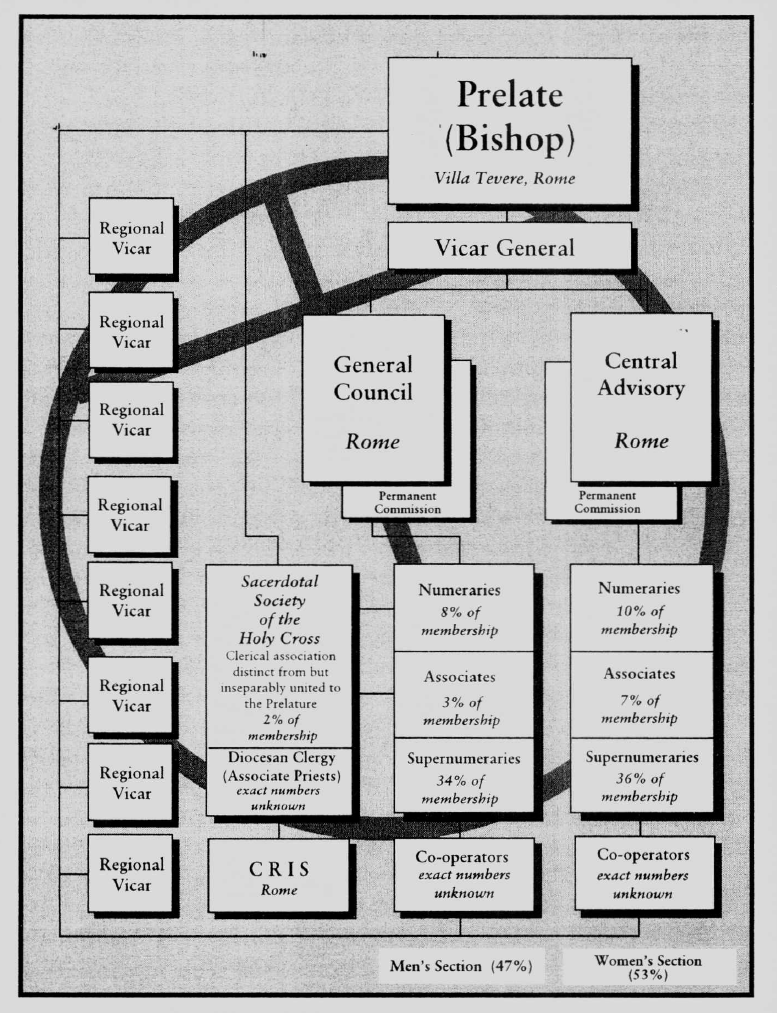
THE STRUCTURE OF OPUS DEI Prelate (Bishop): Villa Tevere, Rome Vicar General Regional Vicars Sacerdotal Society of the Holy Cross (Clerical association distinct from but inseparably united to the Prelature, 2% of membership.) Diocesan Clergy (Associate Priests) exact numbers unknown CRIS: Rome General Council: Rome (Permanent Commission) Numeraries (8% of membership) Associates (3% of membership) Supernumeraries (34% of membership) Co-operators (exact numbers unknown) Central Advisory: Rome (Permanent Commission) Numeraries (10% of membership) Supernumeraries (36% of membership) Co-operators (exact numbers unknown) _______________ Notes: 1. Ynfante, Op. cit., p. 233. 2. Condotte d'Acqua provided the City of Rome with its water supply. Condotte was also a major Italian construction company. It built autostradas (motorways) and had completed the Italian side of the Mont Blanc Tunnel under the Alps. Condone was at that time owned by APSA, the Administration of the Patrimony of the Apostolic See. Condotte d'Acqua would later be sold to Italian financier Michele Sindona in a complicated operation involving the IOR and Sindona's Banca Privata Finanziaria, Milan. 3. Ynfante, Op. cit., p. 251. 4. Ernesto Ekaizer, Jose Maria Ruiz Mateos -- el Ultimo Magnate, Plaza & Janes, Barcelona 1985, p. 167. 5. Maurice Roche, 'The Secrets of Opus Dei', Magill Magazine, Dublin, May 1983. 6. O'Connor, Op. cit., p. 152. 7. Michael Adams, Letter to the Editor, The Irish Press, 14 September 1971. 8. Dr Filippo Leoni, Banco Ambrosiano's general manager for international business, in testimony before the Italian P2 Parliamentary Commission, Vol. CLIV, Doc. XXIII. No.2, Ter 7, p. 228. 9. Romero was later ordained and became Opus Dei's regional vicar for France. 10. Oberle, Op. cit., pp. 86-87. 11. Ibid., p. 88; Ynfante, Op. cit., p. 239; and Ekaizer, Op. cit., p. 276. 12. Vazquez de Prada, Op. cit., p. 302. 13. Golias 30, pp. 40 and 133. Arthur Wiederkehr was a founding director of FGM Foundation, Zurich. 14. Reginald Eason, Daily Mail (London), 25 November 1942. Another article under the heading of 'Allies Stop Nazi Traffic in Exit Permits', appeared in The Daily Telegraph (of the same date). At 1994 exchange rates, 100,000 Swiss francs was worth about £50,000. 15. Vazquez de Prada, Op. cit., p. 303.
|