|
THE HISTORY OF THE FABIAN SOCIETY |
|
Chapter 10: The Policy of Expansion: 1907-12
Statistics of growth—The
psychology of the Recruit—Famous Fabians—The Arts Group—The
Nursery—The Women's Group—Provincial Fabian Societies—University
Fabian Societies—London Groups revived—Annual Conferences—The Summer
School—The story of "Socialist Unity"—The Local Government
Information Bureau—The Joint Standing Committee—Intervention of the
International Socialist Bureau.
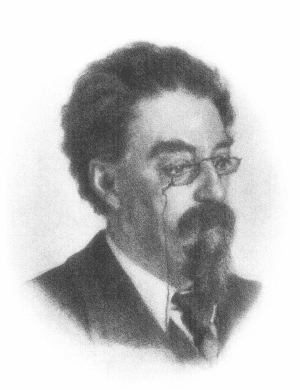
From a drawing by Jessie
Holliday The episode described in the last chapter, which took place during the years 1906 to 1908, was accompanied by many other developments in the activities of the Society which must now be described. In the first place the membership grew at an unprecedented rate. In the year ended March, 1905, 67 members were elected. Next year the number was 167, to March, 1907, it was 455, to March, 1908, 817, and to March, 1909, 665. This was an enormous accession of new blood to a society which in 1904 had only 730 members in all. In 1909 the Society consisted of 1674 men and 788 women, a total of 2462; of these 1277 were ordinary members residing in or near London, 343 scattered elsewhere in the United Kingdom, 89 abroad; 414 were members of provincial Societies and 339 of University Societies. There were in addition about 500 members of local Fabian Societies who were not also members of the London Society, and the Associates numbered 217. The income from subscriptions of all sorts was £473 in 1904 and £1608 in 1908, the high-water mark in the history of the Society for contributions to the ordinary funds. Of course there is all the difference in the world between a new member and an old. The freshly elected candidate attends every meeting and reads every word of "Fabian News." He begins, naturally, as a whole-hearted admirer and is profoundly impressed with the brilliance of the speakers, the efficiency of the organisation, the ability of the tracts. A year or two later, if he has any restlessness of intellect, he usually becomes a critic: he wants to know why there are not more brightly written tracts, explanatory of Socialism and suitable for the unconverted: he complains that the lectures are far less interesting than they used to be, that the debates are footling, the publications unattractive in appearance and too dull to read. A few years later he either settles down into a steady-going member, satisfied to do what little he can to improve this unsatisfactory world; or else, like Mr. Wells, he announces that the Society is no longer any good: once (when he joined) it was really important and effective: its methods were all right: it was proclaiming a fresh political gospel. But times have changed, whilst the Society has only grown old: it has done its work, and missed its opportunity for more. It is no longer worthy of his support. In 1907 and 1908 the Society consisted largely of new members; consequently the meetings were crowded and we were driven out from one hall after another. Moreover the propagandist enthusiasm of Mr. Wells and the glamour of his name helped to attract a large number of distinguished persons into our ranks. Mr. Granville Barker was one of the most active of these. He served on the Executive from 1907 to 1912 and took a large share in the detailed work of the Committees, besides giving many lectures and assisting in social functions. The Rev. R.J. Campbell, who addressed large meetings on several occasions, as also elected to the Executive for the year 1908-9, but did not attend a single meeting. Mr. Aylmer Maude joined the Executive in 1907, held office to 1912, and is still a working member of the Society. Arnold Bennett, Laurence Irving, Edgar Jepson, Reginald Bray, L.C.C. (member of the Executive 1911-12), Sir Leo (then Mr.) Chiozza Money, M.P. (who sat on the Executive from 1908 to 1911), Dr. Stanton Coit, H. Hamilton Fyfe, A.R. Orage, G.M. Trevelyan, Edward Garnett, Dr. G.B. Clark (for many years M.P.), Miss Constance Smedley, Philip Snowden, M.P., Mrs. Snowden (Executive 1908-9), George Lansbury, Herbert Trench, Jerome K. Jerome, Edwin Pugh, Spencer Pryse, and A. Clutton Brock are amongst the people known in politics, literature, or the arts who joined the Society about this period. Some of these took little or no part in our proceedings, beyond paying the necessary subscription, but others lectured or wrote for the Society or participated in discussions and social meetings. These were at this time immensely successful. In the autumn of 1907, for example, Mrs. Bernard Shaw arranged for the Society a series of crowded meetings of members and subscribers at Essex Hall on "The Faith I Hold." Mrs. Sidney Webb led off and was followed by the Rev. R.J. Campbell, S.G. Hobson, Dr. Stanton Coit, H.G. Wells, and Hubert Bland: with an additional discourse later in the spring by Sir Sydney Olivier. Mr. Wells' paper, which proved to be far too long for a lecture, was the first draft of his book "First and Last Things"; but he had tired of the Society when it was published, and the preface conceals its origin in something of a mystery. Sir John Gorst, Mrs. Annie Besant, Dr. Südekum (German M.P.), Sir John Cockburn, K.C.M.G., the Hon. W.P. Reeves, Raymond Unwin, and Sir Leo Chiozza Money were amongst the other lecturers of that year. *** In 1906 and succeeding years a new form of organisation was established. Members spontaneously associated themselves into groups, "The Nursery" for the young, the Women's Group, the Arts Group, and Groups for Education, Biology, and Local Government. The careers of these bodies were various. The Arts Group included philosophy, and, to tell the truth, almost excluded Socialism. But all of us in our youth are anxiously concerned about philosophy and art and many who are no longer young are in the same case. Moreover artists and philosophers are always attractive. Mr. Holbrook Jackson and Mr. A.R. Orage, at that time associated in "The New Age," founded the group early in 1907, and soon obtained lecturers as distinguished, and audiences scarcely less numerous than the Society itself. But in eighteen months "Art and Philosophy in Relation to Socialism" seems to have been exhausted, and after the summer of 1908 the Group disappears from the calendar. Biology and Local Government had a somewhat longer but far less glorious career. The meetings were small and more of the nature of classes. Education is the life-work of a large class, which provides a sensible proportion of Fabian membership, and teachers are always eager to discuss and explain the difficult problems of their profession and the complex law which regulates it. The Education Group has led a diligent and useful life; it prepared a tract (No. 156), "What an Education Committee can do (Elementary Schools)," and besides its private meetings it arranges occasional lectures open to the public, which sometimes attract large audiences. The Nursery belongs to another class. When a society, formed as many societies are, of quite young people, has existed over twenty years, the second generation begins to be adult, and wants to be quit of its parents. Moreover the young desire, naturally, to hear themselves talk, whilst the others usually prefer the older and more famous personages. So a number of younger members eagerly took up a plan which originated in the circle of the Bland family, for forming a group confined to the young in years or in membership in order to escape the overmastering presence of the elderly and experienced. Sometimes they invite a senior to talk to them and to be heckled at leisure. More often they provide their own fare from amongst themselves. Naturally the Nursery is not exclusively devoted to economics and politics: picnics and dances also have their place. Some of the members eventually marry each other, and there is no better security for prolonged happiness in marriage than sympathy in regard to the larger issues of life. The Nursery has produced one tract, No. 132, "A Guide to Books for Socialists," described in the "Wells Report" as intended "to supplement or even replace that arid and indiscriminating catalogue, What to Read." Last in date, but by no means least in importance of the Groups of this period, was the Women's Group, founded by Mrs. C.M. Wilson, who after nearly twenty years of nominal membership had resumed her active interest in the Society. The vigorous part taken by the women of the Society under the leadership of Mrs. Reeves in obtaining the only alteration yet made in the Basis has been already described. The Group was not formed till a year later, and at that time the Women's Suffrage movement, and especially the party led by Mrs. Pankhurst, had attracted universal attention. The early Suffrage movement was mainly Socialist in origin: most of the first leaders of the Women's Social and Political Union were or had been members either of the Fabian Society or of the I.L.P. and it may almost be said that all the women of the Society joined one or more of the Suffrage Societies which for the next seven years played so large a part in national politics. But besides the question of the vote, which is not peculiar to Socialism, there is a very large group of subjects of special interest to Socialist women, either practical problems of immediate politics relating to the wages and conditions of women's labour and the treatment of women by Education Acts, National Insurance Acts, and Factory Acts; or remoter and more theoretical problems, especially those connected with the question whether the wife in the ideal state is to be an independent wage-earner or the mistress and manager of an isolated home, dependent on her husband as breadwinner. Efficiently organised by Mrs. C.M. Wilson, until ill-health required her resignation of the secretaryship in 1914; by Mrs. Bernard Shaw, Mrs. Pember Reeves, Miss Murby, Miss Emma Brooke, and many others, including in later years Dr. Letitia Fairfield, the Group has had many of the characteristics of an independent society. It has its own office, latterly at 25 Tothill Street, rented from the parent Society, with its own paid assistant secretary, and it has issued for private circulation its own publications. In 1913 it prepared a volume of essays on "Women Workers in Seven Professions," which was edited by Professor Edith Morley and published by George Routledge and Sons. It has prepared five tracts for the Society, published in the general list, under a sub-title, "The Women's Group Series," and it has taken an active part, both independently and in co-operation with other bodies, in the political movements specially affecting women, which have been so numerous in recent years. *** It will be recollected that the only direct result of the Special Enquiry Committee, apart from the changes made in the organisation of the Society itself, was the decision to promote local Socialist Societies of the Fabian type with a view to increasing Socialist representation in Parliament. I have recounted in a previous chapter how this scheme worked out in relation to the Labour Party and the running of candidates for Parliament. It remains to describe here its measure of success in the formation of local societies. The summer of 1905 was about the low-water mark of provincial Fabianism. Nine societies are named in the report, but four of these appeared to have no more than a nominal existence. The Oxford University Society had but 6 members; Glasgow had 30 in its University Society and 50 in its town Society; Liverpool was reduced to 63, Leeds and County to 15, and that was all. A year later the Cambridge University Society had been formed, Oxford had more than doubled its membership to 13, but only five other societies were in existence. By the following year a revival had set in. W. Stephen Sanders, at that time an Alderman of the London County Council, who had been a member of the Society since 1890 and of the executive Committee since 1904, was appointed Organising Secretary with the special object of building up the provincial organisation. By 1910 there were forty-six local societies, and in 1912 the maximum of fifty was reached. Since then the number has declined. These societies were scattered over the country, some of them in the great cities, Manchester, Newcastle, Sheffield, and so on: others within hail of London, at Croydon, Letchworth, Ilford: others again in small towns, Canterbury, Chelmsford, Carnarvon: another was at Bedales School, Petersfield, run by my son and his schoolfellows. The local societies formed at this period, apart from the University Societies, were in the main pallid reflections of the parent Society in its earlier days; none of them had the good fortune to find a member, so far as we yet know, of even second-class rank as a thinker or speaker. One or two produced praiseworthy local tracts on housing conditions and similar subjects. They usually displayed less tolerance than the London Society, a greater inclination to insist that there was but one way of political salvation, usually the Labour Party way, and that all who would not walk in it should be treated as alien enemies. If Socialism is only to be achieved by the making of Socialists, as Mr. Wells announced with all the emphasis of a rediscovery, no doubt the local societies achieved some Socialism, since they made some members. If Socialism is to be attained by the making of Socialist measures, doubtless they accomplished a little by their influence on local administration. Organisation for political work is always educative to those who take part in it, and it has some effect on the infinitely complex parallelogram of forces which determines the direction of progress. Possibly I underestimate the importance of local Fabian Societies; there is a school of thought, often represented in the Society, which regards the provinces with reverent awe—omne ignotum pro magnifico—as the true source of political wisdom, which Londoners should endeavour to discover and obey. Londoners no doubt see little of organised labour, and even less of industrial co-operation: the agricultural labourer is to them almost a foreigner: the Welsh miner belongs to another race. But the business men, the professional class, and the political organisers of Manchester and Glasgow have, in my opinion, no better intuitions, and usually less knowledge than their equivalents in London, and they have the disadvantage of comparative isolation. London, the brain of the Empire, where reside the leaders in politics and in commerce, in literature, in journalism and in art, and which consequently attracts the young men who aspire to be the next generation of leaders, where too are stationed all the higher ranks of Civil Service, is different in kind, as well as in size, from other cities. New thought on social subjects is almost always the product of association. Only those who live in a crowd of other thinkers know where there is room for new ideas; for it takes years for the top layer of political thought to find expression in books. Therefore the provincial thinker on social problems is always a little out of date. Except for one or two University men (e.g. Sidney Ball and Sir Oliver Lodge) practically all Fabian tract-writers have been Londoners. The local Fabian Societies have so far achieved nothing towards the making of a middle-class Socialist party, and they have achieved but little else. They have been fully justified because every association for mutual instruction adds something to the mass of political intelligence, does something to disseminate ideas, but that is all that can be said for them. The University Societies belong to a different type. Nothing is more important than the education of young men and women in politics, and the older Universities have always recognised this. Socialist Societies accordingly grew up naturally alongside Liberal and Tory Clubs, and under the shadow of the "Unions." Oxford, as we have seen, had a University Fabian Society from early days. Cambridge followed at a much later date. For years Glasgow University and University College, Aberystwyth, maintained flourishing societies. The newer Universities, dependent largely on the bounty of wealthy capitalist founders and supporters, and assisted by, or in close touch with, town councils and local industries, have been much less willing to sanction political free-thought amongst their undergraduates, and the pernicious influence of wealth, or rather the fear of alarming the wealthy, has at times induced the authorities to interfere with the freedom of the undergraduates to combine for the study and propaganda of Socialism. Undergraduate societies are composed of a constantly shifting population, and we arranged from the first that all their members should also be elected direct to the parent Society in order that they might remain automatically in membership when they "go down." In fact of course the percentage which retains its membership is very small. "Men" and women at Universities join any organisation whose leaders at the moment are influential and popular. They are sampling life to discover what suits them, and a few years later some of them are scattered over the globe, others immersed in science or art, or wholly occupied in law and medicine, in the church and the army, in the civil service and in journalism. Most of them no doubt have ceased to pretend to take interest in social and political reform. A few remain, and these are amongst the most valuable of our members. At times, when an undergraduate of force of character and high social position, the heir to a peerage for example, is for the moment an ardent Socialist, the Fabian Society becomes, in a certain set or college, the fashionable organisation. On the whole it is true that Socialists are born and not made, and very few of the hundreds who join at such periods stay for more than a couple of years. The maximum University membership—on paper—was in 1914, when it reached 541 members, of whom 101 were at Oxford and 70 at Cambridge. But the weakness of undergraduate Socialism is indicated by the extraordinary difficulty found in paying to the parent Society the very moderate fee of a shilling a head per annum, and the effect of attempting to enforce this in 1915, combined with the propaganda of Guild Socialism, especially at Oxford, was for the moment to break up the apparently imposing array of University Fabianism. In 1912 Clifford Allen of Cambridge formed the University Socialist Federation, which was in fact a Federation of Fabian Societies though not nominally confined to them. Mr. Allen, an eloquent speaker and admirable organiser, with most of the virtues and some of the defects of the successful propagandist, planned the foundations of the Federation on broad lines. It started a sumptuous quarterly, "The University Socialist," the contents of which by no means equalled the excellence of the print and paper. It did not survive the second number. The Federation has held several conferences, mostly at Barrow House—of which later—and issued various documents. Its object is to encourage University Socialism and to found organisations in every University. It still exists, but whether it will survive the period of depression which has coincided with the war remains to be seen. Lastly, amongst the organs of Fabian activity come the London Groups. In the years of rapid growth that followed the publication of "Fabian Essays" the London Groups maintained a fairly genuine existence. London was teeming with political lectures, and in the decade 1889-1899 its Government was revolutionised by the County Councils Act of 1888, the Local Government Act of 1894, and the London Government Act of 1899 which established the Metropolitan Boroughs. Socialism, too, was a novelty, and the few who knew about it were in request. Anyway even with the small membership of those days, the London Groups managed to persist, and "Fabian News" is full of reports of conferences of Group Secretaries and accounts of Group activities. In the trough of depression between the South African War and the Liberal victory of 1906 all this disappeared and the Group system scarcely existed even on paper. With the expansion which began in 1906 the Groups revived. New members were hungry for lectures: many of them desired more opportunities to talk than the Society meetings afforded. All believed in or hoped for Mr. Wells' myriad membership. He himself was glad to address drawing-room meetings, and the other leaders did the same. Moreover the Society was conducting a series of "Suburban Lectures" by paid lecturers, in more or less middle-class residential areas of the Home Counties. Lectures to the Leisured Classes, a polite term for the idle rich, were arranged with considerable success in the West End, and other lectures, meetings, and social gatherings were incessant. For co-ordinating these various bodies the Fabian Society has created its own form of organisation fitted to its peculiar circumstances, and more like that of the British Empire than anything else known to me. As is the United Kingdom in the British Empire, so in the Fabian movement the parent Society is larger, richer, and more powerful, and in all respects more important than all the others put together. Any form of federal organisation is impossible, because federation assumes some approach to equality amongst constituents. Our local societies, like the British self-governing Dominions, are practically independent, especially in the very important department of finance. The Groups, on the other hand, are like County Councils, local organisations within special areas for particular purposes, with their own finances for those purposes only. But the parent Society is not made up of Groups, any more than the British Government is composed of County Councils. The local Groups consist of members of the Society qualified for the group by residence in the group area; the "Subject Groups" of those associated for some particular purpose. The problem of the Society (as it is of the Empire) was to give the local societies and the groups some real function which should emphasise and sustain the solidarity of the whole; and at the same time leave unimpaired the control of the parent Society over its own affairs. The Second Annual Conference of Fabian Societies and Groups was held on July 6th, 1907, under the chairmanship of Hubert Bland, who opened the proceedings with an account of the first Conference held in 1892 and described in an earlier chapter. Fifteen delegates from 9 local and University Societies, 16 from 8 London Groups, 8 from Subject Groups, and 9 members of the Executive Committee were present. The business consisted of the sanction of rules for the Pan-Fabian Organisation. The Conference of 1908 was a much bigger affair. A dozen members of the Executive, including Mr. H.G. Wells and (as he then was) Mr. L.G. Chiozza Money. M.P., and 61 delegates representing 36 Groups and Societies met for a whole-day conference at University Hall, Gordon Square. Miss Murby was chairman, and addressed the delegates on the importance of tolerance, an apposite subject in view of the discussion to follow on the proposed parliamentary action, especially the delicate issue between co-operation with the Labour Party and the promotion of a purely Socialist party. A resolution favouring exclusive support of independent Socialist candidatures moved by Mr. J.A. Allan of Glasgow received only 10 votes, but another advocating preference for such candidates was only defeated by 26 to 21. The resolution adopted left the question to be settled in each case by the constituency concerned. Another resolution directed towards condemnation of members who worked with the Liberal or Tory Party failed by 3 votes only, 17 to 20. In the afternoon Mr. Money gave an address on the Sources of Socialist Revenue, and a number of administrative matters were discussed. The 1909 Conference was attended by 29 delegates of local and University Societies, and by 46 delegates from London Groups and from the parent Society. On this occasion a Constitution was adopted giving the Conference a regular status, the chief provisions of which required the submission to the Conference of any alteration of the Basis, and "any union affiliation or formal alliance with any other society or with any political party whereby the freedom of action of any society ... is in any way limited ... "; and of any change in the constitution itself. These are all matters which concern the local organisations, as they are required to adopt the Basis, or some approved equivalent, and are affiliated to the Labour Party through the parent Society. No contentious topic was on this occasion seriously discussed. The Conference of 1910 was smaller, sixty-one delegates in all. Resolutions against promoting parliamentary candidatures and favouring the by this time vanishing project for an independent Socialist party obtained but little support, and the chief controversy was over an abstract resolution on the "economic independence of women," which was in the end settled by a compromise drafted by Sidney Webb. Sixty delegates were present at the 1911 Conference, held at Clifford's Inn, who, after rejecting by a seven to one majority a resolution to confine Fabian membership to Labour Party adherents, devoted themselves mainly to opposition to the National Insurance Bill then before Parliament. In 1912 the Conference was still large and still concerned in the position of the Society in relation to Labour and Liberalism. Both in 1913 and in 1914 the Conference was well attended and prolonged, but in 1915, partly on account of the war and partly because of the defection of several University Societies, few were present, and the business done was inconsiderable. *** The Summer School was another enterprise started at the period. It was begun independently of the Society in this sense, that half a dozen members agreed to put up the necessary capital and to accept the financial responsibility, leaving to the Society the arrangement of lectures and the management of business. It was opened at the end of July, 1907, at Pen-yr-allt, a large house, previously used as a school, looking out over the sea, near Llanbedr, a little village on the Welsh coast between Barmouth and Harlech. The house was taken for three years partly furnished, and the committee provided the beds, cutlery, etc., needed. One or two other houses near by were usually rented for the summer months. The value of the plan for a propagandist society is largely this, that experience shows that people can only work together efficiently when they know each other. Therefore in practice political and many other organisations find it necessary to arrange garden parties, fêtes, picnics, teas, and functions of all sorts in order to bring together their numbers under such conditions as enable them to become personally acquainted with each other. In times of expansion the Fabian Society has held dinners and soirées in London, many of which have been successful and even brilliant occasions, because the new members come in crowds and the old attend as a duty. When new members are few these entertainments cease, for nothing is so dreary as a social function that is half failure, and a hint of it brings the series to an end. But a Summer School where members pass weeks together is far more valuable in enabling the leaders and officials to find out who there is who is good as a speaker or thinker, or who is a specialist on some subject of value to the movement. Moreover, gatherings of this class attract those on the fringe of the movement, and many of our members have come to us through attendance at the school. Apart from the direct interests of the Society, a School of this character is valued by many solitary people, solitary both socially, such as teachers and civil servants, who are often lonely in the world, and solitary intellectually because they live in remote places where people of their way of thinking are scarce. It is not necessary to describe the arrangements of the School, for these institutions have in the last few years become familiar to everybody. We do not, however, as a rule make quite such a business of the schooling as is usual where the term is short, and study is the sole object. One regular lecture a day for four days a week is the rule, but impromptu lectures or debates in the evenings, got up amongst the guests, are customary. Moreover, frequent conferences on special subjects are held, either by allied bodies, such as the Committee for the Prevention of Destitution, or by a Group, such as the Education Group or the Research Department. On these occasions the proportion of work to play is higher. The School-house belongs to the Society for the whole year, and parties are arranged for Christmas, Easter, and Whitsuntide whenever possible. After four years at Llanbedr the lease was terminated and the original Committee wound up. The capital borrowed had all been repaid, and there remained, after a sale by auction, a lot of property and nearly £100 in cash. This the Committee transferred to the Society, and thereupon the quasi-independence of the Summer School came to an end. In 1911 a new experiment was tried. A small hotel at Saas Grund, off the Rhone Valley, was secured, and during six weeks three large parties of Fabians occupied it for periods of a fortnight each. The summer was one of the finest of recent years, and the high mountains were exceptionally attractive. On account of the remoteness of the place, and the desire to make the most of a short time, lectures were as a rule confined to the evening, and distinguished visitors were few, but an address by Dr. Hertz of Paris, one of the few French Fabians, may be mentioned, partly because in the summer of 1915 his promising career was cut short in the trenches which protected his country from the German invaders. In 1912 Barrow House, Derwentwater, was taken for three years, a beautiful place with the Barrow Falls in the garden on one side, and grounds sloping down to the lake on the other, with its own boating pier and bathing-place. A camp of tents for men was set up, and as many as fifty or sixty guests could be accommodated at a time. Much of the success of the School has throughout been due to Miss Mary Hankinson, who from nearly the beginning has been a most popular and efficient manager. A director is selected by the Committee to act as nominal head, and holds office usually for a week or a fortnight; but the chief of staff is a permanent institution, and is not only business manager, but also organiser and leader of excursions and a principal figure in all social undertakings. A great part in arranging for the School from the first has been taken by Dr. Lawson Dodd, to whose experience and energy much of its success has been due. *** The year 1911 saw the formation of the Joint Standing Committee with the I.L.P., and this is a convenient place to describe the series of attempts at Socialist Unity which began a long way back in the history of the Society. For the first eight years or so of the Socialist movement the problem of unity did not arise. Until the publication of "Fabian Essays" the Fabian Society was small, and the S.D.F., firm in its Marxian faith, and confident that the only way of salvation was its particular way, had no more idea of uniting with the other societies than the Roman Catholic Church has of union with Lutherans or Methodists. The Socialist League was the outcome of an internal dispute, and, if my memory is correct, the S.D.F. expected, not without reason, that the seceders would ultimately return to the fold. The League ceased to count when at the end of 1890 William Morris left it and reconstituted as the Hammersmith Socialist Society the branch which met in the little hall constructed out of the stable attached to Kelmscott House. In January, 1893, seven delegates from this Society held a conference with Fabian delegates, and at a second meeting at which S.D.F. delegates were present a scheme for promoting unity was approved. A Joint Committee of five from each body assembled on February 23rd, when William Morris was appointed Chairman, with Sydney Olivier as Treasurer, and it was decided that the Chairman with H.M. Hyndman and Bernard Shaw should draft a Joint Manifesto. The "Manifesto of English Socialists," published on May 1st, 1893, as a penny pamphlet with the customary red cover, was signed by the three Secretaries, H.W. Lee of the S.D.F., Emery Walker of the H.S.S., and myself, and by fifteen delegates, including Sydney Olivier and Sidney Webb of the F.S., Harry Quelch of the S.D.F., and the three authors. Like most joint productions of clever men, it is by no means an inspiring document. The less said, the less to dispute about, and so it only runs to eight pages of large print, four devoted to the evils of capitalism, unemployment, the decline of agriculture, and the ill-nurture of children, and the rest to remedies, a queer list, consisting of:—
An eight hours law.
Prohibition of child labour for wages. Free Maintenance for all necessitous children (a compromise in which Fabian influence may be traced by the insertion of the word "necessitous"). Equal payment of men and women for equal work. (A principle which, whether good or bad, belongs rather to individualism than to Socialism: Socialism according to Bernard Shaw—and most of us agree with him—demands as an ideal equal maintenance irrespective of work; and in the meantime payment according to need, each to receive that share of the national product which he requires in order to do his work and maintain his dependents, if any, appropriately.) To resume the programme:—
An adequate minimum wage for
all adults employed in Government and Municipal services or in any
monopolies such as railways enjoying State privileges.
Suppression of all sub-contracting and sweating (an ignorant confusion between a harmless industrial method and its occasional abuse). Universal suffrage for all adults, men and women alike. Public payment for all public service. These of course were only means tending towards the ideal, "to wit, the supplanting of the present state by a society of equality of condition," and then follows a sentence paraphrased from the Fabian Basis embodying a last trace of that Utopian idealism which imagines that society can be constituted so as to enable men to live in freedom without eternal vigilance, namely, "When this great change is completely carried out, the genuine liberty of all will be secured by the free play of social forces with much less coercive interference than the present system entails." From these extracts it will be seen that the Manifesto, drafted by William Morris, but mutilated and patched up by the other two, bears the imprint neither of his style, nor that of Shaw, but reminds one rather of mid-Victorian dining-room furniture, solid, respectable, heavily ornate, and quite uninteresting. Happily there is not much of it! Unity was attained by the total avoidance of the contentious question of political policy. But fifteen active Socialists sitting together at a period when parties were so evenly divided that a General Election was always imminent could not refrain from immediate politics, and the S.D.F., like many other bodies, always cherished the illusion that the defeat of a minority at a joint conference on a question of principle would put that minority out of action. Accordingly, as soon as the Manifesto had been published resolutions were tabled pledging the constituent societies to concentrate their efforts on Socialist candidates accepted as suitable by the Joint Committee. On this point the Fabian Society was in a hopeless minority, and an endless vista of futile and acrimonious discussions was opened out which would lead to unrest in our own society—for there has always been a minority opposed to its dominant policy—and a waste of time and temper to the delegates from our Executive. It was therefore resolved at the end of July that our delegates be withdrawn, and that put an end to the Joint Committee. The decision was challenged at a members' meeting by E.E. Williams, one of the signatories of the Joint Manifesto, subsequently well known as the author of "Made in Germany," and in some sense the real founder of the Tariff Reform movement; but the members by a decisive vote upheld the action of their Executive. Four years later, early in 1897, another effort after Unity was made. By this time Morris, whose outstanding personality had given him a commanding and in some respects a moderating influence in the movement, was dead; and the Hammersmith Socialist Society had disappeared. Instead there was the new and vigorous Independent Labour Party, already the premier Socialist body in point of public influence. This body took the first step, and a meeting was held in April at the Fabian office, attended by Hubert Bland, Bernard Shaw, and myself as delegates from our Society. The proposal before the Conference was "the formation of a court of appeal to adjudicate between rival Socialist candidates standing for the same seat at any contested election," an occurrence which has in fact been rare in local and virtually unknown in Parliamentary elections. As the Fabian Society did not at that time officially run candidates, and has always allowed to its members liberty of action in party politics, it was impossible for us to undertake that our members would obey any such tribunal. The difficulty was however solved by the S.D.F., whose delegates to the second meeting, held in July, announced that they were instructed to withdraw from the Committee if the Fabian delegates remained. The I.L.P. naturally preferred the S.D.F. to ourselves, because their actual rivalry was always with that body, and we were only too glad to accept from others the dismissal which we desired. So our delegates walked out, leaving the other two parties in temporary possession of our office, and Socialist Unity so far as we were concerned again vanished. I do not think that the court of appeal was ever constituted, and certainly the relations between the other two Societies continued to be difficult. The next move was one of a practical character. The Fabian Society had always taken special interest in Local Government, as a method of obtaining piecemeal Socialism, and had long acted as an informal Information Bureau on the law and practice of local government administration. The success of the I.L.P. in getting its members elected to local authorities suggested a conference of such persons, which was held at Easter, 1899, on the days preceding the I.L.P. Annual Conference at Leeds. Sidney Webb was invited to be President, and gave an address on "The Sphere of Municipal Statesmanship"; Will Crooks was Chairman of the Poor Law Section. At this Conference it was resolved to form a Local Government Information Bureau, to be jointly managed by the I.L.P. and the Fabian Society; it was intended for Labour members of local authorities, but anybody could join on payment of the annual subscription of 2s. 6d. For this sum the subscriber obtained the right to have questions answered free of charge, and to receive both "Fabian News" and the official publications of the I.L.P., other than their weekly newspaper. The Bureau also published annual Reports, at first on Bills before Parliament, and latterly abstracts of such Acts passed by Parliament as were of interest to its members. It pursued an uneventful but useful career, managed virtually by the secretaries of the two societies, which divided the funds annually in proportion to the literature supplied. Several Easter Conferences of Elected Persons were held with varying success. Later on the nominal control was handed over to the Joint Committee, next to be described. The problem of Socialist Unity seemed to be approaching a settlement when the three organisations, in 1900, joined hands with the Trade Unions in the formation of the Labour Representation Committee, later renamed the Labour Party. But in 1901, eighteen months after the Committee was constituted, the S.D.F. withdrew, and thereafter unity became more difficult than ever, since two societies were united for collective political action with the numerically and financially powerful trade unions, whilst the third took up the position of hostile isolation. But between the Fabian Society and the I.L.P. friendly relations became closer than ever. The divergent political policies of the two, the only matter over which they had differed, had been largely settled by change of circumstances. The Fabian Society had rightly held that the plan of building up an effective political party out of individual adherents to any one society was impracticable, and the I.L.P. had in fact adopted another method, the permeation of existing organisations, the Trade Unions. On the other hand the Fabian Society, which at first confined its permeation almost entirely to the Liberal Party, because this was the only existing organisation accessible—we could not work through the Trade Unions, because we were not eligible to join them—was perfectly willing to place its views before the Labour Party, from which it was assured of sympathetic attention. Neither the Fabian Society nor the I.L.P. desired to lose its identity, or to abandon its special methods. But half or two-thirds of the Fabians belonged also to the I.L.P., and nearly all the I.L.P. leaders were or had been members of the Fabian Society. The suggestion was made in March, 1911, by Henry H. Slesser, then one of the younger members of the Executive, that the friendly relations of the two bodies should be further cemented by the formation of a Joint Standing Committee. Four members of each Executive together with the secretaries were appointed, and W.C. Anderson, later M.P. for the Attercliffe Division of Sheffield, and at that time Chairman of the I.L.P., was elected Chairman, a post which he has ever since retained. The Joint Committee has wisely confined its activities to matters about which there was no disagreement, and its proceedings have always been harmonious to the verge of dullness. The Committee began by arranging a short series of lectures, replacing for the time the ordinary Fabian meetings, and it proposed to the Labour Party a demonstration in favour of Adult Suffrage, which was successfully held at the Royal Albert Hall. In the winter of 1912-13 the Joint Committee co-operated with the National Committee for the Prevention of Destitution (of which later) in a big War against Poverty Campaign, to demand a minimum standard of civilised life for all. A demonstration at the Albert Hall, a Conference at the Memorial Hall, twenty-nine other Conferences throughout Great Britain, all attended by numerous delegates from Trade Unions and other organisations, and innumerable separate meetings were among the activities of the Committee. In 1913 a large number of educational classes were arranged. In the winter of 1913-14 the I.L.P. desired to concentrate its attention on its own "Coming of Age Campaign," an internal affair, in which co-operation with another body was inappropriate. A few months later the War began and, for reasons explained later, joint action remains for the time in abeyance. It will be convenient to complete the history of the movements for Socialist Unity, though it extends beyond the period assigned to this chapter, and we must now turn back to the beginning of another line of action. The International Socialist and Trade Union Congresses held at intervals of three or four years since 1889 were at first no more than isolated Congresses, arranged by local organisations constituted for the purpose in the preceding year. Each nation voted as one, or at most, as two units, and therefore no limit was placed on the number of its delegates: the one delegate from Argentina or Japan consequently held equal voting power to the scores or even hundreds from France or Germany. But gradually the organisation was tightened up, and in 1907 a scheme was adopted which gave twenty votes each to the leading nations, and proportionately fewer to the others. Moreover a permanent Bureau was established at Brussels, with Emile Vandervelde, the distinguished leader of the Belgian Socialists, later well known in England as the Ministerial representative of the Belgian Government during the war, as Chairman. In England, where the Socialist and Trade Union forces were divided, it was necessary to constitute a special joint committee in order to raise the British quota of the cost of the Bureau, and to elect and instruct the British delegates. It was decided by the Brussels Bureau that the 20 British votes should be allotted, 10 to the Labour Party, 4 to the I.L.P., 4 to the British Socialist Party (into which the old S.D.F. had merged), and 2 to the Fabian Society, and the British Section of the International Socialist Bureau was, and still remains, constituted financially and electorally on that basis. In France and in several other countries the internal differences between sections of the Socialist Party have been carried to far greater lengths than have ever been known in England. In France there have been hostile groups of Socialist representatives in the Chamber of Deputies and constant internecine opposition in electoral campaigns. In Great Britain the rivalry of different societies has consisted for the most part in separate schemes of propaganda, in occasional bickerings in their publications, in squabbles over local elections, and sometimes over the selection but not the election of parliamentary candidates. On the other hand co-operation on particular problems and exchange of courtesies have been common. The International Socialist Bureau, under instructions from the Copenhagen Conference had made a successful attempt to unite the warring elements of French Socialism, and in the autumn of 1912 the three British Socialist Societies were approached with a view to a conference with the Bureau on the subject of Socialist unity in Great Britain. Convenient dates could not be fixed, and the matter was dropped, but in July, 1913, M. Vandervelde, the Chairman, and M. Camille Huysmans, the Secretary of the Bureau, came over from Brussels and a hurried meeting of delegates assembled in the Fabian office to discuss their proposals. The Bureau had the good sense to recognise that the way to unity led through the Labour Party; and it was agreed that the three Socialist bodies should form a United Socialist Council, subject to the condition that the British Socialist Party should affiliate to the Labour Party. In December, 1913, a formal conference was held in London, attended on this occasion by all the members of the International Socialist Bureau, representing the Socialist parties of twenty different countries. The crux of the question was to find a form of words which satisfied all susceptibilities; and Sidney Webb, who was chosen chairman of a part of the proceedings when the British delegates met by themselves to formulate the terms of agreement, was here in his element; for it would be hard to find anybody in England more skilful in solving the difficulties that arise in determining the expression of a proposition of which the substance is not in dispute. An agreement was arrived at that the Joint Socialist Council should be formed as soon as the British Socialist Party was affiliated to the Labour Party. The B.S.P. confirmed the decision of its delegates, but the Labour Party referred the acceptance of affiliation to the Annual Conference of 1915[39]. Then came the War. The Labour Party Conference of 1915 did not take place, and a sudden new divergence of opinion arose in the Socialist movement. The Labour Party, the Fabian Society, and the leaders of the B.S.P. gave general support to the Government in entering into the war. The I.L.P. adopted an attitude of critical hostility. Amidst this somewhat unexpected regrouping of parties, any attempt to inaugurate a United Socialist Council was foredoomed to failure. The project for Socialist Unity therefore awaits the happy time when war shall have ceased. _______________ Notes: [39] The Labour Party Conference held in January, 1916, unanimously accepted the affiliation of the British Socialist Party.
|