|
GREEN PARADISE LOST |
|
Part 1. The Fall into Illusion
This book has been a journey for me, 1. Man-Above: The Anthropocentric Illusion We were walking along the beach yesterday and came upon an extensive walled city that had been constructed upon the sand in a marvelous way using driftwood and rocks and shells and sand. It was large and complex and intricate. Some unknown builders had labored long to construct it in the hours between high tide and low tide. But now the tide had turned and was coming back in upon that wondrous city in the sand, so that its hours were literally numbered. Our civilization is like that city in the sand. The tide has turned and time is running out for the way we have done things. But since the way we do is always based upon the way we think, what time is really running out on is our view of things, "the pictures about reality" which our culture has projected upon the cosmic walls of our universe. God-Above and Man-Above Walter Lippmann called them "the pictures in our minds of the world beyond our reach." [1] One such picture which has become deeply embedded in the lining of our minds is that of the Spirit God of the universe who is "above all and beyond all" and who created Man (Adam) to have dominion over all the animals and the rest of creation. Many theologians today remind us that "dominion" can mean responsible stewardship. But it is clear that -- however "dominion" is interpreted -- it always means "above" and implies a right to exercise power over others. In that centuries-old and mythically powerful story from the Book of Genesis in the Bible Man is conceived as definitely "above" the rest of nature. He partakes of the "spirit" character of the divine. He is created in the divine image. He gives all other animals their names, and so on. This same consciousness of Man's place in the cosmic scheme of things is powerfully recapitulated in Psalm 8:3-8:
When I consider thy heavens, the work of thy fingers,
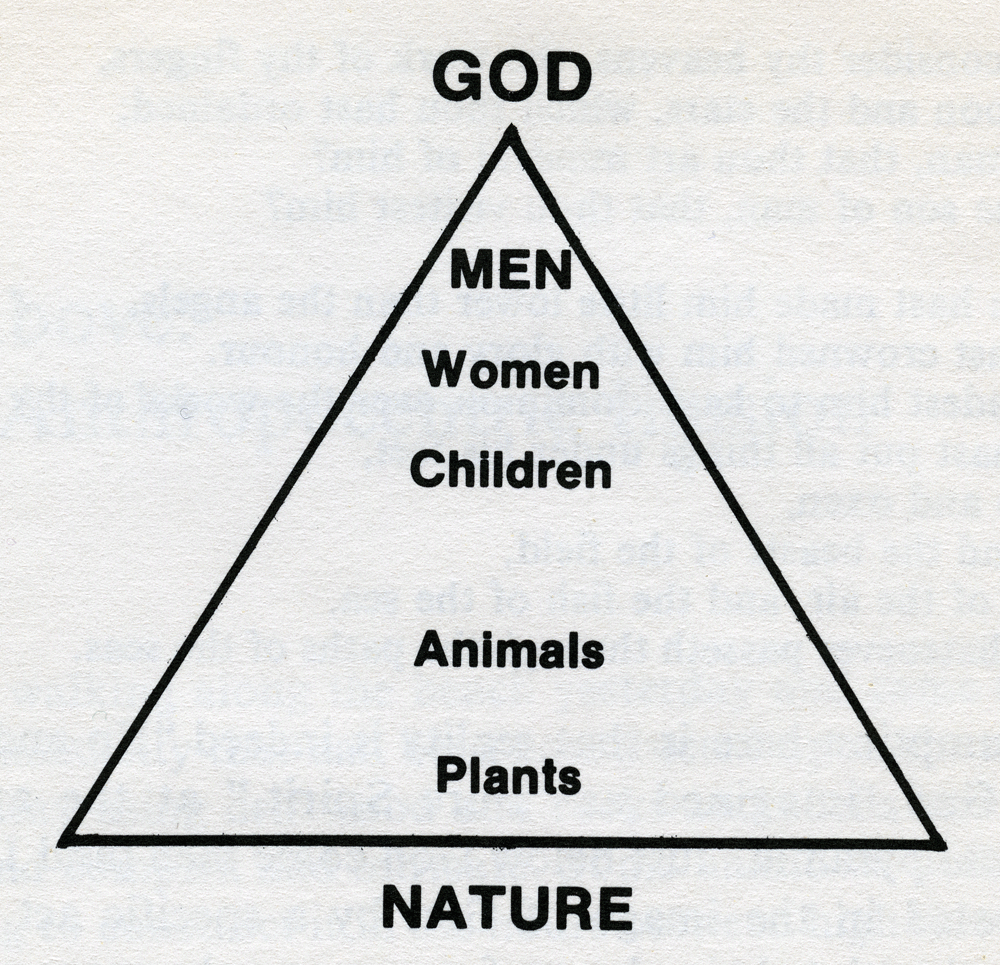
For thou hast made him little lower than the angels, The assumption here is that reality is indeed "Up-and-Down." We find God, imagined as "Pure Spirit," at the apex of a cosmological pyramid. Just below God come men (and I do mean males) created in the image of God by a specific act of God's creation (rather than being born of a woman as happens naturally). In this vision of things men are uniquely capable of communicating with God because of their unique spiritual nature. Women and Nature Below In this biblical view of the nature of things woman comes after and also below man. Woman was created (according to this chronologically earliest account of the Creation of the world in Gen. 2) out of man's body (rather than from a woman's body as happens naturally). She was created in order to be a function in man's life, to ease his loneliness, and to define her existence in relation to him by being a "helpmate" to him. Then come children, so derivative that they are not even in the Creation story. In this view children are obviously less "spiritual" in their formative years and thus suitable for being below. Then come animals, who do not have the unique human spirit at all -- and thus while they live and move, they do not have "Being" as humans do. Thus animals are below. Further down still are plants, which do not even move about. Below them is the ground of nature itself -- the hills and mountains, streams and valleys -- which is the bottom of everything just as the heavens, the moon and the stars are close to God at the top of everything. We need to distinguish here between what the biblical text actually said and how it has been interpreted by subsequent generations. There is in the first chapter of Genesis an account of the Creation written later than the Genesis 2 account. Like Psalm 8, it is hierarchical and gives to humans dominion over all of nature, creating humans (male and female at the same time) in God's image. In the other account of the creation of the world written earlier (Gen. 2) the pattern might be described as anthropocentric rather than hierarchical -- with everything created around the male, including the female created from his rib to be his helpmate.
However, the interpretation through the ages has blended the accounts in Gen. 1 and Gen. 2 into a single Creation Tradition, which has been both hierarchical and anthropocentric. While there is a distinction to be noted between what the Bible says and what generations of male theologians and preachers have understood the Bible to say, nonetheless the effect upon the lining of the cultural mind has come from these male interpretations, not from the biblical texts alone. The picture we have received is a product of Gen. 1 and 2 combined in a single tradition, and it was this combined Creation Tradition which provided us with our picture of the three-story universe of Heaven, Earth and Hell. It should be no surprise to us that within that three-story view of the universe as it developed, the higher up you went, you approached heaven and all that is spiritual (i.e., invisible). In the opposite direction (down) you moved toward the devil, hell and the underworld of pain, punishment and torment -- the place of all that centers upon what is fleshly, unspiritual, and by definition evil. A Pyramid of Dominance and Status I think we are a bit startled when we stand back and look at this hierarchical vision of reality. Expressed so baldly as I have just done, it gives us a bit of a shock. Yet we recognize that this pyramid of dominance and status embodies our accustomed sense that we live in a world in which some orders of being are by nature "above" others. From this hierarchical paradigm flow naturally such later philosophical distinctions (dualisms) as animate/inanimate, mind/body, spirit/flesh, transcendent/immanent, even culture/nature and civilization/nature. Real "spirit" -- the kind that is valued -- dwells only in the top echelons of this pyramid. Lynn White in his famous article about "The Historical Roots of Our Ecologic Crisis" [2] correctly perceived that the pagan animistic view (which affirmed the presence of "spirit" in the lower realms of trees and rocks and streams) functioned to protect nature in a way that the pyramidal paradigm of the Judeo-Christian biblical world-view (which locates "spirit" only in the human and above) does not. In the pyramidal paradigm even women, whom today we might view as equally human, are subordinate and inferior precisely on the ground of "spirit." It is rather shocking to us today to read some earlier Christian theologians on the subject of the kind of "spirit" present in women. Mary Daly cites St. Augustine's opinion that women aren't made in the image of God, and also St. Thomas Aquinas who defined women as misbegotten males. [3] Women are now stepping back from these ancient religious myths, so basic to our Judeo-Christian and Western tradition. They are looking at these myths from the newly found perspective of a feminist consciousness and realizing that these myths are patriarchal -- i.e., they rationalize and justify a society that puts men "up" and women "down." But the creation myth also puts down children, animals, plants and Nature itself. It is no accident that the Old Testament in the Book of Judges casually tells of a master's appeasing a crowd of drunken men who wanted his male guest by offering them instead his concubine -- who was raped until she died. [4] The Book of Genesis tells how under similar circumstances Lot had offered a crowd of lustful men in Sodom his two daughters in order to protect his male guests. [5] It really is no accident then that this same Old Testament recalls with approval the patriarch Abraham almost sacrificing his son Isaac in order to test and strengthen his own faith and trust in God. [6] The right of the male is depicted as absolute over the life or death of females and children -- whether for the male's convenience, for the protection of his male guests, or for the testing and strengthening of the male's religious faith. [7] What is clearly articulated here is a hierarchical order of being in which the lower orders -- whether female or child or animal or plant -- can be treated, mistreated, violated, sold, sacrificed or killed at the convenience of the higher states of spiritual being found in males and in God. Nature, being not only at the bottom of this pyramid but being the most full of dirt, blood and such nasty natural surprises as earthquakes, floods and bad storms, is obviously a prize candidate for the most ruthless "mastering" of all. Darwin's Vision Another picture of the cosmos has been projected upon the cultural mind in the hundred years since Charles Darwin. This is a secular picture that lacks a divine Being. It is a picture in which Reality began at the bottom and at the beginning with a hot mass which over the centuries and millennia cooled and developed into the "primeval soup" from which came the compounds out of which all life slowly evolved through the ages, progressing slowly up the evolutionary ascent until we once again find Man at the top as "the most highly developed species." Darwin's theory of evolution at first seemed to remind mankind that it was itself an outgrowth of nature over many ages (and not a product of a distinct act of creation by God as in the Genesis accounts). But finally even biological perspectives of evolution itself were interpreted to help man concentrate upon understanding himself as the most highly evolved species, with the most highly developed brain and consciousness -- that for which the whole evolutionary process had taken place. What Darwin had visualized as The Descent of Man (2nd. edition, 1874) -- suggesting that in our human family tree our forebears were animal species -- came to be transformed in the popular mind into what J. Bronowski in his television series and subsequent book called The Ascent of Man (1973). The similarity between these two pictures of cosmic reality is curious! Both assume quite unconsciously that Reality is hierarchical, having at its essence a grain, much as wood does, a grain that is profoundly "Up-and-Down" in character. Whether life is visualized as secular and evolving up from primeval compounds to the highly developed brain of Man, or whether life is visualized as religious and beginning with a top-down act of the divine who puts everyone and everything in its place, both views are equally and curiously clear that Man stands in a topmost position in the Up-and-Downness. Up-and-Downness as "The Way It Really Is" It is interesting in this context to contemplate the root meaning of the word "hierarchy," for it is derived from Greek words meaning "holy order." And certainly each of these cosmic visions has been viewed as a sanctified order, the one of them legitimated by religious authority and the other legitimated by a newer priesthood whose authority is scientific and academic and thus perceived today as qualified to tell us about "what is." These two great cosmic visions of the order of things underlie the Western tradition and its great scientific and technological achievements. All of these achievements -- from our splitting the atom to our walking on the moon, from our healing our diseases to the prolonging of our lives, from the multiplicity of new drugs, pesticides and laboratory-created compounds to the vastness of our industrial growth and productivity -- all are predicated upon our confidence that Man is truly "above." They are predicated upon our confidence that his wants and needs and desires are the most important thing upon this earth. Underneath it all there is a confident assurance that what-is-above "calls the tune" -- and that what-is-below will constantly be compliant and adapt. Hear that confident assurance in this comment by a professor at a great technological institution, speaking at a public meeting: The ancient Greeks trembled in awe before the piteous might of their tribal gods, but the thunderbolts Zeus had to throw around are nothing compared to the power science has put in the hands of modern man. [8] Hear that assurance again in this comment of a graduate student at the same institution: I came here to build computers. The question is not how to appreciate the environment, but how to master it. [9] Questioning the Divine Right of Kings The power of science which is wielded with such confidence is born of the sense of himself which modern man has been given by the religious and evolutionary visions, namely, that he is indeed the most highly developed species with the best brain, one whose exploits must of necessity be "onward and upward." Man the thinker or Man the scientific researcher is not deterred even by the possibility of nuclear destruction or by the awesome hazards of DNA viral research. [10] Man's "right" to do these things is spoken of in terms reminiscent of earlier kings' defense of the divine right of kings. Surely this Man whose head is "crowned in flame" has, in this view, the right (if not always the wisdom) forever to blaze new trails, never to rest upon his laurels, always to think new thoughts, produce new miracles, prolong life, and, yes, create in the test tube new life itself. Whether blessed by God or by the evolutionary ascent, such a Man is only a little lower than the angels -- and is justified in working to diminish even further that distance! Meanwhile all that which is below Man will stand in awe of his vast and varied accomplishments. But wait. It doesn't seem to be working out that way. The ozone layer may be thinning, the pollution level thickening, the soil nutrients getting less and the water pollutants getting more. Species we have done away with, never thinking they'd be missed, it now appears "do" some things we did not know they did, which life needs done. How can this be? All these things -- ozone, water, soil, lower species -- all are "lower" than we. We have the illusion that their task is to provide us with what we want, to absorb our wastes, to get out of our way and not cause trouble. That is always what those "below" have been expected to do -- women, children, Indians, Chicanos, blacks, so-called "primitive" peoples. They have always been overpowered by superior strength and "firepower." They have had to adjust and accommodate to that which was superior. How is it that now Nature will not do the same? The answer comes back to us with the relentlessness of the tide we spoke of earlier: "It is because you are not right about who you are. Your city has been built upon the sands of an anthropocentric illusion. Castles built upon hierarchies which do not exist, simply cannot last."
|