Jewish
gnosticism unquestionably antedates Christianity,
for Biblical exegesis had already reached an age of
five hundred years by the first century
Cosmogonic-theological
speculations, philosophemes on God and the world,
constitute the substance of gnosis. They are based
on the first sections of Genesis and Ezekiel, for
which there are in Jewish speculation two
well-established and therefore old terms: "Ma'aseh
Bereshit" and "Ma'aseh Merkabah." Doubtless Ben Sira
was thinking of these speculations when he uttered
the warning: "Seek not things that are too hard for
thee, and search not out things that are above thy
strength. The things that have been commanded thee,
think thereupon; for thou hast no need of the things
that are secret" (Ecclus. [Sirach] iii. 21-22, R.
V.). The terms here emphasized recur in the Talmud
in the accounts of gnosis. "There is no doubt
that a Jewish gnosticism existed before a Christian
or a Judæo-Christian gnosticism. As may be seen even
in the apocalypses, since the second century
In
consequence of this interdiction, notwithstanding
the great age and the resulting high development of
Jewish gnosticism, only fragments of it have been
preserved in the earlier portions of traditional
literature. The doctrines that were to be kept
secret were of course not discussed, but they were
occasionally touched upon in passing. Such casual
references, however, are not sufficient to permit
any conclusions with regard to a Jewish gnostic
system. If such a system ever existed (which may be
assumed, although the Jewish mind has in general no
special predilection for systems), it surely existed
in the form of comments on the story of Creation and
on Ezekiel's vision of the throne-chariot. It is
even probable that the carefully guarded doctrines
lost much of their terrifying secrecy in the course
of the centuries, and became the subject of
discussion among the adepts. Magic, at first
approached with fear, likewise loses its terrifying
aspects as the circle of its disciples enlarges. The
same thing happened in the case of gnosticism, which
was itself largely colored by magic. Hence it may
be assumed that the scattered references of the
amoraim of the third to the fifth century
In the gnosticism of the second century "three elements must be observed, the speculative and philosophical, the ritualistic and mystical, and the practical and ascetic" (Harnack, l.c. p. 219). These three elements may all be traced to Jewish sources. The ritualistic and mystical element, however, was here much less developed than in Judæo-Christian and Christian gnosticism, as the liturgical worship and the religio-legal life had been definitely formulated for many ages. Although very clear traces of it exist, it is difficult to determine exactly the limits of gnosis and to distinguish between what belongs to its domain and what to the domains of theology and magic. This difficulty is due to the nature of gnosis itself, the chief characteristic of which is syncretism, and also to the nature of the Jewish sources, which do not deal with definite problems, but with various questions indiscriminately. If the gnostic systems were not known through other sources, the statements relating to them in the rabbinical works could not be recognized. These elements were, in fact, discovered only in the first half of the last century (Krochmal, Grätz), and new ones have been ascertained by more recent investigators (Joel, Friedländer, etc.); much, however, still remains to be done.
The
speculations concerning the Creation and the
heavenly throne-chariot (i.e., concerning the
dwelling-place and the nature of God), or, in other
words, the philosophizings on heaven and earth, are
expressly designated as gnostic. The principal
passage with reference thereto is as follows:
"Forbidden marriages must not be discussed before
three, nor the Creation before two, nor the
throne-chariot even before one, unless he be a sage
who comprehends in virtue of his own knowledge ["hakam
u-mebin mida'ato"]. Whoever regards four things
would better not have been born: the things above,
the things below, the things that were before, and
the things that shall be. Whoever has no regard for
the honor of his God would better not have been
born" (Ḥag. ii. 1). As Johanan b. Zakkai refers to
this interdiction, it must have been formulated in
pre-Christian times (Tosef., Ḥag. ii. 1, and
parallels). The characteristic words "hakam u-mebin
mi-da'ato" occur here, corresponding to the Greek
designations γνῶσις and γνωστικοί (I Tim. vi. 20; I
Cor. viii. 1-3). The threefold variation of the verb
 in the following passage is most remarkable: "In
order that one may know and make known and that it
become known, that the same is the God, the Maker,
and the Creator" (Abot iv. end; Krochmal, "Moreh
Nebuke ha-Zeman," p. 208); these words clearly
indicate the gnostic distinction between "God" and
the "demiurge." "Not their knowledge but my
knowledge" (Ḥag. 15b), is an allusion to gnosis, as
is also the statement that man has insight like
angels (Gen. R. viii. 11 [ed. Theodor, p. 65,
in the following passage is most remarkable: "In
order that one may know and make known and that it
become known, that the same is the God, the Maker,
and the Creator" (Abot iv. end; Krochmal, "Moreh
Nebuke ha-Zeman," p. 208); these words clearly
indicate the gnostic distinction between "God" and
the "demiurge." "Not their knowledge but my
knowledge" (Ḥag. 15b), is an allusion to gnosis, as
is also the statement that man has insight like
angels (Gen. R. viii. 11 [ed. Theodor, p. 65,
 ]).
These expressions also occur elsewhere, while γνῶσις
and γνωστικός are not found once in the rabbinical
vocabulary, though it has borrowed about 1,500 words
from the Greek; it may be concluded, therefore, that
these speculations are genuinely Jewish. In
classical Greek γνωστικός does not mean "one who
knows," but "that which is to be known"; hence the
technical term may even have been coined under
Jewish influence.
]).
These expressions also occur elsewhere, while γνῶσις
and γνωστικός are not found once in the rabbinical
vocabulary, though it has borrowed about 1,500 words
from the Greek; it may be concluded, therefore, that
these speculations are genuinely Jewish. In
classical Greek γνωστικός does not mean "one who
knows," but "that which is to be known"; hence the
technical term may even have been coined under
Jewish influence.
Gnosis was originally a secret science imparted only to the initiated (for instance, Basilides, in Epiphanius, "Hæreses," xxiv. 5) who had to bind themselves by oath, ἄητα φυλάξαι τὰ τῆς διδασκαλίδα σιγώμενα (Justin, "Gnost." in Hippolytus, "Philosophosemena," v. 24; comp. ib. v. 7: ἀπόῤῥητος λόγος και μυστικός; also Wobbermin, "Religions-geschichte Studien zur Frage der Beeinflussung des Urchristenthums Durch das Antike Mysterien wesen," p. 149; and Aurich, "Das Antike Mysterienwesen in Seinem Einfluss auf das Christenthum," p. 79). The gnostic schools and societies, however, could not have made very great demands on their adherents, or they could not have increased enough to endanger the Church as they did. The Pneumatics, who formed a closed community, endeavored to enlarge it (Herzog-Hauck, l.c. vi. 734). Indeed, most gnostic sects probably carried on an open propaganda, and the same may be observed in the case of Jewish gnosticism. The chief passages, quoted above, forbid in general the teaching of this system, and Eleazar (3d cent.) refused in fact to let Johanan (d. 279) teach him it. Origen, who lived at the same time in Palestine, also knew the "Merkabah" as a secret science ("Contra Celsum," vi. 18; comp. Friedländer, "Der Vorchristliche Jüdische Gnosticismus," pp. 51-57, on Philo and the conditions of being initiated). Joseph, the Babylonian amora (d. 322), studied the "Merkabah"; the ancients of Pumbedita studied "the story of the Creation" (Ḥag. 13a). As they studied it together, they were no longer strict in preserving secrecy. Still less concealment was there in post-Talmudic times, and hardly any in the Middle Ages. Philosophy never has been hedged with secrecy, and the mandate of secrecy reminds one of the κρύβε, κρύβε of the magic papyri. Gnosis was concealed because it might prove disastrous to the unworthy and uninitiated, like magic formulas. By "correct knowledge" the upper and the lower world may be put in motion. When Eleazar was discussing the throne-chariot, fire came down from heaven and flamed around those present; the attending angels danced before them, like wedding-guests before the groom, and the trees intoned songs of praise. When Eliezer and Joshua were studying the Bible, "fire came down from heaven and flamed around them," so that the father of Elisha b. Abuyah, the gnostic referred to below, asked affrightedly: "Do you mean to set my house on fire?" (Yer. Ḥag. 77a, b; comp. Lev. R. xvi. 4; Friedländer, "Der Vorchristliche Jüdische Gnosticismus," p. 59). These men were all pupils of Johanan b. Zakkai. When two other scholars interpreted the Merkabah the earth shook and a rainbow appeared in the clouds, although it was summer. These stories indicate that this secret doctrine revealed the eternally acting media of the creation of heaven and earth.
Knowledge of this kind was dangerous for the
uninitiated and unworthy. When a boy read the
Merkabah (Ezek. i.) before his teacher and "entered
the ḥashmal with his knowledge" [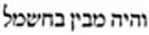 ],
fire came out of the ḥashmal [comp. Ezek. i. 4, "as
ḥashmal out of the fire"] and consumed him [Ḥag.
13a], for the boy was one who knew [
],
fire came out of the ḥashmal [comp. Ezek. i. 4, "as
ḥashmal out of the fire"] and consumed him [Ḥag.
13a], for the boy was one who knew [ = γνωστικός]. Gnosis is neither pure philosophy
nor pure religion, but a combination of the two with
magic, the latter being the dominant element, as it
was the beginning of all religion and philosophy.
The expression "to shake the world," used by the
gnostic Bar Zoma (Gen. R. ii. 4, and parallels),
reminds one of the origins of gnosis. The phrase "to
trim the plants," occurring in the second leading
passage on Jewish gnosticism, quoted below, must be
noted here, for it refers, of course, to the
influencing of the heavenly world by gnostic means.
= γνωστικός]. Gnosis is neither pure philosophy
nor pure religion, but a combination of the two with
magic, the latter being the dominant element, as it
was the beginning of all religion and philosophy.
The expression "to shake the world," used by the
gnostic Bar Zoma (Gen. R. ii. 4, and parallels),
reminds one of the origins of gnosis. The phrase "to
trim the plants," occurring in the second leading
passage on Jewish gnosticism, quoted below, must be
noted here, for it refers, of course, to the
influencing of the heavenly world by gnostic means.
The ophitic diagram that Krochmal shows in the pictures that "may not be looked upon" (Tosef., Shab., and parallels), is evidently derived from magic, for the cabalistic sign of the pentagram is found on one of the earliest shards (Bliss and Macalister, "Excavations in Palestine During the Years 1898-1900," plates 29, 42; Dr. Emaus, in "Vajda, Magyar Zsidó Szemle," xvii. 315 et seq.). A mere reference to this view must suffice here; its importance has been noted by Anrich, l.c. pp. 86-87; it points the way to an understanding of Jewish gnosis. A few interesting examples may be given here. The following passage occurs in the Berlin Papyrus, i. 20, Parthey: "Take milk and honey and taste them, and something divine will be in your heart." The Talmud, curiously enough (Ḥag. 13a), refers the phrase, "Honey and milk are under thy tongue" (Cant. iv. 11), to the Merkabah, one of the principal parts of Jewish gnosis, saying that the knowledge of the Merkabah, which is sweeter than milk and honey, shall remain under the tongue, meaning that it shall not be taught (comp. Dietrich, "Abraxas." p. 157; "honey and milk must be offered"). The Valentinians taught that in order to attain salvation the pneumatic required nothing further "than gnosis and the formulæ [ἐπιήματα] of the mysteries" (Epiphanius, "Hæreses," xxxi. 7).
The Four Who Entered Paradise."Four
scholars, Ben Azzai, Ben Zoma, Aḥer [Elisha b.
Abuyah], and Rabbi Akiba, entered paradise [ = πασάδεισος]; Ben Azzai beheld it and died; Ben
Zoma beheld it and went mad; Aḥer beheld it and
trimmed the plants; Akiba went in and came out in
peace" (Tosef., Ḥag. ii. 3; Ḥag. 14b; Yer. Ḥag. 77b;
Cant. R. i. 4). The entering into paradise must be
taken literally, as Blau points out ("Altjüdisches
Zauberwesen," pp. 115 et seq.). The following
proof may be added to those given there: "In the
beginning of the Paris Papyrus is that great
ἀπαθανατισμός, in which the mystic rises above stars
and suns ἔν ἐκστάσει οὐκ ἐν ἐαυτῳ ὤν, near to the
Godhead. By such art Iamblichus, freed from his
body, endeavored to enter the felicity of the gods
['De Mysteriis,' i. 12], and thus his slaves said
that they had seen him, ten ells above the earth,
his body and garments gleaming in golden beauty"
(Dietrich, l.c. p. 152). Paul (II Cor. xii.
1-4) speaks similarly of paradise, a passage that
Joel ("Die Religionsgesch." i. 163, note 3)
misinterprets as a "picture of gnosis." This
instructive passage is as follows: "It is not
expedient for me, doubtless, to glory. I will come
to visions and revelations of the Lord. I knew a man
in Christ above fourteen years ago (whether in the
body, I can not tell; or whether out of the body, I
can not tell: God knoweth); such an one caught up to
the third heaven. And I know such a man. . . . How
that he was caught up into paradise, and heard
unspeakable words, which it is not lawful for a man
to utter."
= πασάδεισος]; Ben Azzai beheld it and died; Ben
Zoma beheld it and went mad; Aḥer beheld it and
trimmed the plants; Akiba went in and came out in
peace" (Tosef., Ḥag. ii. 3; Ḥag. 14b; Yer. Ḥag. 77b;
Cant. R. i. 4). The entering into paradise must be
taken literally, as Blau points out ("Altjüdisches
Zauberwesen," pp. 115 et seq.). The following
proof may be added to those given there: "In the
beginning of the Paris Papyrus is that great
ἀπαθανατισμός, in which the mystic rises above stars
and suns ἔν ἐκστάσει οὐκ ἐν ἐαυτῳ ὤν, near to the
Godhead. By such art Iamblichus, freed from his
body, endeavored to enter the felicity of the gods
['De Mysteriis,' i. 12], and thus his slaves said
that they had seen him, ten ells above the earth,
his body and garments gleaming in golden beauty"
(Dietrich, l.c. p. 152). Paul (II Cor. xii.
1-4) speaks similarly of paradise, a passage that
Joel ("Die Religionsgesch." i. 163, note 3)
misinterprets as a "picture of gnosis." This
instructive passage is as follows: "It is not
expedient for me, doubtless, to glory. I will come
to visions and revelations of the Lord. I knew a man
in Christ above fourteen years ago (whether in the
body, I can not tell; or whether out of the body, I
can not tell: God knoweth); such an one caught up to
the third heaven. And I know such a man. . . . How
that he was caught up into paradise, and heard
unspeakable words, which it is not lawful for a man
to utter."
Philo says,
similarly: "Some one might ask, 'If true holiness
consists in imitating the deeds of God, why should I
be forbidden to plant a grove in the sanctuary of
God, since God did the same thing when He planted a
garden?' . . . While God plants and sows the
beautiful in the soul, the spirit sins, saying, 'I
plant '" ("De Allegoriis Legum," §§ 52 et seq.;
ed. Mangey, §§ 117 et seq.). Philo here
speaks also of trimming the trees. It is evident
that this is the language of gnosis, but the words
are used allegorically, as in Scripture. The literal
interpretation here is perhaps also the correct one.
The mystic imitates God, as Philo says, in planting
a grove—that is, the mystic becomes himself a
creator. He likewise has the power to destroy. There
were books on the plants of the seven planets—for
example, a work by Hermes, Βοτάναι τῶν 'Αροσκόπων
(Dietrich, l.c. p. 157, note 1). Hence the
planets were also regarded as "plantations," and
Aḥer's "trimming of the plants" in paradise must be
interpreted in this sense. Berechiah (4th cent.)
interpreted the words of Canticles i. 4, "God
brought me into his apartments," to refer to the
mysteries of the Creation and the throne of God
(Cant. R. ad loc.; Bacher, "Ag. Bab. Amor."
iii. 356). Hence he regarded the knowledge of the
Merkabah as an entering of the apartments of God, or
as entering the "Pardes." Akiba says to his
companions who have entered paradise: "When you come
to the pure marble stones, do not say, 'Water,
water!' for of this it is said (Ps. ci. 7): 'He that
worketh deceit shall not dwell within my house'" (Ḥag.
xiv. 6). "Ben Zoma stood and pondered; R. Joshua
passed him and addressed him once and twice, but
received no answer. The third time he answered
quickly. Then Joshua said to him: 'Whence the feet [
 ]?'
He answered, 'Nothing "whence," my master.' Then R.
Joshua said, 'I call heaven and earth to witness
that I will not stir from this place until you
answer me, Whence the feet?' Ben Zoma answered thus:
'I was contemplating the Creation, and between the
lower and the upper waters the distance is not
greater than two or three fingers' breadth, for it
is not written that the Spirit of God "moved," but
that the Spirit of God "hovered," just as a bird
moves his wings, and his wings touch it and do not
touch it.' Joshua then turned and said to his
pupils, 'Ben Zoma is gone [
]?'
He answered, 'Nothing "whence," my master.' Then R.
Joshua said, 'I call heaven and earth to witness
that I will not stir from this place until you
answer me, Whence the feet?' Ben Zoma answered thus:
'I was contemplating the Creation, and between the
lower and the upper waters the distance is not
greater than two or three fingers' breadth, for it
is not written that the Spirit of God "moved," but
that the Spirit of God "hovered," just as a bird
moves his wings, and his wings touch it and do not
touch it.' Joshua then turned and said to his
pupils, 'Ben Zoma is gone [ ].'"
Ben Zoma remained on earth but a few days longer
(Gen. R. ii. 17). The expression "is gone" refers to
ecstasy, the corresponding expression in the
parallel passages being
].'"
Ben Zoma remained on earth but a few days longer
(Gen. R. ii. 17). The expression "is gone" refers to
ecstasy, the corresponding expression in the
parallel passages being
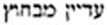 ("he is always beside himself").
Thinkers
have devoted much time to speculations on the
creation of the world; even the Jews who were loyal
to the Law connected these speculations with the
first chapter of the Torah, which dominated the
whole of Jewish life and thought. In order to check
the philosophemes a scribe of the third century
said, paraphrasing Prov. xxv. 2, "In the first
chapter of the Torah it is the glory of God to
conceal things; in the following ones, to search
them out" (Gen. R. ix., beginning). In view of
the unfriendly attitude of official Judaism the
existence of the numerous gnostic allusions can be
explained only on the ground that not all
speculations on the Creation were held to touch upon
the knowledge of the act of creation (comp. the
principal passage in Ḥagigah). The wise Joshua
himself gives an explanation of the Creation (Gen.
R. x. 3). The leading questions of cosmology are:
How, and by whom, and by what means, was the world
created? "A philosopher said to the patriarch
Gamaliel II. (c. 100), 'Your God is a great
builder, but He had efficient means—clay, darkness,
and water, wind, and watery depths [tehom]'" (Gen.
R. i. 4). Johanan (d. 279) said: "One should not
strive to know what was before the Creation, because
in speaking of the palace of an earthly king one
does not mention the dungheap that was formerly on
that spot" (Ḥag. 16a). One may see the nature of
these speculations from such passages: "If God
had not said to heaven and earth: 'Enough!' they
would still continue to extend" (Gen. R. iv. 6). God
is therefore called
 ("he spake,
 = "enough"), and among the Naasenes 'Ησαιδαῖος =
 plays, in fact, an important part (Hilgenfeld, "Ketzesgeschichte
des Urchristenthums," p. 257). The spheres of the
sun and moon are in the second of the seven heavens
(Gen. R. vi. 5). The creation of light was
especially puzzling, several kinds being
distinguished (ib. iii. 4).
plays, in fact, an important part (Hilgenfeld, "Ketzesgeschichte
des Urchristenthums," p. 257). The spheres of the
sun and moon are in the second of the seven heavens
(Gen. R. vi. 5). The creation of light was
especially puzzling, several kinds being
distinguished (ib. iii. 4).
Jewish
thought was particularly sensitive in regard to
monotheism, refusing all speculations that
threatened or tended to obscure God's eternity and
omnipotence. R. Akiba explained that the mark of
the accusative,
 ,
before "heaven and earth" in the first verse of
Genesis was used in order that the verse might not
be interpreted to mean that heaven and earth created
God ("Elohim": Gen. R. i. 1), evidently attacking
the gnostic theory according to which the supreme
God is enthroned in unapproachable distance, while
the world is connected with a demiurge (comp. Gen.
R. viii. 9, and many parallel passages). The archons
of the gnostics perhaps owe their existence to the
word
,
before "heaven and earth" in the first verse of
Genesis was used in order that the verse might not
be interpreted to mean that heaven and earth created
God ("Elohim": Gen. R. i. 1), evidently attacking
the gnostic theory according to which the supreme
God is enthroned in unapproachable distance, while
the world is connected with a demiurge (comp. Gen.
R. viii. 9, and many parallel passages). The archons
of the gnostics perhaps owe their existence to the
word
 = ἀρχή. The first change made by the seventy
translators in their Greek version was, according to
a baraita (2d cent. at latest), to place the word
"God" at the beginning of the first verse of
Genesis. Rashi, who did not even know gnosticism by
name, said it was done in order to make it
impossible for any one to say, "The beginning ['Αρχή
as God] created God [Elohim]." Genesis i. 26 they
rendered: "I [not "We"] will create a man" (comp.
Gen. R. viii. 8). The plural in the latter passage
is explained on the ground that God took counsel
with the souls of the pious. Genesis v. 2 was
amended to: "Man and woman created he him" (not
"them"), in order that no one might think He had
created two hermaphrodites (thus Rashi; comp. Gen.
R. viii.; ἀνδρόγυνος, διπρόσοτος: "Philosoph." ed.
Duncker, v. 7, p. 132; Adam ἀρσενόϑηλυς and other
passages in Hilgenfeld, l.c. pp. 242, 255;
μητροπάτωρ in Wobbermin, l.c. pp. 81, 85;
derived from Babylonian cosmogony; Berosus, in
Eusebius, "Chronicon," ed. Schöne, i. 14-18). Gen.
xi. 7 was changed so as to read "I will come down."
= ἀρχή. The first change made by the seventy
translators in their Greek version was, according to
a baraita (2d cent. at latest), to place the word
"God" at the beginning of the first verse of
Genesis. Rashi, who did not even know gnosticism by
name, said it was done in order to make it
impossible for any one to say, "The beginning ['Αρχή
as God] created God [Elohim]." Genesis i. 26 they
rendered: "I [not "We"] will create a man" (comp.
Gen. R. viii. 8). The plural in the latter passage
is explained on the ground that God took counsel
with the souls of the pious. Genesis v. 2 was
amended to: "Man and woman created he him" (not
"them"), in order that no one might think He had
created two hermaphrodites (thus Rashi; comp. Gen.
R. viii.; ἀνδρόγυνος, διπρόσοτος: "Philosoph." ed.
Duncker, v. 7, p. 132; Adam ἀρσενόϑηλυς and other
passages in Hilgenfeld, l.c. pp. 242, 255;
μητροπάτωρ in Wobbermin, l.c. pp. 81, 85;
derived from Babylonian cosmogony; Berosus, in
Eusebius, "Chronicon," ed. Schöne, i. 14-18). Gen.
xi. 7 was changed so as to read "I will come down."
It may be mentioned here, in connection with these views about original hermaphroditism, that even the earlier authorities of the Talmud were acquainted with the doctrine of syzygy (Joel, l.c. i. 159 et seq.). The following passages indicate how deeply the ancients were imbued with this doctrine: "All that God created in His world, He created male and female" (B. B. 74b; comp. Ḥag. 15a, "mountains and hills," and R. H. 11a). God made man out of the dust of the earth (Gen. ii. 7): "dust" ("'afar") is masculine, "earth" ("adamah") is feminine. The potter also takes male and female earth in order that his wares may be sound (Gen. R. xiv.). The doctrine of the division of the waters into male and female is intimately connected with the gnosis of the Creation. R. Levi said: "The upper waters [rain] are male; the lower waters ["tehom," the great water in which the earth floats] are female, for it is written [Isa. xlv. 8]: 'Let the earth open [as the woman to the man] and bring forth salvation [generation]'" (Yer. Ber. 14a, 21; comp. Pirḳe R. El. v. and xxiii., "male and female waters"). The rain is called "rebi'ah" because it mingles with the earth (ib.; Simon b. Gamaliel, 2d cent.). The rain is the spouse of the earth (Ta'an. 6b, where the expressions used are "bride" and "groom"). In the introduction to the Zohar sins also are divided into male and female.
Prince of the World.The Jews of course emphatically repudiated the doctrine of the demiurge, who was identified by some Christian gnostics with the God of the Old Testament and designated as the "accursed God of the Jews," from whom all the evil in the world was derived (Epiphanius, "Hæreses," xl. 7; comp. Harnack, "Geschichte der Altchristlichen Litteratur," p. 174; Herzog-Hauck, l.c. vi. 736; Friedländer, l.c. p. 69). The monotheism of the Jews was incompatible with a demiurge of any kind. The passage Abot iv. 22, already quoted, is evidently directed against the demiurge and similar views: "To be announced and to be made known that He is the God, the God, the Maker, the Creator, the Prudent, the Judge . . . that He shall judge . . . for all belongs to Him. If thy bad inclination assures thee that the nether world will be thy refuge, [know] that thou hast been created and born against thy will, that thou wilt live and die against thy will, and that thou wilt give account before the King of Kings against thy will." The belief in a "prince of the world" is a reflex of the demiurge. When God said, "I arrange everything after its kind," the prince of the world sang a song of praise (Ḥul. 60a). It was he that recited Ps. xxxvii, 25, for it is he, not God, who lives only since the Creation (Yeb. 16b). He desired God to make King Hezekiah the Messiah, but God said, "That is my secret"; God would not reveal to the demiurge His intentions in regard to Israel (Sanh. 94a; comp. Krochmal, l.c. p. 202).
Two Principles.The two powers ("shete reshuyot"), a good and an evil, are often mentioned. In order to explain evil in the world the gnostics assumed two principles, which, however, are not identical with the Mazdean dualism (comp. Yer. Ber., end; Krochmal, l.c. p. 208, note; Ḥul. 87a; Friedländer, l.c. pp. 80 et seq.). On dualisms, trinities, eight powers ("dyas," "tetras," "ogdoas"), see Hilgenfeld, l.c. pp. 236 et seq. Hypostases often occur (Krochmal, l.c. p. 205). God has two thrones, one for judgment, and one for "ẓedaḳah" (benevolence, justice, and mercy; Ḥag. 14a).
The
official view, and certainly also the common one,
was that founded on Scripture, that God called the
world into being by His word (see Ps. xxxiii. 6, 9:
"By the word of the Lord were the heavens made; and
all the host of them by the breath of his mouth. For
he spake and it was done; he commanded, and it stood
fast"). According to tradition, however, it required
merely an act of His will, and not His word (Targ.
Yer. to Gen. translates "He willed," instead of "He
spake"). There were materialistic ideas side by side
with this spiritual view. The Torah existed 2,000
years before the Creation; it, and not man, knows
what preceded Creation (Gen. R. viii. 2). It says,
"I was the instrument by means of which God created
the world" (Gen. R. i.). This idea is rationalized
in the Haggadah by comparing the Torah with the
plans of a builder. Rab (200
The
gnosis of the Palestinian Marcus conceived the world
to have come into being through the permutation of
letters (Grätz, "Gnosticismus und Judenthum,"
pp. 105 et seq.). The στοιχεῖα of the
alphabet corresponds to the στοιχεῖα of the universe
(Wobbermin, l.c. p. 128). Epstein calls this
view an astrological one, and he expounds it further
(l.c. pp. 23 et seq.). The several
elements of the alphabet play an important rôle in
this cosmologic system, a reflection of which is
found in one of the haggadah, in which the letters,
beginning with the last, appear before God,
requesting that the world be created through them.
They are refused, until bet appears, with which
begins the story of Creation. Alef complains for
twenty-six generations, and is only pacified when it
heads the Decalogue (Gen. R. i. 1). It was evidently
held that the world came into being with the first
sound that God uttered. Johanan thought that a
breath sufficed, hence the world was created by ת
(Gen. R. xii.). This view is connected with another
view, according to which God first caused the spirit
("ruaḥ" = wind) to be. In the Sefer Yeẓirah, the
three principal elements of the alphabet are
 ;
that is,
;
that is,
 (air),
 (water), and
 (fire: Epstein, l.c. pp. 24 et seq.).
According to this conception there are three, not
four, elements, as was commonly assumed after the
Arabic period. Curiously enough, the second
book of "Jeu," p. 195, and the "Pistis
Sophia," p. 375 (quoted in Herzog-Hauck, l.c.
vi. 734), refer to three kinds of baptism —with
water, with fire, and with spirit. It is
impossible to say to what extent the Yeẓirah
speculations influenced the Cabala and its principal
manual, the Zohar, as well as its prominent adepts,
at the close of the Middle Ages and in modern times,
as there are no special studies on the subject. Many
gnostic elements, as, for example, the syzygy
doctrine (in which are found father, mother, and
son), have doubtless been preserved in the Cabala,
together with magic and mysticism.
(fire: Epstein, l.c. pp. 24 et seq.).
According to this conception there are three, not
four, elements, as was commonly assumed after the
Arabic period. Curiously enough, the second
book of "Jeu," p. 195, and the "Pistis
Sophia," p. 375 (quoted in Herzog-Hauck, l.c.
vi. 734), refer to three kinds of baptism —with
water, with fire, and with spirit. It is
impossible to say to what extent the Yeẓirah
speculations influenced the Cabala and its principal
manual, the Zohar, as well as its prominent adepts,
at the close of the Middle Ages and in modern times,
as there are no special studies on the subject. Many
gnostic elements, as, for example, the syzygy
doctrine (in which are found father, mother, and
son), have doubtless been preserved in the Cabala,
together with magic and mysticism.
Gnosis was regarded as legitimate by Judaism. Its chain of tradition is noted in the principal passage in Ḥagigah, Johanan b. Zakkai heading the list. Here is found the threefold division of men into hylics, psychics, and pneumatics, as among the Valentinians. Although these names do not occur, the "third group," as the highest, is specifically mentioned (Ḥag. 14b), as Krochmal pointed out before Joel. The ophitic diagram was also known, for the yellow circle which was upon it is mentioned (Joel, l.c. p. 142). Gnosis, like every other system of thought, developed along various lines; from some of these the Jewish faith, especially monotheism, was attacked, and from others Jewish morality, with regard to both of which Judaism was always very sensitive. There were gnostics who led an immoral life, Aḥer (Elisha ben Abuyah) being among these, according to legendary accounts (comp. Pes. 56a; Eccl. R. i 8; Harnack, l.c. pp. 166 et seq.; Hilgenfeld, l.c. pp. 244-250). But there were also gnostic sects practising asceticism (Herzog-Hauck, l.c. vi. 734, 755). Jose b. Ḥalafta seems to have belonged to one of these, for he speaks of "five plants [sons] that he planted." This is the language of gnosis. Those parties which, though within Judaism, were nevertheless inimical to it—among them Judæo-Christianity—naturally used gnosis, then the fashion of the day, as a weapon against the ruling party, official Judaism. (On the relation between Jewish and Christian gnosis see Harnack, l.c. p. 144, and Friedländer, l.c. p. 63; on antinomian gnosis see Friedländer, l.c. pp. 76 et seq.) The term "minim" in the Talmud often refers to gnostics, as Friedländer, and before him Krochmal and Grätz, have pointed out. The knowledge of the origin and nature of man also belonged to gnosis (Irenæus. i. 14, 4 γιγνώσκω ὄεν εἰμί; comp. Clem. Al. Exc. ex.Theod. 78; see Homunculus; Adam). There are also other traces of Gnosticism in Judaism (comp. Gen. R. vii. 5). See also Cosmogony; Creation.
- N. Krochmal, Moreh Nebuke ha-Zeman, pp. 199 et seq., Lemberg, 1863;
- H. Grätz, Gnosticismus und Judenthum, Krotoschin, 1846 (the chief authority);
- Grätz, Gesch. iv. 112 et seq.;
- Joel, Die Religionsgesch. i. 103-170, Breslau, 1880;
- M. Friedländer, Der Vorchristliche Jüdische Gnosticismus, Göttingen, 1898;
- Schürer, in Theol. Litteraturzeitung, 1899, pp. 167-170;
- Hönig, Ophiten;
- A. Epstein, Recherches sur le sèfer Yezirah, Paris, 1894 (reprinted from R. E. J. xxviii.-xxix.);
- I. Matter, Histoire Critique du Gnosticisme, Paris, 1828;
- Mansel, The Gnostic Heresies, London, 1875;
- A. Hilgenfeld, Ketzergesch. des Urchristenthums, Leipsic, 1884;
- A. Harnack, Gesch. der Altchristlichen Litteratur, i., ib. 1893;
- idem, Doymengesch. 3d ed., Freiburg im Breisgan, and Leipsic, 1894;
- A. Dietrich, Abraxas, Leipsic, 1891;
- G. Aurich, Das Antike Mysterienwesen in Seinem Einfluss auf das Christenthum, Göttingen, 1894;
- G. Wobbermin, Religionsgesch. Studien zur Frage der Beeinflussung des Urchristenthums Durch das Antike Mysterienwesen, Berlin, 1896;
- G. R. S. Mead, Fragmente eines Verschollenen Glaubens (German transl. by A. von Ulrich), ib. 1902;
- A. Wurm, Die Irrlehrer im Ersten Johannesbrief, Freiburg im Breisgau, 1903;
- Biblische Studien, viii. 1. For other works, see Herzog-Hauck, Real-Encyc. vi. 728.