|
THE GENEALOGY OF MORALS |
|
FIRST ESSAY: "GOOD AND EVIL," "GOOD AND BAD" i. Those English psychologists, who up to the present are the only philosophers who are to be thanked for any endeavour to get as far as a history of the origin of morality — these men, I say, offer us in their own personalities no paltry problem; — they even have, if I am to be quite frank about it, in their capacity of living riddles, an advantage over their books — they themselves are interesting! These English psychologists — what do they really mean? We always find them voluntarily or involuntarily at the same task of pushing to the front the partie honteuse of our inner world, and looking for the efficient, governing, and decisive principle in that precise quarter where the intellectual self-respect of the race would be the most reluctant to find it (for example, in the vis inertiae of habit, or in forgetfulness, or in a blind and fortuitous mechanism and association of ideas, or in some factor that is purely passive, reflex, molecular, or fundamentally stupid) — what is the real motive power which always impels these psychologists in precisely this direction? Is it an instinct for human disparagement somewhat sinister, vulgar, and malignant, or perhaps incomprehensible even to itself? or perhaps a touch of pessimistic jealousy, the mistrust of disillusioned idealists who have become gloomy, poisoned, and bitter? or a petty subconscious enmity and rancour against Christianity (and Plato), that has conceivably never crossed the threshold of consciousness? or just a vicious taste for those elements of life which are bizarre, painfully paradoxical, mystical, and illogical? or, as a final alternative, a dash of each of these motives; — a little vulgarity, a little gloominess, a little anti-Christianity, a little craving for the necessary piquancy? But I am told that it is simply a case of old frigid and tedious frogs crawling and hopping around men and inside men, as if they were as thoroughly at home there, as they would be in a swamp. I am opposed to this statement, nay, I do not believe it: and if, in the impossibility of knowledge, one is permitted to wish, so do I wish from my heart that just the converse metaphor should apply, and that these analysts with their psychological microscopes should be, at bottom, brave, proud, and magnanimous animals who know how to bridle both their hearts and their smarts, and have really trained themselves to sacrifice what is desirable, what is true, any truth in fact, even the simple, bitter, ugly, repulsive, unchristian, and immoral truths — for there are truths of that description. 2. All honour, then, to the noble spirits who would fain dominate these historians of morality. But it is certainly a pity that they lack the historical sense itself, that they themselves are quite deserted by all the beneficent spirits of history. The whole train of their thought runs, as was always the way of old-fashioned philosophers, on thoroughly unhistorical lines: there is no doubt on this point. The crass ineptitude of their genealogy of morals is immediately apparent when the question arises of ascertaining the origin of the idea and judgment of "good." "Man had originally,'' so speaks their decree, "praised and called 'good' altruistic acts from the standpoint of those on whom they were conferred, that is, those to whom they were useful; subsequently the origin of this praise was forgotten, and altruistic acts, simply because, as a sheer matter of habit, they were praised as good, came also to be felt as good — as though they contained in themselves some intrinsic goodness." The thing is obvious: — this initial derivation contains already all the typical and idiosyncratic traits of the English psychologists — we have "utility," "forgetting," "habit," and finally "error," the whole assemblage forming the basis of a system of values, on which the higher man has up to the present prided himself as though it were a kind of privilege of man in general. This pride must be brought low, this system of values must lose its values: is that attained? Now the first argument that comes ready to my hand is that the real homestead of the concept "good" is sought and located in the wrong place: the judgment "good" did not originate among those to whom goodness was shown. Much rather has it been the good themselves, that is, the aristocratic, the powerful, the high-stationed, the high-minded, who have felt that they themselves were good, and that their actions were good, that to say of the first order, in contradistinction to all the low, the low-minded, the vulgar, and the plebeian. It was out of this pathos of distance that they first arrogated the right to create values for their own profit, and to coin the names of such values: what had they to do with utility? The standpoint of utility is as alien and as inapplicable as it could possibly be, when we have to deal with so volcanic an effervescence of supreme values, creating and demarcating as they do a hierarchy within themselves: it is at this juncture that one arrives at an appreciation of the contrast to that tepid temperature, which is the presupposition on which every combination of worldly wisdom and every calculation of practical expediency is always based — and not for one occasional, not for one exceptional instance, but chronically. The pathos of nobility and distance, as I have said, the chronic and despotic esprit de corps and fundamental instinct of a higher dominant race coming into association with a meaner race, an "under race," this is the origin of the antithesis of good and bad. (The masters' right of giving names goes so far that it is permissible to look upon language itself as the expression of the power of the masters: they say "this is that, and that," they seal finally every object and every event with a sound, and thereby at the same time take possession of it.) It is because of this origin that the word "good" is far from having any necessary connection with altruistic acts, in accordance with the superstitious belief of these moral philosophers. On the contrary, it is on the occasion of the decay of aristocratic values, that the antitheses between "egoistic" and "altruistic" presses more and more heavily on the human conscience— it is, to use my own language, the herd instinct which finds in this antithesis an expression in many ways. And even then it takes a considerable time for this instinct to become sufficiently dominant, for the valuation to be inextricably dependent on this antithesis (as is the case in contemporary Europe); for to-day the prejudice is predominant, which, acting even now with all the intensity of an obsession and brain disease, holds that "moral," "altruistic," and "desinteresse" are concepts of equal value. 3. In the second place, quite apart from the fact that this hypothesis as to the genesis of the value "good" cannot be historically upheld, it suffers from an inherent psychological contradiction. The utility of altruistic conduct has presumably been the origin of its being praised, and this origin has become forgotten: — But in what conceivable way is this forgetting possible? Has perchance the utility of such conduct ceased at some given moment? The contrary is the case. This utility has rather been experienced every day at all times, and is consequently a feature that obtains a new and regular emphasis with every fresh day; it follows that, so far from vanishing from the consciousness, so far indeed from being forgotten, it must necessarily become impressed on the consciousness with ever-increasing distinctness. How much more logical is that contrary theory (it is not the truer for that) which is represented, for instance, by Herbert Spencer, who places the concept "good" as essentially similar to the concept "useful," "purposive," so that in the judgments "good" and "bad" mankind is simply summarising and investing with a sanction its unforgotten and unforgettable experiences concerning the "useful-purposive" and the "mischievous-non-purposive." According to this theory, "good" is the attribute of that which has previously shown itself useful; and so is able to claim to be considered "valuable in the highest degree," "valuable in itself." This method of explanation is also, as I have said, wrong, but at any rate the explanation itself is coherent, and psychologically tenable. 4. The guide-post which first put me on the right track was this question — what is the true etymological significance of the various symbols for the idea "good" which have been coined in the various languages? I then found that they all led back to the same evolution of the same idea — that everywhere "aristocrat," "noble" (in the social sense), is the root idea, out of which have necessarily developed "good" in the sense of "with aristocratic soul," "noble," in the sense of "with a soul of high calibre," "with a privileged soul" — a development which invariably runs parallel with that other evolution by which "vulgar," "plebeian," "low," are made to change finally into "bad." The most eloquent proof of this last contention is the German word "schlecht" itself: this word is identical with "schlicht" — (compare "schlechtweg" and "schlechterdings")— which, originally and as yet without any sinister innuendo, simply denoted the plebeian man in contrast to the aristocratic man. It is at the sufficiently late period of the Thirty Years' War that this sense becomes changed to the sense now current. From the standpoint of the Genealogy of Morals this discovery seems to be substantial: the lateness of it is to be attributed to the retarding influence exercised in the modern world by democratic prejudice in the sphere of all questions of origin. This extends, as will shortly be shown, even to the province of natural science and physiology, which prima facie is the most objective. The extent of the mischief which is caused by this prejudice (once it is free of all trammels except those of its own malice), particularly to Ethics and History, is shown by the notorious case of Buckle: it was in Buckle that that plebeianism of the modern spirit, which is of English origin, broke out once again from its malignant soil with all the violence of a slimy volcano, and with that salted, rampant, and vulgar eloquence with which up to the present time all volcanoes have spoken. 5. With regard to
our
problem, which can justly be called
an intimate problem, and which elects to appeal to only
a limited number of ears: it is of no small interest to
ascertain that in those words and roots which denote
"good" we catch glimpses of that arch-trait, on the
strength of which the aristocrats feel themselves to be
beings of a higher order than their fellows. Indeed, they
call themselves in perhaps the most frequent instances
simply after their superiority in power (e.g. "the powerful," "the lords," "the commanders"), or after the most
obvious sign of their superiority, as for example "the
rich," "the possessors" (that is the meaning of arya; and
the Iranian and Slav languages correspond). But they
also call themselves after some characteristic idiosyncrasy;
and this is the case which now concerns us. They name
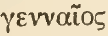
themselves, for instance, "the truthful": this is first done
by the Greek nobility whose mouthpiece is found in Theognis, the Megarian poet.
The word
6. Above all, there is no exception (though there are opportunities for exceptions) to this rule, that the idea of political superiority always resolves itself into the idea of psychological superiority, in those cases where the highest caste is at the same time the priestly caste, and in accordance with its general characteristics confers on itself the privilege of a title which alludes specifically to its priestly function. It is in these cases, for instances, that "clean" and "unclean" confront each other for the first time as badges of class distinction; here again there develops a "good" and a "bad," in a sense which has ceased to be merely social. Moreover, care should be taken not to take these ideas of "clean" and "unclean" too seriously, too broadly, or too symbolically: all the ideas of ancient man have, on the contrary, got to be understood in their initial stages, in a sense which is, to an almost inconceivable extent, crude, coarse, physical, and narrow, and above all essentially unsymbolical. The "clean man" is originally only a man who washes himself, who abstains from certain foods which are conducive to skin diseases, who does not sleep with the unclean women of the lower classes, who has a horror of blood — not more, not much more! On the other hand, the very nature of a priestly aristocracy shows the reasons why just at such an early juncture there should ensue a really dangerous sharpening and intensification of opposed values: it is, in fact, through these opposed values that gulfs are cleft in the social plane, which a veritable Achilles of free thought would shudder to cross. There is from the outset a certain diseased taint in such sacerdotal aristocracies, and in the habits which prevail in such societies — habits which, averse as they are to action, constitute a compound of introspection and explosive emotionalism, as a result of which there appears that introspective morbidity and neurasthenia, which adheres almost inevitably to all priests at all times: with regard, however, to the remedy which they themselves have invented for this disease — the philosopher has no option but to state, that it has proved itself in its effects a hundred times more dangerous than the disease, from which it should have been the deliverer. Humanity itself is still diseased from the effects of the naivetes of this priestly cure. Take, for instance, certain kinds of diet (abstention from flesh), fasts, sexual continence, flight into the wilderness (a kind of Weir-Mitchell isolation, though of course without that system of excessive feeding and fattening which is the most efficient antidote to all the hysteria of the ascetic ideal); consider too the whole metaphysic of the priests, with its war on the senses, its enervation, its hair-splitting; consider its self-hypnotism on the fakir and Brahman principles (it uses Brahman as a glass disc and obsession), and that climax which we can understand only too well of an unusual satiety with its panacea of nothingness (or God: — the demand for a unio mystica with God is the demand of the Buddhist for nothingness. Nirvana — and nothing else! In sacerdotal societies every element is on a more dangerous scale, not merely cures and remedies, but also pride, revenge, cunning, exaltation, love, ambition, virtue, morbidity: — further, it can fairly be stated that it is on the soil of this essentially dangerous form of human society, the sacerdotal form, that man really becomes for the first time an interesting animal, that it is in this form that the soul of man has in a higher sense attained depths and become evil — and those are the two fundamental forms of the superiority which up to the present man has exhibited over every other animal. 7. The reader will have already surmised with what ease the priestly mode of valuation can branch off from the knightly aristocratic mode, and then develop into the very antithesis of the latter: special impetus is given to this opposition, by every occasion when the castes of the priests and warriors confront each other with mutual jealousy and cannot agree over the prize. The knightly-aristocratic "values" are based on a careful cult of the physical, on a flowering, rich, and even effervescing healthiness, that goes considerably beyond what is necessary for maintaining life, on war, adventure, the chase, the dance, the tourney — on everything, in fact, which is contained in strong, free, and joyous action. The priestly-aristocratic mode of valuation is — we have seen — based on other hypotheses: it is bad enough for this class when it is a question of war! Yet the priests are, as is notorious, the worst enemies — why? Because they are the weakest. Their weakness causes their hate to expand into a monstrous and sinister shape, a shape which is most crafty and most poisonous. The really great haters in the history of the world have always been priests, who are also the cleverest haters — in comparison with the cleverness of priestly revenge, every other piece of cleverness is practically negligible. Human history would be too fatuous for anything were it not for the cleverness imported into it by the weak — take at once the most important instance. All the world's efforts against the "aristocrats," the "mighty," the "masters," the "holders of power," are negligible by comparison with what has been accomplished against those classes by the Jews — the Jews, that priestly nation which eventually realised that the one method of effecting satisfaction on its enemies and tyrants was by means of a radical transvaluation of values, which was at the same time an act of the cleverest revenge. Yet the method was only appropriate to a nation of priests, to a nation of the most jealously nursed priestly revengefulness. It was the Jews who, in opposition to the aristocratic equation (good = aristocratic = beautiful = happy = loved by the gods), dared with a terrifying logic to suggest the contrary equation, and indeed to maintain with the teeth of the most profound hatred (the hatred of weakness) this contrary equation, namely, "the wretched are alone the good; the poor, the weak, the lowly, are alone the good; the suffering, the needy, the sick, the loathsome, are the only ones who are pious, the only ones who are blessed, for them alone is salvation — but you, on the other hand, you aristocrats, you men of power, you are to all eternity the evil, the horrible, the covetous, the insatiate, the godless; eternally also shall you be the unblessed, the cursed, the damned!" We know who it was who reaped the heritage of this Jewish transvaluation. In the context of the monstrous and inordinately fateful initiative which the Jews have exhibited in connection with this most fundamental of all declarations of war, I remember the passage which came to my pen on another occasion (Beyond Good and Evil, Aph. 195) — that it was, in fact, with the Jews that the revolt of the slaves begins in the sphere of morals; that revolt which has behind it a history of two millennia, and which at the present day has only moved out of our sight, because it has achieved victory. 8. But you understand this not? You have no eyes for a force which has taken two thousand years to achieve victory? — There is nothing wonderful in this: all lengthy processes are hard to see and to realise. But this is what took place: from the trunk of that tree of revenge and hate, Jewish hate, — that most profound and sublime hate, which creates ideals and changes old values to new creations, the like of which has never been on earth, — there grew a phenomenon which was equally incomparable, a new love, the most profound and sublime of all kinds of love; — and from what other trunk could it have grown? But beware of supposing that this love has soared on its upward growth, as in any way a real negation of that thirst for revenge, as an antithesis to the Jewish hate! No, the contrary is the truth! This love grew out of that hate, as its crown, as its triumphant crown, circling wider and wider amid the clarity and fulness of the sun, and pursuing in the very kingdom of light and height its goal of hatred, its victory, its spoil, its strategy, with the same intensity with which the roots of that tree of hate sank into everything which was deep and evil with increasing stability and increasing desire. This Jesus of Nazareth, the incarnate gospel of love, this "Redeemer" bringing salvation and victory to the poor, the sick, the sinful— was he not really temptation in its most sinister and irresistible form, temptation to take the tortuous path to those very Jewish values and those very Jewish ideals? Has not Israel really obtained the final goal of its sublime revenge, by the tortuous paths of this "Redeemer," for all that he might pose as Israel's adversary and Israel's destroyer? Is it not due to the black magic of a really great policy of revenge, of a far-seeing, burrowing revenge, both acting and calculating with slowness, that Israel himself must repudiate before all the world the actual instrument of his own revenge and nail it to the cross, so that all the world — that is, all the enemies of Israel — could nibble without suspicion at this very bait? Could, moreover, any human mind with all its elaborate ingenuity invent a bait that was more truly dangerous? Anything that was even equivalent in the power of its seductive, intoxicating, defiling, and corrupting influence to that symbol of the holy cross, to that awful paradox of a "god on the cross," to that mystery of the unthinkable, supreme, and utter horror of the self-crucifixion of a god for the salvation of man? It is at least certain that sub hoc signo Israel, with its revenge and transvaluation of all values, has up to the present always triumphed again over all other ideals, over all more aristocratic ideals. 9. "But why do you talk of nobler ideals? Let us submit to the facts; that the people have triumphed — or the slaves, or the populace, or the herd, or whatever name you care to give them — if this has happened through the Jews, so be it! In that case no nation ever had a greater mission in the world's history. The 'masters' have been done away with; the morality of the vulgar man has triumphed. This triumph may also be called a blood-poisoning (it has mutually fused the races) — I do not dispute it; but there is no doubt but that this intoxication has succeeded. The 'redemption' of the human race (that is, from the masters) is progressing; swimmingly; everything is obviously becoming Judaised, or Christianised, or vulgarised (what is there in the words?). It seems impossible to stop the course of this poisoning through the whole body politic of mankind — but its tempo and pace may from the present time be slower, more delicate, quieter, more discreet — there is time enough. In view of this context has the Church nowadays any necessary purpose? Has it, in fact, a right to live? Or could man get on without it? Quaeritur. It seems that it fetters and retards this tendency, instead of accelerating it. Well, even that might be its utility. The Church certainly is a crude and boorish institution, that is repugnant to an intelligence with any pretence at delicacy, to a really modern taste. Should it not at any rate learn to be somewhat more subtle? It alienates nowadays, more than it allures. Which of us would, forsooth, be a freethinker if there were no Church? It is the Church which repels us, not its poison — apart from the Church we like the poison." This is the epilogue of a freethinker to my discourse, of an honourable animal (as he has given abundant proof), and a democrat to boot; he had up to that time listened to me, and could not endure my silence, but for me, indeed, with regard to this topic there is much on which to be silent. 10. The revolt of the slaves in morals begins in the very principle of resentment becoming creative and giving birth to values — a resentment experienced by creatures who, deprived as they are of the proper outlet of action, are forced to find their compensation in an imaginary revenge. While every aristocratic morality springs from a triumphant affirmation of its own demands, the slave morality says "no" from the very outset to what is "outside itself," "different from itself," and "not itself," and this "no" is its creative deed. This volte-face of the valuing standpoint — this inevitable gravitation to the objective instead of back to the subjective — is typical of resentment": the slave-morality requires as the condition of its existence an external and objective world, to employ physiological terminology, it requires objective stimuli to be capable of action at all — its action is fundamentally a reaction. The contrary is the case when we come to the aristocrat's system of values: it acts and grows spontaneously, it merely seeks its antithesis in order to pronounce a more grateful and exultant "yes" to its own self; — its negative conception, "low," "vulgar," "bad," is merely a pale late-born foil in comparison with its positive and fundamental conception (saturated as it is with life and passion), of "we aristocrats, we good ones, we beautiful ones, we happy ones." When the
aristocratic morality goes astray and commits sacrilege on reality, this is limited to that particular
sphere with which it is not sufficiently acquainted — a
sphere, in fact, from the real knowledge of which it
disdainfully defends itself. It misjudges, in some cases,
the sphere which it despises, the sphere of the common
vulgar man and the low people: on the other hand, due
weight should be given to the consideration that in any
case the mood of contempt, of disdain, of superciliousness, even on the supposition that it
falsely portrays the
object of its contempt, will always be far removed from
that degree of falsity which will always characterise the
attacks — in effigy, of course — of the vindictive hatred and
revengefulness of the weak in onslaughts on their enemies. In point of fact, there is in contempt too strong
an admixture of nonchalance, of casualness, of boredom,
of impatience, even of personal exultation, for it to be
capable of distorting its victim into a real caricature or
a real monstrosity. Attention again should be paid to
the almost benevolent nuances which, for instance, the
Greek nobility imports into all the words by which it
distinguishes the common people from itself; note how
continuously a kind of pity, care, and consideration imparts its honeyed
flavour, until at last almost all the
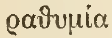
words which are applied to the vulgar man survive finally
as expressions for "unhappy," "worthy of pity" (compare
11. The method of this
man is quite contrary to that of the
aristocratic man, who conceives the root idea "good"
spontaneously and straight away, that is to say, out of
himself, and from that material then creates for himself
a concept of "bad"! This "bad" of aristocratic origin
and that "evil" out of the cauldron of unsatisfied hatred
— the former an imitation, an "extra," an additional
nuance; the latter, on the other hand, the original, the
beginning, the essential act in the conception of a slave-morality — these two words "bad" and "evil," how great
a difference do they mark, in spite of the fact that they
have an identical contrary in the idea "good." But the
idea "good" is not the same: much rather let the question
be asked, "Who is really evil according to the meaning
of the morality of resentment?" In all sternness let it
be answered thus: — just the good man of the other
morality, just the aristocrat, the powerful one, the one
who rules, but who is distorted by the venomous eye of
resentfulness, into a new colour, a new signification, a
new appearance. This particular point we would be the
last to deny: the man who learnt to know those "good"
ones only as enemies, learnt at the same time not to
know them only as "evil enemies," and the same men
who inter pares were kept so rigorously in bounds through
convention, respect, custom, and gratitude, though much
more through mutual vigilance and jealousy inter pares,
these men who in their relations with each other find so
many new ways of manifesting consideration, self-control,
delicacy, loyalty, pride, and friendship, these men are in
reference to what is outside their circle (where the foreign
element, a foreign country, begins), not much better than
beasts of prey, which have been let loose. They enjoy
there freedom from all social control, they feel that in
the wilderness they can give vent with impunity to that
tension which is produced by enclosure and imprisonment in the peace of society, they
revert to the innocence
of the beast-of-prey conscience, like jubilant monsters,
who perhaps come from a ghostly bout of murder, arson,
rape, and torture, with bravado and a moral equanimity,
as though merely some wild student's prank had been
played, perfectly convinced that the poets have now an
ample theme to sing and celebrate. It is impossible not
to recognise at the core of all these aristocratic races the
beast of prey; the magnificent blonde brute, avidly rampant for spoil and victory; this hidden core needed an
outlet from time to time, the beast must get loose again,
must return into the wilderness — the Roman, Arabic,
German, and Japanese nobility, the Homeric heroes, the
Scandinavian Vikings, are all alike in this need. It is the
aristocratic races who have left the idea "Barbarian" on
all the tracks in which they have marched; nay, a consciousness of this very barbarianism, and even a pride in
it, manifests itself even in their highest civilisation (for
example, when Pericles says to his Athenians in that celebrated funeral oration, "Our audacity has forced a way
over every land and sea, rearing everywhere imperishable
memorials of itself for good and for evil"). This audacity of aristocratic races, mad, absurd, and spasmodic as
may be its expression; the incalculable and fantastic
nature of their enterprises, — Pericles sets in special relief
and glory the
12. I cannot refrain at this juncture from uttering a sigh and one last hope. What is it precisely which I find intolerable? That which I alone cannot get rid of, which makes me choke and faint? Bad air! Bad air! That something misbegotten comes near me; that I must inhale the odour of the entrails of a misbegotten soul! —That excepted, what can one not endure in the way of need, privation, bad weather, sickness, toil, solitude? In point of fact, one manages to get over everything, born as one is to a burrowing and battling existence; one always returns once again to the light, one always lives again one's golden hour of victory — and then one stands as one was born, unbreakable, tense, ready for something more difficult, for something more distant, like a bow stretched but the tauter by every strain. But from time to time do ye grant me — assuming that "beyond good and evil" there are goddesses who can grant — one glimpse, grant me but one glimpse only, of something perfect, fully realised, happy, mighty, triumphant, of something that still gives cause for fear! A glimpse of a man that justifies the existence of man, a glimpse of an incarnate human happiness that realises and redeems, for the sake of which one may hold fast to the belief in man! For the position is this: in the dwarfing and levelling of the European man lurks our greatest peril, for it is this outlook which fatigues — we see to-day nothing which wishes to be greater, we surmise that the process is always still backwards, still backwards towards something more attentuated, more inoffensive, more cunning, more comfortable, more mediocre, more indifferent, more Chinese, more Christian — man, there is no doubt about it, grows always "better" — the destiny of Europe lies even in this — that in losing the fear of man, we have also lost the hope in man, yea, the will to be man. The sight of man now fatigues. — What is present-day Nihilism if it is not that? — We are tired of man. 13. But let us come back to it; the problem of another origin of the good — of the good, as the resentful man has thought it out — demands its solution. It is not surprising that the lambs should bear a grudge against the great birds of prey, but that is no reason for blaming the great birds of prey for taking the little lambs. And when the lambs say among themselves, "Those birds of prey are evil, and he who is as far removed from being a bird of prey, who is rather its opposite, a lamb, — is he not good?" then there is nothing to cavil at in the setting up of this ideal, though it may also be that the birds of prey will regard it a little sneeringly, and perchance say to themselves, "We bear no grudge against them, these good lambs, we even like them: nothing is tastier than a tender lamb." To require of strength that it should not express itself as strength, that it should not be a wish to overpower, a wish to overthrow, a wish to become master, a thirst for enemies and antagonisms and triumphs, is just as absurd as to require of weakness that it should express itself as strength. A quantum of force is just such a quantum of movement, will, action — rather it is nothing else than just those very phenomena of moving, willing, acting, and can only appear otherwise in the misleading errors of language (and the fundamental fallacies of reason which have become petrified therein), which understands, and understands wrongly, all working as conditioned by a worker, by a "subject." And just exactly as the people separate the lightning from its flash, and interpret the latter as a thing done, as the working of a subject which is called lightning, so also does the popular morality separate strength from the expression of strength, as though behind the strong man there existed some indifferent neutral substratum, which enjoyed a caprice and option as to whether or not it should express strength. But there is no such substratum, there is no "being" behind doing, working, becoming; "the doer" is a mere appanage to the action. The action is everything. In point of fact, the people duplicate the doing, when they make the lightning lighten, that is a "doing-doing"; they make the same phenomenon first a cause, and then, secondly, the effect of that cause. The scientists fail to improve matters when they say, "Force moves, force causes," and so on. Our whole science is still, in spite of all its coldness, of all its freedom from passion, a dupe of the tricks of language, and has never succeeded in getting rid of that superstitious changeling "the subject" (the atom, to give another instance, is such a changeling, just as the Kantian "Thing-in-itself"). What wonder, if the suppressed and stealthily simmering passions of revenge and hatred exploit for their own advantage their belief, and indeed hold no belief with more steadfast enthusiasm than this — "that the strong has the option of being weak, and the bird of prey of being a lamb." Thereby do they win for themselves the right of attributing to the birds of prey the responsibility for being birds of prey: when the oppressed, downtrodden, and overpowered say to themselves with the vindictive guile of weakness, "Let us be otherwise than evil, namely, good! and good is every one who does not oppress, who hurts no one, who does not attack, who does not pay back, who hands over revenge to God, who holds himself, as we do, in hiding; who goes out of the way of evil, and demands, in short, little from life; like ourselves the patient, the meek, the just," — yet all this, in its cold and unprejudiced interpretation, means nothing more than "once for all, the weak are weak; it is good to do nothing for which we are not strong enough"; but this dismal state of affairs, this prudence of the lowest order, which even insects possess (which in a great danger are fain to sham death so as to avoid doing "too much"), has, thanks to the counterfeiting and self-deception of weakness, come to masquerade in the pomp of an ascetic, mute, and expectant virtue, just as though the very weakness of the weak — that is, forsooth, its being, its working, its whole unique inevitable inseparable reality — were a voluntary result, something wished, chosen, a deed, an act of merit. This kind of man finds the belief in a neutral, free-choosing "subject" necessary from an instinct of self-preservation, of self-assertion, in which every lie is fain to sanctify itself. The subject (or, to use popular language, the soul) has perhaps proved itself the best dogma in the world simply because it rendered possible to the horde of mortal, weak, and oppressed individuals of every kind, that most sublime specimen of self-deception, the interpretation of weakness as freedom, of being this, or being that, as merit. 14. Will anyone look a little into — right into — the mystery of how ideals are manufactured in this world? Who has the courage to do it? Come! Here we have a vista opened into these grimy workshops. Wait just a moment, dear Mr. Inquisitive and Foolhardy; your eye must first grow accustomed to this false changing light — Yes! Enough! Now speak! What is happening below down yonder? Speak out! Tell what you see, man of the most dangerous curiosity — for now I am the listener. "I see nothing, I hear the more. It is a cautious, spiteful, gentle whispering and muttering together in all the corners and crannies. It seems to me that they are lying; a sugary softness adheres to every sound. Weakness is turned to merit, there is no doubt about it — it is just as you say." Further! "And the impotence which requites not, is turned to 'goodness,' craven baseness to meekness, submission to those whom one hates, to obedience (namely, obedience to one of whom they say that he ordered this submission — they call him God). The inoffensive character of the weak, the very cowardice in which he is rich, his standing at the door, his forced necessity of waiting, gain here fine names, such as 'patience,' which is also called 'virtue'; not being able to avenge one's self, is called not wishing to avenge one's self, perhaps even forgiveness (for they know not what they do — we alone know what they do). They also talk of the 'love of their enemies' and sweat thereby." Further! "They are miserable, there is no doubt about it, all these whisperers and counterfeiters in the corners, although they try to get warm by crouching close to each other, but they tell me that their misery is a favour and distinction given to them by God, just as one beats the dogs one likes best; that perhaps this misery is also a preparation, a probation, a training; that perhaps it is still more something which will one day be compensated and paid back with a tremendous interest in gold, nay in happiness. This they call 'Blessedness.'" Further! "They are now giving me to understand, that not only are they better men than the mighty, the lords of the earth, whose spittle they have got to lick (not out of fear, not at all out of fear! But because God ordains that one should honour all authority) — not only are they better men, but that they also have a 'better time,' at any rate, will one day have a 'better time.' But enough! Enough! I can endure it no longer. Bad air! Bad air! These workshops where ideals are manufactured — verily they reek with the crassest lies." Nay. Just one minute! You are saying nothing about the masterpieces of these virtuosos of black magic, who can produce whiteness, milk, and innocence out of any black you like: have you not noticed what a pitch of refinement is attained by their chef d'oeuvre, their most audacious, subtle, ingenious, and lying artist-trick? Take care! These cellar-beasts, full of revenge and hate — what do they make, forsooth, out of their revenge and hate? Do you hear these words? Would you suspect, if you trusted only their words, that you are among men of resentment and nothing else? ''I understand, I prick my ears up again (ah! ah! ah! and I hold my nose). Now do I hear for the first time that which they have said so often: 'We good, we are the righteous' — what they demand they call not revenge but 'the triumph of righteousness'; what they hate is not their enemy, no, they hate 'unrighteousness,' 'godlessness'; what they believe in and hope is not the hope of revenge, the intoxication of sweet revenge ( — "sweeter than honey," did Homer call it?), but the victory of God, of the righteous God over the 'godless'; what is left for them to love in this world is not their brothers in hate, but their 'brothers in love,' as they say, all the good and righteous on the earth." And how do they name that which serves them as a solace against all the troubles of life — their phantasmagoria of their anticipated future blessedness? "How? Do I hear right? They call it 'the last judgment,' the advent of their kingdom, 'the kingdom of God' — but in the meanwhile they live 'in faith,' 'in love,' 'in hope.'" Enough! Enough! 15. In the faith in what? In the love for what? In the hope of what? These weaklings! — they also, forsooth, wish to be strong some time; there is no doubt about it, some time their kingdom also must come — "the kingdom of God" is their name for it, as has been mentioned: — they are so meek in everything! Yet in order to experience that kingdom it is necessary to live long, to live beyond death, — yes, eternal life is necessary so that one can make up for ever for that earthly life "in faith," "in love," "in hope." Make up for what? Make up by what? Dante, as it seems to me, made a crass mistake when with awe-inspiring ingenuity he placed that inscription over the gate of his hell, "Me too made eternal love": at any rate the following inscription would have a much better right to stand over the gate of the Christian Paradise and its "eternal blessedness" — "Me too made eternal hate" — granted of course that a truth may rightly stand over the gate to a lie! For what is the blessedness of that Paradise? Possibly we could quickly surmise it; but it is better that it should be explicitly attested by an authority who in such matters is not to be disparaged, Thomas of Aquinas, the great teacher and saint. "Beati in regno celesti," says he, as gently as a lamb, "videbunt poenas damnatorum, ut beatitudo illis magis complaceat." [Google translate: "Blessed are they in the kingdom of heaven, shall see the punishment of the damned, that the beatitude them more please."] Or if we wish to hear a stronger tone, a word from the mouth of a triumphant father of the Church, who warned his disciples against the cruel ecstasies of the public spectacles — But why? Faith offers us much more, — says he, de Spectac, c. 29 ss., — something much stronger; thanks to the redemption, joys of quite another kind stand at our disposal; instead of athletes we have our martyrs; we wish for blood, well, we have the blood of Christ — but what then awaits us on the day of his return, of his triumph? And then does he proceed, does this enraptured visionary: "at enim supersunt alia spectacula, ille ultimas et perpetuus judicii dies, ille nationibus insperatus, ille derisus, cum tanta saeculi vetustas et tot ejus nativitates uno igne haurientur. Quae tunc spectaculi latitudo! Quid admirer! quid rideam! Ubi gaudeam! Ubi exultem, spectans tot et tantos reges, qui in caelum recepti nuntiabantur, cum ipso Jove et ipsis suis testibus in imis tenebris congemescentes! Item praesides" [Google translate: "but it left for other spectacles, he and the last day of judgment shall perpetual, he nations unlooked for, he derision, with so much of the world they should draw the fire of his one and so many generations of antiquity. Then the breadth of spectacle! What I admire! what laugh! Where rejoice! Where be glad, that looks to so many and so great a king, reports have been received who are in heaven, and Jupiter with him his witnesses in the depths of darkness congemescentes them! Item governors"] (the provisional governors) "persecutores dominici nominis saevioribus quam ipsi flammis saevierunt insultantibus contra Christianos liquescentes! Quos praeterea sapientes illos philosophos coram discipulis suis una conflagrantibus erubescentes, quibus nihil ad deum pertinerc suadebant, quibus animas aut nullas aut non in pristina corpora redituras affirmabant! Etiam paetas non ad Rhadamanti nec ad Minois, sed ad inopinati Christi tribunal palpitantes! Tunc magis tragaedi audiendi, magis scilicet vocales" [Google translate: "persecutors of the Lord's name than they themselves were more cruel than the faint of flames raged against the Christians mocked Him! whom, moreover, conflagrantibus one of those wise philosophers blushing before his disciples, which there is nothing to God pertinerc persuaded by which the soul, or no, or not in His original affirmed that the bodies of return! This is not to pxt Rhadamanti nor to Minos, but to Christ inopinati palpitantes the tribunal! Then tragaedi more to hear, namely, more vowels"] (with louder tones and more violent shrieks) "in sua propria calamitate; tunc histriones cognoscendi, solutiores multo per ignem; tunc spectandus auriga in flammea rota totus rubens, tunc xystici contemplandi non in gymnasiis, sed in igne jaculati, nisi quod ne tunc quidem illos velim vivos, ut qui malim ad eos potius conspectum insatiabilem conferre, qui in dominum saevierunt. Hic est illes, dicam fabri aut quaestuario filius" [Google translate: "to his own proper calamity, then knowing actors, solutiores much through the fire; then be regarded in the driver blushing all the wheel of flame, then ATHLETES contemplating not in the schools, but in the fire of shot, but what I would have them Even then he alive, to them that those who would rather rather the sight of the insatiable done, however, who are in the Lord raged. This is that, I will say, or carpenter's son of quaestuario"] (as is shown by the whole of the following, and in particular by this well-known description of the mother of Jesus from the Talmud, Tertullian is henceforth referring to the Jews), "sabbati destructor, Samarites et daemonium habens. Hic est quem a Juda redemistis, hic est ille arundine et colaphis diverberatus, sputamentis de decoratus, felle et aceto potatus. Hic est, quem clam discentes subripuerunt, ut resurrexisse dicatur vel hortulanus detraxit, ne lactucae suae frequentia commeantium laederentur. Ut talia spectes, ut talibus exultes, quis tibi praetor aut consul aut sacerdos de sua liberalitate praestabit? Et tamen haec jam habemus quodammodo per fidem spiritu imaginante repraesentata. Ceterum qualia illa sunt, quae nec oculus vidit nec auris audivit nec in cor hominis ascenderunt?" [Google translate: "destroyer of the Sabbath, and the Samaritan possessed with a devil. This is whom ransomed from Juda, here is that a reed and with fists diverberatus, sputamentis of with the, drunken with gall and vinegar. He is what secretly subripuerunt to learn that, as is said to be risen from the domination or gardener, not the large number of travelers of his lettuce harmed. That such things should you consider, such as Rejoice, for you who His liberality, the praetor, or consul, or a priest of the supply? And yet we already have these things in a way represented by the faith of the spirit of imagining. But such as these are, which neither the eye hath seen, nor ear heard nor in the heart of man came up?"] (I Cor. ii. 9.) "Credo circo et utraque cavea" [Google translate: "I believe and both the circus cage." (first and fourth row, or, according to others, the comic and the tragic stage) "et omni studio gratiora." Per fidem: so stands it written. 16. Let us come to a conclusion. The two opposing values, "good and bad," "good and evil," have fought a dreadful, thousand-year fight in the world, and though indubitably the second value has been for a long time in the preponderance, there are not wanting places where the fortune of the fight is still undecisive. It can almost be said that in the meanwhile the fight reaches a higher and higher level, and that in the meanwhile it has become more and more intense, and always more and more psychological; so that nowadays there is perhaps no more decisive mark of the higher nature, of the more psychological nature, than to be in that sense self-contradictory, and to be actually still a battleground for those two opposites. The symbol of this fight, written in a writing which has remained worthy of perusal throughout the course of history up to the present time, is called "Rome against Judaea, Judaea against Rome." Hitherto there has been no greater event than that fight, the putting of that question, that deadly antagonism. Rome found in the Jew the incarnation of the unnatural, as though it were its diametrically opposed monstrosity, and in Rome the Jew was held to be convicted of hatred of the whole human race: and rightly so, in so far as it is right to link the well-being and the future of the human race to the unconditional mastery of the aristocratic values, of the Roman values. What, conversely, did the Jews feel against Rome? One can surmise it from a thousand symptoms, but it is sufficient to carry one's mind back, to the Johannian Apocalypse, that most obscene of all the written outbursts, which has revenge on its conscience. (One should also appraise at its full value the profound logic of the Christian instinct, when over this very book of hate it wrote the name of the Disciple of Love, that self-same disciple to whom it attributed that impassioned and ecstatic Gospel — therein lurks a portion of truth, however much literary forging may have been necessary for this purpose.) The Romans were the strong and aristocratic; a nation stronger and more aristocratic has never existed in the world, has never even been dreamed of; every relic of them, every inscription enraptures, granted that one can divine what it is that writes the inscription. The Jews, conversely, were that priestly nation of resentment par excellence, possessed by a unique genius for popular morals: just compare with the Jews the nations with analogous gifts, such as the Chinese or the Germans, so as to realise afterwards what is first rate, and what is fifth rate. Which of them has been provisionally victorious. Rome or Judaea? but there is not a shadow of doubt; just consider to whom in Rome itself nowadays you bow down, as though before the quintessence of all the highest values — and not only in Rome, but almost over half the world, everywhere where man has been tamed or is about to be tamed — to three Jews, as we know, and one Jewess (to Jesus of Nazareth, to Peter the fisher, to Paul the tent-maker, and to the mother of the aforesaid Jesus, named Mary). This is very remarkable: Rome is undoubtedly defeated. At any rate there took place in the Renaissance a brilliantly sinister revival of the classical ideal, of the aristocratic valuation of all things: Rome herself, like a man waking up from a trance, stirred beneath the burden of the new Judaised Rome that had been built over her, which presented the appearance of an oecumenical synagogue and was called the "Church": but immediately Judaea triumphed again, thanks to that fundamentally popular (German and English) movement of revenge, which is called the Reformation, and taking also into account its inevitable corollary, the restoration of the Church — the restoration also of the ancient graveyard peace of classical Rome. Judaea proved yet once more victorious over the classical ideal in the French Revolution, and in a sense which was even more crucial and even more profound: the last political aristocracy that existed in Europe, that of the French seventeenth and eighteenth centuries, broke into pieces beneath the instincts of a resentful populace — never had the world heard a greater jubilation, a more uproarious enthusiasm: indeed, there took place in the midst of it the most monstrous and unexpected phenomenon; the ancient ideal itself swept before the eyes and conscience of humanity with all its life and with unheard-of splendour, and in opposition to resentment's lying war-cry of the prerogative of the most, in opposition to the will to lowliness, abasement, and equalisation, the will to a retrogression and twilight of humanity, there rang out once again, stronger, simpler, more penetrating than ever, the terrible and enchanting counter-war-cry of the prerogative of the few! Like a final sign-post to other ways, there appeared Napoleon, the most unique and violent anachronism that ever existed, and in him the incarnate problem of the aristocratic ideal in itself — consider well what a problem it is: — Napoleon, that synthesis of Monster and Superman. 17. Was it therewith over? Was that greatest of all antitheses of ideals thereby relegated ad acta for all time? Or only postponed, postponed for a long time? May there not take place at some time or other a much more awful, much more carefully prepared flaring up of the old conflagration? Further! Should not one wish that consummation with all one's strength? — will it one's self? demand it one's self? He who at this juncture begins, like my readers, to reflect, to think further, will have difficulty in coming quickly to a conclusion, — ground enough for me to come myself to a conclusion, taking it for granted that for some time past what I mean has been sufficiently clear, what I exactly mean by that dangerous motto which is inscribed on the body of my last book: Beyond Good and Evil — at any rate that is not the same as "Beyond Good and Bad." _______________ Notes: I avail myself of the opportunity offered by this treatise to express, openly and formally, a wish which up to the present has only been expressed in occasional conversations with scholars, namely, that some Faculty of philosophy should, by means of a series of prize essays, gain the glory of having promoted the further study of the history of morals — perhaps this book may serve to give a forcible impetus in such a direction. With regard to a possibility of this character, the following question deserves consideration. It merits quite as much the attention of philologists and historians as of actual professional philosophers. "What indication of the history of the evolution of the moral ideas is afforded by philology, and especially by etymological investigation?" On the other hand, it is, of course, equally necessary to induce physiologists and doctors to be interested in these problems (of the value of the valuations which have prevailed up to the present): in this connection the professional philosophers may be trusted to act as the spokesmen and intermediaries in these particular instances, after, of course, they have quite succeeded in transforming the relationship between philosophy and physiology and medicine, which is originally one of coldness and suspicion, into the most friendly and fruitful reciprocity. In point of fact, all tables of values, all the "thou shalts" known to history and ethnology, need primarily a physiological, at any rate in preference to a psychological, elucidation and interpretation: all equally require a critique from medical science. The question, "What is the value of this or that table of 'values' and morality?" will be asked from the most varied standpoints. For instance, the question of "valuable for what" can never be analysed with sufficient nicety. That, for instance, which would evidently have value with regard to promoting in a race the greatest possible powers of endurance (or with regard to increasing its adaptability to a specific climate, or with regard to the preservation of the greatest number) would have nothing like the same value, if it were a question of evolving a stronger species. In gauging values, the good of the majority and the good of the minority are opposed standpoints: we leave it to the naivete of English biologists to regard the former standpoint as intrinsically superior. All the sciences have now to pave the way for the future task of the philosopher; this task being understood to mean, that he must solve the problem of value, that he has to fix the hierarchy of values.
|