|
ON THE CONSTITUTION OF THE CHURCH AND STATE, ACCORDING TO THE IDEA OF EACH; WITH AIDS TOWARD A RIGHT JUDGMENT ON THE LATE CATHOLIC BILL |
|
IDEA OF THE CHRISTIAN CHURCH THE practical conclusion from our enquiries respecting the organ and idea of the National Church, the paramount end and purpose of which is the continued and progressive civilization of the community (emollit mores nec sinit esse feros [Google translate: softens the manners and allows to be fierce]), was this: that though many things may be conceived of a tendency to diminish the fitness of particular men, or of a particular class, to be chosen as trustees and functionaries of the same; though there may be many points more or less adverse to the perfection of the establishment; there are yet but two absolute disqualifications: namely, allegiance to a foreign power, or an acknowledgment of any other visible head of the Church, but our sovereign lord the king; and compulsory celibacy in connection with, and dependence on, a foreign and extra-national head. We are now called to a different contemplation, to the Idea of the Christian Church. OF the Christian Church, I say, not of Christianity. To the ascertainment and enucleation of the latter, of the great redemptive process which began in the separation of light from Chaos (Hades, or the Indistinction), and has its end in the union of life with God, the whole summer and autumn, and now commenced winter of my life have been dedicated. Hic labor, Hoc opus est, on which alone the author rests his hope, that he shall be found not to have lived altogether in vain. Of the Christian Church only, and of this no further than is necessary for the distinct understanding of the National Church, it is my purpose now to speak: and for this purpose it will be sufficient to enumerate the essential characters by which the Christian church is distinguished. FIRST CHARACTER. -- The Christian Church is not a KINGDOM, REALM, (royaume), or STATE, (sensu latiori) of the WORLD, that is, of the aggregate, or total number of the kingdoms, states, realms, or bodies politic, (these words being, as far as our present argument is concerned, perfectly synonimous), into which civilized man is distributed; and which, collectively taken, constitute the civilized WORLD). The Christian Church, I say, is no state, kingdom, or realm of this world; nor is it an Estate of any such realm, kingdom or state; but it is the appointed opposite to them all, collectively -- the sustaining, correcting, befriending Opposite of the world! the compensating counterforce to the inherent [1] and inevitable evils and defects of the STATE, as a State, and without reference to its better or worse construction as a particular state; while whatever is beneficent and humanizing in the arms, tendencies, and proper objects of the state, it collects in itself as in a focus, to radiate them back in a higher quality: or to change the metaphor, it completes and strengthens the edifice of the state, without interference or commixture, in the mere act of laying and securing its own foundations. And for these services the Church of Christ asks of the state neither wages nor dignities. She asks only protection, and to be let alone. These indeed she demands; but even these only on the ground, that there is nothing in her constitution, nor in her discipline, inconsistent with the interests of the state, nothing resistant or impedimental to the state in the exercise of its rightful powers, in the fulfilment of its appropriate duties, or in the effectuation of its legitimate objects. It is a fundamental principle of all legislation, that the state shall leave the largest portion of personal free-agency to each of its citizens, that is compatible with the free- agency of all, and not subversive of the ends of its own existence as a state. And though a negative, it is a most important distinctive character of the Church of Christ, that she asks nothing for her members as Christians, which they are not already entitled to demand as citizens and subjects. SECOND CHARACTER. -- The Christian Church is not a secret community. In the once current (and well worthy to be re-issued) terminology of our elder divines, it is objective in its nature and purpose, not mystic or subjective, i.e. not like reason or the court of conscience, existing only in and for the individual. Consequently the church here spoken of is not "the kingdom of God which is within, and which cometh not with observation (Luke xvii. 20, 21), but most observable (Luke xxi. 28-31)." -- A City built on a hill, and not to be hid -- an institution consisting of visible and public communities. In one sentence, it is the Church visible and militant under Christ. And this visibility, this publicity, is its second distinctive character. The THIRD CHARACTER -- reconciles the two preceding, and gives the condition, under which their co-existence in the same subject becomes possible. Antagonist forces are necessarily of the same kind. It is an old rule of logic, that only concerning two subjects of the same kind can it be properly said that they are opposites. Inter res heterogeneas non datur oppositio, i.e. contraries cannot be opposites. Alike in the primary and the metaphorical use of the word, Rivals (Rivales) are those only who inhabit the opposite banks of the same stream. Now, in conformity to character the first, the Christian Church dare not be considered as a counterpole to any particular STATE, the word, State, here taken in the largest sense. Still less can it, like the national clerisy, be opposed to the STATE in the narrower sense. The Christian Church, as such, has no nationalty entrusted to its charge. It forms no counter-balance to the collective heritage of the realm. The phrase, Church and State, has a sense and a propriety in reference to the National Church alone. The Church of Christ cannot be placed in this conjunction and antithesis without forfeiting the very name of Christian. The true and only contra-position of the Christian Church is to the world. Her paramount aim and object, indeed, is another world, not a world to come exclusively, but likewise another world that now is (See APPENDIX, A), and to the concerns of which alone the epithet spiritual, can, without a mischievous abuse of the word, be applied. But as the necessary consequence and accompaniments of the means by which she seeks to attain this especial end; and as a collateral object, it is her office to counteract the evils that result by a common necessity from all Bodies Politic, the system or aggregate of which is the WORLD. And, observe that the nisus, or counter-agency, of the Christian Church is against the evil results only, and not (directly, at least, or by primary intention) against the defective institutions that may have caused or aggravated them. But on the other hand, by virtue of the second character, the Christian Church is to exist in every kingdom and state of the world, in the form of public communities, is to exist as a real and ostensible power. The consistency of the first and second depends on, and is fully effected by, the of the Church of Christ: namely, the absence of any visible head or sovereign -- by the non-existence, nay the utter preclusion, of any local or personal centre of unity, of any single source of universal power. This fact may be thus illustrated. Kepler and Newton, substituting the idea of the infinite, for the conception of a finite and determined world, assumed in the Ptolemaic Astronomy, superseded and drove out the notion of a one central point or body of the Universe: and finding a centre in every point of matter, and an absolute circumference no where, explained at once the unity and the distinction that co-exist throughout the creation by focal instead of central bodies, the attractive and restraining power of the sun or focal orb in each particular system, supposing and resulting from an actual power, present in all and over all, throughout an indeterminable multitude of systems -- and this, demonstrated as it has been by science, and verified by observation, we rightly name the true system of the heavens. And even such is the scheme and true idea of the Christian Church. In the primitive times, and as long as the churches retained the form given them by the Apostles and Apostolic men, every community, or in the words of a father of the second century, (for the pernicious fashion of assimilating the Christian to the Jewish, as afterwards to the Pagan, Ritual, by false analogies, was almost coeval with the church itself,) every altar had its own bishop, every flock its own pastor, who derived his authority immediately from Christ, the Universal Shepherd, and acknowledged no other superior than the same Christ, speaking by his spirit in the unanimous decision of any number of bishops or elders, according to his promise, "Where two or three are gathered together in my name, there am I in the midst of them." [2] Hence the unitive relation of the churches to each other, and of each to all, being equally actual indeed, but likewise equally IDEAL, i.e. mystic and supersensual, as the relation of the whole church to its one invisible Head, the church with and under Christ, as a one kingdom or state, is hidden: while from all its several component monads, (the particular visible churches I mean,) Caesar receiving the things that are Caesar's, and confronted by no rival Caesar, by no authority, which existing locally, temporally, and in the person of a fellow mortal, must be essentially of the same kind with his own, notwithstanding any attempt to belie its true nature under the perverted and contradictory name of spiritual, sees only so many loyal groups, who, claiming no peculiar lights, make themselves known to him as Christians, only by the more scrupulous and exemplary performance of their duties as citizens and subjects. And here let me add a few sentences on the use, abuse, and misuse of the phrase, spiritual Power. In the only appropriate sense of the words, spiritual power is a power that acts on the spirits of men. Now the spirit of a man, or the spiritual part of our being, is the intelligent Will: or (to speak less abstractly) it is the capability, with which the Father of Spirits hath endowed man of being determined to action by the ultimate ends, which the reason alone can present. (The Understanding, which derives all its materials from the Senses, can dictate purposes only, i.e. such ends as are in their turn means to other ends.) The ultimate ends, by which the will is to be determined, and by which alone the will, not corrupted, "the spirit made perfect," would be determined, are called, in relation to the Reason, moral Ideas. Such are the ideas of the Eternal, the Good, the True, the Holy, the Idea of God as the Absoluteness and Reality (or real ground) of all these, or as the Supreme Spirit m which all these substantially are, and are ONE. Lastly, the idea of the responsible will itself; of duty, of guilt, or evil in itself without reference to its outward and separable consequences, &c. &c. A power, therefore, that acts on the appetites and passions, which we possess in common with the beasts, by motives derived from the senses and sensations, has no pretence to the name; nor can it without the grossest abuse of the word be called a spiritual power. Whether the man expects the auto de fe, the fire and faggots, with which he is threatened, to take place at Lisbon or Smithfield, or in some dungeon in the centre of the earth, makes no difference in the kind of motive by which he is influenced; nor of course in the nature of the power, which acts on his passions by means of it. It would be strange indeed, if ignorance and superstition, the dense and rank fogs that most strangle and suffocate the light of the spirit in man, should constitute a spirituality in the power, which takes advantage of them! This is a gross abuse of the term, spiritual. The following, sanctioned as it is by custom and statute, yet (speaking exclusively as a philologist and without questioning its legality) I venture to point out, as a misuse of the term. Our great Church dignitaries sit in the Upper House of the Convocation, as Prelates of the National Church: and as Prelates, may exercise ecclesiastical power. In the House of Lords they sit as barons, and by virtue of the baronies which, much against the will of these haughty prelates, our kings forced upon them: and as such, they exercise a Parliamentary power. As bishops of the Church of Christ only can they possess, or exercise (and God forbid! I should doubt, that as such, many of them do faithfully exercise) a spiritual power, which neither king can give, nor King and Parliament take away. As Christian bishops, they are spiritual pastors, by power of the spirit ruling the flocks committed to their charge; but they are temporal peers and prelates. The of the Christian Church, and a necessary consequence
of the first and third, is its Catholicity, i.e. universality.
It is neither Anglican, Gallican, nor
Roman, neither Latin nor Greek. Even the Catholic
and Apostolic Church of England, is a less safe
expression than the Churches of Christ in England:
though the Catholic Church in England, or (what
would be still better,) the Catholic Church under
Christ throughout Great Britain and Ireland, is justifiable and
appropriate: for through the presence of its only head and sovereign, entire in each
and one in all, the Church universal is spiritually
perfect in every true Church, and of course in any
number of such Churches, which from circumstance
of place, or the community of country or of language, we have occasion
to speak of collectively.
(I have already, here and elsewhere, observed, and
scarcely a day passes without some occasion to
repeat the observation, that an equivocal term, or a
word with two or more different meanings, is never
quite harmless. Thus, it is at least an inconvenience
in our language, that the term Church.
instead of being confined to its proper sense, Kirk, AEdes Kyriacae, or
the Lord's House, should likewise be the word by which our forefathers rendered
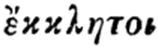
the ecclesia, or the eccleti ( These are the four distinctions, or peculiar and essential marks, by which the church with Christ as its head is distinguished from the National Church, and separated from every possible counterfeit, that has, or shall have, usurped its name. And as an important comment on the same, and in confirmation of the principle which I have attempted to establish, I earnestly recommend for the reader's perusal, the following transcript from DR. HENRY MORE'S Modest Enquiry, or True idea of Anti-christianism. "We will suppose some one prelate, who had got the start of the rest, to put in for the title and authority of Universal Bishop, and for the obtaining of this sovereignty, he will first pretend, that it is unfit that the visible Catholic Church, being one, should not be united under one visible head, which reasoning, though it makes a pretty shew at first sight, will yet, being closely looked into, vanish into smoke. For this is but a quaint concinnity urged in behalf of an impossibility. For the erecting such an office for one man, which no one man in the world is able to perform, implies that to be possible which is indeed impossible. Whence it is plain that the head will be too little for the body; which therefore will be a piece of mischievous assymmetry or inconcinnity also. No one mortal can be a competent head for that church which has a right to be Catholic, and to overspread the face of the whole earth. There can be no such head but Christ, who is not mere man, but God in the divine humanity, and therefore present with every part of the church, and every member thereof, at what distance soever. But to set some one mortal bishop over the whole church, were to suppose that great bishop of our spirit absent from it, who has promised that he will be with her to the end of the world. Nor does the Church Catholic on earth lose her unity thereby. Far rather hereby only is or can she be one. ["As rationally might it be pretended, that it is not the Life, the Rector Spiritus proesens per totum et in omni parte, but the Crown of the skull, or some one Convolute of the brain, that causes and preserves the unity of the Body Natural." -- Inserted by the transcriber.] Such and so futile is the first pretence. But if this will not serve the turn, there is another in reserve. And notwithstanding the demonstrated impossibility of the thing, still there must be one visible head of the church universal, the successor and vicar of Christ, for the slaking of controversies, for the determination of disputed points! We will not stop here to expose the weakness of the argument (not alas! peculiar to the sophists of Rome, nor employed in support of papal infallibility only), that this or that must be, and consequently is, because sundry inconveniences would result from the want of it! and this without considering whether these inconveniences have been prevented or removed by its (pretended) presence; whether they do not continue in spite of this pretended remedy or antidote; whether these inconveniences were intended by providence to be precluded, and not rather for wise purposes permitted to continue; and lastly, whether the remedy may not be worse than the disease, like the sugar of lead administered by the Empiric, who cured a fever fit by exchanging it for the dead palsy. Passing by this sophism, therefore, it is sufficient to reply, that all points necessary are so plain and so widely known, that it is impossible that a Christian, who seeks those aids which the true head of the church has promised shall never be sought in vain, should err therein from lack of knowing better. And those who, from defects of head or heart, are blind to this widely diffused light, and who neither seek nor wish those aids, are still less likely to be influenced by a minor and derivative authority. But for other things, whether ceremonies or conceits, whether matters of discipline or of opinion, their diversity does not at all break the unity of the outward and visible church, as long as they do not subvert the fundamental laws of Christ's kingdom, nor contradict the terms of admission into his church, nor contravene the essential characters, by which it subsists, and is distinguished as the Christian Catholic Church. To these sentiments, borrowed from one of the most philosophical of our learned elder Divines, I have only to add an observation as suggested by them -- that as many and fearful mischiefs have ensued from the confusion of the Christian with the National Church, so have many and grievous practical errors, and much unchristian intolerance, arisen from confounding the outward and visible church of Christ, with the spiritual and invisible church, known only to the Father of all Spirits. The perfection of the former is to afford every opportunity, and to present no obstacle, to a gradual advancement in the latter. The different degrees of progress, the imperfections, errors and accidents of false perspective, which lessen indeed with your advance -- spiritual advance -- but to a greater or lesser amount are inseparable from all progression; these, the interpolated half-truths of the twilight, through which every soul must pass from darkness to the spiritual sunrise, belong to the visible church as objects of Hope, Patience, and Charity alone. _______________ Notes: 1. It is not without pain that I have advanced this position, without the accompanying proofs and documents which it may be thought to require, and without the elucidations which I am sure it deserves; but which are precluded alike by the purpose and the limits of the present tract I will, however, take this opportunity of earnestly recommending to such of my readers as understand German. Lessing's ERNST und FALK: Gesprache fur Freymäurer. They will find it in Vol. vii of the Leipsic edition of Lessing's Works. I am not aware of a translation. Mr. Blackwood, or I should say Christopher North, would add one to the very many obligations he has already conferred on his readers, (among whom he has few more constant or more thankful than myself) by suggesting the task to some of his contributors. For there are more than one. I doubt not, who possess taste to feel, and power to transfer the point, elegance, and exquisite, yet effortless precision and conciseness of Lessing's philosophic and controversial writings. I know nothing that is at once like them, and equal to them, but the Provincial Letters of Pascal. The four Dialogues, to which I have referred, would not occupy much more than a quarter of a sheet each, in ins magazine, which, in a deliberate and conscientious adoption of a very commonplace compliment, I profess to think, as a magazine, and considering the number of years it has kept on the wing -- incomparable -- but at the same time 1 crave the venerable Christopher's permission to avow myself a sturdy dissentient as on some other points, so especially from the Anti-Huskussonian part of his Toryism. S.T. C. 2. Questions of dogmatic divinity do
not enter into the purpose
of this enquiry. I am even anxious not to give the work a
theological character, it is, however, within the scope of my
argument to observe, that, as may be incontrovertibly proved by
other equivalent declarations of our Lord, this promise is not
confined to houses of worship and prayer-meetings exclusively.
And though I cannot offer the same justification for what follows,
yet the interest and importance of the subject will, I trust,
excuse me if I remark, that even in reference to meetings for
divine worship, the true import of these gracious, soul-awing
words, is too generally overlooked. It is not the comments or
harangues of unlearned and fanatical preachers that I have in
my mind, but sermons of great and deserved celebrity, and
divines whose learning, well-regulated zeal, and sound scriptural
views are as honourable to the established church, as their piety,
beneficence and blameless life, are to the Christian name, when I say that passages occur which might almost lead one to conjecture,
that the authors had found the words, "I will come
and join you," instead of, "I am in the midst of you," -- (Compare
1. John, III. 24) -- passages from which it is at least difficult not
to infer, that they had interpreted the promise, as of a corporal
co-presence, instead of a spiritual immanence ( I would that these preceding observations were as little connected with the main subject of this volume, as to some they will appear to be! But as the mistaking of symbols and analogies for metaphors (See Aids to Reflection, pp. 198, 254, G. 398,) has been a main occasion and support of the worst errors in Protestantism: so the understanding the same symbols in a literal i.e. phaenomenal sense, notwithstanding the most earnest warnings against it, the most express declarations of the folly and danger of interpreting sensually what was delivered of objects super-sensual -- this was the rank wilding, on which "the prince of this world," the lust of power and worldly aggrandizement, was enabled to graft, one by one, the whole branchery of papal superstition and imposture. A truth not less important might be conveyed by reversing the image -- by representing the papal monarchy as the stem or trunk circulating a poison-sap through the branches successively grafted thereon, the previous and natural fruit of which was at worst only mawkish and innutritious. Yet among the dogmas or articles of belief that contradistinguish the Roman Catholic from the Reformed Churches, the most important and, in their practical effects and consequences, the most pernicious, I cannot but regard as refracted and distorted truths, profound ideas sensualized into idols, or at the lowest rate lofty and affecting imaginations, safe while they remained general and indefinite, but debased and rendered noxious by their application in detail, ex. gr. the doctrine of the Communion of Saints, or the sympathy between all the members of the universal church, which death itself doth not interrupt, exemplified in St. Antony and the cure of sore eyes, St. Boniface and success in brewing, &c. &c. &c. What the same doctrines now are, used as the pretexts and shaped into the means and implements of priestly power and revenue, or rather, what the whole scheme is of Romish rites, doctrines, institutions, and practices in their combined and full operation, where it exists in undisputed sovereignty, neither repressed by the prevalence, nor modified by the light of a purer faith, nor held in check by the consciousness of Protestant neighbours and lookers-on -- this is question, which cannot be kept too distinct from the former. And, as at the risk of passing for a secret favourer of superannuated superstitions, I have spoken out my thoughts of the Catholic theology, so and at a far more serious risk of being denounced as an intolerant bigot, I will declare what, after a two years' residence in exclusively Catholic countries, and in situations and under circumstances that afforded more than ordinary means of acquainting myself with the workings and the proceeds of the machinery, was the impression left on my mind as to the effects and influences of the Romish (most un-Catholic) religion, -- not as even according to its own canons and authorised decisions it ought to be; but, as it actually and practically exists. -- (See this distinction ably and eloquently enforced in a Catholic work, intitled REFORMA D'ITALIA). This impression, and the convictions grounded thereon, which have assuredly not been weakened by the perusal of the Rev. Blanco White's most affecting statements, and by the recent history of Spain and Portugal, I cannot convey more satisfactorily to myself than by repeating the answer, which I long since returned to the same question put by a friend, viz. -- When I contemplate the whole system, as it affects the great fundamental principles of morality, the terra firma, as it were, of our humanity; then trace its operation on the sources and conditions of national strength and well-being; and lastly, consider its woful influences on the innocence and sanctity of the female mind and imagination, on the faith and happiness, the gentle fragrancy and unnoticed ever-present verdure of domestic life -- I can with difficulty avoid applying to it what the Rabbins fable of the fratricide CAIN, after the curse: that the firm earth trembled wherever he strode, and the grass turned black beneath his feet. Indeed, if my memory does not cheat me, some of the "mystic divines," in their fond humour of allegorizing, tell us, that in Gen iv. 3-8. is correctly narrated the history of the first apostate church, that began by sacrificing amiss, impropriating the fruit of the ground (i.e. temporal possessions) under spiritual pretexts; and ended in slaying the shepherd brother who brought "the firstlings of his fold," holy and without blemish, to the Great Shepherd, and presented them as "new creatures," before the Lord and Owner of the Flocks. -- S. T. C.
|