|
BEYOND THE THRESHOLD -- A LIFE IN OPUS DEI |
|
Critical Reaction to Beyond the Threshold "The most
important, best documented, and most convincing indictment of Opus Dei
ever written." "This
sympathetic autobiography is so persuasive, so convincing, because Maria
del Carmen Tapia only reports on what she herself lived through and
experienced." "A dispassionate
and accurate description of the inner life of Opus Dei. The author's
high position in the hierarchy of Opus Dei and her meticulous concern
for detail make this the best book on Opus Dei." "When it came to
the cause of beatification of Monsignor Escriva, Opus Dei...did
everything to keep at bay the number of unfavorable witnesses. Special
efforts were made to stifle the voice of Maria del Carmen Tapia." "The picture
which the author paints of Opus Dei's founder...is far from that of the
holy servant of God which his beatification proclaims him to be. She
found him egocentric and self-absorbed, in addition to being
authoritarian, haughty, and having a violent temper." "If it were not
for the great intellectual sincerity that the entire book breathes, much
of what we read here could seem exaggerated, as though drawn from
experiences endured in the prison of a totalitarian regime. The book is
exceptional...written without hatred but with great sensitivity." "The insights
that this book provides into the secrets of the Roman headquarters of
Opus Dei -- from its secret-service-like membership list to the specific
spirit of the founder of Opus Dei -- are unique. Whoever gets to know
the founder through Maria del Carmen Tapia will also better understand
Opus Dei: its rigorous asceticism, its shadowy financial practices, its
indoctrination of fourteen-year-aids, and its strict segregation of its
celibate men and women." "[Tapia]
portrays the cult which formed around [Escriva] during his life and
shows how, in the so-called Work of God, the Founder is more spoken of
than God or Christ. The book is absorbingly written." "About Opus Dei
everything always seemed bleak. But after reading Maria del Carmen
Tapia's book, the bleakness acquires the face of fanaticism, misogyny,
and a total absence of love....The book is a journey to the secret
horror of facts that nobody dared to speak about but only the courage
and astonishing memory of Maria del Carmen have been able to bring to
light." "The book has
provoked and still provokes great uneasiness inside and outside the
strong Catholic organization of [Opus Dei]." "Here a highly
sensitive woman describes in a highly detailed and unusually elegant
manner, without hatred and with the distance of over twenty years, a
religious madhouse by the name of Opus Dei, which she came to know
intimately like few others." "Maria del
Carmen Tapia offers authentic insight into the personality and work of
the founder of Opus Dei. She reveals unsparingly the truth about the
churchly 'mafia,' from its questionable methods of recruitment to the
psychic terror it practices on its members....A truly shocking document
of contemporary church history." "A Disturbing
indictment of the methods and ethos of Opus Dei, from a devout Catholic
who spent 18 years in the organization and worked at its highest levels
... Avoding facile sensationalism, Tapia's relentlessly detailed
chronicle shows how idealism can lead to the repression of basic human
rights." "A fascinating and
disturbing book ... a literary grenade seeking to blow apart Opus Dei's
benign and exalted image ... a picture of an obsessively secretive,
manipulative and sexist organization with a virtual cultlike veneration
of its founder." "Tapia's book is a
comprehensive account of the inner workings of the women's branch of
Opus Dei. It should fascinate sociologists and feminists and
contribute to needed self-criticism in the Roman Catholic Church ... A
best seller in Spain and a success in Germany, Portugal and Italy,
Tapia's book has important lessons not only for John Paul II and other
Catholics, but for all who wish to see religion freed from the tyranny
of self-proclaimed saints." "The little I knew
about Opus Dei before reading this book was enough to make me uneasy
about the increasing strength and visibility of the organization in the
Catholic church. Maria del Carmen Tapia's story deepened my
wariness into something akin to dread. Her book, however, is not a
cheap or sensational expose. It is the chronicle of an intelligent
and sensitive woman who served the organization in responsible positions
during her 18 year sojourn as a full member. Despite the inhumane
treatment ... she suffered at the hands of superiors during her last
year in Opus Dei, she writes no 'less from rancor than for the sake of
historic justice.'" "Opus Dei's
cult-like characteristics are confirmed -- secrecy and deception as an
integral part of its methods; the personality cult around the founder;
the blind obedience demanded of members; isolation from the outside
world; the powerful, highly organized hierarchy and, the ultimate goal,
the relentless proselytism. All these are illustrated with the
vivid inside knowledge that has been missing from previous studies of
Opus. For the first time, Tapia puts on record the powerful
internal culture, which, as in all cults, is beyond the reach of normal
research because it is not written: it is the air that members
breathe ... As well as being a fascinating read, this will undoubtedly
remain an invaluable source book on the 'Work' for future students of
its activities." Cover design by Bonnell Design Associations
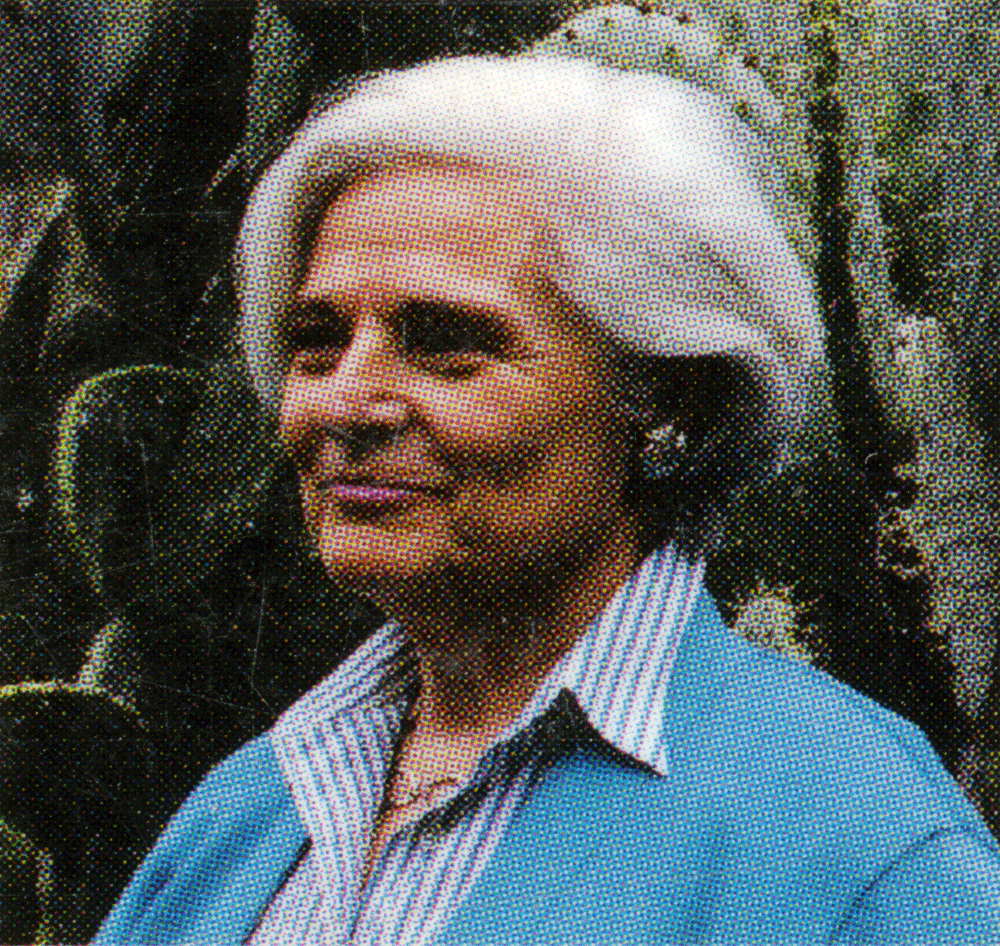
Maria del Carmen Tapia was born in Spain in 1925 and joined Opus Dei in 1948. She works in the system-wide office of the Education Abroad Program of the University of California in Santa Barbara.
|