|
BARRED FROM THE BAR -- A HISTORY OF WOMEN AND THE LEGAL PROFESSION |
|
5. A JOKE THAT CHANGED HISTORY If there were any need to prove your disrespect you've already proved it by your laughter. We've sat here for four days discussing the rights of blacks and other minorities and there has been no laughter, not even a smile. But when we suggest that you shouldn't discriminate against your own wives, your own mothers, your own granddaughters, your own sisters, then you laugh. -- Congresswoman Martha Griffiths, debating the inclusion of an amendment outlawing sex discrimination in Title VII of the Civil Rights Act of 1964 [1] Better if Congress had just abolished sex itself. A maid can now be a man. Girl Friday is an intolerable offense. -- From a New York Times editorial ridiculing the inclusion of sex discrimination in Title VII [2] The United States declared war on Japan after the Japanese bombing of Pearl Harbor on December 7, 1941. And on December 11 Germany and Italy declared war on the United States. As millions of men went off to fight, women were urged to help the war effort by replacing men in the workplace. Three million women answered the call. Most took jobs in the war plants, building airplanes, tanks, and guns. Movie newsreels and the press glorified them as patriotic "Rosie the Riveter." Glamorous female movie stars posed for pictures dressed in overalls and goggles, like the symbolic "Rosie." Another 350,000 women joined the military. Articles in women's magazines written by psychologists who had always urged women to stay home to care for their children now claimed that children were better off when their mothers worked outside of the home. In the professions some signs of change appeared. As enrollments dropped at medical schools and law schools, more women were educated to help maintain tuition income. With more male doctors needed in the war zones, this was especially true of medical schools. But the number of women enrolled in law schools also increased slightly during the war years, [3] and there were a few additional openings for women lawyers in small law firms, real estate offices, banks, and government agencies. Most of the women worked, as before, at desk jobs, but a few managed to find more exciting work. [4] But within a year after the end of the war, as veterans came home and war industries slowed down, women were discharged from their jobs. Estimates were that 75 percent of them had planned to go on working. They had to content themselves with lower-paying clerical and sales jobs. Now psychologists claimed that juvenile delinquency was caused by mothers' working outside the home! Professional schools once again limited female applicants to the minimum, and the progress women made during World War II was quickly eroded. In the fall of 1946, a full-page advertisement signed by prominent women doctors protesting this situation appeared in the New York Herald Tribune. It was headlined "Doctors Wanted: No Women Need Apply." [5] A few women lawyers attempted to defend the gains working women had achieved during the war. Anne Davidow, who had graduated from law school in 1920, agreed to represent Valentine Goesart in a case that eventually was heard before the Supreme Court. During the war, Valentine Goesart, the owner of a bar in Dearborn, Michigan, had hired two female employees to tend bar along with his daughter Margaret. A Michigan law allowed the wives or daughters of a licensed bar owner to work as bartenders but prohibited the hiring of other women. When a male applicant for a bartender's job was turned down by Goesart, he filed suit for enforcement of the law banning women bartenders. Davidow thought she had a good case that would help women achieve equal employment opportunities. Since the oft-stated reason for the law was that women bartenders were in danger of having their morals corrupted, Davidow pointed out that Michigan women were permitted to be barmaids, serving drinks on the floor of the establishment, but not allowed to serve or make drinks behind the bar. Yet surely out in the open bar or restaurant, she reasoned, barmaids were much more likely to be harassed by customers than behind the protective cover of the bar itself. When Goesart v. Cleary was heard by the Supreme Court in 1948, Davidow lost her case. It apparently did not matter that women had worked in every conceivable occupation during the war. The majority opinion declared that "the Constitution does not require legislatures to reflect ... shifting social standards." [6] Women would continue to be legally typecast into "female" occupations for the next sixteen years. Under different circumstances, a new movement for women's equality might have emerged in the postwar period. But larger forces were at work that would effectively gag the precious right to free speech for the next fifteen years. Mary Kaufman, the labor lawyer from New York (see Chapter 4), became aware of the change soon after the end of the war. As Europe's concentration camps like Auschwitz and Bergen-Belsen were liberated by Allied troops, the murders of 6 million Jews by the Nazis became common knowledge. Under enormous pressure to punish the mass murderers, the Allies held trials in Nuremburg, Germany, to prosecute top Nazi war criminals. Two Jewish women lawyers, Kaufman and Cecelia Goetz, fought for and obtained jobs on the Allies' prosecution team. When Goetz was hired, she was required to sign a waiver of disability. Her "disability" was her female condition! In Nuremburg, Kaufman was assigned to the team prosecuting the board of directors of the I. G. Farben Company, a major producer of armaments for the Nazis with connections in dozens of countries. A group of convicted saboteurs, trained by I. G. Farben, had been caught in the United States and convicted during the war. They had been sent back after the war to continue serving their sentences in Germany. Kaufman subpoenaed them to testify. [7] Kaufman later recalled with bitterness that before she could call them to the witness stand, a superior ordered her to cancel the subpoenas and send the witnesses back to their cells "because the State Department was kicking up quite a fuss. That closed the door to proof of Farben's role in the sabotage effort." Without the key testimony, I. G. Farben was found not guilty. "I'll never forget the day when we sat and listened to the Tribunal's opinion and judgment," Kaufman sadly recalled. "We were terribly depressed.... We knew that the decision was politically motivated." [8] But it was not until long after she returned home, in 1948, that Kaufman understood why the State Department had shielded I. G. Farben's board. The friendship between the United States and the Soviet Union, wartime Allies in the struggle against the Axis powers, had crumbled. The Soviet Union had been labeled as the new enemy. There were many reasons for the sudden turnabout. An ideological battle was taking shape throughout much of the world. Nations like France, governed during the war years by Nazi occupiers and collaborators, and Italy, where the fascist dictator Benito Mussolini had held power for decades, were about to elect new governments. In far-flung colonies in Asia and Africa, people newly liberated from German and Japanese control were demanding independence from their colonial rulers. In China a popular revolution was placing the communist Mao Tse Tung in power. The Soviet Union and the United States were both attempting to influence the choices between socialism or capitalism that would determine the control of future world markets. Some scholars also maintain that American policy makers, in order to stop the U.S. economy from backsliding into a revived Depression once war industries shut down, needed to create a new enemy, the "Red Menace," as the reason for keeping the armaments industry producing. But not all Americans accepted the idea that the Soviet Union was a genuine world threat. Nazi armies had invaded the Soviet Union, leaving its economy in ruins and millions dead. Many Soviet and American citizens were urging a policy of peaceful coexistence between the two largest world powers. Their voices were quickly silenced by a national anticommunist hysteria called the "witch-hunt" and "McCarthyism," after Senator Joseph McCarthy of Wisconsin. The U.S. attorney general produced a list of dozens of "subversive" organizations. Although the list included the Communist Party, it also included most groups that had fought for equality, workers' rights, and immigrant rights; and organizations as disparate as environmental groups like Nature Friends of America and even the Chopin Cultural Center. People who had even briefly belonged to any of these organizations or supported issues like world peace, a ban on nuclear tests, and even equal rights for minorities were in danger of being labeled "un-American" and losing their jobs. Over the next fifteen years, fear induced by this modern witch-hunt inhibited free speech in the United States. Thousands were fired from their jobs -- teachers, filmmakers, factory and restaurant workers. President Harry S. Truman issued Executive Order 9835, assigning a special board of Civil Service commissioners to check on government employees and fire anyone who had been shown to be a sympathizer of a listed suspect organization. Those accused had no right to a hearing or even to face their accusers. Because women lawyers had been prominent in labor law, civil liberties law, and poverty law, they became especially vulnerable targets for the witch-hunters. Dorothy Kenyon, for example, New York City's first woman deputy commissioner of licenses and a well-known fighter for civil liberties, was named by McCarthy during his attacks on suspected communists in government. Kenyon called him "an unmitigated liar, a coward to take shelter in the cloak of congressional immunity." [9] Most people did not fight back to stop the witch-hunt and demand respect for the Bill of Rights. The Cold War had indeed succeeded in keeping the economy in high gear. Americans bought homes, appliances, and cars. But in the spring of 1954, McCarthy went one step too far when he held hearings on "subversives" in the military. The Army went on the offensive against McCarthy, and several months later the Senate voted to censure him. Although Senator McCarthy was out of favor, the Cold War was alive and well. A few women lawyers were among a tiny group of Americans who continued to openly oppose Cold War policies. Mary Kaufman was among them. She realized that leaders of the German company I. G. Farben, as well as other notorious Nazis, had been shielded from prosecution as war criminals by the U.S. State Department. These Nazis could provide valuable information to the Central Intelligence Agency (CIA) on the Communists who had been among the valiant anti-Nazi resistance fighters of Europe. This dismaying truth was not fully revealed to the public until many years later. It was now apparent that in the heyday of the Cold War, the U.S. government had decided that a few prominent Nazi leaders would be valuable assets in the fight against communism in general. (In The World at Arms, Reader's Digest Illustrated History of World War II, p. 450, the U.S. role is discussed.) The case of Klaus Barbie, the Gestapo chief in German-occupied France during World War II, is a notorious example of that U.S. policy. Barbie became known as "the Butcher of Lyons" because he had ordered the deportation of thousands of French resistance fighters and Jews to Hitler's death camps. After the war, the CIA and U.S. military intelligence secretly brought Barbie to the United States to help them compile lists of Europe's Resistance activists as part of their anticommunist campaign. In 1951 Barbie was smuggled into Bolivia with a new identity, where he lived a life of luxury helping Bolivia's military regime suppress opposition. The truth came out in 1983, when Nazi hunters found Barbie in South America and returned him to France, where he was tried and convicted as a mass murderer. [10] The atmosphere of fear was so great during the witch-hunt phase of the Cold War that, as one researcher put it, "The rights lawyers in the ACLU fell over each other in the rush to proclaim their patriotism. They were not willing, either in court or in front of congressional committees, to defend the victims of what is commonly called McCarthyism." [11] Kaufman joined the ranks of a few brave attorneys who dared to test Cold War legislation in the courts. She became part of the legal team that defended people who were being prosecuted under a law called Smith Act. This act was being used to silence left-wing political parties. Leaders of the Socialist Workers Party, despite their critical attitude toward Soviet-style undemocratic socialism, were tried, convicted, and sent off to jail in 1943 for the simple act of advocating and teaching socialism. In 1949, twelve leaders of the American Communist Party were indicted. A nine-month trial followed, during which Kaufman was part of the defense team. But despite her trial experience, Kaufman was kept behind a desk while the male attorneys went to the courtroom. When the trial was over, not only were the Smith Act defendants jailed but the trial judge, Harold Medina, charged their lawyers with contempt and sentenced them to prison terms. Kaufman, of course, kept her freedom because she had not been involved in the courtroom work. Later she described her feelings: As I sat there all alone at counsel table while the others stood, I was again profoundly ashamed of my country. The atmosphere of fear already had its firm grip on the American people. The trial lawyers in that case had performed brilliantly and courageously. But I'm ashamed to say they did not get the support of most of the members of the bar. All of the lawyers served time in jail ... and were hounded in a variety of ways, including disbarment. But ... [they] were eventually vindicated and reinstated to the bar. [12] Just as Caroline Lowe had defended IWW leaders in 1917, Kaufman traveled all over the country defending other people indicted under the Smith Act. Often she depended entirely on money raised by defense committees to help house and feed herself and her son. She continued with this work until a Supreme Court decision in 1957 watered down the Smith Act. Then she went into private practice. It was another war, in faraway Vietnam, that brought her back into the fray less than ten years later. During the first decade of the Cold War, even the idea of government guarantees of legal rights for the poor could be labeled "un-American." In Great Britain, a 1950 law required every member of the bar to be available to represent clients who were unable to pay for their own defense. [13] In the United States, the National Lawyers Guild pressed for the same type of law, pointing out that two-thirds of all defendants could not pay for legal services. In response, the ABA launched a widespread campaign against such a law, labeling the British law as "Socialist." The ABA's Special Committee to Study Communist Tactics, Strategy and Objectives even recommended that guild members be forced to take loyalty oaths or be disbarred. Some members of the legal profession took a less extreme position. They simply did not want to be obligated by law to donate a few precious "billable hours" to poor defendants at lower fees. Instead they supported the expansion of Legal Aid services. By 1960, although more Legal Aid offices had been opened, there was still a great need. Surprisingly, the competition between the Soviet Union and Eastern Europe on the one hand and the United States and Western Europe on the other produced some unintended benefits for racial minorities and women in the United States. The Soviet press filled its pages regularly with stories about racism against African Americans in the United States. Occasionally the subordinate role of women was also described. Soviet journalists boasted that in the socialist Soviet Union women had equal access to education and the professions, while in the United States, by 1950, women earned only one-fourth of all bachelor's degrees, their lowest share since the 1920s. Placement in colleges had become more difficult as World War II veterans took advantage of a government program called the GI Bill and returned to school. [14] As more colleges opened, the situation was quickly rectified. It is not unlikely that Cold War pressures had something to do with Harvard Law School's Dean Irwin Griswold's announcement in the fall of 1949 that Harvard Law School would accept "a small number of unusually qualified women students." The twelve women of the first coed class of 1950 received a less than friendly welcome. Griswold greeted them with the words, "I didn't favor your admission, but since you are here, welcome." The male students were no friendlier. In the Harvard student newspaper, a poem appeared in response to the presence of women on campus:
We'll mourn the harried profs'
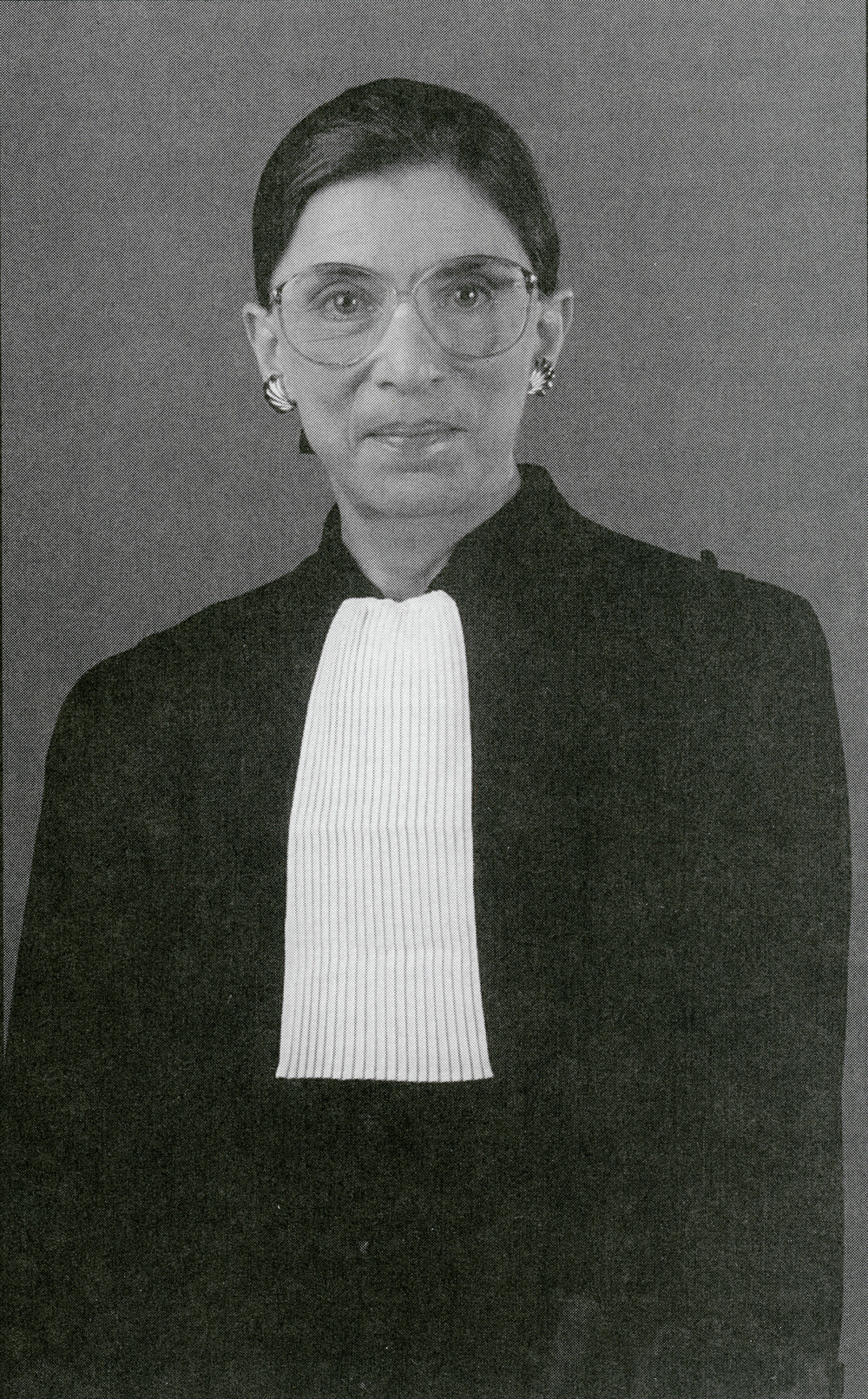
morale, Ladies' Day at the law school was particularly humiliating for the women students. They were required to present cases for the entertainment of the class and then undergo a grilling by their professors. Some professors assigned only lurid sex crime cases to the women. Charlotte Horwood Armstrong later recalled how one professor, whose "style was teaching by humiliation ... took sadistic delight in hounding women." [15] Congresswoman Patricia Schroeder of Colorado, who entered Harvard Law School in 1961, recounted similar unpleasant experiences: The women in the law school were treated like Amazons. Men wanted cute blondes from Lesley [a junior college near Harvard]. Among the men there was a feeling that Harvard Law School had been ruined because they let girls in. [16] Women law students put up with these difficulties because they believed that an Ivy League degree would help them find better jobs. But they quickly discovered that most law firms refused to even interview them. Out of 1,755 women attorneys in New York in 1957, only eighteen worked for large firms. It is no less than amazing that any women continued to study for law careers. Ruth Bader Ginsburg, for example, appointed as associate justice of the U.S. Supreme Court by President Bill Clinton in 1994, was one of nine women in a class of 500 entering Harvard in 1956. Attributing the small numbers of women law students to both resistance by universities and fewer female applicants, Ginsburg explained it this way: Why were there so few women in law school a generation ago? It was the sense that, well, I can go through three years of law school and then what? Who will hire me and how will I support myself? ... So many places were closed to women in those days. The most prestigious clerkships with judges were not open to women. Some of our most distinguished jurists simply refused to interview a female. [17] At the end of her second year, when her husband was offered a job in New York City, Ginsburg transferred to Columbia Law School, graduating in 1959. Although she tied for first place in her class, not one law firm was interested in hiring her. Through the route that many women law graduates used in those days -- connections -- she landed a job clerking for a federal district court judge. Later she worked on a research project on international law at Columbia and then landed a teaching post at Rutgers University in 1963, an unusual job for a woman lawyer.
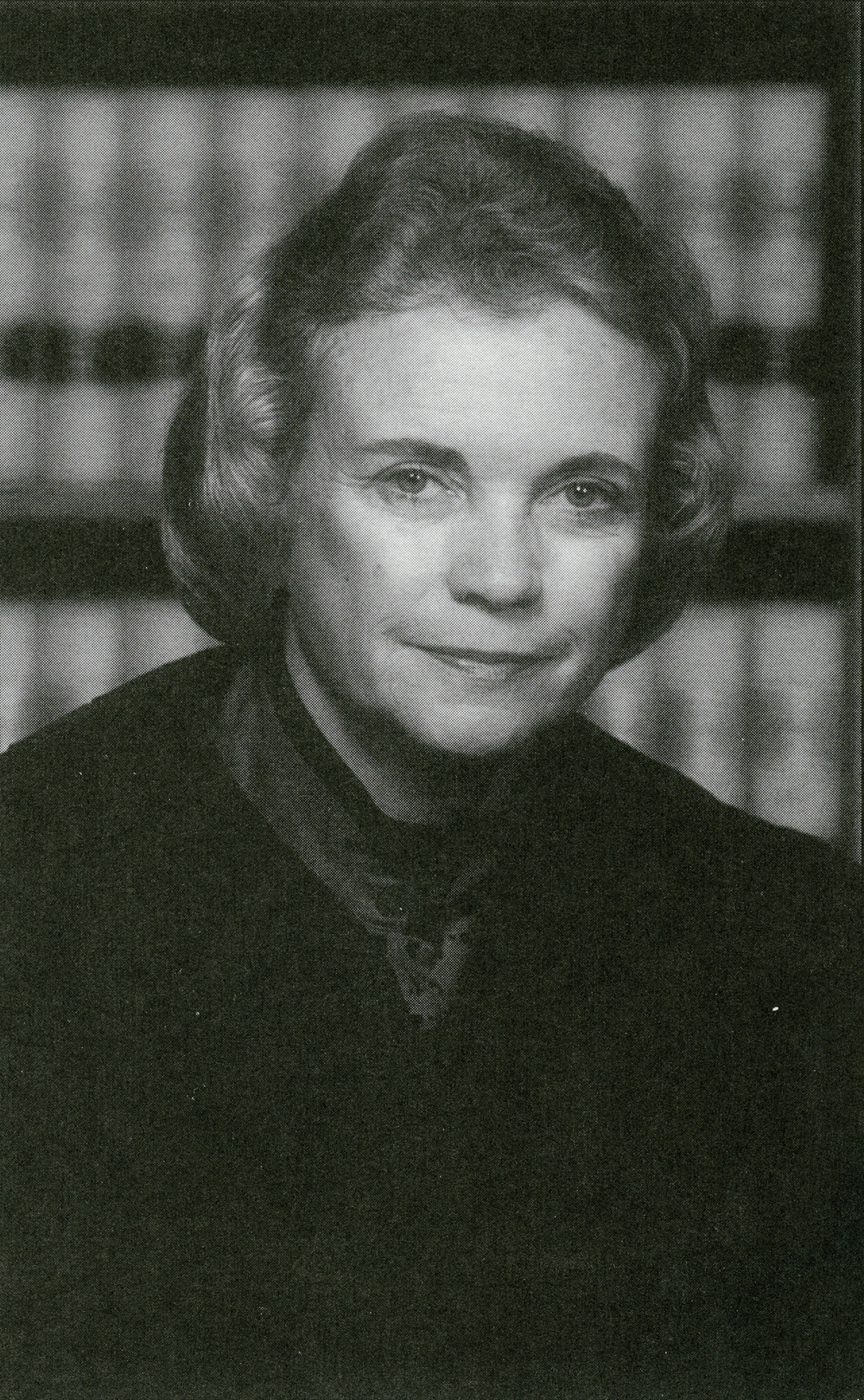
Ruth Bader Ginsburg, the second woman to sit on the Supreme Court, was one of only nine women in an entering class of 500 in Harvard Law school in 1956. Sandra Day O'Connor, the first woman appointed to the Supreme Court in 1981, was third highest in her class when she graduated from Stanford Law School in 1951. She managed to interview with a few law firms but "none had ever hired a woman before as a lawyer, and they were not prepared to do so." [18] The only job offer she received was as a legal secretary in Los Angeles. O'Connor turned to part-time legal work, volunteer work, and raising a family, not returning to full- time employment until 1965. [19] Like both of these exceptionally talented women, most women lawyers in the 1950s faced the same limited choices as their predecessors. The government hired a few more women attorneys, and most of them turned in outstanding performances. Ida Klaus, for example, one of the first women law graduates of Columbia University, was hired by the National Labor Relations Board in 1948. In 1954, New York City mayor Robert F. Wagner appointed her as counsel to his new Department of Labor. Klaus wrote the famous "Little Wagner Act," expanding the right to collective bargaining. In 1961 she was appointed as chief adviser to John F. Kennedy's task force on collective bargaining among federal employees. From 1962 until her retirement in 1975, she was the chief labor negotiator for New York City's Board of Education and director of staff relations.
Sandra Day O'Conner, the first female Supreme Court justice, couldn't get a job as a lawyer when she graduated from law school. The long-standing opposition to women as criminal lawyers remained firmly in place. Ruth Bader Ginsburg described it this way: No U.S. Attorney's office would hire a woman as a prosecutor. U.S. attorneys were beginning to hire women for civil litigation, but not for criminal cases. That seemed to me ironic. The excuse was women are too soft, they can't handle hardened criminal types. But if you looked at the other side of the street to see who was defending indigent defendants, it was Legal Aid. Legal Aid was full of women. The relationship between the defendant and the defense lawyer is much closer than that between the prosecutor and the accused. So it wasn't women's inability to deal with hardened criminals. Women did just that in Legal Aid. Chicago attorney Carole K. Bellows was a law student at Northwestern University in the 1950s when a member of the Chicago Bar came to the school to encourage students to become criminal lawyers. Four women were seated among almost 100 men. Before he started his talk, he announced, "I'm here to recruit investigators for the committee which represents indigent defendants in criminal cases. It is not necessary for any women to stay here. We can't use them." [20] Even in the 1960s, college women were discouraged from pursuing "masculine" studies like mathematics, the sciences, engineering, and medicine and law. Elementary school teaching, nursing, and nutritional fields remained the "feminine" majors. Amazingly, in 1962, when a new women's college, Winthrop, opened in South Carolina, its catalog was strikingly similar to those of the pre-Civil War female seminaries. Courses designed for "young ladies" emphasized "stenography, typewriting ... designing ... needlework, cooking, housekeeping and such other industrial arts as may be suitable to their sex and conducive to their support and usefulness." [21] "We had no idea that we were part of an inherited social contract that required our inequality," lawyer Mona Harrington wrote in 1994. [22] Even for the few activists who were angry over sex discrimination, racism was the issue most on their minds, just as the horrors of slavery had overshadowed the problems of women's inequality in the Civil War era. The government experts apparently agreed. Racial segregation and discrimination was the most obvious contradiction to America's desire for a world image of genuine democracy and equality. In 1954 the unanimous U.S. Supreme Court school desegregation decision in Brown v. The Board of Education negated the separate-but-equal provision that it had upheld in the 1890s. Yet despite this landmark decision on racial equality, over the next decade when the Court heard cases for women's equality, its rulings were almost always unfavorable. On the issue of women serving as jurors, for example, a negative Supreme Court ruling in 1960 perplexed many who had cheered the Brown decision. [23] When an all-male Florida jury found Evangeline Hoyt guilty of murdering her husband, her lawyers had appealed the verdict all the way to the Supreme Court on the basis that Hoyt had been deprived of her equal protection rights to a trial by a jury of her peers. Many Court watchers were sure that the Supreme Court would rule in favor of Hoyt. In 1935, after all, the Court had ruled that African Americans could not receive a fair trial where blacks were excluded from juries. But the justices saw no parallel between all male juries at women's trials and all-white juries at the trials of African Americans. Like a strange echo of Justice Bradley's decision in the case of Myra Bradwell almost a century earlier, Chief Justice Warren Burger called Florida's jury selection law "a reasonable accommodation of women's role as the center of home and family life," adding, "This case in no way resembles those involving race or color." The Supreme Court thereby affirmed the rights of states to exempt all women from jury duty, from age twenty-one to 100, married or single, with or without small children. With this mood prevailing even in the highest court, there was little chance of introducing new legislation on women's legal rights, even on a state-by-state basis. Forty years after women had won the right to vote, women in decision-making positions -- whether in Congress or state legislatures -- remained "rare birds." Women on the bench were just as scarce. Influential women had been pressuring the administration to appoint a woman to the Supreme Court. Florence Ellinwood Allen, justice of the Sixth Circuit Court of Appeals since 1934, was often suggested as a possible candidate. President Truman informed her supporters that he had talked the possibility over with the Supreme Court justices and they had opposed such a move. Perhaps to soften his critics, as well as to win points in the Cold War, he nominated Burnita Shelton Matthews, an ardent feminist, to a judgeship in a federal district court in 1949. In 1919, Matthews had been among the women picketing the White House for the right to vote and had written extensively on the legal rights of her sex. Whenever a strong push was made for the promotion of women, one or two token women received prestigious appointments. In the early sixties, pressure from Puerto Rican leaders led to the hiring of Irma Vidal Santaella, the first Puerto Rican woman lawyer in New York State, as an adviser to two senators, Robert F. Kennedy and Jacob Javits, on the issue of voting rights for Puerto Ricans. [24] In 1960, Lorna E. Lockwood became the first woman member of a state supreme court when she was elected to the Arizona Supreme Court, later becoming the chief justice. A few black women continued to graduate from law schools each year, but their job-hunting prospects showed little improvement. A white woman attorney, Marian Sullivan, came to realize how difficult things were for black women during her own discouraging search for work in the 1950s. I remember one day when I was feeling particularly awful, a receptionist called me over to deliver still one more rejection. She thought she would make me feel better by telling me how they had just rejected a colored girl who had the nerve to apply for the position. I remember thinking no matter how bad it was for me, it had to be worse for her. I never learned who she was but that night I went home and said a prayer for her. [25] Despite these difficulties, some young black women decided to study law specifically to attempt to win equality for African Americans, long before Dr. Martin Luther King, Jr.'s "I Have a Dream Speech" in 1963. They were moved by the struggles of black men during World War II for the right to fight for their country. African American servicemen were almost always assigned to segregated all-black service units commanded by white officers, usually so-called service units for burial duty, garbage duty, and driving the trucks over roads peppered with dangerous land mines to deliver military goods to the front. In the Navy they were permitted to serve only as messmen, performing kitchen duties in the holds of the ships. The symbol of the civil rights movement during that period was a double V: V for victory against the Axis Powers and V for victory against racism at home. When black veterans came home, the very sight of them in uniform enraged segregationists of the South as well as prejudiced people throughout the land. [26] Black veterans were physically attacked. The case that moved President Truman to take action on civil rights was the attack on Sergeant Isaac Woodard, Jr., in February 1946. Pulled off a bus by police in South Carolina, he was savagely beaten and blinded by nightsticks poked into his eyes. A powerful alliance emerged at the end of the war between Jewish Americans, African Americans, and other groups. All over the nation, interracial and interfaith conferences were held. Court cases often became joint enterprises to attempt to reverse segregation in public places. [27] Under pressure to act to ensure civil rights, President Truman, afraid of offending his Democratic Party supporters in the South, stalled. When he finally agreed to meet with a delegation of black civil rights and human rights leaders, he heard about the shocking crime against Woodard and reportedly said, "We've got to do something!" [28] President Truman soon issued Executive Order 9808, creating the President's Committee on Civil Rights (PCCR) and instructing its members to make recommendations on civil rights. Sadie Alexander, one of the handful of pioneer black women attorneys (see Chapter 4), was a member of the PCCR and coauthored its report, To Secure These Rights. Raising the fact that Soviet leaders "have tried to prove our democracy an empty fraud, and our nation a consistent oppressor of underprivileged people," [29] the document called for comprehensive civil rights legislation. Recommendations were one thing. Moving Congress was another. Truman pressed forward on the issue of military integration, and a few blacks were moved into public prominence. Jackie Robinson was hired by the Brooklyn Dodgers in 1946 and became the first black baseball player on a modern major league team in 1947 -- the first and last for several more years. Although Robinson's appearance on baseball diamonds produced brief euphoria, black Americans were also concerned over housing and job discrimination in their everyday life. Tempers flared when a new military draft law was proposed on the floor of Congress in 1947, with continued segregation included in it. At the Democratic National Convention, liberal delegates pushed through a stronger than usual section on civil rights in the party's platform, causing a number of southern delegates to storm out and go home to form a new States' Rights Party. No longer pinned into inaction by the South, Truman moved to win the support of civil rights advocates by cautiously starting the ball rolling on military integration. He issued Executive Order 9981, calling for equality of opportunity for all persons in the armed services, without specifically mentioning integration. Truman won the election, receiving 60 percent of the black vote. Hopes rose that the president would now push ahead on civil rights, but despite a few appointments of African Americans to judgeships and other government posts, and very slow progress toward military integration, discrimination in all its ugly forms remained intact.
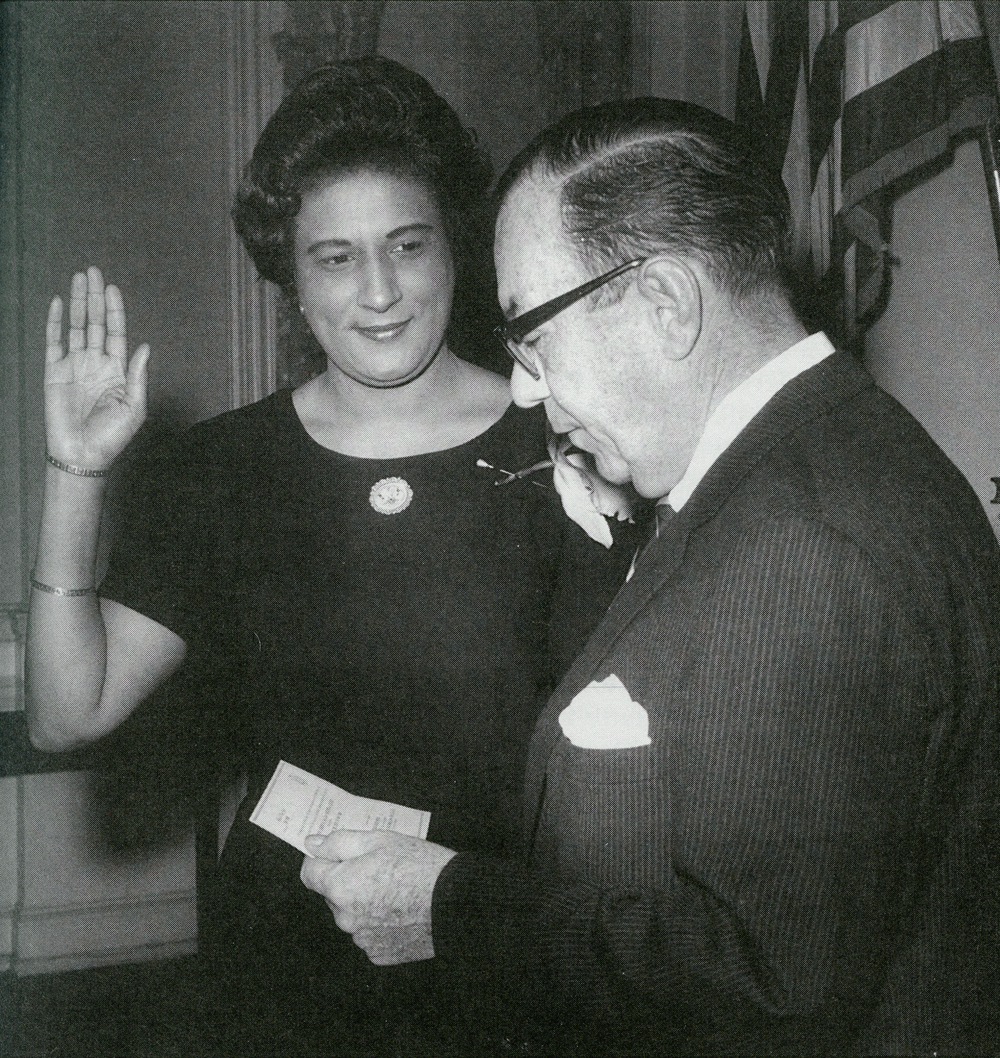
Constance Baker Motley, a lawyer for the NAACP during the civil rights period, became the first black woman to be elected Manhattan Borough President in 1965. New York Mayor Robert Wagner is swearing her in. A number of black women attorneys achieved prominence during these early struggles. Ruth Harvey Charity, who grew up in Virginia, remembered feeling anger over segregation from her earliest childhood. Deciding to study law, Charity attended Howard University. Even at Howard she was confronted with the sexism of black men, when they asked her why she had not majored in home economics. [30] In 1944, Charity helped to organize the first victorious sit-in at a Washington, D.C., restaurant. After she graduated, Charity went into private practice back in her hometown. She instituted suits against the city demanding desegregation of the library and the city park, and proving that the facilities for blacks were indeed separate but totally unequal. The case she considered her most important though was her defense and the subsequent acquittal of more than a thousand civil rights demonstrators arrested in Danville, Virginia, in 1963. But the rights of black women, even when they were violated by black men, were another important cause for Charity. In the organization for black attorneys, the National Bar Association, women lawyers were always given secretarial assignments. Charity and another black woman attorney organized a women's division of the NBA and later formed the National Association of Black Women Attorneys. As so many successful women lawyers did, Charity assisted other women in their efforts to enter the legal profession. "After all, if we don't bring them along, who will?" she once remarked. [31] The best-known African American woman lawyer of that period was Constance Baker Motley. Motley was on the NAACP legal team that achieved the Supreme Court 1954 school desegregation decision. She was also one of the very few black attorneys to come from a poor family. [32] In 1938 Motley attended a meeting at her high school and heard an attorney discuss a recent NAACP separate-but-equal case. Motley started dreaming about a law career but realized that she had no money for her schooling. Two years later when the same speaker appeared at the local Community House, Motley was there. Clarence W. Blakeslee, a wealthy white Connecticut businessman, had donated the money for the center and asked those gathered at the meeting why so few black people used the facility. Young Motley took the floor and told him that the people who ran the Community House did not understand the needs of the black people of the area. Impressed by the outspoken young woman, Blakeslee decided to foot the bill for her education. Constance Motley entered all-black Fisk University in Nashville in 1941 but was shaken by southern segregation. Excluded from theaters and restaurants and even unable to try on clothes in department stores, Motley transferred to New York University and then went on to Columbia Law School, the second black woman ever accepted there. After graduation, Motley was hired by Thurgood Marshall, the director of the NAACP Legal Defense Fund and later the first black Supreme Court justice. She went to work arguing segregation cases, many of them in the South. In southern courtrooms, black men and women were never addressed as "Mr." or "Mrs." Judges persisted in calling Motley "Connie." Barred from local hotels, she had to find housing with NAACP supporters in the area. Constance Baker Motley was a dynamo in court, arguing ten cases before the Supreme Court and losing only one of them. During the height of the civil rights struggle in the 1960s, she served as one of Dr. Martin Luther King, Jr.'s lawyers in Birmingham, Alabama. A few black women pioneer lawyers were appointed to posts in city governments. Jane M. Bolin, the first black woman judge in New York, was appointed by New York's mayor LaGuardia in 1939 for a ten-year term, and was reappointed by every subsequent mayor until her retirement in 1979. President Truman selected a few pioneer black women attorneys, Eunice Carter among them, for visible posts, especially in the United Nations. Marjorie McKenzie Lawson was active in John F. Kennedy's election campaign of 1960, advising party leaders on civil rights issues and later winning a juvenile court judgeship. Lyndon Baines Johnson appointed her as United States representative to the Social Commission of the United Nations Economic and Social Council. Edith Sampson was appointed as an alternate U.S. representative to the United Nations General Assembly in 1950 and was sent on tours to speak on the status of blacks in the United States, a very touchy Cold War issue. Several black journalists accused her of playing down racial issues in order to support the government's anti-Communist propaganda. Sampson herself admitted, "There were times when I had to bow my head in shame when talking about how some Negroes have been treated in the United States." [33] In 1962, Sampson was elected associate judge of the Municipal Court of Chicago, the first black woman so elected in the United States. But both black women and white women lawyers remained in the backwaters of the profession until civil rights legislation, the result of the Civil Rights Movement, had a profound impact on all of them, to the surprise of many. Perhaps if the southern segregationists had remained calm, civil rights and equal rights for women would have been delayed for another twenty or thirty years. The Supreme Court had set no timetable for school integration beyond a vague order in 1955 that it should be accomplished with "all deliberate speed." [34] But segregationists throughout the South panicked and rushed to take preventive action. The Ku Klux Klan and newly formed White Citizens Councils recruited thousands of people to make sure integration would never come to pass. Almost ten years of violence lay ahead, during which television viewers all over the nation would become fully aware of the events in the South. In the summer of 1955, the nation learned about the murder of a fourteen-year-old black teenager from Chicago, Emmett Till. Kidnapped from his grandfather's house in Mississippi and murdered for the "crime" of allegedly flirting with a white girl, Till's mutilated body was thrown into the Tallahachie River. An all-white, all-male jury found his killers not guilty. On December 1, 1955, in Montgomery, Alabama, a tired black seamstress named Rosa Parks, who was also secretary of the local NAACP, boarded a bus after a hard day's work and took the last remaining empty seat in the first row of the "colored" section. When a white man came on board, the driver ordered Mrs. Parks to give him her seat. When she refused, he called the police and Parks was arrested. Within days the Montgomery Bus Boycott was launched, led by a young minister named Dr. Martin Luther King, Jr. For almost a year the 42,000 African American working people in Montgomery refused to ride the segregated buses, instead walking and arranging car pools to get to their jobs. Some white employers risked public criticism by transporting their own much needed maids and baby-sitters. Despite the arrest and harassment of black leaders and even the bombing of four black churches, the movement could not be stopped. A year later the buses were integrated. Television news showed poignant footage in the fall of 1957 of one small, lone fifteen-year-old black girl, Elizabeth Eckford, attempting to attend classes in a high school in Little Rock, Arkansas. A mob of screaming men and women lined the path to the school entrance, cursing and spitting at her. Many Americans were shocked. Eckford's tormenters were not Ku Klux Klanners in white sheets or terrorists speeding in the night with their bombs, but ordinary-looking mothers, fathers, grandmothers. Later, viewers watched as Mississippi governor Ross Barnett blocked the door of the administration building at the University of Mississippi to prevent a black man, James Meredith, from registering. Thousands of students and adults waved Confederate flags. They threw gas bombs and bricks at federal marshals and reporters for fifteen hours. President Kennedy ordered in 12,000 troops. When the rioting ended, 400 people had been injured and two were dead. Americans of every race and religion began to react to the disgraceful events. Angry letters and phone calls demanding firm federal action poured into the White House. Now the Civil Rights Movement could not be stopped by government-enforced token school integration. On February 1, 1960, in Greensboro, North Carolina, four black students occupied stools at the local Woolworth's lunch counter. Refused service, they stayed until the store closed. In some northern cities, black and white youths and adults began picketing local Woolworth's, demanding that the company change its policies in the South. Some jumped on buses and headed South to put their own bodies on the line. They were arrested and sang the new anthem of the movement, "We Shall Overcome," in their jail cells. In the next twelve months, more than 50,000 young people -- most black, some white -- participated in sit-ins in a hundred southern cities. Over 3,600 were jailed. Faced with serious losses of income, many southern businessmen integrated their lunch counters. With the conflict over black civil rights capturing the attention of the nation, in 1961, few noticed the news that President John F. Kennedy through an executive order had appointed a President's Commission on the Status of Women. The commission was asked to explore "additional affirmative steps which should be taken through legislation, executive or administrative action to assure non-discrimination on the basis of sex and to enhance constructive employment opportunities for women." Kennedy told the press, "I see thousands of women getting out of colleges each year. ... What chance do they have to make full use of their powers?" [35] It was the first time that the issue of women's equality was made part of the federal government's agenda. But the public was used to the setting up of commissions, committees, and government-funded studies to look into long-standing problems. Often there were few results from such projects. Although many women with college degrees were sitting at home in the suburbs, with their career aspirations set aside, by 1958, 43 percent of all women were in the workforce, many of them helping to support their families, and some of them the only source of their family income. Betty Friedan's book, The Feminine Mystique, became an overnight best-seller in 1963. In it she addressed the dilemma of women staying home in the suburbs, suffering from "the problem that had no name," a sense of worthlessness and boredom. She expressed ideas that many of them had secretly held. They had the right to have careers and raise children, she told them, the right to walk away from the happy homemaker image and make their own life decisions. Undoubtedly at least some of the members of President Kennedy's commission, many of them mothers and career women, were moved by Friedan's work. The commission's Committee on Private Employment recommended legislation for equal pay for women that would "place main reliance on persuasion and voluntary compliance." [36] The Federal Equal Pay Act was passed in 1963 as an amendment to the Fair Labor Standards Act. [37] The new law made it possible for women to sue to win equal pay in their jobs as well as to gain back pay if they had been previously cheated. The problem with the legislation was that most women worked at so-called female jobs, not comparable to those held by men. When they worked at the same jobs, their titles were often different. Female bank clerks, for example, were called tellers, while men doing the same work were called management trainees. Only a few women had the time or financial resources to take their cases to court, and voluntary compliance was a rare event. The news of black and white students' riding on buses together through the South in "Freedom Rides" created far more excitement. The Supreme Court had ruled that segregation was illegal in interstate bus travel, which included bus terminal restaurants and waiting rooms. Although the Freedom Riders were upholding the law of the land, the federal government offered them no protection. Their buses were set on fire by southern mobs, and many were severely beaten and jailed while FBI agents observed. As the situation worsened, people from all over the nation flocked to join the courageous demonstrators, not only students but ministers, teachers, and housewives. In June 1962, civil rights leader Medgar Evers was killed by an assassin's bullet in his back in the driveway of his home in Jackson, Mississippi, and still the movement grew. In the spring of 1963, many Americans watched their television screens in horror as police and firemen in Birmingham, Alabama, turned high-power hoses, tear gas, and trained attack dogs on civil rights marchers. As people were savagely beaten and bitten and ambulances screamed onto the scene, the demonstrators chanted: "The whole world is watching." And so it was. Inundated with letters, phone calls, and telegrams, President Kennedy sent a government team to negotiate. Birmingham businessmen agreed to allow blacks to eat at their lunch counters. But with each modest victory, the violence escalated. A bomb exploded at the motel where Martin Luther King, Jr., and other leaders were staying. On August 28, 1963, a quarter of a million Americans streamed into the capital and marched to the Lincoln Memorial to join the March on Washington for Jobs and Freedom, where they heard Dr. King's stirring "I Have a Dream" speech. Eighteen days later, four little black girls attending Sunday school in the basement of Birmingham's Sixteenth Street Church were blown to bits when a bomb exploded. On November 22, 1963, President John F. Kennedy was assassinated in Dallas, Texas, and Lyndon B. Johnson was inaugurated as president. It was obvious to the new president that the Civil Rights Movement was not about to disappear. The first comprehensive civil rights act since Reconstruction was introduced in Congress. [38] One of its most hotly contested sections, Title VII, prohibited employment discrimination on the basis of race, color, religion, or national origin. A proposal in the House Rules Committee to add the word sex, making job discrimination against women illegal as well, was defeated, 8 to 7. Oregon's representative Edith Green later claimed that any legislation for equal opportunity in hiring and promotion of women "considered by itself ... would not have received 100 votes." [39] A group of southern Democrats and conservative states' rights Republicans used the sex discrimination issue to try to prevent passage of the civil rights legislation. Howard W. Smith, an eighty-one-year-old congressman from Virginia, offered an amendment to Title VII of the Civil Rights Act including sex along with race, color, and national origin. At first it appeared that Smith's tactic would work. Laughter burst out on the floor of Congress when Smith argued that his amendment would "protect our spinster friends in their 'right' to a husband and family." Even a usually liberal congressman, like Emanuel Celler, defeated in 1972 by Elizabeth Holtzman, a woman lawyer, threw in his little joke: "I usually have the last two words, and those words are 'Yes, dear."' [40] Some strong supporters of the Civil Rights Act tried to defeat the amendment "before it sank the bill under gales of laughter." Representative Edith Green -- who feared that Smith's amendment would be used to defeat Title VII, as Smith intended -- was among them. While the violence in the South continued, the debate on the Civil Rights Act dragged on for four months. Congresswoman Martha Griffiths decided that it was time to act, even if it meant playing up to the racism of some of her colleagues. Griffiths rose to speak while "the room was rocking with laughter" and angrily addressed the assembled congressmen. If there were any need to prove your disrespect you've already proved it by your laughter. We've sat here for four days discussing the rights of blacks and other minorities and there has been no laughter, not even a smile. But when we suggest that you shouldn't discriminate against your own wives, your own mothers, your own granddaughters, your own sisters, then you laugh. The room fell silent as Congresswoman Griffiths continued: You have succeeded in dividing American labor into three parts. First are American white men, who stand at the top and will get what they've always gotten. Then you're going to put in black men and women. And the third class will be your mothers, your wives, your widows, your daughters and your sisters. They will be the last hired and the first fired. Why are you doing this? Add sex. Why discriminate against white women? [41] Two days later, the House of Representatives passed the Civil Rights Act with the prohibition of sex discrimination included and sent it on to the Senate. Howard W. Smith stated for the benefit of his segregationist supporters in Virginia, "I have certainly tried to do everything I could to hinder, delay and dilapidate this bill." The issue of women's equality was barely mentioned in the press, although a New York Times editorial commented that "the civil rights forces had to accept some unexpected amendments." The Times reduced the entire victory to a joke, declaring, "Better if Congress had just abolished sex itself. A maid can now be a man. Girl Friday is an intolerable offense.... Boy wanted -- has reached its last chapter." [42] Civil rights leaders, knowing that the Senate would be an even greater stumbling block to passage of the urgent legislation, decided that it was time to coordinate their efforts and intensify the struggle. A massive voter registration drive was organized in Mississippi, with all of the civil rights groups cooperating. By the early summer of 1964, some 1,200 people arrived in Mississippi. Among them was Anna Diggs Taylor, a young black attorney who volunteered to work without pay with the seventy lawyers sent by the National Lawyers Guild to handle the hundreds of arrests and subsequent civil rights cases expected during "Mississippi Freedom Summer." Taylor had attended Yale Law School on a scholarship and earned her law degree. She had been an assistant prosecutor in Detroit since 1961. But the events in the South mattered more to her than her own career aspirations. Like the other volunteers for Mississippi Freedom Summer, she certainly expected trouble, but perhaps not the horrors that were about to unfold. Twenty-five-year-old Michael "Mickey" Schwerner and his wife Rita, both New Yorkers, were among the volunteers to the Freedom Summer Project organized by the Student Nonviolent Coordinating Committee (SNCC). They were already in Mississippi, running a community center in the small town of Meridian, offering story hours for children and courses in African American history. Working with them was James Earl Chaney, a young black man from the area. When the school term ended, Andrew Goodman, a twenty-year-old student from New York City, joined them. The debate over the Civil Rights Act had stalled in the Senate. For seventy-five days southern congressmen conducted a filibuster to block a vote. On June 10, 1964, the Senate voted 71 to 29 for cloture -- the cutting off of debate and an immediate vote. On June 19 the Senate approved the Civil Rights Act of 1964, by a vote of 73 to 27. It returned the bill to the House for what was certain to be final approval. Southern racists responded with an instantaneous escalation of their violence. The following day, as Schwerner, Chaney, and Goodman drove to the nearby town of Longdale, where a black church had been burned down to the ground, they must have heard the heartening news of the Senate vote on their car radio. They never returned to Meridian. When it was learned that the three men had disappeared, police in nearby Philadelphia, Mississippi, said they had taken them to jail for speeding and then released them. President Johnson sent in 200 FBI agents to investigate the disappearance. Attention around the world was focused for many weeks on the missing civil rights workers. On July 2, while the search for the three civil rights workers continued, the House of Representatives voted 289 to 126 for final passage of the Civil Rights Act. Five hours later, President Johnson signed the bill into law. On August 4, 1964, the bodies of Chaney, Goodman, and Schwerner were found buried deep in an earthen dam. Students coming back from the South after participating in Freedom Summer of 1964 were not willing to return to normal everyday activities. At the University of California campus in Berkeley, a few set up tables with SNCC literature. When campus officials ordered them to stop, they refused and the Free Speech Movement (FSM) was born. Soon, college students throughout the nation were organizing for free speech rights, civil rights, and an end to an escalating, unpopular war in Vietnam. Most of the elected officials in the South continued to defy the Civil Rights Act. As racist violence continued, the Civil Rights Movement grew even larger. When SNCC leader John Lewis was clubbed down leading a protest march in Selma, Alabama, 25,000 people, including many prominent religious leaders and celebrities, answered Dr. King's call for a larger demonstration. Four months later, the Voting Rights Act of 1965 declared voter registration tests illegal. The inclusion of women in the Civil Rights Act of 1964 was all but forgotten. Sex discrimination by employers, employment agencies, and even unions did not suddenly end. Few violators were willing to comply with the new law unless court orders forced them to do so. The government set up the Equal Employment Opportunities Commission (EEOC), headed by Franklin Delano Roosevelt, Jr., to enforce the Civil Rights Act, but it was clear that the issue of sex discrimination was not on the EEOC's priority list. Herman Edelsberg, executive director, informed the press that he thought the sex provision was a "fluke ... conceived out of wedlock." He trivialized the whole issue of sex discrimination by commenting that men were entitled to have female secretaries. [43] But there were a few women attorneys who were intent on taking advantage of the new legal opportunity for job equality. One of them was Elaine Jones, a young black attorney working for the NAACP Legal Defense Fund. Looking back years later, Jones said, Women now had a tool ... but then you need lawyers and you need people who are willing to complain. You need women who are willing to stand up and to say "I've been wronged and I'm going to court to vindicate my rights." [44] The first case testing the sex provision of Title VII was not pressed by a college-educated woman bored with housewifery. Ida May Phillips, a white waitress in Florida struggling to support her seven children, saw a newspaper advertisement for trainees at the Martin Marietta Co. [45] The company refused to even take her application, saying she should be home with her young children. But Phillips knew that she was her children's sole means of support. She could not enjoy the luxury of staying home while her family starved to death or barely survived on welfare payments. The NAACP Legal Defense Fund agreed to take her case. Losing in the lower courts, they appealed to the Supreme Court. Recalling the victory later, Jones smiled when she said, And there the Court got it right. ... Ida May Phillips represented for us -- a woman who stood up, who applied for that assembly training job, and said, "I should be treated no different from a man. I'm qualified. I can do the job, and this society should stop discriminating against me because I have borne children." But for all the satisfaction of courtroom victories, women quickly began to realize that the law alone could not significantly change their lives. They would have to make it abundantly clear that full equality for women was no joking matter.
|