CHAPTER IV.
THE PART WHICH WORMS HAVE PLAYED IN THE BURIAL OF ANCIENT
BUILDINGS.
The accumulation of rubbish on the
sites of great cities independent of the action of worms—The burial of a
Roman villa at Abinger—The floors and walls penetrated by
worms—Subsidence of a modern pavement—The buried pavement at Beaulieu
Abbey—Roman villas at Chedworth and Brading—The remains of the Roman
town at Silchester—The nature of the débris by which the remains are
covered—The penetration of the tesselated floors and walls by
worms—Subsidence of the floors—Thickness of the mould—The old Roman city
of Wroxeter—Thickness of the mould—Depth of the foundations of some of
the Buildings—Conclusion.
ARCHAEOLOGISTS are probably not aware how much they
owe to worms for the preservation of many ancient objects. Coins, gold
ornaments, stone implements, &c., if dropped on the surface of the
ground, will infallibly be buried by the castings of worms in a few
years, and will thus be safely preserved, until the land at some future
time is turned up. For instance, many years ago a grass-field was
ploughed on the northern side of the Severn, not far from Shrewsbury;
and a surprising number of iron arrow-heads were found at the bottom of
the furrows, which, as Mr. Blakeway, a local antiquary, believed, were
relics of the battle of Shrewsbury in the year 1403, and no doubt had
been originally left strewed on the battle-field. In the present chapter
I shall show that not only implements, &c., are thus preserved, but that
the floors and the remains of many ancient buildings in England have
been buried so effectually, in large part through the action of worms,
that they have been discovered in recent times solely through various
accidents. The enormous beds of rubbish, several yards in thickness,
which underlie many cities, such as Rome, Paris, and London, the lower
ones being of great antiquity, are not here referred to, as they have
not been in any way acted on by worms. When we consider how much matter
is daily brought into a great city for building, fuel, clothing and
food, and that in old times when the roads were bad and the work of the
scavenger was neglected, a comparatively small amount was carried away,
we may agree with Elie de Beaumont, who, in discussing this subject,
says, "pour une voiture de matériaux qui en sort, on y en fait entrer
cent." [1] Nor should we overlook the effects of fires, the demolition
of old buildings, and the removal of rubbish to the nearest vacant
space.
Abinger, Surrey.—Late
in the autumn of 1876, the ground in an old farm-yard at this place was
dug to a depth of 2 to 2½ feet, and the workmen found various ancient
remains. This led Mr. T. H. Farrer of Abinger Hall to have an adjoining
ploughed field searched. On a trench being dug, a layer of concrete,
still partly covered with tesseræ (small red tiles), and surrounded on
two sides by broken-down walls, was soon discovered. It is believed [2]
that this room formed part of the atrium or reception-room of a Roman
villa. The walls of two or three other small rooms were afterwards
discovered. Many fragments of pottery, other objects, and coins of
several Roman emperors, dating from 133 to 361, and perhaps to 375 A.D.,
were likewise found. Also a half-penny of George I., 1715. The presence
of this latter coin seems an anomaly; but no doubt it was dropped on the
ground during the last century, and since then there has been ample time
for its burial under a considerable depth of the castings of worms. From
the different dates of the Roman coins we may infer that the building
was long inhabited. It was probably ruined and deserted 1400 or 1500
years ago.
I was present during the commencement of the
excavations (August 20, 1877) and Mr. Farrer had two deep trenches dug
at opposite ends of the atrium, so that I might examine the nature of
the soil near the remains. The field sloped from east to west at an
angle of about 7°; and one of the two trenches, shown in the
accompanying section (Fig. 8) was at the upper or eastern end. The
diagram is on a scale of 1/20 of an inch to an inch; but the trench,
which was between 4 and 5 feet broad, and in parts above 5 feet deep,
has necessarily been reduced out of all proportion. The fine mould over
the floor of the atrium varied in thickness from 11 to 16 inches; and on
the side of the trench in the section was a little over 13 inches. After
the mould had been removed, the floor appeared as a whole moderately
level; but it sloped in parts at an angle of 1°, and in one place near
the outside at as much as 8° 30′· The wall surrounding the pavement was
built of rough stones, and was 23 inches in thickness where the trench
was dug. Its broken summit was here 13 inches, but in another part 15
inches, beneath the surface of the field, being covered by this
thickness of mould. In one spot, however, it rose to within 6 inches of
the surface. On two sides of the room, where the junction of the
concrete floor with the bounding walls could be carefully examined,
there was no crack or separation. This trench afterwards proved to have
been dug within an adjoining room (11 ft. by 11 ft. 6 in. in size), the
existence of which was not even suspected whilst I was present.

Fig. 8. Section through the
foundations of a buried Roman villa at Abinger. A A, vegetable mould; B,
dark earth full of stones, 13 inches in thickness; C, black mould; D,
broken mortar; E, black mould; F F, undisturbed sub-soil; G, tesseræ; H
concrete; I, nature unknown; W, buried wall.
On the side of the trench farthest from the buried
wall (W), the mould varied from 9 to 14 inches in thickness; it rested
on a mass (B) 23 inches thick of blackish earth, including many large
stones. Beneath this was a thin bed of very black mould (C), then a
layer of earth full of fragments of mortar (D), and then another thin
bed (about 3 inches thick) (F) of very black mould, which rested on the
undisturbed subsoil (F) of firm, yellowish, argillaceous sand. The
23-inch bed (B) was probably made ground, as this would have brought up
the floor of the room to a level with that of the atrium. The two thin
beds of black mould at the bottom of the trench evidently marked two
former land-surfaces. Outside the walls of the northern room, many
bones, ashes, oyster-shells, broken pottery and an entire pot were
subsequently found at a depth of 16 inches beneath the surface.
The second trench was dug on the western or lower side
of the villa: the mould was here only 6½ inches in thickness, and it
rested on a mass of fine earth full of stones, broken tiles and
fragments of mortar, 34 inches in thickness, beneath which was the
undisturbed sand. Most of this earth had probably been washed down from
the upper part of the field, and the fragments of stones, tiles, &c.,
must have come from the immediately adjoining ruins.
It appears at first sight a surprising fact that this
field of light sandy soil should have been cultivated and ploughed
during many years, and that not a vestige of these buildings should have
been discovered. No one even suspected that the remains of a Roman villa
lay hidden close beneath the surface. But the fact is less surprising
when it is known that the field, as the bailiff believed, had never been
ploughed to a greater depth than 4 inches. It is certain that when the
land was first ploughed, the pavement and the surrounding broken walls
must have been covered by at least 4 inches of soil, for otherwise the
rotten concrete floor would have been scored by the ploughshare, the
tesseræ torn up, and the tops of the old walls knocked down.
When the concrete and tesseræ were first cleared over
a space of 14 by 9 ft., the floor which was coated with trodden-down
earth exhibited no signs of having been penetrated by worms; and
although the overlying fine mould closely resembled that which in many
places has certainly been accumulated by worms, yet it seemed hardly
possible that this mould could have been brought up by worms from
beneath the apparently sound floor. It seemed also extremely improbable
that the thick walls, surrounding the room and still united to the
concrete, had been undermined by worms, and had thus been caused to
sink, being afterwards covered up by their castings. I therefore at
first concluded that all the fine mould above the ruins had been washed
down from the upper parts of the field; but we shall soon see that this
conclusion was certainly erroneous, though much fine earth is known to
be washed down from the upper part of the field in its present ploughed
state during heavy rains.
Although the concrete floor did not at first appear to
have been anywhere penetrated by worms, yet by the next morning little
cakes of the trodden-down earth had been lifted up by worms over the
mouths of seven burrows, which passed through the softer parts of the
naked concrete, or between the interstices of the tesseræ. On the third
morning twenty-five burrows were counted; and by suddenly lifting up the
little cakes of earth, four worms were seen in the act of quickly
retreating. Two castings were thrown up during the third night on the
floor, and these were of large size. The season was not favourable for
the full activity of worms, and the weather had lately been hot and dry,
so that most of the worms now lived at a considerable depth. In digging
the two trenches many open burrows and some worms were encountered at
between 30 and 40 inches beneath the surface; but at a greater depth
they became rare. One worm, however, was cut through at 48½, and another
at 51½ inches beneath the surface. A fresh humus-lined burrow was also
met with at a depth of 57 and another at 65½ inches. At greater depths
than this, neither burrows nor worms were seen.
As I wished to learn how many worms lived beneath the
floor of the atrium—a space of about 14 by 9 feet—Mr. Farrer was so kind
as to make observations for me, during the next seven weeks, by which
time the worms in the surrounding country were in full activity, and
were working near the surface. It is very improbable that worms should
have migrated from the adjoining field into the small space of the
atrium, after the superficial mould in which they prefer to live, had
been removed. We may therefore conclude that the burrows and the
castings which were seen here during the ensuing seven weeks were the
work of the former inhabitants of the space. I will now give a few
extracts from Mr. Farrer's notes.
Aug. 26th, 1877; that is, five days after the floor
had been cleared. On the previous night there had been some heavy rain,
which washed the surface clean, and now the mouths of forty burrows were
counted. Parts of the concrete were seen to be solid, and had never been
penetrated by worms, and here the rainwater lodged.
Sept. 5th.—Tracks of worms, made during the previous
night, could be seen on the surface of the floor, and five or six
vermiform castings had been thrown up. These were defaced.
Sept. 12th.—During the last six days, the worms have
not been active, though many castings have been ejected in the
neighbouring fields; but on this day the earth was a little raised over
the mouths of the burrows, or castings were ejected, at ten fresh
points. These were defaced. It should be understood that when a fresh
burrow is spoken of, this generally means only that an old burrow has
been re-opened. Mr. Farrer was repeatedly struck with the pertinacity
with which the worms re-opened their old burrows, even when no earth was
ejected from them. I have often observed the same fact, and generally
the mouths of the burrows are protected by an accumulation of pebbles,
sticks or leaves. Mr. Farrer likewise observed that the worms living
beneath the floor of the atrium often collected coarse grains of sand,
and such little stones as they could find, round the mouths of their
burrows.
Sept. 13th; soft wet weather. The mouths of the
burrows were re-opened, or castings were ejected, at 31 points; these
were all defaced.
Sept. 14th; 34 fresh holes or castings all defaced.
Sept. 15th; 44 fresh holes, only 5 castings; all
defaced.
Sept. 18th; 43 fresh holes, 8 castings; all defaced.
The number of castings on the surrounding fields was
now very large.
Sept. 19th; 40 holes, 8 castings; all defaced.
Sept. 22nd; 43 holes, only a few fresh castings; all
defaced.
Sept. 23rd; 44 holes, 8 castings.
Sept. 25th; 50 holes, no record of the number of
castings.
Oct. 13th; 61 holes, no record of the number of
castings.
After an interval of three years, Mr. Farrer, at my
request, again looked at the concrete floor, and found the worms still
at work.
Knowing what great muscular power worms possess, and
seeing how soft the concrete was in many parts, I was not surprised at
its having been penetrated by their burrows; but it is a more surprising
fact that the mortar between the rough stones of the thick walls,
surrounding the rooms, was found by Mr. Farrer to have been penetrated
by worms. On August 26th, that is, five days after the ruins had been
exposed, he observed four open burrows on the broken summit of the
eastern wall (W in Fig. 8); and, on September 15th, other burrows
similarly situated were seen. It should also be noted that in the
perpendicular side of the trench (which was much deeper than is
represented in Fig. 8) three recent burrows were seen, which ran
obliquely far down beneath the base of the old wall.
We thus see that many worms lived beneath the floor
and the walls of the atrium at the time when the excavations were made;
and that they afterwards almost daily brought up earth to the surface
from a considerable depth. There is not the slightest reason to doubt
that worms have acted in this manner ever since the period when the
concrete was sufficiently decayed to allow them to penetrate it; and
even before that period they would have lived beneath the floor, as soon
as it became pervious to rain, so that the soil beneath was kept damp.
The floor and the walls must therefore have been continually undermined;
and fine earth must have been heaped on them during many centuries,
perhaps for a thousand years. If the burrows beneath the floor and
walls, which it is probable were formerly as numerous as they now are,
had not collapsed in the course of time in the manner formerly
explained, the underlying earth would have been riddled with passages
like a sponge; and as this was not the case, we may feel sure that they
have collapsed. The inevitable result of such collapsing during
successive centuries, will have been the slow subsidence of the floor
and of the walls, and their burial beneath the accumulated
worm-castings. The subsidence of a floor, whilst it still remains nearly
horizontal, may at first appear improbable; but the case presents no
more real difficulty than that of loose objects strewed on the surface
of a field, which, as we have seen, become buried several inches beneath
the surface in the course of a few years, though still forming a
horizontal layer parallel to the surface. The burial of the paved and
level path on my lawn, which took place under my own observation, is an
analogous case. Even those parts of the concrete floor which the worms
could not penetrate would almost certainly have been undermined, and
would have sunk, like the great stones at Leith Hill Place and
Stonehenge, for the soil would have been damp beneath them. But the rate
of sinking of the different parts would not have been quite equal, and
the floor was not quite level. The foundations of the boundary walls
lie, as shown in the section, at a very small depth beneath the surface;
they would therefore have tended to subside at nearly the same rate as
the floor. But this would not have occurred if the foundations had been
deep, as in the case of some other Roman ruins presently to be
described.
Finally, we may infer that a large part of the fine
vegetable mould, which covered the floor and the broken-down walls of
this villa, in some places to a thickness of 16 inches, was brought up
from below by worms. From facts hereafter to be given there can be no
doubt that some of the finest earth thus brought up will have been
washed down the sloping surface of the field during every heavy shower
of rain. If this had not occurred a greater amount of mould would have
accumulated over the ruins than that now present. But beside the
castings of worms and some earth brought up by insects, and some
accumulation of dust, much fine earth will have been washed over the
ruins from the upper parts of the field, since it has been under
cultivation; and from over the ruins to the lower parts of the slope;
the present thickness of the mould being the resultant of these several
agencies.
I may here append a modern instance of the sinking of
a pavement, communicated to me in 1871 by Mr. Ramsay, Director of the
Geological Survey of England. A passage without a roof, 7 feet in length
by 3 feet 2 inches in width, led from his house into the garden, and was
paved with slabs of Portland stone. Several of these slabs were 16
inches square, others larger, and some a little smaller. This pavement
had subsided about 3 inches along the middle of the passage, and two
inches on each side, as could be seen by the lines of cement by which
the slabs had been originally joined to the walls. The pavement had thus
become slightly concave along the middle; but there was no subsidence at
the end close to the house. Mr. Ramsay could not account for this
sinking, until he observed that castings of black mould were frequently
ejected along the lines of junction between the slabs; and these
castings were regularly swept away. The several lines of junction,
including those with the lateral walls, were altogether 39 feet 2 inches
in length. The pavement did not present the appearance of ever having
been renewed, and the house was believed to have been built about
eighty-seven years ago. Considering all these circumstances, Mr. Ramsay
does not doubt that the earth brought up by the worms since the pavement
was first laid down, or rather since the decay of the mortar allowed the
worms to burrow through it, and therefore within a much shorter time
than the eighty-seven years, has sufficed to cause the sinking of the
pavement to the above amount, except close to the house, where the
ground beneath would have been kept nearly dry.
Beaulieu Abbey, Hampshire.—This
abbey was destroyed by Henry VIII., and there now remains only a portion
of the southern aisle-wall. It is believed that the king had most of the
stones carried away for building a castle; and it is certain that they
have been removed. The position of the nave-transept was ascertained not
long ago by the foundations having been found; and the place is now
marked by stones let into the ground. Where the abbey formerly stood,
there now extends a smooth grass-covered surface, which resembles in all
respects the rest of the field. The guardian, a very old man, said the
surface had never been levelled in his time. In the year 1853, the Duke
of Buccleuch had three holes dug in the turf within a few yards of one
another, at the western end of the nave; and the old tesselated pavement
of the abbey was thus discovered. These holes were afterwards surrounded
by brickwork, and protected by trap-doors, so that the pavement might be
readily inspected and preserved. When my son William examined the place
on January 5, 1872, he found that the pavement in the three holes lay at
depths of 6¾, 10 and 11½ inches beneath the surrounding turf-covered
surface. The old guardian asserted that he was often forced to remove
worm-castings from the pavement; and that he had done so about six
months before. My son collected all from one of the holes, the area of
which was 5·32 square feet, and they weighed 7·97 ounces. Assuming that
this amount had accumulated in six months, the accumulation during a
year on a square yard would be 1·68 pounds, which, though a large
amount, is very small compared with what, as we have seen, is often
ejected on fields and commons. When I visited the abbey on June 22,
1877, the old man said that he had cleared out the holes about a month
before, but a good many castings had since been ejected. I suspect that
he imagined that he swept the pavements oftener than he really did, for
the conditions were in several respects very unfavourable for the
accumulation of even a moderate amount of castings. The tiles are rather
large, viz., about 5½ inches square, and the mortar between them was in
most places sound, so that the worms were able to bring up earth from
below only at certain points. The tiles rested on a bed of concrete, and
the castings in consequence consisted in large part (viz., in the
proportion of 19 to 33) of particles of mortar, grains of sand, little
fragments of rock, bricks or tile; and such substances could hardly be
agreeable, and certainly not nutritious, to worms.
My son dug holes in several places within the former
walls of the abbey, at a distance of several yards from the above
described bricked squares. He did not find any tiles, though these are
known to occur in some other parts, but he came in one spot to concrete
on which tiles had once rested. The fine mould beneath the turf on the
sides of the several holes, varied in thickness from only 2 to 2¾
inches, and this rested on a layer from 8¾ to above 11 inches in
thickness, consisting of fragments of mortar and stone-rubbish with the
interstices compactly filled up with black mould. In the surrounding
field, at a distance of 20 yards from the abbey, the fine vegetable
mould was 11 inches thick.
We may conclude from these facts that when the abbey
was destroyed and the stones removed, a layer of rubbish was left over
the whole surface, and that as soon as the worms were able to penetrate
the decayed concrete and the joints between the tiles, they slowly
filled up the interstices in the overlying rubbish with their castings,
which were afterwards accumulated to a thickness of nearly three inches
over the whole surface. If we add to this latter amount the mould
between the fragments of stones, some five or six inches of mould must
have been brought up from beneath the concrete or tiles. The concrete or
tiles will consequently have subsided to nearly this amount. The bases
of the columns of the aisles are now buried beneath mould and turf. It
is not probable that they can have been undermined by worms, for their
foundations would no doubt have been laid at a considerable depth. If
they have not subsided, the stones of which the columns were constructed
must have been removed from beneath the former level of the floor.
Chedworth, Gloucestershire.—The
remains of a large Roman villa were discovered here in 1866, on ground
which had been covered with wood from time immemorial. No suspicion
seems ever to have been entertained that ancient buildings lay buried
here, until a gamekeeper, in digging for rabbits, encountered some
remains. [3] But subsequently the tops of some stone walls were detected
in parts of the wood, projecting a little above the surface of the
ground. Most of the coins found here belonged to Constans (who died 350
A.D.) and the Constantine family. My sons Francis and Horace visited the
place in November 1877, for the sake of ascertaining what part worms may
have played in the burial of these extensive remains. But the
circumstances were not favourable for this object, as the ruins are
surrounded on three sides by rather steep banks, down which earth is
washed during rainy weather. Moreover most of the old rooms have been
covered with roofs, for the protection of the elegant tesselated
pavements.
A few facts may, however, be given on the thickness of
the soil over these ruins. Close outside the northern rooms there is a
broken wall, the summit of which was covered by 5 inches of black mould;
and in a hole dug on the outer side of this wall, where the ground had
never before been disturbed, black mould, full of stones, 26 inches in
thickness, was found, resting on the undisturbed sub-soil of yellow
clay. At a depth of 22 inches from the surface a pig's jaw and a
fragment of a tile were found. When the excavations were first made,
some large trees grew over the ruins; and the stump of one has been left
directly over a party-wall near the bath room, for the sake of showing
the thickness of the superincumbent soil, which was here 38 inches. In
one small room, which, after being cleared out, had not been roofed
over, my sons observed the hole of a worm passing through the rotten
concrete, and a living worm was found within the concrete. In another
open room worm-castings were seen on the floor, over which some earth
had by this means been deposited, and here grass now grew.
Brading, Isle of Wight.—A
fine Roman villa was discovered here in 1880; and by the end of October
no less than 18 chambers had been more or less cleared. A coin dated
337 A.D. was found. My son William visited the place before the
excavations were completed; and he informs me that most of the floors
were at first covered with much rubbish and fallen stones, having their
interstices completely filled up with mould, abounding, as the workmen
said, with worms, above which there was mould without any stones. The
whole mass was in most places from 3 to above 4 ft. in thickness. In one
very large room the overlying earth was only 2 ft. 6 in. thick; and
after this had been removed, so many castings were thrown up between the
tiles that the surface had to be almost daily swept. Most of the floors
were fairly level. The tops of the broken-down walls were covered in
some places by only 4 or 5 inches of soil, so that they were
occasionally struck by the plough, but in other places they were covered
by from 13 to 18 inches of soil. It is not probable that these walls
could have been undermined by worms and subsided, as they rested on a
foundation of very hard red sand, into which worms could hardly burrow.
The mortar, however, between the stones of the walls of a hypocaust was
found by my son to have been penetrated by many worm-burrows. The
remains of this villa stand on land which slopes at an angle of about
3°; and the land appears to have been long cultivated. Therefore no
doubt a considerable quantity of fine earth has been washed down from
the upper parts of the field, and has largely aided in the burial of
these remains.
Silchester, Hampshire.—The
ruins of this small Roman town have been better preserved than any other
remains of the kind in England. A broken wall, in most parts from 15 to
18 feet in height and about 1½ mile in compass, now surrounds a space of
about 100 acres of cultivated land, on which a farm-house and a church
stand. [4] Formerly, when the weather was dry, the lines of the buried
walls could be traced by the appearance of the crops; and recently very
extensive excavations have been undertaken by the Duke of Wellington,
under the superintendence of the late Rev. J. G. Joyce, by which means
many large buildings have been discovered. Mr. Joyce made careful
coloured sections, and measured the thickness of each bed of rubbish,
whilst the excavations were in progress; and he has had the kindness to
send me copies of several of them. When my sons Francis and Horace
visited these ruins, he accompanied them, and added his notes to theirs.
Mr. Joyce estimates that the town was inhabited by the
Romans for about three centuries; and no doubt much matter must have
accumulated within the walls during this long period. It appears to have
been destroyed by fire, and most of the stones used in the buildings
have since been carried away. These circumstances are unfavourable for
ascertaining the part which worms have played in the burial of the
ruins; but as careful sections of the rubbish overlying an ancient town
have seldom or never before been made in England, I will give copies of
the most characteristic portions of some of those made by Mr. Joyce.
They are of too great length to be here introduced entire.
An east and west section, 30 ft. in length, was made
across a room in the Basilica, now called the Hall of the Merchants
(Fig. 9). The hard concrete floor, still covered here and there with
tesserae, was found at 3 ft.beneath the surface of the field, which was
here level. On the floor there were two large piles of charred wood, one
alone of which is shown in the part of the section here given. This pile
was covered by a thin white layer of decayed stucco or plaster, above
which was a mass, presenting a singularly disturbed appearance, of
broken tiles, mortar, rubbish and fine gravel, together 27 inches in
thickness. Mr. Joyce believes that the gravel was used in making the
mortar or concrete, which has since decayed, some of the lime probably
having been dissolved. The disturbed state of the rubbish may have been
due to its having been searched for building stones. This bed was capped
by fine vegetable mould, 9 inches in thickness. From these facts we may
conclude that the Hall was burnt down, and that much rubbish fell on the
floor, through and from which the worms slowly brought up the mould, now
forming the surface of the level field.

Fig. 9. Section within a room in the
Basilica at Silchester. Scale 1/18
A section across the middle of another hall in the
Basilica, 32 feet 6 inches in length, called the Œvarium, is shown in
Fig. 10. It appears that we have here evidence of two fires, separated
by an interval of time, during which the 6 inches of "mortar and
concrete with broken tiles" was accumulated. Beneath one of the layers
of charred wood, a valuable relic, a bronze eagle, was found; and this
shows that the soldiers must have deserted the place in a panic. Owing
to the death of Mr. Joyce, I have not been able to ascertain beneath
which of the two layers the eagle was found. The bed of rubble overlying
the undisturbed gravel originally formed, as I suppose, the floor, for
it stands on a level with that of a corridor, outside the walls of the
Hall; but the corridor is not shown in the section as here given. The
vegetable mould was 16 inches thick in the thickest part; and the depth
from the surface of the field, clothed with herbage, to the undisturbed
gravel, was 40 inches.

Fig. 10. Section within a hall
in the Basilica at Silchester. Scale 1/32.
The section shown in Fig. 11 represents an excavation
made in the middle of the town, and is here introduced because the bed
of "rich mould" attained, according to Mr. Joyce, the unusual thickness
of 20 inches. Gravel lay at the depth of 48 inches from the surface; but
it was not ascertained whether this was in its natural state, or had
been brought here and had been rammed down, as occurs in some other
places.
The section shown in Fig. 12 was taken in the centre
of the Basilica, and though it was 5 feet in depth, the natural sub-soil
was not reached. The bed marked "concrete" was
probably at one time a floor; and the beds beneath seem to be the
remnants of more ancient buildings. The vegetable mould was here only 9
inches thick. In some other sections, not copied, we likewise have
evidence of buildings having been erected over the ruins of older ones.
In one case there was a layer of yellow clay of very unequal thickness
between two beds of débris, the lower one of which rested on a floor
with tesserae. The old broken walls appear sometimes to have been
roughly cut down to a uniform level, so as to serve as the foundations
of a temporary building; and Mr. Joyce suspects that some of these
buildings were wattled sheds, plastered with clay, which would account
for the above-mentioned layer of clay.
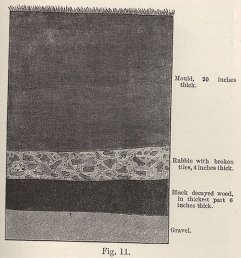
Fig. 11. Section in a block of
buildings in the middle of the town of Silchester.

Fig. 12. Section in the centre
of the Basilica at Silchester.
Turning now to the points which more immediately
concern us. Worm-castings were observed on the floors of several of the
rooms, in one of which the tesselation was unusually perfect. The
tesseræ here consisted of little cubes of hard sandstone of about 1
inch, several of which were loose or projected slightly above the
general level. One or occasionally two open worm-burrows were found
beneath all the loose tesseræ. Worms have also penetrated the old walls
of these ruins. A wall, which had just been exposed to view during the
excavations then in progress, was examined; it was built of large
flints, and was 18 inches in thickness.
It appeared sound, but when the soil was removed from
beneath, the mortar in the lower part was found to be so much decayed
that the flints fell apart from their own weight. Here, in the middle of
the wall, at a depth of 29 inches beneath the old floor and of 49½
inches beneath the surface of the field, a living worm was found, and
the mortar was penetrated by several burrows.
A second wall was exposed to view for the first time,
and an open burrow was seen on its broken summit. By separating the
flints this burrow was traced far down in the interior of the wall; but
as some of the flints cohered firmly, the whole mass was disturbed in
pulling down the wall, and the burrow could not be traced to the bottom.
The foundations of a third wall, which appeared quite sound, lay at a
depth of 4 feet beneath one of the floors, and of course at a
considerably greater depth beneath the level of the ground. A large
flint was wrenched out of the wall at about a foot from the base, and
this required much force, as the mortar was sound; but behind the flint
in the middle of the wall, the mortar was friable, and here there were
worm-burrows. Mr. Joyce and my sons were surprised at the blackness of
the mortar in this and in several other cases, and at the presence of
mould in the interior of the walls. Some may have been placed there by
the old builders instead of mortar; but we should remember that worms
line their burrows with black humus. Moreover open spaces would almost
certainly have been occasionally left between the large irregular
flints; and these spaces, we may feel sure, would be filled up by the
worms with their castings, as soon as they were able to penetrate the
wall. Rain-water, oozing down the burrows would also carry fine dark-coloured
particles into every crevice. Mr. Joyce was at first very sceptical
about the amount of work which I attributed to worms; but he ends his
notes with reference to the last-mentioned wall by saying, "This case
caused me more surprise and brought more conviction to me than any
other. I should have said, and did say, that it was quite impossible
such a wall could have been penetrated by earth-worms."
In almost all the rooms the pavement has sunk
considerably, especially towards the middle; and this is shown in the
three following sections. The measurements were made by stretching a
string tightly and horizontally over the floor. The section, Fig. 13,
was taken from north to south across a room, 18 feet 4 inches in length,
with a nearly perfect pavement, next to the "Red Wooden Hut." In the
northern half, the subsidence amounted to 5¾ inches beneath the level of
the floor as it now stands close to the walls; and it was greater in the
northern than in the southern half; but, according to Mr. Joyce, the
entire pavement has obviously subsided. In several places, the tesseræ
appeared as if drawn a little away from the walls; whilst in other
places they were still in close contact with them.

Fig. 13. Section of the
subsided floor of a room, paved with tesserae, at Silchester. Scale
1/40.
In Fig. 14, we see a section across the paved floor of
the southern corridor or ambulatory of a quadrangle, in an excavation
made near "The Spring." The floor is 7 feet 9 inches wide, and the
broken-down walls now project only ¾ of an inch above its level. The
field, which was in pasture, here sloped from north to south, at an
angle of 3° 40′. The nature of the ground on each side of the corridor
is shown in the section. It consisted of earth full of stones and other
débris, capped with dark vegetable mould which was thicker on the lower
or southern than on the northern side. The pavement was nearly level
along lines parallel to the side-walls, but had sunk in the middle as
much as 7¾ inches.
A small room at no great distance from that
represented in Fig. 13, had been enlarged by the Roman occupier on the
southern side, by an addition of 5 feet 4 inches in breadth. For this
purpose the southern wall of the house had been pulled down, but the
foundations of the old wall had been left buried at a little depth
beneath the pavement of the enlarged room. Mr. Joyce believes that this
buried wall must have been built before the reign of Claudius II., who
died 270, A.D. We see in the accompanying section, Fig. 15, that the
tesselated pavement has subsided to a less degree over the buried wall
than elsewhere; so that a slight convexity or protuberance here
stretched in a straight line across the room. This led to a hole being
dug, and the buried wall was thus discovered.

Fig. 14. A north and south
section through the subsided floor of a corridor, paved with tesseræ.
Outside the broken-down bounding walls, the excavated ground on each
side is shown for a short space. Nature of the ground beneath the
tesseræ unknown. Silchester. Scale 1/36.
We see in these three sections, and in several others
not given, that the old pavements have sunk or sagged considerably. Mr.
Joyce formerly attributed this sinking solely to the slow settling of
the ground. That there has been some settling is highly probable, and it
may be seen in section 15 that the pavement for a width of 5 feet over
the southern enlargement of the room, which must have been built on
fresh ground, has sunk a little more than on the old northern side. But
this sinking may possibly have had no connection with the enlargement of
the room, for in Fig. 13, one half of the pavement has subsided more
than the other half without any assignable cause. In a bricked passage
to Mr. Joyces own house, laid down only about six years ago, the same
kind of sinking has occurred as in the ancient buildings. Nevertheless
it does not appear probable that the whole amount of sinking can be thus
accounted for. The Roman builders excavated the ground to an unusual
depth for the foundations of their walls, which were thick and solid; it
is therefore hardly credible that they should have been careless about
the solidity of the bed on which their tesselated and often ornamented
pavements were laid. The sinking must, as it appears to me, be
attributed in chief part to the pavement having been undermined by
worms, which we know are still at work. Even Mr. Joyce at last admitted
that this could not have failed to have produced a considerable effect.
Thus also the large quantity of fine mould overlying the pavements can
be accounted for, the presence of which would otherwise be inexplicable.
My sons noticed that in one room in which the pavement had sagged very
little, there was an unusually small amount of overlying mould.
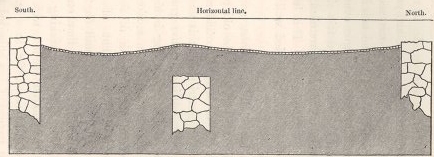
Fig. 15. Section of the
subsided floor, paved with tessarae, and of the broken-down bounding
walls of a room at Silchester, which had been formerly enlarged, with
the foundations of the old wall left buried. Scale 1/40.
As the foundations of the walls generally lie at a
considerable depth, they will either have not subsided at all through
the undermining action of worms, or they will have subsided much less
than the floor. This latter result would follow from worms not often
working deep down beneath the foundations; but more especially from the
walls not yielding when penetrated by worms, whereas the successively
formed burrows in a mass of earth, equal to one of the walls in depth
and thickness, would have collapsed many times since the desertion of
the ruins, and would consequently have shrunk or subsided. As the walls
cannot have sunk much or at all, the immediately adjoining pavement from
adhering to them will have been prevented from subsiding; and thus the
present curvature of the pavement is intelligible.
The circumstance which has surprised me most with
respect to Silchester is that during the many centuries which have
elapsed since the old buildings were deserted, the vegetable mould has
not accumulated over them to a greater thickness than that here
observed. In most places it is only about 9 inches in thickness, but in
some places 12 or even more inches. In Fig. 11, it is given as 20
inches, but this section was drawn by Mr. Joyce before his attention was
particularly called to this subject. The land enclosed within the old
walls is described as sloping slightly to the south; but there are parts
which, according to Mr. Joyce, are nearly level, and it appears that the
mould is here generally thicker than elsewhere. The surface slopes in
other parts from west to east, and Mr. Joyce describes one floor as
covered at the western end by rubbish and mould to a thickness of 28½
inches, and at the eastern end by a thickness of only 11½ inches. A very
slight slope suffices to cause recent castings to flow downwards during
heavy rain, and thus much earth will ultimately reach the neighbouring
rills and streams and be carried away. By this means, the absence of
very thick beds of mould over these ancient ruins may, as I believe, be
explained. Moreover most of the land here has long been ploughed, and
this would greatly aid the washing away of the finer earth during rainy
weather.
The nature of the beds immediately beneath the
vegetable mould in some of the sections is rather perplexing. We see,
for instance, in the section of an excavation in a grass meadow (Fig.
14), which sloped from north to south at an angle of 3° 40′, that the
mould on the upper side is only six inches and on the lower side nine
inches in thickness. But this mould lies on a mass (25½ inches in
thickness on the upper side) "of dark brown mould," as described by Mr.
Joyce, "thickly interspersed with small pebbles and bits of tiles, which
present a corroded or worn appearance." The state of this dark-coloured
earth is like that of a field which has long been ploughed, for the
earth thus becomes intermingled with stones and fragments of all kinds
which have been much exposed to the weather. If during the course of
many centuries this grass meadow and the other now cultivated fields
have been at times ploughed, and at other times left as pasture, the
nature of the ground in the above section is rendered intelligible. For
worms will continually have brought up fine earth from below, which will
have been stirred up by the plough whenever the land was cultivated. But
after a time a greater thickness of fine earth will thus have been
accumulated than could be reached by the plough; and a bed like the
25½-inch mass, in Fig. 14, will have been formed beneath the superficial
mould, which latter will have been brought to the surface within more
recent times, and have been well sifted by the worms.
Wroxeter, Shropshire.—The
old Roman city of Uriconium was founded in the early part of the second
century, if not before this date; and it was destroyed, according to Mr.
Wright, probably between the middle of the fourth and fifth century. The
inhabitants were massacred, and skeletons of women were found in the
hypocausts. Before the year 1859, the sole remnant of the city above
ground, was a portion of a massive wall about 20 ft. in height. The
surrounding land undulates slightly, and has long been under
cultivation. It had been noticed that the corn-crops ripened prematurely
in certain narrow lines, and that the snow remained unmelted in certain
places longer than in others.
These appearances led, as I was informed, to extensive
excavations being undertaken. The foundations of many large buildings
and several streets have thus been exposed to view. The space enclosed
within the old walls is an irregular oval, about 1¾ mile in length. Many
of the stones or bricks used in the buildings must have been carried
away; but the hypocausts, baths, and other underground buildings were
found tolerably perfect, being filled with stones, broken tiles, rubbish
and soil. The old floors of various rooms were covered with rubble. As I
was anxious to know how thick the mantle of mould and rubbish was, which
had so long concealed these ruins, I applied to Dr. H. Johnson, who had
superintended the excavations; and he, with the greatest kindness, twice
visited the place to examine it in reference to my questions, and had
many trenches dug in four fields which had hitherto been undisturbed.
The results of his observations are given in the following Table. He
also sent me specimens of the mould, and answered, as far as he could,
all my questions.
MEASUREMENTS BY DR. H. JOHNSON OF THE THICKNESS OF
THE VEGETABLE MOULD OVER THE ROMAN RUINS AT WROXETER.
Trenches dug in a field called "Old Works."
| |
|
Thickness
of mould in inches. |
| 1. |
At a depth of 36 inches
undisturbed sand was reached .. .. .. .. .. |
20 |
| 2. |
At a depth of 33 inches
concrete was reached |
21 |
| 3. |
At a depth of 9 inches
concrete was reached |
9 |
Trenches dug in a field called "Shop Leasows;" this is
the highest field within the old walls, and slopes down from a
sub-central point on all sides at about an angle of 2.
| |
|
Thickness
of mould in inches. |
| 4. |
Summit of field, trench 45
inches deep .. |
40 |
| 5. |
Close to summit of field,
trench 36 inches deep |
26 |
| 6. |
Close to summit of field,
trench 28 inches deep |
28 |
| 7. |
Near summit of field, trench
36 inches deep |
24 |
| 8. |
Near summit of field, trench at one end
39 inches deep; the mould here graduated into the underlying
undisturbed sand, and its thickness is somewhat arbitrary.
At the other end of the trench, a causeway was encountered
at a depth of only 7 inches, and the mould was here only 7
inches thick .. |
24 |
| 9. |
Trench close to the last, 28
inches in depth .. |
15 |
| 10. |
Lower part of same field,
trench 30 inches deep |
15 |
| 11. |
Lower part of same field,
trench 31 inches deep |
17 |
| 12. |
Lower part of same field,
trench 36 inches deep, at which depth undisturbed sand was
reached |
28 |
| 13. |
In another part of same
field, trench 9½ inches deep, stopped by concrete .. .. .. |
9½ |
| 14. |
In another part of same
field, trench 9 inches deep, stopped by concrete .. .. .. |
9 |
| 15. |
In another part of the same
field, trench 24 inches deep, when sand was reached .. |
16 |
| 16. |
In another part of same
field, trench 30 inches deep, when stones were reached; at
one end of the trench mould 12 inches, at the other end 14
inches thick .. .. .. .. |
13 |
Small field between "Old Works" and "Shop Leasows," I
believe nearly as high as the upper part of the latter field.
| |
|
Thickness
of mould in inches. |
| 17. |
Trench 26 inches deep .. ..
.. |
24 |
| 18. |
Trench 10 inches deep, and
then came upon a causeway .. .. .. .. .. |
10 |
| 19. |
Trench 34 inches deep .. ..
.. |
30 |
| 20. |
Trench 31 inches deep.. ..
.. .. |
31 |
Field on the western side of the space enclosed within
the old walls.
| |
|
Thickness
of mould in inches. |
| 21. |
Trench 28 inches deep, when
undisturbed sand was reached .. .. .. .. .. |
16 |
| 22. |
Trench 29 inches deep, when
undisturbed sand was reached .. .. .. .. .. |
15 |
| 23. |
Trench 14 inches deep, and
then came upon a building .. .. .. .. .. |
14 |
Dr. Johnson distinguished as mould the earth which
differed, more or less abruptly, in its dark colour and in its texture
from the underlying sand or rubble. In the specimens sent to me, the
mould resembled that which lies immediately beneath the turf in old
pasture-land, excepting that it often contained small stones, too large
to have passed through the bodies of worms. But the trenches above
described were dug in fields, none of which were in pasture, and all had
been long cultivated. Bearing in mind the remarks made in reference to
Silchester on the effects of long-continued culture, combined with the
action of worms in bringing up the finer particles to the surface, the
mould, as so designated by Dr. Johnson, seems fairly well to deserve its
name. Its thickness, where there was no causeway, floor or walls
beneath, was greater than has been elsewhere observed, namely in many
places above 2 ft., and in one spot above 3 ft. The mould was thickest
on and close to the nearly level summit of the field called "Shop
Leasows," and in a small adjoining field, which, as I believe, is of
nearly the same height. One side of the former field slopes at an angle
of rather above 2°, and I should have expected that the mould, from
being washed down during heavy rain, would have been thicker in the
lower than in the upper part; but this was not the case in two out of
the three trenches here dug.
In many places, where streets ran beneath the surface,
or where old buildings stood, the mould was only 8 inches in thickness;
and Dr. Johnson was surprised that in ploughing the land, the ruins had
never been struck by the plough as far as he had heard. He thinks that
when the land was first cultivated the old walls were perhaps
intentionally pulled down, and that hollow places were filled up. This
may have been the case; but if after the desertion of the city the land
was left for many centuries uncultivated, worms would have brought up
enough fine earth to have covered the ruins completely; that is if they
had subsided from having been undermined. The foundations of some of the
walls, for instance those of the portion still standing about 20 feet
above the ground, and those of the market-place, lie at the
extraordinary depth of 14 feet; but it is highly improbable that the
foundations were generally so deep. The mortar employed in the buildings
must have been excellent, for it is still in parts extremely hard.
Where-ever walls of any height have been exposed to view, they are, as
Dr. Johnson believes, still perpendicular. The walls with such deep
foundations cannot have been undermined by worms, and therefore cannot
have subsided, as appears to have occurred at Abinger and Silchester.
Hence it is very difficult to account for their being now completely
covered with earth; but how much of this covering consists of vegetable
mould and how much of rubble I do not know. The market-place, with the
foundations at a depth of 14 feet, was covered up, as Dr. Johnson
believes, by between 6 and 24 inches of earth. The tops of the
broken-down walls of a caldarium or bath, 9 feet in depth, were likewise
covered up with nearly 2 feet of earth. The summit of an arch, leading
into an ash-pit 7 feet in depth, was covered up with not more than 8
inches of earth. Whenever a building which has not subsided is covered
with earth, we must suppose, either that the upper layers of stone have
been at some time carried away by man, or that earth has since been
washed down during heavy rain, or blown down during storms, from the
adjoining land; and this would be especially apt to occur where the land
has long been cultivated. In the above cases the adjoining land is
somewhat higher than the three specified sites, as far as I can judge by
maps and from information given me by Dr. Johnson. If, however, a great
pile of broken stones mortar, plaster, timber and ashes fell over the
remains of any building, their disintegration in the course of time, and
the sifting action of worms, would ultimately conceal the whole beneath
fine earth.
Conclusion.—The cases
given in this chapter show that worms have played a considerable part in
the burial and concealment of several Roman and other old buildings in
England; but no doubt the washing down of soil from the neighbouring
higher lands, and the deposition of dust, have together aided largely in
the work of concealment. Dust would be apt to accumulate wherever old
broken-down walls projected a little above the then existing surface and
thus afforded some shelter. The floors of the old rooms, halls and
passages have generally sunk, partly from the settling of the ground,
but chiefly from having been undermined by worms; and the sinking has
commonly been greater in the middle than near the walls. The walls
themselves, whenever their foundations do not lie at a great depth, have
been penetrated and undermined by worms, and have consequently subsided.
The unequal subsidence thus caused, probably explains the great cracks
which may be seen in many ancient walls, as well as their inclination
from the perpendicular.
_______________
1. 'Leçons de Géologie pratique, 1845,
p. 142.
2. A short account of this discovery
was published in 'The Times of January 2, 1878; and a fuller account in
'The Builder, January 5, 1878.
3. Several accounts of these
ruins have been published; the best is by Mr. James Farrer in 'Proc.
Soc. of Antiquaries of Scotland,' vol. vi., Part II., 1867, p. 278. Also
J. W. Grover, 'Journal of the British Arch. Assoc.' June 1866. Professor
Buckman has likewise published a pamphlet, 'Notes on the Roman Villa at
Chedworth,' 2nd edit. 1873: Cirencester.
4. These details are taken from
the 'Penny Encyclopædia,' article, Hampshire.