|
INSPECTOR GENERAL'S SURVEY OF THE CUBAN OPERATION AND ASSOCIATED DOCUMENTS |
|
Santo Trafficante was born in Tampa, Florida, on 15th November, 1914. His father, Santo Trafficante Senior, was a leading figure in the Mafia. In the 1940s he joined up with Lucky Luciano, Frank Costello, and Meyer Lansky to set up gambling operations in Cuba. The dictator of Cuba, Fulgencio Batista, received a large cut of the profits. Santo Trafficante married Josephine Marchese on 17th April, 1938. He worked for his father in Florida and in 1953 he was sent to Cuba to manage some Mafia controlled casinos. Trafficante took full control of these operations when his father died of stomach cancer in August, 1954. Trafficante also spent time in Florida. This resulted in his arrest and conviction for gambling offences. He was released from prison in January 1957 after his conviction was overturned by Florida's State Supreme Court. It is believed that soon afterwards Trafficante arranged for Albert Anastasia, his Mafia rival, to be murdered. Trafficante returned to Cuba but his casinos were closed down when Fidel Castro overthrew Fulgencio Batista in January, 1959. Trafficante spent time in prison before being deported to the United States. In September 1960 Johnny Roselli and Sam Giancana, took part in talks with Allen W. Dulles, the director of the Central Intelligence Agency (CIA), about the possibility of murdering Fidel Castro. In 1961 Roselli persuaded Trafficante to join the conspiracy. Meyer Lansky also became involved in this plot and was reportedly offering a million-dollar reward for the Cuban leader's murder. Trafficante also worked closely with the CIA agent, William Harvey, in this operation. By 1962, Trafficante and his friends became convinced that the Cuban revolution could not be reversed by simply killing Castro. However, they continued to play along with this CIA plot in order to prevent them being prosecuted for criminal offences committed in the United States. It is also believed that Trafficante became involved in Mafia plots to kill President John F. Kennedy. He told a friend, Jose Aleman: "Mark my word, this man Kennedy is in trouble, and he will get what is coming to him. Kennedy's got going to make it to the election. He is going to be hit." Just before Kennedy was assassinated on 22nd November, 1963, Jack Ruby made contact with Trafficante, and another Mafia leader, Carlos Marcello, about a problem he was having with the American Guild of Variety Artists (AGVA). However, the Warren Commission failed to find any direct link between Trafficante and Ruby concluded that "Oswald acted alone". Trafficante continued to work for the CIA and was involved in the Iran-Contra affair. Santos Trafficante died on the 19th March, 1987. On 14th January, 1992, the New York Post claimed that Trafficante, Jimmy Hoffa and Carlos Marcello had all been involved in the assassination of President John F. Kennedy. Frank Ragano was quoted as saying that at the beginning of 1963 Hoffa had told him to take a message to Trafficante and Marcello concerning a plan to kill Kennedy. When the meeting took place at the Royal Orleans Hotel, Ragano told the men: "You won't believe what Hoffa wants me to tell you. Jimmy wants you to kill the president." He reported that both men gave the impression that they intended to carry out this order. In his autobiography, Mob Lawyer (1994) (co-written with journalist Selwyn Raab) Frank Ragano added that in July, 1963, he was once again sent to New Orleans by Hoffa to meet Trafficante and Carlos Marcello concerning plans to kill President John F. Kennedy. When Kennedy was killed Hoffa apparently said to Ragano: "I told you could do it. I'll never forget what Carlos and Santos did for me." He added: "This means Bobby is out as Attorney General". Marcello later told Ragano: "When you see Jimmy (Hoffa), you tell him he owes me and he owes me big."
Maier Suchowljansky (Meyer Lansky), the son of Jewish parents, was born in Grodno, Russia (now in Poland) on 4th July, 1902. The family moved to the United States in 1911 and the settled in New York. After leaving school he became an apprentice toolmaker. In 1920 Lansky met Bugsy Siegel and Lucky Luciano. The three young men became involved in crime and by the 1920s Lansky had his own gang and was involved in bootlegging and the protection racket. Lansky also worked for New York's leading crime boss, Joe Masseria. In 1931 Lansky joined with other gang members, Lucky Luciano, Bugsy Siegel and Albert Anastasia, in the killing of Masseria. In 1936 Lansky established gambling operations in Florida, New Orleans and Cuba. He was also the major investor in the Flamingo Hotel and Casino started by Bugsy Siegel in Las Vagas. He arranged Siegel's execution in June, 1947 when he became convinced that his partner was fiddling the books. By the 1960s Lansky was involved in drug smuggling, pornography, prostitution and extortion. He had also invested heavily in legal businesses such as hotels and golf-courses. It was estimated at the time that his total holdings were worth $300,000,000. In 1970 plans were made to arrest Lansky on suspicion of income-tax evasion. When Lansky heard the news he fled to Israel. He was eventually arrested and returned to the United States but in 1973 he was acquitted of income-tax evasion. Other charges were abandoned because of Lansky's poor health. Meyer Lansky died of lung cancer in Miami Beach, Florida, on 15th May, 1983. It has been estimated that when he died Lansky was worth over $400 million.
Robert Maheu was born in Waterville, Maine, in 1918. After graduating from the College of the Holy Cross, Worcester, in 1940, he joined the Federal Bureau of Investigation. During the Second World War he posed as a German sympathizer. In 1947 Maheu established his own investigative company. Maheu also worked for the Central Intelligence Agency. He was later to admit "The CIA was my first steady client, giving me `cut-out' assignments (those jobs in which the agency could not officially be involved)." This work brought him into contact with Howard Hughes and in the late 1950s worked for him on a freelance basis. This included intimidating would be blackmailers and obtaining information on business rivals. In 1960 Richard Bissell and Allen W. Dulles decided to work with the Mafia in a plot to assassinate Fidel Castro. Maheu was employed by the CIA to organize the conspiracy. The advantage of employing the Mafia for this work is that it provided CIA with a credible cover story. The Mafia were known to be angry with Castro for closing down their profitable brothels and casinos in Cuba. If the assassins were killed or captured the media would accept that the Mafia were working on their own. In August 1960, Colonel Sheffield Edwards contacted Maheu. As Maheu explained in 1995: "In the winter of 1959-60, however, the CIA still thought it could pull off the invasion (of Cuba). But it thought the odds might be better if the plan went one step further - the murder of Fidel Castro. All the Company needed was someone to do the dirty work for it. Professional killers. A gangland-style hit." Maheu offered the contract to Johnny Rosell. He in turn arranged for a meeting on 11th October, 1960, between Maheu and two leading mobsters, Santo Trafficante and Sam Giancana. As Maheu pointed out, "both were among the ten most powerful Mafia members" in America. Maheu told the mobsters that the CIA was willing to pay $150,000 to have Castro killed. On 12th March, 1961, Maheu arranged for CIA operative, Jim O'Connell, to meet Roselli, Trafficante and Giancana at the Fontainebleau Hotel. During the meeting O'Connell gave poison pills and $10,000 to Rosselli to be used against Fidel Castro. Maheu began full-time work for Howard Hughes in 1966. He moved to Las Vegas where he ran Hughes's casinos. Maheu explained later what his role was in the operation: "When he came here, he wanted to tie up all the property on the Strip to develop it properly. He didn't want it to be honky-tonk or like Coney Island. Hughes was a catalyst in the city cleaning up its act." After losing his job with Howard Hughes in 1970 Maheu eastablished a new company in Las Vegas called Robert A. Maheu and Associates. In 1993 Maheu published the book, Next to Hughes. The Federal Bureau of Investigation (FBI), the investigative branch of the United States Department of Justice, was established by Attorney-General Charles J. Bonaparte (1851-1921) in 1908. The original function of the FBI was the investigation of violations of federal law. However, it also assists the police and other criminal investigation agencies in the United States. In 1924 John Edgar Hoover was appointed director of the FBI. Under Hoover's leadership, the FBI also became involved in counter-intelligence activities. This included the collection of information on those with radical political beliefs. For example, the FBI secretly supplied information to Joseph McCarthy and members of the House of Un-American Activities Committee (HUAC). In 1961 William Sullivan was appointed assistant director of the FBI's Intelligence Division. Sullivan gradually moved up the hierarchy and eventually became the FBI's third-ranking official behind J. Edgar Hoover, the director, and Clyde A. Tolson. Sullivan was placed in charge of FBI's Division Five. This involved smearing leaders of left-wing organizations. Sullivan was a strong opponent of the leadership of Martin Luther King. In January, 1964, Sullivan sent a memo to Hoover: "It should be clear to all of us that King must, at some propitious point in the future, be revealed to the people of this country and to his Negro followers as being what he actually is - a fraud, demagogue and scoundrel. When the true facts concerning his activities are presented, such should be enough, if handled properly, to take him off his pedestal and to reduce him completely in influence." Sullivan's suggested replacement for King was Samuel Pierce, a conservative lawyer who was later to serve as Secretary of Housing under President Ronald Reagan. William Sullivan disagreed with J. Edgar Hoover about the threat to national security posed by the American Communist Party and felt that the FBI was wasting too much money investigating this group. On 28th August, 1971, Sullivan sent Hoover a long letter pointing out their differences. Sullivan also suggested that Hoover should consider retirement. Hoover refused and it was Sullivan who had to leave the organization. In 1975, Frank Church became the chairman of the Select Committee to Study Governmental Operations with Respect to Intelligence Activities. This committee investigated alleged abuses of power by the Central Intelligence Agency and the Federal Bureau of Intelligence. The committee looked at the case of Fred Hampton and discovered that William O'Neal, Hampton's bodyguard, was a FBI agent-provocateur who, days before the raid, had delivered an apartment floor-plan to the Bureau with an "X" marking Hampton's bed. Ballistic evidence showed that most bullets during the raid were aimed at Hampton's bedroom. Church's committee also discovered that the CIA and FBI had sent anonymous letters attacking the political beliefs of targets in order to induce their employers to fire them. Similar letters were sent to spouses in an effort to destroy marriages. The committee also documented criminal break-ins, the theft of membership lists and misinformation campaigns aimed at provoking violent attacks against targeted individuals. One of those people targeted was Martin Luther King. The FBI mailed King a tape recording made from microphones hidden in hotel rooms. The tape was accompanied by a note suggesting that the recording would be released to the public unless King committed suicide. The FBI under J. Edgar Hoover collected information on all America's leading politicians. Known as Hoover's secret files, this material was used to influence their actions. It was later claimed that Hoover used this incriminating material to make sure that the eight presidents that he served under, would be too frightened to sack him as director of the FBI. This strategy worked and Hoover was still in office when he died, aged seventy-seven, on 2nd May, 1972. Clyde Tolson arranged for the destruction of all Hoover's private files. In its final report, issued in April 1976, the Select Committee to Study Governmental Operations with Respect to Intelligence Activities concluded: “Domestic intelligence activity has threatened and undermined the Constitutional rights of Americans to free speech, association and privacy. It has done so primarily because the Constitutional system for checking abuse of power has not been applied.” William Sullivan was shot dead near his home in Sugar Hill, New Hampshire, on 9th November, 1977. An inquest decided that he had been shot accidentally by fellow hunter, Robert Daniels, who was fined $500 and lost his hunting license for 10 years. Sullivan had been scheduled to testify before the House Select Committee on Assassinations. Sullivan was one of six top FBI officials who died in a six month period in 1977. Others who were due to appear before the committee who died included Louis Nicholas, special assistant to J. Edgar Hoover and his liaison with the Warren Commission; Alan H. Belmont, special assistant to Hoover; James Cadigan, document expert with access to documents that related to death of John F. Kennedy; J. M. English, former head of FBI Forensic Sciences Laboratory where Oswald's rifle and pistol were tested; Donald Kaylor, FBI fingerprint chemist who examined prints found at the assassination scene.
John Fitzgerald Kennedy, the son of Joseph Patrick Kennedy and Rose Fitzgerald, was born in Brookline, Massachusetts, on 29th May, 1917. His great grandfather, Patrick Kennedy, had emigrated from Ireland in 1849 and his grandfathers, Patrick Joseph Kennedy and John Francis Fitzgerald, were important political figures in Boston. Kennedy's father was a highly successful businessman who later served as ambassador to Great Britain (1937-40). In 1940 Kennedy graduated from Harvard University with a science degree. The same year saw the publication of Why England Slept (1940), a book on foreign policy. He joined the United States Navy in 1941 and became an intelligence officer. After the United States entered the Second World War, Kennedy was transferred to the Motor Torpedo Boat Squadron where he was given command of a PT boat. Sent to the South Pacific, in August 1943, his boat was hit by a Japanese destroyer. Two of his crew were killed but the other six men managed to cling on to what remained of the boat. After a five hour struggle Kennedy, and what was left of his crew, managed to get to an island five miles from where the original incident took place. Kennedy suffered a bad back injury and in December 1943 was sent back to the United States. When he recovered he was promoted to the rank of lieutenant and became a PT instructor in Florida. After a further operation on his back he returned to civilian life in March 1945. For the next twelve months he worked as a journalist covering the United Nations Conference in San Francisco and the 1945 General Election in Britain. A member of the Democratic Party, Kennedy won election to the House of Representatives in 1946. Over the next couple of years he established himself as a loyal supporter of Harry S. Truman. In Congress he advocated progressive taxation, the extension of social welfare and more low-cost public housing. He was also a leading opponent of the Taft-Hartley Bill. Kennedy took a strong interest in foreign policy and in 1951 toured Europe visiting Britain, France, Italy, Spain, Yugoslavia and West Germany. On his return he told the Senate Committee on Foreign Relations that the United States should maintain its policy of helping to defend Western Europe. However, he argued that the countries concerned should contribute more to the costs of the operation. In the autumn of 1951 Kennedy visited the Middle East, India, Pakistan, Indochina, Malaya and Korea. An opponent of colonial empires, Kennedy urged that France should leave Algeria. He also argued for increased financial aid to underdeveloped countries. Kennedy was elected to the Senate in 1952. The following year he married Jacqueline Bouvier, the daughter of a New York City financier. Over the next few years four children were born but only two, Caroline and John, survived infancy. Kennedy continued to suffer from back problems and had two operations in October 1954 and February 1955. While recovering in hospital he wrote the Pulitzer Prize winning Profiles in Courage (1956). Kennedy was a strong advocate of social welfare and civil rights legislation in the Senate. Kennedy also sponsored bills for providing Federal financial aid to education, liberalizing United States immigration laws and a measure that required full disclosure of all employee pension and welfare funds. In 1960 Kennedy entered the race to become the Democratic Party presidential candidate. Kennedy won Democratic primaries in New Hampshire, Wisconsin, Indiana, Ohio, Oregon, Maryland, Nebraska and West Virginia. At the national convention in July 1960, Kennedy was nominated on the first ballot. He selected Lyndon B. Johnson, as his running mate. Kennedy's candidacy was controversial because no Roman Catholic had ever been elected president. It was generally believed that this had played an important factor in the defeat of Al Smith in 1928. Kennedy decided to tackle this issue head on and in a speech in Houston on 11th September, 1960, Kennedy attacked religious bigotry and he explained how he believed in the absolute separation of church and state. If elected, Kennedy, at 43, would be the second youngest president in United States history (Theodore Roosevelt was only 42 when he replaced the assassinated William McKinley in 1901). In contrast, Richard Nixon, the Republican Party candidate, had served for eight years as vice president under Dwight Eisenhower. During the campaign Nixon highlighted his opponent's lack of experience but when the votes were counted, Kennedy won by 34,226,925 votes to 34,108,662. At his inaugural address on 20th January, 1961, Kennedy challenged the people of the United States with the statement: "Ask not what your country can do for you, but rather what you can do for your country." Kennedy also wanted the young people of the country to help the undeveloped world. He announced the establishment of the Peace Corps, a scheme that intended to send 10,000 young people to serve in Africa, Asia and Latin America. Kennedy argued that this "practical, inexpensive, person-to-person program will plant trust, good will and a capacity for self-help" in the underdeveloped world. In the first speech he made to the American public as their President, Kennedy made it clear that he intended to continue Eisenhower's policy of supporting the South Vietnamese government of Ngo Dinh Diem. He argued that if South Vietnam became a communist state, the whole of the non-communist world would be at risk. If South Vietnam fell, Laos, Cambodia, Burma, Philippines, New Zealand and Australia would follow. If communism was not halted in Vietnam it would gradually spread throughout the world. This view became known as the Domino Theory. Kennedy went on to argue: "No other challenge is more deserving of our effort and energy... Our security may be lost piece by piece, country by country." Under his leadership, America would be willing to: "pay any price, bear any burden, meet any hardship, support any friend, oppose any foe to assure the survival and success of liberty." Kennedy's speech had a considerable impact on many young Americans. Philip Caputo was one of those who traced back his decision to join the US Marines to Kennedy's inauguration speech: "War is always attractive to young men who know nothing about it, but we had also been seduced into uniform by Kennedy's challenge to "ask what you can do for your country" and by the missionary idealism he had awakened in us... we believed we were ordained to play cop to the Communists' robber and spread our own political faith around the world." When Kennedy replaced Dwight Eisenhower as president of the United States he was told about the CIA plan to invade Cuba. Kennedy had doubts about the venture but he was afraid he would be seen as soft on communism if he refused permission for it to go ahead. Kennedy's advisers convinced him that Fidel Castro was an unpopular leader and that once the invasion started the Cuban people would support the ClA-trained forces. On April 14, 1961, B-26 planes began bombing Cuba's airfields. After the raids Cuba was left with only eight planes and seven pilots. Two days later five merchant ships carrying 1,400 Cuban exiles arrived at the Bay of Pigs. The attack was a total failure. Two of the ships were sunk, including the ship that was carrying most of the supplies. Two of the planes that were attempting to give air-cover were also shot down. Within seventy-two hours all the invading troops had been killed, wounded or had surrendered. At the beginning of September 1962, U-2 spy planes discovered that the Soviet Union was building surface-to-air missile (SAM) launch sites. There was also an increase in the number of Soviet ships arriving in Cuba which the United States government feared were carrying new supplies of weapons. President Kennedy complained to the Soviet Union about these developments and warned them that the United States would not accept offensive weapons (SAMs were considered to be defensive) in Cuba. As the Cubans now had SAM installations they were in a position to shoot down U-2 spy-planes. Kennedy was in a difficult situation. Elections were to take place for the United States Congress in two month's time. The public opinion polls showed that his own ratings had fallen to their lowest point since he became president. In his first two years of office a combination of Republicans and conservative southern Democrats in Congress had blocked much of Kennedy's proposed legislation. The polls suggested that after the elections he would have even less support in Congress. Kennedy feared that any trouble over Cuba would lose the Democratic Party even more votes, as it would remind voters of the Bay of Pigs disaster where the CIA had tried to oust Castro from power. One poll showed that over 62 per cent of the population were unhappy with his policies on Cuba. Understandably, the Republicans attempted to make Cuba the main issue in the campaign. This was probably in Kennedy's mind when he decided to restrict the flights of the U-2 planes over Cuba . Pilots were also told to avoid flying the whole length of the island. Kennedy hoped this would ensure that a U-2 plane would not be shot down, and would prevent Cuba becoming a major issue during the election campaign. On September 27, a CIA agent in Cuba overheard Castro's personal pilot tell another man in a bar that Cuba now had nuclear weapons. U-2 spy-plane photographs also showed that unusual activity was taking place at San Cristobal. However, it was not until October 15 that photographs were taken that revealed that the Soviet Union was placing long range missiles in Cuba. President Kennedy's first reaction to the information about the missiles in Cuba was to call a meeting to discuss what should be done. Fourteen men attended the meeting and included military leaders, experts on Latin America, representatives of the CIA, cabinet ministers and personal friends whose advice Kennedy valued. This group became known as the Executive Committee of the National Security Council. Over the next few days they were to meet several times. At the first meeting of the Executive Committee of the National Security Council, the CIA and other military advisers explained the situation. After hearing what they had to say, the general feeling of the meeting was for an air-attack on the missile sites. Remembering the poor advice the CIA had provided before the Bay of Pigs invasion, Kennedy decided to wait and instead called for another meeting to take place that evening. By this time several of the men were having doubts about the wisdom of a bombing raid, fearing that it would lead to a nuclear war with the Soviet Union. The committee was now so divided that a firm decision could not be made. The Executive Committee of the National Security Council argued amongst themselves for the next two days. The CIA and the military were still in favour of a bombing raid and/or an invasion. However, the majority of the committee gradually began to favour a naval blockade of Cuba. Kennedy accepted their decision and instructed Theodore Sorensen, a member of the committee, to write a speech in which Kennedy would explain to the world why it was necessary to impose a naval blockade of Cuba. As well as imposing a naval blockade, Kennedy also told the air-force to prepare for attacks on Cuba and the Soviet Union. The army positioned 125,000 men in Florida and was told to wait for orders to invade Cuba. If the Soviet ships carrying weapons for Cuba did not turn back or refused to be searched, a war was likely to begin. Kennedy also promised his military advisers that if one of the U-2 spy planes were fired upon he would give orders for an attack on the Cuban SAM missile sites. The world waited anxiously. A public opinion poll in the United States revealed that three out of five people expected fighting to break out between the two sides. There were angry demonstrations outside the American Embassy in London as people protested about the possibility of nuclear war. Demonstrations also took place in other cities in Europe. However, in the United States, polls suggested that the vast majority supported Kennedy's action. On October 24, President Kennedy was informed that Soviet ships had stopped just before they reached the United States ships blockading Cuba. That evening Nikita Khrushchev sent an angry note to Kennedy accusing him of creating a crisis to help the Democratic Party win the forthcoming election. On October 26, Khrushchev sent Kennedy another letter. In this he proposed that the Soviet Union would be willing to remove the missiles in Cuba in exchange for a promise by the United States that they would not invade Cuba. The next day a second letter from Khrushchev arrived demanding that the United States remove their nuclear bases in Turkey. While the president and his advisers were analyzing Khrushchev's two letters, news came through that a U-2 plane had been shot down over Cuba. The leaders of the military, reminding Kennedy of the promise he had made, argued that he should now give orders for the bombing of Cuba. Kennedy refused and instead sent a letter to Khrushchev accepting the terms of his first letter. Khrushchev agreed and gave orders for the missiles to be dismantled. Eight days later the elections for Congress took place. The Democrats increased their majority and it was estimated that Kennedy would now have an extra twelve supporters in Congress for his policies. The Cuban Missile Crisis was the first and only nuclear confrontation between the United States and the Soviet Union. The event appeared to frighten both sides and it marked a change in the development of the Cold War. During this period Kennedy made it clear that he intended to continue the policy of supporting the South Vietnam's government. He argued that if South Vietnam became a communist state, the whole of the non-communist world would be at risk. He went on to claim that: "No other challenge is more deserving of our effort and energy. Our security may be lost piece by piece, country by country." Kennedy added that under his leadership, the United States would be willing to "pay any price, bear any burden, meet any hardship, support any friend, oppose any foe to assure the survival and success of liberty". President Charles De Gaulle of France, warned him that if he was not careful, Vietnam would trap the United States in "a bottomless military and political swamp." However, most of his advisers argued that with a fairly small increase in military aid, the United States could prevent a NLF victory in South Vietnam. Kennedy had a good relationship with Ngo Dinh Diem, the leader of the South Vietnamese government and in 1961 he arranged for him to receive the money necessary to increase his army from 150,000 to 170,000. He also agreed to send another 100 military advisers to Vietnam to help train the South Vietnamese Army. As this decision broke the terms of the Geneva Agreement, it was kept from the American public. In 1962 the Strategic Hamlet Programme was introduced. For sometime the governments of South Vietnam and the United States had been concerned about the influence of the National Liberation Front (NLF) on the peasants. In an attempt to prevent this they moved the peasants into new villages in areas under the control of the South Vietnamese Army. A stockade was built around the village and these were then patrolled by armed guards. This strategy failed dismally and some observers claimed that it actually increased the number of peasants joining the NLF. As one pointed out: "Peasants resented working without pay to dig moats, implant bamboo stakes, and erect fences against an enemy that did not threaten them but directed its sights against government officials." In the majority of cases the peasants did not want to move and so the South Vietnamese Army often had to apply force. This increased the hostility of the peasants towards Ngo Dinh Diem's government. In the majority of cases the peasants did not want to move and so the South Vietnamese army often had to apply force. This increased the hostility of the peasants towards the Ngo Dinh Diem government. The peasants were angry at having to travel longer distances to reach their rice fields. Others were upset for religious reasons for they believed that it was vitally important to live where their ancestors were buried. Kennedy became worried when he was informed that despite the Strategic Hamlet programme, the membership of the National Liberation Front had grown to over 17,000 - a 300 per cent increase in two years - and that they now controlled over one-fifth of the villages in South Vietnam. These details were used to pressurise Kennedy into supplying more military advisers. This he agreed to do and by the end of 1962 there were 12,000 in Vietnam. Kennedy also made the decision to supply South Vietnam with 300 helicopters. Their American pilots were told not to become "engaged in combat" but this became an order that was difficult to obey. Although Kennedy denied it at the time, American soldiers were becoming increasingly involved in the fighting in Vietnam. Kennedy had little success in persuading Congress to accept his plans for Medicare. Kennedy's proposals would have provided health coverage for persons over 65 years of age. The insurance was to be financed by increases in the social security payroll tax. Medicare would also offer basic hospital care for 60 days as well as the payment of doctor's fees. Medicare was popular with the Trade Union movement but was vigorously opposed by private insurance companies. The American Medical Association were also against it, describing the measure as an example of socialism and Kennedy was unable to persuade Congress to pass the bill. In the 1960 presidential election campaign John F. Kennedy argued for a new Civil Rights Act. After the election it was discovered that over 70 per cent of the African American vote went to Kennedy. During the first two years of his presidency, Kennedy failed to put forward his promised legislation. However, in 1961 he sent 600 Federal marshals to Alabama to protect the Freedom Riders. They were also used to protect the rights of African American students at Mississippi University. Kennedy's civil rights bill was eventually brought before Congress in 1963 and in a speech on television on 11th June, Kennedy pointed out that: "The Negro baby born in America today, regardless of the section of the nation in which he is born, has about one-half as much chance of completing high school as a white baby born in the same place on the same day; one third as much chance of completing college; one third as much chance of becoming a professional man; twice as much chance of becoming unemployed; about one-seventh as much chance of earning $10,000 a year; a life expectancy which is seven years shorter; and the prospects of earning only half as much." On 11th June, 1963, Thich Quang Due, a sixty-six year old monk in Vietnam, sat down in the middle of a busy Saigon road. He was then surrounded by a group of Buddhist monks and nuns who poured petrol over his head and then set fire to him. One eyewitness later commented: "As he burned he never moved a muscle, never uttered a sound, his outward composure in sharp contrast to the wailing people around him." While Thich Quang Due was burning to death, the monks and nuns gave out leaflets calling for Diem's government to show "charity and compassion " to all religions. The government's response to this suicide was to arrest thousands of Buddhist monks. Many disappeared and were never seen again. By August another five monks had committed suicide by setting fire to themselves. One member of the South Vietnamese government responded to these self-immolations by telling a newspaper reporter: "Let them burn, and we shall clap our hands." Another offered to supply Buddhists who wanted to commit suicide with the necessary petrol. These events convinced Kennedy that Ngo Dinh Diem would never be able to unite the South Vietnamese against communism. Several attempts had already been made to overthrow Diem but Kennedy had always instructed the CIA and the US military forces in Vietnam to protect him. In order to obtain a more popular leader of South Vietnam, Kennedy agreed that the role of the CIA should change. Lucien Conein, a CIA operative, provided a group of South Vietnamese generals with $40,000 to carry out the coup with the promise that US forces would make no attempt to protect Diem. At the beginning of November, 1963, President Diem was overthrown by a military coup. After the generals had promised Diem that he would be allowed to leave the country they changed their mind and killed him. Kennedy now had serious doubts about his Vietnam policy. He told Kenneth O'Donnell and Mike Mansfield that he intended to get out of Vietnam. Robert S. McNamara, the Secretary of Defense, also thought that Kennedy would withdraw once he was re-elected. On 22nd November, 1963, President John F. Kennedy arrived in Dallas. It was decided that Kennedy and his party, including his wife, Jacqueline Kennedy, Vice President Lyndon B. Johnson, Governor John Connally and Senator Ralph Yarborough, would travel in a procession of cars through the business district of Dallas. A pilot car and several motorcycles rode ahead of the presidential limousine. As well as Kennedy the limousine included his wife, John Connally, his wife Nellie, Roy Kellerman, head of the Secret Service at the White House and the driver, William Greer. The next car carried eight Secret Service Agents. This was followed by a car containing Lyndon Johnson and Ralph Yarborough. At about 12.30 p.m. the presidential limousine entered Elm Street. Soon afterwards shots rang out. John Kennedy was hit by bullets that hit him in the head and the left shoulder. Another bullet hit John Connally in the back. Ten seconds after the first shots had been fired the president's car accelerated off at high speed towards Parkland Memorial Hospital. Both men were carried into separate emergency rooms. Connally had wounds to his back, chest, wrist and thigh. Kennedy's injuries were far more serious. He had a massive wound to the head and at 1 p.m. he was declared dead. Within two hours of the killing, a suspect, Lee Harvey Oswald, was arrested. Throughout the the time Oswald was in custody, he stuck to his story that he had not been involved in the assassination. On 24th November, while being transported by the Dallas police from the city to the county jail, Oswald was shot dead by Jack Ruby.
Robert Francis Kennedy, the son of Joseph Patrick Kennedy and Rose Fitzgerald, was born in Brookline, Massachusetts, in 1925. His great grandfather, Patrick Kennedy, had emigrated from Ireland in 1849 and his grandfathers, Patrick Joseph Kennedy and John Francis Fitzgerald, were important political figures in Boston. Kennedy's father was a highly successful businessman who later served as ambassador to Great Britain (1937-40). Kennedy went to Harvard University but his studies were interrupted by the Second World War. In November 1944 he joined the United States Navy but the war finished before he was called into action. He returned to Harvard and graduated in 1948. This was followed by a law degree from the University of Virginia. In 1950 Kennedy married Ethel Shakel and their first child, Kathleen, was born on 4th July, 1951. Joe McCarthy, the controversial senator from Wisconsin, was asked to be the child's godfather. Over the next few years Ethel gave birth to eleven children. In 1951 Kennedy joined the Criminal Division of the U.S. Department of Justice but resigned the following year to help his brother, John F. Kennedy, in his successful campaign to be elected to the Senate. Kennedy returned to legal work in 1953 when Joe McCarthy appointed him as one of the 15 assistant counsels to the Senate subcommittee on investigations. Kennedy's first task was to research Western trade with China. He discovered that Western European countries accounted for around 75 per cent of all ships delivering cargo to China. In an interview with the Boston Post Kennedy argued that: "it just didn't make sense to anybody in this country that our major allies, whom we're aiding financially, should trade with the communists who are killing GIs". In a speech in the Senate Joe McCarthy praised Kennedy's research. He also controversially called for the United States Navy "to sink every accursed ship carrying materials to the enemy and resulting in the death of American boys, regardless of what flag those ships may fly." On 29th July, 1953, Kennedy resigned from McCarthy's office. There is some dispute about why he took this action. In his book, The Enemy Within, Kennedy claimed he resigned because he "disagreed with the way that the Committee was being run". However, other accounts suggest that it was the result of a dispute with Roy Cohn. When McCarthy supported Cohn in the dispute, Kennedy resigned. In 1954, after the demise of Joe McCarthy, Kennedy rejoined the Senate's permanent subcommittee on investigations. The following year he became chief counsel and staff director and in 1957 was appointed as head of the team investigating the Trade Union movement. Kennedy emerged as a national figure when his investigation of James Hoffa was televised. Hoffa was eventually charged with corruption. Kennedy claimed that Hoffa had misappropriated $9.5 million in union funds and had corruptly done deals with employers. However, the jury found Hoffa not guilty. George Meany, president of the AFL-CIO, did not agree with the verdict and Hoffa and the Teamsters Union were expelled from the association. When John F. Kennedy was elected he appointed his brother as U.S. Attorney General. The two men worked closely together on a wide variety of issues including the Cuban Missile Crisis, the struggle to get Civil Rights legislation passed by Congress and the Vietnam War. Kennedy also attempted to tackle organized crime but found working with J. Edgar Hoover, head of the FBI, difficult. After the assassination of John F. Kennedy, he worked briefly under Lyndon B. Johnson before resigning to begin his successful campaign to be elected to the Senate. As a New York senator, Kennedy was popular with young people and minority groups, but was distrusted by the business world. Kennedy became increasingly critical of Johnson's Vietnam policy and in 1968 decided to join the fight to become the Democrats presidential candidate. On 4th June, 1968, following his victory in the California primaries, Robert F. Kennedy was shot dead by Sirhan Sirhan.
Chester Bowles was born in Springfield, Massachusetts on 5th April, 1901. After graduating from Yale University he became a a copy writer at George Batton Company, a New York City advertising agency. In 1929 Bowles joined forces with his friend, William Benton, to establish an advertising agency, Benton & Bowles. The business was a great success and their clients included Proctor & Gamble and Maxwell House. By 1935 the Benton and Bowles agency was the sixth-largest advertising firm in the world. After Pearl Harbor Bowles attempted to join the U.S. Navy. He failed his medical and was offered the post as director of the Office of Price Administration in Connecticut. In 1943 President Franklin D. Roosevelt appointed him as general manager of the Federal Price Administration. In 1946 President Harry Truman appointed him as director of the Office of Economic Stability. He also published the book, Tomorrow Without Fear (1946). Bowles also worked for the UN Appeal for Children in Europe before being elected as Governor of Connecticut in 1949. At the end of his term Truman appointed him as ambassador to India. A member of the Democratic Party, Bowles was elected to the Eighty-sixth Congress (January, 1959-January, 1961). President John F. Kennedy appointed Bowles as his Undersecretary of State. He was highly critical of Kennedy's decision to go ahead with the Bay of Pigs operation. Bowles once again became ambassador to India (1963-1969). Bowles wrote several books including Africa's Challenge to America (1956), Ideas, People and Peace (1958), The Makings of a Just Society (1963), A View From New Delhi: Selected Speeches and Writings (1969), Promises to Keep: My Years in Public Life (1971), Ideas, People and Peace (1974) and Conscience of a Liberal: Selected Writings and Speeches (1975). Chester Bowles died in Essex, Connecticut, on 25th May, 1986.
Theodore (Ted) Sorensen was born in Lincoln, Nebraska on 8th May, 1928. He studied at the University of Nebraska and graduated in 1949. Sorensen developed left-wing political views and was a member of the Americans for Democratic Action. He then went on to obtain a law degree from Nebraska's College of Law. Sorensen moved to Washington where he was an attorney with the Federal Security Agency (1951-53). Sorensen did some Senate committee staff work for Paul H. Douglas of Illinois. Douglas introduced Sorensen to the recently elected John F. Kennedy. In 1960 Kennedy appointed Sorensen as his special counsel. He also wrote a large number of Kennedy's speeches. He was also the coordinator of planning for domestic policy and had a key role in formulating Kennedy's recommendations to Congress. In 1964 Sorensen joined a New York City law firm (Paul, Weiss, Rifkind, Wharton & Garrison). He later becoming a television commentator. In 1970, he ran for the New York State Senate. Among his writings are Decision Making in the White House (1963), Kennedy (1965), The Kennedy Legacy (1969), Kennedy Legacy (1970), Watchmen in the Night: Presidential Accountability After Watergate (1975), Different Kind of Presidency: A Proposal for Breaking the Political Deadlock (1984), Let the Word Go Forth: The Speeches, Statements, and Writings of John F. Kennedy (1988), The Kennedy Legacy: A Peaceful Revolution for the Future (1993), Why I Am a Democrat (1996) and Leaders of Our Time: Kennedy (1999).
Arthur Schlesinger, the son of the historian, Arthur Meier Schlesinger, was born in Columbus, Ohio, on 15th October 1917. He graduated from Harvard University in 1938 and became a member of the University's Society of Fellows from 1939 to 1942. After the United States entered the Second World War Schlesinger served with the Office of War Information (1942-43) and the Office of Strategic Services (1943-45). In 1946 he became a teacher of history at Harvard University. A strong supporter of the Democratic Party he was the co-founder of Americans for Democratic Action and worked in for the election of Adlai Stevenson in 1952 and 1956. After the election of John F. Kennedy he was appointed special assistant to the President for Latin American affairs. Following the assassination of Kennedy he became the Albert Schweitzer Professor of Humanities of the City University of New York, and was appointed chairman of the Franklin Delano Roosevelt Four Freedoms Foundation. Schlesinger is the author of several books including The Age of Jackson (1945), which won a Pulitzer Prize for history; the multi-volume The Age of Roosevelt (1957-1960), A Thousand Days (1965), a book about the administration of John F. Kennedy, Robert Kennedy & His Times (1979), Prelude to Independence: The Newspaper War on Britain, 1764-1776 (1980), The Cycles of American History (1986), General MacArthur and President Truman: The Struggle for Control of American Foreign Policy (1992), The Disuniting of America: Reflections on a Multicultural Society (1993) and the Almanac of American History (1995).
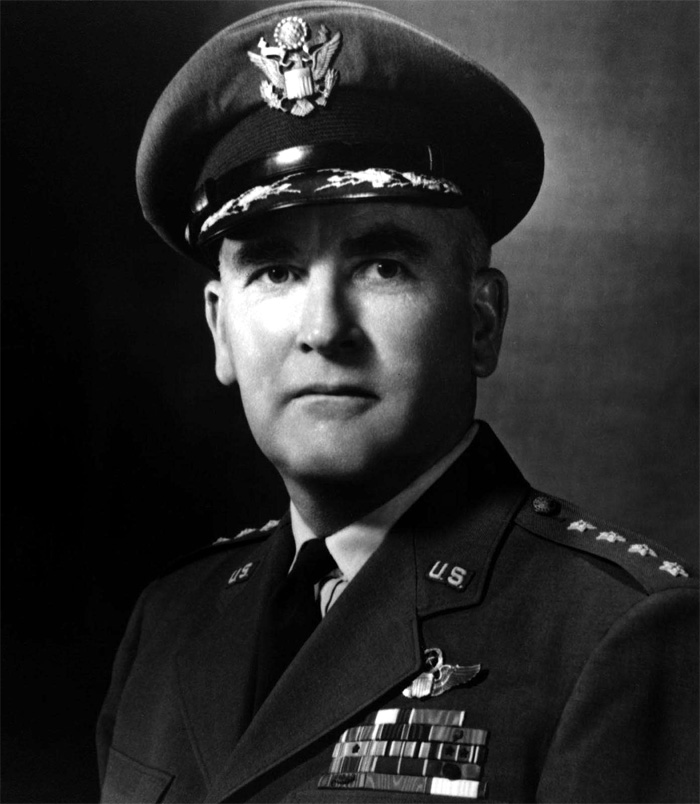
Charles Cabell was born in Dallas County on 11th October, 1903. He graduated from West Point Military Academy in 1925. He also studied at the Command and General Staff School (1940) and the Army and Navy Staff College (1943). During the Second World War Cabell was was a member of the advisory council for the United States Army Air Force headquarters in Washington before being made commander of the Forty-fifth Combat Wing of the Eighth Air Force in the Europe. He also served as Director of Plans (December, 1943 - April, 1944), Director of Operations and Intelligence Mediterranean Allied Air Forces (July, 1944 - May, 1945) and attended the Yalta Conference in February, 1945. After the war he was the United States air representative on the military staff committee of the United Nations in New York. In 1951 he was appointed director of the staff for the Joint Chiefs of Staff, where he worked under General Omar Bradley. In 1953 he was appointed deputy director of the Central Intelligence Agency. In this job he was involved in organizing the Bay of Pigs invasion. It is also believed that Cabell was involved in developing plans to assassinate Fidel Castro. His brother Earle Cabell was elected mayor of Dallas in May 1961. He therefore was involved in planning the trip John F. Kennedy made to Dallas on 22nd November, 1963. James H. Fetzer believes that the brothers were involved in the plot to kill Kennedy: "The two combined motive, means, and opportunity." Cabell retired as a four-star general in 1963 and later became a consultant to the National Aeronautics and Space Administration. Charles Cabell died in Arlington, Virginia, on 25th May, 1971.
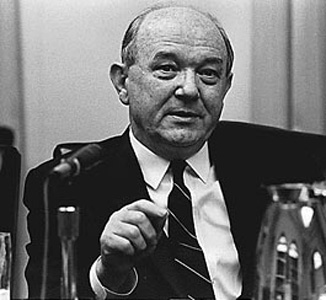
Dean Rusk was born in Georgia in 1909. Educated at Davidson College, North Carolina and at Oxford University, he was appointed as Associate Professor of Government and Dean of Faculty at Mills College. Rusk served in the United States Army during the Second World War. A member of the Democratic Party, Rusk was appointed by President Harry S. Truman as Special Assistant to the Secretary of War in 1946. He also served as Special Assistant for Far Eastern Affairs (1950-51). Rusk lost office when Dwight Eisenhower was elected president in 1951 and served as head of the Rockefeller Foundation until being appointed as Secretary of State by President John F. Kennedy in 1961. In this post he had to deal with the Cuban Missile Crisis and the country's growing involvement in the Vietnam War. He remained as Secretary of State under President Lyndon B. Johnson and remained in the post until Richard Nixon and the Republican Party gained power in 1969. After his retirement Rusk published several books including Waging Peace and War: Dean Rusk in the Truman, Kennedy and Johnson Years (1988) and As I Saw It: A Secretary of State's Memoirs (1990). Dean Rusk died in 1994.
Richard Helms was born in St Davids, Philadelphia, on 30th March, 1913. After graduating from Williams College, Massachusetts, he joined the United Press news agency and in 1936 was sent to Nazi Germany to cover the Berlin Olympic Games. On his return to the United States he joined the advertising department of the Indianapolis Times. Two years later he became national advertising manager. After the bombing of Pearl Harbor Helms joined the United States Navy. In August, 1943, he was transferred to the Office of Strategic Services (OSS) that had made established by William Donovan. The OSS had responsibility for collecting and analyzing information about countries at war with the United States. It also helped to organize guerrilla fighting, sabotage and espionage. After the surrender of Germany in 1945, Helms helped interview suspected Nazi war criminals. Helms remained in the OSS and in 1946 was put in charge of intelligence and counter-intelligence activities in Germany, Austria and Switzerland. The following year Helms joined the recently formed Central Intelligence Agency (CIA). His first task was to mount a mount a massive convert campaign against the Communist Party during the Italian General Election. This was highly successful and this encouraged President Harry S. Truman to establish the Office of Policy Coordination (OPC), an organization instructed to conduct covert anti-Communist operations around the world. In August, 1952, OPC and the Office of Special Operations (the espionage division) were merged to form the Directorate of Plans (DPP). Frank Wisner was appointed head of the DPP and he appointed Helms as his chief of operations. In December, 1956, Wisner suffered a mental breakdown and was diagnosed as suffering from manic depression. During his absence Wisner's job was covered by Helms. The CIA sent Wisner to the Sheppard-Pratt Institute, a psychiatric hospital near Baltimore. He was prescribed psychoanalysis and shock therapy (electroconvulsive treatment). It was not successful and still suffering from depression, he was released from hospital in 1958. Wisner was too ill to return to his post as head of the DDP. Allen W. Dulles therefore sent him to London to be CIA chief of station in England. Dulles decided that Richard Bissell rather than Helms should become the new head of the DPP. Helms was named as his deputy. Together they became responsible for what became known as the CIA's Black Operations. This involved a policy that was later to become known as Executive Action (a plan to remove unfriendly foreign leaders from power). This including a coup d'état that overthrew the Guatemalan government of Jacobo Arbenz in 1954 after he introduced land reforms and nationalized the United Fruit Company. Other political leaders deposed by Executive Action included Patrice Lumumba of the Congo, the Dominican Republic dictator Rafael Trujillo, General Abd al-Karim Kassem of Iraq and Ngo Dinh Diem, the leader of South Vietnam. However, his main target was Fidel Castro who had established a socialist government in Cuba. In March I960, President Dwight Eisenhower of the United States approved a CIA plan to overthrow Castro. The plan involved a budget of $13 million to train "a paramilitary force outside Cuba for guerrilla action." The strategy was organised by Bissell and Helms. An estimated 400 CIA officers were employed full-time to carry out what became known as Operation Mongoose. Sidney Gottlieb of the CIA Technical Services Division was asked to come up with proposals that would undermine Castro's popularity with the Cuban people. Plans included a scheme to spray a television studio in which he was about to appear with an hallucinogenic drug and contaminating his shoes with thallium which they believed would cause the hair in his beard to fall out. These schemes were rejected and instead Bissell and Helms decided to arrange the assassination of Fidel Castro. In September 1960, Bissell and Allen W. Dulles, the director of the Central Intelligence Agency (CIA), initiated talks with two leading figures of the Mafia, Johnny Roselli and Sam Giancana. Later, other crime bosses such as Carlos Marcello, Santos Trafficante and Meyer Lansky became involved in this plot against Castro. Robert Maheu, a veteran of CIA counter-espionage activities, was instructed to offer the Mafia $150,000 to kill Fidel Castro. The advantage of employing the Mafia for this work is that it provided CIA with a credible cover story. The Mafia were known to be angry with Castro for closing down their profitable brothels and casinos in Cuba. If the assassins were killed or captured the media would accept that the Mafia were working on their own. The Federal Bureau of Investigation had to be brought into this plan as part of the deal involved protection against investigations against the Mafia in the United States. Castro was later to complain that there were twenty ClA-sponsered attempts on his life. Eventually Johnny Roselli and his friends became convinced that the Cuban revolution could not be reversed by simply removing its leader. However, they continued to play along with this CIA plot in order to prevent them being prosecuted for criminal offences committed in the United States. When John F. Kennedy replaced Dwight Eisenhower as president of the United States he was told about the CIA plan to invade Cuba. Kennedy had doubts about the venture but he was afraid he would be seen as soft on communism if he refused permission for it to go ahead. Kennedy's advisers convinced him that Fidel Castro was an unpopular leader and that once the invasion started the Cuban people would support the ClA-trained forces. On April 14, 1961, B-26 planes began bombing Cuba's airfields. After the raids Cuba was left with only eight planes and seven pilots. Two days later five merchant ships carrying 1,400 Cuban exiles arrived at the Bay of Pigs. The attack was a total failure. Two of the ships were sunk, including the ship that was carrying most of the supplies. Two of the planes that were attempting to give air-cover were also shot down. Within seventy-two hours all the invading troops had been killed, wounded or had surrendered. After the CIA's internal inquiry into this fiasco, Allen W. Dulles was sacked by President John F. Kennedy and Richard Bissell was forced to resign. Helms now took over the Directorate for Plans. His deputy was Thomas H. Karamessines. Helms now introduced a campaign that involved covert attacks on the Cuban economy. In 1962 Helms became increasingly involved in the Vietnam War. By this time President John F. Kennedy was convinced that Ngo Dinh Diem would never be able to unite the South Vietnamese against communism. Several attempts had already been made to overthrow Diem but Kennedy had always instructed the CIA and the US military forces in Vietnam to protect him. Eventually, in order to obtain a more popular leader of South Vietnam, Kennedy agreed that the role of the CIA should change. Lucien Conein, a CIA operative, provided a group of South Vietnamese generals with $40,000 to carry out the coup with the promise that US forces would make no attempt to protect Diem. At the beginning of November, 1963, President Diem was overthrown by a military coup. The generals had promised Diem that he would be allowed to leave the country they changed their mind and killed him. After the assassination of John F. Kennedy, President Lyndon B. Johnson appointed Admiral William Raborn, head of the Central Intelligence Agency (CIA). Helms became Raborn's deputy but became increasingly influential over decisions being made in Vietnam. This included the covert action in neighbouring Laos and the formation of South Vietnamese counter-terror teams. The following year Johnson promoted Helms to become head of the CIA. He was the first director of the organization to have worked his way up from the ranks. His standing with Johnson improved when he successfully predicted a quick victory for Israel during the Six Day War in June, 1967. However, Helms information about the size of enemy forces in Vietnam was less accurate. Johnson was told in November, 1967, that the North Vietnamese and Viet Cong forces had fallen to 248,000. In reality the true figure was close to 500,000 and United States troops were totally unprepared for the Tet Offensive. Under President Richard Nixon, Helms agreed to implement what became known as the Huston Plan. This was a proposal for all the country's security services to combine in a massive internal surveillance operation. In doing so, Helms became involved in a secret conspiracy as it was illegal for the Central Intelligence Agency to operate within the United States. In 1970 it seemed that Salvador Allende and his Socialist Workers' Party would win the general election in Chile. Various multinational companies, including International Telephone and Telegraph (ITT), feared what would happen if Allende gained control of the country. Helms agreed to use funds supplied by these companies to help the right-wing party gain power. When this strategy ended in failure, Nixon ordered Helms to help the Chilean armed forces to overthrow Allende. On 11th September, 1973, a military coup removed Allende's government from power. Allende died in the fighting in the presidential palace in Santiago and General Augusto Pinochet replaced him as president. During the Watergate Scandal President Richard Nixon became concerned about the activities of the Central Intelligence Agency. Three of those involved in the burglary, E. Howard Hunt, Eugenio Martinez and James W. McCord had close links with the CIA. Nixon and his aides attempted to force the CIA director, Richard Helms, and his deputy, Vernon Walters, to pay hush-money to Hunt, who was attempting to blackmail the government. Although it seemed Walters was willing to do this, Helms refused. In February, 1973, Nixon sacked Helms. His deputy, Thomas H. Karamessines, resigned in protest. The following month Helms became U.S. Ambassador to Iran. James Schlesinger now became the new director of the CIA. Schlesinger was heard to say: “The clandestine service was Helms’s Praetorian Guard. It had too much influence in the Agency and was too powerful within the government. I am going to cut it down to size.” This he did and over the next three months over 7 per cent of CIA officers lost their jobs. On 9th May, 1973, James Schlesinger issued a directive to all CIA employees: “I have ordered all senior operating officials of this Agency to report to me immediately on any activities now going on, or might have gone on in the past, which might be considered to be outside the legislative charter of this Agency. I hereby direct every person presently employed by CIA to report to me on any such activities of which he has knowledge. I invite all ex-employees to do the same. Anyone who has such information should call my secretary and say that he wishes to talk to me about “activities outside the CIA’s charter”. There were several employees who had been trying to complain about the illegal CIA activities for some time. As Cord Meyer pointed out, this directive “was a hunting license for the resentful subordinate to dig back into the records of the past in order to come up with evidence that might destroy the career of a superior whom he long hated.” In 1975 the Senate Foreign Relations Committee began investigating the CIA. Senator Stuart Symington asked Helms if the CIA had been involved in the removal of Salvador Allende. Helms replied no. He also insisted that he had not passed money to opponents of Allende. Investigations by the CIA's Inspector General and by Frank Church and his Select Committee on Intelligence Activities showed that Hems had lied to the Senate Foreign Relations Committee. They also discovered that Helms had been involved in illegal domestic surveillance and the murders of Patrice Lumumba, General Abd al-Karim Kassem and Ngo Dinh Diem. In 1977 Helms was found guilty of lying to Congress and received a suspended two-year prison sentence. Richard Helms died on 22nd October, 2002. As one commentator pointed out at the time: "Helms had gone to his grave with the sole knowledge of what Congress did not manage to uncover." His autobiography, Look Over My Shoulder: A Life in the CIA, was published in 2003. by infoshare1.princeton.edu
Lyman B. Kirkpatrick Jr. was born in Rochester, New York, on July 15, 1916. He attended Deerfield Academy in Deerfield, Massachusetts, and graduated from Princeton University's School of Public and International Affairs in 1938. After leaving Princeton, Kirkpatrick worked on the editorial staff of U.S. News and World Report until enlisting in the Office of the Coordinator of Information, which later evolved into the Office of Strategic Services, in 1942. Based in London, Kirkpatrick served as a liaison with British, French, Norwegian, Czech, and Polish intelligence services. In 1943, he was commissioned as a lieutenant in the U.S. Army, where he served as the intelligence briefing officer for General Omar Bradley, a post he retained until the end of the war. After a brief return to U.S. News and World Report, Kirkpatrick joined the Central Intelligence Agency (CIA) when the agency was created in 1947. He served as a division chief, deputy assistant director of operations, and executive assistant to Director of Central Intelligence Walter Bedell Smith, and appeared to be well positioned for a leadership role in the organization when he contracted polio during a 1952 trip to Asia on agency business. He was left paralyzed from the waist down in 1953 and spent the rest of his career in a wheelchair. After Kirkpatrick returned from hospitalization, Director of Central Intelligence Allen Dulles named him inspector general of the CIA, a post he held until 1961. Richard Helms, another intelligence officer, had been appointed director of covert operations, a job that Kirkpatrick had been expected to assume. As inspector general he traveled overseas on inspection tours, despite his wheelchair, and performed liaison work with the Federal Bureau of Investigation and the president's Foreign Intelligence Advisory Board. He also served as chairman of a joint study group examining all of the United States' foreign intelligence efforts, a group whose report resulted in the creation of the Defense Intelligence Agency in 1961. At the request of Dulles, Kirkpatrick also compiled an internal report on the 1961 Bay of Pigs invasion. The controversial report, which remained classified until 1998, was critical of the planning and execution of the operation and was rumored to have caused resentment among staff at the CIA, particularly Dulles. Kirkpatrick would later write that he believed the report cost him "a fighting chance at the directorship." In December 1961, John McCone, the new director of the CIA, asked Kirkpatrick to chair a working group to study the organizational structure of the agency, which resulted in a major reorganization. In April 1962, Kirkpatrick was named executive director of the CIA, a new position created in order to help ease the administrative demands on McCone and future directors. In 1965, Kirkpatrick left the CIA to become a professor of political science at Brown University. In addition to lecturing and teaching, he served as president of the Association of Former Intelligence Officers, and was a member of the board of directors of the Naval War College and the Defense Intelligence College. Kirkpatrick also contributed to Encyclopedia Britannica (as well as other encyclopedias) and wrote three books for the general public, as well as textbooks used in the intelligence community and articles for journals dealing with military and intelligence matters. He retired from Brown in 1982 and moved to Middleburg, Virginia, one year later. Kirkpatrick died at his home on March 3, 1995. He was survived by his wife, Rita Kirkpatrick, two sons and two daughters from his first marriage to Jeanne Courtney, and five grandchildren.
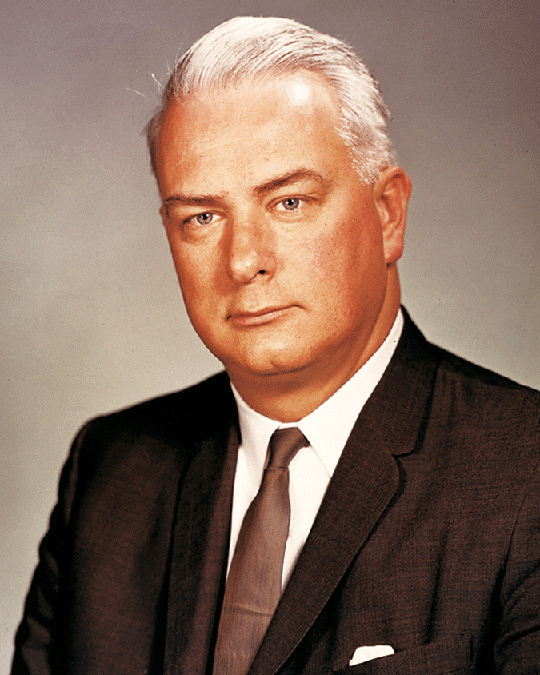
John Alex McCone was born in 1902. After graduating from the University of California with a degree in engineering he found work with the Llewelyn Ironworks. He remained for seventeen years and eventually reached the position of Executive Vice President. In 1937 he established the McCone Engineering Company. The company built and designed oil refineries and industrial plants. On the outbreak of the Second World War McCone established the California Shipbuilding Company. This was a successful move and in 1946 it was recorded that the company made $44 million in wartime profits on an investment of $100,000. After the war McCone was Deputy to the Secretary of Defense (1948) and Under Secretary of the Air Force (1950-1951). While in these posts McCone gave contracts to Standard Oil and Kaiser Aluminum, two companies in which he had financial connections. McCone was an ardent Cold War warrior and in 1956 attacked the suggestion made by Adlai Stevenson that there should be a nuclear test ban. McCone, a strong supporter of Dwight Eisenhower, accused American scientists of being "taken in" by Soviet propaganda and of attempting to "create fear in the minds of the uninformed that radioactive fallout from H-bomb tests endangers life." In 1958 President Dwight Eisenhower rewarded McCone by appointing him Chairman of the Atomic Energy commission. After the Bay of Pigs disaster, President John F. Kennedy sacked Allen W. Dulles as Director of the Central Intelligence Agency. Under pressure from right-wingers in the intelligence community, Kennedy appointed McCone as the new director of the CIA. It is assumed that McCone was informed of Executive Action (a plan to remove unfriendly foreign leaders from power). However, McCone always denied any knowledge of this policy. This included the ZR/RIFLE project, a plot to assassinate Fidel Castro. Robert Maheu, a veteran of CIA counter-espionage activities, was instructed to offer the Mafia $150,000 to kill Castro. The advantage of employing the Mafia for this work is that it provided CIA with a credible cover story. The Mafia were known to be angry with Castro for closing down their profitable brothels and casinos in Cuba. If the assassins were killed or captured the media would accept that the Mafia were working on their own. In April 1963 McGeorge Bundy suggested to President John F. Kennedy that there should be a "gradual development of some form of accommodation with Castro". In an interview given in 1995, Bundy, said Kennedy needed "a target of opportunity" to talk to Fidel Castro. Later that month Lisa Howard arrived in Cuba to make a documentary on the country. In an interview with Howard, Castro agreed that a rapprochement with Washington was desirable. On her return Howard met with the Central Intelligence Agency. Deputy Director Richard Helms reported to John F. Kennedy on Howard's view that "Fidel Castro is looking for a way to reach a rapprochement with the United States." After detailing her observations about Castro's political power, disagreements with his colleagues and Soviet troops in Cuba, the memo concluded that "Howard definitely wants to impress the U.S. Government with two facts: Castro is ready to discuss rapprochement and she herself is ready to discuss it with him if asked to do so by the US Government." McCone was strongly opposed to Lisa Howard being involved with these negotiations with Fidel Castro. He argued that it might "leak and compromise a number of CIA operations against Castro". In a memorandum to McGeorge Bundy, McCone commented that the "Lisa Howard report be handled in the most limited and sensitive manner," and "that no active steps be taken on the rapprochement matter at this time." While McCone was director the CIA was heavily involved in the Congo, supplying mercenaries and arms to the supporters of Sese Seko Mobutu. This enabled Mobutu to oust Patrice Lumumba from power. When John F. Kennedy was assassinated McCone immediately sought a meeting with Robert Kennedy. The two men met between 2 and 2:30 p.m. Kennedy later told his aide Walter Sheridan: "I asked McCone if they had killed my brother." In 1964 McCone arranged for the CIA and other agencies to provide the opponents of Salvador Allende with funds of $20 million. He was also active in helping to establish military rule in Ecuador. McCone had clashed with President John F. Kennedy over his decision to try and withdraw from Vietnam. He got on better with President Lyndon B. Johnson but he objected to his Vietnam policy on the grounds that it could not be successful and advocated the use of increased force. This led to his resignation in 1965 as Director of the CIA. Soon afterwards McCone was appointed to investigate the Watts Race Riot. The McCone Commission report was published in December, 1965. This was not well received. The California Advisory Committee to the US Commission on Civil Rights claimed that "the report is elementary, superficial, unorganized and unimaginative... and... a marked and surprising lack of understanding of the civil rights movement.... The McCone Commission failed totally to make any findings concerning the existence or nonexistence of police malpractices." McCone became a director of ITT. He also did consultancy work with the CIA. In 1970 McCone met with Henry Kissinger and CIA director Richard Helms. McCone later testified that he tried to persuade Helms to accept $1 million in order to prevent the election of Salvador Allende in Chile. The offer was refused by Helms, but $350,000 did pass from ITT to Allende's opponent with CIA assistance. This included implementing ITT dirty tricks campaign in Chile. In retirement McCone was also director of Pacific Mutual Life Insurance, United California Bank, Standard Oil of California, and Western Bancorporation. McCone also helped to establish Committee on the Present Danger. A pressure group that campaigned against cuts in military spending. John Alex McCone died on 14th February 1991.
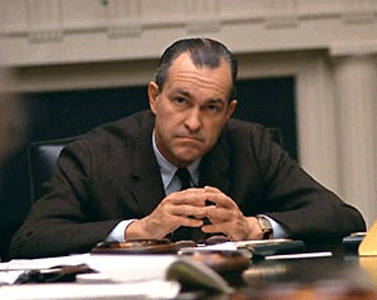
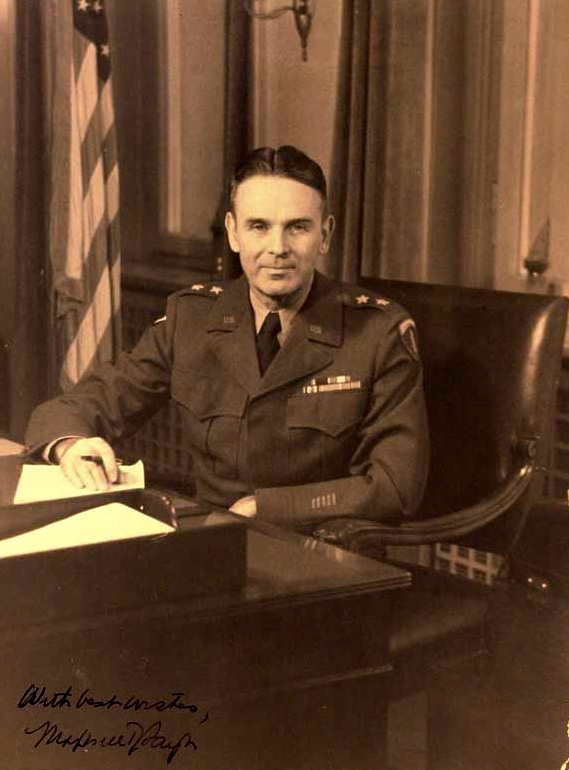
Maxwell Davenport Taylor was born in Keytesville, Missouri, on 26 August 1901. After graduating from the United States Military Academy in 1922 he was commissioned a Second Lieutenant of the 3rd Engineers. In 1926 he was transferred to the 10th Field Artillery. Taylor was promoted to First Lieutenant in February 1927 and became an instructor in French and Spanish at West Point (1927-1932). This was followed by posts at the Field Artillery School at Fort Sill, Oklahoma and the Command and General Staff School at Fort Leavenworth, Kansas. Taylor served at the American embassy in Tokyo (1935-1939) before becoming a military attaché in Peking, China. Promoted to the rank of Major in July 1940 he served in the War Plans Division and on a Hemisphere defense mission to Latin American countries in 1940. Taylor commanded the 12th Field Artillery Battalion at Fort Sam Houston Texas (1940-1941) and served in the Office of the Secretary of the General Staff (1941-1942). He served under General Matthew B. Ridgway as Chief of Staff of the 82d Airborne Division in 1942, then its artillery commander in operations in Sicily and Italy. Taylor commanded the 101st Airborne Division in the Normandy invasion and the Western European campaigns during the final years of the Second World War. In June, 1945, Taylor was promoted to the rank of Lieutenant Colonel and was chief of staff of the European Command. In 1949 he became commander of allied troops in Berlin, a post he held for two years. In 1953, he was sent to the Korean War where he took control of the armed forces assistance program. From 1955 to 1959 he was the Army Chief of Staff. Taylor officially retired from active service in July 1959. After the Bay of Pigs disaster President John F. Kennedy created a committee (SGA) charged with overthrowing Castro's government. The SGA, chaired by Robert F. Kennedy (Attorney General), included Taylor, John McCone (CIA Director), McGeorge Bundy (National Security Adviser), Alexis Johnson (State Department), Roswell Gilpatric (Defence Department) and General Lyman Lemnitzer (Joint Chiefs of Staff). Although not officially members, Dean Rusk (Secretary of State) and Robert S. McNamara (Secretary of Defence) also attending meetings. At a meeting of this committee at the White House on 4th November, 1961, it was decided to call this covert action program for sabotage and subversion against Cuba, Operation Mongoose. Attorney General Robert F. Kennedy also decided that General Edward Lansdale (Staff Member of the President's Committee on Military Assistance) should be placed in charge of the operation. In 1962 President John F. Kennedy recalled Taylor to active duty as Chairman of the Joint Chiefs of Staff. He continued in this post under President Lyndon B. Johnson until he retired in 1964. Taylor served as Ambassador to South Vietnam (1964-1965) and as Chairman of the Foreign Intelligence Advisory Board (1965-1969). Maxwell Davenport Taylor died in Washington on 19th April 1987.
John Foster Dulles, the son of a Presbyterian minister, was born in Washington on 25th February, 1888. His brother was Allen Dulles and his grandfather was John Watson Foster, Secretary of State under President Benjamin Harrison. His uncle, Robert Lansing, was Secretary of State in the Cabinet of President Woodrow Wilson. After attending Princeton University and George Washington University he joined the New York law firm of Sullivan and Cromwell, where he specialized in international law. He tried to join the United States Army during the First World War but was rejected because of poor eyesight. In 1918 Woodrow Wilson appointed Dulles as legal counsel to the United States delegation to the Versailles Peace Conference. Afterwards he served as a member of the War Reparations Committee. Dulles, a deeply religious man, attended numerous international conferences of churchmen during the 1920s and 1930s. He also became a partner in the Sullivan & Cromwell law firm. Dulles was a close associate of Thomas E. Dewey who became the presidential candidate of the Republican Party in 1944. During the election Dulles served as Dewey's foreign policy adviser. In 1945 Dulles participated in the San Francisco Conference and worked as adviser to Arthur H. Vandenberg and helped draft the preamble to the United Nations Charter. He subsequently attended the General Assembly of the United Nations as a United States delegate in 1946, 1947 and 1950. He also published War or Peace (1950). Dulles criticized the foreign policy of the Harry S. Truman. He argued that the policy of "containment" should be replaced by a policy of "liberation". When Dwight Eisenhower became president in January, 1953, he appointed Dulles as his Secretary of State. He spent considerable time building up NATO as part of his strategy of controlling Soviet expansion by threatening massive retaliation in event of a war. In an article written for Life Magazine Dulles defined his policy of brinkmanship: "The ability to get to the verge without getting into the war is the necessary art." His critics blamed him for damaging relations with communist states and contributing to the Cold War. Dulles was also the architect of the Southeast Asia Treaty Organization (SEATO) that was created in 1954. The treaty, signed by representatives of the United States, Australia, Britain, France, New Zealand , Pakistan, the Philippines and Thailand, provided for collective action against aggression. Dulles upset the leaders of several non-aligned countries when on 9th June, 1955, he argued in one speech that "neutrality has increasingly become an obsolete and except under very exceptional circumstances, it is an immoral and shortsighted conception." In 1956 Dulles strongly opposed the Anglo-French invasion of Egypt (October-November). However, by 1958 he was an outspoken opponent of President Gamal Abdel Nasser and stopped him from receiving weapons from the United States. This policy backfired and enabled the Soviet Union to gain influence in the Middle East. Dulles, suffering from cancer, was forced to resign from office in April, 1959. John Foster Dulles died in Washington on 24th May, 1959. Jack Hawkins was born in Texas in 1917. After graduating from the United States Naval Academy he joined the U.S. Marines in 1939. During the Second World War he was captured by the Japanese at Corregidor in the Philippines and spent 11 months as a prisoner of war. He escaped with several other Americans and two Filipino convicts who served as guides, and joined a guerrilla unit for seven months before getting to Australia via submarine in November 1943. In 1945 Hawkins was involved in the invasion of Okinawa. He also took part in the Korean War and helped plan the Inchon. He then served for three years as an instructor on amphibious landings in Marine Corps schools. This was followed by a post at the Marine Corps school in Quantico. In September, 1960, Colonel Hawkins was assigned to the Central Intelligence Agency (CIA). He was given direct responsibility for military training operations. Hawkins was told "that the CIA was planning to land some exile troops in Cuba and they wanted a Marine officer with background in amphibious warfare to help them out with this project.'' Hawkins served under Jake Esterline as Chief of Paramilitary Staff. Richard Bissell, the head of the Directorate of Plans, had appointed Esterline as Task Force Chief for the Bay of Pigs invasion. Esterline was also involved in the plot to assassinate Fidel Castro. In an interview he gave to Don Bohning of the The Miami Herald just before his death, Esterline admitted that Juan Orta, who functioned as Castro's private secretary, had been recruited to slip a poisoned pill into a drink. However, a few days before the invasion Orta changed his mind and fled to the Venezuelan Embassy. When Esterline discovered that the assassination plot against Castro had failed he had serious doubts about whether the Bay of Pigs operation would be a success. Hawkins and Jake Esterline were also unhappy about the decision to change the landing site from Trinidad to the Bay of Pigs. On 8th April, Esterline and Hawkins went to see Richard Bissell and told him they wanted to resign. Bissell persuaded them to stay and be "good soldiers".
William Donovan was born in Buffalo, United States, on 1st January, 1883. After graduating from Columbia University in 1907 he became a lawyer. Donovan was an active member of the Republican Party and after meeting Herbert Hoover he worked as his political adviser, speech writer and campaign manager. During the First World War Donovan joined the United States Army and as a colonel in the 69th Infantry Regiment won the Medal of Honor and three Purple Hearts. While in Europe he visited Russia and spent time with Alexander Kolchak and the White Army. Donovan ran unsuccessfully as lieutenant governor in 1922 but was appointed by President Calvin Coolidge as his assistant attorney general. In 1932 he was the Republican candidate for the post of governor of New York. By the time Franklin D. Roosevelt was elected president in 1932 Donovan was a millionaire Wall Street lawyer. He was a strong opponent of Roosevelt's New Deal but shared the president's concern about political developments in Nazi Germany and in 1940 Donovan agreed to take part in several secret fact-finding missions in Europe. In July 1941, Roosevelt appointed Donovan as his Coordinator of Information. The following year Donovan became head of the Office of Strategic Services (OSS), an organization that was given the responsible for espionage and for helping the resistance movement in Europe. He was helped in this by William Stephenson and Britain's MI6 chief, Stewart Menzies. Donovan was given the rank of major general and during the Second World War he built up a team of 16,000 agents working behind enemy lines. The growth of the OSS brought conflict with John Edgar Hoover who saw it as a rival to the Federal Bureau of Investigation. As soon as the Second World War ended President Harry S. Truman ordered the OSS to be closed down. However, it provided a model for the Central Intelligence Agency (CIA) established in September 1947. Donovan returned to his law practice in 1946 but agreed to become ambassador to Thailand in 1953. William Donovan died in 1959.
McGeorge Bundy was born in Boston, Massachusetts, on 30th March, 1919. After graduating from Yale University in 1940 he joined the office of Facts and Figures in Washington. After the Second World War he took up a teaching appointment at Harvard University. Eventually he became Dean of Arts and Sciences (1953-61). Bundy as his National Security Adviser. William Attwood was the leading advocate inside the Kennedy Administration for talking to Fidel Castro about the potential for improving relations. He was supported by Bundy who suggested to Kennedy that there should be a "gradual development of some form of accommodation with Castro". In April 1963 Lisa Howard arrived in Cuba to make a documentary on the country. In an interview with Howard, Fidel Castro agreed that a rapprochement with Washington was desirable. On her return Howard met with the Central Intelligence Agency. Deputy Director Richard Helms reported to John F. Kennedy on Howard's view that "Fidel Castro is looking for a way to reach a rapprochement with the United States." After detailing her observations about Castro's political power, disagreements with his colleagues and Soviet troops in Cuba, the memo concluded that "Howard definitely wants to impress the U.S. Government with two facts: Castro is ready to discuss rapprochement and she herself is ready to discuss it with him if asked to do so by the US Government." CIA Director John McCone was strongly opposed to Lisa Howard being involved with these negotiations with Castro. He argued that it might "leak and compromise a number of CIA operations against Castro". In a memorandum to McGeorge Bundy, McCone commented that the "Lisa Howard report be handled in the most limited and sensitive manner," and "that no active steps be taken on the rapprochement matter at this time." Arthur Schlesinger explained to Anthony Summers in 1978 why the CIA did not want John F. Kennedy to negotiate with Fidel Castro during the summer of 1963: "The CIA was reviving the assassination plots at the very time President Kennedy was considering the possibility of normalization of relations with Cuba - an extraordinary action. If it was not total incompetence - which in the case of the CIA cannot be excluded - it was a studied attempt to subvert national policy." Lisa Howard now decided to bypass the CIA and in May, 1963, published an article in the journal, War and Peace Report, Howard wrote that in eight hours of private conversations Castro had shown that he had a strong desire for negotiations with the United States: "In our conversations he made it quite clear that he was ready to discuss: the Soviet personnel and military hardware on Cuban soil; compensation for expropriated American lands and investments; the question of Cuba as a base for Communist subversion throughout the Hemisphere." Howard went on to urge the Kennedy administration to "send an American government official on a quiet mission to Havana to hear what Castro has to say." A country as powerful as the United States, she concluded, "has nothing to lose at a bargaining table with Fidel Castro." William Attwood read Howard's article and on 12th September, 1963, he had a long conversation with her on the phone. This apparently set in motion a plan to initiate secret talks between the United States and Cuba. Six days later Attwood sent a memorandum to Under Secretary of State Averell Harriman and U.N. Ambassador Adlai Stevenson. Attwood asked for permission to establish discreet, indirect contact with Fidel Castro. On September 20, John F. Kennedy gave permission to authorize Attwood's direct contacts with Carlos Lechuga, the Cuban ambassador to the United Nations. According to Attwood: "I then told Miss Howard to set up the contact, that is to have a small reception at her house so that it could be done very casually, not as a formal approach by us." Howard met Lechuga at the UN on 23rd September 23. Howard invited Lechuga to come to a party at her Park Avenue apartment that night to meet Attwood. The next day William Attwood met with Robert Kennedy in Washington and reported on the talks with Lechuga. According to Attwood the attorney general believed that a trip to Cuba would be "rather risky." It was "bound to leak and... might result in some kind of Congressional investigation." Nevertheless, he thought the matter was "worth pursuing." On 5th November 5, Bundy recorded that "the President was more in favor of pushing towards an opening toward Cuba than was the State Department, the idea being - well, getting them out of the Soviet fold and perhaps wiping out the Bay of Pigs and maybe getting back into normal." Bundy designated his assistant, Gordon Chase, to be Attwood's direct contact at the White House. Attwood continued to use Lisa Howard as his contact with Fidel Castro. In October 1963, Castro told Howard that he was very keen to open negotiations with Kennedy. Castro even offered to send a plane to Mexico to pick up Kennedy's representative and fly him to a private airport near Veradero where Castro would talk to him alone. John F. Kennedy now decided to send William Attwood to meet Castro. On 14th November, 1963, Lisa Howard conveyed this message to her Cuban contact. In an attempt to show his good will, Kennedy sent a coded message to Castro in a speech delivered on 19th November. The speech included the following passage: "Cuba had become a weapon in an effort dictated by external powers to subvert the other American republics. This and this alone divides us. As long as this is true, nothing is possible. Without it, everything is possible." Kennedy also sent a message to Fidel Castro via the French journalist Jean Daniel. According to Daniel: "Kennedy expressed some empathy for Castro's anti-Americanism, acknowledging that the United States had committed a number of sins in pre-revolutionary Cuba." Kennedy told Daniel that the trade embargo against Cuba could be lifted if Castro ended his support for left-wing movements in the Americas. Daniel delivered this message on 19th November. Castro told Daniel that Kennedy could become "the greatest president of the United States, the leader who may at last understand that there can be coexistence between capitalists and socialists, even in the Americas." Daniel was with Castro when news arrived that Kennedy had been assassinated Castro turned to Daniel and said:"This is an end to your mission of peace. Everything is changed." President Lyndon B. Johnson was told about these negotiations in December, 1963. He refused to continue these talks and claimed that the reason for this was that he feared that Richard Nixon, the expected Republican candidate for the presidency, would accuse him of being soft on communism. Bundy continued to serve Johnson as National Security Adviser and was later blamed for being partly responsible for escalating the Vietnam War. In 1966 he left office to become President of the Ford Foundation. Bundy was also Professor of History at New York University (1979-1989). He was also the author of several books including Presidential Promises and Performance (1980), Danger and Survival: Choices About the Bomb in the First Fifty Years (1988) and Reducing Nuclear Danger: The Road Away from the Brink (1993). McGeorge Bundy died of a heart attack in September, 1996.
Sheffield Edwards joined the United States Army and by the end of the Second World War had reached the rank of colonel. He joined the Central Intelligence Agency and was appointed head of the Office of Security. His main task was to protect Agency personnel and facilities from enemy penetration. In April, 1950 Edwards set up Project Bluebird. This was the creation of teams to check out agents and defectors for the whole CIA. Each team consisted of a psychiatrist, a polygraph (lie detector), an expert trained in hypnosis, and a technician. In 1953 Allen W. Dulles asked Edwards to investigate CIA officers who had been named by Joseph McCarthy as security risks. This included Cord Meyer and William Bundy, who had been supporters of left-wing causes during the 1930s. Allegations were also made against Frank Wisner, head of Directorate of Plans (DPP). Another CIA agent who was investigated, James Kronthal, committed suicide after being interviewed by Edwards and Dulles. Kronthal, a former Nazi Party member and close friend of Herman Goering, had during the war been caught by the German authorities in a homosexual act with an underage German boy. In 1960 Richard Bissell and Allen W. Dulles decided to work with the Mafia in a plot to assassinate Fidel Castro. According to Bissell, it was Edwards who first suggested the idea. Edwards argued that the advantage of employing the Mafia for this work is that it provided CIA with a credible cover story. The Mafia were known to be angry with Castro for closing down their profitable brothels and casinos in Cuba. If the assassins were killed or captured the media would accept that the Mafia were working on their own. Edwards suggested that Robert Maheu should be approached to organize the assassination. Jack Anderson (Peace, War and Politics: An Eyewitness Account) later claimed that Maheu offered the contract to Johnny Rosell. He in turn arranged for a meeting on 11th October, 1960, between Maheu and two leading mobsters, Santo Trafficante and Sam Giancana. As Maheu pointed out, "both were among the ten most powerful Mafia members" in America. Maheu told the mobsters that the CIA was willing to pay $150,000 to have Castro killed. On 12th March, 1961, Maheu, and Edwards' assistant, Jim O'Connell, met Roselli, Trafficante and Giancana at the Fontainebleau Hotel. During the meeting O'Connell gave poison pills and $10,000 to Rosselli to be used against Fidel Castro. Sheffield Edwards died on 15th July, 1975 THE END
|