BOOK 2
Starting from Paumanok
1
Starting from fish-shape Paumanok where I was born,
Well-begotten, and rais'd by a perfect mother,
After roaming many lands, lover of populous pavements,
Dweller in Mannahatta my city, or on southern savannas,
Or a soldier camp'd or carrying my knapsack and gun, or a miner
in California,
Or rude in my home in Dakota's woods, my diet meat, my drink from
the spring,
Or withdrawn to muse and meditate in some deep recess,
Far from the clank of crowds intervals passing rapt and happy,
Aware of the fresh free giver the flowing Missouri, aware of
mighty Niagara,
Aware of the buffalo herds grazing the plains, the hirsute and
strong-breasted bull,
Of earth, rocks, Fifth-month flowers experienced, stars, rain, snow,
my amaze,
Having studied the mocking-bird's tones and the flight of the
mountain-hawk,
And heard at dawn the unrivall'd one, the hermit thrush from the
swamp-cedars,
Solitary, singing in the West, I strike up for a New World.
2
Victory, union, faith, identity, time,
The indissoluble compacts, riches, mystery,
Eternal progress, the kosmos, and the modern reports.
This then is life,
Here is what has come to the surface after so many throes and
convulsions.
How curious! how real!
Underfoot the divine soil, overhead the sun.
See revolving the globe,
The ancestor-continents away group'd together,
The present and future continents north and south, with the isthmus
between.
See, vast trackless spaces,
As in a dream they change, they swiftly fill,
Countless masses debouch upon them,
They are now cover'd with the foremost people, arts, institutions,
known.
See, projected through time,
For me an audience interminable.
With firm and regular step they wend, they never stop,
Successions of men, Americanos, a hundred millions,
One generation playing its part and passing on,
Another generation playing its part and passing on in its turn,
With faces turn'd sideways or backward towards me to listen,
With eyes retrospective towards me.
3
Americanos! conquerors! marches humanitarian!
Foremost! century marches! Libertad! masses!
For you a programme of chants.
Chants of the prairies,
Chants of the long-running Mississippi, and down to the Mexican sea,
Chants of Ohio, Indiana, Illinois, Iowa, Wisconsin and Minnesota,
Chants going forth from the centre from Kansas, and thence
equidistant,
Shooting in pulses of fire ceaseless to vivify all.
4
Take my leaves America, take them South and take them North,
Make welcome for them everywhere, for they are your own off-spring,
Surround them East and West, for they would surround you,
And you precedents, connect lovingly with them, for they connect
lovingly with you.
I conn'd old times,
I sat studying at the feet of the great masters,
Now if eligible O that the great masters might return and study me.
In the name of these States shall I scorn the antique?
Why these are the children of the antique to justify it.
5
Dead poets, philosophs, priests,
Martyrs, artists, inventors, governments long since,
Language-shapers on other shores,
Nations once powerful, now reduced, withdrawn, or desolate,
I dare not proceed till I respectfully credit what you have left
wafted hither,
I have perused it, own it is admirable, (moving awhile among it,)
Think nothing can ever be greater, nothing can ever deserve more
than it deserves,
Regarding it all intently a long while, then dismissing it,
I stand in my place with my own day here.
Here lands female and male,
Here the heir-ship and heiress-ship of the world, here the flame of
materials,
Here spirituality the translatress, the openly-avow'd,
The ever-tending, the finale of visible forms,
The satisfier, after due long-waiting now advancing,
Yes here comes my mistress the soul.
6
The soul,
Forever and forever—longer than soil is brown and solid—longer
than water ebbs and flows.
I will make the poems of materials, for I think they are to be the
most spiritual poems,
And I will make the poems of my body and of mortality,
For I think I shall then supply myself with the poems of my soul and
of immortality.
I will make a song for these States that no one State may under any
circumstances be subjected to another State,
And I will make a song that there shall be comity by day and by
night between all the States, and between any two of them,
And I will make a song for the ears of the President, full of
weapons with menacing points,
And behind the weapons countless dissatisfied faces;
And a song make I of the One form'd out of all,
The fang'd and glittering One whose head is over all,
Resolute warlike One including and over all,
(However high the head of any else that head is over all.)
I will acknowledge contemporary lands,
I will trail the whole geography of the globe and salute courteously
every city large and small,
And employments! I will put in my poems that with you is heroism
upon land and sea,
And I will report all heroism from an American point of view.
I will sing the song of companionship,
I will show what alone must finally compact these,
I believe these are to found their own ideal of manly love,
indicating it in me,
I will therefore let flame from me the burning fires that were
threatening to consume me,
I will lift what has too long kept down those smouldering fires,
I will give them complete abandonment,
I will write the evangel-poem of comrades and of love,
For who but I should understand love with all its sorrow and joy?
And who but I should be the poet of comrades?
7
I am the credulous man of qualities, ages, races,
I advance from the people in their own spirit,
Here is what sings unrestricted faith.
Omnes! omnes! let others ignore what they may,
I make the poem of evil also, I commemorate that part also,
I am myself just as much evil as good, and my nation is—and I say
there is in fact no evil,
(Or if there is I say it is just as important to you, to the land or
to me, as any thing else.)
I too, following many and follow'd by many, inaugurate a religion, I
descend into the arena,
(It may be I am destin'd to utter the loudest cries there, the
winner's pealing shouts,
Who knows? they may rise from me yet, and soar above every thing.)
Each is not for its own sake,
I say the whole earth and all the stars in the sky are for
religion's sake.
I say no man has ever yet been half devout enough,
None has ever yet adored or worship'd half enough,
None has begun to think how divine he himself is, and how certain
the future is.
I say that the real and permanent grandeur of these States must be
their religion,
Otherwise there is just no real and permanent grandeur;
(Nor character nor life worthy the name without religion,
Nor land nor man or woman without religion.)
8
What are you doing young man?
Are you so earnest, so given up to literature, science, art, amours?
These ostensible realities, politics, points?
Your ambition or business whatever it may be?
It is well—against such I say not a word, I am their poet also,
But behold! such swiftly subside, burnt up for religion's sake,
For not all matter is fuel to heat, impalpable flame, the essential
life of the earth,
Any more than such are to religion.
9
What do you seek so pensive and silent?
What do you need camerado?
Dear son do you think it is love?
Listen dear son—listen America, daughter or son,
It is a painful thing to love a man or woman to excess, and yet it
satisfies, it is great,
But there is something else very great, it makes the whole coincide,
It, magnificent, beyond materials, with continuous hands sweeps and
provides for all.
10
Know you, solely to drop in the earth the germs of a greater
religion,
The following chants each for its kind I sing.
My comrade!
For you to share with me two greatnesses, and a third one rising
inclusive and more resplendent,
The greatness of Love and Democracy, and the greatness of Religion.
Melange mine own, the unseen and the seen,
Mysterious ocean where the streams empty,
Prophetic spirit of materials shifting and flickering around me,
Living beings, identities now doubtless near us in the air that we
know not of,
Contact daily and hourly that will not release me,
These selecting, these in hints demanded of me.
Not he with a daily kiss onward from childhood kissing me,
Has winded and twisted around me that which holds me to him,
Any more than I am held to the heavens and all the spiritual world,
After what they have done to me, suggesting themes.
O such themes—equalities! O divine average!
Warblings under the sun, usher'd as now, or at noon, or setting,
Strains musical flowing through ages, now reaching hither,
I take to your reckless and composite chords, add to them, and
cheerfully pass them forward.
11
As I have walk'd in Alabama my morning walk,
I have seen where the she-bird the mocking-bird sat on her nest in
the briers hatching her brood.
|
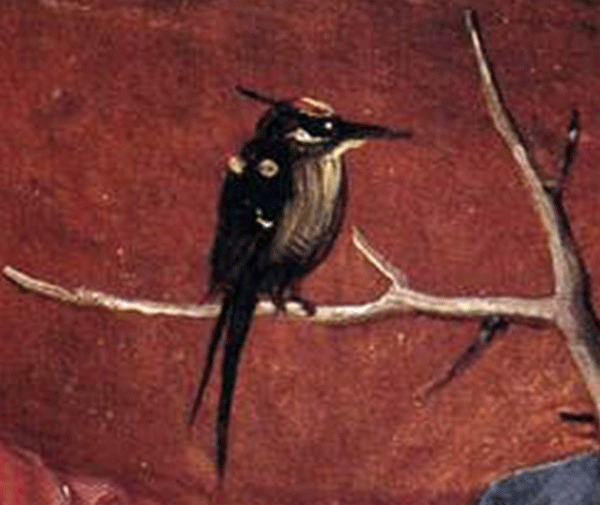
That Anthony also
overcomes this temptation, and that this is very
salutary for his soul is clearly shown by the event that
is painted above his head, to which we will return in
Section 16. This portion of the picture is dominated by
the mocking bird that is sitting above on the withered
twig. If this symbol of mockery, this becoming aware of
one's own folly after the event, is not recognised, much
will remain obscure. We shall show that this motif of
the mocking bird occurs in several parts of the right
inner wing.
11. THE MOTIF OF
SELF-MOCKERY
On the left, facing the
picture of Anthony, a curtain is being drawn aside. The
naked woman, who now appears within a dead rotted tree,
is often regarded as the "temptation of St. Anthony". If
this figure were to represent a temptation, she would
need to be painted as a young seductive beauty. In that
case she would certainly stand in a different posture,
and within different surroundings. (See Fig. 67 and
Plate E).
We can find this woman
in all the stages of Anthony's life. We believe we
recognise her in the little house, that the young
Anthony was trying to guard when he was still bowed down
under the burden of his lands. She is painted kneeling
beside Anthony on the middle panel of the altar-piece,
and also appears in mid air riding on the fish, on the
right inner wing. If we take all these aspects of the
woman together, her meaning for Anthony becomes obvious
as "the woman in his life". Whether this woman did in
reality enter his life or not is not the most important
thing. For a painter like Bosch the important factor is
the nature of femininity. As has already been said,
the soul always presents itself to the imaginative
vision in female guise, while the ego of the human being
with its active aspect, always appears as masculine.
To this extent every person bears the two polarities of
the male and the female within himself. If the
soul-battles of a St. Anthony are to be depicted
therefore) this feminine aspect must also appear. We
must again mention however that it is perfectly possible
that a real woman was also present in his life. Here too
Bosch lifts outer events into the inner picture.
Here he experiences the
woman as his sexual opposite. This is shown by the toad
which is sitting beneath her figure, at the edge of the
water. (See Note 9.) As the Saint (also Bosch himself)
recognises the human body as withered through the fall,
it is not surprising that the painter represents it as a
dead tree. Above all the picture of the mocking bird
in the tree is important. Anthony regards this whole
aspect of life self-mockingly. For this reason the bird
is sitting above the woman. It shows that Anthony is
mocking the impotence of his own soul.
--
The Pictorial
Language of Hieronymus Bosch, by Clement A. Wertheim
Aymes |
I have seen the he-bird also,
I have paus'd to hear him near at hand inflating his throat and
joyfully singing.
And while I paus'd it came to me that what he really sang for was
not there only,
Nor for his mate nor himself only, nor all sent back by the echoes,
But subtle, clandestine, away beyond,
A charge transmitted and gift occult for those being born.
12
Democracy! near at hand to you a throat is now inflating itself and
joyfully singing.
Ma femme! for the brood beyond us and of us,
For those who belong here and those to come,
I exultant to be ready for them will now shake out carols stronger
and haughtier than have ever yet been heard upon earth.
I will make the songs of passion to give them their way,
And your songs outlaw'd offenders, for I scan you with kindred eyes,
and carry you with me the same as any.
I will make the true poem of riches,
To earn for the body and the mind whatever adheres and goes forward
and is not dropt by death;
I will effuse egotism and show it underlying all, and I will be the
bard of personality,
And I will show of male and female that either is but the equal of
the other,
And sexual organs and acts! do you concentrate in me, for I am
determin'd
to tell you with courageous clear voice to prove you illustrious,
And I will show that there is no imperfection in the present, and
can be none in the future,
And I will show that whatever happens to anybody it may be turn'd to
beautiful results,
And I will show that nothing can happen more beautiful than death,
And I will thread a thread through my poems that time and events are
compact,
And that all the things of the universe are perfect miracles, each
as profound as any.
I will not make poems with reference to parts,
But I will make poems, songs, thoughts, with reference to ensemble,
And I will not sing with reference to a day, but with reference to
all days,
|
The inclusion of physiological viewpoints in the teaching of biology
leads to a specific technical procedure, to an elaboration of
biology as
subject matter for the school based on instructive work-experience.
In
this sense there has already been a great improvement in the past
few
years. But this is not the essential problem. It is not just a
question of
improving the teaching procedure, but rather of transforming the
content of our subject, of guiding the student to a new conception
of
nature! To accomplish this, teachings taken from physiology must be
introduced. Consequently, this purpose is not served if a number of
physiological experiments are carried out and interpreted as
postscripts
or appendices, so to speak. Here, too, from the very beginning
the student must be guided to an over-all, total view, and not, say,
to
one that is encyclopedic. He should perceive and feel that behind
the
individual achievement there is a meaningful plan, that behind it
stands the whole organism. Let us take, for example, an experiment
showing the action of saliva in changing starch into sugar. This is
not
just a random interesting fact, but a real accomplishment, a process
in
the service of the preservation of the whole organism. Or, let us
consider the process of seeing: the eye by itself is not able to
produce
any visual images but requires the cooperation of a number of
organs.
Thus, the act of seeing is also an accomplishment achieved by the
entire organism.
These examples show us two ways in which physiology considers
the whole: first, in that the accomplishment is in the service of
the
whole; second, in that it is achieved by the whole. Hence these two
methods of observing an event from the standpoint of the whole
organism
are intimately connected: the conception that every occurrence
is planned, as a part of the total accomplishment, and the
conception
of the organism as a totality, in which everything that occurs
is conditioned and regulated by a meaningful plan. If we guide the
student to this conception of nature as a unified totality by way of
repeated concrete examples, we shall have helped to provide him, at
least in this branch of biology, with a modern method of observation
and he will have acquired the basis for an organic Volkish-based
thinking....
The concept of the total view will come to the fore in the study of
living plant or animal communities more than it will in any other
branch of biology teaching.... Unfortunately this idea has been
understood
by many methodologists in a purely external way as a principle of the organization of matter. It is more than that. Behind it
stands a repudiation of an outmoded tendency in research; the aim
should be to present a view of the whole, to apply methods of
instruction
relevant to the subject matter, to arrive at a national formulation
of biology teaching and the discovery of internal interconnections
in
the occurrences of life. The metabolic changes in a closed biotic
community
reveal a meaningful plan in the greater occurrences of nature,
and when we come to understand that the whole world is a living
space for one biotic community, we can then discover ultimate
interconnections,
and finally arrive at a concept of nature that does not
conflict with religious experience, whereas this was necessarily the
case
with the former purely mechanistic [Darwinian] attitude.
Introducing the student to this mode of observation is in the spirit
of a Volkish education. On the basis of the elaboration of the laws
of
biology we turn to the emotional life of the student: he must come
to
see Germany as his "living space" and himself as a link in the
German
biotic community and the German destiny; and he must regard all
Germans as his blood relations, his brothers. If we reach this goal,
then all party and class divisions sink into nothingness, and more
is
accomplished for education in citizenship than is done by studying
governmental and administrative structures.
For the very reason that the theory of the biotic community is so
important for the development of biological knowledge and for
education
in organic Volkish thinking, it would be expedient to base the
school curriculum on this idea. When we go into the free, open
spaces we always come upon animals and plants in their specific
living
space in which they form biotic communities. It is not a mechanical
system which orders the natural arrangement of organisms, but the
living space. This living space not only presents an external frame
of
community but links its inhabitants to each other with indissoluble
bonds. Whoever, in teaching the concept of the biotic community,
utilizes it only as a principle of the organization of matter has
not
grasped the deeper meaning of bionomics. He stands, as it were, in
front of a deep well of precious water and draws nothing from it
although his companions are dying of thirst. Thus it is a question
of
opening up Volkish values to the students.
At the same time this produces effects which, from a didactic point
of view, are not to be scorned. For one thing, instruction along the
lines of the concept of the living community compels the teacher to
take his students on frequent trips outside the classroom and to
collect
observations for later evaluation. Thus a true teaching of life is
striven for, not just an accumulation of knowledge acquired by
studying
"animal skeletons and dead bones." There is little justification for
a "museum" biology in the instruction which we are striving to
establish.
Even the illustrative specimens, which in many school lessons
still must serve as a substitute for nature, can be dispensed with
in
most cases. They may still serve as a supplement to what has been
seen in a living context, but they can no longer be the source for
the
formation of views.
It is not enough to make one visit to a biotic community, such as
a beech wood. Rather, it must be visited at least once every season.
How different is the effect which a beech wood, for example, makes
on us in early spring, when the ground is covered with a carpet of
anemones, from that which it makes on us in midsummer, when a
mysterious penumbra prevails, when it looks to us like a cathedral
with high, slender columns! Anyone who absorbs the atmosphere of
the landscape, its soul, begins to love his homeland, and it is
precisely
love of the homeland which we want to arouse and can arouse with
the help of the concept of the biotic community. It is almost
self-evident
that educational hikes to the biotic communities in his regional
environment provide the student with a knowledge that is not
limited to the field of biology but includes knowledge about the
homeland....
Still more important, it seems to me, is the fact that the task of
biology teaching, briefly referred to above, can be fulfilled by an
orientation
toward the concept of the biotic community. It must be
grasped here once more on the basis of another idea. We have said
that the student must be led to the conception that Germany is his
living space to which he is linked by the bond of blood. We have
explained in detail that the bionomic approach teaches that the
organisms
within a living space are dependent on each other as well as
dependent upon the whole, and that each link must perform an
indispensable
function in the total accomplishment. When this insight is
applied to the human biotic community, when the future German
racial-comrade feels himself to be a link in the German biotic community, and when he is imbued with the idea of the blood
relationship
of all Germans, then class differences and class hatred cannot
take acute forms, as was often the case in the past due to a
misunderstanding
of the actual bond that unites all estates together. Once
every German regards Germany as his living space and feels himself
to
be a link in the German biotic community, he will be fully conscious
of the fact that every individual within the metabolism of the
biotic
community into which he was born must fulfill his own important
task. Thus a supra-individualistic attitude is created which
constitutes
the best possible foundation for training in citizenship. Indeed, it
can
be said that it has achieved its deepest fulfillment once this
attitude is
transformed into action....
This is also the place for discussing, from a biological viewpoint,
the
family as a value, and the improvement of the sense of family which
has been sorely neglected by many modern pedagogues. The family,
after all, is the smallest biotic community since it forms the germ
cell
of the state. If we take up these questions, the fields of
individual
hygiene and racial eugenics, of genetics and sex education, combine
to
form a meaningful unit, just as, generally, the teaching of biology,
which in the past was fragmented into many unrelated individual
fields, will be fused into a unified whole once our efforts achieve
fruition.
In these discussions on the family we are less concerned with the
student's enlarging his knowledge and more with the aim that he be
imbued with a sense of responsibility, that he begin to sense that
the
deepest meaning of human life is to grow beyond himself in his
children,
and that nothing he could leave to them would be more valuable
than the German heritage which he has received from his ancestors, and that, through race mixing, he could taint and impair his
progeny in a most unfavorable way.
From Paul Brohmer,
Biologieunterricht und volkische Erziehung (Frankfurt: Verlag
Moritz Diesterweg, 1933), pp. 8-10, 68-72, 74-80.
-- Nazi Culture:
Intellectual, Cultural and Social Life in the Third Reich, by George
L. Mosse
|
And I will not make a poem nor the least part of a poem but has
reference to the soul,
Because having look'd at the objects of the universe, I find there
is no one nor any particle of one but has reference to the soul.
13
Was somebody asking to see the soul?
See, your own shape and countenance, persons, substances, beasts,
the trees, the running rivers, the rocks and sands.
All hold spiritual joys and afterwards loosen them;
How can the real body ever die and be buried?
Of your real body and any man's or woman's real body,
Item for item it will elude the hands of the corpse-cleaners and
pass to fitting spheres,
Carrying what has accrued to it from the moment of birth to the
moment of death.
Not the types set up by the printer return their impression, the
meaning, the main concern,
Any more than a man's substance and life or a woman's substance and
life return in the body and the soul,
Indifferently before death and after death.
Behold, the body includes and is the meaning, the main concern and
includes and is the soul;
Whoever you are, how superb and how divine is your body, or any part
of it!
14
Whoever you are, to you endless announcements!
Daughter of the lands did you wait for your poet?
Did you wait for one with a flowing mouth and indicative hand?
Toward the male of the States, and toward the female of the States,
Exulting words, words to Democracy's lands.
Interlink'd, food-yielding lands!
Land of coal and iron! land of gold! land of cotton, sugar, rice!
Land of wheat, beef, pork! land of wool and hemp! land of the apple
and the grape!
Land of the pastoral plains, the grass-fields of the world! land of
those sweet-air'd interminable plateaus!
Land of the herd, the garden, the healthy house of adobie!
Lands where the north-west Columbia winds, and where the south-west
Colorado winds!
Land of the eastern Chesapeake! land of the Delaware!
Land of Ontario, Erie, Huron, Michigan!
Land of the Old Thirteen! Massachusetts land! land of Vermont and
Connecticut!
Land of the ocean shores! land of sierras and peaks!
Land of boatmen and sailors! fishermen's land!
Inextricable lands! the clutch'd together! the passionate ones!
The side by side! the elder and younger brothers! the bony-limb'd!
The great women's land! the feminine! the experienced sisters and
the inexperienced sisters!
Far breath'd land! Arctic braced! Mexican breez'd! the diverse! the
compact!
The Pennsylvanian! the Virginian! the double Carolinian!
O all and each well-loved by me! my intrepid nations! O I at any
rate include you all with perfect love!
I cannot be discharged from you! not from one any sooner than
another!
O death! O for all that, I am yet of you unseen this hour with
irrepressible love,
Walking New England, a friend, a traveler,
Splashing my bare feet in the edge of the summer ripples on
Paumanok's sands,
Crossing the prairies, dwelling again in Chicago, dwelling in every
town,
Observing shows, births, improvements, structures, arts,
Listening to orators and oratresses in public halls,
Of and through the States as during life, each man and woman my
neighbor,
The Louisianian, the Georgian, as near to me, and I as near to him
and her,
The Mississippian and Arkansian yet with me, and I yet with any of
them,
Yet upon the plains west of the spinal river, yet in my house of
adobie,
Yet returning eastward, yet in the Seaside State or in Maryland,
Yet Kanadian cheerily braving the winter, the snow and ice welcome
to me,
Yet a true son either of Maine or of the Granite State, or the
Narragansett Bay State, or the Empire State,
Yet sailing to other shores to annex the same, yet welcoming every
new brother,
Hereby applying these leaves to the new ones from the hour they
unite with the old ones,
Coming among the new ones myself to be their companion and equal,
coming personally to you now,
Enjoining you to acts, characters, spectacles, with me.
15
With me with firm holding, yet haste, haste on.
For your life adhere to me,
(I may have to be persuaded many times before I consent to give
myself really to you, but what of that?
Must not Nature be persuaded many times?)
No dainty dolce affettuoso I,
Bearded, sun-burnt, gray-neck'd, forbidding, I have arrived,
To be wrestled with as I pass for the solid prizes of the universe,
For such I afford whoever can persevere to win them.
16
On my way a moment I pause,
Here for you! and here for America!
Still the present I raise aloft, still the future of the States I
harbinge glad and sublime,
And for the past I pronounce what the air holds of the red
aborigines.
The red aborigines,
Leaving natural breaths, sounds of rain and winds, calls as of birds
and animals in the woods, syllabled to us for names,
Okonee, Koosa, Ottawa, Monongahela, Sauk, Natchez, Chattahoochee,
Kaqueta, Oronoco,
Wabash, Miami, Saginaw, Chippewa, Oshkosh, Walla-Walla,
Leaving such to the States they melt, they depart, charging the
water and the land with names.
17
Expanding and swift, henceforth,
Elements, breeds, adjustments, turbulent, quick and audacious,
A world primal again, vistas of glory incessant and branching,
A new race dominating previous ones and grander far, with new
contests,
New politics, new literatures and religions, new inventions and
arts.
|
When
a race is born, the forms are ensouled by a
certain group of spirits and have inherent capability of
evolving to a certain stage of completion and no
further. There can be no standing still in nature,
therefore when the limit of attainment has been reached,
the bodies or forms of that race begin to degenerate,
sinking lower and lower until at last the race dies
out.
The
reason is not far to seek. New race bodies are
particularly flexible and plastic, affording great scope
for the Egos who are reborn in them to improve these
vehicles and progress thereby. The most advanced Egos
are brought to birth in such bodies and improve them to
the best of their ability. These Egos, however, are only
apprentices as yet, and they cause the bodies to
gradually crystallize and harden until the limit of
improvement of that particular kind of body has been
reached. Then forms for another new race are created, to
afford the advancing Egos further scope for more
extended experience and greater development. They
discard the old race bodies for the new, their discarded
bodies becoming the habitations for less advanced Egos
who, in their turn, use them as stepping-stones on the
path of progress. Thus the old race bodies are used by
Egos of increasing inferiority, gradually
degenerating until at last there are no Egos low enough
to profit by rebirth in such bodies. The women then
become sterile and the race-forms die.
We
may easily trace this process by certain examples. The
Teutonic-Anglo-Saxon race (particularly the American
branch of it) has a softer, more flexible body and a
more high-strung nervous system than any other race on
earth at the present time. The Indian and Negro have
much harder bodies and, because of the duller nervous
system, are much less sensitive to lacerations. An
Indian will continue to fight after receiving wounds the
shock of which would prostrate or kill a white man,
whereas the Indian will quickly recover. The Australian
aborigines or Bushmen furnish an example of a race dying
out on account of sterility, notwithstanding all that
the British government is doing to perpetuate them.
It has been said by white men
against the white race, that wherever it goes the other
races dies out. The whites have been guilty of fearful
oppression against those other races, having in many
cases massacred multitudes of the defenseless and
unsuspecting natives -- as witness the conduct of the
Spaniards towards the ancient Peruvians and Mexicans, to
specify but one of many instances. The obligations
resulting from such betrayal of confidence and abuse of
superior intellect will be paid -- yea, the last, least
iota! -- by those incurring them. It is equally true,
however, that even had the whites not massacred,
starved, enslaved, expatriated and otherwise maltreated
those older races, the latter would nevertheless have
died out just as surely, though more slowly, because
such is the Law of Evolution -- the Order of Nature. At
some future time the white race-bodies when they become
inhabited by the Egos who are now embodied in red,
black, yellow or brown skins, will have degenerated so
far that they also will disappear, to give place to
other and better vehicles.
--
The Rosicrucian
Cosmo-Conception, by Max Heindel |
These, my voice announcing—I will sleep no more but arise,
You oceans that have been calm within me! how I feel you,
fathomless, stirring, preparing unprecedented waves and storms.
18
See, steamers steaming through my poems,
See, in my poems immigrants continually coming and landing,
See, in arriere, the wigwam, the trail, the hunter's hut, the
flat-boat,
the maize-leaf, the claim, the rude fence, and the backwoods
village,
See, on the one side the Western Sea and on the other the Eastern
Sea,
how they advance and retreat upon my poems as upon their own shores,
See, pastures and forests in my poems—see, animals wild and
tame—see,
beyond the Kaw, countless herds of buffalo feeding on short curly
grass,
See, in my poems, cities, solid, vast, inland, with paved streets,
with iron and stone edifices, ceaseless vehicles, and commerce,
See, the many-cylinder'd steam printing-press—see, the electric
telegraph stretching across the continent,
See, through Atlantica's depths pulses American Europe reaching,
pulses of Europe duly return'd,
See, the strong and quick locomotive as it departs, panting, blowing
the steam-whistle,
See, ploughmen ploughing farms—see, miners digging mines—see,
the numberless factories,
See, mechanics busy at their benches with tools—see from among them
superior judges, philosophs, Presidents, emerge, drest in
working dresses,
See, lounging through the shops and fields of the States, me
well-belov'd, close-held by day and night,
Hear the loud echoes of my songs there—read the hints come at last.
19
O camerado close! O you and me at last, and us two only.
O a word to clear one's path ahead endlessly!
O something ecstatic and undemonstrable! O music wild!
O now I triumph—and you shall also;
O hand in hand—O wholesome pleasure—O one more desirer and lover!
O to haste firm holding—to haste, haste on with me.
Go to Next Page