|
CONCLUSION.
I may now draw attention to the main points involved in the fore-
going inquiry.
In the first place, a large number of letters produced by M. and
Madame Coulomb, formerly Librarian and Assistant Corresponding
Secretary respectively of the Theosophical Society, were, in the
opinion>
of the best experts in handwriting, written by Madame Blavatsky. These
letters, which extend over the years 1880-1883 inclusive, and some of
which were published in the Madras Christian College Magazine for
September, 1884, prove that Madame Blavatsky has been engaged in
the production of a varied and long-continued series of fraudulent
phenomena, in which she has been assisted by the Coulombs. The
circumstantial evidence which I was able to obtain concerning the
incidents referred to in these letters, corroborates the judgment of the
experts in handwriting.
In the second place, apart altogether from either these letters or the
statements of the Coulombs, who themselves allege that they were
confederates of Madame Blavatsky, it appears from my own inquiries
concerning the existence and the powers of the supposed Adepts or
MaJuitmaSj and the marvellous phenomena alleged to have occurred in
connection with the Theosophical Society,
1. That the primary witnesses to the existence of a Brother-
hood with occult powers, — ^viz., Madame Blavatsky, Mr.
Damodar K. Mavalankar, Mr. Bhavani Shankar, and Mr.
Babajee D. Nath, — have in other matters deliberately made
statements which they must have known to be false, and that
therefore their assertions cannot establish the existence of the
Brotherhood in question.
2. That the comparison of handwritings further tends to show that
Koot Hoomi Lai Sing and Mahatma Morya are fictitious
personages, and that most of the documents purporting to
have emanated from these " personages,'' and especially from
" K. H." (Koot Hoomi Lai Sing), are in the disguised hand-
writing of Madame Blavatsky herself, who originated the
style of the K. H. handwriting; and that some of the
K. H. writing is the handiwork of Mr. Damodar in
imitation of the writing developed by Madame Blavatsky.
3. That in no single phenomenon which came within the scope
of my investigation in India, was the evidence such as would
entitle it to be regarded as genuine, the witnesses for the most
part being exceedingly inaccurate in observation or memory,
and having neglected to exercise due care for the exclusion of
fraud; while in the case of some of the witnesses there has
been much conscious exaggeration and culpable misstatement..
4. That not only was the evidence insufficient to establish the
genuineness of the alleged marvels, but that evidence furnished
partly by my own inspection, and partly by a large number of
witnesses, most of them Theosophists, concerning the structure,
position, and environment of the Shrine, concerning " Mahat-
ma" communications received independently of the Shrine,
and concerning various other incidents, including many of the
phenomena mentioned in "The Occult World," besides the
numerous additional suspicious circumstances which I have
noted in the course of dealing in detail with the cases con-
sidered, renders the conclusion unavoidable that the pheno-
mena in question were actually due to fraudulent arrange-
ment.
The question which will now inevitably arise is — what has induced
Madame Blavatsky to live so many laborious days in such a fantastic
work of imposture? And although I conceive that my instructions did
not require me to make this particular question a province of my
investigation, and to explore the hidden motives of Madame Blavatsky,
I should consider this Report to be incomplete unless I suggest what I
myself believe to be an adequate explanation of her ten years' toil on
be-
half of the Theosophical Society. It may be supposed by some who are
unfamiliar with her deficiencies and capacities that the Theosophical
Society is but the aloe-blossom of a woman's monomania, and that the
strange, wild, passionate, unconventional Madame Blavatsky has been
"finding her epos" in the establishment of some incipient world-
religion. But a closer knowledge of her character would show such a
supposition to be quite untenable; not to speak of the positive
qualities which she habitually manifested, there are certain varieties
of
personal sacrifice and religious aspiration, the absence of which from
Madame Blavatsky's conduct would alone suffice to remove her ineffably
far from the St. Theresa type.
As Madame Blavatsky in propria persond^ she can urge her
followers to fraudulent impersonations; under the cloak of Koot
Hoomi she can incite "her" Chelas to dishonourable statements; and as
an accomplished forger of other people's handwriting, she can strive to
save herself by blackening the reputation of her enemies. She is,
indeed, a rare psychological study, almost as rare as a " Mahatma ";
she was terrible exceedingly when she expressed her overpowering
thought that perhaps her "twenty years'" work might be spoiled
through Madame Coulomb; and she developed a unique resentment
for the " spiritualistic mediums," whose trickeries, she said, she "
could
so easily expose," but who continued to draw their disciples, while
her own more guarded and elaborate scheme was in danger of being
turned inside out. Yet I must confess that the problem of her motives,
when I found myself being forced to the conclusion that her
claims and her phenomena were fraudulent, caused me no little
perplexity.
It appeared to me that, even should the assertions of Theosophists
that their Society has been partly dependent upon the gifts of Madame
Blavatsky prove to be the reverse of truth, the sordid motive of
pecuniary gain would be a solution of the problem still less
satisfactory
than the hypothesis of religious mania. More might be said in support
of the supposition that a morbid yearning for notoriety was the
dominant emotion which has stimulated and sustained her energetic
efforts in the singular channel which they have so long pursued. But
even this hypothesis I was unable to adopt, and reconcile with my
understanding of her character.
At last a casual conversation opened my eyes. I had taken no
interest in Central Asian perplexities, was entirely unaware of the
alleged capacities of Russian intrigue, and had put aside as unworthy
of consideration the idea — which for some time had currency in India —
that the objects of the Theosophical Society were political, and that
Madame Blavatsky was a " Russian spy." But a conversation with
Madame Blavatsky, which arose out of her sudden and curious
excitement at the news of the recent Russian movement upon the
Afghan frontier, compelled me to ask myself seriously whether it was •
not possible that the task which she had set herself to perform in
India was to foster and foment as widely as possible among the
natives a disaffection towards British rule. [45] Madame Blavatsky's
momentary emotional betrayal of her sympathies in the onset
of her excitement was not rendered less significant by the
too strongly-impressed " afterstroke ^ of a quite uncalled-for vitupera-
tion of the Russians, who, she said, "would be the death-
blow of the Society if they got into India." That she was ever seven
years in Thibet there is much reason for disbelieving. In a letter she
wrote to a Hindu from America, she professed no more than that she
had acquired some occult knowledge from some wandering Siberian
Shamans, which, being interpreted, probably means, if her statement
has any foundation of truth at all, that she learnt their conjuring
performances. According to her own account, in one of the Blavatsky-
Coulomb letters, it appears that before her acquaintance with Madame
Coulomb at Cairo, in 1872, she had been filling a page which she wishes
to be "torn out of the book" [46] of her life. This part of her history
does not at present concern us, except that it proves the story of her
Thibetan experiences to be fabulous. But the letter also refers to her
sojourn at Cairo and her later adventures, and it appears that she and
a certain Madame Sebire had established a Society in Cairo, which was
evidently " spiritualistic," and which failed; that shortly after
parting
with Madame Coulomb in Cairo, slie went to Odessa, taking Madame
Sebire, who dragged her into an enterprise of "making some extra-
ordinary inks," which proved a losing speculation; that from Odessa
she proceeded to India, where " she remained over eight months, and
then returning by Odessa to Europe, went to Paris, and thence
proceeded to America," where the Theosophical Society was established.
The same letter contains the following explanation to Madame
Coulomb, clearly in order that the latter might understand that the
new Society was on a different basis from that which Madame Blavatsky
had countenanced, in 1872, in Egypt.
"We believe in nothing mpematural, and discard every miracle — those
of the Jewish Bible especially. But we are believers in and students of
phenomena, though we do not attribute every manifestation to * spirits '
of
disembodied people solely, for we have found out that the spirit of the
living
man was far more powerful than the spirit of a dead person. We have
quite a number of members theosophists in Ceylon among the Buddhist
priests and others.
"How far this agrees with your present ideas I do not know. But I hope
you will answer me frankly, dear Mrs. Coulomb, and say what you think of
it. And thus we may be able to elucidate more than one mystery before we
meet each other again."
It seems, then, that Madame Blavatsky, a Russian lady, the
daughter of Colonel Hahn (of the Kussian Horse Artillery), and
quondam widow of General Blavatsky (Governor during the Crimean
War, and for many years, of Erivan in Armenia), assisted in starting
a spiritualistic Society in Egypt, which failed; that she afterwards
spent eight months in India, and then proceeded to America for what
would appear to have been the express purpose of becoming an
American citizen, ^* for the sake of greater protection that the
citizen-
ship of this free country affords/' The fact^ moreover, that she was
an American citizen was urged on her behalf when, upon her arrival
in India, she was for some time subjected to the surveillance of the
Indian Government as being possibly a Russian agent. She apparently
made the mistake in the first instance, of adopting " an attitude of
obtrusive sympathy with the natives of the soil as compared with the
Europeans," as Mr. Sinnett tells us (" The Occult World," p. 25); but
she soon remedied this error by obtaining the public adhesion to her
following of such men as Mr. A. O. Hume (see p. 273) and Mr. Sinnett.
And without attempting to show in detail how strongly the patriotic
feeling of the natives has been enlisted in connection with the
Theosophical Society, or how well the procedure of Madame
Blavatsky may be shown Us comport with the view that her ultimate
object has been the furtherance of Russian interests, I may quote
several passages which, I think, suggest meanings which Madame
Blavatsky would hardly dare to blazon on the banner of the Theosophical
Society. Thus Colonel Olcott wrote, and apparently italicised the
sentence, in a letter from New York to a Hindu, in 1878: —
"While we have no political designs, you wUl netd no hint to
understand
that our sympathies are with aU those who are deprived of (he right of
governing
their owii lands for themselves. I need say no more,"
Madame Blavatsky wrote to the same person: —
"Is our friend a Sikh? If so, the fact that he should be, as you say,
'very much pleased to learn the object of our Society ' is not at all
strange.
For his ancestors have for centuries been — until their efforts were
paralysed
by British domination, tliat curse of every land it fastens itself upon
—
battling for the divine truths against external theologies. My question
may
appear a foolish one — ^yet I have more than one reason for asking it.
Tou
call him a Sirdar — therefore he must be a descendant of one of the
Sirdars
of the twelve mizals, which were abolished by the English to suit their
con-
venience—since he is of Amritsir in the Punjflb? Are you personally
acquainted with any descendant of Runjeet Singh, who died in 1839, or do
you know of any who are? You will understand, without any explanation
from me, how important it is for us, to establish relations with some
Sikhs,
whose ancestors before them have been for centuries teaching the great
'Brotherhood of Humanity' — precisely the doctiine we teach. ***
"As for the future 'Fellows' of our Indian Branch, haJrv-e your eyes
upon
the chance of fishing out of the great ocean of Hindu hatred for
Christian
niissionaries some of those big fish you call Rajahs, and whales known
as
Maharajahs. Could you not hook out for your Bombay Branch either
Gwalior (Scindia) or the Holkar of Indore — tiiose most faitlif ul and
loyal
friends of the British (?). The young Gwikovar is unfortunately scarcely
weaned as yet, and therefore not elligible for fellowship.''
The note of interrogation after the word " British " is Madame
Blavatsky's. The above passages are from documents wliich came into
my hands quite independently of the Coulombs. Indeed, I am not
aware that the Coulombs even know of their existence. The
following passage is from a fragmentary script which forms one of
the Blavatsky-Coulomb documents; on one side of the paper are written
a few broken lines in Russian, the full significance of wliich is
dubious
without their context, and on the other side are written these words: —
military men, more than any other, must remember that the approaching
act of the Eastern drama is to be the last and the decisive one. That it
will
require all our efforts, every sacrifice on our part, and requires far
more care*
f ul preparations in every direction than did the last war. They must
re-
member, that to sit idle now, when eveiy one has to be busily preparing,
is
the highest of crimes, a treason to [47] their country and their Czar.''
"He who hath ears let him.
(A facsimile of the manuscript of this passage is given in Plate I.)
While I was in India Madame Blavatsky obtained a partial knowledge
of the substance of this document (which I had no permission at the
time either to show to her or to publish), and she said that it was
probably a portion of a translation which she had made from a Russian
work, and was not her original composition. Be tliis as it may, I
cannot profess myself, after my personal experiences of Madame
Blavatsky, to feel much doubt that her real object has been the
furtherance of Russian interests. But although I have felt bound to
refer to my own view on this point, I suggest it here only
as a supposition which appears best to cover the known incidents
of her career during the past 13 or 14 years. That she is a
remarkably able woman will scarcely be questioned by any save
those of her followers whose very infatuation of belief in her " occult
relations '' is perhaps the most conspicuous proof of that ability
which they deny; and it would be no venturesome prognostication to
say that) in spite of recent exposures, she will still retain a goodly
gathering of disciples on whom she may continue to inculcate the ethics
of a profound obedience to the behests of imaginary Mahatmas. The
resources of Madame Blavatsky are great; and by the means of forged
letters, fraudulent statements of CJielaay and other false evidence,
together with the hypothesis of Black Magicians, she may yet do much
in the future for the benefit of human credulity. But acting in accord-
ance with the principles upon which our Society has proceeded, I must
express my unqualified opinion that no genuine psychical phenomena
whatever will be found among the pseudo-mysteries of the Russian lady
aliae Koot Hoomi Lai Sing alias Mahatma Morya alia^a Madame
Blavatsky.
APPENDIX 1:
THE SASSOON TELEGRAM (vide p. 217), de.
Some of the details which follow, and which serve to explain the
extract quoted on p. 211, I have learnt from the oral statements of
Messrs. A. D. and M. D. Ezekiel, and the written statements of Mr.
Khandalvala shown to me by Dr. Hartmann.
Madame Blavatsky, on her way from Bombay to Madras, in Octo-
ber, 1883, stayed at Poona several days at the house of Mr. N. D.
Khandalvala, a member of the Theosophical Society. On October 23rd
she dined at the house of Mr. Jacob Sassoon, who wsus desirous of seeing
some '' phenomenon.'' Madame Blavatsky despatched the letter from
which the extract is taken, to Madame Coulomb on the morning
of the 24th. While driving with Mr. A. D. Ezekiel on the afternoon of
the 24th, she expressed her desire to call upon Mr. Sassoon. Probably
she
intended, when she wrote to Madame Coulomb, to arrange for a con-
versation with Mr. Sassoon on the afternoon of the 26th, when the sul>
ject of the telegram would be mentioned — only, of course, after much
entreaty by Mr. Sassoon for some phenomenon; but, finding that Mr.
Sassoon purposed leaving Poona on the 25th, she was compelled, if she
was to impress him at all, to take the needful action earlier than she
had anticipated. On this afternoon, then, of the 24th, after refusing
to show Mr. Sassoon any phenomena, she professed, by some " occult "
mental process, to get the opinion of Ramalinga's Master; but, having
imperfectly heard his answer, she wished mentally, as she said, that
Ramalinga should communicate to her the words in writing, that she
might satisfy herself that she had heard aright. She wrote down at the
time the words she expected to receive, and said that RamaJinga would
send a telegram to her at once, or that she might not receive it till
after
a day or two. The telegram did not arrive till the 26th. Madame
Blavatsky's explanation of the delay is that Bamalinga sent on the
words late to Mr. Babajee D. Nath, who copied them and gave them to
Madame Coulomb to be sent by telegram. This explanation was given
to me by Madame Blavatsky, and appears also in the letter professedly
written by her on October 26th to Colonel Olcott. Madame Blavatsky
was too shrewd openly to lay stress upon the telegram, but I have no
doubt, after conversations with Messrs. A. D. and M. D. Ezekiel, who
were
present at Mr. Sassoon's on the 24th, and at Madame Blavatsky's receipt
of the telegram on the 26th, that she wished the occurrence to
be regarded as " phenomenal," notwithstanding Mr. A. D, Ezekiel's
statement to the contrary in his letter to the Times of India.
It may be pointed out in passing that Mr. Babajee D. Nath lends
his sanction to Madame Blavatsky 's explanation, and thus, the
Blavatsky-Goulomb letters being g€iiiuoe, implicates himself in the
fraud.
The statement made by Madame Blavatsky when the September
number of the ChritUan College Magazine appeared in Europe is as
follows: —
The third letter, supposed to be written from Poona, is an entire
fabrication. I remember the letter I wrote to her from Poona. It asked
her to send me immediately the telegram contained in a note from
Kamalinga
if he brought or sent her one. I wrote to Colonel Olcott about the
experi-
ment. He thinks he can find my letter at Madras. I hope to either get
back Eamalinga's note to me or obtain a statement of the whole matter
from
liim. How could 1 make a mistake in writing, however hurriedly, about
the name of one of my best friends? The forgers make me address him —
'' care of H. Khandalawalla '' — when there is no such man. The real
name
is N. D. Khandalawalla.
Now, in the first place, the H originally printed in the Christian
College Magazine was a misprint or a miscopy for the N in the
original document.
As for the letter supposed to have been written to Colonel Olcott,
it proves nothing, even were it written at the time it professes to have
been written, viz., Oiitober 26th, 1883. Colonel Olcott alleges that he
found this letter among his papers at Madras on his return thither at
the end of last year, though he was unable to tell me how, when, or
where he had originally received it. I was afterwards informed by Mr.
Damodar that Madame Blavatsky had sent it through him to Colonel
Olcott, whom he was accompanying on his tour in 1883. My opinion
is that this letter, which was shown to me, is ex post Ja^to^ and
was not written earlier than towards the end of last year. There
are two statements in the letter which appear to me to point to
its having been written at the later date. One of these is Madame
Blavatsky's expression of her deep distrust of the Coulombs; the
other is the following: — Madame Blavatsky, after writing that
Ramalinga objected to give the words to Madame Coulomb, and gave
them to Babajee, who gave them to Madame Coulomb to be sent as a
telegram, continues: " I received the telegram to-day, but as it said,
* Master hSiAJust heard your conversation ' — ^when it was not *just
now'
but yesterday that the conversation took place — it was a glorious
failure I " Now the letter is dated October 26th, therefore " yesterday"
would be October 25th. But the conversation took place on October
24th. If the letter was written a year after the events, the mistake is
intelligible enough. It was probably concocted after the appearance of
the Christian College Magazine in Europe, and then — if we are to regard
Colonel Olcott as a dupe in the matter — sent to Mr. Damodar for
insertion among Colonel Olcott's papers.
I have also seen the letter alleged to have been written by
Ramalinga at the time, and it appeared to me to be written, in part at
least, in the disguised hand of Madame Blavatsky. It is curious, too,
that in this letter Ramalinga is represented as expressing a great dread
of Madame Coulomb; and I may say here that my inquiries have not
enabled me to discover that Mr. Bamalinga Deb's existence has ever
been other than imaginary.
But a more serious flaw in the attempted explanation by Madame
Blavatsky yet remains. Messrs. Elhandalvala and Ezekiel main>
tain that Madame Blavatsky could not have written to Madame
Coulomb on the 24th after the conversation took place at Mr.
Sassoon's in time for her letter to reach Madame Coulomb on the
26th. She declares in her statement that she asked Madame Coulomb
to send her "immediately the telegram contained in a note from
Ramalinga if he brought or sent her one," and from her sup-
posed letter to Colonel Olcott it appears that this expected telegram
related to the Sassoon conversation. Hence this alleged request must
have been made before the aforesaid conversation occurred; and it is
apparently not denied by Madame Blavatsky that she did write to
Madame Coulomb on the morning of the 24th. On Madame Blavatsky's
own showing, therefore — if Messrs. Ezekiel and Khandalvala are right
concerning the time of the conversation and the subsequent events
which prevented her afterwards writing a letter — a specific
pre-arrange-
ment must have been made by her for a conversation, the whole point
of which was that its subject should have arisen extempore.
---------
I may here notice some of Madame Blavatsky's allegations concerning
other extracts which I have quoted. These allegations, among others,
were
publialied in a pamphlet issued in 1884, by the Council of the London
Lodge of the Theosophical Society. Against extract (6), p. 213, she
said:
** There is no ' Maliarajah of Lahore,' hence 1 could not liave spoken
of such
a person, nor have been attempting mock phenomena for his deception." I
do not suppose that any one who is familiar with Madame Blavatsky would
maintain that she could not have written Us Maharajah de Lahore ou de
Beimres simply because there was no Maharajah of Laliore but only of
Benares.
Concerning extract (7), p. 213, Madame Blavatsky said: ''All depends
upon knowing who Lb * Christopholo ' — a little ridiculous figure in
rags, about
three inches high; she wrote to say it had accidentally been destroyed.
She
joked over it, and I too." In reference to another extract (14) — where
'' Christofolo " occurred, she said: '' ' Christopholo ' was a name by
which
she [Madame Coulomb] called an absurd little figure, or image of hers.
She
gave nicknames to everything. " And in B, Replies she wrote d propos of
extract (7) (which occurs at the end of a letter about her intended
movements
for the next few months, and other practical matters), ''I deny having
written any such thing on that same letter. I remember her telling mo in
a
letter her magic Christopholo had melted in the sun, and I may have
answered
her something to that effect. But that after the serious letter that
precedes
I should write such hoih is impossible, not in my style at all."
Concerning extract (13), p. 215, she wrote: ''I could never, in writing
to
her who saw the man every day, use all his names and titles. I should
simply have said, 'Dewan Bahadur,' without adding 'Kajanath Bao, the
President of the Society,' as if introducing to her one she did not
know.
The whole name is evidently put in now to make it clear who is meant."
Now
I think it is probably true that Madame Blavatsky would not usually
write
the full name and titles of Mr. Ragoonath Rao, and I account for her
having
written them in the present case by supposing that she had just written
them in the K. H. hand on the envelope of the Mahatma document
she had prepared, and that they were consequently running in her mind.
APPENDIX 2:
THE ADYAR SAUCER (see p, 218).
The subjoined account is that of
Major-General Morgan himself, [48]
who thinks it sufficiently proves that Madame Blavatsky could not
have written letter No. 4 (p. 212)! It should be compared with his
earlier account, quoted on p. 218.
In the month of August, 1883, I was obliged to go to Madras on
business entirely unconnected with Adyar affairs. Madame Blavatsky was
then staying in my house, and urged me to stay at the Adyar during my
visit
to Madras. This I declined, as the place was too far from my business.
She
then advised me to see the picture of the Mahatma in the Shrine, as it
was a
vexy peculiar work. I replied that I should make a point of going to see
the
picture, but the day was not mentioned. Two or three days after my
arrival
at Madras I went to visit the headquarters, and found that the woman
Coulomb was out, and was requested by Damodar to await her return. She
came in about one hour, having been out shopping in Madras. On my
mentioning the purpose for which I had come, she took me upstairs, and,
instead of going through Madame Blavatsky 's room, we went round outside
to the Occult Room, as she stated that the rooms of Madame were locked
and
the doors blocked up with furniture. On entering the room she hurriedly
approached the Shrine or cupboard, and quickly opened the double doors;
as she did so, a china saucer, which appeared to have been placed
leaning
against the door, fell down on the chunam floor, and was broken to
pieces.
On this she exhibited great consternation, exclaiming that it was a much
cherished article of Madame's, and she did not know what she should do.
She and her husband, who had come with us, picked up the pieces. She
then
tied them up in a cloth and replaced them in the Shrine, in the silver
bowl,
not behind it, the doors were shut, and Damodar took up his position on
a
chair right in front of the Shrine and only a few feet distant from it;
he sat
intently regarding the Shrine and in a listening attitude. I was not
then
aware, as I am now, of the fact that the astral electric current causes
a sound
exactly like that of the ordinary telegraph to be distinctly heard in
the
Shrine; unaware of this, I resumed conversation with the Coulombs
regard-
ing the accident, when I remarked that it would be well if he got some
mastic
or glue and tried to put the pieces together. On my saying this he
started
to get some, which he said he had in his bungalow, situated about 100
yards
from the house, and I, turning to his wife, remarked, '*If the matter is
of
sufficient importance the Mahatmas could cause itd repair, if not you
must
do the best you can." Hardly had I uttered this, [49] when Damodar said,
^' There is a message," and he immediately opened the door of the Shnne
and
took down the silver bowl (in which the letten axe generally found), and
sure
enough there was a note, whidi on openmg contained the following lines:
—
''To the small audience present as witnesses. Now Madame Coulomb
has occasion to assure herself that the devil is neither as black nor as
wicked
as he is generally represented. The mischief is easily repaired. —
^K.H."
We then opened the cloth containing the broken saucer, found it intact
and
whole I Three [50] minutes had not elapsed since I had suggested the glue
should
be procured! and shortly after Coulomb returned with the glue in his
hand. If he could have gone all round the upper rooms, got behind the
Shrine, removed the broken saucer, tied up the parcel, having placed a
whole one in its stead, and written the note regarding the repair of the
saucer (my remark about which he had not heard), then I say his feat
rivalled
that of the Masters! When I spoke to the woman about the wondeiful
manner in which the saucer had been restored, she replied, *^ It must be
the
work of the devil." Here is her note on the subject, written to Madame
Blavatsky, then in Ootacamund. The printer^ a devil has left out a whole
line in the letter, wliich makes nonsense of it, both in Dr. Hartmann's
pamphlet and in the copies I have seen (taken from this) elsewhere.
Below
I give a correct copy.
Adyar, 13th August, 1883.
My Dear Friend,
I verily believe I shall go silly if I stay with you. Now let me tell
you what has happened. On my arrival home I found General Morgan
sitting in that beautiful office of ours, talking with Damodar and M.
Coulomb.
After exchanging a few words, I asked whether he would wish to see the
"Shrine," and on his answering in the affirmative we went upstairs,
passing
on the outside, on account of the furniture of your sitting-room being
heaped
up to block the doors and prevent thieves breaking in.
The General found the portraits admirable, but I wiah I had never gone
up, because, on my opening the "Shrine," I, Madame Coulomb, who never
cares either to see or to have anything to do in these matters, as you
well
know, must needs go and open the Shrine, and see before her eyes, and
through her fingers pass, the pretty saucer you so much cared for.
It fell down and broke in 20 pieces. Damodar looked at me as much as to
say, " Well, you are a fine guardian." I, trying to conceal my sorrow on
account of General lViorgan*s presence, took up the d£bris of the cup,
and
put them in a piece A cloth which I tied up, and placed ix, behind the
silver
bowl. On second consideration I thought I had better take it down, Uzt
some <yiie should throio it dowii again and reduce it tnio ponoder this
time. So
I asked Damodar to reach it for me, and to our unutterable surpiue the
oap
was as perfect as though it had never been broken, and more, there was
the
enclosed note: —
[Then follows the note already quoted from the Master], to which the
General added the few lines and signed as an eye-witness.
Now make what you like of this. I say you have dealings with old Nick,
Yours ever affectionately,
E. Coulomb. [51]
There is a discrepancy between my account and that contained in the
above letter, as to why the doors of the Shrine were opened the second
time;
this was done by Damodar of himself and not by the Coulombs' desire. I
may here observe that on this occasion everything done by the Coulombs
was done mechanically, as if impelled to do certain things, and as
directed
by me. For instance it was on my suggestion Coulomb went for the glue.
I remarked that the Masters could repair the saucer if they chose, and
it was
Damodar who said " there was a message," and opened the Shrine
accordingly.
The man Coulomb's assertion, that the saucer was put in at the back of
the Shrine: I have shown, that to do this, in the short time allowed
him, was
simply impossible; numbers have testified to the fact that the back of
the
Shrine has never been tampered with. In the letter under discussion, 1
am
said to expect a phenomenon " because I told " Madame Blavatsky so. I
never
did so — I really went to see the picture of the Mahatma. Madame
Blavatsky
knew perfectly well that I was intimately acquainted with Spiritualism,
and
knew all about phenomena and had no childish curiosity on that head,
therefore she was very unlikely to have thought I wanted one.
APPENDIX 3:
COLONEL OLCOTT'S FLOWER VASES.
A window which had originally been in the north wall of the Occult Room
was transformed into a cupboard with a secret double back (see Plan, No.
8),
allowing objects to be placed within from the adjoining outside passage.
This
double back was one of the ^'trapdoors" discovered at the tinie of the
expulsion of the Coulombs. Colonel Olcott informed me that one day in
1883,
when he was in the Occult Room with Madame Blavatsky, a vase appeared in
this cupboard — empty just before — as a gift to Colonel Olcott from one
of
the Mahatmas. Colohel Olcott apparently wished to duplicate this vase if
possible, and made mesmeric passes before the closed door of the cup-
board. On re-opening the cupboard a second vase was there, the facsmiile
of
the first.
Madame Coulomb declared that she bought these vases at a shop in
Madras, and that they were placed in the cupboard through the double
back
from outside the Occult Room. The shop where the vases had actually been
obtained was, she said, Hassam's, though they were purchased through M.
Paciole and Co., Popham's Broadway, Madras. I saw M. Faciole, who
remembered accompanying Madame Coulomb to Hassam and Co.; and he
Chinese manager at Hassam's, whom I also saw, showed me a pair of vases
somewhat similar, as he alleged, to the two pairs purchased by Madame
Coulomb. I afterwards requested Colonel Olcott to show me the vases,
when he found to his surprise that they were not in his bungalow, and he
was unable to tell me when they had disappeared. He sent a few words of
inquiry concerning them to Madame Blavatsky, to the main bungalow, about
40 yards distant, and in the meantime gave me a description, which, as
far as
it went, in shape, height, and style of ornamentation, exactly tallied
with the description of the vases Madame Coulomb had purchased at
Hassam's.
Madame Blavatsky herself then joined us, and after stormily denying
that she had taken the vases, alleged that, after Colonel Olcott liad
received
them from the Mahatma, Madame Coulomb had tried to obtain vases like
them, but liad failed; that Madame Coulomb had purchased (yue pair of
vases
{iftencards^ and that these differed in shape, &c., from those received
by
Colonel Olcott. Madame Blavatsky then proceeded to sketch roughly the
vases Colonel Olcott had received, and the sketch differed greatly from
the
description Colonel Olcott had just given. Moreover, the pair of vases
which
Madame Blavatsky said had been brought to her by Madame Coulomb had
also disappeared as mysteriously as Colonel Olcott's. The only mention
of
the vases I could find in the books at Hassam's occurred in connection
with
their pa3nnent by M. Faciole and Co., shortly after the date on which
Colonel
Olcott received them.
Under the date of May 25th (1883) occurs the following entry in the day-
book of M. Faciole and Co.: —
"1 Pair Flower Vase: 7 rupees.
1 Pair Flower Vase: 6 rupees."
These items appear in the account to Madame Coulomb, but have been
struck out. Madame Coulomb's explanation of this is that she wished them
not to appear in the bill rendered to headquarters, and she therefore
paid
cash for them.
Another entry, under date May 25th, occurs in the receipt-book of M .
Faciole and Co.: —
"Received from Assam and Co. —
1 Pair Chapan Flower Vase: 7 Rupees.
Sent to Mrs. E. Coulomb.
1 Pair Chapan Flower Vase: 6 Rupees.
Sent to Mrs. E. Coulomb."
Madame Coulomb therefore purchased the vases on May 25th; Colonel
Olcott received them on May 26th.
Extract from Colonel Olcott's Diary.
''May 26th. Fine phenomenon. Got pair of tortoiseshell and lacquer
vases with flowers in a cabinet a moment before empty."
APPENDIX 4:
STATEMENTS OF WITNESSES CONCERNING THE SHRINE AND ENVIRONMENT.
This Appendix contains the most imi)ortant evidence wliich I received
concerning the Shrine and its environment. The accounts of *'
examinations''
of the Shrine fairly represent much of the '^ evidential" material which
I
gathered from Theosophists in India concerning ** occult phenomena"
generally. It would be superfluous to print the whole of this material,
but-
such accounts as those of Messrs. Rathnavelu, Rajamiengar, and Unwala,
given in tliis Appendix, may be regarded as typical.
Some of the following statements consist of extracts from replies by
Theosophists to a circular inquiry {vide p. 223) issued in August, 1884,
by^
Dr. Hartmann, as Chairman of the Boajtl of Control of the Theosophical
Society. Others were made in reply to my questions and taken down by m»
at the time in writing; and in givmg these here I have omitted various,
details, which chiefly regard certain estimated measurements of size,
distance,
&c., as unnecessarily burdensome to the reader.
Comments of my own are in some cases added in further elucidation of
the statements of the witnesses; but there are many instances of incon-
sistency displayed in the Theosophic evidence which may well bo left to
the
reader's own discernment.
------------
Mrs. Morgan.
In reply to my questions: — ^When Mrs. Morgan arrived at Adyar early in
November, 1883, the wooden door in the room adjoining the Occult Room,
which had blocked that portion of the wall immediately opposite the
Shrine, had been removed, and a bricked frame was being substituted.
Thi»
was completely plastered over, so that the whole wall of Madame
Blavatsky'a
bedroom was bare and visible, and there was no aperture of any kind.
This
smooth wall was then papered in the presence of Mrs. Morgan, the paper-
ing being completed about the 15th of December.
Mrs. Morgan did not see the door which had previously occupied part of
the space of the wall. This door had been removed in consequence of a
doubt expressed by Mr. G. Mr. G. had placed a sealed letter iii the
Shrine. The letter disappeared. It was afterwards returned to him with
the seal apparently unbroken, and it contained the handwriting of a Ma-
hatma in reply to his letter, Mr. G. was not completely satisfied that
the
letter might not liave been taken out from the back of the Shrine and
the
letter opened without destroying the seal. Madame Blavatsky hearing of
this, wished all doubts to be removed, and hence ordered the wall to be
blocked up and covered with chunam.
After this work was completed it was suggested by M. Coulomb that a
shelf and sideboard should be made for the room adjoining the Occult
Room
as a resting place for the dishes which might be i>a88ed through the
upper
part of a closed door issuing from this adjoining room to the terrace.
This
proposal was made to save the servants' passing through the drawing-room
with
the dishes, as this adjoining room was at that time used by Madame
Blavatsky
as her dining-room. This suggestion was welcomed by Madame Blavatsky,
who
ordered M. Coulomb to make the sideboard " at once — at once" This side-
board was made and placed against the wall opposite to the Shrine.
Whether
it contained drawers or was opened by a door Mrs. Morgan is unable to
recollect. This sideboard remained in that place during the time of the
anniversary. It was about three feet high. A plain, single shelf was
also
made and placed so that dishes could be easily put upon it by the
servants
through the upper part of the door issuing upon the terrace.
***
The Shrine was not removed at any time in the piesence of Mrs.
Morgan.
Mrs. Morgan thinks that a cupboard or wardrobe which was being made
by M. Coulomb for the new rooms might have been adapted for purposes
of trickery, and that M. Coulomb's first intention was to prepare trick-
panels and cupboards in the new rooms, with the object of throwing
discredit
on the phenomena, but that he afterwards thought it better to make these
trick-panels, &c., appear in the old rooms, where phenomena had already
taken place.
She noticed how careful M. Coulomb was in bevelling and trimming the
planks, and thought at the time he was a remarkably skilful workman.
She left Adyar on December 31st.
----------
MR. Subba Row (Vakil of the High Court of Madras), in presence of
Mr. Damodar.
In reply to my questions: — ^Tho Shrine was placed in the Occult Room,
in March, 1883.
***
Neither Mr. Subba Row nor Mr. Damodar had ever seen the Shrine
removed.
***
Mr. G. had received a reply to a letter which he had placed in the
Shrine,
and had afterwards expressed his suspicion that his letter might have
been
taken out from the shrine at the back and through a panelled door which
was
on the east side of the wall, and immediately behind the Shrine. Madame
hearing of this, caused this panelled door to be removed, and a wooden.
bricked frame inserted which was filled with a layer of bricks, and then
covered with chunam, so that a bare wall without aperture was formed.
This wall was then papered over, and the work was completed about a
fortnight before the anniversary, December 27th, of 1883.
A sideboard was made and placed against that part of the wall where the
bricked frame had been inserted.
***
This sideboard was placed against the wall before the anniversary, and
remained there during the anniversary. It was the same sideboard in
which M. Coulomb afterwards exhibited the movable back. Mr. Subba
Row had never seen the inside of the sideboard before M. Coulomb opened
it at the time of the "Exposure."
The panelled door was composed of four pieces of teak wood together
with cross-pieces, and resembled the door now fixed in the side of
Madame
Blavatsky's sitting-room, but he cannot say certainly whether it is the
same
door or not.
[Mr. Damodar wished to demur to Mr. Subba Row's statement that the
sideboard was against the wall before the anniversary. He did not
venture
to assert so himself, but said that Mr. C. Soubbiah Chetty (whose
evidence
Mr. Damodar had been very anxious for me to obtain) declared it was not
there during the anniversary. Mr. Subba Row nevertheless was perfectly
confident on the subject, nor did Mr. Damodar venture any further to
dispute Mr. Subba Row's statements. But see Mr. Damodar's evidence,
infra.']
----------
MR. St. George Lane-Fox.
In reply to my questions: — Mr. Lane-Fox examined the Slirine carefully
at the time of the "Exposure." The Shrine was close to the wall, and
muslin and other stuff between the Shrine and the wall.
Mr. Lane-Fox desired my special attention to the fact that an excessive
superstition was attached to the Shrine by the natives. The feeling with
which they regarded it would absolutely interfere with any careful
investiga-
tion of either the Shrine or its surroundings. On the occasion of the
''Exposure," Mr. P. Sreenevas Rao and others ui^ed strong remonstrances
against his pro]x>sal to remove the Shrine and examine the wall, and '*
disturb
the sacred things." He insisted, however, upon doing so. He endeavoured
to look behind the Shrine, but could see nothing. M. Coulomb had said
there had been formerly a hole in the wall just behind the Shrine, and
that the *' saucer" phenomenon was thus accounted for. Mr. Lane-Fox,
therefore, had the Shrine lifted up and he pulled the muslin away, and
then
some other fabric or " stuff" which was close to the wall. This other
stuff
[which the tailor who prepared the hangings of the Occult Room asserts
to have been white glazed calico tacked to the wall] was joined, not
sewn,
so that the joining ran down the wall opposite the middle of the Shrine.
H^ examined the wall, which was whitewashed, very carefully, and could
find not the smallest trace of the previous existence of a hole.
The hole in the east side of the wall, behind the sideboard, had
apparently been made after the sideboard was placed there, and could not
be seen at all from outside when the sideboard was closed.
Mr. p. Sbeenevas Rao (Judge of the Court of Small Causes, Madras).
August 31st, 1884.
From his reply to the circular inquiry: — The Shrine is a rosewood
cabinet,
in which are placed the portraits of the two Revered Mahatmas under
whose
auspices the Theosophical Society is founded, besides certain other
articles
which are considered sacred. This cabinet is lodged about three feet
from
the floor at one end of a room^-called the Occult Room— on the upper
storey
of the main building of the headquarters of the Society, and was at
first
made to rest against a board which completely covered the whole length
and
breadth of a door which opened into the adjoining hall; but
subsequently,
this door having been closed with brick and chunam, the cabinet was
allowed
to rest against the wall thus formed. But there never was a hole or
other
communication of any kind between the cabinet and the door or wall
behind
it, or in any other part of the room. .. . . There were phenomena,
i.e., in other words, letters put in the Shrine disappeared, and replies
were
found in their place, even after Madame Blavatsky left Madras, — that
is,
even after the aforesaid holes had been closed, as alleged by Coulomb;
thus
proving beyond a doubt that the holes were not necessary for the
production
of phenomena....
And lastly, I have to notice the happy circumstance that, subsequent to
the above noticed Coulombs' affiiir, matters are going on in statr^ quo
in our
Society. After a short suspense in the interval the Shrine was opened
to
communication as freely as before, and while the founders of the Society
are
still absent from Madras the Masters are taking away our communications
from the Shrine, and vouchsafing their replies through the Shrine and
often
outside the Shrine, and even outside the Occult Room itself, thus
establishing
the broad fact that for the exhibition of the phenomena no Shrine or
cabinet
is necessary, much less any mechanical contrivance, trap-doors of
Coulomb's
invention ...
In reply to my questions: — ^Mr. P. S. Rao thinks that the Shrine was
first
resting against the planked door, but is not certain, as he never
himself put
his hands behind the Shrine to feel it. The Shrine was never removed in
his
presence.
He never heard a ticking sound from the Shrine. The Shrine wan close
to the wall.
The sideboard in which the panels were shown by M. Coulomb was
standing in its position during the anniversary of 1883.
Mr. P. S. Rao does not know of any instuice of Shrine phenomena after
the expulsion of the Coulombs.
[Concerning Shrine phenomena after Madame Blavatsky left Madras see
Report, p. 248, and Appendix XI.]
----------
MR. T. Vuiaraqhava Chabloo (Ananda) (Official at Headquarters).
In reply to my questions; — The wooden door which had once been on the
east side of the wall behind the Shrine is the same door which is now in
the
aide of Madame Blavatsky's sitting-room.
An almirah (cupboard) was standing for some time before this door in
the east side of the wall, and the almirah was sometimes removed to
allow
sceptics to see that there was no hole to the Shrine.
Mr. G. came and saw the hollow place where some clothes of Madame
were hanging, and he thought his letter which lie had put into the
Shrine
might have been taken out there. Madame, hearing of this, had a wooden
frame made to fit the gap, with cross-pieces of wood. Bricks in a single
layer were then inserted, and the outside covered with chunam. The in-
terior was left hollow at M. Coulomb's suggestion to Madame Blavatsky.
Coulomb said that if the space was filled up, the pressure would tell
too
much upon the roof.
The carpenters say that Coulomb told them only to glue the back of the
sideboard which was made.
[At first Ananda said that this sideboard thus made was placed against
the
east side of the Occult Room wall before the anniversary, but afterwards
asserted that it was not placed there till after the anniversary, and
that
during the anniversary there was no sideboard in the room adjoining the
Occult Room. In a later conversation I told Ananda that other witnesses
asserted that the sideboard was present during the anniversary, and he
then
said that he did not know whether it was present or not, that he was
absent
during the anniversary.]
The Shrine itself was never moved in Ananda's presence, and it was close
to the wall. There was hardly half an inch of space between the back of
the Shrine and the wall.
----------
Mr. Babajee D. Nath.
August 30th, 1884.
In reply to the circular inquiry: — Having been called upon to state
what
I know in regard to the Occult Room in the upstairs and its condition
on,
before, or after the 18th May, 1884, I beg to say that I had before that
date
examined the Occult Room, the Shrine, and its surroundings several
times.
I had an interest in so examining, as I wanted to be able to give my
unquali-
fied testimony conscientiously to a very prominent sceptical gentleman
at
Madras, who knows me well and who urged me to state all my experiences
about phenomena. Madame Blavatsky herself asked me on several occasions
to examine, as she knew my relation to the gentleman. I was also present
on the day when Mr. Coulomb gave the charge of the upstairs to our party
and when he exposed himself audaciously. I remember very well that,
during
the last (YI II.) anniversary, I one day tapped well on the papered wall
behind
the Shrine in various places, and found, from the noise produced, that
it
was a whole wall. I have tapped on the wall after Coulomb's
contrivances,
and found that there is a marked difference between the portion of the
wall where he has cut open and between other portions of it. The former
when tapped produces now the noise of a hollow, incomplete wall; while
the latter portion stands the test of tapping. I know more of the
phenomena, of Madame Blavatsky, and of the Coulombs than any
outsider;
I am in so intimate relatione at the headquarters that I have been
treated
with matters of a confidential nature unreservedly. Even Madame Coulomb
herself had been along treating me as a real friend, and telling much
and
often of what she said she would not tell others. I have, therefore, no
hesitation at all in stating for a fact that any contrivances whatever,
like
trap-doors, &c., that are now found had nothing at all to do with Madame
Blavatsky, who had not the remotest idea of them. The Coulombs are the
sole authors of the plot. It is worth mentioning here that Mr. Coulomb
worked up the walls, set up the doors, and did everything without
allowing
a single carpenter, mason, or coolie, to go upstairs; and he was
furious if
any of us went up to see. To prove that Madame Blavatsky was not a party
to the scheme, I shall cite one fact. She allowed— nay, requested — Mr.
G.
Subbiah Chetty Garu, F.T.S., to examine the work done. He went one day
to see it. Coulomb was furious, and did not allow him, but drove him
out,
and told Madame Blavatsky that none of us should go there at all, since
he
said he was working without clothes alone. Tliis was a mere pretext, as
on
that occasion he was not so, [52] and as we have all seen him often with
only a
pair of dirty trousers. Instances can be multiplied. I must conclude by
saying that the "phenomena" of the Mahatmas do not stand in need of
Coulombian contrivances, as I have witnessed at different times and
different
places when and where there were no such trap-doors, and I have seen and
know those exalted sages who are the authors of the *' phenomena." I can
therefore assure all my friends that the Coulombs had (;ot up a
''Cliristian
plot" during Madame Blavatsky 's absence.
In reply to my questums: — He had seen the boarding on the east side of
the Occult Room wall behind the Shrine; said it was not at all like the
four-
panelled door now in the north side of the sitting-room. [At this moment
a
Venetianed window caught Babajee's eye. He said the boarding was '' liko
that " — pointing to the window!] Ho saw the wall bare and intact some
time before the anniversary, and saw it completely papered.
The sideboard was not placed there till February at the earliest; it
was
the same sideboard as was afterwards exiiibited by Mr. Coulomb.
The four-i)anelled door now in the north side of the sitting-room was
not
set up there till after the anniversary, [in other words] the teak-wood
door
now in the side of the sitting-room was not there when the phenomenon of
*' Ramaswamy's arm " occurred.
***
Mr. Babajee never saw the Slirine removed, but examined the back of
the Shrine before it was set up. There were no panels. There was about
4in. space between the Shrine and the wall, and the wall of the Occult
Room throughout was bai^e and whitewashed.
***
[Concerning Mr. Babajee's statement, it may be remarked tliat the wall
upon which he tapped was, by the agreement of all the other witnesses,
except Babula, just as hollow during the anniversary as it was after M.
Coulombs '* exposure; " that the four-panelled door now in the north
side
of the sitting-room was clearly there during the anniversary and at the
time
of the occurrence of the *^ Ramaswamy's arm " phenomenon, and is
identical
with the boarding originally on the east side of the Occult Room wall
behind
the Shrine; that the back of the Shrine was panelled and much closer to
the wall than alleged, the wall being, moreover, covered with fabric;
and
that the sideboard was placed in position before the anniversary. I
regard
Mr. Babajee's statements about the four-panelled door and the sideboard
at
least as involving deliberate falsification on his part, so much so
fchat I must
regard him as an altogether untrustworthy witness.
It will be seen from Mrs. Morgan's evidence that she left Adyar on
December 31st, so that the sideboard must have been placed in its
x>osition
against the wall behind the Shrine some time in December. Her explicit
testimony that it was placed in its position before the anniversary, and
remained there during the anniversary, b confirmed by the statements of
Dr. Hartmann, Messrs. Subba Row, P. Sreenevas Row, and P. Rathnavelu.
Messrs. Ramaswamier and Cooppooswamy Iyer also gave me their testimony
to the same effect. As to the four-panelled boarding in the side of
Madame
Blavatsky's sitting-room, Ananda and even Babula stated that it was that
which had previously been at the back of the recess behind the Shrine,
and
Mr. Subba Row stated that it reserMed that boarding. The reason men-
tioned by Mrs. Morgan, Mr. Subba Row, and Ananda for the removal of
the boarding from its original position in the recess behind the Shrine,
agrees with that alleged by Madame Coulomb (** Some Account," &c., p.
71),
viz.<f that Madame Blavatsky had ^* heard that some one had hinted at
the
existence of sliding panels in this massive sham door, which was at the
back
of the bricked-up window against which the Shrine leant.'' Against this
statement, in my copy of Madame Coulomb's pamphlet, Madame Blavatsky
has written the word *' never" I In reply to my very definite
questioning
as to the full significance of this word, Madame Blavatsky asserted that
no
one had hinted at panels, and that there never had been a boarding. I
was
so specific in repeating my inquiry that I believe it to have been
absolutely
impossible that Madame Blavatsky could have misunderstood me, yet her
answer was to the same effect as before. Nevertheless, after I had
pointed out to her that by denying the existence of the boarding she was
irretrievably damaging her own evidence, inasmuch as the statements of
Theosophic witnesses clearly established that such a boarding had been
against the wall behind the Shrine, she pretended that she had misunder-
stood my questions, and proceeded to give me a dear and accurate enough
outline of the open history of the boarding under discussion.]
----------
Babula (Madame Blavatsky's native servant).
[Babula, who was near the door part of the time when I was questioning
Babajee, gave a similar description of the Shrine and the space between
the
Shrine and the wall; placing his fingers in the same manner as Babajee,
to
show me the width of the space between the Shrine and the wall.]
***
In reply to my qnettions: — There had originally been a window at that
part of the wall where the Shrine was placed. This window had been taken
away, and the gap bricked up on the Occult Room side, and covered with
chunam. The Shrine was placed against this bare wall. On the east side
of this part of the wall a plank boarding was erected. This boarding was
afterwards taken away and placed in the north side of the sitting-room,
and
is the same as tliat to be now seen there.
The plank boarding, when on the eaat side of the wall of the Occult
Boom, formed the back of a recess, in which Madame Blavatsky used to
hang
her clothes.
When the boarding was taken away a frame was made of wood so as to fit
the outer edges of this recess; a layer of bricks was placed in this
frame, and
the whole then covered with chunam. [The hollow of the recess Babula was
not sure about; he appeared to be tiying to get some cue from Babajee,
who
was present; said first it had been filled up, but finally said he did
not know,
but thinks it was filled up.] The sideboard was put againbt the wall for
the
first time about the beginning of February. He^ saw the wall papered
over
some time before the anniversary.
[See comments on Mr. Babajee's evidence.]
----------
Mr. P. Rathnavelu (Editor of The Philosophic Inq^iirer), Madras.
[He visited Adyar on 14th September, 1884, to inspect the rooms, &c.
Dr. Hartmann, Mr. Judge, and Mr. Damodar led him to the Shrine.]
From a letter to the Editor of The Theosophistf 2lBt September, 1884.
I examined it [the Shrine] carefully and with a critical eye of course
some-
times touching the several parts thereof with my own hand, to guard
myself
against any possible illusion of the sight. There was no opening or hole
on this
side of the cupboard (Shrine) for any one to reach his hand from behind
it. It
was rather loosely but firmly fixed to the wall, so that one could pass
a stick
through the space between the back board of the Shrine and the wall to
which it is attached. On being satisfied with this portion of the
Shrine, I
was led into the adjoining room to see the other side of the wall to
which
the Shrine is attached, and which is alleged to be connected with it by
a trap-
door or back door. Alas I I was shown an ingenious piece of furniture-
like apparatus, standing close to, or I might say even fixed to the
mouth of
the Shrine, to which was fastened a sliding door which, when opened, led
into a small aperture in that wall nearly two by three feet. Inside of
this
again there was a hollow space, sufficiently large for a lean lad to
stand on
his legs, if he could but creep into it through the aperture, and hold
his
breath for a few seconds. I attempted in vain to creep through the
opening
in the wall myself, and simply stretched out my head with some
difficulty
into the small hollow to see its internal condition and structure. It
had no
communication with the back board of the Shrine. At least there was
nothing in it to show that there could have been any such tiling. From
which and other circumstances I thought within myself that the
diabolical
machinery, for the invention of which the Society is greatly indebted to
the
genius of Mr. Coulomb, the *'Engineer-in-Ghief of the Devil," was not
finished, as was intended. I was shown also other similar inventions —
such
as sliding panels, sliding doors, &c., by the selfsame
gentleman; aU of
which
bore the stamp of the freshness of imfinished work.
***
When I had seen the Shrine and its surroundings on a previous occasion,
as stated already, on the Ist April, 1883, there was a large almirah
standing
against the wall, just on the very spot where Mr. Coulomb has been
pleased
to put up his machinery trap-door; and it was, if I remember aright, in
the
bedroom of Madame Blavataky. On the occurrence of the phenomenon
recorded in The FhUosophic Inquirer of the 8th April, 1883, which wa9
neither pre-arranged nor premeditated, as will be seen from my report in
that
journal, I took great care to see that there was no trap-door or opening
behind the Shrine on either side of the wall to which it is fixed. The
almirah was, at our request to Madame Blayatsky, removed with some
difficulty from its place, to allow of the wall on that side being
tapped and
sufficiently examined by me. I did so, and was then convinced thoroughly
that there was no attempt at deception on any one's part.
[Said he had not heard from Mr. Damodar that I was coming.]
In reply to my qxiestimis: — Mr. Rathnavelu inspected the Shrine in
April,
1883. He did not move the Shrine from the wall. There was muslin
between the Shrine and the wall, and there was just space enough to pass
a
stick up and down between the Shrine and Uie muslin, the Shrine being
about an inch from the wall. He passed the stick up and down in this
man-
ner, and it moved freely. When the almirah or cupboard in the room
adjoining the Occult Boom was removed, there was visible a plastered
wall,
which sounded hollow. The plaster covered some planking.
[At first I understood that Mr. Rathnavelu clearly admitted that the
planking, or blocking door, was visible behind the almirah, but he then
stated, on my repeating the inquiry very definitely, that this blocking
door
was covered with chunain. On my asking how he knew there was a door
underneath, he said he had been told so at the time.]
Mr. Kathnavelu also stated that he was present at the anniversaiy, 27th
December, in 1883, and admitted that the sideboard was then present
- against the wall of the room adjoining the Occult Boom.
[The marks of the nails used to keep the plank door in its place are
still visible in the recess on the east side of the wall, and it appears
clearly
that the door was never covered with chunam. Mr. Bathnavelu is quite
alone in this peculiar statement.]
----------
Mr. T. C. Bajamibnoab (native doctor).
[Extract from an account quoted in the Supplement to The Hieoaophiit for
November, 1884.]
I have known the Shrine at Adyar since February, 1883. But it was in
September, 1883, that I had actually an opportuni^ of closely examining
the structure of the Shrine, so as to see whether the trickery, now
pretended
to be exposed, had ever any existence. I may say that I entered the room
containing the Shrine with the mind of an out-and-out sceptic, indeed,
all
this time, I may say I was an unbeliever, though 1 had constantly met
the
founders of the Theosophical Society, and read much of their writing.
What struck me about the doings of the Theosophists was, '* What
necessity
is there for these modem Theosophists to perform their phenomena in a
particular locality, and that in a shrine, while our ancient sages did
all we
have known in open places? '' I was soon quieted by an invitation on
the
part of Madame Blavatsky to inspect the Shrine, and satisfy myself about
it.
I shall now give a brief description of the Shrine and its situation in
order that the outside public may see whether it is possible that
the en-
lightened members of the Society could have been subjected to the
trickery
that the Coulombs now boast of exposing.
Madame Blavatsky had her sleeping apartment in the hall upstairs in the
Adyar premises. There is a door-way leading from this hall to a room
where
the Shrine is suspended, the Shrine itself (a cupboard as they call it)
being
on the wall about four feet above the ground. I opened the doors of this
Shrine,
and found in it some photos and a silver cup and a few other things. I
clearly examined every portion of this Shrine from within, tapping with
my
hands every part of it, and nowhere could I find room for suspicion. Not
satisfied with this, I examined the outside of the Shrine, the front and
the
sides, and the top; and they stood the test. For fear of disarranging
the
things, I did not move the Shrine about, but what was more satisfactory,
I
examined the back portion of the wall on which rested the Shrine (which
was inside the hall containing Madame Blavatsky's sleeping apartment)
and
found that there could not be the slightest room for suspicion in any
direction, so far as the matter of the structure of the Shrine is
concerned.
After this Madame Blavatsky had the kindness to ask if any of us (we
were then about five there) had any letter to send to Mahatmas. One of
us immediately produced a letter; I took up the cup from the Shrine,
having
carefully examined it, and the gentleman dropped the letter into it. I
placed
the cup with the letter in the Shrine, and closed it, as desired by the
above
lady. Two or three minutes after, Madame Blavatsky, who was standing
about two yards off from the Shrine, said she felt an answer came, and
on
opening the Shrine we found a letter addressed to the sender, containing
four
pages with not less than 20 lines on each, which would occupy any mortal
writer, simply to copy it in, not less than half-an-hour. It must be
remem-
bered that there must have been time for one to read the letter, and
then to
prepare an answer which may take up another 15 minutes. But all this
took place in the course of two or three minutes.
I shall now give an account of the so-called trap-door. I found this
trap-
door in an incomplete state for the first time in June, 1884, a few
months
after the departure of the founders. It is so small a door that a thin,
spare
boy of 10 or 12 years could hardly enter through it. It is intended to
be understood the phenomenal letters were ushered into the Shrine
through
this passage, but any one seeing the passage for himself would be
convinced
of the impossibility of the thing being done.
I must, therefore, take this occasion to represent what I know of these
matters to allow Truth to triumph; and I feel it specially necessary
now
that eveiy one of us should speak out his experience of the Theosoplusts
and
their doings, that they may furnish, however lightly it may be, answers
to
the attacks of the Coulombs upon the conduct of persons too far away to
justify themselves.
In reply to my questions; — He had not removed the Shrine from the
wall,
nor had he examined the back of the Shrine from without or the face of
the wall juxtaposed. The wall he examined was in the other room, and
was bare and intact where it corresponded to the Shrine.
The letter produced was one which had been previously forwarded to
Mr. Damodar to be sent to the Mahatma, and Mr. Damodar placed it in the
Shrine.
[The Btatemente of Mr. Rajaniiengar "Ure curiously wide of the trutJi.
He describes the wall behind the Shrine in Madame Blavatsky'e bedroom as
*'bare and intact" in September, 1893, whereas at that time the four-
panelled boarding was certainly there. Mr. P. Parthasarathy Ghetty, who
accompanied Mr. Rajamiengar, recollected that '' in the room adjoining
the
Occult Boom, there was, immediately behind the Shrine, a door which
appeared solid and immovable, and which sounded hollow.''
Since the '* letter " had been previously forwarded to Mr. Damodar, the
Answer might have been easOy prepared beforehand.]
----------
Colonel Olcott,
It was not until after my investigations had been continued some time^
and I had expressed at the Theosophical headquarters my appreciation of
the
great dearth of evidence for any examination of the west side of the
wall
behind the Shrine, that on one of my visits to Adyar I was informed that
Colonel Olcott had that morning found a letter in his drawer, written in
red
ink, and said to be from Mahatma M. Colonel Olcott declared that he had
entirely forgotten the circumstances to which this note referred until
finding
it in his drawer. It ran as follows: —
''Henry, now that your fever is cured I want you perform something
that will cure it for ever. It would not do for you to have it at
Ceylon.
Call Babula and a cooly or two and lifting off the cupboard Shrine clean
off
the wall (you can do so without taking it off its wires or nail), write
my sign
on that spot of the wall which corresponds with the centre and four
comers
of the cupboard. The signs must be veiy small, and thus. [The letter
con-
tained a rough sketch of the positions of the marks.] When you return
from
Ceylon the answers will be there. Copy them. You must not let Upasika
see what you have done, nor tell her. Especially keep this secret from
the
Coulombs."
Colonel Olcott then told me that the finding of this letter had recalled
to
his mind the fact that he obeyed these instructions. He calculated the
date
to be December 17th, 1883. He declares that he looked again on a date
calculated by him to be February 13th, 1884, and found the wall in the
same
condition as on December 17th. There was no mention of these events in
his diaiy. Colonel Olcott said there was muslin behind the Shrine, and
Babula, — ^who was summoned by Madame Blavatsky, not at my request, —
said that he remembered the incident, and that he moved the Shrine, &c.,
very carefully, because he was afraid Madame Blavatsky would be angiy.
Colonel Olcott, in reply to my inquiry made at the time when this note
was
£rst shown me, said that he thought he must have observed any panel or
hollow
if there had been such behind the muslin, which he said was moved at the
different positions so as to allow him to write the initials. Colonel
Olcott's
confidence, however, soon increased considerably, and in a later
conversation
iie asserted that he saw the whole bare wall at once after removing the
'* stuff" between it and the Shrine! The reader however may remember
that to see the whole bare wall at once it would have been needful to
remove not only the muslin but the other fabric, which, according to the
evidence of Mr. Lane-Fox, closely covered the wall immediately behind
the
Shrine.
Examination of Colonel Olcott's testimony in other cases (see Report,
pp. 231-239, analysis of his evidence given before the Committee), even
with-
out the discrepancy noted above, is enough to show the impossibility of
placing any reliance upon his isolated '^ remembered " indirect
observation of
the wall behind the Shrine.
Most probably this Mahatma note is an ex post facto document foisted
upon Colonel Olcott by Madame Blavatsky. Had it really been written at
the close of 1883, it should have been mentioned in Colonel Olcott's
detailed
diary, and it should have been found by Colonel Olcott immediately on
hia
arrival at Adyar from Europe at the end of 1884, when he professes to
have
made a careful search through his papers for documents of value as
against
the Coulombs* charges; nothing, however, was heard of it till the
moment
when evidence for inspection of the Shrine wall was known to be lacking.
----------
Mr. Damodar K. Mavalankar.
August 18th, 1884.
From his first reply to circidar ing;niry: — As regards the hole
[through the
sideboard into the recess] ... in the presence of Dr. Hartmann and
Mr. Lane-Fox, I attempted to enter it. All who know me or have seen
me are aware how thin and lean I am; and although I was almost half
naked at
the time, I could ent^r the '^ hole " with difficulty. And when once
inside I
could only stand abreast without being able to move, either way, an
inch, or
to lift up my hand. I was there hardly 10 seconds when I felt choked,
and I am firmly persuaded to believe that if I had stopped there two
minutes
longer I should have fainted on account of suffocation. And this when
the
cupboard attached to the hole was removed, and there waa passage for ai^
tlirough it. How much more suffocating muat it be when there is no such
free passage for air? Moreover, the piece of wall on which the
^'Shrine"
was himg is intact. Mr. Coulomb himself told us, on the evening ol the
18th,.
tliat there was no communication then between that ''wall" and the
'' Slirinc." The frame of the ''Shrine " was also intact, and there was
no
sliding pa^el to it. All this he himself admitted, adding, however, that
he
had closed them up before Madame Blavatsky's departure from Madras.. If
so, there are several witnesses to show that the phenomena were
witnessed
even in th^ " Shrine " after Madame Elavatsky's departure j and when,
accord-*
ing to Mr. Coulomb's ovm admission, the communication between the
" Slirine " and the aperture was no longer existing.
August 19th, 1884.
From his seco^td reply to circular inq\iiry: — I had not myself
examined the
waU, nor the Shriiie for some time; but I was present on several
occasions
when the various witnesses to the "occult phenomena" had examined them.
One or two of these were themselves engineers, and had closely and
minutely
examined the places. They had scrutinised carefully, in every possible
way,
the Shrine, and had satbfied themselves that it was intact, and had no
paneU
or anything of the kind. I say all this because the several examinations
in
my presence were completely satisfactory, and I had no reason to
complain
in any way. When some outsiders had made unfavourable observations, I
mean these who had never been in the Ocadt Moom, Madame Blavatsky
had asked me to examine the Shrine; and one day, in December or
January-
last, I well remember Mr. Subba Bow. and myself very carefully examining
the Shrine and the wall; and we were both satisfied that they were
intact.
But I must state something before that time. To the other side of the
wall^
behind the Shrine, was put a wardrobe, which was sometimes removed in
the
presence of several witnesses, and we had all every reason to be sure
that the
wall was intact. In July or August last year Madame Blavatsky went to
Ootacamund; and shortly afterwards Colonel Olcott, who was then
visiting the
South Indian Branches, joined her there. During their absence, the key
of
the Shrine and of the Occult Room were in my change, and eveiy week,
with-
out fail, I used to take all the things out of the Shnne, and clean it
myself
with a towel, many times in the presence of Madame Coulomb, and some-
times when others were there I used to rub the frame hard with the
towel,
and if there were any workable panel at that time, it could not but have
moved under the pressure. But I noticed nothing of the kind. The whole
frame was quite intact, and I can say from positive knowledge that it
was sa
till the middle of September last. Madame Blavatsky then returned to
Madras, and I handed the keys over to her. During that period of nearly
tliree months, I had put m several letters in the Shrine, the key being
in
my possession, and invariably I received replies. It was then, during
that
period, that General Morgan saw the phenomenon of the broken saucer
mentioned by him in The Theosophist....
Then he showed us three sliding panels to three pieces of furniture
in Madame Blavatsky's room. These were evidently new. They
coutd not be moved without a great deal of efifort and a great
noise. One of these, moreover, was to a slielf, to be worked from
outside, i.e., the passage from the stairs to Madame Blavatsky 'a
rooms. At all times the door of the stairs was open, and any one going
up
could easily see anyone working it. And, moreover, hardly any phenomena
were produced therein. Another of these panels also was to a shelf, to
bo
worked from outside, so that anyone standing on the stairs could see
what
the person was doing. Moreover, the difficulty and the great noise witli
wliich they could be moved distinctly showed their very recent oiigin
an4
the impracticability of their Imving been used before.
----------
From MR. Damodar's Statement concerning the Blavatsky-Coulomb
Letters. (Printed in a pamphlet compiled by Dr. Hartmaun.)
Septemher 19th, 1884.
But I must say a few. words in regard to the Shrine itself. As Mrs.
Coulomb always promised to look after the books and furniture of Madame
Blavatsky during her absence, the latter always entrusted her with the
keya
of her room, so that the former might be able to see that none of the
booka
and furniture were damaged. Accordingly, when Madame Blavatsky went
to Ootacamund, the keys of her rooms and of the Shrine were as usual
lianded over to Mrs. Coulomb, with full permission, to all of us, to t«e
htr
rooms and tJUngs whenever ire liked. It waa omly in January, 1884, when
Madame Blavatsky began to dine in the room next to the Occult Room, that
the capboard was put to the wall, so that dishes, plates, &c., might be
put.
in it. But this piece of furniture came into existence after the
phenomena,
were no longer produced in the Shrine. — [Vide pp. 228-231.]
MR. G. N. UNWALA.
Bhauimagar, August 3rd, 1884.
Perhaps I may also be allowed to bear testiiuony aa an expert, as the
lawyers say, to the genuineness of an occult phenomenon that I waa
fortunate enough to witness at the Adyar headquarters, where I was a
guest
for three weeks in May, 1883.
I humbly venture to call myself an '* Expert," and I have my grounds
for doing so, which I am constrained to enumerate in this place in the
interests of truth and of justice to our esteemed and venerable teacher,
Madame Blavatsky, against the ill-advised, fatuous, and malicious
attacks of
our enemies, whose wilful ignorance of our transcendental sciences is as
great
as their infamous and wicked desire to distort and misrepresent facts
for their
own self-interest.
I had a scientific education in my younger days, and have never ceased
to take a keen interest in all that appertains to the progress of modem
scientific researches. For the last 12 years or more I have been a
teacher
inter alia of Natural Science, and have also delivered public lectures
on
scientific subjects, supplemented and illustrated by experiments of
various
kinds. When I was in England in 1870, one of my favourite places of
resort
was the Polytechnic Institution, where, as is well-known, scientific
lectures
are delivered. One of these lectures, I may mention here, was on *'
Raising
Ohosts," by Professor Pepper; and I may say that I am fully conversant
with the appliances and apparatus he used to illustrate his lectures. As
a*
humble devotee of Natural Science, I have studied and lectured upon
electric
and magnetic phenomena, and although it would be presumptuous — nay,
absurd — to say that I '* know all about it," yet I may say that I have
some
experience, theoretical and practical, in manipulating electrical and
magnetic
apparatus, including the telephone and the microphone. It was but a few
days ago that I was established in this city under the patronage of the
Maharaja. Besides these pursuits, I may be allowed to state that I have
had
considerable experience in ''Parlour Magic," ''Prestidigitation," &c.,
&c.,
which, I have always been of opinion, are not only productive of
innocent
amusement but also of instruction and Natural Science.
As this letter may be published, I hasten to assure you that it is witli
very great reluctance I make these personal statements to prove the
claim
I, in all humility, put forth to be looked upon as an ''Expert" in the
technical phraseology of the Law Courts. I must not be misunderstood — I
do not pretend to know much; I am no professor!
In May, 1883, when, as I said above, I was a guest at the headquarters,
I had many opportunities of being in the "Occult Boom," and of examining
it and the Shrine; and once, I remember, at the earnest desire of
Madame
Blavatsky, before and after the occurrence of a phenomenon, I can safely
say, without any equivocation or reservation, that in the " Occult
Room,"
or anywhere within the precincts of the headquarters, I never could find
any-
thing, either apparatus or appliances, electric wires, galvanic
batteries,
telephones, microphones, trap-doors, springs, double walls, resonant
tubes,
screens, mirrors, magic-lanterns, photogenic solutions, &c., &c., in any
way
suggestive of " fraud or tricks," as our enemies in their blatant,
miachievous
self-complacency are fond of designating "Occult" phenomena.
Two more phenomeBa I have had the good fortune to witness — the
ringing of silvered-toned bells and the receipt of a letter from one of
our
revered Guru Devs, *' formed " in a hollow tin model of Cleopatra's
Needle.
But these took place before Madame Blavatsky at places a thousand miles
from the headquarters.
This, then, I know for a certainty, that these phenomena — occult
because
the ratiantde is not known, not because *' unscientific," as our
short>sighted
enemies would, in their culpable perverseness, have it— are produced by
the
manipulation of certain forces of nature subtler by far than the subtle
"physical forces" of modem science, still imperfectly known and
inadequately
studied or investigated, as she herself frequently has to confess.
----------
Mr. J. D. B. Gribble.
[From "A Report of an Examination into the Blavatsky Correspondence,
published in the Christian College Magazine"]
"I was also shown two of the sliding doors and i)anels, said to have
been
made by M. Coulomb after Madame Bla\^tBky's departure. One of these is
on the outside of the so-called Occult Room, and the other is on the
outside
of the sitting-room upstairs. Both of these have been made without the
slightest attempt at concealment. The former is at the top of a back
stair-
case and consists of two doors which open into a kind of book-shelf.
Tliis
gives the idea of having been constructed so as to place food on the
shelves
inside without opening the door. The other contrivance is a sliding
panel
which lifts up and opens and shuts with some difficulty. It is evidently
of
recent construction. Certainly in its present state it w^ould be
difficult to
cany out any phenomena by its means. In this case also there is no
attempt
at concealment. Neither of these two appliances communicate with the
'Shrine, which is situated on the cross- wall dividing the Occult Room
from an
adjoining bedroom. I was not allowed to see the Shrine."
[Mr. Gribble is not a Theosophist. The preceding passage refers to his
visit to the headquarters of the Society, on October 3rd, 1884, and the
Shrine
liad by that time, according to Dr. Hartmann, been destroyed. It would
appear from Mr. Gribble's account that the sideboard and the entrance to
the hollow space were not shown to him. His account of the '*two doora
which open into a kind of book-shelf " suggests, moreover, that the
double-
backed cupboard (see Plan, No. 8) had been altered in some way since the
dismissal of the Coulombs, before it was shown to Mr. Gribble. Dr.
Hartmann (** Report of Observations," &c., p. 43), after speaking of "
three
aecret openings and sliding panels," describes one of them as *' opening
into the
back of another cupboard or bookcase, whose front was covered by a
mirror
and which was made accessible from the hall." Tliis is the oi>ening to
which
Mr. Gribble must be supposed to refer, though he was apparently not in-
formed of the existence of the mirror, and had no opportunity of
examining
the position from within the Occult Room.
The sliding-panel to which Mr. Gribble refers is Uiat in the four-
panelled boarding (Plan, No. 3). This I have myself thoroughly examined,
and certainly it could, when I saw it, be opened and shut only with
consider-
able difficulty.
After the boarding had been placed in its present exposed position, it
had
been utilised only once, so far as I could ascertain, in the production
of a
phenomenon. This instance is given in Appendix YI., and it must have
occurred very shortly after the boarding was placed in the side of the
sitting-room. When we consider that the panel liad apparently not been
used
for about five months previous to the dismissal of the Coulombs, and
that for
several months afterwards the rooms were in the possession of Mr.
Damodar,
we should be surprised if Mr. Gribble had found the panel in good
working
order. Indeed, a little accidental grit would account for the stiffiiesa
wliich we both observed, and there was a considerable amount of dirt re*
scmbling the dust of mortar in the hole in the terrace made for the
panel to
sink into. The panel which slid was the lower east panel, and the wooden
block which, according to M. Coulomb, had kept it in its normal
position,
had apparently been removed. The position of the panel when I saw it
was,
therefore, perfectly obvious, in consequence of the hole
manifest beneath it;
but no trace of its sliding capacity was noticeable in the panel itself
when it
was closed; it was, to all appearance, just as firmly fixed as the
other
panels. Fui*ther, the sliding panel did not seem to me to be of more
recent
construction than the rest of the boarding, but whether the whole
board-
ing was only six months old or a year, or much longer, I could not
have told from my own inspection. The question, however, is decisively
enough answered by Theosophists themselves. (See comments on Mr»
Babajee's evidence.)
I may here refer to some remarks made by Mr. Damodar (see his evidence
quoted in this Appendix) concerning these two pieces of '* sliding"
apparatus
mentioned by Mr. Gribble. Accordmg to Mr. Damodar, whose statement
on this point is cca-rect, they could be seen from the stairs; and he
tells ua
further that ** at all times, the door of the stairs was open." He gives
thia
information in order to show that the apparatus in question could not
have
been used for the production of phenomena (though he scarcely
strengthens-
his ai^ument by adding that ^' hardly any phenomena were produced
therein"); but it wc^uld seem to show more strongly the impossibility
of M,
Coulomb's having prepared the apparatus at the time he is declared by
Theosophists [53] to have prepared it, vir., in the absence of Madame
Blavatsky
at Wadwhan, in February, 1884, after she had left Adyar, but before she
had
left India. The curiously suspicious incident told by Mr. Babajee (see
p.
330) occurred while Madame Blavatsky was at headquarters.
Now it would <ippear that after Madame Blavatsky's departure from
headquarters in 1884, the Occult Room and the Shrine were in chaige of
Mr. Damodar (see Appendix XI.); moreover it is apparently not denied by
the
Theosophists that workmen were about on the terrace during the interval
'
assigned to M. Coulomb for his secret work, and according to Mr. Damodar
the door of the stairs was at all times open. If M. Coulomb under these
circumstances c6uld, without the knowledge of any persons at headr
quarters, have constructed the double-backed cupboaid, the panel in the
boarding, the sideboard panel, and the aperture mto the recess, he
would
have performed a feat which I should find much more difficult of
explanation
than all Madame Blavatsky*s phenomena together. And the discovery that
a hole in Uie wall immediately behind the Shrine had previously existed,
but
had been blocked up, and that the wall face in the Occult Boom behind
the
Shrine had been carefully whitewashed so as to conceal the traces of the
hole, would apparently compel the Theosophists to assume tliat this hole
was,
under the same circumstances, not only made but actually closed again,
and
hidden so effectuaUy by M. Coulomb in the Occult Room, which was always
open to Mr. Damodar, that it was very nearly never discovered at all.
And
of these alleged marvellous works we should have to sup^x^se tliat Mr.
Damodar, highly-developed Chela of Mahatma Koot Hoomi, remained
entirely ignorant!! I think, therefore, tliat not only is there no
evidence tcj
establish the non-existence of the apertures and panels in question at
the time when phenomena may have been produced by their means, but that
an insurmountable difficulty lies in the way of supposing that they
could
have been manufactured at the time to which their origin is attributed
by
the Theosophists, and that there can be little doubt that they were made
while Madame Blavatsky herself was at headquarters, and under her
general
instructions.]
APPENDIX 5: MR. G.'S LETTER
[Mr. G. gave mean oral account of the following circumstances, and
after-
wards kindly revised my written statement.]
Mr. G. had had several conversations with Madame Blavatsky concerning
Theosophy before the occurrence of the following incident. Ho had not,
however, expressed any intention of writing a letter to Koot Hoomi.
On October 14th, 1883, he wrote a letter addressed to Mahatma Koot
Hoomi Lai Singh, and after gumming and sealing the envelope, in which
he placed the letter, visited the Adyar Headquarters, accompanied by
Mrs. G.
The letter contained some inquiry as to the advisability of Mr. G.'s
joining
the TheoBophical Society. Having obtained permission to place the letter
iii
the Shrine, Mr. G. , with Mrs. G. , Madame Blavatsky, Mr. Subba Row, and
Mr.
Mohini, entered the Occult Room. The Shrine was opened, and Mr. G. was
invited to inspect it, which he did from within. No opening of any kind
was visible in the back of the Shrine. Mr. G.'s impression is that the
Shrine was placed immediately in front of a planked wall or partition
which
separated the Occult Room in this part from the adjoining room. The
Shrine
Appeared to be rcEting closely against the west side of this wall or
partition^
but the Shrine was not moved at all from its position.
After the letter was placed in the Shrine by Mr. G. himself the door of
the
Shrine was locked, and the key given to Mr. G. Shortly afterwards Madame
Blavatsky left the room for a few seconds, and upon returning she asked
Mr.
O. to go round and examine the eastern side of the wall or partition
behind
the Shrine. Mr. G. went into the adjoining room (used as a bedroom by
Madame Blavatsky) and found that some clothes of Madame Blavatsky were
hanging upon the east side of this partition. The partition consisted of
teak
planking, and appeared to Mr. G., in the cursory examination to which he
submitted it, to be of solid construction, and he observed no sliding
panels.
It was about 6.30 o'clock in the evening, and the light was good.
Mr. G. does not regard his examination as complete. The presence of
Madame Blavatsky's clothes suspended on the partition, inconyeniently
pre-
vented him from scrutinising it ascarefully as he would have
liked to have done;
and he felt this inconvenience even althoui^h Madame Blavatsky herself
moved
some of the clothes apart and asked him to satisfy himself. They then
returned to the Occult Boom, and Madame Blavatsky sat down with her back
to the Shrine, and drummed with her finger nails upon a small table in
front of
her. A curious, rapid ticking was also heard apparently from the Shrine,
which resembled the ticking heard inside a watchmaker's shop. Madame
Blavatsky suddenly asked if he had heard anything. Mrs. G. thought she
heard a noise like the shutting of a door, but did not say so at the
time,
though she afterwards told Mr. G. of tliis fact. Madame Blavatsky
remarked,
''I suspect the letter has gone." Mr. G. then opened the Shrine and
found
his letter had disappeared.
Mr. G. waited some time at the headquarters for an answer to his letter,
but at last left without having received one. About two hours later,
after
dinner, Mr. Mohini came over to Mr. G.'s house (which is about a mile
from
Madame Blavatsky's), bringing Mr. G.'s letter, upon the envelope of
which
was written in blue pencil, ** Mohini — forward immediately to G. Sahib.
—
K. H."
Mr. G. examined the envelope, wliich was sealed with his own signet
ring which he always wears on his left hand, and the envelope appeared
to
liim at that time to be intact. He found no trace of the envelope's
having
been opened. Mr. Mohini said the letter fell in the midst of them at
Madame
Blavatsky's as they were talking, and that he had immediately set off
with it
to Mr. G. Mr. G. opened the envelope by cutting the top edge. Upon
the fly-leaf of his letter was written an answer to his question in blue
pencil, signed K. H.
Mr. G. had previously hoped that he might receive an immediate answer to
his letter, and after reviewing the circumstances of the incident, he
concluded
that there was a x>ossibility that his letter might have been opened in
some
way or other, after having been taken surreptitiously from the Shrine
through
the teak-panelled door which he had so cursorily examined.
He therefore wrote another letter addressed to Koot Hoomi, and in it
requested that the answer to it might fall in the open air outside his
(Mr.
G.'s) own house. This letter he asked Mr. Mohini to take, but Mr. Mohini
declined to do so; and Madame Blavatsky afterwards wrote to Mr. G.,
offering
reasons why his request could not be complied with.
Since these occurrences, Mr. G. has had no communication witli
Madame Blavatsky.
Mr. G. kindly permitting me to examine the envelope, I found certain
noteworthy peculiarities in the seal-impression. A portion of the wax
had
adhered to the seal, so that the paper was visible at one point near the
centre
of the seal-impression. Tliis had been noted by Mr. G. at the time of
his
making the impression, and the seal at first glance appeared to be
entirely
intact. The right flap of the envelope, however, appeared crumpled, and
a
lens revealed a slight crack on the right side of the seal, and also a
very
minute fracture on the same side, at the very edge of the wax, beyond
the
limits of the seal-impression. It seemed as though a very small fragment
of
wax had been broken away, and close inspection Bliowe<r that the right
flap of the envelope was not Iheld at all by the wax. Cutting down the
side-
edges of the envelope I found the right flap liardly adhering at all to
the rest
of the paper, and the part which had been covered with gum presented the
appearance of having been steamed, or otherwise moistened, though this
is
somewliat difficult to determine with any certainty. There was also a
mark
of gum extending considerably beyond the limit of the flap. The
appearance
suggested that the right flap had been withdrawn, that a small drop of
gum
had been placed near the edge of the withdrawn flap, and that part of
this
drop had oozed out beyond the line of the flap when the envelope was
pressed
after replacing the flap. The colour of tliis gum was somewhat different
from the gum on the opposite flap, being yellower and dirtier than what
appeared to be the original gum of the enveloi)e. There was also, as I
after-
wards found, a mark of what appeared to be gum, in a corresponding
position
on the enclosed note itself.
Mr. G. has on various occasions liandled the envelope, and it may be
urged that the seal-impression held all the flap-joinings together when
the
letter was written more than a year previously. This, of course, cannot
b&
disproved, but it is important to observe that Mr. G.'s attention had
not
been before given to the possibility that one of the under flaps might
be
withdrawn as I have suggested, and he was unaware that the
seal-impression
secured only three of the flaps. This is proved by the fact that he
showed
me the sealed letter which he had offered to Mr. Mohini, and which he
still
liad in liis possession. The right-hand flap of this envelope also was
free
from the seal-impression in precisely the same way as the flap of th&
other envelope.
From the appearances described I infer tliat Madame Blavatsky probably
opened the letter in the way implied above.
[P.S. — I had given to Mr. Sinnett in conversation an account of the
above
incident, and shortly afterwards, at the General Meeting of May 29th,
Mr.
Mohini informed me that he had heard a description of the case from Mr.
Siimett. Mr. Mohini then proceeded to suggest that Mr. 6. had omitted
to mention an important circumstance to me, vu., that Mr. G. had
attempted, when the letter in question was returned to him, to open it
by
applying a heated knife-blade to the seal. Mr. Mohini, I inferred, had
not
heard every detail of the case as above given, and he apparently thought
that the disturbance of the seal and the crumpling of the envelope might
be
accounted for by the attempt which he alleged Mr. G. had made. They^
could not, however, be thus accounted for, and I felt certain, from my
examination of the seal, that no person could have made any attempt to-
remove it by means of a heated knife-blade. Moreover, I thought it much
more probable that Mr. Mohini should have remembered an event which had
not occurred, than that Mr. G. should have omitted to inform me of th»
circumstance alleged. Nevertheless, Mr. Mohini's statement was so
explicit
tliat I considered myself bound to mention it at the meeting of June
26th,
when I had occasion to refer to the incident. In the meantime I had
taken
the first opportunity of writing to Mr. G. on the subject, and
the following is
his reply of June 25th, which, so far as I am concerned in it, is in
exact
accordance with my own recollections: —
** Mohini's* memory must either have failed him or else he must have
wilfully misrepresented the matter to you. I did not attempt to open the
seal of the letter, which I put into the cabinet, with a heated knife,
but I
did take another simiixkr envelope and the same sealing-wax and seal
that I
had used for sealing that letter, and having sealed the envelope I tried
to
see if a heated knife-blade would lift the seal and found it would not
do so.
My wife was present and saw me do this, and now confirms my statement.
"It is not likely that I would do anything to the seal of the original
cover
of the original letter, and if 1 had done so I should have told you of
the fact
and you yourself would have discovered where the wax had been melted by
the hot knife-blade.
"The original seal, being made of wax, dropped blazing on the
envelope,
burnt the ])aper a little, that is, it singed it brown, as you may
remember I told
you; moreover, a small piece stuck to my signet-ring and came away with
it,
thus rendering it impossihle to attempt any trifling with the seal by
means of
heat without my detecting it immediately, while any such attempt on my
part would probably have defaced the impression of the signet-ring,
which you
know was intact and perfect."]
APPENDIX 6:
THE ''RAMASWAMY'S ARM'' PHENOMENON.
The teak door in its new position {vide p. 222), seems to have been
utilised in connection with the following phenomenon.
Supplement to The Theosophist, February, 1884.
In these days of scepticism and unbelief, the following testimony to a
phenomenon, not capable of being explained on any theory of trick or
fraud,
will be not without use in exciting at le.ist a spirit of calm inquiry
in
reasonable minds.
On the 24th of November, Mr. S. Ramaswamier and myself both went
to the Adyar headquarters at about 9 p.m. We found Madame Blavatsky
seated in the verandali in front of the main building conversing with
General
and Mrs. Morgan and Miss Flynn, then on a visit to the headquarters,
and a number of Chelas and ofiicers of the Theosophical Society. After
about an hour's conversation there, Madame Blavatsky wished good-night
to our European brethren and went upstairs to her own room, asking us
to follow her thither. Accordingly we went up. There were seven in all
in
the room, wliich was lighted. Madame Blavatsky seated herself facing
west
on a chair near a window in the north-eastern comer of the room.
S. Ramaswamier and m3rself sat on the floor, one behind the other, right
in
front of and facing Madame Blavatsky, close by an open shelf in the wall
on
our left. Babu Mohini Mohim Ghatterji, M.A., B.L., (solicitor, Calcutta)
Messrs. Babajee, Ananda, and Balai Chand Mallik, also seated on the
floor
near us, opposite the wall-shelf and facing it. What had originally been
a
window was closed with a thick wooden plank, which on careful
examination
I found was immovably fixed to the window frame and thus converted into
a
wall-shelf with two cross board's. The plank behind was hung and the
boards were covered and ornamented with black oil cloth and fringe.
About
half-an-hour after conversation began, while S. Rainaswamier was talking
about certain important matters concerning himself and the others were
listening, a slight rustle of the oil cloth, hanging in the back of the
middle
compartment of the wall-shelf, was observed by the four gentlemen
seated opposite the same. From it, immediately after, was extruded a
large hand more brown in complexion than white, dressed in a cloee
fitting
white sleeve^ holding an envelope between the thumb and the forefinger.
The hand came just opposite my face and over the back of S.
Ramaswamier*s
head, a distance of about two yards from the wall, and at a jerk dropped
the letter, which fell close by my side. All, except S. Ramasifvamier,
saw
the phantom hand drop the letter. It was visible for a few seconds, and
then vanished into air right before our eyes. I picked up the envelope,
which was made of Chinese paper evidently, and inscribed with some
characters which I was told were Tibetan. I liad seen the like before
with
S. Ramaswamier. Finding the envelope was addressed in English to
** Ramaswamy Iyer," I handed it over to him. He opened the envelope and
drew out a letter. Of the contents thereof I am not permitted to say
more
than that ihey had immediate reference to what S. Eamas^camier loaa
tqTeakiiuf
to us rather warmly abo7it, and that it teas intended by his Chii'u as a
check on
his vehemence in Hie m^itter. As regards the handwriting of the letter,
it
was shown to me, and I readily recognised it as the same that I had seen
in
other letters shown me long before by S. Ramaswamier as having been
received from his Guru ^also Madame Blavatsky's master). I need hardly
add that immediately after I witnessed the above phenomenon, I examined
the shelf wall, plank, boards, and all inside and outside with the help
of a
light, and was thoroughly satisfied that there was nothing in any of
them
to suggest the possibility of the existence of any wire, spring, or any
other
mechanical contrivance by means of which the phenomenon could have been
produced. V Coopooswamy Iyer, M.A., F.T.S.,
Pleader, Madura.
--------
27th November, 1883
In reply to my questions: — I first questioned Mr. Coopooswamy Iyer
alone downstairs. He was very doubtful about the distance of the hand
from
the wall, and seemed surprised that in his account the distance was
given as
two yards. He said it might be a yard or a yard and a-half. He had not
observed anything beyond the hand and part of the arm, had not looked
beyond this, — could not say whether it ended in a stick, or in nothing
at all.
The liand and arm appeared from behind .the hangings of the shelf,
dropped
the letter, and were immediately gone. His examination of the shelf and
planks behind appears to have been very incomplete. I took him upstaii's
and asked him to describe the positions, and to hold his finger at the
point
which the *'hand'' reached. Madame Blavatsky was in the room, and
requested me to get the tape and measure the distance. The measuring
tape
was in another room. I observed closely the position of Mr. G. Iyer's
finger before I left for the tape. I was away about half-a-minute,
leaving
Madame Blavatsky talking with Mr. C. Iyer about the position. When I
returned the finger was at least a foot further away from the wall. The
distance then measured was 4ft. 9in.
I received two accounts within a few minutes from Mr.' Bamaswamier as
to the respective positions of the sitters, and in his seoond account
both he
and Mr. C. Iyer were represented as sitting in places quite two feet
nearer
the shelf than as described in his first account. Moreover, the words in
the
letter received by Mr. Ramaswamier were not more specific than might
easily have been written before the conversation referred to took place.
They were a general injunction beginning "Patience! Patience!"
Mr. Babajee did not see the hand, he was not looking in that direction
at the moment. He heard a slight noise and saw the letter on the floor.
Ananda (Mr. T. Yijiaraghava Charloo) saw the curtain before the shelf
stirring as though a wind was passing. He then saw a hand and arm come
out from behind the curtain. It came out about a foot or a foot and
a-half ,
about up to the elbow. The letter fell, and his attention was drawn to
the
letter. Then hand and arm were gone.
----------
After the sliding panel was sho^vn in the teak door, Uie defence made
was
that the arm had come from the right side of the shelf, whereas the
sliding
panel was on the left side. I found it perfectly easy, however, to
thrust my
arm through the gap made when the panel slid, and to turn it in the
shelf
recess (which was concealed by the curtains) so that it should appear
beyond
the curtains in front of the right panel instead of the left, and as far
forward
as described by Ananda. I discussed the discrepancies in the different
accounts with Messrs. Ramaswamier and Coopooswamy Iyer; and Mr. Lane-
Fox, who afterwards heard of the different accounts, expressed his
conviction
of the worthlessness of the phenomenon as a test, and assured me that in
a later conversation with Madame Blavatsky she admitted that the
"phenomenon " probably originated with and was carried out by the
Coulombs for the purpose of enabling them afterwardp to discredit other
"phenomena " more easily. Yet Madame Blavatsky had shortly before been
endeavouring to persuade me that the arm must have been "astral," and
urgmg how infinitely impossible it was for the "phenomenon" to have
been
other than a genuine manifestation of the "occult power," which the
initiates of the '* esoteric science " are alleged to possess.
According to M. Coulomb it was Babula's hand that appeared, by Madame
Blavatsky s instructions. This explanation fits in well enough with
Ananda's
account.
APPENDIX 7:
ACCOUNTS OF PHENOMENA DESCRIBED BY MR. MOHINI IN HIS
DEPOSITION BEFORE THE COMMITTEE (See Report, pp. 239-245).
FIRST AND SECOND ALLEGED ASTRAL APPARITIONS.
Account by Me. Mohini.
Mr. Mohini: It was in the month of December, 1882, that I saw
the apparition of one of the Mahatinas for the first time. I do not
remember
the precise date, but it can be easily ascertained. It was a few days
after
the anniveraary of the Theosophical Society was celebrated in that year.
One evening, eight or ten of xa were sitting on the balcony at the head-
quarters of the Society. I was leaning over the railings, when at a
distance
I caught a glimpse of some shining substance, which after a short time
took
the form of a human being. This human form several times passed and re-
passed the place where we were. I should think the apparition was
visible
for four or five minutes.
Ma. Stack: How far did it appear to be
from you?
Mr. Mohini: About 20 or 30 yards.
Mr. Myers: In what way can you be sure that it was not an ordinary
person?
Mr. Mohini: From the position in which it appeared. It appeared at a
place where there was a declivity in the hill, the house being at the
top of
the hill. There was also a bend at the spot, so tliat if an ordinary
human
being had been walking there it would have been impossible for him to
have
been seen. I saw the whole figure, however, so that it must have been
floating in mid-air.
Mr. Myers: Other persons besides yourself saw it?
Mr. Mohini: Oh, yes. One was Nobin Krishna Bannerji, who is deputy
collector at Berhampore, Moorshedabad, Bengal. Another was Ramaswamier,
who is district registrar at Madura, Madras. A third was Pundit Chandra
Sekhara, who lives at Bareilly, K.W.P.
Mr. Myers: All those witnesses saw the
same figure that you did?
Mr. Mohini: Yes.
Mr. Myers: Who observed it first?
Mr. Mohini: It was first observed by Ramaswamier and myself.
Mr. Myers: And all agreed that it could not be a real man walking in
that way?
Mr. Mohini: Certainly. It seemed to us to be the apparition of the
original of the portrait in Colonel Olcott's room, and which is
associated with
one of the Mahatmas.
Mr. Myers: In fact, Colonel Olcott's
Master?
Mr. Mohini: Yes.
Mr. Myers: What amount of light was there
at the time?
Mr. Mohini: This occurred about half -past nine or ten o*clock on a
bright
moonlight night.
Mr. Myers: The figure walked up and down?
Mr. Mohini: Yes, and then disappeared.
Mr. Myers: In what way did it disappear?
Mr. Mohini: It seemed to melt away.
Mr. Stack: Could you distinguish the features at the distance at which
you were?
Mr. Mohini: Oh, yes, and the dress, the turban, and everything.
Mr. Myers: What height did the figure
appear to be?
Mr. Mohini: I should think it was six feet or so— a very tall man.
Mr. Myers: Because we heard from Colonel Olcott that his Mahatma
was something like Oft. 5in. in height.
Mr. Mohini: I could not tell exactly, but it was very tall. I had seen
the portrait several times. It was the first picture of a Mahatma I had
ever
seen, so that it made a great impression upon me.
Mr. Myers: When was the second time that you saw an astral appear-
ftnce?
Mr. Mohini: Two or three days after that. We were sitting on the
ground — on the rock, outside the house in Bombay, when a figure
appeared
a short distance away. It was not the same figure as on the
first occasion.
Mr. Myers: In what way are you sure it
was not a living man?
Mr. Mohini: You could easily find that out from the colour. This was
the same shining colour as before.
Mr. Myers: Did the apparition seem to
walk or to float?
Mr. Mohini: It seemed to float. There was no sound accompanying it.
Mr. Myers: You say that it was a shining substance. Was it phos-
phorescent?
Mr. Mohini: It seemed like phosphorus in the dark. The hair was
dark, and could be distinguished from the face.
Mr. Gurney: Going back to the flrst apparition, it seems somewhat
startling to be told that you could recognise the face at such a
distance off,
and in moonlight. Do you feel sure that if you had seen the face alone
you
would have recognised it?
Mr. Mohini: I cannot answer that. I saw the whole thing, and the
whole thing, taken together, produced upon me the impression that it was
the apparition of the original of the portrait in Colonel Olcott's room.
Had
I seen the face alone, peering out of the dark, I do not know whether I
should have recognised it or not.
Mr. Stack: Do all the Mahatmas dress alike?
Mr. Mohini: No. Colonel Olcott was present on the first occasion,
und, as I have already stated, the apparition that appeared was tliat of
his
Master.
Mr. Myers: On the two occasions did all who were present see the
apparitions?
Mr. Mohini: Yes.
Mr. Myers: Can you give us the names of the persons who were present
on the second occasion?
Mr. Mohini: They were the same persons that were present on the
first occasion.
Mr. Myers: Did the apparition say
anything on the second occasion?
Mr. Mohini: No.
[The following accounts were taken down by me in writing at the time
the statements were made to me by the several witnesses. I received also
additional description of the spots where the alleged astral figures
were said
to have appeared. I was thus able to test to a certain extent the
accuracy
of the accounts, when I visited the old headqimrters in Bombay.]
Account by Mr. Ramaswamibr (District Registrar, Madura).
1.
At the end of the following year (1882), at the headquarters at Bombay,
several of us were together on the upper balcony. I am unable to
recollect
any of the others. I suddenly saw, at the distance of abc^ut 15 paces, a
gleaming substance which assumed the figure of a man. It was not walking
on the ground, but appeared to be gliding through mid-air among the
top-
most branches of the trees. It glided forwards and backwards four or
five
times. I could not recognise the person, could not see whether it had a
beard or not, cannot say whether it was tall or not. The night was moon-
light. Time between eight and nine p.m.
2.
About the same time, at the end of 1882, I was sitting with Madame
Blavatsky, Madame Coulomb, Norendra, Janaki, Nobin K. Bannerji, and
others in a verandah adjoining Madame Blavatsky's writing-room.
On one side was a hill gradually rising to a top. The lull was covered
with thorns. I saw something like a flash of light, and gradually it
assumed the
figure of a person about 20 feet distant. Time between 7 and 8 p.m.
I cannot say whether it was moonlight or not. I did not recognise
the figure;
cannot say whether it had a beard or not; cannot say whether it had a
turban or not. Madame went near the foot of the hill and exchanged some
signs with the figure. Madame then went to her room by the path on our
side, and the figure went in the direction of Madame's room by the other
side.
Afterwards Madame came to us in great excitement and said that one of
the delegates had polluted the house, and it was for this reason the
figure
could not come near us. Shortly after the figure again appeared on the
hill,
and suddenly vanished, leaving a brightness which gradually faded away.
Account by Mk. Nobix Ejeoshita 3annebji (Deputy Magistrate and
Deputy Collector, and Manager-General of Wards' Estates in Moorshe-
dabad, Bengal).
1.
On the occasion ol the seventh anniversary, in 1882, one evening before
the
anniversary celebration, at about 7 p.m., I was sitting in the balcony
of
the headquarters in Bombay, in company with Noreudni Kath Sen, Mohini,
Madame, Ramaswamier, and several others. We were talking when Madame
said, '* Don't move from your seat until I say," or something to that
effect.
This made us expect that something was about to happen. Some were
standing near the railing of the balcony, others were seated a little
back.
After a few moments those standing near the rails saw something, and
made
some remarks which induced the rest of the party, excepting myself and
Norendra, to get up and go towards the rails, and look at the object. We
didn't stir, as nothing further was said by Madame, but kept turning our
heads in expectation of seeing something. But we didn't perceive
anything.
Some four or five minutes after, we inferred from the remarks made,
that the others had seen some luminous astral figure walking to and fro
below the balcony on Uie side of the hill. It was not pitch dark.
Objects
could be seen at a distance, but not distinguished clearly.
2.
The same party with the addition of Mr. Ghosal were sitting together on
the north extremity of the bungalow facing the sea, at about 7.30 p.m.^
when some remark of Madame's made us expect to see something imme-
diately. Shortly after we saw a form standing on a rock close to the
adjoining bungalow, about 10 yards distant. The light was about the same
as on the previous occasion. There was no tree near and the figure could
be seen clearly. The figure was dressed in a white flowing garment, with
a light coloured turban, and a dark beard. The figure was that of a man
of apparently ordinary size, but I- could not recognise who it was. From
my description Colonel Olcott recognised one of the Mahatmas. He men-
tioned the name, which we aftorwards found to be correct, as
Madame and Damodar corroborated it. The figure seemed faintly luminous,
but I aoi unable now fco recollect any further details concerning its
description. The figure gradually vanished, and for a minute or two
after-
wards the place where it had been seemed to be gleaming with a
milky brightness. The rock itself has some date and other trees upon it,
buc the spot where the figure appeared was bare. The figure was standing
still when we saw it.
----------
Account by Mr. Chandra Sekhara (Teacher in High School, Bareilly,
N.W.P.).
1.
In 1882 I went to Bombay in November, reaching there on^e morning
of 26th inst The anniversaiy was postponed from November 27th to
December 7th. On the evening of the 27th, about 8 p.m., we, i.e., about
10 or 11 of us, including the delegates, were seated in the balcony with
Madame B. and Colonel Olcott. Mohini M. Cliatterji, Bishen Lall, and
Janaki Nath Ghosal were present. We were chatting together, and Madame
Blavatsky, witli some other brethren, quickly rose up, and looked
towards the
garden below the balcony. I rose up and looked out, but not in the
proper
direction. J. N. Ghosal pointed me to the proper quarter, and I saw a
luminous figure walking to and fro below the balcony, on the third
terrace
field. [This was explained to mean that there were two fields and a
portion
of a third between the speaker and the figure.] Each field is about 10
yards
wide. The third field is full of thorny trees, so that it Js difficult
for a man
to walk freely. The trees varied in size, and the foliage occupied a
good
deal of space. The figure was upright. I saw him walk three times over
a distance of about 40 yards, and then disappear. There was no
moonlight.
The figure appeared nearly 6ft. high, well-built, but I could not
distin-
guish the features. I could not tell whether he had a beard. My sight is
ordinary.
2.
The following day we were seated in the verandah near the Occult
Boom, when Madame said that she felt something extraordinaiy. The time
was between 7 and 8 p.m. Suddenly we saw the luminous body of one
who was explained to me to be another Mahatma, on the high rock adjoin-
ing the Occult Boom. The distance of the figure was about 16 yards.
Madame Coulomb was with us. I could not distinguish the features
clearly,
not sufficient for recognition. I cannot say whether the figure had a
beard.
As soon as we saw the figure, Madame Coulomb exclaimed, in a nervous
manner, '* There! There! " And in a minute Colonel Olcott said,
''Madame
[Blavatsky], go to the foot of the rock, and talk to the Mahatma.'*
Madame
went to the rock, and in a short time after she came back shivering, and
said
the Mahatma would be willing to come forward to talk to the audience,
but
there was some man in our company whose sin was so great that it would
be
difficult for the Mahatma to approach, and therefore he had to go away.
The figure disappeared suddenly before Madame returned.
Account by Mr. J. N. Ghosal (Allahabad).
One evening, at the Bombay headquarters, on the 27th or 28th of
November, 1882, about 9 or 10 p.m., Madame Blavatsky, Mohini, Chandra
Sekhara, Damodar, Nobin Krishna Bannerji, Norendi*a Nath Sen, and a
few others besides myself, were sitting in the balcony. Some of them had
been called there by me, as I was then expecting that some phenomenon
would take place. My attention was drawn by a sound among some trees
down below, about 10 yards from the balcony. The sound was like the
stirring of leaves. Immediately after I saw the tall figure of a man
apparently more than 6ft. in height, clad in white, near the trees. It
was
a clear moonlight night. The figure was well-built. I could not
distinguish
the features very well, saw something like a beard, but not very
distinctly.
A white turban was on the head. The figure began to walk backwards and
forwards for two or three minutes. Madame Coulomb joined the g^oup,
and the figure disappeared, making the same kind of sound, like stirring
of
leaves, which I heard before the appearance of the figure. But it
appeared to
mo, and a few of those present were of the same opinion, that the figure
walked over one of the trees and suddenly disappeared. Not being able to
distinguish the features, I inquired of Madame, and was told it was the
Astral appearance of her Master.
Next morning I went to the spot where the figure appeared, and found
the spot so low that any one walking on the ground could not have been
en-
tirely seen from the balcony.
[This is the only "astral figure" Mr. Ghosal has seen.]
Account by Mr. NORENDRA Nath Sen (Editor of the Iiidian Mirroi;
Calcutta).
I saw the astral figure on the rock at the Bombay headquarters. It was
7 or 8 p.m., and the figure was about 20 yards distant. I recognised no
more
than that it appeared to be the figure of a man, who came down from the
rock and went with Madame Blavatsky into her room.
----------
THIRD ALLEGED ASTRAL APPARITION.
Mr. MoHna: The third instance which I will describe was the last that
occurred just before my leaving India. We were sitting in the drawing-
room on the first floor of the house at Adyar. It was about 11 o'clock
at
flight. The window looks over a terrace or balcony. In one comer of the
room there appeared a thin vapoury substance of a shining white coloiur.
OraduaUy it took shape, and a few dark spots became visible, and after
A short time it was the fully-formed body of a man, apparently as solid
as
4in ordinary human body. This figure passed and repassed us several
times,
Approaching to within a distance of a yard or two from where we were
standing near the window. It approached so near that I think if I had
put
out my hand I might have touched it.
Mr. Stack: Did you see the face clearly?
Mr. Mohini: Oh, yes; very clearly.
Mr. Myers: And it was Mr. Sinnett's
correspondent?
Mr. Mohini: Yes.
Mr. Stack: How did you identify him as Koot Hoomi?
Mr. Mohini: Because I had seen his portrait several times before.
Mr. Stack: Had you ever seen him in the
flesh?
Mr. Mohini: I cannot answer that. I explained to you the reason
why I could not. Colonel Olcott can, but I cannot.
Mr. Myers: Are we to understand, then, tliat, when favours are
accorded by a Mahatma for the sake of the Chela's own spiritual
advance-
ment, there is a rule which forbids the Chela to describe them, with the
view of preventing spiritual pride?
Mr. Mohini: I have not been told the reason, but that is, I believe, iho
reason.
Mr. Myers: Will you continue your
account?
Mr. Mohini: After a while I said that as I should not see him for a
long
time, on account of my going to Europe, I begged he would leave somd
tangible mark of his visit. The figure then raised his hands and seemed
ta
throw something at us. The next moment we found a shower of rose&
falling over us in the room — roses of a kind that could not have been
pro-
cured on the premises. We requested the figure to disappear from that
side
of the balcony where there was no exit. There was a tree on the other
side,
and it was in order to prevent all suspicion that it might be something
thai
had got down the tree, or anything of that kind, that we requested him
to
disappear from the side where there was no exit. The figure went over to
that spot and then disappeared.
Mr. Myers: You saw its disappearance?
Mr. Mohini: Oh yes, it passed us slowly until it came to the edge of
the balcony, and then it was not to be seen any more.
Mr. Myers: The disappearance bemg sudden?
Mr. Mohini: Yes.
Mr. Gurney: Was the height of the balcony such tliat any one could
have jmnped down from it?
Mr. Mohini: The height was 15 or 20 feet, and, moreover, there wero
people downstairs and all over the house, so that it would have been
impossi-
ble for a person to have jumped down without being noticed. Just below
the balcony there is an open lawn. There were several persons looking at
the moment, and my own idea is that it would have been perfectly
impossible
for a person to have jumped down.
Mr. Stack: Why?
Mr. Mohini: There is a small flight of steps just below the balcony,
and
if a man had jumped from the balcony ho must have fallen upon the stepa
and broken his legs. When the figure passed and re-passed us we heard
nothing of any footsteps. Besides myself, Damodar and Madame Blavatsky
were in the room at the time.
Mr. Myers: Did this figure speak?
Mr. Mohini: Not on that occasion. What it did could not be called
speaking.
Mr. Stack: Were you all in the room when this occurred, or out on
the
balcony?
Mr. Mohini: In the room, with the window open.
Mr. Myers: What light was there on the
balcony?
Mr. Mohini: The moonlight, and the figure came to within so short a
distance that the light, which was streaming out of the window, fell
upon
it. This was at the Madras headquarters, about either the end of January
(»r the beginning of February last; in fact, just before I left Madras.
Mr. Stack: What kind of roses were they that they could not be grown
at Madras?
Mr. Mohini: I said that they could not have been procured on tho
premises, though, indeed, I have not seen any such roses at Madras.
Mr. Stack: What was the colour of the figure? Was it perfectly
natural?
Mr. Mohini: When it came, it was just like a natural man.
Mr. Myers: Can you give any reason why this figure was different in
colour and aspect from those which you saw on the former occasions?
Mr. Mohini: The luminosity [54] depends upon whether all the principles
which go to make up a double are there, without any gross particles
being
attracted.
Mr. Myers: Gross matter is present when
the figure is non-luminous?
Mr. Mohini: Yes.
Mr. Stack: This figure looked like an ordinary man? If you had not
believed that it was the Mahatma Koot Hoomi, you would have thought it
was an ordinary man?
Mr. Mohini: I never would have thought Uiat it was an ordinary man,
because it was such a striking figure.
[See the comments on this case pp. 241-244.]
Letter received at Paris.
[See comments on this case, p. 245.]
Account by Mr. Mohini.
Mr. Mohini: I was staying in Paris, occupying apartments at No.
4G, Rue Notre Dame des Champs. Mr. Keightley and Mr. Oakley
were in the house with mo. On that morning we were discussing as to
whether we should go into the country, to a place where Madame
Blavatsky was then staying, and we decided upon doing so. The two
gentle-
men I have named went to their respective rooms to get ready to start by
the
next train. I was sitting in the drawing-room. Within a few minutes, Mr.
Keightley came back from his room, and went to that of Mr. Oakley. In
doing so ho passed me, and I followed him.
Mr. Stack: Was the drawing-room between
the two bedrooms?
Mr. Mohini: The hall also intervened, I think. To go from one bed-
room to another the easiest way was through the drawing-room. Arriving
in the bedroom we found Mr. Oakley talking with Madame Blavatsky's
Indian
jBervant. Mr. Keightley inquired if Mr. Oakley had called. Mr. Oakley
replied in the negative, and Mr. Keightley then returned to his own
room,
followed by myself. There was a table in the middle of the room occupied
by
Mr. Keightley. He had passed the edge of the table nearest the door,
and was about one foot and a-half distant — I had not yet entered the
room —
when, on the edge of the table nearest the door, I saw a letter. The
envelope was of the kind always used by one of the Mahatmas. Many
4such envelopes are in my possession, as well as in the possession of
Mr.
Sinnett and others. The moment I caught sight of it I stopped short and
called out to Mr. Keightley to turn back and look. He turned back and
at once saw the letter on the table. I asked him if he had seen it there
before. He answered in the negative, and said that hsA it been there he
must have noticed it, as he had taken his watch and chain out and put
them
on the table. He said that he was sure the letter was not there when he
passed the spot, as the envelope was too striking not to have caught his
eight.
Mr. Stack: What are these envelopes? Are they peculiar to the use
of Mahatmas? Or are they ordinary Tliibetan envelopes? [55]
Mr. Mohini: I have only seen them used by Mahatmas.
Mr. Stack: They are made of paper, and have Chinese characters on
them, I think?
Mr. Mohini: Yes.
Mr. Stack: The reason I ask is that Colonel Olcott, in his
conversation,
spoke of them, I think, as if they were Thibetan envelopes. I thought
they might bo in general use in Thibet.
Mr. Mohini: I have never been to Thibet, nor have I ever received a
letter from thence. Indeed, I do not believe that there is any postal
service
with Thibet.
Mr. Gurney: It would not be a hopeful place to communicate with,
then.
Mr. Stack: But they might manufacture such envelopes for use among
the officials there.
Mr. Mohini: I have seen one Thibetan pedlar, but he did not offer me
any such article for sale. Returning to Mr. Keightley, he also said that
he
had been looking for something on the table.
Mr. Myers: What other persons had been in
the apartment?
Mr. Mohini: Myself, Mr. Keightley, Mr. Oakley, and Madame
Blavatsky's Indian servant.
Mr. Myers: Our object would be to ascertain whether anybody could
have placed the letter in the room during Mr. Keightley's absence. Do I
understand that while Mr. Keightley was absent from his room yourself,
Mr. Oakley, and the Indian servant were in his sight all the time?
Mr. Mohini: Yes.
Mr. Myers: Was the outer door of the
house closed at the time?
Mr. Mohini: Yes.
Mr. Myers: Do you feel morally certain that nobody was secreted in the
room?
Mr. Mohini: I do. The -letter was directed to myself, and it was
opened
in their presence.
Mr. Myers: What were the contents of the
letter?
Mr. Mohini: The letter referred to some matters of a private character,
and ended with a direction to me to take down my friends to the place in
the
country.
Mr. Myers: Thus appearing to show a knowledge of events of the
moment?
Mr. Mohini: Just so.
Mr. Myers: Could the letter have been written some days before,
and the allusion as to taking your friends into the country inserted
after-
wards?
Mr. Mohini: No; because Mr. Keightley and Mr. Oakley only came to
the house by accident that morning.
Mr. Stack: On what floor were these
rooms?
Mr. Mohini: On the first floor.
Mr. Myers: Upon what did the windows
look?
Mr. Mohini: One of them looked out upon the yard.
Mr. Myers: Do you consider it impossible that somebody could have
climbed up to the window and thrown the letter into the room?
Mr. Mohini: Absolutely impossible. Mr. Keightley was only absent a
few seconds.
Mr. Myers: Could nobody have reached the
window without a ladder?
Mr. Mohini: Certainly not.
Mr. Myers: Do you remember whether the
window was open or not?
Mr. Mohini: Most likely it was not open.
Mr. Myers: Was the yard which you referred to the court-yard of the
hotel?
Mr. Mohini: The back court-yard.
Mr. Myers: Had you observed any men moving about in the yard
during your stay?
Mr. Mohini: I had not observed any.
Mr. Myers: What language was the letter
written in?
Mr. Mohini: In English, and I recognised the handwriting as that of Mr.
Sinnett's correspondent. Were I to show it to Mr. Sinnett he would at
once
identify it.
Account by Mr. A. Coopeb-Oakley, B.A. (Camb.).
In reply to my inquiry: — Madame Blavatsky, Mr. Keightley, and Mr.
Mohini had been staying together for about 3 days in the rooms in
question.
The day before the occurrence described, Madame B. had gone to Engliien.
Mr. Oakley went frequently to the Paris apartments, and might be
expected to call every day. On this particular morning he called at
about
11.30 a.m., and after some conversation as to what they should do, they
decided to go to Enghien. Mr. Oakley went into a sort of spare room [to
shave]. Mr. Keightley went to his own room, and in 2 or 3 minutes
came in to Mr. Oakley, and asked if Mr. Oakley had called him. He had
heard his name called— Bert. [Bertram.] Mr. Keightley then left Mr.
Oakley, and after a short interval returned, and asked him to come and
look
at something he had received. Mr. Oakley went back with him, and saw
upon a large round table, about 3 paces from the door of Mr. Keightley's
room, a letter. The letter was on the edge of the table, nearest the
door.
It was addressed to Mohini, and asked liim to come with his friends to
Enghien.
Mr. Oakley is positive that no one was in his own room but himself when
Mr. Keightley entered. He believes that Babula was in a small washroom
between the two bedrooms, and is certain that Babula was on the same
flat.
Mr. Oakley volunteered the remark that as a question of strict evidence,
the
case was vitiated by the presence of Babula in the neighbourhood.
The two bedrooms and washroom opened on the same side into a
passage, and Mr. Mohini was in a sitting-room on the other side of th»
passage. The natural way of passing from one bedroom to the other was
along the passage past the wasliroom.
In a later conversation I learnt from Mr. Oakley that as Mr. Keightley
returned to liis room, Mr. Mohini passed into Mr. Keightley's room jast
in
front of Mr. Keightley, and first saw the letter. Mr. Keightley
explained
to Mr. Oakley that the letter was not on the table when he left Uie
room, as
he had been placing some articles on the table, i&c., and must liavc
observed
it liad it been there. Mr. Oakley remarked that he thought it possible
for
Babula to have slii)ped into Uie room immediately after Mr. Keightley's
leav>
ing it, and to have deposited the letter on the table, and departed
without
having been seen in the act.
Account by Mr. B. Ejbiohtley, B.A. (Camb.).
In reply to my inquiries (June 24th, 1885): — Mr. Keightley says that
he
was living in the rooms at the time, but that Mr. Oakley arrived
unexpectedly,
Mr. Keightley being unaware that Mr. Oakley was even in Paris. Mr.
Oakley had not been to the n^oms previously. Mr. Keightley heard his
name called and left his own room to inquire if Mr. Oakley had called
him.
Ho proceeded to the room where Mr. Oakley was engaged. There were
two ways of entering this room after passing a short distance along the
passage upon which Mr. Keightley's room opened.
One way was through the corner of a small dressing-room between Mr.
Keightley's ix>om and the room where Mr. Oakley then was; another way
was through the drawing-room where Mr. Mohini was seated. Mr.
Keightley is unable to recollect certainly which way was taken by him,
and
he cannot be certain whether ho actually went into Mr. Oakley's room,
but
thinks he went just inside. After asking Mr. Oakley whether he had
called his (Mr. Keightley's) name [Bert], and receiving Mr. Oakley's
reply in
the negative, he returned immediately to his own room, and Mr. Mohini
followed him on liis return. Mr. Keightley on returning luid entered his
room and had not quite passed the table when Mr. Mohini, who was barely
inside the door, called out. He was about 3 paces from the table. Mr.
Keightley turned round and saw the letter lying on the table, between
him-
self and the door, and at such a distance from him that he could reach
the
letter by leanmg over. Mr. Mohini had not touched the letter, which waa
lying squarely on the table as though neatly placed there. The letter
wa&
beyond the reach of Mr. Mohini. Mr. Keightley had been looking for some
object just before leaving his i*oom, and had cleared that end of the
table
where the letter appeared, placing moreover liis ring and eyeglasses
upon
the table; so that he is quite certain that the letter was not on the
table
when he left his room. Ho feels sure also that the letter must have
attracted
his attention had it been on the table when he entered his room on
returning.
Mr. Keightley went back to Mr. Oakley to ask him to come and see the
letter, which until then he thinks had remained untouched. Mr. Keightley
thinks that Babula was in the dressing-room at the time. This dressing-
room opened into the comer room where Mr. Oakley was, but not into Mr.
Keightley 's room.
After I had read Mr. Oakley's account to him, Mr. Keightley thought he
could negative the possibility referred to by Mr. Oakley, that Babula
could
have placed the letter on the table. Mr. Keightley thinks the time of
his
absence was so short that Babula could not have escaped being seen by
him,
somewhere in the room or in the passage, while he was returning.
Account written by Mr. Keightley, in June, 1884.
On the following day, [May 14th,] Madame Blavatsky and Mr. Judge
being both at Enghien, where they had gone the previous day, I was
sitting
About 10.30 a.m., in the salon chatting with Mr. Oakley and Mr. Mohini.
We had decided not to go to Enghien, and the subject had been dropped,
when I felt a sudden impulse to go there. This suggestion of a cliange
of
plan was accepted after a little hesitation, Mr. Mohini having the same
feeling. I therefore went to our room to get ready, and was engaged in
arranging my toilette when I thought I heard Mr. Oakley calling me.
Going
out into the passage, just outside the door, I called to know what he
wanted.
Finding that he had not called me, I re-entered the room, Mr. Mohini
following me from the salcn at a yard or two's distance. I had reached
the
middle of the room when I heard him calling me from the doorway, and
turning round I saw him standing on the threshold. I must here state
that
needing a certain article which I thought was on the table, I had
thoroughly
searched everything on it, and had cleared a space at the end next the
door
to put my ring and glasses on.
On turning lound then, I at once noticed a Chinese envelope l3ring as if
•carefully placed there, on the cleared end of the table next the door.
This
envelope I at once recognised as being like those used by MahatmaK. H.,
and also recognised his writing in the address. Having called my friend
Mr.
Oakley, Mr. Mohini opened the envelope, which contained a long letter
from
his Master K.H. (of 3 pages), and concluded with an order to him to take
Mr. Oakley and myself with him to Enghien for a few hours, thus showing
an acquaintance with the question previously under discussion, and also
the
fact, known only to three or four persons in London, and about the same
number in Paris, that my friend Mr. Oakley was then in Paris and
actually
in the house. Mr. Oakley was staying with some friends about 20 minutes
walk distant, while he was in Paris.
----------
THE STRANGE VOICE.
[The following passage from Mr. Mohini's deposition nmy also be
worthy of note.]
Mr. Mohini: There is one other circumstance that I think I ought to
state.
It seemed to me a crucial test. I was seated one night with Madame
Blavatsky
in her room. I lutcl addressed a certain question to one of the
Mahatnias,
and Madame Blavatoky told me I would have a reply, and should hear the
Mahatma's own voice.
Mr. Gurney: Had you asked him before?
Mr. Mohini: Yes, by letter. I had asked him the question; to which
Madame Blavatsky said I should have a reply in his own voice. Madame
Blavatsky said, '' You shall hear his voice." I thought how should I
know
that it was not Madame Blavatsky ventnloquising. I began to hear some
peculiar kind of voice speaking to me from one comer of the room. It was
like the voice of somebody coming from a great distance through a long
tube. It was as distinct as if a person were speaking in the room, but
it had
the peculiar characteristic I have indicated. As soon as I heard the
voice I
wanted to satisfy myself that Madame Blavatsky was not ventriloquising.
A word was uttered and Madame Blavatsky would repeat it. It so
happened that before she liad finished speaking I heard another word
uttered by the voice, so that at one and the same time there were two
voices speaking to me. Madame Blavatsky, by whose side I was seated,
repeated the words for no particular reason, so far as I am aware, and I
came to the conclusion that the Mahatma had known what my thoughts
were.
[Concerning this incident, I need only remind the reader of the hollow
in
the wall, which was near the comer of Madame Blavatsky's room. The
confederate may have been Babula, previously instructed in the reply,
and
with a mango leaf in his mouth to disguise his voice.]
----------
APPENDIX 8:
EXPERIENCES OF MR. RAMASWAMIER.
As considerable importance has been attached to the experiences of Mr.
Ramaswamier, it will be best to give the reader full opportunity of
judging^
for himself what they come to. His first sight of a ''Mahatma" is
described
OS follows ("Hints on Esoteric Theosophy," No. 1, pp. 72-73): —
[Certificate.]
"Bombay, December 28th, 9p.m., 1881.
"The undersigned, returning a few moments since from a carriage ride
witli Madame Blavatsky, saw, as the carnage approached the house, a
inan.
upon the balcony over the portt cochkrt^ leaning against the balustrade,
and
with the moonlight shining full upon hiiii. He was dressed in white, and
wore a white Fthta on his head. His beard was black, and his long black
hair hung to his breast. Olcott and Damodar at once recognised him as
the
'Illustrious.' [56] He raised his hand and dropped a letter to lu. Olcott
jumped
from the carriage and i-ecovered it. It was written in Tibetan
characters,
and signed with his familiar cipher. It was a message to Ramaswamier, in
reply to a letter (in a closed envelope) which he had written to the
Btother
a short time befoi-e we went out for the ride. M. Coulomb, who was
reading
inside the house, and a short distance from the balcony, neither saw nor
heard any one pass tlirough the apartment, and no one else was in \h»
bungalow, except Madame Coulomb, who was asleep in her bedroom.
''Upon descending from the carriage, our whole party immediately went
upstairs, but the Brother had disappeared.
"H. S. Olcott.
''Damodar K. Mavalankab."
''The undersigned further certifies to Mr. that from the time when
he gave the note to Madame Blavatsky until the Brother dropped the
answer
from the balcony, she was not out of his sight.
''S. Ramaswamisr, F.T.S., B.A.
"District Registrar of Assurances, Tinnevelly.
"P.S. — Babula was below in ih^ porte-cochkrey waiting to open the
carriage door, at the time when the Brother dropped the letter from
above.
The coachman also saw him distinctly.
''S. Ramaswamibb.
''Damodar K. Mavalankar.
"H. S. Olcott."
The following is Mr. Ramaswamier's accoimt of what subsequently
occurred to him in the North, published in The Theosophid for December,
1882, pp. 67-69. It is abridged from "How a * Chela 'found his *Guru."*
(Being extracts from a private letter to Damodar K. Mavalankar, Joint
Recording Secretary of the Theosophical Society.)
"When we met last at Bombay I told you what had happened to me at
Tinnevelly. My health liaving been disturbed by official work and wony,
I
applied for leave on medical certificate and it was duly granted. One
day in
September last, while I was reading in my room, I was ordered by the
audible
voice of my blessed Guru, M Maharsi, to leave all and proceed
immediately to Bombay, whence I liad to go in search of Madame
Blavatsky wherever I could find her and follow her wherever sh&
went. Without losing a moment, I closed up all my afiairs and left th»
station.'* Mr. Ramaswamier then describes how after journeying about, he
at last foimd Madame Blavatsky at Chandemagore, and followed her to
Darjeeling. " The first days of her arrival Madame Blavatsky was living
at the house of a Bengalee gentleman, a Theosophist, was refusing to
se»
any one; and preparing, as I thought, to go again somewhere on the bordera
of Tibet. To all our importunities we could get only this answer
from her:
tlmt wo had no business to stick to and follow Afr, that she did not
want us,
and that she had no right to disturb the Mahatmas with all sorts of
questions
that concerned only the questioners, for they knew their own business
best.
In deBimir I determined, come uhat might, to cross the frontier, which
is about
a dozen miles from here, and find the Mahatmas, or — Die." He describes
how he started on October 5th, crossed the river *' which forms the
boundaiy
between the British and Sikkhim territories," walked on till dark, spent
the night in a wayside hut, and on the following morning continued his
journey.
"It was, I think, between 8 and 9 a.m. and I was following the road
to the t-qynx of Sikkliim whence, I was assured by the people I met on
the
Toad, I coilld cross over to Tibet easily in my pilgrim's garb, when I
suddenly
saw a solitary horseman galloping towards me from the op|>08ite
direction.
From his tall stature and the expert way he managed the anin^al, I
tliought
he was some military officer of the Sikkhim Rajah. Now, I thought, am I
caught! He will ask me for my pass and what business I have on the inde-
pendent territory of Sikkliim, and, perhaps, have me arrested and — sent
back,
if not worse. But, as he approached me, he reined the steed. I looked at
and recognised him instantly. . . I was in the awful presence of him, of
the same Mahatma, my own revered Qurn whom I had seen before in his
astral body, on the balcony of the Theosophical headquarters! It was
he, the
* Himalayan Brother * of the ever memorable night of December last, who
had so kindly dropped a letter in answer to one I had given in a sealed
envelope to Madame Blavatsky — whom I had never for one moment during
the interval lost sight of — but an hour or so before! The very same
instant
saw me prostrated on the ground at his feet. I arose at his command and,
leisurely looking into his face, I forgot myself entirely in the con-
templation of the image I knew so well, having seen his portrait (the
one in
Colonel Olcott's possession) a number of times. I knew not what to say:
joy
and reverence tied my tongue. The majesty of his countenance, w^hich
aeemed to me to be the impersonation of jxiwer and thought, held me rapt
in
awe. I was at last face bo face with * the Mahatma of the Himavat ' and
he
was no myth, no ' creation of the imagination of a medixim,' as some
sceptics
suggested. It was no night dream; it is between nine and ten o'clock of
the
forenoon. There is the sun shining and silently witnessing the scene
from
above. I see Him before me in flesh and blood; and he speaks to me ik
accents of kindness and gentleness. 'NVhat more do I want? My excess of
happiness made me dumb. Nor was it until a few moments later that I was
drawn to utter a few words, encouraged by his gentle tone and speech.
His _
complexion is not as fair as tliat of Mahatma Koot Hoomi; but never liave 1
«een a countenance so handsome, a stature so tall and so majestic. As in
his
portrait, he wears a short black beard, and long black hair hanging down
to
his breast; only his dress was different. Instead of a wliite, loose
robe he wore
tt yellow mantle lined with fur, and on his head, instead of a pugri^ a
yellow
Tibetan felt cap, as I have seen some Bhootanese wear in this country.
When
the first moments of rapture and surprise were over, and I calmly
compre-
hended the situation, 1 had a long talk with him. He told me to go mt
further, for I would come to grief. He said I should wait ]>atient]y if
1
^wanted to become an accepted Gfida: that many were those who offered
themselves as candidates, but that only a very few were found worthy;
none
were rejected — but all of them tried, and most found to fail signally,
especially and . Some, instead of being accepted and pledged this
year, were now thrown off for a year » The Mahatma,
I found, speaks very little English-— or at least it so seemed to me —
and
tpoke to me in my m>other tongue — Tamil. He told me that if the Chofmn
])er-
mitted Madame Blavatsky to go to Pari-jong next year, then I could come
with her. . . • The Beng^ilee Theosophists who followed the ^ Upasika *
^adame Blavatsky) would see that she was right in trying to dissuade
them
from following her now. I asked the blessed Mahatma whether I could tell
what I saw and heard to others. He replied in the affirmative, and
that.,
moreover, I would do well to write to you and describe all.
***
"I must impress upon your mind the whole situation and ask you to keep
well in view that what I <atc was not the mere ' appearance ' only, the
astnd
body of the Mahatma, as we saw him at Bombay, but the living man, in his
ot(7n physical body. He was pleased to say when I offered my farewell
namcu-
harams (prostration) that he approached the British Territory to see the
Upasika.... Before he left me, two more men came on horseback, his
attendants, I suppose, probably Chelas, for they were dressed like lama-
gylonga, and both, like himself, with long hair streaming down their
backs.
They followed the Mahatma, as ho left, at a gentle trot. For over an
hour I
stood gazing at the place that he had just quitted, and then I slowly
retraced
my steps. Now it was that I found for the first time that my long boots
had
pinched me in my leg in several places, that I had eaten nothing since
the
day before, and that I was too weak to walk further. My whole body was
aching in every limb. At a little distance I saw potty traders with
country
ponies, taking burden. I hired one of these animals. In the afternoon I
came to the Rungit River and crossed it. A bath in its cool waters
renovated
me. I purchased some fruits in the only bazaar there and ate them
heartily.
I took another horse immediately and reached Darjeeling late in the
evening.
I could neither eat, nor sit, nor stand. Every part of my body was
aching.
My absence had seemingly alarmed Madame Blavatsky . She scolded me for
my rash and mad attempt to try to go to Tibet after this fashion. When I
entered the house I found with Madame Blavatsky, Babu Parbati Chum Roy,
Deputy CoUector of Settlements and Superintendent of Dearah Survey, and
his Assistant, Babu Kanty Bhushan Sen, both members of our Society. At
their prayer and Madame Blavatsky's command, I recounted all that had
happened to me, reserving, of course, my private conversation with the
Mahatma.... They were all, to say the least, astounded! . . After
all, she will not go this year to Tibet; for which I am sure she does
not care,
since she saw our Masters, thus effecting her only object. But we,
unfortunate x>eople! We lose our only chance of going and offering our
worship to the * Himalayan Brothers' who — ^I Ariioto— will not soon
cross over
to British territory, if ever again.
"I write to you tliis letter, my dearest Brother, in order to show how
right we were in protesting against ' H.X.'s' letter in The Theosophist,
The
ways of the Mahatmas may appear, to our limited vision, strange and
unjust,
even cruel — as in the case of our Brothers here, the Bengalee Babus,
some of
whom are now laid up with cold and fever and perhaps murmuring against
the Brothers, forgetting that they never asked or personally permitted
them to
come, but that they had themselves acted very rashly....
"And now that I have seen the Mahatma in the flesh, and heard his
living
voice, let no one dare to say to me that the Brothers do not exist. Come
now
whatever will, death has no fear for me, nor the vengeance of
enemies;
for what I know, I Know!
"You will please show tliis to Colonel Olcott, who first opened my
eyes to the Qfiana Marga, and who will be happy to hear of the success
(more than I deserve) that has attended me. I shall give him details in
person.
'' S. RABiASWAinxR, F.T.S.
'*Darjeeling, October 7th, 1882."
In reference to the above incident on p. 70 of the same number of The
Theosopkistj Mr. Ramaswamier says that he recognised the Mahatma '* on
account of his great resemblance to a portrait in Colonel Olcott's
possession,
which I have repeatedly seen."
Now in Mr. Ramaswamier^s first experience, that of the figure on the
balcony, *' the whole force of the evidence," as we remarked in our
First
Bepoi-t, '' depends on what value can be attached to a recognition by
moon-
light of a person on a balcony above you. Apart from this recognition,
personation through the agency of tJie Coulombs would appear to be
X>eculiarly easy in this case." Mr. Ramaswamier*s account of it, in
reply to
my questions, is as follows: —
"I had been a member of the Society about two months, when I went to
the headquarters at Bombay. After being there 2 or 3 days, Madame came
in to me one morning and said I was Uiinking of something special, and
that she had Master's orders to tell me to put it in writing and give it
to her.
I wrote a letter during the day. Madame asked me to accompany her for a
drive — somewhere between 6 and 7 p.m. As we went downstairs to get
into the carriage, I gave her the letter. She put it into her pocket,
and we
immediately got into the carriage. We got out at the telegraph-office,
in
order that a telegram might be sent to congratulate some friends who
were
being married. Either the Colonel or Damodar went alone to the
telegraph-
office, but not out of my sight.
"Madame then said she felt the presence of the Masters at
headquarters,
and wanted to go back directly. We usually walked up the road towards
the house, but on tliis occasion Madame would not allow us to leave the
carriage. As the carriage neared the portico, I saw the figure of a man
leaning on the railing of the balcony with a letter between finger and
thumb. We all remained motionless for a short time, the figure on the
balcony also. The letter was then thrown down by the figure. It fell
near the carriage, on the ground. Colonel Olcott got out and took it up,
and we all then ran up to the balcony. But no one was there. The night
was bright moonlight. The figure was tall, about 6ft., well-built, and
the
face very handsome. The eyes were very calm and motionless, giving an
aspect of serenity. The hair was dark and long, the beard was short. He
had a fehta on his head, and did not speak. I had never seen the
figure before. Afterwards I recognised the resemblance between this
figure
and the portrait in x>ossession of the Colonel, which I had not
previously
seen.
"The letter was addressed to me, and contained words to the effect
that
every man must have his own deserts, and that if I deserved well of the
Mahatmas they would assist me; also that my desire to become a pupil
had
not been long in existence, and that I should wait to see whether it was
a
mere passing thought or not. (In my letter I had expressed a desire,
among other things, to become a pupil.) This was the whole substance of
the letter, in my own words. Time — ^between 7 and 8 p.m."
During my examination of Madame Blavatsky, concerning some of the
letters in Madame Coulomb's pamphlet. Colonel Olcott gave an account of
the letter which Mr. Ramaswamier had given to Madame Blavatsky.
According to his account, Mr. Ramaswamier gave the letter to Madame
Blavateky in her own rooms, shortly before dinner. The letter was
placed by her on the table, and in a few minutes, on looking for it, it
could
not be found. Madame Blavatsky confirmed this account; Mr. Damodar
also assented to it. Madame Blavatsky was alone with Mr. Ramaswamier at
the time, but Colonel Olcott and Mr. Damodar professed to hare heard the
details shortly after.
I asked Madame Coulomb if she knew anything of this letter. She said
that Madame Blavatsky retired to the bath-room, where she (Madame
Coulomb) was; that Madame Blavatsky was in a great hurry, saying
" Quick! Quick! " and wrote the reply in a few seconds, which she gave
to
Madame Coulomb, to be dropped by M. Coulomb disguised as a Mahatma.
There was ample time for M. Coulomb to have doffed his disguise,
and to be found reading ''a short distance from the balcony,"
and I may remark that an expression used by Mr. Ramaswamier
seems to me especially applicable to the eyes of a dummy head, like that
exhibited to me by M. Coulomb. '^ The eyes were very calm and motion-
less, giving an aspect of serenity." The *' Mahatma " communication is
described as ** written in Thibetan characters," and Mr. Hume has
informed
me that he ascertained that Madame Blavatsky had some knowledge of
Thibetan, though how far her knowledge extends he was unable to say, not
being himself a Thibetan scholar.
I have had many conversations with Mr. Ramaswamier, and I questioned
him closely concerning the '^Mahatma" he saw on the borders of Thibet.
A loose robe covered most of the Mahatma's body. The feet and legs were
not bare. The feet were enveloped in a sort of leather used in that
district.
The Mahatma talked to him for about half-an-hour, spoke to him of Chelas
who had failed, of the duties of a Chela, — told him he should work for
the
Theosophical Society, and gave him certain communications by which per-
sons in high standing in the Society could be assured he had seen the
Master
himself. Among these persons was Colonel Olcott, and I understood that
the
knowledge communicated implied something equivalent to a password.
Mr. Ramaswamier could not describe the Chelas, who passed quickly on
horseback.
I see no improbability in supposing that the Mahatma was personated by
one of Madame Blavatsky's confederates, and it is not impossible that
Mr.
Babajee and Mr. Casava Pillai may have been concerned in the scheme, as
Madame Coulomb implies in her pamphlet. They are both familiar with
districts where Tamil is commonly spoken. Mr. Babajee had not been
accused of actually playing the Mahatma on that occasion, but he was
nevertheless particularly anxious to prove to me how absurd it was that
he,
the Httle Mr. Babajee, could be mistaken for a majestic Mahatma. Mr.
Casava Pillai, who had been on a contemporaneous visit to the North, I
have not had an opi>ortunity of cross-examining; but I obtained
incidentally
some curious information from Mr. Muruganunthum Pillai, who was present
when Madame Blavatsky was conversing with his brother-in-law, Mr.
Casava, after the latter*s return from the North and when he was on a
visit
to Madras. Madame Blavatsky had ''chaffed" Mr. Casava Pillai on the
loss of his beard. Upon inquiry I learnt that Mr. Casava Pillai habitually
wore no beard; he eeems, therefore, to have temporarily acquired a
beard
in the course of his journey north! Mr. Daniodar, who was present when
I
was questioning Mr. Muruganunthum Pillai, was evidently disconcerted
when this piece of suggestive conversation was innocently reproduced by
the
witness. It appeared to us in our First Report that ^' hallucination*'
would
be an easier hypothesis to apply to Mr. Ramaswamier's experience
than *' personation''; but my acquaintance with Mr. Ramaawamier, taken
with the evidence for the reverence displayed by the natives towards the
*' Mahatmas," which would interfere with any careful scrutiny, has
convinced me that he might easily have been deceived by a confederate of
Madame Blavatsky's in disguise.
APPENDIX 9:
EVIDENCE OF MR. MARTANDRAO B, NAGNATH, &c
From " Hints on Esoteric Theosophy," No. 1, p. 103.
"On another night a Brother came in his own physical body, walking
through the lower garden (attached to Colonel Olcott's bungalow) and
stood
quiet. Madame Blavatsky then went down the wooden staircase leading
into the garden. He shook hands with her and gave her a packet. After
a short time the Brother disappeared on the spot, and Madame coming up
the
stairs opened the packet and found in it a letter from Allahabad. We saw
the envelope was quite blank, i.e., unaddressed, but it bore *a
triangular
stamp of Allahabad Post Office of December the 3rd, 1881, and also a
circular
postal stamp of the Bombay Post Office of the same date^ o/s., 3rd
December.
The two cities are 860 miles apart.
"I have seen letters, or rather envelopes containing letters, coming or
falling from the air in different places, without anybody's contact, in
pre-
sence of both Theosophists and strangers. Their contents related to
subjects
that had been the topics of our conversation at the moment.
"Now I aver in good faith I saw the Brothers of the first section and
phenomena, in such places and times, and under such circumstances, tliat
there could be no possibility of anybody playing a trick.
''Martandrao Babaji Nagnath.
"Bombay, 14th February, 1882."
In our First Report we said, with regard to this statement, that we
thought it must '*be regarded as of small value, because postmarks can
be
imitated, and it seems improbable that an unaddressed letter would have
been stamped at the post-office and not subsequently missed. It is, of
eourse, curious that a Brother should seem to ' disappear on the spot,'
bat
Mr. Martandrao does not seem to have been very near. It seems curious in
another way, that the 'brother' should think it worth while to have the
letter scamped at the post-office, when he was going to deliver it
himself."
Its value has certainly not been increased by Mr. Martandrao's later
account
in reply to my inquiries. He said: —
"One day we were sitting in the small verandah at Bombay. There were
present Madame, Bhavani Shankar, MuUwarman Nathwarman, and myself.
We were talking on variouB Biibjecte with Madame^ Madame'a attention on
a Budden was abstracted. She stood up and began to stare far towards the
8ea« After looking for a while, she sat down and went on talking. This
happened twice or thrice. There was no moonlight; a dear starlight
night.
Talking was going on. On a sudden, at about 10 or 11 at night, a white
dad figure was coming through the garden from the brow of the hill
[down-
which, Colonel Olcott interposed, there was no path leading to the
common road at the foot].
"The figure wore a fehta, seemed rather tall, and had a beard. I could
see the man clearly, and could distinguish his features, but did not
know
him. He came fast walking tow&rds us. When he came within 6 or 7
yards of us, Madame went down the wooden staircase, and met the figure
and appeared to shake hands with him. I saw a packet delivered by the
figure to Madame. After some minutes' talk with the figure Madame
remounted the staircase with the packet in her hand, and told us to go
into
the bungalow and shut the door. We went inside, dosed the door, and Sat
on a couch close to the right of the door. We heard Madame talking
outside^
but we did not know the language. It was not French or English. After
some minutes Madame came in and showed us the packet. The packet was
intact, and had three postal marks, Calcutta, Allahabad, and Bombay«
[Interrupted by Colonel Olcott, who persuaded him there were only two
postmarks.] One stamp was triangular, —Allahabad. These postmarks were
of the same date. The letter was without any address. It was opened in
our
presence. Madame read the letter. I believe it was from Mr. Sinnett. It
came from Allahabad."
Colonel Olcott, who was present at this interview with Mr. ICartandrao,
said there was no path leading from the brow of the hill to the common
road
at the foot. I found, however, that there were two such paths, which
apt>eared
to be very old, and which I definitely ascertained were in existence
when
Crow's Kest Bungalow formed the headquarters of the Society. Moreover
I found upon trial that the hill could be ascended where no path had
been made.
In Mr. Martandrao's oral account there appears to be some confusion
between the incident quoted above from *' Hints on Esoteric Theosophy,'^
and a different inddent, of wliich the account previously given by Mr.
Martandrao in the same pamphlet, p. 104, is as follows: —
''In the month of April, 1881, on one dark nighty while talking in
company with other Theosophists with Madame Blavatsky about 10 p.m. in
the open verandah of the upper bungalow, a man, 6 feet in height^ clad
in
a white robe, with a white roonud or phetta on the head, made his
appearance
on a sudden, walking towards us through the garden adjacent to
the
bungalow
from a point — a predpice — where there is no path for any one to tread*
Madame then rose up and told us to go inside the bungalow. So we went
in, but we heard Madame and he talking for a minute with each other in
an
Eastern language unknown to us. Immediately after, we again went out
into the verandah, as we were called, but the Brother had disappeared."
The same absurd statement that there was no path occurs in this account
also. Mr. Martandrao (Clerk in Examiner's Office of Public Accounts,
Bombay,) is, I believe, a very honest witness, though not gifted with a
great
amount of shrewdness, and not able to describe his experiences with any
fluency in English. It was quite impossible for him to have written the
account of his experiences, as it stands above his name in *' Hints on
Esoteric
Theosophy." Colonel Olcott in my presence lias corrected — as to absurd
or
faulty expressions — the written accounts of witnesses; and he may have
erroneously *' corrected " Mr. Bfartandrao's account in the above
particular
concerning the path, just as he made the addendum when Mr. Martandrao
was giving the oral account to myself. The reader will see that either
account is perfectly valueless for proving that the figure was other
than an
ordinary man, — unless the brow of the hill, accessible without
difficulty on the
farther side beyond the observation of the witnesses, were first
transformed
into the summit of a pathless precipice. I may here say that the grounds
which form the environment of Crow*s Nest Bungalow, with their many
paths and easy hiding-places, formed an admirable stage for the display
of ''astral figures," which appear to have been seen much more
frequently at
Crow's Nest Bungalow than elsewhere. The next account is interesting in
the way of suggesting exactly how the '' astral figures" were
pre-arranged
in that particular case for the purpose of enabling the witnesses to
testify to
the existence of the *' Brothers."
Mr. Martandrao's Account published in ''Hints on Esoteric Theosophy,"
p. 105.
"Similarly, in a strong moonlight on another night, I, in company with
three Brother Theosoplusts, was conversing with Madame Blavatsky.
Madame Coulomb was also present. About 8 or 10 yards distant from
the open verandah in which we were sitting, we saw a Brother known to us
as Koot Hoomi Lai Sing. He was wearing a white loose gown or robe, with
long wavy hair and a beard; and was gradually forming, as it were, in
front
of a shrub or a number of shrubs some 20 or dO yards away from us,
until he stood to a full height. Madame Coulomb was asked in our
presence
by Madaine Blavatsky: ' Is this good Brother a devil? ' as she used to
think
and say so when seeing the Brothers, and was afraid. She then
answered:
' No; this one is a man.' He then showed his full figure for about 2
or 3 minutes, then gradually disappeared, melting away into the shrub.
On the same night again, at about 11 p.m., we, about 7 or 8 in
number, were hearing a letter read to us, addressed to the London
SpiriUtalist
sbout our having seen Brothers, which one of our number had drafted, and
which wo were ready to sign. At this instant Mr. and Madame Coulomb
called out and said: ' Here is again our Brother.' This Brother (Koot
Hoomi Lai Sing again) was sometimes standing and walking in the garden
here and there, at other times floating in the air. He soon passed into
and
was heard in Madame Blavatsky's room talking with her. On this account,
after wo had signed the letter to the London 8pirit\wl%$i^ we added a
postscript
that we had just seen him again while signing the letter. Koot Hoomi was
in his Mayavi rupa on that evening."
Mr. Martandrao's accotint in reply to my viquirUs: — "At about 7 or 8
p.m., in Bombay headquarters— it was either in 1881 or 1882 — we were
sitting in the verandah upstairs, Bhavani Shankar, Padshah (elder
brother
of Padshah in England), Madame, Mulwarman Nathwarman, and Damodar.
We were talking together when Madame suddenly became abstracted. She
got up and went to the railing, and stood looking towards the sea. We
thought something would happen. Madame told us to go on talking; then
she
sat down. Again we were talking. Again she stood up; and at once we
also
stood up, and saw a figure in the garden among the shrubs, about 30
yards ofi^
on the brow of the hill. It was moonlight, and the moonlight shone upon
the
figure. I saw first half a figure, and then a full figure approaching a
few
steps, then standing. Then the figure seemed gradually to melt away.
While this figure was standing, Madame sent for Madame Coulomb from
downstairs, as she was always saying the place was haunted by devils.
Madame Coulomb came, and was told to look at the figure, and Madame
Blavatsky asked in a challenging tone, 'Is that the devil, or a man?*
She said quietly, ' This is a man, not a devil.' The figure was very
tall,
5^ or 6 feet. The figure had on a loose white gown, and wore a beard. I
do not now recollect whether the figure had a turban, or not. I did not
recognise the person as one whom I had known before. The figure remained
7 or 8 minutes.
^'We went on again talking, and at 9 or 9.30 we went into another
verandah, and Damodar and Padshah drafted a reply to be sent to the
news-
paper Light. After about 10 or 12 lines of the draft were written, 3 or
4
persons signed. The rest were to sign, and as we were called to sign we
were told to read the draft. While reading, our attention was drawn by
M. Coulomb, who liad come up, to a figure standing in the garden. At
that
time the moon had gone. We went from the table to the Venetian
windows facing towards the sea, and I saw a figure in the garden, while
M. Coulomb and others were standing near me. The figure in the garden
was tall, about 6 feet, standing erect and majestically, with a gown on,
wearing a beard, but was not so robust as the previous figure, and with
a
fehta on his head. Towards that figure I folded my hands in reverence,
thinking it to be a Mahatma. The figure stood for 4 or 5 minutes, at
about 12 yards distance, and I then began to talk with those near me,
and
suddenly heard Madame's servant, Babula, shouting from the bungalow.
Madame went in haste to the porch, and thence to her own room. I then
heard Madame talking with somebody. When I heard Babula shout, 1
looked up again for the figure, and it was no longer there. Padshah and
Damodar suggested that as we saw the figure while we were about to sign
the protest we should add a postscript to that effect. We accordingly
did so."
With these accounts may be compared the following: —
Account by Mr. Bhavani Rao (Shakkab) printed in a compilation by Dr.
Hartmann in 1885.
"In a bright moonlight, on the night of the 13th July, 1881, we were
engaged in a talk with Madame Blavatsky as usual in the same verandah.
M. Coulomb and Madame Coulomb were present on the spot, as also
all the persons of the house, and Madame Blavatsky*s servant. While we
were conversing with Madame Blavatsky, the Mahatma, known as Mr,
Sinnett's correspondent and the Author of the letters published in * The
Occult World,* made his appearance in his Mayavi nipa or 'Double,'
for a few minutes. He was clad in the white dress of a * Punjabee' and
wore a white turban. All of those who were present at that time saw his
handsome features clearly and distinctly, as it was a bright moonlight
night.
On the same night, a letter was drafted to the London SpiritiMlist about
our having seen the Mahatmas. As we were reading the letter in question,
the same Mahatma showed himself again. The second time when he made
his appearance, he was very near us, say at the distance of a yard or
two.
At iJiat time, M. and Madame Coulomb said, 'Here is our Brother/
meaning the Mahatma. He then came into Madame Blavatsky's room and
was heard talking with her and then disappeared. M. Coulomb and
Madame Coulomb signed the letter drafted to the London Spiriixvalist
testifying to the fact of their having seen the 'Mahatma.* Since Madame
Coulomb now says that the Mahatmas are but 'crafty arrangements of
muslin and bladders,' and her husband represented the Mahatmas, how are
we to reconcile this statement with the fact that in the London
^ritualist
of the 19th August, 1881, appeared a letter signed by five witnesses,
in-
cluding myself, testifying to the fact of their having seen a Mahatma,
while
they were writing that letter; and that this document is signed by both
the
Coulombs? There is, therefore, no doubt that they were with the company
who signed the paper. Who was it then that appeared on that occasion as
a Mahatma? Surely neiUier M. and Madame Coulomb with their
'muslin and bladders,* nor Madame Blavatsky's servant, who was also
present, but the 'double* of a person living on the other side of the
Himalayas. The figure in coming up to Madame Blavatsky's room was seen
by us 'to float through the air,* and we also distinctly heard it
talking to
her, while all of us, indudhig her servant ai\d the Coulomhsj were at
the
time, together, in each other's presence."
Now with regard to the statement of Mr. Bhavani, who apparently cams
his living as an official of the Theosophical Society, being Insjiector
of tho
N. W. Theosophical branches, I may remark that the figure in question,
although neither M. nor Madame Coulomb, nor Madame Blavatsky's
servant, may still have been a confederate in disguise. It does, indeed,
appear somewhat odd that "all the persons of the house, and Madame
Blavatsky's servant" should be "present onthespot" with those Theoso-
phists who were "engaged in a talk with Madame Blavatsky," and it is
rather unfortunate that this fact or fancy was not exhibited more
clearly
either in the document forwarded to 2%e SpiriUudiit or in the aocomit
given
soon afterwards (February, 1882) by Mr. Martandrao. A reference to The
Spiritiialist of August 19th, 1881, will sliow that the Coulombs signed
mUy
(he postscript, which runs as follows: " As we were reading the
foregoing
over, a Brother was with us. M. and Madame Coulomb, the latter
Assistant Corresponding Secretary of the Central Theosophical Society,
have
seen him and will testify to tiie same." Then comes the
statement:
*' The above postscript is correct," which is signed by the Coulombs.
Obviously, this postscript proves only tliat the Coulombs were with the
other witoesses when the alleged apparition was seen the second time.
But
this has never been denied by the Coulombs. M. Coulomb asserts that he
appeared first disguised as a Mahatma, that then a letter was drafted to
be sent to The S^iriiualist, and that afterwards Babula appeared
disguised
as a Mahatma, for the purpose of enabling both the (Coulombs to be pre-
sent with the other witnesses, and to add their testimony. These
assertions
are entirely in harmony, not only with the document printed in The 8pirU
ttutlist, but also with the detailed accounts of the two alleged *'
astral "
appearances given by Mr. Martandrao, in whose earlier account it is
plainly enough implied that M. Coulomb was i\ot present with the other
witnesses when the first figure was seen, and that Babula might hare
been
absent from the company the whole evening. His later account confirms
his earlier one in these particulars, and appears to me to be further
cor-
roborative of M. Coulomb's assertions. I think it, therefore, highly
probable
that the appearances were produced in the way .described by M. Coulomb,
and I cannot myself resist the impression that the important and
palpable
discrepancies between the accounts given by Mr. Bhavani and Mr. Mar-
tandrao are due to deliberate falsification on the x>art of Mr. Bhavani.
APPENDIX
10:
ALLEGED ASTRAL APPARITION WITNESSED BY MR. AND MRS.
ROSS SCOTT. REMARKABLE PORTRAITS.
"Hints on Esoteric Theosophy," No. 1, pp. 75, 76.
"The undersigned severally certify that, in each other's presence, they
recently saw at the headquarters of the Theosophical Society " (at
Bombay)
'* a Brother of the First Section, known to them under a name which they
are not at liberty to communicate to the public. The circumstances were
of
a nature to exclude all idea of trickery or collusion, and were as
follows: —
"We were sitting together in the moonlight about 9 o'clock upon the
balcony which projects from the front of the bungalow. Mr. Scott was
sitting facing the house, so as to look through the intervening verandah
and
the library, and into the room at the further side. This latter
apartment
was brilliantly lighted.
"The library was in partial darkness, thus rendering objects in the
farther room more distinct. Mr. Scott suddenly saw the figure of a man
step into the space, opposite the door of the library; he was clad in
the
white dress of a Rajput, and wore a white turban. Mr. Scott at once
recog-
nised him from his resemblance to a portrait in Colonel Olcott's
possession.
Our attention was then drawn to him, and we all saw him most distinctly.
He walked towards a table, and afterwards turning his face towards ms,
walked back out of our sight. We hurried forward to get a closer view,
in
the hope that he might also speak; but when we reached the room he was
gone. We cannot say by what means he departed, but that he did not pass
out by the door which leads into the compound we can positively affirm;
for
that door was full in our view, and he did not go out by it* At the side
of
the room towards which he walked there was no exit, the only door and
the
two windows in that direction having been boarded and closed up. Upon
the table, at the spot where he had been standing, lay a letter
addressed to
one of our number. The handwriting was identical with that of sundry
notes and letters previously received from him in divers ways — ^such as
dropping down from the coiling, &c,; the signature was the same as that
of
the other letters received, and as that upon the portrait above
described.
His long hair was black, and hung down upon his breast; his features
and
complexion were those of a Rajput.
" Rass Scott, B.C.S.
**MiNNiB J. B. Scott.
** H. S. Olcott.
**H. P. Blavatsky.
'' M. MooRAD Ali Beo.
*' Damodab K. Mavalankar.
** Bhavaki Shankar Ganesh Mullapoorkar."
In our First Report we said: " Personation does not seem imx)ossible
in this case, considering the distance, and that there may have been
modes
of ingress to the room known only to the Coulombs. Still less does it
seem
impossible that it can have been the real man in the flesh.'' That it
was
a case of personation I have now no doubt.
The accompanying rough sketch will
explain the position.
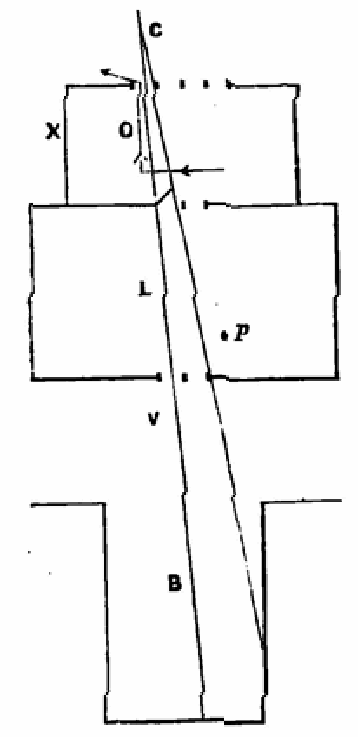
M. Coulomb asserts that he played the
Maliatma on this occasion. He explained
to me that the door leading from the
verandah (V) into the library (L) was an
ordinary double one, and so, likewise, was
the door leading from the library into
Colonel Olcott's office (O), where the figure
appeared; but the door leading from the
office into the compound (C) was a quad-
ruple one. The line of sight from the
position occupied by the party on the
balcony (B) did not permit the wkole of
the quadruple-door exit to be seen, and by
the time the party had reached such a
position as to see the whole space of exit,
M. Coulomb had left the room by the
further side part of the quadruple-door.
One side of the door leading from the
library into the office, M. Coulomb declares
he had pushed partly to, in order to make
certain that his departure should not Ij^
observed.
I performed this manoeuvre m3r8elf in
Bombay, and it succeeded admirably.
With the door pushed partly to, as repre-
sented in the diagram, it was not possible
for the party, who were originally on the balcony, to have seen the
point of
M. Coulomb's alleged exit before reaching the spot marked P. I requested
a gentleman to walk in the direction indicated by the arrowed line, and
found that the illusion was naturally produced that he luid continued to
walk
towards X, and could not have passed into the compound. Walking thus
into the compound myself, I found it especially convenient to keep my
face
turned towards the spectators, as this enabled me to tell exactly when I
was beyond their line of sight, and so make my exit unseen. And this
just
answers to the peculiar description of the disappearance of the figure
given
in the above account. '* He walked towards a table, and afterwards
turning
his face towards us, walked back out of our sight.'' M. Coulomb's asser-
tions, then, were so entirely corroborated by my inspection of the
place, as
to make it highly probable that he personated the Mahatma in the manner
he alleges.
Mr. Sinnett, in giving some additional information to Mr. Hume con-
cerning the above incident shortly after its occurrence, writes truly
that
*' the force of the incident turns on the arrangement of the rooms," and
proceeds to give a sketch of the rooms. This sketch a£fbrds another
illustra-
tion of the remark which I have made in dealing witli *' The Occult
World "
phenomena — that Mr. Sinnett has not exercised by any means sufficient
care
in his investigation. The most important point in the arrangement of ihe
rooms is entirely overlooked by him, the exit into Uie compound being
represented as no wider than the doorway from the library into the
office.
In Mr. Sinnett's sketch, the three doorways appear to be all of the same
size!
I may here draw attention to a certificate, a copy of which was sent by
Colonel Olcott to Mr. Myera in October of last year:
[Copy.]
"Colonel Olcott having to-day shown us a portrait in oils, we at once
recognised it as a very good likeness of a form which, in January, 1882,
we
saw at the headquarters of the Theosophical Society in Bombay, and said
to
be that of one of the Mahatmas known as the teacher of Madame Blavatsky
and Colonel Olcott.
"(Sgd.) Ross Scott
'^(Bengal Civil Service).
"(Sgd. ) Maria J. B. Scott.
"Bonn, Germany, 27tli September, 1884."
This refers to a portrait painted by Mr. Schmiechen from a photograph
alleged to represent Mahatma M. The features of Mahatma M. originated,
I believe, with an artist in America. It appears that this gentleman was
ro-
quested to draw a typical Hindu head. He did so, and Madame Blavatsky
declared that it was the portrait of Mahatma M. It was after this
occurrence
that the figure whose features resembled those of the '* fancy
portrait,"
appeared to Colonel Olcott in New York. Photographs were taken from
this "fancy portrait," and it was either from one of these
photographs, or from the original portrait that Mr. Schmiechen's
painting was made. I have compared the photograph side by side with Mr.
Schmiechen's painting, and must certainly say that there ia a close
resemblance between the two. Considering then that the dummy head with
its equipment of turban, &c., was made up to resemble the early poi
trait,
it is not surprising that a painting made from the same original should
seem
to Mr. and Mrs. Boss Scott a good likeness of the disguised figure which
they saw in Bombay between two and three years previously— and at a
distance from them which I concluded when I was at Crow's Nest Bungalow^
was probably about 20 paces.
Mr. Schmiechen has also painted a portrait of K. H., which appears
to me to resemble his painting of Mahatma M. more nearly than
it resembles the portrait of E. H. which was formerly kept in the
Shrine. The Shrine-portrait and Mr. Schmiechen's cannot both be
striking likenesses of K. H.; they would probably be taken by any ordinaiy
observer to represent di^Terent persons. In the Shrine-portrait, which
is
alleged, I think, to have been the work of some C7i€2a(and if so, was
pro-
bably the work of Madame Blavatsky), the nose is much more aquiline, and
the eyes more almond-shaped than in Mr. Schmiechen's painting. The
expression of the eyes, moreover, is very different from that in Mr.
Schmiechen*s rendering, and the complexion is very much paler. Also the
hair is decidedly curly in the Shrine portrait, but is not curly in Mr.
Schmiechen's. I drew Colonel Olcott's attention to the lack of
resemblance
displayed in some of these respects, and he admitted that there was a
difference, which he described as being such as one would expect between
the attempt of a schoolboy and that of a finished artist. As for the
hair, he
said that '* Hair gets much straighter when it is wet"!
In connection with these portraits, 1 may refer to another, alleged to
have been produced by Madame Blavatsky in less than a minute, in
America.
It appeared to us, at the time of our First Report, that there was no
proof
that the portrait, said to represent a Hindu Fakir, might not liave been
made previously; but the case seemed to be of some interest in
consequence
of the artistic merits of the picture attested to by Mr. O'Donovan and
Mr.
Le Clear {uUie ''Hints on Esoteric Theosophy," No. 1, pp. 85, 86). Mr.
O'Donovan, in the statement which he made concerning the portrait, said
that '* the black tints seem to be an integral part of the paper upon
which
it is done." Mr. Le Clear said: '' I first thought it chalk, then
pencil, then
Indian ink; but a minute inspection leaves me quite unable to decide.
Certainly it is neither of the above "; and also: *' The tint seems
not to be
laid on the surface of the common writing-paper upon which the portrait
is
made, but to be combined, as it were, with the fibres themselves." I
think
it is implied by the statement of Mr. O'Donovan that the lighter tints
appeared to have been laid on, and not to form an integral part of the
paper,
and this appeared also to myself. Madame Coulomb alleged tliat Madame
Blavatsky liad told her that she liad laid on the upper tints herself
upon one
of two photographs of a Hindu Fakir which she possessed, and Madame
Coulomb further alleged that the other photograph was still in one of
Madame Blavatsky's albums, and that I would, without doubt, be able to
see the portrait in the album, and recoflrnise the likeness to the one
supposed
to have been produced by occult methods. I found a portrait which I
thought
might be the counterpart; it was different from an ordinaiy photograph,
the
surface not presenting a polished appearance, and it seemed to me to
resemble rather a mezasotint engraving. I had no opportunity of
comparing
it side by side with the ''phenomenal" portrait, which I had not seen
for
some time previously; and all I can say is ^that I noted a considerable
resemblance about the eyes and forehead which led me to think it quite
possible that the *' phenomenal" portrait may have been the result of
Madame Blavatsky's artistic skill exercised upon a portrait like the one
I
found in her album.
APPENDIX 11.— (Vide
p. 248.)
On the 4th March, 1884 — (Madame Blavatsky and Colonel Olcott were
at this time on the ocean, having left Bombay on Februaiy 20th for
Marseilles) — ^I, owing to certain domestic afflictions, felt
exceedingly
miserable; could not take a morsel of food; and remained in the most
wretched condition of mind all that day. But in the evening, between 5
and 6 p.m., I proceeded to Adyar, in the hope of finding some
consolation
there; and was seated in the office-room of the headcfuarters, talking
to
Mr. Bawaji, without, however, mentioning to any body the circumstance of
my being in an unhappy condition. In the meantime, Mr. Damodar stepped
in; and I at once expressed to him my desire to see the *' Slirine.*'
He very
kindly conducted me to the Occult Boom upstairs forthwith; and unlocked
the *' Shrine." He and I were standing hardly five seconds looking at
the
Mahatma K. H.'s portrait in the '* Shrine," when he (Mr. Damod'ir) told
me
that he had orders to close the '* Shrine; " and did so immediately.
This
course was extremely disappointing to me, who, as the reader will liave
per^
ceived from the above, was sorely in need of some consolation or other
at
that time. But ere I could realise the pangs of this disappointment, Mr.
Damodar re-opened in an instant the '* Shrine" by orders. My eye imme-
diately fell upon a letter in a Thibetan envelope in the cup in the ''
Shrine,"
which was quite empty before 1 I ran and took the letter, and finding
that
it was addressed to me by Mahatma K. H., I opened and read it. It con-
tained very kind words conveying consolation to my aching heart;
advising
me to take courage; explaining how the laws of Karma were inevitable;
and
finally referring me to Mr. Damodar for further explanation of certain
passages in the letter.
How my presence before his portrait attracted the instantaneous notice
of the Mahatma, being thousands of miles off; how the Mahatma divined
that I was miserable and was in need of comfort at his hands; how he
pro-
jected his long and consoling letter from such great distance into the
closed
cabinet, within the twinkling of an eye; and, above all, how solicitous
he,
the great Mahatma, is for the well-being of mankind, and more especially
of persons devoted to him, — are points which I leave to the sensible
reader
to consider and profit by. Enough to say that this unmistakable sign of
extraordinary kindness on the part of the great Master armed me with
suffi-
cient energy to shake off the miserable and gloomy thoughts, and filled
my
heart with unmixed comfort and excessive joy, coupled with feelings of
the
sincerest gratitude to the benevolent Mahatma for this blessing.
P. Srbenevas Row.
2
1 was at headquarters very often during my sojourn with my friend H.
H., the Thakore Sahib of Wadliwan at Madras, whither we had gone last
March for the celebration of his marriage with the daughter of the Hon«
Crujpati Row. One day I asked Mr. D. K. Mavalankar to let me put a
letter
from me to my revered Master K. H. in the Shrine. It was in a closed
envelope, and was regarding private personal matters, which I need not
lay
before the public. Mr. Damodar allowed me to put the letter in the
Shrine,
The day after I visited again the Shrine in company with my wife. On
opening the Shrine I did find my letter unopened, but addressed to me in
blue pencil, while my original superscription,: *' My Revered Master,"
had a
pencil line running tlirough it. This was in the presence of Mr.
Mavalankar,
Dr. Hartmann and others. The envelope was intact. I opened it, and on
the unused portion of my note was an answer from my Master K. H. in his,
to me, familiar handwriting. I should very much like to know how others
will explain this, when as a fact boUi founders were thousands of miles
away.
Hakisinohji RupsnroBJi, F.T.S.
Varel, 9th September, 1884.
APPENDIX 12:
Account by Mr. P. Iyaloo Naidu.
(A reply to Mr. Myers' inquiry contained in his letter of 13th ultimo.)
On the 11th February last, I received a letter from Mr Damodar K.
Mavalankar, dated 8th idem, Adyar. In it there was a message in pencil
by
Mahatma Koot Hoomi, regarding a very important point.
On the same day, viz. , lltli February, I received another envelope by
the same post, '* From Bhola Deva Sarma," in which there was a Thibetan
envelope containing a message in Teloogoo characters on a point very
impor-
tant to me, with the initials of our revered Guru Deva M.C.
In the last month (August) I was anxious about my journey to this
country from Hyderabad, and often tliought of the Mahatma M. C. About
the 26th idem I examined my clothes, &c. , at Hyderabad, and found the
initials of the Mahatma M. C. on a cap which I use during my meditation.
P. Iyaloo Naidu, F.T.S.,
Pensd. Dep. Collector, Amec.
19th September, 1884.
In reply to my inquiries: — Mr. Naidu had sent a letter to Mahatma M.,
through Damodar. About 10 days after, on February 11th, he received a
letter from Damodar, who said he liad " missed " the letter (i.e., that
he had
placed it for the Maliatma to take, and that it had gone), that Mahatma
M.
had taken it and would attend to it. On the same day Mr. Naidu received
a
letter from Mount Road (nearly four miles from the Theosophical head-
quarters), "From Bhola Deva Sarma," supi>osed Chela of Mahatma M.
The cap referred to had been given to him by Colonel Olcott about 20
months previously. The cap had been worn several times during tliis
interval by Mr. Naidu, who had been staying at Hyderabad the whole time.
The initials appear as though marked with a blue pencil, and Mr. Naidu
himself suggested that he should ask Colonel Olcott if the initials were
there
when he received the cap. He thought it possible the initials might have
been there without his observing them. His sight is not good, and he had
never specially examined the cap, which may bo described as a
smoking-cap
made of white soft fabric. The colour of the initials is not deep, and
appears to have suffered the wearing away due to friction.
When we issued our First Report, Mr. Naidu's written statement seemed
to have some interest on account of the use of Teloogoo characters in
the
Mahatma document, but assuming that Madame Blavatsky has native con-
federates, it is obvious that no importance can be attributed to their
use.
Mr. Babajee, however, in reply to my questions, said that he did not
think
anyone at headquarters knew Teloogoo, '* except it be Damodar," but when
I puslied my inquiry further, he said with some hesitation that he
thought
that Mr. Dainodar also was ignorant of Teloogoo. The Teloogoo may have
been written by Mr. Babajee himself. Some writing in English, alleged to
liave been precipitated by *' Bhola Deva Sarma," showed clear traces of
Mr.
Babajee's handiwork. (See Part II. of Report.) Another instance had
occurred
where a Bombay Theosophist had received a phenomenal communication in
the Mahrathi Uuiguage;but Mahrathi is Mr. Damodar's vernacular. Sanskrit
knowledge could also be secured, but a question in Hebrew and Arabic
proved rather too hard a knot fcr the Mahatma Brotherhood. Mr.
Damodar, when conversing with Madame Blavatsky, in my presence, let
slip the remark — in reference to what he would do on his prt>jected
visit
to the North — that he would ''first learn Thibetan and Urdu." Madame
Blavatsky's quick glance of warning, Mr. Damodar*s disconcertion, and
the
speedy change of subject did not lessen the suggestiveness of the
utterance.
APPENDIX 13.
The following accounts will serve to illustrate the quality of many of
the letter-phenomena. They were given in reply to my inquiries.
FALL OF A CALENDAR.
Account by Mr. T. Vwiaraohava Charloo (Ananda).
In May, 1882, Madame Blavatsky and others came to Nellore. There
were more than half-a-dozen of us upstairs. No one could remember the
date. Madame Blavatsky said the Masters could give her a calendar if
they
liked. We were sitting in a circle or semi-circle in front of Madame.
She
shook violently, and a letter struck the wall behind. It was a calendar.
Account by Mr. Doraswamy Naidu.
When we were at Nellore, about midday, in May, 1882, we, Soubbaya
Chetty, myself, Ananda, Madame, and some others, were sitting in a room
together in an upper storey. Madame wanted to know the date. Soubbaya
Chetty gave one date, and another gave a different one. Madame said,
"Haven't you got any calendar?" The reply was No. Some one asked
Madame to supply a calendar. Within two or three seconds something fell
with a noise on the floor. One of the brothers took the object up. It
was a
small paper calendar of an English publisher, apparently quite new.
Madame was sitting at about the centre of one side of the room, and the
calendar fell in the far comer of the room.
MR. GOSHI'S LETTER.
Account by Mr. Babajee.
During the 8th anniversary, M. Goshi was a delegate. He came to
me, and offered his services. He wrote a long' letter of 5 or 6 big
pages. I
gave it to Damodar to give to Madame, who returned it to Damodar with
the words, ''Answer him as you please." Damodar left the letter on the
table. Goshi watched it, and answers came to his questions in the
letter.
Goshi was watching the letter all the time.
Account by Mr. Lukshman N. Goshi (Pensioned Sub-Judge of Sind).
I wrote a long letter of several foolscap pages, and gave it, through
Mr.
Brown, to Madame, who gave it to Damodar to get the Master*s account.
Damodar said he left it on the table, and foimd the writing of Mahatma
Koot Hoomi in it. He returned it to me.
----------
Mr. Norendra Nath Sen, editor of iliQ Indian Min-or, did not appear to
me to have been much impressed by ''phenomena.'* One experience of his
was as follows: —
At the anniversary of 1883, Messrs. Damodar, Mohini, Mullick, Brown,
and himself were sitting together when Mr. Damodar asked him if he felt
anything. The reply was No. Mr. Damodar then said that the Master
told Nprendra to look in his pocket. He found nothing in his pocket, but
found a letter on the seat — from the Mahatma.
----------
Mr. Nobik Krishna Bannerjee received a " phenomenar' letter while
I was at Adyar, but not in my presence. He gave me an account of the
incident almost immediately afterwards.
He had handed some folded manuscript of his own to Mr. Damodar, to be
read through before insertion in The Theosophist. Mr. Damodar took the
manuscript, turned over the sheets quickly, said he would read it
directly,
refolded the manuscript, and placed it on the table. Taking up the manu>
script shortly after, it was foimd that a " Tibetan " envelope was lying
in the
folds, addressed to Harisinghi Rupsinghi in the blue pencil writing said
to
be that of Mahatma Koot Hoomi.
----------
A TEST PHENOMENON!
"December 25th. — Grand phenomenon at Shrine: six or seven notes to
different persons simultaneously appear in the silver bowl — one in
Mahrathi
to Tookaram, in which his secret name was written." (Colonel Olcott's
diary
for 1883.) To the copy I possess of this extract. Colonel Olcott haa
appended the following note: "A Hindu receives from his Guru, at the
' thread ceremony,' when a boy of about seven, a mystical name, and this
he always keeps a secret. This test was therefore perfect." This note
of Colonel Olcott's has been crossed through by a pencil by Mr. Damodar,
who read tlirough the extracts from Colonel Olcott's diary before they
were given to me, and who has substituted the statement: " It was a
part of
his name, but never used by him in correspondence or anywhere else, and
therefore unknown to even his friends."
Mr. Tookaram Tatsra informed me that the name was his " surname" or
"family name," and he told me at once what it was: Padical. He said
that
nobody knew it at Madras, but hia only ground for thinking so appeared
to
be tliat he does not commonly use it. The name is no ucret^ and he said
that friends of his in Bombay may know it. Mahrathi, as already
mentioned,
is Mr. Damodar's vernacular, and Mr. Damodar had lived in Bombay
previous
to the removal of the headquarters of the Society to Madras. But the
mere
fact that the knowledge of the family name of a prominent Hindu member
of the Society has thus come to be characterised by Colonel Olcott as a
*' perfect test," is enough in itself to betoken upon what a flimsy
fabric of
evidence his great convictions may rest.
APPENDIX
14:
PROFESSOR SMITH'S LETTER SEWN WITH SILK.
Colonel Olcott stated in his deposition that a letter which had been
addressed by Professor Smith, of Sydney University, to Mahatma M ---,
"and sent enclosed in a letter to Madame Blavatsky, and which was
sewed
through and through many times with silk of different colours, had been
removed and another paper substituted inside without the threads having
been broken." Madame Coulomb declared to me that it was she herself who,
with very great care, and after a long examination of the silk threads,
unpicked the stitches on one side of the letter and sewed them back by
means of a hair. The *' Mahatma" enclosure had been inserted, she said,
}aj
Madame Blavatsky, who had previously read it over to Madame Coulomb,
and the latter quoted some words which she said had formed part of
Mahatma
M *s reply. Madame Coulomb also said that in sewing the stitches back
she had pulled the silk somewhat *' tighter " than it had previously
been, in
order that she might have enough silk to tie the final knot, and as a
con-
sequence, after tying the knot, there were some small ends of silk to
spare,
which she cut off, and which she showed to me.
Having written to Professor Smith on the subject, I received from him a
letter in which he kindly sent the sewn up note for inspection, and made
the
following statements concerning it: —
"It contains the enclosure with which it was returned. I slit
up the side of the paper to get the enclosure nut, after examining
the whole carefully with a magnifying glass. I could believe that
Madame Coulomb unpicked the silk and restored it again only if I saw
her do it. Observe how closely the ends were cut off so as to leave
nothing
to hold by Madame Coulomb's partial knowledge of the writing
on the enclosure goes for little, as I described it all in a letter to
Madame
Blavatsky."
I examined the sewn-up note, and observed that the threads on one side
had
been clearly pulled tighter than those of the other side, and also that
the silk of
the more tightly pulled stitches had been handled more than the silk of
the
other side, as was manifest by its peculiar frayed appearance. Apart
from these
signs, my examination of the note left me without any doubt that the
opening and redosing of it, as described by Madame Coulomb, were far
from
being impossible. I was desirous, however, of clearly establishing
whether
the note could be so opened and closed or not, but as tJie operation
demanded
a certain sort of delicate care in which I might prove 'deficient, I
requested
Mrs. Sidgwick to undertake the task.
Account by Mrs. Sidgwick.
Mr. Hodgson brought me a letter which Professor Smith of Sydney had
sent to Madame Blavatsky to be delivered to Mahatma M . This letter
had been carefully folded up, and the edges doubled over and sewn down
with red and yellow floss silk. It was returned by Madame Blavatsky
apparently intact, but on cutting open one side, without interfering
with the
silk. Professor Smith found inside a note purporting to come from the
Mahatma. This note could not, I think, have got there by natural
means imless the sewing had been unpicked at one end. Madame Coulomb
asserted, so Mr. Hodgson told me, that she had unpicked the silk at one
end, and sewn it up again by means of a hair. Professor Smith did not
think this possible, and Mr. Hodgson wished me to repeat the operation,
which Madame Coulomb asserted that she had performed, with a view to
ascertaining its possibility.
I thought I could detect slight signs of Madame Coulomb's operations at
one end of the folded paper, and as she said that in sewing it up again
she
had pulled the silk tighter than before in order to leave a margin for
fastening, I selected what I thought was the other end, in order to
secure a margin for myself too. Before undoing the sewing I made careful
diagrams of the way in which the stitches went, and of the relative
positions
in each stitch of the two colours. The fastening knot was not quite easy
to undo, but otherwise the unpicking afforded no difficulties. The
difficul-
ties in sewing it up arose from the impossibility of using a needle in
the
ordinary way owing to the shortness of the silk. Taking Madame Coulomb's
hint, however, I found no great difficulty, though the process was
tedious,
in pulling the silk through its old holes by means of a loop of hair. By
pulling the stitches tight I secured length enough for fastening at the
end,
and the superfluous fragments I then cut off. Before replacing the
sewing
I wrote initials inside to prove that I had undone it.
ELEANOR MILDRED SIDGWICK.
I returned the letter afterwards to Professor Smith, with statements by
Mrs. Sidgwick and myself, and have received a reply from Mrs. Smith on
behalf of her husband (who was too ill to be able to writ« himself),
from
which it appears that Professor and Mra. Smith were quite satisfied, in
con-
sequence of the operation performed by Mrs. Sidgwick, tliat the supposed
evidence of "occult'' agency was worthless.
APPENDIX
15 (Vide p. 293.):
CONCERNING HANDWRITING, &c.
Examination by Mrs. Sidgwick.
Mr. Hodgson was anxious that his statements and conclusions, as regards
the handwriting of the Koot Hoomi documents and some other points,
should, as far as possible, be verified in detail by some other person,
and I
have accordingly examined aU the mss. in question, which he has had in
his hands in England, with great care, with the result that I find
myself in
complete agreement with him. His observations on documents which he saw
only in India I cannot, of course, verify.
First, as regards the plates. The specimens of isolated letters are, I
think, so far as I have compared them with the originals (or in the ease
of
those taken from Mr. Sinnett's series with tracings which I had
previously
compared with the originals), as nearly facsimiles as can be expected,
with
the exception of a certain tremulousness which they ought not to have,
but
which does not affect them for our present purpose. I have thus compared
the larger number of the specimens, and where I have not compared the
copy with the particular letter from which it was traced, I can testify
to its
strong resemblance to many other specimens that might have been
selected.
The plates representing short passages from different documents give a
good
general idea of the writing, but in some instances fail in giving the
individual character of particular letters. Still they are quite
sufficiently
accurate to help the reader to understand the discussion. Those copied
from writing in blue pencil are, as might be expected, less close
facsimiles
than the others.
I have carefully verified every statement Mr. Hodgson makes about the
acknowledged handwriting of Madame Blavatsky, and about the K.H. mss.
in England which he attributes to her. I entirely agree with all he
says,
and am myself strongly convinced that the same person wrote both. The
development of the K.H. writing is very marked, and the gradual elimina-
tion of Blavatskian forms is, to say the least of it, suggestive. The
argument
is greatly strengthened by the occasional spasmodic appearance of
Blavatskian
forms — ^seemingly by accident — throughout the K.H. mss. attributed to
her
— and that this is an accident, and an accident which the writer desired
to
avoid, is proved, I think^ by the erasures and alterations. The last k
selected from K.H. No. 3 on Plate III., which occurs in the original in
the
word Greek, is a fair instance of these alterations.
But convincing as the two considerations already mentioned are, I think
the prevalence of certain peculiarities throughout both sots of
documents is
more convincing still, and in particular the very peculiar a and g
constantly
occurring in both. It so happened that when Mr. Gribble's pamphlet, men-
tioned by Mr. Hodgson, first reached me, while Mr. Hodgson was still in
India, I had in my hands some letters of Madame Blavatsky's and a long
K.H. document, and naturally turned to Madame Blavatsky's handwriting
to see if it possessed the characteristics mentioned by Mr. Gribble.
There,
without doubt, I found among others this peculiar a, but it was with a
shock
of surprise that I found this same a, which I had never seen in any
other
handwriting, occurring even more conspicuously in the K.H. document than
in Madame Blavatsky's acknowledged writing. I have seen a somewhat
similar formation of a in the handwriting of a Russian gentleman.
I think evidence that the K. H. handwriting is a disguised one may be
found in other variations of form besides those which show development.
The variations I speak of remain more or less constant tlirough a
particular
document, but do not appear in other documents, and thus appear to me to
suggest that the writer was not using all the forms of letters
instinctively,
and had not a perfectly clear and persistent idea of what all the forms
should
be. No doubt some variations might be found in every handwriting from
document to document, due to a difference of speed in the writing, to
the
kind of pen employed, <Sbc. But those in the E. H. writing seem to me
more marked than this, and are the more noticeable as the writing is
regular
and very seldom gives one the impression of being carelessly done.
I have counted the English and German d's in various writings of
Madame Blavateky. It is a matter of considerable difficulty to count
correctly the number of times a letter occurs in a long ms. if it is at
all
frequent; I am, therefore, not surprised to find that my numbers are
slightly
different from Mr. Hodgson's. As, however, we in no case differ by so
m%ich
as 5 per cefiit, it is evident that the difference is of no importance
whatever
to the argument, and I therefore considered that it would be waste of
time
to repeat the counting. The extreme rarity of the English d in all the
acknowledged handwriting of Madame Blavatsky in our hands which has
been written since the E, H. correspondence began, except in the B.
EepilieSf
combined with its comparative abundance in the earlier letters and in
the
B. BeplieSy is very striking, and it is difficult to attribute it to
accident.
I have verified completely every statement about the letter called
E. H. (Z) and about Mr. Damodar's ordinary writing, and have little
doubt
that the E. H. (Z) was written by him.
I have also examined the long document professedly in the handwriting
of Mr.Bhavani Shankar. It apjiears to me to bear very evident
indications of
being written in a disguised hand, and to have enough of the marked
characteristics of Mr. Damodar's handwriting to point to him as the
writer.
I have compared the letter which Mr. Hodgson has called the '* Eoot
Hoomi
Lai Sing" with the quotations from it in Mr. Sinnett*s *' Occult
World,''
and find as Mr. Hodgson does, more than 60 differences, without counting
mis-spellings, changes in punctuation, &c.
It only remains to speak of the mis-speUings, faults of idiom, &c.,
quoted
by Mr. Hodgson from the E.H. documents, and from Madame Blavatsky 's
own letters. I have compared all these with the originals and believe
them
to be correctly transcribed. More of the same kind might be adduced.
Eleanor Mildred Sidgwick.
EXPLANATION OF PLATES, &c.
Plan of Occult Room and Surroundings. — Vide pp. 220-222.
Plate 1. — Concerning the groups uf individaal letters in this Plate^
which are very close facsimiles of my own tracings from the original
documents, vide pp. 284-291, 296.
The specimens B (i.), B(n.), &c., which are on the whole very good
representations of the originals though not accurate in every detail,
aro
taken from Madame Blavatsky's undoubted writings, with the exception of
B (x.), which represents the Blavatsky-Coalomb document referred to on
p. 317. The remaining Blavatsky-Coulomb documents being in India, I have
boon unable to produce facsimiles of them in this Report.
B (l ) is from a letter written to a Hindu in August, 1878.
B (ii.) is from a letter written to Mr. C. C. Massey in July, 1879.
B (iil), B (iv.), and B (v.) are from letters lent by Mr. Hume, received
February— June, 1882.
B (vi.) is from an envelope addressed to Mr. 0. C. Massey in 1884.
B (vu.) is from an envelope addressed to Mr. Myers about the beginning
of October, 1884.
B (vnL) is from a letter to Mr. Myers about October, 1884.
B (ix.) is from B Beplies (mde p. 290), written about
the end ^f 1884
or
the beginning of 1885.
B (x.), the Blavatsky-Coulomb document, was probaUy written at some
time between 1879 and 1883.
----------
Plate 2. — The specimens K.H. (i.), K.H. X^i.), &c., are from K.H.
documents which I consider to be the handiwork of Madame Blavatsky, and
they are for the most part good representations of the originaLs. The
K.H.
(vu.), however, is taken from writing in blue pencil, which is much
blurred,
so that the reproduction is not so good as in the other cases, the
originals of
which are in ink.
K.H. (i.) represents a page from the Koot Hoomi Lai Sing letter to Mr.
Hume, of November 1st, 1880. I have placed a small dash under
many of the letters for the purpose of directing attention to
peculiarities mentioned in the preceding discussion.
K.H. (ii.)— K.H. (vi.) are from K.H. documents received about 1881 —
1882, K.H. (ii.) being taken from the commencement of one of
these documents, and K.H. (iii.) from the end of the same
document.
K.H. (vii.) is from a letter to Mr. Myers in 1884.
K.H. (z.), the original of which I attiibute to Mr. Damodar {tide pp.
294-207), does not represent one continuous extract. I
obtained permission to reproduce diflfereiit portions of the K.H.
(Z.) document, which I directed to be placed together as in the
facsimile. The original is in blue pencil, and much blurred, and
several of the most important letters appear in the facsimile
without their original cluuracteristics. Tlius the a of sympatlii^it
(1 6), is in the original document a typical sjiecimen of the beaked
a fonnation, and several of the gf's in the lithograph liave lost all
trace of a similar beaked formation which they exhibit in the
original document. Still the correspondence with the original is
close enough to enable the reader to see several important differ-
ences betweeait and K.H. (vii.), and especially that it contains
no instance of the left gap stroke^ of which he will find various
instances in K.H. (vu.), received about the same time in 1884.
D (i.) and D (ii.) represent two specimens of Mr.Damodar's undoubted
writing in 1884.
_______________
Notes:
45. There is a special role in the Society providing for secret
membership.
Madame Blavatsky's influence is felt, moreover, far beyond the limits of
the
Society. When she returned to India, at the end of last year, an address
of
sympathy was presented to her by a large body of native students of
Madras,
of whom, apparently, only two or three were Theosophists.
46. That this life-page was partly known to Madame Coulomb, and that Madame
Blavatsky feared her in consequence, is borne out by the fact that, in a
dispute
which arose, in 1880, while Madame Blavatsky was at Ceylon, between
Madame
Coulomb and another member of the Society at its headquarters, then in
Bombay,
Madame Coulomb boasted of her power. Her boast was apparently justified
upon Madame Blavatsky's return. Madame Coulomb was supported by Madame
Blavatsky, and therefore also by Colonel Olcott, and the dispute
residted in the
withdrawal from the Society of some of the most influential members at
Bombay,
who regarded the action taken in the matter by the founders as wanting
in
straightforwardness. I have had personal interviews with some of these
ex-
members, who consider that the recent exposures of the Coulombs have
thrown
nmch light on the formerly mysterious behaviour of Madame Blavatsky and
Madame Coulomb in connection with the Bombay episode.
47. The letters "Ru" crossed out in this place may be observed in the
facsimile in Plate I.
48. See Reply by H. R. Morgan, Major-General, Madras Army (retired), to a
Report of an Examination into the Blavatsky Correspondence, by J. D. B.
Gribble, M.C.S. (retired).
49. In the earlier accoimt General Morgan says: '* Five minutes had
scarcely
elapsed after this remark." This five minutes exhibits here a decided
tendency
to approximate to nothing.— R.H.
50. According to the earlier account this interval was considerably
longer,
being five minutes, together with an uncertain interval spent partly in
con-
versation, partly in reading the note, &c. But more surprising still
than the inconsistencies between General Morgan's two accountSi is the
opinion which he apparently holds, that if the phenomenon was fraudulent
M. Coulomb himself must have written the Koot Hoomi note, — and must
have
written it, moreover, in the very interval which has thus dwindled! — R.H.
51. It is easy to read between the lines of Madame Coulomb's letter, even
without her statement that Madame Blavatsky told her to be prudent in
what
she wrote. — R.H.
52. Supposing Mr. Babajee's account to he correct, the fact which he cites
to
prove that Madame Blavatsky was not a party to the scheme, shows rather
the
contrary; it seems not unlikely that M. Coulomb, w^hen the incident
which Mr.
Babajee relates occurred, was actually engaged in the preparation or
alteration of
trick apparatus. Madame Blavatsky might well have trusted M. Coulomb to
Aupply a " pretext" for not allowing any one to inspect his w<irk.
53. Mr. Brown, member of the Board of Control, states that this was *'
nnani-
mously decided'' by the '' gentlemen priesent" at the '* disdoaore."
54. I have no doubt that what Mr. Mohini terms the "luminosity" was-
merely the moonlight reflected from the white robes of the figure. On
tha
*' former occasions " there was moonlight, but in this third case there
was no
moonlight- Mr. Mohini's statement that there was being
erroneous. (See p. 244.)
55. See evidence of Mr. A O. Hume, p. 275.
56. A name by which Colonel Olcott's Chohan is known amongst us.— H.X.
Go to Next Page |