|
THE ESOTERIC PAPERS OF MADAME BLAVATSKY |
|||||||||||||||||||||||||||||||||||||||||||||||||||||||||||||||||||||||||||||||||||||||||
|
Appendix II The Inner Group Teachings [See pp. 235-241 of this compilation for an introduction on the Inner Group.] THE INNER GROUP TEACHINGS I. August 20, 1890 Present: C.W., A.B., G.R.S.M., C.P.W. Warning: H.P.B. explained the extreme seriousness of the Pledge taken by members of the Inner Group. Occultism must be everything or nothing. This pledge once taken resignation avails nothing; its breach means the most terrible consequences in the present life & in future incarnations. It was a more serious pledge than the voluntary initial pledge given by the Chela to the Master: for the Master might make allowances & forgive. But this was taken in the presence of all the manifestations, the emanations, that surround the Higher Self, & all these would be against the breaker of the pledge. (Ques.) C.W. asked if any had broken the pledge. (E.S.) (Ans.) Yes, but H.P.B. would not say which. Some had kept it, some not; the breaches had been involuntary. This new pledge would colour all the life here & hereafter in all future bodies. Those who kept on the right way would be helped; they need not fear. If they were faithful, no external things could harm them. But each must be sure of himself before taking it, as there was no going back. The responsibility is terrible & cannot be evaded. Once taken, the pledge can never be recalled. Taking of the Pledge: The Pledge was then taken by each in turn. H.P.B. "It is in the presence of the Master you have taken it -- (after a pause) Now I am your servant, & must answer your questions." H.P.B. then pointed out that we should not at first recognise the extreme seriousness of the instruction given, but little by little the importance would be seen by us. We must study, work hard, miss no point. The awakening of Kundalini: Night was bad for practical work, for we were tired, physically, mentally, & morally. The morning was best, at sunrise, or at the uneven hours after sunrise. Never take even hours after sunrise: always the uneven, "the hours of the Gods." (the 3rd, or 5th, hour after sunrise). The seven physical Nadis extend up the vertebral column from the lower lumbar vertebra to the atlas; then commence the super-physical, of which the fourth is the pituitary body. The three higher are between the pituitary & the pineal glands. When the fourth vibrates, it swings in curves of greater & greater length, till the pineal gland is set vibrating, the circle is completed, & kundalini is awakened. Ascend by the seven physical nadis to the foramen; if before this any physical effects are felt, stop; think the stages in colour: [This transcription of the Inner Group Teachings is a reduced facsimile of the typescript of the "Cleather Record" described in Joseph H. Fussell's statement found on p. 238 of the present compilation.] Blue: Auric Egg (for Sthula Sarira). May
be taken 1 or 7. On entering the cranium the passage is from the physical to the psycho-spiritual planes. Again seven stages, the colours being taken in the same order as far as the fourth, but not to be thought of so much as physical colours, but as the essence of colour, the pure bright hues seen in the sky. The shade of the colour depends upon the predominance of the psychic or the spiritual. At the fourth, the pituitary body, stop: the three higher colours of the super-physical septenary are not to be pictured; only the pulsating of the interblended essence of colour should be thought. After the physical come the psychic, the spiritual, & the divine planes. It depends on the intensity of the thought, the purity & sublimity of the aspiration, which plane is reached. Only enter on the experiment after shutting out all worldly thoughts, worries & troubles. The three vital airs: It is the pure Akasa that passes up Sushumna; its two aspects in Ida & Pingala. These are the three vital airs, and are symbolised by the Brahmanical thread. They are ruled by the Will. Will & Desire are the higher & lower aspects of one & the same thing. Hence the importance of the purity of the canals, for if they soil the vital airs energised by the will, black magic results. This is the reason why all sexual intercourse is forbidden in practical occultism. From Sushumna, Ida, & Pingala a circulation is set up, & from the central canal passes into the whole body. (Man is a tree; he has in him the macrocosm & the microcosm. Hence the tree used as symbols: the Dhyan Chohanic body is thus figured)! The Auric Egg is formed in curves, which may be conceived from the curves formed by sand on a vibrating metal disc. Each atom, as each body, has its Auric Egg, each centre forming its own. This Auric Egg, with the appropriate materials thrown into it, is a defence: no wild animal, however ferocious, will approach the Yogi thus guarded: it flings back from its surface all malign influences. No will power is manifested through the Auric Egg. Experiment: Get wool of the seven colours: wind round the annular finger of the left hand a piece corresponding to the colour of the day, while meditating, & record the results. This is to discover the ray to which the student belongs. II. September 10, 1890. Present: A.S., C.W., C.F.W., G.R.S.M., I.C-O., A.K., & H.A.W.C. The three last took the Pledge. (In taking it H.P.B. told the Candidate to turn to the Master's portrait). Auric Envelope: 1. What is the connection between the circulation of the vital airs & the power of the Yogi to make his Auric Envelope a defence against aggression? (Ans:) It is impossible to answer this question, which is the last word of magic. It is connected with Kundalini, that can as easily destroy as preserve. The ignorant tyro might kill himself. 2. Is the Auric Envelope of a child a differentiation of Akasa, into which may be woven by the Adept the materials he needs for special purposes, e.g., the Mayavi Rupa? (Ans:) The question was somewhat obscurely worded. Evidently what the questioner wanted to know was, if the Auric Envelope was a differentiation of Akasa, into which, as the child became a man, if an adept, he might weave the materials needed for special purposes, etc. But taking the question in the sense of an Adept putting something into, or acting on, the A.E. of a child; then this could not be done, as the A.E. is karmic & not even an Adept must interfere with such karmic record. If the Adept were to put anything into the A.E. of another, which that person is not responsible for, or which does not come from the Higher Self (? Ego) of that personality, how could Karmic justice be maintained? Adept: A.E.: Globe: Universe: Child's A.E.: The Adept can drawn from his own A.E., or even from that of the Globe, or of the Universe, according to his degree. This envelope is the receptacle of all Karmic causes & photographs all things like a sensitive plate. The child has a very small A.E. which is in colour almost pure white. At birth the A.E. consists of pure Akasa plus the Tanhas, which, until the seventh year remain potential or in latency. A.E. the transmitter: The A.E. is the transmitter from the individual lives to the eternal, from the periodical lives (Prana) to the eternal life (Jiva). Idiot: The A.E. of an idiot cannot be said to be human, that is, it is not tinged with manas. His aura would be of the same nature as that of the animals. Confession: The reason why the confession of the R.C. & Greek Churches is such a sin, is because the confessor interferes with the A.E. of a child or adult penitent by means of his will power, engrafting artificially emanations from his own A.E. & casting seeds for germination into the A.E. of his subject. It is simply on the same lines as hypnotic suggestion. Suggestion: The above remarks applied equally to hypnotism, although the latter was a physico-psychic force, & constituted one of its many serious dangers. At the same time a "good thing might pass through dirty channels," as in the case of the breaking by suggestion of the alcohol or opium habit. Mesmerism might be used by the occultist to remove evil habits, if the intention were perfectly pure, as on the higher plane, intention was everything; & good intentions must work for good. 3. Is the A.E. the expansion of the "Pillar of Light," the manasic principle, & so not surrounding the child until its seventh year? (Ans:) A.E. & Manas: The A.E. is quite pure at birth. It is a question which manas will colour it at the seventh year. The manasic expansion is pure Akasa. The ray of manas is let down into the vortex of the lower principles, & being discoloured & so limited by the Kamic Tanhas & by the defects of the bodily organism forms the personality. Hereditary Karma can reach the child before the seventh year, but no individual Karma can come into play until the descent of the manas. The A.E. is to the man the same as the Astral Light is to the Earth, The Ether is to the man the same as the Astral Light is to the Earth, The Akasa is to the man the same as the Ether is to the Earth. The critical states are left out in this enumeration. These latter are the Laya Centres, or missing links in our consciousness, which separate these four planes from one another. The Dweller: The "dweller on the threshold" is found in two cases: (a) in the case of the separation of the triangle from the Quaternary: or (b) when kamic desires & passions are so intense that Kama Rupa persists in Kama Loka beyond the Devachanic period of the Ego, & thus surviving the reincarnation of the Devachanic Entity (e.g., in the case when reincarnation occurs in two or three hundred years.) becomes this "dweller" by intensifying the kamic principle of the new personality. Some become mad from this cause. Intellect: The white Adept is not always at first of powerful intellect. In fact, H.P.B. had known Adepts whose intellectual powers were originally below the average. It is the Adept's purity, his equal love to all, his working with nature, with karma, with his "inner god," that give him his power. Intellect along will make the black magician. For intellect alone is accompanied with pride and selfishness: it is the intellect plus the spiritual that raises man. For spirituality prevents pride and vanity. Metaphysics: Metaphysics are the domain of the manas, pure: whereas physical science is that of the material or Kama-Manas, which is, as every principle, of seven degrees. The mathematician, who (is) without spirituality, however great he may be, will not reach metaphysics: but the metaphysician will master the highest conceptions of mathematics & apply them without learning. To a born metaphysician the psychic plane will not be of much account: as he will see its errors -- in as much as it is not the thing he seeks for -- immediately he enters on the psychic plane. Music: With respect to music and other arts, they are either the children of the Manasic or Kama-Manasic principle, proportionately as soul or technicality predominates. Karma: After each incarnation, when the manasic ray returns to its father, the Ego, some of its atoms remain behind and scatter. These manasic atoms, tanhic & other "causes", being of the same nature as the manas, are attracted to it by strong bonds of affinity, & on the reincarnation of the Ego are unerringly attracted to it & constitute its karma. Until those are all gathered up, the individuality is not free from rebirth. (cf. the following fragment of the gospel of Philip, as quoted by Epiphanius: "I have known myself & gathered up myself from all quarters, & have sown to the Archon no children, but have torn up his roots, & gathered together the scattered members, & I know thee who thou art." See Dict. Christ. Biog. N. 414) The Higher Manas is responsible for the ray it sends forth. If the ray be not soiled no bad Karma is generated. Turya State: (Yogis cannot attain this
state unless the
Good & bad Karma: we should bear in mind that, in becoming Karmaless, both good as well as bad karma have to be got rid of, & that Nidanas started the acquisition of good karma, are as binding as those induced in the other direction. For both are karma. Mahat: Mahat is the manifested, universal Parabrahmic Mind (for one Mahamanvantara) on the third plane. It is the law whereby the Light falls from plane to plane & differentiates. The Manasa-putra are its emanations. Man alone is capable of conceiving the universe on this plane of existence. Existence: Existence is; but when the entity does not feel it, for that entity it is not. The pain of an operation exists, though the patient does not feel it; & for the patient it is not. 4. In practising concentration, we are told to stop at the Pituitary body, terminating the series of colours with Red. It seems strange to crown the series with the colour of Kama. What is the explanation of this? (Ans:) Upper Colours: We were told to stop at Red: that is, to stop before Red. The upper Red is rather the golden-coloured Prana. There are three degrees, Yellow, Yellow-orange & red-orange. When the flood of Light appears, it must be steadied, otherwise true vision is impossible. Metals: When the student has discovered his colour, the day of that colour should be chosen as the day for special effort, and a ring of the metal of the day worn on the 4th (?) finger of the left hand. When the dominant colour is found, it alone should be used & the seven colours abandoned. Aum: 5. What is the correct pronunciation of Aum? It should first be practised physically, always at the same pitch, which must be discovered in the same way as the particular colour of the student is found, for each has his or her own particular tone. The aura of any person might have a predominant colour. But unless the region of the aura suffused with this colour corresponds with the back of the neck, it was not their colour. (?) Experiment: (Tuning forks -- seven -- should be used to get the pitch.) AUM consists of two vowels & one semi-vowel, which latter must be prolonged. Just as nature has its Fa, so each man has his, man being differentiated from Nature. The body may be compared to an instrument & the Ego to a musician. First learn to play on the Tatwas & Principles as one does on a piano. Learn first the notes, then the chords, & then the melodies. Once the student is master of every chord, he may begin to be a co-worker with nature & for others. He may then by the experience he has gained of his own nature, & by his knowledge of the "chords," strike such as will be beneficial in another, & which will serve as a "Key-note" for beneficial results.
that it vibrates in unison with the upper triad.) 5. Light of Kundalini: As soon as the waves of Light commence should the mind be centered on the eye or on the waves of Light? (Ans.) On the Light. 7. When one feels colour, is it the different rapidity of vibrations that one sees? (Ans.) No; one sense merges into another: all senses are but differentiations of the one sense-consciousness. Hence we can feel colours & see sounds. 8. In repeating Aum, should one lose oneself in the light around one, or should one keep the mind fixed steadily on the Higher Self? (Ans.) On the Higher Self. Effect of the Pledge: The effect of the pledge on future incarnations, if it be kept, is that it will be latent in the succeeding life & will, unconsciously to the disciple, guide him. Seven births: These must be seven actual incarnations, but the disciple might be so pure & strong, that the incarnations might be of the shortest character, e.g. almost still-born, living only an hour or two. Devachan: Advance may be made in occultism even in Devachan, if the mind & soul be set thereon during life; but it is only as in a dream, & the knowledge will fade away as the memory of a dream fades, unless it be kept alive by conscious study. Fear: Fear & hatred are one & the same thing essentially. He who fears nothing will never hate, & he who hates nothing will never fear. III. September 17, 1890. Present: C.W., I.C.-O., A.B., C.F.W., G.R.S.M., A.K., H.A.W.C., A.L.C., L.C. The last two took the Pledge. 9. Image of
(Ans.) H.P.B. asked whether the question
signified the meaning of the
(The Turya is the 4th state.) The Augoeides: We must figure Manas as overshadowed by Buddhi & immersed in Atma. Only Manas, the Higher Ego, can be represented; we may think it as the Augoeides, the radiant figure in "Zanoni." A very good psychic might see this. Psychism: Psychic vision, however, is not to be desired, since psyche is earthly & evil. More & more as science advances the psychic will be reached & understood; psychism has in it nothing that is spiritual. Science is right on its own plane, from its own standpoint. The law of the conservation of energy implies that psychic motion is generated by motion. Psychic action being only the motion on the astral plane, a material plane, the psychologist is right who sees in it nothing beyond matter. Animals have no spirit, but they have psychic vision & are sensitive to psychic conditions; observe how these re-act on their health, their bodily state. Motion: Motion is the abstract deity; on the highest plane it is arupa, absolute; but on the lowest it is merely mechanical. Psychic action is within the sphere of psychic motion. Ere psychic action can be developed in the brain & nerves, there must be adequate action which generates it on the physical plane. The paralyzed animal, that cannot generate action in the physical body, cannot think. Psychics merely see on a plane of different material density; the spiritual glimpses sometimes obtained by them come from a plane beyond. A psychic's vision is that of one coming, as it were, into a lighted room, & seeing everything there by artificial light. When the light is extinguished, vision is lost. Spiritual vision sees by the light within, "the light hidden beneath the bushel" of the body, by which we can see clearly & independently of all outside. The psychic seeing by an external light, the vision is coloured by the nature of that light. Seven planes in Astral Light: C.W. saying that she felt as though she saw on three planes, H.P.B. answered that each plane was sevenfold, the astral, as everywhere else. She gave as an example, on the physical plane, the vision of a table with the physical sight; seeing it still, with the eyes closed, by retinal impression; the image of it conserved in the brain; it can be recalled by memory; the sight of it in dream; or as an aggregate of atoms; or disintegrated; all these are on the physical plane. Then we can begin again on the astral plane, & obtain another septenary. This hint should be followed & worked out. The students might speak of this to other Esotericists, as there was nothing occult in it. The important thing to be kept secret was the way in which such teachings were put into practice, the correspondences. The danger of speaking of this truth publicly was that it would be likely to generate materialism; it was necessary always to remember that there was the spiritual beyond the material.
(Ans.) It is wrong to speak of the "lower quaternary" in the Macrocosm. It is the Tetraktys, the highest, the most sacred of all symbols. There comes a moment when, in the highest meditation, the Lower Manas is withdrawn into the Triad, which thus becomes the Quaternary, the Tetraktys of Pythagoras, leaving what are the Quaternary as the Lower Triad, which is then reversed. The triad is reflected in the Lower Manas. The Higher Manas can not reflect itself, but when the Green passes upwards it becomes a mirror for the Higher; it is then no more green, having passed from its associations. The psyche then becomes spiritual, the Ternary is reflected in the fourth, & the Tetraktys is formed. So long as you are not dead, there must be something to reflect the higher Triad; for there must be something to bring back to the waking consciousness the experiences passed through on the higher plane. The lower manas is as a tablet which records the things seen in trance. The Turya state is entered on the "Fourth Path"; it is figured in the diagram on p. 16 of the Instructions II. The
(Ans.) Seeing the
"Pass-not." 12. With reference to the "Pillar of Light" in Question 3, is the Auric envelope the Higher Ego, & does it correspond to the ring Pass-not? The question was not answered, as going too far. The ring Pass-not is at the end of the manifested Unvierse. Nidanas: 13. The root of the Nidanas is Avidya: How does this differ from Maya? How many Nidanas are there esoterically? (Ans.) Again, asks too much. The Nidanas, the concatenation of causes & effects (not in the sense of the Orientalists) are not all caused by ignorance. They are produced by Devas & Dhyan Chohans, who certainly cannot be said to act in ignorance. We produce Nidanas in ignorance. Each cause started on the physical plane sets up action on every plane to all eternity. They are eternal effects, reflected from plane to plane on to "the screen of eternity." Manas & its Divisions: 14. What is the septenary classification of Manas? There are seven degrees of the Lower Manas, & presumably seven degrees of the Higher. Are there then 14 degrees of Manas; or is Manas, taken as a whole, divided into 49 manasic fires? (Ans.) Certainly there are 14, but you want to run before you can walk. First learn the three, & then go on to the 49. There are 3 sons of Agni; they become 7, & their sons are 49. But the students were still ignorant how to produce the 3. Learn first how to produce the "sacred fire" spoken of in the Puranas. The 49 fires are all states of Kundalini, to be produced in ourselves by the friction of the Triad. First learn the septenary of the body, & then that of each principle. But first of all learn the first triad (the 3 vital airs) as directed in Lessons 1 & 2. Colours & Cord: 15. The Nadis extend from the lowest lumbar vertebra to the atlas. Have these any physical correspondence in the spinal cord, which extends only from the first lumbar vertebra to the atlas? & does the region through which the colours are to be raised correspond with the entire length of the cerebral canal, which, in the adult, terminates on the coccyx? (Ans.) The coccyx is the great line of
demarcation between the animal & the man. It is the place where the man
ends & the animal begins. If, then, you pass beyond it, you pass to the
animal & into Black Magic. Therefore the lower
The Sympathetic Nerve: 16. What is the sympathetic nerve, & its function in occultism? It is found only after a certain stage of animal evolution, & would seem to be evolving in complexity towards a second spinal cord. (Ans.) At the end of the next Round humanity will again become male-female, & then there will be two spinal cords. In the seventh race the two will merge into the one. The evolution corresponds to the Races, & with the evolution of the races the sympathetic develops into a true spinal cord. We are returning up the arc, only with self-consciousness added. The 6th Race will correspond to the "pudding-bags," but will have the perfection of form with the highest intelligence & spirituality. Anatomy & Occultism: Anatomists are beginning to find new ramifications & new modifications in the human body. They are in error on many points; e.g. as to the spleen, which they call the manufactory of the white blood corpuscles, but which is really the vehicle of the Linga Sarira. Occultists know each minute portion of the heart, & have a name for each. They call them by the names of the Gods, as Brahman's Hall, Vishnu's Hall, etc. They correspond with parts of the brain. The very atoms of the body are the 33 ores of Gods. The sympathetic nerve is played on by the Tantrikas, who call it Siva's Vina. Prana: 17. What is the relaxation of man to Prana, the periodical life? (Ans.) Jiva becomes Prana only when the child is born & begins to breathe. It is the breath of life, Nephesh. There is no Prana on the astral plane. Antaskarana: 18. Antaskarana is the link between the Higher & the Lower Egos; does it then correspond to the umbilical cord of the astral in projection? (Ans.) No; the umbilical cord joining the astral to the physical body is a real thing. Antaskarana is imaginary, a figure of speech, & is only the process of bridging over from the Higher to the Lower Manas. Antaskarana only exists when you commence to "throw your thought upwards & downwards." The Mayavi Rupa, or Manasic body, has no material connexion with the physical body, no "umbilical cord." It is spiritual & ethereal, & passes everywhere without let or hindrance. It entirely differs from the astral body, which, if injured, sets by repercussion on the physical body. The Devachanic entity, even previous to birth, can be affected by the Skandhas, but these have nothing to do with Antaskarana. It is effected, e.g. by the desire for reincarnation. Antaskarana: 19. We are told in the "Voice" that we have to become "the Path itself," & in another passage that Antaskarana is that Path. Does this mean anything more than that we have to bridge over the gap between the consciousness of the Higher & the Lower Ego? (Ans.) That is all. Antaskarana: 20. We are told that there are seven Portals on the path; is there then a sevenfold division of Antaskarana? Also, is Antaskarana the battlefield? (Ans.) It is the battlefield. There are seven divisions in Antaskarana; as you pass from each to the next you approach the Higher Manas. When you have bridged the 4th, you may consider yourself fortunate. Aum: 21. We are told that "Aum should be practiced physically." Does this mean that colour being more differentiated than sound, it is only through the colours that we shall get at the real sound for each one of us? That Aum can only have its spiritual & occult significance when tuned to the Atma-Buddhi-Manas of each person? (Ans.) Aum means good action, not merely lip sound. You must say it in deeds. Planes: 22. With reference to the
(Ans.) Each principle is on a different plane. The Chela must rise to one after another, assimilating each, until the three are one. This is the real root of the Trinity. Manas & the A.E.: 23. In the "Secret Doctrine" we are told that Akasa - Pradhana. Akasa is the A.E. of the earth, & yet Akasa is Mahat. What then is the relation of Manas to the A.E.? (Ans.) Mulaprakriti - Akas (7 degrees). Mahat is the positive aspect of Akas, & is the Manas of the Kosmic body. Mahat is to Akas as Manas to Buddhi. Pradhana is but another name for Mulaprakriti. The A. Envelope is Akas & has seven degrees. Being pure abstract substance, it reflects abstract ideas, but also reflects lower concrete things. The 3rd Logos & Mahat are one, & are the same as Universal Mind, Alaya. Tetraktys: (The Tetraktys = Chatrabidj, or the fourfold knowledge in one, the fourfold Brahma.) IV. September 24, 1890. Present: C.W., A.B., I.C.-O., C.F.W., G.R.S.M., A.K., H.A.W.C., A.L.C., L.M.C., W.R.O. (The last named took the Pledge.) Nadis: 25. Have the Nadis any fixed relationship to the vertebrae; can they be located opposite, or between, any vertebrae: Can they be regarded as occupying each a given & fixed extent of the spinal cord; do they correspond to the divisions of the cord known to anatomists? (Ans.) H.P.B. believed that the Nadis correspond to the divisions of the cord known to anatomists. There are thus 6 or 7 Nadis -- or plexuses -- along the Spinal Cord. The term however is not technical but general, & is applied to any knot, centre, or ganglia. The sacred Nadis are those which run above or along Sushumna. Six are known to science, & one (near the atlas) unknown. Even the Taraka Raj Yogis speak only of six & will not mention the sacred seventh. Ida & Pingala: Ida & Pingala play along the curved walls of the cord, in which is Sushumna. They are semi-material, positive & negative, Sun & Moon, & start into action the free & spiritual current of Sushumna. They have distinct paths of their own, otherwise they would radiate all over the body. By concentration on Ida & Pingala is generated the "sacred fire." Shiva's Vina: Trideni: Another name of Shiva's Vina (sympathetic) is Kali's Vina. The sympathetic nerve & Ida & Pingala start from a sacred spot above the Medulla Oblongata called Trideni. This is one of the sacred centres, another of which is the Brahmarandra, which is + if you like - the grey matter of the brain; it is also the anterior fontanelle in the newborn child. Brahmadanda: The spinal column is called Brahmadanda, or the "stick of Brahma"; this is again symbolised by the bamboo-rod carried by ascetics. The Yogis on the other side of the Himalayas who assemble regularly at Lake Mansaravara, carry a triple-knotted bamboo-stick; & are called Tridandas. Brahmin Initiation: This has the same signification as the Brahminical Cord, which has many other meanings besides the three vital airs; e.g. it symbolises the 3 initiations of a Brahmin, which take place; (a) at birth, when he receives his mystery-name from the family astrologer, who is supposed to have received it from the Devas (he is also thus said to be initiated by the Devas). A Hindu will sooner die than reveal this name: (b) at seven years of age, when he receives the cord: & (c) at eleven or twelve, when he is initiated into his caste. Body & Astral body: 26. If the physical body is no part of the human septenary, is the physical material world one of the seven planes of the cosmic septenary? (Ans.) It is: the body is not a principle in esoteric parlance, because the Body & the Linga Sarira are both on the same plane; Then the A.E. makes the seventh: The body is an Upadhi rather than a principle. Astral Light: The earth with its Astral Light are as closely related to each other as the body & its Linga, the earth being the Upadhi. Our plane in its lowest subdivisions is the earth, in its highest the Astral. The terrestrial astral light should, of course, not be confounded with the universal Astral Light. The number 14. The number 14 is the first step between the 7 & 49. Each septenary is really 14, because each of the 7 has its two aspects; thus 14 signifies the inter-relation of the two planes in its turn. The septenary is to be clearly traced in the lunar months, fevers, gestation, etc.: on it is based the week of the Jews, & the septenary Hierarchies of the Lord of Hosts. Seventh Degree: 27. A physical object was spoken of as [ ] on the physical - a septenary, in as much as (1) we could directly contact it; (2) retinally reproduce sit; (3) remember it; (4) dcream of it; (5) view it anatomically; & (6) view it as disintegrated; -- what is the 7th? (Ans.) The 7th bridges across from one plane to another. The last is the idea, the "privation of matter," & carries you on to the next plane. The highest of one plane touches the lowest of the next. Seven is a factor in Nature, as in colour & sounds. There are 7 degrees in the same piece of wood, each perceived by one of the 7 senses. In wood the "smell" is the most material degree, while in other substances it may be the 6th. Substances are septenaries apart from the consciousness of the viewer. Psychometry: The Psychometer seeing a morsel of e.g., a table a thousand years hence, would see the whole table, for every atom reflects the whole body to which it belongs, just as with the Monads of Leibnitz. After the seven material divisions are the 7 divisions of the astral, which is its second principle. The disintegrated matter -- the highest of the seven material subdivisions -- is the privation of the idea of it -- the 4th. Sound: 28. Sound is an attribute of Akasa. But we cannot cognise anything on the astral plane; on what plane then, do we recognize sound? On what plane is sound produced by the physical contact of bodies: Is there sound on 7 planes? & is the physical plane one of them? (Ans.) The physical plane is one of them. You cannot see Akasa, but you can sense it from the 4th Path. You may not be fully conscious of it, & yet you may sense it. Akasa is at the root of the manifestation of all sounds. Sound is the expression & manifestation of that which is behind it, which is the parent of many correlations. All Nature is a Sounding-Board, or rather Akasa is the Sounding-Board of Nature. It is the Deity, the One Life, the One Existence. Sound can have no end. H.P.B. remarked, with regard to a tap made by a pencil on a table: -- "By this time it has affected the whole Universe. The particle which has its wear & tear, destroys something which passes into something else. It is eternal in the Nidanas it follows." & sound if not previously produced on the Astral plane, & before that in the Akasa, could not be produced at all. Akasa is the bridge between nerve cells & mental powers. Senses & Races: 29. Colours are psychic & sounds are spiritual. What, assuming that these are vibrations, is the successive order (these corresponding to sight & hearing) of the other senses? (Ans.) This phrase was not to be taken out of its context, otherwise confusion would arise. All are on all planes. The First Race had touch all over, like a sounding-board; this touch differentiated into the other senses, which developed with the Races. The sense of the first Race ("Pudding Bags") was that of Touch, meaning the power of their atoms to vibrate in unison with external atoms. This "touch" would be almost the same thing as sympathy. The senses were on a different plane with every race; e.g., the 4th Race had very much more developed senses than ourselves, but on another plane. It was also a very material Race. The 6th & 7th senses will merge into the Akasic Sound. It depends to what degree of matter the sense of touch relates itself, as to what we shall call it. Correspondences: 30. If it is right to study the body & its organs, with their correspondences, will you give the main outline of these in connection with the Nadis & with the diagram of the orifices? (Ans.) The Spleen corresponds to Linga
Sarira. The Pineal corresponds with Divine Thought. Psychic Vision & Pituitary Body: Psychic vision is caused by the molecular motion of the Pituitary body, which is directly connected with the optic nerve & thus affects the sight, & gives rise to hallucinations. Its motion may readily give rise to flashes of light, such as may be obtained by pressing the eye-balls. Drunkenness & Fever: These produce illusions of sight & brain by the action of the Pituitary. This body is sometimes so affected by drunkenness that it is paralysed. If an influence on the optic nerve is induced -- & thus reversed -- the colours will probably be complimentary. Exercise: On reaching the Pituitary Body, if the colour seen is your own colour, cross to the Pineal; your own colour will protect you. If it is not, then commence the exercise again. Realise the
Prana: 31. Is Prana the production of the countless "lives" of the human body, & therefore to some extent of the congeries of the cells, or atoms, of the body? (Ans.) No; Prana is the parent of the "lives." As an example, a sponge may be immersed in an ocean. The water in the sponge's interior may be compared to Prana; outside to Jiva. Prana is the motor-principle in life. The "lives" leave Prana, Prana does not leave them. Take out the sponge from the water & it becomes dry, thus symbolising death. Every principle is a differentiation of Jiva, but the life-motion in each is Prana, the "breath of life." Kama depends on Prana, without which there would be no Kama, Prana wakes the Kamic germs to life, it makes all desires vital & living. Sympathetic Nerve: 32. With reference to Question 16, what is it that will become a second spinal cord in the 6th Race? Will Ida & Pingala have separate physical ducts? (Ans.) It is the sympathetic cords which will grow together & form another spinal cord. Ida & Pingala will be joined with Sushumna & they will become one. Ida is on the lesft side sof the cord & Pingala on the right. September, 1890. Teaching suspended by order. Nov. 12. After prolonged discussion, the group resolved to bind itself together by a special pledge. There was a division of opinion as to how far the Pledge should extend, & finally the following form was adopted & signed by all present. (E.T. Sturdy & G. Kislingbury had severally taken the Pledge of the Inner Group during the suspension). "We, the undersigned, pledge ourselves, each to each, to remain & work together in Occultism for the remainder of our lives. We pledge ourselves to make the residence of the majority of the members of our Body, after the death of H.P.B. the headquarters of the Society. We pledge ourselves to refer to the judgment of our Body any private matter that may directly or indirectly affect our common interest -- Theosophy. We pledge ourselves to be ready to give a frank explanation to our Body on any matter which has given rise to question, & generally to cultivate frankness of dealing with each other." "So help us, our Higher Self." L.H. Cooper H.P.B. said that the I.G. was the Manas of the T.S. The E.S. was the Lower Manas; the T.S. the Quaternary. November 26, 1890 Present: L.C., I.C-O., W.R.O., E.K., E.T.S., A.B., C.F.W., H.A.W.C., C.W., G.R.S.M., A.L.C. -- (The last-named took the special pledge.) Kosmic Consciousness: H.P.B. proceeded to deal with Kosmic Consciousness, which is like all else, on seven planes, of which three are inconceivable, & four are cognisable by the highest Adept. Prakriti Consciousness: Taking the lowest only, the Terrestrial (it was afterwards decided to call this plane Prakriti), it is divisible into seven planes, & these again into seven, making the 49. Terrestrial Consciousness: H.P.B. then took the lowest plane of Prakriti, or the true Terrestrial, & divided it into seven. 7. Para-Ego, changed to Atmic. 1. This objective, or sensuous plane, is that which is sensed by the five physical senses. 2. On its second plane, objects are reversed. 3. Its third plane is psychic, here is the instinct which prevents a kitten going into the water & getting drowned. The following table of the terrestrial consciousness was given: -- 1. Sensuous. Astral Consciousness: With regard to the first division of the second plane, H.P.B. reminded us that all seen on it must be reversed in translating it, e.g. numbers appear backwards. The Astral Objective corresponds to the terrestrial objective. The second division corresponds to the second of the terrestrial plane, but the objects are of extreme tenuity, an astralised astral. This plane is the limit of the ordinary medium, beyond which he cannot go. A non-mediumistic person, to reach it, must be asleep, or in a trance, or under the influence of laughing gas. In ordinary delirium people pass onto this plane. Kosmic Planes: x True terrestrial planes, or 7th Prakriti: 7. Para-Ego -- Changed to Atmic. These are related to the Astral Plane immediately succeeding. Astral X The third plane, the Pranic, is of an intensely vivid nature. Extreme delirium carries the patient to this plane. In delirium tremens the sufferer passes to this & to the one above it. Lunatics are often conscious on this plane, where they see terrible visions. It runs into: The fourth division, the worst of the Astral Planes, Kamic & terrible. Hence come the images that tempt; images of drunkards in Kama Loka impelling others to drink; images of all vices inoculating man with the desire to commit crimes. The weak imitate these images in a kind of monkeyish fashion, so falling beneath their influences. This is also the cause of epidemics of vices, & cycles of disaster, accidents of all kinds coming in groups. Extreme delirium tremens is on this plane. The fifth division is that of premonitions in dreams, of reflections from the lower mentality, glimpses into the past & future, the plane of things mental & not spiritual. The mesmeric clairvoyant can reach this plane, & can even -- if good -- go higher. The sixth is the plane whence come all beautiful inspirations of art, poetry, & music; high types of dreams, flashes of genius. Here we have glimpses of past incarnations, without being able to locate or analyse them. C.S. saw the Master here when she looked down on her own Kamic body, being then above the Kamic plane. We are on the seventh plane at the moment of death, or in exceptional visions. The drowning man is here when he remembers his past life. The memory of events on this plane must be centered in the heart, the "Seal of Buddha"; there it will remain. But impressions on this plane are not made on the physical brain. General Notes: The two planes above dealth with are the only 2 planes used in Hatha Yoga. The Pratyeka Buddhas do not go beyond the 3rd Kosmic plane. They have conquered all their material desires, but have not yet freed themselves from their mental & spiritual. Prana & the Auric Envelope are essentially the same, & again, as Jiva, it is the same as the Universal Diety. This, in its 5th principle is Mahat, in its 3th Alaya. (The Universe Life is also seven-principled). Mahat is the highest Entity in Kosmos; beyond this is no diviner Entity; it is of subtlest matter, Sukshma. In us this is Manas, & the very Logoi are less high, not having gained experience. The Manasic Entity will not be destroyed, even at the end of the Maha-Manvantara, when all the gods are absorbed, but will re-emerge from Parabrahmic latency. Conscousness is the kosmic seed or super-Kosmic Omniscience. It has the potentiality of budding into the Divine Consciousness. Rude physical health is a drawback to seership. This was the case with Swedenborg.
Diagram 1: Kosmos 7. Atmic Element of Manifested Kosmos:
One with the Auric Envelope. Atmic Element. Auric Envelope: Contains all the "Karma" of the whole manifested Universe. Hiranyagarbha. N.B. Fohat runs like a thread through all.
Diagram 2: "Prakriti" (I) Planes of Kosmos 7th: the A.E. of the Solar System
Diagram 3: 1st (Prakriti) Plane, subdivided = our Earth. (The visible Universe is on this Plane). 16 Buddhic VI. December 3, 1890 Present: C.W., H.A.W.C., A.L.C., E.K., G.R.S.M., I.C-O., L.N.C., W.R.O., A.B., C.F.W. H.P.B. continued to explain the planes of consciousness. General Notes on Kosmic Septenary. Fohat: Fohat is everywhere; it runs like a threat through all & has its own 7 divisions. Auric Envelope: In the Kosmic Auric Envelope is all the Karma of the manifesting Universe; this is the Hiranyagarbha. Jiva is everywhere; so with the other principles. The diagram (2) represents the type of all Solar Systems. General Notes. Taking the figure to represent the human principles & planes of consciousness, then: -- 7, 6, 5, = Siva, Vishnu, Brahma; Brahman being the lowest. Siva, Vishnu, Brahma: Shiva is the four-faced Brahma, the Creator, Preserver, Destroyer & Regenerator. Between 5 & 4 comes the Antaskarana. The
Vedant: The Vedantins make this
The Septenary of Consciousness of the Terrestrial objective Plane. Notes: Perceptive life begins with the Astral; it is not our physical atoms which see, etc. Consciousness proper begins between Kama & Manas. Atma-Buddhi act more in the atoms of the body, in the baccilli, microbes, etc. than in man himself. 1. Sensuous, objective consciousness: all that pertains to the five physical senses in man, animals, birds, fishes & some insects etc. Here are the "Lives"; their consciousness in Atma-Buddhic; these are without manas entirely. 2. Astral Consciousness: viz. that of plants (sensitive), of ants, spiders, & also some night flies (Indian), but not of bees. The vertebrate animals are without this consciousness, but the placental animals have all the potentiality of man-consciousness, though of course it is at present dormant. Idiots act on this plane; the common phrase, "he has lost his mind," is an occult truth. For when through fright, etc. the lower mind becomes paralyzed, then the consciousness acts on the astral plane. The study of lunacy will throw much light on this point. This may well be called the "nerve-plane"; it is cognised by our "nervous senses," of which physiology knows nothing: #Ex: Clairvoyant reading with the eyes bound, from the pit of the stomach etc. This is greatly developed in the deaf & dumb. 3. Kama-Pranic Consciousness: the general life consciousness which belongs to all the objective world, even to the stones; for if the stone were not sentient it could not emit a spark. Affinity between chemical elements is a manifestation of this Kamic consciousness. Again, there, where there is decay, must also be life, etc. Stones crumble away. 4. Kama-Manasic Consciousness: the instinctual consciousness of animals & idiots in its lowest degrees; the planes of sensation; in man these are rationalized, e.g., a dog shut up in a room has the instinct to get out, but cannot because its instinct is not sufficiently rationalized; whereas a man at once takes in the situation & extricates himself. The highest degree of this Kama-Manasic consciousness is the psychic (Ex: when under laughing-gas). Thus there are seven degrees, from the instinctual animal to the rationalized instinctual, or psychic. 5. Manasic Consciousness: hence Manas stretches up to Mahat. 6. Buddhic Consciousness: the plane of Buddhi & the Auric Envelope; from here it goes to the "Father in Heaven" (Atma) & reflects all that is in the Auric Envelope. Five & Six, therefore, cover the planes from the psychic to the Divine. Notes. Reason is a thing which wavers between right & wrong; but Intelligence (Intuition) is higher, it is the clear vision. To get rid of Kama Rupa, we must crush all our material instincts ("crush out matter"). "The flesh" is a thing of habit, it will repeat mechanically a good impulse as well as a bad. It is not the flesh which is always the tempter, in nine cases out of ten it is the Lower Manas which, by its images, brings the flesh into temptation. Samadhi: The highest Adept begins his Samadhi on the fourth Solar plane, but cannot go out of the Solar system; when he begins Samadhi he is on a par with some of the Dhyan Chohans, but transcends them as he rises to the seventh plane (Nirvana). Silent Watcher: The Silent Watcher is on the fourth Kosmic Plane. Will, Desire: The Higher Mind directs the Will, the Lower turns it into selfish desire. The Dhyan Chohans are passionless, pure, & mindless; they have no struggle, no passions to crush. Pitris: The Pitris are the "Astral" overshadowed by Atma-Buddhi, which was attracted to matter. The "puddings" had Life & Atma-Buddhi, but no Manas. They were therefore senseless. The Great "Why." The reason of all evolution is the gaining of experience. The Dhyan Chohans are made to pass through the "schools of life": -- "God goes to school." Astral: The Astral Body is first in the womb; then comes the germ & fructifies it; it is then clothed in matter just like the Pitris. Chhaya: The Chhaya is really the Lower Manas, the Shadow (of the Higher Mind); This Chhaya makes the Mayavi Rupa. The Ray clothes itself in the highest (7th) degree of the Astral Plane. In the fifth Round all of us will play the part of Pitris; we shall have to go & shoot out our Chhayas into another humanity, & remain until that humanity is perfected. The Pitris have finished their office in this Round & have gone into Nirvana, but will return to do the same office up to the middle point of the next Round. The fourth, or Kamic, Hierarchy of Pitris becomes the man of flesh. A.E. The A.E. takes up the light of Atma & overshadows the coronal, & circles round the head. Additional Notes (from A.B.'s book). "The best of us in the future will be Manasa-Putras, the lowest will be Pitris. We are seven intellectual Hierarchies here. This earth becomes the Moon of the next earth." (H.P.B.) A question was asked: -- "Does the Mayavi Rupa have its laya centre in the heart?" H.P.B. "The Mayavi Rupa is composed of the Astral body as Upadhi, the guiding intelligence from the heart, the attributes & qualities from the Auric Envelope. VII. December 17, 1890 Present: I.C-O., E.K., W.H.O., C.F.W., E.T.S., A.L.C., G.B.S.M., H.A.W.C., L.M.C., C.W., A.B. Auric Fluid: The Auric Fluid is a combination of the Life & Will principles, the Lfe & Will being one & the same in Kosmos. It emanates from the eyes & hands, when directed by the will of the operator. Auric Light: The Auric Light surrounds all bodies; it is the "aura" emanating from them, whether they be animal, vegetable, or mineral. It is the light e.g. seen round magnets. The three Logoi: Atma-Buddhi-Manas in man correspond to the three Logoi in Kosmos. They not only correspond, but each is the radiation from Kosmos to Micro-Kosmos. The third Logos, Mahat, becomes Manas in man, Manas being only Mahat individualised, as the sun-rays are individualised in bodies that absorb them. The sun-rays give life, they fertilize what is already there, & the individual is formed. Mahat, so to say, fertilizes, & manas is the result. Buddhi-Manas is the Kahetrajna. There are seven planes of Mahat, as of all else, Here H.P.B. drew two diagrams, illustrating different ways of representing the human principles. In the first: --
Atma (A.E.) the two lower are disregarded; they go out, disintegrate, are of no account. Remain five, under the radiation of Atma. In the second: --
Auric Egg The lower quaternary is regarded as mere matter, objective illusion; & there remain Manas & the A.E. the higher principles being reflected in the A.E. In all three systems, remember the main principle, the descent & re-ascent of the Spirit, in man as in Kosmos. The spirit is drawin downwards as by spiritual gravitation. Seeking further for the cause of this, the students were checked, H.P.B. giving only a suggestion on the three Logoi: -- 1. Potentiality of mind (Absolute Thought). 2. Thought in germ. 3. Ideation in activity. Variation: Protective variation, e.g. identity of colouring of insect & of that on which it feeds, was explained to be the work of Nature-elementals. Form: Form was on different planes, & the forms of one plane might be formless to dwellers on another. The Kosmocratores build on planes in the Divine Mind, visible to them, though not to us. The principle of limitation -- principium individuationis -- is Form; this principle is Divine Law manifested in Kosmic matter, which in its essence is limitless. The A.E. is the limit of man, as Hiranyagarbha of the Kosmos.
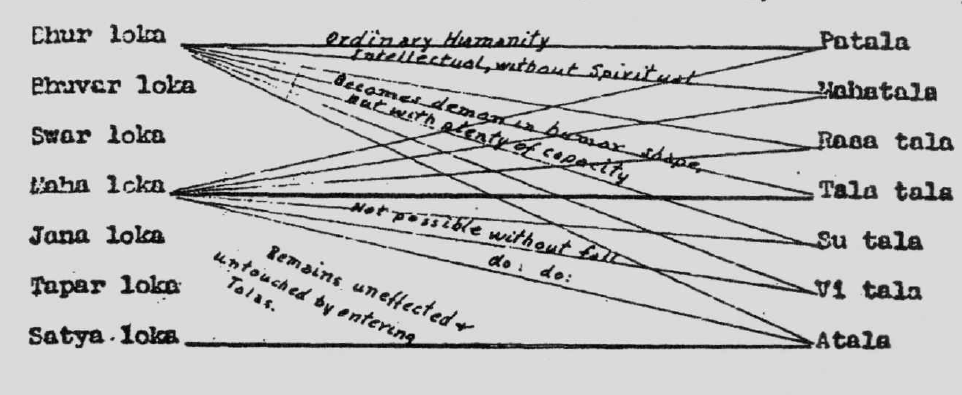
Kriyasakti: The first step towards the accomplishment of Kriyasakti is the use of the Imagination. To "imagine" a thing is to firmly create a model of what you desire, perfect in all its details. The will is then brought into action, & the form is thereby transferred to the objective world. This is creation by Kriyasakti. VIII. December 24th 1890. Present: C.W., I.C-O, G.R.S.M., C.S.W., A.L.C., A.B. (A conversation arose from a remark, made by H.P.B. earlier in the week, that the sun was much younger than the moon; that at the end of the Solar Manvantara, the Sun would break up into innumerable fragments, each of which -- flying off into space -- would gather fresh matter, & would ultimately form a planet in a new solar system. The septenary in nature was the clue to the fact that the moon, which had sent its principles into the laya centre where we were formed, was septenary. Other worlds are built on numbers: e.g. the Sun is built on Ten. The conversation was somewhat desultory.) Suns & Planets: A comet partially cools & settles down as a sun. It then gradually attracts round it planets that are, as yet, unattached to any centre; & thus, in the course of millions of years, a solar system is formed. The worn-out planet becomes a moon to the planet of another system. The Sun we see is a reflection of the true Sun. This reflection, as an outward concrete thing, is a Kama-Rupa, all the Suns forming the Kama Rupa of Kosmos. To its own system the Sun is Buddhi, as being the reflection & vehicle of the true Sun -- which is Atma -- invisible on this plane. All the Fohatic forces -- electricity, etc. -- are in this reflection. The Moon: At the beginning of the evolution of our globe, the Moon was much nearer to the earth, & larger, than it is now. It has retreated from us, & shrunk much in size. (The Moon gave all her principles to the earth, while the Pitris only gave their Chhayas to men.) The influences of the Moon are wholly psycho-physiological. It is dead, sending out injurious emanations, like a corpse. It vampirises the earth & its inhabitants, so that anyone sleeping in its rays suffers, losing some of his life-force. A white cloth is a protection, the rays not passing through it, & the head especially should be thus guarded. It has most power when it is full. It throws off particles which we absorb, & is gradually disintegrating. Where there is snow the moon looks like a corpse, being unable through the white snow to vampirise effectively. Hence snow-covered mountains are free from its bad influences. The moon is phosphorescent. The Rakshasas of Lanka, & the Atlanteans, are said to have subjected the Moon. The Thessalians learned from them their magic. Esoterically the Moon is the symbol of the Lower Manas; it is also the symbol of the Astral. Plants which, under the Sun's rays, are beneficent, are maleficent under those of the Moon. Herbs containing poisons are most active when gathered under the Moon-rays. A new Moon: A new Moon will appear during the 7th Round, & our Moon will finally disintegrate & disappear. There is now a planet, the "mystery Planet," behind the Moon, & it is gradually dying. Finally, the time will come for it to send its principles to a new laya centre, & there a new planet will form, to belong to another solar system, the present "mystery Planet" there functioning as Moon to that new globe. This Moon will have nothing to do with our Earth, although it will come within the range of vision. The Solar System: All the visible planets placed in our solar system, by astronomers, do belong to it, except Neptune. There are also some others, not known to science, belonging to it, & "all moons which are not yet visible for next things." Precious stones: In answer to a question, H.P.B. said that the diamond & the ruby were under the sun, the sapphire under the moon, -- but "what does that matter to you?" IX. December 31, 1990 Present: A.B., C.W., E.K., L.M.C., H.A.W.C., H.L.C., G.R.S.M., I.C-O., W.R.O, C.B.W. Time: When once out of the body, & not subject to the habit of consciousness formed by others, time does not exist. Cycles: There are real & conventional cycles of time. Every day brings before our consciousness events that have happened in the past, as we pass over the same ground in our cyclic journey. Cycles are measured by the consciousness of humanity, & not by Nature. It is because we are the same people as in past epochs that these events occur to us. Effects of Planets: The planets only move in our consciousness. The rulers of the seven secret planets have no influence on this earth, as this earth has on other planets. Sun: It is the Sun & Moon which really have not only a mental but also a physical effect. The effect of the Sun on humanity is connected with Kama-Prana, with the most physical Kamic elements in us; it is the vital principle which helps to growth. Moon: The effect of the Moon is chiefly Kama-Manasic, or psycho-physiological; it acts on the psychological brain. Death: The Hindus look upon Death as impure, owing to the disintegration of the body, & the passing from one planet o another. Atoms: The Atoms are the "principles" of the molecules (six in number). The Atom -- the hypothetical Atom of science -- is on the seventh sub-plane of the seven Kosmic planes, the material, visible, plane. X. January 7, 1991. Present: A.B., C.W., I.C-O., L.M.C., A.L.C., W.R.O., C.P.W., G.R.S.M., E.F.S., H.A.W.C., E.X. (Neither a dupga, nor anyone else, can read your thoughts unless they are on his own plane. Association -- of ideas -- is owing to the Law of Harmony.) H.P.B. began by saying that we ought to know the correct meaning of the Sanscrit terms used in Occultism, & should learn the Occult symbology. To begin with, we had better learn the correct esoteric classification & names of the fourteen (seven, &c., &c.) & seven (sapta) Lokas found in the exoteric texts. These were given in a very confused manner, & were full of blinds. Lokas: To illustrate this, three classifications were given: -- (1) The general exoteric orthodox & Tantric category: -- nothing but a list of blinds: -- Bhur Loka (2) The Sankhya, & of some Vedantins: -- Brahma Loka (3) The Vedantin, the nearest approach to the Esoteric: -- 1. Atala Each & all correspond esoterically both to the Kosmic & Dhyan-Chohanic Hierarchies, & to the human states of consciousness & their (49) subdivisions. To appreciate this, the meanings of the terms used in the Vedantic classification must be first understood. Tala means Place, &c: -- 1. A-tala -- noplace. 2. Vi-tala -- Some change for the better; i.e. better for matter, in that more matter enters into it; or, in other words, it becomes more differentiated. This is an ancient occult term. 3. Su-tala -- good, excellent, place. 4. Kara-tala -- something that can be grasped & touched (from Kara --land); i.e. the state where matter becomes tangible. 5. Rasa-tala -- "place of taste"; a place you can sense with one of the organs of sense. 6. Maha-tala -- exoterically "great place," but esoterically a place including all others, subjectively & potentially, including all preceding it. 7. Pa-tala -- something under the feet (from Pada -- foot); the upadhi or basis of anything, antipodes, America, &c. Pancha maha Bhutas, fatwas, &c: (of. S.B. i 572, note; ii 102, 372) Each of these Lokas, places, worlds, states &c, corresponds with & is transformed into five (exoterically) & seven (esoterically) states or Tatwas, for which there are no definite names. These in the four main divisions, cited below, make up the 49 Fires. 5 & 7 Tanmatras, outer & inner senses. These correspond in general to states of consciousness, to the Hierarchies of Dhyan Chohans, &c. These five Tatwas transform themselves into the world of illusion. Lokas: The 14 Lokas are made up of 7 with 7 reflections: -- above, below -- within, without -- subjective, objective -- pure, impure -- positive, negative -- &c, &c. Explanation of the States of Consciousness corresponding to the Vedantic classification of Lokas: 1. Atala: the atmic, or Auric, state or locality; it emanates directly from the Absoluteness, & is the first something in the Universe. Its correspondence is the Hierarchy of non-substantial primordial beings; in a place which (to us) is no place; & a state which (to us) is no state. This Hierarchy contains the primordial plane, all that was, is, & will be; from the beginning to the end of the Maha-Manvantara, all is there. This statement should not, however, be taken to imply fatality; the latter is contrary to all the teachings of Occultism. Dhyani Buddhas: These are the Hierarchies of Dhyani-Buddhas. Their state is that of Para-Samadhi, of the Dharmakaya, a state where no progress is possible; the Entities there may be said to be crystallized in puritoy, goodness, & homogeneity.
2. Vitala: Here are the Hierarchies of the Celestial Buddhas, or Bodhisattvas, who are said to emanate from the seven Dhyani Buddhas. S.W. It is related on earth to Samadhi, to the Buddhic consciousness in man. No adept, save one, can be higher than this & live; if he passes into the Atmic, or Dharmakaya state (Alaya), he can return to earth no more. These two states are purely hyper-metaphysical. 3. Sutala: A differentiated state, corresponding on earth with the H. Manas, & therefore with Sabda (Sound), the Logos, our H. Ego; and also to the Manushi Buddha state, like that of Gautama on earth. This is the third state of Samadhi (which is septenary). Here belong the Hierarchies of the Kumaras, Agnishwattas, &c. 4. Karatala: Corresponds with Sparsa ("touch"), & to the Hierarchies of ethereal, semi-objective Dhyan Chohans of the astral nature of the Manasa-Manas, or the pure ray of Manas that is the L. Manas before it is mixed with Kama (as in the young child). They are called Sparsa Devas, the Devas endowed with "touch." (These Hierarchies of Devas are progressive: the first has one sense, the second two, & so on to seven. Each containing all the senses potentially, but not yet developed. Sparsa would be better rendered by "affinity," "contact.") 5. Rasatala: or Rupatala, corresponds to the Hierarchies of Rupa, or "sight" -- Devas, possessed of three senses (sight, hearing & touch). These are Kama-Manasic entities, & the highest Elementals. With the Rosicrucians they were the Sylphs & Undines. It corresponds on earth to an artificial state of consciousness, such as that produced by hypnotism & drugs (morphine, &). 6. Maha-tala: Corresponds to the Hierarchies of Rasa, or "taste" Devas, & includes a state of consciousness embracing the lower five senses, & emanations of life & being. It corresponds to Kama & Prana in man, & to Salamanders & Gnomes in nature. 7. Patala: Corresponds to the Hierarchies of Ghanda, or "smell" -- Devas; the underworld or antipodes -- Myalba. The sphere of irrational animals, having no feeling save that of self-preservation & gratification of senses; & also of intensely selfish human beings, waking or sleeping. This is why Narada is said to have visited Patala, when he was cursed to be reborn; he reported that life there was very pleasant for those "who had never left their birthplace," they were very happy. It is the earthly state, & corresponds to the sense of smell. Here are also animal dugpas, elementals of animals, & nature-spirits. Further explanation of the same Classification: -- 1. Auric, atmic, alayic sense, or state; one of full potentiality, but not of activity. 2. Buddhic, the sense of being one with the Universe; the impossibility of imagining itself apart from it. (It was asked why the term Alayic was here given to the Atmic, & not to the Buddhic state? Ans: -- These classifications are not hard & fast divisions. A term may change places according as the classification is exoteric, esoteric, or practical. For the Inner Group the effort should be to bring all things down to states of consciousness. Buddhi is one & indivisible really; it is a feeling within, absolutely inexpressible in words. All cataloging is useless to explain it.) 3. Sabdic, sense of hearing. 4. Sparsic, sense of touch. 5. Rupic, the state of feeling oneself a body, & perceiving it (Rupa -- form). 6. Rasic, sense of taste. 7. Ghandic, sense of smell. All the Kosmic & anthropic (man) states & senses correspond with our organs of sensation, Gayanendriyas, rudiments or organs for receiving knowledge through direct contact, sight, &c. These are the faculties of Sarira, through Netra -- eyes, nose, speech, &c. & also with the organs of action, Karmendriyas, hands, feet, &c. Exoterically these are five sets of five, giving 25. Of these twenty are facultative & five Buddhic. Exoterically Buddhi is said to perceive; esoterically it obtains perception only through the H. Manas. Each of these twenty is either positive or negative, thus making forth in all. There are two subjective states answering to the four sets of five, hence 8 in all. These being subjective cannot be doubled. Thus we have 40 + 8 = 48 "cognitions of Buddhi." These with Maya, which includes them all, = 49. (Once you have reached the cognition of Maya, you are an Adept. Jan. 8, 1891. (Rao B.K. Laheri took the Pledge in the presence of I.C-O., L.M.C., W.R.O., C.F.W., & G.R.S.M.) Notes: Jan. 11, 1891. In their exoteric blinds the Brahmins count 14 Lokas (the Earth included), of which 7 are objective, though not apparent; & 7 subjective, yet fully demonstrable to the Inner man. These are the: -- 7 Divine Lokas (1) Bhur-loka (the Earth) (2) Bhuva-loka (the space between the earth & the Sun -- Munis.) (3) Swar-loka (the space between the Sun & the Pole Star -- Yogis) (4) Mahar loka (the space between the earth & the uttermost limit of the solar system.) [1] (5) Jana loka (beyond the solar system, the abode of the Kumaras, who do not belong to this plane.) (6) Tupar loka (state beyond the Mahatmic region, the dwelling Vairaja deities). (7) Satya loka (the abode of the Nirvanees.) 7 Informal (terrestrial) Lokas (1) Patala (our earth). (2) Maha tala. (3) Rasa-tala. (4) Tala-tala (also Kara-tala). (5) Sutala. (6) Vitala. (7) Atala. [2] Now all these 14 are planes from without within, & states of consciousness through which man can pass, & must pass, once he is determined to go through the 7 Paths & Portals of Dhyani. One need not be disembodied for this. All it is is reached on earch in one, or many, of the incarnations. Notice the order: -- the four lower ones (1, 2, 3, 4) are rupa, i.e. they are performed by the inner man with the full concurrence of the diviner portion, or element, of the L.Manas, & consciously by the personal man. The three higher states cannot be reached & remembered by the latter, unless he is a fully initiated Adept. A Hatha-Yogi will never pass beyond the Mahar loka, psychically; & the Tala-loka, (double, or dual, plane) psycho-mentally. To become a Raj-Yogin, a Chela has to ascend up to the 7th Portal, the Satya-loka. For such, the master Yogins tell us, is the fruition of "ijya," or "sacrifice." When the Bhur, Bhuvar, & Swarwa (states) are once passed, & the consciousness of the Yogi is in Haharloka, it is the last plane & state between entire identification of the Personal & the H. Manas. One thing must be remembered: -- while the "infernal," or terrestrial, states are also the 7 divisions of the Earth -- for planes & states -- as much as they are Kosmic divisions; the Divine Sapta 36 Loka are purely subjective, & begin with the psychic, astral-light plane; ending with the Satya, or Jivanmukta, state. Those 14 Lokas or "Spheres," form the extent of the whole Brahmanda (World). The four lower are transitory, with all their dwellers; & the three higher eternal; i.e. the former states, planes, & subjects to these, last only a Day of Brahma, changing with every Kalpa; the latter endure for an Age of Brahma. In the appended diagram only Body, Astral, Kama, L. Manas, H. Manas, Buddhi, & Auric-Atmic, are given. Life is a Universal Kosmic Principle, & -- no more than Atman -- does it belong to individuals.
Diagram, showing the Interblending of States of Consciousness on the Planes. (from E.T.S.'s Notebook)
_______________ Notes: 1. All these spaces denote the special magnetic currents, the planes of substance, & the degrees of approach that the consciousness of the Yogi, or Chela, makes towards assimilation with the inhabitants of the Lokas. 2. These are the Brahmins read from the bottom. XI. January 14, 1891. Present: A.B., C.W., I.C-O, L.M.C., E.K. E.T.S., G.R.S.M., A.L.C., C.F.W., W.R.O. In answer to questions on the diagram, H.P.B. said that touch & taste have no order. Elements have a regular order, but fire pervades them all. Every sense pervades every other. There is no universal order, that being first in each (student) which is most developed. Organs & States of Consciousness: Students must learn the correspondences; then concentrate on the organs, & so reach their corresponding state of consciousness. Take them in order, beginning with the lowest, & working steadily upwards. A medium might irregularly catch glimpses of higher, but would not thus gain orderly development. Opposites: The Lokas & Talas are reflections the one of the other; so are the Hierarchies, in pairs of opposites, at the two poles of the sphere. Everywhere are such opposites; good & evil, light & darkness, male & female. Blue: H.P.B. could not say why blue was the colour of the earth. Blue is a colour by itself, a primary. Indigo is a colour, & not a shade of blue. So is Violet. Vairajas: The Vairajas belong to, are the fiery Egos of, other Manvantaras. They have already been purified in the fire of passions. It is they who refuse to create. They have reached the 7th Portal, & have refused Nirvana, remaining for succeeding Manvantaras. Little finger: The greatest phenomena are produced by touching, & centring the attentionon the little finger. Antaskaruna: The seven steps of Antaskarana correspond with the Lokas. Samadhi: Samadhi is the highest state on earth that can be reached in the body. Beyond that the Initiate must have become a Nirmanakaya. Purity: Purity of mind is of greater importance than purity of body. If the upadhi be not perfectly pure, it cannot preserve recollections coming from a higher state. An act may be performed to which little or no attention is paid, & it is of comparatively small importance. But if thought of, dwelt on, in the mind, the effect is a thousand times greater. The thought must be kept pure. Pratyeka Buddha: The Buddhists call the Pratyeka Buddha the rhinoceros, the solitary animal. Kama: Remember that Kama, while the parent of bad passions & emotions, helps you to evolve, by giving also the desire and impulse necessary for rising. The Body: The flesh, the body, the human being in his material part, is -- on this plane -- the most difficult thing to subject. The highest Adept, put into a new body, has to struggle against & subdue it, & finds its subjugation difficult. Liver & Spleen: The Liver is the General, the spleen the A.D.C. All that the Liver does not accomplish is taken up & completed by the Spleen. XII. January 21, 1891. Present: A.B., I.C-O., C.W., G.R.G.M., H.A.W.C., A.L.C., E.F.S., E.K. W.R.C., C.F.W. H.P.B. was asked whether each person must pass through the 14 States? and answered, that the Lokas & Talas represented planes on this earth, through some of which all must pass; & through all of which the disciple must pass on his way to Adeptship. Everyone passes through the lower Kolas, but not necessarily through the corresponding Palas. There are two poles in everything; seven states in every state. Vitala: Vitala represents a sublime as well as an infernal state. That state which for the mortal is a complete separation of the Ego from the personality, is for a Buddha a mere temporary separation. For the Buddha it is a cosmic state. Hells: The Brahmins & Buddhist regard the Talas as hells, but in reality the term is figurative. We are in hell whenever we are in misery, suffer misfortunes, etc. H.P.B. remarked that the Group should come to some common understanding, to some standard of agreement. She was anxious to give us facts which would lead us to practical knowledge, but could not do so until we all understood in the same way the instructions already given. Forms in the Astral Light: The Elementals in the Astral Light were reflections. Everything on earth is reflected. It is from these that photographs are sometimes obtained through mediums. The mediums unconsciously produce them as forms. Adepts produce them through Kriyasakti, bringing them down by a process that may be compared to the focusing of rays of light by a burning-glass. States of consciousness: Bhur Loka is the waking state in which we normally live; it is the state in which animals also are, when they sense food, a danger, &c. To be in Swar Loka is to be completely abstracted on this plane, leaving only instinct to work, so that on the material plane you would behave as an animal. Yogis are known who have become crystallized in this state, & they then must be nourished by others. A Yogi near Allahabad had been for fifty-three years sitting on a stone; his Chelas plunge him into the river every night, & then replace him. During the day his consciousness returns to Bhur Loka, & he talks & teaches. A Yogi was found on an island near Calcutta, round whose limbs the roots of trees had grown. He was cut out, & in the endeavour to awaken him so many outrages were inflicted on him that he died. Is it possible to be in more than one state of Consciousness at once? The consciousness cannot be entirely on two planes of consciousness at once. The higher & lower states are not wholly incompatible, but if you are on the higher, you will woolgather on the lower. In order to remember the higher state on returning to the lower, the memory must be carried upwards to the higher. An Adept may apparently enjoy a dual consciousness; when he desires not to see he can abstract himself; he may be in a higher state & yet return answers to questions addressed to him. But in this case he will momentarily return to the material plane, shooting up again in the higher. This is his only salvation in adverse conditions. Intellect & Spirituality: The lower you go in the talas, the more intellectual you become, & the less spiritual. You may be a morally good man, but not spiritual. Intellect may remain very closely related to Kama. A man may be in a loka, & visit one or all the Talas, his condition depending on the loka to which he belongs. Thus a man in Shurloka only may pass into the Talas, & may go to the devil. If he dwell in Bhuvar Loka he cannot become as bad. If he has reached the Satya state he can go into any Tala without danger, buoyed up by his own purity he will never be engulphed. The Talas are brain-intellect states while the lokas -- or more accurately, the three higher -- are spiritual. (Thus M.M.C. was probably between Mahar and Jana when spiritual, & between Talatala & Sutala in intellectual). The Three becoming One: Manas absorbs the light of Buddhi; Buddhi is arupa & can absorb nothing. When the Ego takes all the light of Buddhi, it takes that of Atma, Buddhi being the vehicle, & thus the three become one. This done, the full Adept is One spiritually, but has also a body; the fourfold path is finished & he is One. The Masters' bodies are illusionary, & hence do not grow old, become wrinkled, etc. The work of the student: The student who is not naturally psychic should fix the fourfold consciousness on a higher plane & nail it there. Let him make a bundle of the four lower & pin them to a higher state. He should centre on this higher, trying not to permit the body & intellect to draw him down & carry him away. "Play ducks & drakes" with the body, eating, drinking, & sleeping, but keeping always in the ideal. Mother-Love: Mother-Love is an instinct, the same in the human being & the animal, & often stronger in the latter. The continuance of this love in human beings is due to association, to blood magnetism, & to psychic affinity. Families are sometimes formed of those who have lived together before, but often not. The causes at work are very complex & have to be balanced. Sometimes when a child with very bad Karma is to be born, parents of a callous type are chosen, or they may die before the Karmic results appear. Or the suffering through the child may be their own Karma. Mother-love, as an instinct, is between Rasatala & Talatala. Lipikas: The Lipikas keep man's Karmic record, & impress it on the astral light. Vascillation: Vascillating people pass from one state of consciousness to another. Thought & Action: Thought arises before desire; the thought acts on the brain, the brain on the organ, & thus desire awakes. It is not the outer stimulus that arouses the organ. Thought therefore must be slain ere desire can be extinguished. The student must guard his thoughts; five minutes thought may undo the work of five years, & though the five year's work will be run through more rapidly the second time, yet time is lost. XIII. January 28, 1891. Present: A.B., C.W., I.C-O., L.M.C., H.A.W.C., A.L.C., W.R.O., C.F.W., C.R.S.M., E.K., E.T.S. Consciousness: H.P.B. began by challenging the views of consciousness held in the West, commenting on the lack of definition in the leading philosophies. No distinction was made between consciousness & self-consciousness, & yet in this lay the difference between man & the animal. The animal was conscious only, not self-conscious; the animal does not know the Ego -- as Subject -- as does man. There is, therefore, an enormous difference between the consciousness of the bird, the insect, the beast, & that of man. Self-Consciousness: But the full consciousness of man is Self-Consciousness, that which makes us say "I do this or that." If there is pleasure, it must be traced to someone experiencing it. Now the difference between the consciousness of man & of animals is, that while there is a self in the animal, the animal is not conscious of the self. Spencer reasons on consciousness, but when he comes to a gap, he merely jumps over it. So again Hume, when he says that on introspection he sees merely feelings & can never find any "I", he forgets that without an "I" no perception of feelings would be possible; what is it that studies the feelings? The animal is not conscious of the feeling "I am I"; it has instinct, but instinct is not self-consciousness. Self-consciousness is an attribute of the mind, not of the soul, the anima, whence the very name animal is taken. Humanity had no self-consciousness until the coming of the Manasa-Putras in the third race. Consciousness, brain-consciousness, is the field of the light of the Ego, of the Auric Egg, of the Higher Manas. The acts of the legs are conscious, they cannot originate an idea, although when they are tired they can convey to the man an uneasy sensation, & so give rise to the idea of fatigue. Instinct is the lower state of consciousness. Man has consciousness running through the four lower keys of his septenary consciousness; there are seven scales of consciousness in his consciousness, which is none the less essentially & pre-eminently one, a Unit. There are millions & millions of leaves; but as you cannot find two leaves alike, so you cannot find two states of consciousness alike; a state is never exactly repeated. Memory, &c, & Mind: Is memory a thing born in us? that it can give birth to the Ego? Knowledge, feeling, & volition are colleagues of the mind, not faculties of it. Memory is an artificial thing, an adjunct of retentiveness; it can be sharpened or left dull, & it depends on the condition of the brain cells which store all impressions. Knowledge, feeling, volition, cannot be correlated, do what you will. They are not produced from each other, nor produced from mind, but are principles -- colleagues. You cannot have knowledge without memory, for memory stores all things, garnishing & furnishing. If you teach a child nothing, it will know nothing. Brain consciousness depends on the intensity of the light shed by the higher Manas on the lower, & the extent of affinity between the brain & this light; it is the field of consciousness of the Manas. The animals has the Manas & the Monad latent, but its brain cannot respond; all potentialities are there, but are dormant. There are certain accepted errors in the West which vitiate all their theories. Simultaneous impressions: How many impressions can a man receive simultaneously into his consciousness & record? The Westerns say one: Occultists say, normally, seven, & abnormally, 14, 17, 19, 21, up to 49 impressions can be simultaneously received. You can prove it by striking at once the seven notes of the musical scale, the seven sounds reach the consciousness simultaneously, but the untrained ear can only recognise them one after another, & if you choose you can measure the intervals. The trained ear will hear the seven notes at once, simultaneously. And experiment has shown that in two or three weeks a man may be trained to receive 17 or 18 impressions of colour, the interval decreasing with practise. Memory: Memory is acquired for this life, & can be expanded. Genius is the greatest responsiveness of the brain, & brain-memory, to the Higher Manas. Impressions on any sense are stored in the memory. Mental & physical Sense: Before a physical sense is developed there is a mental feeling, which proceeds to become a physical sense. Fishes which are blind, living in the deep sea, if they are put into a pond will in a few generations, develop eyes. But in their previous state there is a sense of seeing though no physical sight; how else should they, in the darkness, find their prey, avoid dangers, &c. The mind will take in & store all kinds of things mechanically & unconsciously, & will throw them into memory as "unconscious perceptions." If the attention is greatly engrossed in any way, the sense-perception of any injury is not felt at the time; but later the suffering enters into consciousness. So, returning to our example of the seven notes struck simultaneously, we have one impression, but the ear is affected in succession by the notes one after another, so that they are stored in the brain-mind in order, for the untrained consciousness cannot register them simultaneously. All depends on training & on attention. Then the transference of a sensation passing from any organ to the consciousness is almost simultaneous, if your attention is fixed on it; but if any noise distracts your attention, then it will take a fraction more of a second before it reaches your consciousness. The occultist should train himself to receive & transmit, along the line of the seven scales of his consciousness, every impression -- or impressions -- simultaneously, he who reduces the intervals of physical time the most has made the most progress. Consciousness: Its seven scales: There are seven scales, or shades, of consciousness of the unit; e.g. in a moment of pleasure or pain, four lower, three higher degrees. 1. Physical sense-perception: (Perception of the cell; if paralysed, the sense is there, though "you" do not feel it." 2. Self-perception, or apperception: (i.e. self-perception of cell.) 3. Psychic apperception: (of astral double, doppelganger), which carries it higher, to the -- 4. Vital perception: (physical feeling, sensation of pleasure & pain, -- of quality), -- (These are the four lower scales, & belong to the Psycho-Physiological man). 5. Manasic discernment; of the lower Manas. (Manasic Self-perception). 6. Will-perception: (volitional perception, the voluntary taking in of an idea; e.g. you can regard or disregard physical pain). 7. Spiritual, entirely conscious, apperception: (because it reaches the higher Self-Conscious Manas). (Apperception means self-perception, conscious action; not, as with Leibnitz, but when attention is fixed on the perception). You can take these on any planes; e.g. bad news passes through the four lower stages, coming to the heart. Or take sound: -- 1. It strikes the ear. 2. Self-perception of the ear. 3. On the psychic or mental, which carries it to 4. Vital: (harsh, soft, strong, weak, &c.) The Ego: One of the best proofs that there is an Ego, a true field of consciousness, is the fact already mentioned that a state of consciousness is never exactly reproduced, though you should live a hundred years, & pass through milliards & milliards. In an active day, how many states & sub-states there are; it would be impossible to have cells enough for all. This will help you to understand why some mental states & abstract things follow the Ego in Devachan, & why others merely scatter into space. That which touches the Entity, has an affinity for it -- as a noble action -- is immortal, & goes with it into Devachan, forming part & parcel of the biography of the personality which is disintegrating. A lofty emotion runs through the 7 stages, & touches the Ego, the mind that plays its tunes in the mind-cells. Bhurloka: The Bhurloka begins with the lower Manas. Animals do not feel as do men; a dog thinks more of his master being angry than he does of the actual pain of the lash. The animal does not suffer in memory & in imagination, feeling past & future, as well as actual present, pain. Pineal Gland: The special physical organ of perception is the brain, & perception is located in the aura of the pineal gland. This aura answers in vibrations to any impressions; but it can only be sensed, not perceived, in the living man. During the process of thought manifesting to consciousness, a constant vibration occurs in the light of the aura, & a clairvoyant looking at the brain of a living man may almost count, see with the spiritual eye, the seven scales, the seven grades of light, passing from the dullest to the brightest. You touch your hand; before you touch it the vibration is already in the aura of the pineal gland, & has its own shade of colour. It is this aura that causes the wear & tear of the organ by the vibration it sets up. The brain, set vibrating, conveys the vibrations to the spinal cord, & so to the rest of the body. Happiness as well as sorrow sets up these strong vibrations, & so wears out the body. Powerful vibrations of joy or grief may thus kill. We can analyse the work of consciousness & describe it; but we cannot define consciousness unless we postulate a subject. The Heart: The septenary disturbance & play of light around the pineal gland are reflected in the heart, or rather the "area" of the heart, which vibrate & illumine the 7 brains of the heart; just as does the aura round the pineal gland. This is the -- exoterically four, but esoterically -- seven-leaved lotus, the saptaparna, the cave of Buddha with its seven compartments. Astral & Ego: There is a difference between the nature & the essence of the Astral Body & the Ego. The Astral body is molecular, however etherealized it may be; the Ego is atomic, spiritual. The atoms are spiritual & are forever invisible on this plane; molecules form around them, they remaining as the higher invisible principles of molecules. The eyes are the most occult of our senses; close them & you pass to the mental plane. Stop all the senses, & you are entirely on another plane. Individuality: If twelve people are smoking together, the smoke of their cigarettes may mingle, but the molecules of the smoke from each have an affinity with each other, & remain distinct for ever & ever, no matter how the whole mass may interblend. So a drop of water though it fall into the ocean retains its individuality; it has become a drop with a life of its own, like a man, & cannot be annihilated. A student asked whether the group -- as a group -- was a drop. H.P.B. answered in the affirmative; if we had met to but corn [?], we should appear as a group in the Astral Light, but we should not be permanent; but meeting to study occultism, we should cohere, & the impression would be more permanent. The higher & more spiritual the affinity the more permanent the cohesion. A rose created by Kriyasakti remains as a reflection. L. Manas: The Lower Manas was an emanation from the Higher Manas, & was of the same essence as the higher. This nature (essence) can make no impression on this plane, nor receive any; an archangel, having no experience, would be senseless on this plane, would neither give nor receive impressions. So the Lower Manas clothes itself with the essence of the Astral Light; this astral envelope shuts it out from its parent, except through Antaskarana, which is the only salvation. Break this, you become an animal. Kama: Kama is life, it is the essence of the blood. When this leaves the blood, the latter congeals. Prana is universal on this plane; it is in us the vital princiople, pranic rather than Prana. XIV. February 4, 1891. Present: A.B., C.W., G.R.S.M., W.R.O., I.C-O., L.W.C., A.L.C., C.F.W., E.T.S., H.A.W.C., E.K. -- "Self" of Animals, &c. Qualities determine the properties of "self-hood." As, for instance, two wolves placed in the same environment would probably act differently. Higher & Lower Manas; A.E. & Astral Light: The field of consciousness of the Higher Ego is never reflected in the Astral Light. The Auric Envelope receives the impressions of both the Higher & the Lower Manas, & it is the latter impressions which are also reflected in the Astral Light. Whereas the essence of all things spiritual, all that which reaches -- or is not rejected by -- the H. Ego is never reflected in the Astral Light, because the latter is on too low a plane. But during the life of a man this essence, with a view to Karmic ends, is impressed on the Auric Envelope, & after death & the separation of the principles, is united with the Universal Mind (that is to say, those "impressions" which are superior to even the devachanic plane), to wait there -- karmically - until the day when the Ego is to be reincarnated. (There are these three sets of impressions which we may call the Karmic, Devachanic, & Manasic.) For the entities, no matter how high, have to have their karmic rewards & punishments on earth. The spiritual impressions are more or less impressed upon the brain, otherwise the lower Ego would not be responsible. There are some impressions, however, received through the brain, which are not of our previous experience. In the case of the Adept, the brain is trained to retain these impressions. Responsibility: The reincarnating "Ray" may, for convenience, be separated into two aspects, the lower Kamic Ego is scattered in Kama-loka, the Manasic part accomplishes its cycle & returns to the Higher Ego. It is in reality this Higher Ego which is, so to say, punished, which suffers. This is the true Crucifixion of the Christos, the most abstruse but yet the most important mystery of Occultism; all the cycle of our lives hangs on it. It is indeed the Higher Ego which is the sufferer; for, remember the abstract consciousness of the higher personal consciousness will remain impressed on the Ego, since it must be part & parcel of its Eternity. All our grandest inspirations are impressed on the Higher Ego because they are of the same nature as itself. Patriotism, &c: Patriotism, & great actions performed in the national service are not altogether good, from the point of view of the highest. To benefit a portion of Humanity is good, but to do so at the expense of the rest is bad. Therefore in patriotism, &c., the venom is also assimilated with the good. For though the inner essence of the Higher Ego is unsoilable, the outer may be soiled. Thus both the good & the bad -- of such "immaterial" inspirations -- are impressed on the A.E. & the Karma of the bad is taken up by the H. Ego, though it is perfectly guiltless of it. Thus both sets of impressions scatter, after death, in the Universal Mind, & on reincarnation the Ego sends out a ray, which is itself, into a new personality -- & there suffers. It suffers in the self-consciousness that it has created by its accumulated experience. Higher Ego: Every one of our Egos has the Karma of past Manvantaras behind. There are seven Hierarchies of Egos, some of which, e.g., in inferior tribes -- may be said to be only just beginning this present Cycle. The Ego starts with Divine consciousness; no past, no future, no separation. It is long before realizing that it is itself; only after many births does it begin to discern, by this collectivity of experience, that it is individual. At the end of its cycle of incarnations, it is still the same divine consciousness, but it has now become individualized self-consciousness. Responsibility: The feeling of responsibility is inspired by the presence of the light of the H. Ego. As the Ego in its cycle of rebirths becomes more & more individualised, it learns more & more, by suffering, to recognise its own responsibility, by which it finally regains self-consciousness, the consciousness of all the Egos of the whole Universe. Absolute being, to have the sensation or idea of all this, must pass through all experience -- individually, not universally -- so that when it returns it should have the same omniscience as the Universal Mind -- plus the memory of all that it has passed through. Day "Be-with-us": At the day "Be-with-us", every Ego has to remember all the cycles of its past incarnations, for Manvantaras. The Ego comes in contact with this Earth, all seven principles become one, it sees all that it has done therein. It sees the stream of its past incarnations by a certain divine light. It sees all humanity at once, but still there is ever -- as it were -- a stream which is always the "I". We should therefore always endeavour to accentuate our responsibility. Responsibility of the Higher Hego: The Higher Ego may be compared to a globe of pure divine light, a Unit from a higher plane, on which there is no differentiation. Descending to a plane of differentiation it emanates a ray, which can only manifest through the personality, which is already differentiated. A portion of this Ray -- the L. Manas -- during life may so crystallize itself & become one with Kama, that it will remain assimilated with matter. That portion which retains its purity forms Antaskarana.
[TO BE CONTINUED]
|




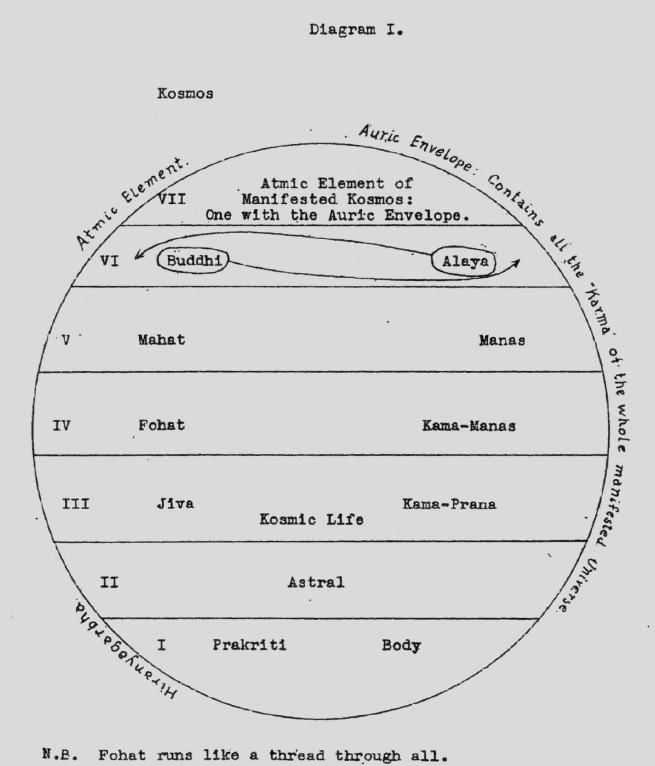
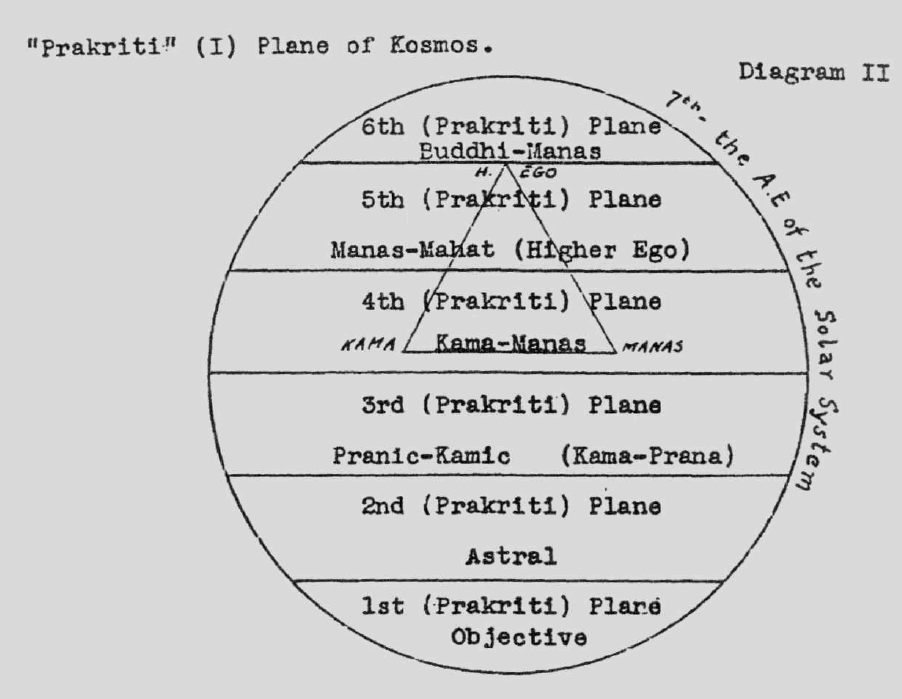
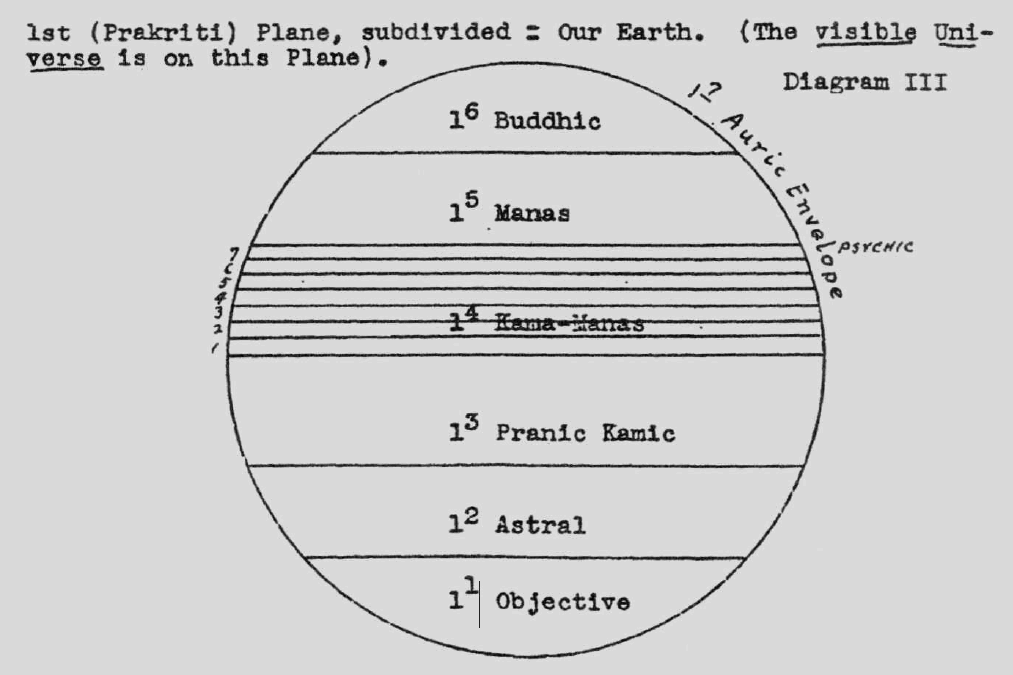
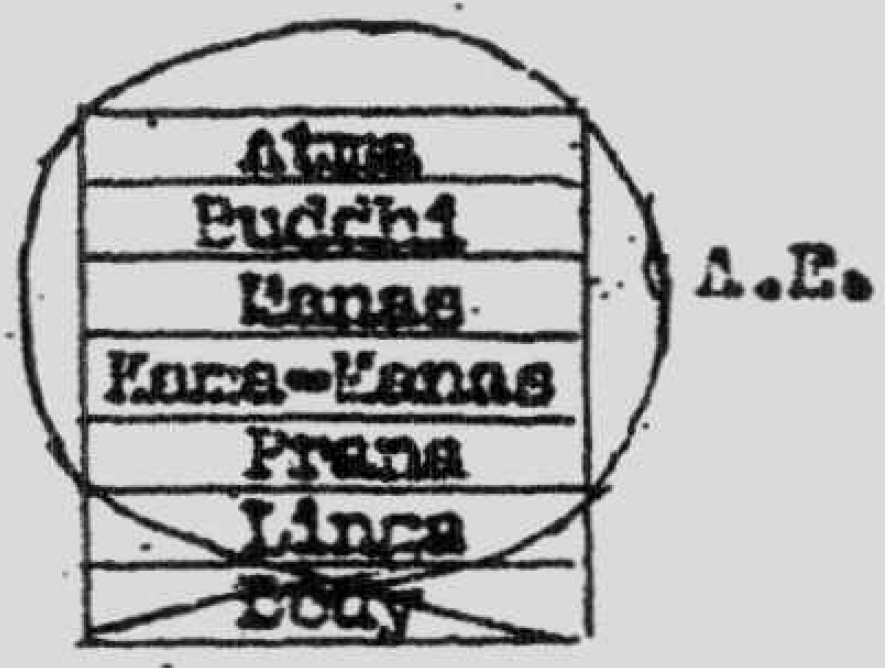
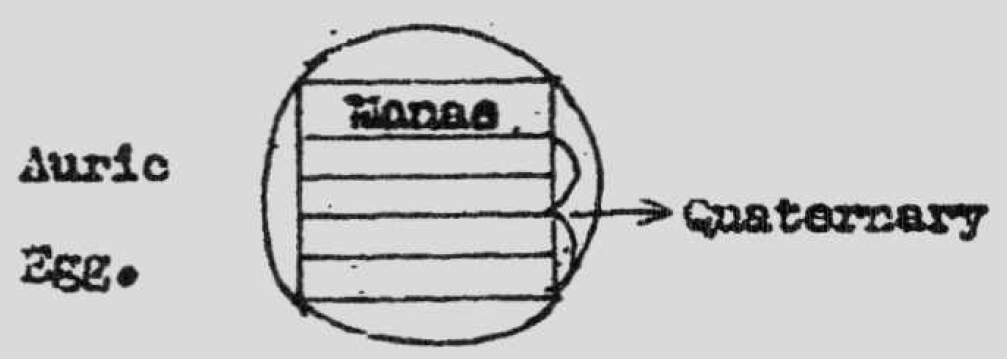

 ,
[2] since just as an innumerable number of men rule the
earth, so a countless number of stars and of Gods rule the
celestial world.
,
[2] since just as an innumerable number of men rule the
earth, so a countless number of stars and of Gods rule the
celestial world.