|
Examination Paper No. 1 dated June 12,
1890 (Facsimile)
STRICTLY PRIVATE AND CONFIDENTIAL.
ESOTERIC SECTION.
As the Head of the Section desires to
make the next Instructions as useful as possible, the following
questions have been drawn up, in order that the answers of the members
may show how far they have progressed, and thus direct her in the choice
of a subject and in other respects.
----------
EXAMINATION PAPER NO. 1
1. What are the Pitris?
2. What is Kama Rupa?
3. What is the difference between the
Higher and the Lower Self?
4. What is the Astral Light?
5. Give your reasons for joining the E.
S.
6. What Theosophical book do you consider
has most helped you?
7. What's Occultism, and what do you
consider to be practical Occultism?
----------
You are requested to answer, as soon as
possible, the above questions without referring to any book and without
assistance; and to send the answers to the Secretary E. S. as soon as
possible. All American members will reply at once on this sheet or
attaching the answer to this, to
By order of H. P. B.
WILLIAM Q. JUDGE,
P. O. Box. 2659, New York, N. Y.
London, June 12, 1890.
***
STRICTLY PRIVATE AND CONFIDENTIAL.
E. S. T. S.
NOTICE
THE attention of all members of the
Esoteric Section is again called to the inflexibility of the following
Regulations:
1ST. That every Esoteric communication to
the Secretary, Mr. William Q. Judge, must bear upon its envelope the
word "Private."
2D. That no other business, Theosophical
Path, or what not, can be upon the same sheet or in the same envelope as
Esoteric business.
3d That no envelope shall bear the word
"Private" which is not upon purely Esoteric business or upon business
purely personal to Mr. Judge.
The reason for this is as follows. All
letters upon business of the Theosophical Society and all upon business
of the Path are separately arranged and filed for immediate use and
subsequent reference, and in order to save time. If a letter contains an
order, a remittance, or a request concerning T. S. or Path business, and
also contains matters concerning the E. S., it must either be withdrawn
from the cognizance of those deputed to execute the office duties, and
thereby receive no attention, or else follow the usual course and be
exposed to inspection by the staff. In the former case the business is
unattended to; in the latter case E. S. matters are made public.
It must be understood that E. S.
communications are kept wholly separate from others, and are filed and
answered by the Secretary himself, that he has other onerous duties to
perform, and it must not be supposed that he can spend valuable time in
separating the different parts of mixed communications.
As this necessary rule has been so often
violated, and as so much time and trouble have been wasted through
violations, the Secretary is obliged to notify members that they must
hereafter expect such violations to be followed by a return to them of
the letters. If, then, a member receives back again a letter by him to
the Secretary and upon it the words "Returned for violation of rule," he
will note that there has been an infraction and must conform his letter
to the rule before it will receive attention.
It is also to be remembered that notices
of change of address must be sent to the Secretary. They have no
validity for the Esoteric Section of the T. S. if sent to the editor of
the Path or to the General Secretary of the T. S.
WILLIAM Q. JUDGE,
Secretary to H.P.B.
July, 1980

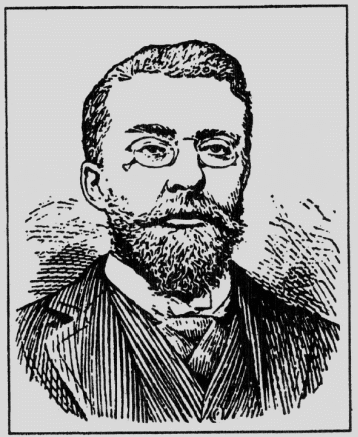
Bertram Keightley
STRICTLY PRIVATE AND CONFIDENTIAL.
E. S. T. S.
Notice from H.P.B.
Having learned since the return of Mr.
Bertram Keightley from the U. S. that several members of the Section
have misconstrued what was said to them by him on his own account in
regard to the Auric Egg, and have supposed that because he came from me
his remarks were to be taken as instructions from me, I have to say:
I. I have neither written, issued, nor
sent through Bertram Keightley any orders or instructions whatever
respecting the above matter.
2. What has been repeated to me, vis:
"that the Auric Egg is to be formed (or to that effect) by colors," and
so forth, has never been stated by me to any one, is incorrect,
unphilosophical, and if such has been attempted, is to be stopped at
once.
3. The only "orders" in Instructions
which I issue in the U.S. are through Mr. William Q. Judge, or those
which I myself sign my name to with my physical hand.
4. Any report or statement by anyone of
orders or instructions alleged to be by me in any other form than as
stated in the foregoing paragraph are and shall be false; and any member
acting on any other sort of order and without first sending the same to
Mr. William Q. Judge, will be expelled from the Section.
5. I desire above all that the members of
this Section shall exercise as much common-sense as they are capable of
and that they shall avoid all dealing with astral messages, reports,
spooks and the like until they shall have attained to the requisite
knowledge and ability.
Mr. William Q. Judge will notify all
members in the U. S. of the above.
H. P. B.
London, August 9, 1980
***
H.P. BLAVATSKY ON THE ESOTERIC SECTION
"Either I have stated the truth as I know
it about the Masters and teach what I have been taught by them, or I
have invented both Them and the Esoteric Philosophy. There are those
among the Esotericists of the inner group who say that if I have done
the latter, then I must myself be a 'Master'. However it may be, there
is no alternative to this dilemma.
"The only claim, therefore, which
India could ever have upon me would be strong only in proportion to the
activity of the Fellows there for Theosophy and their loyalty to the
Masters. You should not need my presence among you to convince you
of the truth of Theosophy, any more than your American brothers need.
it. A conviction that wanes when any particular personality is absent is
no conviction at all. Know, moreover, that any further proof and
teaching I can give only to the Esoteric Section, and this for the
following reason: its members are the only ones whom I have the right to
expel for open disloyalty to their pledge (not to me, H.P.B., but to
their Higher Self and the Mahatmic aspect of the Masters), a privilege I
cannot exercise with the F.T.S. at large, yet one which is the only
means of cutting off a diseased limb from the healthy body of the tree,
and thus save it from infection.... Thenceforth let it be clearly
understood that the rest of my life is devoted only to those who believe
in the Masters, and are willing to work for Theosophy as they understand
it, and for the T.S. on the lines upon which they originally established
it ....
"In my position, half-measures are worse
than none. People have either to believe entirely in me, or to honestly
disbelieve. No one, no Theosophist, is compelled to believe, but it is
worse than useless for people to ask me to help them, if they do not
believe in me. Here in Europe and America are many who have never
flinched in their devotion to Theosophy; consequently the spread of
Theosophy and the T.S., in the West, during the last three years has
been extraordinary. The chief reason for this is that I was enabled and
encouraged by the devotion of an ever- increasing number of members to
the Cause and to Those who guide it, to establish an Esoteric
Section, in which I can teach something of what I have learned to those
who have confidence in me, and who prove this confidence by their
disinterested work for Theosophy and the T.S. For the future, then, it
is my intention to devote my life and energy to the E.S., and to the
teaching of those whose confidence I retain. It is useless I should use
the little time I have before me to justify myself before those who do
not feel sure about the real existence of the Masters, only because,
misunderstanding me, it therefore suits them to suspect me ...."
H.P. Blavatsky
Letter dated August, 1890 and addressed "To My Brothers of Aryavarta"
***
THE INNER GROUP TEACHINGS
"The matter contained in this [E.S.]
Instruction [IV] was delivered orally by H.P.B. in her (Inner) Group
Teaching. ... It ... was carefully written down by the students at the
time, one of the number reporting it in shorthand. All the notes thus
taken were compared, and a fair copy was made by the two Secretaries,
Annie Besant and George R.S. Mead. This copy was again checked by
questioning H.P.B. on any point that seemed obscure ...."
Annie Besant
"Notice" prefacing E.S. Instruction No. IV, July, 1891.
"An Inner Group was later on formed
[August, 1890] by H.P.B.
 at London, so that she might give out teachings to be recorded by the
members, and, if possible, teach them practical occultism. Of this Mrs.
Besant, with George Mead to help her, was made the Secretary ....
at London, so that she might give out teachings to be recorded by the
members, and, if possible, teach them practical occultism. Of this Mrs.
Besant, with George Mead to help her, was made the Secretary ....
"The conversations of H.P.B.
with the Inner Group were taken down in a more or less fragmentary form
by the different members in notes, and later Mrs. Besant and George Mead
wrote them out as Secretaries. I have a complete copy of these, and so
has each member of the Inner Group ...."
William Q. Judge
E.S.T. Circular, "By Master's Direction", November, 1894, p. 3.
***
"The Instructions of H.P.B. to the I.G.
were written down by each member, and these notes were handed to George
Mead and myself, we always writing them down promptly, and H.P.B. often
looking over the completed version, so as to ensure accuracy."
Annie Besant
E.S.T. Circular,
December 19, 1894.
"The I.G. Teachings were given orally by
H.P.B. at its meetings in 1890-91. It was the duty of the two
secretaries, Mrs. Besant and Mr. Mead, to write these Teachings up, from
notes sent in by all of us, after each meeting, and record them in
a book. This record was dealt with at each succeeding meeting, corrected
and often amplified by H.P.B."
Alice Leighton Cleather
H.P. Blavatsky: A Great Betrayal, 1922, p. 83.
"... H.P.B. and the Lansdowne Road
household ... move[d] into Mrs. Besant' s house in Avenue Road.... A
lecture hall had been added to her house (a large detached one, standing
in a garden) for the meetings of the Blavatsky Lodge, both public and
private. It was also used for the meetings of the E.S.T.... To the E.S.
meetings, H.P.B. rarely, if ever, came (in person, at least); and, on
the formation of the Inner Group of the E.S., she was seen even less
often outside her own rooms, save in her bath chair, in the garden at
the back of the house.
"The names of the twelve members of the
Inner Group became subsequently so well known that there can be no
indiscretion involved in giving them here. We were six men and six women
.... [1] Countess [Constance] Wachtmeister and [2] Mrs. [Isabel]
Cooper-Oakley .... [3] Miss [Laura] Cooper and (4) Miss Emily
Kislingbury ... [5] Mrs. [Annie) Besant ...[6] [Alice Leighton Cleather
herself) ...[7] Dr. Archibald Keightley and [8] Mr. Berbert Coryn ...
[9] Claude Wright ... [10] [G.R.S.] Mead ... [11] [E.T.) Sturdy ... (12)
Mr. Walter Old....
"There were two more members of the I.G.
whose names did not appear, who were not under the same strict Rules as
we were, and who never attended its meetings. One [Rai B. K. Lahiri] of
them could not, for the very good reason that he was a native of India
and lived there. The other was Dr. Wynn Westcott....
"The Inner Group was formed, and held its
weekly meetings at 19, Avenue Road, in a room which had been specially
built for it, leading out of H.P.B.'s bedroom; into it no one but
herself and her twelve pupils ever entered. We had each our own place,
and our own chair; and H.P.B. sat with her six men pupils on her right,
and the six women on her left hand side, in semi-circular formation,
during our instructions...."
Alice Leighton Cleather
H.P. Blavatsky As I Knew Her, 1923, pp. 21-24.
"I ... was instructed by H.P.B. to copy
and send the [Inner Group] teachings after each meeting to Rai B. K.
Lahiri (the only member) ...."
Alice Leighton Cleather
The Canadian Theosophist,
December, 1937, p. 302
"...[Regarding] H.P.B.'s Inner Group
Teachings [as published in The Secret Doctrine, Vol. III, 1897] (p. 537)
... there called 'Notes on some oral Teachings'. These are the Oral
Teachings themselves, but very copiously altered in many places and
several important passages omitted. Enough, however, remains to
constitute very valuable teaching not to be found [in print] anywhere
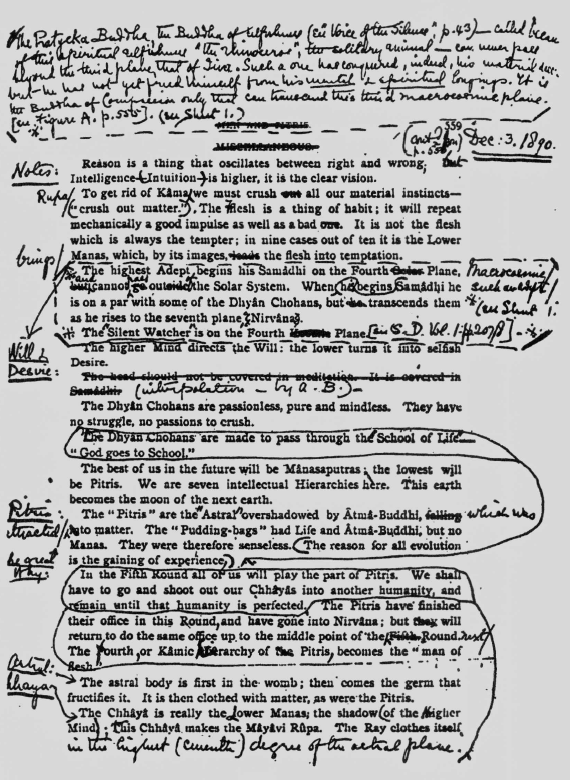
else. I enclose facsimile of a page of the Oral Teachings from Vol. III
[of The Secret Doctrine, 1897 ed.) .... The corrections are in my
handwriting from my copy of the original [Inner Group Teachings MS.]."
Alice Leighton Cleather
The Canadian Theosophist,
December, 1937, p. 302.
NOTES ON SOME ORAL
TEACHINGS
The Three Vital Airs
IT is the pure Ãkâsha
that passes up Sushumnâ: its two aspects flow in Idâ and
Pingalâ. These are the three vital airs, and are
symbolized by the Brâhmanical thread. They are ruled by
the Will. Will and Desire are the higher and lower
aspects of one and the same thing. Hence the importance
of the purity of the canals; for if they soil the vital
airs energized by the Will, Black Magic results. This is
why all sexual intercourse is forbidden in practical
Occultism.
From Sushumnâ, Idâ and
Pingalâ a circulation is set up, and from the central
canal passes into the whole body. (Man is a tree; he has
in him the macrocosm and the microcosm. Hence the trees
used as symbols; the Dhyân-Chohanic body is thus
figured.)
The Auric Egg
The Auric Egg is
formed in curves, which may be conceived from the curves
formed by sand on a vibrating metal disk. Each atom, as
each body, has its Auric Egg, each centre forming its
own. This Auric Egg, with the appropriate materials
thrown into it, is a defence; no wild animal, however
ferocious, will approach the Yogî thus guarded: it
flings back from its surface all malign influences. No
Will power is manifested through the Auric Egg.
Q. What is the connection
between the circulation of the vital airs and the power
of the Yogî to make his Auric Egg a defence against
aggression?
A. It is impossible to
answer this question. The knowledge is the last word of
Magic. It is connected with Kundalini, that can as
easily destroy as preserve. The ignorant tyro might kill
himself.
Q. Is the Auric Egg of
a child a differentiation of Ãkâsha, into which may be
thrown by the Adept the materials he needs for special
purposes—e.g., the Mâyâvi Rûpa?
[The question was
somewhat obscurely worded. Evidently what the questioner
wanted to know was if the Auric Egg was a
differentiation (Page 538) of Akâsha, into which, as the
child became a man, he might, if an Adept, weave the
materials needed for special purposes, etc.]
A. Taking the question in
the sense of an Adept putting something into or acting
on the Auric Egg of a child, then this could not be
done, as the Auric Egg is Karmic, and not even an Adept
must interfere with such Karmic record. If the Adept
were to put anything into the Auric Egg of another, for
which the person is not responsible, or which does not
come from the Higher Self of that personality, how could
Karmic justice be maintained?
The Adept can draw
into his own Auric Egg from his planet, or even from
that of the globe or of the universe, according to his
degree. This envelope is the receptacle of all Karmic
causes, and photographs all things like a sensitive
plate.
The child has a very
small Auric Egg which is in colour almost pure white. At
birth the Auric Egg consists of almost pure Ãkâsha plus
the Tanhâs, which, until the seventh year, remain
potential or in latency.
The Auric Egg of an
idiot cannot be said to be human, that is, it is not
tinged with Manas. It is Ãkâshic vibrations rather than
an Auric Egg—the material envelope, such as that of the
plant, the mineral or other object.
The Auric Egg is the
transmitter from the periodical lives to the Life
eternal, i.e., from Prâna to Jîva. It disappears, but
remains.
The reason why the
confession of the Roman Catholic and Greek Churches is
so great a sin is because the confessor interferes with
the Auric Egg of the penitent by means of his will
power, engrafting artificially emanations from his own
Auric Egg and casting seeds for germination into the
Auric Egg of his subject. It is on the same lines as
hypnotic suggestion.
The above remarks
apply equally to Hypnotism, although the latter is a
psycho-physical force, and it is this which constitutes
one of its many serious dangers. At the same time “a
good thing may pass through dirty channels,” as in the
case of the breaking by suggestion of the alcohol or
opium habit. Mesmerism may be used by the Occultist
to remove evil habits, if the intention be perfectly
pure; as on the higher plane intention is
everything, and good intention must work for good.
Q. Is the Auric Egg the
expansion of the “Pillar of Light,” the Mânasic
Principle, and so not surrounding the child till its
seventh year?
The Dweller on the
Threshold (Page 539)
A. It is the Auric Egg.
The Auric Egg is quite pure at birth, but it is a
question whether the higher or lower Manas will colour
it at the seventh year. The Mânasic expansion is pure
Ãkâsha. The ray of Manas is let down into the vortex
of the lower Principles, and being discoloured, and so
limited by the Kamic Tanhâs and by the defects of the
bodily organism, forms the personality. Hereditary
Karma can reach the child before the seventh year, but
no individual Karma can come into play till the descent
of the Manas.
The Auric Egg is
to the Man
As the Astral Light is to the Earth
As the Ether is to the Astral Light
As the Akâsha is to the Ether
The critical states are
left out in the enumeration. They are the Laya Centres,
or missing links in our consciousness, and separate
these four planes from one another.
The Dweller
The “Dweller on the
Threshold” is found in two cases: (a) In the case of the
separation of the Triangle from the Quaternary; (b) When
Kâmic desires and passions are so intense that the Kâma
Rûpa persists in Kâma Loka beyond the Devachanic period
of the Ego, and thus survives the reincarnation of the
Devachanic Entity (e.g., when reincarnation occurs
within two hundred or three hundred years). The
“Dweller” being drawn by affinity towards the
Reincarnating Ego to whom it had belonged, and being
unable to reach it, fastens on the Kâma of the new
personality, and becomes the Dweller on the Threshold,
strengthening the Kâmic element and thus lending it a
dangerous potency. Some become mad from this cause.
Intellect
The white Adept is not
always at first of powerful intellect. In fact, H.P.B
had known Adepts whose intellectual powers were
originally below the average. It is the Adept’s purity,
his equal love to all, his working with Nature, with
Karma, with his “Inner God,” that give him his power.
Intellect by itself alone will make the Black Magician.
For intellect alone is accompanied with pride and
selfishness: it is the intellectual plus the
spiritual that raises man. For spirituality prevents
pride and vanity.
Metaphysics are the
domain of the Higher Manas; whereas (Page 540) Physics
are that of Kâma-Manas, which does the thinking in
Physical Science and on material things. Kâma-Manas,
like every other Principle, is of seven degrees. The
Mathematician without spirituality, however great he may
be, will not reach Metaphysics; but the Metaphysician
will master the highest conceptions of Mathematics and
will apply them without learning the latter. To be
born Metaphysician the Psychic Plane will not be of much
account: he will see its errors immediately he enters
it, inasmuch as it is not the thing he seeks. With
respect to Music and other Arts, they are the children
of either the Mânasic or Kâma-Mânasic Principle,
proportionately as Soul or technicality predominates.
Karma
After each incarnation,
when the Mânasic Ray returns to its Father, the Ego,
some of its atoms remain behind and scatter. These
Mânasic atoms, Tânhic and other “causes,” being of the
same nature as the Manas, are attracted to it by strong
bonds of affinity, and on the reincarnation of the Ego
are unerringly attracted to it and constitute its Karma.
Until these are all gathered up, the individuality is
not free from rebirth. The Higher Manas is responsible
for the Ray it sends forth. If the Ray be not soiled, no
bad Karma is generated.
The Turîya State
You should bear in mind
that, in becoming Karma-less, good Karma, as well as
bad, has to be gotten rid of, and that Nidânas, started
towards the acquisition of good Karma, are binding as
those induced in the other direction. For both are
Karma.
Yogis cannot attain the
Turîya state unless the Triangle is separated from the
Quaternary.
Mahat
Mahat is the manifested
universal Parabrâhmic Mind (for one Manvantara) on the
Third Plane [of Kosmos]. It is the Law whereby the Light
falls from plane to plane and differentiates. The
Mânasaputras are its emanations.
Man alone is capable of
conceiving the Universe on this plane of existence.
Existence is; but when
the entity does not feel it, for that eternity it is
not. The pain of an operation exists, though the patient
does not feel it, and for the patient it is not.
FEAR AND HATRED (Page
541)
How to Advance
Q. What is the correct
pronunciation of AUM?
A. It should first be
practised physically; always at the same pitch, which
must be discovered in the same way as the particular
colour of the student is found, for each has its own
tone.
AUM consists of two
vowels and one semi-vowel, which latter must be
prolonged. Just as Nature has its Fa, so each man has
his: man being differentiated from Nature. The body may
be compared to an instrument and the Ego to the player.
You begin by producing effect on yourself; then little
by little you learn to play on the Tattvas and
Principles; learn first the notes, then the chords, then
the melodies. Once the student is master of every chord,
he may begin to be a co-worker with Nature and for
others. He may then, by the experience he has gained of
his own nature, and by the knowledge of the chords,
strike such as will be beneficial in another, and so
will serve as a keynote for beneficial results.
Try to have a clear
representation of the geometrical triangle on every
plane, the conception gradually growing more
metaphysical, and ending with the subjective Triangle,
Ãtmâ-Buddhi-Manas. It is only by the knowledge of this
Triangle under all forms that you can succeed, e.g., in
enclosing the past and the future in the present.
Remember that you have to merge the Quaternary in the
Triangle. The Lower Manas is drawn upwards, with the
Kâma, Prâna and Linga, leaving only the physical body
behind, the lower reinforcing the higher.
Advance may be made in
Occultism even in Devachan, if the Mind and Soul be set
thereon during life; but it is only as in a dream, and
the knowledge will fade away as memory of a dream fades,
unless it be kept alive by conscious study.
Fear and Hatred
Fear and hatred are
essentially one and the same. He who fears nothing will
never hate, and he who hates nothing will never fear.
The Triangle
Q. What is the meaning
of the phrase: “Form a clear image of the Triangle on
every plane;” e.g., on the Astral Plane, what should one
think of as the Triangle?
A. [H.P.B asked whether
the question signified the meaning of (Page 542) the
Triangle or the way to represent the Triangle on the
“screen of light.” The questioner explaining that the
latter was the meaning, H.P.B said that] it was only in
the Turîa state, the fourth of the seven steps of Râja
Yoga that the Yogî can represent to himself that which
is abstract. Below this state, the perceptive power,
being conditioned, must have some form to contemplate;
it cannot represent to itself the Arûpa. In the Turîya
state the Triangle is in yourself and is felt. Below the
Turîya state there must be a symbol to represent
Atmâ-Buddhi-Manas. It is not a mere geometrical
Triangle, but the Triad imaged, to make thought
possible. Of this Triad, we can make some kind of
representation of Manas, however indistinct; while of
Atmâ no image can be formed. We must try to represent
the Triangle to ourselves on higher and higher planes.
We must figure Manas as overshadowed by Buddhi, and
immersed in Ãtmâ. Only Manas, the Higher Ego, can be
represented; we may think it as the Augoeides, the
radiant figure in Zanoni. A very good Psychic might see
this.
Psychic Vision
Psychic vision,
however, is not to be desired, since Psyche is earthly
and evil. More and more as Science advances, the
psychic will be reached and understood; Psychism has in
it nothing that is spiritual. Science is right on its
own plane, from its own standpoint. The law of the
Conservation of Energy implies that psychic motion is
generated by motion. Psychic motion being only
motion on the Psychic Plane, a material plane, the
Psychologist is right who sees in it nothing beyond
matter. Animals have no Spirit, but they have psychic
vision, and are sensitive to psychic conditions;
observe how these react on their health, their bodily
state.
Motion is the abstract
Deity; on the highest plane it is Arûpa, absolute; but
on the lowest it is merely mechanical. Psychic
action is within the sphere of physical motion. Ere
psychic action can be developed in the brain and nerves,
there must be adequate action which generates it on the
Physical Plane. The paralysed animal that cannot
generate action in the physical body, cannot think.
Psychics merely see on a plane of different material
density; the spiritual glimpses sometimes obtained by
them come from a plane beyond. A Psychic’s vision is
that of one coming, as it were, into the lighted room,
and seeing everything there by an artificial light; when
the light is extinguished, vision is lost. Spiritual
vision sees by the light within, the light hidden
beneath the bushel of the body, by which we can see
clearly and independently of all outside.
Triangle and Quaternary
(Page 543) The Psychic seeing by an external light, the
vision is coloured by the nature of that light.
X. saying that she
felt as though she saw on three planes, H.P.B answered
that each plane was sevenfold, the Astral as every
other. She gave as an example on the Physical Plane the
vision of a table with the sense of sight; seeing it
still, with the eyes closed, by retinal impression; the
image of it conserved in the brain; it can be recalled
by memory; it can be seen in dream; or as an aggregate
of atoms; or as disintegrated. All these are on the
Physical Plane. Then we can begin again on the Astral
Plane, and obtain another septenary. This hint should be
followed and worked out.
Triangle and
Quaternary
Q. Why is the violet, the
colour of the Linga Sharîra, placed at the apex of the
 ,
when the Macrocosm is figured as
,
thus throwing the yellow, Buddhi, into the lower
Quaternary? ,
when the Macrocosm is figured as
,
thus throwing the yellow, Buddhi, into the lower
Quaternary?

A. It is wrong to
speak of the “lower Quaternary” in the Macrocosm. It is
the Tetraktys, the highest, the most sacred of all
symbols. There comes a moment when, in the highest
meditation, the Lower Manas is withdrawn into the Triad,
which thus becomes the Quaternary, the Tetraktys of
Pythagoras, leaving what was the Quaternay as the lower
Triad, which is then reversed. The Triad is reflected in
the Lower Manas. The Higher Manas cannot reflect itself,
but when the Green passes upwards it becomes a mirror
for the Higher; it is then no more Green, having passed
from its associations. The Psyche then becomes
spiritual, the Ternary is reflected in the Fourth, and
the Tetraktys is formed. So long as you are not dead,
there must be something to reflect the Higher Triad; for
there must be something to bring back to the waking
consciousness the experiences passed through on the
higher planes. The Lower Manas is as a tablet which
retains the impressions made on it during trance.
The Turîya state is
entered on the Fourth Path; it is figured in the diagram
on p. 478, in the Second Paper.
Q. What is the meaning of
a triangle formed of lines of light appearing in the
midst of intense vibrating blue?
A. Seeing the Triangle
outside is nothing; it is merely a reflection of the
Triad on the Auric Envelope, and proves that the seer is
outside the Triangle. It should be seen in quite another
way. You must (Page 544) endeavour to merge yourself
in it, to assimilate yourself with it. You are
merely seeing things in the Astral. “When the Third Eye
is opened in any one of you, you will have something
very different to tell me.”
Q. With reference to the
“Pillar of Light” in a previous question, is the Auric
Envelope the Higher Ego, and does it correspond to the
Ring-Pass-Not?
[This question was not
answered, as going too far. The Ring-Pass-Not is at the
circumference of the manifested Universe.]
Nidânas
Q. The root of the
Nidânas is Avidyâ. How does this differ from Mâyâ? How
many Nidânas are there Esoterically?
A. Again too much is
asked. The Nidânas, the concatenations of causes and
effects (not in the sense of the Orientalists), are not
caused by ignorance. They are produced by Dhyân Chohans
and Devas, who certainly cannot be said to act in
ignorance. We produce Nidânas in ignorance. Each cause
started on the Physical Plane sets up action on every
plane to all eternity. They are eternal effects
reflected from plane to plane on the “screen of
eternity.”
Manas
Q. What is the septenary
classification of Manas? There are seven degrees of the
Lower Manas, and presumably there are seven degrees of
the Higher. Are there then fourteen degrees of Manas, or
is Manas, taken as a whole, divided into forty-nine
Mânasic fires?
A. Certainly there are
fourteen, but you want to run before you can walk. First
learn the three, and then go on to the forty-nine. There
are three Sons of Agni; they become seven, and then
evolve to the forty-nine. But you are still ignorant how
to produce the three. Learn first how to produce the
“Sacred Fire,” spoken of in the Puranas. The forty-nine
fires are all states of Kundalinî, to be produced in
ourselves by the friction of the triad. First learn the
septenary body, and then that of each Principle. But
first of all learn the first Triad (the three vital
airs).
The Spinal Cord
Q. What is the
sympathetic nerve and its function in Occultism? Is it
found only after a certain stage of animal evolution,
and would seem to be evolving in complexity towards a
second spinal cord.
Prâna and Antahkarana
(Page 545)
A. At the end of the
next Round, Humanity will again become male-female, and
then there will be two spinal cords. In the Seventh Race
the two will merge into one. The evolution
corresponds to the Races, and with the evolution of the
Races the sympathetic develops into a true spinal cord.
We are returning up the arc only with self-consciousness
added. The Sixth Race will correspond to the “pudding
bags,” but will have the perfection of form with the
highest intelligence and spirituality.
Anatomists are beginning
to find new ramifications and new modifications in the
human body. They are in error on many points, e.g., as
to the spleen, which they call the manufactory of white
blood corpuscles, but which is really the vehicle of the
Linga Sharîra. Occultists know each minute portion of
the heart, and have a name for each. They call them by
the names of the Gods, as Brahmâ’s Hall, Vishnu’s Hall,
etc. They correspond with parts of the brain. The very
atoms of the body are the thirty-three crores of Gods.
The sympathetic nerve is
played on by the Tântrikas, who call it Shiva’s Vînâ.
Prâna
Q. What is the relation
of man to Prâna—the periodical life?
A. Jîva becomes Prâna
only when the child is born and begins to breathe. It is
the breath of life, Nephesh. There is no Prâna on the
Astral Plane.
Antahkarana
Q. The Antahkarana is the
link between the Higher and the Lower Egos; does it
correspond to the umbilical cord in projection?
A. No; the umbilical cord
joining the astral to the physical body is a real thing.
Antahkarana is imaginary, a figure of speech, and is
only the bridging over from the Higher to the Lower
Manas. Antahkarana only exists when you commence to
“throw your thought upwards and downwards.” The Mâyâvi
Rûpa, or Mânasic body, has no material connection with
the physical body, no umbilical cord. It is spiritual
and ethereal, and passes everywhere without let or
hindrance. It entirely differs from the astral body,
which, if injured, acts by repercussion on the physical
body. The Devachanic entity, even previous to birth, can
be affected by the Skandhas, but these have nothing to
do with the Antahkarana. It is affected, e.g., by the
desire for reincarnation.
Q. We are told in The
Voice of the Silence that we have to become (Page 546)
“the path itself,” and in another passage that
Antahkarana is that path. Does this mean anything more
than that we have to bridge over the gap between the
consciousness of the Lower and the Higher Egos?
A. That is all.
Q. We are told that there
are seven portals on the Path: is there then a sevenfold
division of Antahkarana? Also, is Antahkarana the
battlefield?
A. It is the battlefield.
There are seven divisions in the Antahkarana. As you
pass from each to the next you approach the Higher Manas.
When you have bridged the fourth you may consider
yourself fortunate.
Miscellaneous
Q. We are told that AUM
“should be practised physically.” Does this mean that,
colour being more differentiated than sound, it is only
through the colours that we shall get at the real sound
of each of us? and that AUM can only have its Spiritual
and Occult signification when attained to the
Ãtmâ-Buddhi-Manas of each person?
A. AUM means good action,
not merely lip-sound. You must say it in deeds.
Q. With reference to the
,
is not the Ãtmâ-Buddhi-Manas different for each entity,
according to the plane on which he is?
A. Each Principle is on a
different plane. The Chelâ must rise to one after the
other, assimilating each, until the three are one. This
is the root of the Trinity.
Q. In The Secret Doctrine
we are told that Ãkâsha is the same as Pradhâna. Akasha
is the Auric Egg of the earth, and yet Ãkâsha is the
same as Pradhâna. Ãkâsha is the Auric Egg of the earth,
and yet Ãkâsha is Mahat. What then is the relation of
Manas to the Auric Egg?
A. Mûlaprakriti is the
same as Ãkâsha (seven degrees). Mahat is the positive
aspect of Akasha, and is the Manas of the Kosmic Body.
Mahat is to Ãkâsha as Manas is to Buddhi, and Pradhâna
is but another name for Mûlaprakriti.
The Auric Egg is Ãkâsha
and has seven degrees. Being pure abstract substance, it
reflects abstract ideas, but also reflects lower
concrete things.
The Third Logos and Mahat
are one, and are the same as the Universal Mind, Alaya.
The Tetraktys is the
Chatur Vidyâ, or the fourfold knowledge in one, the
four-faced Brahmâ.
Sacred Centres of Body
(Page 547)
Nâdîs
Q. Have the Nâdîs any
fixed relationship to the vertebræ? can they be located
opposite to or between any vertebrae? Can they be
regarded as occupying each a given and fixed extent in
the cord? Do they correspond to the divisions of the
cord known to Anatomists?
A. H.P.B believed that
the Nâdîs corresponded to regions of the spinal cord
known to Anatomists. There are thus six or seven Nâdîs
or plexuses along the spinal cord. The term, however, is
not technical but general, and applies to any knot,
centre, ganglion, etc. The sacred Nâdîs are those which
run along or above Sushumnâ. Six are known to Science,
and one (near the atlas) unknown. Even the Târaka Râja
Yogîs speak only of six, and will not mention the sacred
seventh.
Idâ and Pingalâ play
along the curved wall of the cord in which is Sushumnâ.
They are semi-material, positive and negative, sun and
moon, and start into action the free and spiritual
current of Sushumnâ. They have distinct paths of their
own, otherwise they would radiate all over the body. By
concentration on Idâ and Pingalâ is generated the
“sacred fire.”
Another name for Shiva’s
Vînâ (sympathetic system) is Kâlî’s Vînâ.
The sympathetic cords and
Idâ and Pingalâ start from a sacred spot above the
medulla oblongata, called Triveni. This is one of the
sacred centres, another of which is Brahmarandra, which
is, if you like, the grey matter of the brain. It is
also the anterior fontanelle in the new-born child.
The spinal column is
called Brahmadanda, the stick of Brahmâ. This is again
symbolized by the bamboo rod carried by Ascetics. The
Yogis on the other sides of the Himâlayas, who assemble
regularly at Lake Mânsarovara, carry a triple knotted
bamboo stick, and are called Tridandins. This has the
same signification as the Brâhmanical cord, which has
many meanings besides the three vital airs; e.g., it
symbolizes the three initiations of a Brâhman, taking
place: (a) at birth, when he receives his mystery name
from the family Astrologer, who is supposed to have
received it from the Devas (he is also thus said to be
initiated by the Devas); a Hindu will sooner die than
reveal this name; (b) at seven, when he receives the
cord; and (c) at eleven or twelve, when he is initiated
into his caste.
(Page 548)
Q. If it is right to
study the body and its organs, with their
correspondences, will you give the main outline of these
in connection with the Nâdîs and with the diagram of the
orifices?
| The |
Corresponds to the |
| Spleen |
Linga Sharira |
| Liver |
Kama |
| Heart |
Prana |
| Corpora-quadrigemina |
Kama-Manas |
| Pituitary
body |
Manas-Antahkarana |
| Pineal gland |
Manas |
until it is touched by
the vibrating light of Kundalinî, which proceeds from
Buddhi, when it becomes Buddhi-Manas.
The pineal gland
corresponds with Divine Thought. The pituitary body is
the organ of the Psychic Plane. Psychic vision is caused
by the molecular motion of this body, which is directly
connected with the optic nerve, and thus affects the
sight and gives rise to hallucinations. Its motion may
readily cause flashes of light, such as may be obtained
by pressing the eyeballs. Drunkenness and fever produce
illusions of sight and hearing by the action of the
pituitary body. This body is sometimes so affected by
drunkenness that it is paralysed. If an influence on the
optic nerve is thus produced and the current thus
reversed, the colour will probably be complementary.
Sevens
Q. If the physical body
is no part of the real human septenary, is the physical
material world one of the seven planes of the Kosmic
septenary?
A. It is. The body is not
a Principle in Esoteric parlance, because the body and
the Linga are both on the same plane; then the Auric Egg
makes the seventh. The body is an Upâdhi rather than a
Principle. The earth and its astral light are as closely
related to each other as the body and its Linga, the
earth being the Upâdhi. Our plane in its lowest division
is the earth, in its highest the astral. The terrestrial
astral light should of course not be confounded with the
universal Astral Light.
Q. A physical object was
spoken of as a septenary on the physical plane, inasmuch
as we could (1) directly contact it; (2) retinally
reproduce it; (3) remember it; (4) dream of it; (5) view
it atomically; (6) view it disintegrated; (7) —What is
the seventh?
These are seven ways in
which we view it: the septenary is our way of seeing one
thing. Is it objectively septenary?
Ãkâsha Nature's
Sounding-Board (Page 549)
A. The seventh bridges
across from one plane to another. The last is the idea,
the privation of matter, and carries you to the next
plane. The highest of one plane touches the lowest of
the next. Seven is a factor in nature, as in colours and
sounds. There are seven degrees in the same piece of
wood, each perceived by one of the seven senses. In wood
the smell is the most material degree, while in other
substances it may be the sixth. Substances are septenary
apart from the consciousness of the viewer.
The psychometer, seeing a
morsel, say of a table a thousand years hence, would see
the whole; for every atom reflects the whole body to
which it belongs, just as with the Monads of Leibnitz.
After the seven material
subdivisions are the seven divisions of the Astral,
which is its second Principle. The disintegrated
matter—the highest of the material subdivisions—is the
privation of the idea of it—the fourth.
The number fourteen is
the first step between seven and forty-nine. Each
septenary is really a fourteen, because each of the
seven has its two aspects. Thus fourteen signifies the
inter-relation of two planes in its turn. The septenary
is to be clearly traced in the lunar months, fevers,
gestations, etc. On it is based the week of the Jews and
the septenary Hierarchies of the Lord of Hosts.
Sounds
Q. Sound is an attribute
of Ãkâsha; but we cannot cognize anything on the Ãkâshic
plane; on what plane then do we recognize sound? On what
plane is sound produced by the physical contact of
bodies? Is there sound on seven planes, and is the
physical plane one of them?
A. The physical plane is
one of them. You cannot see Ãkâsha, but you can sense it
from the Fourth Path. You may not be fully conscious of
it, and yet you may sense it. Ãkâsha is at the root of
the manifestation of all sounds. Sound is the expression
and manifestation of that which is behind it, and which
is the parent of many correlations. All Nature is a
sounding-board; or rather Ãkâsha is the sounding-board
of Nature. It is the Deity, the one Life, the one
Existence. (Hearing is the vibration of molecular
particles; the order is seen in the sentence, “The
disciple feels, hears, sees.”)
Sound can have no end.
H.P.B remarked with regard to a tap made by a pencil on
the table: “By this time it has affected the whole
universe. The particle which has had its wear and tear
destroys some (Page 550) thing which passes into
something else. It is eternal in the Nidânas it
produces.” A sound, if not previously produced on the
Astral Plane, and before that on the Ãkâshic, could not
be produced at all. Ãkâsha is the bridge between nerve
cells and mental powers.
Q. “Colours are psychic,
and sounds are spiritual.” What, assuming that these are
vibrations, is the successive order (these corresponding
to sight and hearing) of the other senses?
A. This phrase was not to
be taken out of its context, otherwise confusion would
arise. All are on all planes. The First Race had touch
all over like a sounding board; this touch
differentiated into the other senses, which developed
with the Races. The “sense” of the First Race was that
of touch, meaning the power of their atoms to vibrate in
unison with external atoms. The “touch” would be almost
the same as sympathy.
The senses were on a
different plane with each Race; e.g., the Fourth Race
had very much more developed senses than ourselves, but
on another plane. It was also a very material Race. The
sixth and seventh senses will merge into the Ãkâshic
Sound. “It depends to what degree of matter the sense of
touch relates itself as to what we call it.”
Prâna
Q. Is Prâna the
production of the countless “lives” of the human body,
and therefore, to some extent, of the congeries of the
cells or atoms of the body?
A. No; Prâna is the
parent of the “lives.” As an example, a sponge may be
immersed in an ocean. The water in the sponge’s interior
may be compared to Prâna; outside is Jîva. Prâna is the
motor-principle in life. The “lives” leave Prâna; Prâna
does not leave them. Take out the sponge from the water,
and it becomes dry, thus symbolizing death. Every
principle is a differentiation of Jîva, but the
life-motion in each is Prâna, the “breath of life.” Kâma
depends on Prâna, without which there would be no Kâma.
Prâna wakes the Kâmic germs to life; it makes all
desires vital and living.
The Second Spinal Cord
Q. With reference to the
answer to the question on the second cord, what is it
that will become a second spinal cord in the Sixth Race?
Will Idâ and Pingalâ have separate physical ducts?
A. It is the sympathetic
cords which will grow together and form another spinal
cord. Idâ and Pingalâ will be joined with Sushumnâ, and
they will become one. Idâ is on the left side of the
cord, and Pingalâ on the right.
Kosmic Consciousness
(Page 551)
Initiates
Pythagoras was an
Initiate, one of the grandest of Scientists. His
disciple, Archytas, was marvellously apt in applied
Science. Plato and Euclid were Initiates, but not
Socrates. No real Initiates were married. Euclid learned
his Geometry in the Mysteries. Modern men of Science
only rediscover the old truths.
Kosmic Consciousness
H.P.B proceeded to
explain Kosmic Consciousness, which is, like all else,
on seven planes, of which three are inconceivable and
four are cognizable by the highest Adept. She sketched
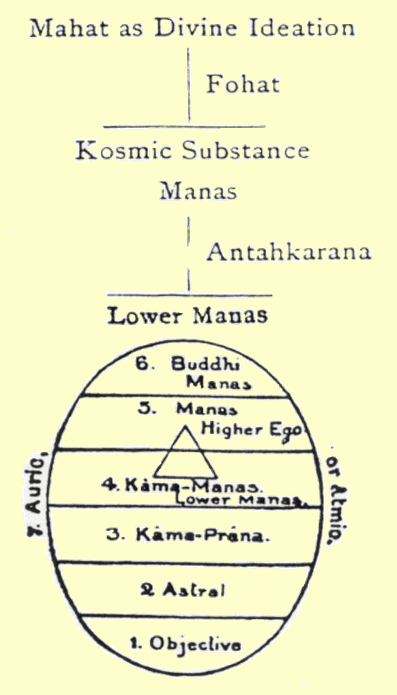
the planes as in the following diagram.
| |
| |
| Manas-Ego |
| |
| Kama-Manas
or Higher Psychic |
| Pranic-Kama
or Lower Psychic |
| Astral |
| Prakritic
or Terrestrial |
Taking the lowest only,
the Terrestrial (it was afterwards decided to call this
plane Prâkritic), it is divisible into seven planes, and
these again into seven, making the forty-nine.
Terrestrial
(Page 552)
She then took the lowest
plane of Prakriti, or the true Terrestrial, and divided
it as follows:—
| True
terrestrial planes or 7th Prakritic |
7 |
Para-Ego or Atmic |
| 6 |
Inner-Ego or Buddhic |
| 5 |
Ego-Manas |
| 4 |
Kama-Manas or Lower Manas |
| 3 |
Pranic Kama or Psychic |
| 2 |
Astral |
| 1 |
Objective |
Its objective or sensuous
plane is that which is sensed by the five physical
senses.
On its second plane
things are reversed.
Its third plane is
psychic: here is the instinct which prevents a kitten
going into the water and getting drowned.
The following table of
the terrestrial, objective consciousness was given:
| 1 |
Sensuous |
| 2 |
Instinctual |
| 3 |
Physiological-emotional |
| 4 |
Passional-emotional |
| 5 |
Mental-emotional |
| 6 |
Spiritual-emotional |
| 7 |
x |
Divisions of the Astral
Plane (Page 553)
Astral
The three lower Prâkritic
are related to the three lower of the Astral Plane
immediately succeeding.
| 7 |
|
| 6 |
Astral-Buddhi |
| 5 |
Astral Manas |
| 4 |
Astral Kama-Manas |
| 3 |
Astral Psychic or Pranic |
| 2 |
Astral Astral |
| 1 |
Astral Objective |
With regard to the
first division of the second plane, H.P.B reminded her
pupils that all seen on it must be reversed in
translating it, e.g., with numbers which appeared
backwards. The Astral Objective corresponds in
everything to the Terrestrial Objective.
The second division
corresponds to the second of the lower plane, but the
objects are of extreme tenuity, an astralized Astral.
This plane is the limit of the ordinary medium, beyond
which he cannot go. A non-mediumistic person to reach it
must be asleep or in a trance, or under the influence of
laughing-gas; or in ordinary delirium people pass on to
this plane.
The third, the Prânic, is
of an intensely vivid nature. Extreme delirium carried
the patient to this plane. In delirium tremens the
sufferer passes to this and to the one above it.
Lunatics are often conscious on this plane, where they
see terrible visions. It runs into the—
Fourth division, the
worst of the astral planes, Kâmic and terrible. Hence
come the images that tempt; images of drunkards in Kâma
Loka impelling others to drink; images of all vices
inoculating men with the desire to commit crimes. The
weak imitate these images in a kind of monkeyish
fashion, so falling beneath their influence. This is
also the cause of epidemics of vices, and cycles of
disaster, of accidents of all kinds coming in groups.
Extreme delirium tremens is on this plane.
(Page 554)
The fifth division is
that of premonitions in dreams, of reflections from the
lower mentality, glimpses into the past and future, the
plane of things mental and not spiritual. The mesmerized
clairvoyant can reach this plane, and even, if good, may
go higher.
The sixth is the plane
from which come all beautiful inspirations of art,
poetry, and music, high types of dreams, flashes of
genius. Here we have glimpses of past incarnations,
without being able to locate or analyse them.
We are on the seventh
plane at the moment of death or in exceptional visions.
The drowning man is here when he remembers his past
life. The memory of events of this plane must be centred
in the heart, “the seat of Buddha.” There it will
remain, but impressions from this plane are not made on
the physical brain.
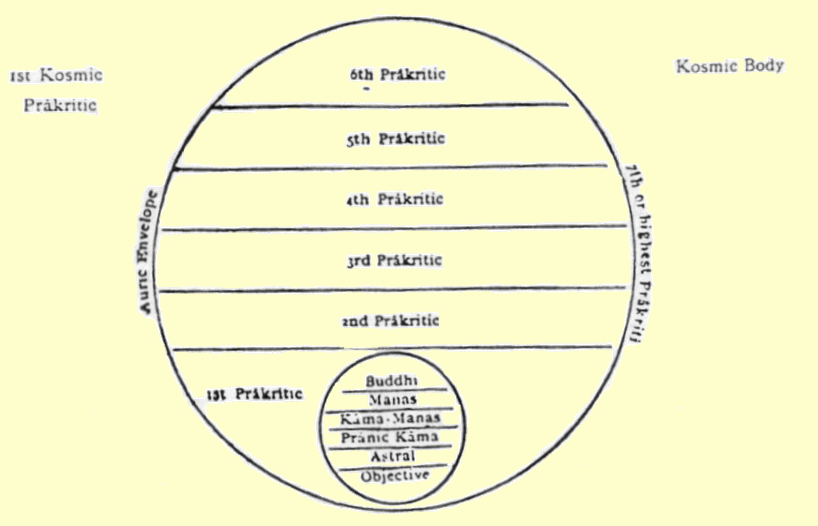
| 4th Kosmic Plane |
Fohat |
|
Kosmic Kama-Mans |
| 3rd Kosmic Plane |
Jiva-Fohat |
Pranic-Kama |
Kosmic Life |
| 2nd Kosmic Plane |
|
` |
Kosmic Astral |
| 1st Kosmic Prakiristic |
|
|
Kosmic Body |
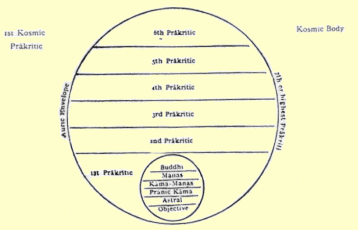
[In this diagram all the
Kosmic Planes should be figured as of one size—the size
given to the lowest plane, Prakriti. Further, within the
circle all the Prâkritic Planes should be of one
size—that given to the first, or lowest. To do this
would make so large a diagram that the planes are
compressed.—Ed.]
Kosmic Planes (Page 555)
General Notes
The two planes above
dealt with are the only two used in the Hatha Yoga.
Prâna and the Auric
Envelope are essentially the same, and again, as Jîva,
it is the same as the Universal Deity. This, in its
Fifth Principle, is Mahat, in its Sixth, Alaya. (The
Universal Life is also seven-principled.) Mahat is the
highest Entity in Kosmos; beyond this is no diviner
Entity; it is of subtlest matter, Sûkshma. In us this is
Manas, and the very Logoi are less high, not having
gained experience. The Mânasic Entity will not be
destroyed, even at the end of the Mahâmanvantara, when
all the Gods are absorbed, but will re-emerge from
Parabrâhmic latency.
Consciousness is the
Kosmic seed of superkosmic omniscience. It has the
potentiality of budding into the Divine Consciousness.
Rude physical health is a
drawback to seership. This was the case with
Swedenborg.
Fohat is everywhere: it
runs like a thread through all, and has its own seven
divisions.
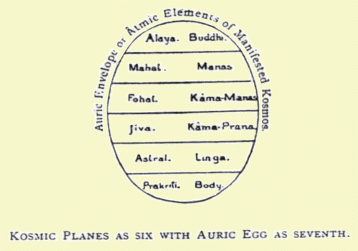
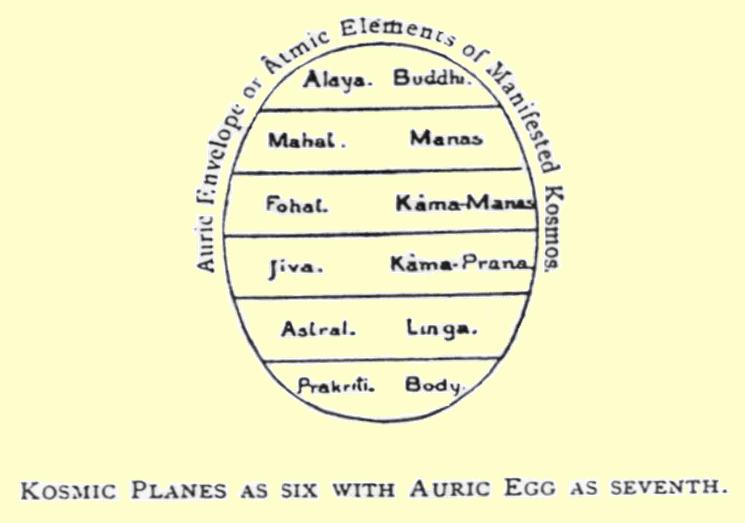
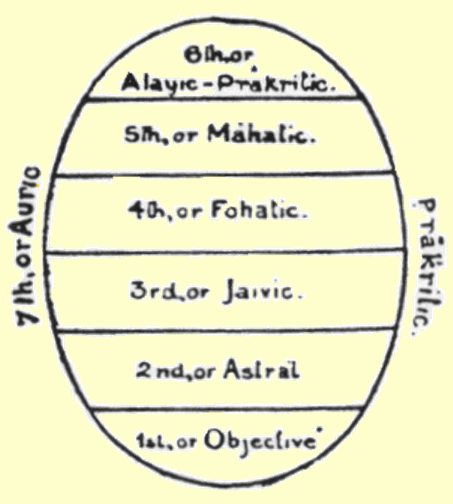
KOSMIC PLANES AS SIX
WITH AURIC EGG AS SEVENTH
In the Kosmic Auric
Envelope is all the Karma of the manifesting Universe.
This is the Hiranyagarbha. Jîva is everywhere, and so
with the other Principles.
(Page 556)
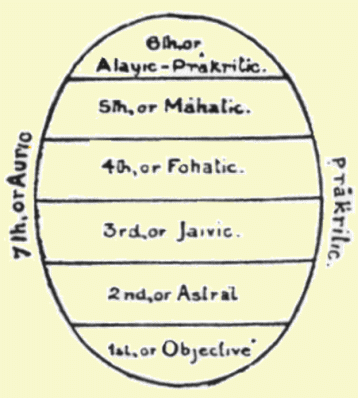
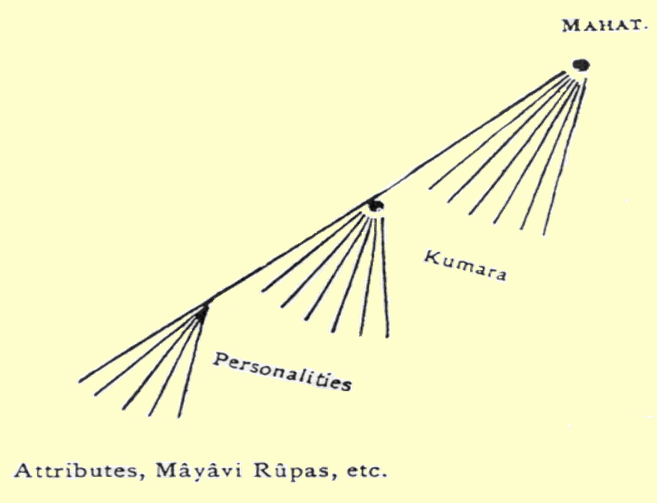
The above diagram
represents the type of all the Solar Systems.
Mahat, single before
informing the Universe, differentiates when informing
it, as does Manas in man.
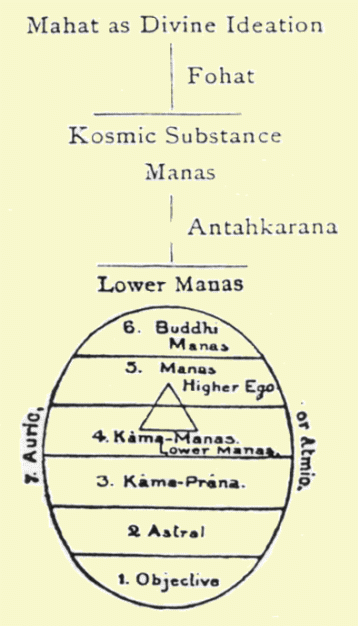
Taking this figure to
represent the human Principles and planes of
consciousness, then ...
Differentiation (Page
557)
7, 6, 5, represent
respectively, Shiva, Vishnu, Brahmâ being the lowest.
Shiva is the four-faced
Brahmâ; the Creator, Preserver, Destroyer, and
Regenerator.
Between 5 and 4 comes the
Antahkarana. The
represents the Christos, the Sacrificial Victim
crucified between the thieves: this is the double-faced
entity. The Vedântins make this a quarternary for a
blind: Antahkarana, Chit, Buddhi, and Manas.
Manvantaric Aspect of
Parabrahman and Mûlaprakriti
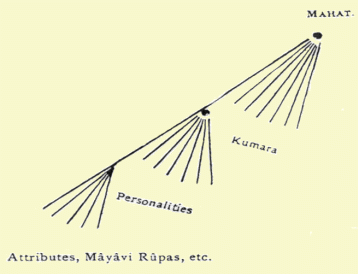
N.B. The number of
rays is arbitrary and without significance.
Perceptive life begins
with the Astral: it is not our physical atoms which see,
etc.
Consciousness proper
begins between Kâma and Manas. Ãtmâ-buddhi acts more in
the atoms of the body, in the bacilli, microbes, etc.,
than in Man himself.
Objective
Consciousness
Sensuous objective
consciousness includes all that pertains to the five
physical senses in man, and rules in animals, birds,
fishes and some insects. Here are the “Lives;” their
consciousness is in Ãtma-Buddhi; these are entirely
without Manas.
Astral Consciousness
(Page 558)
That of some plants
(e.g., sensitive) of ants, spiders, and some night-flies
(Indian), but not of bees.
The vertebrate animals in
general are without this consciousness, but the
placental Mammals have all the potentialities of human
consciousness, though at present, of course, dormant.
Idiots are on this plane.
The common expression “he has lost his mind” is an
Occult truth. For when through fright or other cause the
lower mind becomes paralysed, then the consciousness is
on the Astral Plane. The study of lunacy will throw much
light on these points. This may be called the “nerve
plane.” It is cognized by our “nervous centres” of which
Physiology knows nothing, e.g., the clairvoyant reading
with the eyes bandaged, reading with the tips of the
fingers, the pit of the stomach, etc. This sense is
greatly developed in the deaf and dumb.
Kâma-Prânic
Consciousness
The general
life-consciousness which belongs to all the objective
world, even to the stones; for if stones were not
living they could not decay, emit a spark, etc.
Affinity between chemical elements is a manifestation of
this Kâmic consciousness.
Kâma-Mânasic
Consciousness
The instinctual
consciousness of animals and idiots in its lowest
degrees, the planes of sensation; in man these are
rationalized, e.g., a dog shut in a room has the
instinct to get out, but cannot because its instinct is
not sufficiently rationalized to take the necessary
means; whereas a man at once takes in the situation and
extricates himself. The highest degree of this
Kâma-Mânasic consciousness is the psychic. Thus there
are seven degrees from the instinctual animal to the
rationalized instinctual and psychic.
Mânasic Consciousness
From this plane Manas
stretches upwards to Mahat.
Buddhic Consciousness
The plane of Buddhi and
the Auric Envelope. From here it goes to the Father in
heaven, Ãtmâ, and reflects all that is in the Auric
Envelope. Five and six therefore cover the planes from
the psychic to the divine.
Men and Pitris (Page 559)
Miscellaneous
Reason is a thing that
oscillates between right and wrong. But
Intelligence—Intuition—is higher, it is the clear
vision.
To get rid of Kâma we
must crush out all out material instincts—“crush out
matter.” The flesh is a thing of habit; it will
repeat mechanically a good impulse as well as a bad one.
It is not the flesh which is always the tempter; in nine
cases out of ten it is the Lower Manas, which, by its
images, leads the flesh into temptation.
The highest Adept begins
his Samâdhi on the Fourth Solar Plane, but cannot go
outside the Solar System. When he begins Samâdhi he is
on a par with some of the Dhyân Chohans, but he
transcends them as he rises to the seventh plane (Nirvâna).
The Silent Watcher is on
the Fourth Kosmic Plane.
The higher Mind directs
the Will: the lower turns it into selfish Desire.
The head should not be
covered in meditation. It is covered in Samâdhi.
The Dhyân Chohans are
passionless, pure and mindless. They have no struggle,
no passion to crush.
The Dhyân Chohans are
made to pass through the School of Life. “God goes to
School.”
The best of us in the
future will be Mânasaputras; the lowest will be Pitris.
We are seven intellectual Hierarchies here. This earth
becomes the moon of the next earth.
The “Pitris” are the
Astral overshadowed by Ãtma-Buddhi, falling into matter.
The “Pudding-bags” has Life and Ãtmâ-Buddhi, but no
Manas. They were therefore senseless. The reason for all
evolution is the gaining of experience.
In the Fifth Round all of
us will play the part of the Pitris. We shall have to go
and shoot out our Chhâyâs into another humanity, and
remain until that humanity is perfected. The Pitris have
finished their office in this Round and have gone into
Nirvâna; but they will return to do the same office up
to the middle point of the Fifth Round. The Fourth or
Kâmic Hierarchy of the Pitris becomes the “man of
flesh.”
The astral body is first
in the womb; then comes the germ that fructifies it. It
is then clothed with matter, as were the Pitris.
The Chhâyâ is really the
lower Manas, the shadow of the higher Mind. This Chhâyâ
makes the Mâyâvi Rûpa. The Ray clothes itself (Page 560)
in the highest degree of the Astral Plane. The Mâyâvi
Rûpa is composed of the astral body as Upâdhi, the
guiding intelligence from the heart, the attributes and
qualities from the Auric Envelopes.
The Auric Envelope takes
up the light of Ãtmâ, and overshadows the coronal
circling round the head.
The Auric Fluid is a
combination of the Life and Will principles, the life
and the will being one and the same in Kosmos. It
emanates from the eyes and hands, when directed by the
will of the operator.
The Auric Light surrounds
all bodies: it is the “aura” emanating from them,
whether they be animal, vegetable, or mineral. It is the
light, e.g., seen round magnets.
Ãtmâ-Buddhi-Manas in man
corresponds to the three Logoi in Kosmos. They not only
correspond, but each is the radiation from Kosmos to
Microcosmos. The third Logos, Mahat, becomes Manas in
man, Manas being only Mahat individualized, as the
sun-rays are individualized in bodies that absorb them.
The sun-rays give life, they fertilize what is already
there, and the individual is formed. Mahat, so to say
fertilizes, and Manas is the result.
Buddhi-Manas is the
Kshetrajña.
There are seven planes of
Mahat, as of all else.
The Human Principles
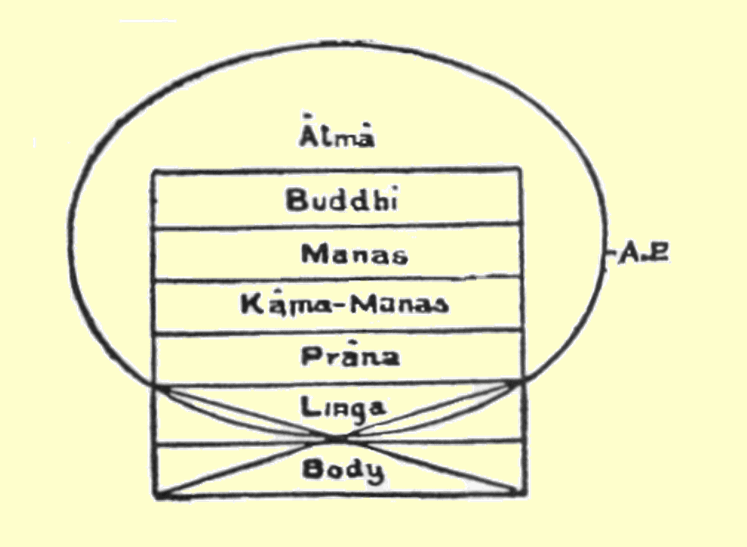
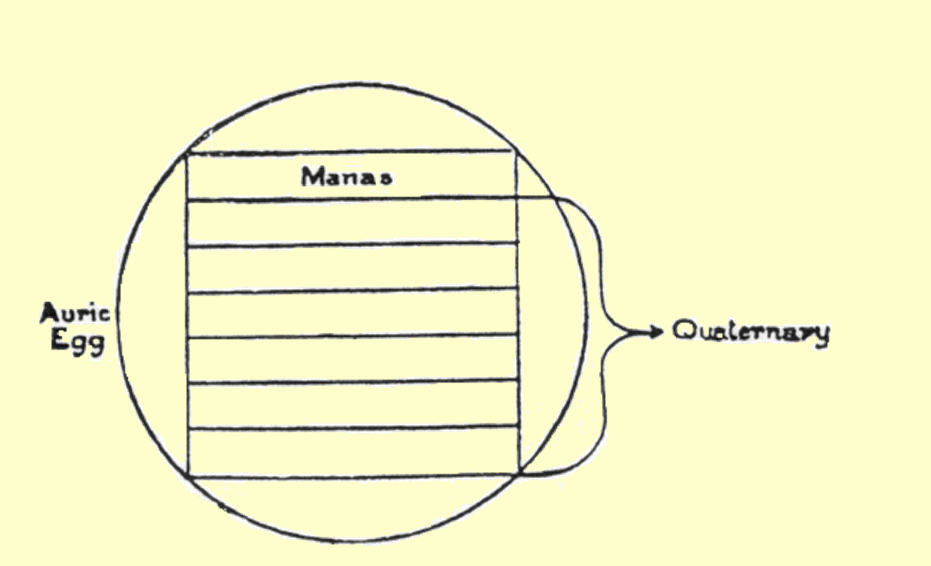
Here H.P.B drew two
diagrams, illustrating different ways of representing
the human principles. In the first:
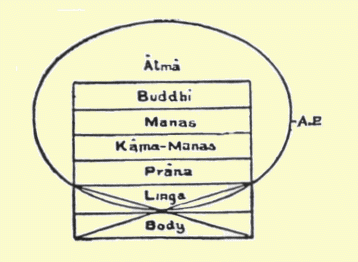
the two lower are
disregarded; they go out, disintegrate, are of not
account. Remain five, under the radiation of Ãtmâ.
Power of Imagination
(Page 561)
In the second:
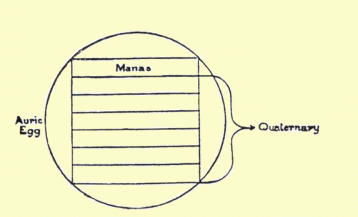
the lower Quaternary is
regarded as mere matter, objective illusion, and there
remain Manas and the Auric Egg, the higher Principles
being reflected in the Auric Egg. In all these systems
remember the main principle, the descent and re-ascent
of the Spirit, in man as in Kosmos. The Spirit is drawn
downwards as by spiritual gravitation.
Seeking further for the
cause of this, the students were checked, H.P.B giving
only a suggestion on the three Logoi:
1. Potentiality of Mind
(Absolute Thought).
2. Thought in Germ.
3. Ideation in Activity.
Notes
Protective variation,
e.g., identity of colouring of insects and of that on
which they feed, was explained to be the work of Nature
Elementals.
Form is on different
planes, and the forms of one plane may be formless to
dwellers on another. The Kosmocratores build on planes
in the Divine Mind, visible to them though not to us.
The principle of limitation—principium individuationis—is
Form: this principle is Divine Law manifested in Kosmic
Matter, which, in its essence, is limitless. The Auric
Egg is the limit of man as Hiranyagarbha of the Kosmos.
The first step towards
the accomplishment of Kriyâshakti is the use of the
Imagination. To imagine a thing is to firmly create a
model of what you desire, perfect in all its details.
The Will is then brought into action, and the form is
thereby transferred to the objective world. This is
creation by Kriyâshakti.
Suns and Planets
(Page 562)
A comet partially cools
and settles down as a sun. It then gradually attracts
round it planets that are as yet unattached to any
centre, and thus, in millions of years, a Solar System
is formed. The worn-out planet becomes a moon to the
planet of another system.
The sun we see is a
reflection of the true Sun: this reflection, as an
outward concrete thing, is a Kâma-Rûpa, all the suns
forming the Kâma-Rûpa of Kosmos. To its own system the
sun is Buddhi, as being the reflection and vehicle of
the true Sun, which is Ãtmâ, invisible on this plane.
All the Fohatic forces—electricity, etc—are in this
reflection.
The Moon
At the beginning of the
evolution of our globe, the moon was much nearer to the
earth, and larger than it is now. It has retreated from
us, and shrunk much in size. (The moon gave all her
Principles to the earth, while the Pitris gave only
their Chhâyâs to man.)
The influences of the
moon are wholly psycho-physiological. It is dead,
sending out injurious emanations like a corpse. It
vampirizes the earth and its inhabitants, so that any
one sleeping in its rays suffers, losing some of his
life-force. A white cloth is a protection, the rays
not passing through it, and the head especially should
be thus guarded. It has most power when it is full. It
throws off particles which we absorb, and is gradually
disintegrating. Where there is snow the moon looks like
a corpse, being unable, through the white snow, to
vampirize effectually. Hence snow-covered mountains are
free from its bad influences. The moon is
phosphorescent.
The Râkshakas of Lanka
and the Atlanteans are said to have subjected the moon.
The Thessalians learned from them their Magic.
Esoterically, the moon is
the symbol of the Lower Manas; it is also the symbol of
the Astral.
Plants which under the
sun’s rays are beneficent are maleficent under those of
the moon. Herbs containing poisons are most active when
gathered under the moon’s rays.
A new moon will appear
during the Seventh Round, and our moon will finally
disintegrate and disappear. There is now a planet, the
“Mystery Planet,” behind the moon, and it is gradually
dying. Finally the time will come for it to send its
Principles to a new Laya Centre, and there a new planet
will form, to belong to another Solar System, the
present Mystery Planet then functioning as moon to that
new globe. This moon will have nothing to do with our
earth, though it will come within our range of vision.
Why Cycles Return (Page
563
The Solar System
All the visible planets
placed in our Solar System by Astronomers belong to it,
except Neptune. There are also some others not known to
Science, belonging to it, and “all moons which are not
yet visible for next things.”
The planets only move
in our consciousness. The Rulers of the seven Secret
Planets have no influence on this earth, as this earth
has on other planets. It is the sun and moon which
really have not only a mental, but also a physical
effect. The effect of the sun on humanity is connected
with Kâma-Prâna, with the most physical Kâmic elements
in us; it is the vital principle which helps growth. The
effect of the moon is chiefly Kâma-Mânasic or
psycho-physiological; it acts on the psychological
brain, on the brain mind.
Precious Stones
In answer to a question,
H.P.B said that the diamond and the ruby were under the
sun, the saphire under the moon—“but what does it matter
to you?”
Time
When once out of the
body, and not subject to the habit of consciousness
formed by others, time does not exist.
Cycles and epochs depend
on consciousness: we are not here for the first time;
the cycles return because we come back into conscious
existence. Cycles are measured by the consciousness of
humanity and not by Nature. It is because we are the
same people as in past epochs that these events occur to
us.
Death
The Hindus look upon
death as impure, owing to the disintegration of the body
and the passing from one plane to another. “I believe in
transformation, not in death.”
Atoms
The Atom is the Soul of
the molecule. It is the six Principles, and the molecule
is the body thereof. The Atom is the Ãtman of the
objective Kosmos, i.e., it is on the seventh plane of
the lowest Prakriti.
Terms
(Page 564)
H.P.B began by saying
that students ought to know the correct meaning of the
Sanskrit terms used in Occultism, and should learn the
Occult Symbology. To begin with one had better learn the
correct Esoteric classification and names of the
fourteen (7 x 2 ) and seven (Sapta) Lokas found in the
exoteric texts. These are given there in a very confused
manner, and are full of “blinds.” To illustrate this
three classifications are given below.
|
LOKAS |
|
The general exoteric,
orthodox and tantric category: |
| Bhur-loka |
|
| Bhuvar-loka |
|
| Swar-loka |
|
| Mahar-loka |
The second seven are
reflected. |
| Janar-loka |
|
| Tapar-loka |
|
| Satya-loka |
|
|
The Sankhya
category, and that of some Vedantins |
| Brahma-loka |
|
| Pitri-loka |
|
| Soma-loka |
|
| Indra-loka |
|
| Gandharva-loka |
|
| Rakshasa-loka |
|
| Yaksha-loka |
|
| And an eighth |
|
|
The
Vedantic, the nearest approach to the
Esoteric |
| Atala |
|
| Vitala |
|
| Sutala |
|
| Talatala (or Karatala) |
|
| Rasatala |
|
| Mahatala |
|
| Patala |
|
Each and all correspond
Esoterically to the Kosmic or Dhyân Chohanic
Hierarchies, and to the human States of Consciousness
and their subdivisions (forty-nine). To appreciate this
the meanings of the terms used in the Vedântic
classification must be first understood.
Talas and Lokas (Page
565)
| Word |
Means |
| Tala |
Place |
| Atala |
no place |
| Vitala |
some change for the
better: i.e., better for matter, in that
more matter enters into it, or, in other
words, it becomes more differentiated. This
is an ancient Occult term |
| Sutala |
good, excellent, place |
| Karatala |
something that can be
grasped or touched (from kara, a hand):
i.e., the state in which matter becomes
tangible. |
| Rasatala |
place of taste; a place
you can sense with one of the organs of
sense. |
| Mahatala |
exoterically “great
place”; but, Esoterically, a place including
all others subjectively, and potentially
including all that precedes it. |
| Patala |
something under the feet
(from pada, foot), the upâdhi, or basis of
anything, the antipodes, America, etc.
|
Each of the Lokas,
places, worlds, states, etc., corresponds with and is
transformed into five (exoterically) and seven
(Esoterically) states or Tattvas, for which there are no
definite names. These in the main divisions cited below
make up the forty-nine Fires:
5 and 7 Tanmâtras, outer
and inner senses.
5 and 7 Bhûtas, or
elements.
5 and 7 Gnyânendryas, or
organs of sensation.
5 and 7 Karmendryas, or
organs of action.
These correspond in
general to States of Consciousness, to the Hierarchies
of Dhyân Chohans, to the Tattvas, etc. These Tattvas
transform themselves into the whole Universe. The
fourteen Lokas are made of seven with seven reflections:
above, below; within, without; subjective, objective;
pure, impure; positive, negative; etc.
Explanation of the
States of Consciousness Corresponding to the Vedântic
Classification of Lokas
7. Atala The Ãtmic or
Auric state or locality: it emanates directly from
ABSOLUTENESS, and is the first something in the
Universe. Its correspondence is the Hierarchy of
non-substantial primordial Beings, in a place which is
no place (for us), a state which is no state. This
Hierarchy contains the primordial plane, all that was,
and will be, from the beginning to the end of the
Mahâmanvantara; all is there. This statement should not,
however, be taken to imply Kismet: the latter is
contrary to all the teachings of Occultism.
Here are the Hierarchies
of the Dhyâni Buddhas. Their state is that of
Parasamâdhi, of the Dharmakâya; a state where no
progress is possible. The entities there may be said to
be crystallized in purity, in homogeneity.
6. Vitala. Here are the
Hierarchies of the celestial Buddhas, or Bodhisattvas,
who are said to emanate from the seven Dhyâni Buddhas.
It is related on earth to Samâdhi, to the Buddhic
consciousness in man. No adept, save one, can be higher
than this and live; if he passes into the Ãtmic or
Dharmakâya state (Alaya) he can return to earth no more.
These two states are purely hyper-metaphysical.
5. Sutala. A differential
state corresponding on earth with the Higher Manas, and
therefore with Shabda (Sound), the Logos, our Higher
Ego; and also to the Manushi Buddha state, like that of
Gautama, on earth. This is the third stage of Samâdhi
(which is septenary). Here belong the Hierachies of the
Kumâras—the Agnishvattas, etc.
4. Karatala corresponds
with Sparsha (touch) and to the Hierarchies of ethereal,
semi-objective Dhyân Chohans of the astral matter of the
Mânasa-Manas, or the pure ray of Manas, that is the
Lower Manas before it is mixed with Kâma (as in the
young child). They are called Sparsha Devas, the Devas
endowed with touch. These Hierarchies of Devas are
progressive: the first have one sense; the second two;
and so on to seven: each containing all the senses
potentially, but not yet developed. Sparsha would be
rendered better by affinity, contact.
3. Rasâtala, or Rûpatala:
corresponds to the Hierachies of Rûpa or Sight Devas,
possessed of three senses, sight, hearing, and touch.
These are the Kâma-Mânasic entities, and the higher
Elementals. With the Rosicrucians they were the
Sylphs and Undines. It
corresponds on earth with an artificial state of
consciousness, such as that produced by hypnotism and
drugs (morphia, etc.).
2. Mahâtala. Corresponds
to the Hierachies of Rasa or Taste Devas, and includes a
state of consciousness embracing the lower five senses
and emanations of life and being. It corresponds to Kâma
and Prâna in man, and to Salamanders and Gnomes in
nature.
1. Pâtala. Corresponds to
the Hierarchies of Gandha or Smell Devas, the underworld
or antipodes: Myalba. The sphere of irrational animals,
having no feeling save that of self-preservation and
gratification of the senses: also of intensely selfish
human beings, walking or sleeping. This is why Nârada is
said to have visited Pâtâla when he was cursed to be
reborn. He reported that life there was very pleasant
for those “who had never left their birth-place”; they
were happy. It is the earthly state, and corresponds
with the sense of smell. Here are also animal Dugpas,
Elementals of animals, and Nature Spirits.
States of Consciousness
(Page 567)
Further Explanations
of the Same Classifications
7. Auric, Ãtmic, Alayic,
sense or state. One of full potentiality, but not of
activity.
6. Buddhic; the sense of
being one with the universe; the impossibility of
imagining oneself apart from it.
(It was asked why the
term Alayic was here given to the Ãtmic and not to the
Buddhic state. Ans. These classifications are not hard
and fast divisions. A term may change places according
as the classification is exoteric, Esoteric or
practical. For students the effort should be to bring
all things down to states of consciousness. Buddhi is
really one and indivisible. It is a feeling within,
absolutely inexpressible in words. All cataloguing is
useless to explain it.)
5. Shâbdic, sense of
hearing.
4. Spârshic, sense of
touch.
3. Rûpîc, the state of
feeling oneself a body and perceiving it (rûpa = form).
2. Râsic, sense of taste.
1. Gândhic, sense of
smell.
All the Kosmic and
anthropic states and senses correspond with our organs
of sensation, Gnyânendryas, rudimentary organs for
receiving knowledge through direct contact, sight, etc.
These are the faculties of Sharîra, through Netra
(eyes), nose, speech, etc., and also with the organs of
action, Karmendryas, hands, feet, etc.
Exoterically, there are
five sets of five, giving twenty-five. Of these twenty
are facultative and five Buddhic. Exoterically Buddhi is
said to perceive; Esoterically it reaches perception
only through the Higher Manas. Each of these twenty is
both positive and negative, thus making forty in all.
There are two subjective states answering to each of the
four sets of five, hence eight in all. These being
subjective can (Page 568) not be doubled. Thus we have
40 + 8 = 48 “cognitions of Buddhi.” These with Mâya,
which includes them all, make 49. (Once that you have
reached the cognition of Mâya, you are an Adept.)
| |
5 |
+ |
5 |
Tanmatras |
2 |
|
|
|
|
| |
5 |
+ |
5 |
Bhuta |
2 |
|
|
|
|
| |
5 |
+ |
5 |
Gnyaneendryas |
2 |
|
|
|
|
| |
5 |
+ |
5 |
Karmendryas |
2 |
|
|
|
|
| TOTALS |
20 |
+ |
20 |
+ |
8 |
+ |
MAYA |
= |
49 |
The Lokas
In their exoteric blinds
the Brâhmans count fourteen Lokas earth included), of
which seven are objective, though not apparent, and
seven subjective, yet fully demonstrable to the Inner
Man. There are seven Divine Lokas and seven infernal
(terrestrial) Lokas.
| |
SEVEN DIVINE LOKAS |
|
SEVEN INFERNAL
)TERRESTRIAL LOKAS |
| 1 |
Bhurloka (the earth |
1 |
Patala (our earth) |
| 2 |
Bhuvarloka (between the
earth and the sun [Munis]) |
2 |
Mahatala |
| 3 |
Svarloka (between the sun
and the Pole Star [Yogîs]). |
3 |
Rasatala |
| 4 |
Maharloka (between the
earth and the and the utmost limit of the
Solar System * |
4 |
Talatala (or Karatala) |
| 5 |
Janarloka (beyond the
Solar System, the abode of the Kumâras who
do not belong to this plane). |
5 |
Sutala |
| 6 |
Taparloka (still beyond
the Mahâtmic region, the dwelling of the
Vairâja deities). |
6 |
Vitala |
| 7 |
Satyaloka (the abode of
the Nirvanîs). |
7 |
Atala |
| * [All these
“spaces” denote the special magnetic
currents, the planes of substance, and the
degrees of approach that the consciousness
of the Yogi, or Chela, performs towards
assimilation with the inhabitants of the
Lokas.] |
[GRAPHIC PAGE 568A
missing)
Man and Lokas (Page 569)
These the Brâhmans read
from the bottom.
Now all these fourteen
are planes from without within, and (the seven Divine)
States of Consciousness through which man can pass—and
must pass, once he is determined to go through the seven
paths and portals of Dhyâni; one need not be disembodied
for this, and all this is reached on earth, and in one
or many of the incarnations.
See the order: the four
lower ones (1, 2, 3, 4), are rûpa; i.e., they are
performed by the Inner Man with the full concurrence of
the diviner portions, or elements, of the Lower Manas,
and consciously by the personal man. The three higher
states cannot be reached and remembered by the latter,
unless he is a fully initiated Adept. A Hatha Yogî will
never pass beyond the Maharloka, psychically, and the
Talâtala (double or dual place), physico-mentally. To
become a Râja Yogî, one has to ascend up to the seventh
portal, the Satyaloka. For such, the Master Yogîs tells
us, is the fruition of Yajna, or sacrifice. When the
Bhûr, Bhuvar and Svarga (states) are once passed, and
the Yogi’s consciousness centered in Maharloka, it is in
the last plane and state between entire identification
of the Personal and the Higher Manas.
One thing to remember:
while the infernal (or terrestrial) states are also the
seven divisions of the earth, for planes and states, as
much as they are Kosmic divisions, the divine Saptaloka
are purely subjective, and begin with the psychic Astral
Light plane, ending with the Satya or Jîvanmukta state.
These fourteen Lokas, or spheres, form the extent of the
whole Brahmânda (world). The four lower are transitory,
with all their dwellers, and the three higher eternal;
i.e., the former states, planes and subjects, to these,
last only a Day of Brahmâ, changing with every Kalpa:
the latter endure for an Age of Brahmâ.
In Diagram V. only Body,
Astral, Kâma, Lower Manas, Higher Manas, Buddhi and
Auric Ãtmâ are given. Life is a Universal Kosmic
Principle, and no more than Ãtman does it belong to
individuals.
In answer to questions
on the diagram, H.P.B, said that Touch and Taste have no
order. Elements have a regular order, but Fire pervades
them all. Every sense pervades every other. There is no
universal order, that being first in each which is most
developed.
Students must learn the
correspondences: then concentrate on the organs and so
reach their corresponding states of consciousness. Take
them in order beginning with the lowest, and working
steadily (Page 570) upwards. A medium might irregularly
catch glimpses of higher, but would not thus gain
orderly development.
The greatest phenomena
are produced by touching and centering the attention
upon the little finger.
The Lokas and Talas are
reflections the one of the other. So also are the
Hierarchies in each, in pairs of opposites, at the two
poles of the sphere. Everywhere are such opposites: good
and evil, light and darkness, male and female.
H.P.B could not say
why blue was the colour of the earth. Blue is a colour
by itself, a primary. Indigo is a colour, not a shade of
blue, so is violet.
The Vairâjas belong to,
are the fiery Egos of, other Manvantaras. They have
already been purified in the fire of passions. It is
they who refused to create. They have reached the
Seventh Portal, and have refused Nirvâna, remaining for
succeeding Manvantaras.
The seven steps of
Antahkarana correspond with the Lokas.
Samâdhi is the highest
state on earth that can be reached in the body.
Beyond that the Initiate
must have become a Nirmânakâya.
Purity of mind is of
greater importance than purity of body. If the Upâdhi be
not perfectly pure, it cannot preserve recollections
coming from a higher state. An act may be performed to
which little or no attention is paid, and it is of
comparatively small importance. But if thought of, dwelt
on in the mind, the effect is a thousand times greater.
The thoughts must be kept
pure.
Remember that Kâma, while
having bad passions and emotions, helps you to evolve by
giving also the desire and impulse necessary for rising.
The flesh, the body, the
human being in his material part, is, on this plane, the
most difficult thing to subject. The highest Adept, put
into a new body, has to struggle against it and subdue
it, and finds its subjugation difficult.
The Liver is the General,
the Spleen is the Aide-de-Camp. All that the Liver does
not accomplish is taken up and completed by the Spleen.
H.P.B was asked whether
each person must pass through the fourteen states, and
answered that the Lokas and Talas represented planes on
this earth, through some of which all must pass, and
through all of which the disciple must pass, on his way
to Adeptship. Everyone passes through the lower Lokas,
but not necessarily through the corresponding Talas.
There are two poles in everything; seven states in every
state.
Yogîs in Svarloka (Page
571) Vitala represents a sublime as well as an infernal
state. That state which for the mortal is a complete
separation of the Ego from the personality is for a
Buddha a mere temporary separation. For the Buddha it is
a Kosmic state.
The Brâhmans and
Buddhists regard the Talas as hells, but in reality the
term is figurative. We are in hell whenever we are in
misery, suffer misfortune and so on.
Forms in the Astral
Light
The Elementals in the
Astral light are reflections. Everything on earth is
reflected there. It is from these that photographs are
sometimes obtained through mediums. The mediums
unconsciously produce them as forms. The Adepts produce
them consciously through Kriyâshakti, bringing them down
by a process that may be compared to the focussing of
rays of light by a burning glass.
States of
Consciousness
Bhûrloka is the waking
state in which we normally live; it is the state in
which animals also are, when they sense food, a danger,
etc. To be in Svarloka is to be completely abstracted
on this plane, leaving only instinct to work, so that on
the material plane you would behave as an animal. Yogîs
are known who have become crystallized in this state,
and then they must be nourished by others. A Yogî near
Allahabad had been for fifty-three years sitting on a
stone; his Chelâs plunge him into the river every night
and then replace him. During the day his consciousness
returns to Bhûrloka, and he talks and teaches. A Yogî
was found on an island near Calcutta round whose limbs
the roots of trees had grown. He was cut out, and in the
endeavour to awaken him so many outrages were inflicted
on him that he died.
Q. Is it possible to be
in more than one state of consciousness at once?
A. The consciousness
cannot be entirely on two planes at once. The higher and
lower states are not wholly incompatible, but if you are
on the higher you will wool-gather on the lower. In
order to remember the higher state on returning to the
lower, the memory must be carried upwards to the higher.
An Adept may apparently enjoy a dual consciousness; when
he desires not to see he can abstract himself; he may be
in a higher state and yet return answers to questions
(Page 572) addressed to him. But in this case he will
momentarily return to the material plane, shooting up
again to the higher plane. This is his only salvation in
adverse conditions.
The lower you go in the
Talas the more intellectual you become and the less
spiritual. You may be a morally good man but not
spiritual. Intellect may remain very closely related to
Kâma. A man may be in a Loka to which he belongs. Thus a
man in Bhûrloka only may pass into the Talas and go to
the devil. If he dwells in Bhuvarloka he cannot become
as bad. If he has reached the Satya state he can go into
any Tala without danger; buoyed up by his own purity he
can never be engulfed. The Talas are brain intellect
states, while the Lokas—or more accurately the three
higher—are spiritual.
Manas absorbs the light
of Buddhi. Buddhi is Arûpa, and can absorb nothing. When
the Ego takes all the light of Buddhi, it takes that of
Ãtmâ, Buddhi being the vehicle, and thus the three
become one. This done, the full Adept is one
spiritually, but has a body. The fourfold Path is
finished and he is one. The Masters bodies are, as far
as they are concerned, illusionary, and hence do not
grow old, become wrinkled, etc.
The student, who is
not naturally psychic, should fix the fourfold
consciousness in a higher plane and nail it there. Let
him make a bundle of the four lower and pin them to a
higher state. He should centre on this higher, trying
not to permit the body and intellect to draw him down
and carry him away. Play ducks and drakes with the body,
eating, drinking and sleeping, but living always on the
ideal.
Mother-Love
Mother-love is an
instinct, the same in the human being and in the animal,
and often stronger in the latter. The continuance of
this love in human beings is due to association, to
blood magnetism and to psychic affinity. Families are
sometimes formed of those who have lived together
before, but often not. The causes at work are very
complex and have to be balanced. Sometimes when a child
with very bad karma is to be born, parents of a callous
type are chosen, or they may die before the Karmic
results appear. Or the suffering through the child may
be their own Karma. Mother-love as an instinct is
between Rasâtala and Talâtala.
Consciousness and
Self-Consciousness (Page 573)
The Lipikas keep man’s
Karmic record, and impress it on the Astral Light.
Vacillating people pass
from one state of consciousness to another.
Thought arises before
desire. The thought acts on the brain, the brain on the
organ, and then desire awakes. It is not the outer
stimulus that arouses the organ. Thought therefore
must be slain ere desire can be extinguished. The
student must guard his thoughts. Five minutes’ thought
may undo the work of five years; and though the five
years’ work will be run through more rapidly the second
time, yet time is lost.
Consciousness
H.P.B began by
challenging the views of consciousness in the West,
commenting on the lack of definition in the leading
Philosophies. No distinction was made between
consciousness and self-consciousness, and yet in this
lay the difference between man and the animal. The
animal was conscious only, not self-conscious; the
animal does not know the Ego as Subject, as does man.
There is therefore an enormous difference between the
consciousness of the bird, the insect, the beast, and
that of man.
But the full
consciousness of man is self-consciousness—that which
makes us say, “I do that.” If there is pleasure is must
be traced to some one experiencing it. Now the
difference between the consciousness of man and animals
is that while there is a Self in the animal, the animal
is not conscious of the Self. Spencer reasons on
consciousness, but when he comes to a gap he merely
jumps over it. So again Hume, when he says that on
introspection he sees merely feelings and can never find
any “I,” forgets that without an “I” no seeing of
feelings would be possible. What is it that studies
the feelings? The animal is not conscious of the feeling
“I am I.” It has instinct, but instinct is not
self-consciousness. Self-consciousness is an attribute
of the mind, not of the soul, the anima, whence the very
name animal is taken. Humanity had no self-consciousness
until the coming of the Mânasaputras in the Third Race.
Consciousness, brain-consciousness, is the field of the
light of the Ego, of the Auric Egg, of the Higher Manas.
The cells of the leg are conscious, but they are the
slaves of the idea; they are not self-conscious, they
cannot originate an idea although when they are tired
they can convey to the brain an uneasy sensation, and so
give rise to the idea of fatigue. Instinct is the lower
state of consciousness. Man has consciousness running
through the (Page 574) four lower keys of his septenary
consciousness; there are seven scales of consciousness
in his consciousness, which is none the less essentially
and pre-eminently one, a unit. There are millions and
millions of states of consciousness, as there are
millions and millions of leaves; but as you cannot find
two leaves alike, so you cannot find two states of
consciousness alike; a state is never exactly repeated.
Is memory a thing born in
us that it can give birth to the Ego? Knowledge,
feeling, volition, are colleagues of the mind, not
faculties of it. Memory is an artificial thing, an
adjunct of relativeness; it can be sharpened or left
dull, and it depends on the condition of the brain-cells
which store all impressions; knowledge, feeling,
volition, cannot be correlated, do what you will. They
are not produced from each other, nor produced from
mind, but are principles, colleagues. You cannot have
knowledge without memory, for memory stores all things,
garnishing and furnishing. If you teach a child nothing,
it will know nothing. Brain-consciousness depends on the
intensity of the light shed by the Higher Manas on the
Lower, and the extent of affinity between the brain to
this light. Brain-mind is conditioned by the
responsiveness of the brain to this light; it is the
field of consciousness of the Manas. The animal has the
Monad and the Manas latent, but its brain cannot
respond. All potentialities are there, but are dormant.
There are certain accepted errors in the West which
vitiate all their theories.
How many impressions can
a man receive simultaneously into his consciousness and
record? The Western say one: Occultists say normally
seven, and abnormally fourteen, seventeen, nineteen,
twenty-one, up to forty-nine, impressions can be
simultaneously received. Occultism teaches that the
consciousness always receives a sevenfold impression and
stores it in the memory. You can prove it by striking at
once the seven notes of the musical scale: the seven
sounds reach the consciousness simultaneously, but the
untrained ear can only recognize them one after another,
and if you choose you can measure the intervals. The
trained ear will hear the seven notes at once
simultaneously. And experiment has shown that in two or
three weeks a man may be trained to receive seventeen or
eighteen impressions of colour, the intervals decreasing
with patience.
Memory is acquired for
this life, and can be expanded. Genius is the greatest
responsiveness of the brain and brain-memory to the
Higher Manas. Impressions on any sense are stored in the
memory.
Scales of Consciousness
(Page 575)
Before a physical sense
is developed there is a mental feeling which proceeds to
become a physical sense. Fishes who are blind, living in
the deep sea, or subterranean waters, if they are put
into a pond will in a few generations develop eyes. But
in their previous state there is a sense of seeing,
though no physical sight; how else should they in the
darkness find their way, avoid dangers, etc.? The mind
will take in and store all kinds of things mechanically
and unconsciously, and will throw them into the memory
as unconscious perceptions. If the attention is greatly
engrossed in any way, the sense perception of any injury
is not felt at the time, but later the suffering enters
into consciousness. So, returning to our example of the
seven notes struck simultaneously, we have one
impression, but the ear is affected in succession by the
notes one after another, so that they are stored in the
brain-mind in order, for the untrained consciousness
cannot register them simultaneously. All depends on
training and on attention. Thus the transference of a
sensation passing from any organ to the consciousness is
almost simultaneous if your attention is fixed on it,
but if any noise distracts your attention, then it will
take a fraction more of a second before it reaches your
consciousness. The Occultist should train himself to
receive and transmit along the line of the seven scales
of his consciousness every impression, or impressions,
simultaneously. He who reduces the intervals of physical
time the most has made the most progress.
Consciousness, Its
Seven Scales
There are seven scales
or shades of consciousness, of the Unit; e.g., in a
moment of pleasure or pain; four lower and three higher.
|
Consciousness, Its Seven Scales |
| 1 |
Physical
sense-perception: |
Perception of the cell
(if paralyzed, the sense is there, though
you do not feel it). |
| 2 |
Self-perception or
apperception: |
I.e., self-perception of
cell. |
| 3 |
Psychic apperception:
|
Of astral double,
döppelganger, carrying it higher to the
Physical feeling, sensations of pleasure and
pain, of quality. |
| |
|
|
| 4 |
Vital perception |
Of astral double,
döppelganger, carrying it higher to the
Physical feeling, sensations of pleasure and
pain, of quality. |
|
These are
the four lower scales, and belong to the
psycho-physiological man. |
| 5 |
Manasic discernment of
the Mânasic self-perception. Lower Manas. |
|
| 6 |
Will perception:
|
Volitional perception,
the voluntary taking in of an idea; you can
regard or disregard physical pain. |
| 7 |
Spiritual, entirely
conscious apperception: ** |
Because it reaches the
Higher, self- conscious conscious Manas. |
|
**Apperception means self-perception,
conscious action, not as with Leibnitz, but
when attention is fixed on the perception |
(Page 576) You can take
these on any planes: e.g., bad news passes through the
four lower stages before coming to the heart.
Or take Sound:
1. It strikes the ear.
2. Self-perception of the
ear.
3. On the psychic or
mental, which carries it to
4. Vital (harsh, soft;
strong, weak; etc.).
The Ego
One of the best proofs
that there is an Ego, a true Field of Consciousness is
the fact already mentioned, that a state of
consciousness, is never exactly reproduced, though you
should live a hundred years, and pass through milliards
and milliards. In an active day, how many states and
substates there are; it would be impossible to have
cells enough for all. This will help you to understand
why some mental states and abstract things follow the
Ego into Devachan, and why others merely scatter in
space. That which touches the Entity has an affinity for
it, as a noble action is immortal and goes with it into
Devachan, forming part and parcel of the biography of
the personality which is disintegrating. A lofty emotion
runs through the seven stages, and touches the Ego, the
mind that plays its tunes in the mind-cells. We can
analyze the work of consciousness and describe it; but
we cannot define consciousness unless we postulate a
Subject.
Bhûrloka
The Bhûrloka begins with
the Lower Manas. Animals do not feel as do men. The dog
thinks more of his master being angry than of the actual
pain of the lash. The animal does not suffer in memory
and in imagination, feeling past and future as well as
actual present pain.
Vibrations and
Impressions (Page 577)
Pineal Gland
The special physical
organ of perception is the brain, and perception is
located in the aura of the pineal gland. This aura
answers in vibrations to any impressions, but it can
only be sensed, not perceived, in the living man. During
the process of thought manifesting in consciousness, a
constant vibration occurs in the light of this aura, and
a clairvoyant looking at the brain of a living man may
almost count, see with the spiritual eye, the seven
scales, the seven shades of light, passing from the
dullest to the brightest. You touch your hand; before
you touch it the vibration is already in the aura of the
pineal gland, and has its own shade of colour. It is
this aura which causes the wear and tear of the organ,
by the vibrations its sets up. The brain, set vibrating,
conveys the vibrations to the spinal cord, and so to the
rest of the body. Happiness as well as sorrow sets up
these strong vibrations, and so wears out the body.
Powerful vibrations of joy or sorrow may thus kill.
The Heart
The septenary
disturbance and play of light around the pineal gland
are reflected in the heart, or rather the aura of the
heart, which vibrates and illumines the seven brains of
the heart, just as does the aura round the pineal gland.
This is the exoterically four- but Esoterically
seven-leaved lotus, the Saptaparna, the cave of Buddha,
with its seven compartments.
Astral and Ego
There is a difference
between the nature and the essence of the Astral Body
and the Ego. The Astral Body is molecular, however
etherealized it may be: the Ego is atomic, spiritual.
The Atoms are spiritual, and are for ever invisible on
this plane; molecules form around them, they remaining
as the higher invisible principles of the molecules. The
eyes are the most Occult of our senses; close them and
you pass to the mental plane. Stop all the senses and
you are entirely on another plane.
Individuality
If twelve people are
smoking together, the smoke of their cigarettes may
mingle, but the molecules of the smoke from each have an
affinity with each other, and they remain distinct for
ever and ever, no matter (Page 578) how the whole mass
may interblend. So a drop of water, though it fall
into the ocean retains its individuality. It has become
a drop with a life of its own, like a man, and cannot be
annihilated. Any group of people would appear as a group
in the Astral Light, but would not be permanent; but a
group meeting to study Occultism would cohere and the
impression would be more permanent. The higher and the
more spiritual the affinity, the more permanent the
cohesion.
Lower Manas
The Lower Manas is an
emanation from the Higher Manas, and is of the same
nature as the Higher. This nature can make no impression
on this plane, nor receive any: an Archangel, having no
experience, would be senseless on this plane, and could
neither give nor receive impressions. So the Lower Manas
clothes itself with the essence of the Astral Light;
this astral envelope shuts it out from its Parent,
except through the Antahkarana which is its only
salvation. Break this and you become an animal.
Kâma
Kâma is life, it is
the essence of the blood. When this leaves the blood the
latter congeals. Prâna is universal on this plane;
it is in us the vital principle, Prânic, rather than
Pranâ.
Self-Hood
Qualities determine the
properties of “Self-hood.” As, for instance two wolves
placed in the same environment would probably not act
differently.
The field of the
consciousness of the Higher Ego is never reflected in
the Astral Light. The Auric Envelope receives the
impressions of both the Higher and the Lower Manas, and
it is the latter impressions that are also reflected in
the Astral Light. Whereas the essence of all things
spiritual, all that which reaches, or is not rejected by
the Higher Ego is not reflected in the Astral Light,
because it is on too low a plane. But during the life of
a man, this essence, with a view to Karmîc ends, is
impressed on the Auric Envelope, and after death and the
separation of the Principles is united with the
Universal Mind (that is to say, those “impressions”
which are superior to even the Devachanic Plane), to
await there Karmically until the day when the Ego is to
be reincarnated. [There are thus three sets of
impressions, which we may call the Kâmic, Devachanic and
Mânasic.] For the entities no matter how high, must have
their Karmic rewards and punishments on earth.
The Crucifixion of the
Christos (Page 579)
These spiritual
impressions are made more or less on the brain,
otherwise the Lower Ego would not be responsible. There
are some impressions, however, received through the
brain, which are not of our previous experience. In the
case of the Adept the brain is trained to retain these
impressions.
The reincarnating Ray
may, for convenience, be separated into two aspects: the
lower Kâmic Ego is scattered in Kâma Loka; the Mânasic
part accomplishes its cycle and returns to the Higher
Ego. It is, in reality, this Higher Ego which is, so to
speak, punished, which suffers. This is the true
crucifixion of the Christos — the most abstruse but yet
the most important mystery of Occultism; all the cycle
of our lives hangs on it. It is indeed the Higher Ego
that is the sufferer; for remember that the abstract
consciousness of the higher personal consciousness will
remained impressed on the Ego, since it must be part and
parcel of its eternity. All our grandest impressions are
impressed on the Higher Ego, because they are of the
same nature as itself.
Patriotism and great
actions in national service are not altogether good,
from the point of view of the highest. To benefit a
portion of humanity is good; but to do so at the expense
of the rest is bad. Therefore, in patriotism, etc.,
the venom is present with the good. For though the inner
essence of the Higher Ego is unsoilable, the outer
garment may be soiled. Thus both the bad and the good of
such thoughts and actions are impressed on the Auric
Envelope and the Karma of the bad is taken up by the
Higher Ego, though it is perfectly guiltless of it. Thus
both sets of impressions after death, scatter in the
Universal Mind, and at reincarnation the Ego sends out a
Ray which is itself, into a new personality, and there
suffers. It suffers in the Self-consciousness that it
has created by its own accumulated experiences.
Every one of our Egos has
the Karma of past Manvantaras behind. There are seven
Hierarchies of Egos, some of which, e.g., in inferior
tribes, may be said to be only just beginning the
present cycle. The Ego starts with Divine Consciousness;
no past, no future, no separation. It is long before
realizing that it is itself. Only after many births does
it begin to discern, by this collectivity of experience,
that it is individual. At the end of its cycle of
reincarnation it is still the same Divine Consciousness,
but it has now become individualized Self-consciousness.
(Page 580)
The feeling of
responsibility is inspired by the presence of the Light
of the Higher Ego. As the Ego in its cycle of re-birth
becomes more and more individualized, it learns more and
more by suffering to recognize its own responsibility,
by which it finally gains Self-consciousness, the
consciousness of all the Egos of the whole Universe.
Absolute Being, to have the idea of sensation of all
this, must pass through all experience individually, not
universally, so that when it returns it should be of the
same omniscience as the Universal Mind plus the memory
of all that it has passed through.
At the Day “Be with
us” every Ego has to remember all the cycles of its past
reincarnations for Manvantaras. The Ego comes in
contact with this earth, all seven Principles become
one, it sees all that it has done therein. It sees the
stream of its past reincarnations by a certain divine
light. It sees all humanity at once, but still there is
ever, as it were, a stream which is always the “I.”
We should therefore
always endeavour to accentuate our responsibility.
The Higher Ego is, as
it were, a globe of pure divine light, a Unit from a
higher plane, on which is no differentiation. Descending
to a plane of differentiation it emanates a Ray, which
it can only manifest through the personality which is
already differentiated. A portion of this Ray, the Lower
Manas, during life, may so crystallize itself and become
one with Kâma that it will remain assimilated with
Matter. That portion which retains its purity forms
Antahkarana. The whole fate of an incarnation depends on
whether Antahkarana will be able to restrain the
Kâma-Manas or not. After death the higher light (Antahkarana)
which bears the impressions and memory of all good and
noble aspirations, assimilates itself with the Higher
Ego, the bad is dissociated in space, and comes back as
bad Karma awaiting the personality.
The feeling of
responsibility is the beginning of Wisdom, a proof that
Ahankâra is beginning to fade out, the beginning of
losing the sense of separateness.
Kâma Rûpa
The Kâma Rûpa eventually
breaks up and goes into animals. All red-blooded
animals come from man. The cold-blooded are from the
matter of the past. The blood is the Kâma Rûpa.
The white corpuscles
are the scavengers, “devourers”; they are oozed out of
the Astral through the spleen, and are of the same
essence as the Astral. They are the seat-born of the
Chhâyâ. Kâma is everywhere in the body. The red cells
are drops of electrical fluid, the perspiration of all
the organs oozed out from every cell. They are the
progeny of the Fohatic Principle.
Rising Above the Brain
(Page 581)
Heart
There are seven brains in
the heart, the Upâdhis and symbols of the seven
Hierarchies.
The Fires
The fires are always
playing round the pineal gland, but when Kundalini
illuminates them for a brief instant the whole universe
is seen. Even in deep sleep the Third Eye opens. This is
good for Manas, who profits by it, though we ourselves
do not remember.
Perception
In answer to a question
on the seven stages of perception, H.P.B said that
thought should be centred on the highest, the seventh,
and then an attempt to transcend this will prove that it
is impossible to go beyond it on this plane. There is
nothing in the brain to carry the thinker on, and if
thought is to rise yet further it might be thought
without a brain. Let the eyes be closed, the will set
not to let the brain work, and then the point may be
transcended and the student will pass to the next plane.
All the seen stages of perception come before
Antahkarana; if you can pass beyond them you are on
the Mânasic Plane.
Try to imagine
something which transcends your power of thought, say,
the nature of the Dhyân Chohans. Then make the brain
passive, and pass beyond; you will see a white radiant
light, like silver, but opalescent as mother of pearl;
then waves of colour will pass over it, beginning in the
tenderest violet, and through bronze shades of green to
indigo with metallic lustre, and that colour will
remain. If you see this you are on another plane. You
should pass through seven stages.
When a colour comes,
glance at it, and if it is not good reject it. Let your
attention be arrested only on the green, indigo and
yellow. These are good colours. The eyes being connected
with the brain, the colour you see most easily will be
the colour of the personality. If you see red, it is
merely physiological, and is to be disregarded.
Green-bronze is the Lower Manas: yellow-bronze the
Antahkarana, (Page 582) indigo-bronze is Manas. These
are to be observed, and when the yellow-bronze merges
into the indigo you are on the Mânasic Plane.
On the Mânasic Plane
you see the Noumena, the essence of phenomena. You do
not see people or other consciousnesses, but have enough
to do to keep your own. The trained Seer can see Noumena
always. The Adept sees the Noumena on this plane, the
reality of things, so cannot be deceived.
In meditation the
beginner may waver backwards and forwards between two
planes. You hear the ticking of a clock on this plane,
then on the astral—the soul of the ticking. When clocks
are stopped here the ticking goes on on higher planes,
in the astral, and then in the ether, until the last bit
of the clock is gone. It is the same as with a dead
body, which sends out emanations until the last molecule
is disintegrated.
There is no time in
meditation, because there is no succession of states of
consciousness on this plane.
Violet is the colour
of the Astral. You begin with it, but should not stay in
it; try to pass on. When you see a sheet of violet,
you are beginning unconsciously to form a Mâyâvi Rûpa.
Fix your attention, and if you go away keep your
consciousness firmly to the Mâyâvic Body; do not lose
sight of it, hold on like grim death.
Consciousness
The consciousness which
is merely the animal consciousness is made up of the
consciousness of all the cells in the body except those
of the heart. The heart is the king, the most important
organ in the body of man. Even if the head be severed
from the body, the heart will continue to beat for
thirty minutes. It will beat for some hours if wrapped
in cotton wool and put in a warm place. The spot in the
heart which is the last of all to die is the seat of
life, the centre of all, Brahmâ, the first spot that
lives in the fœtus and the last that dies. When a Yogi
is buried in a trance it is this spot that lives, though
the rest of the body be dead, and as long as this is
alive the Yogî can be resurrected. This spot contains
potentially mind, life, energy, and will. During life it
radiates prismatic colours, fiery and opalescent. The
heart is the centre of spiritual consciousness, as the
brain is the centre of intellectual. But this
consciousness cannot be guided by a person, nor its
energy directed by him until he is at one with
Buddhi-Manas; until then it guides him—if it can. Hence
the pangs of remorse, the prickings of conscience, they
come from the heart, not the head. In the heart is the
only manifested God, the other two are invisible, and it
is this which represents the Triad. Ãtmâ-Buddhi-Manas.
Christ and Apollonius
(Page 583)
In reply to a question
whether the consciousness might not be concentrated in
the heart, and so the promptings of the Spirit caught,
H.P.B said that any one who could thus concentrate would
be at one with Manas, would have united Kâma-Manas to
the Higher Manas. The Higher Manas could not directly
guide man, it could only act through the Lower Manas.
There are three
principal centres in man: Heart, Head, and Navel, any
two of which may be + or – to each other, according to
the relative predominance of the centres.
The heart represents the
Higher Triad; the liver and spleen represent the
Quaternary. The solar plexus is the brain of the
stomach.
H.P.B was asked if the
three centres above-named would represent the Christos,
crucified between two thieves; she said it might serve
as an analogy, but these figures must not be
over-driven. It must never be forgotten that the Lower
Manas is the same in its essence as the Higher, and may
become one with it by rejecting Kâmic impulses. The
crucifixion of the Christos represents the
self-sacrifice of the Higher Manas, the Father that
sends his only begotten Son into the world to take upon
him our sins: the Christ-myth came from the Mysteries.
So also did the life of Apollonius of Tyana; this was
suppressed by the Fathers of the Church because of its
striking similarity to the life of Christ.
The psycho-intellectual
man is all in the head with its seven gateways; the
spiritual man is in the heart. The convolutions are
formed by thought.
The third ventricle in
life is filled with light, and not with a liquid as
after death.
There are seven cavities
in the brain which are quite empty during life, and it
is in these that visions must be reflected if they are
to remain in the memory. These centres are, in
Occultism, called the seven harmonies, the scale of the
divine harmonies. They are filled with Ãkâsha, each with
its own colour, according to the state of consciousness
in which you are. The sixth is the pineal gland, which
is hollow and empty during life; the seventh is the
whole; the fifth is the third ventricle; the fourth the
pituitary body. When Manas is united (Page 584) to
Ãtmâ-Buddhi, or when Ãtmâ-Buddhi is centred in Manas, it
acts in the three higher cavities, radiating, sending
forth a halo of light, and this is visible in the case
of a very holy person.
The cerebellum is the
centre, the storehouse of all the forces; it is the Kâma
of the head. The pineal gland corresponds to the
uterus; its peduncles to the Fallopian tubes. The
pituitary body is only its servant, its torch-bearer,
like the servants bearing lights that used to run before
the carriage of a princess. Man is thus androgyne so far
as his head is concerned.
Man contains in himself
every element that is found in the Universe. There is
nothing in the Macrocosm that is not in the Microcosm.
The pineal gland, as was said, is quite empty during
life; the pituitary contains various essences. The
granules in the pineal gland are precipitated after
death within the cavity.
The cerebellum furnishes
the materials for ideation; the frontal lobes of the
cerebrum are the finishers and polishers of the
materials, but they cannot create of themselves.
Clairvoyant perception is
the consciousness of touch: thus reading letters,
psychometrizing substances, etc., may be done at the pit
of the stomach. Every sense has its consciousness, and
you can have consciousness through every sense. There
may be consciousness on the plane of sight, though the
brain be paralyzed; the eyes of a paralyzed person will
show terror. So with the sense of hearing. Those who are
physically blind, deaf or dumb, are still possessed of
the psychic counterparts of these senses.
Will and Desire
Eros in man is the
will of the genius to create great pictures, great
music, things that will live and serve the race. It has
nothing in common with the animal desire to create. Will
is the Higher Manas. It is the universal harmonious
tendency acting by the Higher Manas. Desire is the
outcome of separateness, aiming at the satisfaction of
Self in Matter. The path opened between the Higher Ego
and the Lower enables the Ego to act on the personal
self.
Conversion
It is not true that a
man powerful in evil can suddenly be converted and
become as powerfully for good. His vehicle is too
defiled, and he can at best but neutralize the evil,
balancing up the bad Karmic causes he has set in motion,
at any rate for this incarnation. You cannot take a
herring barrel and use it for attar of roses; the
wood is too soaked through with the drippings. When evil
impulses and tendencies have become impressed on the
physical nature, they cannot at once be reversed. The
molecules of the body have been set in a Kâmic
direction, and though they have sufficient intelligence
to discern between things on their own plane, i.e., to
avoid things harmful to themselves, they cannot
understand a change of direction, the impulse to which
is from another plane. If they are forced too violently,
disease, madness or death will result.
The Beginnings (Page 585)
Origines
Absolute eternal
motion, Parabrahman, which is nothing and everything,
motion inconceivably rapid, in this motion throws off a
film which is Energy, Eros. It thus transforms itself to
Mûlaprakrity, primordial Substance which is still
Energy. This Energy, still transforming itself in its
ceaseless and inconceivable motion, becomes the Atom, or
rather the germ of the Atom, and then it is on the Third
Plane.
Our Manas is a Ray from
the World-Soul and is withdrawn at Pralaya; “it is
perhaps the Lower Manas of Parabrahman,” that is, of the
Parabrahman of the manifested Universe. The first film
is Energy, or motion on the manifested plane; Alaya is
the Third Logos, Mahâ-Buddhi, Mahat. We always begin on
the Third Plane; beyond that all is inconceivable. Ãtmâ
is focussed in Buddhi, but is embodied only in Manas,
these being the Spirit, Soul and Body of the Universe.
Dreams
We may have evil
experiences in dreams as well as good. We should,
therefore, train ourselves so as to awaken directly we
tend to do wrong.
The Lower Manas is asleep
in sense-dreams, the animal consciousness being then
guided towards the Astral Light by Kâma; the tendency of
such sense-dreams is always towards the animal.
If we could remember
our dreams in deep sleep, then we should be able to
remember all our past incarnations.
Nidânas
There are twelve Nidânas,
exoteric and Esoteric, the fundamental doctrine of
Buddhism. (Page 586) So also there are twelve exoteric
Buddhist Sûttas called Nidânas, each giving one Nidâna.
The Nidânas have a dual
meaning. They are:
(1) The twelve causes of
sentient existence, through the twelve links of
subjective with objective Nature, or between the
subjective and objective Natures.
(2) A concatenation of
causes and effects.
Every cause produces an
effect, and this effect becomes in its turn a cause.
Each of these has an Upâdhi (basis), one of the
sub-divisions of one of the Nidânas, and also an effect
or consequence.
Both bases and effects
belong to one or another Nidâna, each having from three
to seventeen, eighteen and twenty-one sub-divisions.
The names of the twelve
Nidânas are:
|
THE TWELVE
NIDANAS |
1
2
3
4
5
6
7
8
9
10
11
12 |
Jarâmarana
Jâti
Bhava
Upâdâna
Trishnâ
Vedanâ
Sparsha
Chadayâtana
Nâmarûpa
Vigñâna
Samskâra
Avidyâ * |
| * If the
Nidânas are read the reverse way, i.e., from
12 to 1, they give the evolutionary
order.—Ed. |
(1) JARÂMARANA, lit death
in consequence of decrepitude. Notice that death and
not life comes as the first of the Nidânas. This is the
first fundamental in Buddhist Philosophy; every Atom, at
every moment, as soon as it is born begins dying.
The five Skandhahas are
founded on it; they are its effects or product.
Moreover, in its turn, it is based on the five Skandhas.
They are mutual things, one gives to the other.
(2) JÂTI, lit. Birth.
That is to say, Birth
according to one of the four modes of Chaturyoni (the
four wombs), viz.,:
(i) Through the womb,
like Mammalia.
(ii) Through Eggs.
(iii) Ethereal or liquid
Germs—fish spawn, pollen, insects, etc.
(iv) Anupâdaka—Nirmânakâyas,
Gods, etc.
That is to say that birth
takes place by one of these modes. You must be born in
one of the six objective modes of existence, or in the
seventh which is subjective. These four are within six
modes of existence, vis.:
Karmic Effects (Page 587)
Exoterically:—
(i) Devas; (ii) Men;
(iii) Asuras; (iv) Men in Hell; (v) Pretas, devouring
demons on earth; (vi) animals.
Esoterically:---
(i) Higher Gods; (ii)
Devas or Pitris (all classes); (iii) Nirmânakâyas; (iv)
Bodhisattvas; (v) Men in Myalba; (vi) Kâma Rûpic
existences, whether of men or animals, in Kâma Loka or
the Astral Light; (vii) Elementals (Subjective
Existences).
(3) BHAVA = Karmic
existence, not life existence, but as a moral agent
which determines where you will be born, i.e., in which
of the Triloka, Bhûr, Bhuvar or Svar (seven Lokas in
reality).
The cause or Nidâna of
Bhava is Upâdâna, that is, the clinging to existence,
that which makes us desire life in whatever form.
Its effect is Jatî in one
or another of the Triloka and under whatever conditions.
Nidânas are the detailed
expression of the law of Karma under twelve aspects; or
we might say the law of Karma under twelve Nidânic
aspects.
Skandhas
Skandhas are the germs of
life on all the seven planes of Being, and make up the
totality of the subjective and objective man. Every
vibration we have made is a Skandha. The Skandhas are
closely united to the pictures in the Astral Light,
which is the medium of impressions, and the Skandhas, or
vibrations, connected with subjective or objective man,
are the links which attract the Reincarnating Ego, the
germs left behind when it went into Devachan which have
to be picked up again and exhausted by a new
personality. The exoteric Skandhas have to do with the
physical atoms and vibrations, or objective man; the
Esoteric with the internal and subjective man.
A mental change, or a
glimpse of spiritual truth, may make a man suddenly
change to the truth even at his death, thus creating
good Skandhas for the next life. The last acts or
thoughts of a man have an enormous effect upon his
future life, but he would still have to suffer for his
misdeeds, and this is the basis of the idea of a
death-bed repentance. But the Karmic effects of the
past life must follow, for the man in his next birth
must pick up the Skandhas or vibratory impressions that
he left in the Astral Light, since nothing comes from
nothing in Occultism, and there must be a link between
the lives. New Skandhas are born from their old
parents.
(Page 588) It is wrong to
speak of Tanhâs in the plural; there is only one Tanhâ,
the desire to live. This develops into a multitude or
one might say a congeries of ideas. The Skandhas are
Karmic and non-Karmic. Skandhas may produce
Elementals by unconscious Kriyâshakti. Every Elemental
that is thrown out by man must return to him sooner or
later, since it is his own vibration. They thus become
his Frankenstein. Elementals are simply effects
producing effects. They are disembodied thoughts, good
and bad. They remain crystallized in the Astral Light
and are attracted by affinity and galvanized back into
life again, when their originator returns to earth-life.
You can paralyze them by reverse effects. Elementals are
caught like a disease and hence are dangerous to
ourselves and to others. This is why it is dangerous to
influence others. The Elementals which live after your
death are those which you implant in others: the rest
remain latent till you are reincarnated, when they come
to life in you. “Thus,” H.P.B said, “if you are
badly taught by me or incited thereby to do something
wrong, you would go on after my death and sin through
me, but I should have to bear the Karma. Calvin, for
instance, will have to suffer for all the wrong teaching
he has given, though he gave it with good intentions.
The worst **** does is to arrest the progress of truth.
Even Buddha made mistakes. He applied his teaching to
people who were not ready; and this has produced Nidânas.”
Subtle Bodies
When a man visits
another in his Astral Body, it is the Linga Sharira
which goes, but this cannot happen at any great
distance. When a man thinks of another at a distance
very intently, he sometimes appears to that person.
In this case it is the
Mâyâvî Rûpa, which is created by unconscious Kriyâshakti,
and the man himself is not conscious of appearing. If he
were, and projected his Mâyâvi Rûpa consciously, he
would be an Adept. [I.e., an Initiate, the word Adept
being used by H.P.B. to cover all grades of Initiation.
As above seen, she used the words Mâyâvi Rûpa in more
than one sense.-- Editor ] No two persons can be
simultaneously conscious of one another’s presence,
unless one be an Adept. Dugpas use the Mâyâvi Rûpa and
sorcerers also. Dugpas work on the Linga Sharîra of
other people.
The Linga Sharîra in
the spleen is the perfect picture of the man, and is
good or bad, according to his own nature. The Astral
Body is the subjective image of the man which is to be,
the first germ in the matrix, the model of the physical
body in which the child is formed and developed. The
Linga Sharîra may be hurt by a sharp instrument, and
would not face a sword or a bayonet, although it would
easily pass through a table or other piece of furniture.
Fire is Kriyâshakti (Page
589)
Nothing however can hurt
the Mâyâvi Rûpa or thought-body, since it is purely
subjective. When swords are struck at shades, it is the
sword itself, not its Linga Sharîra or Astral that cuts.
Sharp instruments alone can penetrate Astrals,
e.g., under water, a blow will not affect you, but a cut
will.
The projection of the
Astral Body should not be attempted, but the power of
Kriyâshakti should be exercised in the projection of the
Mâyâvi Rûpa.
Fire
Fire is not an Element
but a divine thing. The physical flame is the objective
vehicle of the highest Spirit. The Fire Elementals are
the highest. Everything in this world has its Aura and
its Spirit. The flame you apply to the candle has
nothing to do with the candle itself. The Aura of the
object comes into conjunction with the lowest part of
the other. Granite cannot burn because its Aura is Fire.
Fire Elementals have no consciousness on this plane,
they are too high, reflecting the divinity of their own
source. Other Elementals have consciousness on this
plane as they reflect man and his nature. There is a
very great difference between the mineral and vegetable
kingdoms. The wick of the lamp, for instance, is
negative. It is made positive by fire, the oil being the
medium. Æther is Fire. The lowest part of Æther is the
flame which you see. Fire is Divinity in its subjective
presence throughout the universe. Under other
conditions, this Universal Fire manifests as water, air
and earth. It is the one Element in our visible Universe
which is the Kriyâshakti of all forms of life. It is
that which gives light, heat, death, life, etc. It is
even the blood. In all its various manifestations it is
essentially one.
It is the “seven
Cosmocratores.”
Evidence of the esteem in
which Fire was held are to be found in the Old
Testament. The Pillar of Fire, the Burning Bush, the
Shining Face of Moses—all Fire. Fire is like a
looking-glass in its nature, and reflects the beams of
the first order of subjective manifestations which are
supposed to be thrown on to the screen of the first
outlines of the created universe; in their lower aspect
these are the creations of Fire.
(Page 590) Fire in the
grossest aspect of its essence is the first form and
reflects the lower forms of the first subjective beings
which are in the universe. The first divine chaotic
thoughts are the Fire Elementals, when on earth they
take form and come flitting in the flame in the form of
the Salamanders or lower Fire Elementals. In the air you
have millions of living and conscious beings, besides
our thoughts which they catch up. The Fire Elementals
are related to the sense of sight and absorb the
Elements of all the other senses. Thus through sight you
can have the consciousness of feeling, hearing, tasting,
etc., since all are included in the sense of sight.
Hints on the Future
As time passes on there
will be more and more ether in the air. When ether fills
the air, then will be born children without fathers. In
Virginia there is an apple tree of a special kind. It
does not blossom but bears fruit from a kind of berry
without any seeds. This will gradually extend to animals
and then to men. Women will bear children without
impregnation, and in the Seventh Round there will appear
men who can reproduce themselves. In the Seventh Race of
the Fourth Round, men will change their skins every year
and will have new toe and finger nails. People will
become more psychic, then spiritual. Last of all in the
Seventh Round, Buddhas will be born without sin. The
Fourth Round is the longest in the Kali Yuga, then the
Fifth, then the Sixth, and the Seventh Round will be
very short.
The Egos
In explaining the
relations of the Higher and Lower Ego, Devachan, and the
“Death of the Soul,” the following figure was drawn:
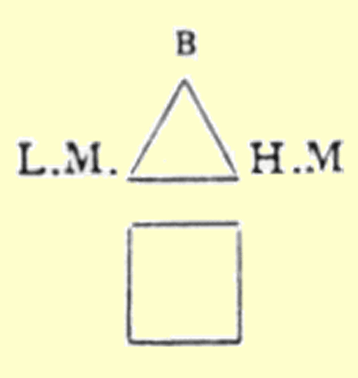
On the separation of the
Principles at death the Higher Ego may be said to go to
Devachan by reason of the experiences of the Lower. The
Higher Ego in its own plane is the Kumâra.
The Lower Quaternary
dissolves; the body rots, the Linga Sharîra fades out.
At reincarnation the
Higher Ego shoots out a Ray, the Lower Ego. Its
energies are upward and downward. The upward tendencies
become its Devachanic experiences; the lower are Kâmic.
The Higher Manas stands to Buddhi as the Lower Manas to
the Higher.
Responsibility and the
Ego (Page 591)
As to the question of
responsibility, it may be understood by an example. If
you take the form of Jack the Ripper, you must suffer
for its misdeeds, for the law will punish the murderer
and hold him responsible. You are the sacrificial
victim. In the same way the Higher Ego takes the
responsibility of every body it informs.
You borrow some money to
lend it to another; the other runs away, but it is you
who are responsible. The mission of the Higher Ego is
to shoot out a Ray to be a Soul in a child.
Thus the Ego
incarnates in a thousand bodies, taking upon itself the
sins and responsibilities of each body. At every
incarnation a new Ray is emitted, and yet it is the same
Ray in essence, the same in you and me and every one.
The dross of the incarnation disintegrates, the good
goes to Devachan.
The Flame is eternal.
From the Flame of the Higher Ego, the Lower is lighted,
and from this a lower vehicle and so on.
And yet the Lower Manas
is such as it makes itself. It is possible for it to act
differently in like conditions, for it has reason and
self-conscious knowledge of right and wrong, and good
and evil, given to it. It is in fact endowed with all
the attributes of the Divine Soul. In this the Ray is
the Higher Manas, the speck of responsibility on earth.
The part of the essence
is the essence, but while it is out of itself, so to
say, it can get soiled and polluted. The Ray can be
manifested on this earth because it can send forth its
Mâyâvi Rûpa. But the Higher cannot, so it has to send
forth a Ray. We may look upon the Higher Ego as the
Sun, and the personal Manases as its Rays. If we
take away the surrounding air and light the Ray may be
said to return to the Sun, so with the Lower Manas and
Lower Quaternary.
The Higher Ego can only
manifest through its attributes.
In cases of sudden
death, the Lower Manas no more disappears than does the
Kâma Rûpa after death. After the severance the Ray may
be said to snap or be dropped. After death such a man
cannot go to Devachan, nor yet remain in Kâma Loka; his
fate is to reincarnate immediately. Such an entity is
then an animal Soul plus the intelligence of the severed
Ray. The manifestation of this intelligence in (Page
592) the next birth will depend entirely on the physical
formation of the brain and on education.
Such a Soul may be
re-united with its Higher Ego in the next birth, if the
environment is such as to give it a chance of aspiration
(this is the “grace” of the Christians); or it may go on
for two or three incarnations, the Ray becoming weaker
and weaker, and gradually dissipating, until it is born
a congenital idiot and then finally dissipated in lower
forms.
There are enormous
mysteries connected with the Lower Manas.
With regard to some
intellectual giants, they are in somewhat the same
condition as smaller men, for their Higher Ego is
paralyzed, that is to say, their spiritual nature is
atrophied.
The Manas can pass its
essence to several vehicles, e.g., the Mâyâvi Rûpa,
etc., and even to Elementals which it can ensoul, as the
Rosicrucians taught.
The Mâyâvi Rûpa may be
sometimes so vitalized that it goes on to another plane
and unites with the beings of that plane and so ensouls
them.
People who bestow
great affection upon animal pets are ensouling them to a
certain extent, and such animal souls progress rapidly;
in return such persons get back the animal vitality and
magnetism. It is, however, against Nature to thus
accentuate animal evolution, and on the whole is bad.
Monadic Evolution
The Kumâras do not direct
the evolution of the Lunar Pitris. To understand the
latter, we might take the analogy of the blood.
The blood may be compared
to the universal Life Principle, the corpuscles to the
Monads. The different kinds of corpuscles are the same
as the various classes of Monads and various kingdoms,
not, however, because of their essence being different,
but because of the environment in which they are. The
Chhâyâ the permanent seed, and Weissmann in his
hereditary germ theory is very near truth.
|
Friedrich Leopold August
Weismann (17 January 1834 – 5 November 1914) was a German
evolutionary biologist. Ernst Mayr ranked him the second
most notable evolutionary theorist of the 19th century,
after Charles Darwin. Weismann became the Director of the
Zoological Institute and the first Professor of Zoology at
Freiburg. His main
contribution was the germ plasm theory, according to which
(in a multicellular organism) inheritance only takes place
by means of the germ cells—the gametes such as egg cells and
sperm cells. Other cells of the body—somatic cells—do not
function as agents of heredity. The effect is one-way: germ
cells produce somatic cells and are not affected by anything
the somatic cells learn or therefore any ability the body
acquires during its life. Genetic information cannot pass
from soma to germ plasm and on to the next generation. This
is referred to as the Weismann barrier. This idea, if true,
rules out the inheritance of acquired characteristics as
proposed by Jean-Baptiste Lamarck.
The idea of the Weismann barrier is central
to the Modern evolutionary synthesis, though it is not
expressed today in the same terms. In Weismann's opinion the
largely random process of mutation, which must occur in the
gametes (or stem cells that make them) is the only source of
change for natural selection to work on. Weismann was one of
the first biologists to deny soft inheritance entirely.
Weismann's ideas preceded the rediscovery of Gregor Mendel's
work, and though Weismann was cagey about accepting
Mendelism, younger workers soon made the connection....
Experiments on the inheritance of mutilations
The idea that germline cells contain
information that passes to each generation unaffected by
experience and independent of the somatic (body) cells, came
to be referred to as the Weismann barrier, and is frequently
quoted as putting a final end to the theory of Lamarck and
the inheritance of acquired characteristics. What Lamarck
claimed was the inheritance of characteristics acquired
through effort, or will.
Weismann conducted the experiment of removing
the tails of 68 white mice, repeatedly over 5 generations,
and reporting that no mice were born in consequence without
a tail or even with a shorter tail. He stated that "901
young were produced by five generations of artificially
mutilated parents and yet there was not a single example of
a rudimentary tail or any other abnormality of the organ".
Weismann was aware of the limitations of this experiment,
and made it clear that he embarked on the experiment
precisely because, at the time, there were many claims of
animals inheriting mutilations (he refers to a claim
regarding a cat that had lost its tail having numerous
tail-less offspring). There were also claims of Jews born
without foreskins. None of these claims, he said, were
backed up by reliable evidence that the parent had in fact
been mutilated, leaving the perfectly plausible possibility
that the modified offspring were the result of a mutated
gene. The purpose of his experiment was to lay the claims of
inherited mutilation to rest. The results were consistent
with Weismann's germ plasm theory.
-- August Weismann, by Wikipedia
26. WHEN THE SWEAT-BORN
PRODUCED THE EGG-BORN, THE TWO-FOLD [1] THE MIGHTY, THE
POWERFUL WITH BONES, THE LORDS OF WISDOM SAID: "NOW SHALL WE
CREATE." Why "now" --
and not earlier? This the following Shloka explains.
27. THE THIRD RACE BECAME THE VAHAN ([2] OF
THE LORDS OF WISDOM. IT CREATED SONS OF WILL AND YOGA, BY
KRIYASHAKTI IT CREATED THEM, THE HOLY FATHERS, ANCESTORS OF
THE ARHATS. . . .
How did they "create," since the "Lords of Wisdom" are
identical with the Hindu Devas, who refuse "to create"?
Clearly they are the Kumaras of the Hindu Pantheon and
Puranas, those elder sons of Brahma,
Sanandana and the other
sons of Vedhas [who] previously created by him ...
without desire or passion, [remained chaste] inspired
with holy wisdom .... and undesirous of progeny? [3]
The power, by which they
first created, is that which has since caused them to be
degraded from their high status to the position of Evil
Spirits, of Satan and his Host -- created in their turn by
the unclean fancy of exoteric creeds. It was by Kriyashakti,
that mysterious and divine power latent in the will of every
man, and which, if not called to life, quickened and
developed by Yogi-training, remains dormant in 999,999 men
out of a million, and gets atrophied. This power is
explained in the "Twelve Signs of the Zodiac," [4] as
follows: --
Kriyashakti: -- the
mysterious power of thought which enables it to produce
external, perceptible, phenomenal results by its own
inherent energy. The ancients held that any idea will
manifest itself externally, if one's attention (and will) is
deeply concentrated upon it. Similarly, an intense volition
will be followed by the desired result.
A Yogi generally performs
his wonders by means of Ichchhashakti (Will-power) and
Kriyashakti."
The Third Race had thus
created the so-called "Sons of Will and Yoga," or the
"Ancestors" -- the Spiritual forefathers -- of all the
subsequent and present Arhats, or Mahatmas, in a truly
immaculate way. They were indeed created, not begotten, as
were their brethren of the Fourth Race, who were generated
sexually after the separation of sexes, the "Fall of Man."
For creation is but the result of will acting on phenomenal
matter, the calling forth out of it the Primordial Divine
Light and Eternal Life. They were the "Holy Seed Grain" of
the future Saviours of Humanity.
Here we have to again make
a break, in order to explain certain difficult points, of
which there are so many. It is almost impossible to avoid
such interruptions. [5]
The order of the evolution of the Human Races
stands thus in the Fifth Book of the Commentaries, and was
already given:
The First men were Chhayas
(1); the Second, the "Sweat-born" (2), the Third,
"Egg-born," and the holy Fathers born by the power of
Kriyashakti (3); the Fourth were the children of the
Padmapani [Chenresi] (4).
Of course such primeval
modes of procreation -- by the evolution of one's image,
through drops of perspiration, after that by Yoga, and then
by what people will regard as magic (Kriyashakti) -- are
doomed beforehand to be regarded as fairy-tales.
Nevertheless, beginning with the first and ending with the
last, there is really nothing miraculous in them, nor
anything which could not be shown natural. This must be
proven.
1. Chhaya-birth, or that
primeval mode of sexless procreation -- the first Race
having oozed out, so to say, from the bodies of the Pitris
-- is hinted at in a Cosmic allegory in the Puranas. [6]
It is the beautiful allegory and story of Sanjna, the
daughter of Viswakarman -- married to the Sun, who, "unable
to endure the fervours of her lord," gave him her Chhaya
(shadow, image, or astral body), while she herself repaired
to the jungle to perform religious devotions, or Tapas. The
Sun, supposing the Chhaya to be his wife, begat by her
children, like Adam with Lilith -- an ethereal shadow also,
as in the legend, though an actual living female monster
millions of years ago.
But, perhaps, this instance
proves little except the exuberant fancy of the Puranic
authors. We have another proof ready. If the materialized
forms, which are sometimes seen oozing out of the bodies of
certain mediums could, instead of vanishing, be fixed and
made solid -- the creation of the first Race would become
quite comprehensible. This kind of procreation cannot
fail to be suggestive to the student. Neither the mystery
nor the impossibility of such a mode is certainly any
greater -- while it is far more comprehensible to the mind
of the true metaphysical thinker -- than the mystery of the
conception of the foetus, its gestation and birth as a
child, as we now know it.
Now to the curious and little understood corroboration in
the Puranas about the "Sweat-born."
_______________
Notes:
1. Androgyne Third Race. The Evolutionist
Professor Schmidt alludes to "the fact of the separation of
sexes, as to the derivation of which from species once
hermaphrodite all (the believers in Creation naturally
excepted) are assuredly of one accord." (Doctrine of Descent
and Darwinism,"p. 159.) Such indeed is the incontestable
evidence drawn from the presence of rudimentary organs.
Apart from such palpable traces of a primeval
hermaphroditism, the fact may be noted that, as Laing
writes, "a study of embryology. . . . shows that in the
human higher animal species the distinction of sex is not
developed until a considerable progress has been made in the
growth of the embryo." (A Modern Zoroastrian, p.106.) The
Law of Retardation -- operative alike in the case of human
races, animal species, etc., when a higher type has once
been evolved -- still preserves hermaphroditism as the
reproductive method of the majority of plants and many lower
animals. 2. Vehicle.
3. Vishnu Purana, I., vii; Wilson, i. 100.
4. See Five Years of Theosophy, p. 111.
5. For explanations and a
philosophical account of the nature of those beings, which
are now viewed as the "evil" and rebellious Spirits, the
Creators of Kriyashakti, the reader is referred to the
chapters on "The Myth of the 'Fallen Angel,' in its Various
Aspects," in Part II of this Volume.
6. Vishnu Purana, III. ii.
-- The Secret Doctrine, by Helena Petrovna
Blavatsky |
H.P.B was asked whether
there was one Ego to one permanent Chhâyâ seed,
oversouling it in a series of incarnations; her answer
was: “No, it is Heaven and Earth kissing each other.”
The animal Souls are in
temporary forms and shells in which they gain
experience, and in which they prepare materials for
higher evolution.
Functions of the Astral
Body (Page 593)
Until the age of seven
the astral atavic germ forms and moulds the body; after
that the body forms the Astral.
The Astral and the Mind
Mutually react on each other.
The meaning of the
passage in the Upanishads, where it says that the Gods
feed on men, is that the Higher Ego obtains its earth
experience through the Lower.
Astral Body
The Astral can get out
unconsciously to the person and wander about.
The Chhâyâ is the same
as the Astral Body.
The germ or life essence
of it is in the spleen.
“The Chhâyâ is coiled up
in the spleen.” It is from this that the Astral is
formed; it evolves in a shadowy curling or gyrating
essence like smoke, gradually taking form as it grows.
But it is not projected from the physical, atom for
atom. This latter intermolecular form is the Kâmâ Rûpa.
At death every cell and molecule gives out its essence,
and from it is formed the Astral of the Kâma Rûpa; but
this can never come out during life.
The Chhâyâ in order to
become visible draws upon the surrounding atmosphere,
attracting the atoms to itself; the Linga Sharîra could
not form in vacuo. The fact of the Astral Body accounts
for the Arabian and Eastern tales of Djins and bottle
imps, etc.
In spiritualistic
phenomena, the resemblance to deceased persons is mostly
caused by the imagination. The clothing of such phantoms
is formed from the living atoms of the medium, and is no
real clothing, and has nothing to do with the clothing
of the medium. “All the clothing of a materialization
has been paid for.”
The Astral supports life;
it is the reservoir or sponge of life, gathering it up
from all the natural kingdoms around, and is the
intermediary between the kingdoms of Prânic and physical
life.
Life cannot come
immediately from the subjective to the objective, for
Nature goes gradually through each sphere. Therefore the
Linga Sharîra is the intermediary between Prâna and our
physical body, and pumps in the life.
The spleen is
consequently a very delicate organ, but the physical
spleen is only a cover for the real spleen.
Now Life is in reality
Divinity; Parabrahman. But in order to manifest on the
physical Plane it must be assimilated; and as the purely
physical is too gross, it must have a medium, viz., the
Astral.
(Page 594) Astral matter
is not homogeneous, and the Astral Light is nothing but
the shadow of the real Divine Light; it is however not
molecular.
Those (Kâmarûpic)
entities which are below the Devachanic Plane are in
Kama Loka and only possess intelligence like monkeys.
There are no entities in the four lower kingdoms
possessing intelligence which can communicate with men,
but the Elementals have instincts like animals. It is,
however possible for the Sylphs (the Air Elementals, the
wickedest things in the world) to communicate, but they
require to be propitiated.
Spooks (Kâmarûpic
entities) can only give the information they see
immediately before them. They see things in the Aura of
people, although the people may not be aware of them
themselves.
Earth-bound spirits are
Kâmalokic entities that have been so materialistic that
they cannot be dissolved for a long time. They have only
a glimmering of consciousness and do not know why they
are held, some sleep, some preserve a glimmering of
consciousness and suffer torture.
In the case of people who
have very little Devachan, the greater part of the
consciousness remains in Kâma Loka, and may last far
beyond the normal period of one hundred and fifty years
and remain over until the next reincarnation of the
Spirit. This then, becomes the Dweller on the Threshold
and fights with the new Astral.
The acme of Kâma is the
sexual instinct, e.g., idiots have such desires and also
food appetites, etc., and nothing else.
Devachan is a state on a
plane of spiritual consciousness; Kâma Loka is a place
of physical consciousness. It is the shadow of the
animal world and that of instinctual feeling. When the
consciousness thinks of spiritual things, it is on a
spiritual plane.
If one’s thoughts are of
nature, flowers, etc., then the consciousness is on the
material plane.
But if thoughts are about
eating, drinking, etc., and the passions, then the
consciousness is in the Kâmalokic plane, which is the
plane of animal instincts pure and simple.
PEACE TO ALL BEINGS
|
"In the archives of the T.S. and E.S. at
Point Loma ...[is] a complete record of all the [Inner Group] meetings
held and the teachings given.... [This record-book) is throughout in the
handwriting of Alice Leighton Cleather, and is preceded (facing the
first page on which the record begins) by the following, also in Mrs.
Cleather's handwriting: 'Copied--- July, 1891---for W.O.J.,' beneath
which are the initials A.L.C....
"In [this] record ... the meetings are
numbered I to XX, the dates of the meetings are given, and mention is
also made of those present at each meeting, these being indicated by the
initials of their names....
"By comparing the other available
[incomplete Inner Group] records...it has become evident that the
Cleather Record... is the most complete, with but few minor
omissions...."
Joseph B. Fussell
Theosophical Forum,
April, 1940, pp. 278-279 &
April, 1941, p. 295.
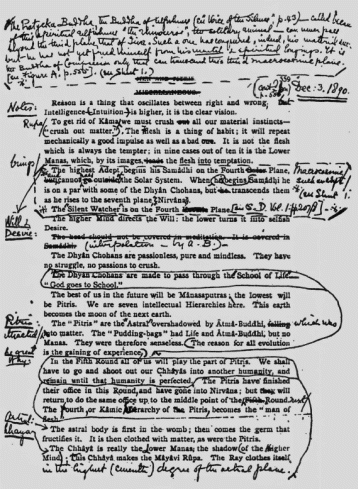
Reason is a thing that oscillates between
right and wrong; but Intelligence (Intuition) is higher, it is the clear
vision.
To get rid of Kama, we must crush all
our material instincts ("crush out matter.") The flesh is a thing of
habit; it will repeat mechanically a good impulse as well as a bad one.
It is not the flesh which is always the tempter; in nine cases out of
ten it is the Lower Manas, which, by its images, leads the flesh into
temptation.
The highest Adept begins his Samadhi on
the Fourth Plane, and cannot pass out of the Solar System. When Samadhi
begins he is on a par with some of the Dhyan Chohans, but transcends
them as he rises to the seventh plane, Nirvana.
The "Silent Watcher" is on the Fourth
Plane.
The higher Mind directs the Will: the
lower turns it into selfish Desire.
The Dhyan Chohans are passionless,
pure and mindless. They have no struggle, no passions to crush.
The best of us in the future will be
Manasaputras; the lowest will be Pitris. We are seven intellectual
Hierarchies here. This earth becomes the moon of the next earth.
The "Pitris" are the "Astral"
overshadowed by Atma-Buddhi, which was attracted to matter. The
"Pudding-bags" had Life and Atma-Buddhi, but no Manas. They were
therefore senseless. The reason for all evolution is the gaining of
experience. The Dhyan Chohans are made to pass through the "School of
Life" -- "God goes to School."
The astral body is first in the womb;
then comes the germ that fructifies it. It is then clothed with matter,
as were the Pitris.
The Chhaya is really the Lower Manas; the
shadow (of the Higher Mind); This Chhaya makes the Mayavi Rupa. The Ray
clothes itself in the highest degree of the astral plane. In the Fifth
Round all of us will play the part of Pitris. We shall have to go and
shoot out our Chhayas into another humanity, and remain until that
humanity is perfected. The Pitris have finished their office in this
Round, and have gone into Nirvana; but will return to do the same office
up to the middle point of the Round next. The fourth, or Kamic Hierarchy
of Pitris, becomes the "man of flesh."
***
Aug. 19, 1890
Dear Fellow Student,
If you are ready to comply with the
following conditions, H.P.B. is prepared to admit you as a Probationer
into the "Inner Group" of the E.S.:
1) That you observe strictly the rules of
the E.S.
2) That you preserve the strictest
secrecy on the instruction given, & on the fact of your membership in
the "I.G."
3) That you abstain from meat-eating &
preserve absolute chastity.
4) That you agree to leave the Group
immediately, if from any reason your presence interferes with its
perfect harmony.
5) That you attend regularly the meetings
of the Group, on the day & hour agreed on.
6) That you are prepared to take the
following pledge:---
Pledge to be taken before the first
meeting:
I declare once more, before my Higher
Self, which I invoke, that my desire is to obtain instruction only in
order to fit myself for the service of others: That I put away all
worldly thought & personal ambitions: That I am free from all hatred &
uncharitable feelings to others: That I submit myself as a humble &
obedient student of Gupta Vidya.
Aum!
***
Formula to be used instead of the above
before each meeting:
"I declare that I am ready,
So help me, my Higher Self."
Regulations
Each member is expected to provide
himself with a note book; & to prepare in writing from one to three
questions which are to be handed to the Secretaries.
If you, therefore, can comply with all
the above conditions, will you attend here at 8 p.m. on Wednesday
evening, Aug. 20th.
Yours most sincerely & fraternally,
Annie Besant
G.R.S. Mead
Secretaries
***
For a complete transcript of the Inner
Group teachings, see Appendix II, pp. 477-552 of the present work.
For more historical background on the
Inner Group, see "A Historical Introduction" in The Inner Group
Teachings of H.P. Blavatsky, 2nd Revised and Enlarged Edition, compiled
and annotated by Henk J. Spierenburg. For variant readings of the Inner
Group Teachings, see also the Spierenburg compilation.
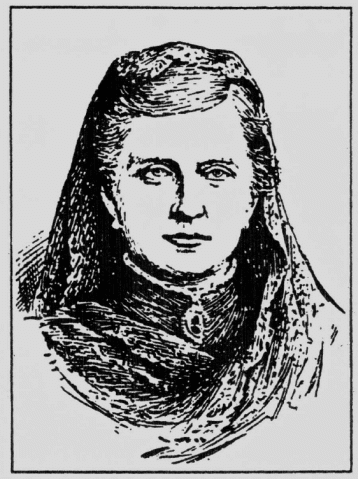
Countess Wachtmeister
***
Strictly Private and Confidential.
[NOT THE PROPERTY OF ANY MEMBERS, AND TO
BE RETURNED ON DEMAND TO THE HEAD OF THE SECTION OR TO WILLIAM Q. JUDGE,
P.O. BOX 2659, NEW YORK, N.Y.]
E.S.T.S.
CRITICISMS AND REMARKS BY THE HEAD OF
THE SECTION CONCERNING ANSWERS TO EXAMINATION PAPER NO. 1.
QUESTION No. 1. -- "What are the Pitris?"
ANSWER. -- In the Hindu Scripture, the
term "Pitri" is used in a very loose manner, but in Esoteric Philosophy
it has a distinct meaning. The Pitris are the "ancestors" of
Humanity, and are divided into two main classes: (a) the Agnishwatta, or
Solar, and (6) the Barhishad, or Lunar Pitris. These again are
sub-divided into seven classes. As stated in the Secret Doctrine (Vol.
I, p. 181), there are "three separate schemes of evolution, which in our
system are inextricably interwoven and interblended at every point.
These are the monadic (or spiritual), the intellectual, and the physical
evolutions. These three are the finite aspects or the reflections on
the field of Cosmic Illusion of ATMA, the seventh, the ONE REALITY.
"1. The Monadic is, as the name implies,
concerned with the growth and development into still higher phases of
activity, of the Monad [1] in conjunction with --
"2. The Intellectual, represented by the
Manasa-Dhyanis (the Solar Devas, or the Agnishwatta Pitris), the "givers
of intelligence and consciousness" to man, and --
"3. The Physical, represented by the
Chhayas of the Lunar Pitris, around which Nature has concreted the
present physical body. This body serves as the vehicle for the 'growth'
(to use a misleading word) and the transformations through Manas and --
owing to the accumulations of experiences -- of the finite into
the INFINITE, of the transient into the Eternal and Absolute."
(a) The Agnishwatta Pitris are
mentioned in the Secret Doctrine under many names. They are the "Virgin
Youths," the mysterious Kumaras, or Manasa-Putras, "Sons of Mind."
In other words, they are our reincarnating Egos, the fashioners of our
"Inner Man." There are seven Hierarchies of these Mind-Born Sons of
Mahat, the Great Principle, the Maha-manvantaric "Mind of the Universe."
(b) The Barhishad Pitris, on the other
hand, are those which are possessed of the physical creative fire, with
which they fashion the physical man. These lower Prajapati are no
more than the "fathers" of the models or types of the physical man,
"made in their image." (Secret Doctrine, Vol. I, p. 459.) They are
the Elohim of Genesis, the seven creative Forces of Nature, and are
generally spoken of as the Lunar Ancestors. During the first three
Rounds "their function is to pass through the whole triple cycle of the
mineral, vegetable, and animal kingdoms in their most ethereal, filmy,
and rudimentary forms in order to clothe themselves in, and assimilate,
the nature of the newly-formed chain." At the beginning of the fourth
Round they evolve their chhayas or shadows for the second classes or
those who come after them. (Secret Doctrine, Vol. I, p. 174.)
Therefore, as the Higher Pitris or Dhyanis had no hand in primeval man's
physical creation, we find him issued from the Barhishads --
spiritually fireless -- and described as "aeriform, devoid of
compactness, and mindless."
Note. -- This question was -- with
rare exceptions -- very badly answered. A large number of Esotericists
simply replied, "I do not know," or, "I am not very clear," -- a
confession of ignorance which no one, after a year of study, should have
been obliged to make. An Esotericist has the duty of right-thinking
as well as right-living, and a lamentable want of study is shown in most
of the papers. It is wholly impossible to give more advanced teaching to
those who are not even familiar with the broad outlines of the doctrines
given to the world in the Secret Doctrine. Even the Notes on the Secret
Doctrine, given monthly in Lucifer, would have enabled Esotericists to
answer this question.
Q. (2) -- "What is Kama Rupa?"
A. -- Kama-Rupa, the body of desire,
is a word used loosely in exoteric writings to denote the fourth
principle, the passional nature, with its animal and sensual desires. It
is the latest developed aspect of the lower quaternary, and is found in
animals as well as in man. The word "Rupa," however, is a misnomer. Kama
has no rupa during life (vide third Instructions). After death the rupa
is formed of the dregs of the Auric Envelope, and these dregs, with the
animal passions and emotions, are the Kama-Rupa. This survives in
Kama-Loca a longer or shorter time, according to the strength of these
elements in the late personality; if drawn into the current of a medium,
and obtaining from him a faint reflection of intelligence, it becomes
the "spook of the seance-room:" in case of separation from the Higher
Self, it reincarnates on earth, forming the worse type of human being.
The Esotericist must distinguish clearly between the Kamic principle in
the personality, and the Kama-Rupa which is the embodiment of that,
principle after death.
Note. -- Many students answered this
question by merely translating Kama-Rupa into "body of desire" -- an
answer that could have been given by any outsider who had picked up a
Theosophical publication dealing with the seven principles. Only a very
small minority stated that the Rupa was formed after death -- a fact
which seems to imply, that great majority of Esotericists have not taken
the trouble to read the third Instructions. Such gross ignorance as the
the confounding of Kama-Rupa with Kama-Loca is also shown in some of the
answers. The mistake in some cases was probably due to the acceptation
by the students of Mr. Sinnett's classification, without any analysis.
Kama-Rupa must be included in the classification, because potentially it
exists, although it is not concentrated or collected into a definite
form until death breaks up the body. This may be understood in the
same way as when we say that in such-and-such a man's body there are so
many ounces of carbon, which, however, we know will not reveal
themselves as carbon until released from the other elements.
Q. (3) -- "What is the difference between
the Higher and the Lower Self?"
A. -- The Higher Self is a spark of
the Universal Spirit, Atma, manifesting in man through Buddhi as its
vehicle. It must not be confounded with the Higher Ego, the
Individuality, the reincarnating Ego -- all terms for the Manasic
Entity. The latter only becomes part of the Higher Self by rising to it,
and assimilating with it, and thus completing the Trinity, which yet is
the One. Atma-Buddhi is universal, eternal, but senseless on this plane.
Manas is the self-consciousness. Buddhi passes on from this
maha-manvantara to maha-manvantara. Manas is limited to one
maha-manvantara.
The Lower Self is the personal Ego,
Kama-Manas; the impermanent personality, the root of "I-am-ship," and
therefore of separateness. It is the animal soul, "of the earth,
earthy," the continual enemy of spiritual progress, the tempter, the
center of selfish desires and personal ambitions. The Kamic element
is the lowest point of materiality, correlative to the fourth Round and
the fourth Globe, the turning-point of the arc, the furthest descent of
spirit into matter. The Manasic element, the Lower Manas in union with
Kama, is the beginning of the reascent: hence Kama-Manas is the
battle-ground of this stage of earth-life.
Note. -- Scarcely any avoided a confusion
between the Higher Self and the Higher Ego. Some fell into the most
hopeless blunders, showing that they had no clear ideas of the septenary
constitution of man. Serious mistakes were also made as to the meaning
of the "Lower Self;" one wild guess identifying it with the Auric Egg.
Yet every Esotericist has invoked the Higher Self, and ought surely to
have taken the trouble to make clear to himself what it was he invoked.
Q. (4) -- "What is the Astral Light?"
A. -- The Astral Light of the solar
system is the Linga Sarira of our globe: as the Astral body of Man is
the moulder of the Physical, so does the Astral Light serve primarily as
the matrix of the earth, but it is now largely composed of the
emanations of our earth. It is the lowest of the seven divisions in the
sixth differentiation of Akasa, and is the offscourings of Akasa
polluted with earthly emanations. In this are reflected, in reverse,
images from above and from below: hence the confused visions of the
clairvoyant, who uses psychic sight which does not pierce beyond the
Astral plane.
In this light are preserved those images,
which thus form a record of all that is said, thought, and done. Good
and evil thoughts charge it with influences which react on living
humanity. Hence the description of it by the Kabbalists as Satan, the
malign influences overpowering the good.
Note. -- That the Astral Light contains
the record of earth was generally stated, although one student informed
his surprised teacher that the Astral Light was the divine spark within
us. This particular student is required to study more and think more.
Few, however, understood the relation of the Astral Light to the earth
as its Linga Sarira.
Q. (5) -- "Give reasons for joining the
E.S."
Note. -- This question was, on the whole,
very well answered, the replies showing earnestness and sincerity.
Q. (6) -- "What Theosophical book do you
consider has most helped you?"
Note. -- If the books named are carefully
studied, knowledge will be rapidly acquired.
Q. (7) -- "What is Occultism; and what do
you consider to be Practical Occultism?"
A. -- Occultism is the science of the
relation of the mind of man to the Mind of the Universe. As all
Planes of Consciousness and all the Principles of man are
root-differentiations of MAHAT, the "Great Principle" or Mind of the
Universe (the Third Logos of the Secret Doctrine), Practical
Occultism is the obtaining of a right knowledge of the correspondences
between the Microcosmic Principles and the Macrocosmic Planes, and of
the use of the natural powers to which such knowledge gives the right
and direction. As such occult knowledge (Gnosis or Gupta Vidya)
teaches Man to rightly comprehend the "root-idea" of this Divine Mind
and hence the supreme reason of each individual's apparently separate
existence from the rest, the true Occultist can never use such powers
against the Law unless at the same time consciously condemning himself
to perdition: on the contrary, he will seek to prove by every thought,
work, and deed, that he lives for service to others alone, and that
he has closed his ears for ever to the "dire heresy" of separateness.
Note. -- Badly answered. Hardly anyone
had caught the central idea of Occultism.
London, August 27, 1890
G. R. S. MEAD,
Secretary, E. S.
Approved.
H. P. BLAVATSKY.
A true copy from original in my hands.
WILLIAM Q. JUDGE,
Secretary to H.P.B.
New York, Sept. 14, 1890.
APPOINTMENT OF COUNCILLOR.
Dr. M. J. Gahan having resigned in
consequence of removal to New York, Mr. Wm. S. Wing, care N. P. R. R.,
Omaha, Neb., bas been appointed in his place by the Head of the Section.
WILLIAM Q. JUDGE,
Secretary to H. P. B.
_______________
Notes:
1. Atma-Buddhi.
***
ERRATA
These alterations must be at once made by
members, with
pen and ink:
JAN-FEB. --1st line, 3d par., p. 23, read
septimum for septimam.
MAR.-APR. -- Wherever Philosophamena
occurs alter to Philosophomena.
Line 38, p. 14, read in in his Apophasis
instead of in his.
Line 3, 3d par., p. 23, read. it
corresponds to Color and Sound.
No. III. -- Last line, p. 4, insert
national for natural (Karma).
Lines 24 and 25, p. 20, alter to are
simply the sharp and the flat of that 'Fa, etc., instead of are simply
the sharps of that Fa (flat), etc.
Make following corrections in the table
of Tatwas, p. 18:
Transpose first line: Upas, Liquid,
Knees; White, Upas, to next succeeding line, so that Tejas, etc.
including second Tejas, shall be the first line; then (e) will be Tejas
Tatwa, and (f) will be Upas Tatwa.
Strike out first foot-note on p. 18.
[Other corrections have been sent me, but
by inadvertence have been blurred before mailing, so that they cannot
yet be given. -- W. Q, J.]
G. R. S. MEAD
Secretary E. S.
London, August 27, 1890.
***
SUMMARY STATEMENT.

N. B. -- The balance may exceed that
given in consequence of the British account going only to August 30,
1890.
N. B. -- With regard to the sum included
under "Donations" (European), it is perhaps well to point out that a sum
of £50 per annum has been subscribed by a single Esotericist in England.
N. B. -- It is necessary also to mention
that the E. S. fund, being practically the only permanent one, has been
often applied to the payment of postages, etc. -- expenses incurred in
correspondence with persons desirous of understanding something of the
tenets of Theosophy, exclusive of those coming under the role of
"British Section."
On Changing the Name of the E.S.T.S. by
H.P. Blavatsky et al.
SUMMARY STATEMENT.

N. B.-In the United States there are over 30 groups, and
only nine of these have contributed, and one alone gave over
$150. Many members have given nothing, -- it is for them to
say whether they were unable to or not. There is a constant
use of funds in answering questions and printing for the
benefit of members, not to speak of time and energy expended
by the workers.
***
H.P. BLAVATSKY
ON THE ESOTERIC SECTION
"You must have seen my circular sent to
all the M.E.S. of India, that for the
time being I have to cease sending them
Instructions."
B.P. Blavatsky
Letter dated Nov. 12, 1890
to Bertram Keightley
***
H.P. BLAVATSKY
ON THE ESOTERIC SECTION
"Even in the Rules of the Esoteric
Section of the T.S. it is stated that the
past misdeeds of the applicant, unless of
a criminal nature, have nothing to do
with the Society; they are the Karma of
each individual. In entering this
Section one is as though new born. If then this is the case with the inner
Section of the T.S. much more then is it
the case with the ordinary exoteric body.
Sufficient to be a Theosophist to be
vilified by the outside world. Instead
then of fearing to come forward, now is
your opportunity to atone for the past by
future work for others for an unselfish
life. I only wish every Theosophist were
as honest as yourself in being ready to
admit his faults.
B.P. Blavatsky
Letter dated Nov. 14, 1890
***
H.P.B. Revises
Two E.S.T.S. Documents
Sometime in 1890, H.P.B. issued a revised edition of the original Pledge
Card (see
original on pp. 27-30 of the present compilation). A facsimile of this
revised Pledge Card
will be found on the following pp. 255-258.
Also in September or October, 1890, H.P.B. issued a 2nd and revised
edition of The
Preliminary Memorandum (see first 1888 edition on pp. 43-70 of the
present
compilation.) This 2nd edition was given a new title: Book of Rules. See
pp. 263-297 of
this compilation for a facsimile of Book of Rules.
Also issued at this time was a new document titled Preliminary
Memorandum which
consisted of extracts from the Preliminary Explanations to No. [II of
the Instructions and
a quote from E.S.T.S. Instructions No. III. For a reprint of this
document, see pp. 259-262 of the present compilation.
***
STRICTLY PRIVATE AND CONFIDENTIAL
THE
ESOTERIC SECTION OF THE T.S.
Dear
I forward you herewith a copy of the
Rules and Pledge for Probationers of the
Esoteric Section of the TS.
Should you be unable to accept them, I
request that you will return this to me without delay.
***
RULES OF THE ESOTERIC SECTION (PROBATIONARY)
OF THE THEOSOPHICAL
SOCIETY.
1. No person shall belong to the Esoteric Section who
is not already a Fellow of the Theosophical Society.
2. Application for membership in the Esoteric Section
must be accompanied by a copy of the Pledge
hereunto appended, written out and signed by the
Candidate, who thereupon enters upon a special period
of probation, which commences from the date of his
signature.
3. All members shall be approved by the Head of
the Section.
4. He who enters the Esoteric Section is as one
"newly born"; his past -- unless connected with crime,
social or political, in which case he cannot be accepted
-- shall be regarded as never having had existence in respect of blame
for actions committed.
5. Groups of Theosophists belonging to the Esoteric
Section may be formed under a charter from the Head
of the Section.
6. Any member joining Section expressly agrees,
without reservation, to Clause II. of the Pledge.
7. To Preserve the unity of the Section, any person
joining it expressly agrees that he shall be expelled,
and the fact of his expulsion made public to all
members of the Section, should he violate any one of
the three following conditions:-
(a) Obedience to the Head of the Section
in all Theosophical matters.
(b) The Secrecy of the Signs and Passwords.
(c) The Secrecy of the documents of the Section,
and any communication from any Initiate
of any degree, unless absolved from such
secrecy by the Head of the Section.
***
PLEDGE OF PROBATIONERS
IN THE
ESOTERIC SECTION OF THE T.S .
1. I pledge myself to endeavour to make
Theosophy a living power in my life.
2. I pledge myself to support, before the
world, the Theosophical movement, and those of its leaders and members
in whom I have full confidence, and in particular to obey, without cavil
or delay, the orders given through the Head of the Esoteric Section in
all that concerns my Theosophical duties and Esoteric work, so far as my
pledge to my Higher Self and my conscience sanction. [*]
3. I pledge myself never to listen,
without protest, to any evil thing spoken falsely or yet unproven,
against a brother Theosophist, and to abstain from condemning others.
4. I pledge myself to maintain a constant
struggle against my lower nature, and to be charitable to the weaknesses
of others.
5. I pledge myself to do all in my power,
by study and otherwise, to fit myself to help and teach others.
6. I pledge myself to give what support I
can to the Theosophical movement, in time, money, and work.
7. I pledge myself to preserve inviolable
secrecy as regards the signs and pass-words of the Section and all
confidential documents; and to return the latter to the Head of the
Section, or her agent, in case of my resignation, or when requested by
her to do so.
To all of which I pledge my most solemn
and sacred word of honour,
So help me, my Higher Self.
Signed: ________________________
[*] As these qualifications may possibly
be abused, the decision shall rest with seven members of the E.S. as
arbitrators, four of whom shall be chosen by the Probationer and three
by the Head of the Section.
***
PLEASE STATE WHETHER
(a) You are an unattached member of the T.S.;
or,
(b) If otherwise, kindly send in the name of the
Branch of the T .S. you belong to.
(c) Whether married or single.
(d) Please forward a photograph of yourself,
stating your age on the back, in order to
assist me in my work.
In case the pledge is taken, the applicant must
copy the pledge (see back) in his handwriting, signing
it in full, and keep this as a reminder.
***
Strictly private and confidential.
ESOTERIC SECTION
PRELIMINARY MEMORANDUM
"If thou canst not fulfil thy pledge, refuse to
take it, but once thou hast bound thyself to any
promise, carry it out, even if thou hast to die
for it."
Membership in the E. S., and "pledges" sent,
accepted and signed, are no warrants for a high
success, nor do these pledges aim at making of
every student an adept or a magician. They are
simply the seeds in which lurks the potentiality
of every truth, the germ of that progress which
will be the heirloom of only the seventh perfect
Race. A handful of such seeds was entrusted to me
by the keepers of these truths, and it is my duty
to sow them there, where I perceive a possibility
of growth. It is the parable of the Sower put once
more into practice, and a fresh lesson to be
derived from its new application. The seeds that
fall into good ground will bring forth fruit an
hundredfold, and thus repay in each case the waste
of those seeds which will have fallen by the
wayside, on stony hearts and among the thorns of
human passions. It is the duty of the Sower to
choose the best soil for the future crops. But he
is held responsible only so far as that ability is
directly connected with the failures, and that
such are solely due to it; it is the Karma of the
individuals who receive the seeds by asking for
them, that will repay or punish those who fail in
their duties to their HIGHER SELF.
(From the "Book of Discipline"
in the Schools of "Dzyan.")
"1. TO THE EARNEST DISCIPLE HIS TEACHER TAKES THE PLACE
OF FATHER AND MOTHER. FOR WHEREAS THEY GAVE HIM HIS BODY AND
ITS FACULTIES, ITS LIFE AND CASUAL FORM, THE TEACHER SHOWS HIM
HOW TO DEVELOP THE INNER FACULTIES FOR THE ACQUISITION OF THE ETERNAL
WISDOM.
"2. TO THE DISCIPLE EACH FELLOW-DISCIPLE BECOMES A
BROTHER AND SISTER, A PORTION OF HIMSELF, [*] FOR HIS INTERESTS AND ASPIRATIONS ARE THEIRS, HIS WELFARE INTERWOVEN WITH THEIRS,
HIS PROGRESS HELPED OR HINDERED BY THEIR INTELLIGENCE,
MORALITY, AND BEHAVIOR THROUGH THE INTIMACY BROUGHT ABOUT BY THEIR CO-DISCIPLESHIP.
"3. A CO-DISCIPLE OR ASSOCIATE CANNOT BACKSLIDE OR FALL
OUT OF THE LINE WITHOUT AFFECTING THOSE WHO STAND FIRM THROUGH THE SYMPATHETIC TIE BETWEEN THEMSELVES AND THE PSYCHICAL
CURRENTS BETWEEN THEM AND THEIR TEACHER.
" 4. WOE TO THE DESERTER, WOE ALSO TO ALL WHO HELP TO
BRING HIS SOUL TO THE POINT WHERE DESERTION FIRST PRESENTS
ITSELF BEFORE HIS MIND'S EYE, AS THE LESSER OF TWO EVILS, GOLD
IN THE CRUCIBLE IS HE WHO STANDS THE MELTING HEAT OF TRIAL, AND
LETS ONLY THE DROSS BE BURNT OUT OF HIS HEART; ACCURSED BY
KARMIC ACTION WILL FIND HIMSELF HE WHO THROWS DROSS INTO THE
MELTING-POT OF DISCIPLESHIP FOR THE DEBASEMENT OF HIS FELLOW-PUPIL. AS THE MEMBERS TO THE BODY, SO ARE THE DISCIPLES TO EACH
OTHER, AND TO THE HEAD AND HEART WHICH TEACH AND NOURISH THEM
WITH THE LIFE- STREAM OF TRUTH.
" 5. AS THE LIMBS DEFEND THE HEAD AND HEART OF THE BODY
THEY BELONG TO, SO HAVE THE DISCIPLES TO DEFEND THE HEAD AND
THE HEART OF THE BODY THEY BELONG TO (in this case
Theosophy) FROM INJURY.
(From the Letter of a Master. )
....
AND IF THE LIMBS HAVE TO DEFEND THE HEAD AND
HEART OF THEIR BODY, THEN WHY NOT SO, ALSO, THE DISCIPLES THEIR
TEACHERS AS REPRESENTING THE SCIENCE OF THEOSOPHY WHICH
CONTAINS AND INCLUDES THE 'HEAD' OF THEIR PRIVILEGE, THE
'HEART' OF THEIR SPIRITUAL GROWTH? SAITH THE SCRIPTURE:--
"HE WHO WIPETH NOT AWAY THE FILTH WITH WHICH THE PARENT'S
BODY MAY HAVE BEEN DEFILED BY AN ENEMY, NEITHER LOVES THE
PARENT NOR HONOURS HIMSELF. HE WHO DEFENDETH NOT THE PERSECUTED
AND THE HELPLESS, WHO GIVETH NOT OF HIS FOOD TO THE STARVING
NOR DRAWETH WATER FROM HIS WELL FOR THE THIRSTY, HATH BEEN BORN
TOO SOON IN HUMAN SHAPE.
"BEHOLD THE TRUTH BEFORE YOU: A CLEAN LIFE, AN OPEN MIND,
A PURE HEART, AN EAGER INTELLECT, AN UNVEILED SPIRITUAL
PERCEPTION, A BROTHERLINESS FOR ONE'S CO-DISCIPLE, A READINESS
TO GIVE AND RECEIVE ADVICE AND INSTRUCTION, A LOYAL SENSE OF
DUTY TO THE TEACHER, A WILLING OBEDIENCE TO THE BEHESTS OF
TRUTH, ONCE WE HAVE PLACED OUR CONFIDENCE IN, AND BELIEVE THAT
TEACHER TO BE IN POSSESSION OF IT; A COURAGEOUS ENDURANCE OF PERSONAL INJUSTICE, A BRAVE DECLARATION OF PRINCIPLES, A
VALIANT DEFENCE OF THOSE WHO ARE UNJUSTLY ATTACKED, AND A
CONSTANT EYE TO THE IDEAL OF HUMAN PROGRESSION AND PERFECTION
WHICH THE SECRET SCIENCE (Gupta-Vidya) DEPICTS -- THESE ARE THE
GOLDEN STAIRS UP THE STEPS OF WHICH THE LEARNER MAY CLIMB TO
THE TEMPLE OF DIVINE WISDOM."
_______________
Notes:
* "So shalt thou be in full accord with all that: lives;
bear love to men as though they were thy brother-pupils,
disciples of one Teacher, the sons of one sweet mother." (Vide
Fragment III, in Voice of the Silence, p. 49.)
(From No. III of the Instructions.)
Good and evil are relative, and are intensified or
lessened according to the conditions by which man
is surrounded. One who belongs to that which we
call the "useless portion of mankind," i.e., the
lay majority, is in many cases irresponsible.
Crimes committed in Avidya (ignorance) involve
physical but not moral responsibilities or Karma.
Take, for example; the case of idiots, children,
savages, and other people who know no better. But
the case of each of you, pledged to the HIGHER
SELF, is quite another matter. You cannot invoke this divine Witness
with impunity, and once that
you have put yourselves under its tutelage, you
have asked the Radiant Light to shine into and
search through all the dark corners of your being;
consciously you have invoked the divine justice of
Karma to take note of your motives, to scrutinize
your actions, and to enter up all in your account.
The step is as irrevocable as that of the infant
taking birth. Never again can you force yourself
back into the Matrix of Avidya and
irresponsibility. Resignation and return of your
pledges will not help you. Though you flee to the
uttermost parts of the earth, and hide yourselves
from the sight of men, or seek oblivion in the
tumult of the social whirl, that Light will find
you out and lighten your every thought, word, and
deed. Are any of you so foolish as to suppose that
it is to poor, miserable H.P.B. you are giving
your pledge? All she can do is to send to each
earnest one among you a most sincerely fraternal
sympathy and hope for a good outcome to your
endeavors. Nevertheless, be not discouraged, but
try, ever keep trying; [*] twenty failures are not
irremediable if followed by as many undaunted
struggles upward: is it not so that mountains are climbed? And know further that if Karma
relentlessly records in the Esotericist's account
bad deeds that in the ignorant would be
overlooked, yet equally true is it that each of
his good deeds is, by reason of his association with the Higher Self, an hundredfold intensified
as a potentiality for good.
_______________
Notes:
* Read pages 40 and 63 in The Voice of the Silence.
***
STRICTLY PRIVATE AND CONFIDENTIAL
THE
ESOTERIC SECTION
or THE
THEOSOPHICAL SOCIETY.
BOOK OF RULES.
N.B. -- The Pledge Card, Preliminary
Memorandum and Book of Rules must on no account be shown to non-esotericists
unless the permission of one of the officers of the Esoteric Section has
previously been obtained.
***
ESOTERIC SECTION OF THE
THEOSOPHICAL SOCIETY.
BOOK OF RULES.
(Strictly Private, Confidential, Personal
for Members only.)
In the following the masculine includes
the feminine; the singular, the plural; and vice versa.
One object of this book is to give timely
warning to any applicant, should he feel unable or unwilling to accept
fully and without reserve the instructions which may be given, or the
consequences that may result, and to do the duties whose performance
shall be asked. It is but fair to state at once that such duties will
never interfere with, nor encroach upon, the probationer's family
duties; on the other hand, it is
certain that every member of Esoteric Section will
have to give up more than one personal habit, such as
practised in social life, and to adopt some few ascetic
rules.
This degree of the Esoteric Section is probationary,
and its general purpose is to prepare and fit the student
for the study of practical occultism or Raj yoga. Therefore, in this degree, the
student -- save in exceptional cases -- will not be taught how to produce physical
phenomena, nor will any magical powers be allowed to
develop in him; nor, if possessing such powers naturally,
will he be permitted to exercise them before he has
thoroughly mastered the knowledge of SELF, of the
psycho-physiological processes (taking place on the
occult plane) in the human body generally, and until he has in abeyance all his lower passions
and his PERSONAL SELF.
The real Head of the Esoteric Section is
a Master,
whom H. P. Blavatsky is the mouthpiece for this Section.
He is one of those Adepts referred to in theosophical
literature, and concerned in the formation of the Theosophical Society.
It is through H. P. Blavatsky that
each member of this Section will be brought more
closely than hitherto under His influence and care if
found worthy of it. No student, however, need inquire which of the Masters it is. For it does not matter
in
reality; nor is there any necessity for creating one
more chance for indiscretion. Suffice it to say, such is
the law in the East.
Each person will receive in the way of enlightenment
and assistance, just as much as he or she deserves and
no more; and it is to be distinctly understood that in
this Section and these relations no such thing is known
as favour -- all depends upon the person's merits -- and no member has
the power or knowledge to decide what
either he or another is entitled to. This must be left to
those who know -- alone. The apparent favour shown to some, and their consequent apparent advancement,
will be due to the work they do, to the best of their
power, in the cause of Universal Brotherhood and the
elevation of the Race.
No man or woman is asked or supposed to do any
more than his or her best; but each is expected to work
to the extent of his ability and powers.
The value of the work of this Section to the individual
member will depend entirely upon:
1st. The person's power to assimilate the teaching
and make them a part of his being; and
2nd. Upon the unselfishness of the motives with
which he seeks for this knowledge; that is to say, upon whether he has
entered this Section
determined to work for humanity, or with only
the desire to benefit or gain something for
himself alone.
Let all members, therefore, take warning in
time, and seriously examine their motives, for to all those who
join this Section certain consequences will ensue.
And at this stage it is perhaps better that the
applicants should learn the reason for the formation of this Section, and what it is expected to achieve:--
The Theosophical Society has just entered upon the
fourteenth year of its existence; and if it had accomplished
great, one may almost say stupendous, results on the exoteric and utilitarian plane,
it had proved a
dead failure on all those points which rank foremost
among the objects of its original establishment. Thus, as a "Universal Brotherhood." or even
as a fraternity, one among many, it had descended to the level of all
those Societies whose pretensions are great, but whose
names are simply masks -- nay, even SHAMS. Nor can
the excuse be pleaded that it was led into such an undignified
course owing to its having been impeded in its natural development, and
almost extinguished, by reason of the conspiracies of its enemies openly begun in 1884.
Because even before that date there never was that solidarity in the ranks of our Society which would not only
enable it to resist all external attacks, but also make it
possible for greater, wider, and more tangible help to be
given to all its members by those who are always ready
to give help when we are fit to receive it. When trouble arose, too
many were quick to doubt and despair, and few indeed were they who
had worked for the Cause and not for themselves. The attacks of the enemy have given
the Society some discretion in the conduct of its external
progress, but its real internal condition has not
improved, and the members, in their efforts towards spiritual culture, still require
that which solidarity
in the ranks can alone give them the right to ask. The
Masters can give but little assistance to a Body not
thoroughly united in purpose and feeling, and which
breaks its first fundamental rule -- universal brotherly
love, without distinction of race, creed, colour or caste,
i.e., the social distinctions made in the world; nor to a Society, many members of which pass their
lives in judging, condemning, and often reviling other members in
a most untheosophical, not to say disgraceful, manner.
For this reason it was decided to gather the
"elect" of the T.S. and to call them to action. It is
only by a select group of brave souls, a handful of determined men and
women hungry for genuine spiritual development and the acquirement of
soul-wisdom, that the Theosophical Society at large can be brought back
to its original lines. It is through an Esoteric Section alone --
i.e., a group in which all the members, even if unacquainted with one
another, work for each other, and by working for all work for themselves
-- that the great Exoteric Society may be redeemed and made to realize
that in union and harmony alone lie its strength and power. The object
of this Section, then, is to help the future growth of the Theosophical
Society as a whole in the true direction, by promoting brotherly union
at least among a choice minority.
All know that this end was in view when
the Society was established, and even in its mere unpledged ranks there
was a possibility for development and knowledge, until it began to show
want of real union; and now it must be saved from future dangers by the
united aim, brotherly feeling, and constant exertions of
the member of this Esoteric Section. Once offered the
grand example of practical altruism, of the noble lives of
those who learn to master the great knowledge but to
help others, and who strive to acquire powers but to
place them at the service of their fellow-men, the whole
theosophical community may yet be steered into action,
and led to follow the example set before them.
The Esoteric Section is thus "set apart" for the
salvation of the whole Society, and its course from its first steps is an
arduous and uphill work for its
members, though a great reward lies behind the many
obstacles once they are overcome. He who wants to
follow the working of his inner self and nature for the
purpose of self-mastery, has to understand them by comparison: he has to strive
to fathom the mysteries of the human heart in general, before he can
hope to learn the whole truth about the mysteries of his own soul.
The power of Occult self-introspection is too limited in its area if it
does not go beyond the Self, and the investigation of isolated instances
will remain forever fruitless if we fail to work it out on firmly
established principles. We cannot do good to ourselves -- on a higher
plane -- without doing good to others, because each nature reacts upon
other natures; nor can we help others without this help benefiting
ourselves.
Disappointment is sure to come to those
who join this Section for the purpose of learning "magic arts" or
acquiring "occult training" for themselves, quite regardless of the good
of other people less determined. Abnormal, artificially-developed
powers -- except those which crown the efforts of the Black Magician --
are only the culmination of and reward for, labors bestowed unselfishly
upon humanity, upon all men, whether good or bad. Forgetfulness of the
personal Self and sincere altruism are the first and indispensable
requisites in the training of those who are to become "White Adepts"
either in this or a future incarnation.
If any member of this Section agrees
to all this, and yet says to himself that, notwithstanding what is said,
he will seek for the knowledge for himself, caring little -- provided he
acquires the powers -- as to whether he shall end as a Black or White
Adept, let him know that disaster awaits him much sooner than he thinks,
and that, although he tries to conceal his motive, it will be known and
shall cause a reaction upon him which no one will be able to avert.
No blame will be attached to anyone
for a constitutional lack of capacity for assimilating the teachings
given, if he works earnestly and continually, if his aspirations do
not relax or weaken; his efforts will be known in the right quarter, and
it is in strict accordance with his deserts that help will be given him
when he expects it the least.
Let every member know, moreover, that the
time for such priceless acquisition is limited. The writer of the
present is old; her life is well-nigh worn out, and she may be summoned
"home" any day and almost any hour. And if her place is even filled up,
perchance by another worthier and more learned than herself, still
there remain but twelve years to the last hour of the term -- namely,
till December the 31st, 1899. Those who will not have profited by the
opportunity (given to the world in every last quarter of a century),
those who will not have reached a certain point of psychic and spiritual
development, or that point from which begins the cycle of adeptship, by
that day -- those will advance no further than the knowledge already
acquired. No Master of Wisdom from the East will himself appear or send
any one to Europe or America after that period, and the sluggards will
have to renounce every chance of advancement in their present
incarnation -- until the year 1975. Such is the Law, for we are in Kali
Yuga -- the Black Age -- and the restrictions in this cycle, the first
5000 years of which will expire in 1897, are great and almost
insuperable.
As to the relations of the Masters to
this Section, it may be further said, paradoxically, that with Them
everything is possible and everything is impossible. They may or may not
communicate personally on the outer plane with a member, and those
who are continually wishing to receive "orders," or communications
directly from Them on this plane, either phenomenally or otherwise, will
in all probability be disappointed. The Masters have no desire to
prove Their power or give "tests" to anyone whatever. And the fact
that a member has concluded that a crisis of some kind or other is at
hand, when, according to his wise opinion, the Master or Masters ought
to speak and interfere personally, is no sound reason for such an
outward interference.
It is, however, right that each member,
once he believes in the existence of such Masters, should try to
understand what their nature and powers are, to reverence Them in his
heart, to draw near to Them, as much as in him lies, and to open up for
himself conscious communication with the guru to whose bidding he has
devoted his life. This can only be done by rising to the spiritual plane
where the Masters are, and not by attempting to draw them down to ours.
Inasmuch as growth in spiritual life
comes from within, members must not expect to receive any other
communications than those through H.P.B. The additional help,
instruction, and enlightenment, will come from the inner planes of
being, and will, as said, always be given when deserved.
To achieve this, the attitude of mind in
which the teachings given are to be received is that which shall tend to
develop the faculty of intuition. The duty of members in this respect is
to refrain from arguing that the statements made are not in
accordance with what other people have said or written, or with their
own ideas upon the subject, or that, again, they are apparently contrary
to any accepted system of thought or philosophy. Practical esoteric
science is altogether sui generis. It requires all the mental and
psychic powers of the student to be used in examining what is given, to
the end that the real meaning of the Teacher may be discovered, as far
as the student can understand it. He must endeavor as much as
possible to free his mind, while studying or trying to carry out what is
given him, from all the ideas which he may be impressed upon him apart
from the words in which they are clothed. Otherwise, there is constant
risk of his ideas becoming colored with preconceived notions as those of
the writers of certain otherwise excellent works upon esoteric subjects
who have made the occult tenets more subservient to modern Science than
to occult truth.
In order, also, that the student may
receive as much benefit as possible, it is absolutely essential that the
superficial and inattentive habits of thought, engendered by Western
civilization, shall be given up, and the mind concentrated upon the
instructions as a whole as well as upon every word in them. To this end
students are required to practice the habit of careful and constant
concentration of mind upon every duty and act in life they may have to
do, and not to reserve their efforts in that direction for the
consideration of these teachings only. The student must make all his
desires lean to, and centre upon, the acquirement of spiritual
knowledge, so that the natural tendency of his thought may be in that
direction. He must, therefore, in every moment of leisure revert to
these subjects, as well as have a special time set apart for their
consideration.
Students must not look for tests and
trials of a special nature; these will come in the affairs of life and
in relations with fellow-men. Specific tests will not in general be
given, but even the manner in which the student approaches these
teachings will be in itself a test or trial. The Masters do not judge
students simply by their ability to do this or that special or difficult
thing, but by the actual self-development and progress accomplished.
In entering this Section, the student
begins to look his own nature in the face, and in accordance with the
intensity of his aspirations, will be his difficulties. These
difficulties may exhibit themselves on the physiological, mental, moral,
or psychic planes of his being, or in the circumstances of his life.
Having signed the pledge, his first failure to keep any one of its
clauses is the failure to stand the first trial. Such a failure,
however, is not defeat, so long as a further sincere endeavor is made.
***
RULES
ENTRANCE.
1. Every applicant for permission to see
the Pledge Card, Preliminary Memorandum, and Book of Rules of the
Section must have been a member of the T.S. for at least three months,
and must give a preliminary promise to keep them secret.
2. No application from a member who
refuses to accept the constitutional organization of the exoteric
Society in the country to which he belongs, shall be accepted.
3. No member of the T.S. need apply for
entrance into the E.S. unless he is prepared to adopt in full the three
objects of the T.S. and to become practically an earnest worker for
Theosophy.
4. Every application for entrance into
the Section shall be laid by the Secretary before the Council, whose
approval must precede the sanction of the Head of the Section. [*]
5. Before the Council recommend the
applicant for admission, steps shall be taken to ascertain whether he
possesses a competent knowledge of general Theosophical subjects.
6. Approved candidates shall be supplied
with a Pledge Card, Preliminary Memorandum, and a Book of Rules. Should
the candidate determine to proceed, he shall write out and sign the
Pledge, and thereupon enter a special period of probation.
7. He who enters the Esoteric Section is
as one "newly born"; his past -- unless connected with crime, social or
moral, in which case he cannot be accepted -- shall be regarded as never
having had existence, in respect of blame for actions committed.
ORGANIZATION.
1. The Section is divided into groups,
each consisting of three or more members.
2. Each group has a President who will
receive the Instructions, etc., for the members of the group, and
transmit them to each member.
3. Members of the groups must repeat the
Pledge of the Section in the presence of their President and of each
other.
4. It must be distinctly understood that
the formation of groups throughout the Section is compulsory, excepting
in the case of those members who are too widely scattered to form such
groups. These members must, however, take the first available
opportunity of enrolling themselves in some regular group, and
conforming to its regulations.
5. The groups referred to are not for
practical occultism, but for mutual study of the Instruction and help in
Theosophic life. Applications for charters for such groups must be
signed by those applying, and sent to a Secretary, with the endorsement
of the nearest Councillor. Such groups are constituted as Lodges of
the Section, with distinctive appellations and numbers. The
President of each group will have charge of, and be responsible for, the
original Instructions.
COUNCILS
There are at present two Councils or
executive bodies of the E.S., each consisting of seven members appointed
by the Head of the Section, one of which exercises its functions in
Europe, India, and the Colonies, and the other in America.
All matters of Organization,
Administration, and Discipline are dealt with by the above mentioned
Councils, and their unanimous decision will be final, if approved by the
Head of the Section.
It is also the duty of the Council to
call the attention of members if they are apparently acting contrary to
the spirit of their Pledge.
It is distinctly understood that the
Councillors of the Section bind themselves not to discuss the motives or
actions of any member except in Council, and then only when the
well-being of the whole body makes it imperative to do so.
SECRETARIES, ETC.
The Secretaries and Agents of the Head of
the Section are:
Bertram Keightley and G.R.S. Mead for the
general work of the Section at the London Headquarters.
In America, William Q. Judge, P.O. Box
2659, New York City, U.S.A.
In India, Colonel H.S. Olcott, P.T.S.,
Adyar, Madras, India.
In America and India all communications
will be sent respectively through W.Q. Judge and Colonel H.S. Olcott,
and all questions addressed to H.P. Blavatsky must be forwarded through
the said W.Q. Judge or Colonel H.S. Olcott, and shall bear upon them the
number of the member as found upon his certificate.
The Treasurer of the Section is Countess
Wachtmeister, at the London Headquarters.
William Q. Judge is authorized to
establish regulations in his discretion in respect to the method to be
followed in America for the transmission of communications, questions
and answers, and also in respect to the appointment of Assistant
Secretaries.
Colonel H.S. Olcott is appointed
confidential agent and sole official representative of the Esoteric
Section for Asiatic Countries.
All correspondence from residents in such
countries relative to admission into, and resignation from, the Section
shall be referred to him, and all Instructions transmitted by him; and
his decision is to be taken and accepted as given by the Head of the
Section. Such correspondence to be invariably marked "Private" on the
envelope.
The term officer of the Section includes
Secretaries, Councillors, and Treasurer.
SECRECY
1. The Pledge, Preliminary Memorandum,
and Book of Rules shall not be sent to any applicant for membership
until he has signed a promise that he will not communicate them to
anyone, and will return them in a specified time.
2. The Pledge of secrecy once taken is
binding for life. It applies to all documents marked "Esoteric Section,
strictly private and confidential," to the Rules and Pledge, and to any
other matter declared to be private and confidential by the Head of the
Section.
3. No member must discuss the teaching
given in the E.S. or any of its confidential documents, with any
Esotericist not personally known to him, with whom he has not exchanged
the sign and passwords.
DOCUMENTS
1. Members must promptly notify any
change of address to the Secretary, at London. If resident in the United
States they must also notify W.Q. Judge, P.O. Box 2659, New York City;
and if in India, Col. H.S. Olcott, P.T.S., Adyar, Madras, as well.
All names and addresses must be written legibly.
2. The receipt of all E.S. papers must be
promptly acknowledged. The word "received" on a post-card, with number
of member subjoined, is sufficient.
3. Any member who leaves the Section must
immediately return all documents and papers relating thereto.
4. Members must make proper provision for
the security of all papers in case of death or accident to themselves,
and for their due return under such circumstances.
LEAVING THE SECTION
1. Anyone who wishes to retire can
have his name removed from the list of members by applying in writing to
that effect, and returning all documents entrusted to him during his
membership.
2. Prolonged abstention from the duties
of the Section shall be taken as equivalent to resignation, and dealt
with accordingly.
3. To preserve the unity of the Section,
any person joining it expressly agrees that he shall be expelled, and
the fact of his expulsion made public to all members of the Section,
should he violate any one of the three following conditions:
(a) Obedience to the Head of the Section
in all Esoterical matters.
(b) The Secrecy of the Signs and
Passwords.
(c) The Secrecy of the documents of the
Section, and any communication from any Initiate of any degree, unless
absolved from such secrecy by the Head of the Section.
GENERAL
1. Groundless condemnation on hearsay, of
others, theosophists or not, must be refrained from, and charity to each
other's faults widely practised among those within, as well as for
others without, the theosophical area.
2. Repetition of statements or gossip
derogatory of others must be avoided. But condemnation of crime, of
social evils and corrupt systems of every description, in the abstract,
is a duty of every "Fellow." Above all, the duty of every member is to
fight against cant, hypocrisy, and injustice in every shape.
3. A derogatory or slanderous statement
made against a fellow theosophist in the presence of a member, shall not
be permitted by him to pass without protest, unless he knows it is true,
in which case he should remain silent.
4. If a member, whether falsely or truly,
asserts that he has received letters of communications from Masters,
unless directed to divulge the same, he will ipso facto, cease to derive
any benefit from the teachings, whether the fact be known or unknown to
himself or to others. A repetition of such offence gives the Head of the
Section the right to expel the offender in discretion. In every case
where a member shall receive a letter or communication purporting to
come from Master or Masters, and which directs the divulgation of its
contents or a part thereof, the same before being divulged shall be
communicated to H.P.B. directly, if the recipient is in Europe, to
William Q. Judge, if in America, and to Col. Olcott, if in India, for
transmission to the said H.P.B. For deception is easy, and, without
great experience, members are not able to decide whether such a
communication is genuine or not.
5. No member shall, under any
circumstances, bring any charge of whatever nature against another
member, either to H.P.B., William Q. Judge, Col. Olcott, or any other
individual member of the Section. All such matters must be laid before
the Council. No individual member is the judge of the acts of another
member or theosophist, in this Section less than in any other.
6. No member shall pretend to the
possession of psychic powers that he has not, nor boast of those which
he may have developed. Envy, jealousy, and vanity are insidious and
powerful foes to progress, and it is known from long experience that,
among beginners especially, the boasting of, or calling attention to,
their psychic powers almost invariably causes the development of these
faults and increases them when present.
7. No Esotericist shall lend money to or
borrow it from a fellow Esotericist, or ask for favours, as such, from
the latter; or use any persuasive means by word or deed to obtain
benefits of a personal nature and for selfish purposes; or use otherwise
the name of Theosophy and Brotherhood in matters not directly connected
with the E.S. or the T.S. Should any such case occur, it shall be
followed by expulsion from the E.S. of those who break this Rule.
Money may be given by the richer to the poorer, but not lent in a
formal, business-like way; services may be rendered, offered, and
accepted, but never asked. This is the strictest of all the laws.
8. No member shall ask for any orders or
instructions as to the conduct of his business affairs or the management
of his social relations, or the ordinary affairs of life, nor as to the
cure of diseases, whether in himself or in any other person, from the
Head of the Section. If in doubt about the expediency of such or another
act of his life, he may apply to his President or one of the Councillors
in direct communication with H.P.B. Questions relative to the
instructions given will alone be accepted and attended to directly by
her.
9. It is required of a member that when a
question arises it shall be deeply thought over from all its aspects, to
the end that he may find the answer himself; and in no case shall
questions be asked out of curiosity, nor until the person has exhausted
every ordinary means of solving the doubt or of acquiring himself the
information sought. Otherwise his intuition will never be developed. He
will not learn self-reliance; and two of the main objects of the Section
will be defeated. For an adept becomes such by his own exertions, by the
self-development of his own powers; and no one but himself can effect
this work. "An adept becomes, he is not made." The office of Guru or
Guide is to adjust the disciple in his progress, and not to drag or push
him forward.
10. The use of wine, spirits, liquors
of any kind, or any narcotic or intoxicating drug, is strictly
prohibited. If indulged in, all progress is hindered, and the
efforts of teacher and pupil alike are rendered useless. He who drinks,
except in cases of illness and under strict medical orders, can never
hope to belong to the inner circle. All such substances have a directly
pernicious action upon the brain, and especially upon the "third eye,"
or pineal gland (vide "Secret Doctrine ,(vol. ii., p. 288 9d- et seq.).
They prevent absolutely the development of the third eye, called in the
East "the Eye of Siva."
11. The moderate use of tobacco is not
prohibited, for it is not an intoxicant; but its abuse, like that of
everything else -- even pure water or bread -- is prejudicial.
12. As to diet: The eating of meat is
not prohibited, but if the student can maintain health on vegetables of
fish, such diet is recommended. The eating of meat strengthens the
passional nature, and the desire to acquire possessions, and therefore
increases the difficulty of the struggle with the lower nature.
13. Each member is expected to set apart
a certain time of the day or night, of not less than half an hour's
duration, for meditation upon the instructions received, for
self-examination and self-study. If possible, the place selected for
this should be used by no other person, nor for any other purpose; but
the providing of such a special place, if inconvenient, is not insisted
upon.
14. Suspicions as to the character of the
members of the Section are prejudicial to advancement. In short, any
malevolent feeling, especially malice, envy or revenge toward any person
high or low, creates peculiarly obstructive conditions in the student's
path, and will absolutely prevent progress of every sort. The
elimination of the desire for reward aids the student in his
development.
15. No member of this Section shall
belong to any other body, association, or organization for the purpose
of mystic study or occult training (Masonry excepted), as this would
interfere with their progress in the Eastern Esoteric Teachings.
16. It is expected that all members of
this Section shall have the following books and magazines where they can
be referred to, as constant reference to them will be made in the course
of the instruction, and no extended extracts will be furnished. Works on
metaphysics and articles expounding the teachings of our Special School
should be procured. The following books and theosophical magazines
should be especially attended to:
"The Secret Doctrine."
"The Bhagavad-Gita."
"Voice of the Silence."
"The Key to Theosophy.
"Patanjali's Yoga Philosophy."
"The Theosophist."
"Lucifer."
"The Path."
This rule is not intended to force
members into the purchase of these books and magazines, but the
undersigned has no time to copy extracts, giving explanations that have
already appeared in print. Much has been already published, and it will
be necessary to refer very often to such matter, and if a member is
actually unable to procure the publications referred to, it is expected
that others who are able will, upon request, furnish the desired book or
a copy of the matter referred to. And herein the plea of poverty -- if a
pretence -- will be as prejudicial to the student as any other vice.
17. As "the first test of true
apprenticeship is devotion to the interest of another," it is expected
that members will endeavour to fully comply with clauses 1 and 5 of the
pledge. Theosophy must be made a living power in life, and, as a
beginning, it must be applied in all relations, whether business,
social, or personal. The doctrine, as a whole, promulgated by the Adepts
being the only true one, must -- supported by such evidence as they are
preparing to give -- become ultimately triumphant as every other truth.
Yet it is absolutely necessary to inculcate it gradually, without
enforcing its theories, though there are unimpeachable facts for those
who know. Direct inferences deduced from and corroborated by the
evidence furnished by modern exact science may often be given; yet as
the "working hypotheses" of modern scientists are not always correct,
but are often distinctly erroneous, the Students must not be always
expecting to check the teachings of the Esoteric philosophy by the dicta
of so-called exact Science. Nor ought such an agreement to be the
chief aim in their pursuits. For these doctrines to practically react on
the life through the so-called moral code or the ideas of truthfulness,
purity, self-denial, charity, etc., we have to preach and popularise a
knowledge of Theosophy. It is not the individual or determined
purpose of attaining oneself Nirvana, which is, after all, only an
exalted and glorious selfishness, but the self-sacrificing pursuit of
the best means to lead our neighbour on the right path, and cause as
many of our fellow creatures as we possibly can to benefit by it, which
constitutes the true Theosophist.
18. Members of the Section will therefore
not neglect the exoteric branches of the Theosophical Society, but are
expected to infuse into those as much energy in theosophical work as
they can. Although all cannot be teachers, yet each one can familiarise
himself with theosophical doctrines, and promulgate them to those who
are inquiring. "There is hardly a theosophist in the whole Society
unable to effectually help it by correcting erroneous impressions of
outsiders, if not by actually propagating the ideas himself." The
efforts of those members who benefit the Cause should never be impeded
by criticism on the part of others who do nothing, but all should be
encouraged and as much help given as is possible, even if that
assistance be limited through circumstances, to mere encouragement.
Every sincere effort for theosophy will bear good fruit, no matter how
inappropriate it may appear in the eyes of those members who have set to
themselves and everybody else only one definite plan of action.
----------
In consequence of the different rates
of progress of members, it has been found necessary to form an
inner circle of Esotericists, who are deemed to have progressed
sufficiently to receive more advanced teaching than those of the outer
circle, and who are accordingly pledged to secrecy even as regards other
members of the E.S. as well as conforming to a stricter mode of life.
The names of those in the inner circle
will remain unknown to those in the outer, so that no opportunity for
personal jealousy will be afforded. Should such exist, however, in the
mind of any Esotericist, it will be detrimental to him alone.
It will always be possible for those in
the outer circle to become members of the inner, but this will depend
entirely on their own progress and merits.
No one must apply for entrance into
it, for any application will be regarded as an absolute
disqualification.
Under instructions from the Head of the
Section, the members of the inner circle may be empowered to correspond
with those of the outer circle with a view to their further teaching.
----------
Further rules will be made if exigency
requires.
N.B. -- Probationers are expected to
work strenuously and practically for Theosophy and the Theosophical
Society; if they fail to do so, after twelve months they will be
requested to hand in their papers. In some very rare cases, where
such work is impossible, exception may be made.
H.P.B.
_______________
Notes:
*. This rule does not apply to America
owing to geographical difficulties.
***
Letter of H.P. Blavatsky
E. S. T. S.
Strictly Private,
THEOSOPHICAL HEAD QUARTERS,
19, Avenue Road,
Regent's Park, N. W.,
London, New Year's Eve, 1891.
To ANNIE BESANT AND ISABEL COOPER (O).[1]
"The Kingdom of God is taken by violence", is a
paraphrase from "The realm of divine knowledge is taken
by force and perseverance", it does not descend to the Chela;
it is the disciple who has to ascend to it, and to penetrate
its adamantine walls. In the East, the Guru and Chela stand
in the relation of the Higher and the Lower Manas -- ONE,
yet for ever separated, unless the lower forces itself upon
the Higher: it is not in the power of the latter to refuse or
to accept. There is no "impertinence" to asking, but it is
certainly useless if you have the right to take; and every one has it,
who has in him the power to reach. [2]
My dear friends, you make too much of me, who am
but the unworthy and humble, though devoted servant of the
MASTER, beyond. He and I can accept you, but until your
Higher Ego, with the light on the Higher SELF on it does,
the first Triangle will never become a complete Tetraktis. If you feel ready
-- go on, and you will soon find it out. To
reach the Shangna robe, one must first reach the plant: and
thorny are the paths that lead the chela to the sacred spot.
However, I am your true friend till the blessed day of my deliverance.
H.P.B.
_______________
Notes:
1. Isabel Cooper-Oakley was her married
name, her maiden name being Cooper.
2. This paragraph is in the handwriting
of Mrs. Cooper-Oakley. What follows is in H.P.B.'s handwriting, though
unusually small.
[The Theosophist, April 1932, pp. 19-20.]
***
NOTICE.
All E.S. Groups and Lodges are hereby directed to appoint
their own Secretaries.
The Central Lodge of the E.S., under the immediate direction
of the Head of the Section, meets on the first and third Sundays of every month, at 3:45, in the Lecture Hall at Headquarters.
The door of the Lodge is locked at 3:50. Candidates are admitted
to membership at the first monthly meeting only. Every
member of the Section is expected to attend this Lodge if they
happen to be in London at the time of its meetings; and if it is
their first attendance, to take the oral pledge. Members who are
not attached to any Group, are particularly requested to avail
themselves
of the first opportunity of fulfilling this obligation.
It has been found necessary to add to the number of Councillors,
owing to the great increase of business to be disposed of.
The Council is now composed of the following members:
Constance Wachtmeister, Annie Besant, W.
Wynn Westcott,
William Kingsland, Edward T. Sturdy, Walter R. Old, Laura M. Cooper, Archibald Keightley,
Isabel Cooper-Oakley, Emily Kislingbury,
George R. S. Mead, Alice L. Cleather, Herbert A. W.
Coryn, and Claude F. Wright.
H. P. BLAVATSKY,
The Head of the Section
G. R. S. MEAD,
Secretary E.S.
Jan. 1, 1891.

Go to Next Page
|