|
by Wikipedia
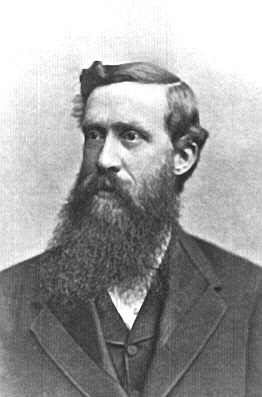
Biography
Coues was born in Portsmouth, New Hampshire. He graduated
at Columbian University, (now, George Washington University) Washington,
D.C., in 1861, and at the Medical school of that institution in 1863. He
served as a medical cadet in Washington in 1862-1863, and in 1864 was
appointed assistant-surgeon in the regular army. In 1872 he published
his Key to North American Birds, which, revised and rewritten in 1884
and 1901, did much to promote the systematic study of ornithology in
America. He was a founding member of the American Ornithologists' Union
in 1883.[2] His work was instrumental in establishing the currently
accepted standards of trinomial nomenclature -- the taxonomic
classification of subspecies -- in ornithology, and ultimately the whole
of zoology. In 1873-1876 Coues was attached as surgeon and naturalist to
the United States Northern Boundary Commission, and in 1876-1880 was
secretary and naturalist to the United States Geological and
Geographical Survey of the Territories, the publications of which he
edited. He was lecturer on anatomy in the medical school of the
Columbian University in 1877-1882, and professor of anatomy there in
1882-1887. He was a careful
bibliographer and in his work on the Birds of the Colorado Valley he
included a special section on swallows and attempted to resolve whether
they migrated in winter or hibernated under lakes as was believed at the
time:
I have never seen anything of the sort,
nor have I ever known one who had seen it; consequently, I know nothing
of the case but what I have read about it. But I have no means of
refuting the evidence, and consequently cannot refuse to recognize its
validity. Nor have I aught to urge against it, beyond the degree of
incredibility that attaches to highly exceptional and improbable
allegations in general, and in particular the difficulty of
understanding the alleged abruptness of the transition from activity to
torpor. I cannot consider the evidence as inadmissible, and must admit
that the alleged facts are as well attested, according to ordinary rules
of evidence, as any in ornithology. It is useless as well as
unscientific to pooh-pooh the notion. The asserted facts are nearly
identical with the known cases of many reptiles and batrachians. They
are strikingly like the known cases of many bats. They accord in general
with the recognized conditions of hibernation in many mammals.
—Birds of the Colorado Valley (1878), Chapter XIV.[3]
He resigned from the army in 1881 to
devote himself entirely to scientific research. He was a founder of the
American Ornithologists' Union, and edited its organ, The Auk, and
several other ornithological periodicals. He died in Baltimore,
Maryland. In addition to
ornithology he did valuable work in mammalogy; his book Fur-Bearing
Animals (1877) being distinguished by the accuracy and completeness of
its description of species, several of which were already becoming rare.
Coues Deer are named after him.
Spirituality Coues took an
interest in Spiritualism and began speculations in Theosophy. He felt
the inadequacy of formal orthodox science in dealing with the deeper
problems of human life and destiny. Convinced by the principles of
evolution, he believed that these principles may be capable of being
applied in psychic research and he proposed to use it to explain obscure
phenomena such as hypnotism, clairvoyance, telepathy and the like.
Coues had claimed to have witnessed levitation of objects
and developed a theory to try and explain the phenomena.[4] His
"telekinetic theory of levitation" claimed that luminiferous ether or a
similar energy causes the moving of tables and other objects under given
conditions, and that the motions which are set up in the ether are in
some way connected with mental activities, which enable the mind to
control the movement of objects through the hands and the spheres
flowing forth through them.[5][6]
He visited Madame Blavatsky in Europe. He then founded the Gnostic
Theosophical Society of Washington, and in 1890 he became the president
of the Esoteric Theosophical Society of America. Around this time he
also exposed Blavatsky and lost his interest in the theosophical
movement.[7]
| E.S.T.S. Document signed May 14, 1889 by
H.P. Blavatsky H.P. Blavatsky having learned
that Professor Elliot Coues (1) of Washington D.C. calls himself
“Perpetual President of the Esoteric Theosophical Society of
America”, feels it necessary to warn the members of the Esoteric
Section of the T.S. of which she is the Head, that Professor
Coues is not even a member of her Section.
1. The Head of the Section desires therefore, to inform all
members of the E.S. that Prof. Coues has no authority, except
his own, for assuming such a title; that he is not, & never has
been, a member of Esoteric Section to which you belong; & that
no papers, documents, memoranda or teachings given in this
section must be shown or communicated to him.
2. Having learned that a memorandum dated March 17th 1889,
relating to the duty which is incumbent on members of the E.S.
to defend the T.S. & its leaders, has got into the hands of Col.
Bundy of the Religio-Philosophic Journal, the Head of the
Section desires to say that should any Member of the E.S. know
how this has happened, it is his duty to communicate at once
with the Council (vide memorandum appended to Instruction No 2).
Should such a breach of faith ever occur again, the Esoteric
Section will at once be broken up & all further instruction
cease. It is therefore the duty of all who desire its
continuance to exercise the greatest possible care &
circumspection.
3. In order to prevent any mistake or deception arising as to
membership in the E.S., the Head of the Section has selected the
following Passwords: ---
The member desiring to ascertain whether another person belongs
to the E.S. will first say “Dhyani” to which the person
addressed (if a member of the E.S. will reply “Pura”. The
questioner must then say “Satri”, to which the reply will be “Asoph”.
No member must ever speak or discuss the teachings given in the
E.S. or any of its confidential documents with any person to
whom he has not previously given these Pass-words, & received
from him the correct replies as given above.
The Head of the Section
(signed) H.P. Blavatsky
For the Council
Bertram Keightley :>
Secretary
14 May 1889
***
"A VOICE FROM
OVER THE SEAS" BY H.P. BLAVATSKY
"A VOICE FROM OVER THE SEAS."
A QUESTION has reached the Head of the Esoteric section of the
Theosophical
Society, regarding the alleged representation of that Section in
America. This question is accompanied by a cutting from the Press of April 21st,
1889, which
reads as follows:-
"Dr. Elliot Coues, the Founder of the Gnostic Theosophical Society of
Washington, is also perpetual President of the Esoteric Theosophical
Society of
America."
In reply, I most emphatically state that I am entirely ignorant of the
origin
or career of the above named "Esoteric Theosophical Society" of which
Dr.
Coues is said to be the "perpetual President," and that this gentleman
is in no
way connected with the Esoteric Section of the T. S. of which I am the
sole
Head; nor can I help thinking that the said Esoteric "Theosophical
Society"
is a printers mistake. The only Esoteric Society which has any
LEGAL right to
the name "Theosophical" is that which Col. Olcott founded and chartered
in
London in October, 1888, for the proofs of which see LUCIFER of that
month.
H. P. BLAVATSKY.
***
Why has he done it? The motive is
plainly shown by a letter received by me from Dr. Coues a few
days before the Convention of the American Section T.S. at
Chicago. This letter was an ultimatum in which the Professor
offered me the choice of the following alternatives: Either to
telegraph immediately to the Convention, using all my influence
to have him appointed President or “Boss” of the whole T.S. in
America, or to see him bust up the T.S. forever. Not being
easily intimidated, I replied that he might do his worst. His
letter and my reply can be published, if thought proper.
--
The Esoteric
Papers of Madame Blavatsky, by Helena Petrovna Blavatsky |
Publications
Among the most important of his publications, in several
of which he had collaboration, are A Field Ornithology (1874); Birds of
the North-west (1874); Monographs on North American Rodentia, with J. A.
Allen (1877); Birds of the Colorado Valley (1878); A Bibliography of
Ornithology (1878–1880, incomplete); New England Bird Life (1881); A
Dictionary and Check List of North American Birds (1882); Biogen, A
Speculation on the Origin and Motive of Life (1884); The Daemon of
Darwin (1884); Can Matter Think? (1886); and Neuro-Myology (1887). He
also contributed numerous articles to the Century Dictionary, wrote for
various encyclopaedias, and edited the Journals of Lewis and Clark
(1893), The Travels of Zebulon M. Pike (1895), New Light on the Early
History of the Greater Northwest: The Manuscript Journals of Alexander
Henry, Fur Trader of the Northwest Company and of David Thompson,
Official Geographer and Explorer of the Same Company, 1799-1814 (1897)
and Forty Years A Fur Trader on the Upper Missouri: The Personal
Narrative of Charles Larpenteur 1833-1872 (1898)
References 1.
"A Great Ornithologist". The Outlook 64: 98. January 13 1900. http://books.google.com/?id=l2pyPw_hYuAC&pg=PA98.
Retrieved 2009-07-30.
2. "The American Ornithologists' Union", Bulletin of the Nuttall
Ornithological Club VIII (4): 221-226, October 1883
3. Allen, JA (1909). "Biographical memoir of Elliott Coues.".
National Academy of Sciences: Biographical Memoirs 6: 395–446. http://books.nap.edu/html/biomems/ecoues.pdf.
4. Metaphysical magazine: a monthly review of the occult sciences
and metaphysical philosophy, Volume 1, The Metaphysical Publishing
Company., 1895, p. 206
5. The Nation, Volumes 60-61, The Nation Company, 1895, p. 125
6. Paul Russell Cutright, Michael J. Brodhead Elliott Coues:
naturalist and frontier historian 2001, p. 302
7. Marble, C. C. 1900. The Late Dr. Elliott Coues. Birds and All
Nature: February 1900.
Return to Table of
Contents |