|
HEALING: THE DIVINE ART |
|
THE PINEAL GLAND Organ of Spiritual Sight Medical gland specialists are in general agreement that the true purpose of the pineal gland in the life of the human being is unknown, and they doubt whether the gland is active in the normal adult. These conclusions are not in agreement with the results of clairvoyant investigations, which indicate that the pineal gland is active throughout life, and is the positive organ of spiritual sight within the human body.
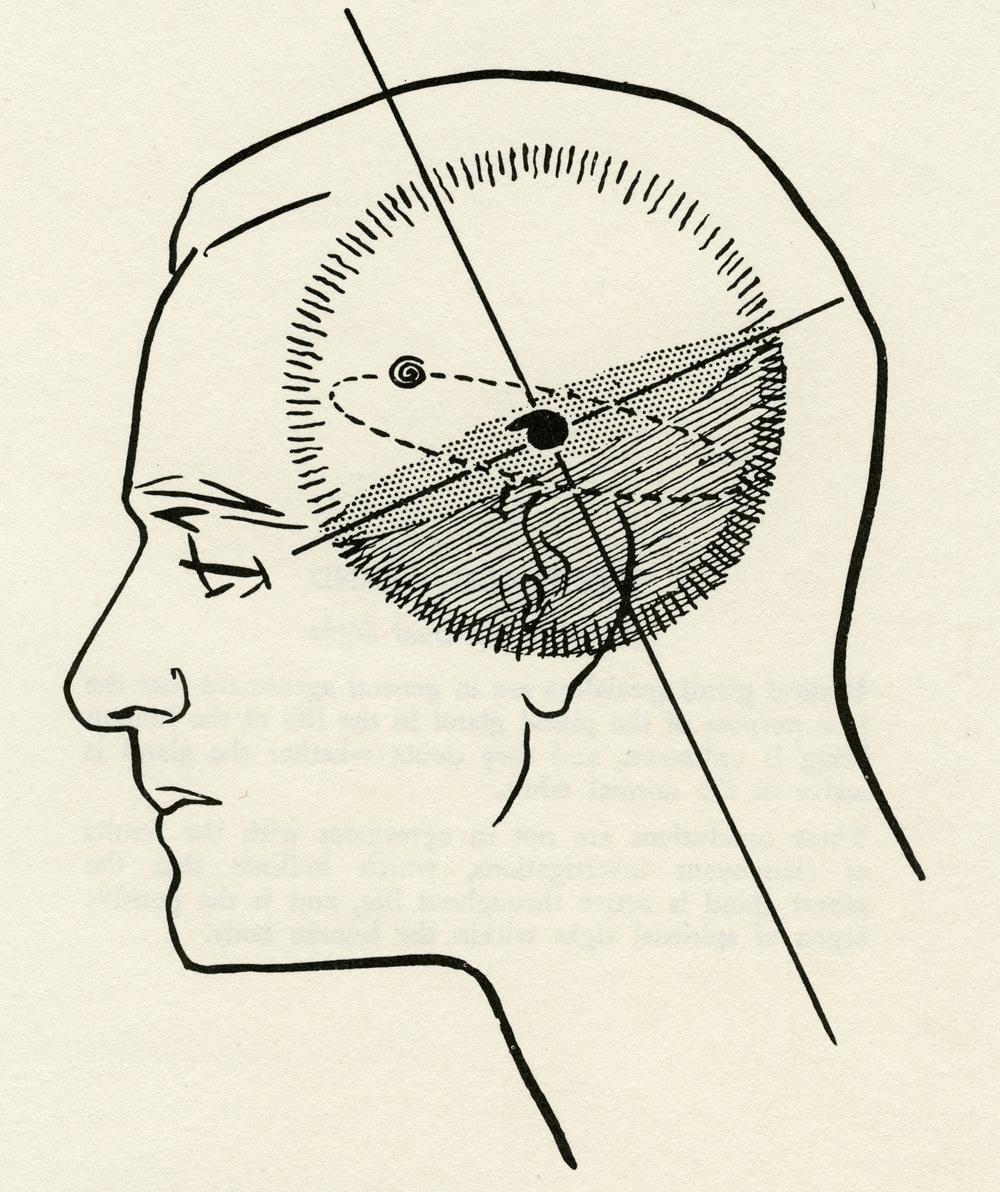
THE PINEAL GLAND A global haze of blue-green luminosity marks the gland's magnetic field. The axis of the field is inclined and the whole resembles a miniature solar system. The mental field of the pineal gland in form resembles a spherical glass bottle, and seems to rest on the surface of semi-liquid mist. An antibody revolves about the gland in an ecliptic [sic] CHAPTER 7: THE PINEAL GLAND AND THE MENTAL FOCUS GOVERNOR AND REGULATOR -- THE ORGAN OF SPIRITUAL SIGHT -- VISIBILITY OF THE GLAND'S AURA -- DISEASES OF THE PINEAL GLAND -- EXTRA-SENSORY ANALYSIS OF THE PINEAL GLAND -- THE SEAT OF SPIRITUAL POWERS -- CONTROL OF THE MENTAL LIFE -- THE FUNCTIONING OF THE PINEAL GLAND -- DEFINITION OF MIND AND BRAIN -- THE SUBCONSCIOUS MIND -- THOUGHT PATTERNS -- THE CONFLICT BETWEEN THOUGHT AND IMPULSE -- THE MAGNETIC FIELD OF THE BRAIN. GOVERNOR AND REGULATOR THE pineal gland is a small body located approximately in the center of the brain. It is the governor and regulator of the entire endocrine system. The endocrines are the glands whose secretions pass directly into the blood or lymph. Considered clairvoyantly, the various ductless glands of the body are dependent for their balanced function upon the pineal gland. The pineal body is a fibrous structure, composed of material similar to the filaments of the optic nerve. The gland is connected intimately with the phenomenon of sight, and deterioration of the gland frequently is accompanied by impairment of the vision. In the normal and healthy adult, the pineal gland contains a number of small granules or crystals. While the exact function of these granules is unknown to science, usually they are absent or greatly reduced in number and size in cases of congenital idiocy and imbecility. For the most part, efforts to examine and study the physiological function of the pineal gland by physical means have been unsatisfactory. Endocrine therapy now is a recognized and valuable part of the science of medicine, with the other bodies of the gland chain having certain definite and clearly defined duties to perform which are understood at least in principle. The exceptional nature of the pineal gland has become more apparent as knowledge of the other glandular bodies has increased. Technic for the diagnosis of pineal imbalance is as yet quite imperfect, and the methods of treatment are wholly inadequate. The usual procedure to date has been to attempt to normalize the function of this gland by conditioning the other glandular bodies. No satisfactory method for direct treatment has as yet been standardized. Questioning several prominent endocrinologists as to the latest scientific information concerning the pineal gland, they have agreed in substance that its true purpose in the life of the human being is unknown; and they also expressed considerable doubt as to whether the gland is active in the normal adult. The pineal gland appears to reach its maximum activity at approximately the twelfth year of human growth. After this time a retrogressive process starts and the gland function decreases until its effect becomes negligible. This may be true of the pineal gland as a physical structure, but these conclusions are not in agreement with the results of clairvoyant investigation. Nearly all of the independent operators who have examined the gland with the aid of extra-sensory perception agree on one point -- the pineal gland is active throughout life, and, under certain conditions, its activity may increase to a marked degree. THE ORGAN OF SPIRITUAL SIGHT I have given a general summary of occult and modern thought and opinion concerning the pineal gland in chapter sixteen of another book, MAN: The Grand Symbol of the Mysteries, with numerous quotations sustaining the contentions of clairvoyant observers that the pineal gland is the positive organ of spiritual sight within the human body. I shall not now enter into the existing scientific controversy as to the physical importance of the pineal gland. My purpose in these pages is to point out certain metaphysical activities which I have observed in the aura or magnetic field of the gland, in research that has been carried on over a period of approximately twenty years. During this time the opportunities have been many to examine a considerable number of persons in whom the activity of this gland presented unusual features. I hold to the hope, and there is every reason to believe, that in time material science and the occult sciences will unite their findings and recognize the necessity of supplementing each other in research problems of this kind. Seen clairvoyantly, the pineal gland is located near the center of a magnetic field or aura varying from twelve to sixteen inches in diameter. This aura has no exact or definite boundaries, nor are its radiations entirely uniform. Rather, it appears as a pulsing, flickering field of energy which becomes intensified under stimulation or irritation, and fades to an almost imperceptible condition as the result of extreme mental or vital exhaustion. Regarding the term aura, all living organisms continually are exuding an insensible perspiration. These subtle emanations are actual extensions of etheric nerve force beyond the terminal circumference of the physical nervous system. The aura, or physical magnetic field, therefore, is an emanation from the nerve terminals which surrounds the body with a dim but discernible radiance. These auric emanations flow from the nerve terminals with an appearance resembling fine fur. When intensely magnified, each separate emanation is visible as a stream of minute geometrically shaped particles pouring with great velocity from the skin's surface. Not only is the human body itself surrounded by a field of these emanations, but each part of the body -- organs, systems, and secretions -- have their own emanations or auras. Even the separate cells, molecules, atoms, and electrons are seen clairvoyantly as centers of fields of magnetic emanations. The colors, the extent, and the rates of vibration of these magnetic fields reveal the intrinsic natures of the structures from which they proceed. No important change can take place within the structure of any living organism without modifying its aura. VISIBILITY OF THE GLAND'S AURA The late Dr. Kilner developed a technique for rendering certain parts of the human magnetic field visible to non-clairvoyant vision. With the aid of dicyanin screens he was able to cause a temporary change in the human optical processes which enabled the average person to see the lower or least attenuated parts of the human aura. Intensive research carried on with these screens resulted in the development of a technique for the diagnosis of human diseases through the study of the patterns and modifications visible in the auric emanations. For details of his methods, consult his text, The Human Atmosphere. The aura of the pineal gland is one of the principal systems of emanations visible in the composite structure of the human being. In brilliance and size it is second only to the aura of the heart, which is the largest and most completely organized magnetic field in the human body. The heart's aura is of sufficient diameter to include within its area all the vital organs of the physical body. The area of the pineal aura is sufficient to include within its radius all of the vital organs of the brain. The energy and power of the aura of the pineal gland is derived from the aura of the heart, which also is the source for the auric field of the reproductive system. These three intimately associated electromagnetic fields sustain the bodily economy, and explain the balance of function everywhere apparent in the life of man. Clairvoyance is the term properly applied to that form of extra-sensory perception by which the faculty of sight is extended, or increased, or supplemented to include the power to observe superphysical phenomena. The power of visual awareness is under the control of the will of the trained clairvoyant, and may be shifted from one plane or focus to another. As the focus changes, various phases of one problem may be analyzed separately. A number of different vibratory qualities must be analyzed and differentiated in the case of the present research. To make this possible, the clairvoyant visual focus must change with each phase of the problem. In other words, each part of the phenomenon must be examined and described in terms of its own plane, or in the vibratory level upon which the phenomenon occurs. If the focus is not changed, only a part of the sequence of force activity can be examined. Omitting to do this accounts, in part at least, for the diversity of testimonies which have accumulated in clairvoyant investigation of nature's unseen forces. Those who have seen only in part can describe only in part. Had the various investigators adjusted their attention to the different levels of the invisible planes, each would have become aware of different and apparently disconnected parts of the processes which are taking place. A synthesis, by which all the processes are observed in proper relationship to each other, demands a methodical, systematic adjustment of the clairvoyant vision to each of the special divisions of vibratory rates which constitute the complex process of function. The human aura is divisible into ten principal levels or planes, and it is necessary to focus the clairvoyant attention upon each of these levels in its proper ascending order of vibratory refinement. Only by such a complete examination will the metaphysical causes behind physical activity be discovered and properly classified. DISEASES OF THE PINEAL GLAND Diseases of the pineal gland may be divided into two classifications: 1. Unbalance as the result of injury or disorder affecting any single gland or group of glands of the endocrine chain. Under such conditions the pineal shows a rapid loss of tone. If one of the lower glands is disturbed or depressed, it throws its load upon another gland. For example: affections of the thyroid may result in a stimulation of the parathyroids, which take up the work of the diseased gland and attempt to preserve bodily harmony. The pineal is the only gland in the ductless chain which cannot shift its load. It is, therefore, less frequently disordered than the other glands, but when once affected it is more difficult to cure. 2. The pineal gland may be disturbed through reflex action from the mind. Destructive thoughts with their interrelated emotional states can result in physiological changes in the organic structure and function of the pineal gland. The gland, once disordered in this way, has a tendency to throw out the functions of the other glands, especially those connected with the processes of reproduction. Serious diseases of the pineal usually involve the rational powers. The disturbance may not be accompanied by any serious pain, but it is particularly observable in the eyes; the pupils may contract and there is a tendency to stare without focusing. Some hallucinations of an optical nature may be experienced, and the imagination becomes distorted. Lesser disturbances are associated with fatigue, lack of coordination and continuity of thought, supersensitivity, loss of appetite, nausea, lowered circulation. In all cases where morbid psychology exists apart from morbid pathology, derangements of the pineal may be suspected. Insomnia is often present, and occasionally a sense of pressure directly under the crown of the head. Chemical analysis of the blood will often show a deficiency of calcium. Except for a limited study of the pineal gland from a pathological standpoint, very little actual information about this mysterious organ is available. Some clairvoyant research has been carried on, but for the most part the observations are merely restatements of occult traditions which identify the gland as the "third eye" referred to in ancient religious symbolism. Observations of the activity of this gland in certain reptiles prove that it is a rudimentary eye which retired into the brain after the development of the present optic system. The composition of the gland itself sustains these findings, and indicates that it might still be sensitive to light. EXTRA-SENSORY ANALYSIS OF THE PINEAL GLAND H. P. Blavatsky, in the E. S. Papers, and certain commentaries by her original students and disciples, have indicated a possible course of study which may lead to a more complete knowledge of the true structure and purpose of the pineal gland at this stage of human evolution. When first examined, the pineal gland's magnetic field glows as an electrical haze of bluish-green luminosity, brilliant at its circumference and almost invisible in those parts closest to the gland itself. In the almost spherical field the gland appears, under some conditions, as if in the midst of a hollow globe with a bubble-like wall. The gland is not in the exact center of the globe; when seen clairvoyantly, it is up about one-third of the distance from the lower extremity of the field. Thus observed, the gland itself resembles a minute four-pointed star of extreme brilliance. Further examination shows that in the small granules is .the source of the star-like light; they glow, not with an inherent energy, but as though fluorescent. A further examination of the magnetic field of the gland shows that this field is stratified. There are ten concentric circles, each dimly but clearly demarked. Each of these circles or rings is in the orbit of small but brilliant points of light. The entire gland with its magnetic field thus resembles a miniature solar system, which is in constant motion around the structure of the gland itself. The axis of the gland's magnetic field is so inclined that its upper extremity passes through the skull close to the two small foramina near the crown of the head. These correspond to what the Hindus call the Brahma-randhra, or gate of Brahma. According to the Hindus, life, departing from the body at death, leaves through these foramina. They are connected to the brain by very direct nerve filaments, which are burned out or destroyed by the departure of the life-principle; and it is this which makes it impossible to resuscitate a person once actually dead. The motion of the small points of light within their orbits in the magnetic field of the pineal gland is proportioned mathematically to the sideral motion of the celestial solar system: It appears (but this will require confirmation) that the annual motion of the solar bodies is accomplished diurnally in the smaller glandular orbits -- a day with man being equal to a year in the solar system. The small orbital points of light of the gland are the positive poles of the complete human endocrine system. Each of the bodily glands of the chain, extending from the pituitary body to the testicular bodies, has its causal nature in the pineal aura. Derangement, disease, irritation, or atrophy of any of the other glands is visible immediately as a modification of its corresponding energy center in the pineal system. The seven principal organs of the brain itself are physical extensions of these glandular vortices. (See E. S. Instruction.) All physical organs are physical extensions of invisible energy centers throughout the physical body. The brain is the Mercavah, or chariot, (Sanscrit: vahan) of the pineal gland; and the ten smaller vortices in the aura of the gland are the horses attached to the chariot of the Sun, the racing steeds described by St. Chrysostom. Further inquiry reveals that the magnetic field of the pineal body not only has its pole inclined to correspond with the earth's pole, but it also has a hypothetical equator. And, in conformity with ancient symbolism, the entire magnetic field is enclosed within an empyrean or heavenly wall composed of thirty-six constellational surfaces, corresponding to the principal constellations of the zodiacal and extra-zodiacal orders. This arrangement need not be regarded as hopelessly complex or involved. While adequate description is exceedingly difficult, the arrangement itself, when conceived as a whole, is orderly, simple; and it is in perfect conformity with the analogical processes everywhere evident in nature. The gland and its auras constitute a microcosm. The cabalists perfectly symbolized the mystery in their Sephirothic tree. The first and highest part of this tree they called Kether; it corresponds to the pineal gland. Chochmah, and Binah, the second and third spheres, correspond to the right and left lobes of the cerebrum. In the cabatistic writings it is stated that the ten parts of the Sepherothic tree represent the ten parts of the human body, but that all of these parts exist primarily within Kether itself. Thus the whole tree is within the Crown (Kether) in principia. Likewise, the whole body and the whole life of man is within the magnetic field of the pineal gland, the light radiating from which is the Crown. THE SEAT OF SPIRITUAL POWERS The implications of this ancient esoteric science are m· evitable: (a) The universe is an extension of powers that remain eternally in the nature of Deity. (b) Man is an extension of powers resident eternally in his own spiritual source. (c) And the body of man is the extension of powers resident temporally within the aura of the pineal gland. Although the aura is divided into ten parts, only the lower four of these parts are concerned with the maintenance of the physical bodily economy. The lower four parts of the aura of the pineal gland are involved in the distribution of the four ethers described in the previous chapter. The remaining six parts of the magnetic field have comparatively little to do with man's external life. Their function is noumenal rather than phenomenal. The ten states of the magnetic field are roughly divisible into two groups of five each, which may be termed the higher and the lower. The five lower are related directly to sensory perception, and the five higher to the mind-octaves of these perceptions; or to the five perceiving powers for which the perceptions themselves are the media. In the various orders of life, visible and invisible, the position of the gland itself in relationship to its magnetic field varies, regulated by the focusing power peculiar to each of the kingdoms of the animal creation. Among animals, the gland is farther from the center of its magnetic field than in the human. CONTROL OF THE MENTAL LIFE Each of the ten fields or orbits of the gland may be isolated for separate consideration. This chapter will consider only the fourth field, the one which controls the mental life of the human being. It is typical of the five orbits which make up the southern hemisphere of the magnetic sphere. Those composing the northern hemisphere must be approached through an entirely different system of analysis. Separated from the rest of the aura, the fourth field appears keyed dominantly to the color green. The reaction, however, is not as much to the shades of green familiar to us, as to a kind of green that is sensed in the substance of light. We are aware that it is green, but we could not hope to find a color or shade of color by which this green could be reproduced in pigment. This green glow is divided within its own field, in divisions that are extremely attenuated and defy complete analysis. This green field is the present focus for the pineal gland itself. The gland is located slightly below the center, and appears to be floating on the surface of a somewhat denser color which occupies the lower two-fifths of the field. In form, the mental field of the pineal gland resembles a spherical glass bottle, the lower two fifths of which appears as though filled with a semi-liquid mist; in the upper part, the material is of almost the same color but entirely gaseous. It is on the surface of the lower semi-liquid mist that the structure of the gland itself seems to rest. Its radiance is more brilliant upward than downward, and it moves slightly as though carried on the surface of a slight tidal motion. It is known that the pineal gland is so constructed and so attached to the inner surface of the brain that it is capable of independent motion. It appears that this motion is not entirely intrinsic; or, possibly more correctly, inherent; but at least part of the motion is communicated to it as to a ship floating on the surface of water. A short distance from the gland itself is a smaller brilliant antibody which for lack of a better term we shall call a mental vortex. Revolving about the gland in an ecliptic it causes periodic descent into the denser substances in the lower part of the magnetic field. This vortex makes a complete revolution about the central gland in approximately twenty-four hours. About one-third of this time is required for its passage through the lower part of the sphere, when the antibody is somewhat dimmed. This phenomenon may prove to be part of the explanation as to the nature of sleep. The effect of rearranging sleep hours so as to break the normal rhythm of this motion will require special research, for it has been observed that in some persons and at some times, the revolutional motion of this antibody appears to be more rapid. The antibody itself is an important structure of mentoids or mental atoms. It has its own polarity and a rotational motion accompanied by constant emanation. This causes the structure to appear like a tiny spiral nebula. Disturbances of the brain, the optic thalamus, and the anterior lobe of the pituitary body cause disturbances within the structure of this pineal antibody. THE FUNCTIONING OF THE PINEAL GLAND In the metaphysics of the classical Greeks, the superphysical nature of man is divided into nine parts arranged in the form of three triads. To these is added the physical body, which completes the decad consisting of nine numbers and the cipher -- the Pythagorean tetractys. Man was exoterically seven; esoterically, ten. Each of the triads was said to be posited in a sphere. The first triad abode in the Supreme Sphere, and consisted of Being, Life, and Light, which together comprise spirit. The second triad abode in the middle sphere, denominated by the Greeks the Superior World. This was the triad of motion. Its parts were: the Unmoved, the Self-moving, and the Moved, referred to collectively as the "gods," and considered as the zonic and azonic hierarchies -- that is, those powers which abide in place, and those which abide distinct from place. The third triad, which abode in the Inferior Sphere, was termed formative. It consisted of the principles of generation designated as creative, preservative, and disintegrative. Collectively they comprised the supermundane divinities, of which order the Greeks declared Zeus to be the chief. The equivalent of Zeus in the human system is the ego, or the complex of self from which personalities are suspended as flowers from a parent stem. The supermundane principles through their extension outward into the tenth sphere, which is matter, produce form, which is organized matter. Of. forms, the human body is the most important to man. Personality is the complex arising from the relationship existing between the supermundane ego and the chain of bodies which it has precipitated. The ego itself, located in the midst of the magnetic field of the physical body, appears in juxtaposition to the physical heart and controls the entire body by impinging its power on the subtle fi1aments of the Bundle of His. The positive pole of the ego, its radiant principle, impinges itself upon the granules in the pineal gland and the adjacent sensitive nerve areas, which become fluorescent as a result. The negative pole operates through the sacro-coccygeal ganglia and the principal internal organs of the generative system. The ego itself has no direct effect upon the physical body except that which it produces in the heart. Its other manifestations are achieved by the polarities which it sustains. The pineal gland, therefore, occupying the middle position in the egoic triad is linked to the noumenal and the phenomenal personalities, by the etheric binders. It is not merely a third eye in the body; it is the eye of the overself, the focussing point between two conditions of form, the invisible archetypal form, and the visible corporeal body. As this focus is located in the vibration of the mental nature, it may be said to grow in the neutral etheric zone between mind and brain. The most sensitive parts of the physical brain, dilated by the presence of an almost intangible gas, are so refined that their ethers mingle with the lowest and most nearly physical dements of the higher nature itself. While they mingle they never actually coalesce, because the two sets of rays move in different directions; but the impingement is so close and so nearly perfect that a neutral zone is created. This neutral zone corresponds with the middle part of the vibratory register of the magnetic field of the fourth orbit of the pineal gland. Impulses from the mind must pass through this focus as through a lens before they can be distributed by the brain as nerve impulses. In the same way. all sensory impulses collected from the periphery of the nerve system must return through this lens before they can be incorporated into the mental nature itself. DEFINITION OF MIND AND BRAIN How, then, shall we define the mind? Pragmatically, it is the cause of those mentational processes which we call thought. It includes inspiration, reflection, imagination, analysis, comparison, and memory. It must be accepted also as the source of mental experience, containing not only the evidence accumulated by the senses from the experiences of objective life, but the residual matter of previous lives -- all that can be implied by karmic memory. Mind is to brain as the brain is to the body; it is the source and superior part of itself. It is as though man extended beyond the boundaries of his physical body into a more subtle state, of which the physical body is merely the grosser, visible part. Individual mind partakes of universal mind, of which it is a specialized area, in the same way that the physical body partakes of physical nature, of whose elements it is composed. Brain is an extension downward of mind into matter, in the same way that the spinal cord is an extension of the brain down into the body. The difficulty of analogy arises because mind, though a form and having dimensions, is beyond the limitations of our visual power. It is mysterious to us, not because there is any actual mystery about it, but just because we cannot see it. Therefore, if mind has the brain as its pole in the body, and is connected with the brain through certain etheric magnetic areas, the entire procedure is brought within the limits of our comprehension. The scientific objection to the idea of the existence of mind independent of brain is easily met by the philosophically inclined: So long as brain must serve as a condenser and distributor of mental impulses which cannot become tangible except through some sensitive magnetized field, it is quite obvious that the removal of that field, or its absence, will result in the failure of mental manifestation. The entire brain as we know it, or even brain organization as we understand it, is not essential to mental existence. But the presence of the magnetic field is essential. Simple monocellular organisms in which no individual brain has been organized are capable of manifesting rudimentary forms of intelligence. This is because in these monocellular structures brain exists in abscondite -- that is, in principle. The entire cell contains brain potentials not yet localized; the magnetic field pervades the entire cell, but its manifestations are rudimentary because there is not sufficient nerve organization to coordinate or rationalize the nerve impulses. In this way all form partakes of mind. Modern psychology, breaking away from the greater field of philosophy of which it is essentially a part, seeks to classify and organize that which is known and that which is knowable concerning the function of mind and its reactions upon the nervous and emotional systems. This art, though in its comparative infancy, is making rapid strides toward the comprehension of its purpose. But psychology can not be regarded as a complete science or a perfected art until its foundations are thoroughly laid in a working knowledge of man's superphysical mental life. This knowledge can be gained only when scientific research is complemented by and coordinated with an intensive examination of the mind itself by properly trained clairvoyants. The majority of modern psychological systems recognize a natural division of the mind into three parts. Popular terminology refers to these as the superconscious, the conscious, and the subconscious mind. These minds are a hypothetical division within the pure substance of the mind itself, whose parts constantly are interrelated in their activities. The psychological divisions are consistent with the findings of occult research. They are merely new names given to old truths. THE SUBCONSCIOUS MIND The superconscious and conscious parts of the mind are not likely to be serious factors in health, as their processes are more or less obvious. But the subconscious mind is a constant hazard to those who permit it to accumulate negative and destructive memory patterns. The subtle power of the subconscious is due largely to those who suffer most from its machinations having no idea of the source of their difficulties. It is my sincere conviction after years of study and observation, that a large part of so-called psychical phenomena is no more than psychological phenomena, associated with sinister patterns in the subconscious mind. The subconscious sphere of mental phenomena might be defined as the haunted house of the mind. It is here, in the dark and musty realm of memories, already forgotten in the conscious life, that the ghosts of old thoughts and experiences walk the gloomy galleries of the mind, as the shade of Hamlet's father wandered about the battlements of Elsinore. We all have a ghost life locked somewhere within us; and all too frequently these shadows from the misty deep rattle their chains, and babble their insensate words into the ears of our conscious selves, causing all manner of disaster. It is important for each person that he should know about this individual family closet where the skeletons are kept, hidden sources of shame or grief that from year to year haunt the present with the faults of the past. Some of the medieval writers recognized three great centers in the brain, corresponding to the three worlds of the Christian Mysteries -- Heaven, Earth, and Hell. Hell was assigned to the ventricle of memory. This may be conformed to the modern concept of the subconscious mind as indeed a kind of personal purgatory, with tormenting sprites and mocking demons abiding amidst the murky flames of unsatisfied desires. It is here that old hates and grievances rise to obscure the light of hope and future promise -- in a madman's world, seething with endless conflict, and poisoning unborn tomorrow with the noxious vapors of dead yesterdays. Habits, attitudes, convictions, and opinions gather here like bats in a dark cave; from here to flutter out at night to plague dreams with their melancholy symbolism, to render painful the long sleepless hours with the fantastic shadows they cast upon thoughts. By the strange workings of the subconscious, fancies become facts, fears are magnified to horrible proportions, and doubts take on the attributes of despair. Nothing is left untouched by the weird forces at work in this subjective sphere, where strong men, once dominated by this ghost world of illusions, can degenerate into hopeless cowards. From out of the subconscious, streams of negation are forever flowing. By an analogy to music, we may say that the conscious mind is a natural tone, the superconscious mind is the sharp of that tone, and the subconscious mind is the flat. Memory is mostly in the minor, and like primitive music, has a sadness about it, a wailing note of frustration and pain. While the subconscious may be the repository of many good and necessary harmonies, it is much more likely to be recognized for .its emission of tones negative and mournful. Visions may be visualized memories, obsessions may be domination by ghosts from the subconscious, voices that sound in the air may come from the mind itself -- and not from the spirit land. Even automatic writing may be impelled by fixations that seem to live and have independent existence in the deep parts of the subconscious. Here, thoughts are things; every impulse has taken form and been given power by frequent repetition. When a heavily loaded subconscious bursts forth into the conscious mind, as it will do finally, if the condition is not corrected, life and health are at hazard. The best method of treating fixations is to break them up before they have time to become deeply entrenched in the consciousness. Grudges held, regardless of the justification, destroy the holder, and not the opponent. No habits should be allowed to take possession of a life so firmly that they cannot be broken by a simple application of the will. It is to be remembered that men do not have habits, habits have the men. The past should not be permitted to over-shade the present 'effort, nor old sorrows be allowed to breed in the mind the pleasant pain of martyrdom. Wrong thinking is its own reward -- and that reward is misery. If it is too late for preventative therapy, then it is necessary to resort to other means. The old patterns must be broken up by an intelligent application of the will. Psychoanalysis helps, but the process is long and expensive. It has been my observation that one of the most terrible aspects of subconscious impulse is an accompanying deadly seriousness. Those most afflicted will fight with all their strength to justify their misfortunes and rationalize the worst of what they believe. In such cases a sense of humor comes like the shining ray of St. Michael's flaming sword, which overcame the Prince of Darkness and his legion of unhappy spirits. The man able to laugh at his own mistakes, who can toss aside with a smile the bitter things that have burdened his soul, can do much to unseat the phantoms that are riding on his thoughts. Never must there be bitterness in the laugh, but the sure realization that man is the master of his destiny, and it is in his power to lift the load of his despondencies by seeing through them, understanding them, and cheerfully accepting the lessons they have to teach. THOUGHT PATTERNS If three distinguishable mental currents are flowing downward from mind into brain, and from brain through body, it is also true that three distinct states of reflexes are flowing back through nerve into brain, and through brain into mind. Mental impulses set up glandular reflexes, and the entire glandular system is involved in human thinking. Conversely, glandular impulses, interpreted first biochemically and then psycho-chemically, affect the mind and the mental attitudes by conditioning sensory and emotional reflexes. Thus a vicious circle is set up, and we become aware of the absolute interdependence upon each other of all the manifestations of life. One school of endocrinology declares that disposition is a matter of glands. It would be just as fair to say that glands are a matter of disposition. Harmony in the mind results in the increasing health of the body; and harmony in the body improves the disposition of the mind. The whole purpose of man's mental evolution is to bring the mind and body into perfect coordination. If the exigencies of the life render this impossible at any given time, then the mind, as the superior part, should receive the greatest emphasis. It is possible for the mind to excel the body because of its natural and inherent excellence; but it never is possible for the body to excel the mind in a normal personality pattern, because of its utter dependency upon the superior part. Excellence of the human body should not be regarded as merely its physical health, but is to be measured in terms of degrees of refinement and sensitivity to mental impulses. The dispositional equation is the result of the complex of mind working through brain. The brain stores up in its own auric field the experiences of the senses and its reactions thereto. This material is absorbed mentally by the mind and transmuted into experience. Thus, in a sense, the brain is a sort of stomach which receives into itself certain foods, but the digestion of these foods and the assimilation of their energy elements is reserved for the processes of mental alchemy. The undigested parts of experience also affect the bodily economy. These impulses are associated with the secretion of pituitrin by the pituitary body; the flow of this secretion differs with each individual, and its psychic load depends upon the undigested mental material which still is in the brain. Personality may be symbolized by an upright triangle with its base firmly established upon the physical reflexes and its apex ascending to the sphere of mind. Mind itself may be likened to an inverted pyramid, with its base rooted firmly in the substance of mind and its apex flowing downward to interlace with the upper part of the pyramid of brain. This symbolism was used by the medieval Rosicrucians to explain the mystery of thought. THE CONFLICT BETWEEN THOUGHT AND IMPULSE The eternal conflict between thought and impulse thus becomes explainable. It is a struggle between a superior and an inferior power for dominion over mental phenomena. The struggle apparently is rendered equal, because the brain, though far less in power than the mind, is closer to the body and more imminently understandable. For this reason the ancients symbolized the brain by the moon and the mind by the sun. Leonardo da Vinci went so far as to declare that the moon gave tides to the fluids in the brain. In this he expressed an opinion current during his time. The neutral zone at the point of overlap between the magnetic fields of the brain and the mind is entirely qualitative, and may only be recognized with the aid of clairvoyant perception. We shall refer to this neutral zone as a lens, because it is a transmitter of mental light; this the old philosophers referred to as the "light of the soul," or "the light of reason," the mysterious light that "Lighteth every man that cometh into the world." It is the sidereal light of the microcosm, according to Paracelsus and the Cabalists. Certain reflexes are transmitted to the brain by the crystalline lens of the eye; but it is the magnetic lens that is the medium for the distribution of noumenal and phenomenal impulses. As defects in the crystalline lens of the eye result in the distortion of the vision, so defects in the magnetic lens result in aberrations of mental activity. Such astigmatism of the magnetic lens is the basis for many abnormal psychological states. As the magnetic lens exists by virtue of the blending of two magnetic fields, its clarity requires an exact adjustment and blending; every mood of the individual affects these, and every mental and emotional reaction. The mind, as the source of reason in man, flows downward into manifestation through this lens. Pure thought always is qualified or conditioned by the state of the lens. Passing through the lens, thought distorted by any fault that may exist in the lens itself, is reflected upon the sensitive centers of the nervous system. The testimony of the senses coordinated in the magnetic field of the brain is reflected upward or inward through the same lens; and the reflection thus cast upon the attenuated surface of the mind itself is likewise distorted according to the imperfections of the lens. Thus the lens itself determines by its quality the accuracy of the impulses which pass through it. The lens may be variously impaired. If the two magnetic fields can not blend at least in part, the result is idiocy. If the blending is but partly accomplished, we have the subnormal and the moron. Under such conditions. no reasonable images are reflected either upward or downward. and only mental confusion and opacity remain. Let us consider how the magnetic field of the brain may be affected. THE MAGNETIC FIELD OF THE BRAIN Every thought arising in the personality complex assumes geometrical form in the brain's aura. This has long been established by clairvoyant research and the findings of trained psychics. These patterns set up in the magnetic field of the brain have been called thought-forms, forms that consist of a color, a number, a sound, and a form. They are precipitated with the same regularity and complexity of design that we see in snowflakes, and in such geometrically formed creatures as radiolaria. The repetition of any special series of thoughts intensifies these thought-forms. The result is that they are constantly appearing and disappearing within the magnetic field, some persisting and others rapidly fading out. When these thought-forms represent sudden moods or transient opinions, they blaze out brightly with various colors and emit a subtle sound. When they represent established convictions, they grow steadily; their intensity is augmented by the fixation of the will. Thus a man attending a concert and affected by the music will interpret these impulses by a mood which is visible clairvoyantly as luminous radiations or waves in the magnetic field. When the concert is over and the mind returns to its normal preoccupations, these waves fade out and other patterns take their place. But an intense hatred will continue as a constant pattern, and may build in intensity over a period of years. Such an intense pattern may ultimately dominate and so completely impregnate the entire magnetic field that it will affect all other thought-forms that may arise there. What the metaphysician terms thought-forms, the psychologist calls fixations, complexes, phobias, and neuroses. The stronger patterns by their vibratory rates produce subtle but permanent changes in the entire substance of the brain's magnetic field. The result will be distortion in the blending of the brain's magnetic aura with the magnetic field of the mind; and in extreme cases even a complete rupture of the two fields may occur. Under such conditions the individual loses his reason as the result of destructive fixations. In many cases, the blending of the two magnetic fields is impaired rather than destroyed, and various degrees of mental abnormalcy are apparent. Nature, eternally striving after balance and normalcy, has devised auto-corrective processes to break down strong fixations in the magnetic field of the brain. Thought-forms may be combatted or neutralized by opposing thought-forms, upon the basis that two rates of vibration may neutralize each other. Also, thoughts or emotions of extraordinary intensity may cause such disturbance within the magnetic field of the brain that they will burn out entire areas of complexes and fixations. Observation of the brain's magnetic field during moments of ecstasy or great emotional exhilaration gives the key to various systems of mental therapy. The mind itself also affects its own magnetic field, but usually the effects are less obvious than those set up in the brain. The mind, less subject to transitory moods than the brain, docs not create thought-forms. Rather, the entire magnetic field of the mind changes gradually, usually from the circumference toward the center. The modifications appear first as color changes in the outer fringe of the field, the hues moving gradually toward the center until the entire field changes color. Within one color, as we can perceive it, there are innumerable shades, because the mind is constantly modifying the color values. In many cases, however, there appears to be a general tone peculiar to the mind and relatively permanent, and the changes are modifications of this tone. The lens composed of the overlapping of the two magnetic fields is thus in constant motion within itself. Even in the state of physical sleep this motion continues, although the colors and forms are somewhat dim. An elaborate series of personality complexes may cause a frost-like appearance to arise in the lens. The personality patterns, like the frost pictures on a windowpane, have shape and definition, but in addition they have an element of life in them that is not apparent in frost pictures. Mental energy passing downward through the lens reflects these thought patterns into the nervous system, where they become the source of innumerable dispositional complexes. The sensory perceptions sending their energy upward through the lens into the mind similarly cause the reflection of the lens patterns to be thrown upon the surface of the mind like stereopticon pictures upon a screen. In this way the testimony of the senses is conditioned by the attitudes of the brain, and the rational impulses of the mind are modified and distorted by these same patterns. The composite consequence is general distortion of the testimony of both the brain and the mind, and results in the personality complex which we have long accepted as intrinsic to man's thinking processes. If the lens becomes too heavily obscured by the patterns, the amount of true light that can pass in either direction is correspondingly limited. Thus a man may experience without benefiting by experience. Or he may have visions of a highly worthy type which he is unable to interpret into action. As long as this confusion exists, he may be said to "see through a glass darkly." It is the desirable end to which all reasonable human beings aspire, that they may perceive clearly and understand that which they perceive. To accomplish these purposes, the lens must be kept clean. If it is already obscured, it must be properly cleansed. If this is accomplished, the result is clarity and constancy. To accomplish this clarity, the body must supply sufficient magnetic energy to sustain the brain's magnetic field. The emotions and the thoughts must be without any serious complexes, and the will must be directed toward the breaking up of such patterns as arise through wrong reaction to the experiences of life. This may be termed psychological conditioning. It may be either preventive or corrective. Preventive conditioning preserves existing normalcy, and corrective conditioning has as its object the breaking down of existing complexes and fixations. At the same time, the mind itself must be strengthened. This is accomplished by the stimulation of the rational faculties through study, reflection, and meditation, under a formularized technique. The directing of the imagination and the rendering orderly of all mental impulses was the purpose of the ancient philosophical education, as contrasted to modern educational theories. The entire problem of thought is reduced to vibration which is affected by every attitude, thought, and emotion which we express. |