|
HEALING: THE DIVINE ART |
|
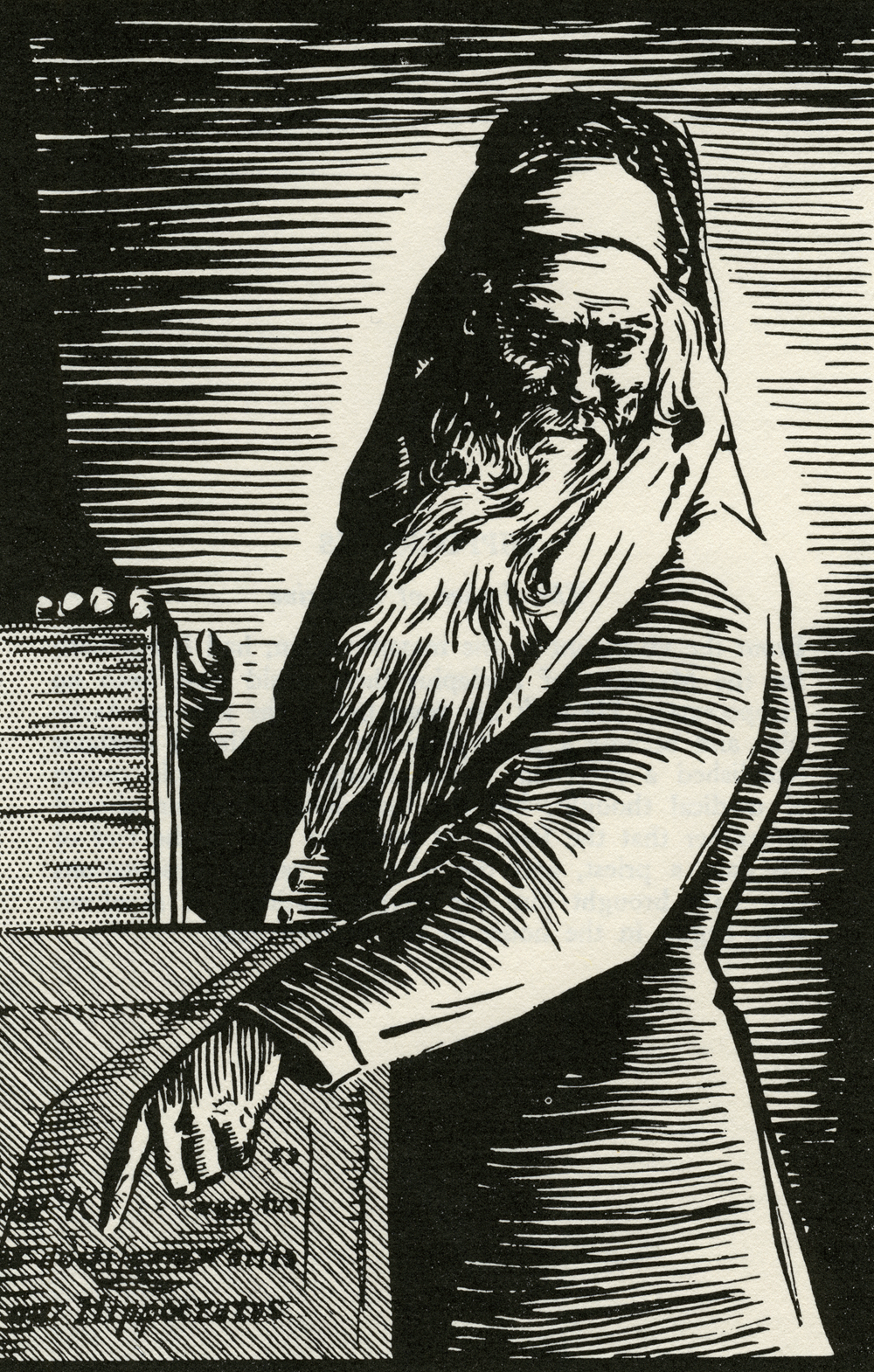
HIPPOCRATES The Father of Medicine From the viewpoint of the metaphysician, had it not been for the Mysteries of Asclepius there could have been no Hippocrates. He took his vows before the altar of Asclepius and became a priest-physician. His clinical methods established a precedent which changed the whole course of medical thought, but the materialist physician should remember that the Father of Medicine was to the end of his days a priest, and the wise and careful observations that have brought him the eternal gratitude of mankind were begun in the house of the healing god.
Hippocrates, born 460 B. C., called the Father of Medicine CHAPTER 3: THE GREEK HEALING CULT OF ASCLEPIUS-HIPPOCRATES THE 'BLAMELESS PHYSICIAN' -- HISTORY IN TIMES PREHISTORIC -- DIAGNOSIS AND TREATMENT OUT OF DREAM EXPERIENCES -- THE RECORD OF RECOVERIES -- HIPPOCRATES, THE FATHER OF MEDICINE -- IN THE HOUSE OF THE HEALING GOD -- THE CELEBRATED OATH -- TREATMENT BY NATURAL MEANS ALONE -- THE WRONGS OF HIPPOCRATES -- ORIGIN OF THE BEDSIDE MANNER -- THE ORACLES AND HEALING SHRINES -- THE SEVERED CONNECTION -- SECULAR MEDICINE IN ROME -- THE INFLUENCE OF BEAUTY ON HEALTH -- SPIRITUAL HEALING AND OUTGROWN BELIEFS. THE 'BLAMELESS PHYSICIAN' THE Greek healing cult of Asclepius, of great importance to the metaphysically minded, is worthy of most careful consideration. While many modern authors mention it in connection with the history of medical arts, few devote more than a dozen lines to this extraordinary order of priest-physicians. This lack of interest among the scientific writers is due, no doubt, to the miraculous means by which the cures were accomplished. In the mild controversy about these cures, as to whether they were the result of mass delusion, or animal magnetism, it has not seemed to occur to many that the miracles might be exactly what the Greeks believed them to be, a divine remedy for human ills. The first priestly healer to be mentioned in history was the Egyptian physician, Imhotep. This mighty man left to his people many proverbs and wise observations about sickness and health, and after his death he was elevated to the estate of a demigod. Temples were built in his honor and a priesthood served these shrines, perpetuating the remedies and magical formulas which he had given to the world. Schools of medicine were established in the Houses of 1mhotep, and clinics maintained for the treating of disease. What Imhotep had done for the Egyptians, Asclepius was to accomplish for the Greeks. The sacred Mysteries of healing were established in his memory and his descendants were priest-physicians until the end of Hellenic civilization. Homer refers to Asclepius as an historical person, a Thessalian prince, and calls him the 'blameless physician.' Almost nothing is known of the life of this great healer. It is believed that he married Epione, a daughter of the King of Kos, and was the father of four children; two sons, Machaon and Podalirius, who also became physicians, and two daughters, Hygeia and Panacea, whose names are still remembered as terms in healing. No date can be assigned to Asclepius with certainty, but he probably lived between 1200 and 1000 B. C. It is possible that some factual elements may be involved in the myths which grew up about this demigod of medicine, since mythology has been defined as the history of prehistoric times. In most accounts, his father was Apollo, god of healing, and his mother was Coronis, a girl of Thessaly. When the father of the girl Coronis forced her to marry a mortal man, Apollo in his rage destroyed the family. Coronis, although about to bear a child, was slain by Apollo's sister, the goddess Artemis. Apollo, as his desire for vengeance subsided, was grief stricken at his deed, and descending in his glory he rescued his unborn son from the burning body of Coronis as she lay on her funeral pyre. Thus Asclepius was brought into the world by a Caesarean section, possibly the first account of a child to be so born. It is generally agreed that Apollo took his infant son to Chiron, the centaur, to be educated. It was from Chiron, who was also the mentor of Achilles, that Asclepius learned the mysteries of medicine. Let us rationalize this part of the fable. HISTORY IN TIMES PREHISTORIC The centaurs have an important symbolical meaning, for they represent the children of time. Their father was Saturn, the old god-Father Time. To the philosophic Greeks, therefore, the centaurs signified tradition, that which is born of ancient time. Chiron was wise in the old lore -- the primitive experience-record of the human race. He was indeed the very personification of tradition, this centaur with his human parts rising out of the body of the animal world. In this light the teacher in the fables takes on a rich new meaning. It is well to remember that all myths yield readily to reasonable interpretation. After Asclepius had learned all that Chiron could teach him, he entered upon his career as a physician and performed many great and wonderful cures. It is said that on at least one occasion he succeeded in raising the dead. This was his undoing; for Pluto, lord of death, fearing that in the end Hades might be depopulated by the skill and magic of a mortal man, appealed to Zeus to protect the dignity of death and the natural laws of the world. The Father of All then took one of his thunderbolts, fashioned in the fiery pits of Etna, and hurling it at the physician, destroyed him with the heavenly flame. But a grateful humankind did not forget its Prometheus of Medicine, who had paid with his life for the life he had brought back. Asclepius was elevated to the rank of demigod, healing shrines were dedicated to him, his sacred Mysteries were established, and his descendants set apart as healing priests forever. Many temples to Asclepius were built throughout the Greek states, and later the Roman Empire. The most famous of these was the great Hieron, or sanctuary, at Epidaurus. This magnificent group of buildings clustered about the central temple of the healing god, and in the adytum of this shrine was the gold and ivory statue of Asclepius, by the sculptor Thrasymedes. The divine physician of noble countenance was represented as a seated figure holding in one hand the serpent-wound staff. The dog of medicine crouched at the feet of its deified master.
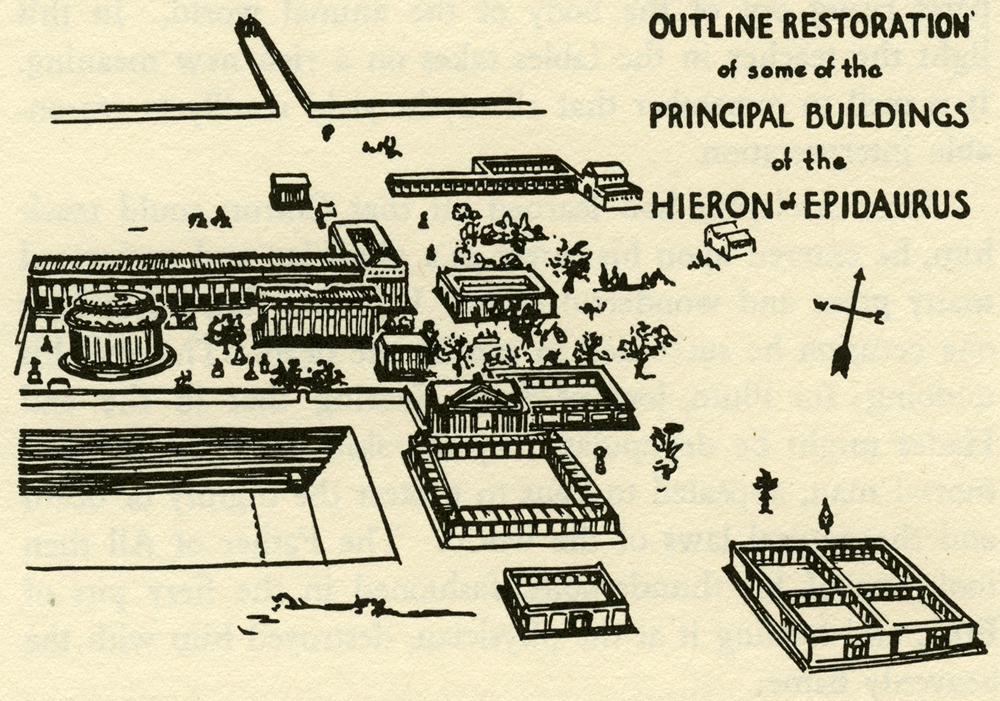
OUTLINE RESTORATION of some of the PRINCIPAL BUILDINGS of the HIERON of EPIDAURUS Grouped about the shrine itself were various buildings and rooms for the lodging of pilgrims and the treatment of the sick. They were large airy buildings, constructed for abundance of sunlight. As a proof that faith alone was not to be the basis of wonders, most of the temples of Asclepius were built near medicinal springs, much like the modern spas. DIAGNOSIS AND TREATMENT OUT OF DREAM EXPERIENCES If the shrines themselves were remarkable, the method of healing practiced in them was even more so. The diagnosis and treatment were determined through oracles given by the god, himself. These oracles were dream experiences of the patients. When the sick came to the temple for healing, they went through a special period of preparation, and then the sufferers, clothed in new white garments, were brought on their couches into the presence of the statue of Asclepius, and left for the night. In their sleep, the sick saw the god come to life; he walked among them and spoke to them, and prescribed the necessary remedies. In the morning the patients told their dreams to the priest-physicians, who then prepared the medicines or magical formulas. The scientifically trained modern practitioner may call the whole thing a disgusting example of primitive superstition. But, the sick recovered. They were carried into the shrine one day, and on the third day thereafter walked out amidst the plaudits of the assembled multitudes. Was it not Paracelsus who said that the true end of medicine is the recovery of the patient? By that definition these ancients were good doctors, even if Dr. Haggard does liken them to Medicine Men. THE RECORD OF RECOVERIES Outstanding healings resulting from the oracles of Asclepius were recorded on tablets in the temples, for the admiration of visitors, and no doubt to increase the confidence of patients. Edgar James Swift quotes several accounts of these metaphysical healings, taken from ancient Greek inscription of the 4th and 3rd centuries B. C. Dr. Swift's opinion of these cures can be gathered from the title of his book, The Jungle of the Mind. For those interested in the records, and not in the viewpoints upon them, here they are, in digest:
Later in this chapter other examples are given of the oracular healings accomplished in the sanctuaries of Asclepius. A European physician once told me that he did not like to hear about such miracles, because they were unfair. The modern doctor knows much more than the ancient priests, but naturally cannot compete with the supernatural! HIPPOCRATES, THE FATHER OF MEDICINE Among historians of the healing arts there is a popular belief that Hippocrates of Kos was the Moses of medicine who led the physicians of his time from the Egyptian darkness of magic and superstition into the promised land of rational therapy. It is in order, therefore, to examine now the life and teaching of this great man, from the viewpoint of a metaphysician. Hippocrates, called the Father of Medicine, was born on the Greek island of Kos, in the year 460 B. C. His father was of the family of Asclepiadea, the guild of priest-healers descended from the deified Asclepius. Early writers make much of the fact that Hippocrates was the seventh in lineal descent from the "divine physician." The mother of Hippocrates, Phaenarete, traced her ancestry back to Hercules, the strongest of mortals. From such an illustrious background a genius could be expected to emerge. Hippocrates studied medicine with his father, Hereclides, a celebrated healer. Later, in Athens, he sat at the feet of the physician Herodicus. For his philosophical education he was for a time the pupil of Georgias of Leontini, a brilliant Sophist; and he also received instructions from Democritus of Abdena, a man of vast learning, and one of the fathers of the atomic theory. Obviously then, Hippocrates was well schooled in those mental disciplines that are the necessary foundation of intellectual greatness. Having completed his education, according to the custom of his time Hippocrates returned to Kos, there took his vows before the altar of Asclepius, and became a priest-physician as his father had before him. How much time he spent in the temple of the god of healing we do not know. In various places and for a greater part of his life he ministered to the needs of the sick; and we have his thoughtful consideration of their ailments preserved for us through his numerous writings. There can be no doubt that Hippocrates was the greatest of the Asclepiadea, and the materialistic physician should remember that the Father of Medicine was to the end of his days a priest. How has it come about that Hippocrates has received in general the plaudits of medical historians, but the great order of priest-physicians that produced him has been passed over with hardly a grudging compliment? Had it not been for the Mysteries of Asclepius there could have been no Hippocrates. As greatness is honored, is not the cause of greatness equally worthy of respect? It surely is not reasonable to accept a man's attainments and then deny, or ignore, the very things that made that man what he was. The predicament of the materialist is, how can he afford to honor the teachers of his hero, when to do so would force him to acknowledge the debt he owes to mystical and metaphysical arts? A grateful world has showered honors upon the memory of Hippocrates; his knowledge, for his time, was extraordinary; and his personal character was above reproach; his clinical methods established a precedent which was to change the whole course of medical thought. All this is to be granted without reservation; but this is not the end of the matter, for there is reason for resentment in a type of statement that in one form or another appears in almost every modern text on the early history of medicine. Its general import is this: "Hippocrates was the first to separate medicine from superstition and priestcraft, to base its practice upon the principles of inductive philosophy, and direct especial attention to the natural history of disease." IN THE HOUSE OF THE HEALING GOD It is not to be ignored that Hippocrates was born in the shadow of the Asclepian shrine, that his father was a priest-physician, that young Hippocrates first came in contact with disease in the healthy and hygienic atmosphere of the Hieron. Those wise and careful observations that have brought him the eternal gratitude of mankind were begun in the house of the healing god. Here the sick were arranged in wards, their bodily comfort assured by ever watchful attendants. Hippocrates could sit by their couches, listen to their symptoms, and watch the course of their ailments. He had the opportunity to observe and study thousands of cases and distinguish many types of disease; only the great clinics of Asclepius could have afforded such opportunity for research. But it was not possible to follow the condition of patients in the temples, as they came only for a short time, so it is probable that Hippocrates also formed clinics of his own so that he might observe the longer courses of some ailments. What little can be gathered about the private practice of Hippocrates indicates that his clinics were patterned, with certain modifications, after those of the temples. Some moderns would have us imagine that Hippocrates stood alone in a benighted world, one shining light in a universal darkness. This is a little difficult to believe. Socrates, Plato, Democritus, Demosthenes, Aristippus, and even Aristotle were among his contemporaries. He lived in the golden age of Grecian intellectual culture, one of the highest points in the philosophical life of the race. Plato and Socrates definitely believed in the Mysteries, accepted the mystical tradition, and acknowledged the existence of the gods and heroic souls; and these are considered reasons for materialistic opinion to seek to dim their glory. THE CELEBRATED OATH It would be interesting to know what Hippocrates himself believed about such matters as the gods, and a future life. He was an initiate of the Asclepian cult, and the celebrated oath attributed to him opens with these words, "I swear by Apollo, physician, by Asclepius, by Hygeia and Panacea, by all the gods and all the goddesses -- taking them to witness ... etc." So it could be suspected that Hippocrates was not a perfect example of emancipated materialism. It might also be recalled that very little of good has come to man, in any age, from those of little faith. Apropos of the Hippocratis jusjurandum -- the great oath of medical ethics -- there is some doubt among inquiring minds as to whether Hippocrates was its true author. Just as the Lord's Prayer was lifted bodily from the Jewish Talmud, it is quite possible that the Hippocratic Oath was part of the Asclepian rites long before the advent of Hippocrates. This Oath, especially the opening lines, is not entirely satisfactory to the non-mystical minded. Not long ago I was privileged to sit in on an argument when precisely this thought worried several eminent medics. It was the final and mature opinion of these gentlemen that the Oath should be revised! -- they wanted references to gods entirely removed, as inconsistent with the state of modern enlightenment. It is a little difficult to believe that the priest-physician who took his Oath, when oaths were meaningful, "by all the gods, and all the goddesses" is the same man, according to many texts, who "separated medicine from the priestcraft." Hippocrates, we know, through a series of clinical observations, made a number of important discoveries concerning the nature and course of disease, and the effects of various remedies, not generally known before his time. But this does not prove that he had any intention of overthrowing priestly medicine. Nor does it indicate any intention to deny the spiritual factors in the problem of health. It is true that Hippocrates said that "there is no authority except facts," but the Greeks certainly would have been the first to assert that it would be a poor religion that facts could tumble from the sky. The Jesuit Father, Athanasius Kircher, discoverer of a number of facts important to medicine, remained a devout man; he never expressed any fear that his findings would overthrow the Papacy. It is probable that the secular physician did come into being as a result of the Hippocratic emphasis upon the physical causes and treatment of disease, but in many ways this separation was a loss rather than a gain to medicine. The division was not necessary to scientific progress. A religious system that produced such outstanding individualists as Pythagoras and Plato would not have hindered the medical practices of Hippocrates. There is no evidence that any effort was made to interfere with any of his methods. Hippocrates practiced his medical convictions and communicated them to his disciples without hindrance or persecution, as did most other teachers of his time -- so long as they did not involve themselves in politics. TREATMENT BY NATURAL MEANS ALONE Hippocrates proved, probably without fully realizing the implications himself, that many diseases can be treated successfully by natural means alone. There were numerous advantages to this viewpoint, but there were also many serious disadvantages, as time was to prove. The greatest good that came from the Hippocratic reformation, so-called, was the impetus that it gave to the physical aspect of medical research. It supplied a reason why physicians should search unceasingly for natural remedies for human ills. The greatest evil that resulted from the new viewpoint was the gradual but relentless motion of medicine away from the spiritual and ethical standards which the Mysteries imposed upon the physician. What were the medical opinions of Hippocrates of Kos? He divided the causes of disease into two general classes; the first external, as weather, climate and locality; and the second, internal or personal, as habits, diet and exercise. He believed that appearance, disposition, and mentality were largely influenced by climate, thus explaining the general superiority of the Greeks. The decline of the Greeks, in spite of their admirable locality, he did not live to see or explain. Disease, according to the Hippocratic doctrine, was due to the derangement of the "four humours," or bodily fluids; these are blood, phlegm, black bile, and yellow bile. When these humours were not in proper proportion or arrangement sickness invariably followed, and if they could be coaxed into a more propitious relationship a cure could be effected. The Father of Medicine was more famous for prognosis than diagnosis, and was accused of a fatalistic attitude in treatment. He may have brought this fatalism with him from the Asclepian temples, for the rules of these shrines included one to the effect that cases obviously hopeless could not be treated. With Hippocrates, if previous cases of a similar nature had ended fatally, he was not likely to oppose the course of the disease. The Hippocratic theory of treatment has been called "cautious and expectant." Diet and baths were his favorite remedies, and he made considerable use of herbs. Leclerc collected a list of almost four hundred milks, wines, fruits, vegetables, fats, and other "simples" which he prescribed. Horns of the ox and stag, and the excrement of the goat, mule, ass, goose, and fox are included in his pharmacology. The opinions of Hippocrates on the subject of astrology are particularly obnoxious to modern practitioners. Treatment was not his greater bid to fame, although he was honored by the Athenians for his services during the outbreak of the plague. Hippocrates was primarily an observer of disease, and his two sons, also Asclepian physicians, assisted him in compiling the various case-histories that became the basis of his writings. He was sometimes accused of being more interested in watching his patients than in trying to help them, and he was accused by his contemporaries of letting the sick die by "doing nothing to keep them alive." In this practice he differed markedly from the modern physician, who prolongs life by any means in his power on the assumption that hope lingers until actual death. It was probably his prognostic skill that caused Hippocrates to neglect cases he regarded as hopeless. Eighty-seven books are attributed to him, but most of these were probably by other learned physicians of his time, some with the same name as himself. This would indicate that he was one of a considerable group of similarly minded men. On this subject, in The Doctor In History, Howard W. Haggard, Associate Professor of Applied Physiology at Yale, writes: "Hippocrates exists as a name rather than a man. Under that name we group all the great and now forgotten men of Greece who in the fifth century B. C. formed the scientific basis of medicine." THE WRITINGS OF HIPPOCRATES The principal works of which Hippocrates of Kos is now believed to be the author, treat such subjects as Prognostics, Epidemics, On Diet, and On Air, Water and Locality. Some of the best of his writings are the Aphorisms, short and spirited sentences, factual and descriptive. The most famous and discouraging of the aphorisms is, "Life is short and art is long." Another is typical. "If a dropsical patient is seized with hiccup, the case is hopeless." Under the name of Bokrat, Hippocrates was known to the Arabs, and his writings were treasured among them through the long night of Europe's dark ages. A considerable mythology has grown up about this great physician and miracles have been attributed to him that do not appear inferior to the wonders performed by the divine Asclepius. As many of these myths are of Grecian origin, and some of them are very ancient, it would not appear that Hippocrates was regarded as a materialist by his contemporaries or followers. If older opinions are confused, the moderns are no better. Logan Clendening in his book, Behind the Doctor, published in 1933, writes, "It is doubtful if there was any single personality known as Hippocrates." It would be rather embarrassing if the father of factual medicine was himself a myth! One thing is certain however, the majority of medical historians do not believe the great physician to be a figment of the imagination. To them he is a very real person, with a long gray beard, and scholarly, if un-Grecian, appearance. How little we really know about these matters upon which we are so sure. My own opinion is that there are few myths that do not root in realities, and Hippocrates was most certainly an actual person, but many of his accomplishments originated among the thinkers of his own, or earlier times. ORIGIN OF THE BEDSIDE MANNER Another important contribution that Hippocrates made to modern medicine was the bedside manner. The physician entered with dignity, and if the ailment was not in a violent stage, seated himself beside the patient and 'artistically' questioned him concerning his age, his manner of living, his recent exposure to infection or contagion, his diet, his previous ailments, and the special seat of the present discomfiture and the symptoms. This was usually followed by a general examination. He had also to encompass the delicate matter of previous physicians and their prescriptions, for it was not ethical to question the ability of a fellow practitioner. Then followed the new medication and recommendations. This, the Hippocratic procedure, has varied little since his day. Concerning the later life of Hippocrates nothing is known, except that he died at Larissa. Ancient writers have given the length of his life variously as 85, 90, 104 and 109 years. Clinton favors 104 years, but most moderns are more conservative, the larger figures do not sound factual to them. He had at least two sons, Thessalus and Dracon, but the date of his marriage and the name of his wife are not preserved. Thus little we know of the wise old physician whose name is burdened with the responsibility of having divided, forever, the art of healing from its priestly founders. The more we study his mind and his methods the more we feel the injustice that has been done him in the name of glory. What Hippocrates really believed was, the gods help those that help themselves. He taught that men should not depend upon divine aid for all the infirmities of their flesh, but should seek natural means of binding up the wounds of their indiscretion. This is not only good science, it is good religion. The many Catholic and Protestant hospitals in our communities, equipped with every modern instrument of diagnosis and healing prove that religions do not reject progress in scientific knowledge. The great 'division' is in the mind alone, and attitudes, not facts, are responsible for the long antagonism between the gods and the doctors, to the dishonoring of both. In his treatise on the Sacred Sickness, (epilepsy), Hippocrates reveals his true position in his own words. "Such things," he writes, "are divine or not -- as you will, for me distinction matters not -- and there is no need to make such division anywhere in nature, for all things are alike divine or all are alike human." Here, the physician, in his own words, denies the very division that has been in his name. Division leads not to progress but to confusion. The fruits of division are dissension, intolerance, and waste. Where there are many schools teaching differently about the same thing all learning is obscured. Mankind is united in all essentials, and divided only in those things which are of secondary importance. But it has been fashionable to magnify the difference and ignore the great unities that bind the world together. Selfishness and stupidity caused the Dark Ages, the Inquisition, the wars and economic upheavals that have plagued mankind for ages, and last but not least, the discords of religion, divided as it is into hundreds of sects, which would serve God by plaguing one another. THE ORACLES AND HEALING SHRINES The discoveries made by Hippocrates did not destroy the cult of Asclepius. It remained for centuries the principal custodian of public health. A great plague broke out in Rome and threatened to destroy the entire city. The Romans sent an embassy to Epidaurus to beseech the help of the god of healing. The oracles were questioned and Asclepius was pleased to listen to the need of the Romans. He permitted himself to be taken to Rome in the form of a living serpent. As the ship was sailing up the Tiber on the return journey, the god glided over the side of the boat and took to himself an island in the river. The Romans, taking the action as an omen, built their sanctuary to Asclepius on this island, and through the favor of the god, the plague was overcome. A memorial tablet has been found on the site of this temple on the Island of the Tiber. The tablet commemorates four miraculous healings that took place in this shrine. The substance of the four inscriptions is as follows:
If these inscriptions are representative of Asclepian therapy it is not difficult to understand why the Greeks and Romans so greatly admired their cult of priestly-physicians. Since the rise of the psychological viewpoint it is customary to dismiss all accounts of miraculous healing as 'purely psychic,' or as 'the result of mental suggestion.' This attitude is justified by the assumption that only functional ailments could be so treated, that none but the secular physician was qualified to cope with serious, organic disorders. Let us apply this kind of logic to the testimonials on the Asclepian tablet from the Island of the Tiber. Blindness, hemorrhage of the lungs, and pleurisy, are not superficial ailments by any standard of medicine. It may be true that blindness can be caused by hysteria; but again, it is more often the manifestation of very serious bodily ills. It is difficult to believe that hemorrhage of the lungs is merely a mild form of psychic disturbance, and its instantaneous cure is something for medical men to think about. The same holds true in the pleurisy case. If psychic medicine can produce such results as those described on the memorial tablet it is a valuable and important part of the technique of healing. Perhaps, indeed it is the therapy of the future, in answer to the prayers of a suffering humankind that has been drugged and purged, and bled for the last two thousand years in the name of materia medica. Not long ago, a man selected my sympathetic ear to pour into it the long tale of his physical woes. His case history included twenty years of suffering, a dozen ineffective doctors, and complete economic demoralization. Would it be facetious to observe that this poor suffering mortal would gladly exchange the opinions of his twelve physicians for one slightly inspired utterance relative to his condition? THE SEVERED CONNECTION Even the trained psychologist knows pathetically little about the powers of the human mind. He is searching, but only centuries of constant effort will be sufficient to perfect his knowledge. Is it possible that the initiated priest-physicians of antiquity did possess a spiritual insight into the origin and treatment of disease, which was lost to the secular doctor when he severed his connection with the great, mystical institutions of healing? The modern materialist assumes a negative answer to this question, but an assumption is not a fact. When Plato opened his school in the Lyceum he discovered that a nearby swamp rendered the location unhealthful. After a short time he was stricken with a dangerous fever caused by the fetid air. His disciples recommended that he move the Academy to a salutary location. But the master refused, explaining that a wise man could free himself from the influence of any environment, once he had recognized the nature of the difficulty. Plato cured himself of the fever by the strength of his mind alone, and continued in the Lyceum the rest of his life with no recurrence of the ailment. He lived to ripe old age, and finally died, in his eighty-first year. It is reported that his death was due to no disease, but to the general infirmities of old age. He died in his sleep, with the books of the poet Sophron under his head for a pillow. A swamp is not a fixation, a phobia, a neurosis, or an inhibition; it is a very real source of bad health. A mental attitude alone is not enough to overcome its evil force, nor is autosuggestion a reasonable answer. Plato might have denied that the swamp could hurt him, but in the end his constitution would have been undermined. There is much more than mere affirming and denying to metaphysical healing. It appears certain that Plato knew how to make himself immune to the local fevers. Who can deny that such knowledge would be valuable, even in this time of inoculations? Plato taught by his example that man possesses within himself the power to cure the diseases of his body, that in the end, every man is his own priest, and every man is his own physician. Wisdom is a universal medicine, and the only remedy for ignorance, the great sickness of mankind. This is the doctrine of the mystics, the doctrine which they learned in the old temples; the doctrine which some day must be the foundation of all enlightened therapy. SECULAR MEDICINE IN ROME Approximate dates of the healing recorded on the memorial tablet are fixed by the first inscription, 'in the reign of Antoninus,' or early in the second century, A. D. By this time secular medicine was well established in Rome, and by numerous Greek physicians who were not priests; so we may assume that they were products of the 'great separation' attributed to Hippocrates. These doctors had first come to the Roman Empire about two centuries before the Christian Era, and because of the Roman respect for Greek culture, they established large and profitable practices. By studying these men we may discover some of the immediate results of the secularizing of medicine. These physicians who had left spiritual values far behind in their haste after physical knowledge, were, on the whole, a scurvy lot. Cato cried out against them, declaring that the Romans had flourished for six centuries without doctors, only, in the end, to be murdered by Greek physicians. To these inquisitive medics the human being had lost his identity as a son of God, and had become a case-history. Of their thirst after knowledge, and their ethics generally, Pliny writes: "It is at the expense of our perils that they learn, and they experimentalize by putting us to death, a physician being the only person that can kill another with sovereign impunity. Nay, more than this, all the blame is thrown upon the sick man only; he is charged of disobedience forthwith, and it is the person who is dead and gone that is put upon trial." It was at this point, also, that commercialism reared its ugly head. The priest-physicians were attached to temples that were supported by the state. If grateful patients, who had been benefited, wished to make gifts to the temple, well and good. Most of the shrines were filled with treasures, along with lesser gifts of no physical worth given by the poor, but every offering was a token of actual assistance. Secular Greek doctors, however, charged high fees; they based these upon the limit of the financial means of the sufferer, and they charged the same whether the patient lived or died. Where medicine ceased to be a religion it became a business. When Cato said that the Romans had gone along for six hundred years without doctors, he meant that until the appearance of the Greek medics the healing arts had been in the keeping of the sacerdotal class. The priest-physicians and the temple of healing were the sole custodians of the public health during the rise of the Roman Empire, the secular physicians were in authority during the decline. Until the coming of the Greek doctors the Romans had never paid a fee for medical attention, but the crafty Greeks assured their new patients that a man only appreciates what he pays for. The new therapy removed the superstition of Divine aid, and substituted for it the superstition that money can buy health, and pay for dissipation. The greater harm was that the high prices kept health away from the poor, and it was the poor who had to fight and die for the glory of Rome. The Romans had quite a time adjusting themselves to the new scientific viewpoint in medicine; they made laws against malpractice, regulated fees, and devised legal methods to hold physicians responsible for their mistakes and the consequences. The new doctors were supposed of course to be men of high principles, and they had taken the Hippocratic Oath, but it could be questioned how important is an oath to the gods, when belief and faith in those gods is itself undermined. These men were no longer ruled by their own spiritual convictions, by the belief in the reality of Divine powers; and then, as always, it was necessary to govern their actions by man-made codes to protect society from an excess of exploitation. It has ever been difficult to make laws against a privileged class, especially if this class organizes itself against any regulations that interfere with its complete freedom of action. The Romans found this out when they tried to regulate the practice of medicine. They succeeded in part, but never again did the Eternal City enjoy that freedom from medical crime that had been there before the coming of the Greek doctors. For several centuries priestly healing and materia medica dwelt side by side in a state of armed truce. To the priests, the secular physician was guilty of the grossest form of sacrilege; and to the emancipated doctors the priests were a superstitious lot insofar as their claims to healing were concerned. In the midst of this tense situation another complication entered -- the Christian religion began its rise to power. There was nothing particularly mysterious about the collapse of pagan Rome. Emperors were degenerate, aristocracy decadent, laws were corrupted by private interest; its religions had been profaned, its citizens demoralized by constant wars, its treasuries exhausted by public graft, and its provinces overrun by barbarians. In the face of all this tribulation, a recent writer with the modern medical attitude on matters of history, naively suggests that malaria was a dominant factor in what Gibbons so euphoniously describes as the decline and fall of the Roman Empire! Could it be that the city built by Romulus on the banks of the Tiber ruled the known world for centuries, but by a curious coincidence, succumbed to its malarial environment at the precise time that its ethics and morality reached their lowest ebb? This attitude is typical of men who try to think through the problems of their world with their minds turned away from the benefits of spiritual education. THE INFLUENCE OF BEAUTY ON HEALTH When secular medicine separated from the Asclepian Mysteries, it departed in such a hurry that it left behind many of the most important furniture and fixtures of the healing art. Primarily it left behind the exalted ethical standards that must apply to all relations between the public servant and the public he serves. It was taught in the temples that wisdom was a divinely bestowed superiority; and that men so favored by the gods must always deport themselves in a manner worthy of the confidence which their wisdom inspires. In their hurried exit the new doctors also overlooked the part that beauty plays in the health of mankind. Utility became their one obsessing concern, and even today, after centuries of progress, the modern hospital looks more like a factory than a temple of health. The temples of Asclepius were places of beauty and gentle dignity. There may have been less efficiency, but there was certainly a noble and beautiful spirit in these sacred places. The priest-physicians were servants of a loving god who looked down with infinite pity upon his suffering world. The body of man was the living temple of a living spirit, and it was gently and reverently cared for. Why is it not possible for a world, rich and powerful far beyond the dreams of the Greeks, to restore this kindly way of health, adding all that scientific knowledge can bestow? Surely in this later day healing can be practiced with the same wise beauty that the ancients knew. The hasty-footed medics in their race for freedom also left behind the most enlightened of all ancient concepts about the ethics of healing -- the simple acceptance that medicine is for all who are sick. In the temple of Asclepius at Rome, slaves left by their masters to die were taken in and hospitalized until their ailments were cured. One of the Emperors made a law that such slaves, if they recovered, were free, and their former masters had no claim upon them. Naturally, most of these slaves could pay nothing for treatment, but this made no difference, the gift of health was a divine right of man. This famous temple on the Island of the Tiber, the first hospital, served the rich and the poor without discrimination. The modern world has its city and county hospitals and free clinics, the last usually attached to some medical school; but few of these compare favorably, in spirit at least, with the shrines of the healing god. The great majority of these charitable institutions are a disgrace to modern civilization, and those who enter through their ornate doors must humiliate and even in some cases pauperize themselves to secure necessary medical attention. And once installed, they are at the mercy of inexperienced internes and overworked nurses; and they are reminded in a multitude of ways that they are enjoying the grudging generosity of the public. Instead of being inspired to feel that a loving world is sincerely interested in their recovery, these patients know that the principal concern of all involved is to get them off the premises with as little time and bother as possible, so that another can have the bed. These misfortunes are beyond doubt the by-products of the famous division of religion and medicine for which wise old Hippocrates is blamed. Great and important as its contributions may be, science alone cannot perfect civilization. If man were simply an animal, living an animal existence and suffering only from the vicissitudes of the animal world, a physical viewpoint might be enough to preserve his economy. But man is more than this; he is a creature elevated by his mental and emotional energies to a unique place among created things. The wisest men of all times have believed in the reality of spiritual values, and they have been inspired to the service of the human need, not by hope of profit, but by love of man. Religion there must be, if the race is to endure; and nowhere is religion more essential than among those who are learned and skilled. There should be something of the priest in every physician, and something of the physician in every priest. Each needs the other, and not the so-called division between them, which is the modern boast. Two schools of medicine have come down to us through the ages, honored and respected by mankind. The first, and oldest, is spiritual medicine, with its doctrines of faith, prayer, penance, divine intercession, miracles, and if you like, a pure and unselfish magic. The second, and much younger, school is material medicine, developing the newer ways of chemistry, biochemistry, and electricity. Between these two now stands psychology, old in principle but new in technique, which must try to unite the mystic and the medic for the survival of the race. There seems no good reason why so many scientists should strive eternally to destroy mysticism, and to condemn and ridicule the old ways which made men happier and better. There is less reason why they should try year after year, in books and articles, to destroy men's faith in spirit and prayer; for to the greater part of humankind these are the most important things in all of life. It is the doctor's task to help us through painful days and nights of suffering, and he who is not grateful is a fool. But the physician walks with us but a little way; science, or none, every man in the end must go through the same dark door into the unknown. Even the physician himself is mortal, and when his years are full, his end is the same as that of some ancient dreamer who has gone long before. Science belongs to this world alone. Man, the mystery of mysteries, does not. Can science solve for us the mystery of that other world, where time rests with the ages? Perhaps some day, but not yet. Edison was working with a kind of telephone that could connect the living and the dead, but death came to him before the work was done. Someday another will carry on, and science will link the worlds, but until that day men can have only their faith to make them strong. SPIRITUAL HEALING AND OUTGROWN BELIEFS The great Mystery Schools of antiquity, the sources of most that we know and believe, taught that the human consciousness was limited only by the arbitrary intellectual boundaries which it imposed upon itself. Is this impossible? Has the modern materialistic thinker really tried to explore the depths of himself? Has he sincerely examined all evidence which is against his own opinion? Has he disproved miracles, magic, clairvoyance, spiritualism, and telepathy? Spiritual healing is good and necessary for those who believe in it and have made it part of their religion. And, there is much in mysticism that would be good for all the world. What there are of superstitions and false doctrines will pass away. All mankind has beliefs, as of today, which a hundred years from now will be regarded as superstitions, and scientists and doctors are not immune. There is much of good, and if we are doing less than the best we know, it is because we are hampered by a medieval educational system and mid-Victorian immorality. As time goes on medicine will depend less and less on harsh drugs to accomplish its results. Already the motion is well under way. Gradually the mind and its power will take the place of many revered remedies. Then we shall find out that there is something even deeper than the mind, and so we shall go on in our cautious crab-like motion toward the world of spirit. When in the end we arrive there, would it not be passing strange if we should come back to the old ways of the gods, and find that the temples of the first day had the truths that shall come to general knowledge in the last day? All honor then to Hippocrates of Kos, who taught men to find natural ways to health. But let us honor him not as the father of a terrible division, but as the wise old Greek who said, "There is no need to make such division in nature, for all things are alike divine, or all are alike human." |