|
THE AGES OF GAIA: A BIOGRAPHY OF OUR LIVING EARTH |
|
8: The Second Home
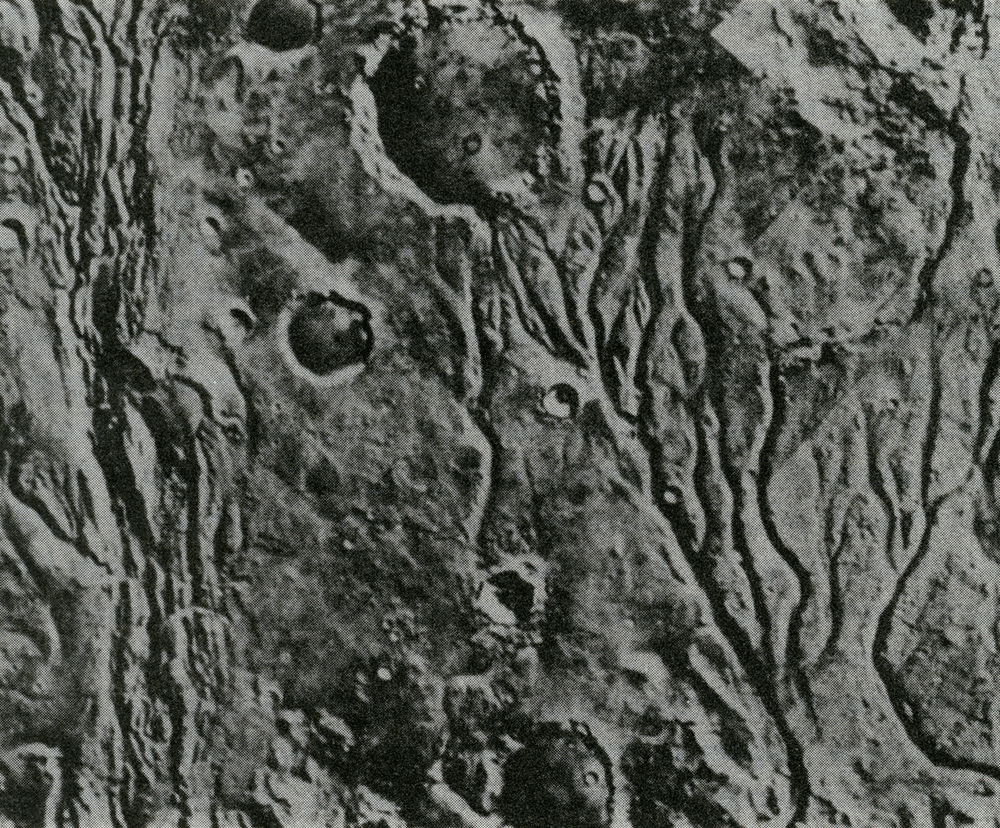
In the summer of 1969 I was in our second home on the shores of Bantry Bay, that part of Ireland where long thin rocky peninsulas point southwest, like fingers on a hand stretched out towards America. It was Monday, July 21, the day after the astronauts Neil Armstrong and Edwin Aldrin had walked on the Moon. The news of their historic journey came to us by radio. So remote and mountainous was this part of Ireland in those days that we were denied the pleasure of seeing the landing on a television screen. To our family, raised in the contemporary scientific culture, the ascent to the Moon was a consummation. For our Irish neighbors on the Beara Peninsula, it was a mind-quake that shook the foundations of their belief. Throughout the week that followed they often asked us, "Is it really true that men have landed on the Moon?" We were puzzled by the question, and replied, "Of course it is true. Did you not hear it on the radio?" Yes, they had heard it, but they wanted to hear from ourselves that there were men up there on the Moon. It took a long time and some prompting from my friends and neighbors, Michael and Theresa O'Sullivan, before I realized that what was an undoubted fact for me was, for the different culture that surrounded me, news of a much more profound and deep significance. To many of those living on the remote Beara Peninsula, Heaven was still simply up there in the sky and Hell beneath their feet. Their faith was not perturbed by the news of the men walking on the Moon, but their religious belief seemed to be undergoing an internal reorganization. I can only compare the intensity of their experience with that of the change of mind that came to many in the last century from the news that Darwin brought back after the voyage of the Beagle. In this century it is the tales of astronauts and the harvest of space exploration that has moved the locked plates of our minds. It should not therefore be necessary to explain why there is a chapter about Mars in a book on Gaia, but I will remind you that the Gaia hypothesis was a serendipitous discovery, arising directly from the invention of a method of planetary-life detection intended for use on Mars. Nearly twenty years later I found myself speculating on the possibility of changing the physical environment of Mars so that it becomes a self-sustaining living system and a brother to Gaia. Like the Gaia hypothesis, this notion also had an indirect and unexpected origin, and I shall digress in the next few paragraphs to explain it. It came about because of a book called The Greening of Mars, written with my friend Michael Allaby, a fluent writer on environmental topics. He wanted a world on which to act out a new colonial expansion; a place with new environmental challenges and free of the tribal problems of the Earth. I just wanted a model planet on which to play new games with Gaia, or rather Ares, the proper name for Gaia's sibling. The idea of developing Mars as a colony has received surprisingly little attention except from science fiction writers. Our book was written as fiction although, as wisely observed by Brian Aldiss in his review, it was more a pamphlet, a serious idea in a fictional setting. We chose this format because of a chastening experience following the publication of a previous book, one about the great extinction of 65 million years ago when the great lizards and much of the rest of the biota perished. It was written as a popular science book, stimulated by the imaginative science of the Alvarez family and their collaborators, who attributed the extinction event to the impact of a large planetesimal. They supplied what seemed to us to be convincing evidence of such a collision, the discovery that iridium and other rare extraterrestrial elements were significantly more abundant at the boundary of the Cretaceous and Tertiary rocks. This is the place in the geological record that marks a large change in the populations and species of the living things that made the rocks. Shortly after its publication, the book was savagely criticized by paleontologists who wrote in those journals that set the scientific trend. Maybe their criticisms were necessary and the punishment was just. We should have, as travelers to an unfamiliar scientific territory, taken steps to learn its language and history and to have had the right visas and letters of introduction to the princes there -- above all, to have been prepared for trouble in a land that was the home of greatest macho, Tyrannosaurus. But we learnt our lesson, and wrote The Greening of Mars as fiction in the expectation that it would not be adversely criticized on points of intricate factual detail. Our book was intended as the scene for a series of imaginary, gedanklich, experiments on another planet. What if Mars, now a hopelessly barren desert, could be made fit for life? How could we then seed it and how would it develop? Neither of us expected it to be taken as more than entertainment. We should have known that everyone, or almost everyone, takes fiction much more seriously than fact. Just think for a moment: if you want to know the sociology of Victorian England, you could read Marx, who was the first social scientist, but more likely, even if you are a Marxist, you will read Dickens. Within months of publication in 1984, our second book stirred far more serious attention than its light-hearted writing seemed to merit. Three scientific meetings on the topic of making a second home on Mars were held, and at one of them, Robert Haynes, a distinguished geneticist from Toronto, coined the word ecopoiesis -- literally, "the making of a home" -- for the practice of transforming an otherwise uninhabitable environment into a place fit for life to evolve naturally. I prefer it to the word terraforming, often used when considering this act for planets. Ecopoiesis is more general. Terraforming has the homocentric flavor of a planetary-scale technological fix. A key step in the development of a new geophysiological system is the acquisition of some novel and inheritable activity by a single organism. It follows that the first act in the ecopoiesis of Mars would have to be made by an entrepreneur. It would be an opportunistic act for private selfish gain; the larger communal act of colonization would come later. Columbus, I think, was not the chairman of a committee, but I suspect that those who traveled later aboard the Mayflower were the members of one. To make Mars a fit home for life we shall first have to make the planet comfortable for bacterial life. In the book, we proposed that this impossible and outrageous act, the changing of the environment of a whole planet, could only be done by a slightly disreputable entrepreneur; the type of man about whom it is said, "He never breaks the law but whenever he does something, legislation is needed to stop him from doing it again." People like this are needed to probe the boundaries and to do those things that are forbidden, things that are apparently too costly or are beyond the possibility of achievement by the well-meant but sometimes undesirable caution of the planned enterprise of governmental agencies. The scenario of The Greening of Mars included therefore a buccaneering character called Argo Brassbottom; later in life, success induced a snobbish gentility that caused him to change his surname to Foxe. He was a dealer in surplus weapons, and had the notion that there must be money to be made from the disposal of the vast accumulation of large, out-of-date ICBMs and other military rocket vehicles. The nuclear warheads could be, and would be, reprocessed as plutonium plowshares or future swords under strict governmental control. But what of the rocket carcasses full of solid propellant? These could not safely be disassembled and reused but they could, without modification, be the key components of a private space program. Brassbottom, through his many contacts in the civil and military services of the West and East, soon found that there would indeed be a reward for disposing of these unwanted rockets. Then he had another bright idea. His main line of business was as an industrial scavenger, a human dung beetle who profited from the disposal of toxic wastes and other noxious products that we prefer not to notice. Why not, he thought, use the rockets to propel the toxic wastes right outside the Earth? Deep space could be a safe dumping place. Moving as he did among the black markets of the world, he was well acquainted with those unscrupulous scientists who will supply their skills, for a fee, to political fanatics or criminals. One of these commented that the recent anxiety over the state of the ozone layer had led to legislation banning chlorofluorocarbon aerosol propellants. Maybe there was a surplus of these products that required their expensive enclosure in vast pressurized tanks. These gases are among the most harmless and benign of chemicals that enter the home. They are not flammable, nor are they toxic or noxious. They were banned because their presence in the atmosphere could deplete stratospheric ozone. Why not, thought Brassbottom, propel them out into deep space and be paid for so doing? It was not long before another scientist suggested sending them to Mars. The chlorofluorocarbons are 10,000 times more potent than carbon dioxide as greenhouse gases to absorb the infrared radiation that escapes from the Earth. On Mars this property might lift off the frozen atmosphere. Brassbottom was enough of a businessman to get title to develop Mars, realizing that the stocks of his Mars development company would boom should the planet get a temperate climate and so become potentially habitable. As a final step, with the help of friends in the United Nations agencies he convinced the new government of the small archipelago of New Ulster in the Indian Ocean to participate in building a launch site for his rockets on the temporarily quiescent volcanic island of Crossmaglen. It was heralded as the space program of the underdeveloped world. Earnest scientists who persisted in taking our fictional scenario as if it were up for peer review have pointed out to me that this would not have worked because the CFCs are rapidly destroyed by solar ultraviolet, and that carbon tetrafluoride, which is not destroyed, should have been proposed instead. Maybe they are right. When you are building imaginary worlds in the spaces of the mind, tiresome details such as the solidity of the planetary foundations and the presence or absence of rising damp or dry rot tend to be ignored. What counts is the position of the property and the grand view across the untouched landscape. Neither Mike Allaby nor I realized the extent to which our dream worlds would be seen as real estates. It is essential therefore, before any of us are carried away, to go back and re-examine our book as if it were a prospectus and not a work of fiction. If we are to avoid, even in the imagination, accusations of fraudulent deception, we need to include also a report on the state of Mars from an independent surveyor. By rights this should have been the task of the two Vikings, but sadly their directors were obsessed by another fictional dream, that of finding life on Mars. They should have made the necessary, albeit dull, measurements of the abundance of light elements in the surface rocks, the ratio of hydrogen and deuterium in the atmosphere, and the structure of the Martian crust; instead these were given less attention than the feverish but pointless search for life. So what do we know of Mars? The best and most readable summary of the information gathered by the spacecraft that orbited or landed on the Martian surface is Michael Carr's splendid and beautifully illustrated book, The Surface of Mars. It includes many photographs taken from orbiting spacecraft. Mars is seen to resemble the Moon much more than the Earth. Impact craters pockmark the surface and reveal a preserved chronicle of events going back to the planet's beginnings. This is in stark contrast to the Earth, where the ceaseless motions of the crust and the weathering by wind and water forever keep her face fresh and clean. Mars differs from the Moon in having an atmosphere, thin though it may be. It also has volcanoes, similar in form to those of the Hawaiian Islands but much larger. There are canyons and channels and dried-out river systems, suggesting that once long ago Mars had flowing water (see figure 8.1); there are polar caps that change their extent with the seasons; and there are clouds and dust storms in the thin remnants of its atmosphere.
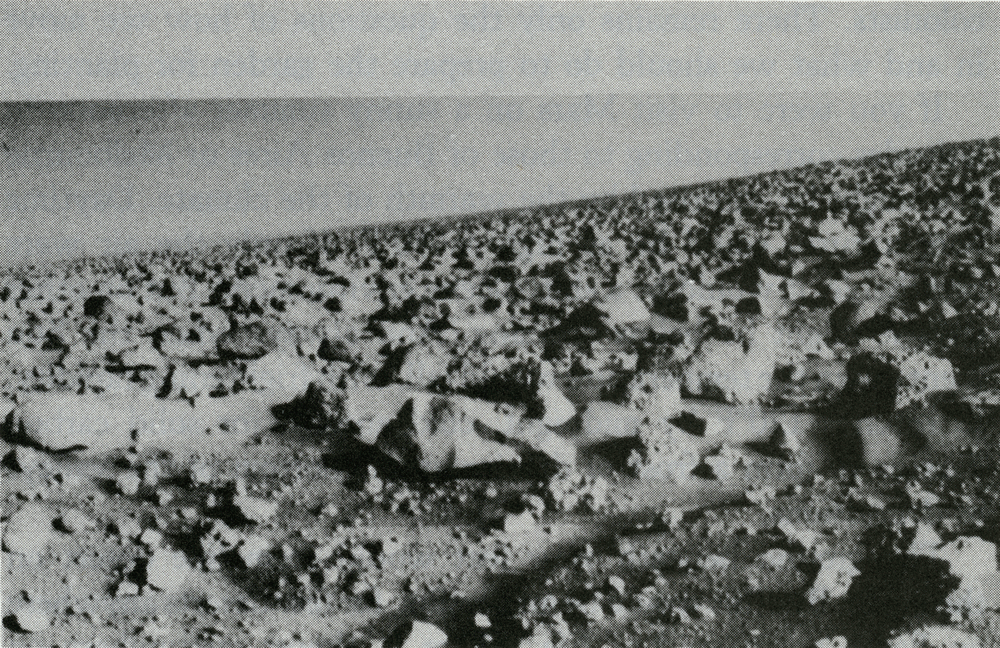
8.1 Water channels on Martian surface. The photographs from space show evidence of channels along which water may once have flowed early in the history of Mars. Mars may seem to be dry, but much water has outgassed from the interior during the planet's history. The total quantity is thought to be somewhere between 12 and 25 million cubic kilometers (2.6 to 5.2 million cubic miles), enough to provide an ocean between 80 and 160 meters deep over the whole planet were it a smooth round sphere, or about 200 meters deep for a distribution of land and sea as on the Earth. Michael McElroy of Harvard University has drawn on data for the isotopic composition of the element oxygen in the Martian atmosphere to argue that there has been little loss of water to space despite the lesser gravitational pull of Mars. Surprisingly the same arguments, when applied to the element nitrogen, lead to the conclusion that Mars has lost a large proportion of its nitrogen to space. There is strong evidence of massive floods and enough water to have produced river valleys nearly 1,000 kilometers long, but this was in the remote past. Where has all this water gone? According to Michael Carr's summary of the available evidence, most of the water now present is likely to be permafrost extending as deep as 1 or 2 kilometers below the surface. Layers of brine, with a freezing point as low as -20°C, may underlay the ice. In addition, the polar regions may overlay domes of ice. That, then, is the present consensus among scientists about Mars. There may seem to be plenty of water, but for various reasons it would be as inaccessible to a colonizing biota as the water below the desert of Australia. In addition, to melt and vaporize the water deep below the surface, heat must be transferred from above. Heat transfer through a surface layer of dust can be astonishingly slow; if limited to the process of simple diffusion it could take millions of years to melt the subsurface ice. This may be a pessimistic conclusion. Frazer Fanale and his colleagues at the Jet Propulsion Laboratory have proposed that the movement of carbon dioxide gas through the rock dust will exert a flushing action and so transfer water to the surface. Changes of atmospheric pressure due to the condensation and evaporation of carbon dioxide are the driving force for this motion. But, on a human time scale, the act of ecopoiesis to bring Mars to the point of seeding could still be unbearably slow. Before we take the drastic step of selling up our home on Earth, we need a great deal more information about our future home than was given by the Viking survey report. We need to know what could be the worst in store for us, and indeed for Mars itself, as a place for ecopoiesis. If you look again at the lunar-like surface of Mars you will see that the channels and flow systems, which so strongly suggest the presence of water, are ancient indeed; almost all date to the period before 3.5 eons ago when planetesimal impacts were more frequent. Mars may have had a thicker atmospheric greenhouse and a warmer climate; also, there may have been heating from the impacts. Four eons ago, the Sun was at least 25 percent less luminous than now. If Mars is frozen now, a thick blanket would have been needed then to sustain an atmosphere and flowing water. Since those distant times, the Sun has warmed and there have been more large planetesimal impacts, although less frequent than in the early days. In spite of this no signs of further water flows are seen. The present conventional wisdom that envisages an ocean of frozen water 100 meters thick may be wrong. Not enough account has been taken of the probability that Mars, like the Earth, was originally rich in chemical substances that react with water to form hydrogen that escapes to space. The water may once have been there, but the escape of hydrogen left oxygen behind, not as free oxygen, but chemically bound in nitrates, sulfates, and iron oxides. Consider the state of Mars 3.5 eons ago. This would be just after the planetesimals had rained down so immoderately and turned to rock and dust the entire planetary surface to a depth of at least 2 kilometers, a process that the planetologists coyly call "gardening." At that time the Earth was reducing; the environment was rich in those chemical compounds of iron and sulfur that have a considerable capacity to react with oxygen. There is no reason to believe that Mars was different. In addition, those early rocks had a considerable capacity to react with carbon dioxide. A 2-kilometer layer of powdered rock derived from basic basalt has the capacity to react with about 600 meters of water and carbon dioxide (3 bars), enough to make the surface atmospheric pressure of Mars three times greater than that on Earth now. Could this account for the thin atmosphere and aridity of Mars now? The abundant water that flowed 3.5 eons ago could have reacted with the ferrous iron of the rock dust, releasing the hydrogen it carried so that it escaped to space. It might be thought that the gas-solid reactions of weathering would be too slow to have removed much oxygen and carbon dioxide. This would be true of the present conditions on Mars; but if free water were present, much of the ferrous iron and sulfides could have been dissolved by the water, or dispersed as a fine slurry, hastening both the reactions themselves and the process of rock digestion. The oxidized state of Mars now, which gives the planet its deep red color, may be only skin deep. But until another surveyor, like Viking, goes there and tests the rocks at depth we cannot be sure that there is an atmosphere and water waiting for us. It is worth reminding ourselves how the Earth avoided the same fate and why we also are not now desiccated. The carbon dioxide originally in the atmosphere has nearly all gone to form limestones and carbonaceous sedimentary rocks. Vast quantities of sulfides and ferrous iron have been oxidized, and the oxygen retained by this process may well have originally been associated with hydrogen in water. The Earth was saved from drying out by the abundance of its water, and by the presence of Gaia, who acts to conserve water. Mars could soon have lost its meager first water, and that may be why those channels are so ancient and why there is so little evidence of bulk water of recent origin. Mars may be irredeemably arid, and what little water is left may be deep below the surface in aquifers as salt and bitter as the Dead Sea. For most living organisms, saturated brine is hardly better than no water. I must confess a personal intuition that Mars is nearer to a state of aridity. I cannot so easily envisage Mars as some potentially lush but deep-frozen sleeping beauty of a planet that waits to have the breath of life blown in from Earth. But fairy stories are much more entertaining than a dry-as-dust view of Mars; so let us accept the current scientific consensus that predicts abundant water and carbon dioxide waiting to be thawed, and let us use this pleasing model as the inspiration for our ecopoietic colonists. There remains only the questions of how we move in and what we should do to prepare the garden for planting. If you were to visit Mars on a sunny summer afternoon in latitudes corresponding to those of Buenos Aires or Melbourne you might be surprised by the warmth of the climate. Daytime temperatures could be as high as 70°F. If only the air were breathable, it would be a shirt-sleeve environment. But on other days it might be below freezing. And always when the Sun went down the temperature would fall, with frightening rapidity, to reach -120°F by midnight; cold enough for solid carbon dioxide to form a frost of dry ice at the bottom of the valleys or depressions. The ground beneath your feet would seem like desert on the Earth. But this would be an illusion, for few deserts anywhere on Earth are devoid of life. There is almost everywhere on Earthly deserts a thin cover of bacterial growth called the desert pavement. There is no soil on Mars, only a lifeless mix of rocks of all sizes from dust to boulders that has been given, almost onomatopoeically, that dry, harsh name, regolith (shown in figure 8.2). Mars is not yet ready for life; it is not only inhospitable to any form of life, it is also poisonous and destructive to organic matter. The air at the surface of Mars is in a chemical state like that of the stratosphere above the Earth. If the stratospheric air 10 miles above our heads could be compressed without changing its composition, we could not breathe it. Ozone is present there at 5 parts per million. Ozone may shield us from solar ultraviolet radiation, but at this abundance it is painful and soon lethal to breathe. The surface of Mars after a planetary lifetime exposed to such an atmosphere is rich in exotic chemicals, such as pernitric acid, that can rapidly destroy seeds, bacteria, or indeed almost all organic matter. Mars is no place for gardening. The highly oxidized surface on Mars today means that life cannot spontaneously develop there. Unlike the Archean Earth, the organic precursors of living matter would not have the chance to accumulate and assemble. The only route for ecopoiesis is, first, for us to change the environment until it is suitable for life and, then, either to allow it to evolve spontaneously or to seed the planet. If we achieve the environmental maturation, I cannot believe that we would have the patience to leave Mars to develop life alone. Someone would seed it, if only by accident.
8.2 Regolith seen from Viking Lander. Mars has no soil -- soil is the structured active surface of a living planet, regolith is rubble spread on the surface of a dead planet. Planetary life needs an operating system like Gaia, otherwise it is vulnerable to any change in its environment that could happen as a result either of its own evolution or of an external disaster such as the all-too-frequent impact of planetesimals. I do not believe that sparse life, existing only in a few oases on a planet, is viable. Such a system is incomplete; unable to control its environment and powerless to resist adverse change. It follows that, even if we sprayed every bit of the planet's surface with every species of microorganism, we could not bring Ares to life. Some organisms might survive and even grow for a brief spell, but there would be no invasion, no infection with the rapid spread of life to take over and control the planet. I find it unusual that otherwise capable organizations like NASA should strive so hard to sterilize their spacecraft when they well know that Mars itself is a great sterilizer. They also know that were the same craft to land unsterilized on the much more hospitable terrain of the antarctic ice cap or the Australian desert, their small complement of microbial passengers would have no chance of establishing a permanent home there. Parts of Mars may now have equable temperature on sunny afternoons, but this does not mean that little needs be done to bring it alive. When life began on Earth, the heat received from the Sun was 60 percent greater than that now warming Mars. There was abundant water on Earth and a dense enough atmosphere to provide a comfortable climate. The only thing in Mars' favor is that it is darker than the Earth and absorbs more of the sunlight falling on it. But this advantage is only for its present state; once water is set free it will evaporate to form clouds and snow cover. This will increase the albedo of Mars so that it reflects to space the heat that it might otherwise have gained. Mars by itself may never be able to provide the conditions needed to start and sustain life, not even in a billion years' time when the Sun is hotter and what is left of the Martian air and water has been set free. What can we then do to start Mars on the evolutionary course that would eventually bring it to a condition like that on Earth now and so become our second home? First, the Martian environment must be changed sufficiently to allow spontaneous growth and spread of microorganisms over a large proportion of the planetary surface. At first glance the notion of planetary engineering, the ecopoiesis of a planet, seems a grandiose impertinence. But it is not so impertinent if Mars is a deep-frozen planet needing only to be thawed; moreover this is the consensus view among planetary scientists, who report that as much as 2 atmospheres pressure of carbon dioxide and enough water to cover the planet to a depth of 100 meters or so have outgassed from its interior over the past 4 eons. If we accept this conclusion, then we could think of Mars as poised on the edge of a cliff of environmental stability; a small push may be enough to change it to a state much more suited to life. In his book on Mars, Michael Carr discusses the possibility that liquid water exists in aquifers beneath the surface of the planet, also the likelihood that such water might be salt. It is often forgotten that the stable state of the element nitrogen is as the nitrate ion, dissolved in water. On Earth, nitrate is formed continuously by high-energy processes (fires, lightning, and nuclear radiation) in the atmosphere. It quickly reaches the ground in rain, and the biota equally promptly return it to the atmosphere as nitrogen gas. There is no life on Mars, and I have often wondered if most of the nitrogen is there as nitrate dissolved in the brines. Or maybe there are vast salt deposits, evaporite beds, left after the ancient water flows dried out. Nitrate and nitrite locked up in these deposits could also account for the relative lack of nitrogen in the present Martian atmosphere. It will take another Viking to find the answers to these questions, and for now we can only speculate about what changes would have to occur to convert the present infertile Mars into a seedbed for planetary life. That is why Mike Allaby and I chose to write our tale of Martian ecopoiesis as fiction, and to warm Mars by projecting surplus CFCs from Earth. I have my doubts about whether enough of these powerful greenhouse gases could be sent, but this idea was intended to titillate the imagination of those who might want to convert Mars by some other means, rather than as a serious engineering proposal. I have often found in my practice as an inventor that a slightly wrong or incomplete invention is more attractive to engineers than one that is a fait accompli. In any event it seems greedy to attempt more than one's proper part of a project, to take from others the chance to exercise their special skills and artistry. Instead of sending CFCs to Mars expensively by spacefreight delivery as proposed in our book, someone may design an automatic plant to manufacture them on Mars from indigenous materials. If the Martian brines exist, and can be tapped, it should be no great task to synthesize fluorocarbons and other potential greenhouse gases, such as carbon tetrafluoride, using the salts of the brines and atmospheric carbon dioxide as the raw materials. It would require a moderate-sized nuclear power plant. Maybe environmentalists would be glad to see one shipped to Mars instead of sited here on Earth. If nitrate and nitrite are present in the brines, then these will provide a convenient local source of both oxygen and nitrogen. Not enough to change the atmosphere, but plenty for early explorers and technicians to breathe in their enclosed habitats. We have proposed the warming of Mars by sending greenhouse gases there; would it work? The basic mechanism of the greenhouse effect looks simple enough, but to calculate the temperature rise corresponding to a stated increase in carbon dioxide is far from simple. On a planetary scale many other things must be taken into account, including the reflection of sunlight by clouds and ice cover; the transport of heat by air movement and by the evaporation and condensation of water; and atmospheric and ocean structure. Not surprisingly, these calculations require the help of the largest computers that are available, and even they are inadequate. So far as I am aware, no models have included the dynamic responsive feedback from the biota. The Martian greenhouse effect is likely to be a great deal easier to calculate -- or at least it will be in the first stages before enough water has evaporated to introduce cloudiness, snow cover, and water vapor. Cloud and ice both are white and sunlight-reflecting. Broadly speaking, ice has the opposite effect of carbon dioxide and causes cooling; clouds can either heat or cool according to their form and altitude. To complicate the problem further, water vapor absorbs infrared, and its presence amplifies the heating effect of carbon dioxide. The idea of warming Mars by introducing CFCs into the atmosphere depends upon a set of favorable coincidences. First, there is a broken pane in the greenhouse. Neither carbon dioxide nor water vapor are effective absorbers of infrared at wavelengths between 8 and 14 micrometers, and a fair amount of heat radiates away to space from the planetary surface and atmosphere at these wavelengths. The CFCs absorb intensely in this region and serve as a new pane of glass, still transparent to sunlight but opaque in what previously was a gap in the infrared. Second, greenhouse gases have a way of amplifying one another's effects. It is not commonly known outside meteorology that the carbon dioxide greenhouse depends mainly on the infrared absorption by water vapor. Carbon dioxide does absorb infrared radiation, but not at the same wavelengths or as strongly as does water vapor. An increase of carbon dioxide will cause some warming and this in turn will increase the water vapor content of the air. The increased water vapor increases the warming and so amplifies the smaller effect of carbon dioxide. On Mars there will be a double amplification. The CFCs will warm the surface a little, this will lift off carbon dioxide and so increase the warming, which will in turn evaporate water and still further warm the planet. This is why it may be possible, using a practical quantity of these strange chemicals, to change the climate of a whole planet. We cannot say, until the modeling is done, how much CFCs would be needed. It might be as little as 10,000 tons or more than one million tons. If it as large as the latter, Brassbottom's enterprise would not succeed; it would, however, still be within the capacity of an automated chemical plant shipped to Mars with the purpose of synthesizing these or other greenhouse gases from indigenous materials. The success or failure of ecopoiesis for Mars is likely to depend on how much carbon dioxide and how much water is there in an available form. With a dense carbon dioxide atmosphere, 2 bars or more, a tolerable climate is likely. With less carbon dioxide, a great deal will depend on the distribution of water and on the effect of snow and clouds on the planetary albedo. In other science fiction scenarios water has been transported to Mars as asteroids of ice, taken from their frigid orbits far from the Sun. Simple calculations show the impracticality of this notion without some incredible new motive power. An asteroid of pure ice, 200 miles in diameter, is needed to equal the quantity of water now thought to be on Mars. Few would be prepared to take on the contract for moving it there. When the CFCs have done their job of lifting an atmosphere from the previously frozen surface, what world do we have? Let us assume, for a start, that we have a planet with an atmosphere of between 0.5 and 2 bars pressure and composed almost wholly of carbon dioxide. The climate is still cold by Earthly standards but the diurnal fluctuations are less extreme; at low altitudes in the tropical regions the night frosts are no longer as frequent or severe. Most important, enough water has evaporated for precipitation to occur in some regions. The surface is still regolith but no longer highly oxidizing; the lethal pernitric acid and other stratospheric oxidants have moved up in the atmosphere to those high-altitude regions where they exist on Earth. I can only guess at the ecosystem that could survive in such an environment. It would be unlikely to include the land plants and animals, at least not initially. The first life on Earth was the prokaryotic microorganisms, and their descendants still flourish in the soil. Our first objective would be to introduce a microbial ecosystem that could convert the regolith into topsoil, and at the same time to introduce surface-dwelling photosynthetic bacteria. These could provide the food, energy, and raw materials for the bulk of the ecosystem dwelling below the surface. If we could arrange that the photosynthesizers be colored dark, they would absorb the Sun's warmth and so be warmer than their surroundings. On a local scale this is like the advantage possessed by dark daisies on Daisyworld; it could encourage the ecosystem that they were a part of to spread across the Martian surface. If this happened the climate might tend towards homeostasis, at first by regions and finally globally. There are other ways available to the biota for regulating climate in addition to the control of albedo. Probably most important is the regulation of the composition of the atmospheric gases. The first act of ecopoiesis was to build an artificial greenhouse made of CFC gases at a few parts per billion in the air. In the early life of Ares, the control of the CFC emissions would still be available from the human colonists. This may be especially important if the atmospheric carbon dioxide is significantly reduced or if snow and cloud cover increase the planetary albedo. There are two ways that carbon dioxide might be removed in significant amounts. The first is if the life is so successful in its spread that it splits large quantities of the gas into carbonaceous organic matter and free oxygen. The second is by the reaction of carbon dioxide with calcium silicate rocks to form carbonates and silicic acid. The first reactions would release free oxygen, which might accumulate in the air; it might be that the rocks of the regolith and the water of the Martian brines contain a fair quantity of materials that scavenge oxygen, such as the element iron in its ferrous form. In any case, the first oxygen to appear in the atmosphere will be too dilute to permit the easy reoxidation of the surplus organic matter produced by photosynthesis. The surplus carbon of the dead photosynthesizers would be reoxidized by other organisms of the bacterial ecosystem using as oxidants the sulfate and nitrate of the regolith. This would return carbon dioxide, nitrogen, and nitrous oxide to the air. Before long, however, the soil of Mars would be tending towards a state where there would be insufficient oxidants as nonrenewable resources to sustain the reoxidation of carbonaceous matter and the return of carbon dioxide to the air. When this point was reached on the early Earth in the Archean, it opened for exploitation a giant niche of surplus organic matter. It was then, I think, that the methanogens evolved to take an opportunistic advantage of this gift from the photosynthesizers. In doing so they converted the organic matter to a mixture of methane and carbon dioxide. Methane is also a greenhouse gas, so the potentially disastrous cooling that might otherwise have occurred was avoided. Already in this brief discussion we have postulated the need for photosynthesizers, nitrate and sulfate reducers, and methanogens. All are normal inhabitants in a sample of soil from almost anywhere on Earth. Aerobic and anaerobic ecosystems peacefully coexist with their respective territories segregated on a vertical basis so that the oxygen-tolerant are at the surface and the anaerobes at the lowest point of the soil. The soil is a complex and intricate assembly, and diverse in its population of species. Successfully establishing the bacterial ecosystem of soil in the Martian regolith is not a matter of finding, or making by genetic engineering, species that will grow there; it is a matter of changing Mars to a state where the microbial ecosystems of the Earth can flourish and convert the regolith to soil. But that is still only the start, for if Mars is to become a self-sustaining system it is necessary for the organisms and their environment to become as tightly a coupled system as they are on Earth. The acquisition of planetary control can come only from the growing together of life and its environment until they are a single and indivisible system. One family in a dwelling does not make a village, still less does it constitute a city with a self-sustaining infrastructure. In the same way there is a critical mass of biota needed for planetary homeostasis, the size of which depends mainly upon how much effort is needed to sustain homeostasis and how large are the perturbations likely to take place. Simple models, derived from Daisyworld, suggest that a stable system requires at least 20 percent cover of the planetary surface if the commoner perturbations are to be withstood. These would be changes in the intensity of sunlight, planetesimal impacts, internal disturbances from the evolution of species that adversely affected the environment, or the exhaustion of some essential resource. If Ares is to grow strong he will need to cover more than just a few oases of the Martian desert. In romantic novels, the excitement is placed before the wedding. That is great for entertainment, but it is no guide for successful married life. So it is with ecopoiesis; the physical and chemical conversion of Mars would be an incredible feat of engineering, a great and enduring saga. In contrast, the nursing of the infant planetary life, though fulfilling, would seem an anticlimax. Great patience and love would need be given to the unremitting task of nurture and the daily guidance of the newborn planetary life until it could, by itself, sustain homeostasis. Thoughts of Gaia will always be linked with space exploration and Mars, for in a sense Mars was her birthplace. Rusty Schweickart and his fellow astronauts have shared with us their revelation on looking back at the Earth from the distance of the Moon; their realization that it was their home. In a lesser, but still significant way, our vicarious view of the planets of the Solar System seen through the splendid eyes of the Voyager and other spacecraft has touched our minds and set in motion the locked plates of the Earth sciences. Lord Young, prominent for his work towards the founding of the open university in the United Kingdom, has been so moved by the idea of bringing life to Mars that he has formed the Argo Venturers to think and act towards this end. He believes that the prospect of colonizing Mars, even before or without its final achievement, is a powerful source of inspiration. I share his view, and think that the contemplation of the daunting difficulties of bringing Ares to life may help us better to understand the awful consequences of so damaging Gaia that we have to take on the never-ceasing responsibility of keeping the Earth a fit place for life, a service now provided for free.
|