|
THE AGES OF GAIA: A BIOGRAPHY OF OUR LIVING EARTH |
|||||||||||||||||||||
|
THE AGES OF GAIA
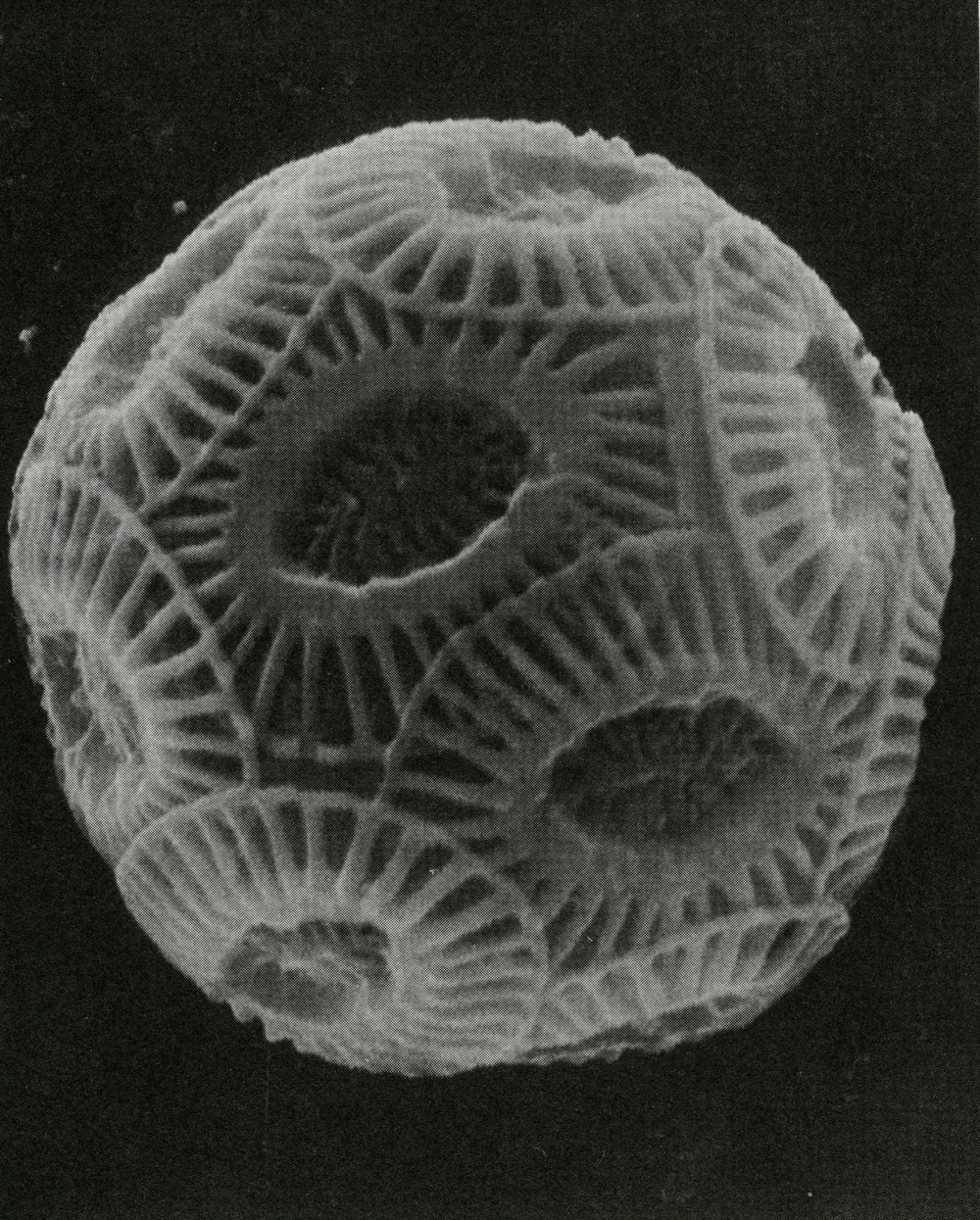
Emiliana huxleyii, known by her friends as Emily, is one of the more important members of the biota. Blooms of these phytoplankton cover large areas of ocean; their presence powerfully affects the environment through their capacity to facilitate the removal of carbon dioxide from the air and their production of dimethyl sulfide (which acts to nucleate clouds over the oceans). 1: Introductory
Of all the prizes that come from surviving more than fifty years the best is the freedom to be eccentric. What a joy to be able to explore the physical and mental bounds of existence in safety and comfort, without bothering whether I look or sound foolish. The young usually find the constraints of convention too heavy to escape, except as part of a cult. The middle-aged have no time to spare from the conservative business of living. Only the old can happily make fools of themselves. The idea that the Earth is alive is at the outer bounds of scientific credibility. I started to think and then to write about it in my early fifties. I was just old enough to be radical without the taint of senile delinquency. My contemporary and fellow villager, the novelist William Golding, suggested that anything alive deserves a name -- what better for a living planet than Gaia, the name the Greeks used for the Earth Goddess?
The concept that the Earth is actively maintained and regulated by life on the surface had its origins in the search for life on Mars. It all started one morning in the spring of 1961 when the postman brought a letter that was for me almost as full of promise and excitement as a first love letter. It was an invitation from NASA to be an experimenter on its first lunar instrument mission. The letter was from Abe Silverstein, director of the NASA space flight operations. I can still recall the joyous and lasting incredulity. Space is only a hundred miles away and is now a common place. But 1961 was only four years after the Soviet Union had launched the first artificial satellite, Sputnik. I listened to it bleeping its simple message that showed we could escape from Earth. Only six years earlier a distinguished astronomer said, when asked what he thought of the possibility of an artificial satellite, "Utter bunk." To receive an official invitation to join in the first exploration of the Moon was a legitimization and recognition of my private world of fantasy. My childhood reading had moved on that well-known path from Grimm's Fairy Tales through Alice's Adventures in Wonderland to Jules Verne and H. G. Wells. I had often said in jest that it was the task of scientists to reduce science fiction to practice. Someone had listened and called my bluff. My first encounter with the space science of NASA was to visit that open-plan cathedral of science and engineering, the Jet Propulsion Laboratory, just outside the suburb of Pasadena in California. Soon after I began work with NASA on the lunar probe, I was moved to the even more exciting job of designing sensitive instruments that would analyze the surfaces and atmospheres of the planets. My background, though, was biology and medicine, and I grew curious about the experiments to detect life on other planets. I expected to find biologists engaged in designing experiments and instruments as wonderful and exquisitely constructed as the spacecraft themselves. The reality was a disappointment that marked the end of my euphoria. I felt that their experiments had little chance of finding life on Mars, even if the planet were swarming with it. When a large organization is faced with a difficult problem the standard procedure is to hire some experts, and this is what NASA did. This approach is fine if you need to design a better rocket engine. But if the goal is to detect life on Mars, there are no such experts. There were no Professors of Life on Mars, so NASA had to settle for experts of life on Earth. These tended to be biologists familiar with the limited range of living things that they work with in their Earth-bound laboratories. There was no reason to suppose that such life forms would exist on Mars, even if life there were plentiful. From the beginning to the end, the Martian life-detection experiments had a marked air of unreality. Let me illustrate this with a fable. Dr. X, an eminent biologist, showed me his Martian life detector; a cubical cage of stainless steel, beautifully constructed, with sides about one centimeter long. When I asked him how it worked, he replied, "It's a flea trap. Fleas are attracted to the bait inside, hop in, and cannot escape." I then asked how he could be sure that there are fleas on Mars; his response was, "Mars is the greatest desert in the Solar System -- a planet full of desert. Wherever there are deserts there are camels, and there is no animal with as many fleas as a camel. On Mars my detector will not fail to find life." I think that the other scientists at the Jet Propulsion Laboratory tolerated me as a devil's advocate. They were under great pressure to get on with the job, and so had little time to think about what the job really was. They viewed my questions about Martian fleas with amused skepticism. I was sure that there was a better way. At that time Dian Hitchcock, a philosopher, visited the Jet Propulsion Laboratory, where she was employed by NASA to assess the logical consistency of the experiments. Together we decided that the most certain way to detect life on planets was to analyze their atmospheres. We published two papers suggesting that life on a planet would be obliged to use the atmosphere and oceans as conveyors of raw materials and depositories for the products of its metabolism. This would change the chemical composition of the atmosphere so as to render it recognizably different from the atmosphere of a lifeless planet. Even on Earth the Viking lander might have failed to find life had it landed on the antarctic ice. By contrast a full atmospheric analysis, which the Viking was not equipped to do, would have provided a clear answer; indeed, even in the 1960s, analyses of the Martian atmosphere were available from telescopes that used infrared instead of visible light to look at Mars. They revealed an atmosphere that was dominated by carbon dioxide and not far from the state of chemical equilibrium. The gases in the Earth's atmosphere, on the other hand, are in a persistent state of disequilibrium. This strongly suggested to us that Mars was lifeless. This conclusion was not popular with our NASA sponsors. They badly needed reasons to support the cost of a Mars expedition, and what goal could be more enticing than the discovery of life there? A certain Senator Proxmire, staunch guardian of the public purse, might have been interested to learn that NASA was pressing on with a Martian landing, at great expense, even when scientists within the organization had said there could be no life there to find. He might have been outraged had he discovered that as part of our research, supported by NASA funds, Hitchcock and I had turned an imaginary telescope on our own planet to show that the Earth bore life in abundance. During those exciting days we often argued about the life that might be on Mars and about the extent of its cover of the surface. In the late 1960s, NASA sent its Mariner spacecraft to view the surface from orbit around the planet. Their view showed Mars, like the Moon, to be extensively cratered, and tended to confirm the dismal prediction that Dian Hitchcock and I had made from a study of its atmospheric composition; that it was probably lifeless. I recall a gentle discussion with Carl Sagan, who thought it might still be possible that life existed in oases where local conditions would be more favorable. Long before Viking set course from Earth I felt intuitively that life could not exist on a planet sparsely; it could not hang on in a few oases, except at the beginning or at the end of its tenure. As Gaia theory developed, this intuition grew; now I view it as a fact. There was much argument about the need to sterilize the spacecraft before sending them to Mars. I could never understand why it should be thought so bad to run the small risk of accidentally seeding Mars with life; it might even be the only chance we had of passing life on to another planet. Sometimes the argument was fierce and macho; full of adolescent masculinity. In any event, feeling as I did -- that Mars was dead -- the image of rape, sometimes used, could not be sustained; at worst the act would be only the dismal lonely aberration of necrophilia. More seriously, as an instrument designer I knew that the act of sterilization made all but impossible the already superhuman task of building the Vikings and threatened the integrity of their exquisitely engineered internal homeostasis. To this day I appreciate the toleration and generosity of my colleagues at the Jet Propulsion Laboratory and in NASA, especially the personal kindness of Norman Horowitz, who was then head of the team of space biologists. In spite of the "bad news" I had brought, they continued to support my researches until the Viking missions to Mars were ready to go. The soft landing on Mars in 1975 of these two intricate and almost humanly intelligent robots was successful. Their mission was to find life on Mars, but the messages they returned as radio signals to the Earth returned only the chill news of its absence. Mars, except during day in the summer, was a place of pitiless frigidity, and implacably hostile to the warm wet life of Earth. The two Vikings now sit there brooding silently, no longer allowed to report the news from Mars, hunched against their final destruction by the wind with its burden of abrasive dust and corrosive acid. We have accepted the barrenness of the Solar System. The quest for life elsewhere is no longer an urgent scientific goal, but the confirmation by the Vikings of the utter sterility of Mars has hung as a dark contrasting backcloth for new models and images of the Earth. We now understand that our planet differs greatly from her two dead siblings, Mars and Venus. That, then, is how the Gaia hypothesis started. We looked at the Earth in our imagination, and therefore with fresh eyes, and found many things, including the radiation from the Earth of an infrared signal characteristic of the anomalous chemical composition of its atmosphere. This unceasing song of life is audible to anyone with a receiver, even from outside the Solar System. I will try to show in the chapters that follow that unless life takes charge of its planet, and occupies it extensively, the conditions of its tenancy are not met. Planetary life must be able to regulate its climate and chemical state. Part-time or incomplete occupancy or mere occasional visits will not be enough to overcome the ineluctable forces that drive the chemical and physical evolution of a planet. The imaginary exercise of seeding Mars with life, or even of bringing Mars to life, is discussed in chapter 8. It is about the effort needed to bring Mars to a state fit for life and to maintain it in that state until life has taken charge. It illustrates the awesome extent to which the greater part of our own environment on Earth is always perfect and comfortable for life. The energy of sunlight is so well shared that regulation is, effectively, free of charge. The Gaia hypothesis supposes the Earth to be alive, and considers what evidence there is for and against the supposition. I first put it before my fellow scientists in 1972 as a note with the title "Gaia as Seen Through the Atmosphere." It was brief, taking only one page of the journal Atmospheric Environment. The evidence was mostly drawn from the atmospheric composition of the Earth and its state of chemical disequilibrium. This evidence is reviewed in table 1.1 in comparison with modern knowledge of the compositions of the atmospheres of Mars and Venus, and with a guess at the atmosphere the Earth might have now, had it never known life. After long and intense discussions, Lynn Margulis and I produced more detailed yet concise statements in the journals Tellus and Icarus. Then in 1979, Oxford University Press published my book Gaia: A New Look at Life on Earth, which collected all our ideas up to that point. I began to write that book in 1976, when NASA's Viking spacecraft were about to land on Mars. I used their presence there as planetary explorers to set the scene for the discovery of Gaia, the largest living organism in the Solar System.
Ten years on and it is time to write again; this time about getting to know Gaia and discovering what kind of life she is. The simplest way to explore Gaia is on foot. How else can you so easily be part of her ambience? How else can you reach out to her with all your senses? I was delighted a few years ago, therefore, to read of another man who enjoyed walking in the countryside and who also believed the Earth to be alive. Yevgraf Maksimovich Korolenko lived over 100 years ago in Kharkov in the Ukraine. He was an independent scientist and philosopher. He too was in his sixties when he began to express and discuss ideas far too radical for the merely middle-aged. Korolenko was a learned man; although self-educated, he was familiar with the works of the great natural scientists of his time. He did not recognize any authority, philosophical, religious, or scientific, but tried to discover answers for himself. One of those with whom he shared his country walks and his radical ideas was his young cousin, Vladimir Vernadsky. Vernadsky, who was to become an outstanding Soviet scientist, was deeply impressed by the old man's assertion that "The Earth is an organism." But to Vernadsky's biographer, R. K. Balandin, this "is another of Korolenko's aphorisms. It is doubtful that young Vladimir Vernadsky should have remembered this aphorism half a century later. Nevertheless, Korolenko's naive analogy of the Earth as a living organism could not but excite the imagination of his young friend." The idea that the Earth is alive is probably as old as humankind. But the first public expression of it as a fact of science was by a Scottish scientist, James Hutton. In 1785 he said, at a meeting of the Royal Society of Edinburgh, that the Earth was a superorganism and that its proper study should be physiology. He went on to compare the cycling of the nutritious elements in the soil, and the movement of water from the oceans to the land, with the circulation of the blood. James Hutton is rightly remembered as the father of geology, but his idea of a living Earth was forgotten, or denied, in the intense reductionism of the nineteenth century -- except in the minds of isolated philosophers like Korolenko. Today, we all use the word "biosphere" rarely recognizing that it was Eduard Suess who in 1875 first used the term, in passing, when describing his work on the geological structure of the Alps. Vernadsky developed the concept, and from 1911 used its modern meaning. Vernadsky said: "The biosphere is the envelope of life, i.e. the area of living matter ... the biosphere can be regarded as the area of the Earth's crust occupied by transformers which convert cosmic radiations into effective terrestrial energy: electrical, chemical, mechanical, thermal, etc." When I first formulated the Gaia hypothesis, I was entirely ignorant of the related ideas of these earlier scientists, especially Hutton, Korolenko, and Vernadsky. I was also unaware of similar ideas expressed in recent years by many scientists, such as Alfred Lotka, the founder of population biology, Arthur Redfield, an ocean chemist, and J. Z. Young, a biologist. I acknowledged only the inspiration of G. E. Hutchinson, a distinguished limnologist at Yale University, and of Lars Sillen, a Swedish geochemist. But I was not alone in this ignorance; in the vigorous objections to or support for Gaia made by colleagues in all sciences, none observed that what was said followed naturally from Vernadsky's view of the world. Even as late as 1983, the monumental Earth's Earliest Biosphere, edited by geologist J. W. Schopf and including contributions from twenty of the most distinguished American and European Earth scientists, made no mention of either Hutton or Vernadsky. The all-too-common deafness of English speakers to any other language kept from our common knowledge the everyday science of the Russian-speaking world. It would be easy to attribute the lack of recognition of Vernadsky's contributions to the present political divisions, but, although this may play some part, I think that it is a small one compared with the malign effects of the nineteenth-century separation of science into neat compartments where specialists and experts could ply their professions in complacency. How many physicists are proud of their ignorance of what they call the "soft sciences"? How many biochemists can name the wildflowers of their countryside? In such a climate of opinion it is not surprising that Vernadsky' s biographer found Korolenko's statement, "The Earth is a living organism," to be naive. Most scientists today would agree with Balandin; yet few of them would be able to offer a satisfactory definition of life as an entity or a process. In science, a hypothesis is really no more than a "let's suppose." The first Gaia book was hypothetical, and lightly written -- a rough pencil sketch that tried to catch a view of the Earth seen from a different perspective. Thoughtful criticisms of this first book led to new and deeper insights into Gaia. In a physiological sense the Earth was alive. Much new evidence has accumulated, and I have made new theoretical models. We can now fill in some of the finer details, though fortunately there seems little need to erase the original lines. As a consequence this second book is a statement of Gaia theory; the basis of a new and unified view of the Earth and life sciences. Because Gaia was seen from outside as a physiological system, I have called the science of Gaia geophysiology. Why run the Earth and life sciences together? I would ask, why have they been torn apart by the ruthless dissection of science into separate and blinkered disciplines? Geologists have tried to persuade us that the Earth is just a ball of rock, moistened by the oceans; that nothing but a tenuous film of air excludes the hard vacuum of space; and that life is merely an accident, a quiet passenger that happens to have hitched a ride on this rock ball in its journey through space and time. Biologists have been no better. They have asserted that living organisms are so adaptable that they have been fit for any material changes that have occurred during the Earth's history. But suppose that the Earth is alive. Then the evolution of the organisms and the evolution of the rocks need no longer be regarded as separate sciences to be studied in separate buildings of the university. Instead, a single evolutionary science describes the history of the whole planet. The evolution of the species and the evolution of their environment are tightly coupled together as a single and inseparable process. Science is not obsessively concerned with whether facts are right or wrong. The practice of science is that of testing guesses; forever iterating around and towards the unattainable absolute of truth. To scientists, Gaia is a new guess that is up for trial or a novel "bioscope" through which to look at life on Earth. In some sciences, Gaian ideas are appropriate, even if not welcomed, because the vision of the world through older theories is no longer sharp and clear. This is particularly true of theoretical ecology, evolutionary biology, and the Earth sciences generally. Theoretical ecologists for forty years -- since Alfred Lotka and Vito Volterra made their simple models of a world populated only by rabbits and foxes -- have tried to understand the complex interactions between a real forest and its vast range of species. Their mathematical models, though good at simulating pathologies, fail to explain the long-term stability of the complex ecosystems of the humid tropical forests. Their models seem counterintuitive; they suggest that the fragility of ecosystems increases with their diversity. They imply that the farmer who rotates his crops and keeps his hedgerows and woodland intact is not only less efficient but less ecologically stable than the monoculture factory farm. In recent times, the evolutionary biologists have engaged in a fiery argument. The normally placid pages of those cool scientific journals, Nature and Science, have burnt like an inner city, the conservative defenders of ordered gradual change reacting against a revolution for the right to interpret Darwin's great insight. Was evolution gradual or did it proceed, as Stephen Jay Gould and Niles Eldredge propose, with long periods of stasis punctuated by catastrophic change? Geologists interested in the evolution of the rocks, ocean, and atmosphere are beginning to ponder about the persistence of the oceans on Earth when Mars and Venus are so dry. Then there is the puzzling constancy of the climate, in spite of an ever-increasing output of heat from the Sun. These and other things that seem obscure within their separated fields of science become clear when seen as phenomena of a living planet. Gaia theory predicts that the climate and chemical composition of the Earth are kept in homeostasis for long periods until some internal contradiction or external force causes a jump to a new stable state. On such a living planet, we shall see that punctuated evolution and abundant oceans are normal and expected. As a theory of a living Earth, this book is neither holistic nor reductionist. There are no sections on climatology, geochemistry, and so on. The next two chapters are a statement of Gaia theory. Then follow three chapters which give a geophysiologist's view of the history of the Earth from the start of life to the present day. These run chronologically, instead of chaotically by scientific discipline. The sequence starts with the beginning of life, the Archean, when the only organisms on Earth were bacteria, and when the atmosphere was dominated by methane and oxygen was only a trace gas. Next that middle age, which the geologists call the Proterozoic, from the first appearance of oxygen as a dominant atmospheric gas until the time when communities of cells gathered to form new collectives, each with its own identity. Then a chapter on the Phanerozoic, the time of the plants and animals. In each, the record of the rocks is interpreted through Gaia theory and the new interpretation compared with the conventional wisdom of the Earth and life sciences. The final chapters concern the present and future of Gaia, with an emphasis on the human presence both on Earth and as it may one day exist on Mars. What would it take to bring Mars to life? The arbitrariness of even a chronological division is underlined by the persistence of the Archean biota; their world has never ended, but lives on in our guts. Those bacteria have been with Gaia for nearly four thousand million years, and they still live all over the Earth in muds, sediments, and intestines -- wherever they can keep away from that deadly poison, oxygen. Any new theory about the Earth cannot be kept a secret of science. It is bound to attract the attention of humanists, environmentalists, and those of religious beliefs and faiths. Gaia theory is as out of tune with the broader humanist world as it is with established science. In Gaia we are just another species, neither the owners nor the stewards of this planet. Our future depends much more upon a right relationship with Gaia than with the never-ending drama of human interest. When our family lived in the village of Bowerchalke in Wiltshire, Helen and I would spend spring mornings seeking rare species of wild orchids. In those days, before its destruction by the machines of agribusiness vandals, the English countryside was a heavenly garden. Orchids grew in profusion on the downs, but the rarer kinds could be exceedingly hard to find. Much prior programming of the mind was needed to spot a musk orchid in the grass. It was an esoteric pastime. Much of science is done like this, and it can be enjoyable to discover new compounds or mathematical concepts or old ones in strange places. But these discoveries usually require rigorous mental and physical preparation and often the learning of a new language. Gaia theory goes back to fundamentals, to genesis. Even geophysiology is too young a science to have a language. Therefore this second book is written like the first, so that anyone interested in the idea that the Earth is alive can read it. Neither a scientific text nor the workshop manual for a planetary engineer, it is one man's view of the world where we belong. Most of all the book is for entertainment, yours and mine. It was written as part of a way of life that included time to go for walks in the country and to talk with friends, as Korolenko did, about the Earth being alive.
|
|||||||||||||||||||||