|
Chapter 8: The
Buildup: July, 1965 - September, 1966
Highlights of
the Period: July, 1965-September, 1966
The U.S. military
effort in Vietnam, according to the Pentagon
study, continued to intensify-both on the ground and in the air
throughout
1965 and well into 1966, despite continuing evidence
that this escalation was bringing "an acceptable outcome" no closer
to realization.
Here, in chronological order, are highlights of this period:
JULY 1965
John T. McNaughton, Assistant Secretary of Defense, defined
"win" for the U.S. as "demonstrating to the VC that they cannot
win."
Secretary of Defense Robert S. McNamara was assured by a special
study group headed by Gen. Earle G. Wheeler, Chairman of the
Joint Chiefs, that "there appears to be no reason why we cannot win
if such is our will." He approved the request for 100,000 more U.S.
troops by Gen. William S. Westmoreland, the U.S. military commander
in Vietnam.
Mr. McNamara, in a memo to the President, said he thought Gen.
Westmoreland's three-phase strategy plan "stands a good chance" of
success; he noted that casualties would increase and suggested that
U.S. "killed-in-action might be in the vicinity of 500 a month by the
end of the year ... "
The Pentagon study notes that U.S. strategy "did not take escalatory
reactions into account."
NOVEMBER 1965
General Westmoreland asked for 154,000 more men; this would
have brought the total number of U.S. troops in Vietnam to 375,000,
the study says. General Westmoreland explained to Adm. U. S.
Grant Sharp, the U.S. commander in the Pacific, that the Vietcong-
North Vietnamese rate of troop buildup was expected to be "double
that of U.S."
Mr. McNamara, in a memo to the President, recommended that
the U.S. supply a total of nearly 400,000 men by the end of 1966,
and added that this "will not guarantee success."
DECEMBER 1965
General Westmoreland requested a total of 443,000 troops by the
end of 1966. The air war was continuing at the rate of 1,500 sorties
weekly.
JANUARY 1966
General Westmoreland increased his troop request to 459,000.
A McNamara memorandum conceded that the air war "has not
successfully interdicted infiltration." A second memo warned, "We
470
are in an escalating military stalemate." It included coalition,
neutralist
"or even anti-U.S." governments as among outcomes U.S.
should be able to accept. But it still urged more troops and bombing.
MARCH 1966
Secretary McNamara, after months of pressure from the Joint
Chiefs, recommended that the U.S. bomb the petroleum, oil and
lubricant supplies in North Vietnam. Admiral Sharp had predicted
this would "bring the enemy to the conference table or cause the
insurgency to wither."
APRIL 1966
Several White House policy meetings were held to consider Vietnam
options. George W Ball, Under Secretary of State, urged "cutting
our losses," conceding that there were "no really attractive
options open to us."
MAY 1966
The President decided to order the P.O.L. air strikes. The C.I.A.
estimated that this would not halt "infiltration of men and supplies."
JUNE 1966
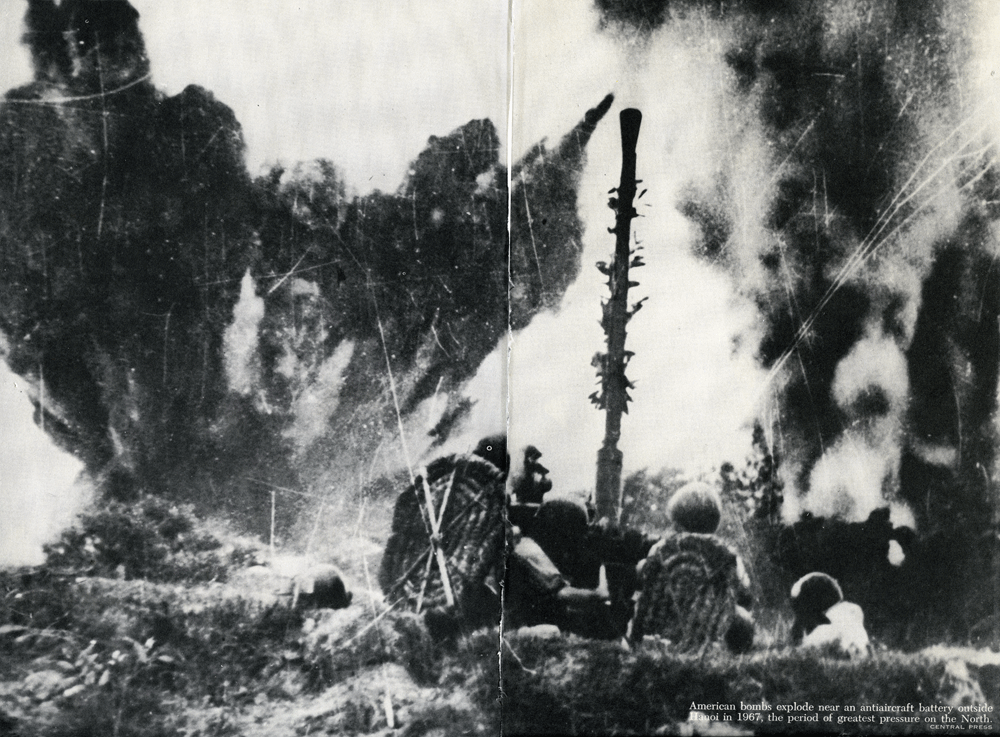
The P.O.L. air strikes started, hitting storage sites in the Hanoi and
Haiphong areas.
JULY 1966
By the end of the month, the Defense Intelligence Agency estimated,
70 per cent of North Vietnam's original storage capacity had
been destroyed.
AUGUST 1966
The major storage sites were destroyed; the study calls the flow of
men and materiel to the South "undiminished" and notes North
Vietnam's "adaptability and resourcefulness" in switching to small,
dispersed sites that were almost impossible to bomb.
The Joint Chiefs passed on to Mr. McNamara a new ground-troop
request from General Westmoreland: a total of 542,588 for 1967.
SEPTEMBER 1966
A report to Secretary McNamara said that Operation Rolling
Thunder "had no measurable direct effect" on Hanoi's capability.
The study group recommended building an electronic barrier
across the Vietnam demilitarized zone.
471
Chapter 8
The Buildup: July, 1965-
September, 1966
-BY Fox BUTTERFIELD
The Pentagon's secret study of the Vietnam war indicates
that the rapid expansion of American forces in 1965 and 1966
occurred because "no one really foresaw what the troop needs
in Vietnam would be" and because the ability of the enemy
forces "to build up their effort was consistently underrated."
"It would seem," the study asserts, that the American planners
would have been "very sensitive to rates of infiltration
and recruitment by the [Vietcong and North Vietnamese
Army]; but very little analysis was, in fact, given to the implications
of the capabilities of the VC/VNA in this regard."
As a result of the unanticipated enemy build-up, the Pentagon
study discloses, Gen. William C. Westmoreland's troop
requests jumped from a total of 175,000 men in June, 1965,
to 275,000 that July, to 443,000 in December and then to
542,000 the following June. Neither the requests of the American
commander in Vietnam nor President Lyndon B. Johnson's
rapid approval of all but the last of them was made
public.
At the same time, the study says, the Johnson Administration's
continual expansion of the air war during 1965 and
1966 was based on a "colossal misjudgment" about the bombing's
effect on Hanoi's will and capabilities.
In particular, the study discloses that the Administration's
decision in 1966 to bomb North Vietnam's oil-storage facilities
was made despite repeated warning from the Central Intelligence
Agency that such action would not "cripple Communist
military operations." Instead the study says, Washington apparently
accepted the military's estimate that the bombing
472
would "bring the enemy to the conference table or cause the
insurgency to wither from lack of support." But the flow of
men and supplies to the South continued "undiminished."
The Pentagon study of this period of escalation in the air
and on the ground also makes these disclosures:
• American military commanders were confident of victory.
General Westmoreland, for example, told Washington in July,
1965, that by using his search-and-destroy strategy he could
defeat the enemy "by the end of 1967." And the same month,
the Joint Chiefs of Staff assured Secretary of Defense Robert
S. McNamara that "there is no reason we cannot win if such
is our will."
• High-level civilian authorities, including Secretary McNamara,
began to have serious doubts about the effectiveness of
both the air and ground war as early as the fall of 1965, but
they continued to recommend escalation as the only acceptable
policy, despite their doubts.
• A secret Defense Department seminar of 47 scientists-
"the cream of the scholarly community in technical fields"-
concluded in the summer of 1966 that the bombing of North
Vietnam had had "no measurable effect" on Hanoi. The scientists
recommended building an electronic barrier between
North and South Vietnam as an alternative to the bombing.
[See Document # 117.]
The Pentagon account of this period of the war-from
July, 1965, to the fall of 1966--forms another section in the
series presented by The New York Times.
The study, ordered by Secretary McNamara in 1967 and
prepared by a team of 30 to 40 officials and analysts to determine
how the United States became involved in the war in
Indochina, consists of 3,000 pages of analysis and 4,000 pages
of supporting documents.
Open-Ended Strategy
When President Johnson decided in July, 1965, to accept
General Westmoreland's request for 44 combat battalions and
to endorse his search-and-destroy strategy, he "left the U.S.
commitment to Vietnam open-ended," the study declares.
"Force levels for the search-and-destroy strategy had no
empirical limits," it adds. "The amount of force required to
473
defeat the enemy depended entirely on his response to the
build-up and his willingness to continue the fight."
"The basic idea" underlying the search-and-destroy strategy,
the study says, "was the desire to take the war to the enemy,
denying him freedom of movement anywhere in the country
. . . and deal him the heaviest possible blows." This concept
replaced the static-defense and enclave strategies, which called
for fewer American troops, and which had been tried briefly
in the spring of 1965.
General Westmoreland intended his original allotment of
44 battalions to be only a stopgap measure, the account says.
They would be used to blunt the enemy offensive that threatened
to overwhelm the fragile Saigon Government, but more
men would quickly be needed if the allies were to win.
To find out how much "additional force was required to
seize the initiative from the enemy and to commence the win
phase of the strategy," Secretary McNamara flew to Saigon
on July 16, 1965, for a four-day visit. While he was there he
received a cablegram notifying him that President Johnson
had approved General Westmoreland's request for 44 battalions
and the use of his search-and-destroy strategy.
According to the study, General Westmoreland then reported
that he needed 24 additional American battalions, or
100,000 men, for the "win phase," which would begin in
1966.
He also outlined, as quoted in the study, his over-all
strategy, based on a three-phase build-up:
"Phase I-The commitment of U.S./F.W.M.A. [United
States/ Free World Military Assistance] forces necessary to
halt the losing trend by the end of 1965.
"Phase II-The resumption of the offensive by U.S.!
F.W.M.A. forces during the first half of 1966 in high-priority
areas necessary to destroy enemy forces, and reinstitution of
rural-construction activities.
"Phase III-If the enemy persisted, a period of a year to a
year and a half following Phase II would be required for the
defeat and destruction of the remaining enemy forces and
base areas.
"Withdrawal of U.S./F.W.M.A. forces would commence
following Phase III as the GVN [Government of Vietnam]
became able to establish and maintain internal order and to
defend its borders."
According to the Pentagon study, General Westmoreland's
plan shows that "with enough force to seize the initiative
from the VC sometime in 1966, General Westmoreland expected to take the
offensive and, with appropriate additional
reinforcements, to have defeated the enemy by the end of
1967."
Secretary McNamara was seriously concerned, the Pentagon
account says, about whether the United States could
"win" in Vietnam. He was worried lest the United States "become
involved more deeply in a war which could not be
brought to a satisfactory conclusion."
Thus while he was preparing for his July 16 trip to Saigon,
the Secretary asked Gen. Earle G. Wheeler, Chairman of the
Joint Chiefs of Staff, for an assessment of "the assurance the
U.S. can have of winning in South Vietnam if we do everything
we can."
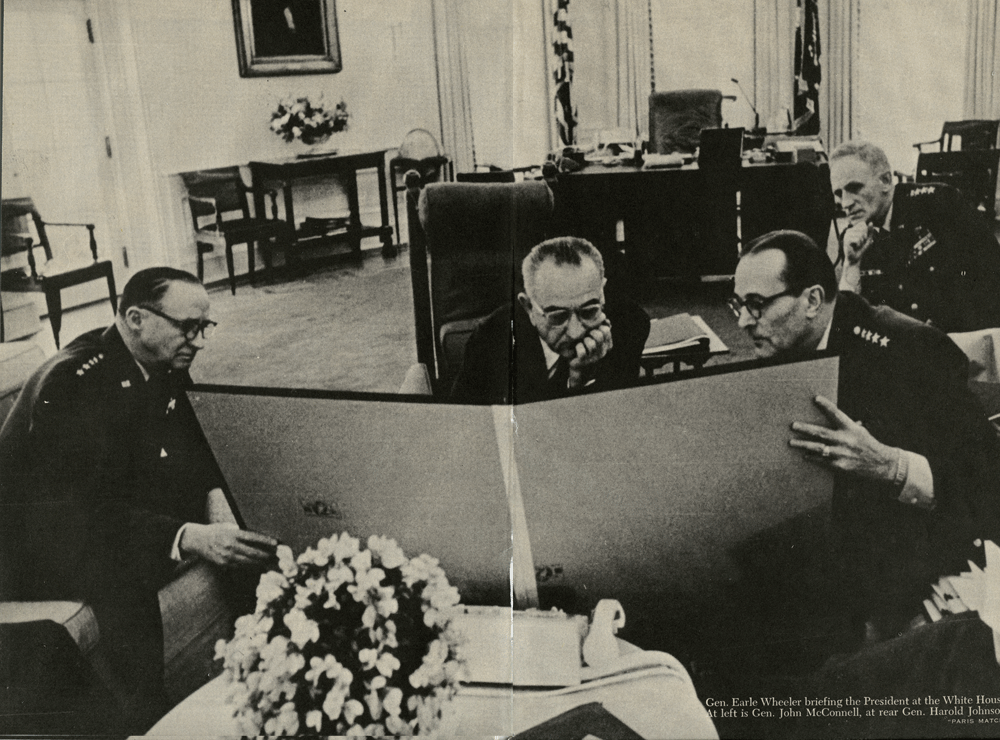
General Wheeler's answer, prepared by a study group of
officers and civilians in the Defense Department, was: "Within
the bounds of reasonable assumptions-there appears to
be no reason we cannot win if such is our will-and if that
will is manifested in strategy and tactical operations."
According to a memorandum to the study group from Assistant
Secretary of Defense John T. McNaughton, on the
working definition of "win," it "means that we succeed in
demonstrating to the VC that they cannot win."
This definition, the Pentagon analyst writes, "indicates the
assumption upon which the conduct of the war was to rest -- that
the VC could be convinced in some meaningful sense that
they were not going to win and that they would then rationally
choose less violent methods of seeking their goals."
Secretary McNamara got this assurance, the study goes
on, and, armed with it, he recommended on his return from
Saigon on July 20 that President Johnson meet General
Westmoreland's request for 100,000 additional troops.
"The over-all evaluation," Secretary McNamara wrote
the President, "is that the course of action recommended in
this memorandum stands a good chance of achieving an
acceptable outcome within a reasonable time in Vietnam."
"U.S. and South Vietnamese casualties will increase, just
how much cannot be predicted with confidence," the Secretary
added, "but the U.S. killed-in-action might be in the vicinity
of 500 a month by the end of the year .... United States
public opinion will support the course of action because it is
a sensible and courageous military-political program designed
and likely to bring about a success in Vietnam."
The Pentagon account declares: "Never again while he was
Secretary of Defense would McNamara make so optimistic a
statement about Vietnam-except in public."
475
By November, 1965, the situation in South Vietnam had
undergone important changes, the study says.
The Phase I deployment of American troops, which was
now nearing its 175,000-man goal, had apparently stopped
deterioration in the military situation.
But at the same time, the narrative relates, the enemy had
unexpectedly built up strength much faster than the American
command had foreseen.
Where there were estimated to be 48,550 Communist combat
troops in South Vietnam in July, 1965, American intelligence
officials believed by that November that there were
63,550. And the number of North Vietnamese regiments had
increased during these months from one to eight, according
to the intelligence officials.
"The implications of the build-up were made abundantly
clear by the bloody fighting in the ladrang Valley in mid-
November," the study says. In this first big battle of the
Vietnam war, units of the United States First Cavalry Division
fought numerically superior North Vietnamese forces for
several weeks in the western part of the Central Highlands,
along the Cambodian border. More than 1,200 of the enemy
were reportedly killed in the fighting, which also left more
than 200 Americans dead.
The Pentagon study says that the carefully calculated
American strategy, with its plans for the number of American
troops required to win, "did not take escalatory reactions
into account."
While the study does not deal with this subject at length,
the public record shows that the Johnson Administration had
repeatedly said during early 1965 that North Vietnam was
infiltrating large quantities of men and supplies into the
South.
In February, for example, the State Department published
a white paper entitled "Aggression From the North," asserting
that North Vietnam was responsible for the war in South
Vietnam and that Hanoi had infiltrated more than 37,000 men.
The public record also shows that Secretary McNamara
devoted a major part of a televised news conference on April
26, 1965, to a charge that North Vietnamese had stepped
up their infiltration. "The intensification of infiltration," Mr.
McNamara said, "has grown progressively more flagrant and
more unconstrained."
Despite these frequent public statements about the build-up,
in November, the Pentagon account says, General Westmoreland
suddenly found it necessary to request a vast increase in
476
troops for the Phase II part of his plan. The general said he
would need 154,000 more men.
As the general explained his needs to Adm. U. S. Grant
Sharp, commander of American forces in the Pacific, who
was his immediate superior:
"The VC/PA VN build-up rate is predicated to be double
that of U.S. Phase II forces. Whereas we will add an average
of 7 maneuver battalions per quarter the enemy will add 15.
This development has already reduced the November battalion-
equivalent ratio from an anticipated 3.2 to 1, to 2.8 to 1,
and it will be further reduced to 2.5 to 1 by the end of the
year."
In response to General Westmoreland's request for 154,000
men, Secretary McNamara detoured on his way from a Paris
meeting of the North Atlantic Treaty Organization and flew
to Saigon.
On his return to Washington on Nov. 30, Secretary McNamara wrote a
memorandum to President Johnson in which
he began to reveal doubts about the ground war. While recommending
that the United States send a total of nearly 400,000
men to Vietnam by the end of 1966, the next year, he
warned:
"We should be aware that deployments of the kind I have
recommended will not guarantee success. U.S. killed-in-action
can be expected to reach 1,000 a month, and the odds are even
that we will be faced in early 1967 with a 'no decision' at an
even higher level. My over-all evaluation, nevertheless, is
that the best chance of achieving our stated objectives lies
in ... the deployments mentioned above." [See Document
#107.1
While Secretary McNamara and President Johnson were
considering troop increases up to nearly 400,000 men-the
number of Americans in South Vietnam was then 184,000-
news accounts were speculating that the troop ceiling might
go as high as 200,000. This was the figure used, for example,
in The New York Times's dispatch on Mr. McNamara's visit
to Saigon on Nov. 28.
The Pentagon study does not say what decision President
Johnson reached on Mr. McNamara's Nov. 30 recommendation.
But the analyst does say that on Dec. 13, in another
memorandum, Mr. McNamara outlined for the President an
approved troop deployment of 367,000 men for 1966 and
395,000 men for June 1967.
Then on Dec. 16, the study reveals, Secretary McNamara
received another request from General Westmoreland, raising
477
to 443,000 men the total he needed by the end of 1966. And
on Jan. 28 the Secretary received a new request, this time
increasing the total to 459,000 men.
Neither General Westmoreland's requests nor President
Johnson's approvals were made public. At a news conference
on Feb. 26, 1966, the President said, "We do not have on my
desk at the moment any unfilled requests from General
Westmoreland." There were 235,000 American soldiers in
South Vietnam at the time.
The Pentagon narrative suggests two possible interpretations
for the rapid ballooning of the number of troops required:
"It can be hypothesized, that from the outset of the American
build-up, some military men felt that winning a meaningful
victory in Vietnam would require something on the order
of one million men.
"Knowing that this would be unacceptable politically, it
may have seemed a better bargaining strategy to ask for increased
deployments incrementally.
"An alternative explanation is that no one really foresaw
what the troop needs in Vietnam would be and that the ability
of the D.R.V./VC to build up their effort was consistently
underrated.
"This explanation seems, with some exceptions, to be
reasonable. The documents from the period around July 1965
seem to indicate that [General Westmoreland] had not given
much thought to what he was going to do in the year or
years after 1965."
Citing a document of General Westmoreland's Military Assistance
Command in Vietnam, the study goes on: "The words
of the MACV history of 1965 indicate something of this.
'The President's July 28 announcement that the U.S. would
commit additional massive military forces in SVN necessitated
an overall plan clarifying the missions and deployment of the
various components. [The general's] concept of operations was
prepared to fulfill this need.'''
"If this is a true reflection of what happened," the analyst
says, "it would indicate the MACV's plan of what to do was
derived from what would be available rather than the requirement
for manpower being derived from any clearly thought
out military plan."
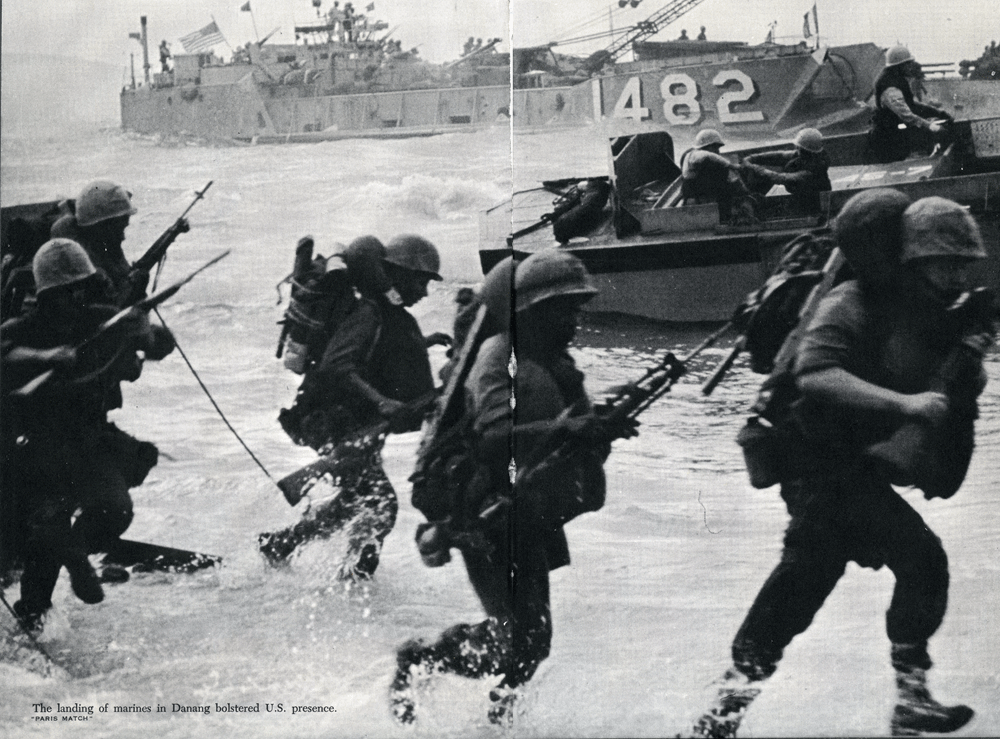
In April, 1965, when President Johnson secretly changed
the mission of the Marines at Danang from defense to offense
and thus committed the United States to the ground war
in Vietnam, the sustained bombing of North Vietnam was
478
relegated to a secondary role, the Pentagon study declares.
Discussing this bombing campaign, known as Operation
Rolling Thunder, the study adds:
"Earlier expectations that bombing would constitute the
primary means for the U.S. to turn the tide of the war had
been overtaken by the President's decision to send in substantial
U.S. ground forces. With this decision the main hope
had shifted from inflicting pain in the North to' proving, in
the South, that NVN could not win a military victory there.
Rolling Thunder was counted as useful and necessary, but in
the prevailing view it was a supplement and not a substitute
for efforts within SVN."
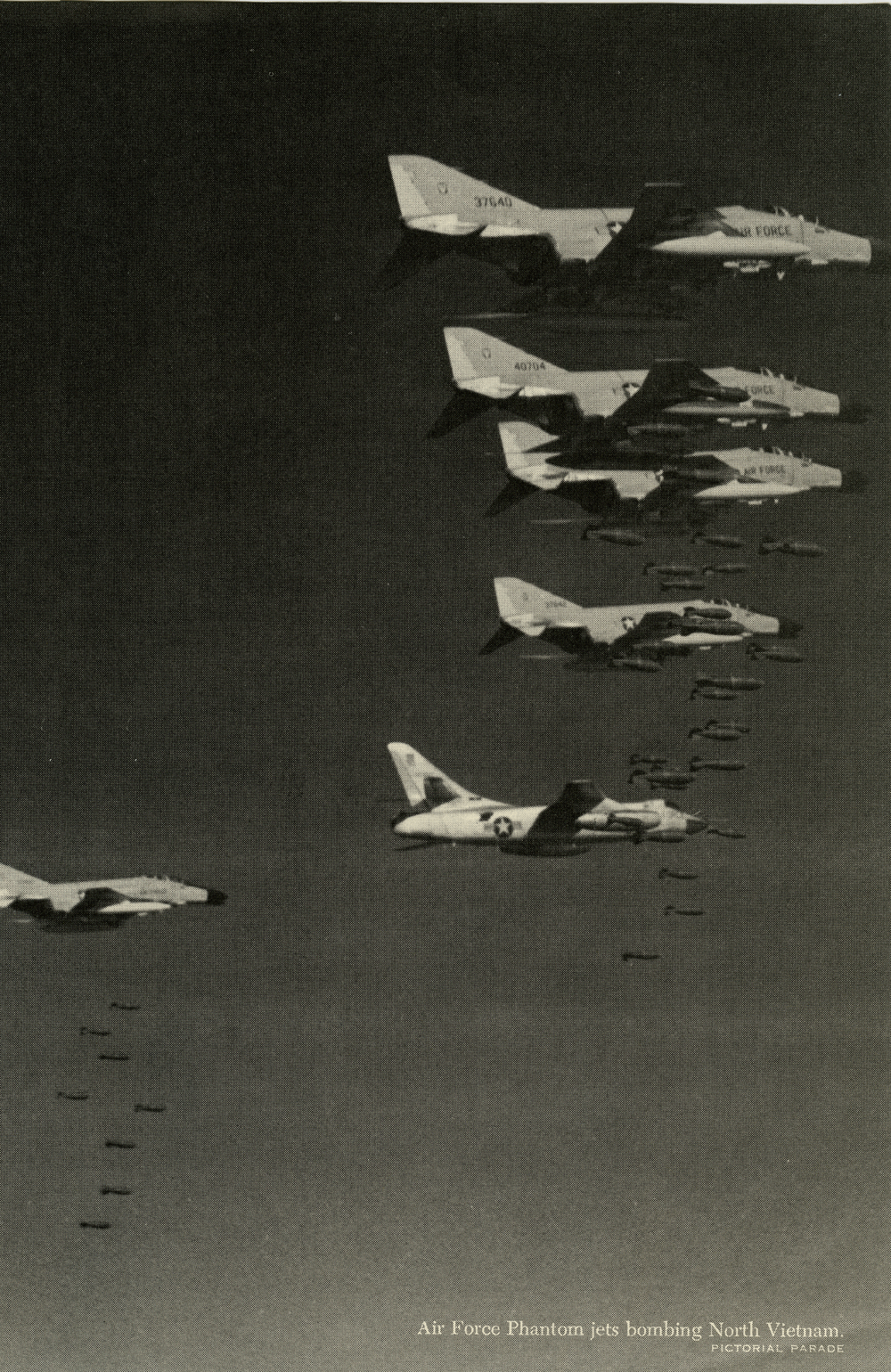
By the summer of 1965, Operation Rolling Thunder's scope
and pattern of operation had also been determined, the narrative
relates.
To emphasize American power, it goes on, the bombing of
the North would proceed "in a slow, steady, deliberate manner,
beginning with a few infiltration-associated targets in
southern NVN and gradually moving northward with progressively
more severe attacks on a wider variety of targets."
Because Operation Rolling Thunder was considered "comparatively
risky and politically sensitive," all bombing strikes
were carefully selected in Washington. Targets were chosen in
weekly packages, the study says, and each target package
"had to pass through a chain of approvals which included
senior levels of O.S.D. [Office of the Secretary of Defense],
the Department of State and the White House."
Attacks were also permitted against certain broad categories
of targets, such as vehicles, locomotives and barges, which
were defined in Washington. In this type of attack, known
as armed reconnaissance, the final selection of a specific
target was left to the pilot.
The number of sorties-individual flights by individual
planes-was gradually increased, the account relates, from
900 a week during July to' 1,500 a week in December, 1965.
By the end of the year 55,000 sorties had been flown, nearly
three-fourths of them on armed reconnaissance.
While the list of targets was also lengthened, Secretary McNamara
continued to' keep the Hanoi-Haiphong area and the
Chinese border area off limits through the end of 1965.
The study reports that the original purpose of Rolling
Thunder, "to break the will of North Vietnam," was changed
during the summer of 1965 to cutting the flow of men and
supplies from the North to the South.
This change in the Government's internal rationale, the
479
analyst writes, brought it in line with the publicly expressed
rationale, which had always been an infiltration cutoff.
The rationale was changed, the study declares, because it
was recognized that "as a venture in strategic persuasion the
bombing had not worked."
In fact, intelligence estimates commissioned by Secretary
McNamara showed that by the end of 1965 the bombing had
had little effect on North Vietnam.
In November, 1965, the Defense Intelligence Agency told
Mr. McNamara that while the "cumulative strains" resulting
from the bombing had "reduced industrial performance" in
North Vietnam, "the primarily rural nature of the area permits
continued functioning of the subsistence economy."
And, the agency's estimate continued, "The air strikes do
not appear to have altered Hanoi's determination to continue
supporting the war in South Vietnam."
In the analyst's view, "The idea that destroying, or threatening
to destroy, North Vietnam's industry would pressure
Hanoi into calling it quits, seems, in retrospect, a colossal
misjudgment."
The analyst continues:
"NVN was an extremely poor target for air attack. The
theory of either strategic or interdiction bombing assumed
highly developed industrial nations producing large quantities
of military goods to sustain mass armies engaged in intensive
warfare. NVN, as U.S. intelligence agencies knew, was an
agricultural country with a rudimentary transportation system
and little industry of any kind.
"What intelligence agencies liked to call the 'modern industrial
sector' of the economy was tiny even by Asian standards,
producing only about 12 per cent of the G.N.P. of $1.6-
billion in 1965. There were only a handful of 'major industrial
facilities.' When NVN was first targeted, the J.C.S. found only
eight industrial installations worth listing."
"NVN's limited industry made little contribution to its
military capabilities," the account continues. "The great bulk
of its military equipment, and all of the heavier and more
sophisticated items, had to be imported. This was no particular
problem, since both the U.S.S.R. and China were apparently
more than glad to help.
"The NVN transportation system was austere and superficially
looked very vulnerable to air attack, but it was inherently
flexible and its capacity greatly exceeded the demands
placed upon it.
"Supporting the war in the south was hardly a great strain
on NVN's economy. The NV A/VC forces there did not
480
constitute a large army. They did not fight as conventional division
or field armies, with tanks and airplanes and field
artillery; they did not need to be supplied by huge convoys of
trucks, trains or ships. They fought and moved on foot,
supplying themselves locally, in the main, and simply avoiding
combat when supplies were low."
A Pause as Pressure
An important element in Secretary McNamara's program
of pressure against North Vietnam, the study says, was a
pause in the bombing. On July 20, 1965, Mr. McNamara
wrote in a memorandum to the President:
"After the 44 U.S.-third-country battalions have been deployed
and after some strong action has been taken in the
program of bombing in the North, we could, as part of a
diplomatic initiative, consider introducing a 6-8 week pause
in the program of bombing the North."
He apparently felt, the Pentagon study says, that the previous
pause-May 8 to May 13, 1965-had been too short
and too hastily arranged to be effective. Hanoi was simply
not given enough time to reply during the May pause, the
study says. It also relates that President Johnson had viewed
the pause "as a means of clearing the way for an increase in
the tempo of the air war in the absence of a satisfactory response
from Hanoi."
The Secretary of Defense repeated his proposal for a bombing
pause several times during the fall of 1965, the account
goes on. As he and Assistant Secretary of Defense McNaughton
envisioned it, the pause would be used as a kind of
"ratchet,"-which the analyst likens to "the device which
raises the net on a tennis court, backing off tension between
each phase of increasing it."
All the high officials who debated the pause in bombing
assumed that it would be temporary, the study declares.
"Throughout this discussion it was taken for granted that
bombing would be resumed."
The officials, known in government circles as the "Vietnam
principals," believed the bombing would be resumed, the
narrative adds, because they knew that the conditions they
had set for a permanent halt were tougher than Hanoi could
accept.
481
In a confidential memorandum on Dec. 3, apparently intended
only for Mr. McNamara, Assistant Secretary Mc-
Naughton outlined the conditions the United States should
insist upon for a permanent halt:
"A. The D.R.V. stops infiltration and direction of the war.
"B. The D.R.V. moves convincingly toward withdrawal
of infiltrators.
"C. The VC stops attacks, terror and sabotage.
"D. The VC stop significant interference with the GVN's
exercise of governmental functions over substantially all of
South Vietnam."
After noting these conditions, Mr. McNaughton wrote that
they amounted to "capitulation by a Communist force that
is far from beaten."
The Joint Chiefs as well as Secretary of State Dean Rusk
opposed any halt in bombing, the study says, because they
were concerned that a pause would ease the pressure on Hanoi.
[See Document # 106.]
They also feared that Hanoi might offer an opening of
negotiations in exchange for a halt in bombing, without
making any of the substantive concessions that Washington
wanted, the study adds.
"The available materials do not reveal the President's
response to these arguments," the narrative relates, "but it is
clear from the continuing flow of papers that he delayed
positively committing himself either for or against a pause
until very shortly before the actual pause began."
The pause was to last 37 days, from Dec. 24, 1965, to Jan.
31, 1966.
Doubts Start to Emerge
The ineffectiveness of Rolling Thunder and General Westmoreland's
mounting demand for troops soon began to create
doubts among the "Vietnam principals," the Pentagon study
says. During the pause in the bombing, both Mr. McNaughton
and Secretary McNamara wrote lengthy memorandums outlining
the change in their feelings.
In a paper titled "Some Observations About Bombing
North Vietnam," dated Jan. 18, 1966 and quoted in the
narrative, Mr. McNaughton asked: "Can the program be
482
expected to reduce (not just increase the cost of) D.R.V. aid
to the South and hopefully put a ceiling on it?"
His own answer was no. "The program so far has not successfully
interdicted infiltration of men and material into
South Vietnam," he wrote. "Despite our armed reconnaissance
efforts and strikes of railroads, roads, bridges, storage centers,
training bases and other key links in their lines of communications,
it is estimated that they are capable of generating in the
North and infiltrating to the South 4,500 men a month and
between 50 and 300 tons a day depending on the season."
This, he noted, was enough to support a major effort
against the United States.
The next day Mr. McNaughton prepared another memorandum,
expanding on his first draft, in which he warned:
"We have in Vietnam the ingredients of an enormous miscalculation."
[See Document # 109.]
"The ARVN is tired, passive and accommodation-prone,
. . ." he wrote. "The PA VN IVC are effectively matching
our deployments ... The bombing of the North mayor
may not be able effectively to interdict infiltration ... Pacification
is still stalled ... The GVN political infrastructure is
moribund and weaker than the VC infrastructure ... South
Vietnam is near the edge of serious infiltration and economic
chaos.
"We are in an escalating military stalemate."
"The present U.S. objective in Vietnam is to avoid humiliation,"
he wrote. "At each decision point we have gambled;
at each point, to avoid the damage to our effectiveness of defaulting
on our commitment, we have upped the ante. We have
not defaulted, and the ante (and commitment) is now very
high." The words in parentheses were in the memorandum.
Mr. McNaughton suggested that Washington ought to consider
settling for something short of a military victory.
"Some will say that we have defaulted if we end up ...
with anything less than a Western-oriented, non-Communist,
independent government, exercising effective sovereignty over
all of South Vietnam," he wrote. "This is not so. As stated
above, the U.S. end is solely to preserve our reputation as a
guarantor."
He then outlined some outcomes that he felt the United
States should be able to accept:
"Coalition government including Communists.
"A free decision by the South to succumb to the VC or to
the North.
"A neutral (or even anti-U.S.) government in SVN.
483
"A live-and let-live 'reversion to 1959.'''
This presumably referred to the situation of low-level
guerrilla warfare that prevailed in 1959, before either North
Vietnam or the United States had committed major forces to
the conflict.
Despite the pessimism of his analysis, the study adds, Mr.
McNaughton went on to recommend "more effort for pacification,
more push behind the Ky government, more battalions
... and intensive interdiction bombing."
On Jan. 24, Secretary McNamara wrote a revised version
of his Nov. 30, 1965, memorandum to President Johnson that,
the study says, echoed much of his Assistant Secretary's pessimism.
While Mr. McNamara, too, recommended increasing the
bombing strikes against North Vietnam, he could say only
that "the increased program probably will not put a tight
ceiling on the enemy's activities in South Vietnam."
And though he recommended raising the number of United
States troops in Vietnam to more than 400,000 by the end
of 1966, he told the President:
"Deployments of the kind we have recommended will not
guarantee success. Our intelligence estimate is that the present
Communist policy is to continue to prosecute the war vigorously
in the South. They continue to believe that the war will
be a long one, that time is their ally and that their own
staying power is superior to ours.
"It follows, therefore, that the odds are about even that,
even with the recommended deployments, we will be faced
in early 1967 with a military standoff at a much higher level,
with pacification still stalled, and with any prospect of military
success marred by the chances of an active Chinese intervention
and with the requirement for the deployment of still more
U.S. forces."
The doubts among officials of the Johnson Administration
grew further with a political crisis in the cities of Hue
and Danang during the spring of 1966, the narrative relates,
and at the White House a major debate was conducted on
America's goals in Southeast Asia.
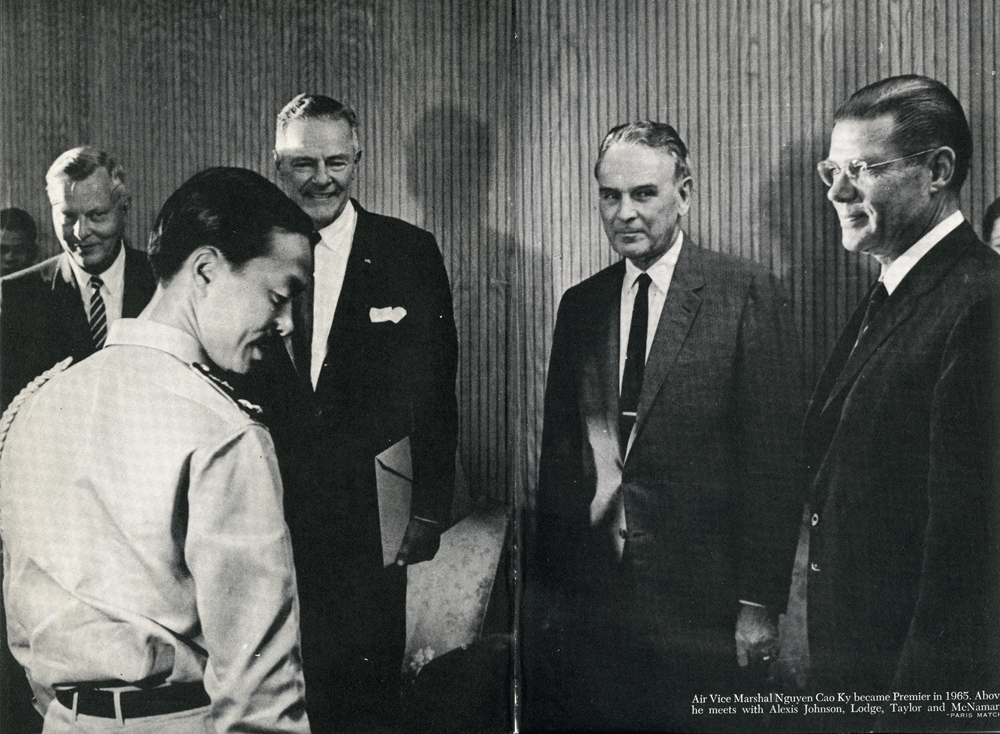
The South Vietnamese political crisis was touched off
March 12, 1966, when Air Vice Marshal Nguyen Cao Ky,
who was Premier, removed the powerful and semiautonomous
commander of the I Corps, Gen. Nguyen Chanh Thi. Buddhist
monks and students quickly joined demonstrations supporting
General Thi and attacking the Ky regime.
The demonstrations stirred fears in Washington that Marshal Ky might be
overthrown and replaced by a neutralist
Buddhist government, the study recalls, and hurried meetings
were called at the White House.
At the first of these meetings, on April 9, the study says,
four policy papers were debated: George Carver, a senior
C.I.A. analyst on Vietnam, argued for what was referred to
as Option A-continuing as is; Leonard Unger, Deputy Assistant
Secretary of State and head of the Interdepartmental
Vietnam coordinating committee, presented Option B-continuing
but pressing for a compromise settlement; Assistant
Secretary of Defense McNaughton argued Option B-continuing
but with a pessimistic outlook; and George W. Ball,
the Under Secretary of State, took Option C-disengagement.
Mr. Ball asserted, as he had the previous June in a memorandum
for the President, that "We should concentrate our
attention on cutting our losses." The United States, he said,
should "halt the deployment of additional forces, reduce the
level of air attacks on the North, and maintain ground activity
at the minimum level required to prevent the substantial
improvement of the Vietcong position."
"Let us face the fact that there are no really attractive
options open to us," Secretary Ball concluded in his policy
paper, as quoted in the Pentagon study.
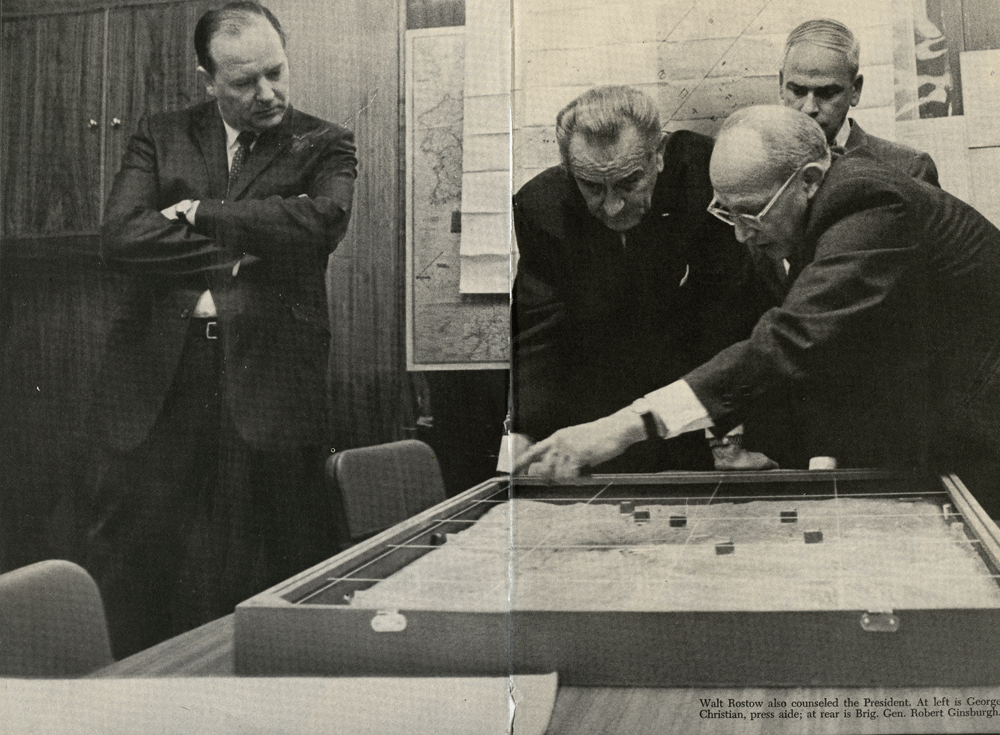
Other papers, including one by Walt W. Rostow, who had
just replaced McGeorge Bundy as Presidential adviser on
national security, were prepared and debated on April 12, 14
and 16.
A hint of Mr. McNaughton's state of mind during this
period, the Pentagon study says, can be gathered from notes
he had taken of a conversation with an official just back from
Saigon. Mr. McNaughton's notes read:
"Place (VN) in unholy mess.
"We control next to no territory.
"Fears economic collapse.
"Militarily will be same place year from now.
"Pacification won't get off ground for a year."
At the April 16 meeting, William P. Bundy, Assistant Secretary
of State for Far Eastern Affairs, presented a draft
entitled "Basic Choices in Vietnam." He apparently favored
the option of continuing along present lines, the narrative recounts,
but he also said:
"As we look a year or two ahead, with a military program
that would require major further budget costs-with all their
implications for taxes and domestic programs-and with
steady or probably rising casualties, the war could well be-
485
come an albatross around the Administration's neck at least
equal to what Korea was for President Truman in 1952."
What new decisions these meetings produced is not clear
from the record, the Pentagon study says. The meetings ended
around April 20 with a lull in the South Vietnamese political
crisis.
The Fuel-Depot Issue
During the spring of 1966, the Pentagon study says, the
question of bombing North Vietnam's oil-storage tanks became
a "major policy dispute."
"Before the question was settled," the account goes on,
"it had assumed the proportions of a strategic issue, fraught
with military danger and political risk, requiring thorough
examination and careful analysis."
The Joint Chiefs of Staff had advocated bombing North
Vietnam's oil tanks as early as the fall of 1965, the narrative
says, adding:
"The Joint Chiefs of Staff pressed throughout the autumn
and winter of 1965-66 for permission to expand the bombing
virtually into a program of strategic bombing aimed at all industrial
and economic resources as well as at all interdiction
targets. "
"The Chiefs did so, it may be added, despite the steady
stream of memoranda from the intelligence community consistently
expressing skepticism that bombing of any conceivable
sort (that is, any except bombing aimed primarily at the
destruction of North Vietnam's population) could either
persuade Hanoi to negotiate a settlement on U.S./GVN terms
or effectively limit Hanoi's ability to infiltrate men and supplies
into the South."
In a memorandum to Secretary McNamara on Nov. 10,
1965, the Chiefs asserted that the only reason the bombing
campaign had not worked thus far was because of the "self-imposed
restraints:"
"We shall continue to achieve only limited success in air
operation in D.R.V./Laos if required to operate within the
constraints presently imposed," the Joint Chiefs said. "The
establishment and observance of de facto sanctuaries within
the D.R.V., coupled with a denial of operations against the
486
most important military and war supporting targets, precludes
attainment of the objectives of the air campaign."
The Joint Chiefs added: "Now required is an immediate
and sharply accelerated program which will leave no doubt
that the U.S. intends to win and achieve a level of destruction
which they will not be able to overcome."
In a separate memorandum the same day, the Joint Chiefs
said that an attack on North Vietnam's P.O.L.-petroleum,
oil and lubricants, in military terminology-"would be more
damaging to the D.R.V. capability to move war-supporting
resources within country and along the infiltration routes to
SVN than an attack against any other single target system."
"The flow of supplies would be greatly impeded," the Joint
Chiefs said. And they contended that "recuperability of the
D.R.V. P.O.L. system from the effects of an attack is very
poor."
"It is not surprising that the J.C.S. singled out the P.O.L.
target system for special attention," the Pentagon analyst
says. "NVN had no oil fields or refineries, and had to import
all of its petroleum products, in refined form .... Nearly all
of it came from the Black Sea area of the U.S.S.R. and arrived
by sea at Haiphong, the only port capable of conveniently
receiving and handling bulk P.O.L. brought in by
large tankers. From large tank farms at Haiphong with a
capacity of about one-fourth of the annual imports, the P.O.L.
was transported by road, rail and water to other large storage
sites at Hanoi and elsewhere in the country. Ninety-seven per
cent of the N.V.N. P.O.L. storage capacity was concentrated
in 13 sites, 4 of which had already been hit. They were, of
course, highly vulnerable to air attack."
In support of the Joint Chiefs' view, Adm. U. S. Grant
Sharp, the commander of American forces in the Pacific, in a
cablegram to the Joint Chiefs in January, 1966, made the
evaluation that bombing North Vietnam's oil would "bring
the enemy to the conference table or cause the insurgency to
wither from lack of support." Admiral Sharp also wanted
to close North Vietnam's ports, presumably by aerial mining.
But from the outset of the debate over bombing North
Vietnam's oil tanks, the study discloses, the intelligence community
had been skeptical that such bombing would have
much effect on Hanoi.
Replying to a query from Secretary McNamara on what
the effect of oil-tank bombing would be, the Central Intelligence
Agency said in November, 1965: "It is unlikely that
487
this loss would cripple the Communist military operations in
the South, though it would certainly embarrass them."
"We do not believe," the agency's evaluation added, "that
the attacks in themselves would lead to a major change of
policy on the Communist side, either toward negotiations or
toward enlarging the war."
"Present Communist policy is to continue to prosecute the
war vigorously in the south," another agency estimate, on Dec.
3, 1965, said. It added:
"The Communists recognize that the U.S. reinforcements
of 1965 signify a determination to avoid defeat. They expect
more U.S. troops and probably anticipate that targets in the
Hanoi-Haiphong area will come under air attack. Nevertheless,
they remain unwilling to damp down the conflict or move
toward negotiation. They expect a long war, but they continue
to believe that time is their ally and that their own staying
power is superior."
If the United States bombed all major targets in North
Vietnam, Secretary McNamara asked, how would Hanoi react?
The C.I.A. replied: "The D.R.V. would not decide to
quit; PA VN infiltration southward would continue."
In March, 1966, after months of hesitation, Mr. McNamara
accepted the Joint Chiefs' requests and recommended bombing
North Vietnam's oil, the study relates. But President
Johnson did not immediately go along with the Secretary's
recommendation.
There were several reasons for the President's hesitation,
the account goes on.
The continuing chaotic political situation in South Vietnam,
with rumors of a change in government, made any further
escalation seem unwise for the moment. There was also a
widespread campaign by several world leaders during the
spring to get Washington and Hanoi to the negotiating table.
President Kwame Nkrumah of Ghana and Prime Minister
Harold Wilson of Britain separately traveled to Moscow to
try to start negotiations.
President Charles de Gaulle of France was in touch with
President Ho Chi Minh in Hanoi, and Secretary General
Thant of the United Nations appealed to both sides to come
to the Security Council. President Johnson could not afford
to escalate the war during these peace efforts, the Pentagon
record says.
An important influence on President Johnson's thinking, the
account goes on, was a memorandum he received from Mr.
Rostow on May 6. Mr. Rostow, who as a major with the
488
Office of Strategic Services during World War II had helped
plan the bombing of Germany, recalled in his memorandum
the damage done to that country's war effort through the
bombing of oil-storage facilities. He then asserted:
"With an understanding that simple analogies are dangerous,
I nevertheless feel it is quite possible the military effects
of systematic and sustained bombing of P.O.L. in North Vietnam
may be more prompt and direct than conventional intelligence
analysis would suggest."
It was late in May when President Johnson decided to order
the oil bombing, the narrative says, and he apparently set
June 10 as the target day. But his decision "was very closely
held," the analyst writes, and not even Admiral Sharp or
General Westmoreland was told.
The Central Intelligence Agency, in a last-minute evaluation
ordered by the "Vietnam principals," reiterated its skepticism
about the effects of oil-tank bombing.
"It is estimated," the agency's report said, "that the infiltration
of men and supplies into SVN can be sustained."
The sequence of events was interrupted on June 7, the
study relates, when Washington learned that a Canadian
diplomat, Chester A. Ronning, was on his way to Hanoi to
test North Vietnam's attitude toward negotiations, a mission
for which he had received State Department approval.
Secretary Rusk, who was traveling in Europe, cabled President
Johnson to urge that the oil strikes be postponed until it
could be learned what Mr. Ronning had found out.
"I am deeply disturbed," Mr. Rusk said in his cablegram,
"by general international revulsion, and perhaps a great deal
at home if it becomes known that we took an action which
sabotaged the Ronning mission to which we had given our
agreement. I recognize the agony of this problem for all
concerned."
President Johnson, responding to Mr. Rusk's request,
suspended the oil raids, the study discloses. When Mr. Ronning
returned, Assistant Secretary Bundy flew to meet him
in Ottawa, but quickly reported that the Canadian had found
no opening or flexibility in the North Vietnamese position.
While Mr. Ronning was in Hanoi, Secretary McNamara
had informed Admiral Sharp by cablegram of the high-level
consideration of oil attacks and told him:
"Final decision for or against will be influenced by extent
they can be carried out without significant civilian casualties.
What preliminary steps to minimize would you recommend
489
and if taken what number of casualties do you believe would
result?"
Admiral Sharp "replied eagerly," the study declares, with a
list of precautions: The strikes would be carried out only
under favorable weather conditions, with experienced pilots
fully briefed, and with especially selected weapons. He predicted
that civilian casualties could be held "under 50."
With Mr. Ronning's return and Admiral Sharp's assurances,
the stage was set for the oil-tank strikes.
On June 22, Washington [see Document #114] gave the
execution message authorizing strikes on the oil targets in the
Hanoi-Haiphong area. The Pentagon analyst terms the execution
message "a remarkable document, attesting in detail to
the political sensitivity of the strikes." The message said:
"Strikes to commence with initial attacks against Haiphong
and Hanoi P.O.L. on same day if operationally feasible ....
At Haiphong avoid damage to merchant shipping. No attacks
authorized on craft unless U.S. aircraft are first fired on
and then only if clearly North Vietnamese.
"Decision made after SecDef and C.J.C.S. [Chairman,
Joint Chiefs of Staff] were assured every feasible step would
be taken to minimize civilian casualties .... Take the following
measures: maximum use of most experienced Rolling
Thunder personnel, detailed briefing of pilots stressing need
to avoid civilians, execute only when weather permits visual
identification of targets and improved strike accuracy, select
best axis of attack to avoid populated areas, maximum use
of ECM [electronic countermeasurers] to hamper SAM [surface-
to-air missiles] and AAA [antiaircraft artillery] fire control,
in order to limit pilot distraction and improve accuracy,
maximum use of weapons of high precision delivery consistent
with mission objective, and limit SAM and AAA suppression
[bombing] to sites located outside populated areas.
"Take special precautions to insure security. If weather or
operational considerations delay initiation of strikes, do not
initiate on Sunday, 26 June."
It is not clear, the Pentagon account says, why what it calls
the "never on Sunday" order was issued.
Because of bad weather, it was June 29 before the oil
strikes were finally begun, reportedly with great success. The
Haiphong dock facility appeared about 80 per cent destroyed,
the study says, and the Hanoi "tank farm" was apparently
knocked out. Only one United States aircraft was lost to
ground fire.
A report from the Seventh Air Force in Saigon called the
490
operation "the most significant, the most important strike of
the war."
"Official Washington reacted with mild jubilation to the
reported success of the P.O.L. strikes and took satisfaction
in the relatively mild reaction of the international community
to the escalation," the Pentagon analyst recounts. "Secretary
McNamara described the execution of the raids as a 'superb
professional job,' and sent a message of personal congratulations
to the field commanders involved in the planning and
execution of the attacks."
In early July, Mr. McNamara informed Admiral Sharp in
a cablegram that the President wished the first priority in the
air war to be given to the "strangulation" of North Vietnam's
fuel system. And he ordered Admiral Sharp to develop a
comprehensive plan to accomplish this.
Throughout the summer of 1966, Operation Rolling
Thunder was concentrated on destroying oil-storage sites, the
narrative relates. By the end of July, the Defense Intelligence
Agency reported to Secretary McNamara that 70 per cent of
North Vietnam's original storage capacity had been destroyed.
But "what became clearer and clearer as the summer wore
on," the account discloses, "was that while we had destroyed
a major portion of North Vietnam's storage capacity,
she retained enough dispersed capacity, supplemented by
continuing imports (increasingly in easily dispersable drums,
not bulk) to meet her ongoing requirements."
In August, the study says, with the large storage sites already
destroyed and the small, dispersed sites hard to find
and bomb, "it was simply impractical and infeasible to attempt
any further constriction of North Vietnam's P.O.L. storage
capacity."
And, it adds, the flow of men and supplies from North
Vietnam to the Vietcong continued "undiminished."
"It was clear," the study says, "that the P.O.L. strikes had
been a failure. . . . There was no evidence that NVN had at
any time been pinched for P.O.L. ... The difficulties of
switching to a much less vulnerable but perfectly workable
storage and distribution system, not an unbearable strain
when the volume to be handled was not really very great, had
been overestimated. Typically, also, N.V.N.'s adaptability and
resourcefulness had been greatly underestimated."
"McNamara, for his part, made no effort to conceal his
dissatisfaction and disappointment at the failure of the P.O.L.
strikes," the study continues. "He pointed out to the Air
491
Force and the Navy the glaring discrepancy between the
optimistic estimates of results their pre-strike P.O.L. studies
had postulated and the actual failure of the raids to significantly
decrease infiltration."
"The Secretary was already in the process of rethinking the
role of the entire air campaign in the U.S. effort," the Pentagon
study says. "He was painfully aware of its inability to
pinch off the infiltration to the South and had seen no evidence
of its ability to break Hanoi's will, demoralize its population
or bring it to the negotiation table."
"The attack on North Vietnam's P.O.L. system," the study
goes on, "was the last major escalation of the air war recommended
by Secretary McNamara."
Troops, More Troops
Another important factor in Secretary McNamara's "disenchantment"
during the summer of 1966, the Pentagon account
declares, was General Westmoreland's continual requests
for more troops.
In June Mr. McNamara approved a new deployment
schedule specifically designed to meet General Westmoreland's
requests. The new schedule, labeled Program 3, called for
putting 391,000 American soldiers-79 battalions-into South
Vietnam by the end of 1966 and 431,000 by June, 1967.
Because articles had begun to appear in the press that the
Joint Chiefs were dissatisfied with the pace of the build-up in
ground forces, the study relates, President Johnson and Mr.
McNamara resorted to a bureaucratic "ploy" to insure that
their new schedule met the Joint Chiefs' requests.
On June 28 the President wrote a formal directive to the
Secretary of Defense:
"As you know, we have been moving our men to Vietnam
on a schedule determined by General Westmoreland's requirements.
"As I have stated orally several times this year, I should like
this schedule to be accelerated as much as possible so that
General Westmoreland can feel assured that he has all the
men he needs as soon as possible.
"Would you meet with the Joint Chiefs and give me at your
earliest convenience an indication of what acceleration is possible
for the balance of this year."
492
Secretary McNamara then passed this directive to the
Joint Chiefs, who replied in a memorandum on July 7 that
the new schedule did meet General Westmoreland's requirements.
In turn, Mr. McNamara replied formally to the President
that he was "happy to report" that the new deployments
were satisfactory.
Thus, the study says, the President and Mr. McNamara
gained a record that could be easily pulled out to show any
critic that in fact they were meeting the military's requests.
But while President Johnson and Secretary McNamara were
approving this schedule, General Westmoreland had already
initiated a new request-for 111,588 men-which was passed
through channels to the Joint Chiefs on June 18. The figure
General Westmoreland said he would now need for 1967 was
542,588 troops.
On Aug. 5 the Joint Chiefs passed the new request to Secretary
McNamara, expressing their view that the proposed increases
were important and necessary.
Mr. McNamara replied the same day:
"As you know, it is our policy to provide the troops,
weapons and supplies requested by General Westmoreland
at the times he desires them, to the greatest possible degree.
"Nevertheless I desire and expect a detailed line-by-line
analysis of these requirements to determine that each is truly
essential to the carrying out of our war plan. We must send
to Vietnam what is needed, but only what is needed." [See
Document #115.]
When the Joint Chiefs completed their detailed study of
the new requests in the fall, the study relates, Mr. McNamara
was no longer ready to approve troop increases automatically.
And in October, for the first time, he would turn General
Westmoreland down.
The major reason General Westmoreland gave for needing
more troops, the account discloses, is that during the summer
of 1966 North Vietnamese infiltration again appeared to be
increasing.
Throughout the summer and early fall, the narrative says,
General Westmoreland sent a steady stream of cables to
Admiral Sharp and General Wheeler warning about the
enemy build-up. [See Document # 116.]
493
A Secret Seminar
During the summer of 1966, while Secretary McNamara
was pondering the failure of the oil-storage strikes and considering
General Westmoreland's latest troop request, a secret
seminar of leading scientists under Government sponsorship
was studying the over-all results of Operation Rolling
Thunder.
Their conclusions, the historian relates, would have a "dramatic
impact" on Mr. McNamara and further contribute to
his disenchantment. [See Document # 117.]
The idea for a summer seminar of scientists and academic
specialists to study technical aspects of the war had been
suggested in March by Dr. George B. Kistiakowsky and Dr.
Carl Kaysen of Harvard and Dr. Jerome B. Wiesner and
Dr. Jerrold R. Zacharias of the Massachusetts Institute of
Technology.
Dr. Kistiakowsky had been special assistant for science
and technology under President Dwight D. Eisenhower and
Dr. Wiesner had held that post under President Kennedy. Dr.
Kaysen had been a Kennedy aide for national security.
Secretary McNamara liked the idea, the study says, and
sent Dr. Zacharias a letter on April 16 formally requesting
that he and the others arrange the summer study on "technical
possibilities in relation to our military operations in Vietnam."
The Secretary specifically instructed Mr. McNaughton,
who was to oversee the project, that the scientists should look
into the feasibility of "a fence across the infiltration trails,
warning systems, reconnaissance (especially night) methods,
night vision devices, defoliation techniques and area-denial
weapons."
The idea of constructing an anti-infiltration barrier across
the demilitarized zone had first been suggested by Prof. Roger
Fisher of the Harvard Law School in a memorandum to Mr.
McNaughton in January, 1966, the narrative says.
The scientists-47 men representing "the cream of the
scholarly community in technical fields," the narrative saysmet
in Wellesley, Mass., during June, July and August under
the auspices of the Jason Division of the Institute for Defense
Analyses.
494
The Jason Division, named for the leader of the Argonauts
in Greek mythology, was used to conduct "ad hoc high-level
studies using primarily non-I.D.A. scholars," the Pentagon
study says. The scientists were given briefings by high officials
from the Pentagon, the Central Intelligence Agency, the State
Department and the White House, the study recounts, and
they were provided with secret materials.
Their conclusions and recommendations, which were given
to the Secretary of Defense at the beginning of September,
had "a powerful and perhaps decisive influence in Mc-
Namara's mind," the Pentagon record says.
These were the recommendations, it goes on, of "a group
of America's most distinguished scientists, men who had
helped the Government produce many of its most advanced
technical weapons systems since the end of the Second World
War, men who were not identified with the vocal academic
criticism of the Administration's Vietnam policy."
Their report evaluating the results of the Rolling Thunder
campaign began:
"As of July, 1966, the U.S. bombing of North Vietnam had
had no measurable direct effect on Hanoi's ability to mount
and support military operations in the South at the current
level."
They then pointed out the reasons that they felt North
Vietnam could not be hurt by bombing: It was primarily
a subsistence agricultural country with little industry and a
primitive but flexible transport system, and most of its
weapons and supplies came from abroad.
These factors, the scientists said, made it "quite unlikely"
that an expanded bombing campaign would "prevent Hanoi
from infiltrating men into the South at the present or a
higher rate."
In conclusion, the Pentagon study says, the scientists addressed
the assumption behind the bombing program-that
damage inflicted on a country reduces its will to continue
fighting. The scientists criticized this assumption, the study
says, by denying that it is possible to measure the relationship.
"It must be concluded," the scientists said, "that there is
currently no adequate basis for predicting the levels of U.S.
military effort that would be required to achieve the stated
objectives-indeed, there is no firm basis for determining
if there is any feasible level of effort that would achieve these
objectives. "
As an alternative to bombing North Vietnam, the 47
495
scientists suggested that an elaborate electronic barrier, using
recently developed devices, be built across the demilitarized
zone.
The barrier would consist of two parts, the Pentagon report
discloses: an anti-troop system made up of small mines
(called gravel mines) to damage the enemy's feet and legs,
and an anti-vehicle system composed of acoustic sensors that
would direct aircraft to the target.
Most of the mines and sensors would be dropped by planes,
but the system would have to be checked by ground troops.
The whole system would cost about $800-million a year,
the scientists estimated, and would take a year to build.
Secretary McNamara "was apparently strongly and favorably
impressed" by the scientists' ideas, the Pentagon study
relates, and he immediately ordered Lieut. Gen. Alfred D.
Starbird, an Army engineering expert, to begin research on
the barrier.
On Oct. 10, 1966, the study reports, Secretary McNamara
set out for Saigon to assess General Westmoreland's latest
troop request. He had ordered General Starbird to precede
him there to begin an investigation of conditions for the barter.
Characterizing Mr. McNamara's attitudes toward the war,
the Pentagon analyst says that the Secretary had gone from
"hesitancy" in the winter of 1965 to "perplexity" in the spring
of 1966 to "disenchantment" the following fall.
When he returned from his October trip to Saigon, the
study relates, he would detail his feelings in two long memorandums
to President Johnson and for the first time would
recommend against filling a troop request from General Westmoreland.
496
KEY DOCUMENTS
Following are texts of key documents accompanying the Pentagon's
study of the Vietnam war, covering the period late 1965
to the summer of 1966. Except where excerpting is specified,
the documents are printed verbatim, with only unmistakable
typographical errors corrected.
# 106
State Department Memorandum in
November on Bombing Pause
Excerpts from memorandum, "Courses of Action in Vietnam,"
from the State Department, Nov. 9, 1965, as provided
in the body of the Pentagon study. According to the study,
the memorandum was speaking for Secretary of State Dean
Rusk, and "a penciled note by [Assistant Secretary of Defense
John T.] McNaughton indicates that Ambassador U.
Alexis Johnson was the author."
... The purpose of-and Secretary McNamara's arguments
for-such a pause are four:
(a) It would offer Hanoi and the Viet Cong a chance to move
toward a solution if they should be so inclined, removing the
psychological barrier of continued bombing and permitting the
Soviets and others to bring moderating arguments to bear:
(b) It would demonstrate to domestic and international critics
that we had indeed made every effort for a peaceful settlement
before proceeding to intensified actions, notably the latter stages
of the extrapolated Rolling Thunder program;
(c) It would probably tend to reduce the dangers of escalation
after we had resumed the bombing, at least insofar as the Soviets
were concerned;
(d) It would set the stage for another pause, perhaps in late
1966, which might produce a settlement.
Against these propositions, there are the following considerations
arguing against a pause:
(a) In the absence of any indication from Hanoi as to what
reciprocal action it might take, we could well find ourselves in the
497
position of having played this very important card without receiving
anything substantial in return. There are no indications that
Hanoi is yet in a mood to agree to a settlement acceptable to us.
The chance is, therefore, very slight that a pause at this time could
lead to an acceptable settlement.
(b) A unilateral pause at this time would offer an excellent
opportunity for Hanoi to interpose obstacles to our resumption of
bombing and to demoralize South Vietnam by indefinitely dangling
before us (and the world) the prospect of negotiations with
no intent of reaching an acceptable settlement. It might also tempt
the Soviet Union to make threats that would render very difficult
a decision to resume bombing.
(c) In Saigon, obtaining South Vietnamese acquiescence to a
pause would be difficult. It could adversely affect the Government's
solidity. Any major falling out between the Government
and the United States or any overturn in the Government's political
structure could set us back very severly (sic).
(d) An additional factor is that undertaking the second course
of action following a pause [Le., "extrapolation" of ROLLING
THUNDER] would give this course a much more dramatic character,
both internationally and domestically, and would, in particular,
present the Soviets with those difficult choices that we
have heretofore been successful in avoiding.
On balance, the arguments against the pause are convincing to
the Secretary of State, who recommends that it not be undertaken
at the present time. The Secretary of State believes that a
pause should be undertaken only when and if the chances were
significantly greater than they now appear that Hanoi would
respond by reciprocal actions leading in the direction of a peaceful
settlement. He further believes that, from the standpoint of
international
and domestic opinion, a pause might become an overriding
requirement only if we were about to reach the advanced
stages of an extrapolated Rolling Thunder program involving
extensive air operations in the Hanoi/Haiphong area. Since the
Secretary of State believes that such advanced stages are not in
themselves desirable until the tide in the South is more favorable,
he does not feel that, even accepting the point of view of the
Secretary of Defense, there is now any international requirement
to consider a "Pause." ...
# 107
Notes on McNamara Memorandum for
Johnson after Vietnam Visit
Excerpts from notes accompanying the Pentagon study,
from a memorandum for President Lyndon B. Johnson
from Secretary McNamara, Nov. 30, 1965.
498
· .. The Ky "government of generals" is surviving, but not
acquiring wide support or generating actions; pacification is
thoroughly stalled, with no guarantee that security anywhere is
permanent and no indications that able and willing leadership will
emerge in the absence of that permanent security. (Prime Minister
Ky estimates that his government controls only 25% of the
population today and reports that his pacification chief hopes to
increase that to 50% two years from now).
The dramatic recent changes in the situation are on the military
side. They are the increased infiltration from the North and the
increased willingness of the Communist forces to stand and fight,
even in large-scale engagements. The Ia Drang River Campaign of
early November is an example. The Communists appear to have
decided to increase their forces in SVN both by heavy recruitment
in the South (especially in the Delta) and by infiltration of regular
NVN forces from the North .... The enemy can be expected to
enlarge his present strength of 110 battalion equivalents to more
than 150 battalion equivalents by the end of calendar 1966, when
hopefully his losses can be made to equal his input.
As for the Communist ability to supply this force, it is estimated
that, even taking account of interdiction of routes by air
and sea, more than 200 tons of supplies a day can be infiltrated -- more
than enough, allowing for the extent to which the enemy
lives off the land, to support the likely PAVN IVC force at the
likely level of operations.
To meet this possible-and in my view likely-Communist
buildup, the presently contemplated Phase I forces will not be
enough (approx 220,000 Americans, almost all in place by end
of 1965). Bearing in mind the nature of the war, the expected
weighted combat force ratio of less than 2-to-l will not be good
enough. Nor will the originally contemplated Phase II addition
of 28 more U.S. battalions (112,000 men) be enough; the combat
force ratio, even with 32 new SVNse battalions, would still be
little better than 2-to- I at the end of 1966. The initiative which
we have held since August would pass to the enemy; we would
fall far short of what we expected to achieve in terms of population
control and disruption of enemy bases and lines of communications.
Indeed, it is estimated that with the contemplated Phase
II addition of 28 U.S. battalions, we would be able only to hold
our present geographical positions.
3. We have but two options, it seems to me. One is to go now
for a compromise solution (something substantially less than the
"favorable out once" I described in my memo of Nov. 3) and
hold further deployments to a minimum. The other is to stick
with our stated objectives and with the war, and provide what it
takes in men and materiel. If it is decided not to move now toward
a compromise, I recommend that the U.S. both send a substantial
number of additional troops and very gradually intensify the
bombing of NVN. Amb. Lodge, Wheeler, Sharp and Westmoreland
concur in this prolonged course of action, although Wheeler
499
and Sharp would intensify the bombing of the North more quickly.
(recommend up to 74 battalions by end-66: total to approx
400,000 by end-66. And it should be understood that further deployments
(perhaps exceeding 200,000) may be needed in 1967.
Bombing of NVN. . . . over a period of the next six months we
gradually enlarge the target system in the northeast (Hanoi-
Haiphong) quadrant until, at the end of the period, it includes
"controlled" reconnaissance of lines of comm throughout the
area, bombing of petroleum storage facilities and power plants,
and mining of the harbors. (Left un struck would be population
targets, industrial plants, locks and dams).
4. Pause in bombing NVN. It is my belief that there should be
a three- or four-week pause in the program of bombing the North
before we either greatly increase our troop deployments to VN
or intensify our strikes against the North. (My recommendation
for a "pause" is not concurred in by Lodge, Wheeler or Sharp.)
The reasons for this belief are, first, that we must lay a foundation
in the minds of the American public and in world opinion for
such an enlarged phase of the war and second, we should give
NVN a face-saving chance to stop the aggression. I am not
seriously concerned about the risk of alienating the SVNese, misleading
Hanoi, or being "trapped" in a pause; if we take reasonable
precautions, we can avoid these pitfalls. I am seriously concerned
about embarking on a markedly higher level of war in VN without
having tried, through a pause, to end the war or at least
having made it clear to our people that we did our best to end it.
5. Evaluation. We should be aware that deployments of the
kind I have recommended will not guarantee success. U.S. killed-in-
action can be expected to reach 1000 a month, and the odds
are even that we will be faced in early 1967 with a "no-decision"
at an even higher level. My over-all evaluation, nevertheless, is
that the best chance of achieving our stated objectives lies in a
pause followed, if it fails, by the deployments mentioned above.
# 108
Notes from McNamara Memo on Course
of War in 1966
Excerpts from notes accompanying the Pentagon study,
from a memorandum for President Johnson from Secretary
McNamara, "Military and Political Actions Recommended
for South Vietnam," Dec. 7, 1965.
. . . We believe that, whether or not major new diplomatic
initiatives are made, the U.S. must send a substantial number of
additional forces to VN if we are to avoid being defeated there.
(30 Nov program; concurred in by JCS)
500
IV. Prognosis assuming the recommended deployments
Deployments of the kind we have recommended will not
guarantee success. Our intelligence estimate is that the present
Communist policy is to continue to prosecute the war vigorously
in the South. They continue to believe that the war will be a
long one, that time is their ally, and that their own staying power
is superior to ours. They recognize that the U.S. reinforcements
of 1965 signify a determination to avoid defeat, and that more
U.S. troops can be expected. Even though the Communists will
continue to suffer heavily from GVN and U.S. ground and air
action, we expect them, upon learning of any U.S. intentions to
augment its forces, to boost their own commitment and to test
U.S. capabilities and will to persevere at higher level of conflict
and casualties (U.S. KIA with the recommended deployments
can be expected to reach 1000 a month) .
If the U.S. were willing to commit enough forces-perhaps
600,000 men or more-we could ultimately prevent the DRV /VC
from sustaining the conflict at a significant level. When this point
was reached, however, the question of Chinese intervention would
become critical. (*We are generally agreed that the Chinese Communists
will intervene with combat forces to prevent destruction
of the Communist regime in the DRV. It is less clear whether
they would intervene to prevent a DRV/VC defeat in the South.)
The intelligence estimate is that the chances are a little better
than even that, at this stage, Hanoi and Peiping would choose to
reduce the effort in the South and try to salvage their resources
for another day; but there is an almost equal chance that they
would enlarge the war and bring in large numbers of Chinese
forces (they have made certain preparations which could point in
this direction).
It follows, therefore, that the odds are about even that, even
with the recommended deployments, we will be faced in early
1967 with a military standoff at a much higher level, with pacification
still stalled, and with any prospect of military success marred
by the chances of an active Chinese intervention.
(memo of 24 jan 66: JCS believe that "the evaluation set
forth in Par. 7 is on the pessimistic side in view of the constant
and heavy military pressure which our forces in SEA will be
capable of employing. While admittedly the following factors are
to a degree imponderables, they believe that greater weight should
be given to the following:
a. The cumulative effect of our air campaign against the DRV
on morale and DRV capabilities to provide and move men and
materiel from the DRV to SVN.
b. The effects of constant attack and harassment on the ground
and from the air upon the growth of VC forces and on the
morale and combat effectiveness of VC/PA VN forces.
c. The effect of destruction of VC base areas on the capabilities
of VC/P AVN forces to sustain combat operations over an
extended period of time.
501
d. The constancy of will of the Hanoi leaders to continue a
struggle which they realize they cannot win in the face of progressively
greater destruction of their country
# 109
Further McNaughton Memo on Factors
in Bombing Decision
Excerpts from memorandum by Assistant Secretary of
Defense McNaughton, "Some Paragraphs on Vietnam,"
third draft, Jan. 19, 1966, as provided in the body of the
Pentagon study. Paragraphs in italics are the analyst's paraphrase
or explanation.
McNaughton prepared a second memorandum complementing
and partially modifying the one on bombing. It concerned the
context for the decision. Opening with a paragraph which warned,
"We ... have in Vietnam the ingredients of an enormous miscalculation,"
it sketched the dark outlines of the Vietnamese
scene:
... The ARVN is tired, passive and accommodation-prone ...
The PA VN Ive are effectively matching our deployments . . .
The bombing of the North ... mayor may not be able effectively
to interdict infiltration (partly because the PAVN Ive can simply
refuse to do battle if supplies are short). . .. Pacification is stalled
despite efforts and hopes. The GVN political infrastructure is
moribund and weaker than the ve infrastructure among most of
the rural population . . . South Vietnam is near the edge of
serious inflation and economic chaos.
The situation might alter for the better, McNaughton conceded.
"Attrition-save Chinese intervention-may push the DRV
'against the stops' by the end of 1966." Recent RAND motivation
and morale studies showed VC spirit flagging and their grip on
the peasantry growing looser. "The Ky government is coming
along, not delivering its promised 'revolution' but making progress
slowly and gaining experience and stature each week," Though
McNaughton termed it "doubtful that a meaningful ceiling can
be put on the infiltration," he said "there is no doubt that the cost
of infiltration can . . . be made very high and that the flow of
supplies can be reduced substantially below what it would otherwise
be." Possibly bombing, combined with other pressures, could
bring the DRV to consider terms after "a period of months, not
of days or even weeks,"
The central point of McNaughton's memorandum, following
from its opening warning, was that the United States, too, should
consider coming to terms. He wrote:
C. The present U.S. objective in Vietnam is to avoid humiliation. The
reasons why we went into Vietnam to the present depth
are varied; but they are now largely academic. Why we have not
withdrawn from Vietnam is, by all odds, one reason: (l) to preserve
our reputation as a guarantor, and thus to preserve our
effectiveness in the rest of the world. We have not hung on (2) to
save a friend, or (3) to deny the Communists the added acres
and heads (because the dominoes don't fall for that reason in
this case), or even (4) to prove that "wars of national liberation"
won't work (except as our reputation is involved). At each
decision point we have gambled; at each point, to avoid the
damage to our effectiveness of defaulting on our commitment, we
have upped the ante. We have not defaulted, and the ante (and
commitment) is now very high. It is important that we behave
so as to protect our reputation. At the same time, since it is our
reputation that is at stake, it is important that we not construe our
obligation to be more than do the countries whose opinions of
us are our reputation.
D. We are in an escalating military stalemate. There is an
honest difference of judgment as to the success of the present
military efforts in the South. There is no question that the U.S.
deployments thwarted the VC hope to achieve a quick victory in
1965. But there is a serious question whether we are now defeating
the VC/PAVN main forces and whether planned U.S.
deployments will more than hold our position in the country.
Population and area control has not changed significantly in the
past year; and the best judgment is that, even with the Phase I1A
deployments, we will probably be faced in early 1967 with a
continued stalemate at a higher level of forces and casualties.
2. U.S. commitment to SVN. Some will say that we have defaulted
if we end up, at any point in the relevant future, with anything
less than a Western-oriented, non-Comm list, independent
government, exercising effective sovereignty over all of South
Vietnam. This is not so. As stated above, the U.S. end is solely
to preserve our reputation as a guarantor. It follows that the
"softest" credible formulation of the U.S. commitment is the
following:
a. DRV does not take over South Vietnam by force. This does
not necessarily rule out:
b. A coalition government including Communists.
c. A free decision by the South to succumb to the VC or to the
North.
d. A neutral (or even anti-U.S.) government in SVN.
e. A live-and-let-Iive "reversion to 1959." Furthermore, we
must recognize that even if we fail to in achieving this "soft"
formulation, we could over time come out with minimum damage:
f. If the reason was GVN gross wrongheadedness or apathy.
g. If victorious North Vietnam "went Titoist."
h. If the Communist take-over was fuzzy and very slow.
Current decisions, McNaughton argued, should reflect awareness
that the U.S. commitment could be fulfilled with something considerably
short of victory. "It takes time to make hard decisions,"
he wrote, "It took us almost a year to take the decision to bomb
North Vietnam; it took us weeks to decide on a pause; it could
take us months (and could involve lopping some white as well as
brown heads) to get us in position to go for a compromise. We
should not expect the enemy's molasses to pour any faster than
ours. And we should 'tip the pitchers' now if we want them to
'pour' a year from now."
But the strategy following from this analysis more or less
corresponded over the short term to that recommended by the
Saigon mission and the military commands: More effort for
pacification, more push behind the Ky government, more battalions
for MACV, and intensive interdiction bombing roughly as proposed
by CINCPAC. The one change introduced in this memorandum,
prepared only one day after the other, concerned North
Vietnamese ports. Now McNaughton advised that the ports not
be closed.
The argument which coupled McNaughton's political analysis
with his strategic recommendations appeared at the end of the
second memorandum:
The dilemma. We are in a dilemma. It is that the situation may
be "polar." That is, it may be that while going for victory we
have the strength for compromise, but if we go for compromise
we have the strength only for defeat-this because a revealed
lowering of sights from victory to compromise (a) will unhinge
the GVN and (b) will give the DRV the "smell of blood." The
situation therefore requires a thoroughly loyal and disciplined
U.S. team in Washington and Saigon and great care in what is
said and done. It also requires a willingness to escalate the war if
the enemy miscalculates, misinterpreting our willingness to compromise
as implying we are on the run. The risk is that it may
be that the "coin must come up heads or tails, not on edge."
# 110
McNaughton Memo for McNamara on
Anti-Infiltration Barrier Plan
Excerpts from a memorandum to Secretary of Defense
McNamara, "A Barrier Strategy," as provided in the body
of the Pentagon study. According to the narrative, the
memorandum is unsigned but is by Assistant Secretary of
Defense McNaughton, in whose handwriting the copy is
marked "1/30/66" and "copy given to RSM 3122/66." The
study further says that the document is based on a draft
memo of Jan. 3, 1966, "A Barrier Strategy," by Prof. Roger
D. Fisher of Harvard Law School.
504
B. PRESENT MILITARY SITUATION IN NORTH
VIETNAM.
1. Physical consequences of bombing
a. The DRV has suffered some physical hardship and pain,
raising the cost to it of supporting the VC.
b. Best intelligence judgment is that:
( 1) Bombing mayor may not-by destruction or delay-have
resulted in net reduction in the flow of men or supplies to the
forces in the South;
(2) Bombing has failed to reduce the limit on the capacity of
the DRV to aid the VC to a point below VC needs;
(3) Future bombing of North Vietnam cannot be expected
physically to limit the military support given the VC by the DRV
to a point below VC needs.
2. Influence consequences of bombing
a. There is no evidence that bombings have made it more
likely the DRV will decide to back out of the war.
b. Nor is there evidence that bombings have resulted in an
increased DRV resolve to continue the war to an eventual victory.
[Fisher's draft had read "There is some evidence that bombings .
. . ."]
C. FUTURE OF A BOMBING STRATEGY
Although bombings of North Vietnam improve GVN morale
and provide a counter in eventual negotiations (should they take
place) there is no evidence that they meaningfully reduce either
the capacity or the will for the DRV to support the VC. The
DRV knows that we cannot force them to stop by bombing and
that we cannot, without an unacceptable risk of a major war with
China or Russia or both, force them to stop by conquering them
or "blotting them out." Knowing that if they are not influenced
we cannot stop them, the DRV will remain difficult to influence.
With continuing DRV support, victory in the South may remain
forever beyond our reach.
Having made the case against the bombing, the memo then
spelled out the case for an anti-infiltration barrier:
n. SUBSTANCE OF THE BARRIER PROPOSAL
A. That the U.S. and GVN adopt the concept of physically
cutting off DRV support to the VC by an on-the-ground barrier
across the Ho Chi Minh Trail in the general vicinity of the 17th
Parallel and Route 9. To the extent necessary the barrier would
run from the sea across Vietnam and Laos to the Mekong, a
straightline distance of about 160 miles.
B. That in Laos an "interdiction and verification zone," perhaps
10 miles wide, be established and legitimated by such
measures as leasing, international approval, compensation, etc.
505
C. That a major military and engineering effort be directed
toward constructing a physical barrier of minefields, barbed wire,
walls, ditches and military strong points flanked by a defoliated
strip on each side.
D. That such bombing in Laos and North Vietnam as takes
place be narrowly identified with interdiction and with the construction
of the barrier by
1. Being within the 10-mile-wide interdiction zone in Laos, or
2. Being in support of the construction of the barrier, or
3. Being interdiction bombing pending the completion of the
barrier.
E. That, of course, intensive interdiction continues at sea and
from Cambodia.
(It might be stated that all bombings of North Vietnam will
stop as soon as there is no infiltration and no opposition to the
construction of the verification barrier.)
# III
Johnson's Remarks to Officials of U.S.
and Saigon at Honolulu
Excerpts from remarks by President Johnson to senior
United States and South Vietnamese after the issuance of a
joint communique at their Honolulu conference, Feb. 9,
1966, as provided in the body of the Pentagon study. The
paragraph in italics is the study's explanation.
(The Vietnamese then thanked the Americans for the conference,
and in turn some of the senior members of the American delegation-
in order, Admiral Sharp, Leonard Marks, General Wheeler,
Ambassador Lodge, Ambassador Harriman-made brief statements
about the meaning of the conference. The President then
made his final statement:
... Preserve this communique, because it is one we don't want
to forget. It will be a kind of bible that we are going to follow.
When we come back here 90 days from now, or six months from
now, we are going to start out and make reference to the announcements
that the President, the Chief of State and the Prime
Minister made in paragraph I, and what the leaders and advisors
reviewed in paragraph 2. . . . You men who are responsible for
these departments, you ministers, and the staffs associated with
them in both governments, bear in mind we are going to give
you an examination and the finals will be on just what you have
done.
In paragraph 5; how have you built democracy in the rural
areas? How much of it have you built, when and where? Give
us dates, times, numbers.
506
In paragraph 2; larger outputs, more efficient production to
improve credit, handicraft, light industry, rural electrification -- are
those just phrases, high-sounding words, or have you coonskins
on the wall ....
Next is health and education, Mr. Gardner. We don't want to
talk about it; we want to do something about it. "The President
pledges he will dispatch teams of experts." Well, we better do
something besides dispatching. They should get out there. We are
going to train health personnel. How many? You don't want to
be like the fellow who was playing poker and when he made a
big bet they called him and said "what have you got?" He said
"aces" and they asked "how many" and he said "one aces". . . .
Next is refugees. That is just as hot as a pistol in my country.
You don't want me to raise a white flag and surrender so we have
to do something about that ....
Growing military effectiveness: we have not gone in because
we don't want to overshadow this meeting here with bombs, with
mortars, with hand grenades, with "Masher" movements. I don't
know who names your operations, but "Masher." I get kind of
mashed myself. But we haven't gone into the details of growing
military effectiveness for two or three reasons. One, we want
to be able honestly and truthfully to say that this has not been a
military build-up conference of the world here in Honolulu. We
have been talking about building a society following the outlines
of the Prime Minister's speech yesterday.
Second, this is not the place, with 100 people sitting around, to
build a military effectiveness.
Third, I want to put it off as long as I can, having to make
these crucial decisions. I enjoy this agony .... I don't want to
come out of this meeting that we have come up here and added
on X divisions and Y battalions or Z regiments or D dollars,
because one good story about how many billions are going to be
spent can bring us more inflation that we are talking about in
Vietnam. We want to work those out in the quietness of the
Cabinet Room after you have made your recommendations, General
Wheeler, Admiral Sharp, when you come to us ....
# 112
Memo on Pentagon Meeting Following
up Honolulu Session
Excerpts from memorandum by Richard C. Steadman,
special assistant to Secretary of Defense McNamara, Feb.
9, 1966, summarizing a Pentagon meeting after the Honolulu
talks. According to Mr. Steadman the participants included
the Secretary, his deputies, the secretaries of each of
the armed services and other Defense Department officials.
507
• • • 3. Southeast Asia Program Office. It is essential that the
Department of Defense has at all times a readily available and
centralized bank of information with respect to the Southeast Asia
build-up. To this end. Dr. Enthoven is to establish a Southeast
Asia Program Office which is to be able to furnish Mr. McNamara and Mr.
Vance all information that may be required with
respect to Southeast Asia. Among other things, this unit is to be
able to provide immediate information on what overseas units
are being depleted in order to accommodate Southeast Asia needs.
If there is any drawdown anywhere, Mr. McNamara wants to
know it promptly. We must know the full price of what we are
doing and propose to do.
Mr. McNamara suggested that each Service Secretary establish
a similar Southeast Asia Program Unit to bring together and keep
current data relating to that Service involving Southeast Asia,
and that the Joint Staff might establish a similar set-up.
Mr. McNamara said that it was mandatory that the situation
be brought under better control. For example, the Southeast Asia
construction program was $1.2-billion in the FY 66 Supplement;
yesterday at Honolulu the figure of $2.5-billion was raised. Yet
there is only the vaguest information as to how these funds will
be spent, where, on what, and by whom. This is part of the
bigger problem that there is no proper system for the allocation
of available resources in Vietnam. McGeorge Bundy is to help
organize the country team to deal with this problem, including
reconciling military and non-military demands.
4. Manpower Controls. Mr. McNamara designated Mr. Morris
as the person to be responsible for the various manpower requirements.
He is either to insure that the requirements are met
or to let Mr. McNamara know if they are not being met. Mr.
McNamara wants a written statement whenever we have been
unable to do something that General Westmoreland says he needs
for full combat effectiveness. (In this regard, General Westmoreland
recognizes that it is not possible to have 100 percent combat
effectiveness for all the 102 battalions. For example, there are not
sufficient helicopter companies. Roughly, he estimates he will get
96 battalion combat effectiveness out of the 102 battalions.)
At this point there was a brief discussion concerning the use
of U.S. troops for pacification purposes. Mr. Nitze indicated that
in his view the Marines were doing this to some degree. The
point was disputed. At any rate, Mr. McNamara said that the
102 combat battalions contemplated under Case 1 were not to
be used for pacification but only for defense of base areas and
offensive operations. Mr. McNamara outlined briefly the South
Vietnamese Government's plan for pacification. It will affect some
235,000 people in the whole country. The major allocation of
resources and personnel will be to four very limited areas, one
of which is near Danang. There will also be a general program
extending throughout the country involving some 900 hamlets.
S. Call-Up of Reserves. Mr. McNamara said that it was im-
508
portant that everyone understand why a Reserve call-up is receiving
such careful study. There are at least two important considerations.
First, the problem is a very complicated one and we
do not yet have all the facts. Mr. Morris and others will amass the
necessary data as soon as possible. Second, the political aspects
of a Reserve call-up are extremely delicate. There are several
strong bodies of opinion at work in the country. Look, for
example, at the Fulbright Committee hearings. One school of
thought, which underlies the Gavin thesis, is that this country is
over-extended economically and that we cannot afford to do
what we are doing. Another school of thought feels that we plain
should not be there at all, whether or not we can afford it. A
third school of thought is that although we are rightly there, the
war is being mismanaged so that we are heading straight toward
war with China. Furthermore, there is no question but that the
economy of this country is beginning to run near or at its
capacity with the resulting probability of a shortage of certain
skills and materials. If this continues we may be facing wage and
price controls, excess profits taxes, etc., all of which will add fuel
to the fire of those who say we cannot afford this. With all these
conflicting pressures it is a very difficult and delicate task for the
Administration to mobilize and maintain the required support in
this country to carryon the war properly. The point of all this
is to emphasize that a call-up of the Reserves presents extremely
serious problems in many areas and a decision cannot be made
today.
General Johnson said he wished to add three additional considerations.
First, a Reserve call-up might be an important factor
in the reading of the North Vietnamese and the Chinese with
respect to our determination to see this war through. Second
Reserve call-ups are traditionally a unifying factor. Third, as a
larger problem, a hard, long-term look should be taken at the
degree to which we as a government are becoming committed to
a containment policy along all the enormous southern border of
China. Mr. McNamara said he would ask for a JCS study of this
last point and discussed it briefly.
During the course of the meeting, General Johnson also pointed
out that with respect to overseas deployment, the Army is already
shortchanging certain overseas areas so as to increase the
training cadres in CONUS. He pointed out that because of the
effect on the strategic reserve of deployments already made, the
quality of new units will be lower than at present. He raised
certain additional points affecting the Army. Mr. McNamara, Mr.
Vance, Mr. Resor and General Johnson will discuss these problems
further. . . .
509
# 113
Rostow's Memo on Bombing of Hanoi's
Petroleum Facilities
Excerpt from memorandum from Walt W. Rostow,
Presidential assistant for national security, to Secretary of
State Rusk and Secretary of Defense McNamara, May 6,
1966, as provided in the body of the Pentagon study. Paragraphs
in italics are the study's paraphrase or explanation.
Rostow developed his argument for striking the petroleum
reserves on the basis of U.S. experience in the World War II
attacks on German oil supplies and storage facilities. His reasoning
was as follows:
From the moment that serious and systematic oil attacks started,
front line single engine fighter strength and tank mobility were
affected. The reason was this: It proved much more difficult, in
the face of general oil shortage, to allocate from less important
to more important uses than than the simple arithmetic of the
problem would suggest. Oil moves in various logistical channels
from central sources. When the central sources began to dry up
the effects proved fairly prompt and widespread. What look like
reserves statistically are rather inflexible commitments to logistical
pipelines.
'The same results might be expected from heavy and sustained
attacks on the North Vietnamese oil reserves,
With an understanding that simple analogies are dangerous,
I nevertheless feel it is quite possible the military effects of a
systematic and sustained bombing of POL in North Vietnam may
be more prompt and direct than conventional intelligence analysis
would suggest.
I would underline, however, the adjectives "systematic and
sustained." If we take this step we must cut clean through the
POL system-and hold the cut-if we are looking for decisive
results. . . .
# 114
Joint Chiefs' Order to Begin Bombing of
Hanoi's Oil Facilities
Joint Chiefs of Staff's cablegram to Adm. U. S. Grant
Sharp, commander in chief of Pacific forces, June 22, 1966,
as provided in the body of the Pentagon study.
Strikes to commence with initial attacks against Haiphong and
Hanoi POL on same day if operationally feasible. Make maximum
510
effort to attain operational surprise. Do not conduct initiating
attacks under marginal weather conditions but reschedule when
weather assures success. Follow-on attacks authorized as operational
and weather factors dictate.
At Haiphong, avoid damage to merchant shipping. No attacks
authorized on craft unless U.S. aircraft are first fired on and then
only if clearly North Vietnamese. Piers servicing target will not be
attacked if tanker is berthed off end of pier.
Decision made after SecDef and CJCS were assured every
feasible step would be taken to minimize civilian casualties would
be small [sic]. If you do not believe you can accomplish objective
while destroying targets and protecting crews, do not initiate
program. Take the following measures; maximum use of most
experienced ROLLING THUNDER personnel, detailed briefing
of pilots stressing need to avoid civilians, execute only when
weather permits visual identification of targets and improved strike
accuracy, select best axis of attack to avoid populated areas, maximum
use of ECM to hamper SAM and AAA fire control, in order
to limit pilot distraction and improve accuracy, maximum use of
weapons of high precision delivery consistent with mission objectives,
and limit SAM and AAA suppression to sites located outside
populated areas.
Take special precautions to insure security. If weather or
operational considerations delay initiation of strikes, do not initiate
on Sunday, 26 June.
# 115
August McNamara Memo to Chiefs
Challenging Troop Request
Memorandum, "CINCPAC CY 1966 Adjusted Requirements
& CY 1967" from Secretary McNamara to the Joint
Chiefs of Staff Aug. 5, 1966, as provided in the body of
the Pentagon study.
As you know, it is our policy to provide the troops, weapons,
and supplies requested by General Westmoreland at the times he
desires them, to the greatest possible degree. The latest revised
CINCPAC requirements, submitted on 18 June 1966, subject as
above, are to be accorded the same consideration: valid requirements
for SVN and related tactical air forces in Thailand will be
deployed on a schedule as close as possible to CINCPAC/
COMUSMACV's requests.
Nevertheless, I desire and expect a detailed, line-by-line analysis
of these requirements to determine that each is truly essential to
the carrying out of our war plan. We must send to Vietnam
what is needed, but only what is needed. Excessive deployments
511
weaken our ability to win by undermining the economic structure
of the RVN and by raising doubts concerning the soundness of
our planning.
In the course of your review of the validity of the requirements,
I would like you to consider the attached Deployment Issue
Papers which were prepared by my staff. While there may be
sound reasons for deploying the units questioned, the issues raised
in these papers merit your detailed attention and specific reply.
They probably do not cover all questionable units, particularly
for proposed deployments for the PACOM area outside of SVN.
I expect that you will want to query CINCPAC about these and
other units for which you desire clarification.
I appreciate the time required to verify the requirements and
determine our capability to meet them, but decisions must be
made on a timely basis if units are to be readied and equipment
and supplies procured. Therefore I would appreciate having your
recommended deployment plan, including your comments on
each of the Deployment Issue Papers, no later than 15 September
1965.
# 116
Cable from Westmoreland in August on
Manpower Needs
Excerpts from cablegram from General Westmoreland
to Gen. Earle G. Wheeler, Chairman of the Joint Chiefs
of Staff, and Adm. U. S. Grant Sharp, commander in chief
of Pacific forces, Aug. 10, 1966, as provided in the body of
the Pentagon study.
These and other facts support earlier predictions and suggest
that the enemy intends to continue a protracted war of attrition.
We must not underestimate the enemy nor his determination.
The war can continue to escalate. Infiltration on enemy troops
and supplies from NVN can increase and there is no assurance
that this will not occur.
If, contrary to current indication, Hanoi decides not to escalate
further, some modification of the forces which I have requested
probably could be made. Under such circumstances, I conceive
of a carefully balanced force that is designed to fight an extended
war of attrition and sustainable without national mobilization.
I recognize the possibility that the enemy may not continue
to follow the pattern of infiltration as projected. Accordingly, my
staff is currently conducting a number of studies with the objective
of placing this command and the RVN in a posture that will permit
us to retain the initiative regardless of the course the enemy
chooses to pursue. These include:
512
A. A study which considers possible courses of action by the
enemy on our force posture and counteractions to maintain our
superiority.
B. An analysis of our requirements to determine a balanced
U.S. force that can be employed and sustained fully and effectively
in combat on an indefinite basis without national mobilization.
C. A study to determine the evolutionary steps to be taken in
designing an ultimate GVN security structure.
D. A study to determine the optimum RVNAF force structure
which can be attained and supported in consideration of recent
experience and our estimate of the manpower pool.
REF B [The CINCPAC submission] establishes and justifies
minimal force requirements, emphasizing the requirement for a
well balanced, sustainable force in SVN for an indefinite period.
Consequently, at this point in time I cannot justify a reduction in
requirements submitted.
# 117
Vietnam Bombing Evaluation by Institute
for Defense Analyses
Excerpts from report by Institute for Defense Analyses,
"The Effects of U.S. Bombing on North Vietnam's Ability
to Support Military Operations in South Vietnam: Retrospect
and Prospect," Aug. 29, 1966, as provided in the body
of the Pentagon study. Paragraphs in italics are the study's
paraphrase or explanation.
1. As of July 1966 the U.S. bombing of North Vietnam (NVN)
had had no measurable direct effect on Hanoi's ability to mount
and support military operations in the South at the current level.
Although the political constraints seem clearly to have reduced
the effectiveness of the bombing program, its limited effect on
Hanoi's ability to provide such support cannot be explained solely
on that basis. The countermeasures introduced by Hanoi effectively
reduced the impact of U.S. bombing. More fundamentally,
however, North Vietnam has basically a subsistence agricultural
economy that presents a difficult and unrewarding target system for
air attack.
The economy supports operations in the South mainly by
functioning as a logistic funnel and by providing a source of
manpower. The industrial sector produces little of military value.
Most of the essential military supplies that the VC/NVN forces
in the South require from external sources are provided by the
USSR and Communist China. Furthermore, the volume of such
supplies is so low that only a small fraction of the capacity of
North Vietnam's rather flexible transportation network is required
513
to maintain the flow. The economy's relatively underemployed
labor force also appears to provide an ample manpower reserve
for internal military and economic needs including repair and
reconstruction and for continued support of military operations
in the South.
2. Since the initiation of the ROLLING THUNDER program
the damage to facilities and equipment in North Vietnam has
been more than offset by the increased flow of military and
economic aid, largely from the USSR and Communist China.
The measurable costs of the damage sustained by North Vietnam
are estimated by intelligence analysts to have reached approximately
$86 million by 15 July 1966. In 1965 alone, the
value of the military and economic aid that Hanoi received from
the USSR and Communist China is estimated to have been on the
order of $250-400 million, of which about $100-150 million was
economic, and they have continued to provide aid, evidently at an
increasing rate, during the current year. Most of it has been
from the USSR, which had virtually cut off aid during the 1962-
64 period. There can be little doubt, therefore, that Hanoi's Communist
backers have assumed the economic costs to a degree that
has significantly cushioned the impact of U.S. bombing.
3. The aspects of the basic situation that have enabled Hanoi
to continue its support of military operations in the South and to
neutralize the impact of U.S. bombing by passing the economic
costs to other Communist countries are not likely to be altered
by reducing the present geographic constraints, mining Haiphong
and the principal harbors in North Vietnam, increasing the number
of armed reconnaissance sorties and otherwise expanding the
U.S. air offensive along the lines now contemplated in military
recommendations and planning studies.
An expansion of the bombing program along such lines would
make it more difficult and costly for Hanoi to move essential
military supplies through North Vietnam to the VC/NVN forces
in the South. The low volume of supplies required, the demonstrated
effectiveness of the countermeasures already undertaken
by Hanoi, the alternative options that the NVN transportation
network provides and the level of aid the USSR and China seem
prepared to provide, however, make it quite unlikely that Hanoi's
capability to function as a logistic funnel would be seriously impaired.
Our past experience also indicates that an intensified air
campaign in NVN probably would not prevent Hanoi from
infiltrating men into the South at the present or a higher rate, if
it chooses. Furthermore there would appear to be no basis for
assuming that the damage that could be inflicted by an intensified
air offensive would impose such demands on the North Vietnamese
labor force that Hanoi would be unable to continue and
expand its recruitment and training of military forces for the
insurgency in the South.
4. While conceptually it is reasonable to assume that some
limit may be imposed on the scale of military activity that Hanoi
514
can maintain in the South by continuing the ROLLING
THUNDER program at the present, or some higher level of effort,
there appears to be no basis for defining that limit in concrete
terms or, for concluding that the present scale of VC/NVN
activities in the field have approached that limit.
The available evidence clearly indicates that Hanoi has been
infiltrating military forces and supplies into South Vietnam at
an accelerated rate during the current year. Intelligence estimates
have concluded that North Vietnam is capable of substantially
increasing its support.
5. The indirect effects of the bombing on the will of the North
Vietnamese to continue fighting and on their leaders' appraisal of
the prospective gains and costs of maintaining the present policy
have not shown themselves in any tangible way. Furthermore, we
have not discovered any basis for concluding that the indirect
punitive effects of bombing will prove decisive in these respects.
It may be argued on a speculative basis that continued or increased
bombing must eventually affect Hanoi's will to continue,
particularly as a component of the total U.S. military pressures
being exerted throughout Southeast Asia. However, it is not a
conclusion that necessarily follows from the available evidence;
given the character of North Vietnam's economy and society, the
present and prospective low levels of casualties and the amount of
aid available to Hanoi. It would appear to be equally logical to
assume that the major influences on Hanoi's will to continue are
most likely to be the course of the war in the South and the
degree to which the USSR and China support the policy of continuing
the war and that the punitive impact of U.S. bombing may
have but a marginal effect in the broader context.
In the body of the report these summary formulations were
elaborated in more detail. For instance, in assessing the military
and economic effect of the bombing on North Vietnam's capacity
to sustain the war, the report stated:
The economic and military damage sustained by Hanoi in the
first year of the bombing was moderate and the cost could be
(and was) passed along to Moscow and Peiping.
The major effect of the attack on North Vietnam was to force
Hanoi to cope with disruption to normal activity, particularly in
transportation and distribution. The bombing hurt most in its
disruption of the roads and rail nets and in the very considerable
repair effort which became necessary. The regime, however, was
singularly successful in overcoming the effects of the U.S. interdiction
effort.
Much of the damage was to installations that the North Vietnamese
did not need to sustain the military effort. The regime
made no attempt to restore storage facilities and little to repair
damage to power stations, evidently because of the existence of
adequate excess capacity and because the facilities were not of
vital importance. For somewhat similar reasons, it made no major
515
effort to restore military facilities, but merely abandoned barracks
and dispersed materiel usually stored in depots.
The major essential restoration consisted of measures to keep
traffic moving, to keep the railroad yards operating, to maintain
communications, and to replace transport equipment and equipment
for radar and SAM sites.
A little further on the report examined the political effects of
the bombing on Hanoi's will to continue the war, the morale of
the population, and the support of its allies.
The bombing through 1965 apparently had not had a major
effect in shaping Hanoi's decision on whether or not to continue
the war in Vietnam. The regime probably continued to base such
decisions mainly on the course of the fighting in the South and
appeared willing to suffer even stepped-up bombing so long as
prospects of winning the South appeared to be reasonably good.
Evidence regarding the effect of the bombing on the morale of
the North Vietnamese people suggests that the results were mixed.
The bombing clearly strengthened popular support of the regime
by engendering patriotic and nationalistic enthusiasm to resist the
attacks. On the other hand, those more directly involved in the
bombing underwent personal hardships and anxieties caused by
the raids. Because the air strikes were directed away from urban
areas, morale was probably damaged less by the direct bombing
than by its indirect effects, such as evacuation of the urban population
and the splitting of families.
Hanoi's political relations with its allies were in some respects
strengthened by the bombing. The attacks had the effect of encouraging
greater material and political support from the Soviet
Union than might otherwise have been the case. While the Soviet
aid complicated Hanoi's relationship with Peking, it reduced
North Vietnam's dependence on China and thereby gave Hanoi
more room for maneuver on its own behalf.
This report's concluding chapter was entitled "Observations"
and contained some of the most lucid and penetrating analysis
of air war produced to that date, or this! It began by reviewing
the original objectives the bombing was initiated to achieve:
... Reducing the ability of North Vietnam to support the Communist
insurgencies in South Vietnam and Laos, and ... increasing
progressively the pressure on NVN to the point where the
regime would decide that it was too costly to continue directing
and supporting the insurgency in the South.
After rehearsing the now familiar military failure of the bombing
to halt the infiltration, the report crisply and succinctly outlined
the bombing's failure to achieve the critical second objective-
the psychological one:
... Initial plans and assessments for the ROLLING THUNDER
program clearly tended to overestimate the persuasive and disruptive
effects of the U.S. air strikes and, correspondingly, to underestimate
the tenacity and recuperative capabilities of the North
Vietnamese. This tendency, in turn, appears to reflect a general
516
failure to appreciate the fact, well-documented in the historical and
social scientific literature, that a direct, frontal attack on a society
tends to strengthen the social fabric of the nation, to increase
popular support of the existing government, to improve the determination
of both the leadership and the populace to fight back,
to induce a variety of protective measures that reduce the society's
vulnerability to future attack, and to develop an increased capacity
for quick repair and restoration of essential functions. The great
variety of physical and social counter-measures that North Vietnam
has taken in response to the bombing is now well documented
in current intelligence reports, but the potential effectiveness of
these counter-measures was not stressed in the early planning or
intelligence studies.
Perhaps the most trenchant analysis of all, however, was reserved
for last as the report attacked the fundamental weakness
of the air war strategy-our inability to relate operations to
objectives:
In general, current official thought about U.S. objectives in
bombing NVN implicitly assumes two sets of causal relationships:
1. That by increasing the damage and destruction of resources
in NVN, the U.S. is exerting pressure to cause the DRV to stop
their support of the military operations in SVN and Laos; and
2. That the combined effect of the total military effort against
NVN-including the U.S. air strikes in NVN and Laos, and the
land, sea, and air operations in SVN-will ultimately cause the
DRV to perceive that its probable losses accruing from the war
have become greater than its possible gains and, on the basis of
this net evaluation, the regime will stop its support of the war
in the South.
These two sets of interrelationships are assumed in military
planning, but it is not clear that they are systematically addressed
in current intelligence estimates and assessments. Instead, the
tendency is to encapsulate the bombing of NVN as one set of
operations and the war in the South as another set of operations,
and to evaluate each separately; and to tabulate and describe data
on the physical, economic, and military effects of the bombing,
but not to address specifically the relationship between such
effects and the data relating to the ability and will of the DRV
to continue its support of the war in the South.
The fragmented nature of current analyses and the lack of
adequate methodology for assessing the net effects of a given set
of military operations leaves a major gap between the quantifiable
data on bomb damage effects, on the one hand, and policy judgments
about the feasibility of achieving a given set of objectives,
on the other. Bridging this gap still requires the exercise of broad
political-military judgments that cannot be supported or rejected
on the basis of systematic intelligence indicators. It must be
concluded,
therefore, that there is currently no adequate basis for
predicting the levels of U.S. military effort that would be required
to achieve the stated objectives-indeed, there is no firm basis for
517
determining if there is any feasible level of effort that would
achieve these objectives.
The critical impact of this study on the Secretary's thinking is
revealed by the fact that many of its conclusions and much of its
analysis would find its way into McNamara's October trip report
to the President.
Having submitted a stinging condemnation of the bombing, the
Study Group was under some obligation to offer constructive
alternatives and this they did, seizing, not surprisingly, on the very
idea McNamara had suggested-the anti-infiltration barrier. The
product of their summer's work was a reasonably detailed proposal
for a multi-system barrier across the DMZ and the Laotian
panhandle that would make extensive use of recently innovated
mines and sensors. The central portion of their recommendation
follows:
The barrier would have two somewhat different parts, one designed
against foot traffic and one against vehicles. The preferred
location for the anti-foot-traffic barrier is in the region along
the southern edge of the DMZ to the Laotian border and then
north of Tchepone to the vicinity of Muong Sen, extending about
100 by 20 kilometers. This area is virtually unpopulated, and the
terrain is quite rugged, containing mostly V-shaped valleys in
which the opportunity for alternate trails appears lower than it is
elsewhere in the system. The location of choice for the anti-vehicle
part of the system is the area, about 100 by 40 kilometers,
now covered by Operation Cricket. In this area the road network
tends to be more constricted than elsewhere, and there appears
to be a smaller area available for new roads. An alternative location
for the anti-personnel system is north of the DMZ to the
Laotian border and then north along the crest of the mountains
dividing Laos from North Vietnam. It is less desirable economically
and militarily because of its greater length, greater distance
from U.S. bases, and greater proximity to potential North Vietnamese
counter-efforts.
The air-supported barrier would, if necessary, be supplemented
by a manned "fence" connecting the eastern end of the barrier
to the sea.
The construction of the air-supported barrier could be initiated
using currently available or nearly available components, with
some necessary modifications, and could perhaps be installed
by a year or so from go-ahead. However, we anticipate that the
North Vietnamese would learn to cope with a barrier built this
way after some period of time which we cannot estimate, but which
we fear may be short. Weapons and sensors which can make a
much more effective barrier, only some of which are now under
development, are not likely to be available in less than 18 months
to 2 years. Even these, it must be expected, will eventually be
overcome by the North Vietnamese, so that further improvements
in weaponry will be necessary. Thus we envisage a dynamic
"battle of the barrier," in which the barrier is repeatedly improved and
strengthened by the introduction of new components,
and which will hopefully permit us to keep the North Vietnamese
off balance by continually posing new problems for them ....
The anti-troop infiltration system (which would also function
against supply porters) would operate as follows. There would
be a constantly renewed mine field of non-sterilizing Gravel (and
possibly button bomblets), distributed in patterns covering
interconnected
valleys and slopes (suitable for alternate trails) over
the entire barrier region. The actual mined area would encompass
the equivalent of a strip about 100 by 5 kilometers. There would
also be a pattern of acoustic detectors to listen for mine explosions
indicating an attempted penetration. The mine field is intended
to deny opening of alternate routes for troop infiltrators and
should be emplaced first. On the trails and bivouacs currently
used, from which mines may-we tentatively assume-be cleared
without great difficulty, a more dense pattern of sensors would
be designed to locate groups of infiltrators. Air strikes using
Gravel and SAD EYES would then be called against these targets.
The sensor patterns would be monitored 24 hours a day by patrol
aircraft. The struck areas would be reseeded with new mines.
The anti-vehicle system would consist of acoustic detectors distributed
every mile or so along all truck able roads in the interdicted
area, monitored 24 hours a day by patrol aircraft, with
vectored strike aircraft using SAD EYE to respond to signals
that trucks or truck convoys are moving. The patrol aircraft
would distribute self-sterilizing Gravel over parts of the road net
at dusk. The self-sterilizing feature is needed so that road-watching
and mine-planting teams could be used in this area. Photo-reconnaissance
aircraft would cover the entire area each few days to
look for the development of new truckable roads, to see if the
transport of supplies is being switched to porters, and to identify
any other change in the infiltration system. It may also be desirable
to use ground teams to plant larger anti-truck mines along
the roads, as an interim measure pending the development of
effective air-dropped anti-vehicle mines.
The cost of such a system (both parts) has been estimated to
be about $800 million per year, of which by far the major
fraction is spent for Gravel and SAD EYES. The key requirements
would be (all numbers are approximate because of assumptions
which had to be made regarding degradation of system components
in field use, and regarding the magnitude of infiltration): 20
million Gravel mines per month; possibly 25 million button bomblets
per month ...
Apart from the tactical counter-measures against the barrier itself,
one has to consider strategic alternatives available to the
North Vietnamese in case the barrier is successful. Among these
are: a move into the Mekong Plain; infiltration from the sea either
directly to SVN or through Cambodia; and movement down the
Mekong from Thakhek (held by the Pathet Lao-North Vietnamese)
into Cambodia.
519
Finally, it will be difficult for us to find out how effective the
barrier is in the absence of clearly visible North Vietnamese responses,
such as end runs through the Mekong plan. Because of
supplies already stored in the pipeline, and because of the general
shakiness of our quantitative estimates of either supply or troop
infiltration, it is likely to be some time before the effect of even
a wholly successful barrier becomes noticeable. A greatly stepped-up
intelligence effort is called for, including continued road-watch
activity in the areas of the motorcade roads, and patrol and
reconnaissance
activity south of the anti-personnel barrier.
Air Force Phantom
jets bombing North Vietnam (Pictorial Parade).
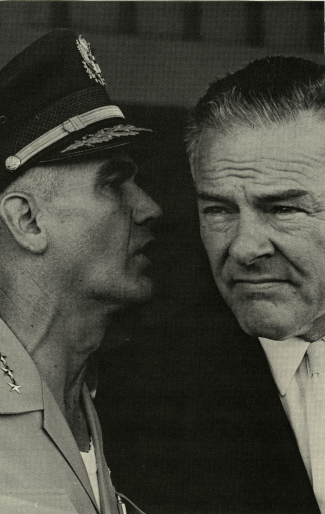
Westmoreland and
Lodge. The Ambassador had proposed the
carrot-and-stick approach to Hanoi made through Seaborn (Harry Redl from
Black Star)
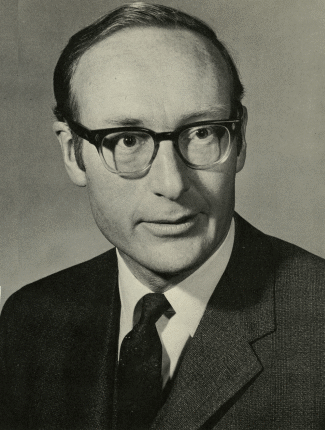
J. Blair Seaborn,
Canadian official, delivered
warning to Pham Van Dong.
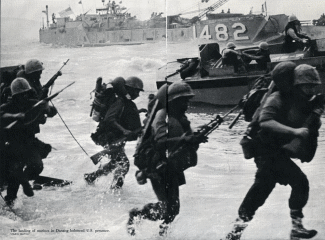
The landing of
marines in Danang bolstered U.S. presence. ("Paris Match")
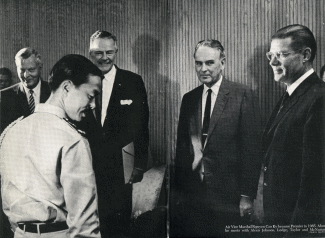
Air Vice Marshal
Nguyen Cao Ky became Premier in 1965. Above, he meets with Alexis
Johnson, Lodge, Taylor and McNamara. ("Paris Match")
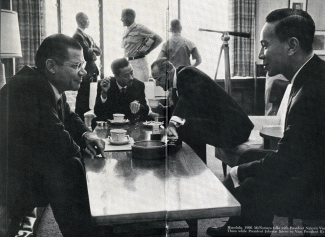
Honolulu, 1966. McNamara talks with
President Nguyen Van Thieu while President Johnson listens to Vice
President Ky.
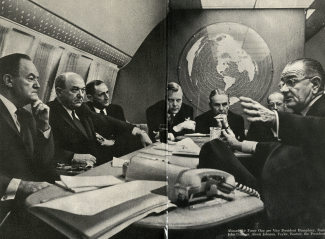
Aboard Air Force One are Vice President
Humphrey, Rusk, John Gardner, Alexis Johnson, Taylor, Rostow, the
President.
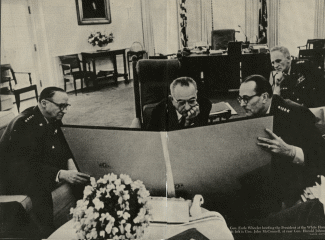
Gen. Earle Wheeler briefing the President
at the White House. At left is Gen. John McConnell, at rear Gen. Harold
Johnson ("Paris Match")
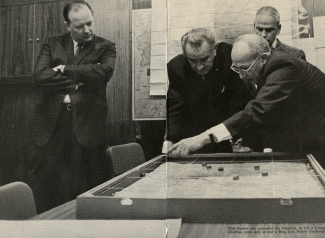
Walt Rostow also counseled the President.
At left is George Christian, press aide; at rear is Brig. Gen. Robert
Ginsburgh.
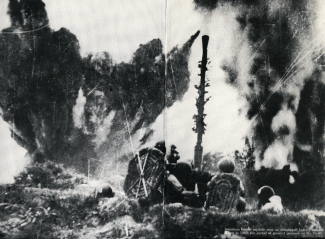
American bombs explode near an
antiaircraft battery outside Hanoi in 1967, the period of greatest
pressure on the North (Central Press).
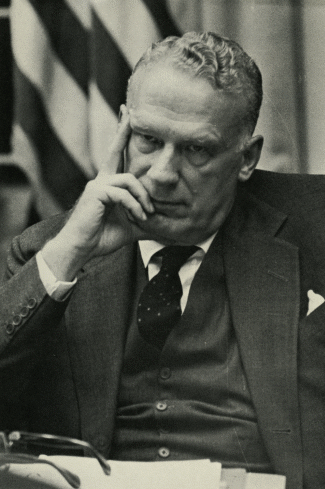
George W. Ball,
who had doubted the effectiveness of bombing
the North, proposed the U.S. "cut its losses" and withdraw (The New York
Times).
Go to Next Page |