|
BLACK EASTER -- THREE SLEEPS |
|
VI Father Domenico's interview with Theron Ware was brief, formal and edgy. The monk, despite his apprehensions, had been curious to see what the magician looked like, and had been irrationally disappointed -- to find him not much out of the ordinary run of intellectuals. Except for the tonsure, of course; like Baines, Father Domenico found that startling. Also, unlike Baines, he found it upsetting, because he knew the reason for it -- not that Ware intended any mockery of his pious counterparts, but because demons, given a moment of inattention, were prone to seizing one by the hair. "Under the Covenant," Ware told him in excellent Latin, "l have no choice but to receive you, of course, Father. And under other circumstances I might even have enjoyed discussing the Art with you, even though we are of opposite schools. But this is an inconvenient time for me. I've got a very important client here, as you've seen, and I've already been notified that what he wants of me is likely to be extraordinarily ambitious." "I shan't interfere in any way," Father Domenico said. "Even should I wish to, which obviously I shall, I know very well that any such interference would cost me all my protections." "I was sure you understood that, but nonetheless I'm glad to hear you say so," Ware said. "However, your very presence here is an embarrassment -- not only because I'll have to explain it to my client, but also because it changes the atmosphere unfavorably and will make my operations more difficult. I can only hope, in defiance of all hospitality, that your mission will be speedily satisfied." "I can't bring myself to regret the difficulty, since I only wish I could make your operations outright impossible. The best I can proffer you is strict adherence to the truce. As for the length of my stay, that depends wholly on what it is your client turns out to want, and how long that takes. I am charged with seeing it through to its conclusion." "A prime nuisance," Ware said. "I suppose I should be grateful that I haven't been blessed with this kind of attention from Monte Albano before. Evidently what Mr. Baines intends is even bigger than he thinks it is. I conclude without much cerebration that you know something about it I don't know." "It will be an immense disaster, I can ten you that." "Hmm. From your point of view, but not necessarily from mine, possibly. I don't suppose you're prepared to offer any further information -- on the chance, say, of dissuading me?" "Certainly not," Father Domenico said indignantly. "If eternal damnation hasn't dissuaded you long before this, I'd be a fool to hope to." "Well," Ware said, "but you are, after all, charged with the cure of souls, and unless the Church has done another flipflop since the last Congress, it is still also a mortal sin to assume that any man is certainly damned -- even me." That argument was potent, it had to be granted; but Father Domenico had not been trained in casuistry (and that by Jesuits) for nothing. "I'm a monk, not a priest," he said. "And "any information I give you would, on the contrary, almost certainly be used to abet the evil, not turn it aside. I don't find the choice a hard one under the circumstances." "Then let me suggest a more practical consideration," Ware said. "I don't know yet what Baines intends, but I do know well enough that I am not a Power myself -- only a fautor. I have no desire to bite off more than I can chew." "Now you're just wheedling," Father Domenico said, with energy. "Knowing
your own limitations is not an exercise at which I or anyone else can help
you. You'll just have to weigh them in the light of Mr. Baines'
commission, whatever that proves to be. In the meantime, I shall tell you
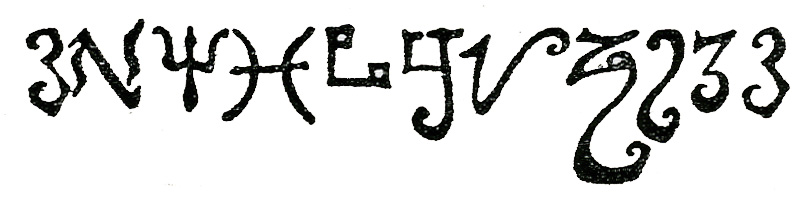
"Very well," Ware said, rising. "I will be a little more generous with my information, Father, than you have been with yours. I will tell you that you will be well advised to adhere to every letter of the Covenant. One step over the line, one toe, and I shall have you -- and hardly any outcome in this world would give me greater pleasure. I'm sure I make myself clear." Father Domenico could think of no reply; but none seemed to be necessary. VII As Ware had sensed, Baines was indeed disturbed by the presence of Father Domenico, and made a point of bringing it up as the first order of business. After Ware had explained the monk's mission and the Covenant under which it was being conducted, however, Baines felt somewhat relieved. "Just a nuisance, as you say, since he can't actually intervene," he decided. "In a way, I suppose my bringing Dr. Hess here with me is comparable -- he's only an observer, too, and fundamentally he's probably just as hostile to your world-view as this holier-than-us fellow is." "He's not significantly holier than us," Ware said with a slight smile. "I know something he doesn't know, too. He's in for a surprise in the next world. However, for the time being we're stuck with him -- for how long depends upon you. Just what is it you want this time, Dr. Baines?" "Two things, one depending on the other. The first is the death of Albert Stockhausen." "The anti-matter theorist? That would be too bad. I rather like him, and besides, some of the work he does is of direct interest to me." "You refuse?" "No, not immediately anyhow, but I'm now going to ask you what I promised I would ask on this occasion. What are you aiming at, anyhow?" "Something very long-term. For the present, my lethal intentions for Dr. Stockhausen are strictly business-based. He's nibbling at the edges of a scholium that my company presently controls completely. It's a monopoly of knowledge we don't want to see broken." "Do you think you can keep anything secret that's based in natural law? After the McCarthy fiasco I should have supposed that any intelligent American would know better. Surely Dr. Stockhausen can't be just verging on some mere technicality -- something your firm might eventually bracket with a salvo of process patents." "No, it's in the realm of natural law, and hence not patentable at all," Baines admitted. "And we already know that it can't be concealed forever. But we need about five years' grace to make the best use of it, and we know that nobody else but Stockhausen is even close to it, barring accidents, of course. We ourselves have nobody of Stockhausen's caliber, we just fell over it, and somebody else might do that. However, that's highly unlikely." "I see. Well ... the project does have an attractive side. I think it's quite possible that I can persuade Father Domenico that this is the project he came to observe. Obviously it can't be -- I've run many like it and never attracted Monte Albano's interest to this extent before -- but given sufficient show of great preparations, and difficulty of execution, he might be deluded, and go home." "That would be useful," Baines agreed. "The question is, could he be deceived?" "It's worth trying. The task would in fact be difficult -- and quite expensive." "Why?" Jack Ginsberg said, sitting bolt upright in his carved Florentine chair so suddenly as to make his suit squeak against the silk upholstery. "Don't tell us he affects thousands of other people. Nobody ever cast any votes for him that I know of." "Shut up, Jack." "No, wait, it's a reasonable question," Ware said. "Dr. Stockhausen does have a large family, which I have to take into account. And, as I've told you, I've taken some pleasure in his company on a few occasions -- not enough to balk at having him sent for, but enough to help run up the price. "But that's not the major impediment. The fact is that Dr. Stockhausen like a good many theoretical physicists these days, is a devout man -- and furthermore, he has only a few venial sins to account for, nothing in the least meriting the attention of Hell. I'll check that again with Someone who knows, but it was accurate as of six months ago and I'd be astonished if there's been any change. He's not a member of any formal congregation, but even so he's nobody a demon could reasonably have come for him -- and there's a chance that he might be defended against any direct assault." "Successfully?" "It depends on the forces involved. Do you want to risk a pitched battle that would tear up half of Dusseldorf? It might be cheaper just to mail him a bomb." "No, no. And I don't want anything that might look like some kind of laboratory accident -- that'd be just the kind of clue that would set everybody else in his field haring after what we want to keep hidden. The whole secret lies in the fact that once Stockhausen knows what we know, he could create a major explosion with -- well, with the equivalent of a blackboard and two pieces of chalk. Isn't there any other way?" "Men being men, there's always another way. In this instance, though, I'd have to have him tempted. I know at least one promising avenue. But he might not fall. And even if he did, as I think he would, it would take several months and a lot of close monitoring. Which wouldn't be altogether intolerable either, since it would greatly help to mislead Father Domenico. "What would it cost?" Jack Ginsberg said. "Oh -- say about eight million. Entirely a contingent fee this time, since I can't see that there'd be any important out-of-pocket money needed. If there is, I'll absorb it." "That's nice," Jack said. Ware took no notice of the feeble sarcasm. Baines put on his adjudicative face, but inwardly he was well satisfied. As a further test, the death of Dr. Stockhausen was not as critical as that of Governor Rogan, but it did have the merit of being in an entirely different social sphere; the benefits to Consolidated Warfare Service would be real enough, so that Baines had not had to counterfeit a motive, which might have been detected by Ware and led to premature further questions; and finally, the objections Ware had raised, while in part unexpected, had been entirely consistent with everything the magician had said before, everything that he appeared to be, everything that his style proclaimed, despite the fact that he was obviously a complex man. Good. Baines liked consistent intellectuals, and wished that he had more of them in his organization. They were always fanatics of some sort when the chips were down, and hence presented him with some large and easily grasped handle precisely when he had most need of it. Ware hadn't exhibited his handle yet, but he would; he would. "It's worth it," Baines said, without more than a decorous two seconds of apparent hesitation. "I do want to remind you, though, Dr. Ware, that Dr. Hess here is one of my conditions. I want you to allow him to watch while you operate." "Oh, very gladly," Ware said; with another smile that, this time, Baines found disquieting; it seemed false, even unctuous, and Ware was too much in command of himself to have meant the falsity not to be noticed. "I'm sure he'll enjoy it. You can all watch, if you like. I may even invite Father Domenico." VIII Dr. Hess arrived punctually the next morning for his appointment to be shown Ware's workroom and equipment. Greeting him with a professional nod -- "Coals to Newcastle, bringing Mitford and me up here for a tertiary," Hess found himself quoting in silent inanity -- Ware led the way to a pair of heavy, brocaded hangings behind his desk, which parted to reveal a heavy brass-bound door of what was apparently cypress wood. Among its fittings was a huge knocker with a face a little like the mask of tragedy, except that the eyes had cat-like pupils in them. Hess had thought himself prepared to notice everything and be surprised by nothing, but he was taken aback when the expression on the knocker changed, slightly but inarguably, when Ware touched it. Apparently expecting his startlement, Ware said without looking at him, "There's nothing in here really worth stealing, but if anything were taken it would cost me a tremendous amount of trouble to replace it, no matter how worthless it would prove to the thief. Also, there's the problem of contamination -- just one ignorant touch could destroy the work of months. It's rather like a bacteriology laboratory in that respect. Hence the Guardian. "Obviously there can't be a standard supply house for your tools," Hess agreed, recovering his composure. "No, that's not even theoretically possible. The operator must make everything himself -- not as easy now as it was in the Middle Ages, when most educated men had the requisite skills as a matter of course. Here we go." The door swung back as if being opened from the inside, slowly and soundlessly. At first it yawned on a deep scarlet gloom, but Ware touched a switch, and, with a brief rushing sound, like water, sunlight flooded the room. Immediately Hess could see why Ware had rented this particular palazzo and no other. The room was an immense refectory of Sienese design, which in its heyday must often have banquetted as many as thirty nobles; there could not be another one half as big in Positano, though the palazzo as a whole was smaller than some. There were mullioned windows overhead, under the ceiling, running around all four walls, and the sunlight was pawing through two ranks of them. They were flanked by pairs of red-velvet drapes, unpatterned, hung from traverse rods; it had been these that Hess had heard pulling back when Ware had flipped the wall switch. At the rear of the room was another door, a broad one also covered by hangings, which Hess supposed must lead to a pantry or kitchen. To the left of this was a medium-sized, modern electric furnace, and beside it an anvil bearing a hammer that looked almost too heavy for Ware to lift. On the other side of the furnace from the anvil were several graduated tubs, which obviously served as quenching baths. To the right of the door was a black-topped chemist's bench, complete with sinks, running water and the usual nozzles for illuminating gas, vacuum and compressed air; Ware must have had to install his own pumps for all of these. Over the bench on the back wall were shelves of reagents; to the right, on the side wall, ranks of drying pegs, some of which bore contorted pieces of glassware, others, coils of rubber tubing. Farther along the wall toward the front was a lectern bearing a book as big as an unabridged dictionary, bound in red leather and closed and locked with a strap. There was a circular design chased in gold on the front of the book, but at this distance Hess could not make out what it was. The lectern was flanked by two standing candlesticks with fat candles in them; the candles had been extensively used, although there were shaded electric-light fixtures around the walls, too, and the small writing table next to the lectern bore a Tensor lamp. On the table was another book, smaller but almost as thick, which Hess recognized at once: the Handbook of Chemistry and Physics, forty-seventh edition, as standard a laboratory fixture as a test tube; and, a rank of quill pens and inkhorns. "Now you can see something of what I meant by requisite skills," Ware said. "Of course I blow much of my own glassware, but any ordinary chemist does that. But should I need a new sword, for instance" -- he pointed toward the electric furnace -- "I'd have to forge it myself. I couldn't just pick one up at a costume shop. I'd have to do a good job of it, too. As a modem writer says somewhere, the only really serviceable symbol for a sharp sword is a sharp sword." "Uhm," Hess said, continuing to look around. Against the left wall, opposite the lectern, was a long heavy table, bearing a neat ranking of objects ranging in length from six inches to about three feet, all closely wrapped in red silk. The wrappers had writing on them, but again Hess could not decipher it. Beside the table, affixed to the wall, was a flat sword cabinet. A few stools completed the furnishings; evidently Ware seldom worked sitting down. The floor was parqueted, and toward the center of the room still bore traces of marks in colored chalks, considerably scuffed, which brought from Ware a grunt of annoyance. "The wrapped instruments are all prepared and I'd rather not expose them," the magician said, walking toward the sword rack, "but of course I keep a set of spares and I can show you those." He opened the cabinet door, revealing a set of blades hung in order of size. There were thirteen of them. Some were obviously swords; others looked more like shoemaker's tools. "The order in which you make these is important, too," Ware said, "because, as you can see, most of them have writing on them, and it makes a difference what instrument does the writing. Hence I began with the uninscribed instrument, this one, the bolline or sickle, which is also one of the most often used. Rituals differ, but the one I use requires starting with a piece of unused steel. It's fired three times, and then quenched in a mixture of magpie's blood and the juice of an herb called foirole." "The Grimorium Verum says mole's blood and pimpernel juice," Hess observed. "Ah, good, you've been doing some reading. I've tried that, and it just doesn't seem to give quite as good an edge." "I should think you could get a still better edge by finding out what specific compounds were essential and using those," Hess said. "You'll remember that Damascus steel used to be tempered by plunging the sword into the body of a slave. It worked, but modem quenching baths are a lot better -- and in your case you wouldn't have to be constantly having to trap elusive animals in large numbers." "The analogy is incomplete," Ware said. "It would hold if tempering were the only end in view, or if the operation were only another observance of Paracelsus' rule, Alterius non sit qui suus esse potest -- doing for yourself what you can't trust others to do. Both are practical ends that I might satisfy in some quite different way. But in magic the blood sacrifice has an additional function -- what we might call the tempering of, not just the steel, but also the operator." "I see. And I suppose it has some symbolic functions, too." "In goetic art, everything does. In the same way, as you probably also know from your reading, the forging and quenching is to be done on a Wednesday in either the first or the eighth of the day hours, or the third or the tenth of the night hours, under a full Moon. There is again an immediate practical interest being served here -- for I assure you that the planetary hours do indeed affect affairs on Earth -- but also a psychological one, the obedience of the operator in every step. The grimoires and other handbooks are at best so confused and contradictory that it's never possible to know completely what steps are essential and what aren't, and research into the subject seldom makes for a long life." "All right," Hess said. "Go on." "Well, the horn handle has next to be shaped and fitted, again in a particular way at a particular hour, and then perfected at still another day and hour. By the way, you mentioned a different steeping bath. If you use that ritual, the days and the hours are also different, and again the question is, what's essential and what isn't? Thereafter, there's a conjuration to be recited, plus three salutations and a warding spell. Then the instrument is sprinkled, wrapped and fumigated -- not in the modern sense, I mean it's perfumed -- and is ready to use. After it's used, it has to be exorcised and re-dedicated, and that's the difference between the wrapped tools on the table and those hanging here in the rack. "I won't go into detail about the preparation of the other instruments. The next one I make is the pen of the Art followed by the inkpots and the inks, for obvious reasons -- and, for the same reasons, the burin or graver. The pens are on my desk. This fitted needle here is the burin. The rest, going down the line as they hang here rather than in order of manufacture, are the white-handled knife, which like the bolline is nearly an all-purpose tool ... the black-handled knife, used almost solely for inscribing the circle ... the stylet, chiefly for preparing the wooden knives used in tanning ... the wand or blasting rod, which describes itself ... the lancet, again self-descriptive ... the staff, a restraining instrument analogous to a shepherd's ... and lastly the four swords, one for the master, the other three for his assistants, if any." With a side-glance at Ware for permission, Hess leaned forward to inspect the writings on the graven instruments. Some of them were easy enough to make out: on the sword of the master, for instance, the word MICHAEL appeared on the pommel, and on the blade, running from point to hilt, ELOHIM GIBOR. On the other hand, on the handle of the white-handled knife was engraved the following:
Hess pointed to this, and to a different but equally baffling inscription that was duplicated on the handles of the stylet and the lancet. "What do those mean?" "Mean? They can hardly be said to mean anything any more. They're greatly degenerate Hebrew characters, originally comprising various Divine Names. I could tell you what the Names were once, but the characters have no content any more -- they just have to be there." "Superstition," Hess aid, recalling his earlier conversation with Baines, interpreting Ware's remark about Christmas. "Precisely, in the pure sense. The process is as fundamental to the Art as evolution is to biology. Now if you'll step this way, I'll show you some other aspects that may interest you." He led the way diagonally across the room to the chemist's bench, pausing to rub irritatedly at the chalk marks with the sole of his slipper. "I suppose a modem translation of that aphorism of Paracelsus," he said, "would be 'You just can't get good servants any more.' Not to ply mops, anyhow.... Now, most of these reagents will be familiar to you, but some of them are special to the Art. This, for instance, is exorcised water, which as you see I need in great quantities. It has to be river water to start with. The quicklime is for tanning. Some laymen, de Camp for instance, will tell you that 'virgin parchment' simply means parchment that's never been written on before, but that's not so -- all the grimoires insist that it must be the skin of a male animal that has never engendered, and the Clavicula Salomonis sometimes insists upon unborn parchment, or the caul of a newborn child. For tanning I also have to grind my own salt, after the usual rites are said over it. The candles I use have to be made of the first wax taken from a new hive, and so do my almadels. If I need images, I have to make them of earth dug up with my bare hands and reduced to a paste without any tool. And so on. "I've mentioned aspersion and fumigation, in other words sprinkling and perfuming. Sprinkling has to be done with an aspergillum, a bundle of herbs like a fagot or bouquet garni. The herbs differ from rite to rite and you can see I've got a fair selection here -- mint, marjoram, rosemary, vervain, periwinkle, sage, valerian, ash, basil, hyssop. In fumigation the most commonly used scents are aloes, incense, mace, benzoin, storax. Also, it's sometimes necessary to make a stench -- for instance in the fumigation of a caul --- and I've got quite a repertoire of those." Ware turned away abruptly, nearly treading on Hess' toes and strode toward the exit. Hess had no choice but to follow him. "Everything involves special preparation," he said over his shoulder,"even including the firewood if I want to make ink for pacts. But there's no point in my cataloging things further, since I'm sure you thoroughly understand the principles." Hess scurried after, but he was still several paces behind the magician when the window drapes swished closed and the red gloom was reinstated. Ware stopped and waited for him, and the moment he was through the door, closed it and went back to his seat behind the big desk. Hess, puzzled, walked around the desk and took one of the Florentine chairs reserved for guests or clients. "Most illuminating," he said politely. "Thank you." "You're welcome." Ware rested his elbows on the desk and put his fingertips over his mouth, looking down thoughtfully. There was a sprinkle of perspiration over his brow and shaven head, and he seemed more than usually pale; also, Hess noticed after a moment, he seemed to be trying, without major effort, to control his breathing. Hess watched curiously, wondering what could have upset him. After only a moment, however, Ware looked up at him and volunteered the explanation, with an easy half smile. "Excuse me, he said. "From apprenticeship on, we're trained to secrecy. I'm perfectly convinced that it's unnecessary these days, and has been since the Inquisition died, but old oaths are the hardest to reason away. No discourtesy intended." "No offense taken," Hess assured him. "However, if you'd rather rest ..." "No, I'll have ample rest in the next three days, and be incommunicado, too, preparing for Dr. Baines' commission. So if you've further questions, now's the time for them." "Well ... I have no further technical questions, for the moment. But I am curious about a question Baines asked you during your first meeting -- I needn't pretend, I'm sure, that I haven't heard the tape. I wonder, just as he did, what your motivation is. I can see from what you've shown me, and from everything you've said, that you've taken colossal amounts of trouble to perfect yourself in your Art, and that you believe in it. So it doesn't matter for the present whether or not I believe in it, only whether or not I believe in you. And your laboratory isn't a sham, it isn't there solely for extortion's sake, it's a place where a dedicated man works at something he thinks important. I confess I came to scoff -- and to expose you, if I could -- and I still can't credit that any of what you do works, or ever did work. But I accept that you do believe." Ware gave him a half nod. "Thank you; go on." "I've no further to go but the fundamental question. You don't really need money, you don't seem to collect art or women, you're not out to be President of the World or the power behind some such person -- and yet by your lights you have damned yourself eternally to make yourself expert in this highly peculiar subject. What on earth for?" "l could easily duck that question," Ware said slowly. "I could point out, for instance, that under certain circumstances I could prolong my life to seven hundred years, and so might not be worrying just yet about what might happen to me in the next world. Or I could point out what you already know from the texts, that every magician hopes to cheat Hell in the end -- as several did who are now nicely ensconced on the calendar as authentic saints. "But the real fact of the matter, Dr. Hess, is that I think what I'm after is worth the risk, and what I'm after is something you understand perfectly, and for which you've sold your own soul, or if you prefer an only slightly less loaded word, your integrity, to Dr. Baines -- knowledge." "Uhmn. Surely there must be easier ways --" "You don't believe that. You think there may be more reliable ways, such as scientific method, but you don't think they're any easier. I myself have the utmost respect for scientific method, but I know that it doesn't offer me the kind of knowledge I'm looking for -- which is also knowledge about the makeup of the universe and how it is run, but not a kind that any exact science can provide me with, because the sciences don't accept that some of the forces of nature are Persons. Well, but some of them are. And without dealing with those Persons I shall never know any of the things I want to know. "This kind of research is just as expensive as underwriting a gigantic particle accelerator, Dr. Hess, and obviously I'll never get any government to underwrite it. But people like Dr. Baines can, if I can find enough of them -- just as they underwrite you. ''Eventually, I may have to pay for what I've learned with a jewel no amount of money could buy. Unlike Macbeth, I know one can't 'skip the life to come.' But even if it does come to that, Dr. Hess -- and probably it will -- I'll take my knowledge with me, and it will have been worth the price. "In other words -- just as you suspected -- I'm a fanatic." To his own dawning astonishment, Hess said slowly: "Yes. Yes, of course ... so am I." IX Father Domenico lay in his strange bed on his back, staring sleeplessly up at the pink stucco ceiling. Tonight was the night he had come for. Ware's three days of fasting, lustration and prayer -- surely a blasphemous burlesque of such observances as the Church knew them, in intent if not in content -- were over, and he had pronounced himself ready to act. Apparently he still intended to allow Baines and his two repulsive henchmen to observe the conjuration, but if he had ever had any intention of including Father Domenico in the Ceremony, he had thought better of it. That was frustrating, as well as a great relief; but, in his place, Father Domenico would have done the same thing. Yet even here, excluded from the scene and surrounded by every protection he had been able to muster, Father Domenico could feel the preliminary oppression, like the dead weather before an earthquake. There was always a similar hush and tension in the air just before the invocation of one of the Celestial Powers, but with none of these overtones of maleficence and disaster ... or would someone ignorant of what was actually proposed be able to tell the difference? That was a disquieting thought in itself, but one that could practically be left to Bishop Berkeley and the logical positivists. Father Domenico knew what was going on -- a ritual of supernatural murder; and could not help but tremble in his bed. Somewhere in the Palazzo there was the silvery sound of a small clock striking, distant and sweet. The time was now 10:00 P.M., the fourth hour of Saturn on the day of Saturn, the hour most suitable -- as even the blameless and pitiable Peter de Abano had written -- for experiments of hatred, enmity and discord; and Father Domenico, under the Covenant, was forbidden even to pray for failure. The clock, that two-handed engine that stands behind the Door, struck, and struck no more, and Ware drew the brocaded hangings aside. Up to now, Baines, despite himself, had felt a little foolish in the girdled white-linen garment Ware had insisted upon, but he cheered up upon seeing Jack Ginsberg and Dr. Hess in the same vestments. As for Ware, be was either comical or terrible, depending upon what view one took of the proceedings, in his white Levite surcoat with red-silk embroidery on the breast, his white-leather shoes lettered in cinnabar, and his paper crown bearing the word EL. He was girdled with a belt about three inches wide, which seemed to have been made from the skin of some hairy, lion-colored animal. Into the girdle was thrust a red-wrapped, scepter-like object, which Baines identified tentatively from a prior description of Hess' as the wand of power. "And now we must vest ourselves," Ware said, almost in a whisper. "Dr. Baines, on the desk you will find three garments. Take one, and then another, and another. Give two to Dr. Hess and Mr. Ginsberg. Don the other yourself." Baines picked up the huddle of cloth. It turned out to be an alb. "Take up your vestments and lift them in your hands above your heads. At the amen, let them fall. Now: "ANTON, AMATOR, EMITES, THEODONIEL, PONCOR, PAGOR, ANITOR, by the virtue of these most holy angelic names do I clothe myself, O Lord of Lords, in my Vestments of Power, that so that I may fulfill, even unto their term, all things which I desire to effect through Thee, IDEODANIACH, PAMOR, PLAIOR, Lord of Lords, whose kingdom and rule endureth forever and ever. Amen." The garments rustled down, and Ware opened the door. The room beyond was only vaguely lit with yellow candlelight, and at first bore almost no resemblance to the chamber Dr. Hess had described to Baines. As his eyes accommodated, however, Baines was gradually able to see that it was the same room, its margins now indistinct and its furniture slightly differently ordered: only the lectern and the candlesticks -- there were now four of them, not two -- were moved out from the walls and hence more or less visible. But it was still confusing, a welter of flickering shadows and slightly sickening perfume, most unlike the blueprint of the room that Baines had erected in his mind from Hess' drawing. The thing that dominated the real room itself was also a drawing, not any piece of furniture or detail of architecture: a vast double circle on the floor in what appeared to be whitewash. Between the concentric circles were written innumerable words, or what might have been words, in characters which might have been Hebrew, Greek, Etruscan or even Elvish for all Baines could tell. Some few were in Roman lettering, but they, too, were names he could not recognize; and around the outside of the outer circle were written astrological signs in their zodiacal order, but with Saturn to the north. At the very center of this figure was a ruled square about two feet on a side, from each corner of which proceeded chalked, conventionalized crosses, which did not look in the least Christian. Proceeding from each of these, but not connected to them, were four six-pointed stars, verging on the innermost circle. The stars at the east, west and south each had a Tau scrawled at their centers; presumably the Saturnmost did too, but if so it could not be seen, for the heart of that emplacement was hidden by what seemed to be a fat puddle of stippled fur. Outside the circles, at the other compass points, were drawn four pentagrams, in the chords of which were written TE TRA GRAM MA TON, and at the centers of which stood the candles. Farthest away from all this -- about two feet outside the circle and three feet over it to the north -- was a circle enclosed by a triangle, also much lettered inside and out; Baines could just see that the characters in the angles of the triangle read NI CH EL. "Tanists," Ware whispered, pointing into the circle, "take your places." He went toward the long table Hess had described and vanished in the gloom. As instructed, Baines walked into the circle and stood in the western star; Hess followed, taking the eastern; and Ginsberg, very slowly, crept into the southern. To the north, the puddle of fur revolved once widdershins and resettled itself with an unsettling sigh, 'making Jack Ginsberg jump. Baines inspected it belatedly. Probably it was only a cat, as was supposed to be traditional, but in this light it looked more like a badger. Whatever it was, it was obscenely fat. Ware reappeared, carrying a sword. He entered the circle, closed it with the point of the sword, and proceeded to the central square, where he lay the sword across the toes of his white shoes; then he drew the wand from his belt and unwrapped it, laying the red-silk cloth across his shoulders. "From now on," he said, in a normal, even voice, "no one is to move." From somewhere inside his vestments he produced a small crucible, which he set at his feet before the recumbent sword. Small blue flames promptly began to rise from the bowl, and Ware cast incense into it. He said: "Holocaust. Holocaust. Holocaust." The flames in the brazier rose slightly. "We are to call upon MARCHOSIAS, a great marquis of the Descending Hierarchy," Ware said in the same conversational voice. "Before he fell, he belonged to the Order of Dominations among the angels, and thinks to return to the Seven Thrones after twelve hundred years. His virtue is that he gives true answers. Stand fast, all." With a sudden motion, Ware thrust the end of his rod into the surging flames of the brazier. At once the air of the hall rang with a long, frightful chain of woeful howls. Above the bestial clamor, Ware shouted: "I adjure thee, great MARCHOSIAS, as the agent of the Emperor LUCIFER, and of his beloved son LUCIFUGE ROFOCALE, by the power of the pact I have with thee, and by the Names ADONAY, ELOIM, JEHOVAM, TAGLA, MATHON, ALMOUZIN, ARIOS, PITHONA, MAGOTS, SYLPHAE, TABOTS, SALAMANDRAE, GNOMUS, TERRAE, COELIS, GODENS, AQUA, and by the whole hierarchy of superior intelligences who shall constrain thee against thy will, venite, venite, submiritillor MARCHOSIAS!" The noise rose higher, and a green steam began to come off the brazier. It smelt like someone was burning hart's horn and fish gall. But there was no other answer. His face white and cruel, Ware rasped over the tumult: "I adjure thee, MARCHOSIAS, by the pact, and by the Names, appear instanter!" He plunged the rod a second time into the flames. The room screamed; but still there was no apparition. "Now I adjure thee, LUCIFUGE ROFOCALE, whom I command, as the agent of the Lord and Emperor of Lords, send me thy messenger MARCHOSIAS, forcing him to forsake his hiding place, wheresoever it may be, and warning thee --" The rod went back into the fire. Instantly, the palazzo rocked as though the earth had moved under it. "Stand fast!" Ware said hoarsely. Something Else said: HUSH, I AM HERE. WHAT DOST THOU SEEK OF ME? WHY DOST THOU DISTURB MY REPOSE? LET MY FATHER REST, AND HOLD THY ROD. Never had Baines heard a voice like that before. It seemed to speak in syllables of burning ashes. "Hadst thou appeared when first I invoked thee, I had by no means smitten thee, nor called thy father," Ware said. "Remember, if the request I make of thee be refused, I shall thrust again my rod into the fire." THINK AND SEE! The palazzo
shuddered again. Then, from the middle of the triangle to the northwest, a
slow cloud of yellow fumes went up toward the ceiling,
making them all cough, even Ware. As it spread and thinned, Baines could see a shape
forming under it; but he found it impossible to believe. It The cloud continued to dissipate. The she-wolf glared at them, slowly spreading her griffin's wings. Her serpent's tail lashed gently, scalily. In the northern pentacle, the great Abyssinian cat sat up and stared back. The demon-wolf showed her teeth and emitted a disgusting belch of fire. The cat settled its front feet indifferently. "Stand, by the Seal" Ware said. "Stand and transform, else I shall plunge thee back whence thou camest. I command thee." The she-wolf vanished, leaving behind in the triangle a plump, modest-looking young man wearing a decorous neck tie, a dildo almost as long and nothing else. "Sorry, boss," he said in a sugary voice. "I had to try, you know. What's up?" "Don't try to wheedle me, vision of stupidity," Ware said harshly. "Transform, I demand of thee, thou'rt wasting thy father's time, and mine! Transform!" The young man stuck out his tongue, which was copper-green. A moment later, the triangle was occupied by a black-bearded man apparently twice his age, wearing a forest-green robe trimmed in ermine and a glittering crown. It hurt Baines' eyes to look at it. An odor of sandalwood began slowly to diffuse through the room. "That's better," Ware said. "Now I charge thee, by those Names I have named and on pain of those torments thou hast known, to regard the likeness and demesne of that mortal whose eidolon I hold in my mind, and that when I release thee, thou shalt straightaway go unto him, not making thyself known unto him, but revealing, as it were to come from his own intellectual soul, a vision and understanding of that great and ultimate Nothingness which lurks behind those signs he calls matter and energy, as thou wilt see it in his private forebodings, and that thou remainest with him and deepen his despair without remittal, until such time as he shall despise his soul for its endeavors, and destroy the life of his body." "I cannot give thee," the crowned figure said, in a voice deep but somehow lacking all resonance, "what thou requirest." "Refusal will not avail thee," Ware said, "for either shalt thou go incontinently and perform what I command, or I shall in no wise dismiss thee, but shall keep thee here unto my life's end, and torment thee daily, as thy father permitteth." "Thy life itself, though it last seven hundred years, is but a day to me," said the crowned figure. Sparks issued from its nostrils as it spoke. "And thy torments but a farthing of those I have endured since ere the cosmic egg was hatched, and Eve invented." For answer, Ware again stabbed the rod into the fire, which, Baines noted numbly, failed even to scorch it. But the crowned figure threw back its bearded head and howled desolately. Ware withdrew the rod, but only by a hand's' breadth. "I shall do as thou commandest," the creature said sullenly. Hatred oozed from it like lava. "Be it not performed exactly, I shall call thee up again," Ware said. "But be it executed, for thy pay thou shalt carry off the immortal part of the subject thou shalt tempt, which is as yet spotless in the sight of Heaven, and a great prize." "But not yet enough," said the demon. "For thou must give me also somewhat of thine hoard, as it is written in the pact." "Thou art slow to remember the pact," Ware said. "But I would deal fairly with thee, knowing marquis. Here." He reached into his robe and drew out something minute and colorless, which flashed in the candlelight. At first, Baines took it to be a diamond, but as Ware held it out, he recognized it as an opalescent, crystal tear vase, the smallest he had ever seen, stopper, contents and all. This Ware tossed, underhand, out of the circle to the fuming figure, which to Baines' new astonishment -- for he had forgotten that what he was really looking at had first exhibited as a beast -- caught it skillfully in its mouth and swallowed it. "Thou dost only tantalize MARCHOSIAS," the Presence said. "When I have thee in Hell, magician, then shall I drink thee dry, though thy tears flow never so copiously." "Thy threats are empty. I am not marked for thee, shouldst thou see me in Hell forthever," Ware said. "Enough, ungrateful monster. Cease thy witless plaudering and discharge thine errand. I dismiss thee." The crowned figure snarled, and then, suddenly, reverted to the form in which it had first showed itself. It vomited a great gout of fire, but the surge failed to pass the wall of the triangle; instead, it collected in a ball around the demon itself. Nevertheless, Baines could feel the heat against his face. Ware raised his wand. The floor inside the small circle vanished. The apparition clashed its brazen wings and dropped like a stone. With a rending thunderclap, the floor healed seamlessly. Then there was silence. As the ringing in Baines' ears died away, he became aware of a distant thrumming sound, as though someone had left a car idling in the street in front of the palazzo. Then he realized what it was: the great cat was purring. It had watched the entire proceedings with nothing more than grave interest. So, apparently, had Hess. Ginsberg seemed to be jittering, but he was standing his ground. Although he had never seen Jack rattled before, Baines could hardly blame him; he himself felt sick and giddy, as though just the effort of looking at MARCHOSIAS had been equivalent to having scrambled for days up some Himalayan glacier. "It is over," Ware said in a gray whisper. He looked very old. Taking up his sword, he cut the diagram with it. "Now we must wait. I will be in seclusion for two weeks. Then we will consult again. The circle is open. You may leave." Father Domenico heard the thunderclap, distant and muffled, and knew that the sending had been made -- and that he was forbidden, now as before, even to pray for the soul of the victim (or the patient, in Ware's antiseptic Aristotelian terminology). Sitting up and swinging his feet over the edge of the bed, breathing with difficulty in the musky, detumescent air, he walked unsteadily to his satchel and opened it. Why -- that was the question -- did God so tie his hands, why did He allow such a compromise as the Covenant at all? It suggested, at least, some limitation in His power unallowable by the firm dogma of Omnipotence, which it was a sin even to question; or, at worst, some ambiguity in His relationship with Hell, one quite outside the revealed answers to the Problem of Evil. That last was a concept too terrible to bear thinking about. Probably it was attributable purely to the atmosphere here; in any event, Father Domenico knew that he was in no spiritual or emotional condition to examine it now. He could, however, examine with possible profit a minor but related question: Was the evil just done the evil Father Domenico had been sent to oversee? There was every immediate reason to suppose that it was -- and if it was, then Father Domenico could go home tomorrow, ravaged but convalescent. On the other hand, it was possible -- dreadful, but in a way also hopeful -- that Father Domenico had been commanded to Hell-mouth to await the emission of something worse. That would resolve the puzzling anomaly that Ware's latest undertaking, abominable though they all were, was for Ware not unusual. Much more important, it would explain, at least in part, why the Covenant existed at all: in Tolstoy's words, "God sees the truth, but waits." And this question, at least, Father Domenico need not simply ponder, but could actively submit to the Divine guidance, even here, even now, provided that he call upon no Presences. That restriction was not prohibitive; what was he a magician for, if not to be as subtle in his works as in his praise? Inkhorn, quill, straightedge, three different discs of different sizes cut from virgin cardboard -- not an easy thing to come by -- and the wrapped burin came out of the satchel and were arranged on top of his dresser, which would serve well enough for a desk. On the cardboard discs he carefully inscribed three different scales: the A camerae of sixteen divine attributes, from bonitas to patientia; the T camerae of thirty attributes of things, from temporis to negatio; and the E camerae of the nine questions, from whether to how great. He centerpunched all three discs with the burin, pinned them together with a cuff link and finally asperged the assembled Lull Engine with holy water from the satchel. Over it he said: "I conjure thee, O form of this instrument, by the authority of God the Father Almighty, by the virtue of Heaven and the stars, by that of the elements, by that of stones and herbs, and in like manner by the virtue of snowstorms, thunder and winds, and belike also by the virtue of the Ars magna in whose figure thou art drawn, that thou receive all power unto the performance of those things in the perfection of which we are concerned, the whole without trickery, falsehood or deception, by the command of God, Creator of the Angels and Emperor of the Ages. DAMAHII, LUMECH, GADAL, PANCIA, VELOAS, MEOROD, LAMlDOCH, BALDACH, ANERETHON, MITRATON, most holy angels, be ye wardens of this instrument. Domine, Deus meus, in te speravi .... Confitebor tibi, Domine, in toto corde meo.... Quemadmodum desiderat cervus ad fontes aquarum.... Amen." This said, Father Domenico took up the engine and turned the circles against each other. Lull's great art was not easy to use; most of the possible combinations of any group of wheels were trivial and it took reason to see which were important, and faith to see which were inspired. Nevertheless, it had one advantage over all other forms of scrying: it was not, in any strict sense, a form of magic. He turned the wheels at random the required number of tunes, and then, taking the outermost by its edge, shook it to the four quarters of the sky. He was almost afraid to look at the result. But on that very first essay, the engine had generated: PATIENCE/BECOMING/REALITY It was the answer he had both feared and hoped for. And it was, he realized with a subdued shock, the only answer he could have expected on Christmas Eve. He put the engine and the tools back in his satchel crept away into the bed. In his state of overexhaustion and alarm, he did not expect to sleep ... but within two turns of the glass he was no longer in the phenomenal world, but was dreaming instead that, like Gerbert the magician-Pope, he was fleeing the Holy Office down the wind astride a devil. X Ware's period of recovery did not last quite as long as he had prophesied. He was visibly up and about by Twelfth Night. By that time, Baines -- though only Jack Ginsberg could see and read the signs -- was chafing at the inaction. Jack had to remind him that in any event at least two months were supposed to pass before the suicide of Dr. Stockhausen could even be expected, and suggested that in the interim they all go back to Rome and to work. Baines shrugged the suggestion off. Whatever else was on his mind, it did not seem to involve Consolidated Warfare Service's interests more than marginally ... or, at least, the thought of business could not distract him beyond the making of a small number of daily telephone calls. The priest or monk or whatever he was, Father Domenico, was still in attendance too. Evidently he had not been taken in by the show. Well, that was Ware's problem, presumably. All the same, Jack stayed out of sight of the cleric as much as possible; having him around, Jack recalled in a rare burst of association with his Bronx childhood, was a little like being visited by a lunatic Orthodox relative during a crucial marriage brokerage. Not so lunatic at that, though; for if magic really worked -- as Jack had had to see that it did -- then the whole tissue of metaphysical assumptions Father Domenico stood for, from Moses through the kabbalah to the New Testament, had to follow, as a matter of logic. After this occurred to Jack, he not only hated to see Father Domenico, but had nightmares in which he felt that Father Domenico was looking back at him. Ware himself, however, did not emerge officially, to be talked to, until his predicted fourteenth day. Then, to Jack's several-sided disquietude, the first person he called into his office was Jack Ginsberg. Jack wanted to talk to Ware only slightly more than he wanted to talk to the barefooted, silently courteous Father Domenico; and the effect upon Baines of Ware's singling Jack out for the first post-conjuration interview, though under ordinary circumstances it could have been discounted as minor, could not even be conjectured in Baines' present odd state of mind. After a troubled hour, Jack took the problem to Baines, not even sure any more of his own delicacy in juggling such an egg. "Go ahead," was all Baines said. He continued to give Jack the impression of a man whose mind was not to be turned more than momentarily from some all-important thought. That was alarming, too, but there seemed to be nothing to be done about it. Setting his face into its business mold of pleasant attentiveness over slightly clenched teeth, Jack marched up to Ware's office. The sunlight there was just as bright and innocent as ever, pouring directly in from the sea-sky on top of the cliff. Jack felt slightly more in contact with what he had used to think of as real life. In some hope of taking the initiative away from Ware and keeping it, he asked the magician, even before sitting down, "Is there some news already?" "None at all," Ware said. "Sit down, please. Dr. Stockhausen is a tough patient, as I warned you all at the beginning. It's possible that he won't fall at all, in which case a far more strenuous endeavor will be required. But in the meantime I'm assuming that he will, and that I therefore ought to be preparing for Dr. Baines' next commission. That's why I wanted to see you first." "I haven't any idea what Dr. Baines' next commission is," Jack said, "and if I did I wouldn't tell you before he did." "You have a remorselessly literal mind, Mr. Ginsberg. I'm not trying to pump you. I already know, and it's enough for the time being, that Mr. Baines' next commission will be something major, perhaps even a unique experiment in the history of the Art. Father Domenico's continued presence here suggests the same sort of thing. Very well, if I'm to tackle such a project, I'll need assistants -- and I have no remaining apprentices. They become ambitious very early and either make stupid technical mistakes or have to be dismissed for disobedience. Laymen, even sympathetic laymen, are equally mischancy, simply because of their eagerness and ignorance. But if they're highly intelligent, it's sometimes safe to use them. Sometimes. Given those disclaimers, that explains why I allowed you and Dr. Hess to watch the Christmas Eve affair, not just Dr. Hess, whom Dr. Baines had asked for, and why I want to talk to you now." "I see," Jack said. "I suppose I should be flattered." Ware sat back in his chair and raised his hands as if exasperated. "Not at all. I see that I'd better be blunt. I was quite satisfied with Dr. Hess' potentialities and so don't need to talk to him any more, except to instruct him. But I am none too happy with yours. You strike me as a weak reed." "I'm no magician," Jack said, holding onto his temper. "If there's some hostility between us, it's only fair to recognize that I'm not its sole cause. You went out of your way to insult me at our very first interview, only because I was normally suspicious of your pretensions, as I was supposed to be, on behalf of my job. I'm not easily offended, Dr. Ware, but I'm more cooperative if people are reasonably polite to me." "Stercor," Ware said. The word meant nothing to Jack. "You keeping thinking I'm talking about public relations, and getting along with people, and all that goose grease. Far from it. A little hatred never hurts the Art, and studied insult is valuable in dealing with demons -- there are only a few who can be flattered to any profit, and the man who can be flattered isn't a man at all, he's a dog. Do try to understand me, Mr. Ginsberg. What I'm talking about is neither your footling hostility nor your unexpectedly slow brains, but your rabbit's courage. There was a moment during the last ceremony when I could see that you were going to step out of your post. You didn't know it, but I had to paralyze you, and I saved your life. If you had moved you would have endangered all of us, and had that happened I would have thrown you to MARCHOSIAS like an old bone. It wouldn't have saved the purpose of the ceremony, but it would have kept the demon from gobbling up everybody else but Ahktoi." "Ach ... ?" "My familiar. The cat." "Oh. Why not the cat?" "He's on loan. He belongs to another demon -- my patron. Do stop changing the subject, Mr. Ginsberg. If I'm going to trust you as a Tanist in a great work, I'm going to have to be reasonably sure that you'll stand fast when I tell you to stand fast, no matter what you see or hear, and that when I ask you to take some small part in the ritual, you'll do it accurately and punctually. Can you assure me of this?" "Well," Jack said earnestly, "I'll do my best." "But what for? Why do you want to sell me? I don't know what you mean by your 'best' until I know what's in it for you, besides just keeping you your job -- or making a good impression on me because it's a reflex with you to make a good impression on people. Explain this to me, please! I know that there's something in this situation that hits you where you live. I could see that from the outset, but my first guess as to what it was evidently was wrong, or anyhow not central. Well, what is central to you? The situation has now ripened to the point when you're going to have to tell me what it is. Otherwise I shall shut you out, and that will be that." Wobbling between unconventional hope and standard caution, Jack pushed himself out of the Florentine chair and toe-heel-toed to the window, adjusting his tie automatically. From this height, the cliff-clinging apartments of Positano fell away to the narrow beach like so many Roman tenements crowded with deposed kings -- and with beach boys hoping to pick up an American heiress for the season. Except for the curling waves and a few distant birds, the scene was motionless, yet somehow to Jack it seemed to be slowly, inexhoraby sliding into the sea. "Sure, I like women," he said in a low voice. "And I've got special preferences I don't find it easy to satisfy, even with all the money I make. For one thing, in my job I'm constantly working with classified material -- secrets -- either some government's, or the company's. That means I don't dare put myself into a position where I could be blackmailed." "Which is why you refused my offer when we first talked," Ware said. "That was discreet, but unnecessary. As you've probably realized by now, neither spying nor extortion has any attraction for me -- the potential income from either or both would be a pittance to me." "Yes, but I won't always have you around," Jack said, turning back toward the desk. "And I'd be stupid to form new tastes that only you could keep supplied." "'Pander to' is the expression. Let's be precise. Nevertheless, you have some remedy in mind Otherwise you wouldn't be being even this frank." "Yes ... I do. It occurred to me when you agreed to allow Hess to tour your laboratory." He was halted by another stab of jealousy, no less acute for being half reminiscent. Drawing a deep breath, he went on, "I want to learn the Art." "Oho. That is a reversal." "You said it was possible," Jack said in a rush, emboldened by a desperate sense of having now nothing to lose. "I know you said you don't take apprentices, but I wouldn't be trying to stab you in the back or take over your clients, I'd only be using the Art for my specialized purposes. I couldn't pay you any fortune, but I do have money. I could do the reading in my spare time, and come back after a year or so for the actual instruction. I think Baines would give me a sabbatical for that -- he wants somebody on his staff to know the Art, at least the theory, only he thinks it's going to be Hess. But Hess will be too busy with his own sciences to do a thorough job of it." "You really hate Dr. Hess, don't you?" "We don't impinge," Jack said stiffly. "Anyhow what I say is true. I could be a lot better expert from Baines' point of view than Hess ever could." "Do you have a sense of humor, Mr. Ginsberg?" "Certainly. Everybody does." "Untrue," Ware said. "Everybody claims to have, that's all. I ask only because the first thing to be sacrificed to the Art is the gift of laughter, and some people would miss it more than others. Yours seems to be residual at best. In you it would probably be a minor operation, like an appendectomy." "You don't seem to have lost yours." "You confuse humor with wit, like most people. The two are as different as creativity and scholarship. However, as I say, in your case it's not a great consideration, obviously. But there may be greater ones. For example, what tradition I would be training you in. For instance, I could make a kabbalistic magician of you, which would give you a substantial grounding in white magic. And for the black, I could teach you most of what's in the Clavicle and the Lemegeton, cutting out the specifically Christian accretions. Would that content you, do you think?" "Maybe, if it met my primary requirements," Jack said. "But if I had to go on from there, I wouldn't care. These days I'm a Jew only by birth, not by culture -- and up until Christmas Eve I was an atheist. Now I don't know what I am. All I know is, I've got to believe what I see." "Not in this Art," Ware said. "But we'll think of you as a tabula rasa for the time being. Well, Mr. Ginsberg, I'll consider it. But before I decide, I think you ought to explore further your insight about special tastes becoming satisfiable only through magic, whether mine or yours. You like to think how delightful it would be to enjoy them freely and without fear of consequences, but it often happens -- you'll remember Oscar Wilde's epigram on the subject that fulfilled desire isn't a delight, but a cross." "I'll take the chance." "Don't be so hasty. You have no real idea of the risks. Suppose you should find, for example, that no human woman could please you any more, and you'd become dependent on succubi? I don't know how much you know of the theory of such a relationship. In general, the revolt in Heaven involved angels from every order in the hierarchy. And of the Fallen, only those who fell from the lowest ranks are assigned to this sort of duty. By comparison, MARCHOSIAS is a paragon of nobility. These creatures have even lost their names, and there's nothing in the least grand about their malignancy -- they are pure essences of narrow meanness and petty spite, the kind of spirit a Sicilian milkmaid calls on to make her rival's toenails split, or give an unfaithful lover a pimple on the end of his nose." "That doesn't make them sound much different from ordinary women," Jack said, shrugging. "So long as they deliver, what does it matter? Presumably, as a magician I'd have some control over how they behaved." ''Yes. Nevertheless, why be persuaded out of desire and ignorance, when an experiment is available to you? In fact, Mr. Ginsberg, I would not trust any resolution you made from the state of simple fantasy you're in now. If you won't try the experiment, I must refuse your petition." "Now wait a minute;" Jack said. "Why are you so urgent about this, anyhow? What kind of advantage do you get out of it?" "I've already told you that," Ware said patiently. "I will probably need you as a Tanist in Dr. Baines' major enterprise. I want to be able to trust you to stand fast, and I won't be able to do that without being sure of your degree and kind of commitment." Everything that Ware said seemed to have behind it the sound of doors softly closing in Jack's face. And on the other hand, the possibilities -- the opportunities ... "What," he said, "do I need to do?" XI The palazzo was asleep. In the distance, that same oblivious clock struck eleven; the proper hour of this day, Ware had said, for experiments in venery. Jack waited nervously for it to stop, or for something to begin. His preparations were all made, but he was uncertain whether any of them had been necessary. After all, if the ... girl ... who was to come to him was to be totally amenable to his wishes, why should he have to impress her? Nevertheless, he had gone through all the special rituals, bathing for an hour, shaving twice, trimming his finger and toenails and buffing them, brushing his hair back for thirty strokes and combing it with the West German tonic that was said to have allatoin in it, dressing in his best silk pajamas, smoking jacket (though he neither smoked nor drank), ascot and Venetian-leather slippers, adding a dash of cologne and scattering a light film of talcum powder inside the bed. Maybe, he thought, part of the pleasure would be in taking all the trouble and having everything work. The clock stopped striking. Almost at once there was a slow triple knock at the door, so slow that each soft blow seemed like an independent act. Jack's heart bounded like a boy's. Pulling the sash of his jacket tighter, he said as instructed: "Come in ... come in ... come in. He opened the door. As Ware had told him to expect, there was no one in the dark corridor outside; but when he closed the door and turned around, there she was. "Good evening," she said in a light voice with the barest trace of an accent -- or was it a lisp? "I am here, as you invited me. Do you like me?" It was not the same girl who had brought the letter to Ware, so many weeks ago, though she somehow reminded him of someone he had once known, he could not think who. This one was positively beautiful. She was small -- half a head shorter than Jack, slender and apparently only about eighteen -- and very fair, with blue eyes and a fresh, innocent expression, which was doubly piquant because the lines of her features were patrician, her skin so delicate that it was almost like fine parchment. She was fully clothed, in spike heels, patterned but otherwise sheer stockings, and a short-sleeved, expensively tailored black dress of some material like rayon, which clung to her breasts, waist and upper hips as though electrified, and then burst into a full skirt like an inverted tulip, breaking just above her knees. Wire-thin silver bracelets slid and tinkled almost inaudibly on her left wrist as she ruffled her chrysanthemum-petal coiffure, and small silver earrings echoed them; between her breasts was a circular onyx brooch inlaid in silver with the word Cazotte, set off by a ruby about the size of a fly's eye, the only touch of color in the entire costume; even her makeup was the Italian "white look," long out of style but so exaggerating her paleness as to look almost theatrical on her -- almost, but not quite. "Yes," he said, remembering to breathe. "Ah, you make up your mind so soon. Perhaps you are wrong." She pirouetted away from him toward the bed, making the black tulip flare, and lace foam under its corolla and around her legs with a dry rustling. She stopped the spin facing him, so suddenly that the skirts snapped above her knees like banners in a stiff gust. She seemed wholly human. "Impossible," Jack said, mustering all his gallantry. "I think you're exquisite. Uh, what shall I call you?" "Oh, I do not come when called. You will have to exert yourself more than that. But my name could be Rita, if you need one." She lifted the front of the skirts up over the welts of her stockings, which cut her white thighs only a few inches beneath the vase of her pelvis, and sat down daintily on the side of the bed. "You are very distant," she said, pouting. "Perhaps you suspect I am only pretty on the outside. That would be unfair." "Oh no I'm sure --" "But how can you be sure yet?" She drew up her heels. "You must come and see." The clock was striking four when she arose, naked and wet, yet somehow looking as though she was still on high heels, and began to dip up her clothes from the floor. Jack watched this little ballet in a dizziness half exhaustion and half triumph. He had hardly enough strength left to wiggle a toe, but he had already surprised himself so often that he still had hopes. Nothing had ever been like this before, nothing. "Must you go?" he said sluggishly. "Oh yes, I have other business yet." "Other business? But -- didn't you have a good time?" "A -- good time?" The girl turned toward him, stopping in the act of fastening a garter strap. "I am thy servant and thy lamia, Eve-fruit, but thou must not mock me." "I don't understand," Jack said, struggling to lift his head from the bunched, sweaty pillow. "Then keep silent." She resumed assembling herself. "But ... you seemed ..." She turned to him again. "I gave thee pleasure. Congratulate thyself. That is enough. Thou knowest well what I am. I take no pleasure in anything. It is not permitted. Be grateful, and I shall come to thee again. But mock me, and I shall send thee instead a hag with an ass's tail." "I meant no offense," he said, half sullenly. "See thou dost not. Thou hadst pleasure with me, that sufficeth. Thou must prove thy virility with mortal flesh. Thy potency, that I go to try even now. It comes on to night i' the other side of the world, and I must plant thy seed before it dies in my fires -- if ever it lived at all." "What do you mean?" he said, in a hoarse whisper. "Have no fear, I shall be back tomorrow. But in the next span of the dark I must change suit." The dress fell down over the impossibly pliant body. "I become an incubus now, and a woman waits for that, diverted from her husband by the two-fold way. Reach I her in time, thou shalt father a child, on a woman thou shalt never even see. Is that not a wonder? And a fearful child it shall be, I promise thee!" She smiled at him. Behind her lids now, he saw with nausea and shame, there were no longer any eyes -- only blankly flickering lights, like rising sparks in a flue. She was now as fully dressed as she had been at the beginning, and curtsied gravely. "Wait for me ... unless, of course, thou dost not want me back tomorrow night ...?" He tried not to answer, but the words came out like clots of poisonous gas. "Yes ... oh God ..." Cupping both hands over her hidden groin in a gesture of obscene conservatism, she popped into nothingness like a bursting balloon, and the whole weight of the dawn fell upon Jack like the mountains of St. John the Divine. XII Dr. Stockhausen died on St. Valentine's day, after three days' fruitless attempts by surgeons from all over the world, even the USSR, to save him from the effects of a draught of a hundred minims of tincture of iodine. The surgery and hospital care were all free; but he died intestate, and it appeared that his small estate -- a few royalties from his books and the remains of a ten-year-old Nobel Prize -- would be tied up indefinitely; especially in view of the note he left behind, out of which no tribunal, whether scientific or judicial, could hope to separate the mathematics from the ravings for generations to come. Funds were gathered for his grandchildren and divorced daughter to tide them over; but the last book that he had been writing turned out to be so much like the note that his publishers' referees could think of no colleague to whom it could reasonably be offered for posthumous collaboration. It was said that his brain would be donated to the museum of the Deutsches Akademie in Munich -- again only if his affairs could ever be probated. Within three days after the funeral, however, Ware was able to report, both brain and manuscript had vanished. "MARCHOSIAS may have taken one or both of them," Ware said. "l didn't tell him to, since I didn't want to cause any more suffering to Albert's relatives than was inevitable under the terms of the commission. On the other hand, I didn't tell him not to, either. But the commission itself has been executed." "Very good," Baines said. He was, in fact, elated. Of the other three people in the office with Ware -- for Ware had said there was no way to prevent Father Domenico from attending -- none looked as pleased as Baines felt, but after all he was the only man who counted here, the only one to whose emotions Ware need pay any more than marginal attention. "And much faster than you had anticipated, too. I'm very well satisfied, and also I'm now quite ready to discuss my major commission with you, Dr. Ware, if the planets and so on don't make this a poor time to talk about it." "The planetary influences exert almost no effect upon simple discussion," Ware said, "only on specific preparations and of course on the experiment itself. And I'm quite rested and ready to listen. In fact, I'm in an acute state of curiosity. Please charge right in and tell me about it." "I would like to let all the major demons out of Hell for one night, turn them loose in the world with no orders and no restrictions -- except of course that they go back by dawn or some other sensible time -- and see just what it is they would do if they were left on their own hooks like that." "Insanity!" Father Domenico cried out, crossing himself. "Now surely the man is possessed already!" "For once, I'm inclined to agree with you, Father," Ware said, "though with some reservations about the possession question. For all we can know now, it's entirely in character. "Tell me this, Dr. Baines, what do you hope to accomplish through an experiment on so colossal a scale?" "Experiment!" Father Domenico said, his face as white as the dead. "If you can do no more than echo, Father, I think we'd all prefer that you kept silent at least until we find out what it is we're talking about." "I will say what I need to say, when I think it is needful," Father Domenico said angrily. "This thing that you're minimizing by calling it an 'experiment' might well end in the dawn of Armageddon!" "Then you should welcome it, not fear it, since you're convinced your side must win, " Ware said. "But actually there's no such risk. The results may well be rather Apocalyptic, but Armageddon requires the prior appearance of the Antichrist, and I assure you I am not he ... nor do I see anybody else in the world who might qualify. Now, again, Dr. Baines, what do you hope to accomplish through this?" "Nothing through it," Baines, now totally caught up in the vision, said dreamily. "Only the thing itself -- for its aesthetic interest alone. A work of art, if you like. A gigantic action painting, with the world for a canvas --" And human. blood for pigments," Father Domenico ground out. Ware held up his hand, palm toward the monk. "I had thought," he said to Baines, "that this was the art you practiced already, and in effect sold the resulting canvasses, too." "The sales kept me able to continue practicing it," Baines said, but he was beginning to find the metaphor awkward, his though it had originally been. "Look at it this way for a moment, Dr. Ware. Very roughly, there are only two general kinds of men who go into the munitions business -- those without consciences, who see the business as an avenue to a great fortune, eventually to be used for something else, like Jack here -- and of course there's a subclass of those, people who do have consciences but can't resist the money anyhow, or the knowledge, rather like Dr. Hess." Both men stirred, but apparently both decided not to dispute their portraits. "The second kind is made up of people like me -- -people who actually take pleasure in the controlled production of chaos and destruction. Not sadists primarily, except in the sense that every dedicated artist is something of a sadist, willing to countenance a little or a lot of suffering -- not only his own, but other people's -- for the sake of the end product!' "A familiar type, to be sure," Ware said with a lopsided grin. "I think it was the saintly Robert Frost who said that a painting by Whistler was worth any number of old ladies." "Engineers are like this too," Baines said, warming rapidly to his demonstration; he had been thinking about almost nothing else since the conjuration he had attended. "There's a breed I know much better than I do artists, and I can tell you that most of them wouldn't build a thing if it weren't for the kick they get out of the preliminary demolitions involved. A common thief with a gun in his hand isn't half as dangerous as an engineer with a stick of dynamite. "But in my case, just as in the case of the engineer, the key word is 'controlled' -- and, in the munitions business, it's rapidly becoming an obsolete word, thanks to nuclear weapons." He went on quickly to sketch his dissatisfactions, very much as they had first come to a head in Rome while Governor Rogan was being sent for. "So now you can see what appeals to me about the commission I propose. It won't be a series of mass obliterations under nobody's control but a whole set of individual actions, each in itself on a comparatively small scale -- and each one, I'm sure, interesting in itself because of all the different varieties of ingenuity and surprise to be involved. And it won't be total because it will also be self-limiting to some small period of time, presumably twelve hours or less." Father Domenico leaned forward earnestly. "Surely," he said to Ware, "even you can see that no human being, no matter how sinful and self-indulgent, could have elaborated anything so monstrous without the direct intervention of Hell!" "On the contrary," Ware said, "Dr. Baines is quite right, most dedicated secularists think exactly as he does -- only on a somewhat smaller scale. For your further comfort, Father, I am somewhat privy to the affairs of Hell, and I investigate all my major clients thoroughly. I can tell you that Dr. Baines is not possessed. But all the same there are still a few mysteries here. Dr. Baines, I still think you may be resorting to too big a brush for the intended canvas, and might get the effects you want entirely without my help. For example, why won't the forthcoming Sino-Russian War be enough for you?" Baines swallowed hard. "So that's really going to happen?" "It's written down to happen. It still might not, but I wouldn't bet against it. Very likely it won't be a major nuclear war -- three fusion bombs, one Chinese, two Soviet, plus about twenty fission explosions, and then about a year of conventional land war. No other powers are at all likely to become involved. You know this, Dr. Baines, and I should think it would please you. After all, it's almost exactly the way your firm has been trying to pre-set it." "You're full of consolations" today," Father Domenico muttered. "Well, in fact, I am damn pleased to hear it," Baines said. "It isn't often that you plan something that big and have it come off almost as planned. But no, Dr. Ware, it won't be enough for me, because it's still too general and difficult to follow -- or will be. I'm having a little trouble with my tenses. For one thing, it won't be sufficiently attributable to me -- many people have been working to bring that war about. This experiment will be on my initiative alone." "Not an insuperable objection," Ware said. "A good many Renaissance artists didn't object to collaborators -- even journeymen." "Well, the spirit of the times has changed, if you want an abstract answer. The real answer is that I do object. Furthermore, Dr. Ware, I want to choose my own medium. War doesn't satisfy me any more. It's too sloppy, too subject to accident. It excuses too much." "?" Ware said with an eyebrow. "I mean that in time of war, especially in Asia, people expect the worst and try to ride with the punches, no matter how terrible they are. In peacetime, on the other hand, even a small misfortune comes as a total surprise. People complain, 'Why did this have to happen to me?'-- as though they'd never heard of Job." "Rewriting Job is the humanist's favorite pastime," Ware agreed. "And his favorite political platform too. So in fact, Dr. Baines, you do want to afflict people, just where they're most sensitive to being afflicted, and just when they least expect it, right or wrong. Do I understand you correctly?" Baines had the sinking feeling that he had explained too much, but there was no help for that now; and, in any event, Ware was hardly himself a saint. "You do," he said shortly. "Thank you. That clears the air enormously. One more question. How do you propose to pay for all this?" Father Domenico surged to his feet with a strangled gasp of horror, like the death throes of an asthmatic. "You -- you mean to do this!" "Hush. I haven't said so. Dr. Baines, the question?" "I know I couldn't pay for it in cash," Baines said. "But I've got other assets. This experiment -- if it works -- is going to satisfy something for me that Consolidated Warfare Service hasn't satisfied in years, and probably never will again except marginally. I'm willing to make over most of my CWS stock to you. Not all of it, but -- well -- just short of being a controlling interest. You ought to be able to do a lot with that." "It's hardly enough, considering the risks involved," Ware said slowly. "On the other hand, I've no particular desire to bankrupt you --" "Dr. Ware," Father Domenico said in an iron voice. "Am I to conclude that you are going to undertake this fearful insanity?" "I haven't said so," Ware replied mildly. "If I do, I shall certainly need your help --" "Never. Never!" "And everybody else's. It isn't really the money that attracts me, primarily. But without the money I should never be able to undertake an experiment like this in the first place, and I'm certain the opportunity will never come up again. If the whole thing doesn't blow up in my face, there'd be an enormous amount to learn from a trial like this." "I think that's right," Hess' voice said. Baines looked toward him in surprise, but Hess seemed quite serious. "I'd be greatly interested in it myself." "You'll learn nothing" Father Domenico said, "but the shortest of all shortcuts to Hell, probably in the body!" "A negative Assumption?" Ware said, raising both eyebrows this time. "But now you're tempting my pride, Father. There've been only two previous ones in Western history -- Johannes Faustus and Don Juan Tenorio. And neither one was properly safeguarded or otherwise prepared. Well, now certainly I must undertake so great a work -- provided that Dr. Baines is satisfied that he'll get what he'll be paying for." "Of course I'm satisfied," Baines said, quivering with joy. "Not so fast. You've asked me to let all the major demons out of Hell. I can't even begin to do that. I can call up only those with whom I have pacts, and their subordinates. No matter what you have read in Romantic novels and plays, the three superior spirits cannot be invoked at all, and never sign pacts, those being SATHANAS, BEELZEBUTH and SATANACHIA. Under each of these are two ministers, with one of the six of which it is possible to make pacts -- one per magician, that is. I control LUCIFUGE ROFOCALE, and he me. Under him in turn, I have pacts with some eighty-nine other spirits, not all of which would be of any use to us here -- VASSAGO, for instance, who has a mild nature and no powers except in crystallomancy, or PHOENIX, a poet and teacher. With the utmost in careful preparations, we might involve as many as fifty of the rest, certainly no more. Frankly, I think that will prove to be more than enough." "I'll cheerfully take your word for it," Baines said promptly. "You're the expert. Will you take it on?" "Yes." Father Domenico, who was still standing, swung away toward the door, but Ware's hand shot out toward him above the desk as if to grasp the monk by the nape of the neck. "Hold!" the magician said. "Your commission is not discharged, Father Domenico, as you know very well in your heart. You must observe this sending. Even more important, you have already said yourself that it is going to be difficult to keep under control. To that end I demand your unstinting advice in the preparation, your presence in the conjurations, and, should they be needed, your utmost offices in helping me and my other Tanists to abort it. This you cannot refuse -- it is all in your mission by stipulation, and in the Covenant by implication. I do not force you to it. I do but remind you of your positive duty to your Lord." "That ... is ... true ..." Father Domenico said in a sick whisper. His face as gray as an untinted new blotter, he groped for the chair and sat down again. ''Nobly faced. I'll have to instruct everyone here, but I'll start with you, in deference to your obvious distress --" "One question," Father Domenico said. "Once you've instructed us all, you'll be out of touch with us for perhaps as much as a month to come. I demand the time to visit my colleagues, and perhaps call together a convocation of all white magicians --" "To prevent me?" Ware said between his teeth. "You can demand no such thing. The Covenant forbids the slightest interference." "I'm all too horribly aware of that. No, not to interfere, but to stand by, in case of disaster. It would be too late to call for them once you knew you were losing control." "Hmm ... probably a wise precaution, and one I couldn't justly prevent. Very well. Just be sure you're back when the time comes. About the day, what would you suggest? May Eve is an obvious choice, and we may well need that much time in preparation." "It's too good a time for any sort of control," Father Domenico said grimly. "I definitely do not recommend piling a real Walpurgis Night on top of the formal one. It would be wiser to choose an unfavorable night, the more unfavorable the better." "Excellent good sense," Ware said. "Very well, then. Inform your friends. The experiment is hereby scheduled for Easter." With a scream, Father Domenico bolted from the room. Had Baines not been taught all his life long that such a thing was impossible in a man of God, Baines would have identified it without a second thought as a scream of hatred. XIII Theron Ware had been dreaming a journey to the Antarctic continent in the midst of its Jurassic splendor, fifty million years ago, but the dream had been becoming a little muddled with personal fantasies -- mostly involving a minor enemy whom he had in reality sent for, with flourishes, a good decade ago -- and he was not sorry when it vanished unfinished at dawn. He awoke sweating, though the dream had not been especially stressful. The reason was not far to seek: Ahktoi was sleeping, a puddle of lard and fur, on the pillow, and had nearly crowded Ware's head off it. Ware sat up, mopping his pate with the top sheet, and stared at the cat with nearly neutral annoyance. Even for an Abyssinian, a bigboned breed, the familiar was grossly overweight; clearly an exclusive diet of human flesh was not a healthy regimen for a cat. Furthermore, Ware was not even sure it was necessary. It was prescribed only in Eliphas Levi, who often made up such details as he went along. Certainly PHOENIX, whose creature Ahktoi was, had made no such stipulation. On the other hand, it was always best to play safe in such matters; and, besides, financially the diet was not much more than a nuisance. The worst that could be said for it was that it spoiled the cat's lines. Ware arose, naked, and crossed the cold room to the lectern, which bore up his Great Book -- not the book of pacts, which was of course still safely in the workroom, but his book of new knowledge. It was open to the section headed QUASARS but except for the brief paragraph summarizing the reliable scientific information on the subject -- a very brief paragraph indeed -- the pages were still blank. Well, that, like so much else, could wait until Baines' project was executed. Truly colossal advances might be made in the Great Book, once all that CWS money was in the bank. Ware's retirement had left the members of Baines' party again at loose ends, and all of them, even Baines, were probably a little shaken at the magnitude of what they had contracted for. In Baines and Dr. Hess, perhaps, there still remained some faint traces of doubt about its possibility, or at least some inability to imagine what it would be like, despite the previous apparition of MARCHOSIAS. No such impediment could protect Jack Ginsberg, however -- not now, when he awakened each morning with the very taste of Hell in his mouth. Ginsberg was committed, but he was not wearing well; he would have to be watched. The waiting period would be especially hard on him. Well, that couldn't be helped; it was prescribed. The cat uncurled, yawned, stretched, lurched daintily to its feet and paused at the edge of the bed, peering down the sideboard as though contemplating the inward slope of Fujiyama. At last it hit the floor with a double splat! like the impacts of two loaded sponges. There it arched its spine again, stretched out its back legs individually in an ecstasy of quivering, and walked slowly toward Ware, its furry abdomen swinging from side to side. Hein? it said in a breathy feminine voice. "In a minute,"' Ware said, preoccupied. "You'll get fed when I do." He had forgotten for the moment that he had just begun a nine days' fast, which when completed he would enforce also upon Baines and his henchmen. "Father Eternal, 0 thou who art seated upon cherubim and seraphim, who beholdest the earth and the sea, unto thee do I lift up my hands, and beseech thine aid alone, thou who art the fulfilment of works, who givest booty unto those who toil, who exaltest the proud, who art destroyer of all life the fulfillment of works, who givest booty unto those who call upon thee. Do thou guard and defend me in this undertaking, thou who livest and reignest forever and ever. Amen! Shut up, Ahktoi." Anyhow it had been years since he had believed for an instant that Ahktoi was really hungry. Maybe lean meat was what the cat needed, instead of all that baby fat -- though stillbirths were certainly the easiest kind of rations to get for him. Ringing for Gretchen, Ware went into the bathroom, where he ran a bath, into which he dashed an ounce of exorcised water left over from the dressing of a parchment. Ahktoi, who like most Abyssinians loved running water, leapt up on the rim of the tub and tried to fish for bubbles. Pushing the cat off, Ware sat down in the warm pool and spoke the Thirteenth Psalm, Dominus illuminatio mea, of death and resurrection, his voice resounding hollowly from the tiles; adding, "Lord who hast formed man out of nothing to thine own image and likeness, and me also, unworthy sinner as I am, deign, I pray thee, to bless and sanctify this water, that all delusion may depart from me unto thee, almighty and ineffable, who didst lead forth thy people from the land of Egypt, and didst cause them to pass dryshod under the Red Sea, appoint me an thou wilt, father of sins. Amen." He slid under the water, crown to toes -- but not for long, for the ounce of exorcised water he had added still had a trace of quicklime in it from the tanning of the lambskin, which made his eyes sting. He surfaced, blowing like a whale, and added quickly to the steamy air, "Dixit insipiens in corde suo -- Will you kindly get out of the way, Ahktoi? -- who hast formed me in thine image and in thy likeness, deign to bless and sanctify this water, so that it may become unto me the fruition of my soul and body and purpose. Amen." Hein? Someone knocked on the door. His eyes squeezed closed still, Ware groped his way out. He was met at the threshold by Gretchen, who sponged his hands and face ritually with an asperged white cloth, and retreated before him as he advanced into the bedroom. Now that his eyes were cleared, he could see that she was naked, but, knowing what she was, that could scarcely interest him, and, besides, he had been devoted to celibacy since his earliest love of magic, like anyone in Orders. Her nakedness was only another rule of the rite of lustration. Waving her aside, he took three steps toward the bed, where she had laid out his vestments, and said to all comers of the phenomenal and epiphenomenal world: "ASTROSCHIO, ASATH, a sacra BEDRIMUBAL, FELUT, ANABOTOS, SERABILIM, SERGEN, GEMEN, DOMOS, who art seated above the heavens, who beholdest the depths, grant me, I pray thee, that those things which I conceive in my mind may also be executed by me through thee, who appear clean before thee! Amen." Gretchen went out, flexing her scabby buttocks, and Ware began the rite of vesting. Hein? Ahktoi said plaintively, but Ware did not hear. His triduum was launched, devoutly, in water, and would be observed, strictly, until the end in blood; wherein would be required to the slaughter a lamb, a dog, a hen and a cat. |