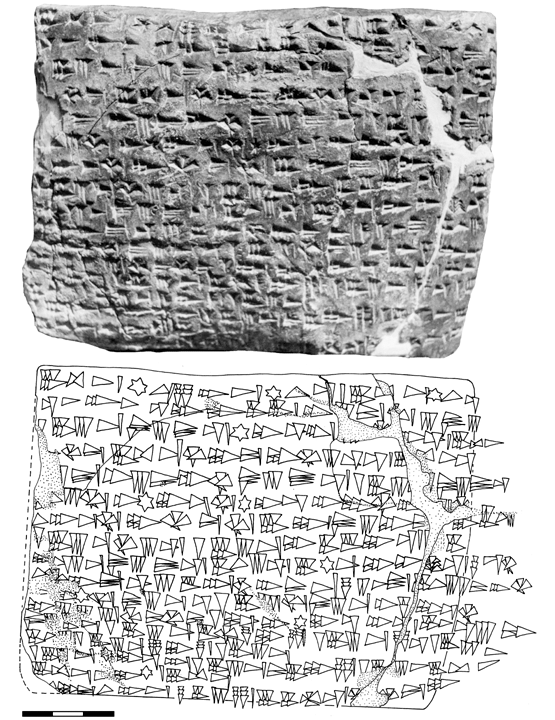
|
by Wikipedia
Ugarit (Ugaritic: 𐎜𐎂𐎗𐎚 ʼugrt;
Arabic: أوغاريت) (modern Ras Shamra رأس شمرة ("top/head/cape of the wild
fennel" in Arabic), near Latakia, Syria) was an ancient cosmopolitan
port city, sited on the Mediterranean coast. Ugarit sent tribute to
Egypt and maintained trade and diplomatic connections with Cyprus
(called Alashiya), documented in the archives recovered from the site
and corroborated by Mycenaean and Cypriot pottery found there. The
polity was at its height from ca. 1450 BC until 1200 BC.
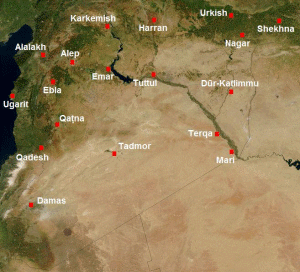
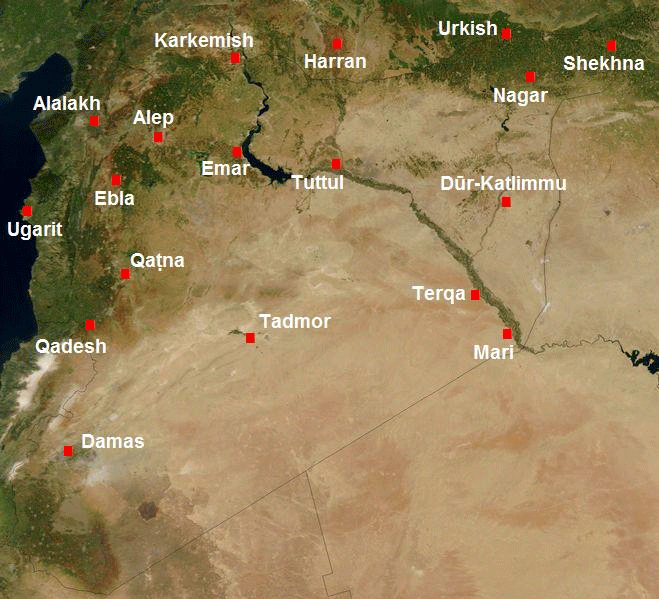
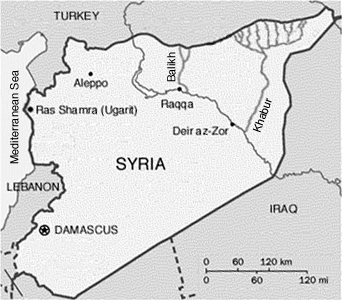
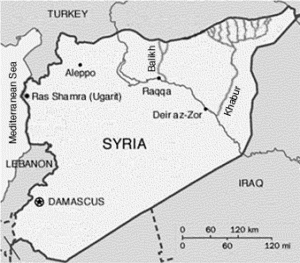
Map of Syria in the second millennium B.C., showing the
location of Ugarit.
Location
Ras Shamra (“Fennel Head”) is a
sixty-five foot mound located near Minet el-Beida (White Harbor) in
northern Syria. It is some seven miles north of Laodicea ad Mare and
approximately fifty miles east of the point of Cyprus. Ras Shamra, as it
is known today, was identified as the ancient city of Ugarit.
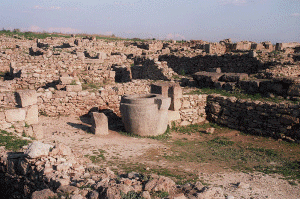
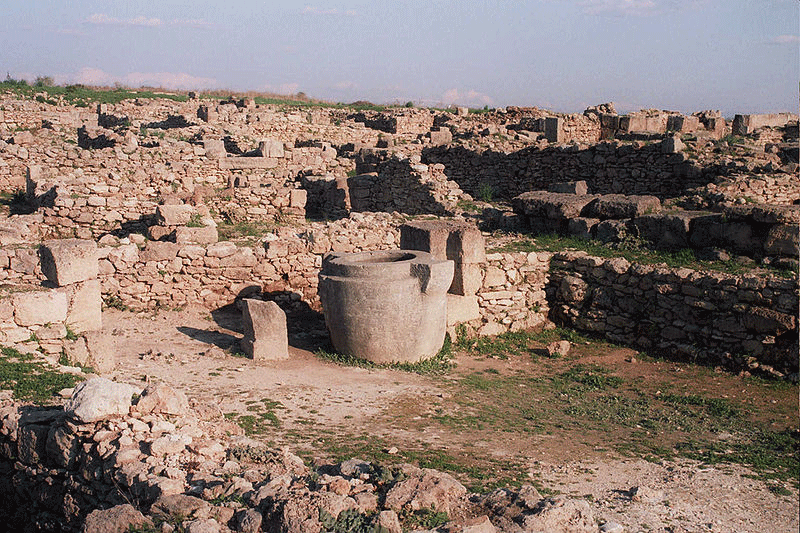
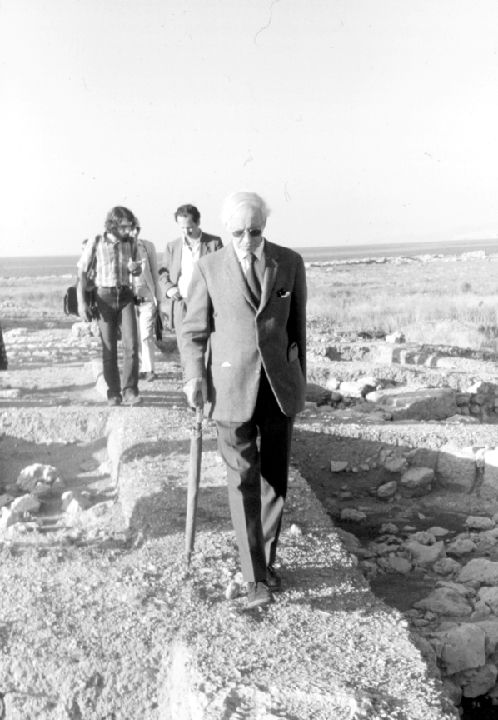
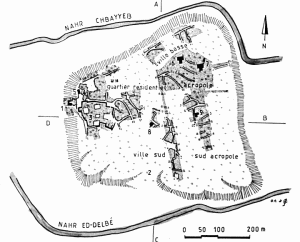
Excavated ruins at Ras Shamra
The Site
Ugarit's location was forgotten
until 1928 when a peasant accidentally opened an old tomb while plowing
a field. The discovered area was the Necropolis of Ugarit located in the
nearby seaport of Minet el-Beida. Excavations have since revealed an
important city that takes its place alongside Ur and Eridu as a cradle
of urban culture, with a prehistory reaching back to ca. 6000 BC,
perhaps because it was both a port and at the entrance of the inland
trade route to the Euphrates and Tigris lands.
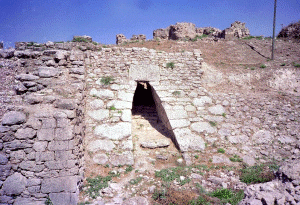
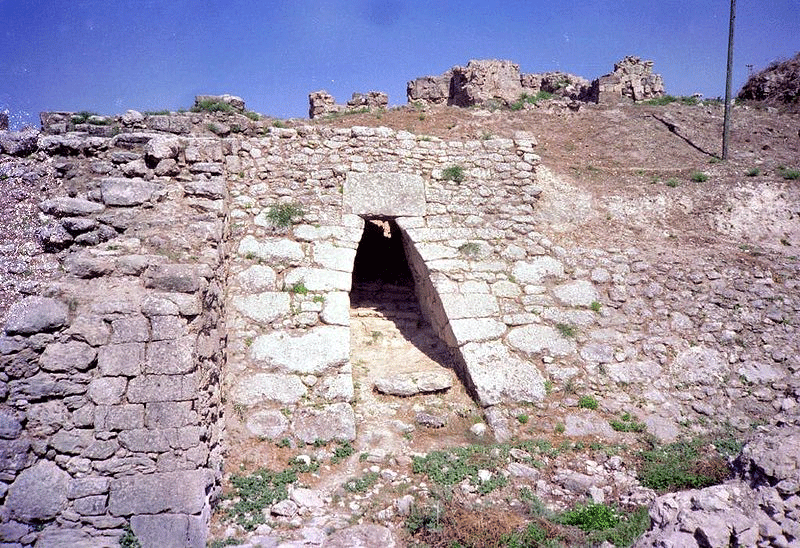
Entrance to the royal palace.
Most excavations of Ugarit were
undertaken by archaeologist Claude Schaeffer from the Prehistoric and
Gallo-Roman Museum in Strasbourg.
The excavations uncovered a royal
palace of 90 rooms laid out around eight enclosed courtyards, many
ambitious private dwellings, including two private libraries (one
belonging to a diplomat named Rapanu) that contained diplomatic, legal,
economic, administrative, scholastic, literary and religious texts.
Crowning the hill where the city was built were two main temples: one to
Baal the "king", son of El, and one to Dagon, the chthonic god of
fertility and wheat.
On excavation of the site,
several deposits of cuneiform clay tablets were found, constituting a
palace library, a temple library and—apparently unique in the world at
the time—two private libraries; all dating from the last phase of
Ugarit, around 1200 BC. The tablets found at this cosmopolitan center
are written in four languages: Sumerian, Hurrian, Akkadian (the language
of diplomacy at this time in the ancient Near East), and Ugaritic (of
which nothing had been known before). No less than seven different
scripts were in use at Ugarit: Egyptian and Luwian hieroglyphics, and
Cypro-Minoan, Sumerian, Akkadian, Hurrian, and Ugaritic cuneiform.
During excavations in 1958, yet
another library of tablets was uncovered. These were, however, sold on
the black market and not immediately recovered. The "Claremont Ras
Shamra Tablets" are now housed at the Institute for Antiquity and
Christianity, Claremont School of Theology, Claremont, California. They
were edited by Loren R. Fisher in 1971. In 1973, an archive containing
around 120 tablets was discovered during rescue excavations; in 1994
more than 300 further tablets were discovered on this site in a large
ashlar building, covering the final years of the Bronze Age city's
existence.
The most important piece of
literature recovered from Ugarit is arguably the Baal cycle, describing
the basis for the religion and cult of the Canaanite Baal.
History
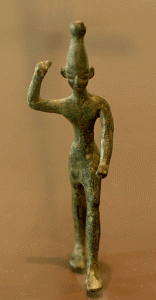
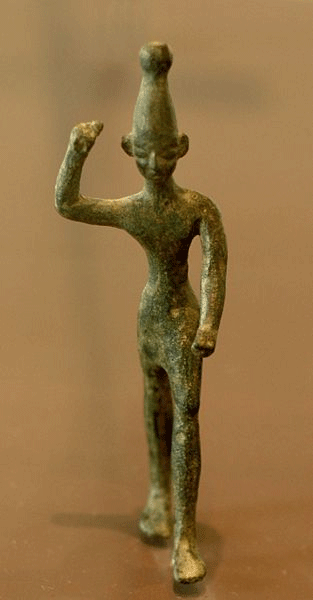
A Baal statuette from Ugarit.
Though the site is thought to
have been inhabited earlier, Neolithic Ugarit was already important
enough to be fortified with a wall early on, perhaps by 6000 BC.
The first written evidence
mentioning the city comes from the nearby city of Ebla, ca. 1800 BC.
Ugarit passed into the sphere of influence of Egypt, which deeply
influenced its art. The earliest Ugaritic contact with Egypt (and the
first exact dating of Ugaritic civilization) comes from a carnelian bead
identified with the Middle Kingdom pharaoh Senusret I, 1971 BCE–1926 BC.
A stela and a statuette from the Egyptian pharaohs Senusret III and
Amenemhet III have also been found. However, it is unclear at what
time these monuments got to Ugarit. Amarna letters from Ugarit ca.
1350 BC records one letter each from Ammittamru I, Niqmaddu II, and his
queen.
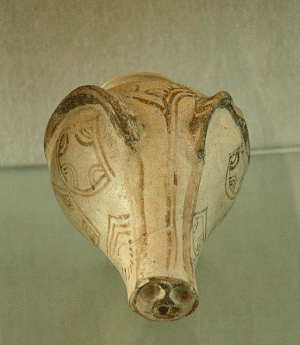
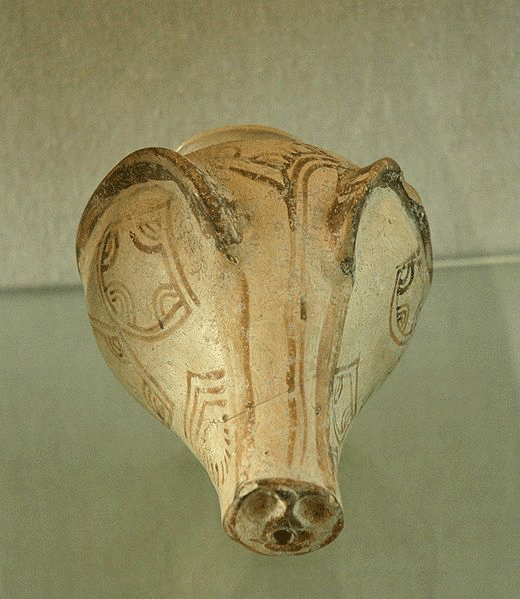
Boar rhyton, Mycaenean ceramic
imported to Ugarit, 14th-13th century BC (Louvre)
During its high culture, from the
16th to the 13th century BC, Ugarit remained in constant touch with
Egypt and Cyprus (named Alashiya).
Destruction
The last Bronze Age king of Ugarit,
Ammurapi, was a contemporary of the Hittite king Suppiluliuma II. The
exact dates of his reign are unknown. However, a letter by the king
is preserved. Ammurapi stresses the seriousness of the crisis faced by
many Near Eastern states from invasion by the advancing Sea Peoples when
he wrote a dramatic response to a plea for assistance from the king of
Alasiya. Ammurapi highlights the desperate situation Ugarit faced in
letter RS 18.147:
My father, behold,
the enemy's ships came (here); my cities(?) were burned, and they did
evil things in my country. Does not my father know that all my troops
and chariots(?) are in the Land of Hatti, and all my ships are in the
Land of Lukka?...Thus, the country is abandoned to itself. May my father
know it: the seven ships of the enemy that came here inflicted much
damage upon us.[1]
Unfortunately for Ugarit, no help
arrived and Ugarit was burned to the ground at the end of the Bronze
Age. Its destruction levels contained Late Helladic IIIB ware, but no LH
IIIC (see Mycenaean period). Therefore, the date of the destruction is
important for the dating of the LH IIIC phase. Since an Egyptian
sword bearing the name of pharaoh Merneptah was found in the destruction
levels, 1190 BC was taken as the date for the beginning of the LH IIIC.
A cuneiform tablet found in 1986 shows that Ugarit was destroyed after
the death of Merneptah. It is generally agreed that Ugarit had
already been destroyed by the 8th year of Ramesses III—i. e. 1178 BC.
Whether Ugarit was destroyed before
or after Hattusa, the Hittite capital, is debated. The destruction is
followed by a settlement hiatus. Many other Mediterranean cultures were
deeply disordered just at the same time, apparently by invasions of the
mysterious "Sea Peoples".
Alphabet
Scribes in Ugarit appear to have
originated the Ugaritic alphabet around 1400 BC; 30 letters,
corresponding to sounds, were adapted from cuneiform characters and
inscribed on clay tablets. A debate exists as to whether the Phoenician
or Ugaritic alphabet was first. While many of the letters show little or
no formal similarity, the standard letter order (preserved in the latin
alphabet as A, B, C, D, etc.) shows strong similarities between the two,
suggesting that the Phoenician and Ugaritic systems were not wholly
independent inventions. It was later the Phoenician alphabet that
spread through the Aegean and on Phoenician trade routes throughout the
Mediterranean. The Phoenician system became the basis for the first
true alphabet, when it was adopted by Greek speakers who modified
some of its signs to represent vowel sounds as well, and as such was in
turn adopted and modified by populations in Italy (including ancestors
of the Romans). Compared with the difficulty of writing Akkadian in
cuneiform—such as the Amarna Letters from ca. 1350 BC— the flexibility
of an alphabet opened a horizon of literacy to many more kinds of
people. In contrast, the syllabary (called Linear B) used in Mycenaean
Greek palace sites at about the same time was so cumbersome that
literacy was limited largely to administrative specialists.
Ugaritic Language
The Ugaritic language is attested in
texts from the 14th through the 12th century BC. Ugaritic is usually
classified as a Northwest Semitic language and therefore related to
Hebrew, Aramaic and Phoenician, among others. Its grammatical
features are highly similar to those found in Classical Arabic and
Akkadian. It possesses two genders (masculine and feminine), three cases
for nouns and adjectives (nominative, accusative, and genitive); three
numbers: (singular, dual, and plural); and verb aspects similar to those
found in Western Semitic languages. The word order in Ugaritic is Verb
Subject Object (VSO); possessed–possessor (NG) (first element dependent
on the function and second always in genitive case); and noun–adjective
(NA) (both in the same case (ie. congruent)).[2]
Ugaritic literature
Apart from royal correspondence
to neighboring Bronze Age monarchs, Ugaritic literature from tablets
found in the libraries include mythological texts written in a narrative
poetry, letters, legal documents such as land transfers, a few
international treaties, and a number of administrative lists.
Fragments of several poetic works have been identified: the "Legend of
Kirtu," the "Legend of Danel", the Ba'al tales that detail Baal-Hadad's
conflicts with Yam and Mot, and other fragments.[3]
The discovery of the Ugaritic
archives has been of great significance to biblical scholarship, as
these archives for the first time provided a detailed description of
Canaanite religious beliefs during the period directly preceding the
Israelite settlement. These texts show significant parallels to Biblical
Hebrew literature, particularly in the areas of divine imagery and
poetic form. Ugaritic poetry has many elements later found in Hebrew
poetry: parallelisms, meters, and rhythms. The discoveries at Ugarit
have led to a new appraisal of the Old Testament as literature.
Ugaritic religion
Writing of 'religion' in the Ancient
Near East is at best a dubious science. Academia prefers to speak of
various 'cults' within the ancient context.[4] The important textual
finds from the Ras Shamra (Ugarit) site shed a great deal of light upon
the cultic life of the city and Canaanite culture. There is growing
scholarly agreement that the material culture of Ugarit should be
properly designated Canaanite High Culture.[5]
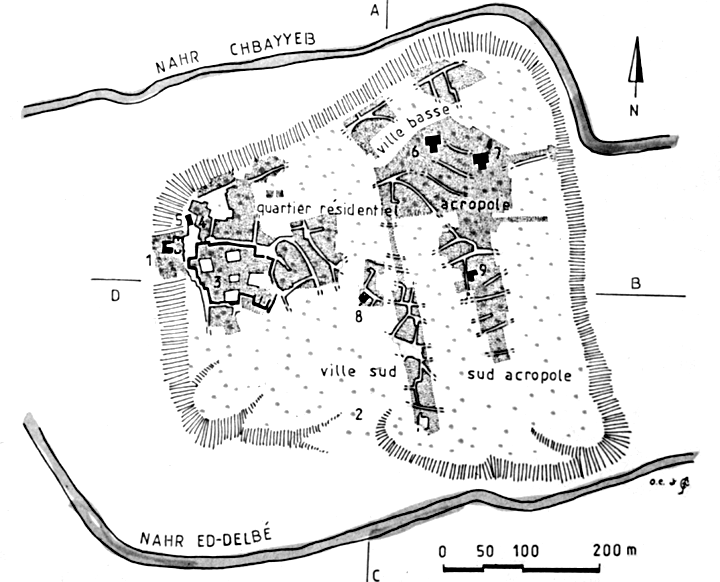
In the north-east quarter of the
walled enclosure the remains of three significant buildings were
unearthed; the temples of Baal and Dagon and the library (sometimes
referred to as the high priest's house). Within these structures atop
the acropolis numerous invaluable mythological texts were found.
Since the 1930s these texts have opened up for us something of the
Canaanite mythological world. The Baal cycle represents Baal's
destruction of Yam (the chaos sea monster), demonstrating the
relationship of Canaanite chaoskampf with those of Mesopotamia and the
Aegean: warrior god rises up as the hero of the new pantheon to defeat
chaos and bring order.
It is almost certain that the cult(s)
of Baal in the Levant influenced later Israelite cult and mythology.
Yahweh often takes on the chaoskampf role of Baal in his struggle with
the chaotic sea. It would, however, be incorrect to use later redacted
biblical texts to reconstruct Canaanite religion or cult. At the
soonest we can date a people known as Israel in southern Canaan by the
Merneptah Stele (c.a. 1200 BCE), and it would be some two hundred years
more before this people have a monarchic state.
While we know El to be the chief of
the Canaanite pantheon, very little attention is paid to him in the
cultic/mythological texts. This is rather common of Middle to Late
Bronze Age mythology; the high god is drawn into the background whilst
new warrior deities move to centre stage. In Ugarit and much of the
Levant this is Baal, to the Shasu / Shosu and
the later Israelites this
is Yahweh and his consort, and in Mesopotamia this is Marduk. These
warrior-god mythologies show remarkable points of contact and are most
likely reflections of the same arche-myth.
Kings of Ugarit
(short chronology)
Niqmaddu I
Yaqurum I
Ibiranu I
Ammittamru I ca. 1350 BC
Niqmaddu II ca. 1350 - 1315 BC Contemporary of Suppiluliuma I of the
Hittites
Arhalba ca. 1315 - 1313 BC
Niqmepa ca. 1313 - 1260 BC Treaty with Mursili II of the Hittites, Son
of Niqmadu II,
Ammittamru II ca. 1260-1235 BC Contemporary of Bentisina of Amurru, Son
of Niqmepa
Ibiranu ca. 1235 - 1225/20 BC
Niqmaddu III ca. 1225/20 - 1215 BC
Ammurapi ca. 1200 BC Contemporary of Chancellor Bay of Egypt, Ugarit is
destroyed
_______________
References
1. Jean Nougaryol et al.
(1968) Ugaritica V: 87-90 no.24
2. Stanislav Segert, A basic Grammar of the Ugaritic Language:
with selected texts and glossary (1984) 1997.
3. Nick Wyatt. Religious texts from Ugarit, (1998) rev. ed 2002.
4. Miller, J. Maxwell, and Hayes, John H., A History of Ancient
Israel and Judah (London: SCM Press, 1986)pp. 121-147
5. Wyatt, Nicholas, Religious Texts from Ugarit: the words of
Ilimiku and his colleagues (Sheffield: Sheffield Academic Press, 1998)p.
53f
Sources
Bourdreuil, P. 1991. "Une
bibliothèque au sud de la ville : Les textes de la 34e campagne (1973)".
in Ras Shamra-Ougarit, 7 (Paris).
Drews, Robert. 1995. The End of the Bronze Age: Changes in Warfare and
the Catastrophe ca. 1200 BC (Princeton University Press). ISBN
0-691-02591-6
Meletinskii, E. M., 2000 The Poetics of Myth
Smith, Mark S., 2001. Untold Stories ; The Bible and Ugaritic Studies in
the Twentieth Century ISBN 1-56563-575-2 Chapter 1: "Beginnings:
1928–1945"
Ugarit Forschungen (Neukirchen-Vluyn). UF-11 (1979) honors Claude
Schaeffer, with about 100 articles in 900 pages. pp 95, ff, "Comparative
Graphemic Analysis of Old Babylonian and Western Akkadian", ( i.e.
Ugarit and Amarna (letters), 3 others, Mari, OB,Royal, OB,non-Royal
letters). See above, in text.
Virolleaud, Charles, 1929. "Les Inscriptions cunéiformes de Ras Shamra."
in Syria 10, pp 304–310.
Yon, Marguerite, 2005. The City of Ugarit at Tell Ras Shamra ISBN
1-57506-029-9 (Translation of La cité d'Ugarit sur le Tell de Ras Shamra
1979)
Ed. K. L. Younger Jr. "Ugarit at Seventy-Five," Eisenbrauns, 2007.
William M. Schniedewind, Joel H. Hunt, 2007. A primer on Ugaritic:
language, culture, and literature ISBN 0521879337 p. 14.
Baal Text
Ba'lu and His Antagonists: Some Remarks on
CTA 6:V.1-6, by Meindert Dijkstra, Theological Seminary, Kampen, The
Netherlands
Ba'lu and His
Antagonists:
Some Remarks on CTA 6:V.1-6
MEINDERT DIJKSTRA
Theological Seminary. Kampen, The Netherlands
The interpetation
of CTA 6: V. 1-6, which relates a battle between Ba'lu and some
antagonists, indicated vaguely as bn 'atrt, has led to divergent
translations,1 though only a decisive solution of the enigmatic words
dkym and shrmt (according to Ch. Virolleaud's copy) presents
difficulties.
In this note some
arguments will be advanced toward their interpretation, following a
suggestion of J. C. de Moor with regard to the damaged group of
consonants shrmt. 2 Consequently, some considerations are submitted on
the connections of the passage with the whole Ba'lu-story, beginning
with Ps. 93: 3-4, in spite of H. Donner's critical remarks made on the
subject. 3
In the main the
Ba'lu-story can be understood as the account of Ba'lu's struggle for his
kingship and consequently the mythological motivation for the building
of his sanctuary.4 The motif of this struggle is present at any moment.
Note the fear expressed by the mother-goddess, 'Atiratu, in CTA
4:11.21-26:
['i]k (22) mgy.
'al'iyn [. b]'1 -- Why has Ba'lu the Almighty come,
(23)'ik . mgyt . b[t]lt (24) 'nt -- Why has the "Virgin" 'Anatu
come?5
mhsy hm[. m]hs~ (25)bny -- To slay me or to slay my sons.
hm [. mkly.s]brt (26)'aryy6-- or to annihilate the group of my
kin?
In fact Yammu
'Sea' and Motu 'Death' are the great antagonists in the mythological
epic of Ba'lu, both known as son and beloved of 'Ilu, the father of the
gods,7 and also sons of the qnyt 'ilm, the procreatress of the gods, 'Atiratu
(CTA 4:1.23; III.26, 30, 35; IV-V.32).8 Thus, her words contain an
insinuation of Ba'lu's intentions, if not a reference to the earlier (?)
defeat of Yammu (CTA 2:IV).9
In CTA 6:V.1-6
there is talk of a new battle with some great sons of 'Atiratu in
relation to Ba'lu's kingship; to think of Yammu and Motu seems to be a
matter of course. Moreover, this connection between struggle and
kingship again forces us to a comparison with biblical passages which
connect the proclamation of Yahweh's eternal kingship with his
superiority over chaotic powers, even where a trace of a primeval clash
hardly remains, as in Ps. 93. In this note, I subscribe again to the
view of those scholars who have associated Ps. 93: 3-4 with the passage
under discussion, and I am of the opinion that the clear parallelism
between the words qolam//dokyam and miqqolot mayim rabbim//misbere-yam10
can help us toward a further interpretation of CTA 6: V.1-6.
In accordance with
the parallelism, the meaning of 'dok'i closely resembles that
of misbere-yam. Fortunately, there is much more evidence of
the latter expression than of the former. In Jonah 2:4b (similar to Ps.
42:8b) it is more or less synonymous with gallim 'the waves'. In Ps.
88:8 the expression is parallel to hamah 'wrath', although the
connection with the depths and the netherworld is not absent (Ps. 88
:7). The association of misbere-yam with death is also
supported by the remarkable variant misbere-mawet 'the waves
of death' (NEB) in 2 Sam. 22:5.11 In these few texts sea and depths are
closely related to death and the netherworld,12 a phenomenon tallying
with ancient near eastern cosmology, which situates the netherworld
below the earth either in or below the depths, seen as the waters of
death.13
Without doubt the
rare word *dok'i, usually derived from the root dakah,14 and
the expression misbere-yam, of which the usual translation is
'the waves, the breakers of the sea', have an association with
destruction. Where the Hebrew dakah (compare also the cognate roots daka/duk/dakak)
occurs, it testifies to such an association in its diverse semantic
contexts, namely the crushing of bones (Ps. 51: 10), though meant
figuratively, and the monster Rahab (Ps. 89: 11 Qere). Note finally Ps.
44:20:
ki dikkitanu
bimqom tannim
wattekas 'alenu be salmawet
Yet thou crushed us in the place of Tannin15
and covered us with the darkness of death.
The more or less
synonymous use of the roots sabar and dakah (note especially Ps. 51:
19)16 enables us to take *dok'i as an abstract noun,
semantically parallel to misbere-yam, of which the
translation could be 'their pounding waves' (NEB) or the like.17
Additional evidence may be found in 1QS 3:4-9 where the choice of words
seems to be influenced by Ps. 93; compare 1QS 3:8-9: ythr (9)bsrw lhzwt
bmy ndh wlhtqds bmy dwky18 "His flesh shall be purified through
sprinkling by water of purification and through hallowing by water of
destruction." The translation 'water of destruction (scil. of guilt)' is
not only supported by the negative sentences 1QS3:4-5: wlw' ytqds bymym
(5)wnhrwt wlw' ythr bkwl my rhs "... nor be hallowed by oceans (5)
and rivers, nor be purified by any cleansing water," but also by the
literal meaning of my ndh (MT me niddah) 'water of excretion'.19
After these
preliminary remarks we will turn to CTA 6:V.1-6:
1. y'ihd. b'l
. bn. 'atrt
2. rbm. ymhs . bktp
3. dkym. ymhs . bsmd
4. shrmt (?) yms'i. l'ars
5. [ytb.] b[']1. lks'i. mlkh
6. l[nht] . lkht. drkth 20
Still Ba'lu seems
to be confined to the netherworld. From CTA 6:1V we come to know how
Sapsu, the sun-goddess, is sent to search for Ba'lu. The following
episode in the myth is separated from the preceding events21 by an
intermediate period of seven years, so CTA 6:V.1-6 may function as the
closing lines of the preceding episode. In this following episode Motu
reproaches Ba'lu with the fate he has suffered (compare CTA 6:11) and
demands a substitute from him for his release;22 compare CTA 6:V.19-2l:
tn. 'ahd
(20)b'ahk 'isp'a
wyth (21 ),ap . d'anst
Give one of your brothers, that I can eat,23
and the anger which I harbor will turn away.24
Unfortunately, the
sequel to the story is not entirely clear. It seems that Motu is tricked
by a gift of seven lads, who appear to be his own brothers.
Consequently, he overtakes Ba'lu in his escape, so that the two
antagonists are engaged in a final battle (CTA 6:VI.12-22). In the light
of this termination of events, it might be assumed that in some way or
other the passage CTA 6:V.1-6 anticipates, if not predicts it. 25
If so, we have a
structure in the story which corresponds to that of CTA 2: IV, where
Ba'lu's victory follows upon the sounding words of the technician-god
Kotaru-waHasisu, predicting the immediate defeat of Yammu. Taken as a
prediction, CTA 6:V.1-6 show the same structure as CTA 2:IV.8-10: (1)
the prediction that Ba'lu will defeat his enemies, and (2) the promise
of his enthronement and kingship. The tentative translation of the
passage could be:
Ba'lu will
seize the sons of 'Atiratu, 26
the great (gods) he will smite with the hatchet. 27
dkym he will smite with the "yoke,"28
shrmt(?) he will bring down to the earth.29
Ba'lu [will sit enthroned] on the chair of his kingship,
on [the seat] of the throne of his dominion.
For the
interpretation of dkym many proposals have been made, but we confine
ourselves to discuss a few which seem to be acceptable.
1. Starting from
the likely plural interpretation of bn 'atrt//rbm, the translation of
dkym with a plural noun, adjective or participle of the root dky 'to
crush, pound', as a by-form of d(w)k/dk(k), such as 'Crushers,
Oppressors', seems to be preferable.30 Less likely is the rendering of
an adjective dky 'small, puny', which should be connected semantically
to Ugar. dq 'small' (CTA 6:1.22),31 Heb. daq 'thin, fine (of dust,
incense)',32 Akk. daqqu 'very small',33 all from the common Semitic root
dqq 'to pulverize, pound'.34 It is hardly conceivable, however, that
this passage is about small antagonists of Ba'lu unless the god 'Attaru
could be so denoted. In spite of Driver's suggestion,35 there is little
evidence that this ridiculed god comes into the picture in this part of
the story.
Moreover, if the
former derivation of the root dky should be preferred, an alternative
interpretation of dkym as an abstract noun dky (*dukyu =Heb. doki)
with enclitic m cannot be excluded. 36
2. That the word
dkym could be a compound of a form belonging to the root d(w)k/dk(k) and
the name of the sea-god, Yammu, has previously been suggested by J.
Aistleitner.37 Unfortunately, his further interpretation of dk as a
tempus afformativum disturbs the clear parallelism, making his solution
unconvincing.38 Nevertheless, I think Aistleitner was on the right
track. As a variation of dkym 'Crushers, Oppressors' derived from the
root dky, one could consider d(w)k/dk(k), which is attested in CTA 161:
35 with a meaning 'to pulverize, pound' (compare also Num. 11 :8).39
Thus we interpret dkym as dk ym = dakiyamma 'the crushers or breakers of
Yammu' and suggest a connection between this expression and the biblical
misbere-yam. Compare for imagery Ps. 89:10; 65:8; Job 26:12.
sh(rt/mt): Any
interpretation of these consonants must be conjectural. Only the first
three signs are probable. Usually, shr is related to the root shr, which
is sometimes found in a qtll-form.40 We may note two things concerning
this root: (l) It functions in semantic contexts of meteorological
phenomena (CTA 3:E.25-26 and parallels; CTA 4:VII.54-58 + CTA 8: 7-12
)41 but is also parallel to the root hr(r) 'to be hot, glow' in CTA
23:41, 44f., 47f.42 (2) Cognate verbs of the roots shr/shh/shy and their
derivations show semantic ranges of 'to be white, clear, bright,
yellowish-red, cloudless, thirsty, scorched, bare, desolation,
desert'.43 With regard to the semantic contexts of the Ugaritic texts, a
restriction to the connotations 'to become dust-colored,
brownish'yellow'44 is not advisable. In general the roots shr/shh/shy
seem to cover an idea which we can express by means of the compounds
'white-hot/red-hot'. Therefore a translation of CTA 3: E.25 nrt 'ilm sps
shrrt "The light of the gods, Sapsu, burns"45 and of CTA 4:VII.56f. 'ibr
mnt shrrm "The wings of the breeze(?) feel glowing"46 remains possible.
Perhaps, taking the other contexts into consideration, a feminine
adjective shrrt should be considered in CTA 6: V.4, which takes on the
substantive meaning of 'the white (red) heat';47 If Virolleaud's reading
is maintained, one might translate 'the heat of Motu, death, the
murdering heat' or the like.48
Summarizing, we
have two reasonable possibilities:
1. dky-m//shr(rt),
which renders the translation:
Oppressors he will smite with the "yoke,"
The white heat he will bring down to the earth.
2. dk-ym//shr(-mt),
which gives us:
The breakers of Sea he will smite with the "yoke,"
The heat of Death he will bring down to the earth.
For evidence of
the latter, I submit the following considerations:
(1) The mention of
Yammu, and especially of his destructive waves, would appear conceivable
if the words ymhs bsmd were understood as a reference to Yammu's defeat,
related in CTA 2:IV.11f., 18f., by the same magic smd-weapon.
(2) A renewed
confrontation between Ba'lu and his old enemy in this part of the story
tallies with ideas of the ancient near eastern cosmology as far as the
netherworld is situated in the realm of the sea-god; moreover, in the
Ugaritic mythology, a personified Naharu, very likely the same as Judge
Naharu, dwells in the area of Motu as his cupbearer, 49 and Ba'lu is
confined to the realm of Death at this point of the story.
(3) Some of the
above mentioned biblical data connect the idea of descending to and
arising from the dead with that of perishing into or escaping from the
sea or the depths, understood as the waters of death (compare especially
2 Sam. 22: 5). For these biblical data the imagery of Isa. 26: 19-27:1
may also be clarifying, since in Israelite thought the resurrection of
the dead is linked to a twofold act of Yahweh, namely the constraining
of the netherworld 50 to uncover her slain and the slaying of the
sea-monsters, Leviathan and Tannin.
(4) The closing
lines of CTA 6:
50. bym. 'ars.
wtnn -- In the sea are 'Arsu and Tunnanu.51
51. ktr. whss . yd -- May Kotaru-waHasisu drive away.
52. ytr. ktr. whss -- May Kotaru-waHasisu do it again(?).52
Why are the
sea-monsters 'Arsu and Tunnanu mentioned here? Again, the course of
events in the last column of CTA 6 is obscure because of the damaged
lines VI.32-42. It appears that after the final battle with Motu, Ba'lu
is permitted to leave the netherworld and to return to Mount Sapanu. 53
Witness to their encounter is the goddess Sapsu, probably during her
nightly visit to the underworld.54 Now and then it is said that the
lines after the gap in CTA 6: VI form part of a hymn to Sapsu,55 but in
my opinion these lines, probably including the fragmentary 37-42,56
contain instructions to Sapsu from Ba'lu to lead the shades and ghosts
to a banquet in Ba'lu's temple.57 The mention of 'Arsu and Tunnanu
in the sea (compare also Isa. 27: 1) may denote the critical moment when
Sapsu and her host leave the netherworld.
As a result of
these observations, I now venture to say that the lines CTA 6:V.1-6
contain a summary of the whole Ba'lu-story, his struggle with both of
his great antagonists Yammu and Motu on the way to his kingship. To this
effect, CTA 6:V.3 also functions as a flashback to the story of CTA 2,
underlining in advance the prediction of Ba'lu's victory over the
summer-heat, that is, over the power of Death.
_______________
Notes:
1 See e.g., C. H.
Gordon, Ugaritic Literature (=UL) (Rome, 1949), 47; G. R. Driver, CML,
113; J. Aistleitner, Die Mythologischen und Kultischen Texte aus Ras
Schamra (=MKT), Bibliotheca Orientalis Hungaria 8 (Budapest, 1959), 22;
J. Gray, The Legacy of Canaan, 2nd ed., (=LC2), SVT 5 (Leiden, 1965),
72; H. L. Ginsberg, ANET3, 141a; J. C. de Moor, The Seasonal Pattern in
the Ugaritic Myth of Ba'lu, According to the Version of Ilimilku (=SP),
AOAT 16 (Neukirchen-Vluyn, 1971), 226; P. J. van Zijl, Baal: A Study of
Texts in Connection with Baal in the Ugaritic Epics (=Baal), AOAT 10 (Neukirchen-Vluyn,
1972), 213-17.
2 See De Moor, SP, 227-28: "Because it is likely that shr mt balances bn
'atrt, rbm and dkym, I assume that shr is in the plural construct
state." He argues that the shr mt 'the Dust colored of Motu' are a
mythological description of the sirocco-winds with their whirling
dust-veils, marking the period of Ba'lu's return from the netherworld.
3 See H. Donner, "Ugaritismen in der Psalmenforschung," ZAW 79 (1967),
346-50.
4 See H. Gese, Die Religionen Altsyriens, Altarabiens und der Mandaer (=RAAM),
Die Religionen der Menschheit (Stuttgart, 1970), 10/2:78-80, especially
79.
5 Though the traditional translation "Virgin" is retained, we do not
regard 'Anatu as a virgo intacta. The epithet refers to the perennial
youth of the goddess and possibly the fact that she never brought forth
offspring. Compare A. van Selms, Marriage and Family Life in Ugaritic
Literature, Pretoria Oriental Series 1 (London, 1954), 69, 109: De Moor,
SP, 97; "ba'al," TWAT 1, col. 714, accepted by Bergmann-Ringgren, "betulah,"
TWAT 1, col. 874.
6 The meaning hm 'behold!' has repeatedly been defended and accepted in
the one glossary and disregarded in the other (compare Aistleicner,
WUS3. no. 837 [with a question mark] and Driver, CML, 137. with Gordon.
UT. §§ 12:3. 5; §19:773). while a number of instances of hm 'behold!'
were recovered from the Old Testament: see J. H. Patton. Canaanite
Parallels in the Book of Psalms (1944), 37: F. M. Cross and D. N.
Freedman, "The Blessing of Moses." JBL 67 (1948) 195; T. F. McDaniel.
"Philological Studies in Lamentations I," Biblica 49 (1968), 33f.; and
the list of M. Dahood. Psalms III, Anchor Bible 17a (New York. 1970).
400. Because of the etymological relation between Ugar. hm (with a
dialectal variant 'im, PRU 2, no. 20:8) and hn and Heb. 'im and hen/hinneh
(see Baumgartner, HAL 58, 241f. and C. J. Labuschagne. "The Particles
hen and hinneh," OTS 18 [1973]. 3. n. 4), a connotation hm, behold!'
for current hm 'if, either ... or' cannot be precluded beforehand. It
would parallel the rare conditional usage of Heb. hen/hinneh beside its
normal usage as an interjection. Nevertheless, I agree with J. C. de
Moor. "Ugaritic hm-Never 'Behold·... UF 1 (969). 201f. (+Nachtrag. 221.
CTA 4:11.24-26!: see also "Ugaritic Lexicography." Estratto da Studies
on Semitic Lexicography, Quaderni di Semitistica 2 (1973), 89) that the
existence of Ugar, hm 'behold!' cannot be demonstrated sufficiently and
might still be doubted, not to mention the examples wrested from the Old
Testament. See also C. van Leeuwen, "Die Partikel 'im." OTS 18 (1973),
15.
7 Compare the expression 'ab bn 'il 'the father of the gods': CTA 32:25,
33 (with parallels): Gese, RAAM, 97.
8 Perhaps the epithet 'um 'ilm (PRU 2, no. 2:43) also refers to 'Atiratu;
cf. Gese. RAAM, 150; de Moor, ''a'serah.'' TWAT 1. col. 474.
9 Though the arrangement of CTA 2 before CTA 3-6 is generally accepted,
it is not without problems. De Moor, SP, 36-40, argues for a sequence
CTA 3-1-2, following F. Ltokkegaard, "The House of Baal," Ac.Or. 22
(1959). 14-15. n. 8: A. van Selms. "Yammu's Deenthronement by Baal." UF
2 (1970), 251, suggests taking CTA 2 (UT 129, 137, 68) as a separate
entity; see also the critical remarks of A. Caquot, "La divinite solaire
ougaritique," Syria 36 (1959). 100; Gese, RAAM, 52,78-80; M. J. Mulder,
"Hat man in Ugarit die Sonnewende begangen?" UF 4 (1972). 81 f.
10 It is attractive to correct MT 'addir mimmisbere-yam (see the
apparatus in BHK3, BHS (11)) but not necessary: see C. Brockelmann,
Hebraische Syntax (Neukirchen, 1956), 58: H. -J. Kraus, Psalmen 2, BKAT
15/2, 3rd ed. (Neukirchen-Vluyn, 1966), 646.
11 With regard to Ps. 18:5 heble-mawet, most scholars accept 2 Sam. 22:5
as the lectio arduor and consequently the correct reading, see BHS (11),
apparatus.
12 Compare also Ps.18:17: 44:20: 69:2f.: 124:4: 144:7: Job 26:5f.;
38:16f: Ezek.26:19f.: 31:15: Amos 9:2: etc.
13 G. Fohrer, Geschichte der israelitischen Religion (Berlin, 1969),
176, 319 speaks of a common Semitic world-picture, best known from
Babylonian-Akkadian sources: cf. B. Meissner, Babylonien und Assyrien
(Heidelberg, 1925), 2:107f., fig. 27; D. Michel, "Weltbild," BHH 3, col.
2161f.: W. Brede Kristensen, Godsdiensten in de oude wereld, Aula 294
(Utrecht/Antwerp, 1966), 7-14. To be sure, the biblical conception of
the world is much less elaborate: see H. W. Hertzberg, "Weltbild," RGG3
6, col. 1616: H. Schmid, "Totenreich," RGG3 6, col. 912; S. Schulz, "Unterwelt,
Totenreieh," BHH 3, col. 2014f.: L. l. J. Stadelmann, The Hebrew
Conception of the World, Analecta Biblica 39 (Rome, 1970).
14 See H. Bauer and P. Leander, Historische Grammatik der hebraischen
Sprache (Hildesheim, 19652), §72h'.
15 See app. BHS (11).
16 Compare D-stem sabar in Ps. 34:21: Isa. 38:13: Lam. 3:4: Ps. 89:11
with Ps. 74:13 and dakka'// nisbar, in Ps. 34: 19.
17 See also M. Dahood, Psalms 11, Anchor Bible 17 (New York, 1968), 341,
who sees an analogy between Ugar. hd//hdd and Heb. hedad 'noise, roar';
also dkym 'Pounder' as an epithet of Ba'lu beside Heb. dokyam.
8 The originally adopted reading dwkw (ed. Millar Burrows; cf. also P.
Wernberg-Moller, "Waw and Yod in the Rule of the Community," RdQ 2
[1960], 231f., contra idem, The Manual of Discipline [Leiden, 1957], 40)
may be dwky, as seems to be supported by 4Qsa; cf. J. T. Milik, RB 67
(960), 413. A majority of scholars connect dwky/w with a root dkh 'to
be pure' referring to Aram. deku, (see e.g., Targum to Lev. 12:4f.) and
Syr. dukaya (cf. Payne Smith, Thesaurus Syriacus 1 :col. 895); cf.
Wernberg-Moller, Manual, 25, 64, n. 27; J. Bowman, RdQ 1 (1958), 81;
Wernberg-Moller, RdQ (1960), 231 f.; J. Maier, Die Texte vom Toten Meer
(Basel, 1960), 1:25; 2: 17f.; J. Carmignac and P. Guilbert, Les Textes
de Qumran I (Paris, 1961), 30; E. Lohse, Die Texte aus Qumran
(Darmstadt. 1971), 11. In my opinion, however, this interpretation
overlooks (1) the use of the current Hebrew zakah N-stem in the context
(IQS 1:4) and (2) a possible influence of Ps. 93 on the choice of words.
In favor of dwky from a root dkh (eventually d(w)k) 'to crush', see W.
H. Brownlee, The Dead Sea Manual of Discipline, BASOR Supplementary
Studies 10-12 (New Haven, 1951), 13. n. 17 with reference to Ps. 93:3;
J. T. Milik, "Manuale Disciplinae (textus integri versio)," Verbum
Domini 29 (1951), 131; H. Bardke, Die Handschriftfunde vom Toten Meer
(Berlin, 19532); P. Boccacio and G. Berarde, srk hyhd Regula Unionis seu
Manuale Disciplinae (Fano, 1953), s.l.; G. Molin, Die Sohne des Lichtes
(Vienna/Munich, 1954). 21. As a possibility it is accepted by
Baumgartner, HAL, 212b; S. H. Siedl, Qumran. Eine Monchgemeinde im Alten
Bund, Studie uber Serek Ha-yahad (1963), 303f.
19 Probably derived from yadah/nadah 'to throw, to remove', cognate to
Akk. nadu; Ethiop. wadaya and Ugar. ndy/ydy; cf. the construct state
niddat dotah 'excretion of her menstruation- blood' in Lev. 12:2 and
niddat tum'atah 'excretion of her impurity' in Lev. 18:19 with Akk. nid
ru'ti 'Speichelfluss'; see AHw., 786b nidu(m) no. 3,706a nadu(m) III,
no. 2a.
20 Cf. Herdner, CTA, 1:41. In CTA 6:VA we follow Virolleaud's yms'i
after examination of the photograph and copy. The reading shrmt
suggested by the copy is very uncertain now; see Herdner, CTA, 1:41, n.
8. especially concerning mt.
21 With regard to the much-discussed problems of this seven year period
we subscribe to the short investigation of A. Kapelrud, "The Number
Seven in Ugaritic Texts," VT 18 (1968), 494-99; see also Gese, RAAM,
78f.; De Moor, SP, 32f.
22 Cf. Edzard, Worterbuch der Mythologie, 62, 67, 88; De Moor, SP, 232;
A. Draffkorn Kilmer, "How Was Queen Ereshkigal Tricked ... ?" UF 3
(1971), 302, pointing to the Sumerian and Akkadian story of,
respectively, Inanna's and Ishtar's descent to the netherworld; cf.
especially the word ipti/eru(m) 'ransom, substitute', according to the
Assur-recension; cf. AHw., 385b; Borger, BAL 3:117.
23 Root sp'u 'to feed' and not 'to eat' (against Gordon, UT, § 19:1789;
Aistleitner, WUS3, no. 1943, etc.) as is suggested by Heb. mispo'
'fodder'; M. Heb. sapah/'; J. Aram. sepa' 'to reach, to serve food'. The
forms 'ispi' (CTA 5:1.5) and yspi' (CTA 22:B.I0) lead to the conclusion
that 'isp'a is a cohortative and that the 'i of the other forms must be
explained as a thematic vowel (against Gordon, UT, §9:9: Aistleitner,
WUS3, no. 1943; idem, UGU, 58; E. Hammershaimb, Das Verbum im Dialekt
von Ras Shamra [Copenhagen, 1941], 168; H. Donner, ZAW 79 [1967], 341,
etc.). I subscribe to the view of De Moor, SP, 233 (with references) in
assuming forms of an N-stem 'to feed oneself, to eat', though in this
case, as in Hebrew (see Bauer-Leander, Historische Grammatik, § 44f.),
the phonetic shift 'a >'i/e in the first syllable must be assumed.
24 Cf. De Moor, SP, 232f.; we take 'isp'a as an asyndetic relative
sentence; cf. Gordon, UT,§13:67. Cf. also CTA 6:1.45f. tn (46) 'ahd. b.
bnk (.) 'amlkn "Give one of your sons that I may make him king!"
25 Cf. De Moor, SP, 226.
26 bn 'atrt//rbm corresponding to standard bn 'atrt//'ilm makes a
singular interpretation of rbm very doubtful; cf. also the expression 'ilm
rbm in PRU 2, no. 90:1f.; Ugaritica V, ch. 3, no. 6:1f. Nevertheless,
rbm may be a special hint to the really powerful antagonists Yammu and
Motu; cf. e.g., mdd 'il ym//nbr 'jl rbm (CTA 3:D,35f.) "the beloved of
'Ilu, Yammu//the mighty rivers of 'Ilu"; note the OT notions mayim
rabbim (Ps. 93:4) and me tehom rabbah//yam (Isa. 51 :10).
27 Cf. R. T. O'Callaghan, "The Word ktp in Ugaritic and Egypto-Canaanite
Mythology," Orientalia 21 (1952), 27-46; Gray, LC2, 72; De Moor, SP,
135.
28 About the double aspect of the weapon, cf. Gray, LC2, 26, n. 6, 72;
O. Kaiser, Die mythologische Bedeutung des Meeres in Agypten, Ugarit und
Israel, BZAW 78, 2nd ed. (Berlin, 1962), 69, n. 278; De Moor, SP, 135.
Kaiser and De Moor propose in CTA 2:IV.11, 19, a translation 'Doppeltaxt,
doubleheaded axe', because of the dual form; however, the singular smd
is also used (CTA 2 :IV.15, 23), being the same weapon, The dual ending
can probably be explained as superfluous, added after a word with a
dual aspect; cf. Heb. kepel beside kiplayim in Isa, 40:2. smd, which
usually has the meaning 'yoke', in this context means a sort of mace or
axe with a double-headed top or double axe-blade. There is some
iconographical evidence for the double-headed axe from the Syrian area;
cf. the "Dieu combattant," described by A. Parrot, "Acquisitions et
Inedits du Musee de Louvre," Syria 29 (1951), 51-53; and Jupiter
Dolichenus, Gressmann, AOB2, no. 356; E. Will, "Reliefs dolicheniens de
Khaltan (Kurd Dagh) conserves au musee d'Alep," Les Annales
archeologiques de Syrie 1 (1951), 135-37, fig. 2.
29 The reading ymsh in Herdner, CTA, 1:41, n. 9 and CTA 3:E.9 is
attractive but conjectural. We take yms 'i as an imperfect of a
causative stem; see Gray, LC2, 72, n, 11; though a G-stem cannot be
excluded; see Deut. 19: 5. Compare perhaps Job 37:13 (with deletion of
the second 'im) 'im lesebet XX [e'arso//'im-lehesed yams'ehu "Either as
a rod XX on his earth, either as mercy he brings it down." To be sure,
the claim that ymsi' is a causative is a very shaky position inasmuch as
the existence of an aphel beside the current saphel (S-stem) is a widely
debated subject. Nevertheless, the variant form ymza' (CTA 12:1.36f.),
which suggests that the verb ms/z has a yiqtal imperfect as in Hebrew,
makes the explanation of ymsi' very difficult unless an aphel-form is
assumed. Though the evidence is scanty, it need not be denied at all
(cf. the inverse case of the exceptional S-stem in Hebrew; L. Wachter,
ZAW 83 11971), 380-89); and further on the aphel in Ugaritic see
Hammershaimb, Verbum, 25f., especially 28; M. Dahood, "Some Aphel
Causatives in Ugaritic," Biblica 38 (1957), 62-73; A. Jirku, "Eine 'Af'el-Form
im Ugaritischen?" AfO 18 (1957), 129f.; S. Moscati (ed.), An
Introduction to the Comparative Grammar of the Semitic Languages, 2nd
ed., (Wiesbaden, 1969),§16: 13; De Moor, Ugaritic Lexicography, 96f.
30 E. Lipinski, La Royaute de Yahwe dans la poesie et le culte de
l'ancien Israel (Brussels, 1965), 99; S. and S. Rin, Aliloth ha-elim
(Jerusalem, 1968), 228; Dahood, Psalms II, 341; and Gray, LC2, 72, n. 9,
all consider it an epithet of Ba'lu; Van Zijl, Baal, 217, as an epithet
of Yammu.
31 De Moor, SP. 227, following a suggestion of H. Bauer, OLZ 37 (l934),
243.
32 Cf. Baumgartner, HAL, 220; Jean-Hoftijzer, DISO, 60.
33 Cf. AHw., 162f., citing from a synonym-list daq-qu = se-eh-ru.
34 Cf. Heb. daqaq 'to pound' (Baumgartner, HAL, 220b); Akk. daqaqu D 'to
cut small, mince' AHw., 162b); Ethiop. daqaqa 'to pound' (E. Littmann
and M. Hoffner, Worterbucb der Tigre- Sprache [1962], 525). A semantic
parallel could also be Hebrew dak (root dakak) 'oppressed, small
folk(?)'.
35 Cf. Driver, CML, 112.
36 So far a grain of truth exists in the connection of Ugar. dkym with
Ps. 93:3 dokyam as suggested by U. Cassuto, Tarbiz. 13 (1941-42), 212;
Ginsberg, ANET3, 141a; Kraus, Psalmen 2, 650; but a direct equation
would require Ugar. dkyhm; cf. also the critical remarks of Lipinski, La
Royaute de Yahwe, 98f.: H. Donner, ZAW 79 (1967), 350.
37 Cf. Aistleitner, WUS3, no, 739; idem, MKT, 22, followed by F.
Lokkegaard, "A Plea for El, the Bull, and Other Ugaritic Miscellanies,"
Studia Orientalia Ioanni Pedersen Dedicata (Copenhagen, 1953), 223; F.
F. Hvidberg, Weeping and Laughter in the Old Testament
(Leiden/Copenhagen, 1962), 38.
38 Cf. H. Donner, ZAW 79 (1968), 347; Van Zijl, Baal, 214.
39 Cf. also Akk. daku 'to kill, slay, beat'; AHw., 152: CAD D, 35f.
40 See Gordon, UT, § 9:42; cf. verb and nominal qtll-forms in Hebrew and
J. Aramaic; Bauer-Leander, Historische Grammatik, 483; Gesenius-Kautsch
(Cowley), Hebrew Grammar, § §55d, 84 VII; G. Dalman, Grammatik des
judische-Palastinischen Aramaisch (Darmstadt, 1960), 165, which like the
Arabic 9th and 11th conjugations are used of permanent and changing
conditions, e.g., colors; cf. Heb. 'amal 'to be/become withered', sa
'an 'to be at rest', ra'an 'to be/become green'.
41 Cf. De Moor, SP, 227.
42 To all appearances, the forms thrr//shrrt could be interpreted as,
respectively, 3rd plural fem. passive imperfect L-stem (Gordon, UT, § 9:
37) and 3rd plural fem. qtll-stem with the bird as subject.
43 An anthology:
(1) root shr: Heb. sahor 'white-yellow-red' (the lexica differ on the
precise color); sohar (*suhru) n. m., 'red-whiteness' (cf. M. Noth, Die
israelitischen Personennamen im Rahmen der gemeinsemitischen Namengebung
[Hildesheim, 1966], 225); sahar n. 1. Ezek. 27:18 'desert(?)' (cf.
however W. Zimmerli, Ezechiel 2, BKAT 13/2 (Neukirchen-Vluyn, 1969), 655
= es-sahra, NW of Damascus); Arab. sahara (11th conjugation) 'to become
yellowish, reddish-white'; 'asharu 'yellowish red'; sahra' 'desert';
Syr. sehar 'to become reddish'; Akk. seru(?) 'steppe, desert'.
(2) root shh: Heb. sahah 'to be white, clear' (Lam. 4:7//zakah 'to be
pure'); sahiah 'naked, bare (of a rock)'; sebibab 'naked, scorched
land, desert' (Ps. 68:7); sabsabot 'desert' (Usa. 58: 11) sab (a)
'white, clear'; (b) 'blazing, glowing (heat: Isa. 18:4; wind: Jer.
4:11)'; J. Aram. sebab 'to be bright, polished'; sabseba' 'clear'; ~sibsuba'
'gloss, shine'; Syr. sab; 'to glow'; sabiba' 'shining'; Arab. sabsabamun
'bare plain, desolation'.
(3) root shy: Heb. sibeb 'parched'; J. Aram. sebi 'to thirst' (cf. also
Jean-Hoftijzer, DISO, 144); sabwana, sabya' 'bareness, drought';
sabyuta' 'thirst'; Arab. saba: Ethiop. sabawa 'to be clear, cloudless
(of the sky)'; Syr. saba 'cloudless sky, heat'. As a semantic parallel
we point to Heb. bamar 'to burn, to become red (through tears, Job
16:16)'; Arab. bamara 'to roast, to scorch' in the 9th and 11th
conjugations 'to be red'.
On the relatedness of roots sharing two strong consonants, see
Gesenius-Kautsch (Cowley), Hebrew Grammar, §§ 30h, 1; other examples
qasas and qasar II 'to cut off, short, to shorten'; qazaz and qazar 'to
cut'.
44 Cf. De Moor, SP, 114.
45 Cf. P. L. Watson, Mot, the God of Death at Ugarit and in the Old
Testament (Yale University Diss. 1970; Ann Arbor, 1971), 40, 79, cited
by M. J. Mulder, UF 4 (1972), 82.
46 Cf. Akk. manitu ' (leichter) Wind, Brise' (AHw., 603a), as suggested
by De Moor, SP, 172. Cf. Jer. 4: 11: ruah sah sepayim//bammidbar derek
bat-ammi "A scorching wind from the bare places, from the desert (is)
on the way to my people."
47 Adjectival qtll-froms in Hebrew are sometimes substantivized; cf.
Isa. 37:29; Job 30:12; Bauer-Leander, Historische Grammatik, 483.
48 On the superlative force of mt/mawet, cf. S. Rin, "The MWT of
Grandeur," VT 9 (1959), 324f.; D. W. Thomas, "Some Further Remarks on
Unusual Ways of Expressing the Superlative in Hebrew," VT 18 (1968),
120-24; P. A. H. de Boer, "YHWH as Epithet Expressing the Superlative,"
VT 24 (974), 233f.
49 Cf. the sentence hm ks ymsk nhr "If Naharu, mixes the cup" (CTA
5:L21f.: Ugaritica V, ch. 3, no.4A:9f.). Presumably, Naharu as judge (tpt
nhr) and river of death is related to the god of death, Motu: cf. W. F.
Albright, "Zabul Yam and Thapit Nahar in the Combat between Baal and the
Sea," JPOS 16 (1936), 19f.: Driver, CML, 12, n. 7: J. C. de Moor,
"Studies in the New Alphabetic Texts from Ras Shamra," UF 1 (1969), 187.
50 'eres 'netherworld'?: cf. M. Dahood, "Hebrew-Ugaritic Lexicography
I," Biblica 44 (1963), 297: Gray, LC2, 264: N.J. Tromp, Primitive
Conceptions of Death and Netherworld in the OT, Biblica et Orientalia
21 (Rome, 1969), 7, 23f: De Moor, SP, 184.
51 Vocalize tnn Tunnanu with Ugaritica V. ch. 1 no. 137: 1.8'
tu-un-na-nu. Both monsters are also
mentioned in CTA 3:D. 34-48.
52 Cf. Akk. taru 'to do something again' (just like Heb. sub in
combination with another verb); J. Aram. tur 'to spy, to look out
carefully (?)'.
53 We suggest to complete CTA 6:VI.32-35 with CTA 16:VI.22-24:
y[ttb. I'dh.] (33)b'l -- Let them [enthrone] Ba'lu [on his dais],
yttbn[n. lks'i] (34) mlkh -- enthrone [him on the chair] of his
kingship,
ln/ht. lkht (35)drkth] -- on the (seat of the throne of his dominion.]
54 Cf. A. Caquot, Syria 36 (1959), 93-95; Gray, LC2, 71; De Moor, SP,
243f.; Mulder, UF 4 (1972), 86.
55 Cf. T. H. Gaster, Thespis (New York, 1950), 31; Caquot, Syria 36
(1959), 97f.; Fohrer, Geschichte der israelitischen Religion, 47; De
Moor, SP, 243; Mulder, UF 4 (1972), 86.
56 According to the copy, the traces of CTA 6:V1.37 ]'n. hn[ are
presumably to be completed [wy]'n. hn[. . .] "and he (Ba'lu?) answered:
Behold ... "
57 We suggest to complete CTA 6: VI.41f.: ltstql (42) [ib]try "Please,
go quickly to my roomy house!" The verb used is mostly found following
lhkl· (CTA 3: B.17f.; CTA 17:11.25; CTA 19: 170). Ugar. tr may be
cognate to Syr. tara 'space (of time and distance)', Heb. tur 'enclosure
(of pillars)' (e.g. 1 Kgs. 7:2f.) and tirah 'encampment'. I am of the
opinion that the first person pronominal suffix refers to Ba'lu. It
seems that the victory of Ba'lu will be celebrated with a communal meal
of the quick and the dead; compare for imagery CTA 22:B.
UGARIT RITUAL
TEXTS
By Dennis Pardee,
Professor of Northwest Semitic Philology
The Oriental Institute, and the
Department of Near Eastern Languages and Civilizations
The University of Chicago
(This article
originally appeared in The Oriental Institute News and
Notes, No. 172, Winter 2002.)
Excavations have
been going on at the site of Ras Shamra on the Northwest
Syrian coast more or less steadily since 1929 and
inscriptions have been discovered during nearly every
campaign from the first to the most recent, which took place
during May/June 2000. Except for some deep stratigraphic
soundings, virtually all digging has concentrated on the
uppermost levels of the tell, which date to the Late Bronze
Age, and approximately one sixth of the surface has been
uncovered. The soundings have revealed the site was first
inhabited in the eighth millennium BC, and the possibilities
for further excavation extend thus into the indefinite
future.
The excavation team
is French, known as the Mission de Ras Shamra. In 2000, the
project became officially a joint Syrian-French enterprise.
There has been a great deal of continuity owing to this
single archaeological presence, and to the orderly handing
down of the direction from one scholar to another (Claude
F.-A. Schaeffer, Henri de Contenson, Jean Margueron,
Marguerite Yon, and now Yves Calvet [France] and Bassam
Jamous [Syria]). The current plans call for going below the
Late Bronze Age levels, but choosing an area has not been
easy because the latest remains are so well preserved - in
order to see what lies under the stone foundations of a
house these must be destroyed or at least disturbed. Ras
Shamra is an important stop on any cultural tour of Syria,
and the authorities are anxious that its educational and
touristic value not be reduced.
From the
inscriptions it was learned very early on that the tell
covered the ruins of ancient Ugarit, known from contemporary
documents to be an important city in the Late Bronze Age.
More recently discovered texts from Mari, on the middle
Euphrates, show Ugarit already to have been famous in the
mid-eighteenth century BC. The international language of
that time was Akkadian, the principal language of
Mesopotamia, and that usage remained constant to the end of
the Bronze Age. Hence many of the inscriptions from Ras
Shamra were in Akkadian, which was used primarily for
international dealings, though a significant portion of the
internal administrative records were also in that language.
Of greater interest
for West Semitists was the discovery of a new script and
language, named Ugaritic after the city, which belongs to
the great family of languages of Syria, Palestine, and
Arabia (Arabic, Aramaic, Hebrew, Old South Arabian, and
Phoenician). For the first time, scholars of these languages
had not just a few scattered words datable to the second
millennium BC, but texts in a language related to, but older
than, the attested forms of any of these West Semitic
languages. The script was immediately perceived as an
oddity: it was cuneiform and inscribed on tablets, but it
was unrelated to Mesopotamian cuneiform. Rapid decipherment
showed that it represented an alphabetic system: the number
of signs was only thirty, and the consonantal phonemes
represented by these signs, only twenty-seven. An archaic
phonetic system was revealed wherein still functioned
several consonantal phonemes that have disappeared in
Hebrew, Phoenician, and Aramaic
 >; only
missing from a common reconstruction of early West Semitic
were >; only
missing from a common reconstruction of early West Semitic
were  and and
 . .
The texts in
Ugaritic cover a broad literary range: from myths to
"laundry lists," from incantations to letters, from
contracts to medical texts. On the negative side is the fact
that most of the tablets are broken and the reconstruction
of the culture, economy, and religion of the Ugaritians has
for that reason been a long and painstaking one. Moreover,
as G. R. Driver (among others!) used to say, dies diem
docet, or in modern idiom "you learn something new
every day." Hence the work of the pioneers has to be taken
up again by following generations who have the benefit of
hindsight.
This has been my
primary role in the Mission de Ras Shamra. I first seriously
practiced true epigraphy (the study of ancient "epigraphs,"
or inscriptions, with an emphasis on the decipherment and
interpretation of these epigraphs) during the academic year
1980/81 thanks to a Fullbright Fellowship. My teaching
duties were not heavy and I had a great deal of time to
spend studying tablets in the museums of Damascus and
Aleppo. I went to Syria naively expecting to find that my
predecessors had read everything on all the tablets, but I
soon discovered that there was much yet to be done. During
that year, I collated some two hundred tablets, comparing
the editions with the original and preparing my own (very
primitive!) hand copies. I became a member of the Mission de
Ras Shamra epigraphic team in the mid-1980s and have since
devoted my efforts principally to republishing the Ugaritic
texts according to literary genre. My first effort, full of
mistakes in my turn, was a re-edition of the hippiatric
texts, a genre of which the oldest versions are Ugaritic.
These texts, only four in number, reflect empirical medicine
practiced on horses, a practice and literary genre that
continued until quite recently. The second project was a
small group of texts, only nine in number, excavated in a
single house in 1961 that showed a striking peculiarity: all
contained mythological material but in forms that differed
from the long mythological texts for which Ugarit is famous.
The most striking is a brief story about the great god El
becoming drunk at a feast and having to be carried home by
his sons. This atypical myth is followed by a prose recipe
for alcoholic collapse that features the first known
connection between drunkenness and the "hair of the dog":
"What is to be put on his forehead: hairs of a dog. And the
head of the PQQ (a type of plant) and its shoot he is to
drink mixed together with fresh olive oil." This group of
texts I republished as Les textes para-mythologiques
in 1985.
An intermediary
project, a joint one with my French colleague Pierre
Bordreuil, head of the epigraphic team for the Mission, was
a catalogue of all inscribed objects from Ras Shamra (La
trouvaille épigraphique de l'Ougarit, 1989). We
actually touched and measured every inscribed object we
could find (and a surprisingly small number were missing lo
these many years and a World War later), which permitted us
to provide in the catalogue the basic data regarding the
physical properties of the item, the language/script, and
the most basic publications. Because the publications of the
various texts over the decades were widely scattered, an
account of what text corresponded to what excavation number
was necessary and has proved immensely useful for the
members of the Mission - as well, we hope, as for our
colleagues near and far who previously did not have these
most basic data regarding the inscriptions at their
fingertips.
The other two types
of texts collated in 1980/81 were the letters and the ritual
texts. Though the letters were my first interest and the
project that I had in mind when the opportunity arose to
work in Syria, for reasons associated with my teaching
responsibilities in this university I settled on the ritual
texts as my next publication project. There are over eighty
texts that deal with the everyday cultic activities in the
city of Ugarit. After the typical ups and downs associated
with a thick manuscript, Les textes rituels
appeared in February 2001 (though the imprint date is 2000),
all 1,307 pages of it, including those bearing the hand
copies and photographs.
Most of these texts
are dry - and I mean dry - prescriptions of the sacrifices
to be offered during a particular period of time, which may
range from a single day or a part of a day to two months.
For example, the beginning of RS 1.001, the very first text
discovered at Ras Shamra reads: "A ewe as a
 -sacrifice; a dove,
also as a
-sacrifice; a ewe, also as
-sacrifice; two
kidneys and the liver (of?) a bull and a ram for
El." It goes on like this for twenty-two lines. -sacrifice; a dove,
also as a
-sacrifice; a ewe, also as
-sacrifice; two
kidneys and the liver (of?) a bull and a ram for
El." It goes on like this for twenty-two lines.
It is clear that
the Ugaritic cultic system was centered around bloody
sacrifice (that is, the slaughter of animals in honor of a
deity), that it went on continually but was particularly
tied in with the phases of the moon (the festivals of the
new moon and the full moon were the most important, but
sacrificial activity also increased at the second and third
quarters, i.e., at the beginning of the lunar "weeks"), and
that a great number of deities figured in the Ugaritic
pantheon (well over two hundred are known at present). From
the mythological texts, we know that the Ugaritians had
highly developed views of how the deities interrelated with
each other and with humans. There is not, unfortunately, a
clear overlap between the mythological texts and the ritual
ones - other than in the fact that certain deities appear in
both - that would allow us to see more clearly the ideology
and theology behind the ritual acts so abundantly described.
The basic sacrificial types appear to reflect a need to feed
and to care for the divinities and to establish a form of
communion with them. The
 sacrifice, for
example, appears to reflect a cultic meal in which the
offerer partook of the same meal as was offered to the
divinity. This last term, cognate with Hebrew sacrifice, for
example, appears to reflect a cultic meal in which the
offerer partook of the same meal as was offered to the
divinity. This last term, cognate with Hebrew
 conventionally
translated "peace offerings," opens a window on the
interconnections between these West Semites of Northwest
Syria and the better-known inhabitants of Canaan, the
birthplace of the Jewish and Christian religions. Space does
not permit a discussion here. Suffice it to say that there
are long lists of both similarities and differences between
Hebrew and Ugaritic religion and cult. conventionally
translated "peace offerings," opens a window on the
interconnections between these West Semites of Northwest
Syria and the better-known inhabitants of Canaan, the
birthplace of the Jewish and Christian religions. Space does
not permit a discussion here. Suffice it to say that there
are long lists of both similarities and differences between
Hebrew and Ugaritic religion and cult.
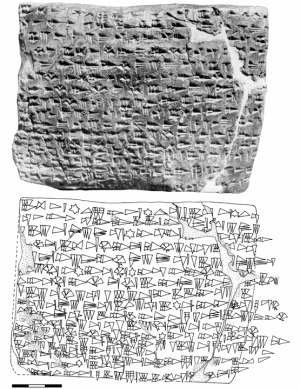
There are some
texts included in this collection that go beyond the narrow
bounds of the typical variety just cited. One, RS 1.002, the
second tablet discovered at Ras Shamra in 1929, ventures
into areas not even hinted at in the texts just described:
mentioned there are such things as "sin," "anger," and
"impatience." The burden of the rite, which has six sections
divided into three for the men of Ugarit and three for the
women, appears to be to foster national unity by erasing all
sources of friction among the various elements of society.
Specifically mentioned are the king and the queen, the men
and the women who live within the walls of the city of
Ugarit, and a whole series of other categories defined by
ethnic, social, and geographical terms. At the end of each
section, the sacrifice of a single animal is prescribed, the
species being specific to the theme treated there. For
example, the sacrifice of a donkey in each of the last two
sections appears to underscore the theme of political
rectitude announced in the first line of each of these
sections.
One of the most
interesting of the sacrificial texts is that of a funerary
rite, probably for the next-to-the-last king of Ugarit,
whose name was Niqmaddu, a name that reappears several times
in this dynastic line. This king died some time during the
last decade of the thirteenth century and, in the last lines
of the text, blessings are called down on his successor,
Ammurapi, and on the queen mother:
- Well-being for
 ,
well-being for his house! ,
well-being for his house!
- Well-being for
 ,
well-being for her house! ,
well-being for her house!
- Well-being for
Ugarit, well-being for her gates!
The particular
interest of this text is that it goes far beyond the dryness
of the standard sacrificial texts and the repetitiveness of
RS 1.002 by its form of expression - it is in poetry rather
than in prose - and by its subject matter - the shades of
the dead king's ancestors are called up to participate in
the ceremony and, once the ceremony is launched, the
principal actor is the sun deity, who assumes the role of
enabling the deceased king to join his ancestors. This is
achieved by the sevenfold lowering of the king's body into
the realm of the dead. I have hypothesized that this
portion of the ceremony would have centered on a large pit
that the archaeologists discovered situated between the two
principal chambers of the royal tomb in the palace. Once
this ceremonial lowering and raising, accompanied each time
by a sacrifice, was completed, the mortal remains would have
been laid to rest in one of the tombs.
Another type of
inscription takes its interest from the object on which they
are written: clay liver models representing the liver of an
animal sacrificed in the rite known as hepatoscopy,
observing the features of a liver as a means of divining the
future. Each model reflects a specific case of consulting a
divination priest and the purpose of the text was to express
the question that was posed to the priest. The clearest of
these reads: "(This liver model is) for
when he was to
procure the young man of the Alashian." Specialists in the
markings on the model tell us that the result of this
consultation was a "yes" answer, that is, that
 should
proceed with his plan to acquire a new servant. should
proceed with his plan to acquire a new servant.
Alongside these
texts that reflect the actual practice of divination are
manuals or catalogues of previous results of previous
divinatory consultations. One such tablet provides a long
list of omens based on malformed animal fetuses, for
example: "If it (the fetus of a sheep or goat) has no right
ear, the enemy will devastate the land and will consume it."
Another tablet lists omens associated with lunar phenomena,
for example: "If the moon, when it rises, is red, there will
be prosperity [during] that month."
The incantatory
genre is very poorly attested at Ugarit. The first text was
discovered at the neighboring site of Ras Ibn Hani in 1978,
but its language was so difficult that its precise literary
structure and character were not easy to determine. A more
recent example, RS 92.2014, is clearly incantatory in
nature. It reads:
- (When) the
unknown one calls you and begins foaming,
- I, for my
part, will call you.
- I will shake
bits of sacred wood,
- So that the
serpent not come up against you,
- So that the
scorpion not stand up under you.
- The serpent
will indeed not come up against you,
- The scorpion
will indeed not stand up under you!
- In like
manner, may the tormentors, the sorcerers not give ear
to the word
- of the evil
man,
- To the word of
any man:
- When it sounds
forth in their mouth, on their lips,
- May the
sorcerers, the tormentors, then pour it to the earth.
- For Urtenu,
for his body, for his members.
The final
ascription to a known personage, plausibly the last
inhabitant of the house in which the tablet was found and a
member of the queen's administration, permits the
classification of the text as an incantation prepared by a
"magician" to ward off Urtenu's enemies, both serpentine and
human.
The work just
described is a technical edition, with hand copies,
photographs of tablets previously unpublished in
photographic form, copious remarks both epigraphic and
philological on each text, a structural analysis of each
text, extensive indices laying out the data in these texts
according to several categories (deity named, type of act,
contents of offerings, time, and place), and an exhaustive
concordance of all words attested. It is intended for
scholars and students who know an ancient Semitic language
well enough to work with the original Ugaritic.
In the next few
months a very different book will appear, this time in
English and intended for a much broader audience. It is
published by the Society of Biblical Literature in the
series Writings from the Ancient World, which
is intended to gather together the most important
collections of ancient Near Eastern texts. The format
includes the text in the original language with accompanying
translation into idiomatic English, some notes in lieu of
commentary, and good indices. The inclusion of the original
text makes these works of interest to students and scholars,
while the English translation and notes open up their
usefulness to anyone who reads English and is interested in
the original texts upon which we base our views of the
ancient world.
This version
differs from the French edition in several respects. First,
only relatively complete texts are included, those that
permit a fairly continuous translation. Second, because of
the nature of the French edition the texts were not arranged
there by subject matter, but the insights gained in
preparing that edition permitted such an arrangement in the
English version. Third, the sacrificial texts are laid out
according to the structure of the rite therein depicted,
permitting the non-specialist to follow the progress of the
liturgy more easily. Fourth, the commentary in the notes is
much briefer and less technical; repetition is avoided by
putting many explanations into a glossary. Fifth, this
freeing up of space allowed for the inclusion of a broader
range of texts, notably those of the "para-mythological"
texts described above that have a reasonably clear link with
ritual as practiced at Ugarit. This broader purview is
reflected in the English title,
Ritual and Cult at Ugarit.
Since earning
his doctorate in this university in 1974, Dennis Pardee has
been teaching the Northwest Semitic languages and
literatures in the Department of Near Eastern Languages and
Civilizations and the Oriental Institute. In addition to his
work in Ugaritic, he has published books and articles on
Biblical Hebrew poetry and on Hebrew inscriptions.
Return to Table of Contents
|