|
Home SENNACHERIB |
|
by Wikipedia (All Bible "PROOF" edited out.)
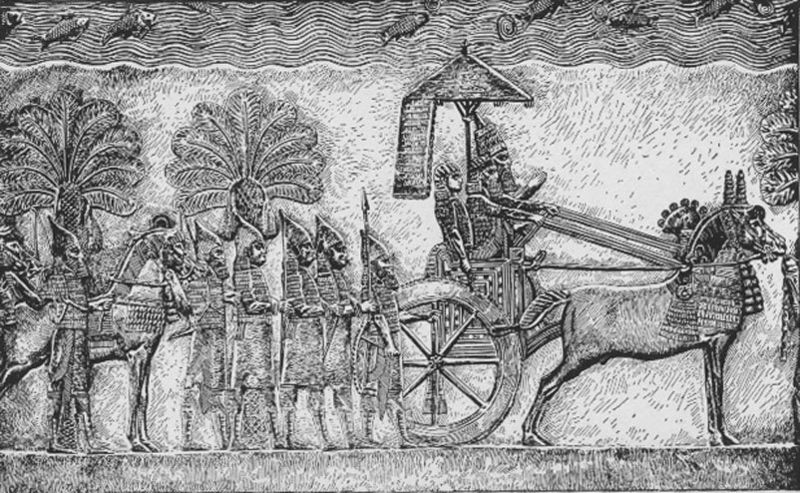
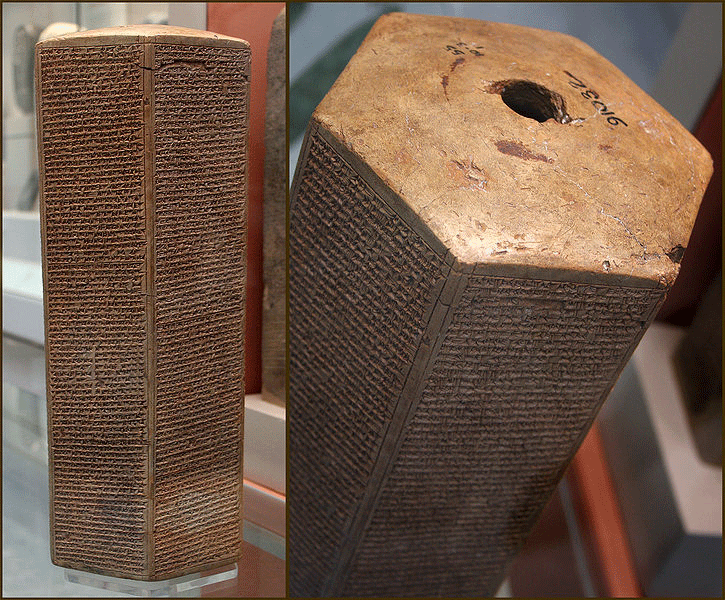
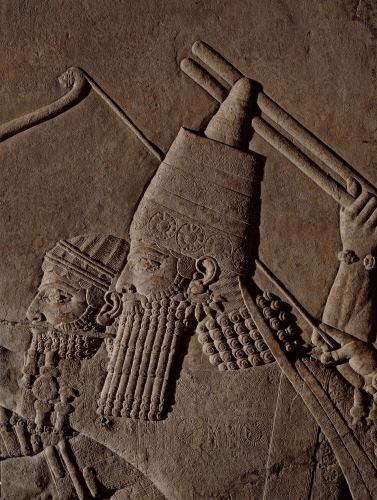
Sennacherib during his Babylonian war, relief from his palace in Nineveh [Sennacherib (Akkadian Sîn-ahhī-erība ("(Moon god) Sîn has replaced (lost) brothers for me") was the son of Sargon II, whom he succeeded on the throne of Assyria (704 – 681 BC). Rise to power As the crown prince, Sennacherib was placed in charge of the Assyrian Empire while his father, Sargon II, was on campaign. Unlike his predecessors, the Sennacherib's reign was not largely marked by military campaigns, but mainly by architectural renovations, constructions, and expansions. After the violent death of his father, Sennacherib encountered numerous problems in establishing his power and faced threats to his domain. However, he was able to overcome these power struggles and ultimately carry out his building projects. During his reign, he moved the empire's capital from his father's newly-constructed city of Dur-Sharrukin to the old city and former capital of Nineveh. It is considered to be striking that Sennacherib not only left his father's city, but also doesn’t name him in any official inscription during his reign. War with Judah Background In 701 BC, a rebellion backed by Egypt and Babylonia broke out in Judah, led by King Hezekiah. In response Sennacherib sacked a number of cities in Judah. He laid siege to Jerusalem, but soon returned to Nineveh, with Jerusalem not having been sacked, in order to put down an attempted coup. This event was recorded by Sennacherib himself, and by Herodotus. Sennacherib's account Some of the Assyrian chronicles, such as the baked-clay Taylor prism now preserved in the Oriental Institute, Chicago, date from very close to the time. (see also: Military history of the Neo-Assyrian Empire) [1](The Taylor Prism itself bears the date "the month of Tammuz; eponym of Galihu, governor of Hatarikka" which is Tammuz in the year 689 BC, according to the Assyrian Eponym List). Sennacherib's Prism or Taylor prism is a clay prism inscribed with the annals of the Assyrian king Sennacherib notable for describing his siege of Jerusalem in 701 BC during the reign of king Hezekiah.
Assyrian accounts do not treat it as a disaster, but a great victory — they maintain that the siege was so successful that Hezekiah was forced to give a monetary tribute, and the Assyrians left victoriously, without losses of thousands of men, and without sacking Jerusalem. In the Taylor Prism, Sennacherib states that he had shut up Hezekiah the Judahite within Jerusalem, his own royal city, like a caged bird. Sennacherib first recounts several of his previous victories, and how his enemies had become overwhelmed by his presence. He was able to do this to Great Sidon, Little Sidon, Bit-Zitti, Zaribtu, Mahalliba, Ushu, Akzib and Akko. After taking each of these cities, Sennacherib installed a puppet leader named Ethbaal as ruler over the entire region. Sennacherib then turned his attention to Beth-Dagon, Joppa, Banai-Barqa, and Azjuru, cities that were ruled by Sidqia and also fell to Sennacherib. Egypt and Nubia then came to the aid of the stricken cities. Sennacherib defeated the Egyptians and, by his own account, single-handedly captured the Egyptian and Nubian charioteers. Sennacherib captured and sacked several other cities, including Lachish (the second most-strongly fortified city in the Kingdom of Judah). He punished the "criminal" citizens of the cities, and he reinstalled Padi, their leader, who had been held as a hostage in Jerusalem. After this, Sennacherib turned to King Hezekiah of Judah, who stubbornly refused to submit to him. Forty-six of Hezekiah's cities (cities 1st millennium BC terms ranged in size from large modern-day towns to villages) were conquered by Sennacherib, but Jerusalem did not fall. His own account of this invasion, as given in the Taylor prism, is as follows:
Building projects During Sennacherib's reign, Nineveh evolved into the leading Metropolis of the empire. His building projects started almost as soon as he became king. Already in 703 BC he had built a palace complete with park and artificial irrigation he called his new home ‘The palace without rival’. For this ambitious project an old palace was torn down to make more room. In addition to his own large gardens, several small gardens were made for the citizens of Nineveh. He also constructed the first ever aqueduct, at Jerwan in 690 BCE,[5] which supplied the large demand of water in Nineveh. The narrow alleys and squares of Nineveh were cleaned up and enlarged, and a royal road and avenue were constructed, which crossed a bridge on its approach to the park gate and which was lined on both sides with stelae. Temples were restored and built during his reign, as is the duty of the king. Most notable is his work on the Assur (god) and the new year (Akitu) temples. He also expanded the city defences which included a moat surrounding the city walls. Some of his city walls have been restored and can still be seen nowadays. The labour for his giant building project was performed by people of Que, Cilicia, Philistia, Tyre, and Chaldeans, Aramaeans, and Mannaeans who were there involuntarily. Sennacherib is sometimes credited with the invention of the Archimedes screw for the purpose of irrigation, although evidence for this is contentious[6]. Death Sennacherib was assassinated by two of his sons. [7] He was ultimately succeeded by another son Esarhaddon. One part tells of one of Sennacherib's sons toppling a giant statue of a bull with a mans head, thus crushing him to death. _______________ References 1. (http://www.kchanson.com/ANCDOCS/meso/sennprism1.html) 2. ["Wesley's Notes on the Bible" II Chronicles 32 http://wes.biblecommenter.com/2_chronicles/32.htm] 3. The legends of the Jews, Volume 6 By Louis Ginzberg, Henrietta Szold, Paul Radin 4. [Adam Clarke's Commentary - 2 Chronicles 32 http://www.godrules.net/library/clarke/clarke2chr32.htm] 5. von Soden, Wolfram. (1985). The Ancient Orient: An Introduction to the Study of the Ancient Near East. (pp.58). Grand Rapids: Erdman's Publishing Company. 6. Stephanie Dalley and John Peter Oleson (January 2003). "Sennacherib, Archimedes, and the Water Screw: The Context of Invention in the Ancient World", Technology and Culture 44 (1). 7. The British Museum: Sennacherib, king of Assyria (704-681 BC) Military
history of the Neo-Assyrian Empire The Assyrian Empire originated in the early 2nd millennium BC,[3][4] succeeding the Akkadian Kingdom of the late 3rd millennium BC.[5] Assyria did not become a powerful military state until the early 1st millennium BC, when Ashurnasirpal II's conquests reasserted Assyria's hegemony in the Near East,[3] nor was it a true empire until the reforms of Tiglath-Pileser III in the mid-8th century BC. The Assyrian empire has at times been described as the first military power in history.[6] This article deals with the forces of the Assyrians in the above described times. In 911 B.C., the Assyrian state was ruled by Adad-nirari II and was in a poor state -- trade routes were under foreign control and her territories in Babylon and other former vassal states were out of their hands. Adad nirari II changed all of this with aggressive campaigning against his opponents. His son was later succeeded by one of the most successful military Kings of Assyria, Ashurnasirpal II.[7] Ashurnasirpal II is credited for utilizing sound strategy in his wars of conquest. Whilst aiming to secure defensible frontiers, he would launch raids further inland against his opponents as a means of securing economic benefit,[8] as he did when campaigning in the Levant. The result meant that the economic prosperity of the region would fuel the Assyrian war machine.[9] Ashurnasirpal II was succeeded by Shalmaneser III. Although he campaigned for 31 years of his 35 year reign,[9] he failed to achieve or equal the conquests of his predecessor,[10] and his death led to another period of weakness in Assyrian rule.[10] Assyria would later recover under Tiglath Pileser III whose reforms once again made Assyria the most powerful force in the Near East,[11] and transformed her into a fully fledged empire -- the first of its kind. Later Kings under Shalmaneser V, Sargon II and Sennacherib would see further Assyrian offensives, although these were designed not so much for conquest but to destroy the enemies ability to undermine Assyrian power. As such, costly battles raged taking tolls on Assyrian manpower. Esarhaddon succeeded in taking lower Egypt and his successor, Ashurbanipal, took the southern upper half of Egypt. However, by the end of the Ashurbanipal's reign it appears that the Assyrian Empire was falling into another period of weakness,[12] one from which she would not escape. It appears that years of costly battles followed by constant (and almost unstoppable) rebellions meant that it was a matter of time before Assyria ran out of troops. The loss of the outer regions meant that foreign troops were gone too. By 605 B.C., Independent Political Assyrian records vanish from history and the Assyrians lose their independence forever.[13] Background Mesopotamia, whilst a fertile land in Ancient History, was the site of some of the earliest recorded battles in history.[14][15] In fact, the first recorded battle was between the forces of Lagash and Umma c.2450 B.C.[15] Like many Mesopotamian records, it contains an element of fiction. The ruler of Lagash, Eanatum, was inspired by his God Ningirsu to attack the rival Kingdom of Umma; the two were involved in minor skirmishes and raids along their respective borders.[15] Eanatum, although the attacker, triumphed, even though he was struck in the eye by an arrow. After the battle, he proudly documented the behavior of the vultures. Akkadian and Old Assyrian According to legend, Sargon, the first King of the Akkadian Kingdom, was discovered by a gardener in Mesopotamia in a basket.[15] In time, he would found the city of Agade and raise an army of 5,400 men,[15] and then conquer much of modern-day Iraq. His inscriptions boasts of 34 victories and "5,400 men eating bread before Sargon", exemplifying both the vast manpower and the obedience of his troops (and possibly a standing army as well). Though small by even the standards of later kings, Sargon's army was larger and more sophisticated than others of the time, utilizing a combination of spears and missile weapons. Bronze swords[15] and four wheeled chariots[15] brushed aside any resistance as he carved out his Empire, which may well have included (at least briefly) parts of the Mediterranean, Anatolia and western Iran.[14] Siege warfare was not a problem; most of the cities that were walled at the time of Sargon were made of mud and his inscriptions further boast of the destruction he brought on the walls of captured cities.[15] Though he utilized simple tactics that would be later emulated in many states, his dynasty survived for another 125 years.[5] Assyrian, Babylonian and even Persian conquerors would claim to be Sargon's successors and attempted to emulate his great military success.[citation needed] Middle Assyrian Information on the Assyrian army during this time is difficult to make out =- the Assyrians were able to establish their independence on two occasions, during the Old Assyrian Kingdom and the Middle Assyrian Kingdom, with the latter reaching as far as Babylon in their pursuit of conquest. However, military tactics mainly involved using troops raised from farmers who had finished planting their fields and so could campaign for the King until harvest time called for their attention again. The result was that military campaigning was limited to a few months of the year. As a result, armies could not conquer vast amounts of land without having to rest (and hence allow their enemy to recover) and even if they did they would not be able to garrison conquered lands with troops for long. Organization of the Military The Assyrian army's hierarchy was typical of the Mesopotamian armies at the time. The King whose rule was sanctioned by the gods, would be the commander of the entire army of the Empire. He would appoint senior officers on certain occasions to campaign in his place if his presence on the battlefield could or had to be spared.[16] Sargon of Akkad
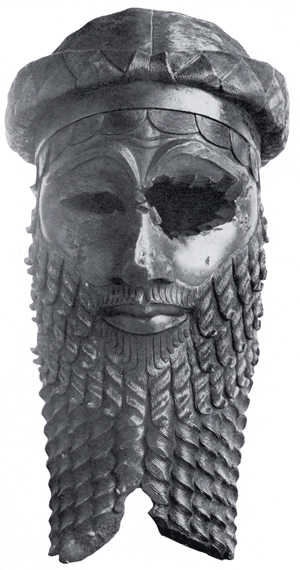
A helmet believed to represent Sargon of Akkad, first great conqueror of Mesopotamia and creator of the first standing army.[17] Sargon of Akkad is believed to have created the first standing army. Such feats required food and weapons to be supplied to the army at all times. He is also credited for introducing the composite bow to Mesopotamia as he defeated his Sumerian adversaries.[18] Later on, his successor Shulgi introduced specialized units; grouping missile units and infantry into different smaller groups.[19] Pre-reform
Before the reforms of Tiglath-Pileser III, the Assyrian army was also very much similar to the other Mesopotamian armies of the time. Soldiers were mostly raised farmers, who had to return to their fields to collect the harvest. Professional soldiers were limited to a few bodyguards that protected the King and or other nobles and officials but these would not have been deployed or wasted in battle unless the situation became urgent, as it later did. Assyrian armies could be very large; Shalmaneser III once boasted a force of 120,000 men in his campaigns against Syria.[2] Such a force required men to be extracted from conquered peoples. A large army also needed more food and supplies and for this the Assyrians organized what they needed for a campaign before they set out. Preparations for a new Campaign Preparations for a new campaign required first and foremost the assembly of troops at a designated base.[2] In Assyria, the designated locations included Nineveh, Kalhu or Khorsabad.[2] On some occasions the designated meeting points would change depending upon the campaign. Governors were instructed to accumulate supplies of corn, oil and war material.[2] Other requirements of the Governors included calling up the needed man power. Vassal states were in particular required to present troops as part of their tribute to the Assyrian King and in good time -- failure to do so, would have almost certainly been seen as an act of rebellion.[2] The arrival of the King and his bodyguard ended the preliminary stage and the army would move on to the target of their campaign. The army would march in good order; in the vanguard came the standard of the Gods, signifying the servitude of the Assyrian Kings to their primary God Assur.[2] Following this was the King, the humble servant of Assur surrounded by his bodyguard with the support of the main chariot divisions and cavalry, the elite of the army. In the rear was the infantry; the Assyrian troops followed by the conquered peoples. Following this would be the siege train, supply wagons and then the camp followers. Such a formation would have been very vulnerable to a rear attack. Some columns of troops could travel 30 miles a day and such speed would have been used to surprise and frighten an opponent into submission.[2] Reforms of Tiglath-Pileser III
Before long, the weaknesses of the Assyrian army soon began to show itself. Battle after battle killed off important soldiers, whilst the seasons ensured that soldiers returned after a short time to their fields without achieving decisive conquests. By the mid-eighth century B.C., the Assyrian levy-army could not cope with the demands of an empire that often stretched from the Mediterranean Sea to the Persian Gulf.[20] All was to change when Tiglath Pileser III came to the throne in 745 B.C. After increasing the efficiency of the Assyrian administration,[11] he went on to change the Assyrian army as well.[20] The most important aspect of his reform was the introduction of a standing army. This included a larger number of foreign soldiers but mixed in with other Assyrian soldiers.[20][16] These men could be supplied by vassal states as tribute or when demanded by the Assyrian King. They were given Assyrian equipment and uniform which made them indistinguishable from one another, possibly to increase their integration.[20] Whilst the infantry in the standing army contained a large number of foreigners (including Aramaeans and even Greeks), the Assyrian Cavalry and Charioteers continued to be dominated by Assyrians.[16] There were exceptions however, and as casualties mounted additional troops would not be unwelcome; Sargon II reports that he managed to incorporate 60 Israelite Chariot teams into his army.[20] Transportation and Communication Assyrians using inflated sheep skins to transport Chariots across the Euphrates (or Tigris).[21]With the rise of the Assyrian Empire, new demands were placed on transport and communication. Governing such a vast Empire required the attention of the Assyrian king and his administrators. Prior to the Neo-Assyrian Empire, roads in Mesopotamia were little more than well-trodden pathways used by the locals -- over time a clear path could be made out.[22] However, this was inadequate for an empire whose armies were constantly on the move, repressing one revolt after another. The Assyrians were the first to institute, control and maintain a system of roads throughout their empire.[22] Pony expresses with regular way stations for messengers to rest and/or exchange horses were established.[22] Later, these would form the basis for the Persians to expand this system to their own empire.[22] Rugged mountains were cut through thus greatly decreasing travel time. Engineers built fine stone pavements leading up to the grand cities of Assur and Nineveh, so as to impress foreigners with the wealth of Assyria. By the 2nd millennium B.C., wooden bridges were built across the Euphrates. By the 1st millennium B.C., Nineveh and Assur were blessed with bridges of stone,[22] testament to the wealth of the kingdom of Ashur. The construction of roads and increased transport meant that goods would flow through the empire with greater ease, thus feeding the Assyrian war effort further. Of course, roads that sped up Assyrian troops would not discriminate and would also speed up enemy troops as well. Use of Camels The Assyrians were the first to use Camels as beasts of burden for their military campaigns.[23] Camels were of greater use than Donkeys because they can carry five times the load and yet require less watering. Camels were not domesticated until shortly before 1000 B.C., on the eve of the Neo-Assyrian Empire.[23] Wheeled Vehicles Although the Sumerians are credited for inventing the wheel sometime before 3000 B.C.,[23] the Assyrians were the first to manufacture tires of metal, made from copper, bronze and later iron.[23] Metal-covered wheels have the obvious advantage of being more durable and when overrunning an opponent in battle, will have a greater effect. Weapons Chariots
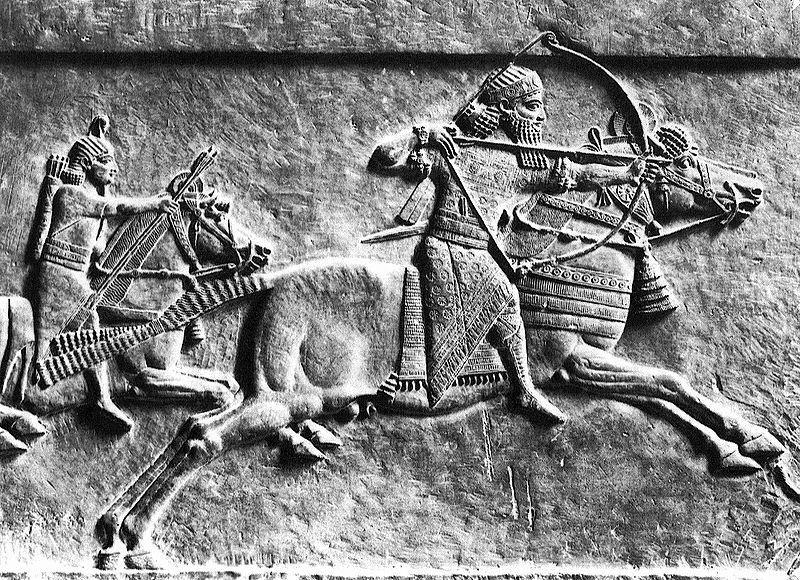
Assyrian king Ashurbanipal on a chariot during a royal lion hunt, during which only the King was permitted to kill lions, and only his chariot was permitted a parasol. The core of the Assyrian army lay in her chariots.[24] Originally these chariots were used as two-horse vehicles.[24] The Ancient Egyptians and Sumerians used War Chariots in this fashion as firing mobile platforms or as mobile command platforms; the elevated view would give the General some ability to see how the troops fared in battle. The Assyrians also used Chariots in reconnaissance,[24] carrying messages to and from the frontlines as well as for battle. However, the rise of Cavalry in the 1st Millennia B.C. meant that by the 7th Century B.C., the Chariot was demoted to combat duties only;[24] lighter chariots consisting of two to three horses were later upgraded under the reign of Ashurnasirpal II to heavy four horse chariots.[24] Such chariots could contain more men (four in total). Heavier Chariots also found new roles; smashing into enemy formations and dispersing the infantry in the process.[24] The Assyrian Cavalry and Infantry would then be able to exploit the gap and rout the enemy thereby taking the field. Cavalry Cavalry were rarely used by the Assyrians or many other Mesopotamians until the 9th century B.C. when their use is mentioned during the reign of Tukulti-Ninurta II.[24] Before then, many nomads or steppe warriors relied on cavalry, who raided Assyrian lands. The Assyrians had to counter this mobile form of warfare and so beat their opponents (notably the Iranians) at their own game.[25] Perhaps the greatest outside influence is that of the Iranian peoples, the Elamites and the Medes. It is ironic that the raiding by these people assisted Assyrian attempts in building a Cavalry army with which to destroy the Kingdom of Elam. However, Assyrian attempts were not without difficulties; horse archers were utilized but could not use their bows and the reins of their horses at the same time. As a result, Cavalry under Ashurnasirpal are depicted in pairs, with one rider holding both reins and the other shooting with a bow.[24]
An Assyrian Cavalry Archer, most likely a King; the robes and the perfect handling of his horse testify to his supreme position. The Assyrians would experience fewer problems with Cavalry when they were deployed as Lancers; under Tiglath Pileser III, the Assyrian Cavalry continued to be paired off but this time each warrior holds his own lance and controls their own horse.[24] By the 7th century B.C., mounted Assyrian warriors were well armed with a bow and a lance,[24] armored with lamellar armor and their mounts equipped with fabric armor, providing limited yet useful protection in close combat and against missiles. Cavalry would form the core of the later Assyrian armies. Large units of Cavalry were required to be deployed by the Assyrians; some units would consist of hundreds or even a thousand horsemen. There is little doubt that without a continuous supply of horses, the Assyrian War machine would have collapsed. As the Empire suffered horrendous casualties under Ashurbanipal's campaigns of conquest, the rebellions following his death may have contributed significantly to the downfall of the Empire as fewer vassals were available to pay tribute horses and other war material needed. Horses were an incredibly important war resource and the Assyrian King himself took a personal interest to oversee adequate horse supply. Three main sources of horses were:
Horses would be drawn from outlying provinces and brought in to be trained with new recruits for war.[25] Infantry
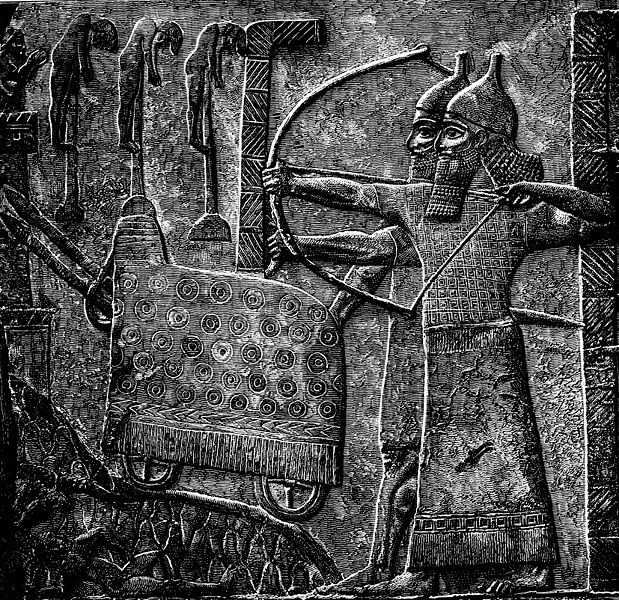
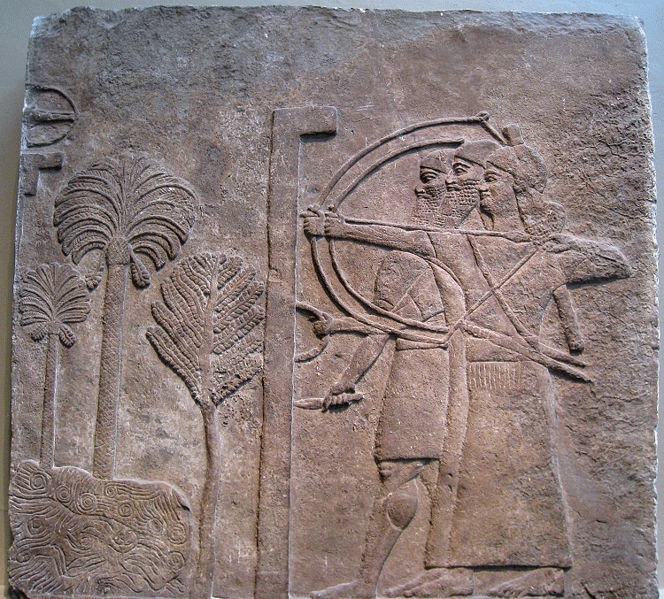
Assyrian archers taking aim, under the protection of a shield bearer. Whilst Cavalry provided the most expensive and effective arm of the Assyrian Empire, Infantry are cheaper and more numerous. In the right circumstances, they were also more effective, for example in siege warfare whereby the mobility provided by Horsemen would be of no advantage in such encounters. Assyrian Infantry were composed of both native Assyrians and foreigners employed as auxiliaries, spearmen, slingers, shield bearers or archers. The latter type was the most dominant in Assyrian armies.[25] From the time of Ashurnasirpal, archers would be accompanied by a shield bearer whilst slingers would aim to distract the enemy into lowering their shield to protect against the stones, thereby allowing the archers to shoot above their shield walls and slay their enemies.[26] Even in siege warfare, arrows were used to drive back defenders from the wall whilst engineers advanced against the fortifications. Many different types of bows are recorded by the Assyrians, including Akkadian, Cimmerian and their own "Assyrian" type.[26] However, it is most likely that these were simply different variants of the powerful composite bow. Depending upon the bow, an archer would have a range of anything between 250 to 650 meters.[26] Vast amounts of arrows could be expended in battle so in preparation for war many arrows would be made. Facilities also existed that would travel with the army's supply train that could manufacture more arrows.[26] An Assyrian army without arrows was an army without the main capability to win. Lancers were introduced to the infantry under Tiglath-pileser III.[26] The idea was that a long spear would be able to penetrate and attack the enemy's ranks at longer range than a sword or a dagger could. Armour (lamellar) amongst the melee troops was limited to Elite soldiers only, whilst the rest of the army made do with shields and helmets. Strategy and Tactics Tactics Not much is recorded about Assyrian tactics in battle. However, Assyrian reliefs always depict their troops launching devastating chariot and cavalry charges,[28] smashing the enemy lines and allowing their foot soldiers to exploit the divided enemy. It is likely that the chariots would head in first. A preliminary barrage of arrows would soften up the enemy for a chariot attack. To keep up the momentum, cavalry would follow up. Lagging behind would be the infantry whose job was to destroy the now scattered enemy. Despite the extensive use of missile weapons, the Assyrians still preferred a bloody frontal assault as Sennacherib describes his pyrrhic victory (in which he claims total victory):
Assyrian frontal offensives were designed to shock the enemy and surprise them. However, they were also a strategy employed when time was not on their side:
Despite the above, Sargon II's instinct saved the day; leading his exhausted troops, he launched a surprise attack against his Urartian opponents who broke at the speed and surprise of the attack. So vicious was the battle that the Urartian King abandoned his state officials, governors, 230 members of the Royal family, many cavalry and infantry and even the capital itself was abandoned. Overall war strategy
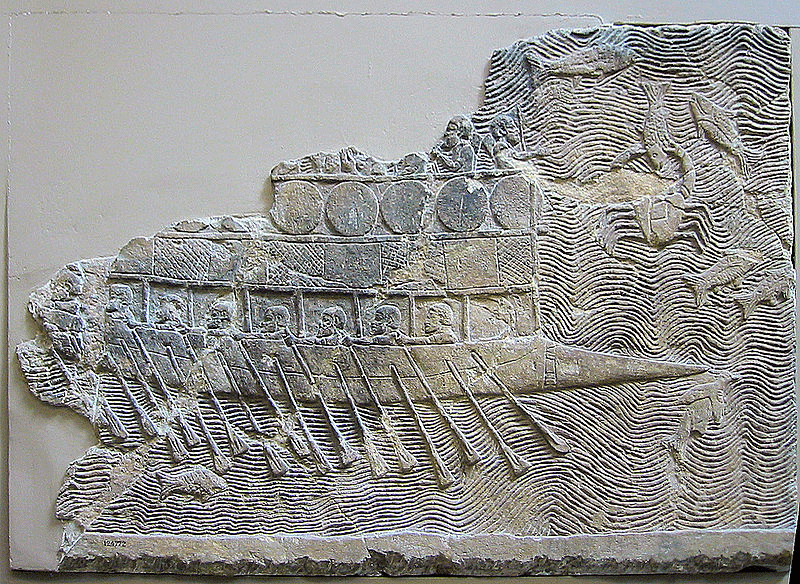
Assyrian warships. The Assyrians would have used these to transport horses, chariots and supplies across rivers. Although they reached the Mediterranean on numerous occasions[31], problems (in the shape of rebellions) in the Fertile Crescent would have made such sea ventures into the Mediterranean unlikely. The nature of Mesopotamia, plain and fertile with few natural defenses, meant that defensive operations were out of the question; only a decisive attack could defend such vulnerable yet valuable locations. The cities of Assur and Nineveh were both "sandwiched" between rivers, Nineveh being more so enclosed and protected by the Tigris whilst Assur, whilst being close to the Tigris, was a fair distance away from the Euphrates. The result was that both cities had a measure of natural protection. However, rivers would not stop a determined army so attacking and destroying the enemies' ability to wage war was the best method of ensuring survival. To this end the Assyrians sought a decisive encounter that would destroy the enemies' army. Colonization: The Assyrians, in conjunction with their deportation (see below) would also send some of their own into foreign lands and settle them as colonists. The primary aim was to establish a loyal power base; taxes, food and troops could be raised here as reliably as at their homeland, or at least it must have been hoped. Furthermore, their presence would bring innumerable benefits; resistance to other conquerors, a counter to any rebellions by the natives and assist the provincial Assyrian governors in ensuring that the vassal state was loyal to Assyria. Total Destruction: One must be careful before assuming that the Assyrians utilized Total War. However, it is known that the Assyrians, as part of their overall strategy of weakening their opponents and of exacting revenge would violently destroy what they could not take back or could not consolidate.:
This "strategy" is not dissimilar to genocide, and the Assyrians are often cited among the first offenders of genocide. Psychological warfare The Assyrians fully appreciated the use of terrorizing their enemies. To conserve manpower and rapidly move on to solve Assyria's multiple problems, the Assyrians preferred to accept the surrender of their opponents or else destroy their ability to resist a surrender. This in part explains their offensive strategy and tactics. Deportations It is not known if the Assyrians were the first to deport people, although since none before had ruled the Fertile Crescent as they did it is likely that they were the first to practice it on a large scale. The Assyrians began to utilize mass-deportation as a punishment for rebellions since the 13th century B.C.[32] The purposes of deportation included, but were not limited to:
By the 9th century B.C. the Assyrians made it a habit of regularly deporting thousands of restless subjects to other lands.[33] Re-settling these people in the Assyrian homeland would have undermined the powerbase of the Assyrian Empire if they would rebel again as a result, Assyrian deportation involved removing one enemy population and settling them into another. Below is a list of deportations carried out by Assyrian Kings:[31]
Tiglath Pileser III re-introduced deportation on a grand scale, deporting tens, even hundreds of thousands of people. Deportations were also coupled with Colonization, see above for more details. Dealing with Rebels When rebellion inevitably broke out in the Assyrian Empire, the Assyrian Kings would often brutally crush the rebellion (as an alternative to deportation) and inflict great punishments on her rebellious vassals. Ashurnasirpal II ensured that the rebellions he suffered would be crushed with the same ruthlessness so that his opponents would never wish to do so again; in this way he was utilizing psychological warfare:
Ashurnasirpal II paints a descriptive picture when he later describes how he dealt with the rebels; they were flayed, impaled, beheaded (first if they were lucky), burnt alive, eyes ripped out, fingers, noses and ears cut off. Ashurnasirpal II's brutal treatment succeeded in pacifying the rebels. As he campaigned into Syria, he was able to take a large body of soldiers out of Mesopotamia without fear of a rebellion cutting his supply lines. So successful were his brutal sieges of the cities of northern Syria that many other smaller settlements immediately surrendered to his army as it marched south parallel to the Mediterranean. The Assyrians viewed their Kings as governing with the gods' (or the god Ashur) sanction. To rebel against this most humble servant of Ashur would be to rebel against Ashur himself, something that could only bring divine destruction; hence the glorification of such brutality.[citation needed] Other acts of brutality include: rape, mutilating men until death, placing heads, arms, hands and even lower lips on the conquered city's walls, skulls and noses atop stakes.[32] Alternatively these could also be piled up or even their corpses cut up and fed to the dogs. On some occasions, people were blinded so that as they wandered throughout the land they would speak of Assyrian terrors and demoralize the local population. Siege warfare
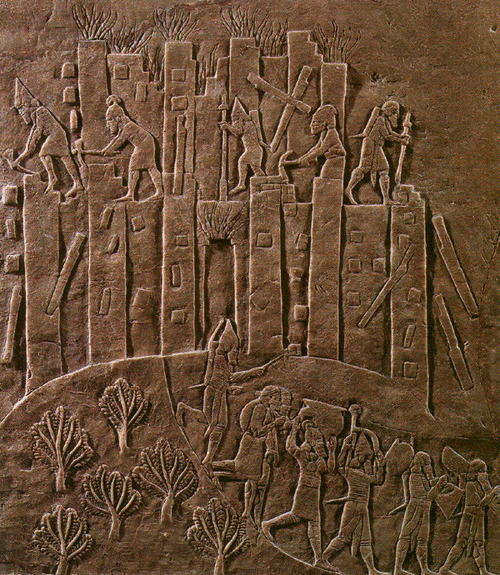
Susa, sacked by the Assyrians. Ashurbanipal's brutal campaign against Susa in 647 BCE is triumphantly recorded in this relief. Here, flames rise from the city as Assyrian soldiers topple it with pickaxes and crowbars and carry off the spoils. In 647 BCE, the Assyrian king Assurbanipal leveled the city during a war in which the people of Susa apparently participated on the other side. A tablet unearthed in 1854 by Austen Henry Layard in Nineveh reveals Ashurbanipal as an "avenger", seeking retribution for the humiliations the Elamites had inflicted on the Mesopotamians over the centuries. Ashurbanipal dictates Assyrian retribution after his successful siege of Susa:
The plains and fertile lands of Mesopotamia were not only ideal for warfare: they actually attracted war. Raiders from all nations coveted the lands of the Assyrians -- Scythians to the north, Syrians, Arameans and Cimmerians to the West, Elamites to the East and Babylonians to the south. In fact, the latter never tired of rebelling against Assyrian rule.[10] As a result, in order to prevent chariots and cavalry from completely overwhelming these settlements, walls were constructed though often from mud or clay since stone was neither cheap, nor readily available. In order to destroy the opponents, these cities had to be taken as well and so the Assyrians soon mastered Siege warfare -- Esarhaddon claims to have taken Memphis, the capital of Egypt in less than a day, demonstrating the ferocity and skill of Assyrian siege tactics at this point in time:
Sieges were costly in terms of manpower and more so if an assault was launched to take the city by force -- the siege of Lachish cost the Assyrians at least 1,500 men[2] --found at a mass grave near Lachish. Before the advent of standing armies, a city's best hope would be that the harvest would force the enemy to return to their fields and therefore abandon the city. However, with the reforms of Tiglath Pileser III Assyria's first standing army was forged and could therefore blockade a city until it surrendered instead. Nonetheless it is known that Assyrians always preferred to take a city by assault then to settle down for a blockade -- the former method would be followed by extermination or deportation of the inhabitants and would therefore frighten the opponents of Assyria into surrendering as well.[17] Siege weapons The Assyrians were not naturals at siege warfare and this can be seen by their attempts to experiment with numerous methods for taking a city. The most common siege weapon and by far the cheapest was the ladder. However, ladders are easy to topple over and so the Assyrians would shower their opponents with arrows to provide cover fire [37]. These archers in turn would be supported by shield bearers[26]. Other ways of undermining the enemies' defences included mining. A 9th century Assyrian relief depicts soldiers using ladders to scale walls, while others use their spears to scrape the mud and clay from the walls. A soldier is also depicted beneath a wall, suggesting that mining was used to undermine the foundations and bring the walls down on their opponents. The Battering ram appears to be one of the best Assyrian contributions to siege warfare. Although looking nothing like the tougher weapons used by the Greeks and Romans many centuries later, they nonetheless served their purpose. They consisted of a tank-like wooden frame on four wheels. There was a small tower on top for archers to provide covering fire as the engine moved forward. When it had reached its destination, its primary weapon, a large spear, was used to batter away and chip pieces of the enemy wall. Whilst this would have been almost useless against stone walls, one must keep in mind that mud and not stone was used to build walls. Even when dried, these mud walls could be attacked with such engines. Walls were strengthened with time and the Assyrians responded by building larger engines with bigger "spears". In time, they closely resembled a large and long log with a metal tip at the end. Even stone would not withstand pounding by a larger weapon. Larger engines accommodated greater numbers of archers. To protect against fire (which was used by both sides at the Siege of Lachish) the battering ram would be covered in wet skins[38]. These could be watered at any time in battle in case they dried.
Siege towers, even
ones that could float were reported to have been in use whenever there
was a wall facing a river.[2] 3rd and 2nd Millennia B.C.
9th Century B.C. Cavalry use first recorded by Tukulti Ninurta II
8th Century B.C.
7th Century B.C.
Collapse of Assyria
_______________ References
Notes 1. Until
final Egyptian aid at Megiddo was beaten
|